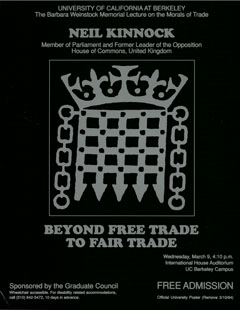
[00:00:00] NEIL KINNOCK:
Shortly after he was elected leader of the British Labor Party in 1983, an interviewer for the Times of London asked our speaker, the Right Honorable Neil Kinnock, to reveal his life’s long-range goals. He replied, quote, “I want to retire at 50. I want to play cricket in the summer, geriatric football in the winter, and sing in the choir.”
I’ve been doing considerable research, but I’ve been able to f– learn how he is doing with the last three of his goals. But I note that in less than three weeks from today, he will celebrate his 52nd birthday, and not only is he still a member of Parliament, a privy counselor, and a member of the British Labor Party’s National Executive Committee, but as we can all testify, he is giving endowed lectures at overseas universities. As you will be reminded when he begins to speak, Mr. Kinnock is a Welshman.
He was born in South Wales. He received undergraduate and graduate degrees from the University College of Wales in Cardiff. He was first elected to Parliament in 1970 as a member for Bedwellty, and since the general election of 1983, has, has been member for the new constituency of Iowan.
I am incidentally not at my best in pronouncing Welsh names, and so I hope you and yours–our speaker will forgive me if I have mangled them. Mr. Kinnock is, of course, best known to Americans as the former leader of the British Labor Party, a position to which he was elected in 1983. From 1983 to 1982, he occupied the official position of the leader of Her Majesty’s Loyal Opposition, a position, incidentally the counterpart of which many American political scientists would like to see established officially in this country rather than letting the media confer it on Bob Dole.
But that aside, in the run-up to the general election of 1992, mo– most analysts on both sides of the Atlantic expected the Labor Party to win a majority of the seats, which would make Neil Kinnock the first Labor Prime Minister since 1979. It didn’t happen, but most observers continued to credit Mr. Kinnock with having brought the Labor Party from the 1940s into the 1990s, and many, including me, expected him to head the party in the next general election, probably in 1996. However, shortly after that election, Mr. Kinnock’s sense of politics, and I think it fair to say honor, led him to resign his leadership so that a new leader could build the party’s case for the next election.
Great Britain and the Labor Party may or may not be the better for Mr. Kinnock’s decision, but in all honesty, it has greatly benefited Americans because it has freed up enough of his time that he can prepare and deliver lectures like this one. On behalf of the University of California, especially the Dean of Berkeley’s Graduate Division, it is an honor to present to you the Right Honorable Neil Kinnock.
(applause)
Can I say how grateful I am for that extremely generous introduction? Indeed, it was so nice I thought for a second I was dead. But one of the great benefits of retiring from the leadership of a political party at a young age is that you get the chance to hear your obituaries.
And that is greatly preferable to the alternative of them being even more glowing when you are incapable of hearing them, so I’m extremely grateful to you. It may be said, of course, that now well past my 50th year and still not settled down to choral singing and playing cricket and geriatric football, the next slide down the chute of life from playing geriatric football is giving endowed lectures in foreign universities. You will have to be the judge of that.
I must say that when I did see the general title of the Weinstock Lectures was The Morals of Trade, I was struck by the oxymoronic nature of the title, but I comforted myself that when H.G. Wells said that military intelligence was a confusion in terms, he wasn’t always correct. So perhaps there are some things to be said about the morals of trade, at least I intend to occupy the next 40 or 45 minutes of your time trying to demonstrate that we need to employ ethical values in the conduct, and the planning, and policy of trade throughout the world in the 1990s and beyond. 80 years ago, as the First World War approached, the British socialist thinker Richard Tawney wrote, “The failure of modern politics to appeal to noble and important emotions and beliefs is easy but inconvenient to explain.
It’s due to the fact that people have tacitly denied that any moral issue is raised by the relationships and the conduct with which politics and economics are largely concerned. Politicians cannot rescue people from the vacuum which such a false philosophy has created, for people cannot lift themselves by holding the soles of their shoes. Action spurred by a moral impulse has to be taken if people are to be enabled to achieve a higher condition of life.”
Now, I don’t know whether Mr. Harris Weinstock, who endowed these lectures on the morals of trade, ever met or had even heard of Richard Tawney. I think I can safely speculate, however, that both understood that if human society is to enjoy the desirable conditions of liberty, prosperity, security, and stability, there has to be an ethical basis for economic endeavor. I take that view too, and for that reason, I’m grateful to this university for providing me with the opportunity to make the case for the world to go beyond free trade to fair trade.
In two months’ time, representatives of most of the countries of the world will gather in Marrakesh for the formal signing of the GATT agreement. Seven and a half tortuous years after their launch in Punta, Punta del Este in Uruguay, the present round of talks will formally be in– at, at an end. Several times during those years, it really did seem that this point might not be reached.
Total deadlock threatened on several occasions. Waiting for GATT began to feel like waiting for Godot. There was a real danger at last 50 years’ framework for international trade might disintegrate under the pressures of bringing new items like textiles and, of course, agriculture, as well as new areas such as services, investment, and patents, and the GATT control.
So looking forward to Marrakesh, there’s reason to be thankful that countries are coming together in agreement at all. As I shall go on to outline, there is still much to be done, very much to be done, to change the content of world trade rules. But the grim prospect of a world in which might is right was the only trade rule has at least been averted, or at least mitigated.
That must not, however, seduce us into settling for second best, nor must we succumb to the enervating ailment sometimes called trade talk fatigue. There’s too much at stake in this divided and dangerous planet for anyone to rest on the rather dried-up laurels of the Uruguay Round. For the last few years, understandably perhaps, much of the thinking about trade policy has been at the level of technical detail.
The burning questions have been how to quantify acceptable levels of agricultural subsidies or how to achieve line-by-line agreement on tariff schedules. The technocrats and the trade negotiators have to necessarily have the field. But this concentration on the detailed issues has rather obscured the question of what trade means to ordinary people’s lives, what it means for their livelihoods, for their access to the goods and services they need, for their quality of life, and out of that, their quality of liberty.
So today, I’d like to measure trade against those considerations. Before anyone becomes preoccupied once again for the next round of horse trading, it’s essential that we stand back and take the long view. After the years of grueling haggling over trade, it’s now important to identify the main elements of a new trade policy agenda, then to ensure that these are incorporated into the new trade structures and into the next round of–
As we set about those tasks, it’s clear that if any moral perspective is to lead to practical policy, it must be informed by an understanding of the key features of the rapidly changing world trade system. Three of those features appear to me to be essential. First, the increasing globalizing of corporate activity and of economies.
Second, the redrawing of the world trade map and the shift to regional trading blocs. And thirdly, the uneven distribution of the fruits of trade. The first and most fundamental of the changing characteristics of the international trade system is the scale and scope of the linkages which today bind the economic fate of the world together.
The globalization of economic activity, of course, is already well-developed. It constitutes a major qualitative shift. Trade has not only grown faster in absolute terms over the last few decades than it ever has before, it’s grown faster than economic output.
That itself, in itself is a clear sign of the internationalization of production. About a fifth of the $20 trillion world output is now traded. Twenty-five years ago, it was an eighth.
The range of what is traded has expanded too. While industrial goods still make up the bulk of the growth in trade, services, now nearly a fifth of total world trade, have expanded very rapidly in recent years. The nature of trade has also changed in important ways.
Traditional arms-length trade between different corporations in different countries is no longer the dominant pattern. More and more, trade is between different parts of the same global corporations or through joint ventures. Half of America’s total trade is estimated to be of this kind, and as much as four-fifths of Britain’s trade.
Asking whether a computer or a car or even a shirt is made in Britain or made in the USA is becoming increasingly meaningless as the production process itself is scattered around the globe. Is a Ford Escort car British because it’s finally assembled in Dagenham, England?
[00:12:42] AUDIENCE MEMBER:
That’s dramatically changed the nature of world trade and of production. As competition between these companies escalates, that production, distribution, and financing are all planned on a global rather than a national or regional basis. These corporations now come for something like a quarter of all production in the world’s market economies.
Of the world’s hundred biggest economic units, half are countries and half are transnational corporations. That in itself is a sobering fact for politicians or any others seeking to try to plan for fairer trade. As the global marketplace has developed, so many issues that have traditionally been controlled by domestic, national, or local policy have become trade issues.
Everything, it seems, these days is trade-related, as the GATT-speak has it, from what films Europeans see on their TV screens to what environmental laws American state governments can pass. In such a setting, the eruption of anti-GATT protests around the globe are only a foretaste of the controversial impact that trade issues are set to have on domestic political realities. In one striking but so far little-noticed example, a group of outraged Indian farmers deep in the Karnataka countryside in southern India went to Bangalore last July and burnt down the office of the local American seed company, the Cargill Corporation.
They were protesting that the GATT deal on seed patents would prevent their access to the seeds that they needed at prices they could afford. Those changes would mean India would have to change its national laws preventing the patenting of seeds, often the product of generations of farmers. And scrapping those laws as required by the GATT will mean higher seed prices for hard-pressed farmers and higher food prices for impoverished consumers.
[00:15:13] NEIL KINNOCK:
If trade now touches so many areas of public policy, should this not mean that the World Trade Body should expand its remit to match those realities? Those questions are made even more pressing by the fact that this global shift is not only about physical trade. Technological change, notably in communications and information, has played a key part.
International investment too has obviously been integral to the strategy of global corporations. Global capital flows now reach a trillion dollars a year, and as exchange controls have disappeared, so global currency transactions have grown to 20 ma– times the value of world trade. Indeed, one of the marked features of the globalization process is the breaking down of the Chinese walls which once separated trade, finance, and investment.
With the growth of the globalized economy has come the second salient feature in the speedily evolving world trade system: the redrawing of the world economic map towards a more multipolar pattern. The main propellant of the world industrial system in the 1950s and ’60s was the booming trade between the developed market economies, led, of course, by the United States of America. This overwhelming dominance became less marked as first the German, and then the Japanese, industrial exports grew prodigiously.
Obviously, this group of countries remains central to the overall state of world trade, still accounting for half of world manufactured trade. However, there’s also a significant shift of world industrial production to Southeast Asia, away from the core of industrialized producers that have dominated trade for the last two centuries. A new triad of economic power, North America, Europe, and Southeast Asia, straddles the globe, accounting for three-quarters of world manufactured exports and over 60% of all industrial production in the world.
The trade between these blocs is still strong, especially in Asia’s trade with the other two blocs, but even here, intraregional trade is growing fast. The formalization of regional trading blocs has also been moving forward, in Europe, obviously, through the single market and the Treaty of Union of the European Communities, here in North America through NAFTA, and in Asia through ASEAN and other fora, though obviously at a less intense level so far. Many of the countries outside those blocs, naturally including some of the poorest and least secure in the world, fear being left out in the cold, and not without some justification, indeed great justification.
Meanwhile, the World Bank and other authorities now identify China as a fourth pole of the future. Together with Hong Kong, its economy continues to show massive and sustained growth and its imports are already two-thirds of those of Japan’s. By one measure, says the World Bank, China could overtake the United States as the world’s largest economy by the early part of the next century, although, of course, its per capita income would still be much lower.
The third feature developing in the altering world trade system is that the benefits of this globalized economy have, to say the very least, been very unevenly spread as they’ve been marked by painful and continuous restructuring. What many regard as the golden age of growth in the 1950s and ’60s was brought to an abrupt end in the early 1970s. In the Western industrialized countries, of course, we have since been mired in slow growth and high unemployment.
In many ways, these latest problems have against highlighted some of the problems of long-term unemployment and the industrial decline that has become marked from the mid-1970s, and has persisted throughout all that time. In an old coal mining area like the one that I represent in Parliament, the problems of long-term unemployment and economic and social decay that come with it never went away in the short-lived boom of the 1980s.
[00:20:14] AUDIENCE MEMBER:
The rise of racist and fascist groups in Europe, West, and East, is deeply worrying evidence of that. Whilst the scale of the problems of the industrialized countries is great, the size of those in many developing countries has been of an altogether different order. Indeed, they are in deep and prolonged crisis.
Given the heavy dependence of many poor countries on exporting raw materials to the industrialized countries, our periods of recession and economic restructuring in the north of the world have been multiplied into a spiral of debt, austerity, and poverty over the last decade, particularly in the south of the world. Even in periods of upturn in the industrialized countries, the world trading system has delivered few benefits to large parts of the south. Commodity prices have persistently declined.
Cocoa, for example, recently touched its lowest-ever real price. And for all the rich world’s table thumping on free trade, they too have kept up high trade barriers. Poor countries have faced severe restrictions on basic industrial exports, such as textile and clothing, into which they’ve sought to diversify.
In the world now, the gap between rich countries and poor countries is still growing wider. Over a billion people in the world live in crushing poverty without enough income to secure the basics of life, including food. There are more than 400,000.
I’m sorry, there are more than 40,000 preventable child deaths a day. Clearly, the failure to reorder and to harness trade to lift people out of poverty, or to give them a fair chance of lifting themselves out of poverty, presents the planet with its most urgent challenge, especially when warfare and environmental degradation are both products and causes of the widening and deepening poverty in the world. These, then, are the primary features of the changing patterns affecting the world, and to inform our attempts to identify policy responses to those new realities, we need to look back at the policy framework within which the world has been operating over the past decades.
The Marrakesh meeting in April will take place just before the 50th anniversary of the international meeting at Bretton Woods in New Hampshire in July 1944. It’s very clear that today’s economic conditions are quite different from those prevailing then, as the Second World War neared its close, but there are nevertheless still parallels between the beginning and the end of this half-century. Then, as now, the world was emerging from a global conflict, even if in today’s case, the war in question was Cold and the Northern Hemisphere at least didn’t suffer millions of dead.
At both times in history, however, economies have been scarred and distorted by the costs and the conduct of the conflict. Now, as then, the world has a mixture of tentative hopes and residual fears resulting from the uncertain legacy of the preceding hostilities. Now, though not as much as then, there is a growing willingness to challenge the existing economic orthodoxies as their shortcomings have become clearer.
Now, though not as much as then, there’s been an upsurge in optimism about the potential for more effective international governance through the United Nations. The Bretton Woods meeting was the product of the experience of prolonged global slump in the 1920s and ’30s, and of the World War of the 1940s. If we’d asked the delegates at that meeting about the fundamental moral and practical questions of trade, the why and the how of world trade, I think they would have answered without hesitation and with complete confidence, and they would have asserted that they were seeking to facilitate an orderly expansion of trade in order to underpin future international security by delivering sustained employment and incomes to ordinary people across the world.
The institutions governing world trade were, they would have said, being set up with those overriding objectives in mind. As United States Treasury Secretary, Henry Morgenthau, said in his opening address, “To the delegates at Bretton Woods, all of us have seen the great economic tragedy of our time. We saw the worldwide depression of the 1930s.
We saw currency disorders develop and spread from land to land, destroying the basis for international trade. In their wake, we saw unemployment and wretchedness, idle tools, wasted wealth. We saw their victims fall prey in places to demagogues and dictators.
We saw bewilderment and bitterness become the breeders of fascism and finally, of world war.” And as another delegate concluded emphatically, “The civilized world must not permit a repetition of this tragic situation.” It was equally axiomatic for the Bretton Woods delegates that the tragedy would not be prevented simply by faith or hope or charity.
It needed international cooperation and international management of the world trading system. Of course, that pragmatic and interventionist approach hasn’t exactly been fashionable over the last decade or so, but the failure, the comprehensive and utter failure of the extreme new liberal hands-off approach to deliver growing fair or stable economies is now being recognized once again.
[00:27:42] NEIL KINNOCK:
The 1944 conference put in place the foundations for the regime of global economic management, which saw more than two decades of unprecedented, sustained economic growth. Amongst the decisions taken, there were, of course, those which created the two pre-eminent international financial institutions. The International Monetary Fund was set up to stem large international currency imbalances and competitive currency devaluations, and the World Bank was established to finance economic development projects in poor countries and to rebuild the war-ravaged economies of Europe.
Al– Although, of course, in practice, the Marshall Plan became the effective mechanism for that. The powers meeting at Bretton Woods, however, also agreed upon the need to establish a third leg to complete the tripod of world economic governance.
It was to be called the International Trade Organization. The detailed organization, Detailed negotiations required to bring the ITO into being were left to be pursued at the Havana Conference on Trade and Employment three years later. It was to prove to be a fateful delay.
The Havana Charter, as drafted, mapped out the shape of an international trade organization, and that draft has relevance for today’s new trade agenda, 50 years later.
[00:30:12] AUDIENCE MEMBER:
Commodity-stabilizing agreements of that sort were a key part of John Maynard Keynes’ original conception of an international trade organization, which he canvassed at Bretton Woods. At a time when the terms multinational and transnational were hardly known in the business context, the charter further specified the need to tackle the restrictive business practices of international companies in order to curtail international monopoly power and to ensure fair competition. In addition, it stressed the need for greater transparency in commercial operations.
The ITO, declared the Havana Charter, was to work closely with the United Nations’ institutions. It was not to be a law unto itself. And while the charter itself was drawn up by a relatively restricted group of countries, it set out a pragmatic form of democratic control at the international level.
Though the 18-member Executive Board would have included the eight countries termed to be of chief economic importance, the General Conference of the ITO would have been on the basis of one country, one vote. In the event, of course, the practical idealism of the Havana Charter was halted by the returning tide of economic nationalism and by the onset of the Cold War. By the time ratification came to the United States Congress, it had become hopeless and it was abandoned without even a vote taking place.
The General Agreement on Tariffs and Trade, originally conceived as a temporary and partial measure in anticipation of the ITO, was much more limited in its scope. It contained very little, if any, of the broader vision of trade management evident in the Havana Charter. The loss of that vision and the proposed organization meant the loss of a sense of moral purpose in trade policy across the world.
The consequences of that have been felt all too keenly by the developing countries. In addition to the failure of the IMF and the World Bank in the 1980s to fulfill their original purposes of countering downturns in economic cycles, there has been no ITO to ameliorate the worst effects of the unmanaged or inadequately managed world trading system. Over the last 50 years, there have been numerous attempts to propose a more permanent and comprehensive trade organization of the kind envisaged by Keynes and set out in the Havana Charter.
None have succeeded, and the GATT has remained the primary and imperfect body relevant to these issues. However, the meeting in Marrakesh next month will lead to the setting up of a new body to take over from the GATT. It’s to be called the World Trade Organization.
That development has been little debated by politicians and opinion formers around the world. As yet, there is no firm indication of whether the World Trade Organization will amount to little more than a GATT by another name or whether it will be the basis for a new institutional approach to world trade. I hope that awareness about the actual and potential role and responsibilities of this new world institution will increase.
Many of the answers to the future direction of world trade policy could hang upon the direction and the mission chosen for the World Trade Organization. Naturally, I consider that the WTO should manifest the combination of common sense and common decency, of enlightened self-interest and justice, which produced the impetus for the last attempt at securing a stable and moral world economic order 50 years ago. Of course, we can’t simply transplant all remedies into new contexts, but in an interdependent and fragile world, we can and we must, in our generation, reinterpret and renew the spirit and the values of Bretton Woods and the Havana Charter in ways that relate to the new realities of today’s global economy.
This would suggest four new ways of approaching that, four benchmarks by which we should measure a successful trading system. First, economic development. How well does it promote genuinely global economic prosperity in all countries?
Clearly, the growth in trade has become one of the most significant engines of global economic growth since 1945. Removing trade barriers has been at the heart of that process, and as a result of this change, a further $200 billion worth a year in economic growth gains have been predicted by the OECD and the World Bank. But we have to go beyond the ambition of growth.
Just like free trade, growth should be a means to an end and not an end in itself. We have to ask what real income and jobs gains it will bring to those who need them, both in the industrialized countries and particularly in the developing nations. This is especially urgent when studies by the United Nations and others are pointing to a phenomenon which they are calling jobless growth.
It’s crucial that patterns of trade are promoted to deliver real gains in the form of new and increasing employment. Without that, sustainable growth, not only in the developing countries, but in the industrial world too, will prove simply to be a mirage, an alteration in the shape of the world’s economy, in which new generations, including the generation represented most strongly here, simply will not be invited to participate. The next measure of success must be equity.
How effectively will the world trade system share out the benefits between and within nations? The OECD World Bank study recognizes that the gains of the Uruguay Round will not be spread evenly. The continent of Africa, for ins– instance, is predicted to be a net loser.
It will be hit by the rising cost of food imports and the likely fall in the prices paid for commodities like tea, coffee, and cocoa, upon which many African economies still heavily rely. And the simple truth is that Africa is already on, or in many cases, below the breadline. The peoples of that continent cannot afford to lose out.
Just as the quality of a society mu– must be judged by how it treats its weakest members, so the world trade system must be judged by what it does to address the needs of the poorest countries. Measured against that criterion, the GATT has failed. But any design for future trade patterns must take account of the need for greater fairness within nations.
Traditionally, this wouldn’t be seen as a question that could be legitimately raised in the context of the international trading system. Trade, trade might play a part in generating wealth, it was argued, but the way in which countries then distributed that wealth was a matter of domestic, political, and economic conditions and priorities, not one for international consideration. If the two could ever be divided in the w– in that way in the past, which is doubtful, then they certainly cannot be divided now in the era of the globalized economy.
And as the nation state is less able to control or to channel the economic forces which determine the lives of its people, so it is more essential to work at regional and increasingly at global level to make policy really effective. Central to determining the distribution of wealth are government rules which do or do not, for example, set minimum wages or health and safety standards, and which do or do not allow independent trade unions. Workers have campaigned and negotiated over decades to secure basic standards, and they’re demanding minimum workers’ conditions in international trade agreements, doing that so that they’re not grossly disadvantaged in international competition.
The problem is where to draw the line so the poorer countries aren’t locked out of prosperity. Workers in industrialized countries are rightly resisting being driven down-market by excessive deregulation. Workers in the Third World, meanwhile, are deeply skeptical of what they see as just a form of politically correct protectionism, unfair trade barriers dressed up in progressive clothes.
On reflection, it’s clear that this is an only old-age-old challenge that has only changed in scale. In all of the developed economies, the workforces went through decades of division as new labor was hired at rates which undercut established employees. National agreements, standards, and laws eventually diminished the problem and its accompanying injustices and inefficiencies.
Now, in our generation, similar conditions must be made international if the world is to avoid grade, great and dangerous enmities. The third benchmark against which the success of the developing trade system must be justified is ecological. Will trade rules promote environmentally sustainable forms of production, or will the absence of rules promote unrestrained environmental exploitation?
Having languished unaddressed in a GATT environment committee that never actually met in seven and a half years, environmental standards have been thrust to the forefront of the trade debate in the last couple of years. Highlighted here in the NAFTA debate, they’re now slowly being taken more seriously by trade negotiators. Once again, in considering the issue, those negotiators must try to steer a course between the rock of anxiety that freer trade will strip away the ability of governments to set tough environmental rules and the hard place of fear in many developing countries that the environmental rules will be a cunning new protectionist device to keep out their products.
The fourth criterion for judging success in the evolving world trade system must result to democracy. To what degree will all the governments of the world have a meaningful say in trading regimes and not just those with economic muscle?
[00:42:51] NEIL KINNOCK:
And in attempting to do that, I want to put forward what I consider to be practical policy options that can make the principles of development, equity, environmental responsibility, and democracy operative in the world trade system. First, I stress the continuing need for a multilateral trade body to set rules to which all are subject with an effective system of enforcement and arbitration. There is clearly a need for a World Trade Organization that carries authority.
Second, the world trade organization must not be allowed, as GATT did, to see the trade agenda only as a question of opening up markets to the exclusion of all else. The employment and income-generating impact of trade, labor standards, and environmental issues must all be addressed by the new organization. I don’t argue that the WTO’s competence should be extended to cover these areas.
That would be overburdening and probably destroying the organization. Instead, it should be obliged to work much more closely with the United Nations and other bodies that already deal with these issues, but which have been ignored by the GATT. Proposed trade rules could be scrutinized by liaison committees which have effective sanctions on matters relating to the environment, to labor conditions, particularly with the input of the International Labor Organization, and to the needs of developing countries, perhaps by linking with UNCTAD.
Third, as a matter of policy, central policy, the World Trade Organization must seriously address the trade needs of developing countries, especially the poorest. A full review of policy in this area should be initiated in order to produce practical proposals for the new WTO to work on. One critical issue that must be addressed relates to the methods of stabilizing commodity prices.
That might include a more positive and direct role for the WTO in seeking to revive and restructure commodity agreements where appropriate, and the organization should also recognize the continuing role for some form of trade preference scheme, especially for the very poorest countries. A strengthened and tiered scheme might also be part of a more orderly system whereby countries can go through a phased graduation out of the benefits of the arrangements as they reach given levels of economic development. It means restructuring to advance instead of restructuring to lower levels of prices, incomes, and living standards, which has been the habit of the IMF and the World Bank over the last dozen years.
Fourth, the idea of making a social charter an integral part of global trade rules should be pursued. Trade should be serving to uphold basic labor and human rights, not undermining them. However, and I fear that this isn’t being stressed enough in the proposals so far discussed, this n– mustn’t be a means of backdoor protectionism against the South of the world, dressed up in moral clothes.
It’s a possibility that many in the South fear, and not without good cause. Progress on this issue can be made, but it has to be negotiated in genuine dialogue with the workers and governments of poor countries. Action has to be mutual, not applied unilaterally by the relatively powerful against the absolutely weak.
And fifth, the World Trade Organization must bring the full weight of the international community to bear on the issues raised by the growth in influence of the transnational corporations. This mustn’t take the form of knee-jerk opera– opposition. That would be unrealistic and counterproductive.
But it must recognize the real dangers of restrictive business practices at global level, which work against the interests of employers, consumers, taxpayers, and national governments. Sixth, the WTO must be much more democratically based so that whilst maintaining structures that allow it not to be bogged down in bureaucracy, it really is a forum for productive debate between rich and poor countries. And seventh, and crucially, the creation of the World Trade Organization must be accompanied by a reaffirmation of the original purposes of the International Monetary Fund and the World Bank as instruments for counter-cyclical action and development promotion.
That reassertion of purposes must obviously take full account of changed and changing economic realities in the world, including the huge effects resulting from the tendency of transnational corporations to undertake new investment more according to the quality of labor and infrastructure than to the quantity and cheapness of labor. The World Trade Organization has yet formally to be established and the agenda for the next round of trade talks is still only in draft form so now is the chance to influence the future and put a meas– measure of ethics into the policy agenda. If we miss the chance, the blind growth, the blind pursuit of growth at any cost, measured purely in material wealth, will drive roughshod over all else.
That will leave a trail of destruction across many parts of the world, and it’ll generate insecurity and danger for the whole world. The warning lights should already be flashing. Poverty is a cause and result of mass migration, epidemic disease, and pandemic violence, all of which originate, in many cases, in poverty.
A fascist demagogue has just collected 25% of the parliamentary vote in impoverished and alienated Russia. Just days ago, he demonstrated his ability to threaten infant democracy, and consequently, to reduce the security of a whole continent. Closer to you, it was no coincidence that Mexican peasants began an insurrection as NAFTA opened its doors.
[00:50:12] AUDIENCE MEMBER:
The chance of doing that now exists, and the need to do it is certainly pressing. The alternative to doing it is to go on restricting the potential for greater economic vitality in all nations and all parts of the world, and by doing so, guaranteeing instability and insecurity that affects the whole of the world. In the rich countries, we can help ourselves by helping the poor.
In Richard Tawney’s words, “We can help them to achieve a higher condition of life.” Or alternatively, we can go on telling the barefoot of the world to pull themselves up by their own nonexistent bootstraps. That’s the choice.
And in a world where poverty, disease, and violence are more easily and quickly communicated than ever before in history, self-preservation as well as sympathy, material advantage as well as morality, compels cooperation for a fairer system in order to gain a freer world. I thank you for listening.
(applause)
You might as well recognize the person first. Okay, yeah.
(applause)
Mr. Kiddo has kindly agreed to take some questions, and I have kindly agreed that he will recognize the person to ask the question, and not me. Okay, that’s called labor-saving. Okay. Could we have the first question, or comment, possibly?
[00:52:36] NEIL KINNOCK:
[00:52:38] AUDIENCE MEMBER:
[00:52:51] NEIL KINNOCK:
First of all, poor people make lousy customers, and if they want to look forward to secure a future, it’s no good having a world in which only about one-third of the population are capable, really, of being consumers, and two-thirds live on or so far below the breadline as to be unable to consume. A lot of the corporations are beginning to understand what I call a new form of Fordism. If you remember, Henry Ford was not only the man who really developed the assembly line for production, he also had the sense to see that if his enterprise was going to be successful, he had to provide his workers with the means of buying his products.
He therefore paid the highest hourly rate in the whole world at the time, and he also virtually invented hire purchase in order that people could get his cars. There are multinational corporations now that recognize that kind of economic empowerment is basic to their future continued expansion. And so there is a disposition, I won’t say that it’s a crusading zeal at the moment to take them in the direction of showing greater responsibility in their decisions.
The second consideration in the minds of some in global corporations relates to their ability to develop throughout the world. What’s been apparent over the last 10 or 15 years, really, is that original presumptions about comparative advantage were mistaken.
[00:54:59] AUDIENCE MEMBER:
And there are some who are showing a disposition to do that. Now, it isn’t an act of mercy, it’s obviously an attitude prompted by material gain but at the same time, I think it can take them in that direction increasingly. But one of the ingredients that is essential for fostering that attitude in the transnational corporation is missing, and the most important ingredient that’s missing is that of political leadership and of consensus amongst the world powers that there should be a new form of effective management and guidance for the world trading system.
That’s why I put the emphasis on that in what I had to say earlier. The transnational corporations cannot be permitted in the interests of the world and in a great degree in their own interest to be laws unto themselves. And it’s necessary, therefore, for us to replicate the efforts of the powers of the 1940s in trying to introduce a greater and stronger idea of world trade management.
I think that there are multinational corporations that given that lead and an opportunity to participate in the form of partnership with decision-making would welcome that. They would rather have a situation in which they had a chance, for instance, to influence the establishment of global environmental rules and international conventions than one in which the governments of the world eventually became so afraid of the consequences of environmental exploitation that they had to impose those rules in any case. So whilst there are movements for the reasons that I suggested in the right direction by some multinational corporations willing to embrace the ingredients for fair trading regime, the key that’s required or the engine, perhaps is a better analogy, that is required to drive them faster in that direction is consensus amongst the governments of the world, particularly the democratic governments.
Particularly the democratic governments in the industrialized countries that have to serve the interests of the whole world, including their own countries by ensuring that these great private global economic powers conform to the general requirements of a world that can live in relative economic and political security. Next question. Yes, one down the front here.
[00:58:49] STUDENT:
Because I remember once there was a company in France they moved to Scotland because in Scotland–
[00:59:26] AUDIENCE MEMBER:
[00:59:27] STUDENT:
[00:59:27] AUDIENCE MEMBER:
[00:59:28] STUDENT:
[00:59:32] AUDIENCE MEMBER:
[00:59:33] STUDENT:
[00:59:44] AUDIENCE MEMBER:
[00:59:44] STUDENT:
[00:59:56] AUDIENCE MEMBER:
(audience laughing)
Right.
[01:00:00] NEIL KINNOCK:
So, if I can deal with the three things. First, well, the good news is that to a great extent the Social Democrats in Germany, the British Labor Party, and indeed all of the Democratic Socialists and Social Democratic Parties of Western Europe, in the European Community and in the applicant countries have united. And we are now, all of us, members of an organization called the Party of European Socialists.
That was inaugurated last year. Now, it doesn’t mean that we have an absolutely common identity. But it does mean, for exin– for instance, for instance, that in all 12 countries of the European Community, when we fight the European Parliament elections in June of this year, we will all fight on a common manifesto.
We will all use the same slogans, all the same symbols, and pursue the same policies. So there is a much greater degree of homogeneity in the political approach between the labor movements in Western Europe than there’s ever been before. And naturally, we’re building on that together with the Swedes, the Finns, the Norwegians, and the Austrians.
And there are Eastern European Social Democratic Parties that have observer status and are near participants in the Party of European Socialists. So, that’s a development that is taking place. Now, our common interests haven’t been asserted, to use the word that this gentleman used, aggressively.
But I suppose that it’s very difficult to be an aggressive infant. When we move towards puberty, perhaps, we’ll be pardon the phrase, more thrusting. And, and I look forward to a truncated youth, so that we can quickly get on to being able to shave and do other things.
Because it’s certainly necessary that the common interests are effectively asserted. But the way in which we’ve chosen to do it, both in our individual parties and more broadly between the parties, is through an effort to develop a con– consensual relationship with employers in the countries of Western Europe. The reason we do that is not as a consequence of any lack of radicalism or any desire to rapidly increase living standards.
But it is because when we look at the instances of successful operation in the post-war Western European economy they all have in common a consensual partnership approach between labor and capital. There’s no doubt at all about it. And we also face the fact that our continent has just gone through, indeed is still in some respects, going through this idiocy of deregulation at any cost, of the withdrawal of democratic government from basic decisions about the nature and quality of economic policy, and that the effect of doing all that, far from releasing great new energies in the Western European economy, has resulted in 20 million people unemployed, the loss of opportunities, especially for young people, the increase in poverty.
And a return, therefore, to consensual approaches and joint determination and the evolvem– involvement of democratic governments is necessary. Now, we don’t think that we can win consent for that approach by taking an appro– taking a view and striking a pose that is too radical. And we therefore prefer, and say it very publicly, there’s no secret about it, to take a more pragmatic and gradualist approach, with the hope of getting the result of joint employer-employee participation and cooperation than to take the risk on the bolder and more entertaining strategy which might founder on the suspicion of employers.
So those things we are doing. Just one, if you like, indirect comment. Because we’ve now got a single market in the 12 countries of the European Community and because there is, by law as well by practice, a freedom of movement of capital and labor in that single market, there are swings and roundabouts.
There are gains and losses within that market. Yes, Scotland gained a substantial Hoover plant to the loss of France, but France has gained the whole of our transputer industry. The company developed in Britain with state funding under the last Labor Government, has by a mixture of mischief and neglect under Conservative Governments dwindled, so it was taken over by Thomson, the French concern, which coincidentally happens to be a nationalized organization.
So we get into this position that in a, as an act of dogma, a Conservative Government shutdown a publicly owned advanced science, advanced technology company and sold it off to another nationalized corporation in a neighboring European country. So the flows move both ways. The examples are to be seen in the inward flow of Japanese investment.
There has been an era in which Japanese investment has been attracted to Britain because of relatively low labor costs. In most recent decisions, Japanese transnational corporations have not been developing so much in Britain. They’ve been developing in Germany where they can gain immediate access to more highly qualified and highly skilled labor forces that they need for their decision-making operations in the course of their production.
So there is a swirling around taking place and that’s another reason why we find it necessary to try to secure employer cooperation for the purposes of establishing basic ground rules and safeguarding conditions of work, care, and opportunity. That’s the approach that we are taking. Now, we actually think that it can be globalized, and globalized partly because of the menace that is posed by continuing poverty and partly because of the vested interest that all commercial corporations have got in being able to guarantee a similarity of conditions for production and trading just about anywhere in the world.
And that’s why I referred to the history of the development of labor movements. What has really changed, to repeat myself, is scale. The world economy now is in many respects only as big in objective terms as say the British economy was to the individual producer or the individual employer 250 years ago.
Distances in time were just as great in what is now a national economy as they are in a global economy. And if we can adapt the best of the practices that produced solidarity, negotiation, and the advance of working and living standards to modern conditions, I think that we can secure successes for working people and communities throughout the world. I’m confident that we can do it.
Right at the back.
[01:08:30] AUDIENCE MEMBER:
[01:08:47] NEIL KINNOCK:
I don’t know exactly what point is now being proved in the administration and in the United States Congress but it’s about time that those outdated attitudes towards Cuba were dropped. I deeply regret the fact, as someone who works for the development and expansion of human rights throughout the world, that Cuba’s human rights record even now leaves a very great deal to be desired. I think that those human rights standards are more likely to improve in the benevolent setting of a different trade regime than in any other circumstances.
The other consideration is this, that delicate feelings about the nature of government and the records on human rights don’t appear to impinge in many other cases on the conscience of the United Kingdom or, come to that, the United States governments. I put it very delicately.
(audience laughs)
Gentleman back there.
[01:10:56] AUDIENCE MEMBER:
[01:11:07] NEIL KINNOCK:
If they give real consent and they’re willing properly to participate in the World Trade Organization, it is much easier to deal with those trading blocs, specifically the European community, NAFTA and ASEAN, for instance, than it would be to have to deal with the 12 countries of the community, plus the Nordic countries, then Japan and the other constituent countries. Then separately, the North American countries. So again, it’s a question of political leadership.
If the parliaments and more particularly the government leaders of the countries of the trading blocs will a future for those blocs as a very coherent way of developing fairer patterns and practices in world trade. Then that development will come very quickly, and it’ll be a very cogent operation. If for any reason they want to restrain it, then of course the whole world will lose out.
Now I can’t see any rational why they would want to sustain it, but politics isn’t always about rationality any more than economics is. It’s therefore important that the citizenry of all of these democracies, and most of them are democracies in each of the trading blocs, really do understand not only that there’s a moral impulse to try and gain reform and improvement in the world trading system, but that very literally their economic opportunities and standards of living, and certainly their children’s standards of living and chances of getting decent jobs depend very much now as never before on the way in which we can secure cooperation, advance and fairness in the world trading system. And that’s what I meant when I suggested in the course of what I had to say, that it’s important that people now come to consider what happens to the world trading system as fundamental to their daily lives.
It really is bread and bu– butter politics and not an esoteric ma- matter of a lot of men in gray suits meeting in Marrakesh next month. It really is to do with next week’s jobs, the level of taxes the kind of pay that can be earned, and the range of goods that can be bought. And if that’s understood, I believe that the leaderships of the democracies particularly will come to understand that they should use these instruments that they’ve established to generate trade between themselves and to give themselves a measure of trade and protection.
They can use those institutions for the development of an edifice of world trade that makes things better the whole world over. Yes, gentleman here.
[01:14:44] AUDIENCE MEMBER:
Is it your opinion that this is still a factor in international political considerations, British and American?
[01:15:26] NEIL KINNOCK:
But we’re not gonna get into that situation. What we do need, however, is incomes that people are able to earn and willing to spend in order to generate the future prosperity of world trade to make our world go round. And that is the basic understanding that they’ve gotta have.
Now in the wake of Cold War, that excuse for forms of economic linkage and crypto imperialism that used to dictate that the leading economies wouldn’t offer guaranteed prices for basic raw materials and agricultural products, that excuse is gone now, and we’ve got nothing other than benefit to get from changing the arrangements. Perhaps I can, from another paper that I did a couple of months ago, show just what a difference it would make if the Western countries, the industrialized democracies were to adopt a different attitude towards the trading position of the countries, the Windward Islands that produce bananas, or, or the African countries that rely, and Latin American countries that rely heavily on coffee and cocoa crops and so on.
[01:17:35] AUDIENCE MEMBER:
If we transferred $100 billion a year to countries with per capita income of less than $2,000 a year, that would, in five years, increase demand for industrial countries’ exports by over 30%. The return on spending the equivalent of one month’s arms expenditure, $100 billion, the return for distributing that to the poor and middle income countries in the world would be to increase demand for finished manufactured goods in the world by 30%. People say to me, “We are faced with an awful structural problem of unemployment.
What the hell are we gonna do about it?” And I say to them, “Well, the first thing is we can enable people who now can’t buy things to buy things.” And we should be able to, able them to do that because unemployment in the Western democracies isn’t free.
If we’re going to sustain great pools of unemployment, which we do, we pay for it at massive cost. We run up terrific federal or public sector borrowing requirements. It’s better to translate that into expenditure in the south of the world in order to generate jobs in the north of the world.
And that’s just one of the segments. There are a couple of other suggestions that I have, but that’s one of the ways of ensuring that we diminish the massive cost, social and economic, of sustaining unemployment and at the same time relieve poverty on a huge scale and provide the people of the South with a means of gaining their own incomes. That’s why the ideas expressed by Mr. Simon and still adhered to what, 30 years later?
No, 35, 30, 40 years later are so anachronistic, and why they’ve got to be dislodged from the attitudes of governments in the 1990s. They are self-inflicted wounds, and in the course of hitting ourselves on the head, we are wiping out masses of other people as well who are guiltless. Somebody from over this side.
We haven’t, I don’t think we’ve had a woman asking a question. Have we?
(unintelligible)
Here we are, yes.
(unintelligible)
Could you stand up, please? If you protect the price of commodities, let’s say in African countries, and they’re gonna get a higher price for it, how can we ensure that the undemocratic or the militaristic governments will give that money back to the people? How will it increase employment or better wage conditions?
There are two ways of doing it. One is to use the same conditionality that we employ in other respects in our relationships with those governments and to police their activities, if you like, in terms of the continual monitoring of the way in which the income from the guaranteed commodity prices is spent or aid flows are spent. This is done in several respects.
It’s not done as well or as perfectly as I’d like it. And you may know of this absolute scandal we’ve got exposed in Britain at the present time. But I mean, it’s so stupid that it’s now actually becoming a great source of humor.
But it’s nevertheless possible to sustain linkages which make it realistic for us to see after the money has been earned what it’s being spent on. Second way, and frankly, it’s the way that I prefer, is to develop the relationship on commodity prices, not so much with the governments, but with the producers.
[01:22:35] NEIL KINNOCK:
So there are all kinds of ways, relationships with the producers themselves, better monitoring of the governments who might be recipients, and then, if you like, a league table of trustworthiness that we could afford to rely on as a way of guaranteed prices. I realize, of course, that there is a kind of neocolonialism about that third attitude, and I deeply regret it. But there are many people colleagues, friends, acquaintances, that come from the South who say, either because their association with non-governmental organizations, or because they’re in political oppositions, or sometimes associated with governments, “Look, even if we’ve got to have a more demanding regime for demonstrating what money goes on, whether we’re earning it or whether it comes in the form of development aid, even if we’ve gotta have that, let’s have it because we’ve got to be able to combat the continuing downward spiral of poverty that engulfing our country.”
They don’t say it as supplicants. They say it as very practical people who themselves have got nothing to hide and want to work in partnership with the rest of the world. The important thing is, of course, that in their interest as well as in our own we should really start to develop those systems of guaranteed pricing because what we’re doing now is a mockery of any idea of fairness or even of efficiency in economics.
I mean, the, the situation that we’re in Ghana, two years ago in Ghana, the farmers left half of the cocoa crop on the trees. It wasn’t even worth cutting because they would get absolutely nothing for it.
[01:25:01] AUDIENCE MEMBER:
And what you’ve then got is a line drawn across a whole generation, and that’s what’s happening and will happen unless and until we change our policies on what we’re prepared to pay for the basic raw materials and foodstuffs that give us our standard of living. Right at the back. Do you have an idea of a vision of how an engine, which could pull the African countries to below could look like, and which, which could mobilize these really amazing resources that–
Well, Africa presents a fantastic challenge because of history, because of division. Uh, there is a potential, of course, that South Africa could become an engine of development, but there are such monstrous problems in South Africa, developed as a consequence mainly of the apartheid regime and the way in which it distorted the economy in the course of inflicting horrific injustice on people that I don’t think we can rely upon South Africa as people 15, 20 years hoped would be possible in the event of democracy coming to the Republic. So I think that the, the second thing is that even where there are economic area agreements, like the Southern Africa Development Council between the Frontline States and one, or two others that will embrace South Africa sometime this year or possibly next year, that, by definition, really is a trading arrangement removing tariff barriers between pretty poor countries producing more or less the same things.
So that’s not going to be an engine. Uh, and north of the Sahara, of course, even the agreement that exists there is not of particular relevance to the majority of countries in Africa. So I believe that the only way to deal with Africa is not by hoping that from somewhere there will come an external, sorry, an internal source of energy, but by developing world strategies that have a particular application for the continent.
And it does mean that we have to make infrastructural investment because that’s one of the reasons for Africa’s great difficulty in moving beyond a certain point in development. There has to be a great concentration on improving health, because one of the terrible afflictions of central and north central Africa, certainly from Uganda to Tanzania, is an epidemic of AIDS that is killing scores of thousands of people every year, the like of which doesn’t exist anywhere else in the world. And of course there are other poverty-related diseases that disable whole generations, so there’s got to be a major health initiative in Africa as well.
But the most important thing, of course, is that we provide for people who have damned hard, especially, it has to be said, the women of Africa, the means of earning a living from their production, and that’s where I think the externally arranged and honored commodity price agreements will have a particular impact on that. The extraordinary thing is several of the very best non-governmental organizations point out that even if we did fix commodity prices and pay people on a regular basis for what they produce, it would still mean they’d be in poverty. They’d still be working themselves to death.
There’s no question at all about that because nothing can be done over a short period of time. But at least instead of working themselves to death for nothing, those people would be working themselves to death and getting an income, a basis on which their economies could build. But I fear that it’s going to have to substantially be done from the outside in partnership with specific African states and industries because there is no obvious source of vitality coming from within that greatly exploited and divided continent itself.
It’s a tragedy, but I think that’s the truth of the matter. Yes, gentleman there. How do you see the new world trade order addressing such issues, which are known as non-proliferation and promoting reasonable, reg– regional stability as in the Balkans and the Indian Subcontinent?
Right. Okay. What are you doing for breakfast?
(laughter)
Well, if, all right, if I can give what by definition has to be a partial answer. I think that one of the things that should occur is that we get a redevelopment and recasting of NATO. Uh, not just for the purpose of fulfilling its role that it should fulfill as the agency of the United Nations in respect of former Yugoslavia, but being there as, eh, the monitor and supervisor of stable relationships, not just in Europe, but to use the term that’s employed in NATO, out of theater.
Now, the last thing that I want to do is to see NATO regarded as the final and ultimate world power that can rampage all over the world and do all the other things. The fact of the matter is, that if we’re going to ensure that in the future, in the world, only the bullies are intimidated and only the violent have any need to be afraid, then there’s going to have to be an instrument in the hands of democracies capable of being used against the warlords, the aggressors, those who trample on human rights and on the sovereignty of other countries. It’s no good thinking to ourselves that we can live in a world without that, and whilst I don’t believe that NATO should act out of theater unilaterally, I think that it should be in conjunction with countries in theater, as it were, as it was in the war against Saddam Hussein, in alliance with Egypt, for instance, and then the, at least the general neutrality of Syria.
Then that pattern should be the pattern developed in the future.
[01:32:09] NEIL KINNOCK:
I mean, tragically, one of them was Yugoslavia and under Tito. But there still are countries that haven’t got formal alliances, associations, but do have a mutual agreement in the Non-Aligned Movement and working between the democracies that are trying to secure extended authority for the Non-Proliferation Treaties and those countries have got a record of doing it. I think that we can at least mitigate the prospects of proliferation.
[01:33:31] AUDIENCE MEMBER:
I think that partnership is basic to that, and partnership between those countries that have the strength and the surveillance capacity to work against proliferation, operating in partnership with those countries that can see the sense of it and have got a record of trying to prevent proliferation themselves. Ladies and gentlemen, our revels now are ended. And I know you will all join me in warning the next Weinstock speaker that he’s going to have a tough act to follow.
(applause)
Thanks very much.
(applause)https://gradlectures.berkeley.edu/media/SA1784_001_1.mp3