[00:00:00] PROF. JOHN EFRON:
Good afternoon. I speak to you from very on high. My name is John Efron.
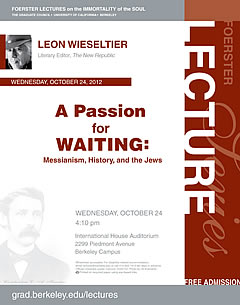
I’m the Koret Professor of Jewish History in the History Department, and also direct the Institute of European Studies. And last but not least, I’m a member of the Foerster Lectures committee, and we are very pleased, along with the Graduate Council, to present Leon Wieseltier, this year’s speaker in the lecture series. Now, please bear with me, because there’s a condition of the bequest.
We are actually obligated to tell you how the endowment supporting the Foerster Lectures on the immortality of the soul came to UC Berkeley. So, and it’s a story that exemplifies in many ways the way the campus is linked to California and the Bay Area. So, it goes like this.
In 1928 Ms. Edith Zweybruck, I’m not sure that she pronounced it according to the German pronunciation, but established the first lectureship to honor the memory of Agnes Foerster and Constantine Foerster. Edith was a public school teacher in San Francisco for many years, and the teaching profession was to her, an opportunity to develop a true knowledge and love of the spiritual values of life in the young minds entrusted to her care. Edith’s beloved sister, Agnes Foerster, shared her high ideals and hopes, as did Agnes’ husband, Constantine.
A lawyer by profession, Foerster was a man of high intellectual achievements and rare personal charm. Although he passed away at the age of 37, he achieved an enviable place at the San Francisco bar and was considered one of its most highly respected members. For several years prior to his death, Foerster was a law partner of Alexander F. Morrison, one of the most prominent San Francisco attorneys for whom our Morrison Memorial Library is named.
In her last days, Ms. Edith Zweybruck expressed her deep and abiding interest in spiritual life, that usually happens at the end of one’s last, at the last days, by creating this lecture on the subject the immortality of the soul or other similar spiritual subjects. She believed that through the medium of a great university, and the words of scholarly lecturers, she might bring new light upon a subject that has interested for the world for centuries. So thank you to Edith Zweybruck.
And now, about our lecturer briefly. Leon Wieseltier as you will soon hear, was born in Brooklyn.
[00:02:31] HOST:
He attended the Yeshivah of Flatbush, and later, Columbia University, and Oxford, and Harvard, and is currently a member of the editorial board of the Jewish Review of Books. Leon is an acclaimed writer, critic, historian, long-standing literary editor of The New Republic. And since beginning, the beginning of his tenure there in 1983, he’s published many influential articles in The New Republic and, of course, elsewhere, and for many years, he’s written the weekly and very widely read Washington Diarist.
And he’s author of several critically-acclaimed volumes, including Nuclear War, Nuclear Peace, Against identity and, of course, his deeply learned, deeply moving and deeply lyrical work, kaddish ‘A Meditation on the Jewish Prayer for the dead’. Leon Wieseltier has also published a number of translations of the works of Yehuda Amichai and other modern Hebrew poets in The New Republic, The New York Times and The New Yorker. Most recently, he edited and introduced a volume of Lionel Trilling’s works titled ‘The Moral Obligation to Be Intelligent’.
Most importantly, I think, Leon also appeared in the sopranos.
(audience laughing)
It doesn’t require any further explication.
(audience laughing)
You may see why he was cast in one of these roles shortly. All of his works are imbued with a deep intelligence and rapier-like wit. So much so, that in a New York Times feature article about Leon, Sam Tanenhaus described him as, ‘Part Maimonides, part Oscar Wilde.’
Now, I’m not sure exactly how accurate that is, but it is a wonderful way to be spoken of. This afternoon’s talk is entitled, ‘A Passion for Waiting, Messianism, History, and the Jews’. After Amichai passed away in 2000, Leon, together with Amichai’s widow, Chana, went through a treasure trove of the poet’s unpublished writings.
In a fragment that Leon translated, Amichai wrote the following, and here is is Leon’s translation, “As in the story of the Jew who keeps the Sabbath, and finds a gold coin on the Sabbath, and does not wish to touch it, and stands over it until the three stars that announce the end of the Sabbath have appeared in the sky, I stand, and I stand. Oh, the pain in my legs. I stand, and I stand, but where are my stars?”
Maybe the stars represent the awaited Messiah, I am not sure. At any rate, this is how the great modern Hebrew poet so poignantly described the Jewish passion for waiting. Now, it’s time for us to hear Leon Wieseltier on that very subject.
So please join me in welcoming to UC Berkeley, Leon Wieseltier.
(applause)
[00:05:37] PROF. JOHN EFRON:
Thank you. I’m very honored to be giving the Foerster Lecture on human immortality, and I hope my words lift you to a higher realm. It is one of the commonplaces about Judaism, historical and spiritual, that it was responsible for the idea of the Messiah, that Messianism was Judaism’s innovation or Judaism’s gift, a gift that backfired on the giver when it was acted upon by those Jews, who precisely because they acted upon it became known as Christians.
But Jewish Messianism, as many historians and theologians have observed, was in significant ways divided against itself. In a people so given over to Messianic theory, the scarcity of Messianic practice is striking. From the very beginning, there appeared to be a contradiction between the intensity of the Jewish tradition’s interest in the idea of the Messiah and the coolness of the Jewish tradition toward the prospect of the Messiah.
This contradiction might be formulated a little more sharply. For the Jews, the history of Messianism has been the history of false Messianism. It is a fact of singular importance that the people who invented the Messiah has never accepted a Messiah.
So the Jewish gift, if a gift it was, was not merely the idea of the Messiah, it was the idea of the Messiah and the simultaneous refusal to accept one, the reluctance to be redeemed. This eschatological skepticism, as I will argue, was not merely a matter of historical circumstance. Indeed, Jewish circumstance might seem to have mandated the opposite desire, the hunger for a swift historical release.
But the culture of a minority, any minority, or of an oppressed people, any oppressed people, cannot be adequately explained solely by reference to its minoritarian status or its experience of oppression. Even in adversity, people may inwardly determine themselves. So, I do not believe that the Messianic ideas of the Jews can be reduced to the circumstances of the Jews.
Instead, I wish to show that the hesitation about the Messiah was internal to the Messianic idea itself. In the Jewish tradition, the longing for redemption is regularly accompanied by a suspicion of such a longing. More often than not, the longing for redemption is to be mastered rather than fulfilled.
As the Israeli poet Yehuda Amichai once wrote in a poem in the 1970s.
(speaking foreign language)
“I seek new beginnings and find only changes.” For a believer, of course, all this is not really a problem. A believer would explain that the distinction between the idea of the Messiah and the reality of the Messiah is not really a contradiction at all.
The redeemers whom the Jews have rejected were turned away simply because they were not the true redeemers since they did not meet the strict and clear requirements that the rabbis devised for the evaluation of any such eschatological claim. The intellectual consistency of this rabbinical stubbornness was very powerful. Consider this passage from an epistle by Jacob Sasportas, the 17th century jurist and polemicist who was the great adversary of Shabbetai Zevi, and one of the most unfairly maligned figures in Jewish history.
In 1666, Sasportas wrote from Hamburg to the rabbis of Amsterdam, quote, sometimes I will read a little in the Hebrew, otherwise I will give you my translations of it. He wrote, “Have you, where have you seen it written in any book that we are obliged to believe that anybody who says, ‘I am the Messiah,’ really is the Messiah prior to his having behaved in the manner that Maimonides in his Code of Law specified that Messiahs will behave? Everything depends on the propriety of his actions.
Otherwise, anybody who wants the name of the Messiah can have it if his piety has been proven, and there will be as many Messiahs as there are pious people.” Close quote. It was because he believed in the Messiah that Sasportas did not believe in Shabbetai Zevi.
This is a perfectly representative expression of the traditional standpoint. Opposition to a messiah is not opposition to the Messiah. When a savior presents himself who will meet the requirements of saviorhood, well, then the Jews will straightforwardly agree to be saved.
[00:10:21] LEON WIESELTIER:
But an unbeliever, or more pertinently, a historian, cannot be satisfied by such an explanation for the Jewish lack of enthusiasm for redemption. He may seek a different kind of explanation, a political explanation for example, according to which the power of a Messianic figure posed too great a threat to the power of the rabbinical establishment. In such a view, the contradiction between Jewish theory and Jewish practice in the case of Messianism was the inevitable result of the refusal of rabbinical elites to entertain a challenge to their authority.
No religious establishment welcomes a charismatic figure or renewal of revelation. It is certainly true that Messianic activism in the medieval and early modern Jewish world was often an expression of social and theological defiance, and it is also true that there existed a strong rabbinical interest in the discreditation of messiahs. But a purely social or political explanation trivializes the perplexity that provoked the eschatological skepticism of the rabbis.
The contradiction between Messianic theory and Messianic practice was indeed an attempt to avert a collision between two types of authority in Judaism, but I would argue that the aversion of that collision was more than the interest of an elite. It was the interest of an entire spiritual temperament, and the short name for that temperament is Halakhah, or the law. The reluctance to be redeemed is a startling thing.
The Jews, after all, were in exile, and in many times and in many places, exile meant also persecution. The wretched conditions in which many Jewish communities found themselves should have prepared them to welcome a great reversal of their misfortune, and yet the opposite was the case. The reluctance to be redeemed was nothing less than an indifference to their own happiness, or a refusal to confer upon their happiness centrality in their life.
And the same, surprisingly enough, may be said about the Messianic expectancy. One of the most striking facts about Jewish Messianism is that there is no correlation between eschatological activity and the experience of persecution. As Gershon Cohen long ago observed, quote, “There is no discernible connection between oppression and Messianic movements.
Jewish Messianic movements were not the religion of the oppressed.” The Crusades, the Almohad invasion, the expulsions from England and France, the blood libels, the pastoral onslaughts, and the persecutions at the time of the Black Death, indeed even the expulsion from Spain and the Khmelnytsky massacres did not generate a single Messianic movement. Conversely, all the Messianic efforts made in Iraq and Persia, and above all in Spain and North Africa, were undertaken in areas and in periods of relative stability.
Now, subsequent scholarship has somewhat complicated Cohen’s picture of the distribution of Messianic energy across the various Jewish cultures. But even if there were some Messianic stirrings in the French and Germanic lands, they were exceedingly rare and disproportionately fewer than the miseries of Ashkenazic experience might have warranted. Cohen’s main point still stands.
Jewish Messianism cannot be properly understood simply as a response to harsh circumstances. It was not chiefly a social, or political, or economic phenomenon, it was a religious phenomenon. The expression of a spiritual temperament within Judaism that continues to clash to this day with a different and more normative temperament within the same faith.
The clash between the Jewish Adventists and the Jewish anti-Adventists may be described as follows. For the Adventists, or those who hunger to experience the climax, redemption is required for meaning. For the anti-Adventists, or those who actually hunger not to experience the climax, redemption is not required for meaning and sufficient meaning exists prior to redemption in the fallen or punished state.
Redemption, after all, promised an exchange of one reality for another, a transformation in totality. In the words of the great Messianic thinker, Yehuda ben Bezalel Loew, the Maharal of Prague, quote, “The coming of the Messiah represents the creation of a new reality and will cause the reality that preceded it to be lost.” Close quote.
It was the transformative nature of redemption, its totalism that posed the problem. Historical transformation for the Jews has two faces. The arrival of the Messiah threatened the Jews not only with a consummation of meaning, but also with an expiration of meaning.
The dream of a perfect future has always served as the standpoint for the most damning indictments of the imperfect present. For all its failings however, the world in which the rabbis found themselves did not seem too paltry or too poor to nourish the soul or the community. The world as they found it was not everything, but it was also not nothing.
Their eschatological skepticism may be properly understood, in fact, as a defense of the sufficiency of their circumstances for the significance that they were enjoined by tradition to impute to their lives. And this sense of the sufficiency of the actual world is foundational to Jewish civilization in ways that have not yet been properly explored. Now, the rejection of redemption rep– reveals an extraordinary confidence about one’s spiritual and existential situation, and the proof of this confidence in Judaism was the law.
The obligation to perform the commandments, ethical commandments, ritual commandments, implied that this imperfect world is not so imperfect that the ideal of perfection is impossible within it. The premise of Halachic life was that the absolute is here and now, adequately if not completely available. Jews, of all people, resolutely do not hate the world, and the Halachic life may be seen as a regular rejection of such a hatred.
If the Jews preferred to wait, it is because they did not lack the means with which to begin, because they already found themselves in the middle. They could be patient for the end because they were already in the thick of an engagement, a steady and stable engagement with the eternal. Indeed, it was impatience that was deemed by the rabbis to be the supreme distortion that Messianism visited upon Judaism.
Judah Jews, as is well known, are forbidden by the Talmud, quote, “To force the end and to calculate the end.” They are forbidden, that is, to repudiate the present, which is the only improper time for moral life and ritual life. For the rabbis, the fear of the Messiah was the fear of sin.
They viewed the rupturing of history as the rupturing of the ritual and ethical framework, and the law as they knew it, that framework as they observed it, was a theater of religious meaning more desirable than any glamorous abrogation of it. Thus, the four cubits of Halakhah were capacious enough, and strenuous enough, and enchanted enough, and the fifth cubit of the Messiah could be resisted. The overwhelming Jewish preference was for waiting.
The Jews had a passion for waiting. I take this phrase from Walter Benjamin who once wrote, quote, “That one cannot appreciate the charm of a café unless one has a passion for waiting.” Close quote.
It’s actually a very good sentence to speak in Berkeley. I wish to suggest that one cannot appreciate the charm of the Messiah unless one has a passion for waiting, at least if one is a Jew. There is something very radical and hugely beautiful about such constancy, about preferring tradition to salvation.
And this preference is stated with surprising, but not entirely adequately remarked upon candor throughout the medieval and modern tradition. Let us follow it briefly beginning in 1263 in a remarkably blunt statement about Messianism made by Nachmanides on the second day of the dramatic Disputation at Barcelona. Nachmanides addressed his words directly to the King James I of Aragon, who was in attendance and keenly followed the discussion.
Quote, “My Lord King, hear me. The essence of our law and our teaching is not the Messiah. You are worth as much to me as the Messiah.
You are a king. He is a king. You are the sovereign of your nation.
He is the sovereign of Israel, for the Messiah is nothing other than a king of fle– of flesh and blood like yourself.” Close quote. Nachmanides’ point in this exchange was not only to diminish the centrality of Messianism in Judaism, he proceeded to a still more startling remark, again addressing the king.
Quote, “When I serve my Creator by your leave, in your realm, in the conditions of exile and persecution and servitude in which we suffer the scorn of the nations daily, my reward is great, for I am making of my own body an offering to my God, and therefore I am more and more worthy of life in the world to come. But when a king of Israel, a king of my own faith, will rule the world and I will perforce abide by the laws of the Jews, my reward will not be so considerable.” Close quote.
Nachmanides was here arguing for the spiritual utility of adversity. It was almost an argument for exile. The passage is especially surprising in the light of Nachmanides’ own emigration or flight to the Holy Land in the aftermath of the Barcelona Disputation, and it reverberates interestingly for present day discussions about Judaism in a Zionist and allegedly post-Zionist world, but never mind its contemporary relevance for now.
It is Nahmanides’ circumscription of the Messianic idea that I want to recommend to your attention. In this avowal of the great rabbi, we find again the Jewish attachment to the world, the insistence that the observance of the commandments is the Jew’s highest purpose and that, and the confidence that adversity and exile of whatever intensity do not impair the Jew’s ability to fulfill that purpose. Some of Nahmanides’ bluntness in this exchange may be attributed, of course, to the charged context in which he was speaking.
The discussion of Messianism throughout the medieval tradition was frequently accompanied by harsh echoes of the disputation between Jews and Christians about the interpretation of biblical and rabbinical eschatology, yet it is clear from his other writings that Nahmanides’ relaxation of Messianism was not merely a polemical or diplomatic matter. It was rather an external expression of his internally considered view of the place of the eschaton in Jewish life. Sefer haGeulah, or The Book of Redemption, which he appears to have composed also in the early 1260s, is not addressed to the Christian authorities of Spain, but to his own Jewish brethren, and it includes this reflection on what he calls, quote, “The essence of our longing for the Messianic Age.”
Quote, “To be sure, we cling to the prospect of the Messianic redemption because it is a well-known truth expounded by our scholars and our prophets, and we attest to its truth and we refute the words of the heretics with the proof of its truth, and we rejoice in it for the reason that we hope that this redemption will bring us closer to God. But know, God help you, that were we to decide in our hearts that our sins and the sins of our fathers have disqualified us from the promises of consolation, and so the exile will lengthen and endure without end, and were we also to conclude that God wished to torment us for his own reasons or for our own good in this world by subjugating us for the, to the nations, none of this would do any harm to the foundations of our faith. For the purpose of our reward is not the Messianic era or to enjoy the fruits of that Holy Land or the hot springs of Tiberias or other such pleasures.
Even the restoration of the sacrifices and the services at the Temple is not our highest wish. No, the object of our desire and of our gaze is the world to come, the Forster Lecture in human immortality and the delight of the soul in what is known as the Garden of Eden and the rescue of the soul from the punishment of hell.” Close quote.
So, according to Maimonides, the belief in the Messiah has a place in the Jewish faith, but it does not have pride of place. The objective of the faith is not redemption. The objective of the redemption is faith.
The idea of the supreme priority of Messianism for Judaism is not an ancient or medieval idea. It is a modern idea, developed and promoted by scholars and philosophers who worked in an age of historicism and revolution. But that theme is for another day.
What I would like to stress here is that one of the most striking elements of Nachmanides’ statement is his unequivocal promotion of the spiritual over the historical, and the rabbi’s eschatological patience strikes one with even greater force a few pages later in his own treatise where he records his conviction that,
(speaking in foreign language)
“We are ourselves living in the end of days.” Perhaps he even enjoyed the hot springs of Tiberias himself. This historical patience that I have used Nachmanides to illustrate had a long career in the history of the Jews.
I will give some examples so as to gradually build my portrait of this un-Messianic Messianism. The same calming influence may be detected in Or Adonai, or The Light of the Lord, which Hasdai Crescas, the fiercely anti-Maimonidean thinker and one of the great statesmen of the Jewish community in Spain, completed in Saragossa in 1410. Or Adonai was the first part, the philosophical part, of Crescas’ projected systematic treatment of Jewish beliefs and practices.
In the third section of his book, Crescas lists those articles of faith, quote, “That we have seen fit to include among the cornerstones of the Torah, so that the belief in them is mandatory and the denial of them is a rebellion so enormous that the denier must be counted among the heretics.” Close quote. Among those necessary and inalienable beliefs, Crescas elected not to include the belief in the Messiah.
Indeed, he could not have been clearer about the loss of its priority. Quote, “In the absence of the Messiah, the reality of the Torah is plainly warranted.”
[00:25:18] PROF. JOHN EFRON:
Close quote. This moderation of the appetite self-sal– For salvation was expressed by a man whose own son had been murdered by the anti-Jewish mob in Barcelona in 1391.
Joseph Albo was a student of Hasdai Crescas. In 1413, he played a prominent role in the Disputation at Tortosa, the longest and the most troubling of all the debates that the medieval Christians imposed upon the medieval Jews. In the Latin protocol of that confrontation, it is recorded, quote, “That as if in a great rage, Rabbi Joseph spoke as follows.
‘suppose it were proved to me that the Messiah had already arrived, I would not consider myself a better or worse Jew for it.’” Close quote. So one’s Judaism does not stand or fall on one’s Messianism.
Albo was making the same point at the debate in Tortosa that Nachmanides had made a century and a half earlier at the debate in Barcelona. And Albo’s account of Messianism, like Nachmanides, was not dictated solely by political pressure. In 1425 in Castile, he completed his great work on Jewish belief, Sefer Ha-Ikkarim, or The Book of Principles.
It was written in part to fortify Jewish faith in the wake of Tortosa, which had been the cause of a significant number of Jewish conversions to Christianity. Near the conclusion of his treatise, Albo discusses the place of Messianism in Judaism.
(speaking in foreign language)
Whoever does not believe in the coming of the Messiah denies the words of the prophets and violates the positive commandments.
[00:30:19] LEON WIESELTIER:
That can be fulfilled only in the land. That is the sum total of Solomon’s idea of the Messianic utilityIt was just as well that Solomon lectured on the limits of Messianism often during the year because on that particular Shabbat, his cautionary words about a historical convulsion were defeated by a natural convulsion. In a brief preface to his sermon, Solomon recorded an extraordinary event.
Quote, “As I was preaching, the ground shook powerfully and only I did not feel the earthquake owing to the intensity of my devotion to the words of the Torah. Most of the people who were present in the synagogue rose and fled.” Close quote.
And so, he taught the great lesson of eschatological patience to an empty room. He insisted that the world would not turn upside down even as it was turning upside down. In 1625, Rabbi Shaul Mortera preached a sermon on the holiday of Sukkot to his congregation in Amsterdam.
The congregation was comprised of Jews who had once lived as Christians in Portugal, and in Amsterdam had replaced their false Christian identity with a true, and in some ways, quite virulent Jewish identity. Some years later, Mortera acquired a brilliant pupil called Baruch Spinoza, and in 1656 he played a role, and thereby achieved a certain modern notoriety in Spinoza’s excommunication. In his sermon of 1625, the text of which was only recently discovered, Mortera pauses in the middle of a philological discussion of the name of the city of Jerusalem to make this ringing declaration.
Quote,
(speaking foreign language)
Our perfection and our greatness do not depend on the greatness of Jerusalem. If the Messiah comes or if the Messiah does not come, we are Jews, and all that concerns us is the observance of the Torah. Please note again that Mortera has not denied the belief in the Messiah, but he has decidedly demoted it.
In the 19th century, Rabbi Moses Sofaer, the great jurist in Pressburg and the most brilliant enemy of modernity that Judaism ever produced, reprised this tradition of moderation about salvation. In a response among the question of dogma and Judaism, Sofaer declared that the belief in the Messiah is an important Jewish belief, but not an essential Jewish belief. Quote, “It is impossible for me to believe “that our redemption is one of the foundations of our faith, “so that if this stone is removed, the wall will come “tumbling down, heaven forfend.
“Even were we to say, God forbid that our sins have warranted “that God condemn us to an eternal exile, “as Rabbi Akiva said about the 10 tribes “that are banished forever. “Is this a sufficient reason to throw off the yoke of Heaven and tamper with even the smallest detail of the law?” Close quote.
Sofaer penned those words in the spring of 1836, when the air was thick with expectation about the year 1840, a year whose Messianic potential had been proclaimed by no less a source than the Zohar itself. I will conclude this tour, and many more stops could have been made on it, in the 20th century when the cause of Jewish inexcitability was taken up most memorably by a non-legal thinker and a secular Jew, who nonetheless thought obsessively and tormentedly about the law. I am referring, of course, to Kafka.
In his notebooks for 1917-1918, there appears this aphorism. Quote, “There are two human sins from which “all the others derive, impatience and indolence. “It was because of impatience that they were expelled “from paradise.
“It is because of indolence that they do not return. “Yet perhaps there is only one major sin, impatience. “Because of impatience, they were expelled.
“Because of impatience, they do not return.” Close. And later, in a famous paradox, Kafka wrote, “The Messiah will come only when he is no longer necessary.
He will come only on the day after his arrival. He will come not on the last day, but on the very last.” All these Jewish thinkers believed in the Messiah, and all of them were content for the Messiah to tarry.
For all of them, redemption was in some way redundant. And this feeling of the redundancy of redemption, I want to suggest, is one of, one of the defining achievements of the Jewish tradition and one of the conditions of its vitality. The passion for waiting was owed then in part to an anxiety about discontinuity.
But this anxiety was a measure of strength, not a measure of weakness. This strength was expressed also within the traditions of Jewish Messianism. There is, of course, a great diversity of eschatological views in Judaism.
I want to be absolutely clear about this. And not all of them reflect the even temper about the end that I have been describing. There were also Jews who burned with salvific desire.
There was an old strain of Jewish Messianism that was militantly utopian and militantly apocalyptic, and dreamed of discontinuity and thirsted for a new beginning. This new beginning would be announced by a number of signs, and foremost among them was the abrogation of the law. Antinomianism is an old and recurring feature of apocalypticism in Judaism.
The impatience with history was frequently expressed as an impatience with law. In the age of redemption, certain laws will become obsolete. The Talmud explains that the Hebrew word for pig,
(speaking foreign language)
a forbidden meat, was given because, quote, “In the future, God will restore it to Israel.
(speaking foreign language)
The entire system of law may even be replaced with a or a Messianic law, whatever that is. For the apocalypticists, there was an essential tension between law and redemption, and they were prepared to overthrow their present duty for their future happiness. Scholem maintained that this tension was characteristic not only of Jewish apocalypticism, but also more generally of Jewish Messianism.
“Authority and messianic authority could not but clash,” he wrote. In this regard, Scholem claimed too much, for the striking fact about apocalypticism in Judaism is that it was not remotely coterminous with Messianism. The more prevalent, if less exciting, Jewish belief in the Messiah was not an expectation of the disruption of the system of meaning in which the community already lived.
It was Maimonides who established this historical sobriety most definitively. Unlike many of the authorities that I have just cited, Maimonides emphatically included the belief in the Messiah among the foundations of Judaism. It was the 12th of the 13 principles that comprised, in his controversial catechism, the dogmas of Judaism.
And yet, his interpretation of Messianism was a long instruction in eschatological equilibrium. In the famous last chapters of his great Code of Jewish Law, Maimonides treats first the Messiah, and then the Messianic Age. About the Messiah, he writes, quote, “Do not assume that the Messiah must perform signs and miracles or introduce any new thing into the world, or resurrect the dead, or the like, for the Torahs, for the laws and the statutes of our Torah are for always and for all time.”
There is no adding to them and no subtracting from them.” Close quote. The anti-antinomianism could not be more plain.
Eschatology here finds its absolute limit in the law. Not only is the abrogation of the law not a sign of the appearance of the Messiah, it is a sign that the appearance of the Messiah was a false one, an illusion, a hoax. In the uncensored version of this chapter of his code, which includes an explicit refutation of the Messianic pretensions of Jesus, Maimonides makes the supremacy of Halakhah and its role as the proper context for the consideration of the end of history completely clear.
When the Messiah arrives, he declares, those who maintained that he would nullify the law, who said, quote, “That the commandments were true but they have lost their validity and are no longer binding,” close quote, will, quote, “recant and realize that they have inherited nothing but lies from their fathers.” Close quote. And this indissolubility of law is not only historical, it is also cosmic.
Maimonides begins the next chapter, which is the final chapter of his code, with these exceedingly sober and naturalistic words:
(speaking foreign language)
“Do not assume that in the days of the Messiah any of the laws of nature will be annulled or that any new thing will be introduced into the order of creation. The world will follow its customary course.” For the Messianic Age to be experienced as the fulfillment of what came before it, some continuity had to be necessary.
Maimonides made the Messiah less frightening by making the Messiah less revolutionary, by assuring the community that upon the arrival of the Messiah, their world, their world would still be recognizable to them. In the concluding part of his code, Maimonides famously cited as the correct definition of the Messianic difference, the remark in the Talmud by the Sage Shmuel in the late second or early third century that, quote, “The sole difference between the present age and the Messianic days is delivery from servitude to foreign powers.” Close quote.
The Messianic change would be only political. The world would be made not new, only better. This was a Messianism that preserved the identity of the world and preserved the identity of the self.
It was the titanic figure of Maimonides who stood athwart Scholem’s lifelong campaign to secure a scholarly foundation for his fascination with apocalyptics. He went to great lengths to deflect and even to deny the influence of Maimonides upon Jewish Messianic belief. He resented the widespread notion that the medieval rationalists had established an eschatological norm.
He resented it on scholarly grounds because his researchers had revealed a vast body of more melodramatic thinking about the end of days, and on philosophical, or rather anti-philosophical grounds, because he never abandoned the Weimar Romanticism of his youth, which he and many young intellectuals of his generation in Germany adopted as a response to what they perceived as the sterility of Rationalism. In 1978, in a response to his critics at a symposium which was published after his death, Scholem railed against the arrogance of Maimonides. Quote, “How did he dare to posit as matters of law, with the explicit authority of law, notions that have no foundation in any tradition of the founders of our nation?”
Close quote. Scholem also wondered how, quote, “The man dared to promote into laws ideas that appealed to him on the basis of his studies of non-Jewish thinkers.” Close quote.
Aristotle, Al-Farabi, and the others. Moreover, Maimonides, according to Scholem, suppressed the sources that he did not admire. And then Scholem hurled his greatest curse, that Maimonides owed his prominence in the understanding of Jewish Messianism to the apologetics of the emancipated Jews of the 19th century who wished to present to Europe a tamed and reasonable and unthreatening version of Judaism.
Scholem, of course, despised nothing more. Quote, “I am convinced,” he wrote, “that the Messianic views of Maimonides are a radical element within the tradition which pointed a way to all those who had no interest in apocalypse. It is no wonder that in the 19th century, in the era of civil emancipation of the Jews of Europe and elsewhere, it was convenient for them to cite the Maimonidean formulations and portray the Messianic idea as purely restorative, built on the denial of its foundations in myth and their banishment to the realm of the imagination.”
Close quote. About the arrogance of Maimonides, Scholem was certainly right. Even the most devoted Maimonidean can be shocked by Maimonides’ conception of himself.
Scholem was also right that there is a diversity of messianic ideas in Judaism. But about the sin of external influence upon Maimonides’ thought, Scholem is simply embarrassing. Moreover, even those thinkers whose eschatological conceptions were more robust than Maimonides, Isaac Abravanel or The Maharal of Prague, even they did not carry their visions of historical disruption all the way to the apocalyptic extreme.
And it is inaccurate to claim that the unconvulsive Messianism of Maimonides was based only on a single saying by a single Talmudic figure. His discussion of eschatology cites many biblical and rabbinical sources. As for the canonical stature of Maimonides, Scholem and the other despisers of reason may not have liked it, but it was a brute historical fact.
The Maimonidean construction of the end of days was not a radical element within the Jewish tradition, it was an anti-radical element and its influence was immeasurable. In its insistence upon the immunity of natural law and religious law to historical convulsion, Maimonidean messianism struck a decisive blow against the romance of historical explosion. In Judaism, we might say law is the antithesis of utopia.
There isn’t a variety of medieval and early modern Jewish thinkers. The view that the immutability of the Torah, an axiom of Jewish faith since antiquity, guarantees the immutability of the world that was created for it to be fulfilled in. I will not trouble you with these texts now, except to note their implication that a belief in the law entails a belief in the world.
The world that abides is not a perfect world. The need for law is itself evidence of its imperfection, but it is a sufficient world, a world right for its purposes. The commitment to normativity removes the grounds for a rejection of the world and also for the hunger to destroy it so as to renew it.
Law or normativity in this understanding is an antidote to the nihilistic element, the appetite for destruction in the apocalyptic critique of the world. The acceptance of the world that is a condition of the law is not a form of complacence since the law is itself a standpoint for criticizing the world and for not conforming to it. But the law-abiding Jew nonetheless feels adequately conditioned for a significant life.
Messianism is commonly interpreted as a variety of idealism, but if idealism is only a part of the Jewish tradition’s attitude toward the worl, the world, then messianism must stand in some relationship also to realism. What we have here is a messianic temper that includes, that prizes, an attachment to reality, and this attachment is not experienced as a paradox or a tension or a contradiction, and it helps to make sense of the paucity of messianic activity in this people who invented the Messiah. For insofar as messianic activity was an open expression of hostility to reality, it was bound to be constrained.
There remains, of course, the matter of messianic calculation. The Jewish tradition of messianic calculation was long. It amounted indeed to an entire genre of Jewish literature.
This vein of messianic speculation, which was often based upon numerological interpretations of biblical phrases and verses, proposed the following years as the dates for the coming of the Messiah if the people made themselves worthy for it. 110, 140, 240, 620, 968, 1130, 1238, 1340, 1306, 1334, 1358, 1403, 1430, 1440, 1503, 1530, 1575, 1598, 1640, 1648, 1713, 1725, 1840, 1850, 1868, and 1931. All these despite the ancient warning against calculating the end, and this is only a partial listing of the auspicious and deceptive years.
So, to what end all those calculations? In the light of the composure that I have been sketching, how are we to interpret all this redemptive arithmetic? There were many medieval calculations that proposed not a precise date for the coming of the Messiah, but a loose time span, a period in history or in the medieval vocabulary, a cycle of creation when the Messiah is most likely to arrive.
In 1497, for example, in his book, Yeshuot Meshicho or The Redemptions of His Savior, the ardent messianist Isaac Abravanel declared that all messianic calculation was general. Its task, he wrote, was to analyze history into three periods. Quote, “The period during which the advent is impossible, the period during which the advent is possible, and the period during which the advent is necessary.”
Close quote. That is not the sort of historical information that makes one pack one’s bags. There is a difference between messianic calculation and messianic activism.
Indeed, many of the ancient and medieval calculations projected the redemption many years into the future, well beyond the lifetime of the respective writers and their contemporaries. For many of the speculators, the year 6000 was an especially enchanted time. The next Jewish millennium, which will arrive in the Christian year 2240.
We should all be glad that we will miss it. The messianic calculations were not designed to incite, though some of them did. They were designed rather to console.
They were promises, not plans. The problems that they were, the problem that they were designed to solve was not the problem of Jewish exile, it was the problem of Jewish despair. The Messianic calculators were playing with fire.
Eschatological precision ran the risk of eschatological disappointment. This was clear already in the Talmud, quote, “Rabbi Shmuel ben Nahmani said in the name of Rabbi Yonatan, ‘May the bones of those who calculate the end be blasted, for they would conclude that since the determined time has arrived but the Messiah has not come, he will never come. No, we must wait for him.’”
Close quote. Similarly, in the 11th century, Moses Ibn Ezra in his treatise on Hebrew poetry sardonically dismissed Messianic calculation as, quote, “Ignorance that will do no harm and wisdom that will do no good.” Close quote.
A century later, Maimonides’ Twelfth Dogma included the indeterminacy of the Messianic date as a part of the belief in the Messiah, “Even if he tarries, we will wait for him.” And Maimonides explicitly argued that, quote, “One must not fix a specific time.” Nachmanides warned that the disclosure of the date of redemption would lead, quote,
(speaking foreign language)
“A demoralization and a weakening of the people’s hope.” This is especially striking because Nachmanides himself engaged in eschatological computation and promoted the year 1358 as the Messianic year. He explained his apparent inconsistency this way, “What we have said about the end,
(speaking foreign language)
those are words of maybe and perhaps. We possess no knowledge on the basis of which a certain truth may be inferred so that we could say it is just so.” We are not prophets who can vouchsafe the secrets of God.
It is rather the case that we hope for the time to come, and we hold this belief generally.” So it was not knowledge that these dates furnished, it was hope. When the predictions were valued, it was not for the historical illumination that they provided, but for the spiritual fortification.
Insofar as they abetted hope, they were acceptable. Insofar as they impeded hope, they were not acceptable. For as Joseph Albo remarked in his discussion of these calculations, quote, “These things are mutually determined.
Hope is the cause of strength, and strength is the cause of hope.” While there is no correlation between crisis and messianic activity, there is a correlation between crisis and messianic speculation. This is not hard to understand.
In the wake of persecution and displacement, particularly in the wake of the expulsion from Spain, the words of maybe and perhaps were not enough. There was a wound to heal, and a discussion of the Messiah and the concretization of the messianic promise hoped to heal it. But again, adversity is never the whole story.
I would like to suggest another way to understand this disjunction between messianic fantasy and messianic activity, between the theory and the practice. This disjunction is problematic and seems like a contradiction only if we continue to accept the most common assumption about Jewish Messianism, which is that it was essentially revolutionary. Scholem in particular stressed the revolutionary character of Jewish Messianism.
He painted a long and thrilling portrait of the messianic energies in Judaism, and in the flamboyant figure of a certain Moses Dobrzutka, a Moravian Frankist who became a Freemason and died with Danton at the guillotine in 1794, Scholem believed that he had tracked those energies all the way to the French Revolution. More generally, the revolutionary interpretation of Jewish Messianism was popularized by the so-called secularization thesis, according to which Marxism and the revolutionary traditions of the modern world were at bottom translations and transpositions of Jewish or Judeo-Christian eschatology. But what if the opposite is true?
What if Messianism played not a revolutionary role in Jewish life, but a conservative role? Recall Scholem’s most famous formulation of Jewish Messianism, quote, “A life lived in deferment.” Close quote.
Scholem believed that Messianism demanded a price, and the price was a certain unreality that attached to Jewish existence. Quote, “There is something grand about living in hope, but at the same time, there is something profoundly unreal about it. It diminishes the singular worth of the individual, and he can never fulfill himself, because the incompleteness of his endeavors eliminates precisely what constitutes its highest value.
Thus, in Judaism, the Messianic idea has compelled a life lived in deferment in which nothing can be done definitively, nothing can be irrevocably accomplished. One may say perhaps that the messianic idea is the real anti-existentialist idea. Precisely understood, there is nothing concrete that can be accomplished by the unredeemed.”
Close quote. To a student of the Jewish community of the medieval and early modern world, this passage of Scholem’s is deeply vexing. Nothing concrete that can be accomplished by the unredeemed?
As a description of the inner and outer realities of traditional Jews, that is spectacularly wrong. Jewish life was never as drained or as postponed by the future as Scholem described it. It was the objective of Halakhah and of the halakhically constituted community to ensure that something can be done definitively, that something can be irrevocably accomplished, and this objective was attained annually, monthly, weekly, daily, and hourly.
The remarkable thing about Jewish life in exile was not how much was deferred, but how much was not deferred. Anyway, what sort of ideal is the deferment of the ideal? Is not the deferment of the ideal, in fact, a way of making peace with the real?
Scholem describes the duration before the arrival of the Messiah as, quote, “The centuries of exile when Jewish history was unprepared to come forward onto the plane of world history.” Close quote. I do not quite know what he means by this Hegelian judgment.
This long, unredeemed period in Jewish history, this allegedly prehistorical or non-historical or ahistorical era was precisely the time in which the Jews created their civilization. More importantly, and here we approach the modern bias in the interpretation of Jewish Messianism, which Scholem perfectly exemplified, the Jewish spirit never regarded itself only historically, and never regarded history as the last word. If thinking Messianically is the most intense way of thinking historically, then the circumscription of Messianism, the restoration of a more complicated and less inflamed view of its place in Jewish life, is also a circumscription of historicity.
So, I would describe the conservative character of Jewish Messianism this way. It protected the traditional acceptance of the world by confining the desire for change to a hope. For it was the premise of the current of thought that I am here describing that the acceptance of the world was worthy of protection.
The acceptance of the world indeed was one of the great achievements of a people to whom the world had not been kind. This was the spiritual challenge posed by Jewish Messianism. To criticize the world without rejecting it, and to change the world without destroying it, or conversely, to accept the world without being complicitous with it.
The paradoxical character of this eschatological temper, the spirit that wished to conserve what it wished to perfect, accomplished both these goals. In one of his letters, Seneca declared that, quote, ‘You must either hate the world or imitate the world.’ But surely it is possible neither to hate it nor to imitate it.
Messianic speculation was an exception to the Jewish patience with history. It was not the exception, it was the expression of it. It was the tribute that realism paid to idealism.
It bled off the bitterness about Jewish historical experience that otherwise might have exploded the whole thing. Was hope then false or insincere? Was hope a form of bad faith?
Was hope an illusion? Was it, as Scholem believed, the enemy of reality? Not exactly.
The understanding of Messianism and Judaism will not be furthered by platitudinous notions about the relationship of theory to practice, for hope stands somewhere between theory and practice. It is the ground of, but not the reason for historical action. Hope is a weaker form of historicity.
Quote, ‘The longer the Messiah will tarry, the greater will be the hope,’ Maimonides explained to the Jews of Yemen in 1172. Better hope than disappointment. That was the Jewish retort to utopianism.
In the Jewish tradition, then, Messianic speculation may be seen as a kind of thinking about change that was not quite a preparation for action. Messianic calculation described the point at which the world would be changed by an accumulation of actions, none of which were designed to change the world. The Messiah would arrive, the ancient rabbis said, when all the people of Israel kept two Sabbaths.
Did they mean that the keeping of the Sabbath was a Messianic activity? They did not. They meant only that the performance of moral and ritual duties by the individual and the community would have a cumulative effect upon the destiny of the Jews, and the destiny of the world.
But this destiny was to be attacked indirectly. We are not enjoined to live climactically, we are enjoined to live significantly. A messiah who is not a revolutionary, criticism without nihilism, a change that is not an end, fulfillment without closure, a climax that preserves, a hope that neither lulls nor incites.
Those are not contradictions. They are rather the terms of a certain Messianic spirit in Judaism, and they are remarkably unlike the terms of Messianism in modern Western politics. At the end of Minima Moralia, Adorno wrote, quote, “The only philosophy which can be responsibly practiced in the face of despair is the attempt to contemplate all things as they would present themselves from the standpoint of redemption.”
Close quote. The Jewish tradition, or at least the portion of it that I have presented here, teaches otherwise. It teaches that in the face of despair, one must resist the standpoint of redemption, for what is redemption if not an invitation to despair?
Perhaps that is precisely where modern Messianism lost its way. It sought to meet despair with revolution. Against Adorno and the modern secularization of the apoco– apocalyptic dream, I would leave you with this exhilarating remark by Shlomo Bet HaLevi in a commentary on a Talmudic parable.
(speaking foreign language)
“If an individual cleaves to God, what does the destruction of the temple matter to him?” The p– and he continues, “The power to cleave and to pray and to plead is available even in the era of exile.” And he concludes, “There is nothing lacking for perfection.”
Closed quote. Nothing, that is, in history. What is lacking for perfection is only the lack in ourselves.
Thank you very much.
(audience applauding)
[01:00:25] PROF. JOHN EFRON:
Thank you, Leon, so much. If there are questions I invite you up. There’s a question, sir.
[01:00:34] AUDIENCE MEMBER:
How do the thoughts of the religious Zionists or, how do the thoughts of the religious Zionists, Rabbi Kook, for example, fit into your theory? It would seem that they were proposing something that was revolutionary, preparing the land for the coming of the Mashiach.
[01:00:48] LEON WIESELTIER:
Yeah, I think as I said, there this debate, or this tension, or these currents, they continue into the present day. There’s no question that when nationalism and religion mixed for the Jews in the early 20th century and thereafter, there developed a, not just an overtly Messianic politics or an overtly Messianic notion of political action, but even an apocalyptic temper. And in that sense, they are consistent with they are, I would say, deeply on my monody and deeply inconsistent with the kind of spirit that I was describing.
They certainly exist. I wanna be clear. I was not saying this was the only kind of Messianism in Judaism.
I was merely trying to correct a certain impression that was left behind by scholarship in the 20th century and since, a certain romance of a certain sort of Messianism. You know, that’s the picture. That’s the picture.
[01:01:47] AUDIENCE MEMBER:
I wanna say first that I really appreciate the diversity of your thought and the artistry of bringing together all these different conceptions. It seems really somehow it’s resolved something for me, in the idea of just the way things are, the perpetuation of, or the Messiah, that which sustains the world, especially in lieu of the condition we are in in the world today. We’ve made it through not having a war with the Cold War.
We’re looking at all these potential holocausts of environmental things and things like that. And in that view, the Messiah or the Messianic would become the Tikkun or just social justice, the environmental justice, the ability to sustain our world in life. And then we are all the Mashiach or the Messiah in our commitment to be that which fulfills the law or fulfills the, I don’t know what to call it, fulfills life itself that we can continue.
[01:02:55] LEON WIESELTIER:
Can you hear me? Okay, yeah. First I should say that the notion of a people that is, consists entirely of Messiahs is even more frightening to me than a people that has only one.
But let’s say something about the T word or the tough word. Let’s talk about Tikkun for a moment. The rabbinic, the word Tikkun, even though we all know it comes from the second paragraph of,
(speaking in foreign language)
to improve, not perfect, to fix or improve the world, and in the Kingdom of God when we’re old and, which is a very ancient text. the notion of Tikkun, the rabbinical notion of Tikkun does not derive from that place. It derives from the Mishnah in Gittin, in a certain track data in the Talmud having to do with divorce of all things, where I guess Tikkun is most desperately needed.
But the Mishnah regards Tikkun, Tikkun for the rabbis is precisely the opposite of a grand comprehensive totalistic final improvement of anything. Tikkun is an adjustment. And in the Mishnah, the rabbis list a series of adjustments, so that if certain legal arrangements are incorrect, this is what you have to do.
This is the Tikkun. It’s a fix. It’s what we would call a fix.
It’s not a redemption, it’s a fix. It’s a real fix. It’s more than a Band-Aid, but it’s not a new world.
It’s not a perfect world. It’s not a completely just order. It is simply, it is a form of tinkering.
But again, one of the things that one has to understand, is the high moral place that tinkering can have as an ideal for social action. It is only in the light of a certain revolutionary frame of mind that tinkering seems small or, you know, irrelevant or so on. And I think that, and again, I don’t mean, I mean, a friend of mine once told me when he read this that he thought that all this was an allegory for liberalism.
I didn’t mean it to be that. But there is something about the primacy of reformism of what used to be called in the late 19th century in England, meliorism. Tikkun is meliorism, which means the slow and steady adjustment and improvement of a variety of things that are not working at capacity.
That’s all it is. That’s all it is. Doesn’t save the world.
It doesn’t save the planet. It doesn’t save the Middle East. It doesn’t save anything.
It doesn’t save anything. It just fixes something. And I think it’s important to, to have that distinction in mind and re, and to see that Tikun Olam is, first of all, been wildly misunderstood, but also that it is a deeply unredemptive sort of activity, a deeply unredemptive activity, which is actually why we’re all enjoined to be, to do it.
We’re all enjoined to do it. Yes, you want to adjust that? Yes.
(laughter)
[01:05:57] AUDIENCE MEMBER:
Just that, really simple things like somebody not having enough to eat, and if they have enough to eat, you could call that a slight tinkering, or you could call it they’re redeemed for the day.
[01:06:08] LEON WIESELTIER:
No, you see, I think–
[01:06:09] AUDIENCE MEMBER:
So, just, but I just am sensing, you know, that with that extension of time and with age and when you’re 20, you’re gonna go save the world, and when you come back, when you’re 50 or you’re 60, you get into those kinds of ideas that–
[01:06:24] LEON WIESELTIER:
Here’s the problem. If you do a good deed, let’s say you feed a child, you can either be gratified that you fed a child and one less child is hungry, or you could interpret it or describe it as you say, that in this way you’ve changed the world. The only problem is that when you look around this fed child, you will discover that the world has not changed.
In other words, the, the, the, the problem here is to, is not to, not to try to improve the world in a way that leads to despair. This is the difference between the way, I’ve heard what you said. This is what the difference between the Jewish and the Christian predicaments, for example, about the Messiah, in my view is something like this.
Our problem, the Jewish problem, is that we’re waiting and we’re waiting and we’re waiting and he never comes, right? We wait, he never comes. The Christian problem, a much graver problem, is that he came, and the world didn’t change.
And as a consequence, they woke up the morning after redemption. And I think waking up the morning after redemption is just about the most danger, I never want that to happen to me because I will immediately understand that the redemption was incomplete. And so the Christians reinterpreted the redemption.
He was not of this, it was not of this world, it was of his kingdom, right? Or so it’s, we are not to measure it that way. Or they developed a theory of the second coming.
And as I joke with my Christian friends, I’m absolutely certain that if he comes again, it will be a matter of hours before I hear the theory of the third coming. Because the world–
(speaking in foreign language)
And so as I say to you, it actually does make a difference how you describe a good deed, and it does make a difference whether you describe a small fix as a salvific gesture or not. I think it makes a huge difference because you run the risk of demoralizing yourself and the community. And in that circumstance, nothing good can be done and it’s a vacuum for power is what always happens.
[01:08:28] QUESTIONER:
First, and you’re arguing that the coming of the Messiah won’t make a difference, but what difference then would the coming of the Messiah make?
[01:08:38] LEON WIESELTIER:
I’m not saying that it won’t make a difference. I’m saying that there are various traditions about what kind and how much of a difference it will make, and that the notion that it will make all the difference has enjoyed an undeserved prestige for a very long time, and that there are enormous dangers, intellectual and even political, in the expectation that the change will be the final one, will be the total one. And that there are more minimal or realistic or naturalistic or moderate, call it what you want, Maimonidean ways of understanding the promise of the coming of the Messiah that enable one to hold sincere hope and really be motivated to improve the world without leading to some of the consequences that I outlined.
So, you know, it’s not quite a, well, it’s sort of an un-Messianic messianism, except again, none of the thinkers that I described did not believe in the Messiah. That’s clear. That’s clear.
Every one of them did. Every one of them did. So it’s about the place of that belief in the cluster of Jewish values, in the constellation of what Jews believe.
And I’m not speaking just ahistorically, have believed in various Jewries at various times, and so on. And what I wanted to do was to complicate the picture and to leave people feeling drawn to a view of the Messiah that is otherwise emotionally not that satisfying. That’s what it was.
Yeah?
[01:10:11] QUESTIONER:
I just speak not as someone who knows anything about–
[01:10:13] LEON WIESELTIER:
Wait, there’s a microphone here.
[01:10:15] QUESTIONER:
The Jewish tradition.
[01:10:16] LEON WIESELTIER:
Wait, wait, wait.
[01:10:17] QUESTIONER:
But someone who is interested in Seneca, I’m sorry?
(staff member whispering)
[01:10:24] LEON WIESELTIER:
Start again.
[01:10:25] PARTICIPANT:
Okay.
[01:10:26] LEON WIESELTIER:
Thank you.
[01:10:26] PARTICIPANT:
Sorry. I’m speaking as someone who knows nothing at all, really about the Jewish tradition, but someone who’s interested in Seneca, whom you quoted, and I’m wondering whether to kind of slightly generalize the thesis that you’re presenting, which I found absolutely fascinating. In Stoicism doesn’t have a theory of the apocalypse or the Messiah, but it does have something which is a little bit analogous, which is the ideal of the wise man.
So, Stoics will say, ‘Unless you’re wise, you’re imperfect.’ But as far as we know, even Socrates was not wise, so the wise man has never come, but we still somehow use him as a norm or a standard. But that’s no way to suggest that the way we find the world currently would be any better for us if in fact, the wise man had come, or even if we achieve wisdom because wisdom in this sense is an Archimedean point.
I wonder if that captures at all the general.
[01:11:40] LEON WIESELTIER:
You ask, I mean, as people in Washington like to say, your question is on point. I would say this. I’ve thought about this a lot because obviously well, I would say this.
Where the Jewish temper that I describe would differ significantly and essentially from Stoicism is that it does not recommend in any meaningful way any kind of detachment from the world. That is the difference, that the peace of mind that the Stoic wise man gains is purchased at the cost of a certain proximity to the world, spiritual proximity, Seneca was busy conspiring against ruler. I mean, he was in it.
But there is nothing that I described here is there any sense that the moderation of the expectation for salvation should either be premised on or bring about some detachment or dissociation from the world. In fact, so interesting to me is that this moderation, this world, maintained with an intense attachment, to the world. I once wrote something which I– In Maimonides has a work about the rules of dying, death, and mourning.
It was a long book. It was a legal monograph that he composed and it has at the end, it has a concluding chapter which is a chapter of theological, philosophical reflections in which he actually refers to Socrates as the wise man. And it’s quite clear from what we know about Nachmanides’ culture and his reading and from the text itself, that it was the Stoic Socrates that he was referring to.
And if you look, I can’t go into it now, but it’s a perfect example of what you’re saying. If you study that text closely, you see that what Nachmanides is doing, it is expressing enormous sympathy, admiration for that degree of wisdom, but while tinkering with it or fixing it, so as to see if that wisdom is possible without that degree of detachment from the world. I mean, you can actually see a kind of confrontation or a inner debate going on between the 13th century Jewish rabbi and the Stoic Socrates.
And he doesn’t reject Socrates, which is very interesting. Maimonides was not open-minded about foreign traditions in that way. He was not enlightened, whatever that means in the 13th century type of thinker.
But he accepted the Stoic Socrates, and then he turned the screw in one more time and tried to say, “That plus,” excuse me, “That plus the attachment to the world.” So that’s how I would answer, but it’s a very important point. Yeah.
[01:14:37] AUDIENCE MEMBER:
So I appreciate your championing of Maimonides and I just, I wonder about one thing, though. I wonder whether Maimonides’ sober politically achievable even conception of what the Messianic time looks like might have contributed in a somewhat ironic sense a diminishing of that sense of passion for waiting that you’re describing.
[01:15:12] LEON WIESELTIER:
Precisely because the Messianic time doesn’t constitute such a terrifying transformation might that have made it not necessary or may make certain people feel like it wasn’t necessary to passionately wait so much anymore? I guessed I’d have to answer that by saying that if, if that, if, if that meant that people would be content to just go on, just to proceed with their lives in this flawed, imperfect world and keep the ritual commandments and keep the moral law and so on, I think that would’ve been perfectly satisfactory to Maimonides. In other words, I think that Maimonides was more concerned about false messiahs and about Messianic illusion than he was about, oh, I’m sorry.
You have, yes, go ahead. Just to clarify. But his vision’s particular specifically political one
and that’s actually, that– Yeah, but the– That political accomplishment.
Yeah, but the end, but the political, yeah, but my point about it is political, but I don’t want, we shouldn’t get all, I don’t wanna get all fancy about political. There’s nothing deep or Straussian about this.
It’s what, what I, I wanna make is that, when he’s, when he’s, when he, when limited it to the realm of politics, what he really was saying is that everything else would be continuous with what we have now. You know, that was the polemical point. That was the polemical point, that people would still have to go on.
They have the same duties, the same obligations, the same flaws, the same anxieties, et cetera, et cetera. It was really, I think, a deeply humane idea, a kind of messianism because it was really, you know, ’cause some of the apocalyptic strain was really about when everything comes to an end, even if you’re born again, which is the problem with the born again metaphor. I mean, I, oh, let me put it this way.
The problem with being born again is that if you’re born completely again, and you don’t remember what it was like before you were born, then being born again is, strictly speaking, the redemption didn’t happen, right? It just didn’t happen. You’re just someone else.
Right? You’re just someone else. And that’s not interesting because it, the whole, the satisfaction of redemption is the memory of the unredeemed time, right?
In other words, it’s all about the continuities here, psychological, philosophical. And what Maimonides was worried about, I think, or maybe I’m imputing this to him, is the deeply inhumane tendencies of ideas of redemption that sought to abolish life as we know it. To abolish life as we know it.
Um, and that’s what really what he– and again, in the case of the Jews of Yemen, they were in big trouble. I mean, you know, he was offering them comfort when they needed it and so on. He was not, I mean, this was not, this was not these were not the words of—these were not, this was not complacency of any kind.
So the point was to preserve the continuity. The, or rather, the question was, how much continuity with the unredeemed world can survive into the redeemed world and still, and for us to still be able to speak of redemption in some meaningful way. That was the problem.
[01:18:33] HOST:
Um, okay. I’m not I’m not a Messianist, but I will invoke some Jewish Messianic language and force the end of our talk today. And I wanna thank, join me in thanking Leon for coming. Thank you.
(applause)
Thank you.
(applause)
And if you wanna continue what has been a brilliant hour and a half or something, we’re still, Leon’s still here for a while And I’m sure will be happy to come down to, to us and entertain your questions. So thank you for coming. All right.
[01:19:07] LEON WIESELTIER:
No questions about Chabad or Obama. No questions about that.
(laughter)