[00:00:00] WILLIAM LESTER:
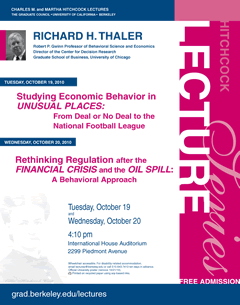
Well, good afternoon. I’m William Lester, Professor of Chemistry and Chair of the Hitchcock Professorship Committee. Uh, we’re pleased, along with the Graduate Council, to present Professor Richard Thaler, this year’s speaker in the Charles M. and Martha Hitchcock Lecture Series.
As a condition of this bequest, we’re obligated and happy to tell you how the endowment came to UC Berkeley. It’s a story that exemplifies the many ways this campus is linked to the history of California and the Bay Area. Dr. Charles Hitchcock, a physician in the Army, came to San Francisco during the Gold Rush, where he opened a thriving practice.
In 1885, Charles established a professorship here at Berkeley as an expression of his long-held interest in education. His daughter, Lillie Hitchcock Coit, still treasured in San Francisco for her colorful personality as well as her generosity, greatly expanded her father’s original gift to establish a professorship at UC Berkeley, making it possible for us to present a series of lectures. The Hitchcock Fund has become one of the most cherished endowments of the University of California, recognizing the highest distinction of scholarly thought and achievement.
Thank you, Lillie and Charles, and now a few words about Professor Thaler. Richard Thaler is renowned for his influential contributions over the last three decades to the emerging field of behavioral economics. He is considered by many to be the pioneer in integrating psychological s-research with economic theory and the inventor of the field of behavioral economics.
Thaler’s studies also focus on behavioral finance and the psychology of decision-making. He explores the implications of loosening the standard economic assumption that everyone in the economy is rational and selfish, instead considering the possibility that some of the participants in the economy are sometimes human. Thaler received his BA from Case Western Reserve University in 1967 and his MA and PhD from the University of Rochester in 1970 and ’74, respectively.
Between 1974 and 1980, he held the positions of assistant professor at the Graduate School of Management of the University of Rochester and assistant professor of economics and public administration at the Graduate School of Business and Public Administration at Cornell University. From 1980 to 1988, he was professor of economics at Cornell’s Johnson Graduate School of Management. He is currently the Robert P. Gwinn Professor of Behavioral Science and Economics, as well as Director of the Center for Decision Research at the University of Chicago Graduate School of Business, where he has held appointments since 1995.
Thaler is also a research associate at the National Bureau of Economic Research, where he co-directs the Behavioral Economics Project. Professor Thaler has been awarded numerous honors for his extensive and illuminating work in behavioral economics. He is a member of the American Academy of Arts and Sciences, and in 2009, he was elected a fellow of the American Finance Association and currently serves as vice president of the American Economics Association.
Please join me in welcoming Professor Richard Thaler.
(applause)
(laughter)
[00:03:35] RICHARD THALER:
Okay. Well, first of all, I have some, uh, good The Giants won three-nothing.
(laughter and applause)
So you can, you can go now. Um, so, uh, I… It’s a great honor to be here and, uh-
(laughter)
Matthew, are you all right?
(laughter)
So, uh, I think I have more friends at this university than any other, and, uh, I also have a daughter and daughter-in-law in the audience today. So, uh, it’s lots of fun, uh, to be here. Um, let me start by talking about my so-called friend, Danny Kahneman, who some of you may know.
He was a professor here, much beloved professor for many years before he, um, ditched Berkeley and went to Princeton. And, uh, Danny and I have been friends, uh, since nineteen seventy-seven. So once when I was out here for some reason, uh, and, uh, we, Danny and I were doing some work at his home up in the hills, um, he, he had to get a phone call from some reporter who was writing a story about me, a profile.
And so I was there. It was a little awkward. You know, we were both– Danny and I were worried about whether I would be, you know, embarrassed by the effusive praise that he would be heaping upon me.
But we, we decided not to share with the reporter that I was in the room. And, um, so D- uh, they’re starting to talk, and then Danny says, “Well, really the best thing about Thaler is that he’s lazy.
(laughter)
So I’m, um, you know, waving at him and writing him a note saying, you know, it, it’s not the best thing, right? I mean, so he and I have been arguing about this ever since. Uh, uh, but the truth is that he’s right.
I don’t know whether it’s the best thing, but it’s an accurate description. And, uh, so, you know, I was a lazy man going into economics, and, um, what was I to do? So, uh, wh-what’s a good research method for a lazy guy?
Uh, introspection. Now, you know, the scientific name for this is thought experiment. And, uh, I’ve actually developed some very little-known statistical methods for analyzing thought experiments.
Um, I think I’m the only person that has those statistical packages. Um, so here’s my first thought experiment. Uh, uh, when I was living in Rochester, a friend of mine were given two tickets to a basketball game.
This is when Buffalo had a professional basketball team. There was a big blizzard, which was not a surprising event, and, uh, we wisely decided not to go to the game. And, um, he says, “You know, it would be nuts to go to this game in this weather.”
But then he says, “But if we had paid for those tickets, we would be going.” “Now, this of course, is a violation of economic theory, uh, because in economics we teach, thou shalt ignore sunk costs. Um, but we were going.
So, uh, it, it started me wondering why. Uh, but I, I discovered the hard way that you can’t publish thought experiments.
So I, uh, did the next best thing, which is ask other people to engage in thought experiments. So while I was working on my doctoral thesis, which was on the value of a human life, uh, uh, uh, it was– that was an econometrics exercise, uh, where I was estimating how much you had to pay people to get them to take risky jobs. I thought it might be fun to ask them some questions.
So I asked two questions. The first was, uh, we can modify it for this crowd. Suppose that by coming to this lecture, you have exposed yourself to a one in a thousand risk of death.
If, if you have this disease, you’re going to die a quick and painless death sometime next week. But I have one cure that I’m willing to sell to the highest bidder. How much will you pay?
So you can think about your answer to that question. Then I asked another question. How much would you demand to expose yourself to that risk?
Now, typical answers to those questions would be something like one thousand dollars and one million dollars. But economic theory tells us that those answers should be approximately the same. So how can they differ by several orders of magnitude?
(cough)
So this got me, got me thinking. Now, I was told that I was this– this ex- this experiment was criticized on the grounds that it was hypothetical. I’ve been trying ever since to do it for-
(laughter)
for for like real. uh, you know, I, I thought Russian roulette for money. Um, somehow I haven’t gotten that past any, uh, human subject committees.
(clear throat)
(laughter)
So this was stif-career stifling. Um, so, uh, then, you know, I moved on to more advanced methods. So, uh, i-i-in nineteen ninety-one, ninety-two, um, my friend Colin Camerer, one of the first people to join me in this, uh, behavioral economics venture.
Uh, he and Danny and I were all spending a year in New York, and i-i– You live in New York, you spend a lot of time in cabs. So Colin and I used to talk to cab drivers a lot. And, um, what they told us was that if they were having a particularly good day, they would quit and go home early.
Now, um, th-this i-is the opposite of what economic theory tells them they should do because essentially what they’re, what they’re doing is they’re minimizing their earnings per hour by working less on the profitable days and more on the unprofitable days. So then, yeah, then I moved on to, uh, playing poker with my colleagues. That was another data collection method.
And What I noticed was that full professors of economics would be entirely different people depending on whether they were ahead or behind by some s– relatively small amount, like fifty dollars. So if they were ahead by fifty dollars, uh, there was no point in trying to bluff them. They would call any bet that didn’t risk putting them behind.
But if they were behind, they, they didn’t like getting much further behind, but, um, uh, they, they were willing to gamble if they could get back to even. So again, uh, it was hard to publish my poker predictions. And in any case, that would have deprived me of an important income source when I was a young professor.
So, um, all of this got– all of these observations, scientific observations, got me thinking about what I’ve called mental accounting, which is how people think about everyday transactions. But why is it that they think that having paid for those tickets makes it seem more compelling that they should go to the game? What, why, uh, does the cab driver think it’s a good idea to quit when they’re making a lot of money?
Um, uh, why do they treat opportunity costs different from out-of-pocket costs? And more important was how to convince any of my colleagues that any of these observations were remotely interesting or compelling. So essentially, today I am going to tell you the story of how, how I began going beyond thought experiments.
So, uh, o-one method is to try real experiments. So here, here, here’s an experiment that Danny Kahneman and Jack Knetsch and I ran. Um, it, it was run actually in a, a class at Cornell, uh, in law and economics.
Uh, for the economists in the room, this is a class in which the Coase theorem was mentioned at least once every lecture. And, um, so we handed out, uh, Cornell coffee mugs to every other student and then created a market in these mugs. And if they had a mug, they could sell it.
If they didn’t have a mug, they could buy it. Now, since there was random assignment of mugs, the economic theory, and particularly the Coase theorem, suggests that it makes a, an, kind of an unusual prediction for economics. It makes a prediction about volume.
Normally, we have predictions about prices, but we rarely have predictions about quantity. But this one predict– makes a prediction about volume. Specifically, it says that about half the mugs should trade.
And the reason is is suppose you rank the the students in this class based on how much they love a Cornell coffee mug. There were, there were forty-four students in this class. The twenty-two who like mugs most should end up owning them, and about eleven of them should have gotten a mug at random, so the other eleven should buy a mug.
Well, that didn’t happen. Instead of a volume of 11 trades, we would get a volume between one and four. Um, the, the, the reason why we didn’t get volume is the people who got mugs didn’t want to part with them, and the people who didn’t get a mug weren’t that interested in buying one.
Uh, I’ve called this the endowment effect. The idea is that once something is in your endowment, you don’t want to give it up, but you wouldn’t pay much to get it. So, um, now, uh, the, the– this experiment was criticized.
Well, this is small stakes. So, um, how I’ll deal with that in a minute. So h-here’s another experiment that was– This was an experiment I conducted to try to, uh, test my observations at the poker table.
And, uh, this was done with real money. It, uh, it’s can be sometimes difficult to run experiments with real money where people can lose money, but we had an unusually intelligent, uh, um, human subjects committee at Cornell, so I was able to run these. So the first group of students are told, \”You’ve just won thirty dollars,\” truthfully.
\”Now, would you like to flip a kind for coin for nine dollars?\” And the seventy-thirty means seventy percent said yes. Another group are told, “You just lost thirty dollars.” Bad, bad luck.
Now, would you like to flip a coin for nine dollars?” If you’re wondering what we did with these poor subjects who lost money, the, the experiment was de-designed in such a way that that was fairly unlikely to happen, and they were told that if they didn’t want to pay, they could, uh, go to the library and Xerox articles. Believe it or not, people used to go to libraries and Xerox articles, uh, if you can imagine such a thing, and we would pay them, uh, for that activity.
But anyway, you can see after having lost money, they’re not as interested in this coin flip. But if we say, “You’ve lost thirty dollars, now would you like ten dollars for sure or a one-third chance to get thirty?” Now they’re back into gambling because this gives them a chance to break even.
Now, th-this experiment indic– illustrates two things. The first we’ve called the house money effect. This is a gambling term.
If you go to a casino, you’ll sometimes see people who win some money. They’ll take the money they’ve won, they put it in one pocket. They take the money they brought with them, and they put it into another pocket.
And the, the money they’ve won, they re– is referred to as the house money. The casino is the house, and it’s like that’s somebody else’s money. They don’t mind losing that money, but they hate losing their own money.
And the problem three illustrates what we’ve called the break-even effect, that people hate losing, but if they get a chance to get back to even, they’ll gamble in order to take it. So again, um, now we have real money, real, real stakes, but people say, “Well, this is peanuts. This is small stakes.
And now people have tried raising the stakes creatively by going to a poor country. So you can play games like this for the same amount of US dollars, but can be three months’ income. Uh, but there’s, uh, another way of raising the stakes, and that’s to use game shows.
So some– I wrote a paper with three Greek colleagues using the game show Deal or No Deal. Now, if you’ve never seen this show, um, y-you’re lucky. Uh, it-it’s pretty much unwatchable.
Um, but, uh, I’ll, I’ll explain how it works. Um, so w-w-we had data from, uh, the Dutch show, the US show, and now I’m forgetting, uh, a German show. The US show was high stakes.
You could win up to a million dollars. The Dutch show, the first prize was five million euros, which is about fifty billion dollars. So, so, here, here, here’s the way this, here’s the way this game works.
In, in the US version, they had to sex the ver– the US version up. There, there are briefcases with various amounts of money and… The–
In the US version, the stakes were a little lower, but it’s the same idea. In the US version, each briefcase is held on stage by a scantily clad model. And, um, the, the…
At the, the first step, the contestant, this guy’s name is Frank. Then names six of the cases that he wants opened. Oh no, I forgot an important step.
First, he picks a case, and they bring it up on stage. That’s his. Whatever amount of money is in there, it could be any of these amounts, is his.
Now he opens six cases, and the amounts are revealed. Notice this tells him what isn’t in his case. So he’s got one of the remaining amounts of money.
At this point, he’s offered a choice, deal or no deal. So in the the offer, in this case, you can see at the top is seventeen thousand pounds. Uh d– Uh, sorry, euros.
Um, and, uh, he can say deal or no deal. At, at the bottom, we’ve calculated and are showing you the expected value. Uh, so, uh, on average, what he would get if he played this game a, a lot of times, and And you can see that’s three hundred and eighty-three thousand euros.
So this is a very bad offer. And in fact, the offers always start out low, and no one ever takes them. And that’s designed to make the show watchable.
So, uh, you can see Frank was quite lucky in this first round. Uh, he didn’t open any of the big briefcases. Uh, the US host frequently reminds guests that the strategy is to pick the briefcases with small amounts of money.
Which, uh, is undoubtedly the right strategy in this game. Uh, I think that’s a game theory result. Uh, so, uh, but Frank’s luck turns immediately.
Uh, so on the second round, he opens up a bunch of really big numbers. You can see his ex-expected value falls to sixty-four thousand euros, and his offer falls. He says no.
So, uh, I’m gonna go through the rest kind of quickly. You can watch how Frank does. Now, notice at this point, Frank has quite a risky portfolio.
(laughter)
(laughter)
Right? Uh, he’s got, uh, one big number, one decent number, and three tiny numbers. Um, he’s being offered seventy-five percent of expected value. That’s a pretty good deal. In fact, we would expect him to take that deal, but he says, “No deal.”
(laughter)
Very unlucky. Um, so he keeps playing. Now, at this point, he’s offered more than expected value. So he’s offered six thousand euros for a fifty percent chance at ten thousand. He says no. Okay? This is,
(laughter)
um, it, there’s a lot of things going on here. What, what, one of them is that the very big stakes that he started with sort of blind him to the fact that this is actually a high-stakes bet. So any other day of Frank’s life, if you walked up to him and said, “Would you like six thousand euros for sure or a fifty percent chance at ten thousand?”
He would say, “Thank you very much,” and take the six thousand. But today, no. Now let me show you, this is, uh, some German Helga, I think.
Uh, I’m not making that up, Ulrike.
(laughter)
Um, and now you can see the German show, um, is, uh, much smaller stakes and, uh, but it works. The rules are just the same. Uh, Helen is quite lucky.
And now this is the house money effect. Uh, h-here we’re offering her exactly an even money bet, and she says, “Fine, I’ll gamble.” “And, uh, um, a-and i-I watched about three or four of the” US shows and then couldn’t bear it anymore and hired a student to watch them and and re-re-record what happens.
Uh, don’t report that to the IRB. Um, and, uh, but i-in one of the shows, I saw a scene kind of similar to this, and this was a first-grade teacher who– The st– the, the stakes were kind of similar to this in dollars and, um, she said, she said, “No deal.”
And, and, uh, the host said, “Why?” And she says, “Well, it’s only twenty-five thousand dollars.” Now, that was six months’ income.
And there is, again, no other context in which she would say, “It’s only twenty-five thousand.” is, uh, but she did here. Okay?
So this was one way of us raising the stakes, and there’s lots of boring, sophisticated econometrics in this paper if you’re interested in reading it. And, uh, uh, but essentially, we’re, we’re able to test a version of, uh, prospect theory, which is a, a theory of choice that Kahneman and Tversky came up with, and we get quite a bit of, bit of evidence supporting it. And remarkably, the, the behavior is very similar to what I observed in the poker game and what we observed in our low-stakes experiments.
(clears throat)
So, uh, o-one of the results of mental accounting is that, uh, so w-what explains this behavior about driving in the snow? O-one way to describe it is to say that people don’t like closing an account, a mental account, in the loss. And so they bought those tickets, and now if they throw them away, they’re out that money.
So, um, again, this is small stakes, anecdotal. Can we raise the stakes somehow? So, uh, your own Terry Odean, uh, uh, w– has run some experiments about, uh, sorry, a study on this with real investors.
Here’s the hypothetical experiment that you want to think about. Uh, suppose you need thirty thousand dollars. You need– You’re gonna sell one of two stocks you own.
One has gone up and one has gone down. Which one do you sell? Now, the rational choice is to sell the loser.
And the reason is the government, our benevolent government likes to share, and they share our gains and our losses. And if you look– dislike paying taxes, then you would rather share your losses with the government than your gains. But, uh, that’s not what people do.
So, uh, th-this is Terry’s data. Um, and w-what he’s looking at here is the– in people’s portfolios, what percentage of their winners do they sell, and what percentage of the losers do they sell? And what you can see is that they sell fifteen percent of the winners and ten percent of the losers.
Now, in December, when taxes get relevant, they get just barely rational. So, uh, they saw slightly more losers than winners in that month, but the rest of the year, uh, no. Now you might think, ah, they’re being smart, and they realize that these losers are going to rebound.
Um, but in fact, that’s not true. The stocks they sell do worse than the stocks they hold on to. Okay.
Um, so some additional evidence, uh, with finance, with cabs– Actually, I think I took the finance out. Uh, I’m going to show that tomorrow, uh, with football and another game show.
So, um, after our driving around experience, um, Colin and I went to some guy, I… It might have been Danny DeVito, um, who was the dispatcher for some, uh, taxi cab company. And he– In New York, many of the taxi drivers fill out some sheet that records every fare.
And so we got a big pile of these that we analyzed, and we did this with Linda Babcock and George Loewenstein. And what we found was some evidence to support this, um, intuition the cab drivers had shared with us, uh, that, uh, on days where in the first half of the day they were doing well. Uh, first of all, we had evidence that that was a good predictor of earnings in the second half of the day, and second, that they were more likely to quit on those days.
So you can think of it as a reason why you can never get a cab on a rainy day in New York, is all the cab drivers have gone home because they’ve made so much money. So we declared victory. Then came along a very mean and evil guy called Hank Farber.
Oh, bef-before I get to Hank, who’s actually quite a lovable guy. But, uh, this, this result was only true for inexperienced drivers. So we divided our sample in, in half t-to the old ones and the young ones, just on a median split.
And the older drivers had figured this out and, uh, got it more or less right. The younger ones were making this mistake. So then Hank, um…
Oh, I’m getting ahead of myself. So here’s the quiz. Does this finding imply that cab drivers are less likely to show up on a day expected to be busy?
Okay. The answer is no. Sur-surprisingly enough, though, uh, one leading journal published a paper that shows that people who work in stadiums are more likely to show up on days like today when the ballpark is full than on days early in the season when there’s nobody there.
Now, this is not surprising or contradictory of anything we found. Cab drivers are more likely to show up on a day that’s busy too. They’re just more likely to quit early.
So it might have been hard to find a beer vendor in the eighth inning today. Um, now we get to, uh, no, More, more evidence. I’m holding Hank in reserve.
There’s also a study by, um, Ernst Fehr and, uh, his student, Lorenz Goette, who find the same data for bike messengers in a field experiment they conducted. But now we get to the evil Hank Farber, who analyzes our data to death and gets the data to confess. Essentially, what he finds is that the, the evidence that the first half of the day predicts earnings in the second half of the day is too weak to draw our conclusion, which was very depressing.
Uh, but to the rescue comes Vince Crawford and one of his students, JJ Meng, who combi-combine even fancier econometrics with even fancier theory provided by Berkeley’s none other than, uh, Botond Kőszegi and Matthew Rabin, and determined the truth. Now, if I could install a ban on any more papers on cab drivers, I would like to do that right now. But at least right now, uh, I don’t know whether this paper is out yet or it’s forthcoming in two thousand and ten.
I’m declaring victory and moving on. Now, one of my colleagues somehow has not been convinced by all this. There was an article in the University of Chicago magazine, a profile of me, and they went to talk to my Nobel laureate colleague, Gary Becker, uh, who’s the chief defender of the rational economic model.
And this was his comment. Um, it bas– I’ll let you read it because I need a sip of water. He basically, The translation is, “No need to pay any attention to Thaler.
This doesn’t matter.” So, presumably cab drivers don’t count. So we decided to turn to National Football League teams.
Now this– You would think– Remember, he’s claiming that the ten percent of people who know what they’re doing will end up in the important jobs, and presumably, you have to be really rich to own a football team. It cost about a billion dollars. I want one.
If, if anyone here has that kind of money, come talk to me after, after the lecture. I, I want somebody to knock off Al Davis, and then we’ll buy the Raiders. Um, and I’ll prove to you in the next ten minutes that we’ll turn them into winners.
Um, so let’s see whether owners of National Football League teams satisfy rationality according to Becker. So what we do is we don’t study the game itself. You don’t need to know the difference between a quarterback and a linebacker, uh, which is good since my daughter’s in the room and doesn’t know the difference between a, uh, quarterback and a linebacker, although her boyfriend is trying hard to explain the difference.
Um, So, uh, every year in April, the teams have a draft where they pick so-called college players. They did attend some college.
(laughter)
Uh, uh, I’m sure the ones at Cal are serious students. Um, and they pick players in order with the worst team picking first. Uh, there are seven rounds of this draft, and, um, the players who are picked by a team are stuck with that team for a period of typically four or five years.
Crucially for what we do, those picks can and are traded. And so what we study is the market for picks, And we want to know whether that market is efficient. So, um, let me show you what that market looks like.
Th-this is a plot of all the trades of– Of this is all the trades, just picks for picks. Sometimes teams will trade a player for a pick.
We can’t analyze those in this way, so we only look at the data that are picks for picks. And, um, we, we estimate a curve to fit that data, and if you’ve ever looked at real data, you know it doesn’t look like this. This, uh, has an R-squared that’s embarrassingly high.
And, um, I mean, it’s point nine nine. And, um, so at first, uh, th-this is a paper done with one of my former students, Cade Massey, who’s now at Yale. And, um, we, we thought maybe we had discovered Newton’s fourth law or or something like that.
Uh, it turns out that wasn’t the case. What, what we had discovered was, uh, something that in the league they referred to as the chart. So it, uh, it turns out sometime in the nineties, the Dallas Cowboys ha-had one of their, one of Jerry Jones’ co-owners, an engineer, e-estimate that curve and, uh, calculate just from past trades what picks were worth.
And he fiddled around. It was nothing very sophisticated. And then, since he was dealing with mere football owners, uh, he produced this chart, and what it– it’s– I’m sure it’s hard to read in the back.
Uh, what it says is, uh, the very first pick up here is worth three thousand points. The last pick, what they call Mr. Irrelevant, is worth not quite a point. And then the second pick is twenty-six hundred, twenty-two hundred, and so forth.
Well, what we were estimating essentially is this chart, because the chart has spread all around the league, and teams all have it, and now when they conduct trades, they’re all looking at this chart. So, you know, if, if, you know, the Raiders, they always have one of these picks up here. So— Uh, so Al Davis has the third pick.
He’s talking to the guy with the twelfth pick about a trade. That there’s a difference of a thousand points. So the guy with the twelfth pick will have to come up with some number of picks that equals a thousand.
And, and the, the, the picks, the trades follow this chart very, very closely. Now, what we’re interested in is, is this chart right? In the sense that is the first pick really worth three times as much as the sixteenth pick?
Or, uh, the is the first pick worth four of these picks down here? And our, our guess was the answer was no. That was our strong intuition.
But as I told you, I’ve had trouble getting my intuitions published. So we collected some data. And, uh, one aside, since the chart came out, so this is when the first chart was done, two things have happened.
One is it’s be-become like more true, uh, i-in the sense that this is the, the variance away from the chart. And so at, it– at the beginning, only the Cowboys had this chart, but then a guy from the Cowboys would leave and go to the Niners, and he would take it with him, and it spread around the league. Now everyone has it.
And so this curve here is plotting the, uh, um… No, I’m trying. Yeah.
Uh, the deviation away from the chart, and this smooths it out. And what you can see is, uh, ev– the chart starts to fit better and better as everyone starts to use it. So wha-what we conclude so far is that the market is– Values high picks very highly.
Now, is, is that correct? So the next question we want to ask is, what do you have to pay these guys? Well, here’s another chart.
This is how much you have to pay picks as a function of draft order. And you can see these early picks are also really expensive. Now you also see this curve also has a really good fit.
There’s no– There’s not a chart. Instead, the league, the league has a chart, essentially, because there’s– I’m not gonna go into detail here, but, uh, there’s something called a rookie salary cap, and the league is basically telling teams how much they can pay rookies, and it’s this. And so players are pretty much slotted.
The first guy makes more than the second guy, and so forth. So, Uh, so high picks are expensive in two ways. The picks are expensive, and the players are expensive.
Now, what that means is a team should only be willing to take a very high pick if they’re really sure this guy is good. Now, if any of you are 49ers fans, um, you probably know a guy called, uh, Alex Smith. Uh, um, when was he drafted?
Uh, a-anyway, uh, w- 2001? Okay. That year, the Niners had the first pick.
They spent about six weeks trying to decide whether Alex Smith or Aaron Rodgers was the better quarterback. In the end, they went with Smith. Now, it’s a very close call.
It should have been. In fact, what, what we find is that the chance that the first quarterback taken is better than the second is about fifty-two percent. And that’s true throughout the draft.
Here’s a plot of that. What this shows is consecutive players at some position, what’s the chance the nth guy is better than the nth plus first? And it’s a little higher in the first round, is maybe fifty-five, fifty-six percent, but then it gets to coin flips very quickly.
So you should be worried about that chart. So here’s, uh, the last step. What we do is we take and value players’ performance, and we value them by how much you have to pay veterans.
And so here’s what you have to pay. I’m going to skip through some things here. This is what you have to pay veterans.
Um, these are all pros, the best players. The blue line are quarterbacks. So quarterbacks get paid about twice as much as everybody else.
The other players, there’s not that much difference between positions. Um, defensive ends get paid a lot, and left tackles get paid a lot. But essentially, what we do is we– like, we take Alex Smith, and we say in his first year, let’s say he was a backup quarterback, that’s worth three million.
Second year, below average quarterback. Third year, fourth year, fifth year, below average quarterback. And we add those all up, and we say, “All right,” that’s what he was worth to the Niners.”
Here’s what we get. What we find– First of all, this is what players are worth. Now, you can see the, the– they know something.
The teams know something. First picks are worth more than the, right? So value goes down with the draft, but not fast enough.
These are the If you subtract the, uh, payment, this is surplus. So this is what the picks are worth to the players. And you can see, according to us, the best picks in the draft are at the beginning of the second round.
Now, just to summarize, here’s the curve we were trying to test of whether it’s rational. Here’s what we think is truth. It’s not close.
This is the biggest– I’ve done a lot of research in behavioral finance. I’ll talk a little bit about that tomorrow. This is much bigger mispricing than anything we’ve found.
What this says is that you can trade the first pick for about five or six second-round picks, each of which is worth more than that pick you gave up. So of course, the Niners should have traded that pick. I was actually interviewed by a reporter around that time and asked, “If you were the Niners, what would you do?”
And I said I would put that pick on sale twenty percent off. Uh, they didn’t do that. Okay.
Um, so, uh, last comment about football, uh, various complaints about our methods. Um, so here’s a simple analysis we’ve conducted. Let’s consider all the trades, one player for two players, see how they do.
On two measures, number of All-Pro appearances and number of starts. This is what we get. We get…
A technical term is dominance. You get just as many Pro Bowl players and the same number of s– So you get just as many Pro Bowl appearances, that’s over here, but a lot more starts.
So this is sort of a nonparametric test. Okay. Uh, one more game show.
Uh, so Uh, so this is a high-stakes prisoner’s dilemma. Um.
[00:47:19] GAME SHOW HOST:
Okay, this is serious life-changing money. Your jackpot today is one hundred thousand, one hundred and fifty pounds.
[00:47:31] RICHARD THALER:
Oh.
[00:47:34] GAME SHOW HOST:
You have one final decision to make.
[00:47:36] RICHARD THALER:
An easy decision. Guys, any reason we have no video?
[00:47:42] TECHNICAL STAFF:
I don’t know, but we’ll figure it out.
[00:47:45] RICHARD THALER:
Otherwise, we’ll have to listen to it. Yeah. But that would really be sad. I, yeah, yeah, yeah, you know. You know what? W-while we’re messing with this, we’re gonna listen.
[00:48:12] GAME SHOW HOST:
Okay.
[00:48:13] RICHARD THALER:
There’s a middle-aged man and a rather attractive young woman.
[00:48:17] GAME SHOW HOST:
This is serious for life-changing money. Your jackpot today is one hundred thousand, one hundred and fifty pounds.
(applause and dramatic music)
You have one final decision to make.
[00:48:29] RICHARD THALER:
An easy decision.
[00:48:30] GAME SHOW HOST:
We’re now going to play Split or Steal.
(dramatic music playing)
I know you’re the last two people in the country I have to explain this to. Well, good. But you have two final golden balls.
You each have a golden ball with the word split written inside. You each have a golden ball with the word steal written inside. You will make a conscious choice of choosing the split or the steal ball.
If you both choose the split ball, you split today’s jackpot of a hundred thousand one hundred and fifty pounds, and you go home with fifty thousand and seventy-five pounds. If one of you splits and one of you steals, Whoever chooses the steal ball will go home with one hundred thousand, one hundred and fifty pounds. He’s shaking his head.
And the person who chooses the split ball- He’s looking scared, goes home with nothing. If you both choose the steal ball, you go home with nothing.
Okay. Before I ask you to choose, I want you to look at your two golden balls and make sure you know which is the split ball and which is the steal ball. This is very important.
Make sure you don’t show each other.
[00:49:50] RICHARD THALER:
All right, now they’re looking at their balls and checking.
[00:49:55] GAME SHOW HOST:
Before I ask you to choose, I think you have some talking to do to each other.
[00:50:01] RICHARD THALER:
Stephen, I just hope they weren’t puppy dog tears, and they were real tears, and you were genuinely gonna split that money. I am going to split this.
[00:50:08] STEPHEN:
I, I just… Fifty thousand. Um, I’m just un– It’s unbelievable. I’m very, very happy to go home with fifty thousand.
[00:50:17] RICHARD THALER:
You were genuinely gonna split the money?
[00:50:19] STEPHEN:
If I stole off you, all of those people watching us, Every single person there would run over here and lynch me. There was no way I could. I mean, everyone who knew me would just be disgusted if I stole.
[00:50:28] RICHARD THALER:
When, when people watch this, they’re, they’re not gonna believe it. Please. I can look you in– Sarah, I can look you straight in the eye and tell you I am going to split.
I swear down to you, I am going to split. Okay. This is serious money.
Okay. Now, uh, we’re gonna take a vote on what you think happens. Um, so, uh, right, there’s two decisions, split or te– steal.
Uh, you couldn’t see the faces, but it probably doesn’t matter that much. How many of you think that the guy will, uh, split? Okay.
How many think the gal will split? Slightly more, but about fifty-fifty. Um, Okay, here’s what happens.
It is.
[00:51:31] GAME SHOW HOST:
Sarah, Steve, choose either the split or the steal ball now. Hold it up.
[00:51:39] STEPHEN:
We’re going home with fifty grand each, I promise you that.
(tense music)
[00:51:50] GAME SHOW HOST:
Split or steal?
[00:51:52] RICHARD THALER:
Oh. So he split, she stole. You never know what’s going to happen in this game. He had his hands like this.
[00:52:03] GAME SHOW HOST:
Congratulations.
[00:52:04] RICHARD THALER:
He’s looking, uh-
[00:52:04] GAME SHOW HOST:
Sarah, you have just won one hundred thousand one hundred and fifty pounds.
[00:52:08] RICHARD THALER:
(audience cheering and applause)
She’s looking kind of mortified.
(audience cheering and applause continues)
[00:52:12] GAME SHOW HOST:
Stephen, I’m so sorry. Commi-
[00:52:17] RICHARD THALER:
Okay. So, uh, this is now the second in my all-star games series, show series of papers. Um, and it’s done with one of my Dutch friends from the previous paper.
And so the first question is, uh, there have been literally thousands of papers written about the prisoner’s dilemma. Uh, none with stakes this big. What happens if you raise the stakes to an average of, um, twenty thousand dollars?
You get amazingly close to the behavior in laboratory experiments for a few dollars. About forty-five percent of the participants split. So which means, um, half of that, about twenty-some percent of people leave with money.
Um, now w-we study a bunch of things. I’m not gonna go into detail ’cause, uh, we’re kind of running out of time. Um, young men, uh, steal more often, which means they are either rational or jerks.
Uh, we can’t distinguish between those. Um, there’s a question of what happens with stake size. Um, w–
So the answer is cooperation rates are quite a bit higher when the stakes are very low. Um, and h-here’s my take on this, and it’s my– the same take I gave you on the Deal or No Deal, that these stakes look low in the context of this game. And so they know that they could be playing for tens of thousands of pounds.
If they are only paying for two hundred, they know it’s peanuts. Why not cooperate? Um, but once you get up to serious money, stakes isn’t doing much.
And we get, you know, about the, uh, forty, forty-five percent. Um, Yeah, so that’s what I just said. Um.
Another question you could ask is, so this game is on television, does that matter? And of course the answer must be yes, but we, we’re not quite sure how it matters. In the Deal or No Deal, we actually ran an experiment with students at smaller stakes where we had some play the game in front of a big audience and some privately on a computer.
And so we c– i-it, it turns out the s– q-quite surprisingly to, at least to me, the, the people in front of the audience did not take more risk. They took a little less. W– I would have predicted the other way around, but the difference wasn’t huge.
Um, so one thing we did here was we looked at whether people sort of had some reputational stake, uh, in appearing to be honest. And we did this by just categorizing their occupations. And here’s the result, that reputation only mattered if the stakes were high, and otherwise it didn’t.
Now, the last thing, uh, no, the next thing is we were interested in, in– there’s a bunch of previous rounds. There were four players originally, and, uh, it seems like in all game shows, you vote to kick people off. Um, there, there’s also a lot of, uh, what game theorists would call cheap talk in this game, where people announce they have some of these balls with amounts of money that are hidden, and they announce what they are.
And what we were interested in is, if you lie about that, does that make you less trustworthy later? The answer is no. It seems that everybody, it, it’s common knowledge that everybody lies, and everybody thinks that everybody lies.
What often happens is if a guy is dealt essentially a good hand, and he has the equivalent of an ace and a king in his hidden balls, he will truthfully say what he has and say, “See, I’m always going to tell you the truth,” and then in the next round will lie if it’s convenient. So they all lie, and they all know they would lie, so this doesn’t matter. Now the, the last thing is y– one way of characterizing behavior in this game would be four types.
Um, the, the first would be, uh, I’ll call Game Boys. Uh, they always defect. They learned that in their game theory class, and so they always defect.
Um, s– then there could be n-nice guys, and they always cooperate. So they always split. The other ones steal.
Third guys, I’ll call them conditional tit-for-tatters. Uh, uh, they will cooperate with someone who they expect to cooperate, and otherwise they won’t. Now, then we have the deep tit-for-tatters.
These are ones who realize, uh, the, the game theorists will know what I’m talking about. This is a weak prisoner’s dilemma game. Um, and th-they, uh, they come up with the following deep realization, that if the other person is going to steal, it doesn’t matter.
No, sorry. If the other person is going to cooperate, it doesn’t matter, so they might as well cooperate. So they’ll cooperate, and if the other guy cooperates, great, they’ll get half.
If the other guy steals, they were not going to get anything anyway, and they might as well look good on TV. Now, notice A, B, and D are all invariant to everything else. So the on– what we do is we investigate whether we can find any evidence for C.
So is there any evidence that people take into consideration what they think the other player might do? And the evidence essentially is no. Um, it turns out the only significant predictor of whether someone will cooperate is whether they explicitly promise to cooperate.
In the clip I played you, he does and she doesn’t. He says, “I promise you I will cooperate,” and then she says something like, “If I didn’t, everyone would think I’m a jerk, and no one would speak to me.” So if you had our data, you would predict that he would cooperate and she would steal, which in– that turns out to be right.
Um, there’s no version of any model we could estimate in which they seemed to pay attention to any of those things. So I can’t tell you what of the other things they’re doing, but they don’t seem to be doing this conditional cooperation. Okay.
So, Um, you know, the, the, the. uh, point one is, uh, good economics requires sensible models of how real people behave. Uh, that’s really the radical departure I had thirty years ago.
Uh, uh, um, you might worry or wonder, what does this ha– say about public policy? But you have to come back tomorrow to find out. Thank you very much.
(applause and cheering)
So, uh, those of you who need to sneak out should do so. Those of you who want to ask questions, please come forward, come to the front. Okay.
This regards the, uh, experiment regarding the one in a thousand chance of death, how much you’d pay to prevent it versus how much you’d have to be paid to take it. I’m curious how different the numbers are or how different you’d expect the numbers are if instead of presented as one in a thousand chance, it was presented as a reduction in lifespan of about two weeks, which, you know, by my estimation is about the expected value of a one in a thousand chance of death, whether that would make a difference to people’s thinking. Uh, Well, I, I, I s– no, no, that’s not right because I told them they would die next week.
Yeah. So, uh, so
I, I don’t, I– So, so my answer to your question is I don’t know, and no.
[01:02:13] AUDIENCE MEMBER:
Okay. You used to publish a column called Anomalies in Economics in the JEP, and I’m, I’m not sure if I got the, the journal right, but I just remember-
[01:02:25] RICHARD THALER:
Journal of Economic Perspectives.
[01:02:26] AUDIENCE MEMBER:
Yeah. And, um, I was wondering if you could just talk a little bit about whether any of those articles ever persuaded a particular economist to say, “I’d seen the light,” or if you could talk maybe even more openly about, you know, the contribution you made in terms of whether people ever flipped or whether it was something else that caused the shift to behavioral economics.
[01:02:47] RICHARD THALER:
Okay. So that’s a great question. Uh, you know, there’s this famous line, I don’t know who it should be attributed to, which is that, “Science marches on funeral by funeral.”
(laughter)
Is it Thomas Kuhn? I think he quotes it. Uh, yeah, I think he, uh, but I think… Somebody Googled that.
(laughter)
Um, so, Uh, anyway, whoever said that was a smart man. Uh, There may have been, there may be ten economists in the world who changed their mind about this. Um, but the, the field has g– not grown for that reason.
Uh, the field has grown because we explicitly adopted a policy of corrupting the youth. And, uh, so, uh, how long have we been doing that camp? Since ninety-two?
Something like that. So starting around ninety-two, uh, we started having a summer camp for graduate students. Uh, the first few we had here in Berkeley.
Um, Matthew Rabin, who’s your– one of your distinguished, uh, behavioral economists, was, uh, was at that camp. We called him a, a counselor in training because he was already a young assistant professor. Uh, the camp the last few years has been run by Matthew and one of the guys who was a student at the first camp, and most of the speakers are previous students.
So I, I think, I mean, there are half a dozen people in the room who are, are practitioners of this art. Um, but they all took it up young. Uh, I suspect some were convinced by some of those columns.
Uh, but, um, obviously Gary Becker hasn’t been.
(laughter)
Yes, Don?
[01:04:55] DON:
The results you presented today were primarily negative in the sense that you’re attacking the assumptions at the foundations of, uh, traditional economics. Um, would you care to comment on, uh, behavioral– the progress that, uh, behavioral economists have made replacing those models with something else and the degree to which that’s, um, as elegant, tractable, or useful?
[01:05:17] RICHARD THALER:
O-okay. So the answer to that is yes and no. Uh, um, so there’s been, I think, a lot of progress on alternative models.
Um, Sadly, the most important and greatest paper of that kind was the first one, um, which is Prospect Theory that was written by Kahneman and Tversky in 1979. We all aspire to writing a paper as good as or as influential as that. It did win an Nobel Prize, so it’s a good thing to aspire to.
Um, but so, uh, uh, but there are a lot, lot of people writing papers almost as good as that, several of them in this room. Um, and the, the answer to your question about whether those models will be as beautiful or tractable is no. And the reason is that there’s nothing as simple as the rational choice model.
Consider the rational choice model, expected utility theory. You take the probability of event, and you multiply it by the utility of the outcome. That– you can’t get any easier than that.
So prospect theory is already more complicated. The probabilities are transformed, and the outcomes are in gains and losses. And, uh, and now, you know, uh, Kőszegi and Rabin have a very complicated model trying to fill in one of the very missing ingredients in prospect theory, which is Where is the reference point?
Because if you have a model defined on gains and losses, it has to be subject to something. That turns out to be a hard problem. They worked many years on this problem.
That’s the advance that, uh, JJ and Vince Crawford used to, uh, beat off the evil Hank Farber.
[01:07:26] AUDIENCE MEMBER:
Um,
[01:07:28] RICHARD THALER:
And but I mean, there are some– Sometimes people get frustrated that, well, there isn’t a behavioral economics model. That’s true.
Mm. But there’s also not a psychology model. There are hundreds of them, each for one phenomenon.
And the truth is that economic theory is not really as parsimonious as it looks. Because, uh, uh, Ken Arrow wrote a very important paper about this very early on, pointing out that rationality per se doesn’t get you very far. Usually, in order to make any real predictions, you have to bring in a bunch of assumptions.
And so sometimes the rational camp accuses us of a lack of discipline, because sometimes we’ll talk about overconfidence, and in another case, we’ll talk about loss aversion. But, you know, sometimes they talk about transactions costs, and other times they talk about taxes or, um… So we all have our tricks.
Uh, what I would say is, uh, behavioral economics is more disciplined because the norm in our field is, if you’re going to make an assumption, it has to be backed up by some empirical data. You can’t pull one out of thin air. So there’s a big literature in economics on habit formation.
Th-the– It has nothing to do with habits
[01:09:13] AUDIENCE MEMBER:
So forgive me, I recently watched quiz shows, so this is somewhat motivated by my assumption that people who are picked for game shows are not necessarily a representative sample of the population. Have you found any data suggesting that just as they might be pr– uh, selecting more attractive contestants, they might be selecting contestants who are more likely to, in some sense, play an, an interesting game?
[01:09:35] RICHARD THALER:
Well, I can tell you for how that works for Deal or No Deal. Uh, in the Dutch show, they were more or less picked at random. They– so that you could think that they were slightly more risk-seeking because I think they first had to buy a lottery ticket,
(gasp)
but it was like a one euro lottery ticket, and that was to get into the show. Then they played a big trivia game, and the winner of that got on the show.
(gasp)
In… that’s very different than the US show, where the contestants were picked for being attractive and an ability to jump a lot. And, uh, now, I, I, the, the, the– I guess we should worry about that if we think that’s correlated with some of the things we’re interested in. And, uh, we’d have to run another experiment to know that, but I think it’s unlikely.
Yes.
[01:10:49] AUDIENCE MEMBER:
This is an NFL question.
[01:10:50] RICHARD THALER:
Excellent.
[01:10:52] AUDIENCE MEMBER:
Have you noticed? I mean, recently, a lot of teams have been avoiding getting, having the number one pick or been unable to trade the number one pick because of all the money and cost that comes with it, and I’m wondering if this is attributed more to players like Alex Smith and JaMarcus Russell being, going number one and then not panning out, or through more research by a lot of teams knowing that it’s just not worth it to pay forty million dollars for one player.
[01:11:17] RICHARD THALER:
Well, so, you know, I can’t give a definitive answer to that question. What– Here’s my s-somewhat informed opinion.
The, the first version of this paper came out an embarrassingly long time ago, since it’s still not published. Um, and there, I can say with some assurance that there’s some geek at virtually every team who’s read the paper. I can say with some assurance that almost no one pays attention to that geek.
So now, on the other hand, Bill Belichick has read the paper. He is a geek, but he’s also a coach. So, um, but the, the Patriots, he’s the coach of the Patriots for, um, my daughter’s benefit.
Um, um, the, the– we, we have some evidence that I didn’t talk about that shows that the teams that do what we advocate do well, and the two best teams are the Patriots and the Eagles. So you’re happy about that. He’s an Eagles fan.
Um, now, the anecdotal evidence I have is that that the teams that have had these very high picks, the first two or three, want to get rid of them, shop them around, and are unable to trade them. But this goes back to something else I talked about. Um, I think the explanation for that is they demand the chart price.
And that’s why, when, when I mentioned that I told this reporter, uh, I think probably from the Chronicle, what my advice to the Niners would be is to put the pick on sale. If they were willing… L-look, we think that pick is t-a terrible pick, and that you should be willing to trade it even up for a second-round pick. There’s no reason to do that.
Trade it for three second-round picks. You’ll have plenty of takers, and you’ll be way ahead of the game. Now the other thing, w- it, it– uh, let, let, let me give a sort of a finance-y answer to this question as well.
Why does this– why can this persist? And, um, the, the answer is that there’s no way for the smart teams to exploit it, and the reason is they don’t get those picks. There’s a reason why our local Bay Area teams have been picking very highly in recent years and why the Patriots have never had a first pick.
So if you keep winning, you don’t get them, and there’s no way to sell the first pick short. Uh, uh, there’s also no way– Like, I would love to sell the Raiders short, but I, you know, I can’t do that either.
Yeah.
[01:14:39] AUDIENCE MEMBER:
Hi. So in a lot of situations, like classical economics models based on rationality make very good, um, predictions or at least predictions that are pretty close.
[01:14:51] RICHARD THALER:
Name one.
[01:14:53] AUDIENCE MEMBER:
Um, say for like s- Um, a large scale market like, um, restaurants moving into a, to like a new area if there’s no intervention by the, by the local government or, uh, or at least they do as rationally if that intervention exists. But I– there have– I’m s-sure that there’s a certain number that make good predictions.
[01:15:16] RICHARD THALER:
Okay. I’ll, I’ll let you. So, that was rude. Uh, go on.
[01:15:18] AUDIENCE MEMBER:
So my main question is, in what sorts of situations
(laughter)
Is that– does your sort of work predict smaller differences from what’s predicted by rational models? And in what sorts of situations does it predict very large differences?
[01:15:32] RICHARD THALER:
So le-let me pick up on the point I was just talking about. Uh, the technical term for this is limits to arbitrage. So, wh-why can this big anomaly in football persist?
It’s just for the reasons I gave, that a smart guy can’t come in and sell the first pick short, uh, or sell the dumb teams short. I mean, the, you know, the Bengals always seem to have, uh, these high picks. For a while, the Chargers always seemed to have these high picks.
We, y-you know, we, we can’t make any money off of their mistakes. In markets when we can, then, uh, prices tend to be pretty good. So le-let me give you another analogy.
That chart that we say is wrong, I sometimes, um, make the analogy there, there’s a famous formula in economics called the Black-Scholes model, uh, another Nobel Prize-winning discovery, and it’s a model of option prices. And the, the analogy is that it’s almost as if Black and Scholes had made a math error, and then ever since, option prices were wrong. So that’s what’s happened with this chart.
The reason why that couldn’t actually happen is that there is arbitrage for options. So if an option price is wrong, then there’s a bunch of trades you can make with the actual stocks that will make you an infinite amount of money very quickly, as long as that price disparity exists. So when the smart money can intervene and drive prices to, to the rational level, then prices will be rational.
Now, the, the last point I want to make about this is that almost never applies to behavior. So, you know, let’s suppose that you deci– you, you tell me you want to be an economist, and I say, “I think you’d be better off as a political scientist.” And let’s say I know.
What can I do with that information? Can I short you? You know?
No. So, uh, if you save too little for retirement, you’re just gonna be poor when you’re old. There’s no market opportunity for me.
So what, what, what, what we need for market forces to drive people to be rational is someone having the incentive to take them there, and that very rarely exists.
[01:18:27] AUDIENCE MEMBER:
Yeah. I was just wondering in the behavior model for the NFL, where’s the ownership incentive? For instance, the ownership may want to maximize profit rather than have the best team, and I guess also teams that might not sell out would want a higher name marquee player and not want to trade it for two lower-rated players.
[01:18:52] RICHARD THALER:
Uh, okay. So two comments on that. O-one is I’ve talked to several of these owners.
I would say if anything, they want to win too much. That we– my impression is they’re willing to sacrifice money for wins rather than the other way around. Second, what, what we’re, what we’re saying is, look, they can win more games at the same cost.
So if they’re trying to maximize profits, this would be totally consistent with our model. Third, having a marquee player as a way of filling the fans, the stadium, I have two words for you: JaMarcus Russell.
(laughter)
Yeah. Uh, it seems- Uh, for those of you who don’t get the allusion, Jesse, um-
It’s that, it, it, a, a big name player is only worth anything if he performs. Nobody comes to watch a bad player. And you can, you have a much better chance at a star player if you pick four second rounders.
That’s what that dominance chart was meant to indicate.
[01:20:09] AUDIENCE MEMBER:
Yes. Um, it seems to me like, you know, I don’t want to oversimplify, but, um, this is an economics lecture, but, um, that some– that behavioral economics is to some degree, you know, the application of psychological theory to economic theory. And I’m curious whether you think, uh, you know, there, you know, how the reverse might be valued, the, uh, the application of economic theory to psychological theory.
[01:20:38] RICHARD THALER:
Yeah. Well, there, there are people engaged in that. And of, and of course, Gary Becker was sort of the, the, the pioneer in exporting economic models to other areas.
And so that’s been going on for years. Um, it, it hasn’t been greatly successful. Um, so there was a big movement for a while in political science to adopt rational choice models.
Um, uh, uh, we economists tend to be obnoxious, uh, as I’ve shown today, And so people don’t like us, and so we have difficulty exporting our brilliant ideas to other fields, especially when we explain to them they’re idiots and they should really be paying attention to us. So, um, So I, I don’t think that that’s been a hugely successful enterprise.
Uh, th-there are some silly applications, uh, like, uh, economic models of the brain. Uh, I don’t think the brain is– the brain, not the mind. Uh, I don’t think the brain is maximizing anything.
Um, but of course, the, the– look, there are– Don was right that this lecture was perhaps unnecessarily negative. Tomorrow’s lecture will solve that, uh, because I’m gonna explain how we can save the world, uh, with these ideas. Um, but, um, I, I think that there are lots of good applications of economics, but keep in mind that there are basically two tools of economics.
One is optimization that we didn’t invent. The other is equilibrium theory. Supply equals demand.
Supply equals demand is a pretty good theory, and more fields should understand it. Optimization is a very good normative theory. It tells you what you should do.
The highest point on a curve is where the derivative is zero, right? That’s true. Um, it, it’s just a question of whether people are good at finding that point.
And, and that’s really the question. And now I, I, I see my minder here, so I think, uh, we’re done.
[01:23:12] WILLIAM LESTER:
Thank you very much. Please come back tomorrow for more.
(applause and cheering)