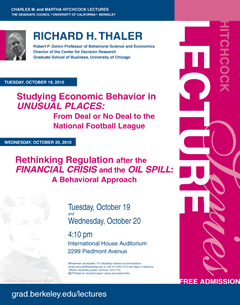
[00:00:00] MATTHEW RABIN:
Okay, hello. Uh, welcome. Um, I’ve lost my place already.
Um, the, uh, my name is, is Matthew Rabin, and I have the honor to introduce, uh, Dick Thaler today. Uh, it’s truly a pleasure to do so. I first wanna thank the university’s Hitchcock Lecture Series for their inspired choice and for all of their work, and for my colleagues, especially Stefano DellaVigna, for his inspiration to propose, uh, Dick and all his work.
I was very honored to, uh, to be asked to introduce Dick. I was at first very excited because I thought it was gonna be some sort of celebrity roast, and I would be able to make thirty minutes of insults. Uh, and then I found out it’s just supposed to be an introduction, and I only had five to eight minutes.
So instead of insults, I’ll say nice things
(laughter)
about him. Um, more honestly, uh, to say all the nice things about him will, will take, uh, a lot more than five minutes, uh, as well. I can say in public that I certainly consider, uh, Dick Thaler one of my true intellectual heroes, uh, for the way he has influenced, uh, economics, not for the result only, but for how he’s gone about it.
Uh, but I’m gonna mention a few things about how I first met him and play off of that to, I think, some of his, uh, uh, great, uh, contributions. Uh, the– I met Dick about 18 years ago, and the first two meetings emphasized some of the themes that have already come up, but that I also want to emphasize. Uh, the first is his laziness.
Um, he knew automatically what story I would tell, which is one of the first times I met him is when he invited me to Cornell, uh, to give a talk. It turned out he was teaching a course with two other professors, and they had a total of three students. And to unload some of that work effort, they brought in visiting speakers, uh, for the course.
Uh, so that’s what I was there for. Um, I don’t know whether there were 30 other people who were invited, but I was flattered nonetheless. Uh, uh, far more importantly, our first, uh, two meetings have stressed a couple things.
He invited me to Russell Sage Foundation. He mentioned that he was there visiting with Danny Kahneman and Colin, uh, uh, Camerer, uh, and I think they were at that time plotting their revolution, uh, probably organizing the first, uh, behavioral camp, which he mentioned last time, which has been running since 1994. We’ve done, uh, nine of them.
Uh, and, um, I did a count in my head at least that there are nine professors on campus who have been or are alumni of that, uh, camp, to give you a sense of, of his, uh, influence. Um, And the theme of that camp and the theme of sort of him inviting me, I think, is that not only his own, uh, in-incredible contributions in terms of the content of economics, but the vision and confidence he had in creating a field, essentially, and how he went about that. Uh, he’s influenced all these young researchers.
As he, he said, I think he wisely thought it would be mostly to influence young people, although I think he’s converted more, uh, uh, people than he, uh, acknowledges. Um, but he has been an incredible influence and incredibly generous in supporting myself, for instance, but countless other people well beyond his own, uh, research. It was an incredible vision to organize this, uh, program that he did and to sort of found a field.
The, um, the reason he invited, one of the reasons he invited me, I think, is because I think I quoted one of his favorite passages that he wrote from one of his Anomalies column, uh, with Robyn Dawes on cooperation about a fruit stand outside of Ithaca, New York. Uh, and he used it as he does in such anecdotes to illustrate a deep point. But these are fruit and vegetable stands outside Ithaca, as they are outside many towns, uh, and in the country that, uh, have no one there.
Uh, they have fruit and vegetables available. Anyone can come and take them, but they also have a box to put money in and a suggested price, uh, or a price. Uh, and he used it as a metaphor for the fact that there were enough generous people, uh, and enough fair-minded people who would actually pay for the fruit and vegetables, uh, so that people didn’t need to be there, but also that the money box was nailed down.
Uh, and that that was the right metaphor for thinking about departures from, uh, self-interest. Uh, so I want to use that example, uh, to, to illustrate a few things, uh, about his research. Uh, first of all, with the, uh, crippling exception of his hyphenation, he is an absolutely brilliant writer, uh, uh, along the lines of Thomas Schelling, and if you haven’t done yourself the favor of reading a lot of his, uh, work, you should, uh, do so.
Um, and other things are as combative and as skeptical as he sounds sometimes, he definitely believes in economic insight. And more than some researchers who have sort of tried to argue with economists, he believes in it enough, uh, And he doesn’t want to ditch the insight of economics. He wanted to understand that that, um, money box would be nailed down, Um, and so– uh, third thing is that despite the anomalies heading, um, and this came up yesterday a bit, he has been an inspiration in always talking about an alternative assumption, never just taking the economist model, saying, “Here, it’s wrong,” but rather proposing intuitively or more or with statistics and so forth, an alternative to the, the rational model.
And that has been, I think, incredibly influential, uh, in making this a very constructive, uh, program of, of behavioral economics. And this leads to the fourth thing, which has been– Dick has talked about this, but it’s been absolutely, I think, crucial. He has had a very explicit strategy of doing all of this within economics.
Speaking to economists in economic journals, uh, trying to influence, uh, economists rather than being a critic, uh, from outside. Uh, that makes it difficult because you get a lot of, uh, crap sometimes, uh, for, for doing that. Uh, but I think that has completely changed, uh, the way things have happened and has been one of the reasons that behavioral economics has been, uh, so successful.
And, uh, the fact that we have nine people on campus now, I think, and they’re in the economics department and in Haas speaks to where he wanted to target, uh, his, uh, the change in thinking. And finally, to use the, um, the, the, what Dick uses in most of his writing, and this illustrates, is he uses a lot of examples from his own life and from everyday life to illustrate, uh, the, the, uh, uh, point. So I wanna do the same and g- and illustrate, uh, this final point with an example from, uh, my own life.
I don’t know if Dick knows this story, but I was attending a finance seminar being given by David Levinson at a major, uh, university business school. Uh, I won’t mention which one. It’s near the Hayward Fault.
Um, And before the seminar, David was going to talk about uh, uh, defaults and, um, savings options, a-an area Dick may talk about today, but it’s certainly a, uh, one of the, the real, uh, breakthroughs in, in a lot of behavioral economics. He was talking about procrastination and people switching their plans and, and, uh, so forth. And before the seminar, a lot of the professors were sitting around, we were all sitting around talking about examples of, uh, procrastination.
I was talking about my own. Mostly, uh, people were talking about their spouses who, who haven’t been paying attention, uh, to their retirement funds, and just going on and on talking about these examples of procrastination. Then David begins his seminar, and all of a sudden, and he talks about other people doing this, and hands go up and say, “That’s impossible.”
If there was that much money at stake, people wouldn’t do that, uh, and, and so forth. And so I often use this as an example of not everything, but a lot of what Dick and others have had to say are relative common sense or very familiar to economists when we have our economists’ hats off. And when we put our economists’ hats on, then we all of a sudden think the exact same things like procrastination that we observe all around us and in ourselves don’t happen.
So I wanna close by saying Dick has rebelled against this distinction between having your economist hat on and economist, uh, hat off. Whatever’s true about people when you have your economist hat off, whatever’s true about people in your everyday, uh, life, is also likely to be true about people in their everyday life when we study them, uh, as economists. Now, it’s not that he leaves his economist hat off when he does economics.
I think it’s quite the opposite. He both does all the, uh, techniques that economists are supposed to use, and he leaves his economist hat on, but he leaves his economist hat on all the time when he’s observing everyday life. And most importantly, he just doesn’t– he simply doesn’t accept this distinction between what seems to be true about people and what seems to be economically, uh, important and what assumptions we’re allowed to make about people in our models.
That seems like a pretty obvious, uh, thing in some ways, but I think it was hard for many economists, uh, uh, to ac-accept. So I think, uh, getting rid of that distinction, uh, and, and really legalizing, putting, uh, very sensible assumptions into economic theory and into e-economic empirical work has been, uh, one of his great, uh, uh, contributions. Uh, and recently, I ca-can introduce him by saying recently, not only is he– he’s added to his, his, uh, decades of contribution to economics, he’s recently very aggressively tried to use a lot of this stuff to improve, uh, public policy, uh, in various ways, and I think he’s going to talk about that, uh, today.
So thank you, Dick.
(applause)
[00:11:10] RICHARD THALER:
Well, Well, uh, thank you very much, Matthew. Um, thanks to everybody who’s come, and special thanks to everybody who’s come back. Um, um, I’ve…
You know, one, one of the advantages of, um, corrupting all these kids, um, Matthew’s one of the older kids, uh, is that I’ve learned, uh, at least as much from them as they’ve learned from me. Uh, from Matthew, I’ve, uh, mostly learned about Homer Simpson. And, um, so, uh, several things in this lecture will be in Matthew’s honor.
Um, so first, an update, uh, from yesterday. Uh, there was– I, I paraphrased the quote, uh, that science marches on funeral by funeral. Uh, here’s the exact quote as emailed to me this afternoon.
Um, it comes from Max Planck. “A new scientific truth does not triumph by convincing its opponents and making them see the light, but rather because its opponents eventually die and a new generation grows up that is familiar with it.” Um, and, uh, paraphrasing, “Truth never triumphs, its opponents just die out,” or the version I gave, thanks to Paul Soss for sending me that.
Okay. So, Uh, eh, I’m going to– Much of what I’m going to talk about today, um, comes from my, uh, book, Nudge, which we’ll get to in a little while, um, that was written with Cass Sunstein. Um, uh, Cass and I, um, try to make the distinction between the people that economists model and the rest of us.
And to shorten it, we call, um, the agents in economic models, econs, and real people, humans.
[00:13:28] MATTHEW RABIN:
Now, how do they differ?
[00:13:32] RICHARD THALER:
Well, e-economists r-really assume that economists are as smart as they are, or really as smart as they think they are. And, uh, and the, the norm in economics has become that, you know, suppose some old guy like me writes down some model of rational behavior, and then a younger guy like Matthew comes along and– but a rational version of Matthew, and, and, and, uh, in every sense, and then– and thinks of a way in which the agents in my model could be smarter, then the norm has become that his model is better than my model. And as a result, the agents in, in economic models have gotten smarter and smarter over the last sixty years, and we haven’t.
And, and so as a result, there’s this been this growing divide that probably peaked in the 1980s of the w-when hyper-rational models be-were very much in fashion. A-a-and so pe-the agents are really, really smart, and we’re just sort of plodding along. Now, um, thanks to, uh, neuroeconomics, we’ve been able to establish the actual truth.
Now, um, so there you go. That’s a visual image of bounded rationality. I, I was trying to get this so it looked like Matthew, but uh, my, uh, P-PowerPoint skills aren’t, aren’t good enough.
Um, so that’s the last thing I’m gonna say about neuroeconomics. Um, now, um- the, the second, uh, way in which economists differ– uh, econs differ from humans is, um, humans have self-control problems. Um, again, I– here’s a quote I learned from Matthew.
Homer, when told by a gun shop owner that there’s a five-day waiting period for a gun he wants to buy to kill somebody, says, “Five days? But I’m mad now. And, uh, now, uh, Matthew, uh, and his colleagues have called this combination of no self-control and no self-insight about one’s self-control, naivete.
And, um, so this is like the pathologically, uh, uncontrolled person who has no clue. And, uh, actual humans are slightly more with it than that, and they lie somewhere between this pathetic creature and a very smart version of this that, uh, uh, David Laibson has suggested of sophistication. And the, the people I’m gonna talk about today are neither as dumb as Homer Simpson or as smart as David Laibson, uh, but there’s a big gap, uh, between those two.
Um, the third way in which humans differ from, uh, econs is that humans are nicer. Um, so e-econs are unboundedly unscrupulous. And they will, Any interaction between a human and an econ is an opportunity for strategy, and they will take advantage of it if they think it’s in their long-run interest.
Um, now, uh, in Matthew’s honor, I’m bringing my empirical evidence of this. This is the picture Matthew referred to of the fruit stand in Ithaca. Uh, it’s selling rhubarb.
Uh, you can’t quite see the rhubarb, but you can see the sign, and you can see the box with the lock. And as Matthew suggested, this is really my model of human nature, which is that there are enough people who will put money in that it’s worthwhile for the farmer to put the rhubarb out, but there’s also enough econs around who will take the money if you just leave it lying there. Um, so finally, we get to markets And behavioral economics is a branch of economics, a way of doing economics, not a branch of psychology, precisely because what we think about is what happens when you put humans into markets, and especially if there are some econs around trying to take advantage of them.
Now, um, the, uh, the standard assumption about, uh, markets is that they are efficient. And here’s my proof that they’re not. Now, this is a picture that was taken in Buenos Aires.
And now, there are some of my finance colleagues, like, uh, Mark Rubinstein, who’s sitting up in the front of the room, will probably say, “No, this is not a violation of the law of one price, which is the fundamental driver of finance theory.” No, this is price discrimination against stupid Americans who don’t know the Spanish for orange juice. Now, notice they have to be so stupid that they don’t see that the two pictures are identical, which kind of violates the unlimited rationality hypothesis.
So you have to give up one or the other. And, uh, now Matthew would prefer that, uh, this– I would stop my discussion of finance at this point. Um, but some, some think this isn’t completely convincing.
So, um, let me spend five minutes, uh, on something more convincing. So, um, the most efficient place where we would expect markets to work best is financial markets because the transactions costs are low, essentially zero in, in, in most cases, and the stakes are very large. So if anything is going to work like a textbook model, it should be the New York Stock Exchange.
So I got interested in finance precisely because of this. Yeah, and it, it, it’s sort of the New York, New York model. You know that if you can make it there, you can make it anywhere.
So my feeling was if we could make some inroads in finance, then it would sort of diffuse this idea that we’re only about toy problems in laboratories. So I was helped with, uh, one of my first students, I think, in fact, my first student, uh, a Belgian named Werner De Bondt, and, uh, he wanted to do finance. So I said, “Okay, you know, why not?”
And, um, so we wanted to test one principle of financial economics, which is that you can’t predict the future from the past. So it– prices– markets can’t be efficient if this is violated, because otherwise you could make tons of money. Now, uh, how, uh, how– at, at this– at one point, Michael Jensen, a leading proponent of market efficiency at this time, now become a born-again something else.
um, uh, Jensen said famously that the efficient market hypothesis is the best established fact in social science. Now, it helped he hadn’t read much social science at that time, but anyway, that was his claim. And, um, so here’s what Werner
and I did. I mean, this is lazy finance. Uh, we, we– especially since Werner did all the programming, We, we, uh, formed portfolios of the fifty biggest losers over a five-year period, and then the fifty biggest winners.
And then we tracked those portfolios for the next five years. How would they do? Now, the efficient market hypothesis says they should do the same, because remember, you can’t predict the future from the past.
So we should just see– they, they should be indistinguishable. So here’s what we find. This is averaging over many years of data.
Uh, we see that losers do very well. They, uh, outperform the market by about thirty percent. The winners do poorly, underperform by about ten percent.
And a-after five years, the difference is about forty percent. Uh, now there’s some funny things in this chart. You notice the losers are doing all their winning in January.
Uh, we had no idea why that was. Happened to be true. There, th-there are other, other funny things that happened in January.
That seems to have sort of died out over time after academics started writing about it, kind of shifted around. Um, but this loser effect, or more general versions of it is still quite robust. It’s called the value effect.
Um, now, what were the– There was an army… I was at Cornell when this was written. There was an army of University of Chicago finance graduate students put to work to find our programming error.
Because th-th-it was known this cannot possibly be true. So what mistake did we make? Well, it turns out De Bondt, uh, bless his heart, um, doesn’t make programming errors.
Uh, he didn’t even– he didn’t trust, uh, canned regression programs. He, uh, so he would write them himself to check to make sure the canned programs, uh, were working right. So here are the complaints.
Uh, the first is that these losers must somehow be riskier than the winners, because otherwise, why are they outperforming? So, uh, now, if, if– the standard measure of risk at this time was something called beta. I won’t go into what that is.
Uh, it’s covariance with the market, essentially. The losers actually had lower betas than the winners, so that couldn’t have been it. Uh, but then people started getting creative in how they measured beta, and if you measure beta afterwards, well, a big argument ensued.
Uh, all I can say is no one has ever found a way in which these losers are actually riskier than the winners. But, in some metaphysical sense, if you want to call them riskier, you’re welcome to. Um, uh, then they were pointed out that the the losers, those were smaller, and there’s a well-known phenomenon that smaller stocks outperform bigger stocks.
Now, what’s true is they had become smaller. They didn’t start out that small. But if you’re the fifty w-worst performing stocks over a five-year period, you’ve really shrunk.
And in any case, finance has absolutely no theory about why portfolios of small firms should do worse than big firms. So this is really just shifting the anomaly from one place to another. Um, so I’m gonna spare you the thirty years of arguing about this.
Um, and move on, uh, to the other dimension of market efficiency, uh, the price is right. Um, now, the idea here is that, uh, in an efficient market, prices are equal to the intrinsic value of the asset. So that, that’s the second pillar of efficient market theory.
And in some ways, it’s an easier one to defend than, uh, the first one, uh, because most of the time it’s not testable. And that’s handy if you want to defend a theory, is to make it untestable. Um, and it’s untestable because you don’t know intrinsic value.
Stocks don’t come with labels saying, “Here’s my intrinsic value.” So you need to be clever to figure out how to test this. So, um, I had a colleague who’s clever, uh, a guy called Owen Lamont, uh, one of my colleagues at Chicago.
And here’s the story we investigated. There was a company in Silicon Valley in the nineteen-nineties, and i-if you remember back to the nineteen-nineties, stock market was going up very fast. Tech companies were doubling every few weeks, and, uh, it was an, an exciting time to be a stock on the Nasdaq.
But 3Com, which owned PalmPilots, which you can think of as a very clunky version of an iPhone that doesn’t make calls, but it was thought to be quite sexy at the time. Um, 3Com is being ignored. Um, so here’s a plot of 3Com’s stock price during this period.
Here’s the summer of nineteen ninety-nine, which was a very exciting time for NASDAQ stocks, but not for 3Com. Um, so 3Com decides we need to unleash value. And how are we going to do that?
We’re going to spin off Palm and make it its own company. Now, of course, in an efficient market, it would make no difference whether Palm is inside of 3Com or outside. However, you can see the market really liked this idea.
So they announced here that they’re gonna spin off Palm, and their stock price jumps from about forty-two to a hundred. And as the IPO of Palm gets nearer and nearer, 3Com is racing up. So here are the details of the spin-off.
The details are important. Um, the this second bullet is the crucial number. Each 3Com shareholder gets one point five shares of Palm.
Okay? Now, with my high-powered mathematics, I’m able to derive the following inequality that that means that 3Com’s share price must be equal or greater than one point five Palm because every 3Com shareholder got one and a half shares of Palm.
Okay? Now, uh, on the first day of trading, the market goes crazy over Palm. At one point, the price is as high as a hundred and sixty-five.
Uh, it ends up settling the day at ninety-five dollars a share. Now, if you multiply ninety-five by one point five, you get a hundred and forty-two. Remember, 3Com was selling for a hundred, so that means it should go up by forty-two percent.
Actually, it fell. It fell by twenty percent. And at the close of the market, the market was valuing 3Com, the stub, meaning its value l-less its interest in Palm, at minus twenty-three billion dollars.
Now, there’s a really basic principle of finance, which is asset prices cannot be negative.
(laughter)
Right? Because you can throw them away. Um, but here we go, minus twenty-three billion dollars.
That’s fairly negative. Here’s a plot. This is– So 3Com’s stub was worth minus sixty dollars a share at the end of that day.
Uh, some sanity came in the next day. It was only worth minus thirty-eight dollars a share. And then it lasted for several months.
Finally, at the IPO, when Palm was released, 3Com was worth some positive amount, which of course it had to be. It couldn’t be worth a negative amount once it started trading. Okay, so, uh, where does this leave us?
Uh, w-we’re more like Homer economicus than Homo economicus. And markets are not perfect. So what does that mean for government?
Does that mean that we should have governments come in and run everything? Should we abandon markets and, uh, adopt Soviet-style systems? Well, you can guess my answer to that is no, and in part because of the realization that governments are run by humans, too.
So, and in fact, running an economy is an impossibly complicated task. So what the role of government should be is an interesting problem with not an obvious answer. And that, of course, is, uh, what Cass and I try to address in our book.
I should say Cass is probably the most distinguished constitutional law professor of his era. Um, a great friend, and now is, uh, well, in the media they call him the regulation czar. Um, he, his official title is he’s the director of the Office of Information and Regulatory Affairs.
And so I call him the nudger-in-chief. Um, so when we set out to write this book, Cass likes to write books. I had never really written a book.
I had stapled a couple, um, co-collections of papers. Uh, have we mentioned my laziness? Yeah, I think that’s come up.
So, uh, Uh, when we wrote this book, uh, we had two goals. Uh, uh, we called them, when we were talking among ourselves, the ambitious goal and the ridiculously ambitious goal. So the ambitious goal was to take uh, the work I and my corrupted young friends have been doing for thirty years or so and bring it to a lay audience and see what it might have to say about public policy.
So that was the ambitious goal. The ridiculously ambitious goal was to try to create a political framework that was neither left nor right. And now in the US, that is a ridiculously, uh, ridiculous goal.
Um, and Glenn Beck has decided that Cass Sunstein is the most dangerous man in America. Uh, quite an honor, I think, for Cass. But, uh, uh, uh, I don’t– Glenn Beck doesn’t know much about me, so if he knew, he would realize I’m more dangerous inherently, but Cass has a more dangerous job.
But, um, but in other countries, there’s some hope that, um, this approach that I’m going to talk to you about, uh, isn’t really ideological. So, um, the Conservative Party in the UK, um, has David Cameron read the book and one summer assigned it to all the Tory, uh, MPs. And, uh, they recently created what is known in Number Ten as the Nudge Unit.
Uh, the official name is the Behavioral Insight Team. And, um, I’m an advisor to that group, and our charge is to think of ways of using behavioral science to improve whatever government is doing. Now, it is fair to say that, uh, the Conservative Party in the UK is not very different from the Democratic Party in the US.
But, uh, I’m just back from Korea, where the prime minister there is a conservative by any definition. He also assigned the book to his cabinet. And so there is some hope, we think, that what I’m about to tell you about could be an idea that either party could take on.
So what is that idea? It comes with a really snappy name, libertarian paternalism. Now, as you know, both of those words are unpopular in this country.
Um, libertarians are thought to be crazy people who live in Montana and Hyde Park, uh, uh, a neighborhood in Chicago. And, um, uh, and but they’re loved compared to paternalists who are reviled everywhere, possibly even in Berkeley. So our idea was to take these two hated, contradictory words and combine them, right?
It’s a winner. So, um, now the w– uh, here’s the way we do that. Uh, by libertarian, what we mean simply is choice-preserving.
So we never want to tell anybody what they have to do. By paternalism, we simply mean, um, that we care about people’s outcomes as defined by themselves. So that’s what we want to do.
And, uh, how do we achieve this? We achieve it with something we call choice architecture. So who is a choice architect?
A choice architect is anyone who designs the environment in which we choose. So consider, uh, if you go to a restaurant, the chef has decided what food items he or she will prepare, but there’s someone who gets to put that on a piece of paper, um, and in some, in some order. So, uh, the place we went to lunch today, uh, what’s it called?
Gather. Very nice restaurant. Um, there were three categories of things.
There were salads, there were pizzas, and there were sandwiches, and maybe there was a fourth one. Um, now it needn’t be grouped in that way, but they were. And then within each category, there’s some order.
Somebody’s deciding that. Well, that person is the choice architect. Now, so what?
Well, here’s the most important point I’m going to make today. There’s no alternative to choice architecture. Sometimes people accuse Cass and I of meddling.
The point I want you to leave with today is it’s impossible not to meddle. So here’s the example we used to start the book. Suppose that the director of school cafeterias in Berkeley dis-discovers, through experimentation, that the order in which the food is displayed influences what the kids eat.
So if the tofu is in front of the yogurt, then more people will take it than the other way around. I assume those are the only two things that are served. at the, at the, uh, s- Berkeley school cafeteria.
Now, now, okay, so armed, armed with that information, what, what should she do? How should she arrange the food? Well, one choice would be to arrange the food in such a way as to make the kids healthy and happy.
So somehow defined, make the kids best off. Okay, that’s one option. She could try to make the kids fatter.
She could fool herself into thinking she can avoid choice architecture by arranging the food at random, but of course, that’s just gonna create havoc. Imagine if all the ingredients in the salad bar are scattered all around the room, so the lettuce is over there and the tomatoes over here, and the dressings are back there, right? The line will come to a complete stop.
Um, or she could follow the Illinois, State of Illinois model and feature the items for which she gets the largest bribes. But, um, again, the point I want to make is she must choose something. It’s impossible not to meddle.
So given that, we argue, why not pick something good? Now, um, this was a hypothetical example, right? This came out of my head, this school cafeteria.
There’s no study that I knew of. It just made sense to me that that would be true. Uh, thanks to Brian Wansink, uh, the author of a brilliant book called Mindless Eating, is this hypothetical example is now true.
Um, so he’s doing experiments in school cafeterias exactly rearranging the food. So in one, one school, they’ve increased the salad uptake just by moving the salad bar. In another school, they’ve increased the fruit consumption by putting the fruit in a nicer display.
And if you’re interested in this, look at Brian Wansink’s, um, uh, website or go to smarterlunchrooms.org. They just got a million-dollar grant, uh, from the government to, uh, continue this work. Now, uh, so that’s one sort of highbrow nudge.
Uh, here’s a more famous one. Now, this is a picture of the urinal in Schiphol Airport in Amsterdam. You, you can see if you sort of squint, there’s something in there.
Uh, so I have a blow-up of that. So some genius dec- decided that if you etch the image of a housefly in the urinals, then… Well, see, I-
Now, I have to explain this, that, you know, men, we have a lot on our minds, you know?
(laughter)
You know, the, the Giants have a big game tonight. Uh, who are we going to start in our fantasy football league team? So while we’re taking care of our business, you know, we-we’re thinking about other things.
But… And I’m sure there’s an evolutionary explanation for what I’m about to say. If you give us a target, we will aim.
(laughter)
S- so, and here, here’s hard data. Uh, uh-
(laughter)
spillage has been reduced by… I don’t know the empirical methods on this.
(laughter)
But, uh, we’re gonna just take that as a given. Um,
(laughter)
Now, this is like a paragraph in our book, but it’s probably had thousands of newspaper articles written about it. But, um, so we have a, a chapter on choice architecture that I don’t have time to go into, and we detail six principles of good choice architecture. Uh, I’m– today I’m going to just talk about defaults.
So, here’s one example that we’re working on in the UK. Uh, in, In the US, in most states, if you want to donate your organs, should you, uh, have a sudden accident, um, you have to take some action. You have to fill out some form or do something.
So it’s an opt-in system. In some countries in Europe, um, most notably Spain, uh, they have an opt-out system that they call presumed consent. And, uh, the way that works is you are presumed to give your consent unless you do something.
Now, the Labour government in the UK wanted to switch from the opt-in system to an opt– to presumed consent, but there was a big fuss made. Um, some people objected to someone else presuming something about their body parts. And so, um, what, what I’m urging the government to do, and I think what they may do, is adopt what I call prompted choice.
Now, in the book, we referred to this as mandated choice. I’ve learned a lot about politics in the last two years. Uh, prompted choice is exactly the same policy, but sounds better, so we call it prompted choice.
Um, this is actually something the state of Illinois does right. When you go to get your driver’s license renewed, the last question the clerk at the DMV asks you is, “Would you like to be an organ donor, yes or no?” “Now, I called it mandated choice.”
Somebody wrote a newspaper article about this, and the, uh, Secretary of State in Illinois said, “No, we don’t have that.” So I got a call from the reporter, s-s– “The state claims they don’t have it.” I said, “You know, I don’t know what he’s talking about.
I’ve been there. I know.” It turns out he just didn’t like mandated.
He says, “We don’t force anybody to do anything.” So technically, he’s right. If–
if you get up to the front of the line and they s-say, “Do you want to be a donor or not?” And you stand there mum, they will check no and give you your driver’s license. So that’s why we now call it prompted choice.
Uh, and, uh, and, and that’s the model I think, uh, we’ll probably adopt in the UK. Now, I wrote a, an article about this in The New York Times, where I have an occasional column. Um, and I said that Steve Jobs, who had just recently gotten a liver transplant, should take it upon himself to make it as easy to donate your organs as it is to download an app on an iPhone.
Two weeks later, there was an app. It– Steve Jobs had nothing to do with it. Somebody read the article, thought it was a good idea.
If you have an iPhone, you can download Donate Lives and sign up to be an organ donor, and maybe we can save a few lives today. Now, uh, another domain in which default options has proven to be very powerful is in 401
(k)
plans. Uh, many 401
(k)
plans, participants never get around to signing up. They procrastinate. Fortunately for Matthew, the pension plan here is required, but, um, probably not the extra part.
But, um, so what– in a normal plan, if you wanna join the p-the plan, you get a big pile of forms to fill out. You have to fill those out. If you don’t, you’re not in.
Uh, under the alternative, i-i-i… which is called automatic enrollment, you get that big pile of forms, and the first page says, “If you don’t fill out these forms, we’re gonna enroll you at this saving rate and in this investment plan.” Well, that jumps enrollments immediately to over ninety percent in every firm that’s tried it. And importantly, very few people wake up a few years later and say, “Oh my God, I’m saving.
What a stupid idea,” and drop out. Now, the, the downside of automatic enrollment is that whatever you make as the default, many people will take. And so many companies make the default saving rate quite low and, uh, the default investment very conservative.
So, um, i-i… we advise now firms to have a more sensible default plan like, uh, uh, something that rebalances the portfolio automatically and adjusts it over time. And, uh, Shlomo Benartzi, another one of my students, and I have created a program we call Save More Tomorrow to solve the saving rate problem. And what we do is we invite participants to sign up for a program where they save more later.
And the reason for that is that we all have more self-control in the future than now. So many of us are planning diets starting next month, Um, uh, including me. Uh, s-so we give them the option of saving more in a few months when they get their next raise, because we wanna mitigate against loss aversion, so they never see their pay go down.
In the first company that adopted this, we tripled saving rates in less than three years. Uh, i– that was a special case where we went around to each employee with a, a laptop and sort of l-led them by the hand. Sign-up rates are, uh, have never been that high in other less costly implemen-implementations, but Everywhere it’s now available in thousands of companies, uh, serving millions of employees.
And wherever it works, the people who get into it stick, and their saving rates go up. Now, I want to switch to, uh, uh, an idea that’s less sexy, I— but I think, uh, is getting some traction, uh, in Washington and elsewhere. Oh, it’s a very geeky idea.
Um, and, And the idea is a simple one. Wherever the government has a required disclosure rule, they would supplement that with an electronic disclosure. So, and the disclosure, where applicable, would have two kinds of information, one about prices and one about uses.
So le-let me explain how this might work for, uh, wireless calling plans, which is very relevant because the FCC is seriously thinking about adopting some version of this idea. So the idea would be once a year, you would get an email from your, uh, mobile calling plan that would have essentially a spreadsheet attached to it, and it would have, uh, a l– It would have data on every way in which you used your phone that incurred a charge.
So how many text messages, how many mega whatevers of things you’ve downloaded, and, um, uh, it would… And how many Simpsons episodes you’ve downloaded. And, um, and then the second would be a list of all the ways they can charge you for things.
Now, it’s not that we think anyone would ever look at that file. Uh, what we think is that– what we know is, because these websites already exist, is that with one click, you would be able to upload that to a website that would then turn you into an Econ. And it would tell you, \”Well, based on the way you use your smartphone, we suggest that you switch to the following plan or the following provider or so forth.”
We, we think we should do this with credit cards, with mortgages. You know those thirty pages of forms you have to fill out when you get a mortgage that no one ever reads, including the, we now know, the people foreclosing on those mortgages. Uh, again, we think that you ought to get a file when you apply for a mortgage that you could upload to mortgage searcher dot com, and it would tell you, “Well, do you notice that this mortgage rate doubles in two years,” or “There’s a twenty-five thousand dollar prepayment penalty,” or all the other stuff in the fine print that nobody ever bothers to read.
So, um, What we think is that in many cases, this kind of disclosure can be an alternative to heavy-handed regulation. And the reason is you just are trying to make the consumers smarter and the markets work better. Um, and it eliminates the fruitless game of constantly thinking up new regulations that the firms are thinking up ways to getting around.
And so I would urge Elizabeth Warren to think very hard about this approach to dealing with the new Consumer Finance Protection Agency. Um. it also should allow for innovation because if you want to introduce a new product, you just need a new line on this electronic form, which is easy to accommodate.
Now, the last thing I want to talk about is the financial crisis and some interesting parallels I’ve drawn between the financial crisis and the oil spill we had in the Gulf of Mexico. And I want to s-suggest that three ingredients create a toxic recipe. Excuse me.
Uh, the three ingredients are statistically rare events, um, in Taleb’s language, black swans, complex technologies that are called black boxes, and counterparty risk, meaning you have to do business with somebody else and you’re not quite sure what they’re doing. So, about black swans.
Hello. Um, in financial markets, we keep observing things that the theory tells us can’t happen. So, uh, behavioral finance got a big boost on October nineteenth, nineteen eighty-seven, when stock prices fell twenty to thirty percent in a single day all around the world on a day with absolutely no news.
The only news was that stock prices were falling all around the world, one country after another, as the stock markets opened. Uh, there was no– It wasn’t that ten heads of state died in a bomb at the UN or that a war was breaking out in the Middle East.
Nothing happened. The rest of that week had two of the biggest up days and another of the biggest down days. Again, in a week that the only news was that the market was going crazy.
Uh, we’ve had more of those happening every few years. Uh, the internet bubble where we created and destroyed seven trillion dollars of wealth, uh, and most recently, the financial crisis. Now, people will tell you these are ten sigma events or fifteen sigma events.
We know we can’t get those. It, you know, maybe once every hundred million lifetimes. So, what’s going on?
At some point, when a lot of these events keep happening, you have to decide you have the wrong model. Now, there’s a wonderful book I wish you could all read. Uh, I just recently gave a lecture about this at Yale.
The, the author of this book was a law professor called Arthur Leff. The book’s called Swindling and Selling. It’s been out of print for thirty years, although you can find it on Amazon.
He talks about all the great cons and, uh, about Ponzi schemes, and he, he introduces the notion of the gray box. And so what he– The theme of the book is for every con, the con man has to explain the answers to two questions: Where is the wealth coming from, And why are you willing to share it with me? And as this passage says, in a Ponzi scheme, the original Ponzi had an arbitrage opportunity.
He claimed he had figured out a way of investing de-depreciated European currencies in international postage coupons and making a killing. Um, so, w– all Ponziers since have some mechanism that they describe, and as Leff says, the mechanism need not be very plausible upon reflection, but it must be possible, publicizable, and complicated. It cannot be a black box, but it cannot be transparent.
It needs to be a gray box, somewhat understandable, but not so much that it can be seen through. Now, why is that? Gray box must be believable and unbelievable at the same time.
It has to be understandable that some people won’t want it. That’s why you’re getting the deal. Now, think about, uh, Wall Street.
First, the financial crisis. The most perceptive article and all that’s been written about the financial crisis was written by a New York- New Yorker food writer called Calvin Trillin. And he, Trillin describes an imaginary scene at an East Side bar where he goes into the bar and meets an elderly gentleman, well-dressed, who offers to explain the financial crisis to him.
Says he c-can do it in one sentence. “Okay, what’s that?” He says, “Smart people started working on Wall Street.”
So, “Okay, well, I’m not sure I get that.” So he says, “Well, back when I was in school, only the C students went to Wall Street. The A and B students wouldn’t touch Wall Street.
They be– went into, you know, good careers like law or medicine. But then in the ’80s, people started making a lot of money on Wall Street, and all of a sudden, the brightest, smartest kids from all the best colleges flocked to Wall Street, where they were making millions.” So Mr. Trillin says, “Okay, uh, so far so good.
I don’t see what the problem is.” He says, “Yes, but who are all those smart kids working for? The guys from my generation, the C students.”
Now, I think that story is so perceptive because it’s– we’ve seen after the fact that many CEOs just didn’t understand what was going on. Even Bob Rubin, the most respected, one of the most respected men on Wall Street, former Secretary of the Treasury, admitted that he had never heard the phrase liquidity put until Citicorp had lost fifty billion dollars selling liquidity puts. And
(cough)
Bernie Madoff, who sold sixty-five billion dollars worth of gray boxes, How did he sell them? He had some story, uh, that– a story that any finance professor with fi– after five minutes would say, “This is not possible for you to make money doing this.” Um, why did people put their money in?
They thought he was front running. Now, front running means he had a trading company; a legitimate, presumably legitimate trading company. What front running means is, suppose Matthew calls his broker and decides to buy a hundred thousand shares of IBM, And the broker quickly buys a hundred thousand shares for himself first.
That drives up the price. He sells those to Matthew. So that’s a pretty sure way of making a little money each time you trade.
Hey, it’s illegal, but that’s what many of the investors and the feeder funds thought Madoff was doing. And they thought, “This is fine because he’s stealing from someone else and giving the money to me.” That which constitutes ethics these days.
Now, here’s some facts about the SEC. They have fourteen hundred lawyers, twenty-five economists, and I don’t know how many hackers Um, I am pretty sure that if they could clone, uh, Salander and put her in the SEC, um, that would, could replace several hundred lawyers, uh, and probably most of the economists. Uh, but the SEC was a job that was used to be suitable for an agency of lawyers, but the SEC investigated Madoff many times, couldn’t find anything wrong with it.
Um, Finally, counterparty risk, I’ll just quote, uh, Mr. Greenspan. In fact, I’ll let you read that while I get a sip of water. Okay.
Now, The oil spill. Uh, Tony Hayward said this oil spill was a mu- one in a million chance. Now, whenever b- somebody says that, you have a pretty good idea that was not a precise calculation.
(laughter)
Uh, but I- if you look at the numbers, there are 15,000 wells in the Gulf of Mexico. Um, in 11 cases, there was an accident in which they had to use the, um, blowout preventer, and the blowout preventer worked forty-five percent of the time. That was their fail-safe mechanism.
It works less than half the time. And if you th– if what he meant by one in a million was one in a million per year per well, you can see over a period of time we’re gonna get some spills. Uh, again, the regulators are not used to dealing with oil wells that are a mile down.
So one of the inspectors said, “You know, we don’t really have the capability of doing this.” And counterparty risks, on the day of the accident, of the 126 people on the rig, only eight worked for BP. So what are we going to do about this?
Well, o-one trap is to conclude that we should give lots of power to regulators. But remember, uh, regulators are human too, and it’s unlikely that if the CEOs didn’t understand what was going on in the company, that some bureaucrat will be able to, no matter how good the bureaucrat is. So one goal I think should be to increase transparency, which will allow more people to get involved.
So the rating agencies let us down. I think with more disclosure, we wouldn’t have needed the rating agencies. If every mortgage-backed security had all the data on every mortgage, which was known to them and was possible to get if you paid enough money, if that was all available just like in our electronic disclosure, then any geek could have become a rating agency.
And in some cases, disclosure will regulate risks to their own firm. Another possibility is to impose taxes on those who impose risks. So this is m– a topic of much discussion in bank regulation.
It could a-also be for oil drillers. The problem with this is, A, knowing how to measure the risk. Is it one in a million?
What is it? Bankers would have told us there was no chance of this sort of breakdown. Um, another approach could be to require them to have insurance, which shifts some of the risk from the government to the insurer.
But of course, we can’t be sure whether the insurance companies are fully up to the job. So let me conclude. Our, our world is getting increasingly complex, but we’re not getting any smarter.
Neither the private sector nor the public sector seems to be up to the job of dealing with this complexity. Uh, to paraphrase something Larry Summers said about financial regulation, we need regulations that don’t require anybody to get any smarter. And by that, what he meant was neither the consumers nor the regulators, because we can’t hope that the next round of regulators will be smarter than the last round.
They’re going to be humans, too. So I’ll offer two rules. Start with electronic disclosure, and don’t ban and mandate, just nudge.
Thank you very much.
(applause)
So we, we have time for some questions. There’s a mic up here. Those of you who have to leave quickly, you should do so. And, uh, those who have insightful questions should go to the mic. Sorry, did I take your job, Matthew?
[01:09:04] MATTHEW RABIN:
Yes.
[01:09:04] RICHARD THALER:
No, but I knew you were just gonna lay on insults, so go sit down.
(laughter)
[01:09:12] AUDIENCE MEMBER:
Yeah. My question, my, my question has a, it relates a little to the black swan idea, but let’s, let’s, uh, uh, suppose a situation. Just suppose a situation, uh, where through some completely unpredictable event, people all have to buy broccoli.
They’re crazy about broccoli. They buy it in stores. They buy it in restaurants.
They go absolutely nuts about broccoli.
[01:09:42] RICHARD THALER:
Mm-hmm.
[01:09:43] AUDIENCE MEMBER:
Naturally, the broccoli goes up in price.
[01:09:45] RICHARD THALER:
Right.
[01:09:45] AUDIENCE MEMBER:
It goes so much up in price that it’s unavailable. It spills over to other vegetables. So this is a situation where intrinsically the transaction of buying or selling broccoli is completely understandable, reasonable, but it is the sheer volume of it that distorts the market.
You’ve talked about this as a black swan event, but it’s more than that. It’s just that the ordinary transactions can simply have a runaway quality to them.
[01:10:16] RICHARD THALER:
Well, I, I, I, I think, I think that I– that story is high– is implausible on two grounds. One, broccoli. Uh, uh, uh, but, uh, the other is that if there’s a big run on broccoli, people will buy cauliflower.
So, uh, or broccolini. So, uh, I, I don’t think we’ve– I mean, occasionally there were tulip bubbles and so forth, but I, I, I don’t think we’ve seen too many asparagus bubbles.
And I think we do need the complexity before we really worry about whether markets work. Yeah, next.
[01:11:03] AUDIENCE MEMBER:
Some of us are particularly concerned about climate disruption, carbon emissions, that sort of thing. Yet most economic models continue to be built around growth. And many of us are beginning to use your work and the work of others on persuasion to try to awaken the public to just how serious a situation we’re facing is.
Could you say anything, uh, about that, please?
[01:11:29] RICHARD THALER:
Yeah, sure. So, um, we, we, we have a chapter on climate change in, in the book. Uh, what Cass and I believe… Well, I don’t know whether he’s allowed to say this publicly. So what I believe, what we wrote in the book, um,
(coughs)
is that the right way to start is, uh, by getting the prices right. So a carbon tax, cap and trade, something like that. Let people face the costs they’re imposing on the rest of the world.
Um, uh, Congress doesn’t seem to have the guts to do that right now. Uh, so there are lots of small things that we can do in the short run. In the book, we, we talk about the example of the ambient orb, which is a little green light that gets installed in houses where they have a smart grid.
And it’s normally green, but when you start using a lot of electricity in peak periods, it starts glowing red. And that reduced, uh, emissions in peak periods by forty percent. I-in the book, we suggest it would work even better if it played annoying music.
Uh, uh, we suggested ABBA, and then got angry, angry mail from ABBA fans. So, uh, uh, uh, uh, uh, Robert Cialdini, the great social psychologist, is working with a company called Opower. Uh, I don’t know whether you get these bills here in Chicago.
We get bills that tell you how much energy you’re using compared to your neighbors. Th-that, that lowers usage bills by about three or four percent. Now that sounds like trivial, a drop in the bucket.
That’s the wrong way to think about this. Costs nothing to put that on that bill. And three, four percent, you know, that’s if we could get three, four percent in a lot of different places, pretty soon we have twenty or thirty percent.
So I think that there are lots of ways. I was at a conference recently, a smart grid conference, uh, where I was asked to speak about how we can use these ideas in this domain, and there, there’s certainly a lot of interest in trying to do that. Uh, you know, I would say you want to get the incentives right and make it salient.
So, uh, and third, and I should have said something about this before, so let me just stick it in. If there’s a three-word message I have, that’s the message of psychology for the rest of the world is, If you want to get people to do something, make it easy. Now, that sounds like the most obvious, banal, stupid comment anyone can make.
Uh, it’s remarkably unobvious to a lot of people and, um, really important. So i-i-if you want people to do something, make it easy. Yeah.
Next question.
[01:14:50] AUDIENCE MEMBER:
Hi. Yeah, I’m curious to get your opinion on the current, uh, forms of legislation that are coming out of government, in particular the financial reform bill. To its critics, people think that it’s just a giant Kafkaesque bill that’s a big kind of rat race between corrupted parties.
To others, say, “Well, the attempt is to not, uh,” stifle innovation in the financial markets, not saying you can’t drive over fifty-five, but getting much longer ’cause you’re trying to redefine driving and what a road is and how we should d-do the rules in general. I’m curious to know your opinion if you think it’s the former or the latter or somewhere in between?
[01:15:20] RICHARD THALER:
Well, I think we don’t– the answer is we don’t know, and, um, it– because the bill doesn’t really say very much. Uh, the, the, uh, the bill creates an agency that has the power to create some regulations. Um, Elizabeth Warren has been appointed to decide what that agency will do.
If they write regulations, Cass Sunstein will have a say in what they are, since his job is to make sure that all new regulations, um, have more benefits than costs. So the truth is, we don’t know. The, at, at, much the same is true of the healthcare reform, that it will take us several years.
I mean, there are some obvious things. We will have more people covered. Will, in, in the healthcare reform, will we manage to get costs down?
That depends on the skill of the people in charge, and, uh, they will be up against lots of vested interests who want to make more money. So these are hard jobs. The– That– Th-this is why I spent a day in Washington a month or so ago talking about electronic disclosure, um, because I think this is a very easy thing to do that doesn’t impose big costs on the firms, but will make markets more efficient, and in particular, will reward honest firms that are giving value for product and penalize firms that are succeeding by obscuring what they do with hidden fees.
So that’s where I would start, but fortunately, I’ve kept my day job.
[01:17:23] AUDIENCE MEMBER:
Yes. The, the part of your presentation about efficient efficient market hypothesis was an education for me, a surprise. So I’m wondering if you would share with us some investment strategies, perhaps your own, perhaps, say, geared to a woman around 30.
(laughter)
I, I could appreciate some counsel.
[01:17:44] RICHARD THALER:
Um, is this the point where I mentioned Fuller and Thaler Asset Management? No, I don’t think, uh, that would be appropriate. Um, so, uh, I mean, the, the truth is, So let me say two things about that.
Uh, I, uh, one of my most regular golf buddies is Gene Fama, who is the Lord High God of the efficient market hypothesis. And, uh, we don’t talk finance on the golf course, but, uh, there are many things we agree upon, and one is that the most important thing for any individual investor to care about is fees. So if you’re investing your money, the most important thing is do it with a company that’s cheap.
I would recommend Vanguard. Uh, the rest is too complicated to go into. You’d have to buy me a beer to…
Okay. Uh, next.
[01:18:50] AUDIENCE MEMBER:
Uh, the Save More Tomorrow program, at least as I understand it, uh, involves data sharing with companies. And what I’m interested in is what do you see the prospects are for behavioral economists and psychologists to collaborate with corporations? Uh, and maybe you could just speak specifically about what it’s been like to get the data stream that you’ve gotten from Save More Tomorrow.
[01:19:13] RICHARD THALER:
Well, uh, so the– here’s the good and bad news about Save More Tomorrow. We’ve– The bad news is we’ve completely lost control of the data. The, the reason for that is we intentionally didn’t patent this idea. We gave it away free to anyone who wanted it. Virtually every major 401
(k)
provider offers some version of that, often with their own fancy name. It’s in thousands of companies, and we don’t know what’s going on anymore. So we had Vanguard, since I gave them a plug, I’ll give them another plug.
They were very helpful to us. Um, they were one of the early firms that pushed it, and they gave us quite a bit of data. They ran some experiments, but now w-we, we don’t really know.
We– There are surveys done in the industry that suggests that somewhere between a third and a half of all companies offer some version of this. So it’s just way too big for us to keep track of anymore. Now, I, I will say that there are lots and lots of companies interested in applying these ideas.
And, uh, you know, I probably get, uh, you know, an, an email two or three times a week from some company. I, I forward them all to Matthew, uh, who I know has got a thriving consulting business on the side. But, so there’s a huge amount of interest out there and way more interest than, uh, any of us can do.
So I, I think there are lots of market opportunities for people who wanna do this in the private sector. Okay, Matthew, I think this is the time for you to start in your insults.
[01:21:13] MATTHEW RABIN:
Ok, I’m not gonna in-insult. I just want to… you to retract your insult against ABBA, um.
(laughter)
We’re not stopping until you do. Uh, okay. I would, uh, very much like to thank everyone for attending. I would like to thank the organizers, and I would most of all like to thank, uh, Dick Taylor for, uh, sharing his wisdom with us. Thank you.
(applause and cheering)