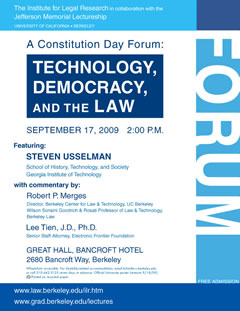
[00:00:00] HARRY SCHEIBER:
Uh, my name is Harry Scheiber, and I have, uh, the privilege of, uh, presiding today as I am chair of the Jefferson Lectures Committee and director of the Institute for Legal Research, the two entities that are sponsoring today’s event. I would ask you just before we begin to be sure your cell phone is turned off or if you have other electronics that are liable to go off. I never know what people, students bring to class these days.
Um, it would be appreciated. Um, and I also wanna mention that we’re gonna have a reception after the lecture, and it’s, uh, the comments and questions, and the audience is very cordially invited to stay on for the refreshments, which are, I think, very lovely, uh,
(coughs)
(coughs)
Uh, the– Just a word about the Jefferson Lectures, uh, Endowment. It’s an endowment of the University of California at Berkeley, uh, which sponsors, um, has sponsored over the years, uh, several conferences and forums, and in, in addition to individual lectures, this is in the forum series, and we’re very grateful, uh, that this fine endowment is available for wonderful occasions like this when we can bring distinguished, uh, public figures and academic figures, uh, to the, uh, campus. Um, uh, Professor Steven Usselman is our principal speaker, uh, today, a very distinguished historian of American technology, a man who works as a scholar in the fields of technology and institutional change and public policy,
(coughs)
and who has a very important role at Georgia Tech, also in the teaching of history of technology and the uses of technology in teaching. Uh, as befits his background, uh, which is a PhD in the history of technology, but also a degree that embraces, uh, history and, and engineering. Um, a full biography of each of our speakers is on the back of your program, and I don’t wanna take a lot of time.
Having had the experience two days ago of speaking, my wife and I gave a paper and the int– The introductions were so lengthy that the, the port– the second commentator never got on. So we don’t want that to happen to you, we, today, I promise.
I do wanna just say that, um, point out to you that Prof– that Professor Usselman has– is a graduate of the University of California San Diego, which is not on the back of your program. And he’s, uh, widely published. Uh, his book on railroad innovation and in business technology and public policy, uh, historically has won a distinguished prize, uh, from the Organization of American Historians, and also the Hilton Prize in Railroad History.
And that he’s won the Newcomen and Williamson prizes, uh, and from the Business History Conference. And, uh, I’m sure, um, in a, a way well appreciated by all of you who are academics. He is elected president of the society in his field, the Society for the History of Technology.
Um, it’s a great pleasure to have him today and our two distinguished commentators. Uh, Professor Usselman is going to speak on, um, on a subject which is directly responsive to the charge of the Jefferson Lectures, which is that we bring to campus important figures to address issues on American democracy. His topic is technology, democracy, and the law.
Professor Usselman.
(applause)
[00:03:40] PROFESSOR USSELMAN:
Thank you, Harry, very much. Um, if you know Harry’s biography and you heard a bit of mine, you realize that we did in fact overlap together at UC San Diego. And, uh, Professor Scheiber, thirty years ago, was assigning me essay questions as I was becoming a historian.
And, uh, this spring, late this spring, when he called me in my home in Atlanta and, uh, very kindly invited me to come speak on this topic, I was, uh, quick to accept. I’d been to Berkeley a couple of times to talk about specialized dimensions of my research, but the opportunity to address this large issue was too alluring to pass up. And, uh, then when I sat down in the summer, and the cold reality of trying to formulate my thoughts came into view, I realized that I had just agreed to take the mother of all essay exams.
(laughter)
Tell us what you’ve been thinking about for the last thirty years: forty minutes, and it was a take-home. So this is my effort, uh, to embark on that, uh, venture. Now, uh, as you may recall, uh, though it seems a distant– the first part of the year seems a distant memory, uh, two thousand and nine marks the two hundredth anniversary of Abraham Lincoln’s, uh, birth.
And as it happens, I know of no better place to begin a discussion of technology, the Constitution, and American democracy or tech– or the law, uh, than with Lincoln. Now, in the winter of eighteen fifty-nine, As Lincoln turned 50, he delivered on several occasions, uh, a public lecture entitled On Discoveries and Inventions. Now, the Lincoln-Douglas debates of the previous summer and fall had thrust Lincoln into the national lam-limelight and made him a leading prospective candidate for the presidency.
He was looking to keep himself in the public eye and further burnish his reputation as a writer and orator. So Lincoln, for the only time in his life, prepared a speech for repeated public delivery to a paying audience to go on the speaking circuit, as it was called. His choice of the topics may surprise us, though, as it did many in his potential audience.
Why not feature the great constitutional issues of popular sovereignty, territorial governance, and the rights of slaveholders that had permeated his debates with Stephen Douglas and still occupied the nation? Why turn toward a seemingly innocuous topic such as technology and innovation? As it turned out, Lincoln had no intention of neglecting these grave questions of the day.
Themes from the debates echoed throughout his speech. Now, however, Lincoln sought to step back from the legalistic details of the debates and to reframe the issues raised by the expansion of slavery into the territories. He looked to cast these issues in broader terms, to present them not just as a pressing crisis, but to show how they reflected the flow of history and the course of American democracy.
Now, Lincoln took this approach out of a sense of desperation, or at least profound frustration. During the debates, as throughout much of his political career, Lincoln had felt himself and his cause being swept aside by the popularly perceived tide of history. Douglas had scored repeatedly by waving the banner of what was called Young America, a vision that had first propelled Senator Douglas to prominence in the wake of the Mexican War.
This image is just– which is captured in the enduring, uh, caricature of Uncle Sam, proffered a view of history that simplistically equated the advance of democracy with the march of American technology across the continent and onto the seas beyond. Douglas heralded the arrival of Admiral Perry’s modern fleet in China, delighted in the ongoing attempts to lay a telegraph wire beneath the Atlantic, uh, from New York to London, with ample assistance from the British and American navies. And he pressed aggressively for a transcontinental railroad, a reckless move in the eyes of critics such as Lincoln.
Lincoln is often celebrated as the father of the Transcontinental Railroad, which is as distorting a portrait as you could possibly imagine. Uh, who believed that this move to force a Transcontinental Railroad had unnecessarily triggered the crisis over slavery in the territories. Now, Lincoln had once risked what his law partner, partner deemed political suicide in standing up to Douglas and opposing the Mexican War on constitutional grounds.
Lincoln’s principled argument that the war’s illegitimate origins actually undermined American democracy held scant appeal among a public teeming with enthusiasm for the wildly successful military adventure. Now Lincoln faced the similarly daunting task of opposing, again on constitutional grounds, what Douglas portrayed as the inevitable march of progress. On the campaign trail, Douglas and his supporters had trumped Lincoln’s narrowly legalistic arguments by branding Lincoln an old fogey, which was basically a quibbling naysayer who, and Douglas never failed to evoke this imagery, lacked the virility of Uncle Sam, and dared stand in the way of a future made possible by technology.
Now, the s- the speech on discoveries and inventions constituted Lincoln’s rebuttal to what had happened to him in the debates. In it, Lincoln laid out an alternative version of history, one which embraced technology and connected it clearly with democratic ideals and with the Constitution, while resisting the simplistic grandstanding of Douglas. Rather than celebrating large state-sponsored technical ventures such as the Atlantic Cable and the Transcontinental Railroad, Lincoln subtly lampooned them as escapades intended to keep the decadent Douglas, excuse me, and his beloved young America supplied with exotic imported wares.
Lincoln la- describes this figure as, uh, drinking whiskey from various places and smoking cigars from Havana and wearing a general, a buffalo robe as a general outsider, as it was called, a coat evoking what was, uh, the desire to, to claim the plains. Now, such individual, uh, uh, or pardon me, the real inventiveness of America, Lincoln insisted, could be found in the ordinary endeavors of farmers, workmen, and other enterprising individuals who pursued less grandiose plans. Such individuals thrived, Lincoln asserted, because of the greatest invention and discovery of them all, the Declaration of Independence and the mechanisms of the Constitution.
Here lay the true genius of America and the best hope for democracy on Earth. And this speech actually, if you read it, has very much of the cadences at points of the Gettysburg Address. Now, the competing claims of Douglass and Lincoln regarding the vital interplay between American technology and American democracy, though uttered in the face of an urgent political battle, fueled above all by the sectional conflict over slavery, they touched on enduringly powerful themes in the life of the nation.
Like most politicians of their day, Lincoln and Douglas had grown up in a political universe devoted above all to articulating, in ideas and in practice, how the tools of representative democratic government might shape the production and deployment of emergent technologies in ways that fulfilled the promise of democracy. In legislatures and at court, where most politicians earn their keep, they spent their days occupied with charters granted to corporations promising to exploit new technologies, with tariffs and taxes designed to spur or impede certain sorts of technical endeavor, with disputes over unanticipated nuisances revolving, resulting from new technologies, with the rights of patent holders, and with subsidies granted to Samuel Morse, the likes of Samuel Morse, the inventor of the telegraph, with allocations for river and harbor improvements capable of accommodating new steam-powered vessels, with grants of federal land to state-chartered railroads. The incessant churning over such matters pumped like lifeblood through American law and politics.
Lincoln took comfort in that churning. To his eyes, the continual wrangling over such issues demonstrated the vitality of democracy. The power of that example, Lincoln believed, would persuade others to the virtues of democracy.
Attempts to forcefully extend democracy through war and other grand gestures made possible by technology, on the other hand, would ultimately backfire. They would entail compromises with democratic principles, and they would alter what Lincoln presumed to be the natural evolutionary course of democracy. He did, as we know, share a birthday with Charles Darwin.
For in Lincoln’s view, democracy had a history, albeit a very brief and tenuous one, and an inappropriate commitment to the wrong technology could have enduring consequences for it. Nothing demonstrated this phenomenon more convincingly to Lincoln than the institution of slavery, which entailed at root a distinctive technology of production. Once a society permitted slavery to gain a foothold, Lincoln believed, this peculiar system of production and its profoundly anti-democratic tendencies would work themselves into the fabric of the culture and be virtually impossible to remove.
Just look at neighboring Missouri. The prospect of this happening again in the territories is what lent such urgency to the moment. It is what roused Lincoln to dare oppose such popular ventures as the Transcontinental Railroad and the Transatlantic Cable.
Now, in essence, Lincoln was grappling with the central recurrent dilemma posed by technology for American democracy. How did one prevent the technologies that seemingly opened opportunities to enhanced democratic aims from taking shape in ways that ultimately posed obstacles to achieving those aims? Lincoln grasped that such technologies often took shape through what Paul Starr has aptly termed constitutive moments.
When rules of governance impart to them an enduring trajectory, often with profound consequences for society. And as Starr’s choice of adjectives suggests, such moments often involve large constitutional questions. Slavery is, of course, an extreme example, one which perhaps strains the definition of technology and seems far removed from democratic aims.
Though here it’s well to remember that many of its proponents considered slavery essential to attaining and preserving democratic freedoms for white males. Yet, as Starr’s work suggests, even the technologies of communication and transport, which seemed on the surface to so conducive to democracy, could potentially undermine the achievement of democratic principles if implemented inappropriately. The slavery question brought such concerns into sharp relief, but Lincoln and many other politicians had long sought to stem what they considered the detrimental effects of certain transport and communications ventures.
Within the confines of free states such as Illinois, they had fought to foster a transport and communications network that would above all promote broad-based local development and promote regional commerce, rather than encouraging concentrated urban growth in commercial centers. More often than not, these efforts had drawn politicians and other interested parties into the courts, where for more than a generation, judges had wrestled over the powers governments possessed to regulate the monopolies they had created to help generate a technical infrastructure. The issue lingered before the courts for a generation or longer after the famed Charles River Bridge case, which raised the curtain on the Jacksonian-era constitutional jurisprudence in the mid-1830s, just at the moment Lincoln first assumed elective office in the Illinois Assembly.
With slavery removed and the nation extended dramatically south and west, such battles reached a new crescendo. For Lincoln had, in confronting slavery, utterly failed in his efforts to shape the technologies of transport and communications to his vision. The war imparted new urgency to Douglas’s ideas of young America, and again brought government into alliance with business.
In the decade or so following Lincoln’s assassination, courts swelled with cases intended to resolve whether the networks of rails and wires must necessarily result in large units spanning much of the continent. There.
(laughter)
Spanning much of the continent, uh,
(clears throat)
pardon me, and in some cases operating as oligopolies or even monopolies. Efforts to curb the power of Western Union, which secur-secured a virtual monopoly in long-distance tele-telegraphy through a combination of astute patent management and an alliance with the Associated Press, sparked a number of formative legal rulings, including several based on the new fourteenth due process clause of the Fourteenth Amendment. Courts prevented states from using powers of taxation, regulation, licensing, and corporate chartering from excluding Western Union, while also assuring that the company could not deny service to any paying customer or disclose the content of the messages it transmitted, much as the Railroad Postal Service could not disclose contents of private letters.
Now, the litany of cases regarding interstate railroads is too large to cover here in any detail, and if I try, I’ll never get back out. So I’m going to skip that and instead s– focus on one of the controversies of the period that particularly intrigues me, and that is the rising concern about the patent system, the one area of the Constitution which spoke directly to the issue of technology. The patent system had long evoked paeans of praise from the likes of Lincoln, who celebrated its democratic universality, which appeared, in his view, to extend encouragement and opportunity to all creative, enterprising citizens.
But in the years following his death, sentiments mounted that the system in fact served to secure enduring positions of dominance for consolidated interests. Farmers railed against nuisance patents involving common devices such as livestock gates and driven wells, and they waged a public crusade against the Singer Sewing Machine Company, which for decades had leveraged a pool of patents to harass alternative suppliers such as Montgomery Ward’s. In return, farm states tried through license fees and other measures to block Singer agents from doing business, practices rendered illegal in a watershed interstate commerce ruling.
Urbanites joined agricultural interests in deriding the Bell Company, which used its patent rights to maintain iron control over the telephone, a technology many had hoped would provide a ready alternative to the telegraph monopolist, Western Union. The monumental ruling upholding Bell’s patents filled an entire volume of the U.S. Supreme Court reports. The author of its majority opinion, Chief Justice Waite, retired to bed after completing it and never got up again.
He died a week later. Justice Bradley, widely recognized as the Court’s foremost expert on patent law, dissented. In this and other decisions, Bradley made a heroic effort to reconcile the patent system with the realities of the emergent– emerging technologies of transport, communications, and manufacturing.
Not surprisingly, many of these cases involved railroads, which encountered numerous novel situations that foreshadowed developments in other areas of economic activity. Among them was a concern that the emergent regulatory apparatus might be exploited to leverage patent monopolies unduly, as George Westinghouse seemingly had done in marketing his safety equipment just after the Massachusetts Railroad Commission circulated a series of reports on railroad accidents. The controversies involving patent monopolists helped fuel a new legal initiative, the antitrust movement, that would ultimately exert a profound influence over emergent technologies.
To a far greater degree than is generally recognized, the antitrust movement drew upon the resentment toward patent monopolists. Both the Sherman and Clayton Acts expressly sought to circumscribe the rights of patent holders. Beyond assigning courts the task of scrutinizing the claims of par– of parties, including patent poolers, who sought to maintain tight control over emergent technologies, evolving antitrust doctrine under the rule of reason soon put courts in the business of assessing the efficiency of technical practices conducted by large manufacturers and systems operators.
By the 19-teens, antitrust law had evolved into a forum where Americans renegotiated the social contract between those who designed and operated technical systems and the larger democratic citizenry. In effect, antitrust law redefined that citizenry from a universal producer who might potentially contribute to those systems into a universal consumer who partook of the products and services those systems provided. Clearly, this marked a watershed development in the evolution of American democracy.
The tools courts made available helped shape many emergent innovations, not least the new technologies of mass communications, mass individualized transport, that is, the gasoline-powered cars and trucks operated on public infrastructure, and mass distributed power. in the form of electricity. No one can narrate the histories of these technologies without wading deep into the waters of antitrust, public purpose doctrine, and the developing regulatory authority of the period.
As Lawrence Friedman has pointed out, one could write an entire book on the ways the American legal system accommodated the automobile. He wrote a chapter. I’m guessing he has severely understated the capacity of historians.
Surely one could fill at least a volume or a shelf on the ways the legal system facilitated the legal re-divest- def- definition of public space in the opening decades of the twentieth century. After all, we have already written several treatises on the landmark case of McPherson versus Buick, which reconciled product liability law with the emergence of a mass market for automobiles and other manufactured goods. Can one imagine a mass market functioning without such a change in doctrine?
I think clearly this is a case where the defendant ultimately prospered by the ruling. And can we imagine modern American democracy functioning without such a market? Now, time doesn’t permit me very much wading of this sort into these different technologies.
So let me concentrate for a moment on one of my favorite examples, the movies. Most people are surprised to learn that in nineteen twenty, Years before the sound revolution, movies were already the fifth largest industry in the United States. They were the other technological phenomena of the automobile age and the first wave of the media revolution that trans so much– transforms so much of public life in the opening decades of the twentieth century.
Here was another constitutive moment for a technology and for American democracy. For movies possessed an extraordinary power to influence public discourse. “History written with lightning” is how President Woodward Wilson famously characterized The Birth of a Nation, D.W. Griffith’s inflammatory history of the Ku Klux Klan and the postbellum South.
Released in nineteen fifteen as the nation weighed possible entry into World War I, the film was viewed by over half of the American population. Asked in 1920 why he deigned to review movies for a Chicago newspaper, Carl Sandburg declared simply, “The movies are.” They were, as Sandburg grasped, an irresistible phenomenon of modern life and an abrupt disjuncture in the movement toward what we have come to call direct democracy.
Not in the sense that they enable citizens to express their own opinions directly to elected officials, but in the broader sense that movies respond to popular taste, for they must find a mass audience in order to reclaim the costs incurred in making them, and can in turn exert a powerful emotional effect upon that public. If you want evidence, I simply suggest reviewing Citizen Kane, which is at once a treatment and an example of the phenomenon. Although lacking the obvious network effects of other communications technologies and the clear public purpose qualities of, say, radio with its military uses and limited spectrum, Movies became embroiled with law virtually from the start.
In a watershed antitrust ruling, courts stymied an attempt by Edison’s Motion Picture Patent Company to block entry into the nascent business. Next, they drew boundaries, new boundaries in copyright law, creating space for movies to get around, uh, performance theatrical rights while extending rights over their own movie screenplays. The powerful new medium also loomed large in the minds of justices as they articulated new censorship doctrines, including the clear and present danger standard.
Who could doubt the implications of film for national security? While leaving intact the framework of local censure under the police powers of the state. As the industry shook out into the studio system during the ’20s, it flirted continually with antitrust prosecution.
Critics took an especially dim view of the exclusive contracts between studios and exhibitors and the bundling of films those contracts entailed. The threat of antitrust provided the government with considerable leverage over the industry, including heightened censorship. Even before the famed Paramount antitrust case materialized on the eve of World War II.
That case, together with rulings that banned exclusive contracts with performers, effectively broke apart the studio system and ushered in the era of independent producers. Many of these same issues informed the slightly later but ultimately concurrent structuring of broadcast radio, which burst on the American scene in the 19– mid-1920s with, uh, shocking suddenness. Uh, the patent system again loomed large, as did the concerns of fostering self-censorship under regulatory and antitrust action, and with maintaining clear boundaries between production and distribution of shows.
The powerful network effects in radio, of course, imparted additional concerns and urgency to the case of radio. Newly created federal commissions, once they were granted authority by courts, faced steep challenges in trying to balance the interests of those promoting high-quality national programming, which many listeners also preferred, uh, against those who sought to foster more diverse local stations. As usual in such disputes, both sides touted the benefits for democracy.
And I think it is difficult to imagine any democratic society forgoing networks entirely at that moment. By the end of the ’30s, as war consumed the nations of Europe, one could detect a distinctive American approach to the media and to other systems deemed essential to mass society. The American approach called for building out its systems fast, though often cheaply and incompletely.
To do this by delegating the task to private parties and to worry about cleaning up the messes later. The messes included persistently high levels of human carnage in the case of transportation, and serious compromises with such fundamental matters as privacy rights and full open access in the case of communications. Despite these limitations, someone like RCA President David Sarnoff could plausibly proclaim that the American arrangement of media and communications technologies served as a bulwark of democracy, as he did when speaking in 1939 at congressional hearings and again later that year at the New York World’s Fair, where in the company of President Roosevelt, he introduced television.
Um The looming presence of Hitler and his propaganda machine, of course, lent credence to this claim. But ultimately, the assertion rested upon the perceived ability of firms like RCA to provide open access for the nation’s citizenry. Sarnoff conceded some role for state intervention in addressing concerns about access when he agreed to sell off one of his networks to a competitive organization and accepted other constraints regarding production and advertising.
Yet he also recognized that as access to material goods, including entertainment and communications services, came increasingly to be seen as the principal barometer of whether the nation had achieved its democratic aims, consumer prices acquired ever greater significance. Indeed, by the wor– eve of World War II, this tendency to elevate price over other concerns was already reflected in the drift of antitrust policy toward a more exclusive focus on cost and market share, rather than the dynamics of system building, trends that would build markedly. amidst the post-war affluence.
Sarnoff’s confident enthusiasm in 1939 owed much, of course, to the fact that Americans had avoided nationalization, an alternative variant of democratic control. The exceptions being long-distance telephony and possibly highways, though even here they devised a federalist system in which the national government set quality standards, uh, required to receive federal funds, but state and local authorities made decisions about who would build roads where. The United States persisted or resisted nationalization, not merely because of the power of organized business interests and the support of courts eager to protect the rights of private property.
Many of its citizens also feared that democratic processes broke down in the face of entrenched bureaucracy. Whether those bureaucracies were private or public. The suspicion could be traced back at least to the days of Andrew Jackson and pursued through periodic battles over such matters as civil service reform.
The sentiment found expression in many forms, not least in a persistent disregard for experts who many hab- Americans habitually treated with suspicion, especially when they appeared to be agents of entrenched interests and potential impediments to change. Indeed, one of the greatest challenges technology has posed for American democracy, since at least the turn into the twentieth century, has been its increasing tendency to require the services of specialized experts. If Americans wanted to enjoy the fruits of such technologies as I’ve been discussing, they could hardly avoid availing themselves of such expertise and its often esoteric knowledge of something like the radio spectrum.
Yet Americans worried deeply about the implications for democracy. They fretted about turning over so much responsibility to communities of experts they could not readily comprehend. Not least because they suspected that experts were responsible for freezing technologies and imparting to them a momentum and accumulated authority that posed a threat to further change and to further and to freer discourse.
Now such concerns, I think, underlay the frequent claims that regulatory agencies fell captive to those they were supposed to govern. Attempts to make space for experts, such as the Hooverian associationalism of the 1920s, often foundered in the face of resistance from private interests and from the courts. Yet it was those same courts, ironically, that often first gave voice to experts of a certain ilk.
Now, it must be said, I think, that judges were most inclined to listen when the expertise was brought to them by people trained in the law. But they listened to Louis Brandeis’s famous sociological brief and to his testimony regarding what railroads might save if they adopted the management methods of the engineer Frederick Winslow Taylor. They weighed the detailed economic assessments of antitrust lawyers.
By the mid-’20s, they even tolerated comprehensive zoning plans packaged as remedies for pressing problems of public health and safety, so long as they included adequate paths for appeal. And if the courts still denied legal authority to the voluntary radio agreements negotiated by Hoover and his radio engineers, they sanctioned those same activities under the aegis just of the Federal Reg-Regulatory– uh, Radio Commission and then the FCC, again, with avenues for appeal. Conservation is another example that could be elaborated and fit in this area.
The challenges posed by specialized expertise grew all the more acute in the wake of World War II. Most obviously with the advent of nuclear technology, but also with electronics, jet propulsion, and other techniques deemed essential to national security. The familiar concerns about democratic access and potential regulatory capture now became entwined with issues relating to state secrecy and the compromises citizens are asked to make with individual liberties considered by many to be fundamental rights essential to democratic societies, including not only such matters as security clearances for scientists and non-disclosure agreements for those working on defense-related technologies, but a range of issues involving surveillance, including data mining and profiling.
The questions of means and ends, which Lincoln raised as a congressman and candidate, and then confronted when conducting the war thrust upon him as president, again loomed large. An effort to fight in the name of democracy had presented profound challenges for democracy. I am getting out of my element here and on to ground other panelists will address with more authority, and the Scheibers can address with infinitely more authority than I can.
I do, however, wish to offer some brief re-reflections on one domain, electronic computing, which developed during the Cold War and continues to exert such a powerful influence upon all of us and the issues we confront in an age of global commerce and global terror. By virtually any measure, computing is an American triumph. And I would suggest that at least part of the credit goes to the American legal tradition.
This is no simple matter, as some might have it, of enforcing an intellectual property regime or refusing to recognize employment contracts demanding non-disclosure or technical secrets– of technical secrets, though those are certainly important elements of the story. Rather, it involves a broad array of legal issues. Intellectual property, yes, though the story is far more involved and evolving than persistent enforcement.
But also censorship, public access doctrine, spectrum allocation, antitrust, and many more. To cite one remarkable instance, I think, contemplate the fact that the United States, as it embarked upon a Cold War, in which electronic communications and information processing clearly would play a crucial role, pursued vigorous antitrust suits against both its largest telecommunications firm and its dominant supplier of computers. Not satisfied with having extracted from these firms agreements to disclose and license much of their technology, though not certain classifications, as Lee is well aware, but much of their technology, uh, uh, uh, the, uh, government then proceeded with further suits stretching over the entire decade of the nineteen seventies that broke up one firm and extracted major concessions from the other.
Perhaps even more remarkable is the rapidity with which the judicial system engaged a myriad of complex questions posed by the sudden and entirely unanticipated phenomena of the Internet and the World Wide Web. We forget how sudden and how unanticipated it was. In the face of overstated claims regarding the inherent democratizing tendencies of these technologies, not all Americans simply sat idly by and awaited the coming nirvana.
Rather, with healthy skepticism and an instinct bred from centuries of tradition, critics set about addressing several troubling concerns. Now I’m not suggesting here that such legal wrangling has itself produced the promised nirvana. As always, promise exceeds reality.
And Lee Tien spends his days, as I understand it, struggling to preserve something of that promise in the face of serious threats to privacy, threats of a sort Americans of Lincoln’s generation could not possibly have envisioned. Resolving those challenges demands vigilance and inventiveness, not just technical cleverness, but legal creativity as well. Yet if history offers no ready prescriptive remedy for these specific latest challenges, I do think we can take some comfort in knowing that the American constitutional tradition provides a mechanism for engaging them.
American democracy remains, as it always has been, essentially about promise and process. Because we invest in it our hopes, we must attend to its processes with care. Democracy does not or must not breed complacency.
Much the same can be said of our technologies. The very success in fonts– their very success in fostering abundance, security, and individual liberty we have come to consider hallmarks of a properly functioning democratic society should not lure us toward a comfortable assumption that they inherently lead toward such outcomes. Such a presumption finds expression, I think, both in the blissful, uncritical embrace of direct democracy and then the heightened expectations that technologies can somehow provide us with universal protection from all misfortune, a notion that underlies what Lawrence Friedman has labeled total justice.
Hope springs eternal. Thank goodness and democracy for that.
(cough)
But attitudes such as these must certainly give way to a harder reality as we take up the perpetual burden of reconciling our democracy with emerging technologies, and like Lincoln and Douglas before us, confront our own constitutive moments, not only with regard to surveillance and security, but also in our efforts to ration technically sophisticated medical care fairly and to address the multifaceted challenges of global warming, a task that promises at the very least to compel substantial reconsideration of public purpose doctrine. These weighty, complex matters will undoubtedly raise streams of such constitutional questions and perhaps even prompt far-reaching constitutional change. Just as the issues of Lincoln’s and Douglas’s day ultimately prompted the constitutional revolution embodied in the 13th, 14th, and 15th Amendments, though not, it must be said, without first experiencing Civil War.
The prospect of working through the challenges of our own times amidst the hothouse of our modern media promises no small measure of adventure, or perhaps misadventure. Thus far, the age of direct democracy has not shown itself to be especially conducive to successful governance, any more than the telegraph and railroad ushered in a period of stable administration in the mid-19th century. Hopefully, as we grapple with the immense challenges of our age, we can manage to avoid civil war along the way.
And on that happy note, I thank you for your attention.
(applause)
[00:47:35] HARRY SCHEIBER:
Well, thank you very much, Steve. Um, I taught a course at Boalt Hall, uh, in times past on, with an historical emphasis on law and technology, and it would have been greatly enriched had this been available to us, uh, by your insights over such a long period in so many, uh, respects in the relationship of law and technology and democracy. Uh, as Professor Usselman has said, um, we have, uh, commentators with very special distinction in fields of expertise that are directly relevant to what you’ve just heard.
Uh, and we’re very happy, uh, to have both of them. The first speaker to follow is my colleague on the Boalt faculty, Professor Robert Merges, who is Wilson Sonsini Goodrich Rosati Professor of Law and Technology and director of our Center in Law and Technology. Uh, and what Steve Usselman is to the history of the social, legal, and economic, political context of, um, technology, uh, in history, uh, to, as Bob Merges is to patent law and antitrust law in relation to patent today.
Uh, his publications are spelled out on the back of your, on the back of your, uh, program. I promise not to take time in that regard. And without further ado, I wanna introduce Bob Merges.
(applause)
[00:49:05] ROBERT MERGES:
I think that’s a great, uh, tradition that people clap before you say a single word. You know, that’s, that’s very heartwarming. Uh, I’m not, uh, going to ask you to clap again at the end, uh, but it would be interesting just to compare the two.
That would give me a good metric, but I’m not going to ask you for that. I don’t think my ego could take it. Uh, so first, a couple of, uh, just introductory words.
Um, if you’re a student, uh, it’s good that you’re here. Whatever the field you go into, whatever, uh, little specialty or subarea you go into, my one piece of advice, if you remember nothing at all that I say here, just remember this. Try to learn as much as you can about the history of that field, and there’s two reasons for that.
I’m going to give you the easy, straightforward reason first here at the beginning, and then at the end, I’m going to come back to the much more important and significant reason. The easy, practical, simple reason is that it makes you seem so incredibly knowledgeable about your field, and it’s fun and easy to pick up that kind of stuff. It’s amazing how just knowing where such and such came from, or who was that named after, or when did that first happen, or when did that start?
It’s amazing how impressed people are with that kind of knowledge, and even other people in your field who study it and dig into it and are, are completely subsumed in it. They’ll be impressed, trust me. Years ago, I started reading the, uh, Technology and Culture, the publication of the Society for the History of Technology, and I picked up all kinds of great tidbits about inventions and technology, which are extremely useful in my field of patent law, and I was an undergraduate history major, uh, but, uh, would not call myself an historian.
But I’ve become a somewhat compulsive consumer of history, and it’s really stood me in very good stead in many, many settings, talking to judges or senators or students or colleagues. It’s great stuff. So that’s the practical reason.
So that’s why I say it’s good that you’re here. Um, now I wanna get on to some, uh, some, some substance, and there’s all kinds of good, meaty stuff to grab a hold of. Stephen has given us a real feast here.
Um, I wanna start with, uh, his starting point, which is this famous speech by Abraham Lincoln, a classic example of what I was just mentioning. Everybody in the patent field knows that Lincoln said that patents add the fuel of interest to the fire of invention, you know, it’s this famous quote. It used to be etched above the old patent office in Washington, D.C.
Very few people have read the paragraph it comes from, let alone the whole speech, and very few people understand how it relates to the bigger picture of Lincoln’s career and the Lincoln-Douglas debates. Reading people like Usselman gives me information like that, and it’s very helpful. So that’s just a simple case study.
Um, in this speech, we see, uh, at least in my interpretation, that Lincoln is the inheritor of what I would call sort of the Jeffersonian tradition of, uh, um, a viewpoint or the Jeffersonian tradition regarding American technology. And I kind of trace two grand, uh, uh, rivulets back to the early days of the Republic. And in contrast to Jefferson, whose views I’m gonna describe in a second, is another view that we often see bumping heads, and that’s what I would call the Hamiltonian view, which is a much more, let’s say, pro-centralization, much more, uh, uh, pro-big government or at least pro-government backing of big technology projects kind of view.
That was, uh, that was Hamilton’s, uh, shtick. That was his take on things. Lincoln followed in the Jeffersonian tradition, which was suspicious of very large units of economic power and very large government-backed technological programs.
He was much more of a believer in smaller-scale economic units, and I think this grew out, of course, of his own experience, uh, on a front– in a frontier state. But also it grew out of, I think, his understanding of how that large nationalizing uh, agenda related to the slavery question, and he saw the Transcontinental Railroad and very rapid national economic expansion as essentially the issue that helped call the question on slavery, And I think in his druthers, we wouldn’t have called that j– that issue for another generation or so, That’s the way it happened.
Um, so in the grand kind of division, you’ve got the Hamiltonian centralizers and the Jeffersonian, uh, Lincolnian, uh, um, decentralizers. Uh, in the history of my field, in patent law, it, it, it plays a very interesting role in both camps, and it represents probably one of the major tensions that, uh, Professor Usselman was talking to us about today. And the reason that’s so is that, um, in order to have any kind of functioning patent system, it has to be, uh, federalized.
It has to be a single national system. There was an era during the Articles of Confederation and even before in the colonial period where we had, uh, the equivalent of colonial patents. Each state or each colony had its own, and it really was quite a mess.
And one of the reasons that patents are mentioned in the Constitution pretty much in the same breath as interstate commerce in, uh, Section Eight of Article, uh, Article…
[00:54:47] AUDIENCE MEMBER:
One.
[00:54:48] ROBERT MERGES:
Thank you. Article One, Section Eight. I think I would know that by now.
Uh, one of the reasons it’s mentioned there is that there was a concern that state-by-state patents were going to be a mess. Um, so that creates this tension, and the tension is this, uh, if you’re going to have a patent system, it has to be centralized in a single federal authority. And yet, as we learn, centralization of economic power has always been a much more difficult question.
So we have a kind of centralizing urge at the beginning of the system, and then a long series of waves and cycles where that centralization of power at the governmental level is contrasted and bumping up against various waves of centralization and concentration of economic power. And Professor Russellman gave us a couple of great examples of, of, uh, those cycles and waves. But the fundamental paradox in a sense, or the fundamental, uh, uh, conundrum is how to have a single centralized federal system while not encouraging or promoting over-concentration of economic power.
That’s one of the great, uh, um, uh, conundra of the patent system. The way that actually has worked out over many of these cycles is an interesting thing to study, and again, Professor Usselman touched on a couple of great examples. Um, Lincoln was obviously a fan of, uh, the smaller inventor or smaller units of economic production.
But he was also present at the creation of the beginning of very important large national markets. And much as he maybe would have preferred a more Jeffersonian economic landscape, it was pretty clear by the end of the Civil War, and certainly thirty years later it was crystal clear, that the old regional economic scene in the US was a creature of the past. So that the federal government, which really was, was spurred into action at a very large kind of national level by the Civil War, uh, immediately kind of retrenched and pulled back at the same time as economic power became concentrated and national markets were really solidified.
And what that all meant for the patent system, and Professor Russell mentioned it a few times, was, um, some political tug-of-war. So he talked about the farmers’ anti-patent movement, the Grange Movement, which was a very interesting early chapter in a sort of populist anti-patent moment in American history. He talked about the relationship of patents to the early antitrust movement, which is a really important development in, uh, the economic history of the U.S. and really in our democratic history, because this was a time when economic centralization was proceeding absolutely willy-nilly.
And it was, uh, it was absolutely essential for the, for the f-federal government to get a bit of a handle on that and to try to move in and become much more activist in regulating some of these large, centralized, concentrated economic powers, because the deleterious effects on the economy were becoming pretty clear. Over-concentration of power in finance and railroads and steel and other industries was beginning to have a really serious impact on the national economy. Unfortunately, for fans of the patent system, one of the tools, not the only one, but one of the tools of the centralizers and the concentrated economic powers were various arrangements involving patents.
And so at this time in the early trust-busting era, uh, as Professor Russerman told us in the Clayton Act and the Sherman Act, patents were somehow connected with and tied into, uh, this whole, uh, over-concentration, uh, antitrust movement. And as a result, uh, for about twenty or thirty years, patents really came to have a kind of a bad name. Now there were figures out there on the legal landscape who tried to mediate and kind of moderate this tension.
There were people like Justice Bradley, who we mentioned, who were fans of the patent system, but also understood that some kind of regulatory structure needed to be overlaid on the patent system in order for it to continue to do what it was supposed to do. And to return to my, my initial theme, this is a moment when the kind of Jeffersonian impulse re-emerged. Uh, I wouldn’t say that the, uh, the trusts were really Hamiltonian in, completely in spirit, but, uh, they were kind of more on that side of the divide, and it was time for the federal government to step in and reimpose a little bit more of a regulatory, uh, uh, moment in the Amer- the development of the American economy.
And teasing out, let’s say, the socially beneficial aspect of patents from the misuse of patents was one of the difficult intellectual exercises of the trust-busting era. And it took, took some time to work its way out. I think the, the ultimate success of that can be measured in cases like one of the ones that Stephen mentioned, and that would be the motion picture patents case.
By that time, the nineteen-teens, uh, there came to be an understanding that not all deployments of patents and not all utilizations of patents were really a good thing for the economy and for society. And in the Motion Picture Patent Case, what the Supreme Court said was, “Thomas Edison,” we’re very pleased with your, uh, patent on the motion picture projector, but the way you’re trying to use it, the way you’re trying to leverage your patent into control of this whole market, that we’re not so pleased with.” And so the Motion Picture Patent Case s-comes to represent a kind of stop sign or a limit, not on the granting of patents, not on technology per se, and I think that’s a very important point, but only on the way that economic power was deployed and the way that economic power was used to create an over-centralized, over-concentrated scheme.
It’s a really important moment in the history of my field because one obvious solution to the problem was get rid of patents. Get rid of patents. And yet this history, Thomas Jefferson was the first patent examiner, and Abraham Lincoln spoke favorably of patents in his eighteen fifty-nine speech.
This history told us there might be something valuable here, right? We don’t want to throw the baby out with the bathwater. And so the overlaying of a regulatory scheme on top of the patent system was this kind of delicate generation-long event, and it came in the end, uh, uh, to create a kind of, um, rough balance where generally speaking, patents were available for new technology, but the regulatory and administrative state would take a careful look at how patents were actually deployed, especially if they were used as a cover for anti-competitive activity.
And if patents were misused, and if patents were being deployed in a way that undermined the kind of basic impulse to have competition rather than concentration, then the regulatory authorities would step in. So it represents kind of a triumph of the centralization of political power, at least in the sense that the administrative agencies that came to regulate the use of patents had a lot of expertise and, of course, had national reach. At the same time, the system was used to try to promote, I wouldn’t say the regionalism of the early years, but I would say the devolution of power back into relatively small economic units.
And that kind of balance is one that we’ve seen, uh, upset and tugged at and pushed and pulled at by a number of technologies and political waves since the ’20s and ’30s. But the basic kind of overlay of regulation on the patent system has held up pretty well. Um, while I’m on the topic of, uh, uh, the motion picture patents, I wanted to say a couple of things about the movie industry because I think it’s another example of, uh, um, the general kind of theme that I’m trying to sound here.
Um,
(coughs)
moving here a little bit more to copyright than patent, the use of, uh, copyrights by the large film studios was something that gave rise to a lot of consternation, a lot of concern. And part of the backbone of the studio system was that the big film studios controlled the copyrights in the films, and partly through that economic power, they were able to control the distribution networks all the way really down to the local theaters. And again, one set of proposals might have been, what we need to do is weaken film copyrights.
Maybe we need to make these economic rights a little less powerful. But that wasn’t the solution that, uh, the regulatory system arrived at. Instead, as with the patent story, there was a movement to try to regulate how the movie studios did business without really undermining the ability of a filmmaker to get a copyright and to protect the copyright pretty strongly.
And I think, again, not to be too Pollyannaish about it, but I think the solution was quite workable, maybe not optimal, but quite workable in the sense that when the antitrust scrutiny and the antitrust pressure led to the breakup of the studio system, fortunately, I think for the entertainment industry, we were left with a legacy of pretty robust and pretty strong copyrights for films as works. And I think the salutary benefits of that were that once the studio system was broken up, everybody who had copyright in their films and everybody who contributed to a film could kind of, uh, exist and subsist under that broad economic umbrella, and it actually helped smaller filmmakers to protect the innovations that they created, to protect the footage that they shot. And ultimately, it helped screenwriters, and it helped other participants in the whole ecosystem of the entertainment industry to make a decent living.
Um, if we had sort of weakened copyright as the spine that supported the studio system, I think once that effort were successful, it would have been an, a burden and a difficulty for the independent film industry and for the smaller units of film production that we see now as the norm in Hollywood. So today, a screenwriter, uh, can be a perfectly free agent, doesn’t work for a studio, pitches to a bunch of producers, and the producer pitches to a bunch of agents, and the agents pitch to a bunch of movie stars. And all of these people, uh, participate in the making of the film, but in most cases, they’re not working for one big vertically integrated company.
They’re all free agents and independent, and the value in the ultimate film is then spilled back to all the participants by a series of contracts. But being able to protect the copyright in the film is what allows everybody to exist independently and to function independently. That’s really sort of the bigger point.
So have we reached a kind of Jeffersonian nirvana? Well, obviously not. Even if we had, the new digital technologies are going to fundamentally threaten and maybe undermine that nirvana.
And that’s kind of my, my last point. Um, when you study the intersection of law and technology, uh, there are times when it seems a single policy really is crying out to be adopted. And this can be true in my field of intellectual property.
It can also be true in environmental law. So if you read Thomas Friedman’s columns in The New York Times, he is absolutely convincing and absolutely certain that there is a very rational government energy policy, and we ought to be adopting it. And he kind of tears out his hair, what it, what left of it, what is left of it, uh, to try to convince everybody that the system is crazy and all these other countries are racing ahead and things are going to be a mess.
And I would submit to you, uh, the same thing is true in my field, because I see what seems to me obvious and egregious misuses of the patent system by people who are getting patents and asserting them against companies and getting damages far in excess of what these inventions are worth through various legal strategies, et cetera. And I can tear out my hair, what, what’s left of it, uh, thinking there’s, there, I know an absolute solution to this if they would just do it. The, the, the short version of this is that democracy can be enormously frustrating, right?
You know there’s an answer, and damn it, the whole structure of the system seems dead set against us getting to that answer. You know, we can’t get the right answer in, in green tech, and we can’t fix IP policy because this interest group is always blocking it, and this group of senators is always living in the caveman era, and we just can’t get it fixed. Well, to return to my initial point, this is the big picture reason why history is so helpful.
It’s helpful because it’s so reassuring. History is ultimately very reassuring. Not that things always work out right, okay?
You can talk about the people who fell in the Civil War and the slaves who were subject to slavery before it and prove that point. But simply that the frustrations and the costs of democracy are often right up here in your face, and the more you know about a particular problem, and the more you study how that problem isn’t being solved, the more those costs can be in your face. It’s a little harder, and the historians can be helpful for us here, in seeing the benefits of democracy, seeing the benefits of this long, slow, perambulating, sometimes extremely frustrating process.
And that, I think, is what Stephen Usselman’s talk brings us back to. We wouldn’t be talking about a long, uh, uh, you know, frontier, a long past of American experience with technology, uh, uh, law, and democracy if fundamentally democracy hadn’t somehow worked more or less, if it hadn’t sort of found a way to get us from way back then to now, And that’s the reassuring part. It’s frustrating.
It makes me crazy sometimes. I know there’s a better way, and yet history tells me that this way actually has gotten us to this point, and maybe that’s something not to be sort of tossed aside lightly. So that’s the reassuring part, and that’s another reason why I like to read history because I can be a bit of a cynic.
And history can make me say, “Okay, relax. Let go. It’ll probably work out.
It usually has. Thanks.
(applause)
[01:09:32] HARRY SCHEIBER:
Thank you very much, Rob. It’s always interesting to hear a person with great expertise who, um, represents a point of view that there’s a clear solution to a problem, and that raises the question of why it’s not getting, uh, full attention. Uh, just take a moment and draw a parallel.
I was at the Tyler Prize ceremonies for, uh, Gene Likens when he got the Tyler Prize. He had discovered acid rain and came up with a proposal, which he was convinced, as a very distinguished scientist, could deal with the problem of acid rain by controlling smokestack emission and so on. And he expressed at this meeting down at USC some years ago, the frustration of 25 years of lobbying for this without being able to get a hearing in Congress.
And now, of course, we’re coming to exactly in the last five or six years, to exactly what he had proposed was needed for clean air. Um, uh, I don’t wanna take any more time because we have a third speaker who has much to say, a great specialist on privacy issues and intellectual property. Uh, Lee Tien is a graduate of our law school, also studied in the Jurisprudence and Social Policy program after coming here after a short career in journalism, and has gone on to take a very important role in today’s public arena with regard to, um, issues of, uh, privacy and, uh, computer technology more generally in relation to the public interest.
Uh, he’s a senior staff attorney at the Electronic Fron-uh, uh, Frontier Foundation fr– uh, located here in San Francisco, often quoted in the business press and the technology press. And, uh, we who are, were on the faculty here while he was here are very proud of his career and especially pleased to introduce Lee Tien today.
(applause)
[01:11:35] LEE TIEN:
Hey there. I am not a historian, uh, and I’m very honored to be here as a result. And, uh, I want to especially thank Professor Scheiber for inviting me since I was not one of his more promising students.
Um, I do appreciate history much more now, though, um, because of my work. I’m not sure whether I’m reassured by it or or made more pessimistic by it, but it’s definitely one of the most important things we have to deal with. And one book from his American legal history class really stands out for me.
Um, the classic book by de Sola Pool, Uh, Technologies of Freedom. The, the very notion of technologies of freedom is central to my work. You know, as an attorney for the Electronic Frontier Foundation, I do policy advocacy and litigation on high-tech speech and privacy issues.
My job is to try to ensure that technologies of freedom don’t become technologies of social control. That is, as it turns out, a daunting task. And part of what makes it daunting is really Professor Usselman’s point that technologies are embedded and embodied in large-scale technical systems They don’t just float around as ideas or innovations.
They have a concrete life in things. So in my little comment, I want to explain how I see these kinds of systems as raising serious issues of accountability and threats to democracy because of the expertise element, or more broadly, the knowledge disparity element, and particularly in relation to privacy, which is my specialty. Um, my general thesis is that we should think and worry about the fact that large-scale technical systems can be architected or designed to serve some interests and not others, and how precisely because they are large in scale and highly technical, it’s really difficult for most people, and even the institutional press, to perceive the architect’s purposes or even its effects.
(coughs)
You know, one big risk here is simply inertia, that things stay the way they are. A further risk is that inertia breeds a sense of legitimacy, the, you know, normative power of the actual. So we worry very much that emerging technologies, well, not really all that emerging, the Internet’s been around for a while now, have or keep having these kinds of, of constitutive moments where they’re shaped in a certain direction, and then once they are shaped that way, well, we’re, we’re sort of stuck with them.
And this, you know, this comes in a lot of different ways, technical standards, the way an, an artifact is defined, the default setting for a particular kind of program, uh, the presence of a filtering, uh, program on a school or library network. All of these things can exist and control what we see or monitor what we’re able to do, yet they’re largely invisible, and we may not even realize, therefore, that anyone has put them there. The other problem here is that even if we do think that someone’s put them there, we might not realize why or who.
You know, one of my, one of the most famous Supreme Court cases is, uh, Katz versus United States, and it’s a case about, uh, privacy of telephone calls. And one of the things that, uh, always struck me in that case was that, uh, when the Supreme Court thought about whether or not a person has a reasonable expectation of privacy in a phone call from a public phone booth, um, they used the phrase that, “Well, you know, someone who goes into a phone booth and closes the door, um, you know, has the right to, to think that his words aren’t going to be broadcast to the rest of the world.” And, you know, I’m quirky enough to think, well, it’s a good thing that phone booth had a door, and if you had been, you know, smart enough to think that that might matter, and you had arranged or legislated that phone booths didn’t have doors, would that, you know, in the context of that case, make the- made the court think differently about whether or not there was a privacy expectation?
And once you start thinking in that somewhat paranoid, but still, I think, fairly rational sort of way, you see that the way that the world is designed around us can be viewed as natural and viewed as functional, and yet can conceal an enormous amount of, of intentionality. And this, that’s what I mean by not perceiving the architect’s purposes. You might also be in a situation where, you know, and I’ve encountered this, where the payphone isn’t really a payphone anymore.
It’s, it’s– doesn’t take coins. It requires a credit card. Um, you know, there could be a lot of reasons for that.
Some reasons could be really mundane, and others might be, “Hey, wait a minute. We don’t actually want people to be able to make a more or less anonymous phone call. And so we’re going to require that any payment instrument associated with that phone call, you know, actually identify you.”
You can extend this. It’s not a communications example, Right, I mean, think about BART.
When you take BART, you know, you have this very relatively anonymous card that you can buy with cash, and it allows you to travel all over the BART system. But there are a lot of places where that kind of transportation payment mechanism is going to be some kind of a smart card that isn’t anonymous, doesn’t take cash, and it’s going to have this built-in ability, uh, to track you. So that’s, you know, one of the things that I, uh, see in the world and that I think about a lot is how do we think about the ways that technologies structure the way we do things and how this affects privacy, how this facilitates surveillance, and how ultimately that, uh, affects the prospects of, of democracy.
Now, I’m just gonna go through some of the, the reasons why I think that we have this kind of a problem. Uh, you know, the first, I guess, is that, you know, large-scale systems tend to be fertile ground for the, uh, codependence of, of government and corporations. This is a really old theme that it’s kind of hard to ignore.
Um, you know, I saw it in my career first in, in nineteen ninety-four, really, uh, with the passage of the Communications Assistance to Law Enforcement Act, which required telephone networks and systems to be designed and engineered to facilitate surveillance. This was something that ultimately ended up being something that the telephone companies really were okay with. I see it also in the cases that the EFF is litigating about the so-called warrantless wiretapping program, which the Bush administration admitted to back in December two thousand and five.
And we sued AT&T for secretly assisting the NSA in this spying operation. You know, we had whistleblower evidence that AT&T had built secret rooms with special access for the NSA. We also had a historical record of, from World War II on, I think, uh, of telco cooperation with the government in domestic surveillance that was publicly revealed during the Church Committee hearings in, of the 1970s.
Clearly, there’s a lot of risk of codependence when you talk about large scale tactical systems. Part of it, I think, is institutional bargains. Each needs the other.
There are so many quid pro quo mechanisms. They can be trying to promote innovation, promote progress, get, uh, the highway system going. And there are subsidies, permits, and licenses, procurements, contracts, threats to regulate, threats to not regulate.
And all of these things give government the power to extract conditions from corporations. The second is an issue of convergence of interests, right? With privacy and surveillance issues, you know, both government and businesses want to know more about us.
They don’t have the same reasons, but they’re definitely more aligned together than they are with us. And finally, you know, the– a lot of these phenomena are relatively invisible. You know, you do not know what those bargains look like.
We do not know whether we are being wiretapped, Uh, we do not know whether or not, uh, subpoenas are actually getting our records from ISPs. There are a few more exacerbating factors, I think. Uh, there is, I would say, a technological tendency toward large-scale systems that creates big, private institutional players in long-term games, And they play with the other side, the intelligence community, the law enforcement community, folks who are around, again, for the long haul, and play strategic games with politics and bargains for many, many years.
Also, these large-tail s-scale systems are intermediaries or middlemen, which means that we can’t do without them, right? I mean, if you wanna make a phone call, if you wanna use any of these kinds of services, you need some bank. You need some phone company.
You cannot do it sort of strictly between you and your friend. You have to go through someone. And that means that as a whole, these intermediary systems know a great deal about all of us.
And internet technology in particular makes it much more likely that they’re going to have a lot more records about our activities. So that makes these systems really, really prime targets for, uh, anyone who wants to know about us. I mean, think, you know, outside the privacy and surveillance area, you know, just think about what the copyright industry is like the RIAA or the MPAA, how much they’re interested in the kinds of information that, uh, your ISP will have about whether or not you download or upload, uh, music files.
And then finally, I’m gonna, uh, end just by talking about some of the ways in which I think the expertise or knowledge disparity issue really plays out. And I think that because of the high-technology nature of these phenomena, most of us cannot and do not really understand exactly what is happening and the choices that are made. And even if we do know at one time, our information ages very, very quickly.
Um, you know, the metaphor of the the I don’t know how many blind men and the elephant is, I think, appropriate here. With a large-scale system, none of us sees the whole thing. We only see a part of the elephant.
And, you know, in order for all of us to get the whole big picture, you know, we would really have to do some serious, serious sort of, uh, uh, combining. We also can’t really see inside the system. It is a black box for most of us.
Um, we do not know what happens inside a switch or a router. Um, we do not know what happens inside the bowels of the, the banking system. In many cases, we cannot even know if there was a decision or an action taken with respect to us.
Um, again, the example of filtering software on a computer. Uh, I would… You know, some systems will, if you try to go someplace where you’re not supposed to go, it’ll tell you, “Oh, you’re not supposed to go there” or there will be a list of results, and you’ll know that seven of them were blocked.
But you could have a system that never showed you the blocked results, never told you that you had any, and you would blissfully be ignorant that anyone had even sort of interposed authority or interfered with your ability to, to look at what was on the web. And even if you did perceive that, again, would you know that it was actually a design decision or why?
This is my, you know, my payphone example or my phone booth door example. And then the very, very last point, I think, is that, and this is something I’ve, I’ve learned recently, really because of the whole wiretapping battle, is how difficult or how hard these technical issues end up being for our policymakers and for our lawmakers. Uh, we’ve been struck by how little, say, Congress seems to know about any of these issues.
We are struck by how Congress lacks technological sophistication. We’re struck by how the executive branch uses doctrines of secrecy, uh, and its own institutional position as the executive to dominate or monopolize the information that’s necessary to understand what it is they’re doing, uh, and why. You know, we do not have good information, accountability on questions of what is the threat, Um, why does this need to be changed?
Um, and so all of these things in combination, and it’s obviously, it’s not just the technology and expertise issue, you know, a lot of these are just structural, big economic issues. But all of these things in combination, I think make it very, very hard for a lot of our traditional, uh, political processes to really work effectively and to get any sort of sense of, of accountability. And, uh, uh, for that reason, I think, uh, Professor Usselman’s, uh, paper really, really made me think about how, just how pessimistic I am about, uh, democracy in our current technological world.
Thanks a lot.
(applause)
[01:26:33] HARRY SCHEIBER:
Well, it’s the two very provocative comments, and appreciate the care that our commentators have given to the study of these questions that are raised by Professor Esselman. Uh, we have time for questions and answers before our reception is set out. Uh, there’s a microphone out there that can be used.
Um, I’ll ask you to raise your hand, and I’ll recognize you, uh, uh, and the microphone will be brought to you. Would anyone like to start? I, okay, there’s a… Let me, let me just begin here, uh, with one thing, one comment as an historian.
I mean, Lincoln– starting with Lincoln was very fascinating to me, uh, that Steve did that because Lincoln, as was suggested, was a Jeffersonian figure in many ways, and yet he was a Whig.
[01:27:17] PROFESSOR USSELMAN:
Yeah.
[01:27:17] HARRY SCHEIBER:
He came out of a party that had, uh, f-found it very amenable in the Hamiltonian tradition to have some centralized institutions like the Bank of the United States to have a large element of planning and internal improvement support with canals and railroads and bridges. And yet there was that, also that attachment to what Steve Usselman referred to it as Lincoln’s commitment to local growth and the dispersal of growth so that prosperity would be not concentrated but dispersed. Uh, when Henry Clay, who was really the principal architect of the party’s program, came in, um, eighteen twenty-seven to the opening of the first segment of the Ohio Canal in Cleveland, uh, the first of the Western Canal projects.
The first segment was opened. Uh, he entitles his address, Good Plans Well Executed, and he praised the degree to which expertise had been brought to bear, excellent engineering, and it was excellent engineering. I gave a talk there on the hundred and fiftieth anniversary, and those locks were still working in their original form.
Uh, and he praised local and local enterprise, and yet the tradition was one that supported transcontinental railroad. So there’s just so many complications in all this, I appreciated the… It really makes you think about, just about– not about Lincoln, not only about Lincoln, but the cross-cutting complexities here and these traditions.
Okay. Questions. Would you identify yourself and by name and give your question, please?
[01:28:49] LOWELL MOORCROFT:
Yeah. I’m Lowell Moorcroft. I’m an Oakland resident that, okay, uh, goes to a lot of lectures
[01:28:54] HARRY SCHEIBER:
All right. Thank you.
[01:28:55] LOWELL MOORCROFT:
…and conferences. Um, I wanted to ask the, either the panelists or the original speaker to address the notion of how, um, technology, especially the arrival of an unfamiliar technology, uh, displaces people and puts them in a disadvantaged, uh, socioeconomic position, which may or may not have a political democratic output, but it certainly pr- limits their equality with the rest of people. And of course, uh, computer technology did that to a lot of people in, in its entryway into our institutions, that’s corporations and universities who, who couldn’t adapt very well, who might have been older.
But also within the programming computer industry, where older people are sort of cast aside because they’re considered to be not catching on fast enough and that sort of thing. Thank you. Thank you.
[01:29:50] HARRY SCHEIBER:
Steve?
[01:29:51] PROFESSOR USSELMAN:
Yeah. Well, I think you put your, uh, finger on an aspect of, uh, my narrative that I didn’t develop fully, but which I hope there were some inc– uh, gestures towards, that, that these technologies never come into the world perceived as being, uh, by any means neutral.
uh, and part of my talk is to say they never have, you know. So our, our, our issues of looking at the, uh, fairness of internet access, for example, we, we look at this instinctively because we’ve always looked at these things. That said, if you do a comparative study of the United States reacting to these technologies, uh, compared to, say, the nations of Europe, uh, we’re very harsh as a culture towards people who, who don’t adapt.
I think it’s safe to say that. But there’s a, there’s a complexity to that. In fact, uh, I want to speak to complexity in a moment after I answer your question.
But the, uh, the complexity is that we also have a tradition of saying, of resenting the f- the sense that the technologies themselves are not open access. This is a long tradition. So Section 10 operates in a, in a tradition, right?
So with railroads, railroads were– and canals, we’re told if you get a certain favor from government, it comes with a quid pro quo, and part of that is that you can’t discriminate against someone who can pay. That you have to be a common carrier.
(coughing)
But we go that far in the question of access, but as a people, we’re much less likely to provide the wherewithal for people to have the economic means to participate fully with access, which I think, Or, uh, to think that we, uh, we should provide as part of the, uh, a, a sort of public burden of adjusting to technologies, uh, with training or, or compensations. I mean, we as a people, uh, we basically say you have access, but you take it at your own wherewithal. So…
[01:32:19] HARRY SCHEIBER:
Thank you, Steve. Do you wanna comment, Rob, on this?
[01:32:22] ROBERT MERGES:
Well, yeah, it’s a great question. Um, I, I think it’s, uh, we, we, we have a kind of faith, you know, and, um, depending on your point of view or the particular moment in history, you could say it’s a blind faith or, um, an unearned faith.
But we do have a faith that in the long term and overall, you know, the displacement that happens today is worth it because to stand in the way of a new technology or possibility of economic growth, um, is, uh, is kind of unthinkable, you know, in the, in the American way of thinking about things. Um, you know, I, I’m, I’m absolutely certain we don’t do it optimally.
Uh, but I’m also sure that the faith has been, you know, again, usually in the long term and, uh, in the aggregate, has usually turned out to be worth it. I think where we really fail a lot of times is in the harshness with which we let that process take place, you know? Um, I think, you know, ideally, we would have the same basic attitude, which is that, um, you know, to stand in the way of a new wave of technology is a dangerous path.
At the same time, we would be much more sympathetic, and I think, you know, much more helpful in helping the individuals who are affected. So we can say, “Well, you know, the travel agents of yesterday, in general, have been replaced by Travelocity and the internet. Um, and we think, you know, overall, in general, the efficiencies from, from, you know, planning your own travel, where that’s possible now, are worth it.
But I don’t think there was ever any great, you know, public program or wringing of hands or gnashing of teeth over what happened to those travel agents we used to see in all those storefronts. I don’t think we do a very good job kind of actually softening the impact. And, you know, that’s just my sort of, my sort of personal view.
[01:34:26] LEE TIEN:
Well, I’m not sure this is incredibly responsive to your question, but I’ll take the liberty to say it anyway since it was sort of prompt– made. I’m led there by what, uh, Bob and Steve were saying. But, I mean, I think one of the things that I f-
I find really interesting is the– is just really the way that technologies do or don’t get framed, how they get framed publicly, and what, uh, you know, how that affects whether they’re viewed sort of neutrally or positively or not. And, and, and I guess I can say this ’cause I’m not a historian, so I’m not burdened by, by knowing what reality in the past was. But it sure feels to me, uh, like there is, it’s a lot more deliberate c-framing, more strategic framing of, of technologies like internet tech-technologies today by the public policy actors.
More policy entrepreneurship about, around framing than there might have been in the past. And I particularly see this again, you know, I have a real bias, as you know, from, from, from what I, uh, from my little talk, you know, in the areas of national security and the areas of law enforcement, because I see them constantly being very effective at d– at when they want to, at demonizing, uh, the internet in a certain way, whether it’s because of, of protecting the children or, uh, some other kind of area that gives you a, a way to sort of grab an outstanding meme that matters to people and ride on it and use that as a vehicle to say, “Well, therefore, you know, because of terror or because of protecting the children, we have to, to think of it as dangerous in this way.” Even though people, ordinary people are simultaneously on, you know, AOL or on Yahoo or whatever, chatting away and doing all s- all sorts of non-dangerous things, yet there is this, this meme that runs around that, uh, that’s very powerful and that makes people worry.
You know, it makes Yahoo say, “We’re not going to have a directory of sexual services anymore,” or Craigslist to say, “Well, we’re not gonna do this anymore.” Not necessarily because there was actually any law, but because someone was able to get a few news stories out there that really sort of made them look bad, and they worried about their, their PR. I see so much of this kind of, um, a very strategic framing of the technology.
I think we’re really lucky that, that, you know, the Reno versus ACLU case, which struck down the Communications Decency Act in, in, uh, uh, it was 1997, occurred so fast and so early before really the, the forces of, of– that were able– that are able to demonize the Internet really got ahold of it. And so the Supreme Court was able to say sort of on a blank slate, “Well, this is just like a big library. It’s just like the biggest soapbox in the world.
Of course, we’re gonna protect it, and we’re not gonna, to, uh, shackle it the way that we’ve shackled broadcasting because there’s no scarcity.” Uh, and that was still, I think, that a really, really big, uh, constitutive moment if, if, you know, in my view.
[01:37:31] PROFESSOR USSELMAN:
I agree. I’m glad to hear you bring that up, because I think that was a cause for if there is optimism, uh, that’s something that I would also cite to you, that precise example of… And when I talked about the rapidity of the response, I think it was quite extraordinary.
And it reflects the fact that there was a long historical set of analogies that could be made, uh, to that situation. Okay, thank you. There is a question there.
While we’re bringing the microphone to this gentleman, just to express my own private hope that the, the new Google initiatives will come into play at some point in this discussion in the next ten minutes. Yeah, that’s very responsible. They affect all of us in this room very profoundly.
Yes, please.
[01:38:14] ALAN WAGNER:
Yes. Hi, thank you. Alan Wagner is my name. Appreciate the opportunity to ask a question.
[01:38:19] PROFESSOR USSELMAN:
Mm-hmm.
[01:38:20] ALAN WAGNER:
And it’s, um, just to get some comment or response.
(cough)
I’m wondering if, um, the way I kind of look at this is a, um, politically democratic, uh, society with, um, with an aristocratic economic system. And we’re speaking here today about, uh, technology, democracy, and the law. And I’m wondering, um, about the notion that tomo– that, that technology reduces our independence so that we become more dependent.
upon technology, uh, technological solutions, and in that sense, we become more dependent upon an aristocratic, um, economic system, and so are losing some of our democratic, uh, political, uh, freedoms.
[01:39:16] PROFESSOR USSELMAN:
Thank you. That strikes home with me. My printer broke down as I tried to punch out my remarks the other day, and, uh, it’s a bit frustrating. We have a lecture in an hour.
[01:39:26] HARRY SCHEIBER:
Okay, go ahead please.
[01:39:28] PROFESSOR USSELMAN:
But think what you have to– ha- used to have to do to get that lecture out.
(laughter)
That’s the, the complication. I, I don’t know that I can, uh, subscribe to the way you framed the situation. I, I think you’re speaking language which approaches the sorts of things I would like to see us thinking about, that, that we can’t simply trust that these systems, w-are– will work towards our democratic ends.
But I do think they have, uh, a democratic potential to them as well. I, I simply can’t look at the rise of telecommunications across the twentieth century and think that this has not, uh, been, uh– had democratic elements to it, even if it has been in the hands often of, of very centralized institutions. And I think this is true even of something like broadcast radio in the nineteen thirties, where, uh, this brought information to people, uh, in a way that had it had not been brought before.
And it’s an immediacy, and it involves emotion, and it involves a sort of, of, uh, behavior that I think that the authoritarian elements that you’re talking about are largely unsettled by. Uh, they have to respond to it. They’ve become very good at responding to it.
But fundamentally, they would prefer a, a world that in which the democracy was perhaps, I think, less agitated in that way by the internet or by, uh, uh, these technologies. So I, I can’t quite go where you’re going. I think the tension, though, that you’re, you’re describing that, yes, there’s also enormous power in these things, and our decision to rely largely on private organizations to build them out and operate them, uh, is a, a fairly distinctive American, uh, historical mode that’s now being widely emulated by the rest of the world, and that, uh, we do well to remember that that was always accompanied by some measure of countervailing concerns and authority.
There’s never a moment when this wasn’t true. And one of the reasons I like to begin with the railroads is because there you can see how this worked. It was always a concern.
There was a presumption that these things were enormously powerful, and that you had to be continually engaged in their governance. And that was not simply a matter of delegating or ceding that process to private interests. It would involve a public, uh, involvement.
Uh, and while I’ve got the little bit of the floor, I just wanted to say to Harry that, that, uh, he’s absolutely right. Um, and my re– I was responding to Bob Merges about, uh, the, uh, Hamiltonian Uh, I would say this, by 1840, everyone had to be a Jeffersonian in the United States.
In the same sense that today no, no candidate could ever run as not being the inheritor of Lincoln. Uh, the Republicans can’t run without being the inheritors of FDR, even if, including Ronald Reagan, which was quite interesting. Uh, there are certain figures that, that you can’t transcend.
So everyone was a Jeffersonian by that sense. R-uh… but… w-uh… Professor Scheiber’s absolutely right that Lincoln came from the tradition that actually was usually in the business of defending a more concentrated or what people often saw as authoritarian in a full sense of that word, including paternalism and a paternalist attitude of the Whigs, of being the experts and the elites who would run these complicated things.
And Lincoln was in that generation that I think was trying to take that tradition and and reconcile it with the Jeffersonian tradition. But he was also at a moment in which what he discovered is the other side, his opponents, the Jacksonians, who of course saw themselves as the ultimate inheritors of Thomas Jefferson, uh, were– had introduced a new dynamic into American politics, and I think it’s a dynamic that if you were paying attention to the early part of my talk, is very familiar to us. It’s about, uh, saying that we want small government, except when we’re using that government to do very grand gestures, uh, that reach so that we will put all our eggs in this basket, a transcontinental railroad, rather than distributing the, the benefits.
We’ll put all of them in, in certain large systems. And what Lincoln was trying to walk was a line that says you can’t, uh,
(clears throat)
W-we should be cautious about doing that. So he’s, I think, the generation that is, is, uh, is articulating a sort of new Jeffersonianism, but everyone’s trying. That–
And then, uh, so this was a not… And, and the thing that, again, for what Lincoln, what he saw is that, that for him, the behaviors that said, “Let’s take the technologies and reach overseas,” were the same behaviors that he associated with large slaveholders. This is what, that he felt this is the same behavior.
Uh, so he would have agreed, perhaps, now that there is an authoritarian or a large centralized interest, and what those centralized interests are doing is they’re mobilizing a sort of populist sentiment towards these big projects which have a spectacular patriotic appeal to them while undercutting the ordinary practice of the small-scale ongoing administration of projects, So of smaller projects.
[01:45:26] ROBERT MERGES:
Yeah, it’s a good question. Uh, I mean, I think when I, when I heard it, I th- I, I heard two different things.
One is there’s a kind of, um… I mean, it’s a very common theme in science fiction that our systems are so complicated that they will somehow turn on us. And, um, I think that expresses a fear of that complexity and an, and a fear that, you know, uh, you know, it’s the, the, the, the many blind men and the elephant.
We know very few people, you know, really understand the intricacies of, uh, of the whole system. Um, I think that, uh, uh, you know, as long as we’re kind of in touch with that fear, I think that’s a good thing. When we, when we start to think that, you know, naturally the systems are beneficial and they’ll take care of us, maybe, maybe that’s when I’ll worry.
So I, I use the index of science fiction output as something to make me feel better. As long as there’s science fiction people worried about it, I know we’re in touch with that fear, then I don’t have to worry about it too much. Uh, the other fear or anxiety is about an aristocracy, and there I think I have to say my own personal experience is that, uh, i-it’s very much counter to that idea.
Um, so I think there’s a world in which, or there are countries in which a very powerful industrialist, you know, can pick up the phone and, and basically squash a rival and say, “I want you, you know, uh, uh, e-exalted leader, to, to crush these guys.” And, you know, that may happen in Russia, it may happen in other countries, but it definitely happens. I think if Bill Gates had picked up the phone in two thousand five and said, “Senator Hatch, you know, and, uh, Senator Feinstein, I– this Google thing, I don’t like, I want you to crush them,” uh, they would’ve laughed, you know?
Uh, in fact, around then they started to get– send their assistants on planes out to Mountain View to find out what these guys were about and see if they were gonna be any good for fundraising someday. You know, that’s how that works.
(coughing)
Um, the point is I, you know, I’ve worked in Silicon Valley, and I’ve lived on the edge of it and studied it, and the most powerful people, people who rub shoulders with the most, you know, the, the biggest of the bigwigs, they get crushed. Now they have nice fat padding around their crushing, but they get crushed just like the travel agents I was talking about. They get crushed by these waves of technological chains, you know?
The guys that used to run Digital Equipment and Wang are nobodies. They’re gone. They’re, they’re the equivalent in the executive ranks of the old travel agents.
And no number of senators and no number of, you know, presidents on the Rolodex could help them. That’s the good and the bad of our system. You know, uh, I don’t worry that there’s an aristocracy.
Sometimes I worry that there’s not enough of an aristocracy because these technological waves can kind of, you know, start rolling, and our general policy is let them roll. And so far that’s worked out. That’s the blind trust I’m talking about.
But I don’t think that there’s a political class that basically is sitting there pulling the levers. I actually think that that’s a fantasy that a lot of people use to make themselves feel better. Would that it were so, you know?
Then we could find this group, break them up, and everything would be fine, but that’s not the way it works. The next wave of technology may have me, you know, Professor Merges, uh, as a target in the bullseye. Uh, it could be, you know, automated teaching robots, and then I’m back with, you know, the head of digital equipment and the, uh…
Oh, well, there’s tenure. We won’t talk about that.
(laughter)
But that, uh, the point is, to return to the theme, nobody’s really safe when you decide you’re gonna let technology kind of roll where it’s gonna roll. And I, I think that that is probably the best evidence that we don’t have a politically protected class. That’s my view.
(coughs)
[01:49:14] HARRY SCHEIBER:
Lee, do you wanna comment?
[01:49:17] LEE TIEN:
Yeah, I’m a-actually, again, I’m, I’m gonna be oblique, and I’m gonna ask Bob here. Well, the one… There is one area that I– that we come across where…
And it’s not exactly technology that’s being protected, but it’s, it seems like an industry, and that’s the content industries and the, and the cont– and the, the expansion of what was at one time really a fairly minimalist copyright model into a really, uh, uh, where, where copyright maximalism is very strong, both politically and in the press and, and with the, uh, with Hollywood, and got support in not only with, uh, extension of, uh, of terms and, you know, the case, you know, Eldred that, that Larry lost and, uh, and also the DMCA. That, that’s not necessarily privileging a particular technology, but it’s certainly privileging s-something in a way that r-really seems, seems unusual.
[01:50:18] PROFESSOR USSELMAN:
Ah, well, here you have a great debate, um, and, uh, uh, uh, it could go on all day, and I won’t bore you with it. Um, first of all, there have– there’s definitely been some expansions of the copyright system that are not very defensible. I would agree with that.
On the other hand, um, to say that the content industries are privileged in a world where, uh, on Wall Street, it’s widely recognized They’re enormously threatened. Uh, and to say that all we need to do is look at the legislation and look at how expansive it is without paying any attention to what’s going on on YouTube and on Facebook and everything else, to me, is to miss the main point. I mean, if you see what Congress is passing, you could say, “My God, these industries are incredibly powerful and wealthy and out of control.”
It would follow from that that their profits must be going through the roof, right? Well, in the movie industry, they’re not doing badly, but take a look at the music industry. They have been the beneficiaries of a lot of this copyright expansionism, and they are circling the drain of history.
They are on the way, you know, down. You’re talking about CD sales dropping ten, fifteen, twenty percent a year, okay? So if this is an industry that’s being protected, I wonder what they’re being protected from.
Uh, an unprotected music industry, you know, I don’t know what that would look like. It probably wouldn’t even exist. Anyway, I’m, uh, sort of being a bit excessive, but my point is, it’s easy to get caught up in law and the books in the area of copyright, but you can’t lose sight of law and action.
What’s actually going on out there? What’s going on out there is, yeah, they’ve got, they’ve got formal protections that are pretty robust, but in the world, they’re having to deal with the fact that, in fact, content is extremely cheap and easy to get, and no amount of legislation seems to be changing that.
So anyway, that’s my view on that.
[01:52:11] HARRY SCHEIBER:
Well, we’re near the end of our time.
[01:52:13] PROFESSOR USSELMAN:
James, please. Don’t talk so much. A little better. A little better.
[01:52:18] JANE SCHEIBER:
Jane Scheiber. I have affiliations with the College of Chemistry and the School of Law. Uh, so far, most of the talk has been about manufacturing and communications and high technology.
And I’d like to ask the panel what they see as the implications on democracy for biotechnology and the ability to synthesize new forms of life.
[01:52:40] HARRY SCHEIBER:
We’ll start with Steve.
[01:52:42] PROFESSOR USSELMAN:
Well, I, I guess you heard most of what I have to say about that matter in my talk.
(laughter)
[01:52:52] HARRY SCHEIBER:
It’s universally applicable.
[01:52:53] PROFESSOR USSELMAN:
What? Well, that’s, uh, no, I, I mean, uh, I could only say that, uh, I’m not gonna be able to say anything more intelligent about that issue, uh, than many people I’m sure who are sitting out in the audience. That’s, um, but it’s absolutely, uh, uh, can’t be neglected.
I c- I can neglect it today, but it cannot be neglected.
[01:53:16] HARRY SCHEIBER:
So, Scott,
[01:53:18] ROBERT MERGES:
Briefly- Yeah, great question. We could go on another couple hours about that.
I’ll s- I’ll say what I’m going to say in about a minute. I’ll really try hard.
Um, a- again, I think as long as most of the individual decisions around, uh, the biosciences are decentralized in the sense of people making individual choices about therapies or individual choices about, um, whether they want to know what’s in their own genome and that kind of thing, as long as we have it in the realm of rights, I think, I think we’re relatively safe. That doesn’t mean it’s completely democratic because, as I’m sure you know, access to these technologies is not democratically distributed. That’s a fact.
They’re very expensive. Um, but putting that aside, at least we don’t have a situation where there’s a centralized authority, uh, you know, purporting to dictate exactly how these technologies are deployed by every single person. That, to me, is the biggest threat to democracy if you get, um, not federal funding and not federal coordination, but federal regulation at the individual level of what people can do and can’t do and what they can know and can’t know.
Especially I’m worried about that what they can- can and can’t know. That’s a really important one for me. I’ll leave it at that.
[01:54:36] PROFESSOR USSELMAN:
Thank you. Lee?
[01:54:39] LEE TIEN:
Great question. I don’t have… I mean, uh, actually, one of the areas that I work in is electronic health records privacy and, and how do we think about the, the op-
The attempt to tran-transition into a national health information network. Um, but that is, you know, that ends up, you know, all of the issues relating to democracy there, I think, have to do with the ugliness of, of a, you know, multimillion-person stakeholder process that’s attempening– attempting to alter an extremely complex, one very complex system and turn it into another very complex system and try to keep– make sure that no one is losing too much in that game. This is, you know, when you think about, when I think about what I do in the health reform area, I, you know, I sit in a little room or on a conference call with twenty-five people who are from, you know, Kaiser and the government and various other parts, and there are probably a hundred, two hundred, three hundred other calls like that going on around the country where people are working on how to architect the system, and no one has any idea, You know, what it looks like.
And so meanwhile, while, while they’re building a national electronic health record system, Google comes along and says, “Oh, we’re going to have personal health records on Google Health.” And, you know, they start busting out a technology for doing electronic health records that puts the rest of the, you know, system sort of into shock because they hadn’t planned on it. Um, their law– the laws don’t even cover them.
You know, the HIPAA doesn’t cover any se– anything like Google as a covered entity because they’re not a hospital or an, a health information clearinghouse or, uh, or a payor. So I mean, it– there– the world just rocked and, you know, it’s gonna keep getting rocked in, in these sorts of areas because of the disruptive effects of the then new technologies. I mean, one other example I like, and this is kind of related to what Bob was saying, has to do with genetic information, right?
That’s, that’s a big, big, uh, issue. We’ve got companies out there right now like 23andMe, which is, is really a Google spinoff, that are trying to, uh, really get their model out there of direct-to-consumer genetic testing. Uh, and wouldn’t you know it, they, you know, this is, this is a very, very interesting thing, but it’s an amazingly, uh, uh, this, this kind of information is a Pandora’s box, right?
From a genetic discrimination perspective, and also simply Because, you know, my genome is not just about me. You know, it tells you something about my parents, it tells you something about my children. It’s, you know, it’s a, it’s a highly private kind of information in which everyone who’s related to me has a stake.
How do we deal with it? We have no idea. And meanwhile, you know, you, you get attempts at legislation that will try to, uh, try to create one bill that was out there, it’s, it’s sort of stalled now.
It would have essentially written into California law, uh, that when you’re– if you’re doing direct-to-consumer genetic testing, you automatically consent to having your influ– your genetic information being used for, uh, sent somewhere for research purposes. Um, you know, we raised a stink about this, and, and that seems to be now, now more abundant. But these are the little things that happen in areas that are sort of related to, to biotechnology that I see all the time that show me that the, the concerns we have about, uh, power and about, uh, economic power, in particular, trying to take away choice and at the same time sort of exploit, uh, you know, pe-
What people don’t know, the knowledge disparity, is going to be as real in this area as in any other.
[01:58:35] HARRY SCHEIBER:
Well, I have the, uh, duty to close, but that gives me the prerogative of one last word. I was sitting here and contemplating what’s been said, and it occurs to me that our distinguished speaker– principal speaker, um, and we also educated in a public university, graduate work in a public university, uh, sitting here in a room with students and faculty and others in a public university, which owed much to the Morrill Act of 1862, signed by Abraham Lincoln to establish agricultural and mechanical colleges in the States. And I think that that faith in education, and in that case technical education, had a great deal, uh, to do with the confidence that these people had when they spoke in those terms in those debates, that this would contribute to a bright future and a democratic future, in which technology would play an important role, but it would, uh, um,
(clears throat)
competency in technologies would be widely diffused and democratically available. And, um, perhaps on further reflection on these things, we can work the question of, of education into the picture as well, both as to technology and its diffusion and as to, as to, um, democracy. Um, I just can’t say how much we all appreciate the care and the int– that’s been given to these papers.
The great interest that they’ve generated is obvious. I wanna thank all three of our speakers, but especially the one who came a, a long way from Georgia Tech to be here with us today. Uh, thank you, Professor Usselman, and both commentators, and thank you to the audience for your attention.
There’s a reception at the back, and I think our, some of our speakers at least will be here for a little while if you have further questions.