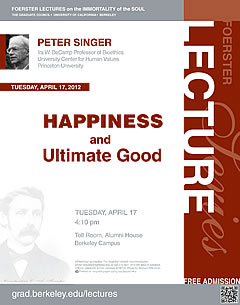
[00:00:00] (background chatter)
[00:00:02] HOST:
Okay. Welcome, everybody. It’s really great to see such a large interested audience.
Welcome, colleagues. Welcome, students. Welcome, community members.
We’re so happy that you can be here and that Professor Peter Singer can be with us to give, give us his words of wisdom. This lecture is sponsored by the Foerster Lectures Committee and the Graduate Council. I am the chair of the Foerster Lecturers Committee, and before we give a formal introduction to Profe– to Professor Singer, I’m obliged by the terms of the– of the award that we got a long time ago, the bequest to tell us, tell you all about, about the Foerster Lectures and how they came to be.
In 1928, Ms. Elizabeth Zweybruck established the Foerster Lectureship to honor the memory of Agnes A. Foerster and Constantine E.A. Foerster. Edith was, for many years, a public school teacher in San Francisco, and the teaching profession was, to her, an opportunity to develop a knowledge and love of spiritual values in the young minds entrusted to her care. Edith’s beloved sister, Agnes A. Foerster, shared her high ideals and hopes, as did Agnes’s husband, Constantine E.A. Foerster.
A lawyer by profession, Forster was a man of high intellectual achievements and rare personal charm. Although he passed away at the age of 37, he had achieved an enviable place at the San Francisco Bar and was considered one of its most highly respected members. For several years prior to his death, Forster was a law partner of Alexander F. Morrison, one of the most prominent of San Francisco attorneys for whom our Morrison Memorial Library is named.
In her last days, Ms. Edith Zweybruck expressed her deep and abiding interest in spirituality by creating this lecture series on the subject, The Immortality of the Soul or related subjects. And our committee defines this rather broadly. I mean, it’s anything that deals with relationships between humanity and the rest of the universe, transcendentalism, spirituality, religion, and so forth.
Edith Zweybruck believed that through the medium of great, of great university and the words of scholarly lecturers, she might bring new light upon a topic that has interested the world for centuries. Thank you, Edith Zweybruck. And now, it’s my pleasure to introduce our speaker, Professor Peter Singer.
Peter Singer specializes in applied ethics, and throughout his long career, has served as a major exponent of a utilitarian perspective to this branch of learning. A prolific author, he’s perhaps best known for the book, Animal Liberation, published in 1975 and widely regarded as the touchstone of the Animal Liberation Movement. His views on animal rights and other issues in bioethics have attracted far-reaching attention and considerable controversy.
In a subsequent publication, Rethinking Life and Death: The Collapse of Our Traditional Ethics, Singer examines the ethical dilemmas of modern medicine and explores the contentious issue of the value of human life and abortion, a medical procedure which he accords a highly original reading. Singer’s most rich– most recent book, The Life You Can Save: Acting Now to End World Poverty makes the argument that it’s a clear-cut moral imperative for ci– for citizens of developed countries to donate generously to charitable causes that help the poor. He is currently working on a book tentatively entitled Sidgwick and Contemporary Ethics.
Here, Singer reviews the utilitarian philosopher Henry Sidgwick’s 19th century masterpiece, Methods of Ethics, to show how Sidgwick’s ideas are relevant to, to the contemporary world and can be made accessible to present-day students and ethicists. Born and educated in Australia, Singer received his BA and MA from the University of Melbourne. In 1971, he received a prestigious graduate degree in philosophy, the BPhil, at the University of Oxford.
He has served as Chair of Philosophy at Monash University, where he founded its Centre for Human Bioethics. Voted one of Australia’s 10 most influential public intellectuals, Professor Singer, in 2005, was included in Time magazine’s list of the 100 most influential people in the world. He is the Ira W. De Camp Professor of Bioethics at the University Center for Human Values at Princeton University and Laureate Professor at the Center for Applied Philosophy and Public Ethics in the University of Melbourne.
He speaks to us today on the topic of happiness and ultimate good. Please join me in welcoming Professor Peter Singer.
(applause)
[00:05:48] PROFESSOR PETER SINGER:
Thank you very much for that introduction. Thank you, all of you, for turning out. And I noticed the little breath of relief when you realized you were not going to get a lecture on the immortality of the soul, which I would not be well-equipped to give.
But I suppose one could say there’s this connection between what I will talk about. If indeed the soul were immortal and if at least some souls went, as some people believe, to paradise or heaven, then presumably they would be happy. But then we have to ask, what does that mean?
What is the good that would be achieved were they to be happy? And that does take us pretty close to my topic, so I prepare that justification in case anyone should challenge the propriety of this talk on that lecture.
(laughter)
What I’m really going to do is talk about what underpins the views that I’ve held on many issues, as was mentioned in the introduction about the treatment of animals, about global poverty, about life or death questions. So I’m not actually going to be addressing the specifics of those questions, but rather the value underneath it. For essentially my whole philosophical life, certainly since I wrote Practical Ethics more than 30 years ago, I’ve held that the right thing to do is what does most to satisfy the preferences of all those affected by one’s action, whether human or non-human.
That’s a view that’s generally known as preference utilitarianism. And I held it, I suppose, to some extent under the influence of one of my Oxford teachers, RM Hare whose view was based on what he called universal prescriptivism. That is, a view of ethics which says that moral judgments are prescriptions, they’re not statements.
They can’t be true or false in an ordinary sense, although we can reason about them because they have to be universalized in a special sense of that term. I’ve been uneasy about that meta ethic for quite some time, but it took two factors, or perhaps it would be better to say two great philosophers, to persuade me to seriously consider a shift away from it. One of them was, as Professor Band mentioned in the introduction Henry Sidgwick who I’m currently working on.
And let me say, I’m working, I’m not just writing this book by myself. I have a co-author, a Polish colleague, Dr. Katarzyna de Lazzari-Radek. And I want to acknowledge that the work that I’m presenting is, to some extent drawn from work that we have jointly prepared as part of the draft of this book.
The second, Sidgwick was an objectivist in ethics, so some extent working out his views on the nature of ethics. The second great philosopher who has influenced me is a contemporary the Oxford philosopher Derek Parfit, whose major recent work On What Matters is at least in part, an extended defense of objectivism in ethics. Now one could accept objectivism as a metaethical position and still be a preference utilitarian in terms of normative ethics.
That is, in terms of the content of what you think one ought to do. Objectivism doesn’t preclude the idea that we ought to satisfy desires or preferences as a normative view. But it does, for various reasons, increase the appeal of some alternatives to it.
And prominent among these is the idea that happiness is the ultimate good. So what I’m going to talk about today is to explore that idea. The idea, in other words, that instead of being preference utilitarians, we should be closer to the classical utilitarians who were concerned about happiness or, as it’s sometimes put, were hedonistic utilitarians.
Hedonism from the Greek word for pleasure. So section two, what do we mean by happiness? The trinity of 19th century utilitarians, that’s Jeremy Bentham, John Stuart Mill, and Henry Sidgwick, were all ethical hedonists.
When they discuss happiness, they often use happiness or pleasure because for them, happiness means a surplus of pleasure over pain. This view has been subject to considerable criticism over the years, and I’m certainly have not been the only one who’s thought that it was not defensible that a preference view was better. And there’ve been quite a few recent works examining in particular, the concept of happiness and what we mean by that.
One of them is by Fred Feldman. It’s a book called ‘What Is This Thing Called Happiness?’ And Feldman is quite critical of the classical view.
He attributes to Bentham, Mill, and Sidgwick what he calls sensory hedonism, which essentially means, I guess, that you’re happy at a time. If and only if you feel more sensory pleasure than pain at that time, and unhappy if and only if you feel more sensory pain than pleasure at that time. What does he mean by sensory pleasure?
Well, I take it that the dictionary definition says relating to sensation or the physical senses, transmitted or perceived by the senses. So, Feldman seems to mean something like that, and he does say that sensory pleasure always has some phenomenally given sensory intensity, which is a measure of how strong or vivid, or brilliant the pleasure is. So it seems that he’s really thinking about something of which the paradigm cases would be the physical pleasures, whether they’re pleasures of sex or of eating or of the warmth of the sun on your back or something of that sort.
And indeed, in arguing against sensory hedonism, Feldman uses an example from sexual pleasure. He asks us to imagine an unfortunate character named Wendell, who’s seen advertisements for an orgasm enhancer that it’s claimed will give him an amazing 400-hedon orgasm. You have to imagine that we can measure pleasure in units that are called hedons.
Although he’s been warned by his friends that the advertisements are probably a scam, he buys the device and tries it out. But when the orgasm comes, instead of the monster orgasm he’s expecting, he gets a pathetic little 12-hedon orgasm. Experiencing it, he’s unhappy.
But why?
(audience laughing)
After all Feldman argues, ’12 hedons is better than no hedons, or minus 12 hedons.’ So, surely Wendell is experiencing pleasure rather than pain. If happiness is just having a positive balance of pleasure over pain, we would have to agree that at the moment of orgasm, he’s happy, but anyone observing him can see that he has a pained look on his face and seems generally unhappy.
Feldman also has another case perhaps more realistic, and in some respects, the reverse of this. He asks us to imagine a woman in the throes of giving birth without drugs because she wants to be able to fully experience the birth process, so she’s in considerable pain. But with one last push, the baby comes out.
Later she says that the pain was the worst that she’s ever felt, much greater than she’d expected, but at the same time the birth, was the happiest moment of her life. Both these cases, Feldman argues, suggest that the hedonism of the Bentham, Mill, Sidgwick variety is false. Well, I think that this is really a travesty of certainly what Sidgwick was arguing.
I won’t answer for Bentham or Mill because he has a much broader notion of pleasure. For example, among the pleasures he talks about are the pleasures of intellectual exercise, of aesthetic reception, of grasping some scientific discovery, and he talks about the pleasure of labor, meaning, I take it work, rather than giving birth. But still.
He also notes that there are states in which a certain amount of pain or discomfort is mixed with pleasure, and among such states, he mentions the triumphant conquest of painful obstacles, which could well describe the birth process. And he might even be referring to someone like, like Wendell when he writes of the disappointment of the hedonist who fails to find self-satisfaction where he seeks for it, adding that this disappointment is attended with pain or loss of pleasure. Now, admittedly, I’m not trying to suggest that but when Sidgwick uses the term self-satisfaction, he had masturbation in mind, but what the passage does show is that he counts disappointment as a pain.
And on that basis could plausibly reject Feldman’s claim that Wendell, at the moment of his pathetic 12-hedon orgasm, which of course is also the moment at which he realizes he’s been the victim of a scam, is experiencing, could reject the claim that that he’s experiencing a positive balance of pleasure over pain.
[00:15:47] HOST:
Another hedonist Feldman criticizes is my Princeton colleague and Nobel Laureate, Daniel Kahneman. According to Kahneman, it makes sense to say Helen was happy in the month of March, if, and I quote, “She spent most of her time engaged in activities she would rather continue than stop, little time in situations she wished to escape, and very important because life is short, not too much time in a neutral state in which she would not care either way.” In that passage, Kahneman does use the word activities rather than mental states or experiences, but he also talks elsewhere about experience and experience utility and the experiencing self, and I think it’s clear that he is actually talking about mental states here.
He talks, for example, about instant utility, adding that instant utility is best understood as the strength of the disposition to continue or to interrupt the current experience. So his view is a mental state view, and one that distinguishes the mental states that contribute to happiness from those that do not by saying, just as Sidgwick does, that the former are ones we desire to continue. In other words, pleasure or the positive mental states utility, is not just one particular type of sensation.
It’s not to be distinguished by a certain kind of feeling in the way that we might distinguish some particular sensations as having a certain type and then they’re just differing along that continuum. But I think pleasure for Sidgwick and for Kahneman is much more widely varied and what determines that it’s pleasure is that it’s a state of consciousness that considered intrinsically, just as a state of consciousness, you would wish to continue, you would wish to have more of. And conversely, pain is a state of consciousness that considered intrinsically, you would wish to have less of.
And I’m going to come back to Kahneman’s view at the end of towards the end of the talk. What does Feldman put up as an alternative to sensory hedonism? He talks about attitudinal hedonism, which he says is to have a positive balance of intrinsic occurrent attitudinal pleasure.
That’s probably not a very transparent phrase. What does it mean? Well, for example, he says, “I might be pleased to learn by reading a newspaper that the distribution of bed nets by aid agencies has reduced the number of children dying from malaria.
To say that I’m pleased to read that doesn’t mean,” Feldman says, “that I have a kind of cheery feeling as I read it, or that I have a warm inner glow as I read it. It just means that I have this positive attitude towards it.” And that’s what, how Feldman would replace for the, the classical utilitarian view, as he sees it.
But as, as Daniel Hebron points out in another recent work on happiness called ‘The Pursuit of Unhappiness,’ that view takes the fun out of pleasure. If the knowledge that fewer children died does not involve any positive emotions or feelings, does it really contribute to my happiness? I agree with Hebron, I don’t think it does.
So, I reject Feldman’s alternative to the traditional view, as well as his critique of that view. Hebron, however, puts his own case against a hedonistic view of happiness, and I think it’s more difficult to counter. His argument is that some pleasures, like the enjoyment of eating crackers, and he also mentions orgasms, I guess they just come into this discussion naturally.
He thinks that some of these pleasures, at least, may be too superficial to have any impact on our happiness. As he puts it, “These pleasures just don’t get to us. They flip through consciousness, and that’s the end of it.
They leave our happiness level untouched.” So, Hebron thinks that to feel pleasure is just to have an experience, which may or may not get to us, whereas to describe someone as happy is to say something that goes deeper, to say something about their emotional state and their mood. Emotional states and moods are not just feelings, they’re dispositions to feel something.
To say that I’m irritable, for example, is not to say that I’m feeling irritated right now, but rather to say that I’m liable to become irritated, perhaps about trivial things that would not bother someone else who was in a more expansive mood than I am. Hebron grants that a person with a generally dour personality might, because of good fortune, be in high spirits for a time, and we could then consider her happy, but he says this would be a fragile sort of happiness, unlike the robust happiness of a person who has a propensity to have those positive moods and emotional states. Now taking that as an account of common usage, of how we ordinarily use the term happiness, which of course is a term in common use, not a philosophical term of art, quite possibly Hebron is right.
That is the sense in which we most commonly use the term, and we could then accept his view that happiness refers not to the surplus of pleasure over pain that the classical utilitarians used it to refer to, but to having a certain emotional state. The question is, does this mean that the classical utilitarians were mistaken? Excuse me.
Okay, Section 3, Happiness, Utilitarianism, and Value. If we agree that Hebron’s account of happiness gets the ordinary concept right, what follows? He himself is clear that to give an account of happiness has no implications for a theory of value as such.
So you could reject the hedonistic account of happiness without rejecting the hedonistic account of value. All utilitarians need to do, he says, is grant that their theories are about pleasure and not about happiness. And given Hebron’s account of happiness, I think that’s a plausible view.
If happiness is, at least in part, a disposition to have certain feelings under certain conditions, how could that be good in itself? What would have to be good, surely, is the feelings that it’s a disposition to have, not having the disposition as such. So utilitarians then would have to change their vocabulary and speak of pleasure rather than of happiness, but they wouldn’t have to change the utilitarian conclusions about what we ought to do.
Still, you might feel the utilitarianism would be less persuasive if they had to talk about maximizing the greatest pleasure for the greatest number rather than the greatest happiness for the greatest number.
[00:23:19] PROFESSOR PETER SINGER:
At least utilitarians need to explain why on their view happiness is important. But I think Hebron’s own account provides such an explanation. To be happy on his view, is to be in a certain emotional state which makes it likely that you’ll experience pleasure.
He says, I quote one of these states, “It’s the single most important determinant, happiness, of our hedonic states.” So, if we combine the classical utilitarian view that the only thing of intrinsic value is pleasure with Hebron’s view that happiness consists of a set of emotional states, we reach the conclusion that happiness is instrumentally good, not intrinsically good. Pleasure, in the sense of being in a positive hedonic state, is intrinsically good, and happy people are more likely to experience this positive hedonic state, so happiness is an important instrumental good, and I think we can also use this account to explain why happiness is important in practical deliberation.
As Hebron himself argues, it’s often easier to work out when making an important choice, whether it will lead to you being happy or unhappy, or other people being happy or unhappy, than whether it will maximize hedonic states. Think, for example, of making a career choice. You might think of a choice between two different careers, that one of them will lead you to be stressed and anxious whereas the other will give you more peace of mind.
So those are not intrinsically good things themselves, but they’re likely to contribute to your happiness or your unhappiness, of course, in the state, the career that leads you to be more stressed than anxious, and therefore to mean that you less frequently have positive hedonic states. So I think we can explain why, in terms of making choices, happiness might come to our mind more easily than pleasure, because it just may be more easily to work out what impact the choices will have on this very basic and important instrumental good that is likely to lead to the actual intrinsic good. Section Four, arguing for the value of mental states, conscious states.
What I’ve argued so far is that criticisms of hedonism as an account of happiness don’t exclude the possibility that pleasure is the only thing of intrinsic value. But I haven’t yet argued that pleasure is of ultimate value, or indeed of intrinsic value at all, let alone the only thing of intrinsic value. Why might we think that it is?
Well, let’s look at how Sidgwick argues for pleasure as the ultimate value. He begins with a claim that when we think about what we judge to be good, everything that can survive the scrutiny of careful reflection has some connection to human existence, or at least to some consciousness or feeling. And in other parts of the Methods of Ethics, he explicitly includes animal consciousness as part of the good.
So what we’re talking about here is he’s saying that anything that can survive the scrutiny of careful reflection in terms of being judged to be good has to be a conscious state of some sentient being, human or animal. He considers possible counterexamples to the claim. He notes, for example, that we commonly judge inanimate objects or scenes to be good because they’re beautiful, or bad because they’re ugly.
But, he goes on to say, no one would consider it rational to aim at the production of beauty in external nature apart from any possible contemplation of it by human beings. Famously shortly after that in Principia Ethica, G.E. Moore did challenge that claim and asked the reader to imagine two possible worlds, one as beautiful as you can possibly make it, the other as ugly as you can possibly make it. Simply one heap of filth uh, in Moore’s phrase with no redeeming feature, and grant that no human being or no sentient being will ever see either world.
Nevertheless, Moore, in Principia Ethica, said it’s rational to prefer that the beautiful world should exist rather than the ugly world. Well, you can consult your own intuitions on this. I think if we can really imagine that world with no being appreciating it, then it really doesn’t make any difference.
Of course, for us, since we’re imagining it, we may like to imagine the beautiful world. That’s a more pleasant experience for us, but we have to somehow subtract that from the process of doing this thought experiment and then I don’t think it makes a difference. And incidentally, Moore himself later on in his little book, Ethics abandoned that view about the worlds without consciousness and agreed with Sidgwick that nothing is intrinsically good unless it has some relation to consciousness.
But even, and if we agree that such things as beauty and knowledge are only good in some relationship to human beings or to minds of some kind, somebody might say that it would be reasonable to be concerned with producing them for their own sake and take them as ultimate ends irrespective of who may come to appreciate the beauty or gain in knowledge. But Sidgwick’s argument is that they can only be ultimately good if they lead either to happiness or to the perfection of excellence of human existence. In other words, he’s saying these goods have to be connected with human existence in some way, and he’s now considering, yes, but maybe they don’t have to be connected with human existence in terms of happiness.
Maybe they are connected with human existence in terms of achieving certain perfections or excellences, which are intrinsically good in themselves. That idea that what is intrinsically good is perfection or excellence probably sounds a little odd to modern ears in a more egalitarian kind of era. But it certainly is an ancient tradition which goes, can be traced back at least to, to an– to Ancient Greece and to Aristotle, and came into Western thought, or Aristotle’s version of this idea came into Western thinking through Aquinas.
And you can find it today in contemporary writers like John Finnis, who in that loosely in that Thomistic Traditionbut I think the Aristotelian version of excellences makes sense only within a pre-Darwinian view of the world. That is, a view that, that the world exists for some purpose and the purpose is for us to achieve these highest goods in particular for Aristotle, to perfect our rationality which is the highest good.
If we abandon the idea that the world exists for a purpose, then at least that Aristotelian way of arguing for excellences as intrinsic good, I think doesn’t really work. Because human nature is not then going to necessarily be intrinsically good. There may be aspects of our nature that we don’t want to perfect, like aggression, for example, which seems on a Darwinian view to be one aspect of our human nature.
There are other forms of perfectionism, too. One is related to the idea of living virtuously, and virtue ethics has had something of a revival in recent years. But I think Sidgwick’s criticism of virtue ethics is something that applies still to modern virtue ethics, at least if the virtue ethicist is trying to offer a comprehensive normative ethical theory.
What Sidgwick says is that to know what qualities are virtues, we need to know what we ought to do. You can’t just have the ideas of virtues independently of some idea of what we ought to do. And to know what we ought to do, we have to define what the good is.
Therefore, to define the ultimate good as virtue is just to go round in a circle. And maybe that can be made clearer if we look at some specific virtues. Sidgwick, for instance, gives the example of frugality, which was a virtue in Sidgwick’s day.
I guess people didn’t get regular mail asking them to take out more credit cards when Sidgwick was around. So, when does frugality pass over into the vice of meanness? Sidgwick asks.
Or when does courage become foolhardiness? When do candor or generosity, or humility, become excessive? Sidgwick argues you can only answer those questions by having a notion of what is good, and without such a notion, virtue theory would be seriously incomplete.
Finally, just one third form of perfectionism. John Rawls, in A Theory of Justice, talked about perfectionism as simply the idea that achieving excellence, whether in art or science or culture, trumps all other values. So for a perfectionist, if the achievements of ancient Greece could only be realized because they had slaves, then slavery was justified.
That, of course, is not Rawls’ view. But Sidgwick does discuss such a view too, and he argues that however immediately the excellent quality of such gifts and skills may be recognized and admired, reflection shows that they’re only valuable on account of the good or desirable conscious life in which they are or will be actualized, or which we somehow promoted by their exercise. In other words, he’s sticking to a mental state view and saying that art, science, and philosophy are good only insofar as they promote or are part of a desirable conscious life.
And again, you have to ask yourself, does reflection show that? Sidgwick is appealing to your considered judgment. And again, I would say at least that mine does, and may not be true of all of you, but I think if art, science, and philosophy had no positive effect on the conscious lives of sentient beings at all, it would not be valuable.
So Sidgwick at this stage is taking his argument to show that ultimate goodness is good or desirable consciousness or sentient life. There’s a well-known objection to this view, a modern objection that Sidgwick didn’t, of course, explicitly consider, although he does say some things relevant to it. It was put forward by Robert Nozick, and I’ll read you a couple of relevant passages.
Suppose there were an experience machine that could give you any experience you desired. Super-duper neuropsychologists could stimulate your brain so that you would think and feel that you were writing a great novel or making a friend or reading an interesting book. All the time, you would be floating in a tank with electrodes attached to your brain.
Should you plug into this machine for life, programming, pre-programming your life desires? Of course, while in the tank, you won’t know that you’re there. You’ll think it’s all actually happening.
Others can also plug in to have the experiences they want, so there’s no need to stay unplugged to serve them. And Nozick says we should ignore problems such as, who’s going to service the machines if everyone plugs in?
(audience laughter)
The question is, would you plug in? And the point of the example, of course, is that Nozick expects us to say, no, I would not plug into the experience machine. And if you do say no, that surely implies that something matters to you other than conscious experiences, other than how your life feels from the inside.
Because if you do plug in, you can have the best possible conscious experiences you can imagine of the whole range of pleasures. This is not like Feldman’s criticism of just sensory pleasures, because if you want the pleasure of making a friend or reading a good book or climbing Mount Everest, we can program the machine to give it to you. But Nozick says, “We don’t want that.
We want to be a certain kind of person, loving, brave, intelligent, and so on, not just a body floating in a tank. We want to live in contact with reality.” The experience machine is a powerful reason for rejecting ethical hedonism, but does the conclusion really follow from this example?
It’s true that we can have desires for things that are not mental states, that we do have such desires. For example, I might desire that the people I consider to be my friends like and respect me. Suppose also, in fact, none of these people like or respect me.
They think that I’m a conceited fool. But they are very well-intentioned people and they know about my desire, and they don’t wish to cause me distress, so they all pretend to like and respect me.
(audience laughing)
And they do this so well that I never know the difference. I live to a ripe old age, I die without ever knowing that I was mistaken about the opinions of the people I took to be my friends.
(audience laughing)
Although I believed that my desire to be liked and respected was satisfied, there’s clearly a sense in which it was not. And the desire theory, that’s the theory that, as I said, I certainly used to hold and for a long time, the desire theory does not locate ultimate value in mental states alone. And so it gives you an easy response to the experience machine thought experiment.
If we don’t want those illusions, then the desire theory or the preference utilitarianism does not have to say that we should plug in. If our desire is to live in contact with reality, it follows for the preference utilitarianism, that this is what we should indeed do. So as I say, that was an example that was one of the factors, not the only one, but one of the factors that led me to think that a preference-based view is better than a hedonistic view.
But I’m no longer convinced that the experience machine is a sufficient reason for abandoning hedonism in favor of a desire-based theory of value. I recognize the strength of the intuitions we have against plugging into the machine. They’re, in part, I believe, the result of our nature as purposive beings.
For thousands of generations in the world in which our ancestors were surviving, both competing and cooperating with other intelligent beings, to improve their chances of survival and the survival of their offspring, they had to act purposively. They couldn’t just act for the pleasures of the moment. So we’ve evolved a need to act purposively, and a strong tendency to override our immediate pleasures and pains for the sake of larger purposes.
That leads to what’s sometimes called the paradox of hedonism, the idea that we’re most likely to find pleasure by setting ourselves certain purposes and goals that stand apart from our own desire for pleasure. If you directly say, “I’m going to do what will give me most pleasure now,” the paradox of hedonism suggests you’re not going to find it. But the experience machine objection asks us to imagine a world in which everyone’s needs can be taken care of completely, forever.
And that includes not only the needs for food and shelter, but for the avoidance of whatever experiences they wish to avoid. In such a radically different world, all of our usual purposes become otios. There’s no need for us to save for old age, ensure that our children and grandchildren get a good education, or even to seek to end world poverty or protect human rights.
To make the example complete, I guess we have to say there’s no need for us to work to protect the welfare of animals either. I suppose that might mean that they get their own experience machines. I’m not quite sure what Nozick had in mind there.
But if we still have this need to live to some purpose, then it’s no wonder that we think that there is something wrong with plugging into the experience machine. The situation resembles that of asking somebody to drink a glass of apple juice in which, just in front of their eyes, you have taken a roach, carefully sterilized in a medical sterilizing cabinet, and then dipped it into the apple juice and withdrawn it. This is an experiment that has been done by Jonathan Haidt, among others and we know that many people are reluctant to drink the apple juice, even though previously, they’ve expressed a desire to drink some apple juice.
(laughter)
So intellectually, we can grasp that there’s nothing wrong with the apple juice that had the roach, sterilized roach dipped into it, but we can’t quite get rid of that intuition. So I’m suggesting that maybe something similar is going on here with our intuition that even in the circumstances described, very imaginary circumstances quite beyond reality, that we would not want to plug into the experience machine. There are other reasons too, of course.
One might be that we just don’t believe that the technology is foolproof, there’s a problem of accepting the hypothesis and so on. Of course, since Nozick put this example, we’ve become familiar with the idea from films like The Matrix. But we don’t like that idea either because we were being exploited by intelligent machines who needed our body heat to provide energy for some further bizarre reason that’s difficult to understand.
But you have to imagine that in Nozick’s machines you know that none of this is going to happen. No one is going to suffer or will be. Still a suspicion that something will go wrong is hard to avoid.
There’s another possible factor going on here that’s been exposed by some empirical research by Philippe De Brigard. He asked people to imagine he was interested in finding why people are reluctant to enter the experience machine, or if indeed they are. So he asked people to imagine that they’re already connected to an experience machine, and now face the choice of either remaining connected or going back to live in reality, and he randomly offered them one of three vignettes.
In what he called the neutral vignette, you’re simply told that you can go back to reality if you like, but not given any information about what reality will be like for you. In the negative vignette, you’re told that in reality, you’re a prisoner in a maximum security prison.
(laughter)
[00:43:24] HOST:
And in the positive vignette, you’re told that in reality, you are a multimillionaire artist living in Monaco.
(audience laughing)
Now, of those participants given the neutral vignette, 46% said they would prefer to stay plugged into the experience machine. Among those giving the negative vignette, that figure rose to 87%. That’s not so surprising, for the alternative with them was life in a maximum security prison.
But most surprisingly of all, of those given the positive vignette, exactly half preferred to stay connected to the machine rather than return to reality as a multimillionaire artist living in Monaco. Monaco has to do a bit better in its public relations, obviously.
(audience laughing)
So these results don’t support Nozick’s confident judgment that we prefer to live in reality rather than plugged into a machine. They also, though admittedly, don’t support the hedonistic view that what people are choosing to do is to maximize their pleasure. But what is interesting and the reason why Brigard asked the– De Brigard asked the question the way he did is that the status quo bias is playing a role here.
So the status quo bias, for those who are not familiar, is a well-known psychological phenomenon, it’s been studied in various ways, that suggests that people are reluctant to depart from the status quo. So if you give them $2, and for example, and say, “For $2, you can buy this cup.” Then let’s say relatively many people would think, “Oh, that’s a nice cup.
Sure, here’s $2. I’ll buy it.” But if you give them the cup and say, “Here’s your cup.”
And somebody offers them $2 for it, I think I’ve got this slightly wrong, sorry. But the idea is whatever you give them is something, their endowment, and they’re reluctant to depart from it. So the same kind of thing seems to be going on here, that one of the reasons why we may be reluctant to enter into the experience machine is we’re reasonably content with the status quo.
And so we don’t want to give it up for something unknown. But if you ask people to imagine, even just imagine, that they are plugged into the machine, and then that they move from that to reality, then they are also more reluctant to abandon the status quo. And one way of confirming that once De Brigard had his results, he then put a fourth vignette to people, identical to the neutral one, except that the participants were told that life outside the machine is not at all like the life you experienced so far.
That information dropped the number of people who were prepared to disconnect from 50% to 41%. Not a huge difference, but it did appear to have an effect. So that also suggests that the experience machine is not a decisive objection to the view that what is ultimately good is a state of consciousness.
Section seven, the experiencing self and the remembering self. Many attempts to survey happiness ask people how satisfied they are with their life. For example, there’s something called the Gallup World Poll, which has many questions.
One section is on well-being, and under well-being, the Gallup World Poll asks people to give a number between one and 10, indicating their answer to the question, “All things considered, how satisfied are you with your life as a whole these days?” Haybron and Feldman have pointed out that for various reasons, this asks a different question from, “How happy are you now?” You might be satisfied, but you might be satisfied because you have low expectations.
Some people might think, for example, “Well, how happy can a sinner like me expect to be?” Or someone who has internalized the repressive attitudes of her society towards women might also be fairly, be not very happy at all, but still satisfied with her life. The same might be true if you’re a member of a low caste or an ethnic minority.
Daniel Kahneman, who I mentioned earlier, together with uh, Angus Deaton, has shown another interesting distinction between the answers that Americans at least give to Gallup’s life satisfaction question and the answers they give to questions about their emotional well-being. So on the one hand, an answer to the question that I just gave you, “How satisfied are you, all things considered, with your life these days?” With questions that indicate the emotional quality of an individual’s everyday experiences, the frequency and intensity of experiences of joy, stress, sadness, anger, and affection that make one’s life pleasant or unpleasant.
According to Kahneman and, Deaton, the higher your income, the higher life satisfaction you are likely to report, your emotional well-being shows no further increases once your income reaches $75,000 per annum.
[00:48:35] PROFESSOR PETER SINGER:
Adam, as I say four Americans. and this is interesting answer to, there’s been a lot of discussion about whether indeed happiness does increase with income. For many years, it was believed that it did not, that it increased only up to a certain plateau and then that it just plateaued.
Then Kahneman and Deaton argued that that was wrong. Deaton in particular initially and a couple of other people argued that in fact it does go up indefinitely, although admittedly it goes up much more slowly only after that plateau. But they claimed it did increase.
Now it seems that the answer is it depends exactly on what you’re measuring, whether you’re measuring how people answer the life satisfaction question, in which case, yes, it does continue to go up even after the plateau, although more slowly than before, or whether it’s these, this emotional well-being that is the frequency of these experiences, which obviously is closer to what I’ve been talking about, the hedonistic view of pleasure and pain. And there it does seem that it plateaus after this reasonably comfortable level of 75,000 per annum. And as part of this discussion and other writings, it’s a good thing that I got my laptop here rather than paper
I guess, isn’t it? Kahneman has developed the distinction between the experiencing self and the remembering self. And here’s one way of illustrating that distinction.
Patients undergoing a colonoscopy, thank you. Patients undergoing a colonoscopy were asked to report at intervals the level of pain or discomfort they were feeling. It’s pretty amazing that people consent to this research, I think.
(laughing)
Just what you need. You’re undergoing a colonoscopy and there’s some guy asking you, “How does it feel now? How bad is it now?”
“Give me a number, one out of 10, what it’s like now.” It seems like people did this. Then after the procedure was over, they were asked to assess how bad it was and to make a hypothetical choice between having it repeated or having a barium enema.
Also not a very pleasant experience. The results were surprising. So I’ll take just a two sample patients here.
Patients A and B might have identically painful experiences for the first 10 minutes of the colonoscopy. Suppose that patient A’s experience ends at that point, after 10 minutes. Then the colonoscopy is over.
He feels no more pain.
[00:51:06] HOST:
Whereas patient B’s experience, having the identical first 10 minutes as patient A, continues for another five minutes at a level that he still finds painful, but not as severely painful as the first 10 minutes. Okay, so first question, who suffered the most pain? Let me ask you actually.
A show of hands, how many of you think A suffered the most pain? How many of you think B suffered the most pain? Well, of those who dare to show your hands, the great majority is for B.
I think that’s right. Clearly B did. For the first 10 minutes, he had just as much pain as A, and then he had an additional five minutes of some pain, while A was feeling no pain at all.
Yet when we asked the patients after the experience is all over to rate the experience, typically A rates it worse than B and is less willing to repeat the procedure. And this is not just in colonoscopies. Kahneman has repeated this by getting people to put their arm into extremely cold water for two minutes and then for one further minute into water that is still painfully cold, but not as cold as it was for the first two minutes.
And you get the same result. The people who put their arm in the extremely cold water for two minutes and then take it out altogether describe it afterwards as a worse experience than the people who had the one extra minute of still uncomfortably cold water. Kahneman calls this phenomenon duration neglect, and he considers it a focusing illusion.
We focus on the last moments of the experience rather than the entire experience. And he goes so far as to say that we have two selves, the experiencing self and the remembering self. When we ask questions about life satisfaction, we aren’t necessarily addressing ourselves to the remembering self.
We’re asking the self to remember what these last few days have been like. We can only access the experiencing self if we interrupt it at frequent intervals to ask, as I said, “What is it like now?” And Kahneman has done this not just for the patients in colonoscopies, but for a larger number of subjects going about their daily lives.
And it’s interesting how technology makes this easier to do. He programs their mobile phones to interrupt them at very random intervals throughout their lives, and then they have to put in a number between 0 and 10 to indicate the quality of their experience at that particular moment. And then he can get all of these results and tabulate them and associate them with what they were doing at particular times and so on.
But given this distinction, we then face a value question. What is of ultimate value? Is it the quality of life of the experiencing self or of the remembering self?
Kahneman seems to lean towards the experiencing self, saying the logic of duration weighting is compelling. Duration weighting, of course, being the idea that we should take account of how long an experience lasts. And he’s also written that the total utility of an episode is a product of average instant utility, the average level, and the duration, and that retrospective evaluation leads to erroneous estimates of the true total utility of past experiences.
But he also says that duration weighting can’t be considered a complete theory of well-being because individuals identify with their remembering self and care about their story. But a theory of well-being that ignores what people want cannot be sustained.” So his conclusion is that the remembering self and the experiencing self must both be considered.
Their interests don’t coincide, but they both need to be taken into account. That’s from his most recent book, Thinking, Fast and Slow. And then he adds, “Philosophers could struggle with these questions for a long time.”
No doubt they could, and perhaps they will. But Sidgwick did actually think about these questions and without of course knowing exactly this distinction that Kahneman is drawing, but he did conclude that we should have, “Impartial concern for all parts of our conscious life.” That’s a quote, and it is of course Kahneman’s principle of duration weighting.
I agree. It’s true that individuals identify with their remembering self and care about their story, but presumably this actually has some impact on their experiences. When they’re thinking about their story, remembering their past or recent experiences, and feeling positively about this, this is a positive experience that improves their current experience.
And to the extent that caring, their caring about the story affects the quality of their experience, of course it does matter on the hedonistic view of ultimate value. To the extent that it doesn’t affect the quality of their experiences, it doesn’t matter on that theory. So I’m supporting the experiencing self over the remembering self in this choice.
Is it true, as Kahneman says, that a theory of well-being that ignores what people want cannot be sustained? I certainly would have thought that in the past, but now I think that perhaps the only way in which that’s true is that politically, it can’t be sustained. If government set out to measure happiness and to promote it, they’d better come up with an idea of happiness that people want and are prepared to support.
It’s the remembering self that votes, after all, not the experiencing self. But that’s a problem for democratic theory and political philosophy rather than for the area of ethics that inquires into ultimate value. Okay, brief conclusion.
The 21st century is on track to become the happiness century, at least if we can judge by its first dozen or so years. The small Himalayan kingdom of Bhutan has long had a policy of promoting Gross National Happiness rather than gross national product, and work in this area has accelerated since Bhutan became a constitutional monarchy and a democratic monarchy in 2008. That was also the year in which the French President Nicolas Sarkozy set up a commission chaired by the economist Joseph Stiglitz, and including also Amartya Sen and Jean Paul Fitoussi, to recommend ways of measuring social progress as well as economic performance.
Last year, Bhutan achieved a diplomatic success by persuading the United Nations General Assembly to support a non-binding resolution encouraging member states to undertake steps that give more importance to happiness and well-being in determining how to achieve and measure social and economic development. And earlier this month, there was a United Nations meeting in, in New York to discuss that issue further. This year, we’ve also seen the United Kingdom begin surveying the public with a view to establishing a measure of societal well-being, and the United States Department of Health and Human Services has set up a panel of experts in psychology and economics, including Daniel Kahneman, to try to define reliable measures of subjective well-being.
If the panel is successful, these measures could become official government statistics. Some Americans responding to the recent announcement of this panel have voiced fears that it could herald more government interference in our lives.
[00:58:42] PROFESSOR PETER SINGER:
In my view though, Americans have long had an exaggerated suspicion of the dangers of government interference, and it’s already cost them the kind of universal healthcare system that in other countries, in other developed countries there’s a political consensus about the desirability of that crosses the liberal-conservative divide. Just as governments see it as their function to promote opportunities for business development that lead to economic growth, so I don’t see why they should not see it as their function to promote individual choices that lead to greater personal happiness, or indeed, to maximization of pleasure over pain. After all economic growth is only a means to an end.
I’ve argued that happiness is also a means to an end, but I think happiness comes closer to the ultimate end that I’ve defended, at least partially defended, of intrinsic value of a maximization of desirable consciousness, as Sidgwick could have called it, or pleasant experiences over painful ones, and that seems to me therefore to be a desirable thing for governments to do. Thank you for your attention. I hope that I’ve, you’ve found the lecture not only an a pleasurable experience, but that I’ve ended on a high note, and I look forward to your questions.
(audience applauding)
[01:00:19] HOST:
So thank you very much, Professor Singer, and those of you who have questions, would you please line up here where I’m gonna put the microphone imminently. And we ask that they really be questions and not lengthy comments. If you have a comment rather than a question, please make it pointed and short, okay?
Thank you very much.
[01:00:55] STUDENT:
Besides the idea of happiness, which in my opinion is what happens to us, being instrumental, what about inner joy, which is what I really want?
[01:01:05] PROFESSOR PETER SINGER:
So if we’re talking about joy I think we are talking about experiences. We are talking about a conscious mental state and not a disposition. So insofar as you’re actually experiencing joy certainly that would count as a pleasure in the term that I’m using it and therefore as being something of ultimate value.
[01:01:29] STUDENT:
Okay.
[01:01:30] PROFESSOR PETER SINGER:
Thank you.
[01:01:33] STUDENT:
Little hypothetical thing. This is a question for you and a question for myself. If you could clone yourself into a thousand experienced machines in perpetuity, would you do it? I think good experience machines.
[01:01:49] PROFESSOR PETER SINGER:
Sure. So in a way, you’re asking a somewhat different question from the one I’ve addressed, because you’re asking if this intrinsic value that I’ve talked about is such that the more of it, the better, even if that means bringing new beings into existence rather than raising the intrinsic value of the lives of existing beings. My answer to that is yes, I do think it would be a good thing to do.
Of course, unfortunately, in the planet that we’re living on, we have limited resources and there would be negative aspects of it there. But if we can imagine these experience machines, we can surely also imagine a planet with limitless resources or the ability to colonize other planets. So then, yes, I do think that would be a good thing to do.
[01:02:34] AUDIENCE MEMBER:
Hello. I’m currently studying one of your books in one of my philosophy classes, The Life You Can Save. And I was wondering, in when you think about happiness, do you think we have an obligation as individuals to sacrifice our own happiness if it would increase more than that much happiness in others, if we could somehow measure that?
[01:02:57] PROFESSOR PETER SINGER:
Okay. So my answer to that is also yes. That is an obligation in the sense that it is the right thing to do.
Utilitarians typically don’t draw much of a distinction between what we ought to do, what’s the right thing to do, what we have an obligation to do. In some other ethics, these are different categories. Um, and in ‘The Life You Can Save,’ as you might know, I do talk about how demanding an ethic can reasonably be.
And I consider essentially the question that you’re asking about relieving suffering, relieving extreme poverty, more than about promoting happiness, but these are two sides of the same coin. And very often, relieving suffering is the most effective way we can promote happiness. Um, and what I say there, just, just briefly for those not familiar with it, is that at a theoretical level, the ethic that I’m proposing is very demanding and has exactly the implications that you make, that if we could reduce suffering by more than it would cost us in terms of increasing our own suffering, we ought to do that.
But I also think that in terms of an ethic that can be effective in getting people to act and in encouraging people to act, in other words, an ethic that we ought to advocate, not just as philosophers, but as campaigners for social change that is too demanding. And it can be off-putting to people to think that ethics is so demanding. So at the end of The Life You Can Save, and also for those who don’t want to buy the book, um– uh, there’s a website that I’ve put up, the same name, thelifeyoucansave.com, where I’ve put this up.
I’ve suggested a kind of graduated table of what people might consider giving in proportion to their income, and suggested that if you meet that level, even though you could still give more and not be making a sacrifice as great as the gain that you would be achieving, you might still feel that you’ve done enough to satisfy a kind of decent ethical–
[01:05:04] STUDENT:
But is it still doing something wrong if we continue to be happy while others are suffering?
[01:05:11] PROFESSOR PETER SINGER:
As I say, in the– Yes. I mean, if you ask me, qua philosopher, “Is that still doing something wrong?”
I would have to say yes. If you ask me, as campaigner, am I gonna go and tell people who are meeting or even exceeding the standard that I put forward that they’re doing something wrong because they could give still more? I’m not going to, because that would not have the best consequences, and as a utilitarian, I’m concerned about having the best consequences.
[01:05:35] STUDENT:
Thank you.
(laughter)
Hey, thanks for coming out, Professor Singer. –I really appreciate it. You spoke about the government promoting personal choices to derive pleasure over pain.
I guess my question was what about, or what would you say to somebody who implies that people derive a bit of pleasure, or derive pleasure from inflicting pain on others? I’m not talking about, extreme psychosis, but I think to a certain extent, it seems we do derive a bit of pleasure from inflicting pain on others all there.
[01:06:11] PROFESSOR PETER SINGER:
Are we talking about consenting others here? I mean, are we talking about sexual relationships that are a little like this? Or are we just talking about Schadenfreude or something like–
[01:06:20] STUDENT:
Sure, for instance, economic exploitation. You know?
[01:06:25] PROFESSOR PETER SINGER:
I don’t see the I mean, it depends what you mean by derive pleasure from inflicting pain I mean, you can think of the most rapacious, exploitative capitalist you like, but typically, I think that what they’re trying to do is to accumulate as much wealth or resources for themselves, and they just don’t care about the impact that it has on others. And I think if you said to them, “Look, by snapping your fingers, you could make your workers happier,” um, it would not, cost you anything at all. I think most of them would say, “Fine, I’ll snap my fingers.”
It’s not that they’re sadists. It’s not that they enjoy the fact that they’re screwing the workers. It’s just that they, without screwing the workers in the real world, they wouldn’t get quite as much for themself, we assume.
I mean, that might, this may not or may not be good economics. But we, but I assume, or they assume. So in that sense, I think that then the suffering of others is a byproduct.
It’s not something that they’re really aiming at. If they were aiming at it then, again, following up from the last question, if they’re inflicting more suffering on others than they’re getting out of it, clearly that’s gonna be wrong by any standards. Yeah.
[01:07:39] STUDENT:
Thank you.
[01:07:39] PROFESSOR PETER SINGER:
Thank you.
[01:07:42] STUDENT:
Hi. Given that people watch movies and listen to recorded music, why is it that only 50% of the people would plug into Nozy’s much more exciting pleasure machine?
[01:07:56] PROFESSOR PETER SINGER:
Well, they don’t watch movies or listen to music I guess all the time. Certainly they don’t the movie is the more total immersion experience. You know, most people only go to one movie or maybe two movies at the most, then they get out in the real world.
So I suppose that’s part of the difference. Also, though, they know when they’re in the movie that this is an illusion and that they can leave it at any time. So perhaps that’s the one difference between the choices.
[01:08:31] STUDENT:
Thanks.
[01:08:31] PROFESSOR PETER SINGER:
Thanks.
[01:08:35] STUDENT:
Hi, Mr. Singer. Currently, in my philosophy class, we were going over bestiality, whether it was morally acceptable or not. I was just wondering if, what are your views on that? I know it’s a little different from everybody else’s question.
(audience laughs)
[01:08:48] PROFESSOR PETER SINGER:
Right, this topic keeps coming up.
(audience laughs)
I guess I can’t deny that it is relevant to discussions of pleasure and pain. All I ever wrote on this one, I once reviewed a book about bestiality, but it does keep coming back. So I’ll give you my view anyway.
I’m not troubled by it. I think, in general, humans having sex with animals is wrong because in general, it inflicts pain and distress on the animals. But, so it should be prosecuted under cruelty laws, which obviously I strongly support and, in fact, I think should be made more severe.
But there are cases of people having sex with animals which do not involve suffering by the animals. There are some cases in which you could even say the animal may consent to the act. The animal has every opportunity to walk away or not be near the human who’s engaging in this practice, but does not do so.
So interesting question is why do we still have a taboo about those sexual relations which sometimes occur from people who actually have very strong positive attitudes towards animals? In fact, I know one of them who said to me, “How is it that people think it’s okay to eat animals, but don’t think it’s okay to have sex with them, even when they’re in
(audience laughs)
able to stop having the sex if they want to? So there is that attitude. And it is interesting that we’ve had lots of taboos against basically non-reproductive sex, right?
We’ve had taboos, most obviously against homosexual relations, which fortunately have now broken down. We’ve had taboos against oral sex, which have also now broken down. But the taboo against sex with animals even in the circumstances that I described, has not.
So I’m not saying that in any way it’s normal or natural, or you know, I’m not saying that in that sense am positively approving this, or as some people have suggested in things that they’ve written about my views. But I honestly don’t see why there should be criminal sanctions against it in the specific group of cases that I mentioned.
[01:11:13] HOST:
Thank you.
[01:11:17] STUDENT:
Hi, so some people have mentioned an objection to the, well, not an objection, a modification to the experience machine, where we experience a little bit of pain to make the experience more realistic. Do you think it’s intrinsic in humans to want to desire some level of pain?
[01:11:36] PROFESSOR PETER SINGER:
No, I don’t think it’s intrinsic in humans to want and desire some level of pain. But it may be that some pleasures can only be achieved with some level of pain, that if, for example, the pleasures of overcoming a challenge, as I said, Sidwick already mentions that triumphant overcoming of obstacles in a way that involves pain. So that could be the climbing Everest case or it could be the running a marathon sort of case.
And some people, I think, do feel that these pleasures are somehow worth it and better pleasures than the other pleasures that you get not in that way. So I think that’s why there is this suggested modification, as you say, that it introduces this element that, you know, other people think that you need the contrast, that without some elements of pain you wouldn’t have the ability to experience and really appreciate the pleasures. Thank you.
[01:12:37] STUDENT:
Yeah, I guess one of the consequences of your work in animal rights, in addition to vegetarianism, has been sort of this ethical meat and, you know, more humanely produced animals that still have killing. And so I guess I’m wondering, assuming that can be assumed to be, you know, accurate description of how the animal was treated during its life and the suffering is not there, I’m wondering the actual act of killing, can you justify or justify opposition to it from a preference utilitarian standpoint or do you not, or, you know, in philosopher’s hat, what would you say, and I guess maybe a campaigner’s, I guess hat as well as, sort of how you would treat the actual, the act of the killing setting aside the treatment and the suffering of animal during its life?
[01:13:24] HOST:
Yeah, well, this is another interesting question that does raise some of the differences between the preference view and the hedonistic view. So what I’ve argued in Practical Ethics and, and other works written from a preference utilitarian standpoint is that the, the ex– the extent to which killing is wrong depends at least partly on the capacity of the being killed to have desires about the future. So I’ve argued that beings that are self-aware, that see themselves as existing over time can have desires for the future, can want to go on living in the future, and that that makes killing them more seriously wrong than it makes killing beings that lack that kind of capacity for desires.
So on this view killing some species of animals might be more serious than others. Chimpanzees, for example, it seems, do have some sense of self that enables them to project themselves into the future in some ways but perhaps fish don’t. You know, it’s hard to know exactly where you would draw that line.
And of course, the line also applies with humans both in terms of comparing newborn infants with older children and comparing humans with some profound intellectual disabilities with others without such profound intellectual disabilities. So that’s led me to views about killing both for animals and for humans that have also been controversial. And I suppose my answer to your question on the preference utilitarian view would be if the animal does not have self-awareness than the killing in itself is not intrinsically wrong.
Although there is a lot more to be said, including from a practical point of view about what raising of animals commercially, even with reasonably good animal welfare standards does to our attitudes to animals and to the likelihood that they will be well looked after. One of the interesting differences with moving towards a kind of hedonistic view that I’m exploring in this talk and in this work is that actually gives you only an indirect justification for drawing this distinction between beings that a– are more self-aware and those that are not self-aware, because it doesn’t make any difference, you know, if the animal is killed instantly to the actual amount of pleasure or pain that it experiences.
[01:15:57] PROFESSOR PETER SINGER:
The only difference that it makes is that you could say, and in fact Bentham says this somewhere, that when you have beings with the ability to understand that they have a future and to know things about their environment, killing one of them is likely to cause fear and apprehension in others who know that, therefore, they could be ki– being killed, that, that killing is something that happens, and therefore are in fear of being killed themselves. Whereas, again, if you talk about beings with no self-awareness, they can’t have that apprehension, and so that draws a somewhat similar line but for different reasons, again, between different categories of human beings and between humans and at least some non-human animals.
[01:16:45] STUDENT:
First of all, I wanted to thank you for coming out. Um, you’ve actually inspired a paper that I’m writing this semester.
[01:16:50] PROFESSOR PETER SINGER:
Thank you.
[01:16:50] STUDENT:
My question is, if you could reach worldwide fairness, your subjective view of it for all sentient beings, but that would be contingent on the ceasing of your existence, would you take that? And moreover, is that because reaching fairness makes you happy, or is happiness and fairness completely independent? And lastly, what is the limit on the size of a system’s population of fairness, where you would no longer consent?
[01:17:18] PROFESSOR PETER SINGER:
So if I understand your question, it’s a kind of a bit like the one that Dostoevsky asks in The Brothers Karamazov, except that instead of sacrificing the little child in order to produce heaven on earth or utopia for– forever after you have to sacrifice yourself. Is that roughly right?
[01:17:35] STUDENT:
Yeah.
[01:17:36] PROFESSOR PETER SINGER:
Yeah. Okay, so my answer to that is yes, I definitely ought to sacrifice myself for that purpose. That’s not a prediction as to whether I would or would not.
I guess I hope that I would do so. It would certainly not be for my own happiness because after I sacrifice myself, I have no further happiness and you know, presumably my happiness would be brief. Now you could perhaps say, “Well, but if you didn’t do it, you would be unhappy for the rest of your life because you would have this on your conscience that there was all this suffering going on, and you could have stopped it, but you didn’t.”
So I guess you could argue that, but for me, really, the, you know, the relevant thing is that it’s clearly what you ought to do. If you don’t do it, then you’re being extremely selfish but, you know, I certainly don’t claim to be a saint, and that’s why I’m not making any prediction. I hope that I would be able to do it.
Now, your question, that had a little sting in your tail, which I think was how large does the population have to be. So at the moment– Is that right?
[01:18:33] STUDENT:
An intermediate part of does that mean that fairness and happiness are independent? Or is your fairness dependent on happiness? You touched on it, but–
[01:18:41] PROFESSOR PETER SINGER:
Yeah–
[01:18:41] STUDENT:
Are they completely different?
[01:18:42] PROFESSOR PETER SINGER:
I was taking okay, so again, for me, fairness is not really an independent value, so I was taking it as the best possible distribution of happiness throughout the population treating fair as meaning the one that maximizes the distribution of happiness throughout the population, which is certainly not what everybody means by fair, I must admit. So now I guess you have the idea. Okay, so you’re prepared to do it for seven billion.
Are you prepared to do it for seven million? Are you prepared to do it for 7,000? Are you prepared to do it for seven?
And I suppose now I will still give the same answer, right? I would think I ought to do it even if it’s only for two. But the likelihood that I will do it probably does diminish because I would think it would be so awful not to do it for seven billion, for the amount of suffering that goes on in the world.
Whereas if it’s only two, well, their suffering maybe is, I could enjoy my life, and that wouldn’t be as great as how they could enjoy it if I did this, but the discrepancy is no longer so great. So, I wouldn’t have to be as horribly selfish to decline to do it for two others, as I would to decline to do it for seven billion others.
[01:20:02] STUDENT:
All right, thank you.
[01:20:03] PROFESSOR PETER SINGER:
Thank you.
(unintelligible)
[01:20:06] STUDENT:
Yes, Professor Singer, when you were mentioning the paradox of hedonism, it came to my mind about Dr. Viktor Frankl, who suggests that by searching for consciousness or experience, meaning, by going toward meaning that happiness could come as a side effect. But to go for happiness as a goal, it is likely that you might not reach it. So how would you relate this to this premise?
It’s like consciousness, I assume, like meaning and consciousness are similar in this way.
[01:20:48] PROFESSOR PETER SINGER:
Yes, I think you’re right. I think that Viktor Frankl’s psychology or view of life is in accordance with the, the paradox of hedonism. Um, I have a, a book I wrote a few years ago called ‘How Are We To Live?’ which discusses questions about meaning and, and how they relate to personal happiness and therefore to reasons for acting ethically.
Um, and I refer to– to Frankl briefly in that. So I do think that very often we find happiness and certainly satisfaction, but also somebody right at the beginning talked about inner joy, also those kinds of experiences from doing things that we find meaningful, Uh,
[01:21:33] FIRST QUESTIONER:
There’s–
[01:21:34] PROFESSOR PETER SINGER:
That may be, as I say, related to the kind of beings that we are, but that is part of our nature.
[01:21:38] FIRST QUESTIONER:
Like a little more depth rather than just being a superficial gratification.
[01:21:42] PROFESSOR PETER SINGER:
Yes, rather than just lying on the beach and enjoying the sun on your back. That’s right.
[01:21:45] FIRST QUESTIONER:
Right.
[01:21:46] PROFESSOR PETER SINGER:
Which pulls after a while, I think.
[01:21:47] FIRST QUESTIONER:
Thank you.
[01:21:48] PROFESSOR PETER SINGER:
Okay.
[01:21:52] STUDENT:
Hello. How you doing?
[01:21:53] PROFESSOR PETER SINGER:
Good.
[01:21:54] STUDENT:
Thank you for coming here today. Um, yeah, I just want to– My question is what if we can make the argument that certain attitudes or states of consciousness or lenses consistently create or perpetuate or expand happiness, for example, love or compassion? So, shouldn’t our focus, if you are ultimately trying to create happiness, be on creating those things that create happiness, love, and compassion?
And I find it interesting that love hasn’t really been mentioned much in terms of happiness. So what are your thoughts on that?
[01:22:25] PROFESSOR PETER SINGER:
Sure. Because I haven’t been trying to give an account of what things lead to happiness. I’m not doing what’s nowadays called positive psychology of trying to chart out the things that, you know, yes, you too can be happy, and here are the seven steps that will lead you to a happy life.
Um, I’m not saying that isn’t a valuable thing to do insofar as the psychologists are right about the seven steps that will lead you to a happy life. I think it’s good that people are doing that and studying that. Um, and I’m quite sure that uh, love is one of those uh, important parts of it, finding love, finding close personal relationships anyway, put it that way.
Not everybody can be fortunate enough to find love perhaps for long periods. But I do think that that’s a very important part of human happiness. And you also mentioned compassion.
Compassion, I think, is somewhat more mixed because while I think compassion does lead us to relate to others, it can also lead us to feel more pain when others are suffering. So, I think compassion is very important in reducing the amount of suffering in the world, and therefore is a good in terms of maximizing happiness or pleasure generally. But is not necessarily for your personal happiness in the same way as I think being able to love others and being loved by others is very important for people’s personal happiness.
[01:23:57] FIRST QUESTIONER:
Thank you.
[01:23:58] PROFESSOR PETER SINGER:
Thank you.
[01:24:01] HOST:
Thank you, Professor, for being here. I have a question about the ethics of assisted suicide. Like, is there an ethical framework for assisted suicide, or should we, like, if it’s consent is involved, can, like, suicide shops open up all over the country if there’s, like, what’s the frame-work of assisted suicide.
[01:24:22] PROFESSOR PETER SINGER:
Okay, yeah. Well, that, yeah, certainly, I mean, that, that’s a relevant issue in terms of how to minimize suffering because the suffering the people experience in the last months of their lives is certainly I think something that is a very negative aspect or strong disvalue. But you’re asking the question as if we don’t have, already have experience of this.
But of course we do. Physician-assisted suicide or physician-assisted dying, if you prefer, that term has been legalized by voter initiatives in Oregon and Washington, has been legalized by a court decision in Montana. And along with voluntary euthanasia, that is where the doctor actually administers the lethal injection, has been legal for many years in the Netherlands and more recently in Belgium and Luxembourg.
So we know how this works. Basically, it works well. None of these countries have wanted to rescind their legislation and none of these none of these states in the United States, despite changes of government in for example, in the Netherlands and Belgium.
And it doesn’t mean that there are suicide shops. It means that there are doctors who you can consult and request assistance in dying. And in various, there’s various different kinds of legislation which have periods that the request has to lie on the table in a sense that you can’t say, “I want your assistance in dying right now for the first time.”
Perhaps a second opinion has to be called on. But generally, this seems to work well. There have been allegations that it’s been abused in the Netherlands, but those allegations don’t actually stand up when you look at the comparative figures with other countries that have not legalized voluntary euthanasia.
And I do think it’s a very simple reform that reduces unnecessary suffering and also gives people what they want. So whether you take a desire-based theory, a preference theory, or a hedonic theory, I think both of them point towards the legalization of voluntary euthanasia and physician-assisted suicide.
[01:26:38] HOST:
All right. Thank you.
[01:26:39] PROFESSOR PETER SINGER:
Thank you.
[01:26:41] HOST:
Hi, Professor Singer. I wanted to thank you for being here and for much of your work. I actually went from a vegetarian to a vegan 18 years ago after reading Animal Liberation.
And in that book, you made what’s been called the argument from marginal cases. And I wanted to back up and look at one of your answers regarding the wrongness of, for instance, killing a cow being in frustrating future preferences. On that reasoning, that would be the wrongness of killing in a perfectly healthy infant as well.
My perspective would be that whether the infant knows it or the cow knows it or not, they’re conscious. That consciousness belongs to them, and you’re taking away their future stream of consciousness when you kill them. But my understanding is that that isn’t your view, that isn’t other utilitarian’s view, like Lori Gruen at least in the past she’s been a utilitarian.
So I believe you said maybe that it wasn’t inherently wrong to painlessly kill a cow or what’s your position there? And wouldn’t that position also apply to healthy non-self-aware human infants?
[01:27:44] PROFESSOR PETER SINGER:
Okay. So firstly, I didn’t say anything specifically about cows today. I indicated a wide range between chimpanzees and fish where there might be this spectrum, and I didn’t say where cows fall on it.
And I’m not sure that cows do fall on the fishy side, if you like, of that divide. If, and I’m not even saying, I mean, you know, when we talk about fish,but there’s a huge range of species,of course,and I’m not even really saying that there are no fish that are self-aware. I just don’t know.
But there are lots of stories that show that cows have long memories. A lot of people don’t know, but in the dairy industry requires newborn calves to be taken from their mothers and lots of dairy farmers will tell you if they’re honest, that the cows miss their calves for quite a long time. Temple Grandin has a story in one of her books about a cow that was separated from her calf at a particular place, and she used to walk past that place coming in from the pastures.
This was one of the relatively better dairy farms where cows actually get to be on pasture. And she used to stop and call and bellow for the calf for months after the separation. So they clearly have long memories about the past.
It’s not clear to me that they don’t have anticipation of the future. But if we’re talking about beings with no anticipation of the future, then yes, whether they’re human infants or whether they’re non-human animals killing of them is intrinsically or inherently on the same footing. There may be different other factors, extrinsic factors, such as obviously the wishes of the parents are gonna be highly relevant to the case of the killing of an infant.
And that may or may not be relevant in the case of other animals. So that’s, that’s the view that I’ve held. Um, I’m, there are certainly other people.
You mentioned Lori Gruen. There are a number of others who I’ve had discussions and debates with, and I’m sure I’ll continue to do so. In fact, there’s a conference called Mining Animals in Utrecht being held in late June, and uh, I’m gonna be discussing that issue with some other people there.
So it’s still an ongoing question, but that is the way that I’m judging it at the moment. Thank you.
[01:29:59] HOST:
Let me congratulate all of the questioners. I thought they were exemplary. And also congratulate Professor Singer.
[01:30:09] PROFESSOR PETER SINGER:
Thank you. Thank you very much.
(applause)