[00:00:00] MODERATOR:
Very important occasion. Um, I’m Harry Shiver. I’m chair of the Faculty Committee on the lecture series.
Dean Andrew Serrie sitting here is, he and his office, Ms. Gabler coordinate all the arrangements and we’re very grateful to you for that. And so without further ado, I don’t think anyone came here to hear a long introduction. I’m going to give a very brief one and start by saying for those of you who may not have looked in the program, the Bonstelle family gave a very generous endowment for a series of lectures that would celebrate Jefferson’s vision of American democracy.
And over the years this has produced some very important books and some very important articles, and articles that became books, and we’re very proud collectively–of how these lectures have really made a huge contribution to the study of American democracy. Had a series of very, very eminent people from law, and the judiciary as well as, and journalism, and public life, as well as from academia. And our speaker today is certainly in a tradition of a very outstanding person in her field.
Theda Skocpol, we welcome you. She’s a very major figure in social science in the United States and internationally. The specifics of her biography are, of course, enormously impressive because of her extensive writings and ambitious books, not small books, on social welfare, comparative revolution, more and more lately, on topics that are more current to the condition and the, and the debates– in American democracy today.
She’s done a great deal as an historian. I particularly appreciate the work that she’s done in historical field in recapturing for us the traditions, or at least the continuities and discontinuities of ideology, policy, institutions, and politics in American history. In her recent studies of the healthcare debate, now in two books that are coming out on Obama and one that’s out on the Tea Party, her subject today, she’s enriching our understanding of contemporary politics in unique ways.
[00:02:28] LARRY ROSENTHAL:
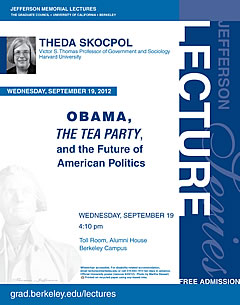
So it’s our special pleasure to welcome you and we look forward to your talk, The Tea Party and Obama in American Politics, Theda Skocpol.
(audience applauding)
[00:02:44] THEDA SKOCPOL:
That’s fine. I don’t need it for the questions. Well, thank you for that generous introduction and I’m delighted to be here.
I’m kind of awestruck by the tradition of speakers for this lecture, and I hope that today my remarks and our discussion afterwards, which I actually look forward to very much, will stand the tradition in good stead. My talk today is about Obama, the Tea Party, and the future of American politics. I think we can all recall the tumultuous joyful scene in Grant Park in Chicago on November 5th, 2008 when a massive crowd greeted Barack Obama, Joe Biden, their families as the first African American president of the United States was elected, and one who promised change that a very large majority of Americans wanted at that point.
It wasn’t an old, two weeks later that Time magazine had a striking cover on its November 24th, 2008 issue that was called ‘The New New Deal: What Barack Obama Can Learn From FDR.’ It had a picture of an open convertible with a grinning Barack Obama with a fedora and a cigarette hanging from his mouth Franklin Roosevelt style. The whole theme of that magazine was very similar to a lot of the punditry and the analysis, the breathless punditry at that moment that we were on the verge of a second new deal, that the Democrats and Obama were arriving in Washington and were gonna change the direction of American government, and the youthful coalition behind this youthful president was going to relegate the Republicans to permanent oblivion and take the country in a new direction.
Okay, that was then, and then two years later in November 2010, the scene was very, very different. Uh, the Republican Party was not only not in oblivion, it had thundered back to one of the biggest sweeping victories in any election in the 20th century. Took 63 seats in the House to take the gavel from Nancy Pelosi and hand it to John Boehner.
Uh, there were big gains in the Senate that brought the Republicans within striking distance of grabbing the majority in 2012. And, of course, in, in many ways, even more important, the huge transformations of State House uh, posts and governorships in key states, including key states like Wisconsin and Florida Ohio, that Obama would need if he were to win re-election in 2012. So from then on the question was, why did Obama and the Democrats fail to deliver the promised changes?
I see people nodding their head Yes And you need to wait till the end of the lecture to argue that.
(laughter)
Or did something about what happened in this period reenergize the Republicans and enable them to, to, to sweep around? Um, I’m gonna be suggesting in this lecture that Obama actually accomplished quite a bit of what he promised, but in ways that provoked and irritated and enraged his enemies and opponents a– and remained invisible and largely disappointing to his friends. Uh, in any event, we can be sure that whatever changes did or did not happen in that first two years of Obama’s presidency, they did not lead to the expected political payoffs for Democrats.
So the sort of marrying of policy redirection to the building of a new political majority that had been envisaged at the time, by many analysts at the time of 2008 election, certainly did not occur. So what I am going to do in my remarks today is first address the question of what happened and didn’t happen. In other words, were there major transformations that were accomplished in the first two years?
I can tell you that very little has been accomplished in the last two years, so we can concentrate on 2009 and 2010. And then to the degree that not as much as might have happened has not occurred, why? What were the limits on change and why did it take certain channels during what I’m gonna call Obama’s Halfway New Deal?
Secondly, what happened to the Republican Party? Because during this period, we’ve seen the Republican Party radicalize. And that’s not just me saying it.
According to the quantitative measures that political scientists use to measure the ideological positions of parties, the Republican Party has taken the biggest leap to the right in any measurement in the 20th century. So, we’ll talk about what Obama did and didn’t accomplish, why it had this kind of effect of frustrating friends and provoking and mobilizing enemies, what happened with the Republican Party, and then finally, we’ll end it with some reflections on what next. What next is pretty much now.
We’re very close to next. Not entirely, but next is the pivot to next is very closely upon us. So let me start by talking about Obama’s Halfway New Deal.
Well, why was it that so many pundits and even some analysts, who were more sober, thought that there was an opening for a real redirection of government policy and a complementary building of a politics to support it and flow from it in 2008? Well, all right, the Democrats for the first time really since Clinton’s election in 1992 took the presidency and both Houses of Congress and did so with more substantial majorities, at least at the electoral, in the presidential election for Obama. That’s a rare conjuncture and it happened because both the House and the Senate strengthened their majorities in 2008.
The campaign itself had been fought with Obama being pretty clear that he wanted to change directions. In foreign policy, he promised to withdraw from Iraq. He did promise to with, to double down in Afghanistan, so nobody can tell me that he didn’t say that.
He did.
[00:09:55] INSTRUCTOR:
But he promised to withdraw from Iraq, and he also was promising to build a more bottom-up political economy rather than to double down on the sort of trickle-down. He talked about taxes for the first time that any Democrat had in eons, and actually stuck with it when the fire got turned up, continued to insist that he would raise taxes on people making more than $250,000 a year. He promised and redoubled after he was inaugurated, to redirect health policy, major health reform, education policy, environmental policy, and energy policy.
And that’s just a few of the things he promised. This president was elected with a youthful coalition that saw the highest level of participation since the ’60s in a presidential election, with under-45-year-old voters, minorities, women, and very much behind the President and the Democratic Party. The GOP appeared to be in total disarray after the election.
It was, and its leaders were in a state of shock. The victories that they managed to eke out in 2008 were restricted to Southern states until the Appalachian chain into the Ozarks. So a lot of pundits were thinking, too, that Americans would suddenly be open to strong governmental efforts, because of course all this coincided with an, a financial and economic meltdown, and Americans were telling pollsters that they were more open to the government stepping in to do something.
Now I have to say that even at the moment, at the height of the hysteria that there would be a second new deal, there were analysts in my profession of political science, and it’s such a dour profession, who were saying, wait a minute. And they were pointing to some things that, I think, even the White House and probably a lot of people in both political parties knew, is that the 2010 election was gonna see a much less of a turnout than 2012, will often say they want government to do things, are quite wary, in crisis periods.
[00:12:26] PRESENTER:
When government appears to be doing too much So, there were reasons to think that the Republicans were gonna make more of a rebound than the Time Magazine suggested, and that much of what happened was going to happen, have to happen quickly, and might or might not be popular. The first months of Obama’s presidency, though, seemed to underscore the positive narrative. His popularity remains sky-high.
The Democrats put through a fairly sweeping American Recovery and Reinvestment Act, and various other laws such as the Lilly Ledbetter Fair Pay Act that had been blocked under Republicans for the previous eight years. It looked as if, possibly the president’s first budget was anything but the usual snoozy document. It reiterated the promise to move forward with comprehensive health reform that would expand coverage to the millions who didn’t have it or were losing it in the economy.
It committed to education reforms and it committed to energy and environmental legislation, including a version of capin’ and trade. And that’s only a few things. There were many other agendas being pressed by Democrats in Congress.
So, it looked for a while as if this kind of burst of redirection and government policy might happen in the popularity for Obama, if not all the Democrats might be sustained. But it didn’t take long before things bogged down and the popularity waned as the economy plunged into the highest levels of unemployment and the greatest levels of distress, particularly in the housing market since the Great Depression. So, I’d like to talk about what happened and what didn’t happen after that by invoking a comparison to the first New Deal period of the 1930s.
I’m not doing that to suggest that these two periods are the same, but to use the comparison to clarify what is different about the political and institutional context in our time, and what was different about the crises. But they do invite comparison because these are both moments in the 20th, 21st century in which reform-oriented Democratic presidents backed by large Democratic majorities come to Washington in a moment of massive and profound national economic crisis. And that brings me to the first point I wanna make.
We have to ask what kind of economic crisis, and what the timing of the downturn was in relation to the arrival of the reformist Democrat. In the Great Depression, I’m tempted to say, you will recall, but I don’t think any of us recall, but we recall from history. Roosevelt arrived three years into the downturn.
25% national unemployment so desperate were the businesses, the farms, the homeowners, the workers of the country that he, the bills Roosevelt sent to Congress were passed by huge bipartisan majorities, eh, even before the written texts arrived. Didn’t last, but that’s the way it was the first year. Um, Obama, by comparison, arrived just as the crisis was starting, a financial crisis.
He ended up as it were, holding hands with Herbert Hoover. Roosevelt had been very careful not to hold hands with Herbert Hoover. Obama had little choice because he was drawn into the negotiations to prevent the Wall Street meltdown from turning into a second worldwide Great Depression, even before he took office, and continuing after he moved into the White House.
So, he didn’t arrive at a moment when most Americans understood the need for massive emergency action by government. And he certainly didn’t arrive at a moment when both parties were prepared to support his emergency efforts. Furthermore, his involvement in preventing the Wall Street meltdown almost certainly influenced his choice of economic advisors and his choice of Secretary of the Treasury.
He picked people with ties to Wall Street, many on the left are really, can think that’s just awful. And maybe it is, but it was understandable. Those were the people he had been dealing with.
Those were the people that he probably hoped could talk these institutions into righting the ship before it completely broke apart. So, from the point of view of ordinary Americans, they ended up conflating the stimulus with the bailout of Wall Street, was thinking of them as one and the same, and the president himself appeared to be saving the big boys while allowing all of the rest of America to suffer losses in family income and, in many cases, employment. Uh, in many ways uh, middle class America began to wonder, “What, what is this all about?”
And, “Is this really addressing what we care about?” did not stress investments in jobs, even though many of the investments in the Recovery Act were about creating or saving jobs. Now, the second big thing, of course, is GOP obstruction. Unlike the Republicans and conservative Democrats who went along with the early stages of Franklin Roosevelt’s New Deal, certainly they turned against it by ’34, but the first part, Obama faced almost a solid wall of deliberate opposition from Republican leaders from the moment he moved into the White House.
We now know that they had a dinner the night of the inauguration to set in motion this plan. Um, it was a cold-blooded but rational calculus on the part of the Congressional leaders of the Republican Party, McConnell and Boehner. They were dealing with a demoralized angry base, being whipped into fear and anger by Rush Limbaugh and others in the right-wing media, and they didn’t see any percentage in cooperating with efforts to limit the economic downturn because they didn’t think they’d get credit for cooperation, and they thought if the economy turned up quickly, that would merely help to reelect a president that they very much wanted to displace.
Obama was slow to recognize, I think it’s fair to say, that he wasn’t getting any cooperation from these folks.
[00:20:04] THEDA SKOCPOL:
But it’s empirically obvious from the record. The stimulus was cut back and barely eked through after a few of, of what counted at that time as moderate Republicans were allowed to take much of the spending out of the measure and place more emphasis on tax cuts, which are not as stimulative of growth. And we know, we all know, that the long battle for the Affordable Care Act, which passed only 15 months into Obama’s presidency, was greatly slowed down by the willingness of Republican leaders in the Senate to crack the whip and impede every single move on every appointment, every legislative step about that bill and everything else grinding the Senate to a virtual halt during and after that struggle.
So that’s a second difference. Now, another difference from the ’30s would be not so much that there were conflicts between conservatives and liberals in the 1930s, and much of the rhetoric of politics in the 1930s was just as shall we say, unlimited in its demonization of the opponent, as anything we hear now. There’s nothing about American politics that’s really a tea party– if, if I can say so in that Tea Party sense, you know, the old tea party sense.
It’s a contact sport and there’s a lot of vituperation in periods of mobilization and crisis. But the difference in the 1930s was that ideological polarization and partisan polarization did not perfectly line up. There were moderate to liberal Republicans who went along with parts of the New Deal.
There were certainly a conservative block in the Democratic Party, which ended up being the arbiter of how far things like labor law reform– or the shape of Social Security, how, how many groups it included in the society went. And you might say, “Well, what difference does that make? There’s polarization in both cases between conservatives and liberals?”
But what I would argue that in the Obama period, by the time he had already arrived in office, this had already happened, the sharp polarization that lines up conservatives with Republicans and li– and liberals and moderates with Democrats was so extreme already that that gave party leaders in the Republican Party a, a more, a more effective means for, for disciplining their cohorts who were like-minded and more of an ability to line up a, a message of opposition that is highly ideological with the wielding of Congressional power. So it does matter. It also matters given the norms of parts of the media, which will always give equal time to Democrats and Republicans, and so the message that would be heard, especially from the Republican side, would be consistent in certain ideological terms in our period.
Now that brings me to know another factor that really matters, and that’s the structure of our media, of mass media, of communications. Both Franklin Roosevelt and Barack Obama were innervate– innovate– innovators in presidential communication. Franklin Roosevelt was famous for his radio chats with the American people, Fireside Chats, in which he hopped over the newspaper editors who were mostly opposed to him and got right into people’s homes through the radio.
Obama, as you know, does these weekly internet video chats that are pretty good. They get to a lot of people and allow him to bypass the scrum that would take the message in another direction. But that’s where the similarity ends, because by the time you get to our era, the mid– the 20th century norms of balance in which newspapers and television outlets after the ’60s kind of say, “Well, there’s two sides to every story.”
Obviously, there’s not just two sides to every story, but that’s what they, they’ve, they’ve said for many decades. There are two sides to every story, so we’re gonna have one Democrat and one Republican to tell those stories, or one pro and one con to tell those stories. Well, we still have parts of our media, some newspapers to the degree that they’re, you know, hobbling on in economic circumstances, some television networks that try for that.
But we also have the growth of a right-wing media sector around Fox News, that is much more like 19th-century American politics. In 19th-century American politics, media outlets were overtly aligned with one political party or the other, and frankly presented a combination of propaganda and news. Everybody knew they were.
That’s the way it worked. So now what we have is frank propaganda combined with information or disinformation in the Fox network, which is reinforced by a network of radio talk hosts around the country that echo those messages. That coexisting with economically stressed, increasingly fragmented modern media outlets, some of them internet, some of them newspapers that are still trying to do a little bit of this and that.
That combination of 19th-century media and 20th-century institutions under stress and increasingly fragmented leads to a situation in which the right wing can set the agenda. Time and time again, Fox and the talk radio people raise some accusation or scandal, and the rest of the media spends time discussing it. The New York Times always waits a few days and then has an article about how, what do we, h– that sort of meta, uh– but, but w– should we really be talking about death panels, you know?
I mean in the, in the, in the Healthcare Act. Now, th– my point would be that that makes it very difficult for a government official, president, Congress, who are trying to promote fairly complicated changes to even get an explanation of what they’re trying to do through the hubbub. And all the more so because the citizens are partly aligning themselves by age group and by partisan identification with different sets of media outlets, so that people aren’t even hearing the same facts or the same realities at all.
Now that brings me to the final big difference I wanna draw between FDR and, and Obama, between the first New Deal and the attempt at a second one, and that is there’s a huge difference between trying to expand federal government interventions and benefits into new sectors of social and economic life for the first time in peacetime and trying to remake already deeply entrenched sets of regulations, benefits, taxes, and tax credits. When Roosevelt and the New Dealers were putting in place Social Security, some of the first labor laws, some of the first financial regulations, there was certainly intense argument about whether it should be done. But people had an idea that something was happening, that something new was happening and some sense of what it was.
And that was true both among the opponents and among the proponents and the possible beneficiaries. Now, Obama arrives in 2008. He is proposing to move social policy and tax policy in a somewhat more middle class and lower income friendly direction, and to make it a little bit less tilted toward business and the very wealthy.
But he’s doing, he’s proposing to do that in an era of tight fiscal constraints with a budget very much out of balance before he arrived after, after, after the Bush wars and and social policy measures had busted the the, the deficit picture for the long run. And he is proposing to change things that are already embedded in the life of business sectors and in the lives of families and communities, but often in ways they don’t see. So for example, in higher education loans, Obama set to work to remove subsidies from banks that they were using to channel loans through college financial aid offices, recapture some of those resources to expand the Pell Grants for low income students and make more loans to middle class families at a, a lower expense to the federal government.
Sounds logical, but in a situation like that, which was repeated, by the way, in the healthcare arena, a very complicated public-private healthcare system in which Obama was going to retrieve some resources committed to Medicare and Medicaid, some of the subsidies being given to hospitals, pharmaceutical companies, medical device manufacturers and unionized workers, and take those resources and redirect them to the expansion of coverage for low and middle and lower middle income people. In both of those cases the people whose toes were going to be stepped on-the businesses that were going to lose regulated profit opportunities or subsidies, the wealthy people who were gonna be asked to pay a smidgen more in taxes, the Medicare, wealthy Medicare people who might have to pay a little bit more. As you will recall, the unions whose workers might have to take a little bit less generous tax subsidy for 10 years from now in their health benefits.
So this is not really just partisan. All the players with the embedded advantages knew their toes were being stepped on and could mobilize instantly in opposition. But many of the beneficiaries couldn’t see what they would get, either because the transformations were occurring in things they didn’t even know they were getting in the first place.
There’s a lotta good research now that shows that Pell Grant recipients don’t even know they’re getting a Pell Grant.
(laughter)
Whereas, you know, GI benefits after World War II, every GI knew. And that’s, that’s a direct benefit, but it’s so embedded in the layers of tax credits and loan subsidies and letters that nobody can read that aren’t in English that they don’t know. And certainly large numbers of people who were going to be beneficiaries of the Affordable Care Act, the 30 million who are going to get expanded affordable health coverage through Medicaid or through subsidies on the health insurance exchanges, they didn’t know what they were going to get.
So there’s a huge difference between putting into place fairly clear, direct government benefits and regulations in the first place and trying to rework a forest of regulations, subsidies, and benefits that include many invisible tax credits and subsidies for businesses to deliver things, or nonprofits to deliver things to people indirectly. There’s a huge difference, and Obama, in many ways, has paid the price because his enemies knew and his friends still don’t know in many cases what they stand to get or what they have already gotten. Now that brings me to what I wanna talk about next, which is the Tea Party and the Republican Party.
You know, I’ve talked about all this stuff about Obama, but in the long run of history, people may look back at this period, and say the real story here was not the Democrats, not their attempts to change things in Washington, but the radicalization and the mobilization of the Republican Party. It’s certainly not Dwight Eisenhower’s Republican Party anymore. It’s not Richard Nixon’s Republican Party.
It’s not even John McCain’s Republican Party because remember in 2008, John McCain said global warming was a serious issue. He sorta advocated cap and trade. He was a little vague on that.
And he certainly reiterated that Republicans too wanted to get health insurance to everyone. It’s just that they had a different way of doing it. That’s not where we are now with the Republican Party.
There has been a documentable leap to the right in what party leaders, candidates, and officeholders are prepared to say about all of these issues and in the quantitative measures that political scientists use to measure their voting behavior. So what happened? In many ways, this was a period in which the cold-blooded leadership calculation that’s nevertheless rational that I described in 2009 that the Republican leaders in Congress took to oppose Obama and hope for the best in the next election, that was reinforced by the eruption and the pincer movement of the Tea Party.
Now what do I mean by that? It was just a few weeks into Obama’s presidency when a rant, as it came to be called, occurred on CNBC. Rick Santelli, a financial commentator, went into an emotional rant in his television program invoking the Founding Fathers, including Jefferson.
Is there a bust of Jefferson? No. To condemn mortgage assistance being put out by the Obama Administration to losers neighbors that weren’t that were you know, freeloading on the real Americans, and he called for Tea Party protests.
And within weeks, there were regional demonstrations cheered on by Fox News and right wing radio commentators, and we saw older people carrying signs denouncing Obama as a communist, a socialist a Nazi all at once. It was almost as if the, the Pact had returned temporarily. And within weeks after that, by late spring and through the summer of 2009 while the regional demonstrations were going on and building to the big one in Washington that was held in the, September of 2009 for the first time, Tea Partiers were taking another step which to a student of American civic life like myself is quite extraordinary.
Across the country, they started organizing regularly meeting local Tea Parties that met once a week or once a month. In our book, Vanessa Williamson and I have a map showing that they were all across the United States. They were put together by people who often met each other for the first time during some of the protests.
And they were quite an achievement in this era where locally meeting citizens’ groups rarely happen and are not usually newly created. By 2010, Tea Partiers were beginning to influence elections. They were credited with part of the Scott Bow, Brown victory in Massachusetts, which really sent a cannon shot through Washington D.C.
And they were certainly responsible for, say, Crist being the moderate Republican Crist being defeated in Florida and Marco Rubio displacing him on the Republican ticket. They went on during the course of 2009 to influence quite a few substitutions, a very, very conservative Republicans for merely very conservative Republicans, and were credited, with a lot of the energy that helped the sweep of the Republicans that I described earlier in November 2010. Now, one of my graduate students, Vanessa Williamson, and I were working on other projects as all this began to unfold.
I was working on the Obama presidency. And we obviously noticed something is happening here, and we were very interested to figure out what it was. So we set out to do the research that’s been published in the ‘Tea Party’ book and, you know, we threw every possible research method at it.
We collected all the surveys that asked who Tea Partiers were, what they thought, what other Americans thought of them and arrayed them over time. We studied media coverage of the Tea Party, FOX News, and CNN. We pulled together electoral statistics and we commissioned a couple of undergraduates to help us put together a database of the 900 Tea Parties around the country by studying their websites, so we know where they are and what they’re saying on their websites.
But we also wanted to take another step. We wanted to talk to Tea Partiers. Now, that was a new one for me.
I’ve talked to policy makers, but I’ve never talked to grassroots actors, particularly those who think that professors are demons.
(audience laughing)
And I can tell you that in Tea Party land, Harvard professors are pretty bad. Pretty high on the list. And it doesn’t take much clicking around on the web to find out that I’m a known New Deal liberal.
(audience laughing)
I mean, you know. One Tea Partier that we were set, we were set to visit her Tea Party in Minnesota. We’d gotten the governor, or the Republican who ran for governors unsuccessfully, with Tea Party support, he had arranged for us to visit a Tea Party outside of Minneapolis.
We were all set to go when she clicked on her website, on her computer one Saturday afternoon and discovered who Theda Skocpol was.
[00:39:50] ANNE:
And it tells you something about local Tea Partiers that she immediately canceled the engagement. It didn’t matter that elites in her state thought she should cooperate. She wasn’t about to do that when she wrote me an email said, “Your views are not ours.
Don’t come.” Well, we didn’t go. But we did go to visit and observe local Tea Parties in several parts of Virginia, several parts of New England, and Arizona.
And when Tea Partiers would allow us to come, I mean, these are public meetings, so you can go, and I went to one of them incognito. I’ll tell you about it in the question period. But we usually asked and when they allowed us to come and when they allowed, agreed, a certain proportion of them, to sit down with us for one-on-one, personal, confidential interviews, they were utterly gracious to us.
We, of course, put aside our Harvard-ness for the occasion and showed respect to our fellow citizens. And that wasn’t hard to do because the people we were interviewing were devoted citizens. They had organized volunteer meetings.
They threw in their own money. Tea Parties do not receive checks from the Koch brothers. They are run like Methodist church gatherings in which ladies sell baked goods and people put money in a basket, or they sell things like beautiful Tea Party pins, I should’ve brought my Tea Party pin or biographies of Sarah Palin, or for proportionate a–
The Tea Party pins are lovely, they’re made in China.
(laughter)
But that’s how they raise money. And so anyway, we visited these places and interviewed people individually and here’s what we found out by putting together our interviews with the survey research and the other resources. Tea Partiers are all older, White, conservative-minded people.
They always vote for Republicans against Democrats, but they are suspicious of the established Republican leadership, office holders, and Karl Rove, for that matter. They feel very strongly against regulation and spending, but when you sit down and talk with them one-on-one, you get a more nuanced view than you’re gonna get out of any national survey. We, for example, were curious what they thought about government regulation and we had people whispering in our ear to find out if they were against Wall Street and willing to regulate business abuses.
Well, I can report to you that we never heard a single Tea Partier criticize business in any way whatsoever, and although they didn’t like the bailout, they blamed the politicians, not Wall Street. When it comes to regulation, they’re completely opposed to any regulation of business or any regulation of private property homeowners, but they are very much in favor of cracking down on immigrants. All Tea Partiers in all parts of the country believe the United States is being overrun by illegal immigrants who are crowding into our emergency rooms and our schools and taking taxpayer-funded resources that they don’t have a right to, and they want the toughest possible enforcement at the border and in their communities against immigrants who are not documented.
About half of Tea Partiers are also Christian conservatives and they wanna crack down on homosexuals, abortion and family behavior. What about spending? Now I will admit that Vanessa and I going into this research were skeptical that a lot of older people, most Tea Partiers, I fit right in most Tea Partiers are 45 and above, almost all, and most are 55 or 60 or above and when you go to a Tea Party meeting, you arrive there and there are big Buick white cars, with you know bumper stick– stickers like, ‘Redistribute my work ethic.’
‘keep working, millions on welfare depend on you.’ Things like that. Or ones attacking Obama.
And they are older couples, men and women, who are attending these meetings together in most cases. And so we were skeptical that that demographic, if you will, was completely against government spending. I mean, they’re on Social Security.
(laughter)
[00:44:33] THEDA SKOCPOL:
They’re on Medicare, and they’re on veterans’ benefits, and they know those are government benefits. Don’t let anybody tell you these are stupid people who don’t know, they know. And they think they deserve them.
Just like most Americans, they think they’ve worked a lifetime and they’ve paid their taxes, and they deserve these benefits. They’ve earned them. So what kind of government spending are they against?
Well, it turns out they’re against government spending for freeloaders and moochers. I think we’ve heard this just recently. And who are the freeloaders and the moochers?
I mean, we wanted to know, so we were all ears. And I have to tell you that in these interviews, we just listened. We’d ask the softballest questions and just wrote down the answers, no matter what they were.
So obviously illegal immigrants, they’re big on the moocher/freeloader scale. Next would be lower-income people who, given the way they’re talked about, are often people of color, although people were very careful in interviews with us, never to overtly make racist, racist statements, except against Muslims. No, no holds barred there.
And young people. Young people. That was one of the most surprising things we discovered in the interviews.
People would cite their own grandkids and their own grandnephews as examples of freeloaders.
(laughter)
They wanted Pell Grants. They wanted food stamps. They wanted help going to college. They were moving in back home with mom and dad, and not finding jobs. And they supported that Obama, in a lot of cases.
(laughter)
Now, older people, I can tell you, do sit around and gripe about young people. It happens.
(laughter)
But in Tea Party circles, it has a harder edge to it. It’s tied to a political fear that those people are asking for taxpayer-supported benefits that they don’t deserve, that they’re getting ahead of themselves. Now obviously, hatred of Barack Obama brings together all of these things at once.
He’s a Democrat. That’s his biggest problem. And remember, the right wing in this country went after Clinton with just as much ferocity.
So frankly, whenever one party takes everything in Washington that mobilizes the activists of the opposite party, and I’m a– when George W. Bush moved into the White House with two houses of Republicans behind him, there was despair in Cambridge, Massachusetts. I can report that. Uh, people didn’t mobilize as fast perhaps, but they were, they thought they’d lost their country, and that’s what these conservatives think when all Democrats move in, that they’ve lost their country.
And I think it was even more shocking that the, the, they’d lost it to somebody named Barack Hussein Obama. His Black skin may be part of it, but I think his foreign father is a bigger part of it because of the sense that America’s place in the world is changing and that he might be tied to the Muslims and that he’s young, that he’s a constitutional law professor who hangs out with, with Henry Louis Gates at Harvard, that he is adored by the young. One woman said to us, “Two million young people yelling, ‘Obama, Obama, Obama!”
You could hear in her voice the fear about what that could possibly mean. So he is the perfect storm. He represents all the changes, generational, racial, immigrant, moral, that these people fear and want to fend off.
“Our country is being taken away from us.” That’s what they say, and that’s what they feel, and when you interview them individually, what you hear is not so much anger as fear, and fear is a powerful, powerful political mobilizer. Now, the other part of the Tea Party that I haven’t mentioned, I will quickly.
Have nothing to do with grassroots anger or fear. It’s longstanding, ultra-free market, billionaire-backed advocacy groups that for decades have been working to turn Social Security and Medicare into private subsidies for insurance companies, to privatize them, or, and, or Wall Street, that want to get rid of all regulations, that above all want to block environmental regulations of any kind and dismantle the EPA. Uh, Dick Armey and Freedom Works, the Koch brothers and Americans for Prosperity, and various other very professionally run, very opulently backed advocacy groups that when this eruption emerged jumped on the bandwagon, renamed part of themselves the Tea Party in many cases, and put their elites in front of the camera to speak for what the Tea Party wanted.
So soon we have the 70-year-old Dick Armey, a former Republican leader in the House, a 15-year lobbyist for business interests, presenting himself as a revolutionary leader in front of the media to tell the media, after 2010 media needs spokespeople for the Tea Party and the decentralized grassroots groups are no good for that, so they put the Dick Armies up there. And they tell everybody, “The Tea Party wants to get rid of Social Security and Medicare.” Think of the irony of that.
All right, now let me bring us to the present and stop so that we can have a discussion. Obviously, American politics is not dull in our period. We went from the sweep into power of a parent of reform-oriented Democrats perhaps on their way to building strong majorities in 2008 to this backlash that was not just a swing to Republicans, but something surprising to political scientists, a swing to Republicans who were at the same time being pulled far to the right and where a pincers movement of big money interests and grassroots activists were enforcing a new kind of anti-compromise orthodoxy on Republicans running for office or Republicans in office.
You really only have to knock a few Richard Lugar’s or Bob Inglis’s, or I’m forgetting the man in Utah, Bob Bennett. You only need to knock a few of them off to terrify all of them in Washington. And then they suddenly stop voting for anything that could be construed in any way as a compromise.
And that was the point. That was the point of the grassroots mobilization from below of half the Republican base, half, and the more intentive, attentive half, the half that knows what’s being debated, that goes to the public debates, that sends delegations to congressional offices, that sends letters.
[00:51:58] ANNE:
All the things citizens are supposed to do by the way, they do them. And you combine that with the money that can flow into any election to fund a challenger to a too-moderate Republican, and that’s where you get to the situation we’ve had in the last two years where Republicans refuse to compromise on anything. Came very close to pushing the United States of America into default, and the local Tea Partiers I knew in Virginia, who, lovely people, a lot of them really lovely people, they were all for it on the grounds that, well, things were a mess already, so why not just go all the way?
The last time I heard that was when I was a new leftist in, in, in my 20s, and there were Leninists arguing that. It, it was stupid then and it’s, it’s stupid now, but that’s the kind of pressure that Republican officeholders and candidates are getting, and which Republicans office-seekers have not held up against and a case in point is a man named Mitt Romney, who has signed on to every extreme grassroots and elite Tea Party priority that there is. I thought he was doing it stealthily.
I wrote an op-ed in April calling him the stealth Tea Party candidate. Forget the stealth. He’s open about it.
He’s both endorsing the crackdown on immigrants that the grassroots prioritize and the rollback of the New Deal and Great Society and the privatization of Social Security and Medicare, which is what Ryan stands for, who is a, who is a protege of the Koch brothers, Koch brothers, brought up in the Americans for Prosperity network in the Midwest. So this is quite a turnaround, and what’s gonna happen next? Well, you know as well as I do, I can’t predict, all I can tell you is what the possibilities are.
It turns out that the 2012 election is an even more important election than 2008. It’s one of the most important elections in American history because it really is going to determine whether the attempts to, with difficulty, transform the direction of American tax, social policy, regulatory policy that Obama haltingly and imperfectly launched after 2008 will s– survive, the parts Like affordable care that passed, and proceed, or whether we’re gonna see not just a rollback of affordable care or, and the other Obama reforms like the Wall Street regulations, however imperfect they may be, but a radical rollback of the role of the place of government in providing security and opportunity. I haven’t even talked about educational investments.
Those are all there in the radicalized GOP and Mitt Romney program, and believe me, if they control the presidency, the House, and the Senate, they’ll do it in three months. Filibusters will not matter. They’ll be overridden.
The Congressional Budget Office will not matter. It will be set aside. It’ll happen very fast, because they think, it’s their last chance.
They see generational and racial and social changes in the United States that are going to make it impossible to realize these conservative goals, which are heartfelt for most conservatives, if they wait even one more election. So they’re not gonna wait. On the other hand, if Obama is reelected, the major accomplishments of what I call halfway New Deal, which really were major, the Affordable Care Act, I don’t care if it doesn’t have a public option, it is one of the most redistributive pieces of legislation ever to pass in modern America.
It taxes the wealthy and business interests to provide health insurance to millions of low-income and lower-middle-income working families. Its opponents know exactly what it is, and they understand that if it is implemented after 2014, Americans will want to keep its major parts. All of its specific parts, except the individual mandate, are highly popular.
They, once they’re actually in place, along with the Medicare drug benefit, the 26-year-olds on the parents’ insurance, the new rules of the game for insurance companies, they will cement a new relationship between the however muddling Democratic Party that passed them and the American majority. And so, a lot is at stake politically, as well as socioeconomically in the mere survival of that law. It will survive if Democrats survive one of the three.
It won’t if they’re swept. And that’s just the beginning. The EPA may be gone, or it may stay on, and the EPA is being used, however haltingly, to push in the direction of new kind of uses of energy in the United States.
The student loan reforms, the investments in education they won’t survive perhaps in as generously funded a way as anybody thinks is necessary, but they’ll be there, and that’s a big difference from not being there. So, it’s a very important election, and it remains to be seen whether the lagging economic recovery, the imperfectly explained Obama economic measures, Bill Clinton did a better job of explaining it than Barack Obama ever did, and the irritating changes whose payoffs to the majority are not yet clear, whether with all of that baggage Obama can squeak through to reelection. Now, the one reason to think it might happen, apart from Mitt Romney
(audience laughs)
(applause)
By the way, no Tea Partiers that we interviewed in the spring of 2011 were enthusiastic about Mitt Romney. And you know why, they said? They said he’s not authentic. Not authentic. People didn’t name policies. They said, “He’s not authentic.”
(murmured discussion)
I wrote in my notes, “Something we can all agree on.”
(audience laughs)
I mean, he was governor of Massachusetts as a liberal. So apart from that, the thing that is different this time is that in 2010, two out of five eligible voters went to the polls. Skewed toward the old, the white, the conservative.
The way it always happens in midterm elections but more so, because the elderly swung heavily against the Democrats. They were convinced that Medicare was being destroyed, that death panels were being put into place.
[00:59:32] MODERATOR:
In this election, we’ll be closer to the three out of five eligible voters that went to the polls in 2008, and the outcome may very well depend on how much closer we are, because if you just ask for opinions, if you just ask registered voters even, Obama’s way ahead, but he’s not way ahead among those who are necessarily going to vote. So, it’s quite a cliffhanger, in my opinion, still, particularly since a billion and a half of ads are about to be unleashed, in the swing states, most of them on the Republican side. But the outcome on November 6th will tell us a lot about the kind of country we’re going to be moving toward over the coming months and years.
So, let me stop on that.
(applause)
Do you want me to take some questions? Yes. You want to call on people?
Do you want to just stay? Okay. Mr. Skocpol has kindly agreed to take some questions.
It’s my duty, please forgive me if it offends you, to remind you that these are questions, not speeches. And that with a group this size, we really need to keep it very short, so that a reasonable percentage of folks get a chance to ask questions. So, there’s a microphone here.
And I should also add that there will be a reception afterward behind these closed doors. A closed door reception, conservative kind of reception. Okay.
Yes, please. Yeah. And please tell me who you are when you ask your question
[01:01:24] ANNE:
Oh, my name’s Anne, and I’m from Berkeley.
[01:01:26] MODERATOR:
Good.
[01:01:28] ANNE:
So my question is if Obama does win re-election, but the House and the Senate either stay Republican control to the House and perhaps Democrat of the Senate, which is the same situation we have today, how could anything be accomplished in the next two years or four years? Because nothing has been in the past two years, and I believe that that’s what the Republicans want is to not have any government functioning, which is what we’ve got. So what do you see happening there?
[01:01:56] MODERATOR:
Okay. That’s a good question. I think that if Obama is re-elected, let’s just say Obama’s re-elected, the Senate stays barely in democratic hands, although with some real Democrats
[01:02:13] ANNE:
Um, Joe Lieberman will be gone and, and, and, and he doesn’t even label himself as a Democrat anymore. So it’s fair to say that there will be a Democrat in the Democratic caucus, probably, not certainly. Connecticut is not a sure thing.
In any event, let’s say barely in Democratic hands, and then the House, I, I expect the Democrats to gain 15 seats, but I don’t think that’ll be enough. It’ll–it may be enough to send a message to some of the remaining Republicans, but we’ll be right back into the same situation in a way in which Republicans will understand that there’ll be a lower turnout in the, in the mid-term election. And in fact, all politicians now take that kind of swing into account in their calculations.
So if that’s the situation, actually Obama’s gonna be in a lot stronger position than he has been the last two years. And here’s why. First of all, he’s re-elected.
You know, so much of what’s been, it’s all been about has been preventing that, and he will be there. But more important a lot of the first issues to come up are about taxes and about spending. There’s this kind of what’s Washington’s all in a tizzy about a fiscal cliff.
I don’t really believe it’s as much of a cliff, but they definitely have decisions to make, because the Bush tax cuts, which are tilted toward the wealthy and responsible for a substantial part of the long-term deficit are going to expire. Well, that’s different than needing positive action. You don’t need positive action.
You need to do something to either keep them or keep part of them. So Obama and some of the Senate Democrats are signaling the same. They can let them expire.
They don’t have to be frightened into one-sided compromises. And if that happens, then you get to a situation in early 2013 in which it’s no longer a question of raising taxes or voting to get rid of taxes, the cuts that are already there, but of reinstituting tax cuts. I mean, everybody knows, and this includes Mitt Romney, that that’s gonna be a, a, a relatively good situation within the overall hopeless situation to be in.
[01:04:32] THEDA SKOCPOL:
So he’ll have more leverage and probably will be able to strike a bit of a bargain about the mix of revenue and spending cuts, let alone the direction of the spending cuts, because the other issue here is whether any spending is gonna come out of the defense budget, or all spending cuts are gonna come out of social programs. Now, does that mean that comedy is gonna break out in Washington?
(audience laughs)
What a discouraging place to visit. I’d rather visit a Tea Party meeting.
(audience laughs)
I don’t think so. But, and I don’t think that a lot of positive steps are gonna be taken on things like environment, carbon controls legislation. But on the other hand, a president can do a lot through regulation, and he’ll be able to hang tough on some of the regulatory steps through the Labor Department and the EPA, and above all, the Affordable Care Act will survive.
And I have to tell you, the Assur, the Affordable Care Act alone is worth it. If you care about making life better for millions of families and much of the implementation is automatic, the subsidies are automatic in the federal budget, and most of the action will be in the states where community groups can mobilize to make a better version in their state of the implementation of the Affordable Care Act. I think some of that is happening here in California.
In Vermont, they’re using the framework planning to use it to have single payer. There will be variance, but that’ll go forward, and most of the governors will come around because the huge federal subsidies for Medicaid will be very tempting to them. And even though they’re all saber-rattling now, they’ll stop saber-rattling if Obama is re-elected.
I’m willing to make that prediction, and you can hold me to it. A lot of what’s being said now is hot air.
(unintelligible)
[01:06:31] MODERATOR:
Yeah, thank you, right there. Right, right here. Fourth and fifth row.
[01:06:37] AUDIENCE MEMBER:
What’s distressing to me is that if Nick Romney wins, is that I believe it’s three or four of the Supreme Court justices that are in their 70s and probably retiring. And that sets off almost a 20 or 30-year right-wing-leaning court.
[01:07:03] MODERATOR:
You were–
[01:07:04] THEDA SKOCPOL:
Yeah, because there’s a genuinely radical judicial philosophy on the verge of being carried out that would, in many ways, eviscerate the New Deal powers of the federal government on its own. So, you know, I don’t even have to add to that. You said it.
That’s not going to be a very big part of the election, although I think it’s on the mind of conservatives. I do. I think they’re very aware of it.
[01:07:27] ANNE:
Should be on the mind of Democrats too.
[01:07:28] AUDIENCE MEMBER:
Yeah.
[01:07:29] THEDA SKOCPOL:
Well.
(applause)
[01:07:30] AUDIENCE MEMBER:
Especially, go ahead.
[01:07:31] LARRY ROSENTHAL:
Yeah. Hi. I was wondering why didn’t Hillary Clinton use her influence in the Obama Administration to include single-payer healthcare in Obamacare?
[01:07:41] THEDA SKOCPOL:
I don’t know of any reason to think that Hillary Clinton was ever in favor of single-payer. Do you?
[01:07:46] LARRY ROSENTHAL:
Because I remember there was a lot, there was a lot of that’s what the original, I mean, that’s what the, a lot of what the original healthcare was actually going in the direction of single-payer healthcare. And then Hillary Clinton started, I’m not sure what you wanna call tacking, or she started to changing her position when she was promoting her healthcare plan. But as far as I know she didn’t–
[01:08:13] THEDA SKOCPOL:
Well, I wrote a book about both the rise and fall of the Clinton health plan and the rise of the Obama health plan and revised the book, which is now out again after the Supreme Court decision. And I can just tell you that no mainstream Democrat anywhere near the capacity to legislate in Washington has been in favor of single payer for a long time. Now, I’m not endorsing that.
You know, if we, if politics were like Scrabble, and you could gather up all the tiles and turn ’em in and get another set of tiles. I think we might have wanted one that was called single payer. There’s all kinds of reasons.
It’s just that that’s not what politics is like. You have to get there from where you are. And Democrats now, for 25 years, have had a, what I would call a kind of expert and, you know, mainstream consensus that has included most liberal reformers that they needed to accommodate, at least for a time, regulated private insurance.
And in the 2007, ‘8 campaign, all three candidates, Edwards, Clinton, and Obama converged on exactly the same approach, which was regulated, new rules of the game for private insurance, subsidies to expand coverage to the uninsured through Medicaid or through purchase of private plans, and tentatively they talked about a public option. Maybe that’s what you’re talking about. But it was very tentative, and it came down to Joe Lieberman.
That’s what it came down to. He wouldn’t vote for it, and without that, you couldn’t get 60 votes in the Senate. So single payer wasn’t on the table.
A public option was. By the time it got to the final legislation, it was so watered down, I’m not sure it would’ve mattered that much. And the House Democrats, led by Nancy Pelosi, exchanged the public option, the residual public option that couldn’t get through the Senate anyway, for more generous subsidies for low and middle-income people.
And the law passed that way. But that, Hillary Clinton, if anything, was to the right of that, not to the left.
[01:10:26] MODERATOR:
I think we have time for one or two more questions.
[01:10:28] LARRY ROSENTHAL:
Hi. Yeah. Uh, my name is Larry Rosenthal. Or however you wanna start. I’m–
[01:10:31] THEDA SKOCPOL:
Fine.
[01:10:31] LARRY ROSENTHAL:
Um I, I’m curious your, your views about the, the demographics or the Damocles hanging over the Republican Party. You know, they, as far as I can tell, you know, they seem to have one strategy to deal with it, which is voter suppression. Perhaps you have some insight into do they have any kind of notion of how they might avoid becoming a rump party, a regional party, anything of that nature, on a national scale?
[01:11:05] THEDA SKOCPOL:
Okay. Well, one thing I’m gonna say is that, and I think that many conservatives believe this too, as political strategists. I don’t believe demography is automatically destiny.
One of the things that makes me a so-called historical institutionalist in political science, and I didn’t use a lot of theoretical terms like that here today, but what does that mean? It means that things play out over time, that you start from where you are, that where you are determines a lot of what you can do next. And it also involves the study of something called policy feedbacks.
And that’s an idea that says it’s not just that politics, that is, the mobilization of voters and interest groups creates policies. Policies create politics, too. Social Security, for example, was not really created by old people, as such.
I mean, they were part of it, but once it passed, it has had the impact of mobilizing senior citizens to be the ones who vote the most often, who pay the closest attention to politics, regardless of income level. I mean, Henry Brady’s wonderful student, Andrea Campbell, wrote a book about that. Nailed it.
And it also helped to create the AARP. And the AARP was kind of a small teachers’ operation, and then it grew into a behemoth. You know?
36 million or something. Uh, So, another way of saying this is that yes, the demography doesn’t look good right now if you assume young people are gonna keep right on voting for Democrats, Latinos are gonna keep right on voting for Democrats, and African Americans are gonna keep right on voting for Democrats. But what I would say from my theoretical perspective and what I’m sure conservatives believe is that if you change the policy mix going forward, you’ll redefine values and interests and alliances, and particularly for Latinos.
I think they think they have a chance to get Latinos for conservative family values and for entrepreneurial, what they would call entrepreneurial values if only Latinos don’t get Obamacare, you know? That’s a little crude, but not really. And so I do think that the policies matter.
And so that’s why the policy consequences of 2012 will influence the political participation and alliances going forward. You break up Social Security and Medicare into private accounts, you won’t have that mobilizing effect anymore, particularly for the poor because they’ll be hammered by this. On the other hand, inside the Republican Party there is not consensus about what to do about Latinos.
I know it looks like there is right now because the Tea Party crackdown on ’em approach has taken hold, but Jeb Bush is waiting, and Jeb Bush has a completely different way of thinking about Latinos. He believes that there should be some softness in the appeal to Latinos, that some positive things should be offered, not just rounding up people and shipping ’em across the border.
[01:14:27] MODERATOR:
And he will assert himself in the war within the Republican Party that will break out if Mitt Romney loses. Now I’m not saying he’ll necessarily win, especially not the first round, because I think conservatives will say Mitt Romney wasn’t authentic and they may try an authentic one. Uh, but there will be a war within the Republican Party and in due course, some people will emerge who have a more inclusive vision of what that Conservative Party should be.
It’s going to happen. They exist, they’re there, they just haven’t spoken up, but they will. Should we stop?
Well, I think that we probably we’re very much indebted to you and wanna say thank you to all of you.
(applause)
These doors will magically open, and there will be a reception afterward.