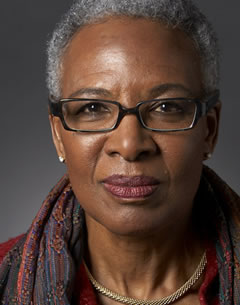
[00:00:00] WALDO MARTIN:
Greetings.
[00:00:01] AUDIENCE:
Greetings.
[00:00:03] WALDO MARTIN:
Okay. How are we doing this afternoon?
[00:00:06] AUDIENCE:
Great.
[00:00:07] WALDO MARTIN:
Good. I’m Waldo Martin, professor of history here at Cal, and a member of the Jefferson Memorial Lectures Committee. We’re pleased, along with the graduate council, to present Professor Nell Irvin Painter, this year’s speaker in the Jefferson Memorial Lecture Series.
The Jefferson Memorial Lecture Series was established in 1944 through a bequest from Elizabeth Bonestell and her husband, Cutler L. Bonestell. A prominent San Francisco couple, the Bonestells cared deeply for history and had hoped that the lectures would encourage students, faculty, scholars, and those in the community to study the legacy of Thomas Jefferson and to explore values inherent in American democracy. Past lecturers, Ambassador Jeane Kirkpatrick, Senator Alan Simpson, this is a text, Representative Thomas Foley, Walter LaFeber, Archibald Cox have delivered Jefferson Memorial Lectures on early American history, about Jefferson himself, and on American institutions and policies in politics, economics, education, and law.
Personally, I am honored and humbled to introduce Professor Painter, Edwards Professor Emerita of Princeton University. Professor Painter is one of the most important and influential historians of our time. Her list of distinguished publications, academic and scholarly awards, and honorary degrees dazzles.
As a scholar and public intellectual, Professor Painter has helped transformed how we think and write about 19th and 20th century US history. Her wide-ranging and stimulating body of historical scholarship has ranged across African American history, Southern history, working class history, women’s history, cultural history, social history, and for good measure, intellectual history. Her scholarly range is stunning.
Her scholarship itself is exemplary. Because of her powerful work, we now see 19th century Black immigrants; Black working class radicals and communists; the late 19th and early 20th century; Sojourner Truth; enslaved women; and, yes, White people, in fresh and revealing ways. Those of us who make it a point to read her work, including her strikingly perceptive essays, articles, and reviews, delight in her historical sensibility, her erudition, her rigor, her insight, and her inviting prose.
Those of us who know Nell personally marvel at the commitment to teaching and to the training of future historians and scholars. Both of these have earmarked her path-breaking career, a career that took her to the University of North Carolina at Chapel Hill and the University of Pennsylvania before Princeton. Many of her former graduate students have gone on to illustrious, illustrious scholarly careers in their own right.
Nell’s mentorship is not only exceptional, but legendary. A genuinely cool and deeply humane person, Nell has modeled intellectual generosity, graciousness, and rigor. At critical points in the careers of many historians, like myself, Nell has provided not only verbal encouragement and sage advice, but she has also provided substantive and helpful criticism, necessary criticism.
For that, her mentorship, and the inspiring example of her work and her career, we are all indebted. Nell Irvin Painter, as they say, where I come from, a proud and brilliant Black woman, pointed the way. Today, having retired from her Princeton gig, Nell Irvin Painter is reinventing herself, becoming an exciting visual artist, sporting a 2009 BFA from Rutgers and a 2011 MFA from the Rhode Island School of Design.
With her BA in anthropology from Berkeley, her MA in African history from UCLA, and her PhD in American history from Harvard, she knows a thing or two about credentials. Not bad, as my down-home friends would say, “for a true homegirl,” a graduate from Oakland Tech’s gifted and talented program. This afternoon, Professor Painter will be speaking on and illustrating why white people are called Caucasian.
(applause and cheering)
[00:06:21] PROFESSOR PAINTER:
Thank you.
(applause and cheering)
Thanks, Waldo, that was terrific. Thank you, sir.
(applause and cheering)
Well, thank you so much, Waldo. It is really lovely. It’s wonderful to be back in the Bay Area.
Haven’t been here since last year. My father, who’s now 94, who spent his career in Lewis Hall as the chief technician of chemistry, last year, came to New Jersey. So, we haven’t been coming back as often as we did before.
I want to thank the Jefferson Lecture Committee for bringing me here from Newark, and for giving me the chance to talk to you and see old friends and some new friends. So this afternoon, my talk has three sections. One is an autobiographical section, fairly short.
I want to tell you something about my process. The second part is the actual body of the lecture with the illustrations which I made especially for you. And then the last section is very brief.
It has just one image, which the Georgian National Museum very kindly let me use without making me pay for permission. So the question of, ‘Why are White people called Caucasian?’ lies at the foundation of my 2010 book, ‘The History of White People.’
People ask me, ‘Why did you write that book?’ And I said, “I wanted to understand why White people are called Caucasian.” I started working during the Chechnyan Wars of the late 20th century, and I thought, “Why are White people called, why are American White people called Chechens?”
And so the book came out of that. So the book took many hundreds of pages. It’s a very visual book ’cause I wrote it while I was in art school.
But it’s fundamentally a history book rooted in an archive of words. Its research came out of the Princeton University Library, and I actually dedicated the book to the Princeton University Library. In the book, Johann Friedrich Blumenbach, 1752 to 1840, who plays a central role in the question I’m asking, also has nearly an entire chapter.
But his role in my presentation to you this evening, he is really somewhat smaller, and that has to do with the process, my process of putting together this talk. So, as Professor Martin told you, I spent five years in art school at Rutgers and at the Rhode Island School of Design. And there, I learned to see, to really, really see.
And the process of making an image, whether you make it with your hand, which I do, or you make it with your computer, which I also do, and the images that I’m going to show you this afternoon are digital images that I made in my computer. But whether you do it one way or the other, manually or digitally, you have to fill the space. That means seeing into all that space.
And that process profoundly altered what I had written, actually, and what I had already studied to write a book. So, for instance, the skulls now occupy a much more important place than before, because I looked at them and I looked for them with an artist’s eye, not simply looking for words. So, the artifacts that reached science, I now see as particular artifacts belonging to particular people, and that reached to science through the hands of particular people.
So, my image-centered approach has the great advantage of embodying, not just quoting or analyzing, scientific utterance. Embodying scientific utterance. Because usually, in historical writing, the people who intone scientific truth, they remain relatively unknown.
Usually, you can’t see them. You can’t see what they’re wearing. You can’t see how they stand.
You can’t see their jewelry, for instance. But in today’s lecture, written and produced by an artist as well a historian, I hope to make you see as many people in this story as possible into real people in actual places and particular circumstances. Even those whose destiny was to appear as parts of a taxonomy,
(speaking in foreign language)
as types of millions of people, really. They turn out to be particular individuals whose intimate experiences place them in the path of science. So, that’s my autobiographical introduction telling you about my process and how my process influenced what I’m going to show you today.
So my topic, the question, ‘Why are White people called Caucasian?’
[00:12:27] JIM:
It’s a pretty simple question and it’s crossed a lot of peoples’ minds. It’s crossed more peoples’ minds than have actually said it. How many of you have wondered about that?
Put your hand up if you, okay. How many of you have said it out loud, have actually said to somebody, “Why are white people called Caucasian?” Whoa, so many fewer.
So this has come up pretty often this year. So here’s a general question: why are white people called Caucasian? And here’s a question for 2013.
Now, where exactly is the Caucasus, or is it are the Caucasus? Look for the red Google marker between the Black and the Caspian Seas. That shows you the place we’re looking for, or the places we’re looking for, and they’re right on the border between Europe and Asia.
And now anthropologists have known what Caucasians look like in terms of taxonomy, Type de Caucase or something like that. And this one, these images come from William Z. Ripley’s Races of Europe, 1899, which was the bible of race thinking in the early 20th century, was the bible for the federal government in the era of closing down immigration from Southern and Eastern Europe. So those people standing behind my Brooklyn revelers, those people are or were Caucasians.
Now, a word on naming. In both the popular literature and the scientific literature, the names of the people and the places slide around. So we talk about Caucasian, we talk about Circassian or Circassian, we talk about Georgian, and those terms function almost interchangeably outside of Russia.
But in the historical period, that is before the 20th century, before the late 20th century, those people were synonyms of the most beautiful people in the world.
[00:15:03] PROFESSOR PAINTER:
And if you ask Georgians, that is from the Republic of Georgia, if you ask them now, “Is it true Georgians are the most beautiful people in the world?” What do they say? Yes.
(audience laughter)
I haven’t met Circassians, and I haven’t met people from the Caucasus who call Caucasian, so I don’t know their answer. Within Russia, however, Caucasians are the subject of negative stereotype, as a young American living in Moscow explains in this snippet of a video.
[00:15:44] VOICEOVER:
Well, basically, what I wanna talk about is what is the deal with the Caucasians in Moscow? And I’m not, like, a racist person or anything, especially ’cause I’m Black, like how am I gonna be racist in Russia, about other people? But it’s not even about that, I mean, like, all right, let me explain.
There’s always a huge group of them, it’s like, they don’t socialize with the Russians there, it’s all just I have a great Caucasian friend from he lives in Russia. Sorry, I forgot what country he’s from. He’s probably watching this video right now, but you know, it’s early in the morning, I was drinking last night, I’m sure George understands.
But I have a great friend named George, and he’s Caucasian, and he doesn’t even like out Caucasion in Russia. Now, from what I hear from people, is that they’re dangerous, they carry knives, they carry guns and all this stuff, and maybe that is, maybe that isn’t, but I just wanna know the deal ’cause apparently from what I hear from a number of Russian people that Caucasians are disliked more than Blacks in Russia, like Africans and Blacks. I’m like, “Holy crap.”
You know? They’re hated more than us? I didn’t think that was possible.
[00:16:54] PROFESSOR PAINTER:
The view from Moscow.
(laughter)
Now, in February 2014, the Winter Olympics will begin in Sochi, which is the Black Sea resort in the western Caucasus, and you are going to be hearing more about Sochi this afternoon and also in February. Meanwhile, back in the United States, scientific literature freely employs the word Caucasian as a term taken for granted to mean White people or non-Black people or non-people of color. So, it’s a word that’s still circulating and it still circulates because it still circulates.
It has a place in American jurisprudence. For instance, Justice Anthony Kennedy’s opinion for the Supreme Court of the United States in Fisher versus University of Texas at Austin in June of this year, Kennedy mentioned, without pausing, that the petitioner, that is Abigail Noel Fisher, who is Caucasian. Kennedy’s statement prompted a New York Times reporter to ask, “Has Caucasian lost its meaning?”
This article was in the 6th of June, the 6th of July 2013. I’m actually quoted in it. And the reporter Shaila Dewan, notes in her piece, and this is her quote, “In 1889, the editors of the Oxford English Dictionary noted that the term Caucasian had been practically discarded.”
1889. She continues, “But they spoke too soon. Blumenbach’s authority had given the word a pseudo-scientific sheen that preserved its appeal.
Even now, the word gives discussions of race a weird technocratic gravitas, as when the police insist that you step out of your vehicle instead of your car.” There is a short answer to my question, short but opaque. In the late 18th century, Johann Friedrich Blumenbach, an 18th century German scholar, assigned the name to people living in Western Europe, to the River Ob in Russia, to Northern Africa, and to India, called them Caucasians.
It’s a large group of people. Blumenbach enjoyed a scholarly reputation that gave his designation enormous heft, and it got picked up very quickly. Although the term Caucasian now has many synonyms, including white, it return– it retains a certain currency by dent of repetition.
So, the short answer is that skull you see. The fuller and longer answer is complicated, and it entails the history of scholarly exchange, Russian imperialism, and notions of human beauty. So, the short answer first.
Johann Friedrich Blumenbach, the father of physical anthropology, the father of scientific anthropology, called the people in Europe over to India, well into Russia, and North Africa, Caucasians because they were the most beautiful in the world. And here you have Blumenbach and the skull that inspired the designation. And Blumenbach says, “Also, for the determination of the really most beautiful form of skull, which in my beautiful typical head of a young Georgian female, always of itself attracts every eye, however little observant.”
So the author of “De Generis Humani Varietate Nativa,” written in Latin, Blumenbach had 82 skulls, and this made him an expert in human taxonomy. He made a five-fold designation, a taxonomy of human types. He called them varieties.
And he arranged them from left to right. Now, this is not a hierarchical arrangement. Some of you may know Stephen Jay Gould’s book, “The Mismeasure of Man.”
Do you know that book? Yeah. So Gould shows a triangle with the Caucasian skull at the top.
That’s not the way Blumenbach laid it out. Blumenbach was a believer in the unity of mankind. He was a Black bibliophile in the sense that he collected books by Black authors.
He really believed in the unity of mankind, so he arranged the skulls according to difference. So, at the two ends were the Mongolian and the African, and he thought of them as the extremes. In the middle is the beautiful one, it’s the gorgeous median, and that’s the Caucasian.
And then the, the ones beside the Caucasian are, are the American and the Malay, because he thought those were the intermediate races. So, in short Blumenbach’s most beautiful skull, the one in the middle, gave this large group of people, which we can call White people but includes many others, the name Caucasian. Now, a fuller answer.
We need to look at Russian imperialism and English imperialism, scholarly networks and slavery. Slavery which gave rise to the figure of the odalisque, that is the beautiful White slave girl, as a figure of quintessential beauty. So this is about beauty not only of skulls, but also of slave girls.
But whose skulls were these, and how did they get to Blumenbach in Germany? The skull that made White people Caucasian was the gift of Georg von Asch, 1829, I’m sorry, 1729 to 1807, a Russian of German background who had studied at Blumenbach’s Gottingen University. And Asch was considered one of the great fathers of the Göttingen Library and all their collections.
So, one of the five skulls embodying Blumenam– Blumenbach’s human varieties, I’m sorry, of those five skulls, two of them came from Asch. Asch also sent skulls and books and all sorts of things. So, here we have Asch giving the skull to Göttingen.
Now, Asch gave lots of skulls to Blumenbach. Of the 82, something like 20 or 25 came from Asch. Who was this man?
He had some nice clothes, that’s one thing we know. He was a medical doctor who served in Catherine the Great’s armies when Catherine the Great was launched on imperialism at the expense of the Ottoman Empire and others as well. She was a Russian of German background, as many of the aristocratic Russians were, and Asch served her imperial designs.
In the 1780s and 1790s, Catherine was taking over the Caucuses. She began with Georgia as a protectorate of Russia in 1783. And remember, the beautiful skull was from Georgia.
The Russian conquest of the Caucuses took a century, and entailed ethnic cleansing and genocide. And to this day, every time Russian power falters, Caucasians make a break for independence. So, two of Blumenbach’s five skulls from Asch.
Two of Blumenbach’s five skulls came from a wealthy and influential, ultimately knighted English naturalist named Joseph Banks, 1743 to 1820. Banks had taken part in Captain Cook’s first voyage to the South Seas in the 1760s, early ’70s. And actually from California.
You know, you probably all think that eucalyptus are native to California, right?
[00:27:00] STUDENTS:
No.
[00:27:02] PROFESSOR PAINTER:
Where do they come from?
[00:27:03] STUDENTS:
Australia.
[00:27:04] PROFESSOR PAINTER:
And who brought them there?
[00:27:07] STUDENTS:
Pirates.
[00:27:08] PROFESSOR PAINTER:
Banks. I mean, he didn’t bring them here, but Banks was one of those people who saw things that would be useful in one place and said, ‘Why don’t you take them somewhere else?’ So, we can thank Banks for eucalyptus and acacia.
He was a very wealthy young man. And as a young man, he corresponded with Linnaeus the father of taxonomy.
[00:27:38] LEDA:
And he actually employed one of Linnaeus’s students as his sort of personal little Linnaeus. So he headed the Royal Society for many years, and he sent Blumenbach the skulls that Blumenbach labeled American and Malay. The Malay one was from Tahiti.
And Banks sent his men in, in the Bounty over to Tahiti to dig up breadfruit. He said breadfruit would be a very useful thing to have in Saint Vincent, in the Caribbean. Good thing to eat, cheap.
So he sent his men out to dig up the breadfruit. They spent months and months and months doing that. And during that time, they made liaisons with local women.
And one of the reasons for the mutiny on the Bounty was having to leave Tahiti to go to Saint Vincent with the breadfruit. So, Banks was also a connoisseur of skulls, and he sent the American skull and the Malay skull. So that’s, now we’ve accounted for four of the five skulls.
The fifth skull, which was labeled Ethiopian, came from a professor at the University of Utrecht in the Netherlands, and I have not been able to identify him beyond the name that Blumenbach gave and spelled it Steph Joel Van Gonds. Can’t find him. But we know that the skull is female and that he called it Ethiopian.
Blumenbach did not provide the names of four of his five skulls. He called them typical skulls. But he kept careful records, careful enough that the individuals begin to emerge if we look more closely and bring together the images and the words.
So, the Mongolian skull is the only skull with a name. It’s called Mongolian. Blumenbach calls it Mongolian, but we know th– that the owner of it lived in Siberia.
[00:30:13] PROFESSOR PAINTER:
This is one of Asch’s skulls. The Ethiopian, we know, was the common-law wife of a man who brought her from West Africa, from Africa to the Netherlands and considering the the traffic, probably she was from Ghana, what we now call Ghana. And we know that she died in Amsterdam in her 28th year.
The American lived in the Caribbean island of St. Vincent, and this is the St. Vincent where Banks had close friends, including the head of the royal garden. So we know that the Carib chief’s bones were dug up for Banks and then sent to Blumenbach. And then the skull labeled Malay belonged to a Tahitian, most likely one of the wives or girlfriends of the sailors whom Banks had sent to dig up breadfruit trees.
The one in the middle, the Caucasian, a Georgian woman, very young by the look of her teeth. Do any of you know what used to happen to women when they became pregnant? What happened to their teeth?
[00:31:54] AUDIENCE MEMBER:
Lots of cavities.
[00:31:56] PROFESSOR PAINTER:
Lots of cavities and fewer teeth. So before the age of fluoride and good dentistry, when women got pregnant, they very often lost their teeth. This woman has all her teeth.
This is a very young woman whose fate was exceedingly unhappy. A young Georgian female, after her venereal sudden death, sent to the Theatrum Anatomicum for legal obduction. That is to say, after she died of venereal disease, a scientist boiled her down and sent her skull to Asch, and Asch sent it to Göttingen to Blumenbach.
The Georgian’s debt through sex and Blumenbach’s linking of Caucasians with beauty belongs to a longer tradition. I don’t know when the tradition started. I know it goes back to the 17th century in Western Europe.
I suspect it may be of Ottoman or Iranian beginnings. Now remember Blumenbach’s hymn to the beauty of his Georgian skull? “Really the most beautiful form of skull in which my beautiful typical head of a young Georgian female.”
In this regard, Blumenbach joined a tradition dating back to the 17th century that called Caucasians, Circassians or Georgians the most beautiful people in the world. And this, at least in that part of the world, is a is a tradition that lives on.
(upbeat electronic music)
Nice-looking people, huh? And young. One of the earliest Europeans to attempt to categorize people by body type was François Bernier, 1625 to 1688, a French physician and traveler who became the personal physician of the Mughal Emperor of India for 12 years.
In the image that I’ve made for you, Bernier sits down below there by the bush under his more illustrious compatriot, Jean Chardin. Bernier’s 1684 publication, Nouvelle Division de la Terre par les differentes espèces ou races qui l’habitent, is considered the first post-classical classification of humans into distinct races. In ‘Nouvelle Division de la Terre,’ he had referred to the beauty of Circassian women as, assumed by all the travelers.
All the travelers. In a 1667 letter from Shiraz, Persia, Bernier described the burning of widows in India. At this point in his career, he was evidently going around watching widows being burnt, because he describes several of the burnings, older ones, younger ones, and so forth.
And at one burning, he was together with Jean Chardin, who was another illustrious French traveler who was also a jewelry merchant. It was Chardin’s description of beautiful Georgians that Blumenbach quoted in his book as proof that Circassian beauty or Georgian beauty was agreed upon by scientists. Chardin’s Journal
(speaking foreign language)
1689, this book is the authority that Blumenbach refers to when he speaks about Georgian beauty. For Chardin, “The blood of Georgia is the most beautiful in the Orient, and I would have to say in the world, for I have never noticed an ugly face of either sex in this country, and some are downright angelic. Nature has endowed most of the women with graces not to be seen in any other place.
I have to say, it is impossible to look at them without falling in love with them.” And this is a quote from Chardin, and Chardin is together with contemporary Georgians, that is Georgians of our time, and also the most famous Georgian of the 20th century, Joseph Stalin. Now, by the time Blumenbach wrote in the late 18th century, Chardin’s view was commonplace, and the world’s most illustrious philosopher, Immanuel Kant, agrees with Chardin and with Blumenbach.
In observations on the Feeling of the Beautiful and Sublime of 1763, Kant says, “Circassian and Georgian maidens have always been considered extremely pretty by all Europeans who travel through their lands.” And Kant goes on to repeat something that appears over and over and over again in this literature, that the Caucasians, the Georgians, the Circassians sell their children, particularly their girls, to the Turks and to the Arabs and the Persians beco– it– for, for reasons of eugen– what we would call eugenics, th– that is, to beautify the race. And then Kant and all the others slime the Turks by saying, “They really need it.”
Exactly.
(laughter)
Now much better known in the English-speaking world was a traveler and Cambridge professor named Edward Daniel Clarke, 1769 to 1822. Clarke wrote Travels in Various Countries of Europe, Asia, and Africa, first published in 1810, but republished and revised and republished and revised, republished in the United States as well. So Clarke was a much better known authority in the United States on this issue than Kant or Chardin or Bernier.
And for Clarke again as an eyewitness, he also testified that the women of the Caucasus are the most beautiful in the world. He was a tutor in Jesus College in Cambridge University, a member of the Academy of Sciences in Berlin and the Cambridge Philosophical Society, and many other learned societies that formed an important scholarly network. So in Clark’s work, the notion of Circassian beauty or Georgian beauty is taken for granted.
Now, what is this lady? This is 1850s, a Circassian beauty in the United States. This is Barnum’s American Museum.
And in the 1850s and 60s, Barnum showed several women, all with Afros, as Circassian beauties, the most beautiful women in the world, and for American audiences, examples of white purity. Now, why the headdress? Or why the hair?
I mean, we know why the hair. She had hair like this and she let it grow. But why was this associated with Circassians?
This is the headdress of Circassian warriors, so the woman in New York, her hair echoes the headdress. Now, the idea
(papers rustling)
(papers rustling)
Sorry. Now, over and over again, and the authorities I’ve mentioned to you, the idea of the beauty of Caucasians is linked with the idea of the slavery of Caucasians. So, before the Atlantic sla– slave trade to the Western Hemisphere shaped our ideas about what slave trades are all about, there was a slave trade from this part of the world, that is the Caucasus, Ukraine, Crimea, and so forth.
And that trade goes back before the reaches of time. This is Herodotus. Herodotus writing in the 5th century BC writing about the enumeration of taxes and tributes paid to the Persian kingdom collected from the lands that it controlled and the lands even far away in the distance.
He said that a voluntary contribution was taken by the Colchians, that is the Georgians and the neighboring tribes between them and the Caucuses, and it consisted of, and still consists of, that is in the 5th century BC, every fourth year, 100 boys and 100 girls. This was before Herodotus could even see the beginnings of it. I should add Herodotus also mentioned a tribute from the southernmost part of the edges of the Persian world, and that was for people called Ethiopians.
And what they owed was gold and ivory. People were not mentioned. So, the Black Sea slave trade was the slave trade in the Western world until the 15th century when the Ottomans captured Constantinople and cut the Black Sea off from Western Europe.
At that point, 15th century, the Atlantic slave trade becomes the western slave trade. So, let’s go back to Jean Chardin for a moment. His famous words of 1689 actually described a familiar experience in the Black Sea in the 1660s.
This was Chardin who was in the, in the cameo there. Chardin was actually on a voyage to India to buy jewelry, but he couldn’t go his usual way, the southern way, so he went through the Caucuses, which he hated. He hated it.
But in the Black Sea area, he describes a situation where he was on a boat with captives, with slaves, and he talks about one particular woman who was 25 with “a smooth, even, lily-white complexion and admirably beautiful features. I have never before seen such beautifully rounded breasts. That beautiful woman inspired overall sensations of desire and compassion.”
Now, it turned out that on that voyage and on that boat was a Greek trader, and Greeks handled that longstanding Black Sea slave trade. So, Chardin tells us what people cost. He says, in crowns, I have translated it into pounds so you can get a sense of what we’re talking about.
Pretty girls aged 13 to 18 went for about 60 pounds. Plainer girls for less. Women went for about 36 pounds.
Children from nine to 12 pounds. Men aged 45, 25 to 40 for about 45 pounds. Those older, only about 24 pounds to 30 pounds.
The Greek merchant whose room was next to Chardin’s on the boat bought that beautiful woman with the baby at her breast for about 36 pounds. Daniel Edward Clarke, our Cambridge Don, also located Circassian beauty or Caucasian beauty in the enslaved. The Circassians frequently sell their children to strangers, particularly to Persians and Turkish seraglios.
The most beautiful prisoners of both sexes go there. He speaks of one particular Circassian female who was 14, who was conscious of her great beauty, who feared her parents would sell her according to the custom of the country. How much?
The women selling generally from 25 to 30 Roubles a piece, somewhat less than the price of a horse. The beautiful, young slave girl became a figure, and she had a name, Odalisque. She combines the powerful notions of beauty, sex, and slavery.
In American and European art in the 19th century particularly, she looks like the White girl next door, but she is a slave, so you can do with her as you will. Ingres, Gerome, Powers, and Matisse specialized in odalisque paintings. The figure of the odalisque faded from memory as the Black Sea slave trade ended in the late 19th century, and the Atlantic slave trade overshadowed that from the Black Sea.
Today, the word slavery invariably leads to people of African descent. Americans seldom associate the word odalisque with slavery in the Americas. And parenthetically today, many American painters use odalisque figures.
Mickalene Thomas, for instance, has done a series of what she calls “American Odalisque.” But the phrase and the figure of the odalisque has lost its association with slavery, and now in American art history and in contemporary American art, odalisque simply refers to a beautiful woman, usually unclothed. Now, in North and South American history, the odalisque-like figure appears in the guise of the beautiful quadroon in Uncle Tom’s Cabin, for instance, Eliza and her son in Harriet Beecher Stowe’s work.
The Caucasus and Russian imperialism. Although the odalisque association of Caucasian beauty and white slavery has slipped out of memory, the Caucasus continues as a region in revolt against Russian control. Caucasians have not forgotten the ethnic cleansing they suffered in their 100 years war against Russians, which cost at least half a million Caucasian lives, and you will see part of this in part of a recent video which mentions the slaughter of Caucasians in a place called Sochi.
(solemn orchestral music)
(solemn orchestral music)
(solemn orchestral music)
[00:51:22] LEDA:
Whenever Russian power has seemed threatened, the Caucasian borderland has pulled away. After the Second World War, Jo– Josef Stalin exiled millions of Circassians to Dagestan and Kazakhstan, places that came up in the story of the Boston bombers last spring. As the Soviet Union broke apart, Chechnya struck out for independence, and more recently in 2008, Georgia and Russia played a part in US policy discussions.
In conclusion, Caucasian is only one term for people of European descent. The word used depends on the context and the group taken as its opposite. Who is speaking, to whom, when, where, and for what purpose?
The use value of Caucasian depends on its use, not on any basis in biological fact. The term Caucasian for white people grows from three main roots. One root lies in the history of Imperialism, the Russian campaigns of Catherine the Great and her army, the German-trained medical doctor, von Asch, sent so many specimens to Blumenbach.
[00:52:46] PROFESSOR PAINTER:
Many specimens to to bloominh bar, British imperialism also played its part in the person of Joseph Banks. One root lies in notions of beauty, Caucasians as the most beautiful people in the world. And one root lies in the idea and the ideal of enslaved women as especially beautiful, as in the Odalisque.
Yes, the term Caucasian for people of European descent is not only outmoded, it has always been contingent. It didn’t work in pre-Holocaust Europe where divisions were drawn between Gentiles and Jews, and Jews were racialized even though they were of European descent. It didn’t work in societies like the Balkans where religion divided people.
So you can use it if you want, but understand that it’s only as scientific as its use. When researchers start using Caucasian to mean white Americans, the term will no longer be recognized. Now, a coda.
On Thursday, the 17th of October, 2013, The New York Times ran a front-page story entitled Skull Fossil Suggest Simpler Human Lineage, illustrated by Skull 5, another sensational Georgian skull. Dmanisi, Georgia, the skull was 1.8 million years old. This skull was found along with five others, sorry, with four others, a group find unusual in archeology.
Usually, skulls are found alone, leading anthropologists to classify each different one as a different species. Each single skull usually became the embodiment of a different group of humans, as was in the case with Blumenbach’s five skulls. Each of his individual skulls, the skulls of girlfriends or victims of sexual assault, became the figure for an entire classification of people The group of skulls recently found in Georgia, however, is leading to a a reverse conclusion.
Even though Skull 5 and each of the other skulls look different from one another, they’re all taken to belong to the same group. The point of Skull 5’s story is that ancient skulls, yes, differ from one another, not because they belonged to different hominid species, as previously assumed, but because they belonged to different individuals. Even people who had been dead for more than a million years were individuals, not species.
So here we come full circle from Blumenbach’s 18th-century skulls, notably his beautiful female skull from Georgia. Blumenbach’s skulls had belonged to individuals, but he classified them as racial types. In October 2013, anthropologists finally realized that each individual is singular, that each skull’s owner has its own life history.
Thank you.
(applause)
[00:56:57] MODERATOR:
Okay. We’ll now entertain questions. Keep them brief, keep them pointed, and there is a microphone that’s coming over here. And so, lights. Yeah. Right here. Okay, you can come up and ask your question. There are no questions from this Berkeley audience?
[00:57:43] AUDIENCE MEMBER:
Hi, I thought that was a great talk. My question is, what’s the role of gender in these racializations? ’cause it seems like you brought it up a lot, especially in the late 18th century, these elite, elite White men who had this very gendered relationship with the racialization project, so how do you see race and gender working together?
[00:58:00] PROFESSOR PAINTER:
Well, you saw it there, that the relation of at least two of the women involved was a very gendered relationship, a sexual relationship. And the Georgian woman, in particular, got raped to death. How gendered can you get?
I noticed when I was working on the history of White people, that all of the people who were intent on classifying by race and bent to that purpose, were men. So, it’s a very gendered undertaking. Among the eugenicists, I would say that maybe, oh, I’ll just overstate and say they were all childless.
There were probably some children in there, but it’s remarkable how many eugenicists who were interested in regulating sexuality had no children of their own. I think for Blumenbach, and for Asch and for Banks, the skull had no sex. So, if it was a female skull, it could stand for a group of people, just as well as a male skull.
Maybe it was easier to get female skulls, maybe they just happened to have female skulls, and certainly if someone is in your power, their skull is more likely to be in your power as well.
[00:59:34] AUDIENCE MEMBER:
My question is based on this recent finding, just within the last month, what is the significance for the previous findings where they at first thought the oldest people were in the Olduvai Gorge, then it moved to Ethiopia, then it moved to South Africa? What’s the significance for those?
(laughs)
[00:59:59] PROFESSOR PAINTER:
The short answer is, I don’t know. I did anthropology as an undergraduate in the 1960s, and you’re pointing to the kinds of things I learned then. Is there an anthropologist in the house?
(laughter)
I’m assuming that this supersedes older knowledge, but I think the idea that each scattered find is a different clump of people, I think we’re moving away from that. But, you know, we can move back and forth.
[01:00:49] JIM:
Go ahead. No, no, I’m not gonna do that, sorry.
[01:00:53] HOST:
Hi. Nice talk, Professor Painter.
[01:00:55] PROFESSOR PAINTER:
Thank you.
[01:00:55] HOST:
I have a historian son who seems to be.
[01:00:58] PROFESSOR PAINTER:
You do.
[01:00:59] HOST:
Suspicious of, I think, all racial classification.
[01:01:03] PROFESSOR PAINTER:
Mm-hmm.
[01:01:04] HOST:
Do you share that kind of suspicion?
[01:01:07] PROFESSOR PAINTER:
I do. And congratulation on your son’s recent book and his successes. I think in the United States, we turn all too readily to biological explanations of experience, of life’s chances.
We’re just sort of automatic racializers. Now, on the, I’m not saying that we throw, we need to throw out race, because it’s part of our DNA as Americans, and racial discrimination is real. Slavery was real.
Segregation was real. And it isn’t over yet, so we do still need it, but it’s not all we need. So, we had a conversation at lunch today in which I picked up a hatchet and chopped off the head of your illustrious law professor, Ian Haney-López.
We disagreed very much on how much one needs to stress race, and I’m much more on the side of your son, I think. We have lots of excellent work that does stress race. We don’t have enough that looks at other variables and how they intertwine with race.
[01:02:40] JIM:
Um, what–
[01:02:43] PROFESSOR PAINTER:
One of my oldest friends here.
[01:02:45] JIM:
What are the implications in America regarding these racial classifications and the American education system?
[01:02:56] PROFESSOR PAINTER:
Just a little something, Jim.
(all laughing)
Once again, race is important in understanding how education works or doesn’t work in the United States, but it’s not all there is. And we need to know of. Well, we know enough already.
We don’t need to know anymore. We need to act. We know enough.
We know what works in countries other than the United States, like pay teachers and put money into education. The– what’s missing is the political will, and certainly the recent election in my state of New Jersey of a privatizer of public education is not encouraging.
In terms of racial classification, racial classification in, as it appears in the US Census, is a political plaything. So, it changes every 10 years depending on what Congress wants to know. And so, in the early 20th century, white people were asked about their descent.
You know, “What country are you from? Are you native born, or you’re, are you an immigrant? and where are your parents from?”
That’s what people wanted to know then. And then after the Second World War, all white people fell into one big category, and the anthropologists said, “No, no, no, no. There’s no sub-races within whites, say.
There’s no such thing as a Jewish race, there’s no such thing as a Southern Italian race. There’s all, you know, there’s Caucasoid, and there’s Mongoloid and there’s Negroid, in that order,” with the oids to say it was scientific.
(students laughing)
And those are the real races, and the others aren’t. After 1965, with the revision of immigration in the United States, we have Latin immigrants. So now, since 2010, you have to choose not only a race, but an ethnicity, so you have two things now.
So, you can be a Black person of either Hispanic or non-Hispanic. You can be a White person of Hispanic or non-Hispanic. And then you can be of more than one race, if you want.
[01:05:28] LEDA:
I don’t know if you can be of more than one ethnicity, but it’s getting to look like this. And the reason we still have those racial classifications is because that’s just about the only way we have of trying to address past racial discrimination. So, the people who want to hold onto racial classification are the people who wanna do social justice.
And you know this story very clearly here in California because it was the conservatives who wanted to do away with racial classification because they wanted to do away with affirmative action.
[01:06:09] PROFESSOR PAINTER:
Hi. I’m still trying to pull my mind back together, after you’ve blown it apart. But okay, yesterday, I was at the Museum of the African Diaspora in San Francisco, where I have volunteered for the last two years.
[01:06:23] LEDA:
Wonderful.
[01:06:23] PROFESSOR PAINTER:
And I was there with my museum studies class, from a community from City College of San Francisco, and when you walk in the first floor of that place, one of the things that is up on the wall is this, the statement that, “We are all Africans.” So, as you were talking, I was just wondering, I don’t know, some part of my brain said, “What would these men have thought if they could be transported to the future, placed in that first floor of the Museum of the African Diaspora, and just see that statement and how they, how would they handle that?” And you know, I don’t even know what I’m really asking you, except that I have come to mistrust deeply so many things about history and race and culture, you know, as I’ve gotten older.
All the writings so many things, so many notions. So, just this whole thing of White slavery, you know, I heard the term White slavery and you’re the first person that really broke it down. But anyway, what would these people that were, you know, are upholding this, what do you think they would say or do if they were visiting MoAD and saw themselves described as Africans?
[01:07:42] LEDA:
Blumenbach wouldn’t have had any problem with it. Blumenbach collected the books of Black writers, and he lived in a world in which there was a growing, it would appear, it would blossom in the 19th century of people who believed that there was more than one Adam and Eve.
[01:08:02] PROFESSOR PAINTER:
So, that like they were called polygenists, so that there was, you know, one creation for white people and another creation for Black people. And another creation for Malays and so on and so forth, I suppose. But Blumenbach wouldn’t have had any problem.
Banks would say, ‘I’m sorry, I gotta go get a boat.’ And Asch would have bought the stuff and said, ‘I’m gonna take this over to Russia.’ He was more into collecting stuff.
I don’t know his, you know, I don’t know how he moved in the world, but I know that he was very focused on getting stuff and you know, making museums. He would have said, “What kind of a museum is this?
How’s your stuff? Are you taking good care of it?” That’s probably what he would have said, he was into museums.
[01:09:11] LEDA:
But ultimately, it does seem like it’s about classification, you know? When I move about the world, I’m constantly, or maybe not constantly, but often asked, ‘What are you?’ Depending on how I’m wearing my hair, what clothing I’m wearing, jewelry where I’m seen.
So, you know, and one thing I finally decided was people are just obsessed with knowing what somebody like me is because I think what they wanna do is classify me, file me away, and you know, rest on their assumptions about whatever race I am. But they freak out when I won’t tell them, they just–
[01:09:52] PROFESSOR PAINTER:
Especially in the United States.
[01:09:54] LEDA:
Yeah, particularly here.
[01:09:55] PROFESSOR PAINTER:
Cause I think we are very anxious about identity. And it’s like we don’t know enough until we know the racial bit. And so, the racial bit always has to be there for complete knowledge.
[01:10:14] LEDA:
Yeah.
[01:10:16] PROFESSOR PAINTER:
Thank you.
[01:10:17] LEDA:
Thank you.
[01:10:17] PROFESSOR PAINTER:
Let me just say, about what I sort of, my final lessons for ‘The History of White People,’ I’m talking about the book, one is that things change. There is no such thing as a stable nomenclature or a stable classification. It depends on who’s writing or who’s talking and to whom and for what purpose.
And the second thing is that people have been moving forever.
[01:10:47] STUDENTS:
Centuries.
[01:10:49] PROFESSOR PAINTER:
Not millennia. This is what people do, then they stop, and they have sex. And then they move some more, and they stop, and they have sex
So, I actually figured out in the book how many ancestors you have, you know, just only four or five generations back, and you can’t keep up with that many people. So, we have a truism in American history, that if you have American ancestors back into the middle of the 19th century, you have ancestors from three continents. You have American ancestors, you have European ancestors, and you have African ancestors.
You can’t keep up with all of them, and they’re all moving around and having sex.
(students laughing)
I’ve gotta present a contrarian view and I don’t wanna identify myself in that sense. We can talk about it later. But it seems to me that human differences, which could be racial, cultural, et cetera, is critical to humanity.
Both critical in how humanity formed. It is a fundamental distinction between us and animals. For example, language.
Imagine a world in which no one spoke Chinese. Let me give you an example. I was at an event in DC a few days ago, and it was uh, Ron Walters.
It was a event about Brother Womble who was a friend of mine at one point. And a brother stood up and said, everyone All the Black men were wearing neckties and, a few of us had traditional African clothes on. And they referred to, the brother with the necktie referred to the African clothes as garb.
And I said, “Well, if you ever look, a necktie serves no purpose. The necktie is garb.” It’s garbage.
It is a cultural statement. You know? When you put a necktie on, you’re not catching food.
You’re identifying with Western society and Western culture. Human groupings are critical. That’s why Esperanza never became whole.
That’s why we go to Chinatown and appreciate Chinatown. That’s why we have an African identity.
[01:12:58] WALDO MARTIN:
That’s why we’ve cultural differences, call them racial, call them cultural, are critical to humanity. Without them, it’s Hard to distinguish between. We’re only another species in the sense that we’re.
The cows and the horses don’t have this. So, I would think that, quite the opposite of being a liability, that human distinction is important. Community is central to human development.
And if you look at all the literature, you look at how humans evolve, we evolved in small groups. No one could tell me that any other group of people going through what Black Americans went through would have produced jazz. It would not have happened.
There is a fundamental truth in racial differences, one that is not explained either in terms of a Marxist utopia, a classic society, which is another absurdity, which is another belief system. There is, one might accept the argument that there aren’t fundamental racial differences, but one can never accept the argument that there’s, there aren’t fundamental differences in humanity that contributes to humanity, that human beings will never become one group. We will always have groups, and they are critical to our identity is a group identity, that is to say, community is a group identity, it is the height of absurdity to imply that at some point, because at some point, which dominant culture will be dominant?
Will we all wear neckties and not say that they’re garb, but then so culture races are fundamentally different, and they’re important, and I would present that as a contrary outlook, and I would debate it, and I’ll write about it And present it at any point I felt compelled to say that, thank you very much.
(indistinct conversation)
[01:14:53] PROFESSOR PAINTER:
I have nothing against groups.
(laughs)
I just want to point out that classification is not biological.
(indistinct conversation)
What you call it is not biological.
(indistinct conversation)
[01:15:12] LEDA:
Hi, sorry, I’m blanking. Oh, do you think, ’cause at least in my experience usually, white people are the ones who use the word Caucasian, do you think that’s a way to, for them to avoid talking about race in a critical way?
[01:15:33] PROFESSOR PAINTER:
Um, if I, if I’m hearing you correctly, you’re wondering if the use of Caucasian by people who identify as white is a kind of evasion? Probably. But, you know, there are lots of–
I don’t know. I think if you wanted to evade, you wouldn’t even use a word like that. Um, you know, part of, part of the ingredients of American white identity is that you don’t have a race, you’re an individual.
So, I think the people who are trying to evade race are just insisting that they’re individuals. Thank you.
[01:16:15] WALDO MARTIN:
Okay, I think we’ve reached the end of the–
[01:16:17] PROFESSOR PAINTER:
Wait a minute. Leda, did you wanna–
[01:16:18] WALDO MARTIN:
Oh, I’m sorry.
[01:16:19] PROFESSOR PAINTER:
Yeah, go ahead.
[01:16:19] LEDA:
Okay,
[01:16:20] PROFESSOR PAINTER:
Go ahead. Okay. Last one.
[01:16:23] WALDO MARTIN:
One more question. And then we have a sumptuous reception right back there. Yeah, it’s gonna be good.
(laughter)
(footsteps on stage)
[01:16:37] LEDA:
I just wanna say, first of all, thank you so much for being here and sharing this wonderful, profound education with us today. And my concern or statement, I have to bi– piggyback a little bit of what Paula said about when people ask you, “What are you?” Um, it’s an insult unless it’s a friend.
And, but–
[01:17:03] PROFESSOR PAINTER:
Your friends know. Your friends know you’re you.
[01:17:05] LEDA:
Yes, that’s right. And, some time ago, I was asked, you know, “What are you?” So, I just stated a bunch of races.
(laughter)
And the person asked me, “Well, aren’t you confused?” I said, “No, I’m not confused. I know who I am.”
And what really infuriates me is filling out various forms and the racial breakdown, black, white, da-da-da-da-da. So, a couple of years ago, I decided to honor all of my racial ethnicities and I put them all down, and that’s it for me.
[01:17:42] PROFESSOR PAINTER:
Okay.
(laughing)
Thank you. My book came out in 2010, which of course was a census year. And I would invariably get a question from a person who I think felt that he or she should identify as white, but felt squeamish about it.
So, after several of these questions, I decided to offer a remedy, and I offer this remedy to you, to whoever wants. When you’re faced with one of those boxes, check black. We need more black people.
(laughter)
[01:18:20] WALDO MARTIN:
With that, we wanna thank Professor Painter for a very stimulating and provocative lecture. And don’t forget the reception in the back.
(applause)