
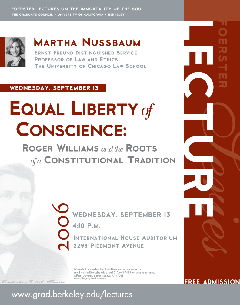
[00:00:00] MARY ANN MASON:
Good afternoon. I’m Mary Ann Mason, the Dean of the Graduate Division, and on behalf of myself and the Graduate Council, we sponsor these lectures, we are enormously pleased to present Martha Nussbaum, this year’s Foerster Lecture Series. As a condition of the bequest, the Foerster, Foerster bequest, we’re obligated to tell you how the endowment supporting the Foerster Lectures on the Immortality of the Soul, my very favorite lecture series title, came to UC Berkeley.
It’s a story that exemplifies the many ways this campus is linked to the history of California and to the Bay Area. In nineteen twenty-eight, myth– Miss Edith Zweybruck established the Foerster Lectureship to honor the memory of Agnes A. Foerster and Constantine E. A. Foerster. Edith was a public school teacher in San Francisco for many years, and the teaching profession was to her an opportunity to develop a deep knowledge and love of the spiritual values of life in the young minds entrusted to her care.
Now, Edith’s beloved sister, Agnes Foerster, shared her high ideals and hopes, as did Agnes’s husband, Constantine E. A. Foerster. A lawyer by profession, Foerster was a man of high intellectual achievements and apparently rare personal charm. Although he passed away at the age of thirty-seven, he achieved an enviable place at the San Francisco Bar and was considered one of its most highly respected members.
So it’s very appropriate we have a professor in the law school who’s coming here today. For several years prior to his death, Foerster was law partner of Alexander F. Morrison, one of the most prominent, uh, San Francisco attorneys for whom our Morrison Memorial Library is named. And Morrison and Foerster, known locally as MoFo, is still one of our major San Francisco law firms.
In her last days, Myth– E– Ms. Edith Zweybruck expressed her deep and abiding interest in the spiritual life by creating this lecture series on the subject, the immortality of the soul or other similar spiritual subjects. She believed that through the medium, forgive the pun, of a great university and the words of scholarly lectures, she might bring new light upon a subject that has interested the world forever. Thank you, thank you, Edith Zweybruck, for being so foresighted and for establishing an endowed lectureship in 1924, which now means that we have a substantial amount and are allowed to bring wonderful, wonderful speakers like, um, Martha Nus-Nussbaum every year.
Past Foerster Lecturers have included Oliver Sacks, Thomas S. Kuhn, Aldous Huxley, and Paul Tillich. And now I welcome Professor Anthony Long, Chair of the Foerster Committee, to the podium to introduce our speaker.
[00:02:55] ANTHONY LONG:
Good afternoon, everyone. Uh, very happy to welcome you as well as, uh, our dean just now. It’s, um, some thirty years since I first met, um, Martha Nussbaum.
It was, I think, in Oxford. It could have been in Princeton. But what brought us together on that occasion was our common interest in Greek philosophy and literature.
That was thirty years ago. Thirty years since then, that’s just who I am still. I’m still, um, Greek philosophy and literature.
The difference between us is that while, uh, Professor Nussbaum continues to work, uh, uh, great deal in those fields, she’s expanded her range of concerns and expertise to the point where she’s become the author and spokesperson for a quite remarkable blend of philosophical, literary, social, political, educational, and legal contributions. Um, the names of some of our, uh, former, uh, Foerster lecturers, of course, are very familiar, uh, some less familiar, but I’m sure no one came into this room today without knowing the name of, um, Martha Nussbaum. At a time when public intellectuals are a rare commodity, especially ones of authentic ability and substance, Martha Nussbaum is a signal exception.
Her publishing productivity and versatility are legendary. In the last decade alone, she’s produced a large volume virtually every year, with books as different in their scope as Upheavals of Thought, which is cutting-edge theory on the cognitive nature of the emotions, Women and Human Development, which reflects her social work and experience in India.
[00:04:49] MARY ANN MASON:
Yeah.
[00:04:51] ANTHONY LONG:
Her latest book, if I have my facts right, will be Liberty of Conscience: The Attack on America’s Tradition of Religious Equality. I think we’re going to get a sample of this work in today’s lecture, with its reference to Roger Williams, the seventeenth-century London clergyman who became the founder of Providence, Rhode Island. Now, Martha’s never let up on her original interests in Greek philosophy and literature, as I said, and philosophy in general.
In fact, these interests, and I think especially her devotion to Aristotle, on whom she published her first book, have significantly helped to shape her approach to such gigantic modern issues as affirmative action, feminism, gay rights, Third World economics, and international justice. After all, Aristotelian ethics, psychology, and literary theory presuppose the notion that human beings are emotional as well as rational animals. Rational, of course, features in Aristotle’s classic definition of the human being, but it’s central to Aristotle’s ethical view that we are emotional animals, too.
The importance of tempering reason with feeling, or tempering feeling with reason seemed to me constant and consistent themes in Martha’s work and in the urgency of her voice, whatever her theme or concern. Many of us in this room are instructors in the humanities. A stock justification for our calling is that the study of great literature or art or philosophy is supposed to enlarge the mind, broaden the cultural perspective, and enhance critical thinking.
As members of a public university, moreover, we are beneficiaries of tax dollars. Fewer, no doubt, than we would like, but a sizable number of dollars. And that benefaction reflects the belief that what we do as educators is for the public good.
Yet while Berkeley and many other American universities regularly reap top ranks in surveys, the role of the intellectual as an influential public voice in this land, never great, I think, but at present threatens to become quite silent, or at least unheeded. Fortunately, that will not happen under the watch of Martha Nussbaum. She is a tireless speaker and writer on behalf of what she deems to be the public good, as measured by concepts of reason, humanity, and compassion.
Now, to play that role is not only quite rare, it also calls for unusual eloquence and persuasion, and for great energy and courage. By taking on the huge issues that she does, Professor Nussbaum risks controversy and criticism, and she’s had her share of controversy and criticism, especially from those of us who stay within the comfort zones of our own disciplines and ivory towers. Long may you continue, Martha, your dedicated activism and your life of what Aristotle calls practical rationality.
As Chicago’s first, uh, uh, sorry, as Chicago’s Ernst Freund Distinguished Service Professor of Law and Ethics, we are indeed honored to have you in Berkeley as our two thousand six seven Foerster lecturer. We are eager to hear you speak on Equal Liberty of Conscience: Roger Williams and the Roots of a Constitutional Tradition. So I have much pleasure in welcoming Martha Nussbaum to the podium.
Martha.
(applause)
[00:08:58] MARTHA NUSSBAUM:
Well, thank you very much, Tony. I really appreciate that. Uh, it’s, it’s really great to be here.
Uh, the book that Tony mentioned is a book in progress, of which you’ll get a little sample. Uh, what I wanted to do, uh, seeing the climate of polarization and, and, uh, animosity over issues of the relationship between religion and the public, uh, good, uh, was to try to write something that I, I think by tracing some of the philosophical and historical foundations of the constitutional tradition, we, we may be able to promote some, some kind of a stable consensus. So at any rate, that’s the aim of the book as a whole, and I’d be very glad to have questions about how some of the things I’ll say here about the early tradition, uh, shed light on contemporary issues like the Ten Commandments and the Pledge of Allegiance and so forth.
Okay, two quotations to begin with. The first is from Roger Williams’s major book, The Bloody Tenent of Persecution, in 1644. “Sixthly, it is the will and command of God that since the coming of His Son, the Lord Jesus, a permission of the most paganish, Jewish, Turkish, or anti-Christian consciences and worships be granted to all men in all nations and countries.
And the second is a letter that Roger Williams wrote to the governors of Massachusetts and Connecticut, who did not, uh, extend liberty of conscience to all those other groups. Yourselves pretend liberty of conscience, but alas, it is but self, the great God self, only to yourselves. Life was tough for the settlers of seventeenth century New England.
They responded to hardship by trying to gain God’s favor for their new colony, which required, as they saw it, establishing and sternly enforcing a religious orthodoxy. By punishing or banishing those who disobeyed in word or deed, they hoped to cast impurity from their common life. The idea that a good community would be one that allowed all people to seek God in their own way took root only gradually and with great struggle.
This lecture traces that struggle, focusing on the life and ideas of one of the century’s great apostles of religious liberty and fairness, Roger Williams, founder of the colony of Rhode Island and seminal philosophical writer about the persecuted conscience. American writings about religious liberty were in conversation with similar work in Britain, and there are striking similarities between the arguments used in Williams’s two most influential books, published in sixteen forty-four and sixteen fifty-two, and those used more famously and later by John Locke.
Nonetheless, the American tradition has some distinctive features that ultimately proved valuable in forging our constitutional heritage. The American tradition I want to recover contains first, an emphasis on the tremendous importance of a mutually respectful civil peace among people who differ in conscientious commitment. The vulnerability of all Americans in the perilous new world they had chosen led to a recognition which came much slower in Europe, if indeed it has come at all, that people with different views of life’s ultimate meaning and purpose really need to learn to live together on terms of equal respect if they were to survive at all.
Roger Williams dramatizes this idea from the start by making his work a dialogue between two friends called Truth and Peace, in which Truth acknowledges the deep importance of reaching accommodation with people whom one believes to be in error. The second distinctive feature of the American tradition is a personal and highly emotional sense of the precariousness and the vulnerability of each individual person’s conscience, that seat of imagination, emotion, thought, and moral choice through which each person seeks for meaning in his or her own way. The experience of both solitude and space that the wild world conveyed to its new inhabitants brought with it a picture of human life as a risky and lonely quest.
This idea, in turn, led to the thought that this search, this striving of conscience, is what is most precious about the journey of human life, and that each person, Protestant, Catholic, Jew, Muslim, or pagan, must be permitted to conduct it in his or her own way without interference either from the state or from orthodox religion. To impose an orthodoxy upon the conscience is nothing less than what Williams, in a memorable and repeated image, calls soul rape. Third, and perhaps most important for the overall argument I’m trying to make in this book, Williams grounds his views of church and state in an idea of fairness and impartiality, of equal respect for conscience.
In my larger project, I argue that this idea links the Free Exercise Clause to the Establishment Clause and provides very good guidance as we confront, uh, difficulties– contemporary issues. So first, Section 1. The Wild and Howling Land.
Life in New England was fragile and exposed. If people did not die on the voyage to the new land, they knew well that they might die shortly in it, whether from starvation, disease, or cold, or at the hands of the native inhabitants, whose claims to the land they utterly ignored. On the dubious authority of a land claim made by James the First, they grasped for security, alleging that the land was their own because Englishmen first discovered it, something that Roger Williams called, quote, “A solemn public lie.”
End quote. He added the sarcastic comment, quote, “Christian kings,” so-called, are invested with right by virtue of their Christianity to take and give away the lands and countries of other men.” End quote.
The world around them really was alarming. The wind, the seas, the forests, the deep snows, all of this was strange to people accustomed to life in England, whether urban or rural. Quote, \”But, oh, poor dust and ashes,\” Roger Williams wrote of himself and his fellows, \”like stones once rolling down the Alps, like the Indian canoes or English boats loose and adrift, where stop we until infinite mercy stop us?”
In his remarkable book, Key to the Languages of America, a study of the Indian tribes, their life and languages, written during a sea voyage back to England in sixteen forty-three, Williams ponders the Indians’ ability to coexist with impermanence and constant vulnerability in what he calls this wild and howling land. And astonishingly, the Indians don’t mind picking up and moving on to a new place whenever climate or insects or Sheer inclination moves them. Quote, “I once in travel lodged at a house,” at which in my return I hoped to have lodged again there the next night, but the house was gone in the interim, and I was glad to lodge under a tree.”
End quote. This sense of life as transient, as requiring reinvention at each moment, deeply shaped the new Americans’ culture and ultimately their religious sensibilities. The Indians may have made their peace with transience.
The Puritans, used to a very different sort of life, resisted. To keep the world at bay, they found it prudent to enforce orthodoxy of religious belief, expression, and practice, suppressing dissent. John Cotton, fifteen ninety-five to sixteen fifty-two, pastor of the First Church of Boston, one of Massachusetts’ most influential religious leaders, and Roger Williams’s lifelong intellectual adversary, wrote copiously in defense of religious persecution, arguing that it was necessary for civil order.
It was also God’s will, he said, in order to separate the diseased element of society from the healthy element. As he and Williams wrangled endlessly about whether people diverse in faith and way of life could c- coexist peacefully in civil society, Cotton maintained again and again that the wholesome parts of a community cannot but be corrupted by the presence of heretics and dissidents unless those people are brought to judgment, punished, and if they don’t repent, banished. Sometimes the desire to keep sin at bay did not consent it– content itself with persecution and banishment.
Witch trials, as you all know, were common in both Massachusetts and Connecticut. And John Demos’s research shows that the most common so-called victim of the witches was not actually the famous teenage girls, but instead, much more commonly, a young adult male on the verge of responsible adulthood. Demos concludes that heightened vulnerability and uncertainty about whether one would be able to make a life at all led to the desire to demonize others.
Such reactions to insecurity are sadly familiar throughout America’s history. Arthur Miller was quite right to connect the witch trials to witch hunting of leftists in the McCarthy era. Today, we’re told by our leaders that we’re living in another time of heightened vulnerability, a time, um, a couple of nights ago, uh, we were told that, uh, civilization itself is actually at stake.
In this situation, it’s all too easy to let the longing for homogeneity and control ride roughshod over the spirit of fairness and respect, projecting the causes of instability on to, um, other people, grabbing hold of Cotton’s seductive metaphor of a stain or taint in our midst that must be removed if we are to resist, uh, destruction. There are, however, other ways of living in difficult times. What makes Roger Williams of particular interest is not just the quality of his philosophical work, which is high.
It is also the way in which he offers an alternative to the paranoid response to uncertainty, urging on his readers attitudes of fairness, reasonableness, and civility, words which recur with obsessive frequency throughout the two philosophical dialogues totaling about some one thousand pages, which, uh, constitute his major works. Section two: “To ship myself all alone in a poor canoe, Williams’s Rhode Island.” Williams is typically remembered as a religious and political leader rather than a thinker.
If his ideas are recalled at all, he’s identified with one uncharacteristic phrase he used once in a letter, namely the phrase, “The wall of separation between church and state,” rather than for the careful and extensive arguments about the evils of persecution, the primacy of the individual conscience, and the jurisdictions proper to the civil and the religious spheres. His ideas are rarely set out with care, and the relationship of those ideas to those of more famous seventeenth-century philosophers, Locke in particular, is rarely appreciated. Although, in fact, his important writings of the sixteen forties anticipate Locke’s, uh, Letter Concerning Toleration, sixteen eighty-nine, In every major point.
But since Williams was a leader as well as a thinker, and since his work needs to be assessed in the context of his life and career, uh, we first should recount his story. Williams was born in England, probably in 1603, to a prosperous merchant family. He grew up in London, near the Smithfield Plain, where religious dissenters were sometimes burnt at the stake.
As a young man, he attracted the attention of the distinguished lawyer, who I should say also was steeped in Stoic natural law arguments, so this is the intellectual background. Sir Edward Coke, Chief Justice of the King’s Bench. Coke arranged for the young man’s education at Sutton’s Hospital, the future Charterhouse School, and then at Pembroke Hall in Cambridge University, where Williams received his AB in sixteen twenty-seven after a classical education that focused on natural law theories, uh, deriving from ancient Greek and Roman Stoicism, which suffused Coke’s work, and which were much in vogue at the time.
Williams quickly impressed by his remarkable flair for languages, mastering Latin, Greek, Hebrew, French, and Dutch. In this way, he made the friendship of John Milton. He taught Milton Dutch in exchange for receiving Hebrew lessons.
On graduation, Williams took orders in the Church of England, and in 1629 accepted the post of chaplain at Otes in Essex, the manor house of Sir William Masham, grandfather of the Sir Francis Masham, who was Locke’s host at Otes in the 1690s. In 1630, a leading Puritan reformer was placed in the pillory. One of his ears was cut off, one side of his nose was split, and he was branded on the face with the letters SS for sower of sedition.
Later, the other side of his nose was split, and his other ear was cut off. For good measure, the man was then imprisoned for the rest of his life. Williams, who witnessed these events and who was already very critical of the Anglican orthodoxy, decided that he could not live the religious life he wanted in England.
He set sail for Massachusetts. At first, Williams was warmly welcomed by the leaders of the Massachusetts Bay Colony. Although in Boston, his views about the individual conscience were found too radical, he was welcomed by the congregation at Salem.
He expressed his religious ideas freely. At the same time, he published a pamphlet attacking the colonists’ claims to the Indians’ property. The officials of Massachusetts Bay called him into court, but took no action when Williams agreed to withdraw the pamphlet from circulation.
He continued, however, to teach the falsity of the colonists’ property claim. He also urged resistance to a proposed o-oath of loyalty to be taken by all colonists. During this period, Williams spent some peaceful months at Plymouth, where he pursued his study of Indian life and languages.
By sixteen thirty-five to six, authorities saw that Williams was bent on continuing his divisive teaching. They ordered him to be arrested. Tipped off in advance, he fled.
Looking back on the incident from Providence in sixteen seventy, he describes it this way: “”I was unkindly and un-Christianly, as I believe, driven from my house and land and my wife and children in the midst of New England winter now about thirty-five years past. I steered my course from Salem, though in winter snow, which I feel yet, until these parts, where I may say, as Jacob, “Peniel,” that is, I have seen the face of God. So begins the story of Rhode Island.
In keeping with his sense of divine deliverance, Williams named the new colony Providence. A key part of the life of that new settlement was respectful friendship with the Indians. Williams had always treated them as human beings, not beasts or devils.
He respected their dignity. When the great Narragansett chief Canonicus, who spoke no English, broke a stick ten times to demonstrate ten instances of broken English promises, Williams understood his meaning and took his part. When the colonists objected that the Indians couldn’t own land because they were nomadic, Williams described their regular seasonal hunting practices, arguing that these practices were sufficient to establish property claims, a legal argument that strikingly anticipates very recent litigation over Aboriginal land in Australia.
Linguist that he was, he reports having at this period, quote, “a constant zealous desire to dive into the natives’ language,” and he learned several of the languages by actually living with the Indians for long periods of time. “God was pleased,” he says, “to give me a painful, patient spirit to lodge with them in their smoky holes “to gain their tongues,” et cetera. When Williams arrived as a refugee then, his dealings with the Indians had long prepared the way for a few fruitful relationships.
Chiefs Massasoit and Canonicus welcomed him like an old friend because he had befriended them before he needed them and had given them lots of gifts for many years. He was already known as a good public debater in the native languages, and therefore, quote, “held with them as a sachem.” “End quote.”
“One of the key provisions of the Charter of Rhode Island was,” quote, “It shall not be lawful to or for the rest of the colonies to invade or molest the Native Indians,” end quote. A provision that Williams particularly sought from the king, and when granted, applauded, noting that hostility to the Indians, quote, “hath hitherto been practiced to our continual and great grievance and disturbance,” end quote. Throughout his life, Williams continued these friendships.
As he wrote to the governor of Massachusetts Bay, explaining why he refused to return to Massachusetts, quote, I feel, I feel safer down here among the Christian savages along Narragansett Bay than I do among the savage Christians of Massachusetts Bay. And that didn’t mean that they had been converted. He never tried to convert the Indians.
He just meant that their behavior exemplified the Christian spirit more truly than the behavior of the people in Massachusetts. He, he’s very fond of noting examples of Indian decency and honesty and contrasting this behavior with that of the, uh, other, uh, neighbors in Massachusetts and Connecticut. Williams’s experience of finding integrity, dignity, and goodness outside the parameters of orthodoxy surely shaped his evolving views of conscience.
But there was al-always already something antinomian about Williams, something that led him to those friendships in the first place, a respectful curiosity about the varieties of humanity. That’s the paradigm of something that, um, played a, a good role in the history of the American colonies as a nation of strangers and immigrants. Williams immediately provided for religious liberty in the new colony.
The majority would make policy, but, quote, “Only in civil things,” end quote. Broad liberty of conscience was officially guaranteed. Rhode Island rapidly became a haven for people who were in trouble in other places.
Other settlements were founded. Baptists, Quakers, and other dissidents joined the Puritan dissenters. In 1658, fifteen Portuguese Jewish families arrived in Newport.
Although the Touro Synagogue, America’s oldest surviving Jewish synagogue and its first Sephardic synagogue, was not dedicated until 1763, Jews enjoyed the same religious liberty granted to others, a fact that’s rather astonishing when we note that Jews in Britain gained full civil rights only in 1858. In 1643, Williams set sail for England to secure a formal charter for the new colony. During the voyage, he wrote his book about the Indian languages.
While in England, he wrote and published The Bloody Tenant of Persecution. A democratic charter was obtained, and the colony proclaimed liberty of conscience. In 1652, Rhode Island passed the first law in North America making slavery illegal.
By this time, Williams had been won over by the Baptists’ arguments in favor of adult baptism. He was re-baptized in 1639, and from that time on, he referred to himself simply as a seeker. Meanwhile, John Cotton’s angry reply to The Bloody Tenent, published in 1647, led Williams to produce another work about a hundred pages longer than the first one, refuting all of Cotton’s arguments.
Published in 1652 in London during another of Williams’ visits to England, it bears the unwieldy title, The Bloody Tenent Yet More Bloody by Mr. Cotton’s Endeavour to Wash it White in the Blood of the Lamb: of whose precious blood spilt in the blood of his servants, and of the blood of millions spilt in former and later wars for conscience sake, that most bloody tenent of persecution for cause of conscience, upon a second trial is found now more apparently and more notoriously guilty. You see why philosophers don’t, they really can’t cope with this man. He’s a very, very prolix writer.
The civil wars and the restoration made, made it necessary to renegotiate the charter. Williams again went to England and found in Charles II a ready ally for his experiment in religious liberty. Williams notes that the Barbados already permitted re-religious liberty by omission and policy rather than by explicit royal guarantee.
Quote, “But our grant is crowned with the King’s extraordinary favor to this colony, in which His Majesty declared himself that he would experiment whether civil government could consist with such liberty of conscience.” With amusement, he describes the shocked reaction of the King’s ministers when they read the unorthodox document. Quote, “But fearing the lion’s roaring, they couched against their wills in obedience “to His Majesty’s pleasure,” end quote.
The charter was shocking indeed, not only in its odd provision regarding the Indians, but above all in its clause regarding religious liberty, which goes like this: “No person within the said colony at any time hereafter shall be anywise molested, punished, disquieted, or called in question for any differences in opinion in matters of religion, and he do not actually d-disturb the civil peace of said colony, but that all and every person and persons may from time to time and at all times hereafter freely and fully have and enjoy his and their own judgments and consciences in matters of religious concernments throughout the tract of land hereafter mentioned, they behaving themselves peaceably and quietly, and not using this liberty to licentiousness or profaneness, nor to the civil injury or outward disturbance of others. Any law, statute, or clause therein contained, or to be contained, usage, or custom of this realm, to the contrary hereof, in any wise, notwithstanding. Okay, what does this clause protect?
Belief and the expression of opinion in religious matters, clearly. But Williams, throughout his philosophical writings, was very careful to insist that acts of worship should also enjoy protection. Indeed, in his writings, we rarely encounter the word belief without the word worship or practice.
In the passage I just read at the beginning of the talk, taken from the introduction to The Bloody Tenent, ‘consciences and worships are all permitted.’ Elsewhere, he uses phrases such as, ‘for either professing doctrine or practicing worship, doctrine or practice,’ et cetera, et cetera. It’s a bit unfortunate that the charter is less precise, but we can understand the latitude of its protection from the other direction as stopping where civil disturbance and violation of the rights of others begins.
Williams was no John Stuart Mill. He thought that the business of civil government included not only protection of individuals from harm to their rights by others, but also the maintenance of public order and morality. Thus, like virtually everyone at this time, he favored laws against adultery and other so-called morals offenses.
Not, however, on religious grounds. His conception of public morality, as we’ll see later, keeps it quite distinct from religious norms and justifications. The final provision in the clause is especially interesting.
The Charter guarantees liberty of religious belief and practice even when a law or custom already on the books forbids it. In other words, if the law says you have to swear an oath before God to hold public office, this law is nullified by the Charter. Moreover, it appears that the Charter nullifies the applicability of laws to individuals whenever such laws threaten their religious liberty.
If a law says that people have to testify in court on a Saturday and your religion forbids this, then that law is non-applicable in your case. In other words, it would appear that Williams is forging the legal concept of accommodation, which soon became very widely accepted in the colonies. Laws of general applicability have force only up to the point where they threaten religious liberty.
Just so long as public order and safety are not at stake. This was not mere talk. Williams was notoriously skeptical about Sunday as the chosen day for no work.
He had considerable sympathy with the theological arguments of the Seventh-day Baptists. More generally, he saw the burden that comes with imposing a majority practice on everyone. Rhode Island had no Sunday law during his lifetime.
Section three: This conscience is found in all mankind, Williams’ defense of religious liberty. Behind this impressive political achievement is a body of thought as rich on these issues as that of Locke, and considerably more perceptive concerning the psychology of both persecutor and victim.
At its heart is an idea or image on which Williams focused with deep emotion and obsessional zeal, the idea of the preciousness and dignity of the individual human conscience. Williams defines conscience as holy light and as, quote, “a persuasion fixed in the mind and heart of a man which enforceth him to judge and to do so and so with respect to God, his worship, et cetera.” It is, he says, quote, “indeed the man,” end quote.
Williams has his own very intense religious beliefs, and these beliefs entail that most people around him are in error. Error, however, does not mean that they do not have the precious faculty of conscience. “This conscience,” he writes, “is found in all mankind,” in Jews, Turks, Papists, Protestants, pagans, et cetera.”
End quote. And even though one thing that’s precious about the conscience is its ability ultimately to find the truth, that’s not what Williams emphasizes. What he reveres is the committed search, the sincere quest for meaning.
Quote, “I commend that man, whether Jew, or Turk, or Papist or whoever,” that steers no otherwise than his conscience dares.” For neighbor you shall find it rare to meet with men of conscience.” End quote.
One can’t help thinking of Williams’s respect for his Indian friends when one reads passages like this. Furthermore, since he says that men of conscience are rare, but the conscience itself is in everyone, he clearly holds that the precious faculty of conscience exists even in less virtuous people, and that all deserve basic human respect. So everyone has inside him or herself something infinitely precious, something that demands respect from us all, and something in regard to which we are all basically equal.
Williams now argues that this precious something needs space to unfold itself, to pursue its own way. To respect human beings is therefore to accord them that sort of space, and to accord it to each and every one of them. He expresses indignation that someone, quote, “that speaks so” tenderly for his own hath yet so little respect, mercy, or pity to the like conscientious persuasions of other men.
Are the thousands of millions of millions of consciences at home and abroad fuel only for a prison, for a whip, for a stake, for a gallows? Are no consciences to breathe the air but such as suit and sample his? End quote.
These images are revealing. They tell us that Williams thinks of consciences as delicate, vulnerable, living things, things that need to breathe the air and not to be imprisoned. There are so many of them in prison all over the world, but all alike should have breathing space.
Williams has the very keenest sensitivity to any damage to this precious thing, comparing persecution repeatedly to spiritual and soul rape. And it is soul rape, he says, when any person is limited with respect to either belief or practice, so long as he is not harming others or violating other civil laws duly constituted. Quote, “I acknowledge that to molest any person, Jew or Gentile, for either professing doctrine or practicing worship merely religious or spiritual, it is to persecute him.
And such a person, whatever his doctrine or practice be true or false, suffereth persecution for conscience. This persecution is therefore a terrible error.” Williams explicitly says that it is a worse thing than being a heretic.
Indeed, he goes on, persecution is a doctrine, quote, “which no uncleanness, no adultery, incest, sodomy, or bestiality can equal. This ravishing and forcing, explicitly or implicitly, the very souls and consciences of all the nations and inhabitants of the world.” End quote.
Williams doesn’t believe that the offenses to which he compares persecution are trivial. Indeed, he’s rather inclined to favor the death penalty for adultery. So we can see how strong his objection to persecution is, if it’s worse than these things.
Most rulers in all ages, he concludes, after very copious historical surveys, have practiced violence to the souls of men. Conscience, then, is not invulnerable to worldly conditions. It can be imprisoned, that is, prevented from carrying out its search in action, and it can even be raped, that is, damaged or defiled.
One of Williams’s reasons for abhorring pe-persecution is instrumental. If you force someone, it hardens their opposition, thus preventing their voluntary conversion, hence their salvation. He makes this point repeatedly in ad hominem argument with John Cotton, and it was a common Protestant argument in the period, one that Locke later makes central to his own case for toleration.
But Williams makes much less of this argument than does Locke, and one can’t really read Williams’s text and doubt that Williams also thinks damage to conscience an intrinsic wrong, a desecration of what is most precious about a human life. Moreover, he insists repeatedly that this precious something is worthy of equal respect and is equally in us all. Therefore, it’s a heinous wrong to give it freedom for some and to deny the same freedom to others.
Again and again, he hammers home the charge of partiality and unfairness. “Magistrates,” he says, “give liberty with a partial hand and an unequal balance.” How, quote, “Will this appear to be equal in the very eye of common peace and righteousness?”” His own marginal summaries of his argument, particularly in the later book, keep recurring to this theme, saying things like, “Unchristian partiality,” “gross partiality to private interests,” or, “Gross partiality, the bloody doctrine of persecution.”
Williams has a keen nose for special pleading and unfairness, and he sees it everywhere restrictions on religious liberty are found. He suggests that the error of the persecutor is a kind of anxiety-ridden greed, which is hypocritically disguised as virtue. Each person, anxious and insecure, aims to carve out special protections and privileges for himself by attacking in others what he most values in his own life.
In his letter to the governors of Massachusetts and Connecticut, which I read earlier, he indicts them for a hypocritical and unfair set of principles, for worshiping, in effect, only the great God self. If persecution is the worst of errors, liberty of conscience is, as Williams repeatedly states, a most precious and invaluable jewel. The proponent of liberty, he goes on, does not indulge in special pleading.
Even though he believes that he’s right, he doesn’t puff himself up, for he knows how difficult his quest is. He remembers God’s mercy to him, and he has mercy on those whom he believes to be in error. He also has an even-handed, fair-minded spirit of love and civility to all men, a civility that includes respect for their freedom.
In one remarkable passage, Williams writes that persecution is not only, quote, “To take the being of Christianity out of the world, but to take away all civility and the world out of the world, and to lay all upon heaps of confusion.” End quote. What does he mean by saying that persecution takes the world out of the world?
I think he’s expressing the view that the spirit of love and gentleness, combined with the spirit of fair play, are at the heart of our worldly lives with one another. Take these things away, and you despoil the world itself. You make it nothing but a heap of confusion.
Williams is an emotional writer. His sense of his own religion is deeply subjective and passionate. Nonetheless, it’s not implausible to compare his core ideas to those that will animate the philosophy of Kant a century later.
I should add that both owe a pr- debt to the Stoics, which has got to be a topic for another time. At the heart of the thought of both men are two ideas: the duty to respect humanity as an end wherever we find it, and the duty to be fair, not to make an exception for one’s own case. Kant’s categorical imperative asks each person to test the principle of his or her conduct by asking whether it could, without contradiction, be made a universal law for all human beings.
This test will show us whether we’ve been selfishly partial to our own case. Williams’ critique of the leaders of Massachusetts and Connecticut is that their ideas can’t pass Kant’s test. They love freedom, but only for themselves.
They could not will persecution as a universal law, and their selfishness prevents them from willing freedom of conscience, which could pass the Kantian test as a universal law. Kant’s second test is, of course, the formula of humanity, asking us to test our principle by seeing whether it treats humanity as an end. We are to ask whether we’re really showing respect to the dignity of human beings or whether we’re just using them as objects in the pursuit of our own selfish ends.
This complaint, too, is a constant theme in Williams’s writing. The conscience is precious, but people use other people’s consciences to serve their own anxious and greedy ends. Kant’s third way of testing principles invokes the idea of autonomy.
We’re to ask ourselves whether we can view our principle as a law that we could give to ourselves. There’s no precise echo of this part of Kant in Williams, but his insistence on the deeply personal quest of the individual conscience and the priceless value of freedom in this quest is in great sympathy with Kant’s way of thinking. For both, the source of moral principles and of all moral worth is ultimately in our own freedom, and that freedom must be respected.
For both, doing the right thing because of obedience to a law imposed from outside has no moral worth at all. Finally, Kant speaks of good principles as constituting a realm of ends, a virtual society of free beings who each respect one another as equals. I believe that this idea is very much what Williams is after when he says that persecution takes the world out of the world.
It destroys the basis of human fellowship in respect, freedom, and civility. Williams then lies at the beginning of a distinctive tradition of thought about religious fairness that resonates to the present day in John Rawls’s distinguished work on liberty and equal respect. Compared to both Kant and Rawls, Williams has an extra measure of psychological insight, helping us see why persecution is so attractive and what emotional attitudes might be required to resist it.
Section four: A model of church and civil power. If Williams had offered only an account of conscience and its fair, impartial treatment, he would already have made a large contribution to our understanding of religious liberty.
He accomplished, however, much more, developing an elaborate account of the proper jurisdictions of religious and civil authority that anticipates Locke’s more famous account in every major point, and that still offers helpful guidance. In this part of his work, Williams is replying to a so-called model of church and state proposed by John Cotton. Truth says to peace, “Oh, what book do you have there?”
Peace produces Cotton’s large book and reads from it at great length the claim that the church must hold high authority in the civil realm and should be superior to all civil magistrates if peace is to be preserved. The two hundred pages that follow contain Williams’s alternative model. According to Williams, there are two separate sets of ends and activities in human life, separate though related.
Corresponding to these are two utterly different sorts of jurisdiction, two sorts of authority. Civil or state authority concerns the bodies and goods of subjects, exactly the characterization that Locke later gives. And, uh, haven’t been able to prove whether Locke knew this work.
I mean, Quentin Skinner and other Locke scholars are, uh, Locke never cites what he’s read, but, you know, the similarities are so great, and he was living in the same house where Williams did his early work. Uh, so, so it seems highly likely that Locke is lifting some of this from Williams. Civil authority must protect people’s entitlements to property and bodily security, and it may properly use force to do so.
The civil law applies to all, including members of the clergy. The foundation of civil authority lies in the people, and it is the people who are entitled democratically to choose civil magistrates. The other sphere of human life is that of the soul and its safety.
Law and force have absolutely no place in this sphere, which must be governed by persuasion only. Churches and their officers have this sphere as their jurisdiction, but with the proviso that their only proper means of addressing the soul is persuasion. The two sorts of authority, civil and spiritual, can coexist peaceably together.
Peace is in jeopardy only to the extent that churches overstep their boundaries and start making civil law or interfering with people’s property, livelihood, and liberty. Williams now tells us that there is, of course, a way in which the civil state needs to make laws respecting religion. Namely, it has to make laws protecting it, saying, for example, quote, “That no persons, Papists, Jews, Turks, or Indians be disturbed at their worship, a thing which the very Indians abhor to practice toward any.”” Such protective laws are not only permitted, they’re extremely important, and he calls them “the Magna Carta of the highest liberties.”
End quote. But there is, he continues, another type of law respecting religion that’s very different from these protective laws, the sort of law that establishes or forbids acts of worship, says who can or cannot be a minister, and so on. To say that these should be civil laws, quote, is as far from reason as that the commandments of Paul were civil and earthly constitutions.
End quote. John Cotton makes two claims that Williams must answer if he is to defend his radical position well. First, Cotton makes a claim about peace and stability.
People simply can’t live at peace with one another unless some religious orthodoxy is established. In response, Williams invokes both reason and experience on his side. People with false religious views, he says, may be perfectly decent and peaceable citizens.
We can see this all the time. People do live together peacefully, so long as they respect one another’s conscience space. Once again, life with the Indians provides a handy illustration.
What really break, breaks the peace is persecution. Quote: “Such persons only break the kingdoms or cities’ peace who cry out for prisons and swords against such who cross their judgment or practice in religion.” The other argument of Cotton’s on which Williams focuses is an argument about competence.
Cotton claims that being a good citizen and being a good civil magistrate are inseparable from having the correct religion. We simply don’t want our public life to be run by sinners because they’re making very important decisions, and if they’re sinners, they will do so sinfully and badly. Here, Williams makes one of his most interesting, and for the time, very novel arguments.
God, he says, has created different sorts of goodness in the world. There are diverse sorts of goodness corresponding to the different sorts of things that God has created. He illustrates this point at great length, talking about the goodness of artifacts, the goodness of plants, the goodness of animals, and so on.
But one of the ways God created diversity in the world was to create a type of, quote, civil or moral goodness, end quote, that is, quote, commendable and beautiful, end quote, in its own right, and that is distinct from spiritual goodness. It can be there in its full form and be beautiful, even if the person is in religious error, even, quote, “Though godliness, which is infinitely more beautiful, be wanting,” end quote. What’s needed to be a good subject in a civil state is the moral sort of goodness, and it is that sort as well that we need in our civil magistrates.
Later, returning to this point, he insists that the foundation of the magistrate’s authority, quote, “Is not religious,” Christian, et cetera, but natural, humane, and civil.” End quote. For many activities in human life, a worldly foundation is sufficient.
Quote, “A Christian captain, Christian merchant, physician, lawyer, pilot, father, master, and so consequently magistrate, et cetera, is no more a captain, merchant, physician, lawyer, pilot, father, master, magistrate, et cetera, than a captain, merchant, et cetera, of any other conscience or religion, end quote. Particularly surprising, I think, is his casual mention of father as one of those roles whose duties can be faithfully and completely fulfilled independently of spiritual enlightenment. In short, for Williams, the civil state has a moral foundation, but a moral foundation need not be, and for reasons of fairness to all, must not be a religious foundation.
The necessary moral virtues, honesty is one to which Williams devotes special attention, can be agreed on and practiced by people from many different doctrines. To be sure, he adds, a person’s religion will connect these moral virtues to religious ends, but so far as the moral sphere itself goes, orthodox and dissenter, religious and non-religious can all agree. It’s not fanciful to see here an adumbration of John Rawls’s idea of civil society as involving a set of what Rawls calls freestanding moral principles concerning which people from different comprehensive doctrines can join in what Rawls calls an overlapping consensus.
Like Williams, Rawls stresses that political society has a moral foundation, but he holds that this is a, a module that can be linked to different religious doctrines or non-religious doctrines in a variety of different ways. Although religious people will certainly feel that their religion provides the moral principles with their highest ends or deepest sources, here again, he agrees with Williams, they can nonetheless agree about the moral terrain in a way that is, for practical purposes, free-standing. That is, not requiring the acceptance of any particular religious orthodoxy for its justification.
So we don’t have exactly a wall of separation between people’s religions and their political principles. Recall that Williams used that phrase only once and in a polemical context in a letter, not at all in his thousand pages of, of major writing. We do have separation of jurisdictions between church and state, but where people are concerned, they will rightly see the morality of public life as one part of their own comprehensive doctrine, a part nonetheless that they can share with others without converting them to what they take to be the true religion.”
This idea is, I think, a much more helpful idea to think with than the bare idea of separation, which might suggest that the state doesn’t have anything to do with the deep ethical matters that are central to the religions. The state needs to be built on moral principles, and it would be weird or tyrannical to ask religious people to accept the idea that moral principles are utterly separate from their own religious principles. The idea of an overlapping consensus, or to put it Williams’ way, the idea of a moral and natural goodness that we can share while differing on ultimate religious ends, is an idea that helps us think about our common life together much better than the unclear and misleading idea of separation.
We must respect one another’s freedom and equality, the deep sources of conscience that lead us through the wilderness of life. We will only do this if we keep religious orthodoxy out of our common political life. But we can and must base that common life on ethical principles that for many also have a religious meaning and a religious justification.
All we need to do when we join with others in a common political and moral life is to acknowledge that someone might actually have those ethical virtues in the way that is relevant for political life while not sharing our own view of life’s ultimate meaning. If we once grant that, then Williams’s other argument concerning fairness and impartiality will lead us to want a state that has no religious orthodoxy, that is, just in that sense, separate from religion. Concluding section: Truth and Peace, Their meetings seldom and short.
Looking back from our own time to the time before the founding, we often associate the constitutional idea of freedom of conscience and the related idea of non-establishment more with Enlightenment rationalism and deism than with their seventeenth-century precursors. But Williams’ version of doctrines that later became part of the Enlightenment is distinctive in a number of ways, ways, ways that continue to exert a deep influence on America’s thought and life, and that I think are valuable for us today. First of all, Williams speaks as a religious person.
Skepticism about religion or denigration of religion is no part of his brief for religious liberty, as it is for Jefferson, who often said things about religion that seemed dismissive or scoffing. Many Americans who have a hard time identifying with Jefferson’s rather smug disdain for religiosity can perhaps find their own concerns well represented in Williams’s spiritual quest. His arguments show that one may be a deeply committed religious person while yet believing that fairness and the worth of the individual conscience require a wide and equal religious liberty and a ban on religious establishment.
Truth and peace love one another, although their meetings, as he ruefully says at the end of his second book, are seldom and short. Second, Williams’s romantic and deeply emotional picture of the conscience as a lonely and vulnerable traveler in life’s great wilderness is the source of a distinctively American set of religious attitudes that are attractive starting points from– for religious thought. America’s tradition is rather different from many European traditions, much more skeptical of any kind of public orthodoxy or homogeneity.
Williams’s idea of conscience explains the roots of this tradition and shows why it is compelling. If we see things Williams’s way, we will be strongly inclined to a delicate accommodation, even under law, of eccentric religious needs in all citizens, as well as to scrupulous fairness and constant self-criticism in our pursuit of civil peace. Truth and peace don’t meet often.
So often they comment to each other, they meet up lovingly, only to be parted by the persecutor’s sword, by hypocrisy and selfish partiality. But they have a surprise ally. At the end of The Bloody Tenant, a third character makes her appearance.
“But lo,” says Peace, “who’s here?” Truth replies, “Our sister Patience,” “whose desired company is as needful as delightful.” Patience utters not a single word, but she’s clearly there.
The year before, in his book on Indian languages, Williams has written eloquently of the patience of the Indians, who can sit silently for ages waiting for what they want. Quote, “Every man hath his pipe of their tobacco, and a deep silence they make, and attention give to him that speaketh.” ” To his impatient world, Williams commended that example.
Now, at the close of his great dialogue, patience is represented as, in effect, an Indian, silent after the prolixity of her sisters, waiting for a time that may be very long in coming, a time of equal respect for people who differ. In that silence, at the close of so much speech, rests Williams’s hope for the future. Thanks.
(applause)
(applause)
(applause)
[01:00:24] ANTHONY LONG:
Martha, thank you very much. I’ll, um, I’ll thank you a little, in a little more, um, extensively in a moment, but just before we have the question period, which you’ve said— Is that on?
[01:00:34] MARTHA NUSSBAUM:
I’m not sure it is. You, you said?
[01:00:37] ANTHONY LONG:
I think people can hear me anyway.
[01:00:38] MARTHA NUSSBAUM:
They can hear you anyway, yeah.
[01:00:40] ANTHONY LONG:
Um, I’m probably one of the few people in the room who knew very little about Roger Williams before, but I’m sure nobody in the room about Roger Williams as you do, and who have made him seem extremely interesting. So that the, the, the whole session is open for discussion now and questions with our, our speaker.
[01:01:02] MARTHA NUSSBAUM:
And as I say, I’m happy to have questions about the modern i-issues as well, ’cause that’s what I’m, what, what I’m ge-gearing up for in this early part of the book.
[01:01:15] AUDIENCE MEMBER:
Uh, first, let me congratulate you on an absolutely stunning presentation. Uh, I just wonder if you could say anything about the way these ideas were implemented on a daily basis within the colony.
[01:01:29] MARTHA NUSSBAUM:
Mm-hmm. Well, uh, you know, first of all, the extraordinary fact that there was to be no interference with people’s worship, and that was something he, he tried very, very hard to establish that. Now, one of the difficulties he got into was that he felt that some of the people, I mean, of course, immediately all kinds of weird people flooded in, and he had trouble with some of them because he did feel that some of their ways of behaving religiously tested the borders of civility.
Uh, we think of Quakers as very peaceable, but in Rhode Island, Quakers were hectoring people, and they were really trying to, you know, shout them down and so on. And, um, so Williams had to really struggle with himself, and he in fact, he wrote a book directed against George Fox called George Fox Digged Out of His Burrowes, which attacked this bad behavior on the part of Fox and some of the Quakers. And he, he didn’t–
He, he couldn’t figure out exactly where the limits of civil peace should be drawn in this case because it was clearly religious behavior, and he wanted to bend over backwards to be, uh, to, to protect that, uh, and, and ultimately did. But he, he was sorely tested in that case. Now, the other thing is this idea of accommodation.
Now, this is something that quickly spread from Rhode Island to other colonies, so that by the time we get to the founding, most colonies have explicit provisions that people, people’s liberty of conscience and religious practice may not be burdened by anything under law, uh, unless they are threatening peace and safety. The words peace and safety keep coming up. Now, what did that mean?
It meant that Jews don’t have to go to court on S-S-Saturday if they’re subpoenaed. So, you know, unlike Locke, who says, “Well, you know, too bad for you,” you have to go to jail and or pay your fine, uh, Williams and the American colonists didn’t feel that way. They felt that laws of general applicability when peace and safety were not at stake had holes in them for people’s conscientious observances.
Quakers did not have to take off their hats in court. Um, there was even an extraordinary law in Rhode Island, and it’s on the books to the present day, I’ve checked this out, that Jews were exempt from the incest laws because they– he had discovered that levirate marriage was very, um, or, but not only levirate marriage, but, uh, uncle and niece marriage were favored by the Jews who were there on religious grounds, and so he wrote an exemption to the incest laws. And it’s still, as I say, it’s still on the books.
And so there’s been a recent case where a couple who were married, uh, of an uncle and a niece, then they moved to New York, and then the question is, is this marriage valid in New York? You know, um, so wow, I mean, all the things about full faith and credit that we get in the gay marriage case were already on the, the table. So, uh, you know, what i- is anticipated here is our whole modern doctrine of religious accommodation.
Namely, that if there’s a law, then, uh, an individual’s conscience may not be forced to bear a substantial burden without a compelling state interest. And of course, peace and safety are the central examples of a compelling interest, but there are also others. And, and that’s, that’s a, a, a view that in, uh, in the modern period, Americans overwhelmingly support.
The Supreme Court has gone in and out of focus on that. They had supported it until 1990, but in 1990, with the case interestingly and significantly involving Native American drug use, so the scary topic of drugs and the ill-understood religions of the Native Americans, the Supreme Court, um, with Justice Scalia writing the majority opinion, went back to the Lockean position saying, “Well, sorry, law is always majority law.” If your religion’s a minority, you just have to bear the burden,” and so on.
Uh, so they’ve been going back and forth, uh, on the Court between Scalia’s hard Lockeanism and a much more Williams-oriented position, which is Justice O’Connor’s position and Justice, uh, Kennedy. Alito and Roberts are kind of in the middle because they do… They, they, they, they’ve tried to stretch, uh, as far as they could to use the, the idea of fairness to work in some sorts of accommodation without completely overturning the, uh, the, the, the precedent that the Scalia had, um, written about.
So anyhow, that’s what happens later. But in the colonies, I think it’s very interesting that even though they didn’t all think of themselves as influenced by Williams, that key idea was one that they had very, very securely. I mean, namely, if your conscience tells you to do something and the law says, “Too bad,” you’ve gotta be in court on a Saturday,” well, you just don’t have to do it.
[01:06:23] AUDIENCE MEMBER:
Thank you for a very interesting talk. Um, so I had a question about what you think or whether Williams grappled with the question of whether the civil and the religious realms can be separated as neatly as it appeared he was assuming they could be from what you said. Um, I mean-
[01:06:41] MARTHA NUSSBAUM:
Yeah
[01:06:41] AUDIENCE MEMBER:
you know, so to take like the examples of adultery or of sodomy, which he clearly saw as somehow, um, something that, according to some natural law,
[01:06:51] MARTHA NUSSBAUM:
Yeah, you
[01:06:52] AUDIENCE MEMBER:
know, should be outlawed. And now, nowadays, many people would say that that is a private matter-
[01:06:57] MARTHA NUSSBAUM:
Right,
[01:06:57] AUDIENCE MEMBER:
that we should not invade. So, so, I mean, this natural law, he’s assuming, it seems, he sort of thinks there’s this natural thing out there that, that we’ll all agree on, and that seems very problematic, and like there are many areas that-
[01:07:07] MARTHA NUSSBAUM:
Yeah, I think it’s very problematic. Um, I mean, obviously, if you have Mill’s position, namely that some, um, uh, relation to the rights of others is a necessary, uh, condition for lawmaking, then you have a much easier time separating these two jurisdictions. Although, of course, Mill very correctly emphasized that that didn’t mean that the family was off-limits to lawmaking because, uh, rape in marriage and other things that concerned Mill greatly were practiced within the bosom of the family, but they were harms to others in the most, uh, in, in, in the most intimate way.
So Mill, um, didn’t think the public-private distinction was the right one, but the, the distinction that he, uh, advanced between the self-regarding and the non-self-regarding seems to me the, the best one to work with. Now, no one had that at that time, and, uh, we still don’t. I mean, uh, individual states, in particular Pennsylvania, New York, and Kentucky, have put Mill’s principle into their state constitutions, and they, interestingly, they invalidated sodomy laws some time ago on that basis.
The reason it’s those three states is that they wanted it to get rid of laws that criminalized the private possession of alcohol because they were all big alcohol-producing states. Um, but anyway, that’s, so that’s the history of that. But, uh, quite, uh, generally, the U.S. has never accepted in law that, uh, Mill distinction between the self-regarding and the non-self-regarding.
Laws criminalizing nude dancing in consensual clubs. Uh, laws like that have been upheld by the Supreme Court, and they’ve explicitly said, you know, “We’ve never accepted Mill’s idea.” Now, if you don’t have that idea, then it becomes very, very murky how you distinguish the moral from the religious, uh, obviously.
And I think that neither Williams nor Locke thought at all well about that. Uh, Williams, I think the reason he doesn’t is that all the religions he knows anything about, including the Indian religion, had, uh, a lot of, um, concern with the policing of sexual morality. So he just doesn’t think of that as something that might be a sectarian matter.
He just thinks, well, this is part of what we all agree about. Uh, Locke does recognize that there might be a problem with this, but i- you know, in one very unsatisfactory paragraph, he waves it away. So Yeah, I mean, I think that it’s precisely the weakest point in Williams that you’ve put your finger on ’cause he just, uh…
For a writer who writes so much, you would think he would spend some time on this, but he doesn’t at all. The, uh, problem that I see with the Williams philosophy generally is that we have so many more people now than we did in Williams’ day. Uh, the United States was underpopulated then, and it is, um, fifty, a hundred times more people now.
And, um, China, India have so many more people now than they did then that it’s a lot less, uh, possible for people to go off and, uh, found a colony, uh, as Williams did in Rhode Island. And, um, it, it seems to me that a democratic principle, uh, necessarily, uh, follows that the, uh, conscience, uh, as you define it, uh, has to re- rub a-against people, um, more frequently than it did th-in Williams’ day. And, um, there has to be some way of settling those arguments.
And, uh, it seems to me that their, the democratic principle is the only, uh, possible solution to that, uh, conundrum. Well, okay. First of all, I think some early American colonists thought that, “Well, we got lots of space, so if you don’t get your way in our community, go found one that you like.
And, and certainly colonies, some of them were founded on that principle. Uh, they all, you know, in other words, you can make your own, um, restrictive orthodoxy in some other place. Williams’s principle is dead set against that way of thinking about space.
His idea is that we have to learn that we all share a common space, and what that means is principles of equal respect for all the diverse people who are going to inhabit a common space. Uh, and in fact, his idea contains many more diverse people than were actually there. I mean, he keeps talking about Turks, by which he means Muslims.
As far as I’ve been able to find out, there were no Muslims in North America at the time, not even one. And then what does he mean by pagans, anti-Christians? I mean, he’s i-inventing categories really to make it clear that his principle is fully comprehensive, that whoever is there in this common space, we have to learn to share a common space.
And, um, you know, I think our current situation in America is different in, slightly different in degree in the sense that there are some religions he didn’t know about, forms of polytheism. I mean, Hin-Hin– Well, but the Indian religion was polytheistic, but Hin-Hindu, Hinduism, he didn’t know much about. Uh, he didn’t, uh, know about non-theistic religions such as Buddhism, Confucianism, Taoism.
But, you know, the principles that he thought about were pretty good principles for handling that greater diversity, too. I mean, right at the time of the founding, George Washington already wrote to the Quakers and the Mennonites saying that they didn’t have to perform required military service on grounds of conscience. Well, in the Vietnam War, that principle was extended.
Uh, it didn’t have to require now that it was a theistic religion. It was extended to people who were very, um, you know, sui generis believers who had belief systems that they, the court said, were rather like Buddhism. But but, in any case, it, it, it came under that exemption.
So the principles do need to, um, be rethought when you have a greater diversity. I think that the principle of, um, all sorts of utterances in mentioning God, um, you already had problems at the time of the founding, and Jefferson and Madison were both very, very concerned about public mention of God. Uh, the Constitution makes no reference to God, and test oaths were forbidden in Article three.
Um, but, you know, they were worried about non-believers, and in fact, quite a large proportion of Americans at the time of the founding didn’t belong to any church. But now we have to worry about just something a little bit extra, namely, we have to worry about the singular of the word God. So we have to worry that it offends not just non-believers and believers in non-theistic, uh, religions, but we also have to say that it offends, uh, polytheists.
So, but you know, these are not, these are, are new things that don’t require, I think, utterly new principles. They just require an explicit, um, tailoring of the old principles to the new case. And you say the democratic principle, but I think, you know, there are different ways of thinking about democracy, and one way is that it’s pure majoritarianism.
That’s never been the American way, and by the time we got to the founding, it was perfectly clear that certain essential rights and liberties were going to be insulated from majority panics and majority tyranny by the Bill of Rights. And that’s, that’s, so that’s a kind of democracy that’s not a pure majoritarianism, and I think that’s, that was wise.
It was good that they wrote that down. They almost didn’t. But, um, you know, uh, as I’ve been studying the history, you see again and again panics about immigration, panics about some new group, and they’re– horrible things happen when that, um, when, whenever people think, “Oh, here are some new people who are just so scary.
They’re not like us.” Anti-Catholicism has been one of the worst and most pervasive forms of, of, um, panic, but also panic about Mormonism, about the Jehovah’s Witnesses, and so on. So, but fortunately, we have a constitutional tradition that’s not purely majoritarian, or else a lot of harm would have been done.
So, so I think the kind of democracy that insulates certain basic liberties from the majority is pretty important to have.
[01:16:50] MARY ANN MASON:
We’ll take one more question.
[01:16:56] AUDIENCE MEMBER:
Hi. Um, just a question about, um, about what you understand or what Williams understands, um, when he talks about conscience, uh, especially thinking about it as something that requires breathing space, Mm, uh, and that sort of thing. You know, you might think of conscience just as the capacity for religious belief in some sense, but then it becomes puzzling why, uh, it’s so important to give it, um, breathing space.
Uh, especially if you combine, um, an at– this attitude towards, uh, conscience with religious conviction. I mean, because giving it breathing space means giving people the freedom to form false views about matters of religion. And you might wonder really, quite naturally, what’s so valuable about that.
I mean, the, the ideal you described, um, seemed, you know, to have elements of, uh, a kind of picture of autonomy and independence, where it seem– what seems valuable really is making up your mind, uh, your own mind about matters that bear on how you live your life, and then actually living your life according to your own conception. That seems a very intelligible ideal, but it, it starts to seem like one that has much less to do with religion and, and sounds a lot more like, um, an Enlightenment’s conception of, um, autonomy or something like that. Um, could you say a bit about that?
[01:18:06] MARTHA NUSSBAUM:
Yeah. Well, you know, here’s where I do think… I mean, unlike other 17th-century writers like Grotius, uh, Williams does not talk a lot about his classical sources.
But we know that, uh, the education he received fo– did focus a lot on Stoic, uh, natural law doctrine, and we, we know what Grotius made of it, namely that, uh, it was very, very important, and he invokes Cicero and Seneca, uh, ceaselessly does Grotius, to, um, give people the chance to pursue their own way in, um, matters of religion, even if what they come up with is false. Now, um, Grotius, of course, thought that each state should do this separately, so he had this rather, I think, unsatisfactory version of that view, where you can, uh, just so long as there were a variety of states, then each state internally could be rather repressive. But Williams, uh, I think, has the much more consistent view.
I think that, you know, you can… If you compare his view of what’s worthy of respect in a human being to, let us say, Seneca’s, I think there are both deep similarities and very important, um, differences. I mean, like Seneca and other Stoics whom he would have known, he does think that in each person is a faculty connected particularly with moral choice and the direction of life.
And of course then he would add to it the, the, the religious life, uh, which is, uh, very, very, um, central to our being human at all and to our being not like the beasts, and that is worthy of reverence, and it’s the only thing that’s really worthy of reverence. Uh, and this is the faculty with which we direct the whole course of our life. Now, that’s the similarity, but then Williams, of course, first of all, most obviously, he is much more focused on religious life and the search for ultimate meaning for whatever might be God and so on.
And secondly, he has also a sense of this conscience as, as vulnerable, as needing space. Um, of course, Stoics, it is a notorious problem, uh, whether they can use their idea of the, of the power of choice to justify any critique of political institutions, since they do hold that it can’t be damaged, um, by, by external factors and, you, you know, if you’re free, you’re, you’re free within, and nothing the world can do to you can ever take that from you. Williams thinks that the conscience can be, first of all, imprisoned, that is prevented from carrying out its quest, which is very important, and it might not be able to get to the, the meaning that it’s looking for.
But second, this i- This image of rape is really very, very striking, uh, and it comes up again and again. And the, the idea seems to be that it can actually be damaged or defiled by what’s done to it by others.
And, um, so here, he, he, this is a, a sort of Puritan theme that he, uh, and Puritan and Protestant theme that, that becomes, uh, common in in other Protestant writers, but it’s very, very different, I think, from the Stoic heritage, and it’s something that he weighs, he, he lays a lot of weight on when he’s trying to justify his political program. I mean, it’s, it’s not, it– it’s not, um, a matter of indifference what we do to people in religious matters and, and, and, because it can defile them, and it can ruin them.
All these images that suffuse his work, um, come from this picture of conscience as a very vulnerable thing. And now, of course, what Cotton and others on the other side all the time are saying is, “Oh, but surely if they get to the truth, that’s, that’s the main thing.” Now, I think here, you know, Locke goes off in several different directions at this point.
He– Locke says, first of all, they can’t be forced to see the truth. That just, uh, doesn’t work. You can only do it if you come to it yourself.
He said– Then second, Locke has various skeptical remarks that he throws in about it’s very hard to know what the truth is. And then third, I mean, I think the most fruitful strand in Locke is where he says, “And by the way, uh,” we all have equal natural rights, and we owe respect to one another.” Um, but those are quite different arguments, and they kind of sit i-uneasily together.
I think Williams is the, uh, precursor of, of that third strand. Namely, there’s a, a, something about humanity that demands respect from us all, and we all, um, basically are entitled to this kind of space, uh, and anything else is, is an intrinsic wrong. He uses some of the Lockean, the Lockean you can’t convert people by force argument occasionally, but he does not rest much, uh, weight on it, and I think it’s wise that he doesn’t because that’s a peculiarly Protestant argument and it just doesn’t, um, doesn’t work with people for whom it’s ritual observance or something that’s at the heart of religion.
So anyway, I think he, you know, he makes an argument that’s about, th-th-that’s got a lot of the ingredients, you’re right, of later autonomy-based arguments, but, uh, it’s in this rather, um, romantic and, um, you know, this romantic way that also stresses the vulnerability of the conscience, which eighteenth century writers don’t always do. And so I think that’s why he, um, had such a good influence on, on people like Madison who, who come at his things in-indirectly. I mean, I don’t think Madison studied Roger Williams.
Madison too really agrees with him that when you persecute people, it does them harm. And, um, he sees this, uh, around him. He–
So he gets it just from his experience. He had a college roommate who was from Pennsylvania, and his correspondence with that roommate says, “Well, you know, here i-in Virginia, you know, we have a horrible situation because people are being damaged in all these ways by this bad religious repression. Uh, and Pen-Pennsylvania is, is a much better place.”
So I think Madison felt this as an experiential matter, but it was Williams who first gave it philosophical articulation.
[01:24:32] ANTHONY LONG:
Um, I– ob-obviously we could, uh, go on and on, and I’m sure you’d like that, and so would I, but I’m afraid time, time has, um, run out on us. Uh, you would want me to thank Martha very warmly for a lecture which is not only extremely informative, so we learned something about a very interesting person, and I’m sure many of us will want to, uh, actually read the work of Williams. Is he actually in print?
[01:24:58] MARTHA NUSSBAUM:
Yeah, well, it’s still not existing. I mean, it’s in libraries. It’s in libraries, yeah. You can’t fi– you can’t just go out and order it, though. No, you just have to try to get it from interlibrary loan, ’cause not all libraries have it even.
[01:25:08] ANTHONY LONG:
But the discussion we– we– in any case– I mean, the discussion we’ve just been having, you know, whether you’re talking about conscience, uh, democracy, uh, civil liberties, is how are you in… What, what, what’s involved in not doing harm to another? All these are immensely complex issues, but it’s, it’s very fascinating to see this man, uh, raising those issues and even perhaps more fascinating to see you showing us how he does that.
So thank you very, very much. And I think there might be just time, you know, for one or two people to come up and talk to Professor Nussbaum—
[01:25:39] MARTHA NUSSBAUM:
Yes, please.
[01:25:39] ANTHONY LONG:
—privately. Uh, but thank you. Let’s please give her a very warm hand. Um,
(applause)