[WILLIAM LESTER]
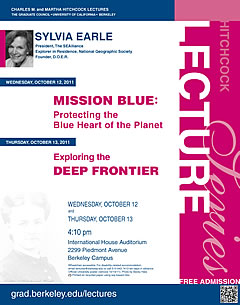
Well, good afternoon. I’m William Lester, Professor of Chemistry and Chair of the Hitchcock Professorship Committee. We’re pleased, along with the Graduate Council, to present Dr. Sylvia Earle, this year’s speaker in the Charles M. and Martha Hitchcock Lecture Series.
As a condition of this bequest, we’re obligated and happy to tell you how the endowment came to UC Berkeley. It’s a story that exemplifies the many ways this campus is linked to the history of California and the Bay Area. Dr. Charles Hitchcock, a physician for the Army, came to San Francisco during the Gold Rush, where he opened a thriving private practice.
In 1885, Charles established a professorship here at Berkeley as an expression of his long-held interest in education. His daughter, Lillie Hitchcock Coit, still treasured in San Francisco for her colorful personality as well as her generosity, greatly expanded her father’s original gift to establish a professorship at UC Berkeley, making it possible for us to present a series of lectures. The Hitchcock Fund has become one of the most cherished endowments of the University of California, recognizing the highest distinction of scholarly thought and achievement.
Thank you, Lillie, Charles, and now a few words about Dr. Earle. World-renowned mari-marine scientist, Dr. Sylvia Earle, is president of the Sea Alliance, a nonprofit whose mission is to create awareness of the ocean’s importance to all life, explore global waters, and inspire conservative action. In 1992, she founded Deep Ocean Exploration and Research, which pioneers technologies for scientific ocean research and exploration.
The company presently is owned and operated by Elizabeth Taylor and Ian Griffith, who are working with Dr. Earle to develop technologies for working access to full ocean depth. Through Mission Blue, Dr. Earle, Sea Alliance, and a growing number of partners are working to establish Hope Spots, regions rich in marine biodiversity that with protection can help restore areas damaged by human activities and natural disasters. Early in her career, Earle led the first team of women aquanauts during the Tektite Project.
Among several diving records, she was the first person to dive solo to a depth of a thousand two hundred and fifty feet, uh, without being connected to a support vessel. Dr. Earle has authored more than eighty publications, has led a hundred expeditions worldwide, and logged over seven thousand hours underwater in connection with her research. She is an explorer in residence at the National Geographic Society and was the U.S. National Oceanic and Atmospheric Administration’s chief scientist from nineteen ninety to nineteen ninety-two.
Earle received her B.S. from Florida State University in nineteen fifty-five. And her M.A. and Ph.D. from Duke University in nineteen fifty-six and nineteen sixty-six respectively. In addition, Dr. Earle has been awarded twenty honorary degrees.
Dr. Earle has been awarded numerous honors for her extensive and illuminating work in oceanography. She is a recipient of the Netherlands Order of the Golden Ark, and is a member of the National Women’s Hall of Fame and the American Academy of Achievement. In addition, Earle has received medals from the Explorers Club, the Lindbergh Foundation, the National Wildlife Federation, and the National Parks Conservation Association.
She received the two thousand and nine TED Prize and the two thousand and eleven Royal Geographical Society Patron’s Medal. Please join me in welcoming Dr. Earle.
(applause and cheering)
[SYLVIA EARLE]
Thank you. Thank you for that grand introduction. Uh, very small edits. First, it’s conservation, not conservative.
(laughter)
Although the roots are the much the same. If you want to be a conservationist, you really want to take care, uh, and protect the, the wild world and keep things in good shape. Nothing wrong with that. The, uh, other was Hope Sports, which I think is a great idea, but it’s really Hope Spots.
(laughter)
And and that, by that I mean places like the Grand Canyon, like Yellowstone, like the national park system as a whole. But in the ocean, we have been lacking the kind of protection that over much of the 20th century has grown into globally about 12% of the land invested in some way to protect nature. In the ocean, we’re lagging far behind with a tiny fraction of one percent where even the fish are safe.
About 1% overall that is protected with some kind of management regime, such, such as here in California, with a new network of protected areas along the coast and the four marine sanctuaries, national marine sanctuaries, including the Farallones just offshore, Cordell Bank just up the coast a bit, and of course, the Monterey Bay National Marine Sanctuary that goes far beyond Monterey Bay. It’s about five thousand square miles of ocean. But sanctuary is perhaps not the right term to use for any of these or the Channel Islands National Marine Sanctuary, because the squid aren’t safe, the herring aren’t safe, the crabs aren’t safe.
We exploit them inside and outside the sanctuary with about the same degree of, of latitude with overarching policies. But it’s time that we look at the ocean with, with new eyes, new respect. That’s primarily what I’m going to focus on during this first of two opportunities to sound off about a number of things with you.
Uh, actually, this is not my first time on campus. My first time goes back to 1966, before most of you were born. I had a chance to work with people in the botany department here and from others who were interested in the marine plants, the algae, that the macroalgae that live in great abundance along the rocky shores of California and off into deep water beyond.
We started up close to the northern edge of the California border and worked our way over the coastline down to pretty close to the southern border of California, camping along the way, gathering samples of as many kinds of creatures as we could find by just snorkeling and looking along the beach. We did not have diving equipment available to us at that time. We’ve learned so much, so fast during the decades that have followed.
Uh, I actually spent some time on campus here working on what was my dissertation, preparing it for publication in 1967, 1968. The publication actually came out in 1969. Some of you will perhaps remember the state of the world during that era, when I remember driving onto campus, that would have been about 1968, ’69, and there was tear gas all over the place, and I, I felt a little bit insulted that they were stopping people, not letting them come on campus, but they let me through.
I mean, what, what was it about me that made me okay when some of my pals, they said no, no, they wouldn’t let them on? I’m glad they let me come on campus because I holed up and worked in the botany department looking at the great collection of marine algae that is housed here. Most of you probably don’t even know that it exists, but it’s one of the best collections in the world.
It documents the history of the kinds of creatures, the, the plants, at least, that live in the ocean over long periods of time before the present, collected by people who have used the herbarium in the botany department as a repository for this great historic record of how things were and how things are as a guide to imagining how they might be going forward. It’s a critical part of being alive right now to reflect on how fast things have changed, not just in forty or fifty years, and not thinking geologically. Of course, things have changed over time.
But even in the last ten years, the pace is picking up of how the world, the natural world, is feeling the influence of what we’re doing to it. We could see it on the land, and Rachel Carson wrote in The Sea Around Us in 1951 about what was sort of a distillation of what was known concerning the oceans of the world for the popular audience, but scientifically sound. Uh, one of the great science writers who laced the scientific facts with a good deal of poetic presentation that made it accessible to the public at large.
In 1951, ten years before the Silent World, uh, the, excuse me, the Silent Spring was published, uh, Silent World, Cousteau’s beginning of, in terms of communicating with the public, was 1952. This was a time when we just were beginning to think about what- What was under the surface of the ocean.
Plate tectonics was, was not, not known at that time. And I think there’s some people who thought maybe the continents moved around. No mechanism was identified, though, in the 1950s.
Now it’s a major scientific endeavor, a whole study of geoscience, of, of plate tectonics, looking at, at how the continents have moved around, how the sea floor has spread over time. We’ve learned more about the ocean, literally, since the mid-fifties than during all preceding human history put together. And at the same time, I think it’s fair to say that more has changed because since then, about half the coral reefs around the world have either disappeared or they have been affected negatively.
I mean, they’re in a state of great decline. In the Caribbean, it’s about eighty percent of the coral reefs are gone since the nineteen fifties. Since the nineteen fifties, for heaven’s sake.
Half a century plus a bit. What we’ve done to the fish in the sea because we love to eat them, and now we know how to catch them in ways that fish just aren’t prepared for our means of finding and extracting and shipping them all over the world. This is new on the horizon.
Ninety percent, more or less, of many of the fish that we love to consume, the tunas, the swordfish, the sharks, the, the creatures that once did not have humans as predators, now we are the principal source of, of their decline. Uh, it’s true with so many kinds of creatures in the sea. We knew going back to the beginning of the twentieth century that we had the power to greatly reduce the number of marine mammals in the sea.
At the time, m- m- Whales and seals and sea lions and otters were primarily thought of as commodities. And it’s hard in today’s perspective to imagine a time as recently as nineteen seventy-two when the Richmond Whaling Station was still well–
Well, that was the year it closed, but it was open until then, taking humpback whales for, for dog food, for pet food, for oil, for fertilizer. Now we understand, we understood even early in the twentieth century that we had the power to greatly reduce wildlife in the sea, even using relatively modest techniques. Fortunately for whales and for us, we realized that while we have the power to eliminate them, and they are valuable as commodities, that we also have the power to protect them.
And since nineteen eighty-six, commercial whaling around the world has a moratorium exists that has been good news for gray whales, good news for humpback whales, good news for most whales. Hasn’t hasn’t turned things around for some species, but the general theme is pretty obvious. If you stop killing them, they might begin to recover.
We haven’t learned that with fish. We’re still, still on a, on a downward spiral of taking too much of the wild creatures in the sea and haven’t really faced up to the reality that if we really want to have tunas and swordfish and sharks and many other creatures in the ocean, we’ve got to stop killing them, for heaven’s sakes. There are other ways we can feed ourselves, and maybe we can get by with taking a few.
But the commercial exploitation of ocean wildlife, now we know that there are real limits, and we’ve exceeded those limits on most of the kinds of things that we like to take from the sea presently. So what to do about it? It’s hard to bring about overnight changes on anything of consequence, but some change, some places in the sea, if we can establish them for protection, as has been done here in California with this little network of fully protected areas, marine reserves.
Where it has happened, good news occurs. The fish in very short period of time, two or three years, begin to recover. You get greater diversity, you get larger numbers, you get larger fish.
Like duh, you stop killing them. It’s a first step toward recovery. There are other things that we can do.
You need to protect breeding areas, feeding areas. You can’t compete with them as we are in Antarctica, competing with not just whales, but the whole system by taking the krill in large numbers. Well, much of wh-what I’m addressing right now is something that we have just begun to face up to since I arrived on the planet.
The awareness that, unlike the attitude, that shaped our policies formed in the 1950s and ’60s and ’70s, and even today, based on this feeling that the ocean is so big, so vast, so resilient, that there’s nothing much that we puny human beings can do to alter its nature. But now we know that it’s different. We do have the power to alter the skies above with excess carbon dioxide driving climate change, global warming, and now acidification of the oceans with excess CO₂ turning to carbon dioxide, uh, carb– to carbonic acid, creating bad news for things with a calcium carbonate shell, the little creatures that do much of the heavy lifting in the ocean, generating oxygen, grabbing carbon.
Bad news for coral reefs. Who knows what problems are being caused right now because of this trend toward acidification. But the good news is, now we know what we could not know fifty, sixty, a hundred, a thousand years ago.
Now it’s confirmed, we have the power to alter the nature of nature. Now we know that our lives depend on these natural systems for things we’ve always heretofore taken for granted. Like, do you like to breathe?
I mean, where do you think oxygen comes from? It doesn’t just magically pop in, into the air. It is generated by photosynthesis.
Those green things on the land, the green and blue-green creatures in the sea, largely bacteria that generate much of the oxygen in every breath we take. And the water cycle, the carbon cycle, the– whatever it is, is governed largely because there is an ocean out there that we haven’t had to take conscious actions to protect until about now. One of the things that gives me cause for hope is that much has been learned about the sea in my lifetime.
I think the most important thing perhaps may be the magnitude of our ignorance, that only about five percent of the ocean has been seen, let alone explored, let alone put on the balance sheet in terms of, okay, this is how it relates back to us. But we know enough to know that if the ocean is in trouble, we’re in trouble. And we also know enough to know that we have the power to take actions to stabilize some of these trends that are so worrisome.
And one of the things that can be done, just as on the land, is to protect the engine that works, protect the natural systems that have developed through all preceding history and do no harm to them. Keep them intact. Do what we can to restore what we can of the systems that keep the na– keep the…
Oops, what’s happening?
(laughter)
Keep the engine running in our favor. And so when I was given an opportunity in two thousand and nine by the TEDsters, this organization that originated in this area, well, Silicon Valley, started about 26 or 27 years ago, where a group of people got together, and it was k-kind of an intimate group to start with, a little brain trust of people who began discussing issues and thinking about what they could do to use their powers to maybe leave the world a better place. It grew, and it grew and it grew, and it became something of a phenomenon that you may now know as, as TED, just T-E-D, but it’s Technology Entertainment Design, and now has moved to Southern California because a bigger space was required, and they operate it now out of Long Beach.
And now, uh, the, the way they tend to generate their, their, um, activity is to invite individuals that they choose from anywhere in the world to come and basically give the talk of their life, and to cram it into eighteen minutes flat. I mean, a door opens, and you fall through it after eighteen minutes and ten seconds. So I had been on the outside wanting to go attend the TED Talks.
I never got to do it. And I really did want to have an opportunity to, you know, give the talk of my world, of, of my life that could be spread around the world. That’s, that’s the other thing.
TED uses the new media now available to take these eighteen-minute messages and make them available in the new ways that we can that didn’t exist not even ten years ago, but now do as a megaphone to take these messages far and wide. So I got the call from Chris Anderson, who is the, the backer, the… He calls himself the curator of TED, to what I said, I’m gonna be asked to give a talk, and yes, I was.
I was asked to give a talk, but it was more. I was told that I had been awarded the TED Prize. And the TED Prize is a bit of money, but most importantly, it is, they grant you a wish.
Huh. If somebody said, “We’ll ga-grant you a wish,” like the fairy godmother comes in and says, “Bonk.” Okay, but it can’t be something little.
It has to be a, a wish big enough to change the world. Well, for me, that was pretty easy. I knew what I wanted to wish right away.
Cramming that into eighteen minutes was the real challenge, and articulating it in such a way that maybe people would buy into the idea, think that, yeah, this is kind of important, that maybe we should think about taking care of the ocean that takes care of us. And how do you do that? Lots of different ways.
But I said we need to ig-ignite public support awareness by harnessing the internet, harnessing whatever media exists, by furthering research and exploration; new technologies to explore and understand the ocean. But fundamentally, we need to protect the ocean in a physical, tangible way by having protected areas, something that California has pioneered, but we need to do– go a lot further to make this happen. And when you think, here’s the world, and a fraction of one percent of it is safe for the life that lives in the ocean, that drives the way the world works.
What an opportunity to come along at this point in history, at the beginning of the twenty-first century, to do for the oceans what those pioneers early in the twenty-twentieth century did for the land. The idea that some said was the best idea America ever had, the national park system. We need this not just for this country, but for the world, to protect the assets, to protect our life support system.
And now we have some new tools to do it with, to share the view, to provide the rationale, to, to do what we couldn’t do when I was a kid, couldn’t do even twenty years ago, couldn’t do ten years ago, with that wonderful platform called Google Earth, and underlying that the, the scientific basis information that, that, uh, Esri, the E-S-R-I, the organization based here in California, that gathers information, knits, stitches the information together, and presents it in a way so that ecologists have new insights. Anybody, city managers, kids, um, CEOs, leaders of countries. Excuse me.
So I’m going to take you on a quick tour using not only Google Earth, but the ocean in Google Earth. It’s magic. Sorry.
Don’t mean to do that.
[ANNOUNCER]
Come along to our clinician group and organize.
[SYLVIA EARLE]
No sound. It’s the coolest image in the world. Of the world.
I mean, I came along years ago before this image was possible. Kids now take it for granted that. Yes, now we know the world is round.
There was a time not so long ago when that was still a matter of debate. Well, it’s not quite round. We know that now.
Now you can, with your cell phone, your iPad, your computer, whatever you like, you can do this. You can fly to Baja, California, dive in, get a look at the creatures who live underwater. The engineers at, at Google had a couple of challenges in transforming Google Earth so that you could actually dive in beneath the surface.
First of all, they could go from the stars above down to the surface and fly around Grand Canyon, see your backyard and your neighbor’s backyard, find Starbucks, and do all sorts of things. The one thing they couldn’t do was go underwater. And they didn’t know where, how to portray the surface of the water, so you knew when you were above or below.
But as you can see, they’ve kind of solved that problem now. And you can do what is done here in a little snapshot of create your own tour of Google Earth, Google Ocean, and there are ways to upload your photographs to share with the rest of the world. To actually use this as a, a node, a, a way to understand better what’s happening around the world.
And, and anybody can be a vicarious explorer to see places, to see creatures, to personally connect the dots and look for patterns. This is like an atlas that’s alive, and it changes, can change every day. And over time, I think we’ll have a role in sensitizing people to the need to take care of this system that really is vital to our survival, our well-being.
To go to places such as you see here, off in the Coral Triangle, the, the Western Pacific, where the greatest diversity of corals and coral reef fish, and echinoderms and many categories of ocean creatures have their highest level of diversity here. But it’s at risk right now from fishing, from coastal development, from ignorance. Largely, people don’t know, so they can’t care.
Not everybody is going to be able to zip down to Antarctica, to take a look at what’s happening there. But again, vicariously, you can do this. You can see how the, the ice is retreating and make the connection, make the link back to, well, why is it so quickly disappearing in the Arctic as well?
And to understand what’s beneath the surface, like the Gakkel Ridge under the Arctic Ocean, that the existence of this wasn’t known when I was a kid. Now we know that it’s there. Now we know about the existence of hydrothermal vents in places throughout the oceans of the world.
The best hope for the future is really in knowing. You can’t care if you don’t know, and we haven’t known so much about why, why nature, why the ocean, why fish alive matter. And so we’ve done some really stupid things in the past through ignorance.
But now there’s no excuse for not taking care of these things that we don’t know how to put back together again once they’re gone. So watch this. Come on.
There you go. I can drive submarines, but this is a challenge.
(laughter)
And I’m so glad that Ellen
(laughter)
is here to keep me straight.
(coughs)
Again, that image, I, you know, I’ve been associated one way or the other with the National Geographic ever since I was a kid. I mean, first of all, we used to subscribe to it.
(laughter)
Our, our house in New Jersey was kinda tilted in this direction. The Geographics were on the downside. Um, we can’t throw them away.
I still can’t throw them away. They, uh, occupy a big part of what I call home, um, over in Oakland. But I first had a chance to make a contribution to the National Geographic in nineteen seventy-one, and at the time when they asked me if I would write an article about living underwater, my first reaction as an ivory tower scientist then at, at Harvard, it was actually nineteen seventy when they asked me, um, I said, “No,” because scientists don’t write for the popular press.
If they do, they cross the line. Even the National Geographic, as distinguished and beloved as it is, at the time for me was, um, was, uh, you know– As a scientist, it would have put me in a different category.
And I wrestled with the idea of whether I should write for the National Geographic, uh, after I said no. And what caused me to eventually say yes and write my first article was a curious coincidence. On my shelf, there’s a little book by Thomas Huxley called On Discourses Geological and Biological, where he has a collection of essays.
The first essay was to the carpenters’ union in, in Norwich, England. And he took a piece of chalk out of his pocket, and he describes this in his essay, and showed it to the carpenters and pointed out that here was the history of the North Atlantic Ocean written in the creatures that were in the chalk. And he had a way, he entranced me a hundred years after this book was published.
And it was the beginning of the book, though. In the introduction, he said, “As a scientist, your fellow scientists will scorn you for speaking to the public, but you must do it as a scientist to give back. And the one thing you must do is tell the truth and don’t re- don’t give in to the temptation to embellish.”
And that I, I now know it’s the kiss of death, and that’s probably why the scientific community has over the years become resistant to the idea of communicating because often communicating with other than their learned colleagues, it gets– the truth gets stretched, and stories get passed around, and it’s not what you said, it’s what others want to believe. But I was motivated to give in and write my first article for the National Geographic. And I was impressed by the scrutiny that they put me through more than any peer-reviewed journal that I’ve ever, ever written for.
And I mean, I did cross the line, and I did lose some ground, I suppose, as a learned scientist among my colleagues. But now it’s somewhat different. Now, I think in part because scientists are really having a hard time being appreciated as, and, and science, it’s not the scientist, it’s the science that, that is…
We need to become better communicators, whatever it takes. And now we have new tools to do it. And now the National Science Foundation and other granting institutions not only, uh, encourage you to do it, in some cases they really mandate that you find some way to communicate beyond just the usual scientific journals.
I hope this is good news because we need science-based policy. We need science-based, conservation, for heaven’s sakes. We need to understand the reality to the best of our ability and to get the public generally to appreciate what we know and what they need to know.
So, This is a picture that the National Geographic had nothing to do with developing, but it’s still perhaps the best image that has ever been taken in terms of something that will make a difference in the way people regard themselves. I’ve also come along not just during this time of great new means of communicating, but also new ways of exploring the ocean. I had the fun of being one of the first people in the country to try scuba.
It was nineteen fifty-three. I was taking one of the first classes taught in, in the country in marine biology was at Florida State University. We had two scuba tanks.
I had two words of instruction, “Breathe naturally.”
(laughter)
And it’s really important to do that. Don’t hold your breath while you’re going up and down in the water column. Um, and it kept us alive, and later we learned a lot of other things that we needed to do to stay alive.
I think it’s fantastic, wonderful, a blessing that we have now developed new means of exploring the ocean. And there are millions of people who have taken the plunge, put on a mask and flippers, a tank, been able to go down to fifty meters or so beneath the surface, get acquainted with the blue part of the planet, this little blue speck in the universe that is special. I’ve had a chance to live underwater on nine different occasions, and this is the most recent underwater laboratory in existence.
Uh, the, the Aquarius was launched more than twenty years ago. It’s still working away down in the Florida Keys. And, I mean, you can submit a project and perhaps do what they call be an aquanaut.
I got to be an aquanaut first in 1970 for the Tektite project, living underwater for two weeks. At first, they didn’t know whether women would be allowed to participate because they hadn’t thought to say no women should apply. But when a number of us did, and the projects and our qualifications seemed to be pretty good, the head of the program made history of a sort, Jim Miller, who’s– who’s had a happy marriage, I think, and had a good mom, because he said, \”Well, shall there or shall there not be women?\” Well, half the fish are female.\”
(laughter)
“I guess we could put up with a few women.”
(chuckle)
And they did. They put up with us. They couldn’t put us together with our male colleagues because…
And the words they used at the time were, “It could be hanky-panky on the reef.” I mean, hanky-panky, what kind of word is that? But anyway, they made a, an all-women’s team, and it turned out to be a, a media feast.
The idea of women, a team of women, mirror women living underwater for two weeks. And there were 50 men and women over a period of that year, 1970, that stayed for 10 days to as much as, as two full months living underwater. But I was one of the, uh, our, our team, the women’s team, stayed for two weeks.
And we got wonderful questions such as, “Did you wear lipstick underwater?” “Did you use the hair dryer?” I mean, like, okay, We answered those questions to this f- the amazing, uh, amount of interest that was generated.
We had a ticker tape parade down State Street in Chicago. The women’s team, not the guys, just the women’s team. I got to address Congress and tell about what it was like to live underwater.
We were treated more or less the way the astronauts were treated in the early days. I mean, it sounded kind of similar, astronaut, aquanaut. And it was perhaps a good thing for the ocean.
That’s the only basis on which I could kind of stand to look at all these microphones. It scared me to death with the idea of speaking not just to a, a group like this, but there are twenty-five million people out there on one of the, the broadcasts that came after the Tektite project. But that was for me, that and the National Geographic beating on my door saying, “Would you please write an article?”
Ever since then, I’ve been beating on their door saying, “Please, may I write an article for your magazine about this, that, or something else?” This is an amazing time that we live in, time that we share for the first time, kind of understanding how the whole system, not just a little piece here or there, but to really pull the whole system together and understand what we’re doing to it and how, in the next ten years, We have an opportunity to literally make history one way or the other through what we do or fail to do, because we’re so close to losing or so close to gaining an enduring place for ourselves within the natural world that keeps us alive. So part of it is having the tools to get out and explore.
I, in 1979, had a chance to use this suit. I’ll talk about it a little bit more tomorrow night when we talk more about technology. But it seems so primitive in a way to just go down and walk around a thousand, twelve hundred feet beneath the surface.
We can go twelve hundred feet every other direction with no real issue. But imagine just going a thousand, uh, two thousand, five thousand feet under the surface of the ocean. It’s, um, still a big deal.
But I, I love the new technologies that have come along just in recent years. Little submersibles that are so simple to drive that even a scientist can do it, and I’m living proof, you know? Get in like a little sports car and take off two thousand feet down beneath the surface.
Or another version, the, the Deep Rover that I actually started, uh, three companies, but the first one was to try to develop systems that would take scientists down to explore the ocean personally. And, and that goes to a thousand meters. So there, this is the two-person version of the Deep Worker that’s built up in Canada.
There are about 20 of these systems, the single and dual Deep Worker systems. It’s not quite enough yet to be like Hertz Rent-A-Sub, but it’s getting there. You know, it’s maybe in a few years it will be kind of like that.
So you want to spend the Saturday afternoon going off to Monterey, not just diving along the beach in the kelp forests. That’s really cool, and I love it, but there’s a difference. If you go down to 100 feet, you can still see kelps.
You can still see the sea lions and the otters. But go down to 1,000 feet, and it’s not that far, 1,000 feet, the place is owned by echinoderms. There are basket stars.
They’re brittle stars. The place is just alive with another group of animals that you don’t see at all on the land or in freshwater. They’re only in the ocean.
And oh, are there ever a lot of them. And they’re beautiful and they’re important. But what do we know about them?
What does the average person who lives in Mo-Monterey know about the starfish that li-live a mile offshore and a thousand feet down? Practically nothing. It is changing because we now have aquariums like the Monterey Aquarium, the best in the world, and the, of course, the Steinhart Aquarium, it’s one of the oldest in the world.
And down on Pier 39, there’s this great aquarium that brings in, I think, something like two million visitors a year. A halfway house for fish and people to get acquainted in ways other than, you know, a lot of people see fish swimming with lemon slices and butter, but seeing them swimming in an aquarium, or best of all, go down in the ocean, go deep in the ocean. Here’s the irony.
Here we are with this great space program. Yeah, it’s cutting back a bit, but still, you know, we’ve been to the moon. We have sent probes out beyond our own solar system, but we only have a handful of vehicles that can go as much as half the ocean’s depth.
This is one of the two Mir subs that Russia owns. Actually, they have three subs now that can go to six thousand meters. France has one.
Japan has one that goes to six thousand five hundred. India is building one to go that deep. China is building one to go to seven thousand meters.
But nobody’s building something to go to full ocean depth, that is to eleven thousand meters, except through private initiative, not governments. But we have Richard Branson and Jim Cameron, private individuals with their own money, backing something to push the envelope to be able to solve the problem that actually was solved with government funding going back to nineteen sixty when the Trieste made a dive to the deepest part of the ocean once for twenty minutes. I’ll talk more about that tomorrow as well.
But once you get there, what do you see? Coral reefs, sponge reefs, life from the surface to the greatest depths. Critters everywhere.
Every drop of water. Craig Venter, with his great project on the human genome, turns– now turned his attention to the sea, looking kind of at the genome of the ocean, um, looking at how many of what kind of microbes live in a spoonful of water, spoonfuls of water being taken all over the world, and finding the enormous diversity of life at the microbial level that we didn’t even know existed going back to when I was a kid, or even twenty years ago. What else is out there, down there, that we are just beginning to explore now that we have tools to get there to try to understand what is what, what, what are starfish worth?
I don’t mean in terms of pounds of starfish meat, but what are they doing? What are sponges doing for the ocean, and how does all this relate back to us? It’s like Aldo Leopold said about the diversity of life, “The nuts, the bolts, the cogs, the wheels that hold the world together.
Which ones can we afford to lose? Probably none.” At least at our risk, do we lose diverse creatures that each has a role, a place in the sea, in the way, making the way the world function as it does?
Right now, most people, if they think about squid at all, they think calamari. Even here in California, where there’s a somewhat more enlightened attitude about life in general than in many parts of the world, It’s open season on squid. And yet, if you look at the ocean and how it works, the last creatures we would want to kill would be the squid.
They’re the middlemen low on the food chain that are so important to birds, to seals, to sea lions, to otters, to fish, to the chemistry of the ocean. Food chains that result every step of the way, taking food in, putting nutrients out that drive the phytoplankton, that drive the food chain, that drive the oxygen cycle, that drive the carbon cycle, that drive the way the world works. We need this engine to function for our sake.
I mean, I am a squid hugger. I love squid. They’re just such great animals.
I’ve had many encounters with them where they get probably frustrated with humans who look at them. They go through all this repertoire of changing their colors and shapes, and it is true with octopuses, and all, all the cephalopods are just amazing in their ability to communicate with color and perhaps with bioluminescence, and we can’t do that. We’d probably look like idiots out there.
All we can do is bubble. And he goes through this extravagant, um, messaging system, and we just bubble back. To many, water, lakes, rivers, streams, the ocean is just that, just water.
But now we know that water, wherever it is in nature, is likely to be alive. Well, we don’t know about Mars or Jupiter or elsewhere in the universe where water exists, in some cases in abundance. Comets loaded with water, frozen water.
But Earth is blessed with lots of water and with lots of life. Liquid water is the key. And we treat it as if it’s ours, first of all.
Water is ours. We pipe it, we use it for agriculture, we use it for all sorts of purposes. But the best– the most important use for water is that it’s home for most of life on Earth.
Perhaps ninety-seven percent of life on Earth is out there in the ocean. It keeps us alive, shapes the way the world works. And until we face up to it and the need to protect it, our lives are, are on the line, at risk.
I love going out and diving with whale sharks. I, it’s fairly recently that I’ve had a chance to do that because o-only recently have we identified a few places in the world where they do congregate. Now pretty reliably you can go to Baja California, you can go off Cancun, you could go a hundred miles south of the Mississippi Delta out into the Gulf of Mexico and find yourself in the midst of gaggles of whale sharks feeding.
You have to first of all find out where the food is, And then you’re likely to find out where the whale sharks gather. And also the west coast of Australia at certain times of the year, whale sharks get together.
Mostly they’re solitary, but when there’s food around, nobody knows yet where they go to hoop it up and do what it takes to make more whale sharks. The breeding area is still a mystery. But one thing we do know is that when they take a big gulp of plankton, they’re taking a gulp of the cross-section of life on Earth.
The larval stages of so many of the creatures in the sea, maybe a dozen phyla of animals, go down the goozle of a whale shark with every gulp. It’s astonishing the diversity of life that’s out there in the water itself. So when they put a desal plant in and take in water, it isn’t just water.
It’s wa– It’s a soup. It’s a living soup.
You sacrifice all the little guys that are in the water going in to get fresh water and salt coming out the other end And, uh, it doesn’t mean that we shouldn’t be doing this, but we should do it with our eyes open and consider the trade-offs. Be careful, and maybe get smarter about how we deal with water as a commodity.
And fish as a commodity. Huh. Living underwater, that first experience and every time since, and now every dive, every time I put my face in the water, I’m aware that every fish is different from every other one.
And if a fish came sailing through this room right now and looked around, they’d probably think that all people look alike. And that’s the attitude that I had about sardines or grouper or, or even, you know, squid. They see a big s- flock of them, a group of them, and they do look pretty much alike.
And then when you spend time with them, quality time, Like day and night, get to know individuals, you realize they have different faces, different behaviors, different attitudes. You can tell them apart. Every person on the planet, whoever has been, ever is now, or ever will be, is different.
Every cat, every dog. I know it about every cat.
(laughter)
(sighs)
You know for sure. that it’s such a— I mean, why is it taking us so long to realize that every sardine is its own self, different from every other one, with its own little DNA foot– fingerprint? It’s a revelation, coupled with a revelation new in my time, that the, the connectivity, that the DNA, the RNA, the chemistry of life through all forms of life is remarkably similar.
That each of us shares so much in common with every cat, every pine tree, every jellyfish. That’s the miracle of life. The great diversity, infinite diversity, and the great common ground we all share.
That puts us as part of this system. It’s all connected. No two parrotfish that look exactly alike with freckles on their nose or speckled rays or spotted little trunkfish or angelfish or you name it.
Now we know. Now that we know, there’s no excuse anymore for continuing to behave toward the ocean as if it’s just a place to take stuff out and put things in. We need to understand and respect the ocean with new eyes, new understanding, and new policies, new ways that are not just good for the fish and the reefs of the ocean, whales and whatever, but it’s, it’s really important to us.
So extracting wildlife from the sea using trawls that scrape the sea floor like bulldozers catching songbirds using– in a forest, scrape them up and shake out the forest, throw it away and take a few pounds of protein. We’re destroying much of the ocean with these heavy-duty, damaging techniques that fifty years ago, forty years ago, even twenty-five years ago, maybe there was some excuse because we didn’t know what we now know, how vulnerable the ocean is to our actions. You know, I love the, the policies that have been developed over recent times to look at, at Mars, our sister planet, and other places, and thinking about what we can do to terraform other parts of the solar system, especially Mars.
And yet, you look in our backyard, and we’re kind of doing the reverse. We’re not– I mean, while we’re looking to terraform Mars, make it more Earth-like, we’re Mars-a-forming Earth.
Making it more, uh, well, making it less hospitable, more like our sister planet, through transformation of the carpet of life that keeps us alive into something that, yeah, it’s okay to farm. We need to do that to grow the food. In eighteen hundred, it was a billion.
When I came along, it was two billion. Nineteen eighty, four billion. Now it’s seven billion, and the numbers go up, but the planet doesn’t get any bigger.
But we can’t just do to the entire planet what we’ve done to a big chunk of it, transform the natural systems that keep us alive into something else. We need to get better, smarter, more efficient, more effective about using the assets instead of burning through the assets as if it’s all about us, all about now, if we want to have a future for humankind. The way we extract wildlife from the sea, like this trawl that takes orange roughy from two thousand feet beneath the surface in the Southern Hemisphere and market it right here in Oakland, in Berkeley.
I think last week, orange roughy sold for eight ninety-five a pound. This fish, the one you’re seeing here, may be a hundred years old. It’s like the rockfish offshore in California.
They live a long time. They grow slowly. It may take twenty-five or thirty years for them to mature.
We don’t raise twenty-five-year-old chickens or cows. You know, we like to turn them over pretty fast, and, and yet we take wildlife from the sea, sharks and creatures that, again, live a long time might have taken twenty or twenty-five years to grow, and yet we extract them thinking, “Huh? No, they’re free.
Let’s just go get them.” And it’s exactly what we’ve been doing at a pace that out- outstrips the capacity of these creatures to recover, whether it’s sharks or tunas. Where is our capacity as brilliant creatures that we are to think of a tuna fish as good only in a sandwich, or in a salad, or sushi, or sashimi?
I have actually stood next to MIT engineers watching them sigh with envy at images of bluefin tuna and other streamlined fish Well, they try to figure out how to learn from their efficiency and capture their secrets with RoboTuna, with creatures that might emulate in, in engineering terms what they do naturally. Capturing the energy from their, as they move their tail back and forth, Little whirlpools are formed and power them at a speed faster than a nuclear submarine, fifty miles an hour through the water.
We don’t have– with ninety-seven percent efficiency according to their calculations. What can we learn from sperm whales, biggest brain on the planet, with close-knit societies, long migrations that come back to areas, ability to hold their breath and dive more than a mile beneath the surface and find squid? There’s so much that whales can tell us or, or they can be turned into pounds of meat.
True with dolphins. We’re still, in some parts of the world, just looking at dolphins as pieces of meat. A few countries, not all of them, of course, but it’s an attitude now that we know, now that we have alternatives.
It was a different thing ten thousand years ago when the best way we could figure out to, to supply energy for ourselves was to go out and kill wildlife, cut the trees, and all of that, but now we know. We should be able to capitalize on our big brains and figure it out, find a place for ourselves within the natural systems that keep us alive. Figure out alternatives to building, to burning fossil fuels now that we know the downside.
We know the upside. Burning fossil fuels, we went to the moon. We couldn’t do that on whale oil.
And using fossil fuels, we travel the planet and are learning things that we couldn’t know without burning through those assets in the short period of time since the middle of the twentieth century to give us what we now have is the, the most powerful knowledge base that the planet has ever had available to it. And now we know we have to think differently about how to power our civilization going forward. Because now, along with the upside, we know the downside.
Let’s use our brains. I mean, the talent is there. The talent is in this room to be able to measure and calculate and project where have we come from, where are we, and where are we going?
We could not have built this graph fifty years ago, but now we can. This is just from nineteen eighty to nineteen ninety-seven, looking at the summer ice in the Arctic. It’s a powerful picture that just shows the rate of change in a little snapshot of time that we all share.
That, that loss of summer ice in the Arctic is really bad news for walruses and polar bears. It’s happening in the Antarctic as well. Bad news because of the acidification of the ocean with these little coccolithophorids, the foraminifera, the prochlorococcus.
Although it doesn’t have calcium carbonate shell, prochlorococcus is said to generate one in every five breaths we take, and a change in the acidity of the ocean could well affect its fate and future, and therefore ours. We didn’t even know of its existence before Penny Chisholm and some of her colleagues from MIT on an expedition to look for phytoplankton using a new technique, found these ultra-microscopic organisms that are so important to food chains in the sea and to powering the oxygen cycle and the carbon cycle. What else don’t we know about the role of copepods or the role of krill?
We do know that they’re critically important to food chains in the sea, but what are we doing to the ocean that could alter their fate and therefore modify coral reefs. And last year, this time last year, I think m-many of us were riveted with what was happening in the Gulf of Mexico with the access to deep sea that didn’t exist until fairly recently to extract from the heart of the earth beneath the bottom of the ocean, far beneath the bottom of the ocean, a mile of water, but then there’s the rock beneath, to access these sources of power, fuel, that we now are using to power our society, and the downside that we are now putting on the balance sheet. There are risks, there are rewards, but certainly there is the big reward of using our power, now that we know, to shape the future based on knowing, for example, that one-time use plastics are kind of a stupid thing for us to be engaged in, and yet we are doing it now that we know we should change our ways.
This is a good news story because that little turtle was freed from its encumbrance and swam away. I hope it’s still out there. But a lot of gear is out there in the ocean continuing to fish, continuing to catch and kill.
Some three hundred thousand marine mammals alone, and hundreds of thousands of birds are snared in derelict fishing gear every year. It’s not just entanglement, it’s just the sheer mass of the junk that is clogging the ocean. This is another good news story.
Volunteers, students going out to the northwest Hawaiian Islands hoping to retrieve masses of plastic, the, the fishing gear, and taking it out of the ocean. Another good news story. In July of this year, I went to Hong Kong, where a thousand school kids gathered to take the pledge, “We will protect sharks.”
We will never eat shark fin soup again, or ever. I don’t think most of them ever had tried it, but they pledged not to. Here in California, just a week ago, Governor Brown signed the legislation making it illegal to have trade in shark fins.
Yahoo! Yay!
(applause and cheering)
(clears throat)
The good news, people do care, and that’s why I am a hopeaholic. I think that armed with knowledge, the ability to communicate, to gather and disseminate information, and to bring the community together, not just the scientists, not just the policymakers, not just the artists, not just the historians, not just the writers, w- it’s everybody.
I personally have a vested interest in all of this because I have three children. I have four grandsons, two of them here, and they remind me we’ve got to figure out which way are we going, you know? We have a choice.
We do have a choice. What do you like? The blue one or the red one?
Uh, I like the blue. We’re e- e- edging towards the red through our actions.
More CO2 in the atmosphere, more like Mars. Less water, or water that is not usable for us. Less life.
We want to, I think, aim for this, an enduring place for ourselves within the systems that keep us alive. Well, the consequence of my TED wish, I showed this picture first, and I used the comment that I first used when I gave a talk at the World Bank a couple years ago. I said, “There it is, the World Bank.”
That’s where the assets are. And we’ve been drawing them down through the history of our species. Now we know we’ve got to take care of the place.
We have to use those assets wisely. It doesn’t mean that we have to stop fishing or stop farming in places, but we can be much wiser about how we use the assets. We must think about the importance of the diversity of life and its value to us.
I mean, it’s good enough for me to save whales or tunas or calamari in the the, the squids for their own sake, for– just because they’re– I don’t know how to make them, And I don’t think I should exert my power to destroy them. But I think the, the thing that will get to most people is, well, what does it matter?
Why should I care? If the ocean dried up tomorrow, what difference would it make? Well, a lot of difference.
Like if you like to breathe, if you like to have, uh, an existence on Earth. So one of the outcomes of my talk, after the talk, right after the talk, one guy came up. He was just a, a, like a little, I mean, almost elf-like.
He’s just a really unassuming-looking person, but he said with a great seriousness, “I think I understand.” If we fail to take care of the ocean, nothing else matters.” And the economy, security, health, all anchors back to taking care of the natural world, mostly blue.
And he wrote a check for a million dollars, And that was the start of Mission Blue as an organization. It was the start of an expedition to the Galapagos Islands that took place, uh, a year and a half ago, where we got about a hundred of people, some of the best minds that we could muster from around the world, to come together and to give the talk of their life. About twenty-five people actually gave talks.
The rest were there to listen and to use what they were inspired to do as a consequence of hearing these talks and thinking about the ocean, and to go forth and and do something. And it’s resulted in a a lot of different things, but it includes this organization that it’s called the Sylvia Earle Alliance. But it’s a bit like Lance Armstrong.
That’s the foundation, but what is he trying to do? Live strong. So it’s the Sylvia Earle Alliance, that’s the foundation.
What we’re trying to do is to just build momentum. The Mission Blue, it’s to get people to use their talents, use their capacity in whatever way they are inspired to do to make a difference for the ocean. It’s a loose network of, of organizations, of individuals, of anybody, everybody, to sign up to the idea that it’s our mission to take care of the place.
And poets can join in, scientists can do it, kids, CEOs, presidents of, of companies or corporations or, or, uh, countries. Anybody and everyone can do what they can do. I want to just share with you a little glimpse of what happened when we went to sea.
It’s a little video clip. It’s a trailer, actually, for a film that will come out first at Sundance this spring, and then it will be in theaters, I hope, following that. Uh, it’s a little heavy on, on what they say about Sylvia Earle.
They should say more about the ocean, but it’s a glimpse anyway of– to catch the idea of what actually happened. I’m going to go straight to the end. And then to the last one.
So, take the plunge. There it is. We need the sound up again.
It seemed at that time to be a sea of Eden.
(music playing)
But now we know we are now facing Paradise Lost.
[SPEAKER 4]
This trip is absolutely brand new for TED.
[SPEAKER 5]
We’ve never done anything like it before.
[SPEAKER 6]
The trip came about because of a wish that
[SPEAKER 7]
TED granted Sylvia Earle.
[SYLVIA EARLE]
I hope that your help to explore and protect the wide ocean will lead us all to restore its health and in so doing, secure hope for humankind.
[SPEAKER 7]
Sylvia Earle has devoted her life to this passion of the oceans. And the need for knowledge
[SPEAKER 8]
about all aspects of
[SPEAKER 7]
the environment, whether on land or
[SPEAKER 9]
on the sea. I’ve always been a scientist.
[SPEAKER 10]
I am a scientist, but I’ve been
[SPEAKER 11]
transformed in part,
[SPEAKER 12]
I suppose, by having children
[SPEAKER 8]
and seeing that the places I knew as a child,
[SYLVIA EARLE]
I can’t take them because they’re gone.
(music playing)
[SPEAKER 4]
The trip is a bet that if you bring together a group of really remarkable people who are well-resourced, some of the world’s greatest marine scientists, some of the world’s greatest storytellers, you put them together and you show them what’s happening in the oceans, something incredible is going to happen.
(music playing)
[SYLVIA EARLE]
I was raised with great respect for nature, but I never added the ocean to that. And to be able to be in a place like the Galapagos, to actually get into the water and see some of the creatures that we’re talking about has changed my life. Getting people to not only understand it intellectually, but to know with their hearts that we’re so changing the way the world works that our future is at risk.
The type of fishing going on today is really wiping groups of them ecologically off the planet. Whale meat being sold in these markets was really dolphin, and it was tough. There’s, uh, around a hundred million sharks caught every year.
So this is a, a truly global problem. where it’s literally something like a straw, like that on this planet. And so the idea of Hope Spots, the idea of protected areas is like, whoa, you know, but it’s got to be big
and it’s got to be real. And you’ve got to have people with guns out there to protect it because it sure as hell isn’t going to be protected by wishful thinking or let’s all go off and sing Kumbaya.
(applause and laughter)
[SPEAKER 13]
But if we wait another 50 years or even another 10 years, things we can do now will be gone.
[SPEAKER 14]
There is no more tomorrow that we can avoid confronting.
[SPEAKER 15]
We will have declared a state of emergency because it becomes a law.
[SPEAKER 16]
To save the environment, the world begins to touch it.
[SPEAKER 17]
The meat who are may not look dead.
[SPEAKER 18]
Man is destroying the planet. Just like the Bible said. In the meantime, you will destroy your own earth, and that’s what’s happening.
[SPEAKER 19]
Scientists in Mississippi are trying to gauge the impact of this spill as it starts to spread into the prime habitat of the biggest fish in the Gulf.
[SPEAKER 20]
These animals are here to feed during this time, and so it’s right in the backyard.
[SYLVIA EARLE]
And so, and so, If for nothing else, good comes of this major spill, it may be to wake up people, say we have to protect the Gulf.
[SPEAKER 23]
There are real issues here of money and power
[SYLVIA EARLE]
It’s life itself that evolution has delivered. And we who appear as evolution, we have to carry evolution on.
[SPEAKER 24]
Why don’t we want to find a way to live?
[SYLVIA EARLE]
There must be some place where these forests and unique creatures can be safe.
[SPEAKER 21]
Sylvia’s timing is perfect. This is that moment.
[SPEAKER 22]
And Donovan is on board.
[SPEAKER 23]
And this film is not only a first in the United States, this is a first in the world.
[SPEAKER 25]
I hadn’t heard the album until a couple days ago.
[SPEAKER 23]
On corals, you’re just looking at brown gunky stuff.
[SYLVIA EARLE]
A great grand finale for this version of the album. We need every bit of insight that we can muster. The ocean is alive. Without the ocean, life on Earth simply would not exist.
[SPEAKER 27]
I do not want to envision a world for our grandchildren and great-grandchildren that doesn’t have whales, that doesn’t have tuna on their shelves, because we’re all connected.
[SPEAKER 28]
I’m here because Sylvia Earle is one of the most remarkable women on Earth.
[SPEAKER 29]
She’s the real thing. She’s a person who has committed herself and everything that
[SPEAKER 30]
that commitment involves,
[SPEAKER 28]
Um, and we need more of that.
[SYLVIA EARLE]
We have the capacity to protect the systems that keep us alive. We still have a chance, but now is the time. So this is the time. Thank you.
(applause and cheering)
[WILLIAM LESTER]
Dr. Earle has agreed to, uh, respond to questions. If there are some, please come forward. Please come forward.
[SYLVIA EARLE]
Please keep your questions brief. Thank you.
[CHRIS PINCETICH]
Hi, my name is Chris Pincetich, and I work, uh, at the Turtle Island Restoration Network.
[SYLVIA EARLE]
Great.
(laughter)
[CHRIS PINCETICH]
So there is a group of people that live very close to the ocean, that care very deeply about the ocean, that drag giant bulldozers across the Gulf of Mexico, sweeping down everything in their path, the shrimp trawl fishermen. How do we communicate to them that this livelihood that they care so much about is something that is, while profitable, causing huge devastation to the Gulf of Mexico ecosystem?
[SYLVIA EARLE]
It’s a tough question, but one answer that I wish I could snap my fingers and make happen is to take them down to see what it’s like. It’s transformative. Actually, out there in the Gulf, wh-where when I was with the whale sharks, diving with them.
It was with, actually, a charter fishing boat. This was just sports fishing, but, uh, the crew consisted of individuals who were commercial fishermen. And the one, when he saw us jumping in the water, getting with it, he wasn’t intending to get in the water with, but he couldn’t resist it.
So he jumped, he grabbed a pair of fins and snorkel, and he went in the water. And, uh, uh, the filmmakers involved interviewed him afterwards. I hope this comes through in the final cut of the film because he just gets this faraway look in his, in his face, and he talks about how he could– he thought he could hear the heart beating of this big fish.
And he’d never been in the water with a fish before. Never, never done it. But we were all doing it, and the fish were– the big fish were right there.
He just couldn’t stand it. If, if I had a submarine available to take people down to just look. People who eat the shrimp are a part of the problem.
You love popcorn shrimp? Give it up.
(laughter)
Shrimp cocktail? it’s too expensive, no matter how little or how much you pay for it. It– the real price of it is just n-not there for you to see.
It’s written in the… Uh, uh, Monterey Aquarium had a wonderful exhibit, uh, not now, but recently, this was a few years ago. They had this portrayal of a crystal goblet with shrimp, like a half dozen shrimp, big juicy ones all around.
And around it was this halo of life that had been killed in the process of getting those six shrimp. I mean, the, the ratio is conservatively five to one. But I’ve been on board shrimp boats.
It’s more like a hundred to one, sometimes more. If you’ve seen Forrest Gump, here’s the trawler. Goes across the ocean floor, and dumps it out on the deck, turtles included.
I didn’t see any in Forrest Gump, but that’s how a lot of turtles die. Uh, or the nets that are left. There, some of the turtles are drowned because the trawls drag for quite a while on the bottom, long enough to drown the turtles.
Anyway, it’s– it’s just disgraceful that we know this exists, and we just go on business as usual. Long lines, another great source of killing turtles. Um, knowing is it’s got to be the answer.
Um, it’s the key. If you, if you don’t know, you can’t care, and most of those who are in the business, especially the large scale, industrial scale extraction of ocean wildlife, like menhaden from the Gulf of Mexico and the Chesapeake Bay and along the eastern seaboard, it’s the filtration system for those, those areas, along with sponges and oysters and clams and such, and it’s part of the food chain. It’s part of what makes the ocean work.
And we can get away with taking a few, but we can’t do it on the scale that we’re now– Uh, we’re using the techniques that we’re now imposing. So I don’t know a straight answer to your question.
Short question. He did his job. Long answer.
Sorry about that. But it takes some real thinking and ideas that you might have. Uh, it’s not the fishermen’s fault.
They thought when they started, “Hey, this is what we do.” Nobody thought that there was any problem with killing all these starfish and, and other things that are dragged up from the ocean floor. But the fishermen do know.
I, I mean, I did spend some time, I spent a lot of time around the Gulf, and just a few weeks ago, I was up in Martha’s Vineyard, the center of the universe for early whaling. Uh, they’ve seen the transition. whaling, cod, and now, you know, that they’re, I think small-scale local fishing, sensitive to the– in having a, an enduring place within the system could work, might work.
But whatever it is, has to be coupled with large scale protected areas where you leave the system alone. If you wanna have birds, you can’t just slaughter them on a wholesale basis. We’ve, we did that with passenger pigeons and, and the Carolina parakeets.
and Eskimo curlews. We know how to exterminate the great auks. We’ve done that.
What we don’t have clearly a vision for is how do we, how do we keep these creatures as a part of what keeps us alive? We need, we need to start at the earliest age to get kids locked into that as a mission in life. The fishermen in the Gulf, the kids aren’t looking to that as a way to make a living.
They’re not. They can’t. It’s not much of a living now.
[ED ALMANZA]
Ed Almanza with Laguna Ocean Foundation. I wonder if you might say something about how these hope spots are selected.
[SYLVIA EARLE]
How are the s- hope spots selected? Well, it’s, it’s like open season for hope spots.
(laughter)
Uh, a colleague of, of mine, a fellow explorer in residence at the National Geographic, Enric Sala, who was at Scripps for ten years and really focused on pristine areas to protect, and I really wholeheartedly endorse that. Find those places that are still in great shape and do everything you can to not let them be destroyed, like Raja Ampat out in the Western Pacific, like the Northwestern Hawaiian Islands, still in pretty good shape. Um, looking at, um, the deep reefs almost everywhere in the high seas, there’s still reason for hope that if we act now, we can maintain that in-the integrity, and they’ll help s-restore some of the areas that have d-been diminished.
So using the new techniques that are out there, high diversity is one measure of water quality. Another measure is how realistic is it? Is there any reason, any possibility that you can actually make this happen?
Good news. Just last year, this year, this year, earlier this year, the UK has declared the biggest
(coughs)
fully protected area in the ocean, half a million square kilometers around the Chagos Archipelago in the Indian Ocean. Beautiful coral reefs, no fishing allowed. Uh, I have a small sea story about the Northwest Hawaiian Islands, about how that was selected.
It took about ten years of people building a database, making a case for why this matters. There’s the monk seal. That’s their primary habitat.
And there are only about a thousand of them left in the world. So either you take action to protect them or we’re going to see them go the way of the monk seal that was in the Gulf of Mexico and the Caribbean, the last one seen in 1952. They’re gone.
All gone. So Jean-Michel Cousteau did a film about the Northwest Hawaiian Islands, a series of films, actually four films. And Laura Bush, uh, an unlikely person might, one might think, but she does really care about nature, and she made a trip out to the Northwest Hawaiian Islands to Midway, was just appalled at the mass of plastic out there, seeing those poor albatrosses just stuffed, the babies
(gasp)
got dead in plastic, and plastic spilled out all over the ground. So one thing led to another, and she invited Jean-Michel to come to the White House and show his film. And a little list of fifty people were selected.
I got to be one of the lucky ducks to be invited. And nobody really expected that she would show up, but she did. And more than that, so did George.
And must’ve been a quiet week in Washington or on the planet as a whole because they both came. And we watched the film, had popcorn, drank sodas, and then were invited to dinner in a room about this large with tables for six people and each of, uh, you know, all set up. We went through a line to fill our plates, and I had invited a guest who sat, uh, uh, was a little ahead of me in the line.
She sat at the table, and this guy came and asked if he could sit next to her, and it was the President of the United States. And so she said yes, he could sit with her. And then Jean-Michel came and sat next to him.
That was his rightful place. And then the head of the Marine Sanctuary Program, Lori Arguelles, uh, Foundation, a-and her husband. And there’s one seat left, and I, I, I started walking toward my friend, and then I saw who she was with, and then I started to back off ’cause I didn’t think, you know, I’m just a guest here.
This is… But my feet kept going anyway, and I took my place. And we, uh, we had an hour and a half over dinner without any watchers or anything.
We just, we talked fish. And I remember hearing myself saying, because Bush likes to fish, that if there are to be fishermen, you’ve got to have fish. Duh.
And if you are to have fish, you have to protect the places that they live, breeding areas, feeding areas. They have to have space. We can’t take them anywhere in any numbers at any time.
and that’s what we’ve been doing to fish, and that’s why he didn’t know that ninety percent of many of the big fish are gone. He didn’t know that less than one percent of the ocean was really protected. At that time, it was less than one percent.
Because of the ten years invested in making a case and people, individuals, and organizations making a case, it was kind of an easy nudge, but it was still unexpected that when he left that night, he called over to the group, um, to Jim Connaughton, who’s the head of the CEQ. “Jim, I want you to make it happen. Uh, this should be the biggest area.”
They had three sizes: small, medium, and large. He said, “We want the biggest area, and we want it to be no-take, no fishing. You got that, Jim?”
Everybody was swept away. We thought it was going to be another place like the Monterey Bay Marine Sanctuary, that is a managed area where fishing would be fine. You just, you know, you, you declare it a sanctuary, but you let things go on pretty much business as usual with some constraints.
and certainly the idea that you would educate people to care for the place. But… no, he said, “No, no take.” To make it happen meant Jim Connaughton went off in a huddle and resurrected the technique that Teddy Roosevelt used to establish some of the biggest and best national parks in the country.
That is the Antiquities Act that made it possible to declare a monument. This isn’t a sanctuary, it’s a monument. So the president, by presidential decree, could say three, it was two hundred and forty thousand…
No, it’s three hundred and forty thousand square miles of ocean. N- I’m sorry, for the Northwest Hawaiian Islands, it’s a hundred and forty thousand square miles of ocean.
At the time, the biggest marine protected area in the world by the not-so-green president. He’s certainly blue because the Northwestern Hawaiian Islands Marine Monument, National Marine Monument, is bigger than all the national parks put together, and the fish are safe there. It takes some enforcement.
(laughter)
As Jeremy Jackson said, you know, he said, “you’ve got to go out there with guns.” But, a-and there are some problems, but the fact is that that started, uh, this big is something… And, and in Kiribati, in the Western Pacific, they have two hundred miles surrounding their little speck of islands.
The, they’ve established even a larger marine protected area. And then came the UK with the Chagos Archipelago, and then Chile. Again, Enrique Sala had something to do with this.
A little speck of rock in the ocean called Sala y Gómez that now is fully protected and the waters around it, one of the biggest marine protected areas. So the needle is moving. It was less than one percent, now it’s slightly more than one percent, and now there are people who are saying we need twenty percent by twenty twenty.
Woo-hoo. Yeah, maybe we can get there. I don’t know.
Any, every inch, every drop counts, and that’s how you do it, any way you can.
[WILLIAM LESTER]
Please join me in thanking Dr. Earle for a wonderful and informative presentation.
(audience applauding)
[SYLVIA EARLE]
Thank you.
(audience applauding)