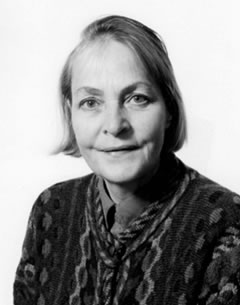
[00:00:01] JOHN CAMPBELL:
Good afternoon. I, I’m John Campbell. I’m Willis S. and Marion Slusser Professor of Philosophy and chair of the Howison Committee.
And it’s my pleasant task, along with the Graduate Council, to present Sarah Broadie, who’s this year’s speaker in the Howison Lectures in Philosophy series. So first of all, I should say a little bit about the Howison legacy and how this endowment came to Berkeley. George Holmes Howison was born in Maryland in 1834.
Um, his family then moved to, um, Marietta in Ohio, and following college where he did, uh, studied German, um, he became passionate about mathematics and became largely a self-taught mathematician. At the age of thirty, he was awarded a professorship in mathematics at St. Louis University, um, uh, where he taught in all branches of mathematics, including mechanics and astronomy. Um, but then he encountered the St. Louis Hegelians who were reading Hegel’s Phenomenology of Spirit, and he became gripped in particular by the question of how can even how can evolution be consistent with freedom of the will?
In order to pursue this interest, he couldn’t, uh, teach philosophy at St. Louis at that time, so he moved to the Massachusetts Institute of Technology. And then after six years, he got an offer from the University of California to come and found the Department of Philosophy. So he became our first endowed, uh, chair in philosophy, the Mills Professor of Intellectual and Moral Philosophy and Civil Polity.
He had a strong, outgoing personality, um, and he really, uh, generated the philosophy department, um, uh, until, uh, he retired in 1909. When he died, he gave all his property to the university, and in 1919, his friends and former students, uh, established the Howison Lectures, uh, that we have today. Um, during his life, he’d succeeded in bringing the greatest minds of his age, William James, Josiah Royce, John Dewey, out here to the rural wilderness of California.
And through his legacy, um, that tradition continues today, uh, which brings me to my pleasant task of introducing Sarah Broadie. Um, Sarah is renowned for her work on moral philosophy in the Aristotelian tradition. She’s a specialist in classical philosophy.
She’s highly regarded as an explicator of Aristotelian thought. Um, but her interests range across classical philosophy and into general– into philosophy generally. Her Aristotelian Society presidential address was called “Actual Instead,” and it was about the relation between determinism and the use of counterfactuals to evaluate human actions.
She’s given– This is not her first distinguished lecture. She’s given many more than one could reasonably recount.
For example, in 2003, she gave the Nellie Wallace Lectures at the University of Oxford called “Nature and Divinity in the Philosophies of Plato and Aristotle.” Um, she’ll be presenting the 2014 Woodbridge Lectures at Columbia. She’s written many, many books on moral philosophy and metaphysics within classical philosophy.
Her most recent book is Nature and Divinity in Plato’s Timaeus, um, that one reviewer described as Platonic exegesis of the highest, most demanding order. In 2003, she edited and offered a lengthy introduction as well as a detailed line-by-line commentary to a new translation of Aristotle’s Nicomachean Ethics. She’s also written Aristotle and Beyond, the magisterial Ethics with Aristotle, Nature, Change, and Agency in Aristotle’s Physics, and Passage and Possibility: Aristotle’s Modal Concepts.
She’s written about topics such as the classical notions of virtue, temporality, and the Platonic conception of the soul. She is now Professor of Moral Philosophy and the Wardlaw Professor at the University of St. Andrews. Before she started at the University of Edinburgh, moved to Texas at Austin, Yale, Rutgers, and then Pr-Princeton before coming to St. Andrews in 2001.
She did her first degree in Oxford, uh, in the hairy Oxford of 1960s classical philosophy with, uh, Ryle, Gwil Owen, and, and John Ackrill. Uh, and she did her PhD at the University of Edinburgh. She’s a member of the Academia Europaea and a fellow of the British Academy, the Royal Society of Edinburgh, and the American Academy of Arts and Sciences.
I’m very, very pleased to welcome Sarah Broadie.
(applause)
[00:05:21] SARAH BROADIE:
Well, thank you, John, for these, uh, kind, um, descriptions. And of course, I must thank the, um, uh, uh, this great university, um, and the Howison Committee for, uh, the honor that I f- definitely feel I’ve received in being invited. And, um, I would want to express my pleasure at being able to accept the invitation and even greater pleasure at actually managing to be here and, um, and also gratitude for how well everything has been organized and the trip made, uh, so easy.
And even you have beautiful weather. I know it’s not just for me, but I feel as good about it as if it were just for me. So I come from a, a land of swirling gray mists and all of that.
Okay. Um, so this paper or this lecture, um, is titled Aristot- Plato and Aristotle on the Theoretical influence, i-impulse.
And, um, I, for some reason, was asked to give a subtitle or a description, uh, so I provided the one-liner here. The human being as theoretical adventurer through the eyes of Plato and Aristotle. That doesn’t really tell you any much more than the title does.
Okay, so this lecture is going to be more about Plato than Aristotle. Uh, but I’ll start with Aristotle, the reason being mainly to set up a foil for Plato for what I want to say on the subject of Plato. Of the two philosophers, Plato is harder to pin down anyway on today’s topic.
It was Aristotle who gave us the terms theoretical and practical, words whose form is almost the same as in his ancient Greek. He also presented a very clear and helpful contrast between practical and theoretical thinking. In fact, Aristotle’s contrast is so clear and helpful that one could almost call it canonical for the historians of philosophy.
One result is that when we find Plato making distinctions that seem to lie on one side of Aristotle’s contrast, we are liable to feel that Plato has somehow missed his way, that he was aiming or was sort of aiming, or should have been aiming at the Aristotelian contrast, but somehow failed to hit it cleanly. I’m sure I used to have this impression, but now I don’t think it’s correct. And even if it were correct or true, it tells us nothing of positive interest about Plato.
In fact, Plato’s handling of this matter has a shape and a rationale of its own and is full of positive interest, and I hope that something of this will emerge as we go along. My aim is not to defend Plato in some sort of standoff with Aristotle. I don’t sort of think that either of them exac-exactly needs me as a defender.
But my aim is rather just to display in a certain amount of detail what some of their differences on this to-topic are. So Aristotle, as probably is very well known, treats practical and theoretical as mutually exclusive types of activity, intellectual activity. For him, the objects of ins- of theoretical inquiry are universal, non-contingent features of the universe, features that hold independently of us and which our actions cannot affect.
For Aristotle, the objects of, by contrast, of practical inquiry are contingent, that is, they may or may not happen. They depend on us as agents, and in the first instance, these objects are highly particularized. Uh, the reason I say in the first instance, uh, just then, is that basic practical thinking for human beings, um, is a matter of deliberating and deciding what to do in particular situations.
This sort of thinking needs to be tailored to the particular context, since what it’s good to do in one context may not be good in another. This basic practical thinking does not count as philosophy because it is ad hoc rather than systematic, and it doesn’t seek to ground everything on first principles. But there is also, um, in Aristotle’s intellectual universe, a more detached and more scientific kind of ethical and political reflection on the human good, such as we find, of course, in Aristotle’s own treatises on ethics and politics.
This kind of thinking strives to be systematic and to take everything back to first principles, and therefore it does count as a kind of philosophy. But Aristotle is very clear that this kind of thinking too, um, is practical. So his, Aristotle’s Ethics, is a practical treatise of practical philosophy, practical rather than theoretical, because it’s meant to actually guide social and political practice, particularly the practices of legislation and general moral education.
Now, a related important aspect of the practical-theoretical distinction, according to Aristotle, is that theoretical activity should be engaged in just for its own sake, whereas practical reflection seeks an outcome beyond the undertaking itself, normally an outcome involving or consisting of some change or some difference at any rate in the state of the, uh, so-called external world, as either our social environment or, or our physical environment or obviously both. Now one might think that this is a false contrast, the contrast between theoretical being engaged in just for its own sake, whereas practical seeks a further outcome. One might think it’s a false contrast on the ground that theoretical activity aims at building up bodies of knowledge which remain in our possession even when the theoretical inquiry has ceased for the time being.
This resembles the way practical activity always aims at some objectives such as safety, health, good terms of employment, whatever, And, of course, these could be for oneself or for others. Um, and these objectives, if secured, remain at our dis- our disposal when the activity of getting them and the activity of thinking out how to get them, um, is over. But it would seem that Aristotle rejects this parallel.
Instead, he very emphatically places the value of theoretical activity in the activity itself. No doubt, the thinker’s success in leaving a body of scientific knowledge would be an important mark of the excellence of his or her theoretical activity. But apparently for Aristotle, this activity itself is not for the sake of any result, not even for the sake of having some new knowledge in one’s repertoire.
What really matters on this picture is the actual achieving of new understanding or insight, as opposed to being in the state of having achieved it. Now, I think that this position may be plausible if what we’re thinking of is a scientist or a philosopher who’s engaged in what I’m just, uh– This is quite vague. Uh, I hope I’ll be forgiven for being vague, but I know I would not also need to ask to be forgiven for being too detailed.
Um, if what we’re thinking of, uh, this is may be plausible if we’re thinking of a scientist or a philosopher who’s engaged in a positive project of finding something out, or maybe engaged in many positive projects of finding something out. The moment of positive discovery is the great thing, and of course, you know, we experience that as something very exciting, perhaps. Likewise, for this thinker’s students, plausibly, nothing for them is so valuable as the moment when, under their, maybe under their teacher’s guidance, they succeed in solving some problem.
But what if our thinker is primarily a sort of destructive critic? Someone who aims to tear down false opinions and remove obstacles to good thinking rather than engage in or engage his followers in positive intellectual enterprises. Of course, Socrates in the pages of Plato typically has this negative or crit- purely critical or negatively critical role.
And I think that the same is very often true, very often what Plato himself is fundamentally doing. Not so much trying, in my view, directly to make new discoveries as trying to remove obstacles. Of course, there are many kinds of obstacles to effective or good intellectual activity, but maybe among the main obstacles are two kinds of distrust, distrust of the use of independent reason.
First, there is the kind of distrust that affects everyone at first, because at first we can only access the world through sense experience and through what other people tell us. So we are bound to trust these sources and to feel thoroughly at home in our dependence on them. Secondly, there is the distrust of reason that can attack would-be rationalists when they realize that all sorts of paradoxes can be launched against reason by reason itself, and when they can see no way for reason to escape its own undermining.
Now, Plato in different places, uh, sets himself to overcome each of these kinds of distrust of reason. Sometimes, of course, by exhortation, but especially with the second kind, where re– the problem seems to be that reason is undermining itself with its clever paradoxes. In the second kind, um, he, he, he, he tries to deal with it especially by making logical distinctions, distinctions that free us from the traps by which logic seems set to destroy itself and our reliance on it.
The point that I’m driving at is this: the condition of no longer being in intellectual bondage, whether, as it were, enslaved to the s- the experience of the senses and sort of traditional, uh, unreflective, maybe wisdom of the culture, or in intellectual bondage to some kind of seeming logical problem that prevents one, uh, trusting reason anymore. The condition of no longer being in intellectual bondage is surely more desirable than the achievement, the transition into having achieved that condition.
Just as being free from illness is more desirable, one would suppose, than the moment of recovery. Indeed, the achievement of freedom gets its value from the fr- value of freedom achieved, and not the other way around. So, if Plato’s exemplary philosopher is the one who frees him or herself and others from blocks to intellectual progress, whereas Aristotle’s exemplary philosopher is one who is actually making positive progress, as of course was the case with Aristotle himself, the, um, founder or pioneer of so many distinct branches of human knowledge.
Um, if each of these great philosophers, as it were, have in mind a different kind of exemplary philosopher, then maybe we shouldn’t be surprised if the two thinkers diverge, as I believe they do, in how they see the intellect’s prime objective. For Aristotle, it’s the very act of specific positive discovery, whereas for Plato in many places it’s the condition of not being hobbled by one or another snare and delusion. Now, given this difference, perhaps we shouldn’t be surprised to find other differences between Plato and Aristotle when we try to compare them in terms of some kind of contrast between practical and theoretical reason.
Now, that contrast was Aristotle’s, and we’re going to see in more detail how Plato not only did not draw the contrast, but for better or worse, wasn’t even groping for it. Only we have to stay with Aristotle a little longer so as to note that for him, the contrast isn’t just between types of subject matter, um, for example—that is, between a theoretical subject matter that is universal and necessary, and a practical subject matter that is changeable and contingent, and so forth. For as well as this modal and ontological difference of subject matter, there is also for Aristotle a deep difference between the styles of thinking that are appropriate for when we’re being practical and when we’re being theoretical.
Theoretical thinking seeks only understanding, and in itself it could go on forever extending its frontiers, perfecting its reasonings, and cultivating its ramifications. Whereas practical thinking, and there are many passages in Aristotle that, um, support this point. Um, practical thinking, even at its best, tends to rely on rough sketches, abbreviations, um, and limited perspectives.
This, for Aristotle, is true even at the level of systematic inquiry into universal questions of ethics and politics, and it is even more true for the basic level where practical thinking is in response to particular situations. But in Plato, we have a philosopher who, apparently anyway, seldom, if at all, seems to worry about any deep contrast between good thinking styles in so-called practical and so-called theoretical reasoning. That being so, we shouldn’t be surprised if the entire practical theoretical polarity turns out to be somehow unreal for him.
In general, philosophers divide up territory differently depending on what oppositions they regard as fundamental. So take, for example, I haven’t put this on the handout because there was no need, really. Take, for example, a passage in Plato’s dialogue, The Statesman, where he classifies knowledge into two main types, and he calls one of them practicae, practical.
But Plato here doesn’t mean by practical what Aristotle was going to mean by it. Plato’s division is actually closer to the traditional ancient Greek contrast of deeds and words, because Practical in Plato’s sense here is restricted to expertise that operates by physical work, so working with your hands. The contrast is with kinds of expertise that operate just through thoughts and words.
This latter kind he calls gnostike, which that word is, um, has to do with knowledge, which in some translations is rendered by the word theoretical, but is actually better translated by the word intellectual. Now, this intellectual type of knowledge in Plato’s dialogue divides into two narrower kinds. One, illustrated by mathematical reasoning, is called kritikē, which literally means the art of making a, making judgments, um, because it’s merely concern, a concern to make true judgments.
As Plato says, his– these are his words, “Like a spectator.” So it doesn’t do anything to anything, it just stands back, um, spectating and making true– hopefully making true judgments. Whereas the other kind of intellectual, main kind of intellectual knowledge is called directive, since it directs the activities of the manual workers.
It is illustrated by the master builder, by the ruler’s advisor, the advisor of the leader, leader of society or the community, and finally, by the ruler himself. So the basic division here is not between the pure contemplator of changeless facts and the agent of change in the world around us. It’s between those who get their hands dirty and those who operate solely by thought and speech.
For Aristotle, of course, the master builder and the ruler belong on the same side as the workers who work with their hands, even though, uh, they are more honorable and admirable and their practical knowledge is in some way more profound. Now, is Plato’s taxonomy in this dialogue superficial compared with Aristotle’s? I wouldn’t be surprised if many readers assume that Plato here has just lost, lost touch with the real contours of the subject matter that he’s supposed to be talking about, and is motivated instead by petty snobbism against the blue-collar worker.
But there is a more philosophical and more charitable explanation of Plato’s classification in that dialogue, “The Statesman.” Namely, that he’s simply following his own, um, I think everyone knows this about Plato, his own fundamental distinction between the use of the senses and the use of the intellect. Where use of the intellect includes verbal articulation.
Now, if this distinction is playing a dominating role, then we have a natural grounding for the division in that dialogue between manual and intellectual activities. The manual ones obviously entail use of the senses, as does checking the physical quality of the product. Whereas this is rather, as it were, slightly somewhat idealized picture, of course.
But whereas the expert who simply issues directives is the s- in the same general box as the purely contemplative expert, say the pure mathematician, since both of them operate just by thinking and speaking. And Plato surely has it in mind here that both the directive thinker and the purely contemplative one are operating from an intellectual grasp of reasons and causes. Now this aspect, the intellectual grasp of reasons and causes, is a major theme in the famous preamble of Aristotle’s Metaphysics.
Um, Aristotle’s Metaphysics is probably one of the most difficult, um, works of… Well, it’s a perhaps a set of works of philosophy, um, brought together at a very early point. Um, some of the most difficult philosophy that’s ever been, uh, produced.
But he begins with what is now divided into two chapters, where it’s just absolutely pellucid. One can just dive straight into this, uh, pool of water, which is just the right temperature for, uh, anyone, even if they– whether they’ve read them or studied the metaphysics before, or whether it’s the fifteenth time that they’ve tried to kill themselves understanding it. Okay.
So, um, in this famous preamble, um, this idea of the intellectual grasp of reasons and causes is an important theme. Um, in the preamble, Aristotle traces a hierarchy of types of cognition all the way up from the lowest and commonest type, which is sensory cognition, to the highest and most rare, which turns out to be the purely theoretical knowledge of the ultimate causes of all things. An essential intermediate rung of this cognitive ladder, which has got a number of, uh, intermediate rungs, is the non-theoretical expertise or techne of, for example, the medical practitioner who understands the reasons or causes why such and such a treatment is successful, as distinct from the also medical practitioner who just has a good hunch about the matter based on unarticulated experience.
But we should notice the very pla– non-Platonic way in which Aristotle starts, starts all this off, and I’ve just given you the quotation of the first two sentences. His famous first two sentences, which right away introduce Aristotle’s great difference between valuing something for itself and valuing something for the sake of a further end. He says, “All human beings by nature desire to know.”
An indication of this is the delight we take in our senses. For even apart from their usefulness, we delight in them for their own sake, and most of all in the sense of sight. So the primary contrast here is not at all Pla-Plato’s contrast between intellect and senses.
Instead, it’s the very Aristotelian contrast already encountered in this lecture between welcoming cognitive activity for its own sake and welcoming it because useful. In the metaphysics passage, the senses are first brought in, interestingly, to illustrate both sides of this contrast, even though the senses are right at the bottom of the hierarchy of con-cognition. They’re at the bottom because they belong to our basic biological nature, which we share of course, with many other animals, uh, to some extent.
Whereas the highest sort of cognition has to be– It’s not biologically based at all. It has to be carefully cultivated and is noble and difficult and rare.
Yet, the fact that all of us, whether educated or not, naturally enjoy the sheer exercise of our senses gives Aristotle a universal and totally familiar starting point for the claim that the very highest form of human knowledge, which he also says is the most godlike form of human knowledge, is such that it is and ought to be sought just for its own sake. It’s this that enables him a few steps later to conclude that this highest human knowledge must be of a kind completely devoid of any practicality, namely its knowledge. It’s a grasp of the ultimate causes of all things.
Um I’m now going to turn for a while to Plato’s d- huge dialogue, Republic. Um, looking in particular at the career of the philosopher rulers in Plato’s ideal or city state, or anyway, the ideal city state of that dialogue, Republic. Plato’s whole approach in this work is founded on his basic distinction of senses versus intellect.
We’ve already seen that where this distinction dominates, the theoretical and the practical do not necessarily divide off from each other in the sharp way that’s characteristic of Aristotle. And so it is with Plato’s philosopher rulers. Their special education, designed precisely to qualify them to take the reins of government, includes a lengthy grounding in pure mathematics and astronomy.
The astronomy is actually not observational astronomy, or on a bit— but kind of ideal, um, mathematical, um, purely abstract, as it were, astronomy. This mathematical education prepares them for the next stage of their education, which is training in the yet more abstract discipline called, quote, “Dialectic.” Here, the inquiries are even more remote from sense experience.
Dialectic, um, in Plato’s words, is the sole discipline that systematically attempts to grasp with respect to each thing itself what the being of it is. I guess only a philosopher could have written that. Yet, Plato’s trainee rulers are selected from the start, not only as being mathematically and dialectically able, but as exhibiting to a very high degree the moral virtues of justice, courage, self-discipline, love of truth, a boundless desire for mental exercise and learning, along with a rock-solid orientation towards the good, even before they grasp what it is intellectually.
After that, after having all these, uh, moral virtues drummed into them, they receive the years of training in higher mathematics and dialectic. Ne- Their training is still not over even after this.
Next, these trainees go back into civic life. This is of course the ideal, uh, trainee ruler. They go back into civic life, where for 15 years they are exposed to the experiences, uh, not as leaders, but as, uh, just workers really, um, uh, managers really.
The experiences of warfare and administration. All this is what has to happen before they can receive the culminating vision of the good itself, that in the Republic, the absolute intelligible first principle, which once grasped, brings into unifying focus the entire domain of subordinate intelligible forms. Only then is the education of the rulers complete.
And in Plato’s words, “Now they must labor in politics and rule for the city-state, s- for the city’s sake, not as if they were doing something fine, but rather as if they’re doing something that just has to be done.” Now, this whole amazing construction weaves together strands that we might want to single out distinctly as practical and theoretical. Obviously, the ideal rulers must be moral as well as intellectual para-paragons, since without s-moral moral sound moral formation, they might be cowardly or unjust rulers.
Um, the moral fo-formation, um, in Plato’s eyes, especially in the qualities of persistence and refusal to be contented with half-truths and specious answers or anything less than the best in thought and action. This moral formation for Plato is clearly a necessary condition for the desired intellectual development simply because the intellectual studies are so difficult. Um, then there is also on Plato’s part, the fear of the evils of dialectic.
He expresses this in The Republic in many pages. Um, the evils as di– of dialectic as currently practiced in non-ideal political conditions. According to him, it makes morally unsteady people into clever skeptics about morality.
It fills them with lawlessness, so that philosophy, so-called philosophy, is not only discredited in ordinary people, in the eyes of ordinary people, but it becomes toxic to some of the brightest intellectuals in the community. Even so, uh, there’s much to be baffled by here, even if we, as it were, buy into, uh, these last few points. Obviously, if all this abstract training is necessary for future rulers, then this is a kind of tautology, really, what I’m saying.
Then, of course, they need to get it. If it’s necessary, they need it. But, uh, why should such a lot of dialectic and mathematics be supposed necessary for becoming a ruler?
This, that is, being a ruler, is after all a practical task. Now, I see at least two responses to this question. One of these responses we might find congenial, the other one probably not.
The congenial answer, which I don’t think goes far enough, um, involves two points. First, Plato was right to see government in a complex society and culture as needing personnel who are good at thinking clearly at a high level of generality, and willing to follow lines of reasoning wherever they lead. Rulers need this ability, or else they need some advisors who are like that.
The second point is that for Plato, the w– the, it so happens as a matter of historical fact, there were few, if any, examples available of the consistent pursuit of clear, unbiased, and genuinely cogent reasoning apart from mathematic, uh, mathematics, along with dialectic as practiced by someone like Socrates. So, the specific intellectual training described in The Republic could be seen by us as essentially, from our perspective, a placeholder for any kind of rigorous training in thinking. It is kind of an accident, um, that it, as it were, is so completely dominated for him by mathematics.
That’s a relatively commonsensical explanation for why the future rulers in Plato’s Republic need all that training in maths and dialectic. The other explanation is not at all commonsensical, but I think it’s pretty Platonic. It is based on the assumption that the intelligible objects or intelligible relationships studied in mathematics and dialectic are akin to, and perhaps even are somehow models for the or-order and harmony that constitute justice and the other virtues in the just city or the just community, and in every just person, and especially of course, in the philosophical ruler.
Thus, for Plato, for the individual philosopher, doing philosophy is, in Plato’s words, is, quote, “Consorting with the divine and coming to imitate it.” He says that in The Republic. Studying mathematics and dialectic enhances and perfects the harmony established in the future leader’s soul through the base– through his, his or her basic moral training, and then through her or him as a conduit, um, once they are in power as actual rulers, that same harmony comes to be realized in the city whose life they now direct.
Now this picture seems to imply that nobody can be fully just, courageous, or temperate. These are, as it were, what we think of as basic moral virtues. Nobody can be like that unless he or she has had the benefit of highly intellectual studies.
This is a conclusion which many of us would find, Um, repellent and contrary, uh, unreasonable. However, this response of ours reflects a common sense understanding of what it is for the harmony and the soul to be enhanced and perfected, and what it is to be fully just, courageous, and temperan- temperate. In fact, I take Plato’s meaning to be that through studying the abstract forms of mathematics and dialectic, the individual’s psychic harmony is raised from being a personal disposition for good, basic, practical con conduct.
It continues to be that, but it’s now no longer just that. It’s raised from just being that to being a disposition with the additional power of reflecting on itself, articulating its own general nature, and finally propagating this pattern into the wider community, both by the way it governs the city or the community, and by introducing this pattern through teaching to the next, next generation of philosopher rulers. In other words, the philosopher ruler’s higher education is not meant to make its recipients more just or courageous in the ordinary way, nor does it inculcate some entirely new set of virtues of, say, as it were, purely intellectual enlightenment.
Instead, it’s meant to bring the ordinary or familiar virtues up to an unfamiliar level of programmatic manifestation, a level from which they have a chance of being effective on a grand scale in the culture and society. Now, metaphysically, this is a more interesting, though whether or not correct, I’m certainly not going to try to say. Um, but metaphysically, this is a more interesting picture, and it’s one that preserves the intuition that not very highly educated persons can be thoroughly morally good.
More to our purpose, however, it ma– it– this picture helps make sense of Plato’s mingling of the practical and the theoretical. For the picture strongly suggests that the trainee rulers must focus on the eternal objects of mathematics and dialectic just as they are in themselves, rather than focusing on those eternal objects as somehow the means to or the basis of some kind of practical project that points downwards, so to speak, towards the realm of change. In the words of Socrates in The Republic, the trainees studying these objects are, these are his words, “Consorting with the divine.”
Now, if we consort with the divine, we probably should not behave towards it like those who, when honored by an audience with queen, pope, or president, I’d say I’m trying to be really ecumenical with my examples. Those who when honored with such an audience are all the time principally thinking of how this precious encounter is a boost to their future career. When we consort with the divine, whether it is majesty, holiness, or supreme executive authority, maybe I shouldn’t say power, but just authority.
When we consort with the divine, uh, we shouldn’t be looking past it, looking over its shoulder as if this contact is a s-stepping stone to something else. So the words of Socrates suggest full absorption in the intelligible objects themselves, rather than attention to them just as forwarding some ulterior project. Let me apply here a, an idea from the great myth in a different Platonic dialogue, the Phaedrus.
There he says that for the intellect to see the incorporeal forms is for it to feed on them and get nourished. Now, when a hungry person literally eats, what presents itself to the appetitive drive is just the food material itself with its gustatory pro-properties or qualities. The drive that ingests what what nourishes is cognizant of its object as good or satisfying, period.
It does not cognize it. This, I’m talking about the sort of sheer drive, the passion, um, um, um, passionate impulse. It does not cognize it as good for the further process of growth or restoring the tissues, even though these things are true.
It is good for, for those reasons. In the same way, the intellect just takes in the forms, enjoying them as they are in themselves. This would be experienced as what we call or what, in the Aristotelian, as it were, line, theoretical contemplation.
The Republic trainees’ focus on the objects of mathematics and dialectics seems to be like that. Furthermore, one may well suppose that these objects are most effective when taken in, in that theoretical way. That is, that only in their pure form, not framed by a purpose to be played out in space and time, are they most efficacious for transforming an ordinary virtuous soul into a rationally articulate power for propagating political structures similar to itself.
So here we have one sort of explanation for Plato’s insouciance in The Republic about combining practical and theoretical. Just very quickly to summarize it, because it is actually quite complicated. This explanation involves four main points.
One, the ordinary moral virtues become fully effective in benefiting the wider society only through being raised up into a kind of institutional model of themselves, as distinct from being simply practiced in the lives of particular individuals, uh, scattered here and there in space and time. Secondly, this institutional model that I’ve just mentioned is not an entity distinct from those original virtues in the way in which a representation is distinct, as so we normally think, from the objects represented. It is rather, and this is a real piece of, as it were, Platonicism, which only became fully artic-articulated by Platonists after Plato.
So, um, uh, uh, rather this s– what I’m calling this institutional model is those same original ordinary virtues at a different level of actuality. This is to put it in somewhat Aristotelian terms. That’s one reason why the trainees, um, have to possess.
They actually do have to possess the ordinary virtues themselves. Third quick point, the raising to this new level is accomplished by studying abstract structures through mathematical and dialectical activity. And fourthly and lastly, this process works only because the intellect in that study focuses on and takes in those structures in themselves and for their own sake.
For anyone who accepts this account, distinctions between practical and theoretical have melted away or at any rate turned out to be somewhat superficial. This is so whether the contrast is drawn between the practice of the basic virtues and study of the intelligible structures, or between the, this study, um, and the realization of political goods through government. But this story does incur a huge burden of proof.
It postulates a kind of isomorphism between the intelligible structures themselves, that is the things you study in mathematics, et cetera, and the ground-level virtuous dispositions of concrete individuals. And secondly, it postulates the same kind of, um, isomorphism between those same intelligible structures that’s still the mathematical, et cetera, ones, and justice in the concrete society as a whole. Now, all this makes sense only on the assumption that justice, et cetera, in the concrete human individual is a harmony strongly akin to, if not in the end, the same as some kind of mathematical structure.
From Aristotle’s perspective, as it’s well known, probably this assimilation of ethical properties to mathematical ones is a philosopher’s fantasy. Perhaps Aristotle thinks this, and because he takes his own theoretical, practical contrast to be fundamental and independently secured, and deduces from it a corresponding gulf between mathematical and ethical properties. Um, I just, again, I’m not, as it were, in the business of defending one of them against the other, but, uh, I have to point out the Platonist could reply that this move just begs the question.
From what we’ve seen, it might well be that Platonism is happy to soften the theoret- theoretical, practical contrast precisely because Platonism is independently attracted to a sort of mathematization of the ethical. Um, I am getting to the end. We have looked at how the practical-theoretical distinction fares in Plato’s Republic when we try to apply it to the different elements, moral element and intellectual element of the philosopher-ruler’s education.
This education prepares them for actual government, and actual government is not a further phase of their education. Now let’s look at the relationship that Plato suggests between that education as a whole, particularly the edu– the intellectual part of it, and the work of government to which it paves the way. Naturally, he gives the title philosophy to dialectic, the highest intellectual discipline.
He’s probably also happy to call mathematics and astronomy philosophy too. Now, we wouldn’t be surprised when or if Plato says that the trainees in his ideal curriculum will be less, less than complete if they don’t eventually take up the reins of government. I mean, you know, you do all this training and then for some reason you don’t actually govern, there’s something incomplete there.
But in one passage, this is the second one on the handout, second and last, he seems to suggest something stronger and more arresting, namely, uh, a really quite surprising suggestion. Uh, namely that the philosopher, as a philosopher, is incomplete. Um, not just that his career, as it were, is incomplete if he just trains but never governs, but that his, his, his being as a philosopher is incomplete unless and until he or she lives under a con-uh, does– a constitution that suits his nature, and that will be the constitution in which philosophers rule.”
I won’t read out the whole of that passage, but the underlied, underlined phrase, um, ho-I hope makes the point. This passage, I’ll just give it a tiny bit of context. It comes just after where Socrates describes philosophers in existing cities, that is non-ideal situations, who have managed to remain uncorrupted.
Um, he says, “Either they’ve gone into exile, or their city is such a what totally one-horse place that nobody of any stature would want to take part in running it.” Right? “Or, as in Socrates’s Athens, they, they withdraw from public life because they can’t change the injustice around them, and nor can they compromise with it.”
” And it’s in this context that he makes these remarks, Socrates makes these remarks. Um, the, the main point is in the, the, the third speech.
Uh, Socrates says, “Under a suitable constitution,” that is one which en-encourages philosophers to rule, his own growth,” that is his growth, I take it to mean his actual growth as a philosopher, “will be fuller, and he’ll save the community as well as himself.” So in other words, not only is it of the essence of rule that rule is best when in the hands of philosophers, but it’s of the essence of philosophy to come culminate in rule by philosophers. In other words, this is really, I think, very surprising and, and controversial.
Philosophy is deficient as philosophy when this fails to come about. That is when it doesn’t, as it were, the wave doesn’t break over into, uh, actual, um, practical rulership. And this is true, that is, philosophy in that situation is deficient as philosophy, even when being in that dissita- situation where they’re not invited to rule is not the fault of philosophy’s practitioners, but of external circumstances.
And maybe Plato therefore means to imply an equally startling claim about pure mathematics and dialectic. Given, given that these subjects are essentially philosophy, it belongs to these disciplines as such to be the propaedeutics of ideal rulership. For them to be deprived of that particular role is for them to be somehow diminished versions of what they themselves are.
However, this might seem to be in conflict with one very famous feature of Plato’s ideal city. Namely, the feature that once the philosophers have been fully trained, they are actually not at all keen to leave their special studies, their intellectual studies, and take up the task of government within the city itself. They have to be goaded towards their foreordained role, uh, by considerations of justice, of what they owe to the city that educated them.
Basically, the city has given them this scholarship which lasts long– much, much longer than any, uh, as it were, scholarships in the real world. But in the end, they need to do something in return. They see ruling as a yoke to which they must submit.
They have to put their necks into the halter. But the passage that we’ve just looked at, at the second on the handout, seems to say that actual rule is the natural completion of the philosophical curriculum. If so, shouldn’t their transition to it be happy and spontaneous?
The answer is no, not necessarily. A natural progression, in the sense of a thing’s development into its full nature, need not be smooth and easy in the case of human beings. Some of its stages can only be effected by a struggle against the current grain.
The clearest example is the human being’s initial ascent from Plato’s cave. You know, the great cave of, comes in the middle of the Republic, as it were, right down the bottom of the Republic. Um, the human being’s initial ascent from the cave, uh, which is the condition of illusion in which we’re all imprisoned to begin with.
It’s hard to break out of it, he emphasizes. Turning one’s back on the cave’s shadows so as to start the climb towards sunlight is painful and disorientating. Even so, it is a move towards our full realization and not away from it.
There is more, but I just– one more point about the reluctant ruler in The Republic. The idea that reluctant rulers are the best rulers is, of course, paradoxical. From the point of view of common sense, it probably seems, anyway, at first, that good ru– that people will, in general, people will be better at a task if they’re keen to do it.
However, Plato is very clear that good rulers must be ready to resign their office eventually, no doubt so as to make room for the next ruling generation. For Plato, ever systematic, and in my view, an extremely sort of tidy thinker, um, for Plato, this means that good rulers must have built into them, into their very capacity as good rulers, the disposition not to cling to the job. Thus, the ideal education of rulers as rulers.
We must design them to be eager to step down. This is Plato’s mechanism. You might think this is a super utopian mechanism for ideally ensuring that leaders peacefully hand over the task when the time comes.
You know, there are no le-elections in Plato’s Republic. It’s a totally non-democratic, um, setup. Thus, Plato brilliantly dispatches two birds with one stone by assigning a dual function to mathematics and dialectic.
These studies give the trainees their, what Plato thinks is their intellectual equipment for the true work of governing. While at the same time, these studies set them up to bid that work a happy farewell later on. What makes this second function possible is that the trainees, as part of their training, fall in love with mathematics and dialectic for their own sake.
Hence, they are reluctant to take up rule, and in a sense, they cannot wait once they’ve taken it up to lay it down. They want to s- go on spending indefinite time with abstract studies, and later when they are ruling, it will be as if they can’t wait to get back to them. This vision of Plato’s makes havoc of any neat Aristotelian separation of practical and theoretical.
For in Plato’s reluctant rulers, the purely theoretical enjoyment of mathematics and dialectic is joined at the hip with a practical political purpose that looks beyond them. We have here, in fact, an interesting interplay between godlike and ungodlike longings that help to compose the human being. For Plato, the impulse to theorize for its own sake is one of the best things in our genuinely human nature, and it also manifests our aspiration to live on a godlike plane.
But for human beings indulging this impulse, the theoretical impulse, also serves a purpose beyond itself, although not in such a way as to compromise its internally free, self-justifying, godlike quality. Giving in to our theoretical impulse is our protection, perhaps for Plato, the uniquely suitable protection against another equally human passion, namely the ugly, dangerous lust for power. Thank you.
(applause)
[01:01:40] JOHN CAMPBELL:
We have so much to talk about here, and we only have time for relatively few questions. We only have what? Ten, fifteen minutes? Um, so can you keep your questions pithy, um, so that we can hear from as many people as possible? And we will pass around this one if, um, if it’s required.
[01:02:03] SARAH BROADIE:
If you have a question, please raise your hand
[01:02:27] AUDIENCE MEMBER:
Um, would you say that Aristotle is trying to preserve a pre-Socratic distinction between, um, the study of the cosmos and the life of the city and ethics, whereas Plato was then, uh, perhaps because of pr-Pythagorean interests collapsing those distinctions? Thank you.
(coughs)
[01:02:44] SARAH BROADIE:
Yes, I think that’s a very good way of, as it were, summarizing, um, a good deal that I, um, that, uh, comes out in this, in this paper. Um, I mean, there are many, um, you know, um, features relevant here external to the actual philosophies of the two philosophers. Uh, namely that, um, most of his working life, um, Aristotle was not in a city where he himself could take part in political activity as a citizen.
He was in Athens. Later, he was in, um, in the city in, uh, Asia Minor, um, and then he came back to Athens, of course. Um, and his own ci- little city was one of these one-horse towns, you know?
Um, so, um, he, he, he is in quite a different situation from Plato, who comes from a very aristocratic and sort of major Athenian, uh, dynasty. Um, uh, So, yes, I mean, I think perhaps Aristotle, partly because of his personal situation, was able to, as it were, draw that contrast between, um, studying the cosmos and in his case, the first causes of all things, right? Which goes beyond the cosmos actually, and taking part even as a thinker in, in, in politics.
But of course, that, um, famous contrast between, um, the practical philosopher and the theoretical philosopher, which goes back at least to Plato’s in the Theaetetus actually, actually. Um, uh, this is something which became a kind of, um, big talking point maybe after Aristotle.
[01:04:30] AUDIENCE MEMBER:
Oh, thank you. Um, yes. Uh, I, I– Hello.
I, I wonder, um, whether you could say a little bit more about the way in which th- the distinction between theoretical and practical thinking collapses. Um, For you might think that what these trainees are taught is to have a grasp of the form of the good and, you know, on a very, like, pedestrian conception of it, then that knowledge equips you with knowledge of what is good-
[01:05:02] SARAH BROADIE:
Yes,
[01:05:03] AUDIENCE MEMBER:
with relation to each thing.
[01:05:04] SARAH BROADIE:
Yes.
[01:05:04] AUDIENCE MEMBER:
So you know what it is good for. Now, why isn’t that a theoretical kind of knowledge?
[01:05:09] SARAH BROADIE:
Well, um, I mean, uh, if my– one of my main arguments is on the right track, then it would be both theoretical and with huge practical implications, and Plato is basically not interested in that contrast. What I think is quite mysterious and needs a lot of, as it were, where we need to be very understanding with him to understand it, is that you can only properly prepare for that supposedly purely intellectual kind of semi-mystical, or some people think, grasp of, of the good, Capital T, capital G, um, if you’ve been through all this training in mathematics and in dialectic, uh, and that’s the thing which I think is very, very difficult for us to, um, to make sense of. Um, you know, we want to think, well, you know, maybe you have to be a very, very good person, uh, in terms of ordinary virtues to grasp in a more, somehow more, more intellectually effective way what something called the form of the good.
But why do you need to go through all that mathematical training? And I think some very special explanation has to be rolled in to make sense of that. And it’s going to be a kind of Pythagora-
Pythagoreanizing conflation of order in, in, uh, the order of morality with the some sort of psychic harmony which enables us to stay as kind of non-schizophrenic individuals, and then that is also going to be eq-equated with order in the community. So these are just huge assumptions which, you know, we, uh, are very expensive, philosophically very expensive assumptions which Plato, Plato, if, you know, he’s expect us to spend
(laughter)
on them.
[01:07:13] AUDIENCE MEMBER:
I apologize for asking what might be a very elementary question, but if I recall my college philosophy correctly, Aristotle maintained that moral error was intellectual error. So wouldn’t that be consistent with Plato’s notion that by refining oneself in an intellectual sense, you naturally are led toward a positive moral outcome, if you assume that Aristotle mor– and Plato’s outlooks are the same on this? I, I apologize.
I don’t know enough about the subject to Really ask, uh, answer, so I, that’s why I asked.
[01:07:45] SARAH BROADIE:
Well, no, that’s a very relevant question, of course. And, and, uh, uh, and I mean, on a very, uh, you know, fairly high level of generality, that is, that’s, uh, what you’ve just said, uh, uh, pointed out is absolutely, uh, correct. Um, however, when Aristotle is actually dealing with this topic in his, in his ethics, um, um, Um, I mean, he thinks that error, in one way or another, is always, in some sense, an error of how we’re using our minds rather than a sheer perversity, or due to a sheer perversity of the will, okay, which is perhaps more of a kind of Judeo-Christian concept, um, maybe.
Um, but having said that, uh, when you look closely, uh, at what he says in his ethics on this, um, his account of the, uh, of the error of the, what we would call the weak-willed person who, person who just yields to some temptation knowing that it’s wrong, but, you know, as so often happens, that is just something that we do. Um, Aristotle says, in a sense, this person is acting in a kind of ignorance. But he says it’s, it’s just that they–
It’s not that they don’t have knowledge of what they should do, they just don’t use it in the, in the situation. So in other words, they’re– it’s as if they’re almost pretending that they don’t know what they should be doing. You know, and I’m pretending that I kn-don’t know that I shouldn’t have the fifth donut or the, the second double whiskey or whatever it is.
Because, you know, I’ve, I’ve been taught, my parents brought me up, I’ve learnt maybe even through bitter experience, et cetera, et cetera. So in a sense I know, but the, the failure to know is not really like a big theoretical error, you know, like believing in the steady state universe rather than the Big Bang or something. It’s more like, um, a just closing of the eyes, um, t- or failure to give due attention to the things which you already know.
But thanks. I mean, you know, that, that question came from, came from a good place.
(laughter)
[01:10:10] JOHN CAMPBELL:
Rosenberg?
[01:10:21] AUDIENCE MEMBER:
Thanks so much for the talk. Um, my question is whether, um… So one of the things that you kind of brought out as this really important part of the Aristotelian distinction is the distinction between sort of contingency, things that are eph’ hēmin, uh, versus things that are necessary.
And I was wondering whether you thought that there was an element of that in the Platonic. Like, you could see some, uh, preliminary, uh, idea of what the, the practical theoretical distinction in a lot of what Plato says, um, less about like dialectic and the form of the good, um, but when he talks about, like, experience-
[01:11:00] SARAH BROADIE:
Mm-hmm.
[01:11:01] AUDIENCE MEMBER:
um, and like, you know, kind of as a knack type of thing, and the idea of things being quite contingent and always changing-
[01:11:08] SARAH BROADIE:
Mm-hmm.
[01:11:09] AUDIENCE MEMBER:
uh, versus, um, you know, what philosophy’s about, which is about these unchanging-
[01:11:14] SARAH BROADIE:
Yeah.
[01:11:14] AUDIENCE MEMBER:
necessary connections and, uh, whe-whether you thought that that could be like a proto-practical theoretical distinction?
[01:11:22] SARAH BROADIE:
Well, I, I mean it c– maybe it could be, but I’m not sure that he really uses, uses that opportunity that you’ve pointed out that, that he has. Um, he’s very– he doesn’t say much about how the supposedly, uh, as we would put it, purely theoretical understanding of the good based on this purely theoretical education in maths and dialectic. He says nothing about any possible problem of translating that into useful practical knowledge, which is going to actually, uh, help me to, when I go back into the cave to start ruling, help me to make pol–
You know, day-to-day s- decisions as well as big, uh, policy decisions. He doesn’t, as it were, see that, um, as any kind of problem that he needs to discuss. Aristotle, I think, probably saw this as a huge problem that, uh– and, in fact, in the end, Aristotle divides things up in such a way that, uh, there can never be that problem, because theoretical knowledge is just of these things that we cannot change, and then about things that we can change, only here does practical knowledge come in.
So that essentially Aristotle’s distinction means that I can have, you know, a hundred years of education in theoretical studies, and it’s not going to make me one single inch better as a practical thinker. Um, where, uh, Plato just sort of seems to kind of happily just jump from one to the other. Um, yeah.
[01:13:02] JOHN CAMPBELL:
Well, we’re, we’re just starting, but I think we have to wrap it up now. So let’s thank Sarah Murray.
[01:13:08] SARAH BROADIE:
Thank you.
(applause)
Thank you. Thank you.
(applause)
(applause)