[00:00:02] WILLIAM LESTER:
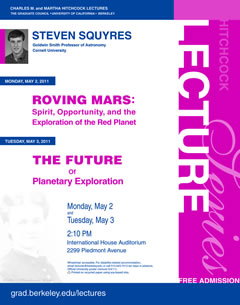
Well, it’s a beautiful afternoon, wouldn’t you say? We’re inside for a wonderful presentation. I’m William Lester, professor of chemistry and chair of the Hitchcock Professorship Committee.
We’re pleased, along with the Graduate Council, to present Professor Steven Squyres, this year’s speaker in the Charles M. and Martha Hitchcock Lecture Series. As a condition of this bequest, we’re obligated and happy to tell you how the endowment came to UC Berkeley. It’s a story that exemplifies the m-many ways this campus is linked to the history of California and the Bay Area.
Dr. Charles Hitchcock, a physician for the Army, came to San Francisco during the Gold Rush, where he opened a thriving private practice. In 1885, Charles established a professorship here at Berkeley as an expression of his long-held interest in education. His daughter, Lillie Hitchcock Coit, still treasured in San Francisco for her colorful personality as well, as well as her generosity, greatly expanded her father’s original gift to establish a professorship at UC Berkeley, making it possible for us to present this series of lectures.
The Hitchcock Fund has become one of the most cherished endowments of the University of California, recognizing the highest distinction of scholarly thought and achievement. Thank you, Lillie and Charles, and now a few words about Professor Squyres. Steven Squyres is best known for his studies of the history and distribution of water on Mars and the possible existence and habitability of a liquid water ocean on Europa, one of Jupiter’s moons.
His research focuses on planetary sciences with particular interest in the robotic exploration of planetary surfaces, geophysics and tectonics of icy satellites, tectonics of Venus, and planetary gamma ray and X-ray spectroscopies. Former chair of the NASA Space Science Advisory Committee. Squyres has participated in a number of NASA’s planetary and spaceflight missions, including the Voyager mission to Jupiter and Saturn, the Magellan mission to Venus, and the Near Earth Asteroid Rendezvous mission.
Spearheading a team of over three thousand, Squyres was the principal scientist behind the eight hundred million dollar Mars Exploration Rover project. He dreamed up the mission of exploring the red planet beginning in nineteen eighty-seven and turned it into a reality with a successful landing of rovers on Mars’ surface in two thousand and four. Squyres received his BS and PhD from Cornell University in nineteen seventy-eight and eighty-one respectively.
He then spent five years as a postdoctoral associate and research scientist at the NASA Ames Research Center before returning to Cornell as a faculty member. Squyres currently serves as a scientist and principal investigator for the Mars Exploration Rover project and is the Goldwin Smith Professor of Astronomy at Cornell University. He is also a co-investigator on the Mars Express mission and on the Mars Reconnaissance Orbiter’s High Resolution Imaging Science Experiment.
Squyres is a member of the Gamma Ray Spectrometer flight investigation team for the Mars Odyssey mission and part of the imaging team for the Cassini mission to Saturn. Professor Squyres has been awarded numerous honors for his extensive work in astronomy. He recently received the two thousand and ten Mines Medal for his achievements.
In two thousand and seven, Squyres was awarded the prestigious Benjamin Franklin Medal in Earth and Environmental Science by the Franklin Institute. His honors also include the American Astronomical Society’s Harold C. Urey Prize, the Space Science Award of the American Institute of Aeronautics and Astronautics, the American Astronomical Society’s Carl Sagan Award, and the National Space Society’s Wernher von Braun Award. Please join me in welcoming Professor Steven Squyres.
[00:04:08] STEVEN SQUYRES:
Thank you very much.
[00:04:08] WILLIAM LESTER:
Appreciate it.
[00:04:09] STEVEN SQUYRES:
Thanks a lot. All right. Well, thank you very much.
It’s an enormous pleasure to be back at Berkeley again. Could we bring the house lights down as far as we can bring them? I’ve got a lot of cool pictures of Mars to show people today.
So let’s see. If I’m doing my math right, today is day two thousand five hundred and eighty-five of our ninety-day mission to Mars. Um, the mission is still going on, and in the next, uh, hour or so, I’m going to try to share with you some of the adventure story that has been the Mars Exploration Rover project.
This, of course, is Mars, the object of our affections. It’s a truly terrible place. If you went there, you would absolutely hate it.
Um, the average temperature’s about sixty degrees below zero Celsius. It goes down to minus a hundred at night. If you took all the water vapor on the Martian surface and you condensed it out, uh, took all the water vapor in the Martian atmosphere and condensed it out on the planet’s surface, you’d make a layer of frost barely a hundredth of a millimeter thick.
So it’s a cold and dry and desolate world today. But in the past, it was different. This is a picture that was taken from orbit, and it shows a little sinuous valley across the Martian surface, and this, this, this valley was carved by flowing water.
In fact, you can look up here, and you can actually see in the upper right the little channel through which the water that carved that valley flowed. But you can’t do this on Mars today. On Mars today, it’s too cold, and it’s too dry to allow something like this to happen.
So what this is telling us is that in the past, it was different. It was warmer, it was wetter, it may have been more like Earth. Now, any geologist will tell you that any place that you have erosion, somewhere else there has to be deposition.
And there are places that you w- can go on Mars where you’ll find these wonderful sequences of layered sedimentary rocks. The great thing about layered sedimentary rocks is that they preserve in their details, in their chemistry, in their texture, information about what the conditions were like when the rocks were laid down. So if you can go to these rocks, you can find them and then you can investigate them with the right set of tools.
You can read the story that the rocks have to tell about what conditions were like on Mars long ago. Was it warm? Was it wet?
Were there conditions there that would have been suitable for life? So to do this, we built two robot geologists. Uh, this picture was taken at Cape Ca- Cape Canaveral, uh, over seven years ago.
This is the rover Spirit in the foreground, uh, all tricked out, ready to go to Mars. You can see Opportunity in the background there. It doesn’t have her wheels on yet.
I’m the handsome guy in the white suit here. And these rovers are effectively our surrogates. We explore Mars through their sensors.
We see Mars through their eyes. The, um, rover itself carries a scientific payload, and the scientific payload comes in two main parts. One part is supported by that big, fat, white stovepipe-looking thing, that mast there, and that supports two instruments.
One is a set of very high-resolution color stereo cameras at the top of the mast, and then down at the base of the mast, there’s an infrared spectrometer. And what that does is it looks up the inside of the mast. It’s hollow on the inside, and then there’s a pair of mirrors at the top that can be used to k- scan the countryside.
This thing’s basically a periscope. And so the infrared spectrometer gets the same view of Mars that the cameras get. Once we’ve identified interesting rocks using the camera, using the spectrometer, we then can drive over to them, and on the front end of the vehicle, there’s an arm.
The arm has a shoulder, an elbow, and a wrist. It has exactly the same dimensions as my arm, which is purely a coincidence.
(laughter)
And at the end of the arm, there’s a hand, and the hand has four fingers on it. There’s a microscope for telling us what the rocks look like close up. Two more spectrometers for telling us what the rocks are made of in detail, and this device here that we call the RAT, R-A-T, the Rock Abrasion Tool, and that’s a diamond-tipped grinding tool that can grind away the outer surface of a rock, kind of opening a window into its interior for the other instruments to look through.
Now, the spacecraft that gets this contraption to Mars is built sort of like one of those Russian doll sets. You know, where there’s a doll inside a doll inside a doll. It’s like that.
The rover, shown here, folds up in this horrifyingly intricate fashion to produce a compact little package that will then fit inside the lander. This is the lander here. Now, lander has these three things on the sides that we call petals because they’re like the petals of a flower.
What they do is they fold up around the rover, enclosing it, encasing it, protecting it, and producing this kind of tetrahedral pyramid. That’s what the lander looks like when it’s all folded up. That is then encased in turn in another shell that has two parts.
The first part here is called the heat shield, and what this does is protect the vehicle during its fiery descent through the Martian atmosphere. That cone-shaped thing that goes on the back, we call the back shell, and that completes that outer shell. And then this kind of blue Frisbee-looking deal on the back end, we call that the cruise stage.
And what the cruise stage provides is propulsion, electrical power, the stuff you need to get you to Mars. This is what the spacecraft looks like when it’s all put together. This is the Spirit spacecraft hanging inside a giant thermal vacuum chamber at the Jet Propulsion Laboratory where we did the assembly and testing of the vehicles.
We launched them in the summer of two thousand and three. Uh, two Delta II rockets, uh, from Cape Canaveral in Florida, one in the daytime, one at night. The launches were beautiful, exhilarating things to see.
It took us seven months to get to Mars. Now, once you get to Mars, you hit the top of the Martian atmosphere going Mach twenty-seven, twenty-seven times the speed of sound. That heat shield bleeds off kinetic energy, slows the vehicle down, and then once you get down to a nice leisurely
Mach two, you deploy a supersonic parachute. We learned the hard way that supersonic parachutes are very difficult things to design and build. The lander descends on a long cord, and this is what the vehicle looks like as it’s still screaming down towards the Martian surface at three hundred or four hundred miles an hour.
You do not drift down lazily on a parachute on Mars. The atmosphere is too thin. We had a terrible time with our parachutes.
Uh, these are some stills from a video of the first test that we did of the parachute design that we thought would land us successfully on Mars. Remember, we did these tests at a National Guard gunnery range outside of Boise, Idaho. It’s the kind of place where you can drop big, heavy things from the sky and they won’t kill anybody.
And we dropped our test article from a helicopter at four thousand feet. The parachute deployed. It blossomed to make this beautiful, perfect orange and white bowl, and then it just exploded.
It just ripped to ribbons. And parachute after parachute failed. What had happened was that as the design of our vehicle matured, our understanding of how heavy it would be got bigger.
And by the time we did these tests, the vehicle was too heavy for the parachute to successfully land it. So we had to go on a crash program of parachute redesign. We actually came up with three different parachutes that we designed in parallel, praying that one of them would work.
One of them did. We did our final testing of the parachutes in a big NASA, uh, wind tunnel just across the bay at NASA Ames Research Center. This is the design, this is the design of the actual parachute that landed us successfully on Mars.
This test, our first successful test of a parachute, took place only eight months before we had to be on top of the rocket in Florida, so it was a really scary schedule. We land using airbags. The airbags inflate, uh, explosively around the vehicle.
Uh, they’re sort of like the airbags in your car, except a lot more expensive. And, uh, then what happens is we fire these solid rocket motors, oh, maybe twenty, thirty meters above the surface. We cut the airbags free, and they fall to the surface and they bounce, and they bounce, and they bounce, and they bounce, and they roll, and they roll, and they roll, and they can bounce and roll as much as a kilometer before the vehicle finally comes to rest.
This is just a, an airbag engineer at JPL being consumed by his work. Um, we had an awful time with the airbags too. This is some stills again from a video of our first airbag testing.
This was done at a, uh, NASA, the, the world’s largest vacuum chamber. It’s a NASA facility in Sandusky, Ohio. And you can sort of tell from the looks on their faces it’s not going real well.
Well, um, I mean, the way this test works, you, you decompress this chamber and then basically use giant bungee cords to whack the airbags down onto a panel that’s studded with sharp, pointy rocks. And the bags just ripped. They shredded.
And that right there, that’s a gaping hole in one of the bags. Again, what had happened is the design of the vehicle had become so heavy that the airbags couldn’t handle it. And so we had to strengthen the bags, adding layer upon layer upon layer to them, making them heavier, making the other problems even worse.
Um, we eventually got the airbags to work, too. Uh, the picture on the left is from one of our first successful airbag tests, and of course, the ultimate test, these are airbag bounce marks on the surface of Mars. Now, once this thing lands, we retract the airbags, the pedals open up, and it flips the vehicle right side up.
And then inside, all folded up still is the rover, looking nothing like a rover yet. So this thing now has to do origami in reverse, unfolding itself through multiple stages to turn itself into a rover. Now, there were a lot of parts of this mission that made me nervous, but this part right here, with all the gears and motors and springs and hinges and latches, was terrifying.
And what you’re seeing right here, those are the solar arrays. Those carry the life-giving solar cells that must be exposed to the sun the first day on Mars, and if they aren’t, the vehicle doesn’t survive the first night on Mars. The camera mast comes up, the antenna comes out, and now by the time we get to this configuration, the vehicle is safe.
The sun is shining on the solar arrays, so we have power. The mast is up, so we can take pictures. The antenna is out, so we can transmit those pictures back to Earth.
But we can’t go anywhere yet because the whole suspension system is still folded up underneath the vehicle. There’s another step, and it’s even worse. Watch this.
There’s a jack underneath the vehicle, like the jack in your car that lifts it up. And now watch what the front wheels do. Watch this.
Ah. I mean,
(chuckle)
it’s been seven years and I still get the heebie-jeebies watching that.
(laughter)
You know, if those latches don’t latch, you’re done. The mission is over. Now, when we came up with this whole cockamamie scheme for landing on Mars with the heat shield and the parachute and the airbags and the bouncing and the unfolding and everything, we thought that once we got to this configuration, with the vehicle standing up on the lander deck, we were pretty much home free.
We just cut the cable that connects the rover to the lander. We go monster trucking down onto the Martian surface, and everything’s good. And we did some tests.
Yeah, this is a bad day. Um, it turns o- turns out that when you drive one of these vehicles off a lander, it can flip upside down under certain conditions. So we had to fix that.
The solution that we came up with, you actually saw when those petals first op- The petals first opened. Between the petals, made of fabric, we built some ramps.
And what happens is when the petals fold into place, the ramps, which are just fabric, they’re made of the same fabric as the airbags, really tough stuff, those snap into position, and then the rover can drive down the fabric wrench, uh, the fabric, uh, ramps. Now, once you get on the Martian surface, you gotta deal with the fact that it’s not exactly paved, okay? There are rocks and bumps and drifts and dunes and things that the rover has to be able to negotiate.
And so our mechanical engineers had to come up with a scheme whereby the wheels of this complex six-wheeled vehicle could go over topography and could conform to whatever topography they encountered without the rover bumping around too much or tipping over. It’s a, it’s an elegant system. This, this sort of shows it in action.
Watch this. Watch the wheels. Watch the suspension system as we go over this topography.
Watch this. Isn’t that cool? I mean, if we find a corrugated metal roof on Mars, we’re all set.
But watch, we’ll do a little spin here. It’s a very, very elegant system. Really neat mechanical engineering.
Okay, now drive it. How do you drive this thing? What I wish I had, of course, is a joystick, right?
What I want to be able to do is sit in my office and steer it around rocks and other obstacles, but you can’t do that. On the night we landed, when Earth and Mars were pretty close together, it still took ten minutes for that radio signal traveling at the speed of light to go from Earth to Mars. Something happens on Mars, ten minutes for the result to come back, twenty-minute round trip, I’m going to run into a rock.
Okay, so what we’ve had to do instead is endow the vehicles with vision and intelligence and the ability to make their own decisions about what is safe and what is not. Um, and what we’ve done is we’ve, we’ve built into the vehicles a pair of these kind of wide-angle, googly-eyed cameras that take this hundred and twenty degree fish-eye view off the front end and the back, back end of the vehicle, and they build up a little three-dimensional model in their computer brain of what the topography looks like. And they can compute, is that obstacle small enough that I can drive over it, or is it big enough that I have to go around it?
And we can program different levels of courage or cowardice into the vehicles, depending on how difficult and dangerous we think the terrain is. Here’s a drive that was done by Spirit early in the mission. The first part here we commanded explicitly, but from here on, the rover’s going to be making its own decisions, and this is exactly what it did.
So it drove along, and then right here there was a scary pile of rocks. So it thinks about it for a minute, thinks about it, says, “Okay, I can do this. I’ll do it backwards.”
Makes that beep, beep, beep sound, you know, as it’s backing up. Another pile of rocks here. Thinking about it, thinking about it, says, “Okay, I’ll go this way, and I think they told me to stop right here.
All done.” They’re pretty smart little vehicles. Okay, the RAT.
The Rock Abrasion Tool. This is one of the most important parts of the science payload. When a rock sits on the surface of a planet, um, it gets exposed to the elements: sunlight, dust, wind, humidity.
These are things that produce a process that geologists call weathering. It modifies the surface of a rock. What it does is it destroys the evidence of what that rock was originally like.
So if you want to know what the rock is really like, you need to be able to get through that weathered material and down into the fresh rock underneath. And our tool for doing this is the RAT. It has these diamond-tipped grind heads that spin at 3,000 RPM.
And they can, over a period of time, grind into the hardest rocks that we’ve encountered on Mars. So the RAT is effectively, it’s a power tool. It’s the world’s first interplanetary power tool.
And as with all power tools, we have to be very careful when we use the RAT so that we don’t, um,
(laughter)
do anything like that. I’m sorry. I thought the wheel coming off was a nice touch anyway.
All right, let’s go to Mars. I’m going to start with Spirit. The landing site that we chose for Spirit is this crater, big blue crater right there.
It’s called Gusev Crater. It’s about 160 kilometers in diameter. It lies at 16 degrees south latitude on Mars.
The reason we chose it, what sets this crater apart, is this. There’s a great big dried up riverbed flowing into that crater. Now, there’s no water in that riverbed now, and there hasn’t been for billions of years.
But this is a big hole in the ground with a dry river flowing into it. There has to have been a lake in Gusev Crater or at some point in the past. So we went to Gusev hoping and expecting to find layered sedimen- sedimentary rocks that had been laid down billions of years ago in a Martian lake.
We landed and we saw this is nice and flat, easy for driving. I managed to convince myself for about three days that this is what a Martian dry lake bed ought to look like. But then we started looking at the rocks.
The first rock that we looked at was this one right here. We named it Adirondack. It’s about that big.
And we hit this thing with everything that we had. We drilled into it with the RAT. We looked at it with our spectrometers, with our microscope.
We did everything we could to this rock, and what we found, and you can sort of guess just by looking at it, is this is not a sedimentary rock at all. There are no layers in that. It’s a piece of lava.
This is basalt. This is a volcanic rock. And every other rock for kilometers in every direction is the exact same stuff.
We landed on a bunch of lava. Mars faked this out here. I still believe those layered sediments must be down there somewhere, but what happened was, after the sediments were deposited, they were covered with lava.
And we didn’t know that until we landed and reached out and touched the rocks. So this was a bitter disappointment. Now our rovers were designed to last for ninety Martian days and to drive six hundred meters over their lifetimes.
When we landed and we looked around, off to the southeast at a distance of about two and a half kilometers, we saw this beautiful range of hills. We named them the Columbia Hills after the Columbia Space Shuttle. Um, at two and a half kilometers away, They seemed impossibly distant.
But given the fact that we realized quickly that there was nothing but lava in this scene, we realized that we had to go to the Columbia Hills or else we were going to see nothing but lava the whole mission. So off we went. We reached the base of the Columbia Hills on day 156 of our 90-day mission, and everything changed.
The minute we entered the hills, everything was different. This is the view from the base of one of the highest hills in the range. This one is named Husband Hill.
It’s named after Rick Husband, who was the commander of the Columbia when it went down. And, uh, this is the hill that we chose to climb. We worked our way over a period of hundreds of Martian days up the slopes of Husband Hill, finding some very different rocks along the way.
This is a picture, a set of pictures taken with a microscopic imager. This image here is just three centimeters across. So now we’re seeing layering.
Now we’re seeing subcentimeter-scale layering in the rocks. When we look at these rocks with our spectrometers, we started to see other minerals. We see minerals like goethite, which is an iron oxyhydroxide.
Hydroxide, that means that you need water to make goethite. So now we’re starting to see layered rocks. We’re starting to see rocks that show compelling evidence of water being implicated in their formation.
Over a period of hundreds of Martian days, we did the first ever mountaineering on Mars, working our way laboriously up to the summit of a Martian mountain as tall as the Statue of Liberty. Um, like any good mountaineer, we took a, a picture when we got to the top. Uh, this is part of this spectacular view from the summit of Husband Hill looking off to the south.
And as we speak, the Spirit rover is right there, having spent, uh, nearly 2,600 days on the surface of Mars. Spirit has had a tough time. Martian mountaineering is pretty tough on a robot.
And after about 800 days of driving this vehicle, the right front wheel, right front wheel failed. So the right front wheel would no longer turn. And what that meant was that when we drove the vehicle, we had to drive it backwards, dragging that dead wheel through the soil.
It made it very hard to drive. What we discovered, though, was that this cloud had a wonderful silver lining in that dragging that wheel digs this marvelous hundreds of meters long trench through the Martian soil. And what we found to our surprise was that every so often something fascinating will pop up in the floor of that trench.
There was one day when we were driving the rover very close to where I showed you in that most recent image. Um, we’re drive- We’re driving the rover through a little valley, and at the end of the drive, the front wheel, the right front wheel, had dredged up some soil that was as bright as white snow.
This caught our attention. We went over with our spectrometers. We made a measurement of the composition of the stuff.
This one is, this stuff is ninety-one percent pure silica, SiO2. This is not quartz, not beach sand. This is amorphous silica.
This is opal, sort of like the gemstone. This is the kind of stuff that typically forms in hot springs and volcanic steam vents on Earth. So what this silica deposit in this little valley on Mars is pointing to is an environment, billions of years ago, that would’ve been one suitable for life.
You can go to volcanic steam vents, you can go to hydrothermal systems on Earth, and they’re teeming with microbial life. Now, I do not know if life was ever here, but these silica deposits in this valley represent a former habitable environment on Mars. Of course, we named the place Silica Valley.
Um, Spirit has had a tough life in another way, too. Uh, this is a picture that the vehicle, this is a self-portrait, a picture that Spirit took of itself on day three hundred and thirty of the mission, and the solar arrays are brown. They are coated with dust.
Dust in the Martian atmosphere settles out of the atmosphere, and it just coats horizontal surfaces on the rover. Um, when this rover was brand new, straight off the showroom floor, those solar arrays would put out about nine hundred watt-hours of power per day. It’s enough energy to run a 100-watt light bulb for nine hours.
By the time this picture was taken, with all the dust on the arrays, that number was hovering between 250 and 300 watt hours. And we think that death for the vehicle was somewhere a little below 200. So it was looking like Spirit was close to the end.
And then one marvelous day, this happened. A lucky gust of wind the ve– hit the vehicle, cleaned it off, and overnight the power went back up to eight hundred and fifty watt-hours. Pure, dumb luck.
It was as if this had happened. Somebody thought– sent me this picture, I thought this was great. What was really going on, check this out.
Look at this. Dust devils. Little Martian mini tornadoes that go whirling through the scene in the summertime.
I’ll play this again. I love this thing. You only see Dorothy and Toto flying through all of that.
Check this out. What was that? See right now?
Eclipse. I heard it. Yes, an eclipse.
Um, Mars has two moons. Their names are Phobos and Deimos. This is the moon Phobos passing in front of the sun.
This is the first solar eclipse ever witnessed from the surface of another planet. There’s no science in this at all. We just did it ’cause we could.
And that’s a sunset. On Mars, the sky is pink in the daytime and it turns blue at sunset. It’s the opposite of Earth.
Now, this sunset picture, this beautiful image, this was taken by Spirit. Where things stand with the Sp- Spirit rover right now is we have not heard from Spirit in about a year. Uh, Spirit, we managed to coax through three very long, dark, difficult Martian winters.
By the time the fourth winter came, uh, the mobility system, the wheels were sufficiently crippled that we could no longer force Spirit up onto steep slopes that would point the solar arrays towards the sun. And it’s beginning to appear that Spirit may not have survived the most recent winter. Uh, we have dug very deeply into our bag of tricks to contact the vehicle.
We have another few things to try. Uh, we’re gonna keep trying for a little while longer, but, uh, Spirit may have reached its end. Opportunity, on the other hand, is still doing well.
Let me talk about the Opportunity mission now. These slides show the Opportunity landing site. We chose the landing site for Opportunity not because of its topography, no big hole in the ground, no dry riverbed.
We chose it on the basis of its chemistry. The picture at the right shows data from an infrared spectrometer collected from orbit. The blue stuff is boring old lava again, but the red and yellow and green, that’s a mineral called hematite.
Hematite’s an iron oxide. It’s a mineral that is present in rust, and it’s a mineral that sometimes, not always, but often forms as a result of the action of liquid water. So this hematite signature is like a be- beacon visible from space saying, “Hey, come land here.
Water may have been here.” Now, this picture here shows an image of what the landing site looks up- looks
like close up. Very smooth, very flat, extremely safe for landing, Very easy for driving, great landing site. But the thing that made me nervous about this site is that it’s so smooth and so flat, I feared that we might not ever encounter the topography that we would need to expose the bedrock we would want to see.
Turns out I need not have worried. Um, these are some of my favorite images from the entire mission. When our vehicle was landing, as it’s descending on that parachute, it had mounted on the underside of the lander a camera that was looking down at the surface.
That camera snapped off three pictures as we’re going through this violent and rapid landing process. The little black dot that you see just to the left of that crater, that’s the shadow of the parachute. Okay?
This picture at the lower right is just the same scene being viewed obliquely. Now what the red curve is, the red curve is the reconstruction of the trajectory that our spacecraft followed as we went through the landing process. So here we are coming screaming in from space, hundreds of kilometers an hour.
Right here, we fire those rocket motors, and we cut the airbags free, and they fall to the surface and begin to bounce. Now, the wind that afternoon on Mars was blowing from the south, and so the trajectory bends to the north. Bounce, bounce, bounce, bounce, bounce, bounce, bounce.
And then reading the green perfectly, the trajectory bends to the left. and goes right into a little 20-meter diameter impact crater. Tiger Woods on his best day could not have accomplished this.
Again, it was pure dumb luck. We opened our eyes, and there was this spectacular outcrop of layered bedrock in the wall of the crater right in front of the rover. Now, the night that we landed, when we first saw these images, we didn’t know which crater we were in, so we didn’t know how far away the crater wall was.
So we didn’t know how big the outcrop was. And on the night that we landed, when my team saw this massive outcrop that we were gonna have to negotiate, the name that they gave it that night, what they called it at first, was the Great Wall. That was the name.
Then we took some stereo images and did a little trigonometry. Little tiny outcrop, great big rover. The Great Wall’s about this high.
(laughter)
But its small size was part of its charm because what that meant was that this layering that we were seeing was very, very fine. Okay, th- you gotta remember, this is only three weeks after we had landed at Gusev Crater with Spirit and seen nothing but lava. Here we clearly had something very different on our hands.
The first thing we went looking for while we were still on the lander was the hematite. That was what brought us here. Okay, our infrared spectrometer is good at detecting hematite.
We went looking for it. Again, red is lots of hematite, blue is none. There’s lots of hematite outside the crater and some in the, the, the soil on the crater wall.
There’s a bit of hematite in the outcrop, not nearly as much. And then on the crater floor in blue, there are these weird splotches that have no hematite at all. The splotches are the airbag bounce marks.
So you bounce in the dirt here and hematite goes away. This is one of the first of many clues. I’ve shown you this picture before.
You can see the, the airbag bounce marks, very smooth, and in between, where the hematite is, there’s this gravel. So we’re thinking, “Ah, the hematite must be in the gravel.” We drove off the lander, we looked down with our cameras and took the first good picture of that gravel, and here it is, and we started to notice that those grains of gravel looked awfully round.
So we took out our microscope, and we took this picture. And I will remember as long as I live where I was standing, and how I felt, and the unrepeatable words that I said when I saw this picture. The surface of Mars at this landing site is littered with an uncountable number of little round things.
And they’re four, five, six millimeters in diameter, and they are absolutely everywhere. We have- we had no idea what we were dealing with.
We drove over to the outcrop, and what we quickly learned was that the little round things are embedded in the outcrop like blueberries in a muffin. The muffin is soft, the blueberries are hard. The muffin erodes away, and the blueberries fall out, and they’re everywhere.
Now, at this point, of, of course, we’re, we’re desperate to know what the blueberries are actually made of. We suspected that they were made of hematite. Now, on the end of the arm, we have a spectrometer that’s a wonderful hematite detector.
The problem with that spectrometer is that its field of view– This is a picture taken with our microscope. It’s three centimeters across. Okay, the field of view of that spectrometer is a centimeter and a half.
So if you try to go up to just one little blueberry embedded in the rock, what you wind up with is a spectrometer whose field of view is filled by a little bit of blueberry and a whole lot of muffin, and it’s hard to figure out what you’re looking at. So what we needed instead was a gathering of blueberries. We found one.
Right here, there’s a place where there was a little bowl-shaped depression in the rocks, and a bunch of the blueberries had rolled down into it. We called it the berry bowl. And we stuffed our spectrometer into the berry bowl, and we made a measurement of this stuff, and sure enough, the berries are made of, of hematite.
Now, after looking at these things for a while, what we came to realize is that the blueberries are what geologists call concretions. Concretions form in sedimentary rocks on Earth that are saturated with liquid water, and there’s some mineral dissolved in the rocks or dissolved in the water that wants to precipitate out. It’s supersaturated, and it finds a little nucleation point, and it begins to precipitate.
And it adds layer upon layer upon layer as more minerals precipitate, and it grows, building a little hard spherical nodule in the rock, sort of like the way an oyster builds a pearl. So what this is showing us is that at this location, at one time in the past, the water here would sat– the, the, uh, the rocks here were saturated with liquid water. And we were also interested in whether or not rock water came to the surface.
And this is, um, some experiments done where you s- you have water flowing over sand. If you’ve ever looked into the bed of a sandy stream, you’ve seen this. Where water flows over sand, it makes ripples, and the ripples propagate downstream.
And the key thing here that you observe is that the crests of those ripples are not straight. They’re highly sinuous over length scales of five or 10 centimeters. And that sinuosity of the ripple crest is the signature of water as the fluid that is transporting the sediments.
Here’s the same thing being simulated in the computer. So sinuous crested ripples propagating downstream, and look what’s left behind. What’s left behind in the sedimentary record is not flat-lying sediments.
Instead, what you get is these little concave upward smiley shapes in the rocks, five or ten centimeters in size. Here’s the real thing. These are from some sediments in the Colorado River in the southwestern United States.
and here it is on Mars. Little smiley shapes in the rocks. These are rare.
We haven’t seen these all over the place. We’ve seen them only in a few spots. But what they say is that not only was there water beneath the ground, but occasionally water came up to the surface and flowed across the ground here on Mars.
We spent 60 wonderful Martian days exploring this little crater. You see tire tracks everywhere. And then we left, and the place that we went to was Endurance Crater.
Um, Endurance Crater, hundred fifty meters in diameter, twenty meters deep. It’s this spectacular thing. And I remember telling reporters, telling people in the news media, “Oh, yeah, when we get to Endurance Crater, it’s gonna be great.
We’re gonna be able to go down into the crater and look at all these layers in the rocks.” We got to the crater rim, and it scared the living daylights out of us. I mean, that looks like an overhanging cliff there.
That’s exactly what it is. This is the kind of place where if we screwed up, our little rover could fall off a cliff and die. It was a frightening place.
But look at those layered sedimentary rocks. We had to find some way to get at, get down into this crater. Now, I showed you that picture before with the little outcrop and the big rover.
Here it is to scale at Endurance. This is a very frightening place. But I will tell you that in 200 days of operating in this crater, we drove that little rover down into the crater and up to this spot right here.
We’re parked right on top of that rock there, and I’ll show you a picture taken from there in just a second. Now, when we first took on this task, we had no idea what the rover could do in terms of climbing steep slopes. We had not designed it for this kind of thing.
So we had to test it, and we went out, literally, we went out to Home Depot, and we bought a bunch of paving stones. We got a bunch of sand. I had grad students gluing BBs onto the rocks to make blueberries.
And we took our test rover, and we, we would tilt this thing to different angles and run it up and down the slope, and it turns out the rover climbs pretty well. It can ha-handle slopes up to about 34 degrees. So into the crater we went.
Over a period of months, we worked our way slowly, systematically down through this beautifully exposed stack of layered rocks. And each time we got into a new layer, we put in a hole with the RAT, we’d look at it with our microscope, we’d look at it or w- with our spectrometers, we’d study how things changed as we went down section, as a geologist would put it. Um, in geology, you, what you try to do in sedimentary ro-
Rocks is you try to construct what’s called a stratigraphic section, measurements through a whole set of layers, and that’s what we did here. It’s the first stratigraphic section ever done on Mars. Um, we got down on the cr- flo-floor of the crater, we found some really weird stuff.
This is the rock that when the picture first came down, my team called it the petrified Martian dinosaur brain. When this one came down, one of the guys on the team said, “Now that’s what a rock from another planet should look like.” No idea what’s going on there.
Um, we then worked our way up to the base of that cliff, and we took this image. And I wish I could show you this image in its full high-resolution glory. There’s about three IMAX screens worth of data in this image.
I’m gonna just zero in on one tiny little section of it up here. There it is. And the entire image is that good.
And every single image that we’ve ever taken since the day we landed on Mars is on the web. Anybody can download it. Anybody can work with it.
This is a treasure trove of data that people are gonna be working with for decades into the future. We left the crater, and the next place that we went was our heat shield. Okay, you remember the heat shield?
It protects the vehicle as you descending through the atmosphere. When we don’t need the heat shield anymore, we drop it off the vehicle, it falls to the surface, and it hits the surface. Um, here’s the heat shield at the top as it looked last time I saw it at Cape Canaveral in Florida.
Here it is busted into pieces on the Martian surface, along with the crater that it made when it hit. Now we went to visit the heat shield not to learn about Mars, we went to it to learn about heat shields. Okay, for decades, engineers have been given the task of designing a heat shield that will work in a very poorly understood Martian atmosphere.
But until our mission, not one of those engineers had had the luxury of seeing their creation after it had done its job. We were able to drive up to this heat shield, take our microscope, and take a microscopic image of a cross-section through the broken heat shield and give that image to the engineer who had designed and built the thing so he could assess how well it had performed. Now, at the same time that we’re doing our engineering investigation on the heat shield, you know, we’re scientists, so we’re looking around for rocks, and we saw one right next to the heat shield.
Here it is. We named it Heat Shield Rock. And we went over to Heat Shield Rock and we measured its composition.
Turns out this thing is not made of conventional rock at all. This thing is made of a nickel-iron alloy. It’s a meteorite.
This is an iron meteorite just sitting there right next to the heat shield. Again, pure dumb luck. I told the team we shouldn’t stay here.
This is obv-obviously a place where big metal objects fall from the sky. We drove away from the heat shield, and we embarked on a long, arduous drive to the south. Many kilometers.
And as we got farther and farther to the south, the nature of the terrain changed. And where it once had been perfectly smooth and flat, now we began to see these little windblown ripples. And the farther south we got, the bigger and bigger and bigger they got.
And we blithely just drove over those things, bombing along, up one side, down the next. We drove over hundreds of these things. And then one terrible day, we hit a ripple that was somehow, and I still don’t completely understand this, but we hit a ripple that was just somehow a little bit different from the hundreds that had come before.
And instead of driving over, our wheels broke through the crust of this thing and started to sink in. And we did 50 meters of wheel turns thinking we were driving across the plains, when in fact we were just sinking deeper, and deeper, and deeper into this thing. We came in the next morning and all six wheels were buried over the hubcaps.
This was a bad day. Now, the first rule in a situation like this is don’t do anything stupid that’s going to make the problem worse. Right?
The sun is shining, we have electrical power, the vehicle is safe, it’s certainly not going anywhere. We have time to figure out this problem. And when we built the rovers, we actually built four of them.
Spirit and Opportunity are on Mars, but we have two that are back here on Earth, and we can use the ones that are here on Earth to simulate predicaments that we’ve gotten ourselves into on Mars, and then try to figure a way out of it. In order to figure a way out of this predicament, what we really, what we needed was a large quantity of fake Martian soil. Now, if you’re ever called upon to make fake Martian soil, here’s the recipe that you should use.
It is roughly equal parts play sand, the stuff in kids’ sandboxes, clay, and diatomaceous earth, the stuff that’s used in swimming pool filters. Once we figured out this recipe, a bunch of engineers and pickup trucks fanned out across the LA basin and bought up literally tons of these three ingredients. And people were getting algae in their swimming pools across Los Angeles all summer because we bought all the diatomaceous earth.
We brought it back to JPL, and we mixed it together, and we created mounds and pits and drifts and dunes, and we drove the rover into it and we got it stuck. We spent two and a half weeks rehearsing, trying to find the optimal way to extract the robot from a sand dune on another planet. There are a lot of things you can do.
Um, you can steer the wheels back and forth to try to open up the holes that they’re in a little bit. You can run the wheels at different velocities. You can rock the vehicle.
We tried all those things and a bunch more. After two and a half weeks, we found the optimal technique. The optimal technique, it turns out, was to put it in reverse and gun it.
Um,
(laughter)
now there’s no place you go to look this stuff up.
(laughter)
So here we are, gunning it on Mars. Uh, this is the left front wheel. Uh, here’s the left rear wheel.
I mean, we were really stuck. We were in trouble. We had to do 192 meters worth of wheel turns to get the rover to move one meter.
But one marvelous Saturday morning, after six weeks stuck in a feature that we later came to call Purgatory Dune.
(laughter)
The vehicle popped out, and we have been treating those ripples with much greater respect ever since. So this shows where we operated over a period of years. Here’s Eagle Crater.
That’s a one kilometer scale bar. Here’s Eagle Crater where we landed. There’s Endurance, where we spent all that time.
The heat shield was about here. Uh, Purgatory Dune was about here. The place we were hoping to get to was Victoria Crater.
Now, you notice that the craters on here are all named after famous ships of exploration. Eagle, of course, was the lunar module on Apollo 11. Endurance was Shackleton’s ship.
Victoria was one of Magellan’s ships. Magellan left Spain with five ships, Victoria was one of them, two hundred and sixty men aboard, with the intention of circumnavigating the globe. Magellan himself was killed in the Philippines.
After three years at sea, the one remaining ship from the original five, with 18 remaining surviving sailors from the original two hundred and sixty, limped back to Spain. So we chose that name for this crater because we thought it was a suitable analogy for the shape that we would be in with our beat-up little rover being driven by 18 surviving graduate students, if we ever got as far as the crater. But I’m pleased and proud to say that we did make it.
Uh, this is a wonderful image of Victoria Crater. This was taken from orbit by NASA’s Mars Reconnaissance Orbiter. This was a marvelous coincidence at almost the exact moment that we rolled up to the rim of Victoria Crater.
MRO went into orbit around Mars, turned on its camera for the first time, and one of the very first pictures it took was this image of Victoria. I’ll blow up just that little portion of it. There it is.
If you look carefully, That’s Opportunity. In fact, if you look really carefully, you can see the shadow of the camera mast being cast on the Martian surface. It was really nice to see our rover again.
Um, we spent two years exploring Victoria Crater, and you can see in this image, taken after about a year’s worth, the wheel tracks that we made as we worked our way along the rim of this crater. The rover drivers told me that when this was done, that was gonna s- spell out, “Hi, Steven.” I’m not seeing it.
But, uh,
(laughter)
seriously, these, these wheel tracks to me actually represent one of the finest accomplishments in the history of space robotics systems. And you got to realize, the rovers are operated by a group of engineers whose first and foremost job is to keep the vehicle safe. We’re driving it along the top of an eight-meter tall cliff with a bunch of scientists saying, “Go closer, go closer.”
(laughter)
And time and again, they took us right to the edge, and we got just spectacular images in the process. Here is one of them. Um, this is a place called Cape St. Mary.
That cliff’s about eight meters tall. I’m gonna zoom in on this portion of it. There it is.
Look at the layering. Look at just– This is what geologists call cross-bedding, just spectacular layering, uh, exposed in the wall of this cliff.
What this is telling us is this was an ancient sand dune, uh, very, you know, billions of years ago on Mars with this, this sand blowing around and in the Martian wind. Um, I don’t know if you’ve been to a lot of talks by geologists, but geologists, when they show a picture of an outcrop, they always put their rock hammer in it for scale. So there’s my, uh, my virtual rock hammer for scale.
I wish it were my real one. But anyway, just spectacular stuff. Couple of years ago, we left Victoria Crater, and we have continued our trek to the south.
Um, so let’s see. Endurance Crater is that little tiny dot right below the letter U in the word endurance. Big old Victoria Crater, 800 meters in diameter, is right there.
As we speak today, the rover Opportunity is right there. We have driven 28 and a half kilometers, and we are now just four and a half kilometers away from the rim of Endeavour Crater. Endeavour Crater is twenty-five kilometers in diameter.
It is hundreds of meters deep. Its rim is composed of materials that we know by looking at it from orbit are fundamentally different from anything we’ve ever seen before with either rover. If we can manage to keep this very old and very tired rover going for another four and a half kilometers, and we get to the rim of Endeavour, it’s going to be like the mission has started all over again.
Um, are we going to make it? I don’t have any idea, but we’re sure going to try. This picture came down this morning.
Uh, this was taken yesterday on Mars. Uh, we are back into very smooth, very flat terrain. The rover is making very good progress.
This, these wheel tracks are from a single day’s drive of a hundred and twenty meters. So we’re making really good progress and if the vehicle stays healthy, I’m looking forward to getting to the rim of the Endeavour Crater before too long. Uh, whenever I give talks about the Mars Exploration Rover project, I always end them with this slide.
I wrote a book about the project called Roving Mars, and in an appendix of that book, I made an attempt to list the names of all the people who worked on the project. There are more than four thousand names on that list. I’m just one member of that four thousand person team.
Here are some more people on the team. This is at Cape Canaveral down in Florida. This is the night that we sent the Opportunity spacecraft, which you see it upper right, out to the launch pad.
Um, for every one of us who has had the remarkable experience of being part of this mission, it has been in the literal sense of the phrase, the adventure of a lifetime. And I want to thank you very much for inviting me here to tell you about it. Thanks a lot.
(applause and cheering)
Thank you.
(applause and cheering)
Thank you. Yes. Bring the lights up. Let’s bring the lights up, and I’d be happy to take your questions forward. Questions? Oh, got a microphone and everything. All right. I do recall that they, um,
(noise)
[00:56:08] AUDIENCE MEMBER:
they kicked up some… Looked like a white step on the tracks. It looked like, uh, either salt or ice.
[00:56:16] STEVEN SQUYRES:
Mm-hmm.
[00:56:18] AUDIENCE MEMBER:
Did you, uh, did they, uh, actually liquid water ice?
[00:56:21] STEVEN SQUYRES:
No, we have not found ice at all with either one of the rovers. We, as you saw with Spirit, we did have that very bright stuff. That turned out to be silica. There have been other places where what we have found turned out to be sulfate salts, but nowhere have we found ice.
[00:56:36] AUDIENCE MEMBER:
Thank you.
[00:56:36] STEVEN SQUYRES:
We’re pretty close to the equator on Mars, and so you wouldn’t really expect it. It’s too warm there. Um, the Phoenix lander, which landed at seventy-eight degrees north latitude, was able to dig into the soil with its robotic arm at, like, five centimeters below the surface.
Found bright deposits of ice. So that’s been done, but that’s close to the pole.
[00:56:58] AUDIENCE MEMBER:
That was ice.
[00:56:59] STEVEN SQUYRES:
That was ice, yes. That was a different mission. Yeah.
[00:57:02] AUDIENCE MEMBER:
A hundred and twenty meters per day is very impressive for a machine on Mars, but for us here on Earth, if we could walk that in a few minutes. So I’m, I’m curious, kinda, how does the rover spend its time? Is it spending a lot of time thinking where it’s going next?
[00:57:13] STEVEN SQUYRES:
Um. Yeah, that that’s part of it. It depends on where you are in the drive.
So why does it ta– why can you only do about a hundred and twenty meters a day? Fundamentally, we’re limited by power. Right now, the solar arrays on Opportunity are pretty dusty.
Uh, right now, Opportunity’s got about four hundred watt hours per sol. So it’s four hundred watt hours to do everything, all of the driving, all the computing, taking the images, transmitting the data to Earth, running the heaters to keep the vehicle warm at night, et cetera. So we’re fundamentally power limited.
Um, the way we drive the vehicle is the first part of the drive, we will just simply command it. We call it blind driving, and what it means is that we know the terrain is safe. We just say, “Rover, go,” and it will just drive at top speed.
You apply full voltage to the wheels, you’ll get about six centimeters a second, and that’s how fast it goes. Once we’ve gotten about eighty meters out, then we’ve driven so far that the images are not good enough to recognize potential obstacles, and that’s when we turn on that automatic hazard avoidance stuff. Um, when the rover’s doing that, it is excruciatingly slow.
Um, I mean, uh, you, you can watch one of these rovers. We’ve tested them on Earth, and it’ll go like this, and it’ll stop and take a picture, and it’ll think for two and a half minutes about what to do before it will move on. The, uh, the computer inside this rover was a smoking hot machine in about 1987.
It runs at a screaming 10 MIPS. Um, and so the rovers, I mean, your cell phone is a lot smarter than my rovers. My rovers are on Mars, though.
Um
(laughter)
And so it’s, it’s excruciatingly slow. But yeah, we’re fundamentally limited by how much power we have. If we ha– If the solar arrays were completely clean, we’d be able to get more mileage per day.
[00:59:02] AUDIENCE MEMBER:
Thank you.
[00:59:02] STEVEN SQUYRES:
Yeah. Sure.
[00:59:06] AUDIENCE MEMBER:
I was very interested to see the, uh, microscopic images. And I had wondered from the beginning of the Mars Exploration Program why microscopes were not put on the earliest, uh-
[00:59:18] STEVEN SQUYRES:
Ah, yeah, landers. Um, you know, the, the, the microscopes, it has been one of the most fundamentally useful things on the payload. I think the answer to your question is, I mean, recognize there weren’t too many missions that preceded ours.
Yeah. Okay, there were the two Viking landers. Viking was fundamentally about looking for microbial life in the soil, and rather than a microscopic approach to that, which is very difficult with even soil samples on Earth, and you’d need an electron microscope to do it properly, uh, which is very hard to, to do for space.
The approach they took was a set of experiments that, you know, you would look at like a labeled release experiment where you feed it a nutrient and look at the gases come off. Um, the next mission after that was Mars Pathfinder. After that was Mars Pathfinder, and that was fundamentally an engineering mission.
That wasn’t really about science at all, and the next mission after that was us. So-
[01:00:08] AUDIENCE MEMBER:
Oh, well, the- you know, it kind of makes sense. The second part of what I’m asking really is going forward, I mean, clearly what we’d really like to see is evidence of life.
[01:00:16] STEVEN SQUYRES:
Yep.
[01:00:17] AUDIENCE MEMBER:
So what we need is not only the very fine microscopy, but also to be able to dig down to where there’s water. Yeah. I realize that’s a big challenge, but I was interested in your remarks.
[01:00:27] STEVEN SQUYRES:
That, that’s, that’s a very big challenge, but it’s a very important one. Um, right now, the, the next mission that’s going to Mars, uh, is the Mars Science Laboratory, a big rover. Uh, what it focuses on primarily is trying to look not for water, but to look for, uh, at very, very low concentrations, organic materials in the rocks and the soil.
And then the next step step after that it’s probably to bring samples back from Mars, and that process, I hope and expect, will involve a drill that can go a meter or two below the surface. Thank you. Yeah.
Right there. Just yell it out.
(questioner background chatter)
Nope, we got– Apparently, you gotta come forward, sorry.
[01:01:14] AUDIENCE MEMBER:
It’s all right.
(laughter)
[01:01:15] STEVEN SQUYRES:
Oh, you’re recording it, of course, yeah. Okay. I can always repeat the questions, I guess.
[01:01:19] AUDIENCE MEMBER:
Hi. As, uh, as an old Mars observer from the nineteen fifties, I have been just delighted by your beautiful presentation of your outstanding success. But nonetheless, because it’s seven kilometers lower there and below the triple point of water, I’d like to suggest that you go to hell.
(laughter)
[01:01:50] STEVEN SQUYRES:
Okay. I believe what you meant was to go to the Hellas Basin?
[01:02:03] AUDIENCE MEMBER:
That’s right.
[01:02:04] STEVEN SQUYRES:
Yeah. Sorry, I had to think about that one for a second. Um, yeah, Hellas, Hellas is actually an attractive landing site from some perspectives because it is going to be one of the highest pressure places that you’ll find.
The, the– One of the difficulties with Hellas is it’s pretty, pretty deep in the southern hemisphere, and so it’s at a rather high latitude, and so the temperatures are quite cold. So even though the pressures are a wee bit higher, uh, the temperatures are pretty cold there compared to what you get near the equator. The other thing to recognize is that the atmospheric pressure probably varies enormously as a function of time on Mars because the planet goes through big variations in its obliquity, that is the tilt of its spin axis.
And when the tilt of the spin axis is high and you have a lot of sunlight in the, in the high latitude regions, you’re gonna drive a lot of carbon dioxide out of the soil, and you may be able to pump the atmospheric pressure up to two or three times what it is now. So even though the pressure at mid-latitudes and over most of the planet is bel- just below the triple point now, uh, at periods of high obliquity, it may be well above the triple point everywhere. So you, you gotta take sort of the more global view in mind.
But you’re right, Hellas would be an interesting place to go. Yes.
[01:03:25] AUDIENCE MEMBER:
Hi, Stephen. I just want to thank you very much for your presentation and to tell you that I am one of the 4,000-plus people who, uh, you did not mention, and I think it’s kind of interesting, something that, uh, you might give a little riff on, which is I worked up at Los Alamos National Laboratory—
[01:03:45] STEVEN SQUYRES:
Oh.
[01:03:45] AUDIENCE MEMBER:
in the plutonium plant,
[01:03:46] STEVEN SQUYRES:
Okay.
[01:03:47] AUDIENCE MEMBER:
with Pu-238.
[01:03:49] STEVEN SQUYRES:
Oh, yeah, yeah, yeah.
[01:03:50] AUDIENCE MEMBER:
And I was the last one to touch the pellet that went into the flashlight that we,
[01:03:54] STEVEN SQUYRES:
oh wow,
[01:03:54] AUDIENCE MEMBER:
we sent to you that went into the axles of the rovers.
(Fantastic.)
[01:04:00] STEVEN SQUYRES:
So, good for you. Yeah, no, that’s, that’s, that’s crucially important. And, you know, the, the thing that was so frustrating about trying to put together that list of names is that I knew it was incomplete.
And, you know, when you just sort of do the math and you ask yourself, “Well, okay, How much money are we spending? And divide that by how much per person you’re probably spending. You get a number bigger than 4,000.
And then with the, you’ve got subcontractors and sub-subcontractors, so I missed a bunch of people. The plutonium-238 is critically important. It is very cold at night on Mars.
And so to protect our sensitive electronics, we built one of the world’s most expensive styrofoam coolers, basically, this warm electronics box, put all the electronics boards inside there, but then we need a way of heating it. Uh, one way to heat it is to use electrical heaters, but of course, those consume power. Another way to heat it is with these plutonium-238 RHUs, radioisotope heater units.
And they’re lovely little devices that just put about, put out– each one, one puts put about, puts out about one watt of thermal power, and it’s just a steady… You know, you can wrap your hands around it figuratively and keep them warm at night, right? It’s a, it’s a steady source of, of, of, uh, of heat that helps protect the vehicle and, and keep it alive longer.
They’ve worked great, so thank you.
[01:05:18] AUDIENCE MEMBER:
Thank you. Thank you. And I will just say that everyone that I worked with, and we worked with a very large team to get you those safely, we’re also very attached to the rovers, so we were watching all of this progress-
[01:05:29] STEVEN SQUYRES:
Yeah, I know.
[01:05:30] AUDIENCE MEMBER:
-with, with warmth in our heart. And it wasn’t radioactive warmth, it was just warmth in our heart that the little things, you know-
[01:05:36] STEVEN SQUYRES:
just kept on going. Thank you for everything you did. I really appreciate it.
[01:05:45] AUDIENCE MEMBER:
Hi, Steve. Thank you for your presentation. Um, I enjoyed your pictures of the dust devils-
[01:05:50] STEVEN SQUYRES:
Yeah, that they had.
[01:05:51] AUDIENCE MEMBER:
And I was wondering if in any future missions, uh, that they were planning to do, uh, any, um, like, uh, little wind-oriented or at-atmospheric-oriented, uh, um, ec- uh, not exploratory
[01:06:08] STEVEN SQUYRES:
instrumentation.
[01:06:08] AUDIENCE MEMBER:
Yeah, yeah.
[01:06:09] STEVEN SQUYRES:
Yeah, absolutely. Um, that’s been done numerous times and will be done in the future. The, uh, Viking landers c- had little meteorology packages.
There was a modest meteorology capability on the Phoenix lander. Um, the Mars Science Laboratory has a really nice meteorology package provided by Spain. We’re one of the few missions that has flown that didn’t carry a meteorology package because we were very much focused on the rocks.
Um, you know, funny thing about the dust devils, I showed you that wonderful movie with the dust devil move– dust devils moving through the scene. What I didn’t show you, for obvious reasons, is the hundreds and hundreds of hun– and hundreds of pictures that we took hoping to see dust devils that weren’t there. So you, you take hundreds, thousands of pictures, and occasionally you’ll catch one of these little guys moving through the s- through the scene when you get lucky.
After a couple of years of this, we just got frustrated. And so one of the nice things about having the rovers around for a long time is even though the hardware is static and it just sort of wears out, you can always upgrade the software. And so we now have onboard automated dust devil detection, where we will just take a dust devil sequence.
The rover looks at those pictures, says, “Well, is there a dust devil there or not?” If there isn’t, it doesn’t bother to send the pictures down to the ground. We only see the pictures that have the dust devils in them.
So even though the rovers are a lot older now, they’re also smarter. Thank you.
(laughter)
Okay.
[01:07:32] WILLIAM LESTER:
Please join me in thanking-
[01:07:33] STEVEN SQUYRES:
Thank you very much,
[01:07:33] WILLIAM LESTER:
Professor Squyres for a wonderful presentation.
(applause)