
[00:00:00] SPEAKER 1:
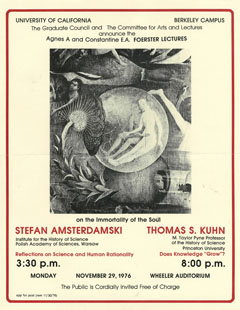
Good afternoon. Welcome to this year’s Foerster Lectures. In nineteen twenty-eight, Miss Edith Zweybruck provided an endowment for the Agnes and Constantine Foerster Lectureship on the Berkeley campus.
The subject of the lectureship was to be the immortality of the soul or some kindred spiritual subject. The first Foerster Lecture was delivered in nineteen thirty-three, and by nineteen sixty-four, some twenty-five Foerster lectures had been given, mainly by men of the cloth, theologians, and moral philosophers. No lectures were given between 1964 and 1969, the five crisis years on the Berkeley campus extending from the inception of the Free Speech Movement to its denouement of the People’s Park.
Upon the advent of the present post-revolutionary restoration area, the Graduate Council reactivated the lectureship and appointed a new Foerster committee that was to take A so-called modern view of the terms immortality and the soul. What then can be meant by a modern view of the soul and of its immortality? If by modern is meant non-religious, and if one is not to assume the philosophically sterile stands of scientistic positivism, that is to say, the idea that the soul is nothing other than the global electrophysiological output of the cerebral cortex, and that the concept of its immortality is complete nonsense, then what remains?
Well, what remains is the view that the soul is that very aspect of man that makes him uniquely human. In other words, the modern view is that put forward by René Descartes, namely, that it is thanks to its immortal soul that that man is more than a machine, that he is a person to whom moral laws apply and whose unique identity is not extinguished upon death of the body. But maybe the very notion that there is anything uniquely human about man is merely an illusion.
Maybe man is, in fact, no more than a machine. One of the main modern arguments that can be advanced in, uh, in favor of the notion that man is, in fact, more than a machine,
[00:02:30] INTRODUCER:
is that he has knowledge, which differs in some radical and so far unfathomable manner from the information stored in the central nervous system of lower animals or in the memory cores of computers. And so the recent Foerster Lectures have all been addressed in one way or another to the problem of the nature of human knowledge and its symbolic essence in order to illuminate that most elusive and yet central aspect of the soul. Today’s Foerster lectures will examine that possibly most paradoxical type of knowledge, namely scientific knowledge.
Scientific knowledge is paradoxical precisely because it is uniquely human on the one hand, but it seems to oblige us to deny the humanity of Homo sapiens. The first of the two– today’s two lectures is entitled Reflections on Science and Human Rationality, and will be given by Stefan Amsterdamski. The second of the two lectures, uh, which will be given tonight, is entitled “Does Knowledge Grow?”
And will be given here at, uh, 8:00 p.m. by Thomas Kuhn. This afternoon’s speaker, Professor Amsterdamski, was born in Warsaw and sought refuge in the Soviet Union at the outbreak of World War II. He received a secondary education in the wilds of Siberia and then returned to Poland after the war.
There he first studied chemistry at the Lodz Polytechnical Institute and then received his PhD in philosophy from the University of Warsaw. From nineteen fifty-four to nineteen sixty-eight, Professor Amsterdamski was on the faculty of the University of Lodz, and since nineteen seventy, he has been a member of the Institute for the History of Science at the Polish Academy of Sciences in Warsaw. Professor Amsterdamski’s work in the philosophy of science has been concerned mainly with epistemology.
That is to say, with the problem of how we know what we know. In particular, he has addressed the problem of the extent to which scientific knowledge can really be said to be objective. In nineteen seventy-three, he published a book entitled Between Experience and Metaphysics, which appeared last year in English translation.
That book sets forth with admirable clarity the nature of the deep philosophical problems presented by science, of which most working scientists still remain blissfully unaware. I hope that this book, uh, of Amsterdamski’s will be widely read and provide the much-needed enlightenment it offers. It’s with great pleasure, therefore, that I now present to you Professor Stefan Amsterdamski and his reflections on science and human rationality.
(applause)
[00:05:34] STEFAN AMSTERDAMSKI:
Good afternoon. It is a great honor for me to have been invited here to this university to deliver one of the Foerster Lectures, And it is a really pleasure for me to contribute to this event together with Professor Thomas Kuhn. As you know, I have chosen for my lecture the problem of science and human rationality, or perhaps more exactly, the problem of rationality and of growth of scientific knowledge.
For a long time, science has been regarded as the best incarnation of human rationality. In the 19th century, even the anti-scientifically minded Romantics did not question the rationality of science and of its development. When they attacked science, they attacked it just for its cold rationality and for pretending to be able to solve any and all human problems.
They fought against rationalism as an attitude towards the world and treated science as the strongest bulwark of this attitude. The problem of the rational character of the growth of scientific knowledge could not even be formulated in the framework of the commonly accepted image of science, regardless of whether this image served as a basis for denouncing or for blessing science as a cultural phenomenon. To question the rationality of science understood in this manner would be equivalent, roughly, to asking whether a bachelor is an unmarried man.
Today, the situation has changed. The problem of the rational character of the growth of knowledge became one of the most widely discussed questions in the philosophical reflection on science. So it seems reasonable to start with the question: what are the reasons for this change?
It goes beyond any doubt that our knowledge about science, about its methods, its history, and social determination is much wider today than it was one hundred years ago. Nor can it be doubted that the new knowledge about science and its development came in contradiction with the socially accepted image of science inherited from the nineteenth century. During the same time, the social status of science and the role of scientists in society have changed considerably.
Scientific activity became more and more subordinated to the technocratic social order and political establishment around the world. This subordination puts science in a vulnerable position. On the one hand, the critique of the technocratic social order easily becomes a critique of science serving its aims.
If this order is treated as non-rational, it means that science serves non-rational ends, and it is supposed that it serves them not by accident, but as a result of the very nature of its evolution. On the other hand, as a result of the fundamental changes in the social status of science, it became more and more difficult to maintain the nineteenth-century opinion that scientific activity is unequivocally beneficent to the mankind. Today, even the opinion that scientific activity is axiologically neutral seems to be unacceptable.
Philosophers and scientists themselves believe more and more, or then their activity is just– Sorry, that their activity, just like any human activity, is axiologically ambivalent, and ambivalence is not, of course, the same as neutrality. It is important to realize that as long as is what beli– as it, as it was believed that scientific activity is beneficent or at least axiologically neutral, scientists could believe that their ethical obligation qua scientists consists first of all in promoting the fastest possible growth of knowledge, i.e. in the best application of the scientific method according to which knowledge grows.
Consequently, in this situation, the philosophical reflection on science, which constitutes the self-consciousness of scientists, was concentrated mainly, if not exclusively, on the methodological questions. In the new circumstances, however, it became evident that even the best methodology cannot suffice For the ethics of science. In order to understand their own situation in society, it became necessary to go beyond methodology and to reflect upon the historical and social determination of scientific activity.
I believe that it is precisely these two kinds of factors I spoke of above that are responsible for the fact that history and sociology of science became recently a real battlefield on which different philosophies of science try to substantiate their evaluative attitude towards science as a social phenomenon and is the framework of which science reaches its self-consciousness. And it is just in the framework of this situation that the problem of rationality of science and of its development became so controversial. The discussion concerning this problem is in fact, first of all, so not exclusively a polemic about the factors which are supposed to determine the growth of knowledge.
The thesis that the growth of knowledge is a fully rational process may be interpreted in different way. First of all, this thesis may mean that the real process of the growth of knowledge is a pure reali-realization of some logical pattern embodied in the very method of science. If this thesis were right, it would mean that there exists a full coincidence between the logic of scientific discovery and the history of science.
It does not seem necessary to argue that this thesis is evidently false. I do not know anybody who would defend it in such a radical form. Everybody agrees that the history of science depends on a multitude of factors which are external to any logic of scientific discovery.
The problem is how relevant these factors are for the understanding of the process of growth of knowledge of science. Secondly, the thesis may mean that although history and logic do not coincide completely. Nevertheless, the process of the growth of knowledge may be reconstructed according to some permanent logical pattern which constitutes precisely the method of science.
This reconstruction is set to offer a logical or rational skeleton for understanding the whole process. It is the opinion we know from Popper’s Logic of Scientific Discovery or from Imre Lakatos’ History of Science and its Rational Reconstructions. Though logic and history are not supposed to coincide, it is believed that they mutually correspond as a distorted picture corresponds to the original it represents.
According to that opinion, the internal and the external history of science should be differentiated. The internal history, being a realization of the logical pattern, is fully rational, while the external history is not rational, i.e. it does not depend on the logical factors. It may only explain the accidental deviations of the real course of the historical process from the logical pattern.
As Lakatos said, “The rational aspect of scientific growth is fully accounted for by one’s logic of scientific discovery. Why? The external circumstances which disturb the logical pattern of the growth of knowledge are irrelevant for the understanding of science.”” Let us notice that, according to this opinion, the rationality of the process of growth of science is granted by definition.
Since it is assumed that the logic of scientific discovery constitutes the rational pattern of the growth of knowledge, and that internal histories are constructed from its basis, and that the external factors are quite irrelevant for the understanding of this process, then it follows that the process cannot but be a rational one. I would say that this is a point of view which in fact cancels all possibilities of discussion about the rationality of the growth of scientific knowledge. Its rationality is simply granted by definition.
After all, it is said that the facts which cannot be embraced by the rational reconstruction are irrelevant for the understanding of the process. And I would only add that what stands behind this opinion is a particular evaluative attitude towards science, an attitude which identifies science with rationality. We shall come below to discuss how this rationality is understood.
Thirdly, the thesis about the rational character of the process of growth of knowledge may mean that though the real historical process cannot be reconstructed according to some logical pattern, since human knowledge is always conditioned, since human knowledge is always conditioned by some extra-logical, i.e., non-rational factors, it may nevertheless be studied as a logical process of the growth of objective knowledge running in the third world. For understanding the growth of knowledge, we have to abandon the study of the second world of human beliefs and opinions, which are always somewhat subjective and never fully rational, and study the logic of evolution of the world of ideas, of problems, situations, and so on. It is, as I understand it, the last Popperian attempt to save the thesis about the rational, i.e., purely logical, character of the process of growth of scientific knowledge in view of historical facts showing that the very process as it, as it runs in the second world cannot be explained and understood only as a result of logical and methodological factors.
For saving rationality of science, we have to do epistemology without a knowing subject. It seems curious to notice how the defense could cocoon of the thesis– of this thesis led Popper to some kind of Hegelianism or Platonism. He wrote himself, “I might have challenged those who have heard of my adverse attitude towards Plato and Hegel by calling my lecture a theory of the Platonic world or a theory of objective spirit.”
And indeed, the logic of scientific discovery, which has been previously presented as a method by means of which men do science, or at least by means of which it should be done, anyway, as a method func-functioning in the world of the hum– of the human intellectual activity, this method becomes now something like Hegelian dia-dialectics, i.e., as a logic of the growth of– as a logic of evolution of the world of pure ideas. If, however, the process of the growth of knowledge is studied in the third world of ideas and problem situation, what else but logic could determine its path? Once again, the rationality of the process is granted by definition, i.e., by the very conception of the third world.
Now, Popper is obviously right when he says that in order to study the process of the growth of knowledge, we must investigate the logic of problem situations. But I cannot understand why we should agree that this logic determines the path of evolution unequivocally. I see a close analogy between this opinion and the conception of the spirit of history, which determines the path of human history despite of all accidental circumstances in the framework of which the process may run.
The opinion which Popper himself has so violently criticized in his historiosophical works. I do not see any any reason to believe that all questions which potentially could have been asked in a given problem situation are always actually articulated as it should be if the process depended only on the logic of this situation. Just on the contrary, it seems that the formulation of the question which is possible to formulate in the given problem situation depends on different factors which are quite external to the logic of discovery.
I would say that this logic might provide only the possibility of formulating the question, while the process of the growth of knowledge depends not only on this possibility, but also on factors which decide whether this possibility would be realized or not. Let me mention only one of these factors. I mean the systems of values which co-determine the scientific activity as well as the accepted image of science of its aims.
It seems obvious that the fact whether a question which it is possible to ask in a given problem situation will actually be asked depends on this kind of factors. It is precisely the values on which the very concept of science is based which decide whether a given question will be treated as scientific and worthy of investigation or unscientific and sterile. Today, thousands of physicists and mathematicians study the behavior and properties of minute elementary particles whose lifetime does not exceed a billionth of a second.
These investigations are carried out in enormous accelerators and with the expenditure of an enormous amount of money. On the other hand, thousands of facts known from everyday life do not constitute a subject of scientific interest. After all, we cannot be sure a priori whether the mathematical formula of the formation of foam on the top of a mug of beer or for the path of a filing– falling leaf would be not as interesting from the cognitive point of view.
And they are disregarded not because we know that they are futile, but because of the prevailing conception of science and of its aims. The link between the cognitive and the technological functions of knowledge is, however, by no means an epistemological or logical necessity. It is possible to imagine science which would attempt mainly to reach an understanding of the world, to made it intelligible without pretending to increase continuously our possibilities of producing things and manipulating them.
And it is hard to doubt that in the framework of science based on values other than those which determine its contemporary conception, the logic of a given problem situation could generate quite different problems to solve. Let us notice further that the values which stand behind the accepted conception of science determine the rules of acceptance and of rejection of scientific claims and the criteria of satisfactory explanation of phenomena. In other words, they determine the accepted methodology.
To take one example only, let us refer once more to Popper’s methodology. It is subordinated entirely to the goal of the fastest possible elimination of false claims from the corpus of accepted knowledge. It is meant to serve to introduce innovations into this corpus.
Falsificationism is nothing but a proposal of a certain ethics of investigations, of an ethics which recommends the exposure of acquired knowledge to the greatest possible risk of refutation. The primary value of this methodology is the permanent revolutionization of knowledge. We may perfectly sympathize with this ethical attitude, but we should be aware of the fact that the conception of knowledge whose main goal is innovation is is not the only possible.
We could imagine, and in fact there were, in fact, there were such societies in which the men of knowledge were supposed to preserve and transmit to future generations the knowledge already acquired and taken as true. They were supposed just to guard this knowledge against any novelties, modifications, or distortions. The image of a man of knowledge, whose main task is to contribute his own creative additions to the body of accepted knowledge, constitutes undoubtedly a product of a culture which values change– of the culture which values change and progress highly.
It is hard to believe that the Popperian methodology of science, independently of how it may be appraised today, could be elaborated in a society for which the preservation of tradition could would be the main main value. So my conclusion of the first part of this reflection may be formulated as follows. If the thesis about the rational character of the process of the growth of knowledge is to mean that the logic of problem situation determines unequivocally the process of the growth of knowledge or gives the possibility of its reconstruction in such a way that it explains the real historical process, then this thesis seems unacceptable.
Putting this conclusion in more philosophical terms, I would say that I cannot accept the Popperian thesis about the primacy of logical in respect to genetical, i.e., historical, psychological, or sociological questions. And let me notice that it is just one of the few theses which remain unchanged in the long evolution of the Popperian philosophy of science from the Logik der Forschung to the epistemology without a knowing subject.
(cough)
There is, however, another aspect of the problem under discussion, in which the thesis about the rational character of the process of the growth of knowledge concerns some questions other than the factors determining the process. I mean, the problem of absolute versus relative character of the criteria of rationality, and in consequence, the problem of the continuity of the growth of knowledge. The second part of my lecture will deal just with these questions.
When we do not advance such a definition of science or of scientific method as would guarantee a priori the rationality of the process of the growth of knowledge, when we do not assume a priori that the rules of the scientific method must always be equivalent with the criteria of rationality, we face the following problem. What are specifically the criteria on the basis of which we apprise the growth of knowledge as a rational or non-rational process? There would be, of course, no problem of rationality if men were regarded as fully rational beings, just as there would be no problem of truth if men were unable to produce and accept false statements.
It is, however, by no means clear what we are asking about when we are looking for the criteria of rationality, what we try to differentiate by means of such criteria. First of all, the problem may be regarded as a purely epistemological issue. It may be assumed that among different methods of acquiring or accepting items of valuable knowledge, I stress here the word valuable.
Some methods are more reliable than others or can even guarantee certainty. It could be said that the history of epistemology, and especially of modern epistemology since Descartes and Bacon, is a history of attempts to outli- to outline such a method. It is obvious that we cannot discuss these attempts in any detail here.
It seems, however, that two points should be made in this context. First of all, what stood behind these attempts to discover the rational method of acquiring and accepting items of knowledge, especially in modern epistemology, was the belief that in the actual process of cognition, the different methods of acquiring and accepting knowledge are entirely, or at least to a high degree, independent from one another. If it were not for this belief, the very idea of discriminating such a method among the natural human cognitive abilities could not even arise.
Knowing and believing, experiencing and reasoning, describing and evaluating were treated as faculties functioning separately and independently of one another in the actual process of human cognition. No matter whether it was claimed that human rationality consists in accepting such knowledge which is controllable on the grounds of the natural human cognitive abilities, or that it consists in accepting only knowledge of a purely empirical character free from any metaphysical assumptions, or in accepting only facts whose necessary character may be demonstrated, the proposed– The proposed criteria of rationality were always based on this assumption I just spoke about. And it seems that the conception identifying science with rationality is one of the consequences of this assumption.
It is based namely on the belief that scientific cognition is just that kind of cognition which could– which grows may be entirely independent from all extra-logical factors. Different conceptions of the scientific method from Descartes, Bacon, and Hume to Carnap and Popper are in fact attempts to differentiate such a method. Let us notice finally that this attitude towards the problem of rationality leads inevitably to the question: what are the foundations of human rationality?
As if rational cognition had different foundations than the methods of cognition treated as non-rational. It may be interesting to notice that if previously this question was understood as pertaining to the foundations of logic, today we have to deal with the tendency to look for the foundations of rationality in biology. No matter what are the philosophical differences between the epistemological conception of Chomsky, Piaget, Lévi-Strauss, and last but not least, Popper, it seems that it is their common tendency to explain the foundations of rationality.
Thus, for example, Popper wrote, “From the amoeba to Einstein, the growth of knowledge is always the same.” We try to solve our problem and to obtain by a process of elimination something approaching adequacy in our tentative solutions. The difference between the amoeba and Einstein is that, although both make use of the method of trial and error elimination, the amoeba dislikes to err, while Einstein is intrigued by it.
From the amoeba to Einstein is just one step. It is in Objective Knowledge, page seventy and two hundred sixty-one. Now, and this is the second point I wanted to stress, if we treat the problem of criteria of rationality as a purely epistemological issue, then the difference between rationality and non-rationality is regarded as a fact of nature.
Philosophy of science, or more generally epistemology, is to discover this difference, which, as a fact of nature, is given to us once and for all. Accordingly, the criteria of rationality, no matter what they are supposed to be, are treated as historically unchangeable and independent from any transient factors or any cultural framework. If you accept this point of view, it means that we believe that the concept of valuable knowledge is also historically unchangeable and does not depend upon any cultural factors.
And to the contrary, if only we agree that the accepted concept of valuable knowledge is not permanent, that in different cultures and in different periods of their evolution, different kinds kinds of knowledge may be preferred. We have to agree by the same token that the conception of reliable methods of acquiring or accepting the items of such knowledge cannot be unchangeable either. This means, obviously, that the difference between rationality and non-rationality is not given once and for all, no matter what could be the biological foundation of human knowledge.
Epistemology is not to discover this difference as a fact of nature. It posits it rather normatively accordingly to the social- socially preferred conception of valuable knowledge. Let us take only one example.
If, for instance, we treat knowledge, and especially scientific knowledge, as a means for achieving certain pragmatical goals, whatever they may be, then the difference between rationality and non-rationality is exactly the same as the difference between effective and ineffective ways of action. It is obviously the concept of rationality which we use when we are talking about the theory of rational decisions. It is applicable only for appraising the means, but not the ends which these means are to serve.
It is often claimed this is a value-free concept of rationality. I wonder whether this opinion is right. When we are appraising our methods of acting and knowing in its terms, we usually express just our preference for some specific kind of knowledge, namely for knowledge as an effective and axiologically neutral tool of action.
When we say that science provides a rational method of acquiring true knowledge, and when we understand rationality in this way, it simply means that truth is understood here as technological proficiency. Such a conception of science is obviously the product of a culture in which technological efficiency is considered as a primary value. Thus, I would say that the demarcation between rationality and non-rationality is not a fact of nature, but is culturally determined.
It is constituted by the socially determined conception of valuable knowledge, or, as we could say, by the socially accepted image of science and of its aims. This means that it is subordinated to the acceptance of some value systems. Being culturally determined, this line of demarcation is historically changeable, and it is impossible to fix it once and for all.
I see a close analogy between the claim of radical empiricism that there are pure empirical facts which are not theory-laden, and the belief that the rationality of science is independent from the socially accepted evaluative conception of knowledge, that it is determined only by the objective nature of scientific statements which are intrinsically different from other statements. In other words, I think that just as the demarcation line between empirical and theoretical statements is impossible to draw without relativization to a given language and a given state of knowledge, so it is impossible to differentiate rationality from non-rationality without relativization to a given conception of knowledge imposed by culture. What follows from this point of view is that the criteria of the demarcation between rationality and non-rationality cannot be treated as suprahistorical.
Their validity is limited to a given culture and, by the same token, transient. The circumstance that this criteria may be commonly regarded as universally valid and considered almost obvious or even the only— the only possible does not in fact change their relative character. It may only conceal it.
The presentation of a convention as of an objectively descriptive statement is a perfectly known ideological phenomenon. It results in treating facts of culture as object-objective facts of nature. What stands behind this attitude is the acceptance of some value systems which dictate the conventions and which only in this manner can achieve the status of universality and objectivity.
The rationality of today does not want to be treated as contemporary rationality only, but rather as rationality tout court, valid in all places and in– at all times. But it can achieve this status, this, only in one manner, namely, it has to conceal its own conventional character and present itself as a fact of nature which cannot be questioned. After all, gentlemen don’t quibble about facts, but even gentlemen are tempted to consider as facts what is only a product of their own culture.
Now, let us consider the problem of the rationality of scientific growth with respect to the conceptual framework I have tried to outline above. The conception that the difference between rationality and non-rationality is a fact of nature which is to be discovered by epistemology leads obviously, as I have said, to the belief that the criteria of rationality are suprahistorical, that they are rooted in the very nature of human cognition. The categories of rationality and non-rationality are treated as pertaining to objective features of scientific cognition independently of any evaluation rather than as evaluative concepts which express our attitude towards science as a cultural phenomenon.
If the growth of science is treated as a rational process, then this means that science realizes always the same pattern of rationality. On the contrary, if we treat rationality as a category which is determined culturally and historically, our problem of the rationality of scientific growth assumes quite a different dimension. In fact, what we are asking is the question whether the evolution of scientific knowledge proceeds always in conformity with the changing pattern of rationality.
Such a formulation of the problem does not presuppose that scientific growth is either a rational or a non-rational process. However, this conception does presuppose that if the growth of knowledge is a rational process, then it does not realize always the same pattern of rationality, and any statement expressing, expressing such an appraisal is determined by a specific evaluative conception of knowledge. It may be interesting to note in this context that the two opposite points of view about the rationality of the process of the growth of scientific knowledge, namely, that this process is always rational or, on the contrary, that it is not a rational process, that in science everything goes, have a common source.
Neither of them, neither of them perceives the possibility that the growth of knowledge and of scientific knowledge in particular may be a rational process without realizing a permanent pattern of rationality. The first of these viewpoints treats as a fact that science realizes some logical pattern as an evidence for claiming that the growth of science realizes always the same pattern. This point of view absolutizes the logical pattern of the evolution of scientific knowledge in any given epoch and treats this pattern as universally valid and independent from historical circumstances which are said to be irrelevant.
From the second point of view, the fact that there is no permanent logical pattern of growth of knowledge, that there is no universally valid criteria of rationality, implies that there are no such criteria at all. If all the historical facts cannot be explained by the same pattern, then we must conclude that the process of the growth of knowledge is not a rational one. That, finally, we have to do with three concepts.
We have to deal with three conceptions. According to the first, the difference between rationality and non-rationality is rooted in the very nature of cognitive procedures, while scientific knowledge is just that kind of knowledge which, due to its method, always realizes the pattern of rationality. According to the second conception, historical facts show that the growth of science does not realize any such pattern of rationality and therefore cannot be treated as a rational process.
According to the third point of view, which we are presenting here, the difference between rationality and non-rationality is not a fact of nature, but is constituted by culture. As such, it is historically changeable and has an evaluative character. The thesis that the growth of scientific knowledge is a rational process would mean in this framework that different patterns of rationality could be realized in different epochs and under different historical circumstances.
Whether this thesis is, is true or not is an empirical question that should be solved by historical investigation. In order to know whether and how science realizes the historically changeable pattern of rationality, we have to start by construct– reconstructing the criteria of rationality accepted in the given historical and cultural circumstances by the scientific community as well as outside the scientific community. Appraisals of the growth of knowledge as a rational or non-rational process may be formulated only on these grounds and are always relative in this respect.
Among different objections raised against the presented point of view, two seem to me to be especially important. The first concerns the problem of the incommensurability of scientific theories. Since I treated this question at some length in my book, Between Experience and Metaphysics, I shall repeat here only the conclusions.
First of all, it seems to me that if we seriously accept this thesis that there are no pure empirical facts and that all facts are theory-laden, then this thesis about incommensurability must be accepted as a consequence. What this thesis means is that the same empirical statement has different meanings in different theoretical frameworks. Thus, when the theoretic-theoretical framework changes, there cannot be full correspondence between successive theories.
This seems to be true independently of whether the criteria of rationality are or are not relative. Secondly, I tried to show that such an interpretation of the thesis about incommensurability does not contradict the thesis about the accumulation of knowledge in the process of the growth of science. Subsequent theories may explain all the facts explained by their predecessors, plus some facts they could not cope with, without corresponding with the old theories in their meanings.
So I think that the thesis about incommensurability does not exclude the possibility of speaking about the process of the growth of knowledge. Thirdly, there is the problem of the consensus omnium. It has been argued that if the criteria of rationality in science are relative and historically changeable, there must exist some periods of transition in which there is no consensus omnium at all, when the rational communication between scientists must break down, and when the process of growth of knowledge is not subordinated to any criteria of rationality, either permanent or transient.
This conclusion seems to me unjustified because it does not follow from the accepted premises. It would be implied by them only if we claimed that all the opinions and assumptions constituting the consensus omnium of the scientific community at any given time were abandoned simultaneously. I see no reason for accepting such a model of scientific change.
Thus, even if the pre and post-revolutionary theories are incommensurable and the criteria of rationality are relative, this does not necessarily imply that there is not any consensus omnium in the period of transition. The second objection, which I will answer, pertains to the problem of relativism. It is often claimed that the relativism is in our time the central bulwark for irrationalism and the main danger for, danger for our culture.
Maybe the acceptance of this opinion depends on where we are coming from, what would constitute just the point on behalf of re- of relativism. But I should confess that I cannot see why absolutism should necessarily be treated as less dangerous than relativism. There is enough of historical evidence to show that our culture may be threatened by the belief that all truth is relative, as well as by, by the belief that we are in command of the method which guarantees absolute truth.
Anyway, these are not arguments which could substantiate the claim either for relativism or on behalf of absolutism. As we know, relativism is claiming that there is no absolute universally valid truth, that all appraisals of truthfulness are always relative. It is, however, obvious that there are many kinds of relativism in philosophy, and it does not seem to me that everybody who claims that the criteria of rationality are rooted once and for all in human nature is by the same token an absolutist.
Just on the contrary, the polemic we are speaking about is rather a polemic between different kinds of relativism. Let me explain in a few words what I mean. As I have said above, the conception according to which the difference between rationality and non-rationality is a fact of nature, arises the question, what are the foundations of human rationality?
This problem is usually considered as a question concerning the nature of logic. Now, as it is perfectly well known on the grounds of the hu-Husserlian critique, it is impossible to substantiate the concept of absolute truth by psychological or biological or conventional interpretation of logic. All this interpretation relativizes the concept of truth to some few features of the human species, be they psychological, biological, or cultural.
None of this interpretation allows us to say that some statements are true in the absolute sense of the word, i.e., that they are necessary truths irrespectively of the nature of the knowing subject. When, for example, Popper identifies the criteria of rationality with the rules of errors elimination and looks for the biological background of these rules, this is how I understand his comparison of the amoeba with Einstein. He obviously accepts some kind of relativism.
Truth becomes the same as acceptability for a species with a specific biological constitution. It is not the right time for explaining why I do not believe that Husserl was able to substantiate the absolute concept of truth. I can only refer to Leszek Kołakowski’s book, Husserl and the Search for Certitude, and say that I agree, agree with his argumentation.
But what I want to say is that when Popper, for example, claims that relativism is the main bulwark for irrationalism and the danger– danger for our culture, he does not in fact defend absolutism against relativism. What he defends is a biological relativism against cultural or sociological relativism. His anti-sociological attitude with respect to the problems of the theory of knowledge is obviously an expression of his evaluative conception of the human nature.
But at the same time, his adverse attitude towards relativism seems to be self-destructive for this– for his own philosophy. Even if relativism were indeed the main danger for our culture, there is no reason for claiming that biological relativism is something less dangerous than historical relativism. I think there are no arguments which could substantiate either point of view.
What stands behind the conflict between relativism and absolutism is rather a conflict of value systems. And it seems true that both of these attitudes, relativism as well as absolutism, have been necessary conditions for the evolution of our culture, since this culture has grown just because of the conflict of values which stood behind each of these attitudes. Thank you for your attention, and I apologize for my English pronunciation.
(applause)
[00:57:49] INTRODUCER:
Professor Amsterdamski had ag- has agreed to answer questions, uh, in case… No, you have agreed? In case, uh, uh…
But I, I’d like to ask the first question then. Uh, I, I didn’t– Do you say that the, um, the absence of, um, a permanent criterion of rationality, which you say could be an em– subject to empirical test, do you believe that has already been tested empirically and shown to be not so?
Or are you only considering the possibility that the criteria of rationality have changed through history? That, that was not clear to me.
[00:58:34] STEFAN AMSTERDAMSKI:
No. What I said, what I said is that we have no evidence at all that criteria of rationality are permanent. I didn’t claim any stronger statement.
[00:58:56] INTRODUCER:
So it, it is possible that they’re permanent. Is that, is that a possibility? No. It’s not possible.
[00:59:01] STEFAN AMSTERDAMSKI:
No. So I– You didn’t– I, uh, I didn’t say what I wanted, if you understand me. No, what I claim is that they are not permanent. That they are not permanent.
[00:59:16] INTRODUCER:
But is that, is that claim based on empirical evidence, or is that-
[00:59:20] STEFAN AMSTERDAMSKI:
Y-yes, on historical evidence.
[00:59:22] INTRODUCER:
I see.
[00:59:23] STEFAN AMSTERDAMSKI:
On historical evidence.
[00:59:25] INTRODUCER:
So historical evidence is already available that shows that there are– that the criteria of rationality are not permanent?
[00:59:32] STEFAN AMSTERDAMSKI:
Yeah.
[00:59:33] INTRODUCER:
That’s your– I see.
[00:59:34] STEFAN AMSTERDAMSKI:
Yes, that’s my thesis.
[00:59:36] INTRODUCER:
I see.
[00:59:40] STEFAN AMSTERDAMSKI:
Uh, yes, please.
[00:59:43] AUDIENCE MEMBER:
I would like to, uh, knowing the, the, uh, country from which the speaker is coming, I would like to know what is your opinion regarding rationality of, of socialist realism for instance, if there is any? If there is any, is that then depending on the cultural patterns? in, in various, uh, parts of our humanity, or is the one criteria, one place where the irrationality is a basis for socialist realism?
[01:00:25] INTRODUCER:
Do you want answer that, uh, uh…
[01:00:29] STEFAN AMSTERDAMSKI:
First of all, I should say is that I am not a literary critic, so it’s very hard to answer your question for me. And I don’t think for– I don’t think that the c-concept of rationality may be applied in this field as it is applied in the field which I was concerned with. That’s all I could say.
I th– I don’t think that the concept of rationality may and should be applied for uprising trends in art. I don’t s-s– I couldn’t say about any kind of art and about any school of art, is it rational or not rational? I don’t think this is a concept which can be applied to this problem.
[01:01:30] INTRODUCER:
Yes. How does it…
[01:01:31] AUDIENCE MEMBER:
There’s a certain simplistic question. What was the citation you gave for the post-Surrealist manifestation at the end?
[01:01:38] INTRODUCER:
Can, can you speak louder? I, I, I can– we can’t hear you.
[01:01:41] AUDIENCE MEMBER:
Could–
[01:01:47] STEFAN AMSTERDAMSKI:
Yes. It’s Professor Kolakowski. Kolakowski. The book is published by Yale University, Yale University Press in 1974 or five, I don’t remember exactly, and the title is Husserl and the Search for Certitude. Sure.
[01:02:29] AUDIENCE MEMBER:
Yes. Could you elaborate more on your response to the first question by giving some examples of historical changes? in predatory rationality. Or is that too much time?
[01:02:49] STEFAN AMSTERDAMSKI:
You know, I tried to give some examples in my book, and I will not repeat them now. I would say only one thing. What I mean about this problem is that, for example, if you have the concept of valuable knowledge as a knowledge of, which is technologically efficient, so you will appraise the rationality of this knowledge, of the growth of such knowledge in quite different terms, that you will appraise the growth of knowledge When you treat science not as a means for achieving certain technological goals, but as a means of making the world more intelligible, et cetera.
It’s the difference I see. And if, if you have a different conception of valuable knowledge, then the criteria of appraising its rational growth will be different. You are, are asking me about some historical examples.
Without treating them in details, if you will refl– if you would reflect about the aims of knowledge as it was understood in antic– in antiquity and Middle Ages, and if you will regard the aims of knowledge as they have been– as they were regarded in modern times and contemporary, we easily will find– And you easily will find what are the differences in their aims. And if you will find the differences in their, in the aims of the growth of knowledge, then we will s– you will see the differences in uprising the rationality and non-rationality of their growth.
[01:05:00] AUDIENCE MEMBER:
Yes. When we apply your own notion of relativity to the conception of rationality that you’ve developed, or the thesis that you’ve developed? In other words, what sort of truth are you claiming for your thesis?
What sort of rationality are you claiming for the methods that you use to reach it? Is it rational in the sense that it’s technologically efficient?
[01:05:25] STEFAN AMSTERDAMSKI:
No, I’ve… I am not sure that I did understood exactly your question, but anyway, uh, I, I I do not treat the concept of rationality.
It seemed to me evi-evident in my lecture that I didn’t treat the concept of rationality as equivalent with technological efficiency, just what I wanted to criticize. So it must be a misunderstanding if you understood my lecture in this way. What I have said, what I tried to say was that there is not one concept of rationality, that if you have different conception of valuable knowledge, you have by the same token different conception of rationality.
And the con– And that the conception of rationality is a category, is a kind of uprising from some, from some point of view. And no, I repeat that the difference between rationality and non-rationality is not a fact of nature, but a fact of culture.
So our appraisals are relativized to some culture in which, according to the c– values of which we apprise. That’s what I wanted to say.
[01:07:04] AUDIENCE MEMBER:
If I may ask one more question then. Would you think it is conceivable that mathema– there would be cultures in which mathematics or formal logic would be considered, i-i-if they knew about it, that they would consider that n-uh, not rational, that it would fail, uh, with the criterion of rationality, that culture would fail, uh, to– mathematics will fail under that criterion?
[01:07:25] STEFAN AMSTERDAMSKI:
That’s a very difficult question.
[01:07:27] AUDIENCE MEMBER:
I see.
[01:07:27] STEFAN AMSTERDAMSKI:
It’s a very difficult question, you know, uh, because It is a question just as I, if I understand it right, It is a question, is it possible that there would be a culture or that there would be even a living species for which the principle of contradiction would be not true? It is a question you asked me just. I don’t know.
No. I, I- Yes, because if I accept this thesis that there can be a culture in which logic or mathematics can be treated as non-rational.
It would imply that in this culture, for example, the principle of contradiction will be not accepted. And I do not see, I don’t think that it’s possible. I don’t think.
I don’t know. I don’t think so. So that’s all what I…
I have no argumentation for this point. I don’t know.
[01:08:40] AUDIENCE MEMBER:
Yes. Yeah. There were a few references to the nature of technology as an extension of rationality.
Uh, And then what I was wondering is, are we then left with political innocence of the means of production? Um, could you possibly remind us somewhat of your views on, uh, the role of technology and whether or not it’s– can be viewed as, uh… Obviously, there’s a relation between, uh, its use and its, uh, conception.
Could you possibly, um, discuss whether or not the, the neutrality of tech-technology, or the means of production, would, uh, be inevitable or perhaps, uh, you might have something to say on that?
[01:09:37] STEFAN AMSTERDAMSKI:
I cannot discuss this problem simply because it’s not the thesis I defended. I n– I didn’t say that the, the means of production are axiologically neutral. I didn’t say that.
So I cannot… It’s just– I just said I didn’t, uh, speak about that problem, but what I say about science implies some concept of some answer to this, to your problem.
It’s not what you said.
[01:10:22] INTRODUCER:
All right, one more question then, yeah.
[01:10:23] AUDIENCE MEMBER:
One more question. Um, do I understand correctly that, uh, empirical knowledge is not rational? Or that if there is, uh, if this rational– whether this rationality could be determined by that, uh, uh, specific culture.
[01:10:55] INTRODUCER:
Yeah, I guess I didn’t understand your question either. He didn’t, uh-
[01:10:59] STEFAN AMSTERDAMSKI:
Excuse me, but maybe it’s my fault, but I didn’t understand the question. Um, I didn’t understand the question, I cannot answer.
(laughter)
[01:11:11] AUDIENCE MEMBER:
Professor, I thought that I heard you state, stating that, uh, empirical knowledge is not rational.
[01:11:18] STEFAN AMSTERDAMSKI:
No, I didn’t say that.
[01:11:19] INTRODUCER:
No, he didn’t say that.
[01:11:20] STEFAN AMSTERDAMSKI:
I didn’t say that.
[01:11:22] AUDIENCE MEMBER:
Thank you very much.
(laughter)
[01:11:25] INTRODUCER:
Well, so we thank Professor Amsterdam once more, and we meet again at eight o’clock tonight. Professor Schoonstock.
(applause)