
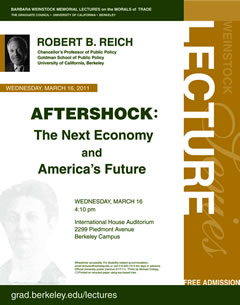
[00:00:00] ANDREW SZERI:
Good afternoon.
(background chatter)
Good afternoon. I’m Andrew Szeri, Dean of the Graduate Division. We’re pleased, along with the Graduate Council, to present Robert Reich, this year’s speaker in the Barbara Weinstock Memorial Lecture Series.
In 1902, Harris Weinstock, a well-known businessman of Sacramento, presented the University of California with a fund to support an annual public lecture on the morals of trade on behalf of his wife, Barbara. Weinstock was fundamentally committed to the economic and moral progress of humankind. He wrote many newspaper columns and gave numerous lectures on topics ranging from Napoleon to socialism.
Inspired by Sp– Spencer and Newton’s essays on the morals of trade, which lamented the state of morals in the mid-19th century business world, he argued that a man does not profit if he gains the whole world and loses his soul. Harris Weinstock hoped that this lectureship would lead to a better life for those who spent their lives in commercial pursuits. He said, and I quote, “Let men and women the world over worship character rather than wealth.
Let them do homage to the highs, high-minded and pure-minded, rather than the merely rich and powerful. And the ideal age will be at hand when trade will carry with it the badge of honor, and the successful man of business will take the pla– high place hitherto confined to the patriot and faithful servant of mankind.” End quote.
Past lecturers who have delivered the Barbara Weinstock Memorial Lectures on the morals of trade include Ralph Nader, Member of Parliament Neil Kinnock, and Nobel Laureate Amartya Sen. And now, I’d like to welcome Professor Carlene Roberts, the chair of the Weinstock le– lectureship committee, to the podium to introduce Professor Reich.
(applause)
(footsteps)
[00:02:13] INSTRUCTOR:
Thank you. Before I introduce Professor Reich to you eh, all of you, I’m sure, know a great deal about him or you wouldn’t be here. But before I do that, I’d like to explain why, if you look on the back of your program, you will find that there has never been a Weinstock lecturer who was on the faculty at Berkeley at the time he was asked to be the Weinstock lecturer.
And the reason is pretty simple; we forgot.
(audience laughter)
So at our meeting to select this lecture, as chair of the Weinstock Committee, I said, “Look, guys, we–” And by the way, it is guys except for Ellen. Uh, “We have never had a professor who was on this faculty, and look at all the sterling professors we have beginning with Robert Reich.”
And that was the end of that conversation. So I want to welcome you all and Professor Reich today. And I’m not going to say too much about him because you have a little blurb about him and most of you know about him, and I’ve seen his books flying around here pretty well.
Um, he is the Chancellor’s Professor of Public Policy at the Goldman School here at Berkeley, rah. Um, and he was, as you probably know, the 22nd Secretary of, of Labor. And he was voted by Time Magazine as being the most, one of the most outstanding secretaries of labor.
He’s written quite a bit. I hear him on the radio quite a bit. And So I, and, and so I think we’re all anxious to get on with it and listen to Professor Reich.
I just wanted to tell you something I didn’t know. He graduated from Dartmouth and then he went on to be a Rhodes Scholar at Oxford, and then he got a law degree from Yale. And he’s he has talked to the Su– Supreme Court on the part of the US government.
May I welcome Robert Reich?
(applause)
[00:04:27] ANDREW SZERI:
Professor Roberts.
[00:04:28] ROBERT REICH:
Professor Ro– thank you, Professor Roberts. And thank you all for coming today. I was informed just as I got here that this lecture is going to be, I’m being.
What, I’m streamed, I’m being streamed live. Is that right? I don’t know what it means to be streamed live, but that’s what I am going to be.
In fact, it’s already happening. You are actually witnessing the streaming of someone live. Well, I’m going to talk for about 40 minutes while I am streamed live, and then invite your questions.
And hopefully, I will have an opportunity to respond to most of your questions. A couple of other points need to be said. About Harris Weinstock and this lecture, The Morals of Trade, many of you in this audience know that about 12 years before Harris Weinstock endowed this lecture and conceived of this lecture in 1890, the great economist Alfred Marshall wrote his Principles of Economics.
Before that time, economics was not really thought of as a separate discipline. In most of the 19th century, it was all called moral political economy. And before that, in the 18th century, it was all called moral philosophy.
Adam Smith did not consider himself an economist, obviously did not really even consider himself a political economist. He thought of himself as a moral philosopher. And so even though I’m going to be talking to you a lot about economics and politics, really underlying what I am saying are questions of ethics, questions of how we live together as members of the same society, and members of really the same human species on the globe.
We’re all reminded of that notion that we’re all together as members of the same human species on the globe, in which what we do is inevitably going to affect what others do directly or indirectly by the terrible tragedy now unfolding in Japan. It is, first and foremost, a human tragedy, and also an environmental tragedy. We don’t know the dimensions yet, and probably, like you, I have been getting every piece of information I possibly can.
But it is also way down the list an economic tragedy. Japan is the third-largest economy in the world. In fact, of developed economies, so-called advanced economies, Japan is second only to US, which means that we have enormous amount of trade with Japan.
Japan owns a lot of our debt, a lot of Treasury bills. What happens in Japan inevitably, quite apart from the human suffering, quite apart from the environmental degradation, quite apart from these very, very important primary issues, there is also the economic interdependence and the economic consequences, which I’ll get to in a moment. A question I want to address with you today is what is going to happen over the next few years in an economy, that is, the United States economy, that is having a painfully difficult time getting out of the gravitational pull of the Great Recession.
Now, if you listen to people on Wall Street, if you appear as I do on CNBC, or have, or, or listen to–I don’t know. How many of you actually watch CNBC? Don’t be embarrassed.
(laughter)
That’s about what I expected. I debate people on CNBC and now on MSNBC, and occasionally on the networks, and what passes for economic discussion on CNBC is very much Wall Street’s point of view. That is, the issue is, what’s going to happen to stocks and bonds?
It’s not really the economy, or at least perhaps I should say it this way, the economy is defined as Wall Street, as stocks and bonds, and that is not to criticize CNBC or anybody else. That’s what the business pages of the newspapers tell us. That’s what many experts focus on because so many people are dependent on what happens on Wall Street.
They want to know. Their retirement income depends on it. Their future security depends on it.
They like to know where Wall Street is heading. And I, I will tell you before the end of our 45 minutes, I’ll tell you exactly where Wall Street is going.
(laughter)
I’ll do it very rapidly, so listen carefully. You may miss it because it will occur so rapidly. But that’s not the economy.
The real American economy is different from Wall Street. If you listen only to the cheerleaders on Wall Street, you see we’ve had a, a huge bull market. Things are almost back to where they were before.
The Dow Jones Industrial Average is over 12,000. Well, that’s not quite where it was in 2007, but it’s still getting way up there, and on top of that, corporate executive salaries and bonuses on Wall Street are just about back to where they were, and things are looking very good. Yes, there is some concern about the consequences of the United States economy of what’s happened in Japan, and, and there is some worry about oil prices given what’s happening in the Middle East.
But generally speaking, there’s an enormous, almost buoyant confidence that comes out of Wall Street and out of corporate America. Corporate profits, by the way, are soaring. They really have, in my experience, never been, if you look at the major, large American corporations, almost never this high.
Big companies in the United States are sitting on $1.8 trillion of cash. Now, those estimates vary between 1.4 trillion and 1.9 trillion. I saw yesterday at the end of 2010, it was 1.9 trillion.
It’s very difficult to estimate. It’s hard to get. But we know it’s a very big number.
There’s a lot of money and they are sitting on it. It’s in the form of cash, which means the big companies don’t even know really what to do with it. Normally, normally after a recession, when large companies begin showing profits, they take those profits and they invest them in additional capacity, which means more jobs.
Not immediately. There is typically a jobless recovery, at least until businesses start feeling confident that consumers out there will buy and are capable of buying all of the goods and services that those companies are capable of producing at full employment. But then employment cranks up and you get a virtuous cycle because as employment goes up and people get more wages and they feel more confident and they feel more secure, they buy more.
And as they buy more, the economy naturally rises. Most of the business cycle in this country, at least most of our recent experiences with the business cycle, by the cycle I’m talking about the cycle of, of exuberance and expansion and then overshooting, which leads to a kind of downward momentum, often a recession is the ending point. Most of those cycles, those business cycles, are really brought about by the Federal Reserve Board.
And the Federal Reserve Board either overshoots or undershoots. The Fed either raises interest rates too high, trying to ward off inflation, or it keeps interest rates too low and generates just too much economic activity, given the capacity of the country to avoid inflation. And that’s what it is usually.
But something is different this time. Something is different this time. Profoundly different.
There is a decoupling between the profits that the big companies are showing and the extraordinary gains on Wall Street on the one hand and job growth on the other. There’s a decoupling between how people at the top are doing, and they are doing extraordinarily well. I’m talking about the top 1% on the income scale or the top 1% on the wealth scale, or even the top one-tenth of 1% to make a point even more dramatically.
They’ve never done as well. There’s a dramatic gap between how they are doing and how everyone else is doing in this recovery. And going back to Harris W– Weinstock’s concern about the morality of trade or the morality of our commercial system, something seems out of whack.
And many people are asking themselves, “What’s going on?” Now, again, if you think of this as just the normal business cycle, you would expect that when the Federal Reserve Board kept interest rates near zero or at zero for as long as it has, we would see a lot of borrowing going on, and that borrowing would generate more economic activity. You would think when we had as much spending, at least until recently, as we had at the federal government level, that that would have generated enough of a so-called multiplier effect, that is everyone who benefited directly by the spending would have more money in their pockets, they would turn around and buy more and so on, that that would also have contributed to a vigorous recovery.
You would expect that fiscal and monetary policies, as those are called, would by now have kicked in. And given how deep a hole we have found ourselves in in this Great Recession, you would think that by now, not only would unemployment start really dropping, but also the economy would start growing. I mean, if you’re in a hole, to get back to the surface, back to where you were before, you do need more than normal growth.
I mean, think of the economy as sort of a, a, a, almost a, a, a climb, a kind of you’re moving uphill. The economy is growing, but when you fall into a hole on that climb, then you need to have faster growth in order to just get back to the surface where you can then resume the growth you had before. So what we would normally assume would be instead of 2.5 or 3% growth, now we would assume 4 or 5 or 6% or 7% growth.
It’s not happening. Mystery upon mystery. Something is different.
Well, I want to talk about that because it seems to me that what really is happening has a lot to do with long-term structural changes in the economy, changes that have a lot in turn to do with inequality of income and wealth, an opportunity, and political power. No one likes to talk about political power. I will.
(audience laughing)
And less and less to do with the business cycle. And this is why it seems to me people are looking in the wrong place for answers. I, I, don’t get me wrong.
I do think the Fed needs to keep interest rates as low as possible. I do think and wish Washington were prepared to expand fiscal policy. I think it’s the height of folly for Congress and the, for the president right now, right now, to be concerned about budget deficits.
Yes, be concerned about it three or four or five years from now when we are out of the gravitational pull of the Great Recession, but right now when we need as much aggregate demand as possible, when consumers are still scared, when businesses are still sitting on so much money because they don’t think that there are customers out there for their goods and services, when we have unemployment as high as we do nationally, 8.9%, 8.8%, but also almost 14 million Americans unemployed, half of them unemployed for a very long period of time, this is no time to pull in your horns and start cutting and whacking budget deficits. And oil prices are going up. And at the same time, state governments are pulling in and cutting their budgets, and many of the things that are being cut are desperately important to the working class and the middle class and the poor who are suffering enormously.
And let’s don’t do it. Not now. But having made that point, I wanna go beyond and talk about inequality.
Here, it seems to me, is the terrain that we really need to traverse in terms of understanding what’s happening. The typical 30-year-old man, and I’ll explain to you in a moment why I’m talking about the 30-year-old man, the typical 30-year-old man today, if he has a job, is earning, adjusted for inflation, no more than the typical 30-year-old man earned three decades ago, adjusted for inflation. Or to put it a different way, if you look at the bottom 90% of Americans and looked at their average wage, adjusted for inflation, each worker would be doing a little bit better.
That is, wood loo– would earn this year about $280 more than he or she earned three decades ago. That’s not much to show over three decades. The American economy is much larger.
It’s twice as large as it was three decades ago, and yet the median wage for those lucky enough to have jobs has gone nowhere, and if anything, it’s gone down. Why? What’s going on, and how does this relate to the Great Recession and the difficulty we’re having getting out of the Great Recession?
How does this relate to questions of ethics and morality? And also, where did all the money go? I mean, if the American economy is twice as large as it was 30 years ago, and if the median wage is pretty much stuck in neutral, then you’ve gotta have some idea of where all the gains went.
If you’re in the top 1%, you are not stuck in neutral. Your share of total income doubled over the last 30 years. If you’re in the top 1/10th of 1%, your share of the national income tripled over the last 30 years.
We haven’t seen this degree of concentration of income, and wealth is even more concentrated, since the 1920s. More about that in a moment. How have working families over the last 30 years managed to maintain their standard of living?
How have they managed to continue to spend? Well, one of three ways. The first way was women going into paid work in great numbers, starting in the late 1970s, increasing in the 1980s, increasing again in the 1990s.
A huge number of women in the United States went into paid work. I wish I could tell you it was all because of the wonderful professional opportunities open to professional women beginning in the late ’70s and starting in the ’80s. No, that was not the primary reason.
The primary reason that women went into paid work in great numbers, even those with young children, was because they needed to in order to prop up family incomes where male wage earners were actually showing declines in wages. That’s the only way they could keep up their living standards. But, you know, we come to an end of that coping mechanism, right?
In the 1960s, to give you an example, only about 20% of women with young children were in the paid workforce. I say paid because women always were working. Question is whether they were getting paid for their work.
And 20% of American women in the 1960s were, with young children, were in the paid workforce. By the 1980s and 1990s, we were up to 50 and 60%. In fact, by the 1990s, it was up to 60% of women with young children were in the paid workforce.
Well, you can’t go much beyond that. American families had to search for a second coping mechanism, a way of keeping going. And the second coping mechanism was for everybody to work longer hours.
When I was Secretary of Labor, I remember looking over the data on the number of hours Americans were working and I couldn’t believe it. In terms of overtime, in terms of billable hours, in terms of second jobs, in terms of third jobs Americans had never worked that long, that hard, 350 hours a year longer than the typical European, longer even than the typical worker in Japan. Two incomes, everybody working longer.
I used to have a demographic term I used, DINS, D-I-N-S. Double income, no sex.
(laughing)
I don’t know how we reproduced in those years. And then that obviously was exhausted, that second coping mechanism, because there are only a certain number of hours people can work. And right about then, late 1990s, a third coping mechanism came along.
It was almost as if the, there were trapezes and you moved from one to the other. There is just a trapeze just in time to save us, to let us enable us to keep on maintaining our standard of living. And that third coping mechanism, that third trapeze, was rising housing values that enabled the working middle class to refinance their homes or to take out home equity loans, all of which enabled people to live better than they otherwise could live, going deeper and deeper into debt.
But the rising home values seemed an easy means of maintaining that debt. Well, that proved illusory. When I came to Berkeley in 2006, I had an opportunity.
I, I, I was very, very fortunate to get a, a, an offer from University of California, Berkeley to come and teach here leaving the East Coast, leaving the weather on the East Coast, le– leaving snow and sleet and horrid summers and– everything that you don’t even want to know about that occurs. But I bought a house. I bought a house here in Berkeley.
I think it was April. I think it was the first week of April of 2006 which is important for you to know because that was when the housing market reached its zenith.
(laughter)
You see, my investment strategy has always been buy high, sell low.
(laughter)
Those extraordinary housing values couldn’t keep up. The debt load couldn’t be maintained. There was no way that that’s what turned out to be a speculative bubble could continue.
And obviously, it didn’t. That debt bubble burst. And when it burst, the final coping mechanism also burst.
There was no way that the typical American could continue to maintain the same living standard and continue to be a customer, continue to consume in ways that Americans had for three decades before. And without customers or without as many customers, without people being as willing to buy, the economy is not going to hire that many people. Companies are not going to hire.
The entire wheels of commerce begin grinding to a halt. Now, I know that the version of events that you have in your head about why the Great Recession occurred has much more to do with Wall Street’s excesses than anything I’ve said to you so far. And I don’t wanna let Wall Street off the hook.
Wall Street did overreach. And regulators who were supposed to look at Wall Street did look the other way. I’m just saying that behind all of this lies a deeper structural story that has more to do with the plight of the working and middle classes of America and stagnant incomes and the final failure of the third coping mechanism, which was debt, to enable people to continue to buy as before.
Right after President Obama was elected, he had a meeting of several of his economic advisors in Chicago. And I attended the meeting, and I remember Paul Volcker was there, along with my colleague at Berkeley, Laura Tyson, and several others. Paul Volcker, as you may know, was former head of the Federal Reserve Board.
He’s very, very tall. He’s remarkably tall. He’s irresponsibly tall.
(audience laughing)
I mean, in environmental terms.
(audience laughing)
He uses up more energy and exudes more carbon than anybody I know. But in any event, we were talking about the Great Recession. And of course, this is a very important time.
The new President has just been elected. Things look like they’re collapsing and they were collapsing and the new President wants to know, why, what’s going on. And Paul Volcker, I remember, said, “Mr. President, yes, Wall Street has gone berserk and exceeded the boundaries that we expect of Wall Street and there wasn’t adequate regulation, but underlying all of this, Mr. President, underlying all of this is the simple fact that Americans spends more than they earned.
[00:29:46] INSTRUCTOR:
They lived beyond their means for too long. Lived beyond our means. We have lived beyond our means.
That’s what Paul Volcker’s view was, and that view, you can still see around. It is a rather moralistic view, to go back to Harris Weinstock, but then Laura Tyson, my colleague here, piped up and she said, “No Paul, I think you’re wrong. I don’t think the underlying problem is that Americans spent beyond their means, or lived beyond their means.
I think the problem is their means did not keep up.” And of course, Laura was absolutely right. Their means did not keep up with what we would expect an expanding economy, a growing economy, to permit.
Now, this being Berkeley, many of you in this room obviously, and I don’t mean to sound in any way snarky about the comment I’m about to make, but this being Berkeley, many of you in this room think about consumption in a way that many people and the rest of this country don’t think about. That is, to you, consumption is just the acquisition of a lot of material goods. Just filling up houses with stuff.
And maybe, although I don’t really want to presume to read your heads, maybe you may be saying to yourself “Look, what’s wrong with us not consuming as much? In fact, we are consuming too much. We are consuming about a quarter of the entire world’s energy, resources.
Maybe it’s a good thing that we’re not consuming as much.” I want to draw a distinction just for you in this room and for anybody who’s watching on streaming video.
(audience laughing)
Between consumption and consumerism. What you may be worried about, and I worry about it too, is just a mentality of consuming more and more and more. No, I’m talking about consumption in more, in broader terms.
It’s not just individuals or families buying and consuming. It’s also public goods. It’s what we as a people, as a nation, are able to afford to do.
It’s better education and more education. It’s more healthcare and better healthcare. It’s public transportation.
It’s all sorts of things that also could, if we did more of it, utilize our productive capacity as a nation. Some of that will actually be on a better environment. We can, if we spend more, and this sounds ironic and paradoxical, but if we spend more, we might actually be able to move away from carbon fuels.
It means some investments in basic research in non-carbon-based fuels. You get my drift. I just want you to, in your heads, I wanna cut off what I expect some questions might be, “Isn’t it good that we are not consuming as much?”
Again, consumerism, this is not an argument for consumerism. This is an argument for being, having enough aggregate demand in the system to keep the system going. And that aggregate demand could come from a variety of sources, including sources that are public goods that everybody in this room, or most of you, might approve of.
Now, I wanna go back because some of you may, having heard this story, wanna understand, because obviously what we’re, what I’m doing now is trying to explain why we are in the predicament we’re in. Why it’s so hard to get out of the gravitational pull of the Great Recession. What we need to do next.
What I, what I’m trying to lay the foundation for is that kind of next move. How do we get out of the predicament we’re in? Some of you may be asking yourselves right now, “What do we know about why, beginning three decades ago, so much of the nation’s income and wealth started going to the top?
I mean, there must be some reason for all of this. And did it ever happen before?” The answer is yes, and yes.
There is a reason, and it did happen before. And by looking at when it happened before, we can get a glimpse at, or a clue as to why it began happening again, beginning in the late ’70s and beginning in the 1980s, and maybe that will give us some notion of what to do next.
[00:34:46] ROBERT REICH:
Of what we need to do next. In 2007, top one percent by income in the United States got 23.5% of total national income. Now, as I said to you before, that was more than double what they had 30 years before.
30 years before they were getting about nine or nine and a half percent of total national income. Now, go back in time in the United States and ask yourself, when was it that the top 1% had anything close to 23 and a half percent of total national income? Was there another time?
And if you look at the data, what you see is that there was another time. In fact, there was another year that almost remarkably exactly parallels the peak year of 2007 in terms of concentration of income, and that other year is 1928. And then came 1929.
Now, I’m not suggesting that the Great Crash and also the 2008 crash were necessarily only responsive to these widening disparities, but there are very important parallels. The head of, of the Federal Reserve Board between 1934 and 1948 is a man named Marriner Eccles. How many of you have heard of Marriner Eccles?
Put up your hand. I’m surprised. 17 of you.
(laughter)
Marriner Eccles and, and, and researching my latest book about all of this I came across Marriner Eccles’ work on the Great Depression. Marriner Eccles came to the conclusion that the Great Depression was a function of widening inequality. Because he said so much income concentrated at the top that the only way the vast majority of Americans could keep spending and maintain the economy, and the government could keep maintaining to the extent that government was spending in those days, was by means of going deeper and deeper into debt.
And that debt bubble could not be sustained. It exploded. And it exploded in 1929.
And so there is a very powerful parallel. What did Franklin D. Roosevelt do? He did two things belatedly.
One of them he did very poorly. One of them he, turned out he did very well, but he didn’t know he was doing it. What did Barack Obama do after 2008?
Well, he did one of the things that Franklin D. Roosevelt And he did do did, but he did them did it much better than Franklin D. Roosevelt did. But he didn’t do the other thing that Franklin D. Roosevelt did.
Let me stop being so opaque.
(audience laughter)
Franklin D. Roosevelt. First of all, there was a liquidity crisis, a banking crisis. Uh, what Franklin D. Roosevelt did, and he built upon Herbert Hoover.
He basically closed the banks. He tried to provide some more liquidity. He didn’t know exactly what he was doing.
There were runs on banks. You remember Jimmy Stewart, It’s a Wonderful Life? Your money is in her property, and her money is in your property.
It didn’t matter. There were still runs on banks, but Franklin D. Roosevelt did try to stop the runs on the banks with pumping in more money. Not nearly enough.
The Obama administration learned from that. Uh, Ben Bernanke was a, he was a student. He had written a lot about the Great Depression.
Uh, and others in the, both the George W. Bush administration, but more importantly in the O– Obama administration, understood the importance of flooding the economy with liquidity, of getting confidence in the banks back even to the extent of giving the banks, the major banks a tax fare funded bailout. Now, it’s easy to say in retrospect, but even at the time, I was advising, that the bailout of the banks be connected to conditions put on the banks. Conditions such as supporting legislation that would allow homeowners to declare bankruptcy on their first homes, and thereby give them a little bit more leverage in their negotiations with lenders.
Putting caps on bonuses and so forth. But none of this happened. But nevertheless this was the lesson that came out of the Great Depression.
What you do when you have a banking crisis, when you have a financial crisis. And I think that uh, really the Obama administration, apart from not being tough enough with the banks did that pretty well. We avoided a meltdown.
Unfortunate choice of words right now. But what the Obama administration did not do that Franklin D. Roosevelt did do, and herein lies a very important lesson unlearned. Franklin D. Roosevelt took an economy in which the gap between the very rich, the super rich and everybody else, was growing immeasurably and did several things that actually changed the equation.
Number one, the Wagner Act, the National Labor Relations Act of 1935, creating a right to collective bargaining, imposing on employers the duty to bargain in good faith with employees. That, it turned out, had a huge effect by the 1950s when 35% of Americans were in trade unions. And those, I’m talking about American workers, and those who were not in trade unions benefited by the negotiations that unions created with employers because the prevailing wages really were set even in the non-union sector by employers who feared that if they did not mimic what was in those labor agreements, they would be next to become unionized.
So, they had a, it had an effect all over the economy. Franklin D. Roosevelt also created a minimum wage, a 40-hour work week with time and a half for overtime, Social Security, including aid for families with dependent children, disability came later, a long list of things that we almost take for granted now. Unemployment insurance, 1938.
All of the foundation stones for a modern economy based on the idea that workers are also consumers and there is no way in which an economy can function unless that basic bargain linking workers and their productivity to their pay so that they can turn around and consume would be maintained. By the 1950s, not only did we have all of that, but we also had a GI Bill. Many Americans were attending college.
We had a huge investment in infrastructure under Eisenhower, the National Defense Highway Act, creating the entire interstate highway system. After Sputnik, investments in the education and training of a whole generation of science and mathematics teachers and new investments in the classrooms in terms of math and science teaching. We rebuilt Europe in those years.
We rebuilt Japan. How did we do that after the Second World War? Well, in part because our economy was growing very fast, but I remember we also had a huge deficit.
In fact, we came out of World War II with a national debt that was as a proportion of our whole national product over 100%. The national debt was larger than the yearly national product of the United States after World War II. I remember in 1950, my father, this was my first economics lesson, my father saying to me, “Bobby, you and your children and your children’s children will be paying the national debt created by Franklin D. Roosevelt.”
It scared the hell out of me.
(audience laughing)
I could remember I couldn’t sleep. I didn’t know what a national debt was, but I knew,
(audience laughing)
I knew it would haunt me and my children and my children’s children. But my father, who was right about most things, was wrong. How did we afford all of that?
Well, we afforded it because the economy grew so buoyantly, because that pact between workers and employers many of the investments that had been made in education and in infrastructure began to pay off. Also, the marginal income tax on the highest earners was substantially higher. Coming out of the Second World War, it was over 70%, and under Dwight D. Eisenhower, who nobody to my mind has ever accused of being a socialist.
(audience laughing)
Republican, former General Dwight D. Eisenhower, the marginal income tax on the top earners was 91%. Now, of course, the effective rate when you got rid of all the deductions and the tax credits was lower than that, but still much, much higher than anybody is talking about today. My point to you is that the legacy of the New Deal right through Truman and Eisenhower, right through John F. Kennedy and Johnson, right through those years, those legacies of public investment and shared prosperity and shared sacrifice and a deal, a basic bargain between employers and employees built a new American economy that grew faster than the economy has ever grown since.
In those 30 years after the Second World War we grew, we grew. Sometimes people ask me when I talk about where we should go, I talk about the principles of shared prosperity and shared sacrifice. I talk about public investment in education and infrastructure, basic research and development.
I talk about renewing the bargain between employers and employees. People say to me, “Name a nation. What are you talking about?
Netherlands? The Netherlands or, or Sweden or Norway? They’re not like us.
Are you talking about Canada? They’re socialists up there.”
(audience laughing)
People say to me, and I get on these talk shows and they, and, and, and people from the Cato Institute and the Heritage Foundation,
(audience laughing)
they say, “You’re a socialist.
[00:47:37] ANDREW SZERI:
You’re talking about, you’re talking about Scandinavia.
(audience laughing)
And I say, no, I’m talking about the United States. For the 30 years after the Second World War, we did it here. And if we did it in the 30 years after the Second World War, there’s no reason we can’t do it again, in terms of those principles.
We can’t exactly replicate precisely what we did then. We’ve gotta do something different. And we can talk about individual, specific public policies.
All I’m saying to you is that those principles have got to guide us once again. And going back to Harris Weinstock and his concern about morals and trade, fundamentally, fundamentally, these principles are ethical principles about how we live together. It’s just coincidental that these principles also support a vibrant and buoyant economy.
In other words, if we adhere to these principles, we all gain. Even people at the top would do better to have a smaller percentage of a rapidly growing buoyant economy than they would with a larger percentage as they have now of an economy that is anemic and prone more than ever before to booms and busts. One final point, and then I invite your questions.
There’s a great deal of anger in America if you haven’t seen it or experienced it already. On one of these talk shows that I alluded to before on television not long ago, the producer, during a station break, said to me in my earpiece, ‘You need to be angrier.’
(audience laughing)
And I said, I, I’m sorry. I thought we were having a very respectful, good discussion. I don’t wanna be angrier.
And she said, ‘You have to be angrier.’ And I said, why do I have to be angrier? And she said, “You have to be angrier because people are surfing through the channels, and they stop when people are yelling at each other.
(audience laughing)
because it’s like a gladiator contest. It’s very exciting.”
(audience laughing)
And I said, I don’t want to do that. She said, ‘You must.’ And I’m afraid at that point, I lost my temper.
(laughter)
[00:50:25] ROBERT REICH:
But I think the reason that people when they are surfing through channels want a gladiator contest has something to do with a degree of frustration, anxiety, and anger so many people feel out there. Who want to work, who know that they’ve played by the rules, who feel that somehow the game is rigged against them. A few days ago, I got a call from somebody who, and I checked on this, was an organizer of the Tea Party.
And I said, “I’m really you know, it’s very interesting to talk to you because I, I know we don’t see eye-to-eye on many issues.” But it turned out after about 45 minutes of talking, I discovered that there was a great deal of overlap. One of the most surprising points of overlap that I hadn’t really thought through, but this person reminded me, the Tea Party got its start in a kind of revulsion against the bailout of Wall Street.
That’s what started it. And I asked, “Well, why, why are you so much against government? Why are you not against Wall Street and big business?
Why have you taken out your ire against government?” And the response I got back was, “Because we don’t trust that government is not going to be in the pocket of big business and Wall Street.” Well, I can’t say that I became a Tea Partier at that moment.
But I at least understood that there is a vast overlap between progressives who are very upset about the direction things are going in and Tea Partiers and others who are very upset. And I’m not talking about the fellow who gets out the window, yells out the window, “I’m mad as hell And I’m not gonna stand for it anymore.”
I’m talking about genuine upset that is based upon some sense that the game is rigged in favor of those with wealth and power. So what we also need to do in addition to adhering to principles of shared prosperity and shared sacrifice, a new contract between labor and management, and also public investment. What we also need to do is dedicate ourselves to freeing our democracy from the scourge of big money.
The decision by the Supreme Court last year in Citizens United against the Federal Election Commission was one of the most grotesque decisions ever enunciated by the Supreme Court, in my view.
(audience applauding)
And I have no doubt that with a few new Supreme Court appointees, hopefully from President Obama or his successor who has the same values, that case will be reversed. If not, we are going to see the game rigged more and more. More big money from big corporations, attempt to reduce taxes on the rich, attempt to starve government and make it impossible for people to have the education, and the infrastructure and the public investments that they so desperately need, while all the time turning people in the middle class and working class against each other, against public employees, against the poor, against immigrants, against unions, against China.
You see how many scapegoats there are? We’ve got to get beyond scapegoating, and we’ve got to return to original principles that we learned 75 years ago. Thank you very much.
(applause)
[00:55:40] ANDREW SZERI:
Thank you.
(applause)
[00:55:49] ROBERT REICH:
We have about 15 minutes for questions. Are you able to stay 15 minutes?
(unintelligible)
If you aren’t, leave now.
(audience laughs)
But if you are able to stay 15 minutes, let’s take questions. There’s a microphone right here. And let me just make one request of questioners, because I have had the privilege of speaking to Berkeley audiences before.
(audience laughs)
And a microphone is a delightful thing to have,
(audience laughs)
but let me ask you instead not to make comments so much, although I’m interested in your comments, I’m more interested in your questions. So keep your comments short, and your questions, and I will try to answer your questions just as quickly as I possibly can.
[00:56:40] ANDREW SZERI:
Yes, sir. Well, first, you promised to tell where Wall Street was going, and I didn’t hear that. So I’ll remind you–
[00:56:47] ROBERT REICH:
Oh, I did. You must not have, you must have missed it.
[00:56:49] ANDREW SZERI:
Okay.
[00:56:51] ROBERT REICH:
I did it so quickly.
[00:56:52] ANDREW SZERI:
Okay. Well, first question is, could you do that quickly again? Second question is, given global warming is gonna reduce food production and oil is peaking, isn’t there gonna be great implications of things like agricultural commodities, oil, precious metals, like for example, the rare earths that are used in solar, and China has a demand for, going way up, and therefore affecting two things, Wall Street, and also affect, that is, Wall Street in the sense that it would be a good investment to invest in commodities going up?
And secondly, hurting the poor and the middle class because these prices of food and gas will go up.
[00:57:41] ROBERT REICH:
Yes. First of all, your second point, fuel and food take a much higher proportion of the incomes obviously of the poor working class, lower middle class, than they do of people who are higher on the income ladder. And so, as food and fuel prices rise, as I expect them to over the next six months, given supply and demand we are going to see even a greater problem for not only America’s lower income people, but lower income people, to an even greater extent, much greater extent, around the world.
Your investment point though, be careful. Because oil prices, although they have shown that given tumult in the Middle East, and given China’s voracious appetite for oil they’ve trending upward. When there are fears that the entire globe is slowing down, and therefore oil consumption may be less, oil futures drop and oil prices drop, and both of those are happening right now, simultaneously.
So I would not urge you to invest in any commodities, because most commodities are actually now being buffeted by both trends. In terms of where the stock market is going to go?
(laughter)
You know, the first week of October of 1987, I just have to tell you this, ’cause this is, first week of October 1987, you know what happened in the third week. First week of October ’87, I was in a debate, wo– with somebody who said, and the question was, “What’s going to happen to the stock market over the next month? I mean, is it going to continue to be a bull market?”
And the, my debate partner said, he was almost he was such a, he was so bullish, he said, “Get into the market. Get in right now. You won’t see a if you don’t even wait for the end of this debate.
Get, call your broker and get in.” And it came to me And I said, “No.
I, I’d, get out. Get out now. I, in two weeks, the market’s gonna lose 20% of its value.”
I said that. And then in two weeks, the market lost 20% of its value. And people were overwhelmed.
People called me who saw that debate. They wanted to know how to sign up for my investment letter.
(laughter)
I told them I didn’t have one. What I did not tell them, however, and I’m going to ask you to keep this to yourself, that prediction I had been made– I had made that in two weeks the market’s gonna lose 20% of its value, I’d been making that same prediction for four and a half years.
(laughter)
Which just shows you, when you stick to your guns.
(laughter)
So I think the market is going to go down,
(laughter)
10%. A correction. 10% correction. I’m not gonna tell you when.
(laughter)
Yes?
[01:00:48] INSTRUCTOR:
You’ve said that the-
[01:00:50] ROBERT REICH:
Within the next two weeks.
(laughter)
[01:00:52] INSTRUCTOR:
You’ve said that the disconnect between the interests of management and the interests of workers has created the condition under which the majority of the income holders can no longer sustain aggregate demand. At what point is that going to become sufficiently self-limiting that bargain between management and employees will be or can be restored? Because I see no evidence that certainly the private sector wants to do it.
[01:01:27] ROBERT REICH:
Well, let me make sure that you understand what I’ve asserted. It’s not just the bargain between management and labor.
[01:01:34] INSTRUCTOR:
Right.
[01:01:34] ROBERT REICH:
It’s also public investments. It’s also shared sacrifice with regard to a tax system that is much fairer than we have now. It’s many, many other things, but certainly, a social contract between management and labor is one piece of what must be restored.
Your question, what happens if we don’t restore it? Isn’t it going to be self-limiting in the sense that corporations will do less and less well. Their profits will decline.
That would be the case in a closed economy, but remember, we have a global economy. Big American corporations are now doing quite well abroad. In fact, some of the biggest American corporations are earning more from their foreign affiliates and creating more jobs outside the United States than they are inside the United States.
So it’s not exactly the same social contract as we created, began to create in the 1930s. Didn’t come to fruition until the 1950s, which gets us off into a huge question about and discussion, or could, about globalization, but we don’t have time. But September 1st, in this room, I’m giving a lecture on globalization.
(laughter)
If anybody’s interested
[01:02:54] INSTRUCTOR:
I came all the way from Michigan just to hear you do this today.
[01:02:57] ROBERT REICH:
No, don’t do that.
(laughter and applause)
Make me much too worried about that. Yes?
(applause)
[01:03:06] INSTRUCTOR:
Hi. I just wanted to thank you for today’s talk. It was a nice, succinct summary of your newest book.
[01:03:13] ROBERT REICH:
You still have to buy it.
[01:03:14] INSTRUCTOR:
Oh, I already, I have it.
(laughter)
And my question, two related, is how to increase the purchasing capacity of the average American here, and wondering if it’s linked for workers to have more control in the work environment either like worker cooperatives or employee-owned companies, and how that works.
[01:03:41] ROBERT REICH:
Yeah, worker cooperatives and employee-owned companies, are all fine. What I worry about, particularly with employee ownership, is the problem with putting too many of your eggs in one nest. That is some companies that have been employee-owned or have been 40% or even 60% employee owned when they tank, and there’s always a chance that a company’s going to tank those investments, those savings all disappear.
I would much rather that we come up with systems in which workers and managers can share productivity improvements, profit-sharing, rather than force employees to essentially give up diversification of their portfolios. That worries me.
[01:04:31] INSTRUCTOR:
Cause I’m part of an ESOP now, and my understanding is that there isn’t a lot of personal investment that I have. It’s just that I share in the returns, and it’s–
[01:04:42] ROBERT REICH:
Well, then that’s more like a profit-sharing. Or gain-sharing agreement. What I’m talking about the original idea, Kelso’s idea behind employee stock ownership was that employees take part of their earnings in the form of shares of stock in the firm.
Which, again, worries me, because the history has been one of sometimes all of those savings going down together.
[01:05:07] INSTRUCTOR:
And then in–
[01:05:07] ROBERT REICH:
Can I, I’m sorry.
[01:05:08] INSTRUCTOR:
And just in terms of–
[01:05:09] ROBERT REICH:
Can I–
[01:05:10] INSTRUCTOR:
Purchasing capacity?
[01:05:11] ROBERT REICH:
I’m willing to go on talking to you afterwards.
[01:05:13] INSTRUCTOR:
Okay.
[01:05:14] ROBERT REICH:
But I really, I wanna, there’s so many people behind you, and we only have 10 minutes left. I really do apologize. Yes?
[01:05:21] AUDIENCE MEMBER:
First of all, thank you for your ongoing efforts to educate the American people about the nature of these economic challenges that confront us.
[01:05:31] ANDREW SZERI:
Um, in their book, The Winner Take All Politics the political scientists Jacob Hacker and Paul Pierson conclude that the wealthiest have succeeded in their effort to capture a larger slice of the American economic pie by doing four things. One, getting organized. Establishing think-tanks like the Cato Institute to help frame the national conversation.
Three, applying political pressure through lobbyists at the level of policy. And four, delivering vast amounts of money needed to run successful political campaigns. First, do you agree with this analysis?
And if so, how can the rest of us marshal an effective counterattack to this?
[01:06:28] ROBERT REICH:
I agree with much of that analysis. Uh, and I don’t wanna pick on the Koch brothers, but they’re rich enough to be picked on. And really do exemplify all of the things that we’ve just talked about.
Here we have multi-billionaires who make most of their money through oil and who have entrenched themselves and continue to entrench themselves by subsidizing political candidates who adhere to or respond to their political wishes, which have nothing to do, in fact, are antithetical to the social contract that I’ve talked about with you today. What can we do? Well, I’ve asked myself that on and on and on.
I I agreed about four months ago to become chairman of a citizens group called Common Cause, because they are dedicated to getting big money out of politics. Now, there are many other groups that are doing a lot of very good work as well. Uh, and I would urge everyone in this room who feels that the recreation and re-knitting of that social contract is terribly important, and getting big money out of politics is terribly important to become, and there is no substitute for this-politically active, and I don’t mean just politically active in Berkeley.
I mean, in Berkeley, we tend–and I can say this, I’ve been here five years, I’m amazed, we tend to talk not necessarily to talk to people in Kansas City.
[01:08:03] INSTRUCTOR:
To talk to people in Kansas City. And yet, I’ve been lobbying, in fact, I keep, every time I see Tom Bates, our mayor, I say, “We need a sister city program.”
(laughter)
We need a red state sister city so we can, you know, we can correspond with each other. If they have good ideas, let’s use them, but if they, you know, if we can out-debate them, every blue state, blue city needs to be talking across this great divide, and we’re not doing nearly enough of that.
[01:08:42] ANDREW SZERI:
Thank you.
(applause and cheering)
[01:08:54] AUDIENCE MEMBER:
I just wanted to say that every two weeks I send your column in the Chronicle to President Obama.
(all laughing)
[01:09:03] INSTRUCTOR:
I’m sure he appreciates that.
[01:09:05] AUDIENCE MEMBER:
Yeah.
(all laughing)
And I’m very sorry that you’re not on his, quote, “team.” But you said something about, very passing, about people, getting appointed to the Supreme Court who have President Obama, or someone like him, as values, and I don’t see those values. I don’t know whether he’s just a coward, whether, I know he’s not stupid, he’s just in the back pocket of Wall Street, front pocket, you know, can we do about him?
(laughter)
[01:09:45] INSTRUCTOR:
Look, I. I’ve served in the cabinet of a Democratic president.
[01:09:57] ANDREW SZERI:
Yes.
[01:09:58] INSTRUCTOR:
I’ve served in three administrations, two before that. I can tell you, nothing good happens in Washington, unless people outside Washington are mobilized and energized to push people in Washington to do the good thing. We can have the best president in the world.
I think President Obama’s inclinations are quite good, I think his values are quite good, but he is extremely cautious, and he is not feeling very much pressure at all from progressives in this country.
[01:10:37] ROBERT REICH:
In fact, almost all the pressure he’s feeling are coming from the middle and the right. No president is going to be able to do the right thing if the imbalance is so total.
[01:10:53] INSTRUCTOR:
Well, I don’t know. All my friends and I, we sign petitions, and–
[01:10:58] ROBERT REICH:
Well, you can sign petitions. I go around, I want to stress this, I go around Berkeley, and I see signs, “If you want to, end the war in Afghanistan, honk.” What are we doing?
(applause and laughter)
I don’t wanna denigrate good people here, but we don’t need to honk at each other.
(applause and laughter)
Do you understand what I’m saying?
(applause)
I mean, we mobilize, every one of us has friends in Indiana, or we know somebody in Indiana.
(audience laughs)
We know, if you don’t know anybody, even remotely, if you don’t know somebody who knows somebody in Indiana, and I don’t just mean Indiana, it’s again, It’s the heartland of America, it’s the red states of America, we need to reach out to them. And create a grassroots progressive movement that is going to exert some force and some power and have some influence on people in Washington, like the President, who really, I think, would do the right thing if there were that pressure, but will not do the right thing if there is not that kind of pressure.
[01:12:13] AUDIENCE MEMBER:
First, I’d like to say, I think you’re a wonderful speaker. I’ve really enjoyed listening to you. I wondered if you had considered the option of a state-owned bank on the model of the Bank of North Dakota as a way to bring our revenues and assets back to the state, and leverage them into credit for the local economy rather than giving that power away to Wall Street?
[01:12:35] ROBERT REICH:
If I’ve considered a state-owned bank?
[01:12:37] AUDIENCE MEMBER:
Yeah, North Dakota is the only state that has its own state-owned bank. It totally escaped the credit crisis. In 2009, it had the largest budget surplus that it ever had. It has the lowest unemployment rate in the country. It has the most lowest finance per capita.
[01:12:50] ROBERT REICH:
You know, North Dakota, I don’t know enough about North Dakota’s state-owned bank. But let me tell you, credit markets are global. I mean, everybody in this room who has savings, I would wager, wants to get the highest return on those savings possible.
Now, some of you are investing in socially responsible investment funds, but every socially responsible investment fund I know tries to be competitive with non-socially responsible investment funds. I don’t know anybody who is, or would necessarily, put their money into a state bank or a state fund that only invested in California, and thereby sacrifice return on retirement earnings. Now, maybe people will, maybe they do.
I doubt it. Maybe people in North Dakota would do that. I don’t think so.
[01:13:45] INSTRUCTOR:
It’s actually the assets and revenues of the state itself, and they have a 26% return on investment. They return 70% of that to the state.
[01:13:52] ROBERT REICH:
Well, if they have a 26% return on investment, I want to invest in North Dakota.
(audience laughing)
You know, that’s not about North Dakota’s bank. It’s about, you know, a very–
[01:14:02] INSTRUCTOR:
Meanwhile, CalPERS lost–
[01:14:04] ROBERT REICH:
A good return on investment. And that’s, you know, that’s great. Thank you.
(audience member laughing)
Yes?
[01:14:12] AUDIENCE MEMBER:
These principles you’re talking about that we need to get back to, seems to me that one aspect of getting there would be through campaign finance reform.
[01:14:24] ROBERT REICH:
Yeah.
[01:14:25] AUDIENCE MEMBER:
I mean, the, both the Republicans and the Democrats are in the, are beholding. So what does, I mean, where is that, and is it, does it have any oomph in it? The other thing, when you just talked about grassroots movements, I was sitting in this room next to some Cal students, and we started talking.
And one of the young men did not know that there was not a draft at this point. I said, “How could you go to Cal and not know that?”
[01:14:54] INSTRUCTOR:
Are we talking MBA?
[01:14:56] ROBERT REICH:
Wait a minute. He didn’t know that there was not a draft? He thought he was going to be drafted?
[01:14:59] AUDIENCE MEMBER:
He didn’t know that there was not a draft and what a draft was, is. And that’s pretty depressing to me. And if we can’t get the students excited about their own future now, where are we?
[01:15:14] ROBERT REICH:
Well, if we institute a draft, students wouldn’t be very excited.
[01:15:17] AUDIENCE MEMBER:
Well,
(audience laughing)
do they,
(audience laughing)
that’s really depressing.
[01:15:24] ROBERT REICH:
You know, I think, though, I mean, if we’re talking about reinstituting a social contract of a sort, that I’ve been talking about today–
[01:15:32] AUDIENCE MEMBER:
Where’s the SDS?
(laughing)
[01:15:34] ROBERT REICH:
Well, no. One aspect of it might be public service, the expectation that every young person puts in two years, maybe not put in harm’s way directly, but certainly in terms of giving to society. That doesn’t strike me as–
And it’s not a new idea. It’s been around, you know, we’ve talked about this for 30, at least 30 years. Uh, President Clinton had it as part of his campaign platform, but we don’t really act on it.
But I think that maybe we do have to get more serious about that. But you had a– You started off with another question.
[01:16:07] INTERVIEWER:
About campaign finance reform.
[01:16:09] ROBERT REICH:
Campaign finance. Now, look, I– I’m completely sold. I think we need-
Once candidates for Senate or House, or governor and certainly president are in the primary campaigns, maybe earlier, but once they have reached a certain threshold, there ought to be public financing to match dollar for dollar any amount of money that any opponent raises privately. And if you had that kind of public financing, you would have a tremendous effect, because why would anybody you know, go through the humiliation of trying to raise all that money? I ran for governor in Massachusetts in 2002.
I didn’t get very far. I got through– I was number two in the primaries out of a field of six and that’s ’cause I didn’t have any money, and, but I spent six days a week, five hours a day trying to raise money for a year.
[01:17:11] INTERVIEWER:
Yeah.
[01:17:14] ROBERT REICH:
I was six feet one when I started.
(laughter and applause)
So the reason I’m– But the reason I accepted chairmanship of Common Cause is because I am so determined that that’s one way. I mean, campaign finance–
[01:17:30] INTERVIEWER:
How possible is it?
[01:17:31] ROBERT REICH:
Reform is critically important.
[01:17:33] INTERVIEWER:
Yeah. How possible is it–
[01:17:34] ROBERT REICH:
Well, if– if– in
[01:17:35] INTERVIEWER:
Our lifetime?
[01:17:36] ROBERT REICH:
Anything is possible if we mobilize. You know, the greatest enemy we have is cynicism. If we become cynical about the possibilities of change, they win.
[01:17:51] INTERVIEWER:
Right.
(applause)
[01:17:59] ROBERT REICH:
With regard to your comments on the trillion dollars that is sitting in corporate cash. The banking sector now has put over a trillion dollars into excess reserves with the Federal Reserve. That’s money that’s not being loaned out into the economy.
Prior to Chairman Bernanke paying interest on that money, which is now paying an interest rate of three to four times the comparable Treasury bill rate, that money in excess reserves was only a few million dollars. It’s now a trillion. Do you think Chairman Bernanke made an error by doing that?
I think that as long as banks or large corporations feel that in the United States economy, they cannot get a substantial high enough return on their money, they’re either gonna go abroad or they’re gonna sit on the money. And I’m not blaming them. This is not contrary to Citizens United, Corporations are not people.
They don’t have a moral sense. There is no head, there’s no brain. They’re existing to make money.
Yeah. But isn’t the Federal Reserve making it attractive to the banks to keep it as excess reserves? Because the Federal Reserve is now paying three to four times the comparable Treasury bill rate.
So when a bank looks about loaning it out where there’s risk, Treasury bills, and just putting it back with the Federal Reserve, most of QE2 is just going right back to the Federal Reserve. It’s not getting out into the system. Well, that’s an interesting debate, and it’s going on right now with the Fed.
In fact, yesterday, when the Fed got together, many of the governors were discussing that very question, and they decided that the quantitative easing is going on through June. Yeah, I don’t Wanna get into a debate. I don’t either.
And there are a number of people after you, but thank you. We have about what, five minutes? Four minutes?
I’m not sure we’re gonna. If we don’t get through everybody, I’ll talk to you individually. Yeah.
[01:20:09] ANDREW SZERI:
It is 2009. Obama has just taken office, and you have been appointed to the group whose responsibility it is to suggest reforms for the rules by which the financial system works.
[01:20:28] INSTRUCTOR:
What single actionable structural change would you suggest?
[01:20:32] ROBERT REICH:
Well, I what to do about the financial sector? I think that one of the first thing you do is resurrect Glass-Steagall. I mean, I think the Glass-Steagall Act that separated commercial banking from investment banking there was no good reason.
I, you know, I, I’m embarrassed. I was lo– I was long gone from the Clinton administration, but I’m embarrassed that the Clinton administration did support that basically repeal of Glass-Steagall in 1999. And Bob Rubin and Larry Summers and several others.
That’s number one. Number two you’ve got to increase reserve requirements in all the banks with regard to the part of the banks that are doing basically the investment banking rather than the commercial banking. Number three, you’ve gotta put some limits on the size of the banks.
Cap the size. Use antitrust laws or some sort of cap, because right now, the biggest banks are bigger than the biggest banks were in 2007. We have more bank consolidation as a result of the implosion of Wall Street, which means that they–or there is a moral hazard there right now.
They know that they are going to be bailed out in the event that their wild gambles don’t pay off. And fourth, I would really close all of the loopholes on derivative trading. Right now, there are loopholes that you could drive a truck through in terms of derivatives that are not transparent, that are not listed on exchanges that are not backed by sufficient capital.
You know, there is some social utility to spreading risks. Fine. But to have bets on bets on bets on bets there’s no social utility to that at all.
So those are the things, at the very least, that I would do.
[01:22:26] INSTRUCTOR:
You think Obama could have succeeded in doing those four things if he had tried right away?
[01:22:30] ROBERT REICH:
Could he do all those four things? If he had tried. Is that what you’re asking?
[01:22:34] INSTRUCTOR:
Could he have done?
[01:22:35] ROBERT REICH:
Could he get done?
[01:22:36] INSTRUCTOR:
Could he have done in 2009?
[01:22:38] ROBERT REICH:
Could he have done?
[01:22:39] INSTRUCTOR:
In 2009.
[01:22:40] ROBERT REICH:
No, I mean, we all saw what happened to financial reform. We all saw that the banking industry, Wall Street the amount of money they poured into it. I think one of the problems there, to get back to a sub-theme of this lecture, is that most Americans just–their eyes glaze over.
Right. You know, they don’t know a derivative from a perivative. I mean people, you know, they know that something’s rotten, but you know, the degree of financial literacy is not high, and the media did not do its job, in my humble opinion, of educating people as to what was really at stake as financial reform rolled out.
And it’s still, right now, in the Treasury, in the Securities and Exchange Committee, Commission, in the Commodity Futures Trading Commission in the Federal Deposit Insurance Corporation, all of these rules are being written pursuant to the financial reform laws. But you can see the–I mean, for every person writing those rules, there are about 30 people or 40 people from the financial industry who are trying to get their particular idea installed. It’s it should not be this
[01:23:54] INSTRUCTOR:
In 2009, when Obama–
[01:23:58] ROBERT REICH:
Thank you.
[01:24:01] INSTRUCTOR:
Hi. I wanna say thank you, first of all. Um, earlier in this lecture, you spoke to I suppose what could be considered the role of the United States post-World War II.
And you mentioned that we rebuilt Europe, that we rebuilt Japan. And now that we no longer necessarily play that role in conte– in, I mean, today how can we be so certain that the principles that led us out of World War II will still yield the same positive outcomes?
[01:24:29] ROBERT REICH:
We can’t be. I mean I have not yet had a chance to talk about, because there’s so much else to talk about defense spending, which is completely out of control. I mean, it’s so far beyond what any reasonable appraisal of our national security needs would require that you can only conclude that one of the big reasons we are spending as much on defense as we’re spending it is because it is, in effect, a jobs policy.
The defense industry has spread itself out into every congressional district, and there are so many people who are dependent on defense jobs that at a time particularly of high unemployment, all of the pressure is to increase defense spending– Mm-hmm. Rather than to cut defense spending. But no logical person would say that this kind of defense spending is justified.
Even, even Secretary Gates is having a hard time cutting defense spending. You know, we took a portion of what we are spending on defense and used it to– I mean, of our budget is being spent on foreign aid. 1%, I mean, it’s so small relative to defense.
If we actually provided help for many of the people who need it around the world, we would probably do better in terms of the moral authority of the United States in the world than we are doing right now. We have time for– Thank you. We have time for one more question, and I apologize.
Thank you. I’ll see all of you afterwards. Question ought to be great because–
[01:26:12] INSTRUCTOR:
It’s gonna be great.
[01:26:14] ROBERT REICH:
Because I need a question to kind of–
[01:26:16] INSTRUCTOR:
Okay.
[01:26:17] ROBERT REICH:
Summarize everything that I’ve said–
[01:26:19] INSTRUCTOR:
Okay.
[01:26:20] ROBERT REICH:
Up ’til now.
[01:26:21] INSTRUCTOR:
This is it. This is it. So is America ready for a short president?
(applause and cheering)
That would put pressure on Obama.
[01:26:35] ROBERT REICH:
Are you insinuating?
[01:26:36] INSTRUCTOR:
Yeah.
(laughter)
[01:26:39] ROBERT REICH:
Was that a hiatus remark?
[01:26:41] INSTRUCTOR:
Yes, it was a hiatus statement from a 5’6″ person.
[01:26:46] ROBERT REICH:
You know, I–and this is a good– thank you for–this is a good way of ending this
[01:26:50] INSTRUCTOR:
That wasn’t my question, but I’ll let you go.
[01:26:52] ROBERT REICH:
Oh, you have a real question.
[01:26:53] INSTRUCTOR:
No, go ahead.
[01:26:54] ROBERT REICH:
Go ahead. No, no, you go ahead.
[01:26:55] INSTRUCTOR:
No, the real question was you were saying that even in the interest of the wealthy, if the general economy rises, but don’t the wealthy gain from what’s going on abroad? Why do they even need the American economy to be going strong?
[01:27:16] ROBERT REICH:
Well, uh, the American economy is such a large part of the global economy that if the U.S. economy actually went into structural decline or any kind of decline, it would have profound effects on the rest of the world. I mean– China is dependent to a huge extent on exports to the United States. Uh, Japan is dependent on exports to the United States.
Both China and Japan are holding a huge number of treasury bills. Uh, if the United States were to–
[01:27:45] ANDREW SZERI:
Okay.
[01:27:46] ROBERT REICH:
Really drop– I mean, I, you know, in the last couple of days people have- who I respect, financial people whose opinions I respect are deeply worried about both the stock market and the bond market and Treasury bills. I think that they are overly worried, but the fact that these people are worried suggests to me that there is no escape. It’s not as if you can just, you know, take your money and run.
It’s one quite solidly integrated global economy with the United States still very much at the center.
[01:28:26] ANDREW SZERI:
Thank you.
[01:28:26] ROBERT REICH:
And on that upbeat note, we will end. Thank you very much.
(audience applause)
[01:28:39] INSTRUCTOR:
Thank you, Professor Reich, for what was a most enjoyable but also, and more importantly, informative talk.