[MODERATOR]
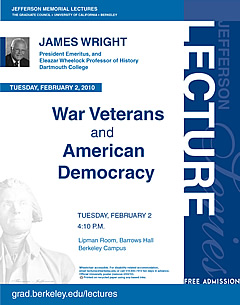
Well, I want to welcome everyone to this panel on Veterans in American Society. It follows up, uh, on the, uh, wonderful Jefferson Memorial Lecture for twenty ten that was given yesterday by President James Wright, President Emeritus of Dartmouth and, uh, a, uh, distinguished historian
(cough)
who spoke on veterans and the history of American democratic society and raised many important questions, uh, about, uh, the role of veterans in society, the ways in which veterans have been treated, uh, after the wars historically,
[HARRY SCHEIBER]
uh, in America and in particular gave attention near the end to the differences that are so obvious and so important, but which have not really been explored in depth, uh, by– as between the reception of veterans after the Vietnam War and combat veterans of the present, uh, conflicts in Iraq, Afgha- and Afghanistan. And so these and other issues will be addressed today. Our format will be the presentation of lead comments and reflections, uh, by four speakers, and then the panelists will, uh, uh, c- will contribute on an ad hoc basis, uh, for the remainder of our time.
Let me start by, I’m Harry Scheiber, uh, Professor of Law and History in, uh, the Law School here at UC Berkeley. I’m also a member of the History Department. And, uh, uh, I want to, um, uh, start by introducing our lead speakers.
Uh, before I do, let me just thank the Jefferson Memorial Lectures, um, Committee and the Endowment, uh, Dean Szeri of the Graduate, uh, Division, who administers the awards with a faculty, uh, group, uh, as advisors, and, um, selection committee. And to thank Dean Edley of the Law School, uh, who is, uh, supports the Institute for Legal Research, which I direct, and which is the, um, co-sponsor of this and organizer of this session. I’ll thank, I’ll thank the staff as a whole, but in particular, Karen Chen and Tony Mendocino of the Institute and Ellen Gobler of the Graduate Division.
So welcome, all of you, and let me begin by introducing our lead speakers one at a time. We’ll go right… I, I’ll introduce everyone at once.
We’ll go around the table, and then we’ll commence. Our first speaker, um, uh, this morning, uh, will be Admiral Harold Robinson, uh, uh, a rabbi who is, uh, the, uh, who’s had a long service in the United States, uh, Navy and Marine Corps, and who is, uh, a rear admiral. Uh, and has, um, uh, uh, has been, uh, uh, deeply involved in, uh, in, in, in the, um, spiritual life of, uh, and the organizational life of Marines and Navy people, uh, uh, throughout his career.
And he’s director currently of the Jewish Welfare Board and the Jewish Chaplains, uh, Council. Welcome, Admiral Robinson. Uh, Richard Abrams, to his left, your right, uh, is a professor of history emeritus at the University of California, Berkeley, and the author of, uh, many works on American politics and society.
And the latest, which is, uh, particularly relevant to our theme today is called America Transformed: Sixty Years of Revolutionary Change, 1941 to 2001, and he gives a lot of attention, uh, to the 1960s. Jan Scruggs, uh, is the founder and president of the Vietnam Veterans Memorial Fund.
Uh, Jan is, uh, an, a very important figure in the, uh, recognition of veterans’ needs, uh, and, veterans’ welfare. He himself is a, a veteran of, uh, a decorated veteran of the Vietnam War. And, uh, directly to my right, uh, T.J. Pempel, Professor of Political Science here at UC Berkeley, formerly Cornell, Wisconsin, University of Washington.
The author of many, uh, very important books on Japanese society and on Japanese-US relations, and on, um, and is the author of Beyond Bilateralism: US-Japan Relations in the New Asia-Pacific and Remapping East Asia: The Construction of a Region. He himself is also a Marine Corps veteran, and in this case from the Vietnam, uh, era as well. Professor and President James Wright, uh, who is our Jefferson lecturer and a guest of the campus, is a distinguished American historian who has written on, um, social and political history, particularly of the American West.
has, uh, had a very magnificent career, uh, for 11 years as president of Dartmouth College and is widely known for his work as well with wounded and injured veterans in the current, uh, war situation. And he has been, along with J.N. Scruggs, has been instrumental in, uh, pursuing their interests in returning to, um, civilian life and in particular to, uh, bring them to– back into colleges and universities, uh, through educational counseling and assistance. Uh, the organization is called Severely Injured Military Veterans Fulfilling Their Dreams, uh, administered by the Council of Education.
Um,
(coughs)
next to President Wright is Colonel Leland Liebe, who is a professor of military science in our ROTC here at, uh, UC Berkeley. And he holds a master’s degree of science and strategic intelligence from the Joint Military Intelligence College in Washington. He is a veteran of the Iraq- Iraqi Freedom conflict and has served in combat areas and is highly decorated for his work and, uh, both with the First Cavalry Division and in the intelligence.
And, uh, we welcome, uh, Colonel Leyva for his, um, experience in the contemporary war situation and as an educator here at Berkeley. Next to him, Professor Todd La Porte, Professor Emeritus of Political Science here at Berkeley. Also a U.S. Marine Corps veteran, a fighter pilot of carriers, and who has had a very, uh, uh, important, uh, role here at Berkeley in the Political Science department as a specialist in organization and as a figure who has done very extensive consulting, uh, on a variety of issues regarding organizational aspects of safety systems such as nuclear power, aircraft carrier, uh, nuclear aircraft carrier organization, and so on.
Um, he was, uh, he has served as, uh, an advisor in the Department of Energy, the Los Alamos National Laboratory, and other, and other, um, uh, government agencies associated with strategic affairs, with energy, with organization. Um, Professor Richard Candida Smith is a professor here at– also in the history department at UC Berkeley. He’s also the director of the Oral History Project or the Regional Oral History Office at Bancroft Library, and as such has been collecting… in charge of, uh, a very, d– uh, well-established and well-recognized program that goes back many years of doing oral histories, uh, to help recapture the history of this region and of institutions.
And, um, uh, undoubtedly flowing in part from that work, uh, he has given course here at Berkeley called Winners and Losers: Exploring Wartime Experience and Its Post-War Effects on American Life. So he is a scholar who has given direct attention to the very subject of our, uh, the context of the subject of our day today. He’s a cultural historian who’s written, among other things, Utopia and Dissent, a study of art, poetry, and Politics in California.
One of his many books that he’s written, and we welcome him as well. Dr. Michael Ascher is, um, next, and Doc– Dr. Ascher is a Dartmouth graduate. I have to mention that with President Wright here.
And, um, Dartmouth Medical and Harvard Medical School, and a specialist in infectious disease and immunology. He’s had, like, um, Todd LaPorte, Professor LaPorte, he’s had many very important, uh, consulting positions in addition to his administrative positions in government, uh, relating to bioterror, um, infectious disease, uh, and, uh, other, uh, matters, and has subsequently been with the US Department of Homeland Security, Lawrence Livermore Lab, uh, consultant to the Secretary of Health and Human Services, and is, as well as being a distinguished scientist in the medical field, has been a very important figure in public life. The next one who I will introduce is at the end of the table, Professor Melissa Murray.
She’s an assistant professor of law at Boalt Hall Law School, our law school, specialist in criminal and, and family law, has written in those areas. Um, and she has, uh, clerked, uh, f- Uh, as part of her training with, uh, then Judge Sonia Sotomayor, who’s now a justice, Supreme Court, and, uh, with Stefan Underhill of the US District Court in Connecticut after her graduation from Yale Law School.
And she is, uh, among her many interests in family law and family organization, she has recently done some work on veterans and is again a scholar in the area as well as an observer of more general competency. Uh, Lloyd– Professor Lloyd Burton is a professor of public affairs at the University of Colorado, a graduate– a doctoral graduate of our program in jurisprudence and social policy here at Berkeley. He directs the MPA program in Environmental Policy, Management and Law, and the MPA program in Emergency Management and Homeland Security.
He’s also written on a variety of subjects with relation to cultural aspects of law, and, um, he has been a, uh, Fulbright fellow at the University of Auckland in New Zea-New Zealand, and studied culture, religion, and environment in Thailand.
[LLOYD BURTON]
A Vietnam vet.
[HARRY SCHEIBER]
Also a Vietnam vet. Also a Vietnam veteran, he reminds me, who was in the Medical Corps in the 3rd Division– for the Marines 3rd Division in Vietnam. And, uh, Colonel Rocky Chavez, next to him, was appointed by Governor Schwarzenegger of California as Undersecretary of the California Department of Veterans Affairs, uh, after, uh, his retirement from the Army, where he served nineteen seventy-four to two thousand– Excuse me, the Marine Corps.
Nineteen seventy-four to two thousand and one. And, um, he, uh, was, uh, in public life in Oceanside, California after that, and then was appointed by, uh, the governor to be the Undersecretary of our Department of Veterans Affairs. And, um, he is, uh, a, a graduate of the Air War College and the Armed Forces Staff War College and the Marine Corps Command and Staff College, so he has had a very long and distinguished career in the Corps before going into civilian life.
Next to him, uh, Lieutenant Colonel Brian Stone, who is a professor of aerospace studies in our ROTC program here at, um, UC Berkeley. And, um, he is, uh, uh, like Colonel Leiva, he, uh, commands and directs the training of cadets, not just from our university, but over several other universities and colleges in the Bay Area, uh, serving a very important role. Um, he is, uh, a grad-
(cough)
graduate of the VMI, the Virginia Military Institute, and was a senior air battle manager with twenty-nine hundred hours of flying experience, eleven hundred combat hours in Iraqi Freedom and Enduring Freedom campaigns, Middle East. And finally, uh, my colleague Gordon Silverstone, Silverstein, excuse me, my colleague Gordon Silverstein of the Political Science Department, assistant professor there. Again, he spent a little time at Dartmouth College on the faculty, as I did, I must say.
And, um, he is a specialist in constitutional issues and constitutional culture, both in the United States and in a cross-national compar– uh, perspective. He’s the author of a classic book, now cla– instant classic book, and one that has become more and more relevant over time on executive power with regard to war and foreign affairs in relation to the powers of Congress and, uh, the Supreme Court And his latest book is Law’s Allure: How Law Shapes, Constrains, Saves, and Kills Politics, published by Cambridge Press in February of last year.
A book that’s received a great deal of attention, uh, among political scientists and, uh, law and society scholars.
(cough)
So with those introductions, um, uh, made, I want to start the program, and, um, I’ll call upon the, uh, speakers, uh, in, uh, the order that I suggested. Um, we’re starting with Jan. Starting with Jan Scruggs, who will be the first of our lead commentators.
[JAN SCRUGGS]
I’m Jan Scruggs, and very, uh, very pleased to be here, humbled to be here actually, at, uh, Berkeley. What I’ve been given is ten minutes to, uh, tell my story, and, uh, I shall begin right now. Uh, nineteen sixty-eight was the year that I graduated from high school, and for me, a pretty reasonable decision seemed to be to volunteer for the draft, which required, uh, two years of, uh, active duty, uh, service.
But when you did that, the army would select what, which, uh, military specialty you went into. So they put me, uh, in the infantry, and I had a sort of a bad time over there. I was wounded.
I was, uh, decorated. But, uh, we, we took some Significant casualties. And, uh, coming back from Vietnam was, uh, a difficult experience for many of us, uh, because many of us did have some sort of post-traumatic, uh, experiences, psychological difficulties coming back.
As well, our peer group, our, in our demographic was, uh, very much involved in protesting the war, and many people really made a moral judgment on us for being participants in it. Indeed, uh, when we began the effort for the Vietnam Veterans Memorial, we talked about the importance of separating the war from the warrior. But, uh, cognitively, people could not differentiate between the actual Vietnam War and the participants in it.
So we were, uh, many times vilified and spat upon, and people would flip us the bird in, in airports, and it was a kind of a difficult time to be in the service. But for me, it was, uh, uh, uh, nineteen months of active duty. I was very lucky actually to become seriously wounded, uh, during my time in Vietnam, which gave me a completely free education.
So I merely selected the most expensive school that I could get into, which was, uh, American University in Washington, DC. Got a, a master’s degree, uh, in psychology. During the time that I was studying for ma-my master’s degree, I slowly but surely became an authority in what is kno-now known as post-traumatic stress disorder.
I did a, an at-attitudinal questionnaire survey, and, uh, published the result, results in Military Medicine, a, a professional journal, testified in front of the U.S. Senate, and wrote an article in The Washington Post. And if you do those three things, no matter what you’re studying, you’re automatically a recognized expert. So I all of a sudden had some credibility, uh, intellectually.
I became very fascinated with something known as the survivors’ conflicts. And you don’t have to be in a war. You can be in a car crash, you can be in a bank robbery in which there’s a fatality, but survivors many times feel guilty, uh, for having survived.
Very common phenomena among, uh, military veterans, the survivors of events like the Holocaust and World War II. So I had this body of knowledge, and in 1979 went to see a movie with my wife, uh, called The Deer Hunter, and, uh, the next morning I announced that I was going to build a national memorial in the center of Washington, D.C. engraved with all the names of the casualties. And I went to my boss at the Department of Labor and told him what I was doing.
I was a GS-7, the lowest employee, uh, at the Department of Labor at the time, and told him I needed a couple days off, and he said, “Well, you know, Scruggs, we all need a mental health day from time to time, but why don’t you take a week?”
(laughter)
Well, during that week I became very, uh, in-interested. Flipped back through the old textbooks to a guy named Carl Jung, who was one of the original students of Sigmund Freud, who talked about collective psychological states. And suppose your football team here won the biggest game in, you know, the championship.
This would affect the psychological state of everyone here at Berkeley. Uh, nations have psychological states a-as well. So I had a theory that I could build this memorial engraved with the names of the casualties that would give the military veterans the recognition denied them, and also, uh, have an effect on the entire country with respect to healing the wounds, uh, some of the wounds, uh, of this war.
I enlisted, uh, George McGovern, who was a presidential candidate, in case you don’t know, who ran on the anti-war platform, who, by the way, lost in forty-nine out of fifty states, uh, when he ran for the presidency. But he, he helped and Barry Goldwater helped, who was a big hawk, hawkish fellow on the Vietnam War. And so we, we got a very wide variety, uh, of people involved, including a friend of mine now who lives in Berkeley.
His name is Country Joe McDonald, somewhat famous for having sung a song at, at Woodstock. So I started the effort and, uh, announced it at a press conference, and, uh, this, this was May of nineteen seventy-nine, and, and by July fourth, I got a call from the Associated Press. They wanted to know how much money I’d raised, and I said, “Well, I’ve actually raised a hundred and eighty-eight dollars and fifty cents.”
So we were not off to a stunning start. I had no idea what I was doing, but we needed a team. You know, we needed accountants, we needed attorneys, we needed experienced lobbyists, so we got this team together and, uh, put together a brain trust to make this all happen.
We decided that the symbolism of the Lincoln Memorial with the, its u-unique legacy, this was the war that saved America as a f- Uh, as a united country. This was a war that ended slavery.
This was the most divisive experience in American history of the Civil War. Yet, the most divisive experience, uh, for foreign wars was the Vietnam War, and indeed, n-not everyone here was alive during the sixties, but, uh, those who were will remember college campuses, Washington, D.C., Dupont Circle, tear gas. I think there– Berkeley holds the distinction of having had, uh, helicopters actually spraying tear gas from– on the crowds.
So, uh, this was a very dramatic time in American history, but the, the hope was that I could sort of bring people together through this by using the names. So we got a bill through Congress to put this next to the Lincoln Memorial, And, uh, we decided to have a design competition, and we had the largest architectural design competition held in the history of Western civilization. That’s an absolute verifiable fact.
The winner was a, an undergraduate at the time at Yale University, and her name was Maya Ying Lan– Ying Lin, a Chinese American. Uh, very brilliant design. She used the verticality of the other monuments, the Washington Monument, the Lincoln Memorial, to, uh, d- she worked with them and using really the, the Asian concepts of yin and yang, came up with a brilliant idea with this horizontal memorial.
The names on the memorial are not alphabetical, but they’re chronological. So they’re really like pages in a book, and the beginning and the end of the war meet in the center of the memorial. It’s a very simple memorial, and, uh, uh, it became very controversial.
People said black’s the color of shame, all the other monuments are white, and this was on 60 Minutes, and The Wall Street Journal had editorials. So we had to find a compromise. As we were, uh, outgunned, uh, politically.
The compromise was to add a statue. The memorial was actually dedicated in 1982, three years after we introduced the legislation. So we introduced the bill, had the world’s largest competition, and raised all of the money, which was eight point four million dollars, mostly from twenty dollar contributions from small people to build the Vietnam Veterans Memorial that became, uh, very well known, very well recognized.
Immediately, people began leaving things there, and, uh, there are now– there have now been one hundred and twenty thousand items left at the Vietnam Veterans Memorial, more than twice the number of, of– than there are of names on the memorial, which is, uh, a little over fifty-eight thousand. People feel compelled to leave things there. It’s been studied by sociologists and psychiatrists and so forth.
There’s no precedent for it, but people keep doing it. So what, uh, we’re doing now is that we’re going to build an, an underground, uh, educational center across the street from the Vietnam Veterans Memorial. This will show some of these great items that have been left there.
Uh, it will teach, uh, people about, more about the casualties of Vietnam. We’ll have their photos there, which will change every day. And it will be a very profound, uh, and positive educational experience for those who come to visit it one day.
It will teach about the, the experience and the values Of, of courage and honor and, uh, duty that have, uh, motivated our service people since, uh, the days of, uh, Lexington and Concord in seventeen seventy-five. Now, the other thing, I just returned from Vietnam, uh, and this is a, a lovely country. I, I hope that anyone who has an opportunity to go there as a tourist, uh, does, does that.
We have a program in Vietnam which is now nine years old in which we actually remove, uh, unexploded ordnance, uh, from that country. We have removed, uh, thousands of pieces. We blow them up in place, the small pieces.
The other ones, we have people who defuse them. And, uh, I– the Vietnamese, as you may know, have been at war all of the last century. You know, they were conquered by the Japanese, they fought the French, they had their problem with the United States of America, and, uh, they have had nothing but war.
But they’ve had now over thirty years of peace. This is a country that is not creating any problems for Asia. Uh, they’re not exporting weapons.
They’re not making nuclear bombs or anything like that, and it’s a great pleasure and honor as a veteran to, uh, give something back, uh, to them a-and we’ve removed a lot of ordnance and people who’ve been hurt, uh, from it. We’ve set them up in little businesses. Uh, we buy them some ducks, and they can sell ducks and so forth, and, uh, so they earn a living.
So that is the end of my tale, and I’m good at, at doing things in exactly ten minutes. If someone says ten minutes, I, I will do it in ten minutes, and I’ve just completed it. Thank you all very much.
My final thought to each and every one of you is that if you, if you have some idea, no matter how big or small, uh, even if you don’t know exactly what you’re doing, uh, once you begin the process, uh, you can be a-amazed what you can accomplish. Whatever your cause is, a battered women or, some international cause, uh, don’t be afraid to take the initiative. That’s what leadership’s all about.
Thank you.
[HARRY SCHEIBER]
Thank you very much.
(applause)
I think we’ll just go down the table in order, which makes the most sense at this point, And I call upon Admiral Robinson to s- hear his reflections on this general theme.
[ADMIRAL ROBINSON]
Thank you very much. I’m, I’m both awed and honored to be with this extraordinary panel. Um, despite the fact that I had no connection to Dartmouth. Um,
(laughter)
Uh, I, I will say, though, that I voted in the one state that was one, one Massachusetts. So which is a bit of an introduction. I, uh, span the generations in a sense, uh, having been a protester against the Vietnam War and entering the armed forces in 1971 during the, during the struggle.
Uh, entering the armed forces with the intention of serving the soldiers, sailors, airmen, and marines who were serving our country in a war that I very much disagreed with, uh, and profoundly, uh, antagonistic to the war, but not to the warrior. Um, however, I did not serve in Vietnam, and, uh, my only period, significant periods of active service are Operation Iraqi Freedom and Operation Enduring Freedom, uh, which, um, is, uh, the Afghan conflict. Today, uh, we’re taping on the third of February.
I mentioned that date because on the third of February in nineteen forty-three, just after midnight, a troop ship named the Dorchester with nine hundred, uh, and twenty, uh, American soldiers and coastguard men and merchant marine on board was struck with two torpedoes off the coast of Iceland. Um, that happened to many ships, but this one was sui generis, and I’ll try to explain why. But first, let me tell you that had you seen World War II movies with ships struck with torpedoes and the like, and you know the lights flicker for a moment, and then they come back on, and, uh, that’s a necessity, a necessity of filming.
You can’t film in darkness, but it’s not true in reality. Uh, immediately after the torpedoes struck, um, the ship, the ship began to list severely. All the lights went out.
The soldiers needed to find their way on deck, uh, in, uh, sometimes walking literally on what had been walls before the torpedo struck. There was smoke filling the passageways. And when they got on deck, they found four chaplains who were amongst the oldest people on board, um, having, uh, already graduated, uh, um, uh, seminaries and several having, uh, served congregations for a significant period of time.
Those chaplains were Father Washington, Reverend Poling, Reverend Fox, and Rabbi Goode. Those four chaplains took charge of the chaos aboard, uh, that, uh, the deck of that ship and started handing out life jackets, uh, until the life jackets were depleted. And then, uh, intuitively and without conversation amongst the four of them, each untied the life jacket that they were wearing and placed their life jacket on the life– on the, uh, onto one of the soldiers that was coming forward, seeking that one hope for salvation in this world.
Uh, when the, um, the ship sank in less than half an hour, in twenty-seven minutes, and of the nine hundred and twenty souls that had sailed, uh, two hundred and thirty were rescued by the Coast Guard escorts and six hundred and sixty-eight perished. Two hundred and thirty of those individuals testified to the unique gift of that– of those two Protestant chaplains, the Catholic chaplain, and the rabbi. And that story in February of nineteen forty-three became a powerful part of American mythology, and I don’t mean mythology in the sense of inaccuracy, but rather in the sense of the story that– the foundational stories we tell about ourselves.
It helped America understand itself as a country of at least religious diversity, and that’s part of what the World War II experience was writ large, where you had, uh, young men, almost entirely men, uh, less than five percent of the American armed forces were made up of women, 4.4 percent. But young men from Brooklyn and Berkeley and Biloxi and, um, and Butte, Montana, all serving together, not just for a few months, uh, but for years, and getting to know each other. And the war, um, mobilized 16.1 million U.S., um, military members out of a cadre, the male cadre of available for draft from the age of eighteen to, uh, to thirty-nine was just under twenty million.
So sixteen million out of twenty million, an entire generation. I mean, of the remaining four million, some were incapable of serving for a variety of reasons. Um, so that en– nearly that entire generation of men, and in those days it was, in America, about men, um, served and became unified and, and had a sense of identity as Americans that hadn’t existed before.
Part of that was a religious identity that described America in the paradigm of Protestant, Catholic, and Jew. Another event that, um, that came out of that war was, of course, uh, the capture of Iwo Jima. Um, the raising of the flag became iconic.
The, uh, flag was raised on the twenty-third of February. On the twenty-sixth of March when the battle was just concluded, uh, the, uh, cemetery on Iwo Jima was dedicated, and a rabbi, Roland Gittelsohn, uh, preached the following dedicatory address, which was carried across the country in the newspapers of this land at a time when people still read newspapers. Um, and I’m gonna quote one paragraph of, of his dedicatory address: “We dedicate ourselves first to live together in peace the way they fought and are buried in this war together.
Here lie men who loved America because their ancestors generations ago helped in her founding, and other men who loved her with equal passion because they themselves or their own fathers escaped from oppression to her blessed shores. Here lie officers and men, Negroes and whites, rich men and poor, together. Here no man prefers another because of his faith, nor despises him because of his color.
Here there are no quotas of how many from each group are admitted or allowed. Among these men, there is no discrimination, no prejudice, no hatred. Theirs is the highest and purest democracy.
He goes on to speak, um, of, uh, do we, the living, now dedicate ourselves to the rights of Protestants, Catholics, and Jews, of white men and Negroes alike, to enjoy the democracy for which all of them here have paid the price. This was a war that redefined the American paradigm, and I can suggest to you but not prove that the civil rights movement of the second half of the twentieth century and the, uh, availability of higher education, uh, through the v– uh, GI Bill, as, as was described by Dr. Wright last night, are all a product of this war. Not so Vietnam.
Vietnam was a war that didn’t unite and the United States, but rather divided it. And those divisions continue. Uh, I’ve quoted the, uh, two chaplains or or actually the stories of several chaplains from World War II.
The chaplains of Vietnam serve as a Chaplain Corps bridge generation to today’s Chaplain Corps that is really bifurcated between those who see a, a United States of multi-religious, uh, dimensions, uh, and there’s a need to serve people across both denominational and religious lines, and those who see the Chaplain Corps as a means of bringing their faith, uh, often evangelical Christianity, to those who are as yet unsaved and need saving. And that’s not the approach of, uh, the Chaplain Corps of World War II, nor of the population body politic of this country that came out of it. In World War II, an icon of the war was General Eisenhower, Supreme Allied Commander of Europe, and eventually President of the United States, who as president said,
[DWIGHT D. EISENHOWER]
uh, “Our government makes no sense unless our government is founded in a deeply felt religious faith, and I don’t care what it is.” You got to believe something,
[ADMIRAL ROBINSON]
but who cares what it is? Today, forty percent of the chaplains of the United States military believe that their mission is to convince you to support, to believe, to be saved their way. That represents a division within American society, Um, that the Chaplain Corps, instead of changing, is in fact mirroring.
Uh, and by the way, that forty percent are the those who have agreed to serve within a pluralistic environment. The– I know there are lots of rabbis, ministers, and priests who, who don’t even get that far to serve within a pluralistic environment. So, um, one example of that of the current era is a chaplain now, um, removed from the military.
I say removed because it was a disciplinary matter, um, called, uh, Lieutenant, uh, Gordon Klingenschmitt, who goes around telling people that Christians in the military are not allowed to pray in Jesus’ name, uh, because he was not allowed to pray at public command settings in Jesus’ name. Um, I will tell you that having, um, opened the, uh, Senate in prayer, the United States Senate in prayer, they give you a set of rules. You can’t…
I mean, fourteen percent of the senators are Jewish. You’re not going to mention Jesus and exclude them when it comes to, and we say together, “Amen,” but not you, fourteen. Um, and so there’s a set of rules.
Uh, but this, uh, Klingenschmitt goes around saying that it is necessary for America to save the Chaplain Corps. That’s a very different America, and, and I put the roots of this in Vietnam.
[HARRY SCHEIBER]
How so?
[ADMIRAL ROBINSON]
Um, there are two stories of Vietnam. If you j-just do a simple Google search, who lost Vietnam? You will find two stories.
(coughs)
You will find the story that McNamara eventually came to admit, um, far too late for the fifty-eight thousand mentioned on the wall, that it was never a winnable war, could never have been won. Uh, it was the wrong war at the wrong time. There’s the, uh, and I suspect that in Berkeley, that’s a widely held point of view.
But there is a solidly held point of view across America that the war was lost not because of the American fighting man, not because, uh, it couldn’t be won, but because we lost our national and political will. The– There is a, um, uh,
(cough)
an alignment between those who hold that view of Vietnam, many of who, of whom come, uh, having fought in Vietnam or come from, uh, segments of the United States that, uh, did fight in Vietnam, who believe that we didn’t lose, but rather the liberal elements of American society lost it for us, who are also those who often support the, uh, the de-evolution of the, uh, model of diversity which World War II and its chaplains presented to us. So I don’t know if that’s ten minutes, but it’s as close as I could get. And, uh, thank you, and I look forward to the other comments.
(applause)
[HARRY SCHEIBER]
Thank you very much. It’s, uh, appropriate given the end of the Admiral’s remarks with respect to the longer term effects of the war and the society’s response to the war over time to our own day, that our next speaker should be Pr-Presser Richard Abrams, who has written on the nineteen-sixties and perhaps will help to give, give us a further historic context. Professor Abrams.
[RICHARD ABRAMS]
Thanks, Harry. And thanks for all those comments. I, um, when Harry asked me to participate here about, on a, on a program of, uh, veterans’ experience in American society, I said, “Harry, I don’t know anything about the veterans’ experience in American society, but I can talk about the America that the Vietnam veterans returned to.
Uh, and that’s what I’ll– I, I will, I will attempt to do. And, uh, since I’m not a veteran, I’m probably among very few here who maybe who is not, not a veteran. I don’t have any anecdotes, So I’ll stick to the history, if I may.
Now except for the Civil War, as Admiral Robinson has just said, the Vietnam War was the most devastating calamity in United States history. The physical, the physical costs alone, of course, were awful. Uh, as you’ve heard a few times, more than fifty-five thousand Americans were killed.
More than a hundred and twenty thousand suffering injuries requiring hospitalization and rehabilitation. Measured by American casualties in, uh, other U.S. wars, it was only the fourth worst war, uh, although it was the nation’s longest war, at least until now. The Civil War and the two World Wars killed more, and they were all shorter wars.
But the relatively few American casualties, in itself owed in part from one of the most destructive and divisive features of the war, namely, the reliance on airborne weapons, including B-52 bombers flying from Guam thousands of miles away and dropping bombs from nearly seven miles up. So there could be no expectation of confining the devastation to m-military targets. And unlike in World War II, when Americans were far less divided over the justification of U.S. military action, television and massive news coverage on the ground in Vietnam and Cambodia brought it all into Americans’ living rooms in graphic color.
The disregard for horrendous so-called collateral damage seemed epitomized in the spraying of many thousands of acres with sometimes deadly chemical defoliants such as Agent Orange in order to expose targets in the jungle areas. Now, such policies brought to mind the deathless comment by one US officer following the destruction of the South Vietnam village of Ben Tre. “It sometimes,” he said, “it sometimes becomes necessary to destroy a city in order to save it.”
Well, the tactics kept U.S. casualties relatively low while maximizing casualties on the ground, inevitably including hundreds of thousands of civilians. Now, this is to highlight the outstanding cost of the war for Americans. The conspicuous, callous brutality with which the United States came to wade, wage the war confounded the humanitarian ideals for which American democracy was supposed to stand.
It would sharply divide intellectuals and political leaders. Some chose to stick with their commitment to use American power to resist totalitarianism worldwide. Others could not face responsibility for the inhumane devastation.
And so George Kennan at one point testified in the Senate, and I’m quoting him, \”Any rooting out of the Viet Cong could be achieved, if at all, only at the cost of a degree of damage to civilian life and civilian suffering generally, for which I should not like to see this country responsible.” End quote. As our government pursued the war with exactly the consequences Kennan feared, Norman Podhoretz, a fervent sup-supporter of the war and later a bitter critic of anti-war liberals, he himself felt compelled to write, and I’m quoting him, “As one who has never believed that anything good would ever come from an unambiguous American defeat, I now find myself unhappily moving to the side of those who would prefer just such an American defeat, rather than a so-called Vietnamization of the war, which calls for the indefinite and unlimited bombardment by American pilots in American planes in that already devastated region.”
End quote. After reviewing dozens of researchers’ accounts of the war, the veteran journalist Neil Sheehan would write in 1973, and I’m quoting him, “If you credit as factual only a fraction of the information assembled here about what happened in Vietnam, and if you apply the laws of war to American conduct there, then the leaders of the United States for the past six years at least, including President Nixon, may well be guilty of war crimes.” End quote.
Well, the wanton massacre of defenseless men, women, and children at My Lai would become a blazing symbol for the opponents of US involvement in Vietnam. When President Nixon named Lieutenant William Calley, the only man prosecuted for the crime, as a war hero, he called him a war hero, it highlighted the gaping division within American society that in large measure was precipitated by the war. Now, such a contrast in moral outlook, which was already growing before US involvement in Vietnam, would leave a lasting, festering scar on the country to which Vietnam veterans returned.
And all of this took place, you understand, in the context of dramatic domestic changes that had already compromised the integrity of, uh, established authority in both the public and private arenas and would burden the returning troops. During the third quarter of the twentieth century, the country witnessed truly revolutionary changes in a number of major social and economic areas. The business system, for example, into which most veterans sought entry either as wage earners, managers, or entrepreneurs, was it—
(coughs)
was in the process of a dramatic transformation comparable to that of the Second Industrial Revolution of the late 19th century. Conglomerates and multinationals overwhelmed the single industry corporation, just as in the late 19th century, the large-scale multi-division public corporation overwhelmed the small single proprietary business firm. Now more than that, the financial deals, financial deals came to surpass production of goods and services as the primary business of American business.
The contemporary expression, “Greed is good,” maybe forty percent hyperbola, was almost certainly a sixty percent accurate characterization of the new business culture into which American veterans returned. Meanwhile, the civil rights movement highlighted Americans’ traditional hypocrisy regarding social equality. Just as the broad challenges to sexual conventions and the feminist challenge to ascribe gender roles mocked authoritative wisdom about propriety and decorum.
At the same time, the emerging consumer protection mo– uh, uh, protection movement revealed epidemic dishonesty in advertising, packaging, lending, and sales. At the same time, the insurgent environmental movement brought to light the poisonous pollution of air, soil, and water by powerful business interests that were heedless of the injuries that they were inflicting on fellow human beings. Now, that such things had been permitted to happen eroded confidence in the authority of government, business, and, and tradition, at least for educated Americans who were actively concerned about those issues.
On the obverse side, it was not possible to overlook the rising anger among traditionalists throughout the country that was directed at the federal government over judicial decisions that mandated school busing, that appeared to be too soft on crime and criminals, that challenge local cus-customs of piety by banning officially sanctioned prayer in public schools, and that added costs to doing business by requiring record keeping to avoid or defend against suits over racial, gender, and disability discrimination. There was, in other words, a grassroots rebellion rising from the main, main streets and the Elm Streets of the country against the so-called elite that many Americans, probably most of them, held responsible for the erosion of a traditionalist social order in which they had felt comfortable. Now, all of this reached a crash point by nineteen seventy-three when OPEC’s oil embargo led to soaring gasoline shortages and prices, and most important, calling attention to the decline of American he-hegemonic power internationally.
Long lines of irate American drivers waiting at gas stations to fill their tanks before supplies ran out signified graphically the end of affluence and the return to an economy of scarcity. That decline had already been marked by the devaluation of the dollar two years earlier, followed by uneven and mostly sluggish growth for the rest of the nineteen seventies and indeed for the rest of the century and beyond. For the final thirty years of the twentieth century, American economic growth, which had been un– which had underwritten the unparalleled pa-post-war affluence of the previous thirty years, slowed to a crawl.
When the mostly male veterans returned home and entered the job market, they faced unprecedented competitive, uh, competition, both from fellow Americans and from abroad. First of all, it was in the ’70s that the bulk of the baby boomers came onto the job market. But not only did the job market become crowded with the flood of the usual competitors, by then, women and minorities had been added to the masses of those seeking employment in fields traditionally reserved for white males.
At the same time, American producers, especially in manufacturing, faced vigorous competition from the newly revived and de- and developed, developed– developing manufacturing sectors of Western Europe and Japan. So, is it any wonder that much of American society turned sour? This is the environment into which the veterans returned.
And as the society turned sour, so did American politics. The rise and the fall of Richard Nixon sign-signaled the ascendancy of a politics of trickery and demagoguery that would become embellished and magnified by later administrations. Repeated and deliberate abuse, deliberate abuse of facts and outright dishonesty by political leaders and even business executives became a common strategy.
Noting the success of the strategy, no one conservative political commentator gleefully labeled it, and I quote him, “The power of the outrageous.” The power of the outrageous. We’re still living with that legacy and with the apt motto of the 1970s, looking out for number one.
Vietnam veterans were the last of the citizen soldiers, conscripted by their country to put their lives on the line in times of need, a need defined by political leaders. There were no victory parades for them when they returned home because there was no victory. Small-minded enthusiasts among some anti-war militants vilified them, confusing their duty-bound service with the misbegotten politics that directed them.
As President Wright noted yesterday in his wonderful talk, that confusion underlay the failure of the anti-war movement to link up with the mostly blue-collar draftees who suffered the consequences of their forced service in a misbegotten war. Thereafter, in a sharp break from American history and tradition, the country would depend on those who chose to offer their service. We should be grateful to them for their choice.
We should also be a bit wary. The fathers, so-called fathers of our country, long ago cautioned against the establishment of a large professional military. And so I’ll leave you with that thought.
(applause)
[HARRY SCHEIBER]
Thank you very much. So I reflect on this, uh, very interesting recapitulation of our history since the Vietnam War and some of the things that have, um, that relate to the topics that President Wright opened yesterday with his interesting talk. I also have to reflect on the gains of the civil rights movement, the achievements of affirmative action, the flourishing of the American research university during this period, the enormous expansion of access to our colleges and universities, and one has to ask whether the experience of the Vietnam War and the disillusionment with some of the country’s failures might not have had positive results as well.
But leave that to other speakers. Um, our next, um, I do some work myself on Japanese law and society, and I’ve always found from– since I was first introduced to his work by a great Japanese scholar whom I had the privilege of collaborating with, that the work of T.J. Pempel is some of the most important that has been done on, uh, politics, society, and public policy and administration in Japan. And, uh, Professor Pempel’s interests have broadened, and he works today on two topics that certainly are directly relevant to many of the remarks that have been made or will relate to President Wright’s address on–
Two of his fields in– of interest today are US foreign policy and Asian re-Asian realism. Uh, sorry, Asian reason– Asian realism, excuse me. Um, topics that also relate very directly, I think, to the Vietnam experience.
Uh, Professor Pempel, as I said, is also a veteran of that period, and I’ve asked him, I– when I called him, uh, I asked him whether he, as a former captain in the Marine Corps would be willing to do this. He said no, he was very sorry. Very interested in the forum, but, um, he was too young to be a captain when he served in Vietnam and that he served on the ground.
And so I welcome Professor Pampel and would like to hear, as I told him then and as I believe now, hear what must be his very interesting reflections on his experience and on these topics from an academic standpoint.
[T.J. PEMPEL]
Thank you very much. And again, it’s my pleasure to be with such a distinguished group. Uh, my comments really are going to be much more from the ground up, uh, at the risk of being, uh, unduly biographical or autobiographical.
But, uh, like President Wright, I joined the Marine Corps at the age of seventeen. I left, um, uh, I graduated from high school, and the day after my graduation, I was on a train heading to Parris Island, uh, with my mother crying at the train station, wondering what in God’s name she had signed, uh, permission for me to do. The, uh, the comment that, um, uh, Harry Schreiber made, uh, is interesting in the, in the sense that I– when I was in boot camp, at one point, six or seven weeks into, um, into my time in Parris Island, the drill instructor called me up with, uh, what I will clean up slightly, uh, remarks that said, uh, “Private Pempel, get your butt up here.
The Marine Corps hates you.”
(chuckle)
And I said, “Sir?”
(laughter)
He said, “They’re going to make you an officer.” And I said, “Sir?” He said, “They wanna send you to, uh, officers’ training school. You have screwed up so badly as a private, they’re gonna make you a lieutenant.”
(laughter)
And I said, “Thank you, sir.”
(laughter)
And he said, “You won’t.”
(laughter)
Um, and about a half hour later, he called me back And he said, “Pempel, how in the hell old are you?”
(laughter)
I said, “Seventeen, sir.” He said, “The Marine Corps needs officers, but they don’t need them that badly. Uh, you’ve got to be eighteen to be an officer.”
So that was the end of my aspirations to, uh, to higher living. Uh, I left in nineteen sixty-four after four years as a corporal, uh, one rank higher than President Wright, but, uh, he’s since come to surpass my
(laughter)
experiences. My experience in some respects resonates with, um, what Admiral Robinson commented on about the World War II generation. In many respects, when I went into the Marine Corps, I was very much a product of that World War II generation.
I was patriotic, uh, but I was also extremely naive in my patriotism. I was certainly, uh, very inexperienced with my own interactions with, uh, the rest of the world, And I was quite stunned as we headed south to find that when we hit the first, uh, rest stop, lunch stop south of the Mason-Dixon line, the seven Black guys who were in our potential platoon were herded off in one direction for lunch, and the remaining forty-some-odd of us who were white ate in a different place. And this experience of working in a segregated South and dealing with a segregated military was in many ways a very informative period for me, one that, that I don’t think I ever fully experienced, uh, or fully understood until, uh, being stationed in Memphis, uh, and having a good friend from boot camp who was, um, African American.
I, I kept, uh, bugging him every weekend to go into town. And after about the fourth or fifth week when he refused to leave the base, I said, “Hey, man, why don’t you want to go catch a movie with me?” And he said, “Because you’re going to be sitting downstairs, and I’m going to be in the balcony.”
And I realized that this was still a very bizarrely undemocratic, uh, and unintegrated America. In any event, fast-forward from this naiveté to a comment or two on the war in Vietnam. Uh, I had followed the war with the newspapers.
Unlike most of my enlisted colleagues, I was a very or reasonably serious student of political affairs. I listened to the speeches of Jack Kennedy, um, uh, Robert McNamara, Lyndon Johnson, uh, and was firmly convinced that this was a war that was worth fighting and that deserved to be won by America because it would prevent Vietnam from going communist. We were supporting our allies there.
And my initial, uh, skepticism about the war came on my trip back from Asia. I was not stationed in Vietnam, I was stationed in Japan. I was on a troop ship that came back in 1964, April of 1964, and I was with a number of guys who had been in Okinawa, Marines who had in fact served in Vietnam.
And over the course of about thirteen days, uh, bouncing across the ocean from Yokohama to San Francisco and Treasure Island, I heard stories that really disabused me of my preconceptions about what had gone on in Vietnam. I remember saying to a couple of guys something about nobody in– no, none of the American, uh, military are involved in combat, and being met with wide guffaws from, uh, the guys that I was with. And they said, ‘Yeah, right.’
Uh, we all volunteer. Uh, a captain comes rushing in or a sergeant comes rushing in and says, “There’s a plane down. We need ten volunteers.”
And a platoon would immediately jump on a helicopter. We’d go in and shoot up the local village and rescue the captain and then bring him back. But the most telling experience I had was talking to a guy who’d been a tail gunner on a, uh, Marine Corps helicopter.
And he was telling me that his job was to ferry in the ARVN, the South Vietnamese military, to combat operations. The Americans were not then completely engaged in combat. And he said the ARVN troo- troops were under orders to face away from the helicopter.
And his job as the tail gunner was to shoot any South Vietnamese military person who turned around. And I said, “I don’t understand that at all.” He said, “We’d had too many experiences where we flew in the South Vietnamese troops, they were draftees, they didn’t want any part of this war, and what would happen would be as the chopper would pull away, four or five guys would turn around with hand grenades, throw them into the chopper, and blow it up.”
And I thought, “This is not the best military alliance that has been forged in the history of American politics.” Uh, my skepticism about the war, though, was something that I was not prepared to act on. Uh, right after I got out of the military, like many other veterans, I began my, uh, or decided to finish my undergraduate work.
I’d done some coursework while I was in the Marines. Um, I went to Columbia University. There were many other veterans there.
We tended to have a very close bonding by virtue of our difference from the other, uh, civilian students and our experiences in the military, despite whatever branch we’d been in, usually put us, uh, much closer in proximity. Uh, but my two roommates, who had never had any military experience, informed me that they were going down to a demonstration against the war in 1965 in Washington, DC. And I had been a student of, uh, the House Un-American Activities Committee when I was in grammar school.
I knew the dangers that could await anyone who stood up to his or her government and was firmly convinced that I certainly didn’t want to enter into a protest, but I was so opposed to the war and so taken by the experiences and the stories of the people who had served there, that I decided I would have to bite the bullet and go down. Nineteen sixty-five, the demonstration in Washington, if memory serves me right, probably had more FBI agents taking our photographs than we had demonstrators protesting the war. And I realized then and there that if, um, Eugene McCarthy came back in whatever incarnation, my career was over, I would never get a job in the US– Joe McCarthy.
Joe– Joe McCarthy. Sorry, I worked for Eugene McCarthy. Very interesting sidebar.
I, I, I don’t– Uh, ten minutes, I won’t take you to, uh, a very interesting political experience, but, uh, a woman who went off to vote for, uh, Eugene McCarthy under my auspices thought that it was Joe McCarthy. But, uh, uh, and I convinced her that Eugene was as anti-communist as Joe.
The, um, fast-forward, the, um, as many people have said, the anti-war demonstrators were typically, uh, seen as very unpatriotic. They were seen as essentially left-wing draft dodgers out for saving their own skins. And so I was very taken when I heard about a group called Vets for Peace.
These were guys who had served in the military and, uh, who were anti-war, and their primary purpose in organizing themselves together was to make it clear that people could be opposed to this war and have served, uh, successfully in the military, but who were still willing to, uh, come out and demonstrate along with the long-haired hippies and the ladies with funny glasses and, uh, all the rest. And so I joined Vets for Peace, and I had a very interesting experience, uh, somewhere in early 1967. Uh, a guy came into our meeting and said he wanted to join us, and he had been in Vietnam.
This was a guy named Jan Barry Crumb. Jan was the first anti-war Vietnam vet whom we had met. He’d spent two years in West Point, left West Point, uh, been pulled into the infantry and had served thirteen months, as I recall, in the military.
And he said that he wanted to go to the next big demonstration, and between Jan and myself, we rounded up a total of six anti-war Vietnam vets. Uh, three of them, as I recall, were people that I knew from Columbia. And for the first time, Vietnam veterans, uh, joined a demonstration, six guys marching just behind Martin Luther King and Benjamin Spock and others in a demonstration in April 15th, 1967 that marched from the UN to…
I mean, marched from Central Park to the UN. This was the beginning of Vietnam veterans actively opposing the war in which many of them had taken part. Uh, they had very different stories.
Most of them had stories that paralleled those, uh, that I had talked about with the guys on the ship that I had come back with. Uh, many of them had experienced, uh, incidents of fragging of officers, uh, or had, in one way or another, come to conclude that this was a war that was essentially unwinnable and from their standpoint, immoral. And, uh, what was intriguing was, to me, was the fact that although they still came in for a great deal of the criticism from the pro-war or anti-anti-war demonstrators, for the most part, many of these guys could bond with others who had served in Vietnam.
The common military experience transcended the ideological differences, and many of these guys were quite effective in communicating with other conservative ex-military guys about the war and either neutering or transforming their initial opposition to the demonstrations. This, it seems to me, laid the groundwork for what Jan Scruggs talked about, namely the growing activism on the part of many Vietnam vets in terms not only of opposition to the war, but also of attempting to increase and improve the benefits that were provided to the military, uh, that had not been given adequate attention by the political machine that had sent them to Vietnam, and that, in many cases, was responsible for them coming back, uh, with damage of one sort or another. The last point that I guess I would want to make in this regard, though, is that in some respects, I want to identify with Admiral Robinson’s comments about the ways in which the Vietnam War and the experiences of both the veterans and the society at large really made, uh, the Vietnam War a, an incident that created a fissure within the United States that in many ways has yet to be healed.
Uh, the people who lined up on one side or the other of that war have, in many respects, never crossed the boundaries to the other side. Uh, they have become very secure in their own interpretations of the war, whether for it or against it, uh, and they typically find themselves aligned with others of a similar cultural or ideological bent. And it’s given rise, I think, to the blue state, red state dichotomy that, uh, really prevailed in American politics, in some respects starting with Richard Nixon, but going all the way through the 1980s and into the 1990s.
The, uh, Vietnam vets, uh, continued, continue to be quite active in trying to provide benefits for their fellow, uh, military personnel, And they’ve also reached out, it seems to me, to the veterans from Iraq and Afghanistan. But I do think the difference is there between the essentially civilian soldiers who served during Vietnam, most of whom, ended after two years, three years, and went back to a civilian life, versus those for whom the military has become a much longer career and who, for better or worse, remain in many ways far more fundamentally isolated from the broader society and who, uh, in effect, allow this bifurcation to continue. So let me stop on that note.
[HARRY SCHEIBER]
Terry, thank you very much.
(applause)
We’re really, really very privileged to have these personal experiences interlocking with the, um, analytical questions that we have to face since we look back on these things. We have a wonderful, rich array of experience of current involvement in policy and, uh, uh, historical and legal and constitutional expertise here. So I look forward to a very rich discussion.
But before we open the panel, I wanna to open discussion, I wanna ask President Wright if he would just comment at the outset, and we’ll go on from there. I
[PRESIDENT WRIGHT]
I found, uh, these, uh, uh, comments, these introductory comments, uh, very, very, uh, uh, helpful and provocative. And, and I think the individual experiences, uh, underline, uh, the complexity of some of these issues. And, and, and my…
As, as I said, my focus yesterday was on the veterans of the war, uh, rather than, uh, of the war itself. But, uh, it’s, it’s obv- It’s, it’s obvious, uh, uh, and obviously still, uh, all these years later, impossible to separate, uh, the one from the other.
I think that the Vietnam War was so sharply, uh, divisive. Uh, I think that we have managed to accommodate, uh, those divisions. I think that our society as a whole has, uh, uh, managed to try to, to again reach out to the Vietnam veterans and has done that pretty well.
I’m, I think that the scars remain. They’re gonna remain, uh, for some time. But, but rather than my sort of repeat that again or try to summarize this, I would prefer to hear from some of my colleagues on the panel here, and maybe I’ll have something later.
[HARRY SCHEIBER]
Well, thank you, Jim. Um, wanna ask, uh, uh, uh, taking the chairman’s prerogative or the moderator’s prerogative, one of the things that hasn’t been mentioned is the impact on constitutional ideas and constitutional experience and legal experience during the war. There are so many challenges to individual rights and to challenges to, against the government.
And among other experts, we have Professor Gordon Silverstein, so I’ll respond to his.
[GORDON SILVERSTEIN]
Well, I’ll, I’ll try and make, uh, just a couple of points. Uh, first off, I think, you know, the, the, the anecdotal i-it does become interesting. I, I’m, I’m the in-between, uh, generation.
I’m, I’m too young to have served in Vietnam, uh, but too old to have served, uh, in Iraq. Uh, I was, you know, a child of the protest years, uh,
(coughs)
and very much a part of that. My brother missed the draft by one year. He’s three years older than I am, so I’m, I was within four years of the draft in Vietnam.
Um, so, so that I think, uh, is a different perspective. And, and, and I, I do wanna go back…
I, I wanna go to the legal issue in a second, but the idea that, that we, we, we really lack, uh, a communal experience any longer. Uh, public schools are, are no longer cutting across, uh, the demographics of the society. Military service, which was the great equalizer and the great m– you know, the, the great Hollywood movies where you had one of everything getting together and talking to each other and, and, and there was a good deal of truth to it.
It wasn’t quite as idealistic as, as Frank Sinatra would have you believe, but, uh, but it was pretty good. Uh, you know, jury duty, uh, is about it and, and anybody with a high school, uh, A diploma can probably get out of jury duty. Um, you know, go to the airport, and there’s seventeen different lines bifurcated by, uh, income levels and, and, and, and talents.
And, uh, baseball games, you go into your hermetically sealed box, and you never actually interact with anybody else. There’s really nothing left, and I think this, this goes to, uh, what, what Professor Abrams was talking about as well. I mean, this is a, a part of the profound transformation of that, of that era.
Um, on the legal front, uh, the Vietnam War was a, again, a huge breakpoint. Uh, the draft was challenged in the courts. In fact, it was getting extremely close.
There were a couple of cases that made it to the, uh, uh, appeals court level challenging the the constitutionality of the draft in that war because it was an undeclared war and because it lacked a number of the other legal conditions. Uh, but the draft ended shortly before those cases were quite ripe for the Supreme Court, uh, so they didn’t quite get there. Um, the protests against the war, uh, however, did get to the Supreme Court.
Uh, and, uh, this famous case of Tinker versus Des Moines out of Iowa, these, uh… And I– when I lecture on this, I put the pictures of these kids up, and they’re, they’re right off of, uh, of a nineteen-twenties, you know, perfect ideal blonde, blue-eyed, uh, well-scrubbed, uh, neat kids. And, and they, they brought this huge case to the Supreme Court. And it was such a traumatic case that Hugo Black, the greatest defender of free speech America has ever known, uh, turned on free speech.
Uh, he couldn’t tolerate the, the protests against the war. He was getting on in years, and, and it was something that really broke him from his own, uh, commitment to, to free speech. So there were a number of major, uh, legal issues.
Uh, and, and really this question about the constitutionality of a war, this was, uh, the first year with an undeclared war that had happened.
(censorship bleep)
(censorship bleep)
We’ve not actually had a, a, a, a, a legal mandate to be in the war. Uh, the War Powers Resolution was an attempt by Congress to re-legislate this. Uh, so there were, there were tremendous transformations in terms of the, the idea that we would even talk about the legality of a war in the United States and, and challenge the president on these kinds of issues, I think is, is a big part of, of what came out of this.
So, Maybe I’ll leave it with that.
[HARRY SCHEIBER]
Thank you very much, Gordon. The, um, the, uh, impact of World War II on individuals is something that came up in Jim’s talk yesterday. And, uh, in Tom Brokaw’s follow-up volume to The Greatest Generation, there was one passage where a veteran of Vietnam talks about his father’s experience in World War II and how his father always looked at– looked back at it as his great contribution as a citizen and how it had shaped his life.
And he said, “I came back from Vietnam, and I just felt it was for nothing. And it was a very sad thing. And I think that, if I may just take a minute, that World War II experience, I mean, I, I’m of a generation where my uncles and relatives were, cousins were in that war, and it was just, you know, the happiest day in the world when those boys came home from their various combat areas, and one of them never came back, a cousin.
And, um, I– it makes me think of my days again in New Hampshire during the Vietnam War. Um, I was president of the Civil Liberties Union in New Hampshire, and some of the… a lot of our business had to do with conscientious objectors, and they were treated as traitors by their draft boards and often in the courts, and it wasn’t just as objectors. And that was very embittering, and I think that the sympathy for them built up.
But we had on the, the Tinker case was mentioned, and it was a case of stu– high school students with an armband protesting, and the principal wanted to discipline them. And at that very same time, we had a demonstration of students walking out of a high school in New Hampshire, and the principal gave them five minutes to get back in, and then he started issuing sanctions. And so a lot of them went back in, and then more went back in.
And finally, um, he said that those who didn’t come in were not– their grades would not be sent to colleges. They wouldn’t be allowed to be recommended to colleges, and they would do this to them. So it became a case for the Civil Liberties Union, and we had maybe, I think we had the number twenty-four sticks in my mind.
This was forty years ago, and it dwindled down to one. You know, carrying these free speech cases is not an easy thing on families and people. I mean, it’s a terrific burden on you, and you can become a pariah in your neighborhood in the middle of a war.
And finally it came down to one. And this young lawyer who took the case for us, a wonderful country lawyer, never done anything like this before in his life. Uh, he went and interviewed her, and he told her, he said, “You know, I like you.
I mean, I’m from a small New Hampshire town. I, I know you’re gonna live with this thing, you know. People are gonna question you for the rest of your life.”
And she said, “I am not backing down.” Said, “My husband was a Navy flyer. He gave his life for his country.
He was shot down. I’m not gonna let his son suffer this fate at the hands of these people.” And the invocation of wor– of, of, of his service immediately collapsed that principle and his counsels.
I mean, the board of education folded immediately. And you know, you– Invoking war service was still…
It’s so ironic. Invoking war service was something that could offset this kind of thing. So it is again, again, complex.
Very complex. All right, um, other comments and questions? Who would like to begin?
[ADMIRAL ROBINSON]
There, there’s something you just, um, raised on the, um, the protest to, to Vietnam. And, and I was trying to raise the point that while World War II was a unifying force, that Vietnam was a bifurcating and polarizing, radicalizing force for our nation. And I’m wondering what the influence of that was in the run-up to the war in Iraq, specifically the political debate where it seems to me the, um, members of Congress were cowered, uh, from taking a strong political stand, uh, that they were, uh, afraid of being, uh, identified if not as traitors, but as, uh, uh, soft on, uh, terrorism and, uh, and the like.
They were cowered into it. So I mean, it’s an overwhelming, and we all remember Kerry saying, “I was against it before I voted for it, and I was against it later.” But, um, that, that kind of, um, political pressure, um, could it have been a result of the, um, post-Vietnam radicalization, especially, and I want to put it together with something that, uh, was said to my left, the, um, the, the sense, uh,
that we, um… Being of my age, I can forget what I wanted to put it together with.
[HARRY SCHEIBER]
Mm-hmm. Mm-hmm.
[ADMIRAL ROBINSON]
So, as soon as I said to my left- and I’ll come back to it. But, but we lost the, uh, the openness to each other to cross the boundaries into the other perspectives,
[HARRY SCHEIBER]
so that you could no longer- Well, I think that crossing the boundaries became very hard for people when they had been accused of being disloyal and treasonable and… I mean, the- But, but the, the so-called- You know, it escalated beyond the so-called-
[ADMIRAL ROBINSON]
The so-called red voter, um, ironic- ironically, as that, uh, that might be, um, also never crosses the boundary either, uh. And so I lived in, in Louisiana for nine years outside the gate of Barksdale Air Force Base. And, um, it’s amazing how there is so little empathy for the Vietnam protester even today.
[HARRY SCHEIBER]
We’ve talked about Vietnam, and we have not just Vietnam veterans now, but it has been said Afghan war, Afghanistan, and Iraqi war veterans. Maybe we can come back to this, but, um, perhaps Colonel Chavez would like to speak. He, he has heavy responsibilities in our state government here in California for the interests and welfare of veterans, and I think his outlook on this as a minister will be important.
Then I’d like to call one of the peoples in the active military now to comment on their perspective. Go ahead.
[COLONEL CHAVEZ]
Yeah, I’d like, I’d like to approach this from, uh, two perspectives, um, and get a little bit off the Vietnam issue, but, uh, it’ll indirectly reach it. Um, first of all, when– I have the opportunity to go around the state and do a lot of different panels, and, uh, and as stated earlier, you know, I was in politics for seven years. One of the, um, obvious things when you look at a panel is that it kind of reflects the people that are being affected by, you know, wars and military.
And this panel appears basically consisted of white males. There’s two of color, and we have one female. In fact, I noticed that the audience actually has four females and four males.
So they’re, they’re actually more diverse than we are. And, uh, so not to point a finger at it, but I wanna give you a, uh, a little story about a His-Hispanic impact that the military has. Uh, my father was seventeen of eighteen children.
Uh, sixteen of them were born in Mexico. My father– My grandfather fought with Pancho Villa. My father worked in the fields, and when World War II started, he enlisted in the Marine Corps and fought with the Second Battalion, Second Marine, Second Division, and, um, was at Tarawa, Tinian, Saipan, and in the latter phases of Okinawa.
Uh, he worked in the steel mills at the end of the war, but because of the GI Bill, he was able to go to a community college. The auto– the space industry kicked off in LA. And so as a little kid, I was brought up outside the s- U.S. steel mills where the Okies and the Wetbacks used to live together and, uh, where it was common to have gangs and fights.
And we moved from there to a suburb in Torrance, at which time I became a, a Cub Scout and played Little League. But because of his experience in serving the country and the GI Bill, and his ability to work in the aerospace industry, I was able to stay in my little community and rise up and become president of my class and was state champion in sports, a lot of other things. The…
And go to college. My son, as I mentioned earlier, I was joking around with you, he’s, he’s a graduate of UPenn Medical School, went to Davis, and my daughter went to Davis. And as I kid around with my son, I said, “You’re the American dream.”
“You know, uh, your grandfather worked in the fields.” I worked my way through college in the fields. And, uh, and now you’re, you’re out of UPenn.
So it doesn’t escape me when I’m at Camp Pendleton and I see so many hyphenated Hispanic names currently serving in the Corps. And it doesn’t escape me that a very significant number of them
[COLONEL ROCKY CHAVEZ]
are not even American citizens. And it doesn’t escape me that just recently, um, there was a, um, some people would call him an illegal, who gave his life for our country, whose mother was an illegal, who was living here, who the, uh, she became a citizen because she– otherwise she couldn’t even go to the funeral and recognized by our country. So, um, there are impacts that the military has on change in our society that we don’t even recognize sometimes.
I would submit to you if it wasn’t for the GI Bill and the military and veterans, you probably wouldn’t have Colonel Rocky Chavez, Undersecretary, sitting up here today if it wasn’t for that. So I just throw that out there for all the things about the military and the war.
[HARRY SCHEIBER]
Uh- oh, sorry. Just go ahead.
[COLONEL ROCKY CHAVEZ]
Well, I’ll– I just wanna touch this. I gotta do this ’cause it’s on TV and CDVA, the California Department of Veteran Affairs may hit, hit me on this one. When I’m hearing the– I wanna talk more about the future.
What role should our current veterans play in 2015? We know they had an impact. I gave an example of an impact or that might happen f-after the veterans after World War II with my father.
[HARRY SCHEIBER]
Um, I think that’s something that we should really ponder because we know that because of the, uh, weapons that are being used in Iraq and Afghanistan, they’re having a new impact upon our veterans coming back. And I think that, uh, it would be much better to invest in their medical care and their ability to go to college and their ability to be part of the American dream than to put up homes like we have plows to, or, the swords of plowshares or Vietnam Village in San Diego, little tent cities for veterans who are suffering. That we as a society should be more preventative and trying to, uh, ensure that these returning veterans are healed.
For whatever reason, they have gone there, and though we may not see the, as I mentioned earlier at lunch, the physical ailment of a missing arm or leg, a lot of them are coming back with, uh, other issues. And I– currently, we’re working at CDVA with the police force across the state, different police organizations, because some of the incidents where police officers are reacting to a very hostile individual out in town is an individual who’s suffering from PTSD, and too often is, you know, shot or thrown in jail or incarcerated or i-impacted by drugs. So I think, you know, we as a, you know, a body like this in UC Berkeley, you actually can make a big impact in communities and collaboratives to, uh, help these people so that, uh, they will have the American dream.
We’d like to come back to that, back to the theme of the medical needs and so on. R-but first let, uh, Professor Melissa Murray comment on yours.
[MELISSA MURRAY]
Uh, many thanks to Rocky for noting that one of these kids is not like the others. Um, I pre– I, I know I’m the lone woman here, so I wanted to bring up a different perspective.
Um, Rocky noted that his father was a veteran and through his service attended college on the GI Bill. And I think that is the classic narrative around the GI Bill. I was hoping, however, perhaps to complicate it a little bit by not thinking so much as of what the VI– the GI Bill did for veterans, but what it actually might have meant for non-veterans.
And there was a sizable core, um, of non-veterans, largely women, who were deeply disadvantaged by the GI Bill and its provisions. Um, you know, one of the, the narratives that have sprung up around the GI Bill is that this is a way of honoring veteran service, and I think it certainly is that. But we ought not forget that when the GI Bill was created, it was very much a hedge against financial disaster.
Um, when the government was thinking about the GI Bill, and President Roosevelt was very much against it at the beginning, and it was only through the lobbying efforts of the American Legion that it was eventually passed. Um, but when it was passed, people had the Great Depression in mind. They were very much concerned about the prospect of financial uncertainty about the demobilized veterans returning and flooding the labor market to the point where it would be saturated, and we would be again propelled into a state of economic turmoil.
So the GI Bill was in part a way to defer veterans to lots of different types of employment, um, going to college, starting a business, um, creating new lines of economic progress through construction and home ownership and things of that nature. Um, but in doing so, um, it wasn’t uniformly good for everyone. Um, your father’s experience is notable, but for many Latino and African American veterans, that was not the experience.
Um, the veterans, um, home loan provisions and some of the other entrepreneurial provisions were administered locally, even though they were national programs, and as a result, were often administered in very parochial ways, so people of color were often excluded from those. Um, women were often subject to cosigning regulations that required them to have their husbands or their fathers cosign on loans for them, things that white male veterans did not have to have. And then for the non-veteran women, um, the prospect of veterans applying to college and flooding the colleges, including this one, um, meant that they were displaced at many of these universities.
Unless they attended, um, all women’s colleges, many of which didn’t have graduate programs or other professional training, um, they would be diverted and would be denied the opportunity to have the same kind of education. So when we think about World War II, and I agree that it’s a stark contrast to the way veterans were treated in the Vietnam era, we ought not be too misty-eyed about it. And there are profound differences and fissures that were created after World War II that survive to this day.
One very prominent feminist historian has noted that the feminist movement might have taken place ten years earlier, but for the work that the GI Bill did to disrupt the progress of women in the American education system after World War II.
[HARRY SCHEIBER]
Thank you, Melissa. And also, um, we have a, my wife and I have a good friend who’s an eminent historian of the Latino experience, and he once told us that the GI Forum, which was founded and, uh, had a, a former, uh, GIs who were veterans and who in the nineteen-forties formed a, uh, an organization that we probably would call militant today, and that had a lot to do with the subsequent MALDEF, uh, evolution, uh, uh, developed a clout in local politics in some of the towns of the Southwest and became a force for racial integration and equitability in the schools. So again, a complexity.
[COLONEL LELAND LIEBE]
I remember.
[HARRY SCHEIBER]
And, and Rocky remembers
(laughter)
. I– and so that’s another interesting aspect. I mean, people who had a sense of solidarity and of empowerment because they’d been in the military, uh, then organized.
I promised to have a military perspective on this. I’m gonna ask, uh, Colonel Weaver if he would be willing to speak from the standpoint, you know, of how you see this experience very differently, of course, in your institutional setting as a member of the military and with com– recent combat experience.
[COLONEL LELAND LIEBE]
Well, I certainly find the, uh, the contrast between the, the returning Vietnam veterans’ experience and that of the Iraq-Afghanistan, uh, experience certainly, uh, somewhat center in our discussions over the last two days.
[HARRY SCHEIBER]
And I wonder if, uh, some of that, uh, obviously flows from the fact that, uh, many that are in, uh, positions of authority and power now are indeed of the Vietnam era and recognize that, uh, certainly during the Vietnam era, it was probably, uh, somewhat less common for the, uh, war and the warrior to be separated. And I think now there seems to be, regardless of perspective in terms of support for our ongoing conflicts, a differentiation now between the war and the warrior in a way that I think gives us an opportunity to, um, recognize that service in ways that maybe, uh, twenty or thirty years ago, we, we might have had a challenge doing. I’m, I’m certainly interested in, in, in the panel’s perspective on that thought and that notion.
Thank you. Yes, Rabbi.
[ADMIRAL ROBINSON]
Uh, Colonel, one of the distinctions is that the warrior is very different. In Vietnam, the warrior was– the average age of the American fighting in Vietnam was under the age of twenty. Uh, you know from, you know, we know from the, uh, military today that it’s a much older military.
Uh, the other, uh, and, and therefore a more, um, invested military. That is, the– it was harder to notice the seventeen-year-old that had gone off to war in Vietnam as missing from society. They had never– they hadn’t had a job at the plant.
They hadn’t had a job in town. They were– they’d never been part of the larger society. Uh, it’s of note that today, almost forty-five percent of the soldiers, sailors, Airmen, and Marines, and Coast Guard men fighting in Iraq and in Afghanistan are either Reserve or National Guard at any given moment.
So these are people that are very much part of the larger body politic there. They tend to be much older than the, uh, than the career military. Um, and, uh, the-these are people who are part and parcel of the larger society.
They, uh, they have children in, in school, and they are missing from the PTA or whatever goes for PTA nowadays. Um, they don’t show up to their, uh, son’s or daughter’s athletic, uh, contest and, and everybody knows that they’re not, that they’re not there. So the nature of the warrior as a part of society as opposed to as distinct and separated from society, um, is different for this war.
[JAN SCRUGGS]
Thank you, Mr. Chairman. I’d like to point out that we have five people on this panel who’ve not been given the opportunity to speak— I’m just including a carrier pilot and nuclear scientist. So there must be more perspectives.
[HARRY SCHEIBER]
I’m, I’m moving on immediately back to the question of PST, which was raised here by the, uh, Colonel Chavez earlier, and I’d like to ask Dr. Ash-Asher to comment.
[DR. ASHER]
Yes. Um, they say that important events in your life, uh, stick with you and you remember who was in the room and where you were at the time. New York Times, 1967, “The Peace Corps is no longer a deferment from military service.”
I had signed up for the Peace Corps. My entire class of, uh, Harvard Medical School graduates was drafted. It was the last year and only year that the entire class was drafted.
Ye- subsequently, there were no drafts. Um, I had a problem, which is that I was in a subspecialty which didn’t, did not count for deferment. They did not recognize infectious disease as a subspecialty, so I had orders for Vietnam.
So I said to them, “What can I specialize in quickly to figure this out and get deferment?” And they said, “Well, anesthesia, but that still goes to Vietnam.” “Uh, obstetrics?”
I said, “No, it’s not exactly right.” “Uh, research?” I said, “What?”
I said, “Is research a specialty?” They said, “You bet, but the problem is you have to go to a research institute in the United States.” I said, “Well, I can deal with that.”
Thereby hangs the tale. Fast forward, 1991, I was the chair of disease control for the Armed Forces Epidemiologic Board when up jumped Gulf War syndrome right in our face. Now, interesting phenomenon of that experience.
The clinical presentation of the so-called Gulf War syndrome had characteristics that are not widely known. It was heavily represented in the reserves. Number one symptom, which was removed from the symptom list because it was considered not a symptom, was anger.
Fascinating. Now, if you put all this together, you came up with an interesting phenomenon, and it occurred at the Presidential Commission on Gulf War Syndrome in San Francisco, where they opened the forum to public testimony, and everyone that spoke was a reservist, and everyone spoke said the problem was when they came back here, they couldn’t get any medical care for anything, and they were angry. So no matter what it was, we had a flaw in our system, which was that pe-these people were not eligible.
And that’s an interesting problem. They went to war when the healthcare bill, then in progress, was being considered. They came back, and they were dumped with no care.
At that point, the rules changed because the Veterans Administration said, “We will now declare anything in– related to people that are unhappy with their service in the Gulf War eligible for care.” Now, this really did change the rules. That’s never happened before.
There was no disability determination. There were no rules. Uh, the problem was the Gulf War syndrome got a life of its own, but it did offer people a lot of care that they were not otherwise getting, and it did help socialize PTSD in our society, and I think was, was a great step forward.
Now, we at the Armed Forces Epidemiologic Board, uh, incurred the wrath of the Department of Defense by our skepticism about the infectious nature or other nature of this syndrome, and the discussion of this at the scientific level went to eclipse for about fifteen years. But about three years ago, Congress said, “You know, there’s a bunch of stuff floating around in, in the Department of Defense and Veterans Affairs, a sci– probably decent science that is not being overseen because there is no group to do that. And they created what’s called now the Board of Veterans and Military Health of the Institute of Medicine, of which I’m a member.
And we are charged with pulling together all the studies going all the way back to Ranch Hand and Agent Orange and absolutely everything to look at, at some of this. Now, the good news is we have the current situation on our agenda in spades. And just a little, uh, uh, prediction here, and, and President Wright mentioned something very interesting.
Um, Every conflict has a signature syndrome or disease. The signature syndrome or disease of this current conflict is traumatic brain injury. And the reason is there are a lot of them, but it is a complicated story because most or all of the people who present to– for care have PTSD.
So now you’ve sort of taken a step backward. Now, here’s some interesting questions. How do you define a case definition of traumatic brain injury?
Is it self-reporting? If you have a hemorrhage on a scan, do you get a Purple Heart? And if you don’t, do you not get a Purple Heart?
How does this work? So rather interestingly, uh, this will be a real challenge, and we’re working this, this quite seriously. Now, the thing that came out of the most recent discussion at the Veterans Administration of what needs to be done for the current vet-veterans is many, many counselors, and they identified, like, five thousand counselors.
And at our lunch earlier, uh, today, the suggestion was raised by my colleague here that it might be useful to deploy some of that into the places where the veterans are living. So a concept of having resources put into a university, and I will pursue this discussion with our group, rather than at some VA hospital, uh, you know, two hours away. So I think there’s, there’s hope, and I think, uh, things will come together, uh, but, uh, that’s my experience.
And if you remember the famous line from, uh, M*A*S*H where the nurse asks this doctor, “Why, how did an irreverent, uh, guy like you ever end up in the arm- army Medical Corps?” He said, “I was drafted.”
[HARRY SCHEIBER]
Thank you. On the same question, um, Professor Burton mentioned yesterday that he had actually experienced this in coming back from war as a medic in the Marine Corps, and, um, I’d like him to comment further.
[LLOYD BURTON]
Thanks, Harry. I remember hearing an account, uh, some time ago of an interview that was conducted with, uh, General of the Army Curtis LeMay, uh, shortly after World War II, and he was being questioned specifically on his decision to order the firebombing of Tokyo, which actually wound up killing more civilians than Hiroshima. And they said, “Well,” wasn’t that an immoral thing to have done?”
And the response he’s reported to have given was, “All war is immoral.” You allow questions of morality to get in your way, and you can’t soldier.” ” One of the distinctions that’s made between the coming home of Vietnam veterans and others is that when we returned, uh, since many had levied, uh, heavy charges of moral condemnation against the war itself, they also levied charges of moral condemnation against us for our having served in that war, okay.
One of the things that I, I want to be sure that we focus a little bit on here that hasn’t gotten a lot of attention so far is the corrosive effects of war on the human spirit. I had, uh, sig– what turned out to be a pretty significant case of PTSD, but it was about twelve years before they came up with a name for it. VA was less than useless when it came to trying to treat me.
What eventually resolved my problems with PTSD was the discovery of a meditation practice from the Theravada Buddhist tradition, insight meditation. And, um, it’s– was so beneficial to me that I began to teach it as well, and I host a sitting group that actually has a fair number of veterans in it. Um, and there’s a great deal of emphasis put now, and there has been in this, in this conversation together on the differences between the Vietnam vet and the, and the, uh, current vets coming back, which is that, even though may consider– many may consider some of the military actions in the Middle East to be morally questionable, they, uh, do not question the integrity or the character of the people who are serving the country, and that therefore, somehow, that ought to mean that when the veterans come home, They’re not going to suffer internally in the same way that Vietnam vets did.
Just based on my own anecdotal evidence, my view is that that’s not altogether true. If you, for instance, look at some of the data coming out of places like Fort Carson, Colorado, which, uh, has had sent units over that have taken on very heavy casualties, what you find is extraordinarily high rates of homicide, spousal homicide, suicide, domestic violence, okay? Stories of, of, uh, brutalized wives and terrorized children,
[HARRY SCHEIBER]
okay?
[LLOYD BURTON]
Single car fatal accidents. Um, the vets that have turned up in my sitting groups, they’re saying, “Well, you know, I really appreciate the gratitude being expressed to us and whatnot, but there is still and all no way to make up for what we endured, and in some cases, what we did.” And that turns out to, I think in the current day, probably be about as traumatic as anything that any of us suffered in Vietnam.
So now we’re talking about, well, are there preventive measures we can take? Are there better ways we can take care of the vets after they come home from this kind of experience? I’m s-
I still go back to the question, if we were looking seriously at prevention, how about focusing more attention on prevention of the arising of the events that caused them to have to go to war in the first place? And somehow or other, when we have debates about whether or not we ought to fly off and start, uh, messing with somebody’s business somewhere else in the world, maybe there can be some effort made in the future in the way there has not been in the past to ensure that responsible veterans’ voices are part of the debate over whether to go to war or not, rather than just how to clean up the mess after the, after we get back. Um, and as, as you can hear, um, veterans do not speak with one voice.
We go, we go to war with certain views about how things ought to be and our role in the world. We come home with perhaps those same views, but informed by rich experience. So I’m not anticipating that this would universally be, you know, people speaking with one voice.
But most of the of the military activities that we have found ourselves engaged in in the decade have been planned, have been funded, have been driven by people who have no military experience of their own whatsoever.
[HARRY SCHEIBER]
Thank you, Lloyd. And it seems to me that we need to start involving that voice of experience in these decisions on the front end as well as the back. Thank you very much, Lloyd.
I still have a couple of people who haven’t had a chance, and one of them is an historian who’s looked at these very questions in the course of giving a course-
[RICHARD CÁNDIDA SMITH]
Could I-
[HARRY SCHEIBER]
I wanna– in this area, and I’d like to call on Professor Cándida Smith.
[RICHARD CÁNDIDA SMITH]
Okay. Thank you. Um, I wanted to, uh, follow up on the, the question of post-traumatic stress disorder, which is a condition that didn’t have a name, uh, for most of human history, but nonetheless existed.
Not having a name didn’t mean that it wasn’t necessarily unrecognized. That we know very well that, at the– during World War II and after World War II, that the military actively suppressed evidence about, uh, uh, what we now call, uh, post-stress traumatic disorder, but, uh, and that indeed, uh, prevented a film that John Huston had made, uh, set in a hospital, uh, where, uh, soldiers who were exhibiting psychotic behavior because of their, uh, war experiences were being treated. The film was not allowed to be released until nineteen seventy-two, probably ar-around the same time that we were beginning to deal with the realities of these issues in the Vietnam War.
[HARRY SCHEIBER]
And this is one of the things, one of the, um, uh, whether we, you know, however we take it, however we evaluate the, uh, legitimacy or the necessity of a given, uh, conflict, this is necessarily going to be one of the, of the after effects of that conflict. Another is an economic dislocation. There is no war that this country has had that has not been followed by a major, a severe economic downturn of varying lengths of duration.
The Vietnam War, uh, essentially the economic crisis that the Vietnam War contributed to, which I think as Professor Abrams, uh, correctly pointed out, was complicated by the fact of the, the de-industrialization and the re-economic restructuring of this country essentially lasted from 1969 to maybe 1983. Well, yeah.
(laughter)
Uh, and that, uh, the soldiers who c-came back, uh, from Vietnam actually had to, I mean, uh, their– I think their, probably their treatment was being increased, but the, it was in a period in which the government was beginning to contract. And so that the, the question of the needs of society, uh, the needs of veterans are also being forced to compete with other needs. It seems to me this is something that, uh, is only just beginning to happen now that, uh, the economic meltdown of, uh, two thousand eight is something that’s likely to last for a considerable period of time.
And we’re just beginning to grapple with the facts that the needs of returning veterans from the Afghan and Iraqi wars may be competing with, uh, political desires to maintain tax cuts, with, uh, competing demands for funding not just higher education, but K through 12 education, funding prisons, uh, that we, uh, we’re beginning to face the fact that we can’t, uh, spend money like we have been, uh, and this is going to have ultimately some kind of effect on what the returning veteran faces. I, I think the, the idea that a war has economic costs was something that, uh, our earlier political leaders were well aware of, and this, I think, was, uh, was also part of the idea of the citizen soldier. Uh, as Professor Wright pointed out yesterday, You, um, you do your duty, and then you go back home, and we’ll take care of you if you’re in dire need.
Otherwise, uh, you’re, you know, you’re the citizen farmer or the mechanic, uh, the citizen mechanic. Um, I wanted to talk a little bit about this distinction between, uh, the Vietnam and Iraq war, wars that Professor Wright pointed out. And I think, again, in the concept of not re-litigating, as our president says, these, uh, the legitimacy of these issues, but to think about some of the distinctions that, uh, create a climate in which people people, to which people return home to.
Uh, the Vietnam War probably never had very, uh, did not appear to have very strong support when it was supported by the public, and the support collapsed probably, even before the Tet Offensive, which Really then, uh, or began to collapse before the Tet Offensive, and then, which then led to its rather absolute collapse. And this was– And support was not, uh, this lack of support was actually uni– a-a-across the political spectrum, which meant that, uh, President Nixon, when he be– uh, took office and decided that he had to continue the war as part of his larger strategic vision of what to do with China and the Soviet Union, had to figure out how to maintain some kind of public support for his policies. And a, a policy of active polarization of the public was pursued by the White House and by, uh, the people supporting President Nixon.
We– I, I think we have to avoid the idea of thinking that there was moral, simply moral revulsion against the war and those who might have been associated with it. It was also a political choice that was made by the leaders of this country at a particular time to lay down the line and say, “Which side are you on?” I think, uh, just to conclude, President Bush or his supporters tried to do a similar kind of s-
Uh, polarization with the Iraq War with, with support your troops, really meaning support your president’s policies. But that didn’t work for a variety of reasons. And so the polarization which we see around the Vietnam War continues to this day.
It doesn’t exist. Uh, it never was able to take, but not for lack of trying. Thank you very much, Richard.
These are very interesting comments. We have two panelists, both of great learning and experience, who haven’t spoken yet. I’d like to ask Todd LaPorte, Professor LaPorte, if he would comment.
[TODD LAPORTE]
This has been a very interesting experience this la-last, uh, a-afternoon and evening, and, uh, as we listened to, uh, President Wright’s reflections and this today. And I’ve been sort of taking a different role, uh, and I– I’m a founder of the faculty here. I’ve had numbers of undergraduates and graduate students, uh, over the years, and I’ve been wondering about our responsibilities as a university and as a faculty, as the people who come to sit with us bring the experiences of Iraq and Afghanistan with them.
Uh, last night, I think the chancellor noted that we have about two hundred, uh, veterans enrolled, uh, and, uh, y-he didn’t separate them between undergraduates and graduate students. Uh, one can do that, but I expect we will have very likely many more. Uh, and that over lunch we, uh, talk with our, our uniformed, uh, colleagues a little bit about their experiences in that regard.
And so that my reflections have to do really with what obligations and perhaps opportunities we should think about here, uh, in, in our campus in the university system with regard to this. In some ways, uh, we-we’ve taken a kind of a high altitude view of all this through the course of our ins- discussion so far. Uh, and so I, I began to think about what differences the sort of our new veteran returnees will be like compared, contrasted to some of the, the experiences we’ve had in the past.
Most faculty here will have had very few veterans in their classes, uh, until recently. Uh, we just didn’t have them. Uh, most of us, uh, most of my colleagues have themselves were not, were not veterans.
Uh, and so I, I began to think about the questions we should pose to ourselves with regard to their experiences and what we need to, to do to recognize what they bring, uh, both in terms of their their backgrounds, the questions that they must come with, uh, rather like the Vietnam, uh, veterans and, and r-represented by a number of you here. Uh, one can imagine that we have two kinds of responsibilities, I think. Uh, not necessarily curricular, but it’s certainly the way we think about our students.
Uh, and one of them is to help us understand the meaning of the experiences they’re bringing to us in ways that we cannot ourselves comprehend. Uh, the character of the combat situations in, uh, fields of battle now are quite different than, than earlier times. Uh, and, uh, President Wright did a pretty nice job last time, uh, Last yesterday, describing some of those differences.
And we’ve had some of them here ton– uh, to, uh, this afternoon.
[HARRY SCHEIBER]
I think we should take them really seriously because they represent the sorts of, of, uh, sources of questions and sources of wisdom, perhaps, and certainly sources of suffering that our students will bring to the classroom in a way that most of our younger students don’t bring– don’t have at all. Uh, so let me say a little bit about what I think are some of the differences from, uh, it’s sort of, this is quite speculative, because, as I said, some of them will, will be in the, uh, I’m thinking now about university students, and graduate students, rather specifically. There’s a whole lot of them that won’t be classified here.
They won’t have– they won’t be, they won’t be with us, uh, at all. So there’s a s– this is a small set, but it’s the set that’s ours, uh, and that I, I think we should take seriously. Uh, one of them is that, that their experience in the military will be longer in duration than, uh, their former, uh, former veterans.
That means that they will have a whole lot more institutional and cultural experiences in someplace else besides this country. Uh, they will be split in their, uh, in their experience between the warriors and an equal number of contractors who are doing the same thing and getting paid a whole lot more for the exposure to risks. That’s gotta be important in terms of their understanding of what the, what the experience was like.
They will come from a generation, uh, who, while they volunteered for military service, many of their cohorts, age cohorts, volunteered to be Silicon Valley wannabes. A completely different world. So you have as, uh, a demographic generation that in some important ways is deeply split in terms of their understanding of what it means to be in that generation.
Uh, Rich Abrams classified as the Me Generation s-syndrome, which affects this. That’s a really interesting dynamic within. So how do, do they and we understand the, the implications of those dynamics?
that are being brought to us? Uh, and one can go in a vector in this direction, I think it would be very useful for us later on in the university to pay some serious attention to the implications of this with regard to what we, what we do. But there’s another more personal, individual set of obligations I think we have as well.
Uh, and that is we as faculty will have individuals in our, in our seminars, in our discussions, and in our, our community who will bring with them a level of, uh, experience that’s really hard to talk about. Uh, in– as an aftermath of, uh, President Wright’s conversation, he will, he will– for those of you who were able to listen to him, he has a set of stories or, uh, that are extraordinarily powerful, that they aren’t his stories. He’s reporting them with regard to the stories of the young men and women that he’s been able to visit, uh, shortly after their return from being wounded in, in battle.
Those stories need to be shared with the age peers of that same cohort, they need to know what it was like to be over there, and we don’t have ways of telling them. And, and a question I put to him, he said something that really struck me, ’cause I had asked, “Is– is anybody gathering these stories?” And he thought perhaps so, and I made the comment like I just did, and he said, “But they have stories they don’t know that they’re stories.”
Well, if you bring conversation or experience into the classroom with people who have stories, they don’t know their stories, we have a kind of obligation to free them to tell them to us and to share them with their own age, age peers and with us about what it means to go to battle in the contemporary warfare situation.
[TODD LAPORTE]
Most of us cannot imagine what that’s like.
[HARRY SCHEIBER]
Thank you very much, Todd. We have, of course, two military officers at the table here who have this experience now and are in the classroom at our university with students who are, they are themselves— are in the military with a kind of experience that Todd’s just spoken of. And I’d like to ask Colonel Stone if he’d like to speak.
We have only about another eight minutes, so we’ll give you as much time as you need, and then we’ll wind up.
[COLONEL STONE]
Thank you, sir. I’d like to say, uh, Colonel Liebe and I share a common experience here.
We’ve been given the honor, I—I call my, tell my staff, the sacred trust of training the next generation of officers here, uh, at Cal Berkeley to go forth into the military. And one thing we talked about the differences between World War II, Vietnam, and the present day. One thing I think is a common denominator there is the young people, young men and women now that step up are very similar in the same concepts that, uh, they stepped up in World War II and in Vietnam, um, to serve their country.
Uh, obviously, we don’t get involved in the political discussion within the ranks of the military. Uh, we take our lawful orders and go forth and do what our country asks us to do. Um, and we hopefully train them to understand what is the, the, the lawful way to fight those wars.
I’ve talked about some of the atrocities that have occurred in our past wars, and we try to take that into account to train these young men and women to understand the, the just war concept, the law of armed conflict, the law of war, and take that into account and be able to think for themselves and understand what they should be doing and not doing when it comes to combat situations. um, we do hope is when they get done with that duty and come back, as many people have brought up in the course of this panel today, um, that our country does provide them the services and the aid and the support they need, whether it’s for mental health or physical or just educational support, as the California Department of Veterans Affairs does, um, to support our, our young men and women when they come back. So I think we’d all agree that, uh, that common denominator across, you know, even the last centuries of our country is that there have always been young men wo– young men and women that are willing to step up and support their country when that time calls.
And I think it’s, uh, our obligation to them to provide the support they need, uh, when that time is over and they do return.
[HARRY SCHEIBER]
Thank you very much. We- And just to echo, to add to that, we were mentioning about, uh, you know, some of the, the, uh, the things that our veterans are looking for today, and certainly in my discussions with our young people, um, and we were talking about this at lunch, uh, with the Under Secretary here, uh, echo some of his thoughts, that a lot of our veterans are looking for, you know, streamlined access, streamlined access to education, job opportunity, and certainly medical treatment for any issues that they had.
I think from a, what, what do you expect to see with these, uh, veterans as they return? Uh, my experience over the last twenty years, uh, reflects particularly of today’s veteran that they’re, they’re exceptionally highly educated. Our non-commissioned officer force is probably more educated than it ever has been in our history, uh, with the educational, uh, uh, active duty opportunities, uh, for them to enhance their educational background.
So frequently they’ll arrive on campus with a, a number of credits already un-under their belts. They’re married, they have families, uh, they’re intensely devoted to their families. Uh, they’re very technically sophisticated.
Uh, the battlefield, uh, dynamics that they find themselves, uh, particularly our infantrymen and, and, and other supporting branches, uh, exposes them not just to rifles, but to enhanced equipment that allows them to, uh, uh, deliver precision fire in ways that we’ve, we’ve never seen in history before. Uh, their ability to understand the informational dynamics i-in the field, uh, is at a level that I think really boggles my mind as I see them, uh, able to, uh, um, find the salient points of information in very complex situations in a s- in a situation where the a senior individual on the ground might be a sergeant. Uh, the notion of the strategic corporal, uh, as the Marine Corps, uh, commandant said a few years ago, the three-block war, where on one corner you’re handing out, uh, MREs and you’re doing a humanitarian mission, while two blocks over, you’re conducting combat operations.
The, uh, the dynamics of our soldiers today to differentiate those situations and the, the dynamics that we ask them, uh, to negotiate their decisions, I think are as complex as they ever have been. The levels of responsibility as, as we have, uh, placed fewer and fewer soldiers to, uh, guard against, uh, the challenges on larger areas creates tremendous responsibility at the private and the sergeant level. So your veterans now arrive with, with, uh, levels of responsibility I think that our civilian counterparts, uh, look to and see tremendously talented young leaders at a very young age and tremendous maturity.
Um, and they bring an enhanced level of cultural understanding,
[COLONEL LELAND LIEBE]
uh, language ability, um, that we’ve never seen before as well, uh, back into the classrooms that, uh, I think, uh, will capitalize on, on the educational environment, not only for them, but for those around them. So, uh, I think to today’s returning veteran is something that we should be, uh, very excited about as they, they populate our classrooms at this campus and others.
[HARRY SCHEIBER]
Well, thank you very much, Colonel. We’re getting near the end of our time, and I think that it’s important to– We even have a colleague running off to give a class, and I, I think it’s really important to give President Wright a little time here at the end to reflect on this as we’ve tried to reflect on what you had to say yesterday.
[PRESIDENT WRIGHT]
Thank you, Harry. It, it’s been a, a wonderful two hours. In fact, it’s hard to believe that we’ve been here that long because it’s, it’s, it’s moved along so well and, and so many people have so many, uh, terribly important, uh, observations and insights into this.
One of the things that, that strikes me as we’ve talked about Vietnam, and it certainly has been woven through many of the comments today, is that, uh, the, the feelings and emotions, and I won’t say divisions of Vietnam, uh, are still, uh, quite powerful. Uh, people here, uh, that, that went through that experience, uh, whether, uh, serving in the military or not, uh, it’s, uh, it’s still a very powerful part of their lives, and they still think very much about the divisions of that war and, uh, what it, uh, what it meant.
And, and I do think as we try to understand why it is we’re treating veterans, uh, differently today, which obviously I’m pleased that we do. I wish we had treated the Vietnam veterans differently as well, but, uh, we have less control over that. We can’t work with what we can do with the veterans today.
And I do think that, that everyone, even those who still are are are angry and and uh disappointed and embarrassed even about Vietnam and and the, the some of the reasons why we went into the war and even the way it was engaged, are saying we have to, we have to try to reconcile with the veterans, and I do think that’s a powerful factor in the way that people relate to veterans today. I haven’t heard very many people, uh, say anything about, uh, veterans today that’s negative. And in all the time I’ve been involved with this over the last nearly five years now, I, I can’t say it on my, uh, campus or other campuses I’ve ever had anyone criticize me for why are you doing this with veterans?
They understand that, even though they may, uh, still carry hurts from Vietnam, indeed may, may still not even be fans of the military, but they understand that. So I think that, that is a, a powerful thing. We’ve learned something from that.
I don’t think that we, we talked, uh, much today about something that, uh, that I’m increasingly of a view we can’t minimize, and that’s 9/11 and, and, and the way that that caused many people in this country emotionally, uh, to think different about some things. To dif-think differently about, uh, uh, the United States and perhaps our vulnerability. And when we start thinking about our vulnerability, we think more of the military and what they can do to, to, uh, protect us.
And, and I think 9/11 just was a powerful, powerful part of our lives. And, and I do think that there is a deference, uh, to the military today, which, which is, is, uh, very important. Uh, and, uh, I, I join in that deference to, to the military, even though I, I acknowledge a little bit of nervousness about that, because I’m not sure that if you look at the principles of our society that, that, uh, we have to remember that it’s civilians who make, uh, the major calls.
And I have been concerned in recent years in some cases, uh, where military officers have, have sort of publicly challenged, uh, a civilian leadership. Uh, and, uh, even when I’ve agreed with their challenges, I have to admit to some real unease about this. It’s not the way that, that our, our system is, is supposed to work.
And, and I worry as well about an abstraction almost of the military as we’re talking about the, uh, uh, the young men and women who are serving in Iraq and Afghanistan as fewer and fewer of them are from the neighborhood or the, the boy next door. Uh, we do abstract them a bit, and it’s easier, uh, perhaps to romanticize or to think well about things that are abstracted. But, uh, I’ve had the, the wonderful and at times emotionally difficult experience of moving from abstraction to having, uh, these, uh, service men and women be very real people with very real stories, uh, to tell.
And and there is a bit of a distancing, And and I’m not sure that, that, that I, I share a view that it’s a, it’s a, a mercenary force, uh, and, uh, I’m not sure that restoring the draft, uh, would, uh, would deal with this. In fact, I’m quite sure it wouldn’t.
We don’t need a military today of the size that a representative, uh, that, that, that a truly representative draft would provide. We’d still end up with just a small fraction of the draft-eligible young men and young women being drafted, and, uh, there would be all sorts of deferments or and other things that would come into play, I suspect, and I’m just not sure that I would, uh, uh, be, be be comfortable with some of the options and the way that that would play out. But I, I, I do worry about whether or not enough people truly understand who these, uh, remarkable young men and women are because they, uh, we we do abstract them.
We we look at a little bit on television. We we salute them, and, uh, then we move on with our daily lives without being affected one darn bit about what’s happening there. We’re not paying– most of us are not paying for these wars, either in terms of finances or our sons and daughters.
Uh, we’re not paying in any way for it.
[HARRY SCHEIBER]
Thank you very much, Jim. We’ve– I wish that we could go for another hour. We wa– Uh, the Institute for Legal Research is, a-and the Jefferson Lectures Committee are just enormously grateful to all of you, both those who’ve come from afar and taken so much time to be here today, those of you who’ve broken away from their classroom or the office in Sacramento, uh, and other duties locally.
It’s been– There’s been a tremendous investment of time and interest, and it’s a tribute to the subject itself, which is inc-so– increasingly such importance. And of course, we have very special thanks to Jim Wright for a splendid lecture, such thoughtfulness that went into this, and for, uh, inspiring, uh, what we’ve come together to discuss further today. I wanna thank all the panelists.
Alice, I wish we could have given more time to everyone. But, uh, we had a w- number of very interesting perspectives from medicine, policy, education, military, personal experiences, and not least, history, uh, which is appropriate that Jim Wright is the centerpiece because he’s a fine historian to whom we all owe a lot. So thank you very much.
Thank the panelists. Thank the– those who turned out here, and, uh, that’s– called this to an end. If I had a gabble, I’d– Thanks so much.