
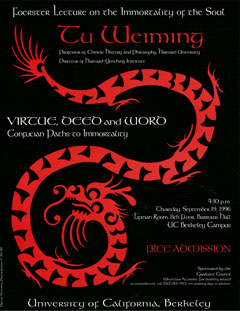
[00:00:17] FREDERIC WAKEMAN:
I’m, uh, uh, Frederic Wakeman, the director of the Institute of East Asian Studies here, and I apologize for, um, the four-minute delay, uh, Professor Duke thought I was going to meet him at the faculty club and bring him over, and I sent a different message this morning, but it obviously didn’t get through to him, so he was patiently waiting for me while all of you were impatiently waiting for him. Um, this is, uh– L-let me just start by saying a few words about the Foerster Lectureship. This is a very distinguished, uh, lectureship with, uh, previous lectures ranging from Loren Eiseley to Paul Tillich to, uh, Aldous Huxley.
Uh, the definition of immortality is very broadly construed. uh, ever since the, uh, the endowment was set up for this back in the 1920s. And, uh, I’m delighted we have this annual event, uh, because it gives us an opportunity to welcome back to Berkeley one of our, uh, most esteemed friends and, and former teachers, Du Weiming, who taught here between 1971 and 1981 before going on to Harvard, uh, where he is now Professor of, uh, History and Philosophy and Director of the, uh, Harvard-Yenching Institute.
Before that, he served as Chair of the Department of East Asian Languages and, and, and Civilization at Harvard as well. Weiming, who is a very dear friend of mine, uh, was born in Kunming, uh, in, uh, in China and then received his, uh, college education on Taiwan at the most prestigious private university, Tunghai, before coming to this country to take his, uh, graduate degrees at Harvard University. After, uh, his, uh, d-degree was won, and it was already clear that he was more than just a wunderkind, he went on to teach at Princeton, and from there we enticed him to come to Berkeley.
And, uh, we were very, uh, I could hardly find the adjective to, to, to describe our feelings when, uh, Harvard beckoned, and he responded. Uh, Professor Du is the author of many, many books and articles. His, his doctoral thesis was revised and published as the, the m-major intellectual biography of one of China’s two post-Confucian philosophers, leading philosophers, Wang Yangming, whose name many of you probably know.
From there, he went on to write a, an extremely inf-influential book about the Doctrine of the Mean, and then a series of books on Confucian thought in English, not to speak of his Chinese publications. Uh, he currently, uh, has a book called The Living Tree, which is about the meaning or the changing meanings of Chinese identity that’s in press, that will soon appear. I venture to say that P-Professor Du is the most influential Chinese intellectual in the world today.
He, uh, commands a huge global following. Y-you mention his name to any learned person in, uh, uh, the Sinophone community, including mainland China, they instantly know who he is. He has been controversial.
We were together in, uh, Beijing, uh, at, at, at, uh, Peking University when he taught a course on Confucianism that caused the Central Committee of the Chinese Communist Party to consider shutting down the class. Uh, uh, it, it, it, uh, is very difficult to describe to those of you who don’t read, uh, Chinese, uh, uh, intellectual journals and publications how widespread his influence is. Uh, and I don’t think I need to say anything more about him because, uh, I, I, I don’t wanna take up the time to, to, to try to explain why that has happened and how important it is for, uh, for, uh, the living thought of the world.
Uh, it’s my great pleasure and my great honor to introduce Professor Du, who will speak to you, uh, on the topic of Virtue, Deed and Word: Confucian Paths to Immortality. Weiming.
(applause)
[00:04:59] DU WEIMING:
Um, thank you very much for your very generous introduction, Fred.
(coughs)
Uh, Professor Wakeman, members of the Foster Lectureship, colleagues, fellow students of comparative religion and East Asian studies, ladies and gentlemen, I feel greatly honored to have this rare opportunity to share my still very tentative interpretation of an intriguing issue from the Confucian perspective, the immortality of the soul. I am pleased to return to Berkeley among friends to explore the religious dimension of Confucian humanism, a subject close to my heart, and in my opinion, relevant to the spiritual self-definition of the modern intellectual. My thesis is simple, hopefully not too, uh, simplistic or simple-minded.
Even though Confucian thinkers never fully subscribed to the Christian thesis of the immortality of the soul, their emphasis on the lived world here and now, and the sensitivity of the body and body and mind, paradoxically offers rich symbolic, practical, and spiritual resources for us to think and rethink the immortality of the soul in the post-Enlightenment period, and of course, its significance for the self-understanding of the public intellectual in the global community. An unintended consequence of, uh, Matteo Ricci’s introduction of Catholicism to China and the, uh, Jesuit Chinese experience in the 17th century was the Chinese intellectual contribution, at least perceived contribution, to the Enlightenment in Europe. Through missionary reports, intellectuals in France, England, Italy, and Germany became aware of the humanistic splendor of Chinese civilization.
Leibniz, Voltaire, Quesnay, Diderot, the phis– the philosophes, the physiocrats, and the deists were fascinated by Chinese worldview, cosmological thinking, benevolent autocracy, and secular ethics. Why the vogue for things Chinese that overwhelmed eighteenth century Europe was more a craze for chinoiserie than a quest for s- philosophical insight. Confucian China was a reference society and an intellectual challenge to the self-reflexivity of, of some of the most brilliant minds in Europe.
Unfortunately, the effects of the Enlightenment mentality, especially in its nineteenth century Eurocentric incarnation on China and her self-perception as a developing modern state has been devastated. The modern West’s dichotomy or di-dichotomous of thinking, spirit, matter, mind, body, physical, mental, sacred, profane, creator, creature, God, man, subject, and object, all these are exclusive dichotomies, it’s diametrically opposed to the Chinese habits of the heart. Informed by Francis Bacon’s knowledge as power and Charles Darwin’s survival through competitiveness, the Enlightenment mentality is so radically different from any style of thought f-familiar to the Chinese mind that it challenges all dimensions of the Sinic world or the Sinological world, not just China, but Japan, Korea, Vietnam.
The Enlightenment faith in instrumental rationality, fueled by the Faustian drive to explore, to know, subdue, and control, made spectacular progress in science, technology, industrial capitalism, nation-building, multinational cooperation, democratic polity, of course, legal system, and military hardware. As the international rules of the game defined in terms of wealth and power were superimposed on China by gunboat diplomacy, the Chinese intellectuals countenanced the inevitability of Westernization and acted accordingly. The sense of urgency that prompted May fourth nineteen nineteen generation of Chinese thinkers to advocate wholesale Westernization as a precondition for cultural survival was disorienting and self-defeating.
The deliberate choice to undermine rich spiritual resources and to embark on a materialist path to save the nation led to revolutionary romanticism and populist scientism. The demand for effective action and demonstrable results was so compelling that the life of the mind was marginalized. As a consequence, there was little room for reflection, let alone meditative thinking.
For philosophy, the outcome was disastrous. In this regard, the modern fate of the Chinese intellectuals was much worse than their Indian counterparts. While centuries of colonization did not break the backbone of Indian spirituality, the semi-colonial states prompted the Chinese intellect-intellectual or intelligentsia as a whole to reject in total and by choice all the spiritual traditions, Mahayana Buddhism, Taoism, including religious Taoism, folk religious traditions, and the religious dimensions of Confucianism that define China’s soul.
We have only just begun to see indications that the Chinese thinkers are recovering from this externally imposed and internally inflicted malaise. Although it’s difficult for us to imagine how an intellectually sophisticated and spiritually rewarding interreligious encounter had occurred in the 17th century. The memory of the golden age of Catholicism in China, roughly sixteen ten to sixteen sixty, si-
so fifty years after the death of Matteo Ricci, is now being retrieved through a European joint venture, a sort of, uh, archaeology of knowledge to recover the Confucian-Christian dialogue. According to the Dutch sinologist Erik Zürcher’s recent study on the Rites controversy, the famous Chinese Christian scholar and patron of the Jesuit mission, Yang Tingyun enumerates the most essential points of similarity and difference between Confucian humanism and the doctrine of the law of heaven in a posthumously published treatise in sixteen twenty-five. Now let me summarize his main points by quoting Zur- Zurich’s work.
Yang Tingyun identified six basic subjects of religious thought and practice, and then goes on to indicate under each heading in what respects Confucianism and Christianity are similar or different. But before doing so, Yang stresses their fundamental compatibility that transcends all difference. That’s his opinion.
The message is clear. Yang fully accepts the idea that the belief in the personalized God is rooted in original Confucianism, and that this constitutes the common point of departure for both creeds. He then presents his six subjects as follows.
As regards ethics, both doctrines agree with each other. As regards the subtle mysteries of the workings of heaven, there is difference, but only one of degree. The ancient Chinese sages referred to them but did not make them explicit, whereas the Western scholars have explained them in full.
Second, the two doctrines agree in their general understanding of the way and its virtue, human nature, and destiny — Tao, Te, Hsing, Ming. But the Confucian classics do not speak about the afterlife and the nature of spirits, while the Westerners clearly explain these matters. Three, originally, Confucians and Christians knew how to revere and serve heaven.
Therein lies their similarity. However, Confucians have come to interpret heaven, or Tian, in terms of principle or pattern, li, and qi, vital energy, whereas the Westerners maintain that there is a law of heaven. Four, both believe in the absolute transcendence of the Creator, whose works are, in the ch– classical Chinese expression, without sound, without smell.
But the Westerners, in addition, preach the doctrine of the incarnation, as well as the three stages in which God has revealed the truth, culminating in the teaching of Jesus. Five, the two doctrines once shared the belief in one law. That was the situation during the three dynasties, so-called Xia, Shang, Zhou, beginning in 2000 BC, roughly.
It is reflected in the main text of the ancient classics, but not in later commentaries, and it is found in the works of great scholars who upheld orthodoxy, but not in those who expound unorthodox theories. Finally, six, there is similarity between the Christian belief in the immortality of the soul and the doctrine of the ancient classics. Later, however, the doctrines grew apart as the Chinese came to believe that a soul disappears into the great void.
For our purpose, Yang Tingyun’s assertion that the Chinese came to believe that a soul eventually disappears into the great void is most significant. It seems, to me at least, evident that prior to the introduction of Indian and Central Asian Buddhism to China in the first century BC. The immortality of the soul was not even a re- a rejected possibility for the Chinese thinkers, since they, in general, assume that the body is the proper home for the soul, and that ideally, and in most cases, practically, the body and soul are inseparable.
The belief that a disembodied soul can have a reality of its own, even more enduring than the body, is obviously untenable. Yet the Confucians were preoccupied with the question of the soul and the question of immortality. And they strongly believe that it is worth the effort to purify the soul and to achieve immortality.
As practical-minded thinkers, they argue that immortality is achievable through the written word, meritorious deeds. and above all, virtue. And that whether or not the soul exists after death, the purification of the soul is intrinsically valuable.
In traditional China, the typical Confucian thinker was a local scholar-official who was informed by a profound historical consciousness, well-seasoned in the fine arts of poetry, lute, a musical instrument, and calligraphy, and deeply immersed in the daily routine of government. If philosophy is loosely defined as an edifying conversation informed by disciplined reflection on insights, Confucian thought is distinguished in its commitment to and observation of the human condition. It is a form of what I call embodied thinking.
with insights derived primarily from practical living. Unlike the Greek philosopher, the Hebrew prophet, the Hindu guru, the Buddhist monk, or the Christian priest. The Confucian scholar is engaged in society, involved in politics, and dedicated to the cultural transformation of the world.
Why is such a person immersed in the world here and now concerned about immortality and purity of the soul? Unlike the modern Western intellectual, at least in Max Weber’s conception, who is disenchanted with the magic garden and universal brotherhood, and is therefore unmusical to religious matters, the Confucian scholar is inspired by a cosmological as well as an anthropological vision, and is therefore not at all anthropocentric. Indeed, the Confucian concern for immortality and purity of soul is rooted in an anthropocosmic, both anthropological and cosmological vision.
This is the main thesis for my presentation. Actually, questions of immortality and purity of soul are not only relevant to Confucian humanism, but also crucial for understanding the religious dimension in Confucian humanism. Indeed, it is my contention that the religious dimension is a defining characteristic of Confucian life orientation.
When Confucius was asked about serving the spiritual beings, he retorted, “If we are not yet able to serve human beings, how can we serve spiritual beings?” When he was asked about death, he retorted, “If we do not yet know life, how can we know about death?” Often, the modern interpreter takes this to mean that Confucius was exclusively interested in life and human beings, and that he was oblivious to death and spiritual beings.
This is, I surmise, a serious misreading of a profoundly meaningful statement about the relationship between life and death, and between human beings and spiritual forces in Confucian humanism. The assertion that knowing life is a precondition for knowing death by no means implies rejection of the need for knowing death. On the contrary, precisely because one cannot know death without first understanding the meaning of life, a full appreciation of life entails the need for probing the meaning of death.
Similarly, it is impractical and indeed implausible to imagine that we can know spiritual forces without a prior knowledge of the human condition. Yet a full appreciation of the meaning of being human demands that we try to understand spiritual beings as well. Modern scholars impressed by Confucius’ apparent pragmatism and atheism, have difficulty explaining the Confucian dictum that filial piety is characterized by our ability to serve our parents when they are alive, bury them when they die, and continuously offer sacrifice to them as if they are always present, all according to the appropriate ritual practice.
In fact, the Confucian tradition is noted for its rich repertoire of elaborate death rituals and its extensive literature on remembrances and veneration of ancestors. How can the anthropologists characterize the ancestral cult as a defining characteristic of Confucian religiousness if the master was interested in neither death nor spirit? There’s a wealth of material on death and spirit, even in the Analects.
I quote, “When Confucius offered sacrifice to his ancestors, he felt as if his ancestral spirits were actually present. When he offered sacrifice to other spiritual beings, he felt as if they were actually present. He said, “If I do not participate in sacrifice in person, it is as if I did not sacrifice at all.”
End of quote. The human form of life envisioned by Confucius is not anthropocentric. Rather, it is anthropocosmic in the sense that they are implicit mutuality, constant communication, and dynamic interaction between our human world and the cosmic order.
Confucian humanism as an inclusive organismic vision of human flourishing involves life, death, and spiritual beings. Paradoxically, the form of life here and now, symbolized by the human body, is the basis for immortality and the vehicle through which the soul can be purified. The Confucian assertion that, uh, quote, “Human beings can enlarge the way and that the way cannot enlarge human beings,” end of quote, is not the equivalent of the Greek idea that man is the measure of all things.
or the Enlightenment belief that man has the knowledge and power to control nature. Surely, as the myth of Yu connotes, a point we will return to later, human beings through diligent work, collaborative effort, charismatic leadership, knowledge, determination, and sacrifice are capable of transforming chaos, in this case, flood, into order. But the Confucian human agent, endowed with rich inner resources for self-transformation, is a servant, partner, and co-creator of heaven.
As a servant, the mandate of heaven works through the human agent for its own realization. As a partner, the human agent, by self-cultivation, and transmits the cultural will by heaven. And as a co-creator, the human agent joins heaven in a collaborative enterprise to bring completion to the cosmic process.
I quote, “Heaven engenders, human completes.” Our ability to enlarge the way makes us humble servants, responsible partners, and reverential co-creators. Precisely because we are empowered by heaven to be an anthropocosmic rather than an anthropocentric being, we cherish the virtue, the virtues of humility, responsibility, and reverence.
The story of Yu, just mentioned, symbolizes a Chinese reflection, particularly a Confucian reflection, of the worldwide flood myth or flood legend. This Chinese cultural hero, maybe a Confucian Noah, confronted the natural calamity with human ingenuity. He managed to control the floodwaters through great coordinated efforts at many levels.
First, he inspired people through exemplary teaching. He’s said to have worked on the project for nine years without visiting his family once, even though he passed through the vicinity three times. Second, his spirit of self-sacrifice was augmented by charismatic leadership that enabled him to mobilize thousands of people to work at gigantic irrigational systems.
Third, unlike his father, who failed to contain the flood by simply constructing dams, Yu studied the terrain, analyzed the nature of the disaster, and developed a comprehensive and practical plan to overcome it. As a result, he drained off the floodwaters of the North China Plain, divided the empire into nine regions, and according to the quality of the land, equitably distributed the natural resources among all the feudal lords. Thus, legend has it that Yu started first Chinese dynasty.
That’s the Xia dynasty. He became immortalized because of an extraordinarily meritorious deed. If we take the Confucian humanistic tradition as a dialectic process involving both a continuation and a departure from the shamanistic Shang culture, the second dynasty, The particular form of humanism which emerged out of the archaic political culture is both ethical and religious.
In the shamanistic order of things, power, authority, influence, and prestige were all centered around a strong desire to communicate with the Lord on High. In fact, it was the interplay between ethical efficacy and religious authenticity that provided the potency for this inclusive humanistic life orientation. Yet by the Western Zhou, with the emergence of the idea of the Mandate of Heaven, this particular form of shamanism had already assumed what may be called an immanentist character, meaning intrinsic character, affirming the innate virtue or the intrinsic virtue and value of the social political order in the world.
However, it is vitally important to note that paradoxically, this particular notion about the intrinsic meaning of the world here and now is never devoid of a transcendent referent. Perhaps Confucius’ unique contribution to human self-understanding is his assertion that a concrete living person here and now is the basis for immortality. A person so conceived is a dynamic process rather than a static structure, inevitably changing and deliberately transforming.
The Book of Change, a major source of inspiration for Confucian teaching, articulates the linkage between the heavenly cause and the human way in terms of renewal. Heaven marches forward vigorously, the profound person emulating it as model makes unceasing efforts for self-strengthening. The process of human self-renewal, individually and communally, is symbolized by three interconnected stages: poetry, ritual, and music.
Aesthetic sensitivity enables us to experience sympathetic resonance with nature. Ritual practice helps us to find our proper niches in society, and the harmonization between self and other in both nature and society provides a sustainable way for human flourishing. The concrete living person in this light is not an isolated individual, but a center of relationships.
As a center of relationships, the dignity of the person is never reducible to his or her useful function in society. Thus, the purity of the soul is an intrinsic value. Learning, as Confucius insisted, ought to be for the sake of the self.
However, as a center of relationships, we are forever interconnected with an ever-expanding netwo-network of communication and interchange. Our learning for the sake of the self is a personal task, but it takes the significance of the other for granted and is inevitably a communal act, and we achieve immortality through the community act or the communal act. It is commonly assumed that from an etymological point of view, the cardinal Confucian virtue in the Analects, humanity or Ren, presupposes a dyadic relationship because the character Ren seems to consist of the ideogram of human on the one hand and the sign of two.
Uh, the Berkeley sinologist Peter Boodberg, impressed by the significance of this particular combination, ingeniously rendered the word ren not as humanity, but as co-humanity. Although this by no means suggests that the dignity of a person is reducible to sociality, it emphasizes dialogue and conversation as proper ways of learning to be human, and the only human paths toward immortality. A concrete living person, as concrete living persons, we learn to become human through the ritual act.
The Confucian conception of learning is, in this sense, humanization as ritualization. No human being can flourish without a constant involvement of the other. The Confucian practice of building an elaborate cultural code on the biological reality of the parent-child relationship is predicated on the belief that the loving care of the parent for the child and the emotional attachment of the child to the parent is the most immediate and natural expression of human feelings.
These feelings are primordial sources for moral strength. They are also basic causes for aggression and self-destruction. It is therefore of paramount importance that elementary education begins with the gradual transformation of the biological necessity of the child’s dependence on the parent into the ethics of filial piety.
Therefore, Confucian education takes the body as its continuous reference as well as its point of departure. The six arts, ritual, music, archery, charioteering, calligraphy, and counting, are all mental exercises roo-rooted in the discipline of the body. Self-cultivation, xiu shen, literally nourishing the body, is the authentic way to purif-purify our soul.
The proper ways to eat, stand, sit, walk, and talk are serious matters for of elementary education, which teaches us to embody these basic ritual acts in our practical daily living, and by implication, to care for our soul. Indeed, Confucius defines humanity as returning to ritual through self-cultivation. and enjoins his students to see, listen, talk, and act in accordance with ritual.
Through ritualization of the body, we appropriate the civilized code of conduct. Only after we have embodied the civilized code of conduct can we express ourselves through the bodies. The art of embodying the rituals as the result of a rigorous and repeated discipline is precisely the process of what the Confucians advocate as learning for the sake of the self, which means taking the purification of our soul as an end in itself.
Confi- Confucians perceive the body as a gift of our parents and of heaven. The Yuan Qi, the primordial vital energy we are endowed with, is thus biologically and cosmologically determined.
Since we choose neither our parents nor the time and space of our births, the particular quality and quantity of our Yuan Qi are predetermined. There are unavoidable structural limitations to the health of our body, which involves, among other things, strength, temperament, disposition, and vitality. It seems on the surface that we are each endowed with the particular quality and quantity of this primordial vital energy, and consequently with a unique body.
However, since the procedure by which we become what we are is never fixed, despite our embeddedness, the freedom to move, encounter, discover, collect, and endure is forever present. The Yuan Qi as a life source is actually the wellspring which never ceases to supply the nourishment for our self-realization. Indeed, we do not have our bodies as given realities.
The whole idea that, uh, we own our bodies is quite foreign to this way of thinking. We become our bodies as we relate to, communicate with, and appropriate from the social and natural world in which we are a part. Strictly speaking, vital energy is not simply the building block of reality.
The language of particles, or even quarks, is too materialistic to convey the sense of unspecifiable power and indeterminate dynamism that Qi, or the vital energy, signifies. Elsewhere, I’ve rendered Qi as a vital force, bearing in mind its original associations with blood and breath. That therefore it’s comparable to the Greek notion of pneuma, and its emphasis on the life process.
Indeed, Qi is existence in process, not being, per se, but becoming, which allows being to be more than merely something. The cosmic vision that underlies this conceptions of the vital energy is the great transformation, the da hua, which encompasses all modalities of being in the universe. Since there is nothing, air, water, earth, rock, plant, animal, or human that is not imbued with energy, with the qi, everything is a vital and dynamic constitutive partner of the Great Transformation.
Accordingly, nature is the result of the fusion and intermingling of vital forces that assume tangible forms. And I quote, “Mountains, rivers, rocks, trees, animals, and human beings are all modalities of energy matter, symbolizing the creative transformation of the Tao is forever present.” Our bodies are therefore the human forms of the vital energy of the Great Transformation that we assume at birth.
More appropriately, our bodies are the gifts entrusted to us by our parents and by Heaven, so that we can fully embody our humanity. And this may have prompted Wang Gen, who was a sixteenth-century thinker, to state as an article of faith, “If we came into being through evolution or transformative birth, huasen, then heaven and earth are parents to us. If, on the other hand, we came into being because of creation or formalistic birth, xingsen, then our parents are heaven and earth to us.”” Accordingly, we do not own our bodies.
We are, we are our bodies ontologically, and we become our bodies existentially. This is perhaps the reason that Mencius observes that only the sage, which means the most authentic and fully realized human being, can be said to have brought his or her form, meaning bodily form, to fruition, a kind of Confucian manifestation of immortality. The non-dualistic mode of thought, sometimes characterized as Qi Monism, enables the Confucians to define humanity as sensibility and sensitivity.
The human body, as a microcosm of the cosmos, is not only a manifestation of the Great Transformation, but also a conduit through which the vital energy of heaven and earth flows. The distinctiveness of being human in the perspective of either creationism or evolution lies in continuity rather than rupture. As a modality of qi, we find affinity and consanguinity with nature.
In the words of a 12th-century Confucian thinker, Zhang Zai, in his Western Inscription, I quote, “Heaven is my father and Earth is my mother, and even such a small being as I finds an intimate place in their midst. Therefore, that which fills the universe I regard as my body. That which directs the universe I regard as my nature.
All people are my brothers and sisters, and all things are my companions. End of quote. Although forming one body with the universe can literally mean that since all modalities of being are made of qi, made of energy, human life is part of a continuous flow of the blood and breath that constitutes the cosmic process.
It also implies that our awareness that our bodies are conduits through which the vital energy of heaven and earth flows empowers us to realize ourselves by intimately participating in the great transformation of the cosmos. Our bodies are gifts of our parents, but they are more than biological realities, for they are also endowed with a particular modality of vital energy that makes us sensitive to virtually all things with which we come into contact. In principle, at least, nothing lies outside the parameters of our human concerns.
Our bodies are experientially in communication with every conceivable modality of being. And since all modalities of being consist of vital energy, the communication is, in practical terms, an interchange. Indeed, we embody heaven, earth, and the myriad things in our human sensitivity because we actually experience their presence, not merely as an other, but also as an inner reality.
Our nature, that particular way in which vital energy crystallizes, endows us with the ability to feel the presence of an ever-expanding network of relationships. Since there’s no limit to our sensitivity, the network is always an open system. It is inconceivable that there is something out there that human sensitivity is incapable of communicating with.
The nature of human sensitivity is such that it encompasses comprehensively to the extent that there is nothing that is incommunicable. Yet the ability of human sensitivity to be all-inclusive is rooted in the ordinary sensory experience, such as seeing, hearing, smelling, and touching. The body, so conceived, is more than a ph-physiological entity.
It is a power station and a communication center. As a power station, it is an energy field rather than a conglomerate of discrete organs. This has been very much argued in Chinese medical thought.
As a communication center, it is a convergence of dynamic processes rather than a combination of static structures. This idea of humanity deliberately honors sympathy, and by implication, empathy, as a defining characteristic of the human manifestation of vital energy. Indeed, that which makes human beings unique in the primordial sense, it’s our native intelligence and innate ability to feel the presence of the other.
Our learned capacity to think rationally, our disciplined strength to will morally, and our cultivated sense to act appropriately are inseparable from the sensibility and sensitivity that allow us to sympathize with our social and natural environments. And to emphasize and empathize with the suffering of others. Strictly, human beings are capable of willing, sensing, and knowing, but feeling underlies all mental and physical activities.
There is no willpower, sense of appropriateness, or cognition without feeling. It is curious to imagine that we can will, sense, or know, as many philosophers have asked us to do, independent of how we feel. Since it is human to feel, the feeling that we naturally experience in response to the suffering of others is not only an expression of what we have, but also a realization of what we are.
We may refine our cognitive capacity to know wisely, strengthen our will to act righteously, and cultivate our sense or taste to live appropriately, But rationality, rightness, and propriety will require the nourishment of commiseration. For without sympathy and empathy, we cannot be truly human. Sympathy and empathy purifies our soul and, and, and enables us to become immortal as an integral part of the Great Transformation.
The anthropocosmic vision underlies our capacity to form one body is portrayed in the four-character phrase, “Tianren heyi,” the union of heaven and humanity. As both a guiding principle and the root metaphor in Confucian metaphysics. Tianren heyi specifies a dynamic, interactive, and mutually beneficial union rather than an aesthetic equilibrium.
Such a union not only allows diversity, but also requires multiplicity. Indeed, it celebrates the complementarity of multifarious paths, many different paths leading to the same way. Accordingly, human beings, in this sense, are not mere creatures, but co-creators of the universe.
The Book of Change, critically acclaimed as the repository of Tianren heyi, or the, or the, uh, anthropocosmic wisdom takes harmony in contrariety for granted as an authentic depiction of the natural world of things. While the Great Transformation is never perceived as a process of homogenization, as it symbolizes the confluence of numerous currents, it suggests a hidden harmony of the way, Notwithstanding the creative tension between heaven and humanity, heaven’s natural way provides the highest standard of inspiration for human morality. After all, embodied in our natur– in our human nature is the secret code for heaven’s self-realization, for it needs our active participation to, to realize its own truth.
The sixteenth-century Neo-Confucian thinker Wang Yangming, that Fred referred to earlier, makes the following statement in an experiential way how we in fact, our sensitivity is linked to the different modalities of the world. I, I quote, it’s a bit long, but it’s very suggestive. “Therefore, when an ordinary person sees a child about to fall into a well, he cannot help a feeling of alarm and commiseration.”
This shows that his humanity forms one body with the child. It may be objected that the child belongs to the same species. Again, when he observes the pitiful cries and frightened appearance of birds and animals about to be slaughtered, he cannot help feeling an inability to bear their suffering.
This shows that his humanity forms one body with birds and animals. It may be objected that birds and animals are sentient beings as he is, but when he sees plants broken and destroyed, he cannot help a feeling of pity. This shows that his humanity forms one body with plants.
It may be said that plants are living things as he is, yet even when he sees tiles and stones shattered and crushed, he cannot help a feeling of regret. This shows that his humanity forms one body with tiles and stones. This means that even the heart and mind of ordinary persons has the humanity that forms one body with all.
The word mind, xin, far from being a Cartesian, res cogitans, entails the visceral sensations of pain and suffering. It is often rendered as heart and mind. The flesh of the body, involving breath and blood, is an integral part of our heart and mind.
Embodiment, in this sense, is not an imaginary act, but an experiential understanding and a real appropriation. The implications of these anthropological and cosmological insights for comprehending the human body are far-reaching. Salient features which deserve special attention include just three points.
The body is a vehicle by which we, as Heaven’s co-creators, participate in the Great Transformation as responsive and responsible agents. Two, the body is an attainment by which we, as beneficiaries of Heaven, Earth, and the myriad things, sustain and enrich nature as filial children and conscientious guardians. Three, the body is a conduit through which we communicate with all modalities of vital energy in order to realize the ultimate meaning of life in ordinary human existence.
Understandably, the Confucian faith in the transformability of the human condition through self-cultivation is reflected in the ritualization of the body as its point of departure. The body, despite its structural limitations, is an indispensable instrument for self-realization. It is the proper home for mind and soul.
Furthermore, by actively participate- participating in intellectual and spiritual life, the body appropriates the world around us and creates real possibilities for cosmic union for us. Time only permits me to note that two visions of human condition feature prominently in this project of human flourishing, the poetic and the historical. The poetic vision involves the language of the heart.
It speaks to the commonality of human feelings and the mutuality of human concerns. It stresses the synchronized rhythm, like the natural flow of sympathetic responses to inspiring music and dance. Human beings are poetic beings, and by implication, musical and artistic beings.
They are aesthetically in tune with nature and capable of generating internal resonances, not only among themselves, but also with heaven, earth, and a myriad of things. The social function, which entails a ritual form through which we learn to express ourselves, are implicit in this language of the heart. The historical vision presupposes that a collective memory embodied in our consciousness helps us to define who we are.
History tells us in graphic detail how specific events in the remote past have a direct bearing on our life here now. It also tells us that we are an integral part of a cumulative effort to make the culture of ours as enduring patterns of human flourishing. Yet history is not only a record of what actually happened, but also a judgment of why things were not always what they could have been and ought to have been.
Since history’s function is that of wise counsel for the present and the future, it is a communal verdict, praise or blame, on the shapers of the major events that has a lasting impact on the human community. A historian so conceived is a social conscience, a guardian of our collective memory, and a political critic. The sense of fear and trembling with which Confucius undertook the task of writing the Spring and Autumn Annals, as noted in the Book of Mencius, suggests that the very act of writing history presumes an air of prophecy and commits one to a judgmental mode, is in basic conflict with the cherished values of harmony, community, and communication as embodied in poetry.
The grand historian Sima Qian, his vision about his own vocation well captures the Confucian spirit of what the mission of history ought to be. I quote, in his autobiography, Writing History, “To probe the overlapping boundaries between heaven and humanity, to comprehend the transformation between past and present, and to complete the family tradition of a distinctive style of transmission.” Implicit in this historical vision is a metaphysical idea.
The idea that all modalities of being are interconnected. This sym-synoptic description of the Confucian perception of the human condition, informed by the two visions, suggests that in the Confucian perception, human beings are more than rational beings, political animals, tool users, or manipulators of symbols. As poetic and historical beings, we can tap rich cultural resources to pur– purify our soul and develop our paths toward immortality.
As exemplary teachers, Confucian intellectuals significantly differed from Greek philosophers, Jewish prophets, Hindu gurus, Buddhist monks, and the Christian priests. They assigned themselves the task of appealing to common sense, good reason, and genuine feeling of the people to establish order in the world. Surely, as teachers, advisors, censors, ministers, and bureaucrats, the Confucian intellectuals were leaders.
But originally, they were farmers, laborers, and merchants, and in theory and practice, should be always organically connected with the people. It is instructive to note that Mencius identified the social origins of his great cultural heroes as an Eastern barbarian. uh, that’s Shun, a farmer, a construction worker, a jailer, an ex-convict, and a merchant.
The message he intended to convey is they became major compu– uh, contributors to humanity and thus achieved immortality through rigorous self-cultivation. Confucian intellectuals were, in terms of class origins, common people. Through education, rigorous effort, and self-cultivation, they developed a communal critical consciousness that their mission in life was to embody the way, to teach through example, so that the body politic can be transformed into a moral community, a wholesome environment for human flourishing.
We can actually envision the Confucian perception of human flourishing based upon the dignity of the person in terms of a series of concentric circles: Self, family, community, society, nation, world, and cosmos. We begin with a quest for true personal identity and open and creatively transforming selfhood, which paradoxically must be predicated on, on our, on our ability to overcome selfishness and egoism. We cherish family cohesiveness.
In order to do so, we have to go beyond nepotism, otherwise Confucian ethics is just like mafia ethics. We embrace communal solidarity, but we have to transcend parochialism to fully realize its true value. We can be enriched by social integration, provided that we, we overcome ethnocentrism and chauvinistic culturalism.
We are committed to national unity, but we ought to rise above aggressive nationalism so that we can be genuinely patriotic. We are inspired by human flourishing, but we must endeavor not to be confined by anthropocentrism. The full meaning of humanity is anthropocentric–
Uh, is anthropocosmic rather than anthropocentric. On the occasion of the International Symposium on Islamic-Confucian Dialogue organized by the University of Malaya, March 1995, the Deputy Prime Minister of Malaysia, Anwar Ibrahim, quoted a statement from Huston Smith’s World– The World’s Religions. It very cap– it very much captures the Confucian spirit of self-transcendence.
I quote, “In shifting the center of one’s empathetic concern from oneself to one’s family, one transcends selfishness. The move from family to community transcends nepotism. The move from community to nation transcends parochialism, and the move to all humanity counters chauvinistic nationalism.”
We can even add the move towards the unity of heaven and humanity, Tianren heyi, transcends secular humanism, a blatant form of anthropocentrism characteristic of the Enlightenment mentality. Indeed, it is in the anthropocosmic spirit that we find communication between self and community, harmony between human species and nature, and mutuality between humanity and heaven. This integrated, comprehensive vision of learning to be human can perhaps serve as a point of departure for a new discourse on the immortality of the soul.
Thank you.
(applause)
[01:01:21] FREDERIC WAKEMAN:
Uh, Professor Du is willing to take questions if you have them or comments as you like.
[01:01:31] DU WEIMING:
Also, feel free to leave when—
(laughter)
I’m sorry, this is a bit too long, but I would be happy to, uh, answer any questions you have or comments you make. Please, sir.
[01:01:44] AUDIENCE MEMBER:
Yeah, your, um, from your remarks-
[01:01:46] DU WEIMING:
Why don’t you sit down? You okay?
[01:01:48] AUDIENCE MEMBER:
Your remarks, uh, from Confucius’ thoughts sounded fairly optimistic to me. Um, uh, you talked a little bit about empathy and a little bit about history, but I was curious, uh, what– if, if they kind of reject the dialectic view, they don’t seem to include a kind of teleological view of time, uh, and they don’t seem to have the, uh, somewhat elaborate, uh, moral concepts, uh, that Western Christians have for talking about history and the failures of history. How do they, uh, talk about or conceptualize historical failures, uh, or tragic views of life?
[01:02:25] DU WEIMING:
Uh, thank you very much. I think let me repeat the question, uh, maybe in summary form. Uh, Confucian humanism seems optimistic, and yet, uh, it seems to lack all these, uh, uh, teleological notions in the West, in the Christian tradition that would be able to explain the major human failures and, uh, how, how do we account for that?
Now, uh, our colleague, um, at the Hoover Institution now, uh, Professor Tom Metzger, uh, in his critique of, uh, virtually all major Chinese, uh, intellectuals currently working on Confucianism, and certainly my work is included in that, and describes the Confucian projects as a kind of naive epistemological optimism. I don’t think that’s the case at all. Just look at it this way.
If the human factor features prominently in the shape of the world in which we live. The human factor can either be a positive or a negative factor. So you do not have, I, I think I don’t believe that the Confucians only believe in circles.
You know, people say only the modern West, we have an idea of progress, and whereas the Confucians always believe like the four seasons. Not circles. I think the Confucians believe the historical process is unpredictable, And the unpredictability is based upon not because heaven, because the heavenly seasons are very orderly, dependent upon the human factor.
We are responsible for the rise and fall of empires, of, uh, even the natural environment and our own fate. So in this connection, they’re not optimists– uh, they’re not optimistic in the sense they have this, uh, grandiose vision of harmony. And they see clearly, for example, Mencius was born in a period we call Warring States.
you could see clearly that the whole world was going through a major crisis. And yet he always believed that the only salvific power that human beings eventually will be able to restore lies upon the human community itself, not anything else. And that’s the reason why there’s a great deal of emphasis on self-cultivation.
You know, in the, in the, uh, great learning, uh, from the emperor to the commoner, each and every one ought to regard self-cultivation as the root. And I think it’s a very serious statement. It’s not just a general statement about, about human flourishing.
Yes.
[01:05:01] AUDIENCE MEMBER:
Ought to was the thing think of. Here is our own world today where there are people who say ought to, ought to.
[01:05:08] DU WEIMING:
Yes.
[01:05:11] AUDIENCE MEMBER:
How do we address the apparent fact that human beings in general don’t?
[01:05:19] DU WEIMING:
The question is, uh, used the word “ought” to, you know, it’s a moral or wishful thinking, right? And in fact, human beings don’t. Uh, I think if you look at the record, first of all, the Confucians are obsessed with history.
If we look at two major civilizations, Indian and Chinese, these two major civilizations have continuous history. Uh, there are civilizations that, uh, flourished very, uh, in, in ancient times, like the Egyptian, the Sumerian, and so forth. But now we can only see the civilizations in the Metropolitan Museum of Art.
There are civilizations that are shaping our world today, the American or the Russian civilizations, but the history of these two civilizations seems to be relatively short. For these long civilizations, both India and China, the Indians’ ability to transcend history is sharply contrasted with the Chinese obsession with history. Ever since, uh, the eighth century or of the ninth century BC, uh, there’s continuous history, recorded history.
So now we have, uh, even after the burning of books and cultural revolution and so forth, we still have about fifty million records, books of various, of various kinds. So to have this collective memory, to understand what’s going on, and to deal with it case by case, that’s the only way you can do it. To believe there is a certain kind of, uh, major transformative force totally outside of the human community that will help us to save ourselves It’s out of the question.
We are co-creators in the cell– in the sense that we can be destroyers of ourselves, not only ourselves, maybe, or the environment as a whole. Yes, sir.
[01:07:10] AUDIENCE MEMBER:
I greatly appreciate your expression of your contribution. Uh, the only comment I would like to submit is that the Hindu gurus or the aristocratic thought is actually created by the kings all along the line, not by the ascetics. From the time of the Yajurveda, which is actually the Janaka, you know, the king, the time of Ram, there is all the Yoga Vasistha is created, that is a king.
The Bhagavad Gita is promulgated by a king on the battlefield. The entire Buddhism was actually promoted by Ashoka, the king, and Buddha himself was a king. So the concept that the Hindu gurus are actually ascetics and really don’t know the world, they are actually trying to say is that once a person has had a full meal, seeing the entire materialism, this life, I really don’t want it.
And then the descension of the new cosmic force and the ascension of the human spirit, that is what is actually here. And the concept of immortality is actually a little wider in the case there. So I would, uh, appreciate considering that, and I certainly think there’s a lot of similarity between Confucianism and and on the rise at a certain level when different concentric circles were presented, and
that of course when it was not concentric.
[01:09:06] DU WEIMING:
Uh, thank you for your comment. And the comment is, uh, to correct a possible misconception of mine that is, uh, the Hindu guru is deeply involved in, in politics in the world, not just simply aesthetic. And in fact, I visited India in December at the invitation of the, uh, uh, Indian Council of Philosophical Research, know, as a lecturer.
Uh, not only New-New Delhi, but Madras, uh, Santiniketan, uh, Banaras, and so forth. So for the first time, I– this is my second visit, but for the first time, I was very deeply engaged in a series of conversations with, uh, Indian philosophers, including those who are in the Advaita Vedanta tradition. But I’m still very much impressed by the idea of the renouncer in the Buddhist tradition as well as the earlier one.
You know, the, the Hindu stages of life. After you’ve served as an apprentice, as a householder, it’s time to– for you to become a forest dweller and eventually to become a, a renouncer as an ascetic. That notion of the stages of life, in a way, is sharply contrasted with the Chinese idea of the inability to leave the world.
Or the notion that when your hair begin to turn white, when you see the face of your grandchildren, it’s time for you to leave. I think such a marvelous idea. Just imagine if all these Chinese leaders, you know, in their 90s now all believe that’s, that’s the way out.
And I, I think I’m serious here. I, uh, I argued, uh, 25 years ago, but e- more recently. If the Chinese intellectuals begin to take India absolutely seriously as a reference society and as an intellectual challenge.
This will be a very major sign for me, encouraging sign of a major intellectual maturity for the following reason. The Chinese intellectual then will begin to appreciate their own cultural traditions, Mahayana Buddhism in particular, but certainly Taoism and the religious dimension of Confucianism. And if they do that, they will be able to…
Leaders in particular, they will be able to deal with Tibet as a cultural universe rather than simply as a, a political entity, more effectively, sympathetically, and in a way, uh, practically. Thank you for the comment.
[01:11:32] AUDIENCE MEMBER:
Yes, sir. In listening to your talk, I was struck by what seemed to me to be almost a remarkable similarity between the social ethics of the Confucian humanists you’ve cited and the social ethics of the Renaissance humanists who lived in Italy from about the fourteenth century to the eighteenth century. In fact, many of the phrases anthropocosmic, etcetera, that you use appear literally in the texts of people like Pico, Ficino, going all the way to the eighteenth century humanists such as Vico.
What I’m wondering historically is, are there any traces of influence from Renaissance Italian humanists into Confucian humanists? And if so, was Ricci the person who might have introduced them?
[01:12:24] DU WEIMING:
Um, thank you very much for the comment. In fact, uh, exchanged these ideas over the years with, uh, Professor Bill Bouwsma and a number of others. Um, I think some aspects of, uh, the Renaissance ideas filtered through the, the, um, the, uh, the teachings of some of the Jesuits.
But I think there’s a, there’s a time gap. I, I– More than that. I think first I focused my attention on Confucius and Mencius.
Confucius was born five hundred and fifty-one B.C. And Mencius, for that period, that was the beginning of a kind of Confucian humanism. And of course, there are many different ways of interpreting that. But the Neo-Confucian humanism began, roughly speaking, in the, um, in, in twelfth century, eleventh, twelfth century.
And I know that the Renaissance tradition, of course, the introduction of ideas from the, the Arabic world, the Islamic contribution. There’s a major difference between a Renaissance man and a Confucian idea of scholar-official. A Renaissance man is a man that has many different talents.
He had– he’s a scientist, uh, he’s maybe a jurist and a literary writer. And so the multidimensional humanistic education characterizes the Renaissance man. This is how we use it even today.
But the Confucian idea of a scholar-official, as a Confucian idea of a thinker in the 10th or 11th century, is different from the idea of a literatus. And in fact, uh, one of the Confucian thinkers, Cheng Yi, argued that if one simply becomes a literatus, then one can never become fully embodied as a Confucian thinker, because the emphasis is more on uh, ethical religious commitment to ideas. So in that sense, maybe the Christian side of the Renaissance that has not been totally marginalized seems to speak directly to this particular idea of, uh, Confucian intellectual self-definition.
Yes?
[01:14:41] AUDIENCE MEMBER:
Um, you contrasted the actual federal parliament, um, I noticed the approach of a central one for the European Enlightenment. Um, how would you trace this difference in, um, metaphysics, um, if you had to trace it back beyond just thinkers and writers, but to perhaps the, um, the beginnings of the civilizations between the West and China? How would you explain that?
[01:15:07] DU WEIMING:
Ex-ex-excellent question. The question, the question is, I contrasted the, uh, anthropocentrism of Enlightenment and the anthropocosmic vision of the Confucian tradition. And the idea is to, uh, maybe to do a little bit of a historical narrative, And certainly the time does not allow me to do that.
But, uh, the emergence of the Enlightenment secular humanism, which was very, very powerful, even– I would even argue it’s perhaps the most powerful sociopolitical ideology of the modern world. It’s still very much a part of us. And that is linked to, um, I already referred to, um, Bacon’s notion, uh, about knowledge as power.
But I think more importantly is Descartes’, uh, very critical distinction. Uh, Descartes make all the exclusive dichotomies I mentioned: mind, body, spirit, matter, sacred, profane, God, man, and exclusive dichotomies. And Descartes was absolutely serious about, about this.
He wanted to find what some scholars called true certainty in terms of our thinking, in terms of our rationality. And that certainty allows him to finally reduce the thinking, reflecting mind as the only basis for true knowledge. So in the, in the Cartesian vision, history is totally um, totally useless.
Uh, all kinds of other humanistic endeavors are marginalized. And the Enlightenment, of course, Enlightenment is very complicated. You have the French, you have the British.
But either French or British, it really underscores the importance of instrumental rationality, uh, as Max Weber and others talked about. Therefore, the notion that man is the measure of all things. I remember when, uh, Emerson Hall was constructed at Harvard.
Two groups of people were involved. One group be-believed that Emerson was a humanist, so the motto for the building should be, “Man is the measure of all things.” The other group believed that he was a, a religionist, so the biblical notion, “What is man that thou art mindful of him?” should be there.
So the religionists won, so now we have a motto, “What is man that thou art mindful of him?” I took a walk on campus with, uh, Professor Quine, who was a great logician, great scholar and I asked him about that. He said, “That’s very simple.”
“What is man that thou art mindful of him?” is the question. The proper answer, man is the measure of all things. And I sat with him once for, for lunch, and he said, “It is important for us to know ethics because we want people to be good.”
Why should we bother by religion? You know, religion has nothing to do with the modern world, and it’s very, very, uh, strange. But it, uh, uh, fortunately, it’s not characteristic of all the academicians in Cambridge now.
But, uh, but I think the notion about anthropocentrism as a powerful enlightenment, uh, enlightenment, you know, professionalism now, uh, it continues. It’s still very powerful. That’s the reason why I believe that the Confucian humanism, which is humanistic to the core and yet not anthropocentric, may provide certain kind of resources for us to rethink the Enlightenment project.
In fact, the Academy of Arts and Sciences recently agreed that we should do some kind of a series of, uh, discussions on the possible Confucian reflection on the Enlightenment. And of course, it requires a great deal of collaborative work to, to, to do it.
[01:19:07] FREDERIC WAKEMAN:
I’m gonna intervene, uh, because I think we’re gonna wear out our guest. Um, I, I’ve never seen this side of Quine. I took deductive and inductive logic with Professor Quine when I was a student at Harvard, and he was a frightening figure.
[01:19:21] DU WEIMING:
You’ve, you— still frightening.
[01:19:22] FREDERIC WAKEMAN:
(laughter)
You’ve humanized him for me. Um, when, when Professor Dew was a member of our, of our history department, he used to— we used to, uh, every couple of weeks get together and, and
(laughter)
drink a lot of brandy and smoke a lot of cigars. And he, he, wh-whenever he, he got in his cups, he would muse about the fact that he, he— that he really wasn’t quite a historian, that he was, that his vision encompassed other things. And I think what we’ve seen here today is that in describing the historical consciousness of Confucianism, uh, along with its spirituality, he’s obviously given us a lecture role we’ll never hear the likes of again.
But I want to tell you, as a Chinese intellectual historian myself, I don’t know of anybody else who could have done this. So, thank you very much.
[01:20:05] DU WEIMING:
Oh, thank you.
(applause)
(applause and cheering)