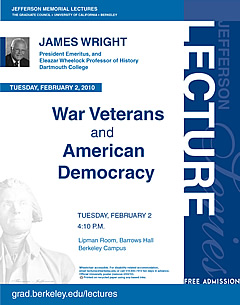
[00:00:00] ANDREW SZERI:
Good afternoon. My name is Andrew Szeri. I’m Dean of the Graduate Division here at Berkeley.
Um, I’d like to begin by thanking the, uh, Jefferson Lectureship Committee for, um, providing us with a wonderful choice for a speaker today. Um, we’re very pleased, along with the Graduate Council, to present, uh, President James Wright, who is, uh, this year’s speaker in the Jefferson Memorial Lecture Series. I’ll tell you a little bit about the lecture series.
The Jefferson Memorial Lectures were established in nineteen forty-four through a bequest from Elizabeth Bonestell and her husband, Cutler L. Bonestell. They were a prominent San Francisco couple. They cared deeply for history and hoped that the lectures would encourage students, faculty, and scholars, and those in the community to study the legacy of Thomas Jefferson and to explore values inherent in American democracy.
Past lecturers, including Ambassador Jeane Kirkpatrick,
(coughs)
Senator Alan Simpson, Representative Thomas Foley, Walter LaFeber, Archibald Cox have all delivered Jefferson Memorial Lectures on early American history, about Jefferson himself, and on American institutions and policies in politics, economics, education, and law. Now I’d like to welcome to the platform Chancellor of the University of California, Berkeley, Robert Birgeneau, who will introduce President Wright. Thank you.
(applause)
[00:01:33] ROBERT BIRGENEAU:
Thank you, Andrew. It’s my pleasure to welcome all of you this afternoon, and I’m delighted to have the opportunity to introduce to you my long-term friend, James Wright, who is President Emeritus and Eleazar Wheelock Professor of History at Dartmouth College. And Jim served as president of Dartmouth from, uh, nineteen ninety-eight until two thousand and nine.
Uh, for those of you in the armed forces, there’s a kind of bonding for people who’ve been in wars together between university presidents. T-tonight, he will deliver the Jefferson Memorial Lecture entitled War Veterans and American Democracy. Uh, I’m proud to say that Berkeley has the largest veteran community of any UC campus.
The campus has worked hard to reach out to and welcome returning veterans. And actually, I personally advocated for the post-9/11 GI Bill, and I’m gratified with the support that will now be given to veterans for a college education under the new bill. This year, we have over 200 veterans, largely
(coughing)
from service, returning from service in Iraq and Afghanistan on campus. And I know that a number of you are here this afternoon, uh, looking forward to hearing Jim Wright’s lecture. President Wright is recognized not only for his important scholarly writings to the field of American political history, but also for his many contributions to the welfare of American war veterans.
In two thousand and five, Jim began a series of visits to US military medical facilities in Washington, DC, where he met Marines and other US military personnel who had been wounded in the course of service in Iraq and Af- Afghanistan. He had himself enlisted in the Marine Corps for three years when he was seventeen years old, and he was just discharged at the rank of lance corporal. Jim, you’ll be pleased, be pleased to know that among our war veterans at Berkeley, the Ma- the Marine Corps is the most strongly represented.
In nineteen visits over the last four years, Jim has encouraged the injured servicemen and women to continue their education. On Veterans Day in November 2009, he was one of the speakers at the ceremony at the Vietnam Memorial in Washington, DC. Jim also joined in establishing an educational counseling program for wounded US veterans, uh, entitled Severely Injured Military Veterans Fulfilling Their Dreams, that is now being offered through the American Council on Education.
Since it was launched in 2007, the program has helped over 450 military personnel severely injured in Iraq and Afghanistan transitioned to college and civilian life. Jim earned his MA and PhD degrees in history at the University of Wisconsin-Madison after completing his undergraduate work at Wisconsin State University-Platteville. He’s been a member of the Dartmouth College faculty since nineteen sixty-nine, where he held various administrative posts, eventually becoming its president.
He’s the author of landmark studies of American politics in the nineteen eighties and the Progressive Era. Among the books that he has written or edited are The Politics of Populism, Dissent in Colorado, The Progressive Yankees, Republican Reformers in New Hampshire, and The West of the– The West of the American People. As Dartmouth’s president, Jim focused on advancing the academic strength of the college by expanding and diversifying the faculty.
Dartmouth now has the highest percentage of tenured women faculty in the Ivy League, and among the highest percentage of faculty of color. He also spearheaded a successful one point three billion fundraising campaign, which was the largest such effort in the college’s history. He’s been awarded numerous honors.
In two oh seven, The New York Times ran a feature on his work to provide education for wounded veterans. In two thousand and eight, the Marine Corps Scholarship Foundation awarded him with its Semper Fidelis Award for his efforts to ensure educational opportunities for wounded veterans. And he’s also an elected fellow from the– of the American Academy of Arts and Sciences.
But he has one special honor that’s hard to beat, especially for someone like myself who lived in Boston for twenty-five years, which is in June two thousand and nine, the Boston Red Sox recognized his contributions to education and to supporting veterans by inviting him to throw out the first pitch at a Red Sox game. And Jim, I’m sure you would have known that Curt Schilling pu- pitched for the Red Sox, and so you would have been elected senator. Uh, please join– For those of you who don’t know, that was the fatal flaw of Martha Coakley in running for the Senate and why she lost, because she thought that Curt Schilling pitched for the Yankees, and in Boston, that’s an unforgivable sin.
Please join me in warmly welcoming Jim Wright.
(applause)
[00:07:11] JIM WRIGHT:
Thank you, Bob. Dean Szeri, uh, thank you and, uh, the Jefferson Lecture Committee for selecting me for this lectureship. Uh, I am privileged to be here, uh, this afternoon.
Uh, I wanna thank Harry Scheiber especially, uh, who’s chair of the committee, and, uh, for all of his work in helping to coordinate, uh, this visit. Over forty years ago, uh, Harry and, uh, Jane Scheiber welcomed me as a junior colleague at Dartmouth, and what a treat for Susan and me, uh, to be welcomed by Harry and Jane here. Harry is a historian of true distinction and is someone whose advice and judgment I have always respected, so thank you, Harry.
Ellen Gobler is in the back of the room, and Ellen represents this university well and surely does much to make guests feel welcome. Thank you very much, Ellen. And finally, Chancellor Birgeneau.
Bob, thank you for your very generous introduction. I have long admired your leadership in higher education, and I applaud now in this trying time, your tremendous effort, uh, to protect and to advance one of the truly great universities of the world. So thank you for what you’re doing, good friend.
The invitation to deliver this lecture came as a great honor to me. I’m delighted to join this vibrant intellectual community for a few days, and I’m humbled in knowing the distinguished individuals who have preceded me as Jefferson Lecturers. Preparing for this presentation gave me an opportunity to reflect upon and to understand better some activities that have engaged me over the last several years, and it also provided me a chance to be a historian again.
Thank you so much for that. I have enjoyed that part of it immensely. In 2005, I did visit Bethesda Naval Hospital, and I spent some time in the ward with young Marines who have been injured in Iraq.
After a few more visits to Bethesda Hospital and to Walter Reed, I became more involved in helping the American Council on Education establish, uh, educational counseling for them. These activities in turn, uh, in– allowed me to relate with other veterans programs, such as the effort to establish a stronger GI Bill. And as I encountered groups and individuals looking to support veterans, I was always struck by the tremendous reservoir of affection, gratitude, and support for the troops and the veterans in this country.
As support for the wars in Iraq and Afghanistan declined, support for the troops who were engaged in those wars seemed to increase. This pattern seemed sharply at odds with the Vietnam experience. This lecture affords me an occasion to share some of my reflections and understandings about the historical treatment of veterans.
In this presentation, I would like to describe some of the assumptions and the conflicts that frame the history of Veterans Affairs in the United States. I will summarize the historical record of support for veterans, and I will share some reflections about changes in the dominant public attitude toward war veterans, the change from those who served in Vietnam to the present veterans of Iraq and Afghanistan. One point I would like to make at the outset, this lecture is not going to assess American foreign policy, nor the causes and justifications for wars.
Nor is this a military history, at least it is not a military history in any conventional sense. And finally, my focus on American war veterans and their casualties is taken fully cognizant of the fact that there are non-U.S. casualties, and that these, notably the civilian ones, need to be acknowledged. War is a violent and a cruel human exercise and can often be quite indiscriminate in its reach.
My subject today is really the U.S. war veterans, those who have served as part of a m-mobilized force, drafted or otherwise called up for a declared or an undeclared war. For most of our history, the United States military has been in a peacetime state, and those who have served in these forces have been volunteers. Military forces during wartime, on the other hand, historically have been conscripted, drafted, or called up to duty from militia or reserve units.
They have been the much celebrated citizen soldiers of the United States. Last August, at the Veterans of Foreign Wars Convention, President Obama said of the legacy of support for American veterans, quote, “America’s commitments” to its veterans are not just lines in a budget. They are bonds that are sacrosanct, a sacred trust that we are honor bound to uphold.”
In November, the United States Supreme Court seemed to affirm this commitment when it ruled in the case Porter versus McCollum for a new hearing for a Korean War veteran who had been convicted of a 1987 murder. The court held that the defense had not presented evidence of the psychological state of the veteran as a result of his war experiences. The justices noted, quote, “Our nation has a long tradition of according leniency to veterans in recognition of their service, especially for those who fought on the front lines.”
Now, I would defer to others to debate sacred or legal obligations to veterans, but I would suggest that the history of our relations with veterans is a more complicated, it’s a less generous, it’s a more ambiguous than these observations from the President and the justices of the, of the Court would imply. From the very beginning of this republic, in revolutionary rhetoric and in legislative provision, those who established a new nation expressed an aversion to the idea of professional or of standing armies. This was one of the issues that led to the revolt against the Crown after all, and the Minutemen at Lexington and Concord ennobled the American ideal of the citizen soldier.
As it turned out, the widespread discomfort with the idea of a standing army also provided some practical budget advantages for the young nation, for armies and navies are expensive things. And the citizen soldier offered a political supplement to the constitutional checks on the declaration of war. It was a widely shared and enduring assumption that in a democracy, no war fought by the citizens of that democracy can be sustained unless there is clear popular support for the commitment and for the cost.
This was consistent with an abiding principle of American democracy, civilian control of the military. The ideal of the citizen soldier was a crucial element in debating the decision in the 1970s to end the draft and to move on then to an all-volunteer force. And in recent years, most proposals that I have seen for a reinstatement of the draft have focused less on military requirements and have been based on the assertion that such a system would provide a more significant popular check on military activities.
The assumption was that if all, all of our sons and daughters faced the possibility of being engaged in armed conflict in Iraqi villages and the Afghanistan mountains, perhaps no sons and daughters would face this exposure. Or if they did, if they did, there would be a full discussion and acceptance of the national interest that required this. The debate about the composition of the military obviously informs broader views toward veterans, but my question is really a simple one.
What does a democracy owe to its veterans following their wartime military service? This simple question does not have a simple answer in practice. Prior to World War II, the prevailing view tended to be that this country owes little to those discharged war veterans who are physically fit.
As citizen soldiers, as beneficiaries of the compact of democracy, their service was not a contract for which further compensation was due, but rather was the necessary obligation of citizenship in a free society. Clearly, this view of no compensation for healthy veterans has not been the prevailing one for the last seventy-five years. The GIs of World War II were cultural heroes, and they came home to a grateful nation.
This reframed the dominant view of veterans’ benefits. Yet it is important to note that even prior to World War II, there were major exceptions to the principle that there was no obligation to healthy veterans. The passage of time has always been important in the development of public affection for, and even mythologizing of, wartime service.
Surely a grateful republic embraced the Revolutionary War veterans. But in the early years of this nation, it was but a quick embrace as the new nation and its citizens had much work to do. Within a few years, however, the celebration of the historic revolution and those heroes now who fought it became an important ritual of national unity.
The pattern of support for veterans that evolved following the revolution would frame the fundamentals that would mark our policy down through the First World War. Support for widows and orphans of those who died in combat action, some limited support for combat-related disability, and it was largely limited in the early years. Selective land grants down through the 1850s, and for Revolutionary War and, uh, Union Civil War veterans, pensions for aged survivors.
The First World War was a war of citizen soldiers. Conscription drew broadly from the population as the military forces increased in eighteen months from approximately a hundred and twenty-five thousand to nearly four million serving by November of 1918. President Woodrow Wilson and the Congress provided a war risk insurance plan for active duty military personnel who had to pay their own premiums.
There was an initial expectation that this, along with the health care for injured veterans, would be sufficient, but it proved not to be adequate. It proved not to be adequate in many cases to provide for the transitions back to civilian life. Even though World War I individual veterans’ benefits were limited, the magnitude of the numbers who served in the armed forces and who required medical support was consequential.
In the nineteen twenties, about twenty percent of the federal budget went to veterans, And in 1921, in response, uh, to the need of Congress of veterans, Congress institutionalized veteran support with the creation of the Federal Veterans Bureau. This was the source of some of the embarrassing corruption during the Warren Harding presidency, and in 1930, the agency was reorganized as the Veterans Administration. Within a few years of the end of the war, many of the veterans who had not required any of the medical treatment or disability-related help were increasingly of the view that they should receive some benefits in compensation for their service.
Economic problems in the United States and the world encouraged this position, and in nineteen twenty-four, the veterans achieved, over President Calvin Coolidge’s veto, passage of a bonus to be paid them in nineteen forty-five. By the early nineteen-thirties, many sought early payment of this bonus as a result of the Great Depression, and a group of veterans organized as the Bonus Expeditionary Force or the Bonus Army, and they marched on Washington to lobby and to protest. In the summer of nineteen thirty-two, President Herbert Hoover ordered General Douglas MacArthur to remove them physically from their encampment in Washington.
He did this by using tanks and tear gas to expel them. This entire experience was an embarrassing one for the United States, and the government’s desire to avoid a repeat of any such confrontation was an important part of the policy consideration for the comprehensive veterans programs that were provided at the, uh, Second World War. The Servicemen’s Readjustment Act of nineteen forty-four, known simply as the GI Bill, was a program that fundamentally shifted the nation’s treatment of war veterans.
This comprehensive legislation provided for all veterans, including the able-bodied, and was passed by the Congress prior to the conclusion of the war. It expanded traditional medical and disability programs, but also provided for substantial investment in the transition of the veterans back into American society. The legislation provided for up to fifty-two weeks of unemployment benefits.
It established an interest-free loan program for the purchase of homes, farms, or businesses, and it offered a comprehensive and generous plan to support education or training for veterans. As with earlier veterans’ legislation, the GI Bill provided medical support, but this one set a new standard with an investment in healthy veterans. It was not without its flaws, however.
There were political calculations involved in the passage of the legislation, and there were instances of fraud in the administration of benefits, as pointed out by Berkeley historian Kathleen Frydl in her thorough analysis of the political context and the full consequences of the GI Bill. Nevertheless, it seems clear that the provisions of the GI Bill encouraged and helped underwrite much of the creative energy that American society experienced following the war. The education provisions of the GI Bill stand, I believe, with the civil rights movement and the women’s rights movements in expanding the system of American higher education so that it became a model for access and for democratization.
Within a few years, veterans comprised nearly half of the students enrolled in American colleges and universities. The GI Bill was more than a compensatory handshake, a gratuity for the citizen soldiers of the global war. It built upon New Deal programs, and one of the goals of the GI Bill was to ease the demobilization of a military force of nearly sixteen million men and women.
The GI Bill was the largest entitlement program up until that point in American history. Social Security would soon surpass it, but it had not yet done that. In the several years following the Second World War, the Veterans Administration had the largest number of employees of any government agency.
And in nineteen fifty, seventy-one percent of federal payments to individuals went to veterans through the various veterans programs. The public generosity toward war veterans in the 1940s would not be sustained at the same level even in the next decade. In the Cold War years and in the major post-war economic and social adjustments, there are a number of competing budget priorities.
And there were concerns about some of the allegations of bi- fraudulent claims under the GI Bill. In establishing programs for Korean War veterans and the then Vietnam War veterans, the government increasingly scaled up military service requirements for eligibility and scaled down levels of support. including reduced unemployment benefits and loans.
And by the Vietnam period, the benefits simply did not even cover full educational costs. It is revealing that no one really questioned the basic assumptions of the GI Bill, even as they scaled back its coverage. The educational benefit came to dominate.
The principle had been established that a grateful nation owed to its wartime citizen soldiers compensatory support that would enable them to pursue an education in order to advance their lives and to pursue their ambitions. Future debates would be over the details, not over the principle. Additionally, there was broad acceptance of policies and programs that provided for medical and other support for veterans from discharge to death, and the medical support was not restricted simply to service-connected disabilities.
Other veterans could meet eligibility standards for VA health care. Vietnam veterans, of course, faced a nation divided in its support for the war, which for some at least meant a lessened sense of gratitude for those who served in the war. Even though there have been unpopular wars historically, there really was no precedent for a significant public sentiment that blamed those called to fight in those wars.
The nature and the unpopularity of the Vietnam War did not noticeably influence the traditional programs for veterans other than the reduced coverage that followed the post-World War II pattern. On the other hand, there was at best a slow, even a grudging acceptance of responsibility for some newly identified and newly understood consequences of combat service. The government denied for many years the medical effects of weapons such as Agent Orange, despite compelling and tangible evidence of this powerful herbicide defoliant’s residual malignancies.
In nineteen ninety-one, following years of litigation and medical claims, the Department of Veterans Affairs agreed to consider Agent Orange a presumptive factor in a range of cancers and other conditions. And only in the last few years, literally in the last few years, has there been any acknowledgement of responsibility for the hundreds of thousands of Vietnamese victims of Agent Orange. Uh, one estimate I saw was that four hundred thousand Vietnamese died as a result of diseases, of cancers that they picked up from Agent Orange, and there are another five hundred thousand birth defects as a result of this.
And we have just in the last few years assumed some responsibility for that. Post-traumatic stress disorder, the psychological malignancy, was also rejected in the immediate post-Vietnam years as a medical condition. Traditional accounts of battle fatigue and of shell shock were as old as warfare.
In the Civil War, it was called soldier’s heart. There was a resistance to recognizing this as a chronic illness, with even some of the older veterans groups dismissing complaints as a whine that Vietnam veterans needed to move beyond. Finally, in 1979, the Congress authorized the Veterans Administration to provide counseling for those suffering from PTSD symptoms.
It was the fifth time such legislation had been introduced in the Congress when it was passed. This followed shortly after the American Psychiatric Association had recognized this as a clinical condition. This was faster and easier than Agent Orange because of the tremendous liability issues that were involved with the latter, including liability issues from some of the major drug companies, the, the major chemical companies that manufactured, uh, these products.
The post-Vietnam programs of support for veterans were comprehensive, and they were expensive, none of which presumes their adequacy in meeting the needs of veterans. In 2000, the year 2000, the department, at cabinet level since nineteen eighty-eight, was the largest federal agency outside the Defense Department, the Department of Veterans Affairs. Over twenty percent of the federal non-defense personnel worked for the VA, and this expense was largely politically protected from cost cutters and critics.
In fact, in the spring of 2001, a Pew survey learned that only three percent of respondents favored a reduction in spending on veterans programs. The Gulf War in nineteen ninety, ninety-one, Operation Desert Storm, had further enhanced the climate of public support for the military and for veterans. The military effectiveness of the troops, uh, uh, of, of, of the troops fighting in those wars, uh, strengthened the image.
And the nine-eleven attacks, of course, underlined this climate of support for the military with an emotional jolt. There have been few events in American history that elicited such widespread fear, resolve, and national unity as did the nine eleven attacks. If the U.S. military had little role to play on that fast-moving morning, it emphatically would soon.
It quickly became apparent that these attacks were initiated by the militant Islamic fundamentalist group, Al-Qaeda, led by Osama bin Laden. This group have been provided sanctuary and training sites by the Taliban government in Afghanistan, and there was strong public support for the U.S. militarily to strike back. The U.S.-led NATO attack in late two thousand and one easily toppled the Taliban in Afghanistan, and the rapid defeat in the early spring of two thousand and three of Saddam Hussein in Iraq, considered then a co-conspirator in international terrorism, one who allegedly was emboldened by weapons of mass destruction in his arsenal.
This only increased the popular acclaim for the professionalism and the s– courage of the American military. And this acclaim never really lessened despite serious opposition to the rationale for the war in Iraq at the outset, opposition which increased in the following months as there turned out to be no weapons of mass destruction. But support for those serving in the military never wavered.
Surely, there were political calculations involved in this. Many learned from the Vietnam experience that it was not only unfair to blame the warriors for the war, but it was also politically inexpedient to do so in this era of acclaim for those who served. There have been few public sports or cultural events in the last several years where servicemen and women have not been saluted.
Magnetic ribbons and bumper stickers on automobiles, lapel pins, and refrigerator stickers all attest to this support. Businesses, corporations, and not-for-profit groups elbow with each other to pay homage to this generation’s armed forces. And communities across the United States have bonded in celebration of local units departing for the Middle East and have waited on the tarmac to embrace their return.
And too often, the routines of life have been altered as entire communities pause to thank and to mourn those whose sacrifice was forever. But national celebration and individual grief do not necessarily result in the delivery of support. As these wars proved more complicated than they appeared when they began, it should not be surprising that some needs of those who served have gone unmet.
There was a national wake-up call to this situation when two reporters for The Washington Post broke a story in February two thousand and seven regarding deplorable conditions for outpatients at Walter Reed Army Medical Center. Ten days ago, I visited Bethesda Naval Hospital. It was my twentieth visit to one of our major military hospitals, and I have to say, on all of these occasions, I have never met anyone with responsibility, with responsibility for serving patients, military or civilian, medical or support personnel, who was not fully committed to doing all that they could to comfort and he– to heal the patients and to support their families.
But the record also affirms that they have not always had the capacity or the facilities to meet their objectives. The wars in Afghanistan and Iraq have gone on much longer than anyone predicted in two thousand and one or two thousand and three. The resistance in those countries have proved more durable, more effective, and deadly than nearly any official projections made at the outset.
As a result of this, our forces have been pressed with multiple tours in the hostile areas, and as their equipment has been pushed too hard and sometimes has proved inadequate to the demands of the theater, so too have the support systems domestically been strained. Hospitals and medical support facilities and VA’s transitional ongoing services have faced unprecedented demands and numbers, unexpected, rather, demands and numbers. And no one in two thousand and one or two thousand and three had predicted wars of this length, nor had they planned for casualties of this magnitude and medical needs of this complexity.
In addition to the duration of the wars, the unexpected need for medical support for wounded veterans has resulted from two other factors, both positive developments, but with real consequences. One has to do with the efficiency and the effectiveness of modern battlefield medicine, and the other has to do with the quality of combat protective gear and its proven effectiveness in preventing some fatal wounds. In all U.S. wars prior to this twenty-first century, the ratio of surviving wounded to fatalities was two point one to one.
That is, for every one killed, two point one, uh, were wounded or injured. This actually was pretty constant. In World War II, it was two point three to one, and in Vietnam it was two point six to one.
But in Iraq, over the period from the invasion in March of 2003 down through mid-December of last year, the ratio of wounded to killed was seven point two five to one. We’re saving a lot more of these young men and women who are injured on the battlefield. In Afghanistan, from October 2001 to December of 2009, it was slightly better than five to one.
Certainly, the speed and the quality of treatment are critical. Military medicine is saving young men and women who would have died in previous wars. Modern medicine has a companion piece in modern military technology.
Even with all of its shortcomings, some of the military, uh, men in the audience here today can, can affirm that, even with its shortcomings, the body armor used in the field serves to protect vital organs from fatal damage. Modern body armor has helped prevent fatalities, but it has not protected troops from loss of limbs, from horrible burns, or from head injuries, often resulting in significant cognitive brain damage. Often enclosed in protective steel vehicles, our troops have been subject to major explosions, resulting often in serious burn injuries and major concussions.
As of one year ago, there were twelve hundred and eighty-six combat veterans with amputations, and down through 2007, there were forty-three thousand, uh, seven hundred and seventy-nine traumatic brain injuries. Their hospital stays are lengthy, with requirements for sophisticated treatment, state-of-the-art prostheses, multiple surgeries, and extended physical and occupational therapy, all of which has often exceeded the capacity of the hospitals. I would add a brief personal, uh, observation.
In my ha-hospital visits over the last four and a half years, I always go room to room and bed to bed, and I talk, uh, there to the wounded veterans. And I’ve always asked them what happened to them, and they’re always quite willing to talk about it. Of the whatever hundred and fifty to two hundred patients with whom I have spoken, they describe snipers and mines.
A few of them have talked about mortars fired behind from a pickup truck behind a berm someplace. They talk most commonly about improvised explosive devices hidden under the road or under a bridge, sitting in road trash, perhaps a suicide bomber in a car or in a crowd. I expect at most a half a dozen of these wounded veterans have told me that they saw the person who attacked them.
The Iraq War has not been marked by many conventional firefights or battlefield engagements where the US military clearly can dominate. There generally has been a strong po-political commitment to address the issues of the wounded veterans, and for several years, this clear resolve was absent, though, in another of the major post-World War II veterans programs, the GI Bill for Education. In 1984, Congress had approved the Montgomery GI Bill.
This peacetime program was restricted in terms of eligibility, and the benefits were often inadequate. Remedies proved politically complicated. The sharp divisions that marked discussions about remedying shortcomings in the Montgomery program were somewhat surprising to me.
The GI Bill, after all, was the celebrated symbol of a successful veterans program. The surprise is lessened, however, when we consider the immediate context, both the nature of the all-volunteer military and the nature of the wars in Iraq and Afghanistan. With a force that was pushed hard by frequent deployments, with a mission that had become complicated and nuanced, and with technology that was increasingly sophisticated, the military needed trained, experienced personnel.
If too many men and women left the service following their initial enlistment in order to enroll in school or a training program, there could be major personnel problems. The tension between veterans’ benefits and military requirements was really largely unprecedented. Previous wartime benefits were either part of a demobilization process, as they were at World War II and, and Korea, or of an engagement such as Vietnam that was sustained by the draft and draft-induced enlistments to maintain personnel goals.
Re-enlistments had always been critical to maintain experienced non-commissioned officers. But in the all-volunteer force, they became even more critical. In the wars in Iraq and Afghanistan, the Pentagon had no draft to increase the pipeline of recruits.
Within a few years after the nine-eleven surge in enlistments, enlistment and re-enlistment goals were challenged by the nature of the war and the optional opportunities in a growing economy. The Army especially was straining to meet its enlistment goals. Senator Jim Webb of Virginia, a decorated Vietnam Marine veteran, Marine officer, a former Assistant Secretary of Defense, Secretary of the Navy, and accomplished novelist on the Vietnam War, introduced legislation in January two thousand seven to provide current veterans with educational benefits roughly equivalent to those of the Second World War.
Officials in the Pentagon projected some significant re-enlistment problems that would result from this expanded G.I. Bill. And so during debate over this proposed legislation, the Defense Department and the White House publicly opposed the bill, and they were joined by a number of congressmen and senators. Secretary of Defense Robert Gates insisted that any enhanced benefits program needed to contain the option of transferability so that military personnel who re-enlisted and who served a minimum number of years could transfer the benefit to a spouse or a child.
Advocates of this believe that such a provision would provide a means to stay in the service and still utilize the benefits, I might even make re-enlistment more attractive. So the Webb Bill, with the transferability amendment, was approved by Congress and signed by President Bush in June of 2008. In the fall of 2009, over a hundred and eighty thousand veterans enrolled under the provisions of the new GI Bill.
But the entire debate over the legislation signaled a major shift in the way many policymakers and government officials regarded veterans’ benefits. In addition to being a service bonus from a grateful nation, this now was considered a personnel tool in the task of managing the modern military. With this overview of official veteran policy historically, I would like to turn now to an intriguing question that is unresolved.
As I engaged for this purpose in researching the history of veterans’ benefits, one thing increasingly stood out to me, the difference in attitudes toward the current generation of veterans as compared with the reception of the Vietnam War veterans in the late 1960s and 1970s. Clearly, the war in Vietnam and the war in Iraq, and more recently, the war in Afghanistan, have not had sustained popular support, popular support. Yet the servicemen and women who have served in our current wars have been warmly welcomed and thanked for their service.
And the Vietnam veterans largely came home to neither welcome nor thanks. As Max Cleland, Vietnam triple amputee and head of the Veterans Administration, one-term United States Senator from Georgia, wryly observed, he and the veterans never had a ticker tape parade, and instead they were treated as, quote, “co-conspirators in some escapade with sinister overtones.” Tim O’Brien, the accomplished novelist and Vietnam veteran, wrote in Going After Cacciato, “They did not know even the simple things, a sense of victory or satisfaction or necessary sacrifice.
They did not know the feeling of taking a place and keeping it, securing a village, and then raising a flag and calling it a victory.” Those who have served in wars other than Vietnam generally recognized that their fellow citizens did not always consider what they had done as heroic. Neither did they reject it as criminal.
In the case of Vietnam, the opposition to the war was often expressed in pretty sharp rhetoric. This was about more than a mistaken policy. Daniel Berrigan’s sense of being, quote, “morally outraged and ashamed” had a resonance in this country.
And when a distinguished journalist such as Anthony Lewis referred to the nineteen seventy-two bombings of Hanoi as a crime against humanity, it was hard not to include the airmen as among the criminals. The culture of the nineteen sixties was marked, of course, by young people of military age revolting against the conventional and affirming values of love, brotherhood, and sisterhood. Surely, Bob Dylan, Joan Baez, assuring that the times they are a-changin’, Country Joe and the Fish’s I Feel Like I’m Fixing to Die challenge, and John Lennon’s Give Peace a Chance plea.
These mirrored as they also shaped a generation’s and an era’s sense of revolution and of resolution. Demonstrations at the 1968 Democratic Convention in Chicago and the acoustic cultural manifesto at the Woodstock Festival in 1969 stood as symbols of the time. Symbols that were in sharp contrast and counterpoint to all that the military and Vietnam seemed to represent in terms of culture and values and goals.
In his compendium of accounts of returning veterans, Bob Greene included many reports of veterans being spat upon at airports, uh, being called baby killers on the streets. Some have challenged the veracity of these reported incidents, but as one veteran wrote, “If the number of spitting incidents are inflated, it doesn’t change for a minute the feelings of rejection and scorn that a bunch of depressed and confused young men experienced when they returned home from doing what their country told them to do.” The Defense Department has estimated that over three point five million Americans served in the military in Vietnam.
There are forty-seven thousand four hundred and twenty-four battle deaths and ten thousand seven eighty-five other deaths in the country. There are over a hundred and fifty thousand wounds that did not require hospitalization and over a hundred and fifty-three thousand that did, some of them quite significant hospitalization. This was a major and a costly war, But as the purpose and the origins came under question, so did those who were fighting it, as did their sacrifices and the sacrifices of their comrades.
The anger and emotions, the defensiveness and the moral judgments of this volatile mix should never be minimized. Public perceptions of the war in Vietnam have been influenced by events during the war and by coverage of them, by disclosure of the horror of My Lai, The photo of Vietnamese General Loan executing a Viet Cong officer. The small Vietnamese girl, and others around her, clothes burned from their bodies, fleeing from napalm.
In 1971, Gallup reported that fifty percent of Americans polled believed that incidents such as the atrocity at My Lai were, quote, “common occurrences in Vietnam.” Um, Louis Harris reported that eighty-one percent of his respondents believed that there were, quote, “other incidents like My Lai” which had been unreported. Of course, we now know that there were other incidents, none of the, of the magnitude and the horror of My Lai, but there were.
And what happened is that the incidents themselves became commonplace in the minds of many. And Lieutenant Calley of the Americal Division, rather than the boy next door of World War II, became to many critics the symbol of the military in Vietnam. The war in Vietnam was in America’s living rooms.
Television footage was far more timely and graphic than were World War II newsreels. And correspondents in Vietnam had far more independence than did their predecessors or indeed their successors in Iraq and Afghanistan. They covered the war in ways that the wars in Iraq and Afghanistan surely are not being covered today.
In February 1968, there were six hundred and thirty-six accredited correspondents in Vietnam. They had pretty free movement throughout the theater. The tragic images of war and accounts of its complexities became part of American life, and a military restriction became critical here.
Uh, these correspondents were not allowed to show photos or images of American troops being killed or having serious wounds, so it was not possible to sympathize with them. Hammond said that the footage was of the Vietnamese who were horribly ravaged by this war. And some veterans of the war come, came home and confirmed incidents that they observed or even participated in that were morally indefensible or at least mor– at least at best morally ambiguous.
In the minds of many, there was a heavy burden of guilt or at least doubt placed quite unfairly on all who served, who were the baby killers. Now, in a comparison filled with ironies, perhaps the greatest one is that those who have served in Iraq and Afghanistan have volunteered for military duty, yet they have been celebrated for serving in unpopular wars. In Vietnam, the draft served to fill enlisted ranks, and the threat of the draft encouraged enlistments.
The unwilling, or at least the unenthused, found themselves criticized for answering the call to military duty. Draftees paid a heavy price for this. In 1965, 28 percent of the soldiers killed in Vietnam were draftees, and by 1969, it was 62 percent.
But the draft was not the great leveler that it promised to be. The historian Christian Appy studied the casualties in Vietnam and determined that the combat forces there were perhaps the youngest in U.S. history. As he noted, “Thus, most of the Americans who fought in Vietnam were powerless working-class teenagers, sent to fight an undeclared war by presidents for whom they were not even eligible to vote.”
If this led to some sense of unfairness and injustice on the part of the combat troops, it did not necessarily lead to a bonding with anti-war protesters, with the Vietnam Veterans Against the War being an obvious counterexample. In fact, many veterans came home from Vietnam with mixed feelings about the war and its conduct. Some significant numbers of them were openly critical, but they did not easily make common cause with the anti-war movement.
Nonetheless, reconciliation did come. Even as for many veterans, the scars remained. President Jimmy Carter’s decision to extend amnesty to all draft resisters helped to move beyond that divisive issue, though in the short term it served to harden the views of those who viewed this group as heroic on the one hand, and those who considered them as traitors on the other.
By the late 1970s, President Carter was reminding Americans that it was crucial to separate the warriors from the war, and to honor the patriotism and courage of those who had served in Vietnam. He insisted that they deserved to be treated as better– to be treated better than as an unfortunate and embarrassing reminder of the divisiveness of the war itself. President, uh, Ronald Reagan rekindled some divisions when he described the Vietnam War as a noble cause, but he backed off from that somewhat by focusing subsequently on the need to honor the veterans.
By the late 1970s, public opinion polls affirmed a far more positive public attitude toward the Vietnam veterans. President Reagan played an important role in restoring the credibility of the military. This was important to him strategically, politically, and personally.
He and Defense Secretary Caspar Weinberger oversaw better compensation for active duty military personnel, and the Reagan rhetoric consistently evoked gratitude for those who served. This found a responsive audience and a bipartisan chorus. Few Democrats were eager to challenge the President on this ground.
The Vietnam Memorial in Washington would prove to be an important symbol of remembering, honoring, and reconciling. Even if in its formative years, it too got caught up in significant and emotional debates over the design and over the message. The focus and the discipline and the commitment of Jan Scruggs, who had been wounded while serving in the Army in Vietnam, were critical for this process.
He never once lost his focus on the need to have the memorial. He and a group of committed veterans and supporters navigated through the political divisions that Vietnam still engendered. Scruggs believed that reconciliation could only follow remembering, and he quoted from Archibald MacLeish, “We were young.
We have died. Remember us. And I’m just delighted to have Jan Scruggs in the audience today.
Jan, I admire so much all that you’ve done. Thank you for being here.
(applause)
The Veterans Day 1982 homecoming celebration welcoming, belatedly, Vietnam veterans and a ceremony formally dedicating the wall provided examples of the ongoing divisions from the war. Those who sought a more heroic memorial continued to be frustrated that the wall did not have any traditional statuary. The Frederick Hart statue of three infantrymen had not yet joined Maya Lin’s wall.
There was also concern from some groups that the anti-war veterans movement had too much influence over the celebration. This apprehension caused President Ronald Reagan finally to, to, to decline to appear at the dedication ceremony. Although he did come over with Mrs. Reagan to the National Cathedral, where they read the names of all of the fifty-eight thousand.
Over three days, they read the names of each of the people who had been killed in Vietnam. This proved to be an occ– an occasion when reconciliation truly began. But as often seemed to be the case regarding Vietnam veterans, the process surely was different.
Columnist Mary McGrory wrote of the Vietnam Veteran celebration, Quote, “Naturally, they had to organize the homecoming parades themselves, just as they had to raise the money for their wall, just as they had to counsel each other in their rap centers, and just as they had to raise the cry about Ancient Orange. Now the contrast with today is sharp. As was the case with Vietnam, many Americans, if they believe that the wars in Iraq and Afghanistan are mistakes, they’ve challenged those engagements and their advocates.
But unlike forty years ago, the troops who have engaged in these current wars have avoided being drawn into the controversy, except as positive references and as allies, as both supporters and critics of the wars affirm their interest in protecting the safety and the honor of those who have served. It is intriguing that the dominant image and rhetoric today invests in the all-volunteer force all of the imagery of the celebrated citizen soldiers who were called up to fight our wars historically. In fact, in today’s military, only the National Guard and Reserve units who are mobilized for combat tours really fit this historic model.
In fact, last year’s Jefferson Lecturer, the distinguished historian David Kennedy, called the current military a mercenary force. He insisted this was not pejorative, but he was concerned about the consequences of not having some form of draft that would make the military more representative of our society. There is a professionalism that marks the armed forces today, partially a deliberate and disciplined military leadership response to the perception of the state of the military during the Vietnam era.
The high level of training, the focus on accomplishing goals and minimizing casualties, the sophistication of modern military technology, all serve to advance more professional armed forces. And the demographics of the armed forces have changed from those of the Vietnam era. Active duty personnel, as compared to nineteen seventy-three, have an older age, an older mean age.
They are more female. Two point two percent of the military in 1973 were women, and twenty percent in 2007 were women. The military today are significantly more likely to be married.
In fact, in their age group, they’re more likely to be married than is the civilian population of their age group. They’re more likely to have a high school diploma than others of their age group. They’re less likely to come from the northeastern states.
They are less likely to be white, with the change in this profile coming from increases in Hispanic and Asian members of the military. A recent study determined that seventy-five percent of those killed in Iraq were, were white. In Vietnam, the figure had been eighty-six percent.
The median age of the Iraq dead was twenty-four years. In Vietnam, it was twenty-one. The troops killed in Iraq tend to be more middle class or lower middle class in background than representative of the poorest income areas.
This may largely be a reflection of the medical standards and education minimums required for enlistment today, and the fact that the poorest families have the lowest health profile and the poorest record of completing a high school education. Public opinion polls affirmed support for the military. In the early nineteen seventies, twenty-seven percent of the public had a great deal of confidence in the military, lagging then behind confidence in U.S. institutions such as medicine, universities, organized religions, and major companies.
By the turn of the century, forty-four percent of the public had great confidence in the military, more than any of the civilian institutions in the United States. The professional image of the all-volunteer force does influence current public attitudes toward the military, but it also reinforces a somewhat abstracted, even video game perspective on combat activities. Scholars such as Richard Kohn and Andrew Bacevich have commented that, commented that military action has become nearly the equivalent of a spectator sport.
As Professor Kohn has suggested, war has become an all-purpose metaphor for any proposed initiative, and I would simply suggest that it’s a trivialization of something that should never be thought of as trivial. The United States may indeed have many political divisions today, but President Obama had no challenges when he said in his State of the Union message last week, as he said to those in uniform, Americans are united in sending one message. We honor your service, we’re inspired by your sacrifice, and you have our unyielding support.
We have come a long way from the revolutionary generation’s belief that the nation owed nothing to healthy veterans and from the Bonus Army protest encampment, and indeed we have come a long way from Vietnam veterans being marginalized or worse. We need to remember always In our democracy, under our Constitution, The military does not start wars. They fight them.
On our behalf and at the direction of our political leadership. Wars are not pretty things. This past December, Secretary of Defense Robert Gates spoke to U.S. troops stationed near Kirkuk in Iraq.
He said, quote, “One of the myths in the international community is that the United States likes war,” and the reality is, other than the first two or three years of World War II, there has never been a popular war in America. Now, one could debate some elements of the Secretary’s assertion, but in fact, I think it is largely accurate. And I would further observe that this is a good thing.
While wars may sometimes be necessary, and while wars surely need to be supported in order to be sustained, it can be a dangerous thing if war becomes popular. But this leads us to a different subject, a terribly important one. I shall not ask us to take that on now.
It is relevant, though, to this concluding thought. Those who serve at risk on our behalf should never again feel that the gratitude of the Republic for their sacrifice is dependent upon the popularity of the war that we have asked them to fight. Thank you very much for joining me today.
(applause)
Thank you.
[01:02:05] ANDREW SZERI:
We’ll see if we can entertain a few questions.
[01:02:07] JIM WRIGHT:
Sure. Absolutely.
[01:02:08] ANDREW SZERI:
Uh, President Wright has, uh, consented to answer a few questions. We have a mobile microphone, which, uh, Ellen is going to help by distributing around the room appropriately. So please, your questions.
[01:02:32] AUDIENCE MEMBER:
I’m not used to this thing, so I don’t know. Uh, I just wanted to ask you a question to clarify an assertion made by a friend of mine who is a recent, uh, veteran from, uh, the war in Iraq. He, uh, stated that the benefits, uh, of veterans change.
Specifically, he said that when a wounded soldier dies in a VA hospital here, his benefits decrease vers– you know, decrease versus if he had di– if he or she had died in, uh, the battle zone. You mean the- Is that, is that-
[01:03:14] JIM WRIGHT:
The insurance or the other payments of survivors would decrease?
[01:03:17] AUDIENCE MEMBER:
Correct. Is, is that accurate or?
[01:03:19] JIM WRIGHT:
I don’t know if that’s accurate or not. Uh, I don’t know if anyone else, uh, here would know that. I, I would be surprised if that were the case.
If they died in a VA hospital of combat-related disabilities, and the VA has a category of that, I, I, I would be surprised. And if, if it is the case, it’s not fair, is it?
[01:03:36] AUDIENCE MEMBER:
That’s… Thank you, sir.
(laughter)
[01:03:46] CADET SAPPER:
Uh, thank you. I’m Cadet Sapper with the Berkeley Army ROTC. Uh, last semester, I actually did a thesis that sort of detailed the transition, um, from a draft army to a volunteer army.
I noticed in particular during the Civil War and during the Vietnam War, there was a feeling that the draft lottery itself was naturally unfair and that it singled out, um, the poor and the minorities in favor for allowing the upper class to get, uh, free– to essentially pay their way out of it. Do you think that contributed to the sort of just animosity and coldness directed towards veterans after the Vietnam War?
[01:04:23] JIM WRIGHT:
Yeah. And I think it also contributed to the attitude of some veterans toward those who were protesting the war. There definitely was a class, uh, quality to those who were fighting in Vietnam.
Uh, first of all, up until, what, 1969, anyone enrolled in college could get a deferment. Anyone en-enrolled in school could get a, uh, a deferment. Uh, so this by definition, uh, excluded a lot of people.
And there are other ways in which one could, could, uh, uh, avoid being called up for the draft, to defer being called up, uh, for the draft. And so the… as, uh, as Appy has, uh, learned, it really– it was a young working class, uh, group. Uh, some, uh, some people have observed that it was regional.
A lot of Southern and, and small town Midwestern guys, but, uh, but Appy really determined it really had to do with class more than anything else, and I think that, uh, that was the case. Then we went to the lottery, uh, briefly, and the, and the lottery was, was marginally more fair, but it didn’t last, uh, very long, and then we went to the all-volunteer army, uh, following, uh, Secretary Gates, not our current Secretary Gates study.
[01:05:28] AUDIENCE MEMBER:
Thank you for the honesty of your presentation, I think especially around the issues of Vietnam. Because, um, because my brother was a returning soldier, and I know that many of the statements you made were true. What I’m concerned about is that I’m wondering what you know about POWs back in both World War I, Korean War, or Vietnam, and how they were treated by, uh, you know, the opposing forces.
Because I find it really appalling right now that we are so publicly in, you know, denial of and violation of the Geneva Conventions and the conventions against torture. So I’d like to know a little bit about how that compares. I’m sure this has happened on all sides throughout war, but the degree to which it is openly spoken about now and approved, I find it very disturbing.
[01:06:25] JIM WRIGHT:
Yeah, I think that, that, uh, World War II, its particularly those in the Pacific theater, uh, Korean War and Vietnam, Vietnam, uh, POWs were not treated very well. Well, clearly, uh, uh, the people who were holding them, uh, did not follow the Geneva Convention. And, uh, and I think that you’re quite right.
Uh, there’s a great controversy in the United States today about the Geneva Convention, but I think that, I think you would discover that the military, uh, is, uh, is insistent on the need to follow the Geneva Convention because they know, they know very well the consequences of this. If we don’t follow the Geneva Convention, we can’t expect those who, who, who are holding our troops to follow the Geneva Convention.
[01:07:13] AUDIENCE MEMBER:
Hi, thank you very much for your presentation. I also very much appreciate the honesty. And my question is about whether or not the VA is really accepting PTSD as a real mental problem that requires long-term, uh, help.
I know there have been some, uh… I don’t know whether it’s opposition, but very slow to respond to the fact that mental illness is a result of combat very often. Thank you.
[01:07:47] JIM WRIGHT:
Yeah. I, I think since nineteen seventy-eight when the, the, the, uh, the, the, the, the psychiatry, uh,
(cough)
determined, uh, that there was such a condition as post-traumatic stress disorder. I think that the VA has slowly learned to deal with that. I don’t think that they handled those for those, those first years, uh, very well.
Uh, I do think, uh, that today, uh, uh, and, and others may have a different comment on this, uh, they’re doing well, and more importantly, the military is doing well. I think that the military is stepping up and, and saying, uh, to the young men and young women who are serving, “You’ve got to report these things.” Uh, there has always been a tendency, uh, for, in, in wars to posture in this macho way.
We’re saying, “No, come on.” You gotta, you gotta be out here. Uh, uh, you can’t back off from this.
I think there’s a recognition that there’s something fundamentally wrong. I think the military support has been significant. And there’s also been a convergence in our understanding of the impact of, uh, of, uh, physical, uh, brain damage, uh, to causing PTSD.
It’s, it’s not, it’s not only, uh, a psychia- a psychiatric condition, it’s also something that sometimes comes from, from physical damage. And, and, uh, look at, uh, at the studies that are being done on the National Football League today and a recognition of what’s happening there. And, and when I talk to, to guys who have served in Iraq or Afghanistan, again, inside these metal vehicles with explosions, the, the number of times they say, “I had my bell rung,” “I had my bell rung.”
I think that, uh, the military now is trying, uh, to do scans on these people who, who talk about having any sort of, uh, of, uh, brain trauma to, to, to make a determination. So they’re trying, and the Veterans Affairs, I think, is, is trying to step up. But it’s, it’s been, it’s been a very slow process, and it’s not something that people easily admit to.
When we had the, the first group of veterans come to Dartmouth from Iraq and Afghanistan, I said, “You know, there’s nothing harder for a 22-year-old to say, ‘I’m, I’m scared, I’m nervous, I’m apprehensive, I’m angry, I can’t sleep.’ But, uh, guess what, guys, you gotta say it. You gotta talk to somebody about those things.
It’s just crucial to do that.
[01:09:59] ROBERT BIRGENEAU:
Thank you very much for a very thoroughgoing and uh factual uh summary. Uh, very hard to digest all at once or to discern exactly what what pattern one prefers to-
[01:10:09] JIM WRIGHT:
You should have seen how long it was a week ago.
[01:10:12] ROBERT BIRGENEAU:
Well, congratulations on whatever succinctness you you achieved. I wanted to ask you kind of a superficial question first, and that is the index provided by the John Kerry uh uh candidacy for president in two thousand and four and the whole swift boat, swift boat thing and, and how it was, how a, a rather, um, uh, changeable person, you know, Kerry, and, and changeable society, uh, was, was treated by the, the swift boat people. But more importantly, I think I myself, as I get older, I, I realize there’s all kinds of components of the society that I don’t know about, even though I pretend to or think I do.
Uh, farming is one. And with the growing food movement, I realize I don’t know beans about American agriculture, and I’d like to. The other area of ignorance is the military.
(coughing)
And that means not the military as a solid unit, but as an internally conflicted and problematic and changing institution. So I’m wondering what we might do to increase the level of civilian knowledge of the military and effective– and have a more effective critique, if there’s one to be delivered, based on knowledge? And does that have anything to do with the military’s reticence or attitudes towards the civilian, uh, population it is supposed to defend?
Thank you.
[01:11:33] JIM WRIGHT:
Yeah, I, I do think… I mean, I, I don’t have any particular observations about, uh, Senator Kerry and the swift boat. Uh, I, as, as I believe he was, uh, uh, treated unfairly.
Uh, but, uh, I really can’t, uh… I have no evidence, uh, to, to determine that, and I think it’s, it’s unfortunately, uh, the nature of, of political campaigns today. And I think that, uh, uh, people deserve better, uh, treatment than that.
Uh, in terms of, of the military, I mean, it is a smaller, uh, uh, a portion, a smaller, uh, part of our country. And as I said, it’s becoming a highly professional operation, all volunteers. And, and I am concerned about the fact that we, uh, that there, there, there’s too much distancing between civilian and military, this sort of video game idea that these guys will go fight our wars, and they’ll do well, and we’ll, we’ll continue on with our lives and not, uh, uh, not, uh, be touched by this at all.
I think that that’s a, a troubling, uh, thing. I don’t think that the, the response to that is the draft. I, I, I don’t think it’s possible to have a, a draft that would be fair, and I don’t know how it would work because the military, if they went to a draft today, there would just be such a small fraction of the people they need to serve that, uh, you know, ninety percent of the eighteen-year-olds would get a pass, and I’m not sure that that draft would be any fairer than the, than the current system.
So I, I don’t think that’s the way. But I do, I do worry about it. Uh, one scholar said that the military is becoming less of an, an institution and more of an occupation, uh, that people pursue.
And, uh, I, I, I don’t, uh, know about making that fine a distinction on it, but I do think it is different today, and I think we all have a responsibility to understand better what they’re doing.
[01:13:14] AUDIENCE MEMBER:
Um, first of all, I’d like to thank you for being here today and, uh, also thank all the young men and women serving in the armed forces. Um, my question is really on the current discourse taking place on the Hill, especially today, on the Don’t Ask, Don’t Tell policy, and what are your views on it going forward? And what are the political and, uh, military implications that might come about from what is being talked about?
Thank you.
[01:13:41] JIM WRIGHT:
Yeah, I think that the U.S. military, and it’s really the Congress, not the military, is on the wrong side of history, and I think it’s time for them to get caught up and to be on the right side of history, uh, on the issue of Don’t Ask, Don’t Tell, and I, and, uh, I, I’m, I’m hopeful that there can be some response. There’s obviously a, within the military, a real reluctance to this because it, a sense of it cuts across, uh, military culture. And, you know, when I was in the Marines, uh, fifty-some years ago, they were just starting to integrate, and they were the first Black Marines, and there was a lot of tension.
A lot of the drill instructors were Southern drill instructors, and there was a lot of tension in boot camp and elsewhere. And, uh, the, I think the military has worked through racial integration, uh, quite frankly, uh, better, uh, than really, uh, any institution in American society that have done an exceptional job in this regard. I do think that, uh, because of the, the, the sort of the, the culture of the military, uh, that, uh, the dealing with gay and lesbians, and even indeed, uh, uh, providing women, uh, full acceptance in the military are going to be complicated things.
But you know what? Uh, complicated things need to be taken on and dealt with. And, uh, the military, uh, I think if, uh, if the senior officers say, “We’re going to do this,” uh, it will get done.
But it’s going to be difficult. But it, it, it needs to happen.
[01:14:55] AUDIENCE MEMBER:
President Wright, uh, thank you for your presentation. I, I’ve learned an immense amount, enormous amount tonight. Thank you also for the self-correction that you just made in distinguishing between Congress and the military as who’s on the wrong side of history.
Uh, it’s not about, um, uh, the military itself is, as, as you pointed out, the military takes its orders from civilian authority in our country, and, Uh, we’re, we’re thankful for that. Uh, I for one can attest that within the Department of the Navy, uh, that over the last ten years, almost any, uh, uh, HR survey that’s been done, uh, within the Department of the Navy has had embedded in it questions, uh, around the issue of don’t ask, don’t tell, and the acceptance of sailors of each other across those boundaries. And we’ve discovered in the Navy that if you’re under thirty-five, you just don’t care.
It’s not on your radar scope. And once in the over thirty-five leadership crowd got that message, it– then it was only a matter of being prepared for implementation Should the civilian authorities, um, be will-willing to— Yeah, I— to make the change?
[01:16:21] JIM WRIGHT:
Thank you for the self-correction. I, you, you made the correction. I saw one survey that said seventy percent of the military today, uh, uh, support, uh, uh, moving away from Don’t Ask, Don’t Tell. I mean, this, this young generation of people is not going to
(coughs)
get hung up on this issue.
[01:16:37] AUDIENCE MEMBER:
Hi. Um, I’m a Vietnam veteran and came home with what later on was being described as post-traumatic stress disorder. What I found helpful, uh, was actually a Buddhist meditation practice from the Theravada tradition, and I now host a sitting group that, uh, has a lot of veterans in it.
Um, and I was conversing with a, an Iraq veteran, uh, about the differences in the experience of our homecoming. And we acknowledged the kind of distinction that you just made, and he said, “Yet at the same time, I feel a little weird sometimes when people express their gratitude to me for the service that I rendered.” He was a fifty-caliber machine gunner, uh, on armored vehicles.
He said, “If those people really had any idea at all of what I saw and what I actually did,” they may not feel quite so grateful. Yeah. And it makes me feel weird.
I’m just wondering if you have any comment about that?
[01:17:35] JIM WRIGHT:
No, I, I think that certainly I’ve, I’ve talked to a lot of veterans, and then some of them, uh, are, are trying to, trying to wrestle through and deal with some of the things that they observed. Uh, and I think that, uh, there’s just, uh, no doubt about that. I think that there’s far greater discipline and control in the military today than there was in Vietnam.
Vietnam was just a, a different sort of theater. It was hard to have, uh… I mean, right now most of the military, uh, in Iraq and Afghanistan are on, uh, specific posts, and they go out from those posts, and they come back to them.
You’re not having people out on patrol for thirty, forty, fifty days, although sometimes in Afghanistan they are. I have to correct that, but by and large they’re not, and I think that they’re just a far greater discipline today. But, but obviously it, you know, they’re, they’re facing moral dilemmas.
I’ll tell you one of the most powerful conversations that I had, and it really says something about war, was with a young man, uh, who had, uh, uh, been with a unit that was, uh, and, and this was in the spring of ’03 at the time of the invasion, uh, going into Iraq. And, uh, uh, his unit came under… They’re, they’re all in, uh, in vehicles, uh, in, in, uh, uh, sort of HU- Humvees, and, uh, the, uh, they got fire from a farmhouse, and they started in a firefight with some people in the farmhouse.
And, uh, this guy saw a little boy run out of the farmhouse and get caught in the crossfire and go down. And, uh, they, uh, they finally silenced the people in the farmhouse, and, uh, uh, this guy jumped out of his Humvee and ran out, uh, in this dusty courtyard, as he said, and there was this boy gasping and clearly was going to die. Uh, he had serious wounds, and he wasn’t going to live very long.
And, and, uh, his sergeant back in the Humvee said, “Get over here. Get your ass over here. Uh, they’re coming over the hill.
We’ve got to get out of here.” And, uh, this guy said, “I know that I was putting my unit at risk, but I decided I didn’t want this boy to die without somebody holding him. I wanted him to know there was a human being holding him when he died.\”
And so I, I stayed right there kneeling in the dirt, and, uh, this, uh, young boy, uh, died. And then I went over and, uh, got, uh, in, in the Humvee, and the sergeant was quite upset with me because there were some more people coming. He said, \”I’m gonna have you court-martialed.
You disobeyed an order. You put us all at risk.\” And he said it was fair enough.
I did do that. Fortunately, somebody up the line said, uh, “Let’s let this one pass,” and they didn’t do it. But th-th-this is an awful thing.
War is a terrible thing. And this is an awful sort of decision to ask a 19 or a 20-year-old to make, and we just have to recognize that.
[01:20:04] ANDREW SZERI:
Well, uh, please join me in thanking President Wright for a very thought-provoking lecture.
(applause)
[01:20:10] JIM WRIGHT:
Thank you.