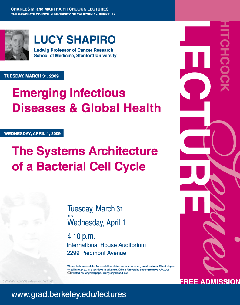
[00:00:00] ELLEN GOBLER:
We are so pleased to have you here joining us today. Ah, thank you for coming to the second lecture. My name is Ellen Gobler. I manage the Graduate Council lectures, and it is my pleasure to introduce Professor David Zusman.
[00:00:12] DAVID ZUSMAN:
Okay.
(applause)
Of course, my job is to introduce Professor Lucille Shapiro. Now, yesterday you heard a detailed introduction about her background and all the awards she’s won, so there’s no reason for me to reiterate how she just won the hundred thousand dollar Gairdner Award or the Selman Waksman Award from the National Academy of Science, or, or that she’s been the first, uh, uh, female director of, uh, the Beckman Center, and, uh, and she’s done all these amazing things. So the first thing that came to mind is, \”Why me?
Why do I get to introduce Lucille Shapiro?\” So I thought about it, and I thought, “Well, we both went to Brooklyn College, we both escaped from New York,” and we work- both work on developmental bacteria that don’t cause any disease and, uh, most people haven’t heard of until recently.”
So, uh, why Caulobacter? Well, Caulobacter has an interesting history. It really came into prominence when Roger Stanier and Jeanne Poindexter isolated.
They were looking for organisms that would grow in the distilled water of the Life Sciences Building. And sure enough, they isolated Caulobacter crescentus because it grows in very dilute environments. Of course, uh, a, a little bit while later, uh, Mike Doudoroff told me, uh, they found a dead rat in the still, so possibly there was some organic material there as well.
Anyway, um, uh, after Stanier, um, uh, and, and Jeanne Poindexter, uh, worked out the life cycle of this, uh, very interesting organism and realized that, uh, it has two forms. It forms a, a s- a stem cell, like, uh, a stalked cell that, uh, puts out swarmer cells. And, and this was a very interesting model for studying, um, cell differentiation.
And so, uh, uh, uh, Dr. Shapiro realized the tremendous power of this system, and she almost single-handedly developed this field from just a kind of a gee-whiz type phenomenon, phenomenology of, of bacteriology into a, a detailed model system for studying the cell cycle. So she’s, uh, accomplished quite a bit. She has over two hundred and fifty papers.
She’s mentored over thirty-one PhD students, fifty post-docs, and her recent graduates have established themselves in major universities in– actually throughout the world. So it’s really a credit to her that she’s accomplished all this. And so I’m very pleased to introduce Professor Lucy Shapiro, uh, to give our lecture on Caulobacter.
(applause and cheering)
[00:03:19] LUCY SHAPIRO:
Uh, thank you. Uh, it’s a pleasure being here today. Good.
It works. And it also sounds like you can hear me because you’re rever– the sound is reverberating right back. Uh, I might add to the introduction that David Zusman gave you about where Caulobacter grows.
Uh, when I was Albert Ei– When I was at Albert Einstein College of Medicine in the Bronx, we isolated one of the first bacteriophages that affect, infects Caulobacter in the Bronx tap water. Uh, and it’s the largest phage ever isolated. So whether there are dead rats in the drinking water in the Bronx or not, I don’t know, uh, but certainly Caulobacter can be found everywhere, and it is probably one of the most ubiquitous bugs on Earth.
Uh, we have used this bug, uh, as a way of carrying out, in essence, systems engineering on a living entity. Uh, what I show here is the cell cycle of Caulobacter and why we’re interested in it. Uh, as you can see, every division is asymmetric.
Uh, you start off with a cell that can swim. It’s called a swarmer cell. It has a flagellum at one pole, and there are a pili at this pole as well.
This is the chromosome. Uh, this cell is not able to initiate DNA replication, and it’s present and swims around for about a third of the cell cycle independent of the generation time and independent of the nutrients. Uh, once this swarmer cell differentiates into a stalk cell by ejecting the flagellum and building a stalk in this place, and as Jeff Skerker showed, sucking these pili back in, then you can initiate DNA replication, shown by this theta structure.
Uh, replication is– uh, goes on during this S phase. Uh, cell division happens here, but you start making the components of the cell division machine quite early. Uh, flagella biogenesis occurs in a hierarchy of about forty-two genes and then is assembled at one side of the cell and nowhere else.
Once the chromosome has completed its replication, then an enzyme that methylates the DNA gets turned on. And this is important because I’m going to come back to this. So when the cell divides, you have two fully methylated chromosomes.
And as you– when you initiate replication and the replication fork travels around the chromosome, you get two copies that are hemimethylated. And then you don’t– That would be here. This is a fully methylated.
You initiate replication, and you get two copies that are hemimethylated. The reason why it happens just here is that the cell, as I’ll show you at the end of this talk, uses the methylation state of the chromosome to integrate multiple regulatory events. Now, all and pili biogenesis, of course, happens between here and here in the cell cycle.
Each one of these boxes represents what I call a functional module. In other words, there are multiple genes within each one of these boxes that have to carry out their function. Each module gets turned on at a specific time in the cell cycle, and there are four master regulators that control two hundred cell cycle regulated genes.
Each group within this two hundred sits in one of these boxes. So now turning to understand how this might be, not how you might get regulators to turn these various things on and how many levels of control allow you to do this, and most importantly, how are these regulatory events coordinated? So, uh, back in the year two thousand, a then graduate student in the lab, Mike Laub, uh, did the first cell cycle microarray of a bacterial cell.
We had just gotten the sequence from TIGR. And what he did was synchronize the cell cycle, which is probably one of the best things about Caulobacter. You can actually synchronize these cells.
And starting with a swarmer cell every fifteen minutes, he took a sample, got the RNA, uh, and then did microarrays. And in yellow, it shows genes that are turned on, blue genes that are turned off. And there is a hardwired pattern during the cell cycle of a consistent set of genes that are turned on and off as you move through the cell cycle.
An example is for the dnaA gene, which is required for the initiation of DNA replication. And that’s turned on in preparation for turning on the replication of the chromosome. Uh, another example is the hierarchy of flagellar genes that are turned on just when needed to build the flagellum at this pole.
And here is that DNA methyltransferase that’s turned on at the end of the cell cycle to remethylate the chromosome. And I could fill this in with many, many, many genes. We know almost all of them at this point.
And so this is turning on a gene not in response to glucose or not in response to lactose, but rather a hardwired pattern of gene expression as you move through the cell cycle. So what could be involved in this? Uh, well, bacteria and Caulobacter as well generally use the two-component signal transduction paradigm.
Uh, most of the, uh, initial work revealing how these things have been done was done by Sydney Kustu here at, at Berkeley. And the paradigm is that there is a histidine kinase, uh, which can have a part of its, uh, protein sticking out into the, uh, uh,
(cough)
to the periplasmic space, or it can be inside. Generally a dimer, uh, and some signal, either inside or outside, causes autophosphorylation of the histidine, uh, and then CtrA is phosphorylated on an aspartate. In this case, this is the global regulator in Caulobacter, and here we have a response regulator attached to a DNA binding domain, which does not have to be the case.
In this case, it is true, and it acts as a transcriptional regulator. Uh, the, uh, Kim Quon, a graduate student in the lab, identified CtrA, and then Christine Jacobs, when she was a, a postdoc in the lab, uh, identified the kinase that’s involved in this phosphorylation reaction. There has since been shown to be another protein in between, but I’m not going to go into that.
Uh, this CtrA protein was very surprising. It was found initially because it controlled flagella biogenesis, but it was very perplexing because it was also an essential gene, and the flagellum is not essential for viability. And then it turned out I had different people in the lab working on different functional modules, And to our astonishment, we found that this one regulatory protein controlled the onset of flagella biogenesis, pili biogenesis, turned on the, the DNA methyltransferase gene, uh, turned on the che- genes for the chemotaxis machinery, as well as cell division genes.
One curious thing about this response regulator is it’s not only a transcription factor, but when it’s present in the cell, it sits on the origin of replication and silences it. So there is a protein that both is a transcription factor and a silencer of the initiation of DNA replication. This protein does not control stalk biogenesis, DNA replication, or chromosome segregation.
But as you can see here, where I’ve colored in where CtrA is, CtrA is in the swarmer cell where it’s sitting on the origin of replication and silencing it. Then in order to turn on DNA replication, this thing has to be cleared out of the cell. Then you stop the proteolysis of CtrA.
It again now accumulates, turns on functional things, and then there is, uh, a closure of the inner membrane of this pre-divisional cell, creating two compartments. This compartment has the CtrA in it, and you’re silencing the origin. This compartment again clears CtrA out of the cell by proteolysis, so you can initiate, uh, DNA replication.
Therefore, each progeny of a division is asymmetric. You get two different cells. Not only do they look different because this guy can swim away, and this guy’s got a stalk, but this one cannot, this one cannot initiate DNA replication, and this one always does.
Clearly, that’s this one. So now I showed that CtrA is present, gets cleared away. It comes back, gets cleared away here asymmetrically.
What about this kinase? Here’s the intermediary protein. What about this kinase?
And this was an experiment that Christine did. Uh, she first showed that this kinase was present throughout the cell cycle by Western blots, but it seemed to be only functioning sometimes. So what she did was label it with a GFP derivative and made the surprising observation that this protein is localized to the pole of the cell.
And, uh, Antonio Iniesta and Nathan Hillson have real-recently shown that if this thing isn’t localized to the pole of the cell, it can’t function. And it is at these times in the cell cycle that it is involved in phosphotransfer to the CtrA protein and activating it. So again, by the time Christine showed this, Janine Maddock in the, uh, lab had already shown that the chemoreceptors are localized at the cell pole.
So we knew that polar localization of proteins, in fact, happened. So now we were faced with the question, how do you go about using the three-dimensional organization of the cell as a regulatory phenomenon? How do you incorporate that into transcriptional circuitry, into proteolysis, into the multiple layers of control?
One of the critical events, which I’m sure you realize at this point, is getting rid of CtrA here. And it has to be absolutely specific, and we ha– it has to be controlled. So this is now another surprising observation.
The ClpXP protease, which has six subunits of the chaperone ClpX and fourteen subunits of the protease ClpP, it’s like a little Waring blender. Uh, CtrA binds to a factor RcdA, uh, which then brings it into the Waring blender and chews it up. But the surprise was that this protease complex localizes to the pole of the cell.
And then the CtrA and RcdA, in other words, the substrate comes down to the protease. CtrA is chewed up, and then surprisingly, it goes away from this pole, but then assembles at the cell division plane, goes away from that, and then reassembles only at this pole so that you chew CtrA up here, but not here. So this is just, uh, an example, a cute little, uh, uh, movie that was made by Antonio Iniesta, and this work is really a summary of the work of Antonio Iniesta, Patrick McGrath, and Kathleen Ryan.
And as you can see, it goes to the pole, and it– the substrate comes in and is chewed up. This ClpXP protein is a single domain response regulator that in fact is required to localize… Excuse me.
The CpdR single domain response regulator is the factor that is required to bring ClpXP to the cell pole. So now the critical question is, how is this integrated with the, uh, passage through the cell cycle and the role of the two component signal transduction proteins? So this CpdR protein, which I introduced to you once before as a single domain response regulator, can exist in the phosphorylated state or the unphosphorylated state.
When it’s in the unphosphorylated state, we call it active because it’s in the unphosphorylated state that it allows the, uh, the protease complex to go to the cell pole. What’s amazing is that this kinase that I showed you a moment ago as the kinase that activates CtrA is the same kinase that keeps this CpdR protein in the phosphorylated state. So in a very robust way, the same kinase that activates CtrA prevents its degradation by keeping this thing in the phosphorylated state.
Now, when this– when, uh, we have CpdR in the unphosphorylated state, it localizes the protease, CtrA and RcdA then go to the protease and get degraded. Now let’s put it together with the localization of this, of this kinase. So here we are in the swarmer cell, and in the swarmer cell, CpdR exists in the phosphorylated state, therefore the, uh, protease is not localized.
Then you have the localization of the protease and its substrates here. It’s degraded. And then you get the localization of this kinase to this pole, and it’s now active.
So what happens when this kinase is active? CpdR accumulates in the phosphorylated state. Those are all the yellow dots.
Uh, then this begins to form, uh, two, uh, compartments with the kinase trapped up here. And because of that, triggered by comp– by, uh, cytoplasmic compartmentalization, you then degrade CtrA because the protease via CpdR is localized to that cell pole. So in fact, there is a correlation between multiple three-dimensional, uh, observations.
Number one, you have to localize the protease itself to a specific place. Number two, when you form two component– two compartments, you trap the protease in one compartment and not the other. And, uh, and you, you are trapping the kinases that make sure that this guy is not able to localize the protease, but this one is.
So there is now a connection between localized proteolysis and the phosphosignaling cascade. This thing then chews up CTRA, and it can initiate DNA replication. So what I’ve shown you is that CTRA is cycling through the cell cycle, but we predict that there has to be at least another regulator that happens when CTRA isn’t around because we know that multiple proteins are made at all these different times in the cell cycle.
So the second, uh, uh, regulatory protein, uh, GCRA, shown here in blue, uh, which was found by Holtzendorff, uh, is present when the c– well, when, uh, CtrA is not present. And CtrA, as I showed you, controls ninety-five genes, that’s directly controls ninety-five genes, uh, by doing ChIP-ChIP analysis. Uh, and GcrA controls the expression of approximately fifty genes, and these fifty genes are involved in DNA replication and chromosome segregation.
So the swarmer cell has it, then it goes away by proteolysis. GcrA builds up. In the early pre-divisional cell, one is going away and the other is building up.
So you have CtrA here. Then you have the differential expression of, uh, GcrA because here it can’t be made. Here you clear out CtrA and GcrA can be made.
So now when the cell divides, the asymmetry is not just morphological. This can swim. This has a stalk.
This has CtrA. This has GcrA. And these are major transcription factors that are controlling different genes.
So if we look now at a circuitry, of a regulatory genetic pathway that CtrA-activated CtrA phosphate controls, and its phosphorylation is a complicated, uh, phosphokinase pathway. This CtrA phosphate controls all of these modules, as I showed you initially. Here is CtrA phosphate sitting at five sites on the origin of DNA replication and silencing it.
Clearly, the degradatory pathway is critical. Now, we can put on top of this the, uh, fifty cell cycle regulated genes that GcrA controls, controlling multiple events, multiple genes that are involved in replication of the chromosome and in segregation, as well as the localization of kinases at the cell pole. So how does GcrA and CtrA deal with one another?
So, excuse me. It forms a regulatory cycle. When CtrA is present, it sits on the GcrA promoter and silences it.
It… it also acts and, and… excuse me. And when you get rid of CtrA, then you can turn on GcrA. When GcrA is turned on and does its thing, it then turns on the P1 promoter of CtrA. You make some CtrA, it’s activated, it shuts off GcrA, it shuts off its P1 promoter and turns on the very active P2 promoter. So what we have here is an oscillating circuit that has GcrA and CtrA doing their things at different times in the cell cycle.
What was particularly surprising was that this oscillation is linked to DNA replication. And I’m going to come back to this again, but in front of the P1 promoter is a DNA methylation site, and the transcription of this gene is dependent on this being in the, uh, hemimethylated state. Now, the GcrA gene, which we know is turned off by CtrA, what turns it on, what turns it on?
And that turns out to be DnaA, a protein that has been known in bacterial– almost all bacterial cells seemingly forever. DnaA is a protein that’s required for the initiation of bacterial DNA replication. It does so by interacting with the single origin of replication, allowing it to open up and form the replisome.
Not too long ago, a couple of years ago, both in Allan Grossman’s lab studying Bacillus subtilis and in our own lab, uh, Allison Hottes and Justine Collier showed that DnaA is a transcription factor, and it’s a transcription factor for approximately 50 genes that are needed right at that time in the cell cycle. So just like CtrA does double duty as a repressor or silencer of the origin of replication and a transcription factor, then DnaA does double duty as an activator of DNA replication, uh, and, uh, as well as a transcription factor. So now that we knew that somehow this cycle is hooked up to the replication of the chromosome, you know, it was a puzzle You know, how could this be?
How could all these parts be integrated? How does the cell know when to do X or Y or Z? How are the modules ordered?
Uh, so we then decided, and then is including Martin Thanbichler and Patrick Viollier and Patrick McGrath. We looked at the Caulobacter cell, and, and it was pretty much assumed that the bacterial chromosome was a bowl of spaghetti sitting inside of the cell with no nuclear membrane. And it was– there were indications that the cell at least knew where the origin was and where the terminus was.
And that’s shown here. Uh, the origin sat at this pole of the cell where the flagellum was, and the terminus sat at the other pole. So what we wanted to ask is, where are the rest of the genes in the cell, all the other loci?
Is it really just a random mess? And so, uh, using a well-known technique at that point in which you put in a, a whole array of DNA binding proteins to a specific place on the chromosome. Here we’re putting in TetO sequences.
And, uh, then we had a plasmid driving TetR, uh, fused to YFP. and if we turned on that plasmid, uh, we were able then to attach this tagged, fluorescently tagged binding protein to a site in the chromosome, and that would light up a specific place in the cell. We also, in all the experiments we did with this kind of technique, we did FISH so that we didn’t have to just depend on multiple, uh, pieces of DNA stuck into the chromosome, and we confirmed it all with FISH analysis.
And so doing this, uh, what we found is that the chromosome is really amazingly ordered. What I’m showing you here is a cartoon. It does not mean that this is the order.
All we do know is that where a genetic loci exists on the chromosome reflects where it sits in the cell. So that loci closer to the origin sit down here. Further away, they move up the gradient so that there is a specific place.
And it, it has a radius of attachment, but it’s within an area for individual loci in the cell, so. So here we have the origin of replication. Uh, when you get rid of CtrA
and you’re no longer silencing the origin, then you build the replisome, and that’s shown here in green on this region. Uh, then what you find is that as soon as you initiate DNA replication, the newly duplicated origin can be seen to harpoon across the cell and establish itself at the other pole. Uh, and here you have the light blue new chromosome going up and the old stuff getting smaller, and you keep moving it apart.
And what I show down here is actually a movie of the, uh, tagged origin of replication, which is shown here, being duplicated and harpooning across the cell. Uh, to us, this was very exciting. Uh, it is not as showy as looking at eukaryotic cells, but this rather blew my mind when it happened.
We could actually see a locus move across the cell and calculate its speed of movement. Now, a graduate student in the lab, Esteban Torres, has recently shown that the thing that first moves across the cell is not the Caulobacter origin of replication, but a sequence not far away from it, called the parS sequence. And in a very elegant series of experiments, uh, Esteban showed that it is this parS sequence that sits away from the origin of replication, that moves first across the cell, and that parS is the centromeric sequence that is the site of force generation that drives chromosome segregation.
And by making a series of, uh, inversions, he was able to show that no matter where you put this parS sequence, that’s what moved first. And you had to replicate through it in order to get the movement. So now what I show here is an overview of what I’ve been telling you.
Here now is the swarmer cell. Now I’m showing this little red dot or origin as parS. Terminus is here. You clear CtrA out of the cell.
The re-replisome forms. What I’ve done here is indicated a genetic locus, some generic genetic lo-locus in, in gold. And what happens here is you have ParA-driven segregation of ParS.
Uh, ParA is an ATPase that assembles into a polymer. And, uh, the newly replicated ParS sequence then moves across the entire cell, and when it reaches the other pole, it’s anchored at that pole by a polymeric network of a protein called PopZ. Uh, this was found in our lab by, uh, Grant Bowman, uh, at the same time as we published this in Cell, uh, we– uh, Christine Jacobs-Wagner also found PopZ in her lab, so the work is definitely corroborated.
Uh, two labs have it. Uh, and it’s an amazing protein because it’s a nineteen-kilodalton protein that forms a very large polymeric complex at that pole and is essential for grabbing this centromeric sequence and holding it there at that pole. If you don’t have PopZ, the chromosome keeps trying to go to that pole, but it goes there and draws back, goes there and draws back.
You have to grab it and keep it there. Uh, but now coming back to the duplication of the chromosome, once the replisome moves through this locus, we find that it is segregated to the mirror image position of the incipient daughter cell. So that in fact, we have segregation occurring while you’re replicating the chromosome, and this region of the chromosome knows how to go to the right place.
Uh, then you finish DNA replication, the replisome disassembles, and you get two cells that are, are mirror images of one another. This cell now cannot initiate replication. This cell, you get rid of CtrA
so you can build the replisome and start again. So now that we know that there are very logical, uh, progressions of DNA replication occurring, how can we integrate multiple cell cycle events with this replication of the chromosome? So I’m gonna tell you two short stories.
One is the spatial regulation of division site placement, which is dependent on the positioning of that centromeric sequences. And the other is DNA methylation control of the actual cell cycle, uh, regulators. So first, the division site placement.
Uh, this again is the work of Martin Thanbichler. And Martin identified a protein called MipZ, which is an, an ATPase, a ParA-like ATPase that’s absolutely essential for placing the, uh, FtsZ gene in the middle of the– the FtsZ ring in the middle of the cell. Sure, we do know that when cell division happens, it– you have asymmetry in a smaller swarmer cell and a larger stalk cell.
But that’s because once the division ring is laid down mid cell, this portion of the cell does not grow as fast as that portion of the cell. Furthermore, we know that this shown in blue is the origin centromere region, and Mipsy co-localizes with that origin region. So now here is, uh, which I should change this to, uh, parS at this point, or the centromere, and that is decorated by the ParB factor.
And ParB then binds directly to MipZ, and this was shown by surface plasmon resonance. But it doesn’t, it doesn’t just have a very orderly attachment. It seems to form some sort of gradient in the cell.
So if we look at MipZ-eYFP, you see it at its higher conc– highest concentration at the pole, but then it becomes less and less as you move towards the center, whereas eGFP-ParB is very tightly bound at the pole. And this gradient of MipZ concentration, which is highest at the, uh, origin regions and lowest at mid-cell, is what in fact gives the function to the, uh, MipZ– I’ve just lost my pointer.
Okay. No, I got it back. Uh, which gives the function to the MipZ-ParB complex.
So how does it do this? Well, Martin showed that if you purify the FtsZ protein, FtsZ is a tubulin that has to assemble into these long polymers. If you add purified MipZ to purified Fts, uh, uh, FtsZ, you get these short non-functional curlicues, And then he went on and showed that MipZ in fact stimulates the GTPase activity of, uh, FtsZ, uh, preventing it from assembling.
So therefore, we knew that we could put together a model of this cell in which here’s the, uh, the centromere or origin sequence decorated with the ParB segregation factor. MipZ is on it. At the other pole of the cell, and this is a new pole that just resulted from a cell division, so you have a pool of the FtsZ protein or tubulin sitting here.
And as you now duplicate this region of the chromosome, you redecorate it immediately with ParB and MipZ. And as it moves across the cell and sees– hits the FtsZ, the FtsZ moves to the region of lowest concentration of MipZ, and that’s where it assembles. And I can actually show you this.
So what I’m showing you here are two cells. Uh, in red, I show, uh, the ParB bound to the origin region, and in green is the pool of FtsZ at this pole. Here’s just a second cell.
And we’ve initiated DN– Oops. We initiate DNA replication and as it moves across the cell, it hits the FtsZ, and FtsZ assembles mid-cell. And we can– Martin has elegant movies where he can chase the FtsZ around the cell so that wherever MipZ is, FtsZ can’t polymerize.
So in fact, what Martin has shown is that this complex represents a novel system that coordinates chromosome origin segregation with the initiation of cell division. And furthermore, it ensures the proper localization of the division plane to mid-cell, the region of lowest concentration of the MipZ inhibitor. Now, turning to the second story, uh, that is involved closely with the coincidence of DNA replication and segregation, the DNA methylation control of the cell cycle master regulators.
We knew, and I’ve been showing you, that this is a Western blot of, uh, when each of these proteins is present in the cell going through the cell cycle. And we knew that GcrA is turned on here. GcrA turns on CtrA. CtrA turns on the DNA methyltransferase.
And DnaA, which starts the whole thing, because DnaA turns on GcrA, et cetera. What turns on DnaA? And how do you, in fact, make this a cycle?
So what Justine Collier found is that it depends on the methylation state of the promoter region. So let me see if I can make this clear. Here is a Caulobacter chromosome.
Here is the origin of replication. I flipped it over. Here is the terminus.
This is where the dnaA gene sits. This is where the ctrA gene sits. In bacteria and in Caulobacter, replication is bidirectional.
And when you begin this, and now we’re in the swarmer cell. Cell is just divided. The chromosome is in the fully methylated state.
A specific sequence, GANTC, is methylated on Watson and Crick. One way to put that. Uh, there is a DNA methylation site within the DnaA promoter, and this is in a fully methylated state, so the DnaA gene is transcribed.
However, CtrA is also in a fully methylated state, and it’s not transcribed because this guy can only be transcribed from a hemimethylated promoter. Now, as the replication initiates and moves through, first, the DnaA gene, you get two copies of the gene that are now both in the hemimethylated state. Because remember I told you, you don’t turn on that DNA methylating enzyme until the end of the cell cycle.
So this is now hemimethylated. Uh, you turn off the transcription of DnaA. The replication fork on this side hasn’t yet hit CtrA, so this guy is not transcribed either.
However, once the replication fork travels through the CtrA gene, creating two hemimethylated copies, then you turn on the transcription of that P1 promoter of CtrA. Therefore, the passage of the replication fork itself controls methylation state and thereby controlling the timing of activation of the promoters of these two genes. Now, I want to remind you that each, uh, protein is controlled at multiple levels. It’s controlled by turning on its transcription, it’s controlled by proteolysis at the right time of the cell cycle, it’s controlled by positioning, and it’s controlled by activation.
CtrA has to be activated. DnaA has to be activated. So there are multiple levels of control.
We found that if we moved DnaA far away from its normal site, so the timing of its transcriptional control is changed, the cell is still alive, but it’s severely impaired. If you make a mixed population of a wild-type cell and a cell in which this gene is moved down here, the gene in– the cell in which this is moved is going to disappear within a, a generation. It’s gone.
Uh, and the same thing is true of moving the CtrA gene. And curiously, moving the CtrA gene, the cells seem confused. They’re of all different sizes, and we don’t really know what causes this, but they’re not dead.
So what we’re looking at is robustness. Now, if we put back into this circuit everything I’ve told you, this would be the epigenetic control, and that’s not really the correct phrase. What this is, is differential methylation of these genes.
So DnaA, which is trans, transcribed from a fully methylated promoter controls, here it was forty genes. I think it’s up to fifty now. DnaA then turns on GcrA, which controls about fifty genes.
GcrA turns on the P1 promoter of CtrA. I told you about this oscillating circuit. CtrA controls about ninety-five genes and inhibits DNA replication, and it also turns on this DNA methyltransferase. Interestingly, there are two methylation sites, uh, within the plus one region of CcrM. And as soon as these are methylated, you turn off the expression of CcrM.
So this DNA methyltransferase is, this is like a shot of the DNA methyltransferase. It methylates up fourteen hundred GANTC sites around the chromosome and then is cleared out of the cell very rapidly by proteolysis. Then while it’s rapidly turning on a whole bunch of genes, it methylates up the DNA, a gene, and you can start the cell cycle all over again.
So in fact, given all of these, uh, coordinated events that occur to give you a logical progression of the cell cycle, we can make some conclusions. One, we believe that there’s a small number of regulated– uh, of master regulators that are controlled both temporally and spatially, and they oscillate throughout the cell cycle. The, uh, control system is hierarchically organized.
Uh, you know, there’s stuff at the top then turns on these and turns on these. A beautiful example of that is the flagella hierarchy. Functions are turned on as modules just in time when needed, and the synchronization of this whole cell cycle engine, uh, is linked to multiple other events For example, I showed you that the cell– the reliable cell cycle functions, the order, is linked to chromosome replication and is also linked to the phosphosignaling pathway, which is linked to the correct time of proteolysis during the cell cycle, so you can get rid of things when you have to get rid of them.
And most importantly, the three-dimensional organization of the cell matters. The dynamic spatial positioning of these regulatory proteins is essential to their function. Uh, their position of the regulatory genes on the chromosome can be essential.
And compartmentalization triggers cell differentiation. So we have a paradigm here where it’s not enough to study the transcriptional regulatory network. That is just a layer of multiple layers of control.
And if you want to model a regulatory pathway, simply looking at a transcriptional network can be very misleading. Overall regulatory wiring diagram, of course, is selected for robustness. And in fact, this DNA methylation regulation, uh, is something that contributes to the fitness of the organism, not life and death.
So in fact, what I’ve shown you is that there is a forward biased circuitry that drives cell cycle progression and the progression through the cell cycle is paced in a ratchet-like fashion so that you have gates moving forward and opening allow you to go from one state to another. And what I’ve shown here is just some of these gates coming back to the first slide I showed you when I started this talk. So here is the cell cycle.
Here are the functional modules. One of the gates is that replication initiation is triggered by proteolysis of CtrA. It’s clearly not the only thing, but it’s one of the licensing events.
Then DNA origin segregation to the opposite pole triggers the cell division machine. Another gate always moving forward. Gate three, the compartmentalization at this point in the cell cycle triggers daughter cell asymmetry by trapping different regulators at the two different poles of the cell.
So in fact, what I’ve shown you is that if you take a, a logical approach to the cell cycle, trying to understand how multiple events happen at specific times and are dependent on all the events that happened before it, you get the forward progression throughout the cell cycle, and we have a systematic explanation of cell cycle expression in a living cell. And, uh, what I have here is I’d like to thank the extraordinary group of graduate students and postdocs who have worked on this, not only currently, including Antonio Iniesta and Grant Bowman and Esteban Toro, but the large group of people who now all run their own labs and are fierce and incredibly wonderful competitors, uh, running their own Caulobacter labs. And I also want to mention that our lab is closely integrated with the lab run by Harley McAdams.
Harley McAdams is a physicist who has become interested and learned the language of genetics and biochemistry. And in his lab, uh, his students are all getting their PhDs in computer science, double E, or physics. And what we’ve done is we’ve integrated our two labs so that we have physicists sitting next to geneticists and electrical en-engineers sitting next to biochemists.
And instead of a biologist saying, “Look, we have this problem, Mr. Physicist, solved this for us,” we design the experiments together, and we understand what we need to ask the questions and how we can interpret the results. Sure, these guys help us write algorithms, and they help us figure out how to build beautiful, technologically advanced equipment, but that’s not the point. We learn each other’s language, and we learn to think in different ways.
So I would like to sort of give a plug for interdisciplinary work. Uh, I work closely with Holly. Not everybody can work quite as closely as he and I do, since he’s my husband.
Uh, but we do know how to talk to each other, and after all these years, we still get along. Uh, so, uh, I really recommend integrated labs. I think they’re wonderful.
And with that, I’d like to thank you all very much.
(applause)
[00:47:19] DAVID ZUSMAN:
I’d like to… I’d like to thank Professor Shapiro for the amazing seminar, and it just shows you that the Caulobacter has come a long way and, uh, is now a household word. So, uh, Professor Shapiro is willing to entertain questions, and we’ll do that up here.
[00:47:45] LUCY SHAPIRO:
Yes. Please come up to the microphone. Thank you.
[00:47:48] QUESTIONER:
She actually blocks the conversation—
[00:47:49] LUCY SHAPIRO:
She’s really tough to do that, yeah.
(laughter)
[00:47:51] QUESTIONER:
But it’s actually not good for the conversation. Okay. Uh, Lucy, so the force that drives one ori to the next after you get the, uh- initiation initiation, presumably that y-you asked me to think about it today-
Mm-hmm, just hearing your seminar. It seems to me that just the replication fork itself might be enough to move-
[00:48:12] LUCY SHAPIRO:
Yeah, but it’s not the, the other… It’s not.
[00:48:15] QUESTIONER:
How can you eliminate that?
[00:48:16] LUCY SHAPIRO:
If you have, uh, a mutation in ParA that prevents it from, uh, hydrolyzing ATP, everything stops.
[00:48:23] QUESTIONER:
But, but that says that it’s necessary, but it might not be sufficient. So part of the activity- Okay. That, that activity is required-
[00:48:30] LUCY SHAPIRO:
Okay, I give you that. It could contribute and, and Rich Losick has has suggested that the force of replication per se could contribute to it. But clearly it’s not.
[00:48:38] QUESTIONER:
But there’s not a filament that runs through-
[00:48:40] LUCY SHAPIRO:
Oh, yes, there is.
[00:48:41] QUESTIONER:
There is that, that it might track along- ParA.
[00:48:43] LUCY SHAPIRO:
ParA polymerizes.
[00:48:45] QUESTIONER:
I see. Uh.
[00:48:45] LUCY SHAPIRO:
So you’re thinking that maybe it moves- And we ha– we’ve shown, we’ve shown polymerization of ParA both in vivo and in vitro. And Ethan Garner has done the in vitro work, uh, of the Caulobacter ParA. And yes, it is a polymer.
[00:48:59] QUESTIONER:
Okay. One other, one other que– this is more of a question. The, the– there’s a lot going on at the ori at different times.
[00:49:06] LUCY SHAPIRO:
Um, you’re, you’re fading out.
[00:49:07] QUESTIONER:
There’s a lot going on at the ori at different times.
[00:49:11] LUCY SHAPIRO:
Yeah.
[00:49:11] QUESTIONER:
The, the vicinity. So presumably the MTC complex that spreads–
(Mm-hmm.)
Uh, comes on after the initiation event? It doesn’t–
[00:49:20] LUCY SHAPIRO:
Yes, it, it comes on it–
[00:49:21] QUESTIONER:
So the replication fork doesn’t move through it–
[00:49:24] LUCY SHAPIRO:
No. No, no.
[00:49:24] QUESTIONER:
–and displace it?
[00:49:25] LUCY SHAPIRO:
It, it’s decorated. Yeah. No, it’s a very complicated business going on at that.
You know, I use the word centromere. What I’m doing is referring to a sequence that is the site of force generation. Clearly, we have to define all the proteins that are coming on and off that particular site as this event is occurring.
Yes?
[00:49:47] QUESTIONER:
Um, do you know something about, um, how, uh, widely distributed in evolutionary history this particular modular architecture is?
[00:49:57] LUCY SHAPIRO:
Well, this is present in, uh, whenever you look at an Alphaproteobacteria, this whole system is in there. And what’s interesting is that, for example, a whole CtrA regulation is there, but the output varies with respect to the ecological niche of the particular Alphaproteobacterium. So that in Brucella, which infects people, it turns on a different set of genes ultimately than they’re turned on in Caulobacter.
In some Alphaproteobacteria, CtrA is essential, as in Caulobacter, and others, it’s not. But in all instances, it’s controlling genes that allow it to live and survive in its environment.
(Mm-hmm)
[00:50:39] QUESTIONER:
So it is a master regulatory gene in all of them,
(laughter)
[00:50:41] LUCY SHAPIRO:
Yeah. but it’s- but it does different things.
[00:50:43] QUESTIONER:
But it doesn’t necessarily control the same set of downstream
[00:50:45] LUCY SHAPIRO:
That’s right.
[00:50:46] QUESTIONER:
genes. All right, thanks. This is a rather awkward setup for asking questions. Um, do you mind if I put you on the spot, Lucy, and just say-
[00:50:56] LUCY SHAPIRO:
Oh, well, please.
(laughter)
Feel free.
[00:50:58] QUESTIONER:
I’m just curious. I mean, since you do collaborate with the physicists, so what, what biological insight did you have-
[00:51:04] LUCY SHAPIRO:
Mm-hmm.
[00:51:04] QUESTIONER:
as a consequence of a collaboration with the physicists that you wouldn’t have had?
[00:51:07] LUCY SHAPIRO:
Okay, so I think the, uh, there are, there are a number of ways of answering that. I think the best example, uh, is that when we were first contemplating what the organization of that genome was like, and we knew that the origin was at one pole, and we knew that the terminus was at the other pole. And what happened in between?
We knew that we could tag individual loci, but the question was, all right, what do we do? Like, lock up twenty graduate students in a dark room for ten years? Uh, that didn’t seem very logical.
And so, uh, working with some of our engineers and physicists, uh, they designed not only the computer-driven, uh, microscope, fluorescence scope, but they designed the algorithms that let the computer analyze fifty thousand images of a hundred and fourteen different tagged loci. And yes, individual, individual genes and their position in the cell had been visualized in E. coli and in Bacillus subtilis, but a few. We went up, now we’re up to, I don’t know, about a hundred and fifty.
So the whole question was, how general is this? And we were able to answer a very important question because immediately when we first started talking about this, my druthers was, well, you initiate replication, you keep replicating, and then you start moving, or maybe you move the origin and the rest comes after it’s all duplicated. And, you know, and the physicists and engineers said, “Wait a minute, that makes no sense.
What you want to do is you want to do it at the same time, and let’s see if the cell does.” You know, hypothesis-driven research, right? As opposed to non-hypothesis-driven research.
And so that’s one example, but there are many others.
[00:52:59] QUESTIONER:
So you talked about this, um, a gate-driven architecture. Mm-hmm. Um, so certain events have to happen for other events to happen.
[00:53:06] LUCY SHAPIRO:
Mm-hmm.
[00:53:06] QUESTIONER:
But then you also talked about the, um, the process depending on time, and so I was interested if there’s a… I-if there’s also a master timer, if you think. So, so both time and the- Mm-hmm conditions for the gates to happen- Yeah, have to be true. Like, can you slow things down?
[00:53:22] LUCY SHAPIRO:
You can slow things down by growing them on media that they’re not very happy on, on a carbon source that takes a lot to use. So you can slow down the generation time, but you get exactly the same pathway. And another timer, of course, is the movement of the replication fork, right?
Because that’s when you get things turned on, and that lets you continue, at least at that level. But there are not only control mechanisms of transcription, there are all those other layered control mechanisms that contribute to the timing, that are connected with the morphology of the cell and the time when you get compartmentalization. So I, I guess what I’m trying to say is that it’s a layered and complicated gate opening as you move through to give you timing.
[00:54:14] QUESTIONER:
So I wanted to ask you, it is very obvious that the localization of the termini and the origin at the two opposite poles is, is very important for all this, uh, story. But you showed, um, that the whole chromosome is, is very localized
[00:54:29] LUCY SHAPIRO:
Mm-hmm,
[00:54:30] QUESTIONER:
in different… What do you think the role of that is?
[00:54:32] LUCY SHAPIRO:
Okay, so where does that become important? So, so there… Let me, let me try to explain a bit about what might be happening here. Um, the question is, are there many loci on the genome that attach to the membrane the way the centromere does to the pole?
Is there another one or two or none? And one possibility is once you harpoon the duplicated origin to the other pole, make believe that the replicating chromosome is like a rope and you’re standing at the top of a swimming pool. And you’re coiling the newly replicated chromosome down into this swimming pool in the most logical energy-saving conformation.
And you’re just wrapping it down and packing it down into the cell as though you’re filling a phage head. And so it’s not that it’s grabbing on to sites and it’s all specific, but rather it’s just physics, just the most logical way of packing into the cell. This is a hypothesis.
We don’t know whether it’s true. Uh, there might be sites, other sites that are grabbing onto things, uh, on– in the cell, but we don’t know that. Uh, Esteban is do– who’s sitting here now, actually, is doing experiments to answer that.
So hopefully the next time I come back, I can answer that question.
[00:55:56] QUESTIONER:
I think you answered my question towards the end because you said the something about the methyltransferase added to the robustness of the system.
[00:56:03] LUCY SHAPIRO:
Mm-hmm.
[00:56:04] QUESTIONER:
But it wasn’t required. So I assume by that a deletion of the methyltransferase is not lethal?
[00:56:08] LUCY SHAPIRO:
It’s lethal.
[00:56:09] QUESTIONER:
How about overproduction?
[00:56:11] LUCY SHAPIRO:
Uh, overproduction is not lethal, but the cells are sick as hell.
[00:56:14] QUESTIONER:
Well, so that– I, I think that’s far from just contributing to robustness.
[00:56:17] LUCY SHAPIRO:
It’s– yeah, but– essential for them. Yeah. Uh, that’s true. Uh, it is lethal, but we don’t know all the functions of that.
[00:56:23] QUESTIONER:
Okay. So my question was, is part of the coupling to growth because is that methyltransferase requires SAM or tetrahydrofolic acid…
[00:56:31] LUCY SHAPIRO:
SAM?
[00:56:32] QUESTIONER:
So is, is growth coupled in an intimate way via methionine levels or methionine biosynthesis?
[00:56:39] LUCY SHAPIRO:
We’ve never done that. That’s an interesting experiment. We’ve not asked that. Yeah. And, you know, it’s interesting, even the SAM is cell cycle controlled and comes up at the same time in the cell cycle as CCRM. But that’s a good experiment. We should do that.
[00:56:55] DAVID ZUSMAN:
What would happen if you, uh, blocked cell division with cephalexin and you got filaments, but DNA replication continues?
[00:57:01] LUCY SHAPIRO:
Mm-hmm.
[00:57:02] DAVID ZUSMAN:
I’m sure you’ve done that.
[00:57:03] LUCY SHAPIRO:
Yeah. Uh, and you have very sick cells.
[00:57:07] DAVID ZUSMAN:
Sick?
[00:57:07] LUCY SHAPIRO:
Sick. They’re long, and they die.
[00:57:11] DAVID ZUSMAN:
They’re long, and they die?
(laughter)
And what would happen… E. coli has, uh, rounds of replication in rich media that initiate before completion.
[00:57:20] LUCY SHAPIRO:
Mm-hmm. We can’t do that in Caulobacter because it’s so tightly coordinated.
[00:57:22] DAVID ZUSMAN:
Right. But do you think this kind of mechanism would work in, uh, an organism like E. coli?
[00:57:29] LUCY SHAPIRO:
Well, E. coli has its own way of regulating the initiation of replication- Right, right which has to do with the Sec protein that binds to-
[00:57:36] DAVID ZUSMAN:
Right. All the other sites, you know, all the other gates that you’ve-
[00:57:39] LUCY SHAPIRO:
Yeah. Well, I think that E. coli is gonna have different kinds of gates. I think whatever I’ve told you applies to the alphaproteobacteria- and not all bacteria.
[00:57:47] DAVID ZUSMAN:
Right.
[00:57:48] LUCY SHAPIRO:
And bacteria are very clever creatures, and they have designed all kinds of different regulatory mechanisms. Is it going to be a logical progression? Sure.
Mm-hmm. You know, it’s not stochastic events that make E. coli be E. coli. Uh, they just haven’t been worked out in this way.
And what’s helped this, of course, is we can synchronize these cells easily, and there’s very tight control, and this tight control is not observed in E. coli.
[00:58:18] DAVID ZUSMAN:
Well, thank you. Thank you for a wonderful lecture.
[00:58:20] LUCY SHAPIRO:
Appreciate it.
(applause)