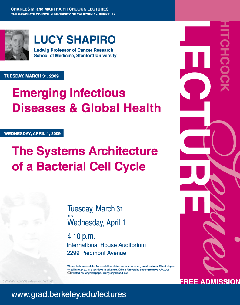
[00:00:00] ANDREW SZERI:
Good afternoon. My name is, uh, Andrew Szeri. I’m Dean of the Graduate Division.
Together with the Graduate Council, we’re pleased to present Professor Lucy Shapiro, this year’s speaker in the Charles and Martha Hitchcock Lecture Series. The story of how the endowment came to the UC Berkeley campus exemplifies the many ways this campus is linked to the history of California and of the Bay Area. Dr. Charles Hitchcock was a physician for the Army.
He came to San Francisco during the Gold Rush, where he opened a thriving private practice. In 1885, Charles established a professorship here at Berkeley as an expression of his long-held interest in education. His daughter, Lillie Hitchcock Coit, still treasured in San Francisco for her colorful personality as well as her generosity, greatly expanded her father’s original gift to establish a professorship at UC Berkeley, making it possible for us to present a series of lectures.
The Hitchcock Fund has become one of the most cherished endowments of the University of California, recognizing the highest distinction of scholarly thought and achievement. And now I would like to invite William Lester, Professor of Chemistry and Chair of the Hitchcock Professorship Committee, to say a few words about Professor Lucy Shapiro.
(applause and cheering)
[00:01:33] WILLIAM LESTER:
Thank you, Dean Szeri. Good afternoon. I’m William Lester, professor of chemistry and chair of the Hitchcock Professorship Committee.
On behalf of the Hitchcock Professorship, we’re pleased to welcome Lucy Shapiro as this year’s speaker in the Charles M. and Martha Hitchcock Lecture Series. Lucy Shapiro is renowned for her contributions to the fields of developmental biology, molecular biology, and genetics. Her research focuses on the cell cycle of a developing microorganism, particularly on the process by which cells divide into dissimilar rather than identical daughter cells.
This process is, in Shapiro’s words, “one of the most fundamental questions of developmental biology.” Shapiro’s pioneering work has revealed the genetic circuitry controlling a bacteria cell with three thousand seven hundred and sixty-seven genes, providing the basic principles of genetic programming that help cells move seamlessly through the cell cycle. Shapiro also focuses on advancing the field of antibiotics, which he argues has reached a critical moment in history.
Since antibiotics were first discovered in the nineteen fifties, they have been overused, and bacteria have now developed ways to build resistance to many antibiotics. There is a difference in where I stand. While many antibiotics still function today, the rate at which they are becoming useless is faster than new ones are being discovered.
Based on her in-depth analysis of a simple bacterial cell, Shapiro identified new antibiotic targets and co-founded a biotech company that designs antimicrobial drugs. Shapiro received her BA from Brooklyn College in Fine Arts and her PhD in 1966 from Albert Einstein College of Medicine, becoming a full professor in 1977 at that institution. While there, she served as chair of the Department of Molecular Biology and director of the Division of Biological Sciences.
From 1986 to 1989, she taught at the College of Physicians and Surgeons of Columbia University, while also serving as chair of the Department of Microbiology. In 1989, Shapiro moved to the Stanford University School of Medicine as the founding chair of the Department of Developmental Biology, since two thousand one, she has served as director of the Beckman Center for Molecular and Genetic Medicine at Stanford University. Shapiro is currently the Ludwig Professor of Cancer Research in the School of Medicine and a senior fellow at the Spogli Institute for International Studies at Stanford University.
Shapiro currently serves on several boards, including the scientific advisory boards of the Pasteur Institute, the Ludwig Institute for Cancer Research, and Lawrence Berkeley National Laboratory, and the board of directors of Anacor Pharmaceuticals and Gen-Probe Inc. Shapiro has been awarded numerous honors for extensive work in biology. The newest was announced March thirty-first.
When is that– When was that? When she was named one of the seven recipients of the two thousand and nine Gairdner Award, Canada’s most prestigious international award for discoveries in medical science. Over the past fifty years, some two hundred and ninety-eight scientists have won Gairdners, and among them, seventy-three have gone on to win the Nobel Prize.
I had the pleasure of interacting with her for a few years in the early nineties. We were members of the Science Year editorial advisory board. Please join me in welcoming Professor Lucy Shapiro.
(applause)
[00:05:39] LUCY SHAPIRO:
Hi. Uh, it’s a pleasure being here today. Uh, can you hear me?
Is this okay? Um, what I’m going to tell you about is scary stuff. Uh, and it’s something that I think it’s important for any concerned citizen to know and to understand.
And what it’s about is the escalating infectious disease threat. And we’ve all, since two thousand and one, had a fear of bioterrorism. Uh, we’ve had a fear of, uh, genetic engineering, different kinds of organisms that could conceivably be made.
And in thinking about this and reading about it and learning about it, it seems to me that the clear and present danger is natural emerging infectious diseases, and particularly the fact that this is occurring at a time when all of our antibiotics are becoming pretty useless, and that bugs and pathogens are becoming resistant to these antibiotics as well as to antivirals. So what I’m going to do today is talk to you about what we know, what our problems are, and what the future holds, and then what we should be doing. So infectious diseases today is probably one of the leading causes of death worldwide in, uh, underdeveloped countries.
Um, these diseases you all know about, acute lower respiratory tract infections, AIDS, uh, tuberculosis, malaria. However, what’s particularly pertinent is that in– since nineteen seventy-three, there have been twenty-nine previously unknown diseases popping up around the world. Twenty well-known diseases have re-emerged in drug-resistant form, and many known diseases that were in one ecological niche have moved into another and more into urban areas, and we are ill-equipped to deal with that.
Uh, the kinds of re-emerging diseases, for example, are very highly multi-resistant tuberculosis, staph and strep. And in fact, we have growing pockets of tuberculosis patients that are resistant to every known drug in the armamentarium. So why is this happening?
Uh, what’s changed? So in fact, what I show here is that we have changed the demographics of the globe. There’s a huge population growth, spreading poverty, urban migration, and the kinds of pathogens that have emerged, many of you know about.
There’s Lyme disease that comes from ticks that happened because vectors moved out into urban areas where they never were before. Another, of course, which we all know about is HIV. Hantavirus, which is in the Southwest and, uh, is adapted to a rodent vector in Arizona, is a disease with a sixty percent death rate.
This is enormous. And there is no way of dealing with this easily. Of course, Ebola, we’ve all heard about, that’s moved out of the forestrated regions.
Another is mad cow disease. How did that pop out and come into our consciousness? It did that because of changes in food processing, primarily in the UK.
And, uh, again, this was a man-made event. And what’s happening now is, faced with global warming, we’re going to be changing the eco-environments of many of these path-pathogens, including malaria, dengue fever, tick and rodent-borne diseases. And these are all going to appear in places that they never were before and that we’re ill-equipped to handle.
So these are all new pathogens or old pathogens in new places. Another major change is the fact that we’re not, we in the United States are not any longer just thinking of ourselves as a nation-state with, with respect to disease, but rather we’re living in a global community. What happens in, in Bangladesh is going to happen in Chicago in twenty-four hours.
So there is no way of saying that we have to protect our borders. The borders are now open and totally fluid, and that changes how you start dealing with things, particularly if you’re dealing with asymptomatic travel, so that if you’re traveling,
(cough)
let’s say, and you have SARS, uh, severe acute respiratory syndrome, you can be infected and infectious for twenty-four hours, and yet you’re sitting on a plane. And I’ll come back to this in a few minutes, and that’s how it’s spread around the globe like wildfire. Uh, Loss of control of natural borders brings up a very important issue, and that’s ineffective quarantine laws.
Many of these diseases, since we have nothing to deal with them in the pharmacological area, the only thing we’ve got is quarantine. And if you have quarantine, you need quarantine laws. How many of you here sitting know where you would go if there was a quarantine?
Who would give you food? Who would provide your medicines? Where would you go for it?
And I’ll come back to this again because this is an absolutely critical issue. Now, one of the most critical things that I want to address is what is this rise in antibiotic resistance? Number one, what is an antibiotic?
It’s a natural or man-made chemical that kills a bug, kills a bacterial cell. A bacterial cell is a free-living organism that can reproduce. There are antivirals, and a virus is just a nucleic acid surrounded by proteins and can only reproduce once it infects a cell.
Antibiotics, uh, have had quite a history, uh, starting here, uh, in nineteen forty-six with penicillin, uh, contr– you know, being used for almost anything and has been just a phenomenal, uh, part of our antibiotic armamentarium. Today, for example, eighty percent of all strains of staph are resistant to penicillin and most of its derivatives. Nineteen fifty, streptomycin, chloramphenicol, tetracycline came about.
Fifty-three. In nineteen fifty-three, we had the first indication that all was not well. There was a Shigella outbreak in Japan.
and suddenly there was a strain of, uh, dysentery with multiple drug resistances. Nobody knew quite what this was. Nobody paid a lot of attention to it, but it did appear.
The 1982 was a new class of antibiotics, the quinolones, and the resistance to that, that Cipro, is rising enormously. In fact, in 2000 and 2000 and 2000 and 2003 were the last two new antibiotics on the market. There has been nothing since.
And the trouble is, every time you design a new antibiotic, you have a short period of time before you become resistant to it. In fact, we are now seeing the emer-emerging resistance to vancomycin, which is considered the antibiotic of last resort. And so there are very many now pathogens resistant to everything.
So we spent so many years from the fifties on saying, “Infectious disease, no problem.” Now we have antibiotics, and we’re fine. Well, the picnic’s over, and we’re not fine any longer.
A lot are still working, but there, it’s of diminishing returns. So now how do bacterial pathogens acquire drug resistance? What, what do they do?
Well, drug resistance comes about because you’re changing how a bacteria responds to some agent that you’re giving it. An antibiotic would affect and, uh, a particular critical event in the bacterial cell, let’s say the ribosome, protein synthesis, the cell wall biogenesis. Bugs, to escape this, because it’s the, the absolute pinnacle of evolution, will have one bug in ten to the ninth bug that develops a mutation that prevents it from responding to an antibiotic.
All the others will get killed off, and that one will grow, and then you have a whole population of antibiotic-resistant strains. What’s so devious about these bugs is that you can acquire resistance from bug to bug to bug very easily because, in addition to the chromosome, there are little plasmids of DNA. And sitting on these plasmids of DNA are multiple genes that code for resistance to antibiotics.
Furthermore, these very– these little plasmids are very promiscuous, and they can jump from cell to cell to cell. So you can disseminate through a whole population of pathogens, these little path– these little plasmids, which will confer resistance. And as I said, there can be multiple resistant genes on one plasmid.
Furthermore, when this little plasmid jumps into the bacterial cell, there are little transporters, little pieces of DNA that jump from the plasmid to the chromosome, and you can actually now put the resistance genes into the chromosome of the bug that you’re trying to kill. Uh, you can turn on latent resistance genes. And so what are these genes encoding?
What, what makes this something that’s scary? What these genes code for are a number of things. Number one, it can change the bacterial cell surface, so it doesn’t allow the antibiotic in.
Another set of genes lets the antibiotic in, but then spits it out. Another set of genes, in fact, uh, chemically modifies the antibiotic once it gets in, so it can’t function anymore. Uh, the bag of tricks is really amazing.
These bugs are very clever, and in fact, they’re winning. Why are they winning? And what I say here is that human-mediated selective pressure favors rapid evolution of drug-resistance bacteria.
Why? What, what is this human-mediated selective pressure? Well, this is an interesting story.
Uh, antibiotics in animal feed and in aerosols for fruits and vegetables are one of the major problems in antibiotic resistance growth. Of the fifty million pounds of antibiotics produced annually, a four– a, a full forty percent go to livestock. Now, a little story.
About a year ago, a doc in a small agricultural town in Indiana, began seeing rashes on the arms and hands of many of his patients when he cultured them, and they got quite ugly. He cultured them, and they turned out to be methicillin-resistant Staph aureus. Uh, Staph aureus is sometimes known as flesh-eating bacteria.
It’s an ugly thing. And, uh, this is– was resistant to most things. Uh, a-actually, across the country by, let’s say, two thousand and five, MRSA, which is methicillin-resistant Staph aureus, was killing eighteen thousand Americans per year.
This is a big number. But in this small town, the high incidence of MRSA was very baffling, and in fact, they tracked it down, and it turned out that a specific strain of MRSA came from infected pigs and was then transferred to humans. Now, in Iowa, forty-five percent of pig farmers carry MRSA, and forty-nine percent of the pigs do.
The likely source of this MRSA comes from overuse of antibiotics in the feedstock. This is just one story. And again and again, the overuse of antibiotics is giving a Petri dish, essentially, to allow the growth of resistant bugs.
The next one, which is the fact that we have a growing number of immunocompromised people, is plus this is partly this is the good news and the bad news. The good news is that medicine is doing amazing stuff, and we can have chemotherapy patients, transplant patients, AIDS patients who are helped. Aging population, well, what can we say about that?
The problem is, with all of these patient categories, these people act as Petri dishes because they have no
(coughs)
natural immunity to the bugs. So they’re helping us grow larger and larger pools of resistant pathogens. Of course, overuse of antibiotics of the human population is rampant.
We have over-prescription. A mother brings a child in who’s sick, and the doc says, “Well, it’s probably viral.” Probably.
That’s a scary word, and they demand an antibiotic, and you try not to, but then it’s prescribed, and again, probably uselessly. And then unregulated over-the-counter sales, which is more international than here. Of course, international travel just sends multidrug-resistant bugs around the world.
One of the best examples was multidrug-resistant strep-streptococcus that was spread from Spain to the UK to the US to South Africa in three weeks. This was an experiment. They did a trial to see how fast it could go.
So that, in fact, we know that giving a single antibiotic too broadly will kill off not only the offending agent, but bystander bugs, and then will encourage the growth of resistance in all concerned. Another example of staph, in nineteen fifty-seven, there was a hundred percent sensitivity of staph to penicillin. Nineteen eighty-two, fewer than ten percent of all staph cases could be cured by penicillin.
Nineteen ninety-three, only vancomycin survived as an effective antibiotic for this bug. And today, there are strains of staph, as I said, that are resistant to all. So now, where do new bugs come from?
One of the big concerns and worries was that genetic engineering would allow designer pathogens. And I remember being called to speak to people at the White House, to Clinton and his cabinet, because early in the 1990s, they got very, very worried that genetic engineering was going to be the death knell to our health system. And in fact, natural genetic engineering is much more effective than the engineering we do in the laboratory.
And as Sydney Brenner said, um, anything we can think about, nature can think about better and make it much worse. And one of the best examples of this is E. coli O157. Now, this is a bug.
It’s new. Uh, it’s a food contaminant. It’s the major cause of kidney failure in children.
Uh, and this came about by natural genetic engineering. I’m sure you’ve all heard of Jack in the Box food, Jack in the Box meat, uh, infected spinach in the area. How did it—how did this thing all start?
Well, in 1975, E. coli O157 was isolated from a fifty-year-old California woman with severe gastric distress and bloody diarrhea. In nineteen eighty, fourteen children were admitted to a Toronto hospital with the same symptoms. Two kids died, and the rest left with severe kidney damage.
One kid was harboring an E. coli that was making a potent toxin. This was the first clue. E. coli doesn’t make toxins, yet this was an E. coli cell making a toxin.
It turned out that this toxin was a Shigella toxin, which is the third most lethal toxin after tetanus and botulism. Then in 1981 in White City, California, 12 pe-people eating in a local hamburger place became ill with the same symptoms. 1982 in Michigan, again, local hamburger place, uh, the distributor found E. coli O157 in meat patties.
1993, Jack in the Box restaurants in the Northwest, a hundred people became ill, four kids died. Then in 1996, it appeared in contaminated apple juice and lettuce, and it turns out that this E. coli O157, in addition to harboring a Shigella toxin gene, also acquired a gene that made it very resistant to acid. So that’s why it appeared in apple juice and lettuce and other acidic things.
And then in nineteen ninety-seven, there was contamination in hamburger meat from a national distributor, uh, and then they had to recall, recall twenty-five million pounds of ground beef. Nineteen– Then two thousand and seven, just a couple of years ago, the spinach from the Salinas Valley, Valley was also, uh, contaminated with E. coli O157, which we– they traced to the runoff from cattle which were nearby. Clearly, this is a very virulent and very hardy pathogen.
As few as 10 or so per infection causes severe illness. There are now 25 to 30 outbreaks per year in the U.S. alone, and 5% of all our dairy cows carry this organism. How did this thing come about?
Uh, what this really comes down to now is understanding the DNA in a bacterial cell. This is an E. coli cell that was exploded, so the DNA came out. And as we know, in bacterial cells, the DNA, when you spread it out, is a thousand times longer than the cell, so it’s all packed in this thing very tightly.
And the story also involves a bacteriophage. A bacteriophage is a virus. It’s a virus that infects bacterial cells and inserts its DNA into the cell.
This is the virus head, here’s the tail, and here are spikes which make it look like a, a moon landing vehicle, alighting on the surface of the cell and injecting its DNA. So here’s what we believe has happened to give you E. coli O157. Here is a Shigella bacterial cell.
Here is its chromosome. Here’s a virus, and this is the DNA in, in the virus. The virus injects its DNA into the cell, and what it does in the process of making more of itself is it chops up this chromosome, and this gene, which is a toxin gene, codes for a toxin, is then incorporated into the small piece of DNA that goes into this viral head.
Thousands of these things are released, and during a, uh, a, uh, epidemic of, uh, pathogens in Central America that had a mixing of E. coli and Shigella, this virus infected an E. coli cell, a harmless E. coli cell, and when it injected its DNA, this gene was incorporated into the chromosome of this E. coli cell, creating E. coli O157. It probably also incorporated some more genes, including the genes giving it resistance, uh, to acid. So that’s one way of understanding how you can create a new pathogen, and you didn’t, it wasn’t done by a scientist in the laboratory.
It was done out there in the wild. So now let me turn to West Nile virus. And what I’m doing is using this as an example of what do we do when a new entity appears.
Now, West Nile virus, which causes an encephalitis kind of disease, had never been known to exist in the West in, in the Western Hemisphere. It just wasn’t here. Now, when this first happened, I think it’s about ten years ago.
Now, human patients in New York City started dying of this encephalitis-type disease. Patient tissue revealed something that looked like mosquito-borne St. Louis encephalitis virus. At that time, since they knew it was mosquito-borne, but they hadn’t really identified the virus, Jerry Hauer, who was then chief of the New York City Office of Emergency Management, bought the entire U.S. supply of the bug repellent Off.
And he managed then to spray most of the city and and prevented further infection. However, while this was first happening, while they were first identifying human encephalitis cases, a vet in the Bronx Zoo noticed that her birds were dying, and her birds were dying of some sort of encephalitis-type disease. She sent her samples to the CDC.
Uh, she got no response. A couple of weeks went by. And then she went to a wedding in California, in Irvine.
And sitting next to her at this wedding was a virologist. And I guess they weren’t having a very good time at this wedding, so they started talking about viral diseases. And, uh, the vet from the Bronx Zoo said, “Look,” I’ve got dying birds.
I’m not hearing anything from the CDC.” He said, “Why don’t you send me some, and I’ll tell you what it is.” So she sent him samples, and a week later he said, “You know, this is not St. Louis encephalitis virus.
This looks like West Nile virus, but this is not possible because it’s not present in the Western Hemisphere.”” Uh, by then, the CDC in Fort Collins, Colorado was beginning to gear up. And I don’t wanna, I don’t wanna make this scene seem like the CDC is a bad villain here. They are underfunded, overtaxed, and cannot do everything at once, and clearly they need more funding.
Nevertheless, they got it together, and they also concluded that, “You know, this looks like West Nile virus.” Uh, concurrently, interestingly enough, An Iraqi defector had reported that Saddam Hussein was developing a strain of West Nile virus as a BW agent and was preparing to release it. Subsequently, this particular defector was shown to be making up a lot of stuff.
And so we never know. We don’t know how this virus got here. Did it hop on a seven forty-seven and a mosquito and take a trip and then reproduce?
A very pregnant mosquito traveled across? Uh, we don’t know. And I think that what we’ve learned from this is that it took too long for the CDC to go through normal channels to identify this virus.
Um, we were too slow in identifying the infectious agent. In fact, the full genome of West Nile virus should have been sequenced immediately. What’s interesting about West Nile is that it’s transmitted from the animal vector to humans, but not human to human.
Uh, the big problem comes when you turn to something like SARS. SARS does do human to human transfer. This is another viral disease.
Uh, it’s, uh, very similar to the viruses that cause the common cold. Uh, it can mutagenize very rapidly. It has a high potential for natural evolution.
And s- you know, severe acute respiratory syndrome is this very serious disease. Uh, and it ma– it poses a serious threat. Its kill rate is not very high.
It kills approximately seven percent of its victims, and ten percent require temporary use of ventilators in intensive care units. There have been not that many cases overall. Worldwide, eight thousand cases, eight hundred deaths, Predominantly in Hong Kong, Beijing, Guangdong province, uh, and a significant outbreak in Toronto.
And I think that this is a, a very good example of how the specter of a traveling infectious disease causes more economic chaos than you would expect from just the numbers itself. And because there was a time period with SARS, this is now very infectious human-to-human cancer– uh, transfer, when you are not symptomatic, but you’re infecting other people, made it very easy to travel around the world. And there was a scientific conference going on in Hong Kong.
Many people were sick with SARS. The next thing we knew that the scientists who were at the scientific meeting in Hong Kong traveled to a scientific meeting in Toronto, because what do we do? We go to meetings.
And so these people turned up in Toronto, and then there was a major outbreak of SARS in Toronto. And it turned out that the only thing we had for SARS was quarantine. The only thing that could stop it.
Now, some countries did a good job of this. So Singapore did a great job. In Singapore, when they say you’re going to be quarantined, you’re quarantined.
In Toronto and Hong Kong, they did a lousy job of quarantine. So it was very, very hard to bring it back down. Beijing did a good job of quarantine.
And however, the response to SARS was much better than the response to West Nile virus. WHO, uh, alerted its Global Outbreak and Response Network. This was an international network that was set up five years ago to spot possible pandemics.
Teams were rapidly established to identify the causative agent. and, uh, we now had microarrays, and we could identify the agent, and things were done quite rapidly. Now let me turn to what is what I consider the clear and present danger, and that’s influenza.
Uh, we had, in essence, a, a strong wake-up call with West Nile and SARS, and now we have a better handle on how we should respond to something that is potentially pandemic. Uh, right now, H5N1, which is a given strain of flu, has been circulating in Asia since 2003. It’s been infecting primarily bird populations.
There, as far as we know, there’s no truly documented transfer from human to human. But it can move very rapidly from birds to humans and other animals, and it is very virulent. H5N1 has a fifty percent kill rate, and this brings us almost down to what we saw in the 1918 flu pandemic.
Now in 2006, H5N1 literally jumped clear across the globe on migrating flocks of birds. In one area in Indonesia, they have the highest human mortality rate, and there it’s up to 80%. But always it’s for people who are in contact with infected poultry.
Now, um, people with any sort of influenza are infectious for twenty-four hours before they become symptomatic and for four to five days afterward. Ten days afterward for children. It’s extremely contagious, and flu spreads two to three feet, that’s it, from every cough.
So you’re sitting on a plane or a bus or somewhere, in a lecture hall, uh, it’s around, and it’s easy to catch. Uh, this virulent bug, uh, is going to cause a lot of concern if there is ever a transmission to humans. So what, what is it?
Why is it called H5N1? What does it stand for? So H– the, these are two proteins that exist on the surface of the virus.
Hemagglutinin binds to host cells and aids the virus to get into the host cell. The neuraminidase allows newly formed viruses, once they’re inside and duplicated, to escape and other– and infect other cells. The antivirals that we have, Tamiflu and Relenza, target this neur-neuraminidase.
Tamiflu is in pill form. Relenza is an inhaled therapy, same type of drug, but more difficult to administer. Um, here is the history of these various hemagglutinins neuraminidase type derivatives of influenza virus, which can mutate very, very rapidly.
H1N1 was a derivative of the 1918 flu that killed 40 million people. The 1957 flu, uh, H2N2, killed 2 million. Uh, ’68 flu H3N2 killed about a million.
Um, current avian flu H5N1 has a fifty percent kill rate. And in fact, we have no immunity against H5, only against H1, H2, and H3. And one thing that is very concerning is that this year’s flu strain, every year the CDC figures out which flu strain is going to be predominant, and this year it was a derivative of H1N1, not the nineteen eighteen strain.
And now that strain is one hundred percent resistant to Tamiflu, which is one of our only antivirals. Last year, H1N1 was only nineteen percent resistant. So in one year, we went from nineteen percent to a hundred percent, which, uh, is pretty frightening.
Now, when you just look at the demographics of influenza across the country, every year, about thirty-six thousand people in the United States die from flu. Uh, generally, it’s not just from the viral infection, but secondary bacterial infections which give you pneumonia that kill you. Uh, so now what do we do about Tamiflu?
If it’s becoming resistant, well, it’s resistant to that particular strain. It’s other strains are not yet resistant to it. How do we give Tamiflu and what should we do?
Uh, Tamiflu has to be given within the first forty-eight hours or just prior to a potential infection. If you give Tamiflu to a hotspot, let’s say you have a hotspot occurring somewhere in the world, um, in, let’s say in the Congo, which is hard to get to, fairly isolated, and you suddenly have human-to-human transmission in that one hotspot. The challenge is to bring that hotspot down.
And you, what you do is you provide Tamiflu to that entire population in the hotspot. It drops the viral load. You have much less transfer of virus from person to person, and then you vaccinate that crowd.
And I’ll get back to the vaccination problems in a moment. Uh, the trouble now, of course, is that if we don’t have effective antivirals, we can’t use that particular trick, and then we’re dependent on quarantine again, and of course, vaccines. But once the virus spreads to a mobile urban nation, the chances of stamping out a pandemic are poor, are very, are very poor.
But if you actually have strains of, uh, influenza that are resistant to any sort of a pandemic strain that’s resistant to Tamiflu, it’s a frightening thing. But it’s really important that we stop the spread of a disease as as at its source. So in fact, what we know now is that transmission is easy between ducks and wild birds, between Asian ducks and cats.
Uh, both cats and wild birds in very intimate contact can transmit it to humans. But at this point, there is slow or no human-to-human transition. So if human-to-human transmission should occur with the H5N1 strain or any other virulent flu strain.
How can we deal with a, a potential pandemic? Well, clearly, we’ve been using vaccines for a long time. What, what is the story with vaccines?
Now, first of all, let me just remind you all, because people, I keep hearing this. You can’t get the flu from a flu shot. The virus is dead.
And again and again, I hear people say, “I got my flu shot, and I got influenza.” This does not happen. However, m-
These in- these vaccinations are not a hundred percent effective. Even healthy young adults, only seventy to ninety percent will actually develop resistance, and in the elderly, only forty to sixty percent have effective resistance. Now, now we turn to, okay, what kind of vaccine are you going to make?
We make a vaccine, again, H1N1 or H3N2, but we’re worried about, about the one that’s really scaring us, H5N1. So a vaccine has been made against the current H5N1. Uh, it’s, it’s pretty kludgy, and you need multiple shots, and they’re not quite there.
But the virus may mutate, and that will make that particular vaccine totally ineffective. Uh, these vaccines are made in chicken eggs. Remember, chicken eggs, chickens are what are infected by H5N1.
And I once actually visited a place where, uh, the chicken eggs are, are used to make vaccines, and it’s the most unbelievable place you’ve ever seen. It’s like a football field filled with hens laying eggs. Zillions of eggs.
It takes two eggs to make one shot of vaccine. And the reason we use eggs is we can get high titers from them. Cell cultures are trying to be used to do this very, very ineffectively, and we’re not there yet.
So that’s where you get it. And it takes several months to produce and disseminate a vaccine that is in early stages of development. And so once you have pandemic started, you have multiple months on the train to get a very effective vaccine against that particular strain.
So again, we come back to quarantine. Now, as I said, the clear danger is that H5N1 will mutate, and if that does, what are we going to do about it? And how do we respond to a potential pandemic?
In ordinary times, now this turns to some economics. In ordinary times, economic logic dictates that we can’t deal with a pandemic. Why?
We keep low inventories. Tax rules push towards the elimination of redundancy and reserves. Uh, drug production offshore is cheaper.
Uh, antitrust rules prevent collaboration amongst companies to speed the development of new drugs, and the major problem is supply line. In fact, we have just-in-time delivery of anything with no surge capacity. Most hospitals carry only a thirty-day supply of drugs, and a breakdown in the supply chain could cause the economy to plummet, as though we needed that, uh, if there was a pandemic of any kind.
The supply chain is very thin and really subject to manufacturing problems and factory shutdowns. In a pandemic, drug company workers will become ill, And what most people don’t know is that eighty percent of raw material for US drugs comes from out of the country. So that if we embargoed the import of many, many sources, even if we were to do that to bring down the drawbridges and say, “Don’t come in to this country,” uh, the embargo on, on inputs will cause a severe shortage of medicines and then thus vaccines.
Truck routes blocked, borders closed makes sense in a pandemic, but will cause a dire loss of vaccines and meds. Food delivery, we can’t afford a just-in-case inventory, yet with pandemic and quarantine, stores will be cleared out. So what needs to be done for epidemic control is develop techniques, first of all, for fast, and I mean hours, not days, identification of causative agents.
Uh, exploit viral and bacterial DNA sequence-based technologies, So you know what you’re looking for and treating. Uh, increase the network of surveillance and reporting protocols, and most importantly, the return to the historical use of quarantine. And in many of these instances, that’s the only thing that we know how to do.
And Americans are not very good at putting quarantine laws in place and have them function. Uh, actually, not only do you have to be limited to where you can move, but you have to impose strict travel restrictions. You have to have in place procedures for delivery of medicines.
And we, the public, uh, have many things that we could do for self-protection, like the use of Clorox. Clorox, household Clorox, that’s the best antibacterial and antiviral on the planet. Don’t drink it.
(laughter)
You can wash your hands at, and in it, wash surfaces with it, face masks, stop shaking hands, stay away from crowds, minimal things that we could do. And in fact, if I now have my final slide, what I look upon this as the perfect storm, and the perfect storm is made up of at once emerging infectious diseases because of the change in our planet, the rising resistance to antibiotics and antivirals, and in fact, something I’ve not discussed, and that is a weak industry pipeline for new antibacterials and antiviral drugs. Why is this true?
Over the past 10 years, two-thirds of the antimicrobial programs in big pharma have been downsized. Why? Increasing costs of clinical trials, more complex regulations.
New antibiotics are kept on the shelf as a drug of last resort to avoid developing resistance. Once you make an antibiotic and disseminate it, it has a limited lifetime. And antibiotics taken for a short period of time do in fact generate less profit than drugs taken for decades, such as lifestyle ailments like cardiac or cancer.
And so what we’re left with is the biotech industry trying to take up the slack. Interestingly, big pharma has now returned in a big way to vaccine production, and that is going on quite strongly. So let me just close by telling you what I think our vulnerabilities are to the escalating infectious disease threat.
Inadequate supplies of vaccines and antibiotics, and of course, civil unrest unless, unless we have enough doses for people who need it, Hoarding of antibiotics and antivirals, which goes on all the time, which leads to their indiscriminate use, which then would lead to a collapse of antibiotic or antibiotic protection, antiviral protection before new antibiotics are discovered. And remember, there’s a very long lead time in making new antibiotics. And while this long lead time is going on, the effectiveness of the ones we have are going right down.
So there’s going to be a window when we will not be protected. There’s an inadequate national and international computer network for the dissemination of information of epidemiology. And finally, powers of quarantine at city, state, and federal level must be clear and communicated to the public before epidemic conditions.
If you have potential pandemic to a population that is totally unprepared, you can have chaos. And it seems to me it makes a lot more sense that we knew how to do this and how to work with that. Now that I’ve cheered you up for the rest of the night, uh, I’m willing to answer any questions.
Thank you very much.
(applause and cheering)
[00:50:12] WILLIAM LESTER:
Please come forward for questions.
[00:50:16] LUCY SHAPIRO:
Yeah.
[00:50:16] AUDIENCE MEMBER:
Are there vaccines against MRSA? Do they seem to be coming along?
[00:50:20] LUCY SHAPIRO:
Yeah, they’re, they’re beginning to do that. Could you, um, please step- What- I’ll, I’ll repeat the question.
Yeah. Uh, he asked if there were vaccines against MRSA, and there are two things happening with MRSA. Uh, they’re trying to develop vaccines, and several biotech companies, in fact, one pharma as well, uh, are trying to develop, uh, new, uh, antibiotics against MRSA.
The trouble is that staph really mutates rapidly. So everything you get and everything you make is going to have a limited lifespan. Yeah.
[00:50:57] AUDIENCE MEMBER:
So the E. coli in one five seven, was that a single event, or did it happen multiple times?
[00:51:02] LUCY SHAPIRO:
Well, what I can tell you is that what they did was identify the genetic profile of that single guy, and they were able to follow that. Now your question is, did it happen multiple times with exactly the same genetic profile, and I can’t answer that.
[00:51:18] AUDIENCE MEMBER:
So with the O157 E. coli, my question would then be, um, a different bacterial strain sort of merging into a new or, or-
[00:51:26] LUCY SHAPIRO:
Mm-hmm.
[00:51:26] AUDIENCE MEMBER:
One gene. Mm-hmm. Is that something that’s very rare, or do you see that more often?
[00:51:31] LUCY SHAPIRO:
I think it’s probably not very rare, uh, but then there are conditions where it’s not good for the new recombinant to survive. And, and always think of it in Darwinian ch– in terms. So if you make a recombinant bug naturally, it needs the right environment to propagate, and then it needs the right population to affect.
So I would assume that these kinds of things happen lots and lots and lots of times, uh, hopeful mutations in Darwinian sense again, and only the ones that were highly resistant to acid were highly– lived very well on host, made it. But yes, I think it’s happening all the time. And and that’s why I think it’s foolhardy to think that it’s, uh, m– that genetic engineering of, of viruses and bacteria is more of a danger than what happens in nature.
[00:52:26] AUDIENCE MEMBER:
Hi there, great talk. I have a question. Uh, what’s your opinion on phage therapy as an alternative to antibiotics?
[00:52:33] LUCY SHAPIRO:
uh, alternative to antibiotics? Keep your hands clean, sleep a lot, and stay away from other people.
(laughter)
Excuse me?
[00:52:41] AUDIENCE MEMBER:
The question was, what do you think about phage?
[00:52:44] LUCY SHAPIRO:
Oh, phage. I thought you said alternative. Oh, thank you.
Uh, okay, so the problem with phage therapy– So, so let me tell you what that is. And this was primarily carried out, uh, in Russia, uh, maybe twenty-five to thirty years ago, where phage, or bacterial viruses, are very specific.
They infect a specific cell and kill it. So you could say, “Oh, great, you know, I have MRSA.” I’ll find viruses that infect it and kill it.”
The truth of the matter is that bacteriophage and their host mutate very, very rapidly. So you get a phage and, and its host, and you say, “Oh, look, this is working.” And in fact, there are cases where people were cured, but it’s very rare.
and in no time flat it mutates away, and it’s useless. So people are still trying to make this happen with a phage that don’t mutate so rapidly, but it’s been a big problem. And what happened with this huge institute, I believe it was in Moscow, but I’m not sure that’s the city.
There was a huge institute for using phage infection of, uh, particular pathogens. Uh, then suddenly it went into, uh, into disrepair. It wasn’t used, and all the strains are not usable any longer.
So there was a big experiment. There are other labs, there are other groups trying to resurrect this now, uh, but the problem is to create a strain that doesn’t mutate so rapidly that it becomes useless in one cycle. Sorry.
Thank you for reinterpreting. Speak clearly so I can understand you.
[00:54:25] AUDIENCE MEMBER:
Um, thanks for your talk, and I certainly understand the strength of the case for improved emergency preparedness. I wonder if you could say anything about, um, possible effective preventive mechanisms, and I’m thinking of the figure of the fifty percent of the antibiotics, w- the use in cattle-
[00:54:44] LUCY SHAPIRO:
mm-hmm, often to healthy cattle.
[00:54:46] AUDIENCE MEMBER:
Um, and do you see any room for improvement here, and what would you suggest?
(laughter)
[00:54:49] LUCY SHAPIRO:
Yeah.
(laughter)
So, uh- could you be specific? Thanks. Yeah, I’ll be specific.
Um, the agricultural lobby needs these antibiotics for because for reasons which we don’t understand, livestock fed with antibiotics are bigger and fatter. And it’s not just to prevent them from being infected. And I think a full six of the 17 antibiotics used in humans, the identical ones, are used in livestock.
And we’ve all been trying for years to have this limited and curtailed unsuccessfully. Yeah, Lynn?
[00:55:37] LYNN:
Hi. Really good talk. As a veterinarian, I’d like to speak to your last point. Mm-hmm. I’m a small animal veterinarian, but I’ve been very interested in zoonotic diseases over the decades.
[00:55:47] LUCY SHAPIRO:
Mm-hmm.
[00:55:48] LYNN:
And the, many of the reasons, as you know, that antibiotics are used by commercial, traditional, um, livestock agriculture in this country is because they’re doing factory farming.
[00:56:01] LUCY SHAPIRO:
Mm-hmm.
[00:56:02] LYNN:
And they’re treating subclinical cases of infection.
[00:56:06] LUCY SHAPIRO:
Yeah.
[00:56:06] LYNN:
So if they switched from factory farming to, um, a less intensive form of farming-
[00:56:14] LUCY SHAPIRO:
Mm-hmm,
[00:56:15] LYNN:
and they used better hygiene as they did in Denmark and eliminated the antibiotics, they would be just as profitable, and they would have cleaner meat-
[00:56:24] LUCY SHAPIRO:
Yes,
[00:56:24] LYNN:
and the human food supply would be much better.
[00:56:27] LUCY SHAPIRO:
What do you think the chances are of that happening?
[00:56:29] LYNN:
With the lobbying? Very slim at this point.
[00:56:31] LUCY SHAPIRO:
Yes.
(laughter)
Okay. I agree. And I, I agree with you on everything you’re saying, of course.
[00:56:36] LYNN:
The other thing I would like to speak to is about Lyme disease. Mm-hmm. Um, I would differ with you— Mm-hmm. Um, with all due respect.
[00:56:44] LUCY SHAPIRO:
Um— that’s fine. It’s okay.
[00:56:45] LYNN:
Okay. Um, in actual, uh, history, the problem really has been more that humans have been in- migrating into new environments- Mm-hmm and in, in sort of invading the sylvatic disease cycles. So people move into suburbia where they’re exposed to the ticks-
Mm-hmm that have been feeding on the deer. Um, and then-
[00:57:08] LUCY SHAPIRO:
But that’s what I meant.
[00:57:09] LYNN:
Yeah. It’s not that the pest- the ticks are moving into an urban area.
[00:57:13] LUCY SHAPIRO:
Wait, no, we’re, we’re moving into there.
[00:57:15] LYNN:
People are move- people are moving- Okay into the suburban area. Okay. And this has also been shown, of course, with malaria- Mm and many other- Yeah of the diseases as- Yeah.
[00:57:22] LUCY SHAPIRO:
Well, it’s, it’s- was very well evidenced when Brasilia and many of the other cities- Yeah, it’s overpopulation, and we’re moving where we should be.
[00:57:27] LYNN:
Right. Absolutely.
[00:57:28] LUCY SHAPIRO:
And what we’re doing is mixing up the vectors and the people.
[00:57:30] LYNN:
Right. Exactly.
[00:57:31] LUCY SHAPIRO:
Absolutely. So we don’t really disagree.
[00:57:33] LYNN:
Yeah. No, no way, it’s just clarification.
[00:57:36] LUCY SHAPIRO:
Thank you.
[00:57:37] AUDIENCE MEMBER:
I, I’d like to know about, um, uh, maybe sh- is this an answer or solution to the problem, more organic food instead of… even though it’s expensive, uh, organics, that helps. Plus, uh, staying away from long trips when you go traveling. Okay.
S- and just go to a resort, maybe like a national park that’s small in the United States. Yeah.
[00:58:02] LUCY SHAPIRO:
Yeah, so there are a lot of things one can do to prevent yourself from being exposed, which is what it amounts to. And, uh, let’s not start with organic foods. I’m at Berkeley right now.
(laughter)
So I won’t touch that one.
(laughter)
[00:58:16] AUDIENCE MEMBER:
Like what? My question is, I understand that MRSA has been fairly successfully controlled in the Scandinavian hospitals.
[00:58:24] LUCY SHAPIRO:
Mm-hmm.
[00:58:25] AUDIENCE MEMBER:
I was curious about- you know, how the United States, Yeah, okay, just your comment on why we’re having more difficulties.
[00:58:30] LUCY SHAPIRO:
Oh, okay. So, so the story is that in the Scandinavian hospitals, they instituted a list of things that one had to do, really intense things, like doctors had to wash their hands before touching a patient, or, uh, or cleanliness was brought way, way, way up. And there was this long list of things that you had to do, which was not being done, is not being done here.
Interestingly, at the s- at the Stanford Hospital, uh, I guess it’s now about nine months that these things were instituted, and all over the place you have to clean your hands, clean change your clothes, do everything when you interact with a patient, and it has brought down hospital-inquired infections by a huge percentage. And this has to be instituted across the whole country in every hospital, and it’s not being done. And, you know, a lot of it is the mindset, oh, we have antibiotics and antivirals, and we have to worry about this cardiac case right here, so let’s not be so neurotically careful.
Well, we better be neurotically careful, and that’s why Scandinavia was able to successfully bring this down and we’re not. I mean, there are ninety thousand cases per year of hospital-acquired infections. So, you know, stay out of hospitals if you can.
I think I scared them enough.
(laughter)
[01:00:00] AUDIENCE MEMBER:
Um, your point about, uh, historical quarantine and, um, which you made quite a point of, I was wondering if you could comment, um, on… I understand that public health officers today, um, actually have, um, quite a bit of powers if, uh-
[01:00:24] LUCY SHAPIRO:
I think it varies. Uh-huh. It varies from municipality to municipality, and there are very few– there are some, but there are very few federal laws. Okay. Uh, and, uh, it’s very spotty. So in different places it’s different things, and this is a problem.
[01:00:41] AUDIENCE MEMBER:
I w- I was just wondering if you thought, um, uh, um, uh, so it’s, it does vary.
[01:00:45] LUCY SHAPIRO:
It varies.
[01:00:46] AUDIENCE MEMBER:
Um, I was quite astonished myself to find out some of the powers that do exist- Yeah, but- in case of, um-
[01:00:53] LUCY SHAPIRO:
But sometimes you need those powers, and sometimes you don’t.
[01:00:57] AUDIENCE MEMBER:
Right. My point being- Yeah that, uh, perhaps a lot of people don’t know- What’s already on the books.
[01:01:03] LUCY SHAPIRO:
Yeah, but there’s not a lot on the books is what I’m trying to tell you. There’s some, but it’s very spotty and there’s very little.
[01:01:08] AUDIENCE MEMBER:
Mm-hmm. I guess just in case of emergen- an emergency, that it appears that in many places there are actually law powers for public health officials.
[01:01:21] LUCY SHAPIRO:
There are some. But I think, and I’ll reiterate this, we need to know what these laws are before anything happens. They should be uniform, and they should be logical.
We should know what the Berkeley population would do if you suddenly had human-to-human transmission of H5N1, And I bet you don’t know. And I don’t know what would happen in Palo Alto. I don’t have a clue.
And that’s not good.
[01:01:47] WILLIAM LESTER:
Further questions? If not, please join me in thanking Professor Lucy Shapiro for a wonderful talk.
(applause)