
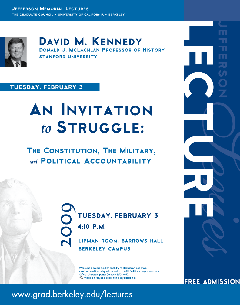
[00:00:01] ELLEN GOBLER:
Good afternoon. My name is Ellen Gobler. I manage the Graduate Council Lectures. Thank you all so much for joining us today. Um, please help us out by turning off your cell phones. Thank you. It is my pleasure to introduce Andrew Szeri, Dean of the Graduate Division. Thank you.
(applause)
[00:00:28] ANDREW SZERI:
Good afternoon. So my name is, uh, Andrew Szeri. I’m Dean of the Graduate Division.
We are pleased, along with the Graduate Council, to present, uh, David Kennedy, this year’s speaker in the Jefferson Memorial Lecture Series. The Jefferson Memorial Lectures were established in nineteen forty-four through a bequest from Elizabeth Bonestell and her husband, Cutler Bonestell. They were a prominent San Francisco couple who cared deeply for history and hoped that the lectures would encourage students, faculty, scholars, and those in the community to study the legacy of Thomas Jefferson and to explore values inherent in American democracy.
Past lecturers have included Ambassador Jeane Kirkpatrick, Senator Alan Simpson, Representative Thomas Foley, and Archibald Cox. They have delivered Jefferson Memorial Lectures on early American history, about Jefferson himself, and on American institutions and policies in politics, economics, education, and law. And now I’d like to we-welcome Professor Harry Scheiber, chair of the Jefferson Memorial Lecture Committee, to the podium to introduce our speaker.
Harry.
(applause)
[00:01:51] HARRY SCHEIBER:
Um, each year, each year, it’s our committee’s privilege to, uh, nominate a Jefferson lecturer, uh, to occupy this place in the most, uh, in our view, the most important lecture at Berkeley, each, uh, in the social sciences and humanities each year. Uh, one of many– one of several important ones, and certainly one that’s a very special interest to those of us who are in one aspect or another of American studies. Um, Professor Kennedy, um, his biography is in your program, and I won’t, uh, go into detail as to his many accomplishments and contributions.
Uh, he is a, a scholar of great eminence. He’s been recognized in many ways for his, uh, writings in American history, uh, which are remarkable for their range and, in a sense, for, uh, their prescience, because he always seems to be a few years ahead of some of the big issues
(laughter)
in American life and, uh, starting with his, uh, early work, uh, on the birth control movement and down to the present day when his, uh, wonderful new book, which has won the Pulitzer Prize, has, um, uh, uh, uh, uh, gained, uh, an especially prominent place in the discussions today of, uh, the Great Depression, uh, as, um, something that we have to think about anew in terms of what’s happened to our country in the last, uh, several years, and particularly the last six or eight months. Um, he’s also renowned as a great teacher, has been, uh, had, had, um, accolades from his own university at Stanford and, and renowned as a lecturer. Uh, Uh, he’s being honored by a big event at his university later this year, it’s well deserved.
And, um, he, uh, has, uh, has, uh, a reputation as a person who is very inspiring to his students in the classroom. Some of those students have come here to Berkeley for graduate work, and we know that at firsthand. And, um, I have to admit, I know it from my own family.
So I have to thank David for what he’s contributed in that regard too. Uh, his, his book is remarkable, uh, for– in several ways, and, um, I’m not here to review the book or to give you a ten-minute exposition on it, but I’ll say that it’s remarkable for the way in which, as C. Vann Woodward in an, uh, in, in an interesting introduction says that David Kennedy writes about people, and people are very much in that book. It’s also remarkable in other ways, though, for the way in which, uh, he deals not only with the Great Depression, which has been getting so much attention of late, but also with the impact of the war and the conduct of the war, World War II.
Uh, wonderful biographical treatment of Roosevelt and others who were involved in the war period and the diplomacy of the war, and then the social effects of the war. It’s a truly remarkable work and one for– one that’s gonna be read for generations. And we’re very privileged, uh, to have him here today to speak on one of the issues that I imagine comes out of that book, because he’s interested in the, um, questions, uh, of, uh, the relationship of the, uh, uh, branches of government to one another in times of crisis.
So it’s a great pleasure to have David Kennedy, and we welcome you. We at Berkeley welcome you, David, and look forward to your talk. Thank you.
(applause)
[00:05:24] DAVID KENNEDY:
Thank you. Thank you very much, Harry, for that very handsome introduction. Uh, thank you, Dean Szeri, for the introduction to the introduction. And my thanks
(laughter)
to my, to my old friend, David Hollinger, for, uh, guiding me around the campus today and for Ellen Gobler for getting me all the way here from Palo Alto. Now, when I, uh, make the journey, as I do occasionally, from Stanford to Berkeley, I’m frequently reminded of a story that some people in this room may have heard. I’ve heard it several times from the mouth of Tom Brokaw, who, as it happens, uh, apparently approximately twenty years ago, had, uh, he has twin daughters, and one of them was a student at Berkeley, and the other was a student at Stanford at the same time.
So he would come out and visit them, and he would frequently remark that, uh, these back-to-back visits to Berkeley and Stanford were like attending serial, uh, performances of the Grateful Dead and the Mormon Tabernacle Choir.
(laughter)
So in honor of that, uh, the spirit of that, uh, observation, I thought it’d be a good idea before I came up here if I got a haircut.
(laughter)
Uh, I was further reminded of the, the cultural distance between Palo Alto or Stanford and Berkeley, uh, when I checked into my hotel this morning. It’s the Durant Hotel right here in your neighborhood. The first thing that greeted me in my room as I walked in were the bed lamps were made out of what appeared to be recycled lava lamps.
(laughter)
Something that hasn’t been seen in Santa Clara County in many, many years. And then if that weren’t enough, I went into the bathroom, and, uh, there’s a large grainy black-and-white photograph on the bathroom wall of indeterminate date of one male and one female streaker.
(laughter)
Again, I think this, this is probably illegal in Santa Clara County.
(laughter)
All right. All right, well, I have a story to tell. Uh, it’s an old story in many ways, uh, but I’m gonna focus on its most modern chapter.
Uh, the story has to do with the composition and configuration of the United States Armed Forces. And I’m going to have some things to say about the nature of our armed forces today in our own time, especially with respect to three characteristics of the American military today. It is, first of all, most obviously, a all-volunteer force.
Secondly, it is, by all historical standards, a relatively small force. And thirdly, and this is, uh, takes a little bit of, uh, argumentation and exposition to establish the point, and I’ll get to it. But thirdly, a third characteristic of today’s military is that it is a relatively inexpensive force.
So just keep these three characteristics in mind. The force is all-volunteer, relatively small in terms of, uh, the numbers of personnel, and it is a relatively inexpensive force given the overall size of this economy. Uh, technology will figure rather conspicuously in the story that I’m going to tell you.
Uh, but my deeper subjects that this story is meant to get at are three. The implications of the military system and structure and force structure we now have, the implications of that force structure for, first of all, political accountability, secondly, for what I’m, what I’m going to call social equity, and thirdly, for what I’m going to call social comity. And if I can borrow a leaf from First Corinthians, Uh, of these three, accountability, equity, and comity, they all abide, but the greatest, my topic and the way I approach the topic at least, is the matter of accountability, political accountability.
Now, I could sum up these remarks, I suppose, uh, briefly. Uh, in a, a remark I heard last summer when I had the privilege of being a visitor for a week at something called Operation Warrior Forge, which is the annual Army ROTC encampment at Fort Lewis, Washington, where they bring six thousand and some, uh, ROTC cadets to Fort Lewis in the summer between their junior and senior year in college, uh, for thirty-three days of what they call leadership training. Uh, and in the course of this, uh, I was just an observer there watching the whole thing, and the high point for me was I got to go to the grenade course.
Uh, but the– In the course of this, I, I spent the week with, uh, a lot of, uh, senior, uh, Army officers, And the question that I was asked, or heard them ask each other many times was, “How can it be that the army is at war and the country is not?” Now, that sums up a lot of what I’m going to try to, uh, develop for you here today.
How is it that we’ve got to a situation where the army is at war, in fact, the army is at war to the point that it’s, by many accounts, it’s stretching that structure to the breaking point, but the society at large really doesn’t feel that burden at all? Now, the premise of these remarks is simple, and I’ll put it in an argumentative way just to get your blood pressure up. Uh, the premise of these remarks is that the United States today has configured its armed forces in a fashion that has many of the attributes of a mercenary army.
Now, I’m going to explain what I mean by that, uh, uh, incendiary term, and I’ll offer you a little brief, uh, historical account of how and why such a force came into being, which is a story with, uh, more than a few ironic twists. Uh, but more importantly, I want to explore some of the political and moral, and perhaps we might, we might even say psychological implications, uh, that the existence of a force with those characteristics, uh, poses for American society. And the proposition I want to argue is simply that the current state of civil-military relations in the United States raises some urgent questions about America’s role in the world, about the informing doctrines of national security policy, about the political health of our democracy, about the moral bases of our society, and perhaps even its literal integrity.
Now, I also want to acknowledge at the outset that many people here in this room, I’m sure, uh, will find it offensive, uh, to, to hear this country’s military described as having any of the characteristics of a mercenary army. So I want to emphasize here at the beginning of this discussion that my own use of that term is in no way intended as a criticism of those who serve in uniform. My own belief, in fact, is that the profession of arms can be a noble calling, and I harbor no disrespect whatsoever for those who follow it.
Their motives for serving are not my concern here, or at least not my principal concern. Though as it happens, the demographic profile of the armed forces today do suggest some issue, issues to which I will return under the rubrics of social equity and social comity. But my principal interest on this occasion is to undertake neither a psychological nor a sociological analysis of today’s service personnel.
What I want rather to explore is some of the– are some of the structural questions about the relation of the military we now have to the conduct of American foreign policy, and especially to the matter of political accountability. So a better title for these remarks, though it’s pretty cumbersome, and that’s why it didn’t get printed in the program, but one that better summarizes the argument I’m trying to make, is to say that what I want to explore is the, the fact that we have an army whose character tempts the political leadership to treat it as if it were a mercenary force, a force structure that creates a kind of political moral hazard for the political leadership and therefore for the society at large. Now, the fact remains, I know, even after all these, uh, disclaimers, that there are some people who, for whom the words mercenary army, army are intended or are heard or comprehended, no pun intended, as, uh, fighting words.
And at the close of these remarks today, I hope to say something about a bit of a fight that they recently, uh, provoked and my role in that, uh, dust-up, and what it suggests about the current state of American culture, uh, including the implications for institutions of higher education. Now, my Random House Dictionary defines the word mercenary as follows: working or acting merely for money or other reward, hired to serve in a foreign army. Now again, I do not want to be understood as suggesting that American service personnel today work merely for money, though recent recruiting campaigns for the all-volunteer force do in fact lay a lot of stress on wages and benefits and signing bonuses.
In fact, The Wall Street Journal reported just two months ago that the Army in 2007 paid twenty-five percent more in signing bonuses alone, some six hundred and forty million dollars, twenty-five percent more than it had paid in the preceding year. So clearly, pay and the pay package offered is a factor in the recruitment and composition of the force we have, but that is not my principal argument here. And of course, we hire our soldiers and sailors and airmen today mostly, mostly from within our own society.
Unlike, for example, the much-maligned Hessians that, uh, George III employed to fight against the American revolutionaries. Though the fact is that more than seventy thousand non-citizens are currently serving in the active duty forces, a fact which prompted the Bush administration in two thousand and two, uh, to expedite naturalization procedures for aliens in the military by waiving the residency requirement. In any case, I recognize, again, I’m probably belaboring the point, uh, that mercenary is a term that carries a lot of negative connotative freight.
So I’d like to unburden the word of at least some of that freight and focus on its core meaning, rooted in the Latin term from which the word mercenary is derived, mercari, to trade or to exchange. So the best way to think about my use of the term might be to ask ourselves, what are the terms of trade between civil society in this country today and the military organization that fights in its name and on its behalf? And as I said a moment ago, as I proceed with this story, you will see that technology has a rather considerable role to play in, uh, giving us an answer to that question.
Another way to put the matter, uh, rather summarily might be to ask, what is the relation of service to citizenship, and of our current force structure to political decision-making? Now, our forebears and ancestors had a pretty ready answer to those questions. From the time of the ancient Greeks right down through the American Revolutionary War and well beyond, well into the 20th century, the obligations to bear arms and the privileges of citizenship were intimately linked.
Uh, in republics from Aristotle’s Athens to Niccolò Machiavelli’s Florence to Thomas Jefferson’s Virginia and well beyond, to be a full citizen was to be expected to stand ready to shoulder arms. Indeed, that’s one of the reasons why female citizenship or full female citizenship was so long in coming, coming until that linkage was at least partly broken. Indeed, in many cases, especially in ancient republics, uh, one was obliged not only to bear arms, but to provide one’s own arms, to show up, uh, when the military summons, uh, came, uh, with one’s own, uh, armor and buckle and sword and horse if you were mounted, and so on and so forth.
And it was their respect for the political consequences of that linkage between service and citizenship, uh, that was among the reasons why the American founders were so committed to the idea of militias and so worried about standing armies, which one of them, Samuel Adams, said were always dangerous to the liberties of the people. Uh, closer to our own time, Franklin Roosevelt, uh, uh, drew from that same well of doctrine and sentiment on many occasions, most memorably perhaps in his D-Day prayer on June 6th, 1944, when he went on the radio and prayed for the success of the D-Day landings. Uh, and in that address, he called the GIs who were then going ashore at Normandy, the, the so-called Greatest Generation.
Uh, he referred to them as our sons, pride of our nation, lately drawn from the ways of peace, they yearn but for the end of battle for their return to the haven of home. African Americans understood the linkage between citizenship and service at least as early as the Civil War, when some one hundred and eighty thousand were taken into service, and they requested combat assignments. And in World Wars I and II, when again African American leaders demanded combat roles denied to them entire– almost entirely in World War II and only a little bit granted in World War I.
But, uh, African American leaders understood that the performance of military duty was a way to strengthen African American claims to full citizenship rights. So for more than two millennia in the Western world, the tradition of the citizen soldier has served several indispensable purposes of strengthening civic engagement, promoting individual liberty, and perhaps most, most notably, again, my central theme of encouraging political accountability when it came to the decision to shoulder arms. Now today, and indeed for the last thirty-six years, that tradition in this country has been seriously compromised.
No American is now obligated to military service. Few will actually ever serve in uniform. Even fewer still will actually taste battle, and still fewer who do serve will have ever sat in the classrooms of an institution like this or my own home institution, Stanford.
Now, a comparison with a prior generation’s war can illuminate the scale and suggest the– both the novelty and the gravity of this situation. In World War II, uh, the United States took some sixteen million men and several thousand women into military service. The great majority of them, again, popular folklore to the contrary notwithstanding, the great majority of them draftees.
What’s more, this country mobilized, uh, the economic and social, and one might even say psychological resources of this society down to the last factory and rail car and victory garden and classroom. World War II is quite rightly understood as a total war. It compelled the participation of all citizens.
It exacted the last full measure of devotion from some four hundred thousand of them, and it required an enormous commitment of the society’s energies to secure the eventual victory. Now, today’s military, in contrast, numbers just one point four million active duty personnel, with another nearly nine hundred thousand in the reserves, in a country whose population has more than doubled since World War II. So proportionate to population, today’s active duty military establishment, that one point four million, is about four percent of the size of the force that was mustered in World War II.
And what’s more, in this behemoth fourteen trillion dollar American economy, at least it was fourteen trillion dollars a few weeks ago, we–
(laughter)
the, the, the economy we now enjoy, call it thirteen trillion, the difference won’t be material. The total military budget of some five hund-hundred to six hundred billion dollars is about four percent of GDP. That’s about one-third the rate of military expenditure relative to GDP at the height of the Cold War.
In World War II, that rate was more than forty percent, an order of magnitude difference, greater than a tenfold difference in the relative incidence of the military’s claim on the society’s military resources. Now, nevertheless, this relatively small and relatively inexpensive force is at the same time, by far the world’s most potent military establishment. Indeed, it’s not only the current world’s most potent military establishment, it’s the most potent military establishment we’ve ever seen in all of history.
So I say it’s relatively inexpensive and relatively small advisedly because the absolute numbers tell a different story. By some responsible estimates, United States defense expenditures, even at four percent of GDP, are greater than the sum of all other nations’ military budgets combined. The United States accounts for more than fifty percent of all military spending in the entire planet, a calculation that testifies as much to the scale of the American economy as it does to the role of the military in our conception of our national security needs and foreign policy priorities.
So the American military today, in short, is at one and the same time exceptionally lean and extraordinarily lethal It displays what, uh, might be called a compound asymmetry. It is far larger and far more potentially destructive than any potentially rival force. And at the same time, perhaps paradoxically, it is far smaller with respect to the American population and economy than at any time since the onset of World War II.
And again, as I’ll get to in just a moment, technology goes a long way to explaining how this situation came about. Now, in my view, the implications of this situation, just this structural situation about the composition and size and economic claim of the military, the implications of this, I think, are unsettling. It means that, uh, history’s most powerful military force ever can be sent into battle in the name of a society that scarcely breaks a sweat when it does so.
The United States today can wage war while putting at risk very few of its sons and daughters, and only those who are willing to go into harm’s way. And virtually, unlike virtually all previous societies in history, the United States today can inflict prodigiously destructive damage on others while not appreciably disrupting its own civilian economy. So we have, in short, evolved an unprecedented and uniquely American method of warfare that does not ask, precisely because it does not require sacrifice in the form of large-scale personal or material contributions from the citizens on whose behalf that force is deployed.
Now, some people may celebrate these developments as triumphs of the soldierly art or as testimony to American wealth and know-how and technological accomplishment. And those, uh, statements I think are all true. But there’s another side to this story as well, Because among other things, the present structure of civil-military relations constitutes a kind of political-moral hazard.
It creates a standing temptation to the kind of military adventurism, to reaching for the military instrument first of all in national security and foreign policy, exactly the kinds of things that the founders feared were among the greatest dangers of standing armies. A danger embodied in their own day in the career of Napoleon Bonaparte, whom Thomas Jefferson described as having transferred the destinies of the republic from the civil to the military arm. Uh, but Napoleon at least, uh, had somehow or other to sustain a broad public consensus to support the levée en masse of hundreds of thousands or even millions of troops, and the huge drafts on France’s economic resources that made his adventures possible.
Napoleon, were permitted to speculate, might have well envied a 21st century leader who shared a version of his transformative ambitions for the world, and who commanded a compact, low-cost, highly effective, all-volunteer force that substantially liberated him from the constraints of manpower and materiel that eventually brought a halt to the Emperor Napoleon’s ambitions. All right, that’s the situation. How did it come about?
And this is now the history lesson. The ultimate origins of this story, I suppose, no doubt trace back to the most, uh, ancient and primitive efforts to gain advantages of weaponry or wealth over one’s adversaries, and to do so at the least possible cost. But in this particular case, the, uh, more palpable, traceable origins of the situation I’ve just described, uh, run back to the Vietnam era.
In nineteen sixty-eight, uh, presidential candidate Richard Nixon, uh, cast about for ways that he might dampen the rising tide of anti-Vietnam War protests, uh, well known in this community as well as at Stanford for that matter. But how he was looking for a way he might somehow dampen that, uh, anti-war sentiment on college campuses. And among the things he hit on was a pledge during the campaign to end the military draft, which was in fact the underlying fuel that drove a lot of campus disruption, and not so incidentally, a formative factor in the lives of millions of American young men through several decades of the Cold War.
Once installed as, inaugurated as president, Nixon tasked his Defense Secretary, Melvin Laird, uh, to undertake a study of the feasibility of going to an all-volunteer force. And Laird, in turn, commissioned his predecessor under Dwight Eisenhower, former Secretary of Defense by the name of Thomas Gates, to study a, uh… or come up with a, a program and a plan, uh, to end, uh, conscription. And in 1973, the Selective Service System stopped drafting young men, and the United States adopted the all-volunteer force that we still have.
And with the wind down of the Vietnam War, not so incidentally, that force also became smaller. It shrank from, uh, forty divisions at the height of the Vietnam War to just sixteen divisions by the time Nixon left office in 1974. Now, again, by way of comparison, the Army fielded ninety divisions in World War II.
Today’s Army numbers just eighteen divisions, ten in the active forces, eight in the reserves, down from twenty-eight divisions at the time of the first Gulf War in the early nineteen nineties. And in fact, given the structure of the forces today, division is becoming a more and more obsolete way to think about the scale and the organization of the armed forces. Regimental, regimental combat teams and brigades are now the effective units in the way the, uh, Army does its calculus about how effective a force it has.
Now, Vietnam’s influence on the size and composition of the armed forces and on the structure of civil-military relations does not end with this little recital of the shift to the all-volunteer force and the downsizing, uh, of the Army from ninety divisions in World War II, forty in Vietnam, twenty-eight in nineteen ninety-one, and ten today. The last Army Chief of Staff to serve under Nixon was a man by the name of Creighton Abrams, General Creighton Abrams. Abrams was a veteran of both World War II and of Vietnam.
He was a tank commander in those conflicts. He was also among those members of the officer corps who were deeply disillusioned with the way the military had been used, or in his view, misused in the Vietnam episode. So to prevent what he regarded as the mistakes of the Vietnam War from being repeated, Abrams became the principal, not the sole, but the principal architect of something called the Total Force Doctrine.
That’s capital T, capital F, capital D. This is the, the term of art given to the structure of the forces and the way of recruiting the forces that Abrams, uh, came up with. Now, to be sure, that Total Force Doctrine, uh, grew out of budgetary constraints in the 1970s, but its deepest logic, and this was salient in Abrams’ thinking, its deepest logic was to structure or restructure the Armed Forces in such a way that they could not easily be deployed in the absence of strong and sustainable public support, something that Abrams and his colleagues in the senior military leadership at that time thought had gone fatally missing in Vietnam.
Now, Abrams’ means to that end was to create a force that could not be deployed in the absence of deep and sustained public support, was to create a force structure that tightly integrated both the active and the reserve components by, uh, re– by, uh, changing the character of the reserves from a strategic reserve, which would be called up only in a battlefield emergency, to an operational reserve, that is, a reserve that would be deployed simultaneously with the active forces in largely a support and uh, a, a behind the lines role. Now, the logic of this goes as follows. That the reserves, the reserve forces are, number one, less expensive to maintain than the active forces.
You don’t have to bivouac them and feed them and so on. But secondly, and much more importantly, configuring the overall force so that it was inextricably dependent on the reserves served a political purpose even more than a fiscal purpose. The reserves then and now are traditionally composed of somewhat older people with deeper roots and responsibilities in civil society than the typical eighteen or nineteen-year-old draftee of the World War II or Vietnam eras.
Abrams’ hope was that with this total force structure in place, political leaders would hesitate to undertake a major deployment that would necessarily, because of the very character of the force that was available, such a, a major deployment would necessarily be highly disruptive to countless communities in which these older civilians were interdigitated, and in which they were playing productive roles, unless the political leadership were sure of solid and durable public support. So in effect, and some people at the time criticized him for this, in effect, the Abrams Doctrine, the Total Force Doctrine, was self-consciously designed to raise the threshold for presidential demonstration of a genuine threat to national security and the national interest, and to require, in a much more insistent and urgent way, to require presidential cultivation of a broad consensus in the Congress and in the country at large on the nature and urgency of the threat as a prerequisite for a large-scale military deployment. It’s been said that the Abrams Doctrine therefore amounted to a kind of extra-constitutional restraint on the president’s freedom of action as commander-in-chief, and I suppose that’s an accurate characterization.
It had, however, a legislative counterpart which actually came to pass in the exact same year that we went from selective service conscription to the all-volunteer force, nineteen seventy-three. I’m referring, of course, to the War Powers Act of nineteen seventy-three, passed by the Congress over Richard Nixon’s veto, was also aimed at restricting the president’s ability to commit troops for the long term without explicit congressional assent. No president has recognized the constitutionality of that bill.
Uh, underlying the War Powers Act in turn, uh, is the constitutional provision, Article One, Section Eight, Paragraph Eleven, which gives the Congress, the Congress, the power to declare war. Now here it might be noted, not altogether incidentally, and I hesitate to involve myself in constitutional discussion in the presence of experts like Harry Scheiber, but I’m going to go ahead anyway. It might be noted that though the Constitution in, uh, Article One, Section Eight, Paragraph 11 vests in the Congress the right to declare war, in the more than two centuries of the Republic’s existence, Congress has exercised that formal, full constitutional right only five times: War of 1812, Mexican War, Spanish-American War, World Wars I and II.
Only five, only five occasions, every one of them at the president’s request, incidentally, has the Congress actually fully declared war in the most formal sense, exercised that constitutional right. A Congressional Research Service study that tracked the matter only up to 1993, so the data, if they were fully updated, would look a little different, records that there, uh, if it, what it looked at were overseas deployments of American troops since seventeen eighty-nine, and the number comes to two hundred and thirty-four. And it would be slightly higher today if we took in the recent interventions, for example, in Iraq and Afghanistan, maybe some others.
But two hundred and thirty-four down to nineteen ninety-three. Now, if you lay those two numbers alongside each other, it seems to me that you’ve got a prima facie issue right there in front of you. Two hundred and forty, let’s say, in round numbers, overseas military deployments since seventeen eighty-nine, but only five formal declarations of war.
Now, all by themselves, it seems to me those numbers tell us that we have had, for two centuries plus, a chronic problem in finding, uh, democratic– finding ways to bring to bear deliberative democratic processes on the all-important decision of shouldering arms. Now, the force, uh, shaped by, uh, Abrams’ doctrine, the Total Force Doctrine persisted, uh, actually it persisted even down into this century, but it persisted in particular into the early years of the Reagan presidency when Defense Secretary Caspar Weinberger took the Total Force Doctrine’s logic of insulating the military from ill-considered political decisions to use it, took that, uh, logic several steps further. And the precipitating factor in this instance was not, uh, Vietnam, but Lebanon, where the Reagan administration had sent troops over the objections of the Pentagon and the Joint Chiefs.
And many of you will remember on October 23rd, 1983, some two hundred and forty-one Marines died in a suicide bombing attack on their Beirut barracks. And it was in reaction to that catastrophe the following month in a speech called The Uses of Military Power, uh, that Caspar Weinberger, then the defense secretary, laid down a set of principles that he said should govern military deployment, and this became known as the Weinberger Doctrine. And it is still in many ways, uh, the, uh, the military’s own core doctrine of how it should be used.
Uh, the Weinberger Doctrine, we, we might say, is Doric in its simplicity. It is, it is not rocket science. It’s a pretty simple matter.
It has six basic propositions, and here they are. This is what Weinberger said in this speech. This is how he laid it out.
One, the United States should not commit forces to combat unless the vital national interests of the United States or its allies are involved. Two, United States troops should only be committed wholeheartedly and with the clear intention of winning. Otherwise, troops should not be committed.
Three, U.S. combat troops should be committed only with clearly defined political and military objectives and with the capacity to accomplish those objectives. Four, the relationship between the objectives and the size and composition of the force committed should be continually reassessed and adjusted if necessary. Five, the one that most interests me, US troops should not be committed to battle without a reasonable assurance of the support of the American public and Congress.
And six, the commitment of American troops should be considered only as a last resort. Now, I find that a pretty sensible doctrine, as a matter of fact. Now, seven years later, in the context of the first Gulf War, the the then Chairman of the Joint Chiefs of Staff, General Colin Powell, glossed the Weinberger Doctrine, updated it slightly, and he managed thereby to substitute his own name for Weinberger’s in popular understanding of the matter.
Uh, some people believe that actually Powell was the person who was the principal architect in drafting the original Weinberger Doctrine. But in any case, people today know less about the Weinberger Doctrine, more about the Powell Doctrine. The Powell Doctrine is nothing more than a slightly updated version of the Weinberger Doctrine.
Powell added two further provisos to the six that Weinberger laid down. One was that the seventh, you might say, was the United States should not enter combat unless it was confident that it had overwhelming force vis-à-vis its adversary, that there’d be no doubt about the outcome of the conflict. And second— eighth, I guess, the second addition was that there must be an exit strategy.
There must be— there must be the initial commitment of troops had to be accompanied at the front end of the planning process by a plan to extract them, uh, at the end of the confrontation. Now, uh, like Abrams, uh, Powell, of course, was a Vietnam veteran. Uh, and he also, uh, in the speech in which he announced what comes to be known as the Powell Doctrine, uh, in nineteen ninety-one, uh, he also, uh, made reference, as Weinberger had, to that Beirut barracks bombing.
And here’s what he said. “We must not,” this is Colin Powell now, “we must not, for example, send military forces into a crisis with an unclear mission they cannot accomplish, such as we did when we sent those Marines into Lebanon in nineteen eighty-three.” We inserted those proud warriors into the middle of a five-faction civil war, complete with terrorists, hostage takers, and a dozen spies in every camp, and said, “Gentlemen, be a buffer.”
The results were two hundred and forty-one dead Marines and U.S. withdrawal from the troubled area. Now, I rehearsed this about Weinberger and Powell at a little bit of length because I think contrary to a lot of stereotypes about the bloodthirstiness of a supposedly warrior class, these various doctrines of General Abrams, of Defense Secretary Weinberger, and General Powell, these doctrines did not, emphatically not, seek primarily to provide rationales for doing– going to battle. Instead, they were principally intended as formulas devised and supported, for the most part by professional soldiers, for avoiding war if at all possible, and then only in the most unambiguous cases and only as a last resort.
So like the total force doctrine that preceded and informed them, both the Weinberger Doctrine and the Powell Doctrine grew out of a persistent anxiety on the part of senior military officers that they lived in a world where it was too easy for their political masters to behave irresponsibly or even recklessly by committing the armed forces to action in the absence of clearly compelling reasons, a well-defined mission, and the reliable, properly informed approval of the citizenry. So these were, in short, counsels of prudence and caution and responsibility. They were intended to induce deliberation and consensus building when confronting the decision to make war.
So how effective were they? The total force doctrine, the Weinberger doctrine, the Powell doctrine. Well, opinions may differ about that matter, but before we can come to any conclusive answer to that question, we have to acknowledge that there’s another intervening development here that, uh, further challenged the already rather frail structural inhibitions on rash or imprudent political decision-making to resort to military force that were characteristic of the Total Force Doctrine and the Weinberger and Powell doctrines.
And this intervening event usually goes by the name of the RMA, or the Revolution in Military Affairs. Now, to be sure, over the course of history, there have been many revolutions in military affairs, uh, from the introduction of gunpowder in the Middle Ages to the twentieth century’s invention of blitzkrieg and strategic bombing. Even Napoleon’s use of that vast conscript force, the levée en masse, is its own kind of revolution in military affairs.
All of these things fundamentally redefined strategic as well as tactical doctrines and changed the very character of warfare. But this newest RMA, Revolution in Military Affairs, that I’m going to dwell on for a moment or two, is notable for three characteristics. Number one, the speed with which it transformed military doctrine.
Secondly, its intimate relationship with, uh, parallel developments in civil society. And thirdly, for the general lack of public understanding about its implications. Now, this RMA, the most recent one, this Revolution in Military Affairs, was, as it happens, foreshadowed in the writings of a man by the name of Albert Wohlstetter, a name I’m sure familiar to some people in this room.
Uh, Wohlstetter was long an influential theorist of nuclear warfare at the RAND Corporation. He was also a longtime professor at the University of Chicago, where among his students was Paul Wolfowitz. Uh, in a series of articles in the 1980s, beginning in the 1980s, that Wohlstetter stressed the factor of accuracy in determining– the the accuracy of weapon systems in determining force composition and warfighting doctrine.
Uh, in a pioneering article in 1983 along this line, he proposed, with calculations to support the argument, that a tenfold improvement in accuracy was the equivalent of a thousandfold increase in sheer explosive power. And by extension, a hundredfold increase in accuracy would amplify destructive power by a factor of one million. Now, the implications of those calculations were energetically pursued by a man by the name of Andrew Marshall, longtime director of the Pentagon’s Office of Net Assessment.
Uh, and if any one individual deserves the title of the father of the RMA, it is Andrew Marshall with, I suppose, Albert Wal- Wohlstetter as the grandfather of this same development. Marshall at the Pentagon in the nineteen eighties, uh, beginning in the nineteen eighties, working from Wohlstetter’s ideas, promoted a broad program of capitalizing militarily on the information and computer revolutions that were already rapidly and pervasively transforming the civilian sector. Especially advances in a technology largely developed near here in Silicon Valley, VLSI, very large-scale integration technologies.
Uh, and specifically, uh, Andrew Marshall and his colleagues stressed the potential of, of VLSI technologies to, uh, uh, permit radical, dramatic technological upgrading of stealth weapons and standoff weapons, of all-weather and all-terrain, uh, fighting capacities, unmanned systems like the Predator drone, and later, uh, actually attack craft, uh, space-ba-based networking, joint force integration, miniaturization, range, endurance, speed, and especially precision, precision, precision was the holy grail of all of these developments. Now, all of these innovations, or you might say the result of these innovations, were spectacularly on display in the early stages of the 2003 Iraq War, though they have proved manifestly less relevant, uh, to the occupation and nation-building missions that followed the conventional military victory. The very first fruits of the, uh, revolution in military affairs that Andrew Marshall promoted, uh, was evident in the 1991 Gulf War, uh, when news coverage, many people in this room will recollect it, uh, when news coverage conspicuously featured the advent of smart bombs, these air-launched weapons, uh, that, uh, could hit the, uh— They could fly through a window of a designated building and knock out one office without touching or causing collateral damage even elsewhere in the same building, something unheard of in the days of World War II.
But the fact is, in the first Gulf War in nineteen ninety-one, is be– that war is best understood, uh, as the, you might say, on the American side, it was the final mission of a force that had been configured to fight a fairly conventional land battle against Warsaw Pact adversaries in Central Europe. The fact is that smart weapons, for all the publicity they got in nineteen ninety-one, accounted for, um, only about 10% of the ordnance that was used in that conflict. The decisive action was Norman– General Norman Schwarzkopf’s blitzkrieg-like flanking attack against the Ir– the Republican Guard forces.
That was a classic World War II armored maneuver. It mimics entirely the German sweep around the Maginot Line, uh, in nineteen forty or Patton’s great sweep to Argentan in nineteen forty-four. But by the time of the second Gulf War in 2003, smart munitions made up ninety percent of the American arsenal, and the implications of accuracy as a force multiplier proved to be just as spectacular as Wohlstetter had predicted.
Here’s an example. By one calculation, it’s actually a very, very, uh, responsible calculation done by the United States Strategic Bombing Survey at the conclusion of World War II, in an, in an effort to assess what was the role that strategic bombing had played in the defeat of Germany and Japan, uh, the calculation was made that to destroy a single target, to reliably destroy a single target, on average it took one hundred and eight aircraft sorties and dropping six hundred and forty-eight bombs to destroy a single target in the context of the technologies available in World War II. During the 2001 campaign in Afghanistan, on the very first night of that battle, thirty-eight aircraft destroyed one hundred and fifty-nine targets in one night, and there was Wohlstetter’s calculation all played out.
So So the RMA, in short, vastly amplified, uh, the firepower and the fighting effectiveness of the individual soldier or sailor or airman and it made it far more feasible to, uh, field a, a much smaller and more efficient force than the lumbering, terrain-bound, largely sightless armies that had fought since time immemorial. So So we’ve seen several developments that have converged, especially the technological one, to give us this downsized, affordable, and remarkably efficient military force we now have. Now, to repeat, many people applaud these efforts as triumphs of American values and ingenuity.
And to repeat, so perhaps they are. But these same developments, it seems to me, have also incubated a grave threat to the no less important American value of political accountability, not to mention responsible decision-making, the kind of thing that Creighton Abrams and Caspar Weinberger and Colin Powell were trying to bolster. The RMA has, in a sense, made possible the fatal undermining of the total force doctrine that Creighton Abrams brought forth by underwriting the downsizing of the armed forces to such a degree that only the willing or the desperate need to serve, and even the call-up of the reserves does not have a really appreciable effect on the overall society.
Now, it’s my belief that it simply isn’t healthy for a democracy to let something as important as war-making grow so far removed from broad popular participation and strict attention and accountability. That’s why the war-making power was lodged in the legislative branch in the first place. And our current situation makes some supremely important things simply too easy, like the violent coercion of other societies and the resort to military instruments on the assumption that they will be swifter than those that could be– things that could be accomplished by, let’s say, diplomacy.
All right, a final word about the… or two words about the separation of the civilian and military spheres that I referred to at the outset, and here I want to touch on the matters just briefly of equity and comity. In the year 2000, the last year from which I can find reliable data, which by itself is a remarkable fact that the data aren’t very accessible, but in the year 2000, minorities, ethnic and racial minorities, composed forty-two percent of the United States Army’s enlisted ranks. Secondly, in the eighteen to twenty-four-year-old cohort in the year 2000, out there in the country at large, forty-six percent of persons in that cohort in the civil society had at least some exposure to college or university-level education.
In the enlisted ranks of the United States Army in two thousand, the number of persons, so the percentage of persons who had had any exposure whatever to a college classroom was six percent. So not only is today’s military remarkably small in relation to the overall structure of civil society, it is in that sense a minority institution. It is also disproportionately composed of racial and ethnic and socioeconomic minorities.
And whoever they are, and for whatever reasons they enlist, they surely do not make up the kind of citizen army that this society fielded two generations ago, whose members were drawn from all ranks of society without res- reference to background or privilege or education, and mobilized on such a scale that civilian society’s deep and durable consent to the use of that force was necessary. So, here is another compound asymmetry of worrisome proportions to me. A hugely preponderant majority of us, with no risk whatsoever of exposure on our part or our children’s part to military service, have, in effect, hired some of the least advantaged of our fellow countrymen to do some of our most dangerous business, while the rest of us go on with our own affairs, unbloodied and undistracted.
All right, last word about comedy. Uh, th- now, now it’s three and a half years ago, I published a much abbreviated version of these remarks in The New York Times. And I heard from a lot of those countrymen of ours, as well as their families and friends, and most of them were deeply offended by my use of the word mercenary in that little eight- hundred-word piece in The Times, and in retrospect, I wish I’d more carefully defined it, or I can blame it on The Times.
They only gave me 800 words. It’s their, their fault that, uh, people got so riled. But frankly, I, uh, I write with some frequency in the popular press, and you always get a certain amount of blowback and feedback and commentary.
I’ve never received a volume of, uh, correspondence like I did in the wake of this piece, and I’ve never, uh, received as much hate mail. And what was most disturbing to me as I read through the literally hundreds, possibly even thousands of messages that the piece elicited, was how completely marinated they were in a bitter, venomous cultural resentment. Uh, in comments that were often, how can I describe them, uh, colorfully embroidered with vivid, uh, anatomical and, uh, scatological detail.
(laughter)
Uh, my correspondents castigated the educated classes, the securely employed, the presumptively effete professoriate, as well as a whole array of supposedly clueless institutions like The New York Times itself and the major universities, especially those like my own at Stanford, that do not have academically accredited ROTC programs and resist allowing military recruiters on campus. Incidentally, I might just say parenthetically, those kinds of policies go a long way toward ensuring that such universities as my own, which pride themselves on training the next generation’s leaders, will have absolutely minimal influence on the leadership of a hugely important American institution, which is the United States Armed Forces, and I don’t see why that’s a good idea. Now, I think it would be a mistake, uh, to dismiss those messages I received as something that emanated from somewhere down the evolutionary chain.
Uh, and it would be a gross exaggeration to suggest that the cultural divide, uh, registered in those reactions is the precursor to the emergence of an American Freikorps or Fasci di Combattimento, the, the organizations that backed Mussolini and Hitler after World War I. But the cultural distance that increasingly and rancorously separates those who serve from those who do not and insulates some of our supposedly greatest universities from the officer corps, those things, I believe, undoubtedly exacerbate the already pronounced cultural tensions that in any case threaten our social comity, and it is yet one more reason to worry about the longer-term implications of maintaining an all-volunteer force, not to mention continuing to ban ROTC. Thank you very much.
(applause and cheering)
[00:56:56] HARRY SCHEIBER:
Thank you very much for a really wonderful talk. Um, I just had occasion recently to read a little noticed but wonderful essay by Chief Justice Earl Warren after his retirement, which he said, I mean, we, we associated him with other things principally, but he said the thing that concerned him the most in the long haul was civil-military relations in the United States and how different thirty-some years later civil-military relations look. And this wonderful, this fine presentation tells us that.
Um, Professor Kennedy has graciously consented to answer questions. We have mi– Ellen Gobler has a microphone. She’ll bring it to you.
Uh, we have a very large audience, not much time, and we don’t want anyone to monopolize the floor. So you’re welcome to raise your hand, and we’ll– Professor Kennedy will recognize you. But, uh, please respect the idea that you won’t speak for a long time, that you keep questions brief, and no speeches.
Thank you. Sorry? Reception?
Yes. Oh, yes. I’m reminded there will be a reception afterwards with, uh, um, fare at the back of the room.
Okay. David, I’ll turn it back to you.
[00:58:06] DAVID KENNEDY:
While we were getting set up for the first question, I might just add one further note on the item on the note I ended with about social comity and the, and the distribution and equity and the distribution of the obligation to serve. Uh, ju-just something else that I learned in the the course of that week I spent at Fort Lewis, Washington, a little over a year ago. uh, the, the s-so-called general officers, that is rank of brigadier general and above, uh, in the U.S. Army numbers about three hundred and five people, and they, they’re a fraternity and a club, and they study themselves, and they periodically poll themselves, and they gather data about themselves.
And one of the things that they were very proud of, uh, people were telling me at Fort Lewis, was that those three hundred and five general officers in the United States Army, this is as of the summer of two thousand seven, amongst them had a hundred and eighty-three of their children in service. And they referred to this sometimes with a little ironic detachment, but not always, as the family business. Yeah.
Well, I thought that was pretty interesting. Three hundred and five general officers, a hundred and eighty-three children in service. So I put a research assistant on the task of determining how many of the five hundred and thirty-five members of the United States Congress had children in service.
It turns out to be, uh, the, the methodology is a little complicated. It’s hard to actually do that. You have to get down to the retail level and look at each person.
But as best she was able to figure out, uh, those 535 elected members of Congress had ten children in service. Now, even if you double that number, even you triple the number, uh, it seems to me that on the face of it, there’s a very disturbing pattern, uh, that we see, uh, in those numbers. Okay, that’s just a little further note.
[00:59:49] SPEAKER 5:
What currency would you give to the phrase now these years, ’03, ’05, ’06, ’09, and all, to the phrase military-industrial complex.
[01:00:03] DAVID KENNEDY:
Well, I, uh, uh, when, when Dwight Eisenhower first, uh, coined that phrase in 1960, um, at that time, the Pentagon budget was, uh, approximately fifty percent, or maybe a little better than fifty percent of the federal budget, and it was claiming ten or eleven percent of GDP. So it’s still the case that there are some powerful, big, uh, military contractors. But the, uh, it seems to me the more important development is that for all the size of that and absolute numbers, uh, the, the relative weight of the military in the economy is a half or a third of what it was, uh, in Eisenhower’s time.
Uh, 4% of GDP. Uh, it’s just, uh, if, if, in fact, mobilizing and deploying a force today would, uh, instantly push the military budget to a point where it started claiming 7, 8, 9, 10 percent of GDP. We would notice it.
You would have to begin redirecting resources from the civilian to the military sector, and there would be less of other things that we would like to buy. So I think the real problem, frankly, is not the, the size or the political influence of the so-called military-industrial complex. That is an issue in its own right.
I don’t mean to wave it away, but I think from an historical point of view, what’s more important to focus on is how relatively cheap this force is that we have and how high technology has underwritten its cheapness or its inexpensiveness. That’s, that’s the really important thing.
[01:01:38] VISITING SCHOLAR:
Good afternoon, Professor, and thank you very much for your very interesting talk. Um, I’m a visiting scholar from Ireland at the university here, um, undertaking a PhD that’s looking at the concept of citizens in uniform. There has been a movement in Europe since 1984, and indeed in 1988, where the European Parliament and the European Council adopted resolutions affording, uh, seeking that countries would afford, uh, to their soldiers, uh, the right of association, thereby increasing their participation as ordinary citizens.
Uh, the hope being that when they’re unleashed in wars and so on, uh, that they would, having been exposed to all citizens’ rights, that they would act in a more democratic manner. The upshot of, of all of that is that many of the European armies today, uh, their soldiers, enlisted personnel, have the right of association where they can negotiate and engage with government on issues that impact on their families, on their welfare, and so on. Uh, do you think, uh…
And I have served in Lebanon myself, and I served for 23 years, uh, as an enlisted person in a European army. Uh, do you think that America is even ready to begin, uh, considering extending all rights of citizenship, including the right of association to its armed forces? And if so, do you think that that would have any impact for the better of the sort of decisions that you’re-
[01:03:09] DAVID KENNEDY:
Uh, you’re gonna have to help me out here because it’s something I’m not sure I understand the term, the way you’re using it. What, what do you mean by the right of association?
[01:03:15] VISITING SCHOLAR:
Um, in our constitution in Ireland, uh, under Article 6, 3, 1, we have the right of association to formulate or to form professional bodies, uh, to represent your interests so that, um, whereas they can’t negotiate with government on the decision to go to war or not, they can negotiate directly with government, enlisted personnel themselves with their own associations, pretty much like a trade union without the right to strike. But they can negotiate directly with government on issues that impact on their families, on their pay, on their pensions, and so on. And it can curb sometimes the decisions of government.
Is America ready for anything like that?
[01:03:55] DAVID KENNEDY:
Well, uh, y- You’re asking for a- an impression, and, and my strong impression is the answer is no.
(laughter)
Uh, and it reminds me of the old saw about, uh, you know, Europeans are from Venus and Americans are from Mars. That, that I think is… First of all, what you call the right of association, I understand it now, I suppose our terminology would be the right to form a union.
Uh, that’s a much less deeply rooted right and practice in this society than in most European countries anyway. And extending that into the armed forces, I think, is not likely to happen in the foreseeable future. Um, but I, I thought, uh, you’ll forgive me, I thought your question was going in a little bit different direction.
I now understand what you were saying. So let, let me, let me give a bit of an answer to the question I thought you were asking, which is about the, the behavior of an armed force amongst the civilian population. And I go back again to what I observed at, uh, at Fort Lewis, Washington, uh, a year ago last summer.
Um, this is a, this, this operation where they bring these ROTC young cadets there for, uh, a little over a month. Has been going on forever, and there’s a very set curriculum, and one of the weeks, the, the week-long component of the curriculum historically has been artillery-infantry coordination, a non-trivially important thing to have some sense of out there in the battlefield. That component of the curriculum has now been dropped, and in its place, they’ve inserted a, a wholly new element called cultural awareness.
Sounds like something that came out of the Berkeley Ethnic Studies Department, you know? So may-maybe we’re not all that Martian after all. But n-but any-but more seriously, um, clearly they’re trying to prepare these y-young candidate officers for leading troops in a situation where the, much, much if not all of the task isn’t confronting the enemy’s uniformed force in, in the field, but dealing in hamlets and villages and so on, where they have to search for weapons or interrogate a suspect or get directions or whatever it might be.
It’s what a British general by the name of Rupert Smith has recently called, uh, war amongst the people. Uh, so they trained… They, they were, they, they– I watched this go on.
They gave these kids s-several days of classroom instruction about this. They had professional actors out there in the woods playing the parts of these people from some country they had made up the name of. It’s just a fictional country, I can’t remember what it was.
And they had different situations about arresting somebody or getting information or searching for something and so on, different scenarios. And they turned these kids loose, um, and under very strict supervision, observation, uh, they had these scenarios, these simulations where they had to do this sort of thing. Well, I watched maybe six or seven or eight of these over the course of the week, and I can tell you without qualification, these kids failed miserably.
I mean, they just, they couldn’t do this. Now, uh, there are no doubt many explanations why this was so difficult for them, but among the explanations I think was that as I talked to these kids over the course of the week, I had reasonably substantial conversations with maybe three or four dozen of them. Uh, they came from some of the most isolated, parochial, provincial sectors of American society.
Many of them had never been outside their home county until they came to this military exercise in Fort Lewis, Washington. Fort Lewis is not exactly a great cosmopolitan center of American culture. Um, and the, the many of them would say, “The reason I joined the armed forces is so I could see more of the country and see Europe or something overseas,” and so on.
In other words, it goes back to what I was saying in my earlier remarks, that we have taken some of the least privileged, least advantaged people, and we’re, we’re expecting them to undertake this highly difficult, delicate task of negotiating a language they don’t know with people from a culture they don’t understand about matters of life and death. So I’m not particularly hopeful about the ability to retrain our armed forces to undertake that kind of counterinsurgency warfare on a large scale. I think that takes some very, very special training, and my impression is that we’re not recruiting people into the force who are really very well suited to receiving that training.
So that’s the question you didn’t ask.
(laughter)
Uh, yes.
[01:08:08] AUDIENCE MEMBER:
Uh, I’d like to fast-forward your very potent and excellent presentation to about two thousand and three, two thousand and four. Uh, my nephew, uh, who was a West Point grad, was in on the preliminary exercises for Iraq and Germany and decided, seeing a lot of what he thought were the better officers leaving, to leave and go back to graduate school. Uh, I asked him when, when the Amer-American military went in and General Wells was the tactical commander, and he cabled the Pentagon and said, “Look, uh, they’re eating me alive in the rear.
I’ve gotta stop and do some mopping up.” And Rumsfeld, Wolfowitz, et al. cabled back, “Your orders are to proceed.” And then Uh, Mr. Wolfowitz, who was a, the student you mentioned, uh, wanted him fired.
Uh, the generals ganged up and said, “We can’t,” he’s too valuable.” Now, the, the point that I’d like you to comment on is the interplay of the civilian and what happened to the Powell and the, and the Weinberger-Wolfstetter doctrines as they came into play. Uh, I asked my nephew what he thought part of the answer was.
The answer was, he said, “Well,” uh, uh, the blitzkrieg in the, in Desert Storm worked so well, and we learned some things from the, from that, but so did Saddam Hussein. What he learned is that his Republican Guard was rather useless, and so he created the Fedayeen, which could melt in and out of the civilian population. But why is it that our military, and particularly, uh, the civilian leadership, didn’t pay attention to past doctrines and didn’t somehow come to grips with that issue?
[01:09:52] DAVID KENNEDY:
Well, I’m, I’m tempted to say here that we- that we, we, we see yet another instance of that old business about generals always fight the last war. Or maybe a slightly more sophisticated version of that is that they try to configure themselves and train themselves so they don’t have to fight the last war, but that is the model, in fact, against which their thinking operates.
Um, Rumsfeld, in fact, this is, uh, it this is only I think dimly understood out there in the public press, but Rumsfeld had a name for the doctrine that he tried to implement. He called it rebalancing. It’s not that that name doesn’t circulate as, uh, with as much, uh, uh, uh, currency, I suppose, as, uh, the Total Force Doctrine or the Powell Doctrine or the Weinberger Doctrine.
But it was aimed precisely at putting the last nail in the coffin of the Total Force Doctrine by decoupling the reserve and active forces. And this is what y-y-what you read about in the public press, is they’re trying to go to a leaner, faster, smaller, more mobile force. Yes, that’s, that’s all part of it.
But the, the other part of it is to make that force fully self-sufficient so you don’t have to go to the reserves in any quantity whatsoever in order to field the force and have it perform its mission. So there was a very, very, uh, self-conscious, deliberate, focused strategy in Rumsfeld, Rumsfeld’s Pentagon to, uh, make the military force as independent of, uh, its impact on the civilian society as possible. So it’s, it’s all consistent with this same direction of realizing the full fruits of the RMA, trying to bring executive authority, the commander-in-chief’s authority, back to where it was before the, uh, War Powers Act and before, uh, 1973, and make the, the, the deployment and use of the military force as easy as possible if the president decides that’s what he wants to do.
I, that’s to repeat the basic message I was trying to deliver earlier. I think that’s a very dangerous situation. Now, there are other extremes e-that we have examples of in the historical record.
Uh, the one that comes to my mind is something called the Ludlow Amendment. Anybody in this room other than Paula Fass know what the Ludlow Amendment was? It was a proposal in the 1930s at the height of isolationist opposition to a-anything Franklin Roosevelt was trying to do to push the country in the direction of putting its oar in the water in the event that becomes World War II.
This representative, I believe from Indiana, uh, Representative Ludlow, proposed a constitutional amendment that would change the Constitution so that the power to declare war would no longer be vested in the Congress. It could only– war could only be declared by a popular referendum. Now, I forget who it was.
It might have been Franklin Roosevelt, who said, “That’s about as sensible as requiring a meeting of the city council before the fire department is allowed to put out a fire.” And you get the analogy. Uh, that, that is way too cumbersome.
I mean, that, that clearly– I mean, even the most pacifistic among us, I think, would regard that as far too binding a constraint on the ability to respond, uh, to a provocation or a threat. So that’s the other extreme. That one isn’t practical either.
But I do think that there is something that need, needs to be carefully thought through, and I’m not sure who’s doing it out there, about how we can bring deliberative processes better to bear in a realistic way on the decision to shoulder arms.
[01:13:11] ELLEN GOBLER:
That will be the last question. Thank you.
[01:13:14] DAVID KENNEDY:
But it’s not the last because there’s food back there.
(laughter and applause)
[01:13:17] ELLEN GOBLER:
Yes. Everybody’s welcome.
(applause)
[01:13:20] DAVID KENNEDY:
Thank you.
(applause)