
[00:00:07] ANNOUNCER:
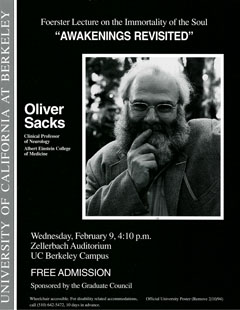
Welcome, ladies and gentlemen, to this year’s Foerster Lecture on the immortality of the soul. Over the years, there have been many distinguished lecturers on the subject. They were largely theologians, historians, uh, people from the humanities.
We never had a physicist, and that’s probably because physicists were not very comfortable with the soul when they couldn’t measure it, couldn’t weigh it. But I think this will change now that physicists have particles without mass. And, uh, I can foresee lectures on conservation of the soul in terms of this.
(laughter)
Uh, today’s lecturer, uh, is in the tradition of several of our previous ones who came to us via medicine, neurobiology. Uh, we had, uh, Sir John Eccles, Gerry Lettvin, and also Gerald Edelman. Today’s lecturer was born in London.
He had his– he read medicine in Oxford and got his degree in Oxford and came over to this country pretty soon afterwards, where he did some internship here in the Bay Area and a residency in neurology at UCLA. He’s at present clinical professor of neurology at the Albert Einstein College of Medicine in New York. And it’s widely–
He’s widely known for his riveting, absorbing case histories in the areas, the far side of neurology and the near side of psychiatry. He won many awards for these lectures and talks and, uh, articles, films. And today his topic is Awakenings Revisited.
Please welcome Dr. Oliver Sacks.
(applause and cheering)
[00:02:43] DR. OLIVER SACKS:
I, I, I do like an, an intimate, cozy auditorium.
(audience chatter and laughter)
Um, Um, I know with the help of this young lady, I shall be visible. I hope there’s some members of the deaf community here, and you– the rest of you tell me if I’m audible.
(laughter)
Um, well, it’s a, uh, pleasure, though at the moment a slightly terrifying one,
(laughter)
uh- -standing here. Um, as you heard, I, uh, first came to the Bay Area, uh, in nineteen sixty. And, um, although I left it in sixty-two, I’ve, uh, I want to– I’ve been nostalgic for it ever since.
Um, I, uh, this is my first time at UC in Berkeley, but as you see from the banana slugs, uh, I have an affiliation with, uh, with UC Santa Cruz.
(laughter)
Um, I think I want to put this a little higher because otherwise I, I have an impulse to crouch.
(laughter)
Um, if… Okay. Sorry.
(laughter)
Oh, okay, thanks. Um, um, The, um, uh, the title, um, on, um, on the immortality of the soul is, um, is sort of an, an awkward one in this, in this materialistic age. Um, William James once gave a lecture on reflexes and theism, but I don’t think there’s going to be anything too, too theological.
On the other hand, I do like the word soul, and I do believe in immortality of a sort. Uh, for example, I think that Mozart’s music is immortal, although he wasn’t. And I think that the immortality of the music and of, of all art, uh, has to do with the power to call to organisms and nervous systems across time and space.
I, um, I’m told that pygmies in the rainforest wept when they first heard Mozart. I have a feeling that Mozart should be put in space capsules and sent out everywhere. Um, and, um, I’m going to bring up the theme of music one way and another, because I think it’s, uh, an oddly important one, and one which is, uh, clinically relevant in all sorts of ways.
Um, the, uh… I used to find it easier to speak on this sort of topic, but now people tell me I’m imitating Robert Williams. And, and…
(laughter)
Um, and, uh, And, and needless to say it, it was the other way round. Um,
(laughter)
But it’s, um, it’s very odd when one’s, um, not only one’s gestures, um, uh, um-
(laughter)
But one’s opinions, one’s feelings, one’s states of mind, one’s aspirations, it was very amazing. It was like acquiring a younger twin. But in particular, I felt that my gestures, I partly feel that my gestures are no longer my own.
And for about a year, I became Parkinsonian, but by, by reaction. Um, but I’m, I’m getting my gestures back slowly. Um, the, uh…
Now, I hope, uh, in the course of my talk to show you some little excerpts from the Real Awakenings, the documentary film, uh, which was made in the late sixties and an early nineteen seventy. Um, although with one scene from this, you will see, there has been a direct transcription from the documentary to the movie. Um, the, the movie took various liberties.
Um, it had me investigating earthworms for five years. Now, that’s complete nonsense. I, I only investigated them for a year.
(laughter)
Um, um, I’m, I’m very fond of, of invertebrates,
(laughter)
um-
(laughter)
And, uh, and all forms of life. Um, Like one of my patients, the man who mistook, I have, uh, I have severe left-right confusion and a lot of difficulty finding my way around. This campus is particularly confusing, um, but fortunately, it has tree ferns.
And, um, every tree fern I’ve seen, I have recorded. I would– I wouldn’t have found the Faculty Club had I not noted that a tree fern marked its spot. Um, it was similar.
It was especially like this in Japan when I, when my map of Tokyo was entirely based on tree ferns.
(laughter)
Um, I, I want to bring this up because I think that some, as Barbara McClintock says, “A feeling for the organism, uh, has to lie at the heart of medicine and at the heart of the, of the clinical life.” And, um, also, in a way which has probably increased over the years, I think I may have found myself feeling slightly uncomfortable with the purely medical pathologizing normative tradition, uh, which speaks only in terms of dichotomies of health and illness and normality and abnormality. And, um, I like to think in terms of forms of life and ways of life, and I think there may be an autistic way of life or a Tourettic way of life, which– a Tourettic life which needs to be considered and not just a person with a, with a, with a hostile condition.
Um, I, I, I’ll get to my subject soon. Um, the, uh, I think I, I want to mention partly because it, it happened yesterday and it’s, it’s in my mind, and I’ve been thinking about it. I had a visit yesterday from a lady whom I suspect is in the audience somewhere, and I hope she will forgive me speaking of her a little bit.
um, this is a fine, intelligent lady who is– was born totally colorblind. She has never seen colors. She has no cones in her eye.
Um, now although there are– she speaks, there are certain associated disadvantages here. She can’t stand bright light, and her visual acuity is not good. She is not pining for color.
If we came along and offered her color, she wouldn’t know what to do with it. She rather objects to the medical word achromatopic or monochromat, or to doctors speaking of her as only seeing gray, because she says that for her, the visual world is exceedingly beautiful. It has a richness and delicacy of shades and tones, which perhaps the rest of us with our violent, vulgar colors are, are often oblivious to.
Um, There’s, uh, sometimes a movement to force cochlear implants on deaf people, and sometimes if the deaf person says, “Well, thanks very much, but you can, you can keep your implant,” and, uh, they may be seen as perverse. But again, the deaf person may feel that their life is quite complete, especially if they have a fluent sign language and a community and a culture. And, um, so I think at the start, I want to make this point that one must never just think in terms of disease or abnormality or deviation.
Um, Osler used to say, “Don’t ask what disease the person has, ask what person the disease has.” And, um, I think before one rushes in medically to fix things, You need to look at the whole complexity of a life and all the adaptations. Um, yeah, I think one more little story, then I will get on to Awakenings.
Um, many years ago, I worked in a migraine clinic, and then again, at first I thought migraine is a hateful condition. It’s a disease. Let’s, um, attack it.
Um, one of, uh, one of my patients was a mathematician, um, and a highly creative mathematician, who would often get rather tense and restless in the middle of the week, and he would get more and more restless and uneasy as the weekend approached. He would be very agitated on Saturday, and on Sunday he would have a terrible migraine. Towards evening, the sufferings would die away, and as sometimes happens with migraines, there was a sort of an, an effusion of, of tears, of urine, of saliva, a sort of catharsis, both physiological and psychological.
And with this, he would feel marvelous. He would have a feeling of rebirth, and he would find himself at the height of creativity and new ideas. Um, when I treated his migraine and stopped his migraines, he stopped his mathematics.
And at that point, he sa– both of us realized very much that one had to look at the economy of a life, at the way in which his creativity and his illness might be involved with one another. Um, so these are sort of preliminary considerations, Awakenings. Um, my, Um, And by the way, I, I will try to leave time for questions.
I, I, I’ve put out the watch, but I, I may forget to look at it, And, and you, Um, Uh, my, my earthworm days ended very badly. Um, after doing this terrible holocaust of, of earthworms in my, in the Bronx, and my, my, my ecological conscience has been after me ever since. Um, I, uh, and preparing a decigram of, of, of earthworm myelin, I lost my sample.
It was one of many accidents I had in which I broke the ultracentrifuge. I screwed the oil objective lens through a slide, and, um, and at Einstein, they, they’d had enough of me. This was in sixty-six.
They said, “Get out.” You know, “You’re, you’re a menace. Go, go see patients.”
(laughter)
Um,
(laughter)
“Uh, you’ll do less harm.”
(laughter)
And, um, and this, this was the, the ignoble start of, of of the, of my clinical career. Um, the first patients I saw, um, were the migraine patients I’ve mentioned, but also I went to a hospital in the Bronx, uh, called Beth Abraham. Um, and there, when I entered the lobby, I saw an amazing sight of, uh, dozens of motionless, frozen figures, some of them in strange postures, uh, like statues in the lobby, in the corridors.
Some of them were sitting down. Although I had seen catatonic patients on the back– on the psychiatric back wards, this looked different. I’d never seen anything like this.
I’d never heard of anything like this. I’d never imagined anything like this. I found, to my horror, that some of these patients had been like this for twenty or thirty or forty years.
Um, they could be walked, they could be fed, they could be toileted, um, but sometimes not much else. Um, I wondered what was going on inside them. Uh, and the nursing staff, many of whom had been there themselves for ten or twenty or more years, spoke of very intact intelligences and personalities which were imprisoned in these frozen bodies, and of occasional rare releases of the inner person with music and at other times.
Uh, the hospital had been opened in 1920 for these people who were, who were the first victims of a then worldwide epidemic of sleepy sickness, a vile sleepy sickness, of encephalitis lethargica. Hospitals were open all over the world for patients like this. In London, there was one huge fever hospital which had twenty thousand of these patients, an entire township.
Um, I think now I, um, since one needs images as well as words, I want to show you a clip from some film which was taken in 1918 by von Economo, the Austrian physician who first described this illness. I— am I, um… So, so can we have the first, in fact, the first two clips?
They’re in black and white.
(music playing)
[00:17:56] NARRATOR:
The first alarmist reports of the new disease came at the end of the Great War. All over the world, doctors were as baffled as the press. They named it sleepy sickness after its commonest symptom, a trance-like state which often overcame its victims for years.
In Switzerland, a bride fell asleep at the altar. In France, not even childbirth could rouse one mother. As the epidemic spread, other symptoms multiplied.
Parents were horrified to find their children’s personalities changed overnight. Doctors reported schoolgirls becoming troublesome brawlers. One victim wrote, “I feel certain that we have all been given another character, and that our own died in our sleep.”
But the more seriously affected suffered only a short agony. Within a few weeks, patients could scarcely talk or swallow. They became emaciated and soon died.
More than a million during the early twenties. No cure was ever found, and fifty years later, the disease still holds as many surprises as when it first appeared.
[00:19:08] DR. OLIVER SACKS:
Um, let’s go on to the next segment as well, please.
[00:19:13] NARRATOR:
It soon became obvious that sleepy sickness affected posture in a variety of ways. Often they seemed contradictory. Many patients had symptoms like those of Parkinson’s disease, tremors, and shaking of the limbs.
Others were caught or frozen in whatever position they were placed, immobile and statuesque. This condition, described as the rigidity of insanity, had previously only been found in schizophrenics and other deeply disturbed mental patients, and it seemed to support the view that these patients neither conveyed nor felt the feeling of life. They had become as passive as zombies.
[00:19:50] DR. OLIVER SACKS:
Good. Um, can we have the lights now, please? Um, Incidentally, I think that, um,
(laughter)
description, vivid description has been something of a casualty in medicine. In the last century, one had wonderful clinical descriptions and in the earlier part of this century. And the iconography of disease was, was very richly illustrated.
Um, Uh, here you only see one form of illness. S-in some people, uh, the encephalitis took different forms. Some people, instead of becoming Parkinsonian or lethargic, became, uh, over-animated or insomniac.
Some of them developed tics and sudden movements. Some of them developed a condition rather like Tourette’s syndrome, which is– which will be something I return to. Um, the– especially in children, there were all sorts of strange personality disturbances.
Sometimes a dull child would become bright or emotionally bright or creative. Um, I had one patient who felt that she had been given an alien personality at the age of fifteen, a strange, antic, wisecracking personality, which was very different from her own rather shy, reserved one. Um, although she felt this other personality was her as well.
It was both alien and yet, in a way, it was her. Um, something I would love to show you if I had time, uh, is a film clip almost as old as the ones you’ve seen. I’ve mentioned this hospital in London where there were twenty thousand of these people.
Uh, in the early days, many of these patients were hyperactive and very fast, very agile in their movements. And there used to be football matches between the post-encephalitics, or in England, the post-encephalitics or Enkies, as they call themselves, and the normals. And I’ve got a film of a football match between the Enkies and the normals, uh, in which the bizarre speed and unexpectedness and suddenness of movement in the Enkies is often more than a match for the normals.
Um, this is something one sometimes sees in, in Tourette’s syndrome, and I want to bring this up if I remember, as, so to speak, the other side of disease sometimes. However, by the mid and the late twenties, all of these patients, all of whom survived, all of those who survived, were overwhelmed and engulfed by a wave of immobility, Parkinsonism, lethargy, catatonia, in a strange trance-like state, a strange alteration of consciousness. Um, I said before that I think one sometimes needs to think of patients and diseases as forms of life.
I think also one needs to think in terms of forms of consciousness. Um, these people came to a halt internally as well as externally, psychically as well as, as motorically. Many of them were abandoned by their families, and so they tended to sink into a limbo which was social and cultural as well as physiological and psychological.
Um, and some had been like this for, in this way, for forty years. Now, There’s a very short clip now, and this, we’re now jumping ahead to 1966. These were some of the patients as I first saw them.
Can we have the next short, silent clip, please? Only the eyes. This lady had been like this since 1926, Sylvie.
Harold Pinter wrote a play about her called A Kind of Alaska. And this is the original Leonard L. Okay, lights please. Um,
(coughs)
Intelligent faces. Um, I’m not sure what one means by an intelligent face or an intelligent look, but one certainly had this feeling with these people of, of some int– or often an intense inner life, but with not much expression. Uh, in particular, these people found it difficulties to– difficulty in initiating movement or conversation or anything.
But they could sometimes respond and, uh, and in particular, uh, they could respond sometimes to a thrown ball. Um, and many of them could also respond to music. And, um, during the response, they would– Uh, the response to music or to thrown balls or to some other stimuli was instantaneous.
Uh, and I think you’ll see this in the clip, in the two clips actually, which are going to come up now. Uh, this is the clip which was more or less, which was studied very closely by the makers of the film and used by them almost literally. So if we could look at the next segment with the sound back.
[00:26:16] NARRATOR:
Sacks noticed that although the patient seemed grossly physically disabled, for brief and surprising moments, they could rediscover their lost coordination.
[00:26:29] DR. OLIVER SACKS:
Yes.
(background chatter)
(clanking)
(background chatter)
(clanking)
(clanking noises)
Um, let’s go straight on to the next clip, which, um, which is Lola in slow motion. Um, one can’t find an intermediate frame. She is either totally Parkinsonian or playful.
And, uh, it’s here as if the, the play suddenly bypasses the mechanisms for, for Parkinsonism. Okay. Okay, if we can have the lights again.
Um, Um, some of these patients would, would move extremely slowly. I remember on one occasion seeing a man with a series of what I thought were frozen postures. Uh, Later, I asked him about it, and he said, he was scratching his nose.
And I said, “But this took ten hours.” And he said that for him, it hadn’t seemed to. And I put some of these still pictures together, and they sort of formed a time-lapse series.
One saw, in fact, that he was scratching his nose. But, um, uh, sometimes on L-DOPA, one saw the opposite. Um, Lola there would throw balls back so rapidly.
I would have the students play ball with her, and when she threw it back, the ball would hit the students on the palm of the outstretched hand. And I would say to Lola, “Look, slow down.” “Count up to ten before you throw the ball back.”
And it would come back a, a few milliseconds later, and I would say, “I asked you to count up to ten.” And she said, “I did count up ten.”
(laughter)
And, um, the, um, uh, um, I was talking with some colleagues today in the psychology department about tempo and the nervous system, and one can certainly see very astonishing retardations and accelerations here. Um, incidentally, there’s an H.G. Wells story called “The New Accelerator.” Um, I, I loved H.G. Wells as a child.
Well, I still love him, and, um, I’m amazed at how many of his stories seem to, seem to come true. Uh, as an aside, um, H.G. Wells also wrote a wonderful long short story on the, on the Valley of the Blind, and later this year, I’m going to go to the Island of the Colorblind, and I think this is going to be a Wellsian experience. Um, but apart from these brief animations with, with music or ball playing, there was no medication which could touch these patients.
Early in 1967, there were reports of a new medication. Um, Leonard L, uh, Uh, who was able to tap messages very slowly with one finger. He heard about this new medication, L-DOPA, which was converted in the brain to dopamine, and he tapped out, “Dopamine is resurrectamine.”
And this will give you some idea of the intelligence and the desperation and the irony and the humor which these very intact patients had. Um, I, I hesitated for a long time. I didn’t know whether I should try L-DOPA or not.
Um, Von Economo, who had spoke of these patients in the later stages of illness as being extinct volcanoes. I wondered if they were not sleeping volcanoes and, and, uh, and with reference especially to the sometimes to the violence of their early states in the ’20s, I wondered what, what, what Krakatoa might, uh, might erupt if we, if we sort of lifted the Parkinsonism and the catatonia. The other thing was, uh, some of these patients seemed to me not to have moved on.
Um, all of us, for better or worse, get, get updated. We get, we get– we change, we get old. Um, this didn’t seem to be occurring in some essential, existential way with these patients, and I wondered what it might mean to rather suddenly come to.
And, um, however, the patients were getting ill, some of them were dying, and so finally in sixty-nine, I tried L-DOPA, first of all with Leonard L. and with a number of patients. So now we’re going to look at a clip from that time of the patients. Uh, I am afraid it also has my, my younger self.
I, um, I like seeing the patients. I’m sort of horrified when I see my younger self and think what, what time does. But anyhow, let’s look at the next clip.
(laughter)
(laughter)
Lola, who was unable to swallow solid food and was threatened with starvation. She was first given L-DOPA in May 1969 in the hope of keeping her alive. It did much more than that.
Lola had been, had been transfixed in a state of extreme, really in a state of infinite Parkinsonism and catatonia for decades. And her change, her awakening, uh, occur- occurred in, in seconds. And she jumped out of the chair, and she flew down the passage, and she burst into conversation.
And, um, it was, um, it was an incredible scene, and I would doubt my own memory, uh, were it not supported by everyone else’s memory, and of course, by, uh, um, by our accounts and films and so forth, which, which we took at the time. Um,
(cough)
I, I, I, I had thought that, that clip was longer, but, um, um, uh, um, uh, well, uh, in the movie of Awakenings, so you have this sort of night of the living dead, the sort of Halloween night when, when, when people rise, and it wasn’t like that. Um, but there were eighty-odd patients who did get awakened over the course of two months. And with Lola, as you’ve heard, there was no warming up period.
It was like that. And in fact, all her reactions to L-DOPA were like that. She was either on or off, and the on and off states became more and more extreme with her.
But I’ll, um… The, uh… So I think, um, I think let’s go on to the, the next clip.
It’s a long while since I’ve used this. I just hope it’s, it’s there. But the most dramatic awakening came in July with Sylvia.
After thirty-five years in hospital, frozen and inert, she regained the enthusiasm for life which had deserted her forty years before. But something in her manner was strange. Sacks noted in his diary, “Is it possible that Sylvia has in fact never moved on from the past?”
She was in a, in a marvelous mood, uh, for a while, and she, um, she was talking away and singing and dancing. But, but almost everything she, she said and did, uh, had reference to, um, uh, to nineteen twenty-six or before. She referred to figures who were topical at that time.
Um, some of her, some of her mannerisms, uh, some of her slang was of a sort which had been obsolete for forty years. She was, so to speak, a flapper who had come to life.
(upbeat music playing)
[00:36:02] NARRATOR:
During the summer months, the patients came back to life. Their childish gaiety and enthusiasm shattered the hospital routine.
(music playing)
[00:36:15] DR. OLIVER SACKS:
Okay, let’s have some lights. Um, if, um, if ever you see the full documentary, uh, at that point after I, I call Sylvia a flapper, she, she sings a, uh, a wonderfully obscene song.
(laughter)
Um, Um, now Sylvie talked about Gershwin as if he was still around. Um, at first, I wondered if she was disoriented, if she was amnesic. Um, uh, but when I asked her questions, she was a very quick, bright woman.
She said, “I can tell you the date of Pearl Harbor. I can tell you the date of Kennedy’s assassination.” She said, “I registered these things.”
And but she went on to say that none of them seemed real, uh, and or to have any relation to her. She said, “I know it’s nineteen sixty-nine, but I feel it’s nineteen twenty-six.” “I know I’m sixty-four, but I feel I’m twenty-one.”
And so though there were these occasional sort of flashbulb-like registrations later, there was no historical sense, no sense of a lived life, no autobiographical sense, really from the time of her acute illness in nineteen twenty-six. Um, As I say, as I said there, she was like a young woman, sort of a flapper, strangely reanimated, but with obsolete mannerisms, argot. Um, She didn’t belong.
She hadn’t been updated. And, uh, she was very conscious of this, um, and conscious of the world having, the rest of the world having changed beyond belief and in a way she didn’t like. She talked about, um, this television and all this trash.
Um, she said that everything which had had meaning for her had vanished. And after ten days of a strange state in which she kept singing songs from her youth, she suddenly went back into this trance-like state, and neither giving her L-DOPA nor anything else, uh, made any difference, even though she lived another ten years. Um, very, very uncanny, that, and disturbing.
Um, Of course, in general, if one problem was the the dormant volcano problem, the business of treating an incredibly complex disease with all sorts of brain damage, uh, the other problem was this one of, of anachronism. Uh, here was a young woman reanimated, uh, a, a twenty-one-year-old woman reanimated in the body and the circumstances of a sixty-four-year-old woman. Um, a tremendous identity challenge faced all of these patients.
Um, I, I think it– the rest of us can’t imagine it. For better or worse, again, we, we are continuous. We are, we are updated, roughly speaking.
Roughly speaking. Um, I must say for myself, actually, nothing has felt too real since about forty-five. But, um, uh, I think that that may be a, a common feeling.
Uh, Studs Terkel wrote a remarkable book called The Good War, in which he described this sort of syndrome. But this is only, only a sort of a way of speaking. Um, I mean, for better or worse, I think I am in, in nineteen ninety-four, whereas in some sense Sylvie was right back there in the past.
Um, well, the first days and weeks of giving L-DOPA were wonderful. It was indeed a resurrection, as Leonard had said, and the sheer delight in being alive, in moving, in feeling. Many of these people had been as cut off from feeling as they had from movement.
And movement and feeling and consciousness, I think are all indistinguishable, one from the other, as one of your former lecturers, Gerald Edelman, was at pains to point out. Um, but then, uh, and there were, and these people who had been so isolated formed friendships, there were marriage proposals, relatives were found, and, um, there was a very joyful, festive, uh, lyrical summer in sixty-nine, and then things started to go wrong. Can we look at the next clip, please?
(crowd chatter and laughter)
(background shouting and screaming)
[00:41:44] NARRATOR:
Good health decomposed abruptly. Tics, nightmares, and long-forgotten symptoms flourished, apparently independent of the amount of L-DOPA administered. The ward became a bedlam.
(background shouting and screaming continues)
Sacks was faced with the enigma of a drug which could restore health to Parkinsonian patients after forty years and yet snatch it away again in weeks.
[00:42:19] DR. OLIVER SACKS:
Um, uh…
(sigh)
There are a couple more clips. I’m not quite sure if I will show them because I think I probably need, need to move along. Um, the, uh, the movie of Awakenings for dramatic purposes sort of opened a window, a therapeutic window, a window into life, and then closed it again.
This did happen with some of the patients. This was the case with Leonard L. It was the case with Sylvie.
And interestingly, these are the two most tragic patients whom, uh, playwrights and scriptwriters seized on. Most of the patients, however, negotiated a way through these evil days in the fall of ’69 and, um, and achieved a sort of accommodation which was at once physiological and, uh, and, and, and psychological and social. Um, the– this partly went with, um, making a life.
It’s not sufficient to, to animate, just to give someone L-DOPA and to animate them in a vacuo. The L-DOPA was necessary, but it wasn’t enough. Uh, the L– with the L-DOPA alone, with the amount of damage these people had in their nervous systems, things had to go wrong.
Um, old symptoms returned and flourished. Uh, again, you have to imagine that these people may have had ninety-nine percent of some of their regulatory systems knocked out, and one was demanding normal function from a tiny vestige of remaining cells, and this couldn’t support it. And sooner or later, most of the patients started oscillating between states of hyperactivity, sometimes between states of frenzy and stupor.
This certainly happened with Lola, sometimes sixty or seventy times a day. It happened with many other patients Until or unless, um, one could achieve equilibrium in another way. And in particular here, one started to see the power of work, performance, relationship, and art.
For example, one patient, the one I call Miron in the book, used to be a shoemaker. And when we set up a cobbler’s bench and last in the hospital and returned him to his work and to his former identity, his violent oscillations got much less. Um, it, um…
We had with every patient to look for meaning, to look for relationships, to look for what Freud would call work and love. Um, The power of this, uh, in these physiologically terribly unstable patients was most remarkable. I mean, I think, uh, and it, it made one think, is there power in all of us?
Uh, we all need work and love and structure and meaning. Although we may present an appearance of functioning, even if we don’t have them, these people could not present an appearance of functioning. They would literally disintegrate unless one had these powerful integrating, uh, uh, forces working for them.
Um, the, um, E. M. Forster writes somewhere, uh, he says the, um, “The arts are, are not drugs. They are not guaranteed to act when taken.” And he wonders whether they act by something as, uh, mysterious as releasing the creative impulse in people.
Um, music was tremendously important for these patients. It still is. Um, one sees some of these patients unable to move, unable to take a step, but able to dance, and patients unable sometimes to speak, who can sing.
And, uh, then if a slightly, um… One patient I had, who was a former music teacher, said that she had been unmusicked or demusicked by her illness, and that she needed to be remusicked. Um, I think, uh, I think music calls, uh, essentially to what is active and personal and unique.
Uh, and, um, the– its power with, with patients like this is very remarkable. When Leonard L. was writing an autobiography, and he wrote a fifty-thousand-page autobiography in ten days, Um, uh, he did this with his t-his, his tiny atrophic index fingers. The sort of bizarrely quick typing.
When he did this, uh, he was fine. The moment he s-he stopped typing, he, he disintegrated into jerks and spasms and twicks and twitches. I was gonna say Twix.
And, um, when, uh, one saw the power of performance and concentration to hold someone together. Um, now I think I should stop in five minutes perhaps and maybe have some questions. Um, uh, as some of the, um– Now, had I, uh, time, I would have gone on to show you another clip of a, uh, uh, of a woman who had achieved a sort of tranquility despite this immense oscillation.
Um, and she was a marvelous person who in fact came along to the film set in 1990 and did a scene with De Niro. Uh, the actors were immensely moved when they saw her, and they wanted to touch her and sort of touch the rock and ground themselves because they had been thinking that some of this was just, um, you know, Sacksian confabulation or, or, or, or sort of Hollywood fantasy, and here was this real person. Um, Actually, the only time I ever saw, uh, De Niro lose his self-possession, he’s immensely self-possessed, was when he had to really represent her or represent her state with her being two foot away.
And, uh, she had, uh, she, with her accommodation, had taken the form of she was animated and awakened for about six hours a day, in which she was pretty normal and in a sort of trance-like state, though not unconscious for, for the rest. And when she was, she had gone into this, this trance-like state, and then De Niro came in, was wheeled in, and, and, and, and after watching her nervously, he took up his, his trance-like state. And I wondered what she was thinking of him.
And I saw her dart a, a quizzical, skeptical glance in his direction. You saw earlier how the eyes, just the eyes can move. And then she gave a tiny little thumbs up sign which,
(laughter)
which meant he’s okay, he’s, he’s got it.
(gasp)
Um, Uh, It’s, um, I don’t think this illness will– I don’t know whether this illness will be seen again. Uh, it affected many millions of people, sort of at the time of the First World War.
There had been smaller epidemics earlier in the century, uh, sorry, in previous centuries. There are still a few sporadic cases. Um, there is some– As some of the patients continued on L-DOPA, some of them became more and more hyperactive.
I’ve said some of them had something like, like Tourette syndrome in the, in the early days. Tourette syndrome, um, was described by a French neurologist, Gilles de la Tourette, uh, in the 1880s, and people who have it, um, uh, have, um, tend to be somewhat accelerated. They’re very energized.
They tend to have all sorts of involuntary or compulsive movements, emotions, imaginings. Um, it, uh, it’s a disorder which can tear one, i-in a way, there’s too muchness, and there’s a sort of richness of impulse and experience as well as movement, which is built into this. And this can tear one apart sometimes unless it’s orchestrated by one, and then, as it were, one can make use of the, of the Tourette’s.
Um, the, uh, there’s some very fine Tourettic athletes, uh, Eisenreich, the baseball player, Chris Jackson, basketball. There are many, uh, Tourettic jazz drummers and jazz musicians. Um, uh, one of them wrote a wonderful autobiographic piece called, called Rhythm Man, in which he talks about this, this, this rushing stream of energy, this roller coaster of Tourette’s, and how it is marvelous and terrible.
Terrible if it masters you, wonderful if you can master it. Um, the, um– Medically, there’s a certain tendency, at least with children, to give a drug which is the opposite of L-DOPA. Um, Tourette’s syndrome probably goes with too much dopamine, and you may try and damp these people down.
But if you damp them down, you may damp down the person as well. And this then raises a very complex situation, because if you’ve had a, a condition, and especially one with an energy and an impulsiveness of its own, since the age of three or four, it will have wound itself around your own personality, and the two will become interweaved. Uh, and to some extent, uh, the person becomes Tourettized, but the Tourette’s becomes personalized.
And what you have then is a unique idiosyncratic condition which has both, both personal as well as, as well as the sort of automatic qualities. Um, I think this way Tourette’s, you know, m-medically one just sees this in terms of disease or deviance or abnormality, uh, but in human terms, it can take on some of the attributes of flavor or style. I know a Tourettic artist, I know a Tourettic composer, and I think there is such a thing as a Tourettic art and a sort of Tourettic style.
Um, and this is sort of, as I said earlier, something like the other side of disease. Um, listen, I think I better wind up. Basically, I wanted to, um…
These awakenings patients not only suffered greatly from their illness, they suffered greatly from neglect and abandonment. They wanted to believe that their lives had importance. They often said to me, “Tell our story or it’ll never be known.”
And although now they are all gone, and the last one, Lillian, died about four months ago, I want to tell their story, um, so that they will be known. And because I think that, like so many neurological patients, people like this are absolute heroes and, uh, and they show that, um, human beings can survive almost anything, at least almost anything which nature can do. Okay, thank you very much.
(audience applause and cheering)
[00:55:32] ANNOUNCER:
Thank you, Dr. Sacks. Dr. Sacks has agreed to entertain some questions. There are microphones at the two ends of the stage. If you would like to come up and ask your questions here.
[00:55:51] AUDIENCE MEMBER:
Thank you, Dr. Sacks. A delight. Um, have you found other people with similar kinds of syndromes about which you’ve been able to come to any understandings?
[00:56:04] DR. OLIVER SACKS:
Um, when you say similar kind of syndromes-
[00:56:08] AUDIENCE MEMBER:
Well, I, I don’t know, I don’t know what to suggest because I don’t know what you mean-
[00:56:11] DR. OLIVER SACKS:
Similar to the post-encephalitic?
[00:56:13] AUDIENCE MEMBER:
Yes. Yes. Um,
[00:56:15] DR. OLIVER SACKS:
Yeah, about, um, last year, I, I was in Guam, where there’s been a strange endemic disease, probably for two centuries, with many similarities, uh, at least clinically, to the post-encephalitic patients. Um, no one knows what it’s due to. There’s been fifty years of medical research.
No one knows whether it’s a virus or whether this disease only occurs with the native Chamorro population on Guam. Um, and, um, although sometimes many members of a family are affected, it doesn’t behave like a genetic disorder. It’s not a hereditary disorder.
Therefore, there must be something unique in the environment or in the interaction of the environment with their constitution. Um, the, um, some people have wondered whether eating the seeds of cycads, um, can cause this. I’m very fond of cycads and, um, I, I first thought this was a, a slur on, on my favorite plant.
Um, but, uh, but this hasn’t been worked out. I think there’s some, there’s some very exciting work going on, and I think that if the Guam disease can be cracked, it might cast a very important light on all sorts of so-called neurodegenerative disorders like Parkinson’s and Alzheimer’s and ALS, motor neuron disease and, and others. Um, but the, the, the thing most similar in the world is the, is the Guam disease.
[00:57:56] AUDIENCE MEMBER:
I was told by a medical student that with the birth of MRIs and PET scans that neurology was a dying field, and I was wondering what you had to say to
(laughter)
Um, a potential neurology student.
[00:58:10] DR. OLIVER SACKS:
Um, uh, y-yes and no. Um, the, you know, uh, neurologists used to be wonderful diagnosticians and wonderful at locating the lesion on the basis of subtle clinical signs. Now, I think this traditional diagnostic power is indeed being taken over, and perhaps very effectively, by brain imaging and other techniques.
But this is only a fraction of it, I rather dislike the term, the word neurologist. I like the old-fashioned term, a neurological physician. And the physicianhood and the total concern for the patient and the interest in every aspect of a life, a life lived with multiple sclerosis or Parkinsonism or Tourette’s or whatever, I think is, um, still gives, uh, yeah, enormous scope for concern and compassion and acuity and humor and interaction.
And, um, I hope that, uh, you know, um, I’m all for high tech, but I also feel very much as Buber said, the– he said, “We must humanize technology before it dehumanizes us.” I think there’s plenty of room for the human dimension and the human relationship, and there always will be. So be encouraged.
(audience applause and cheering)
[00:59:38] AUDIENCE MEMBER:
Thank you, Dr. Sachs. You said there are very few cases of sleepy sickness now, and I was wondering what sociological factors, if any, do you think contributed to the epidemic in the nineteen twenties and in past centuries?
[00:59:56] DR. OLIVER SACKS:
Um, the, um, I’m, I’m no expert on, on epidemiology. Um, And, uh, things are complex with, with animal reservoirs and, uh, um, and, uh, levels of resistance, uh, and forms of communication. For example, um, you know, many of the so-called new diseases now, probably including AIDS, at least in their inception, may have something to do with air travel and that sort of facility.
Um, but um, I, I can’t answer your question, and I think it really– it hasn’t been, been answered. Thank you. Sorry.
[01:00:40] AUDIENCE MEMBER:
Professor Sachs? I– over here.
[01:00:45] DR. OLIVER SACKS:
Oh, sorry.
[01:00:48] AUDIENCE MEMBER:
Thank you very much for your intensely human recollections. I have a question for you about–
(applause)
I have a question. I’d like your opinion about Moshé Feldenkrais’s work with integrating the nervous system through awareness, through movement.
[01:01:09] DR. OLIVER SACKS:
Um, Um, uh, the– I don’t know a great deal about it, but what I do know has interested me very much. Uh, Feldenkrais himself was a physicist who, um, uh, who himself had become quite disabled and almost written off medically as, as an invalid, and who then studied his own body and posture and movement very, very minutely. Um, I– without knowing details, I think that the Feldenkrais approach and the Alexander approach and others, um, are deeply interesting because of the minute attention, uh, which they pay to posture and movement and trying to bring these things in, into understanding.
And, um, I don’t know, I think perhaps sometimes some techniques make extravagant claims, but so long as these are not made, I am I am I am all for it, and I just wish there was enough time for psychoanalysis and Feldenkrais and swimming and botany and the whole lot.
(laughter)
Okay. But I, I, I think it’s very interesting stuff.
[01:02:26] AUDIENCE MEMBER:
Dr. Sacks, I was wondering what your opinion was on fetal tissue transplant for possible cures for Parkinson’s disease?
[01:02:37] DR. OLIVER SACKS:
Um. as I look round at these ten thousand faces, I wonder if I can speak in confidence.
(laughter)
Um, um, uh,
(laughter)
well, first, putting the ethical issues aside, um, I think that there is increasing evidence, um, and this would have been deemed impossible even ten years ago when regeneration wasn’t really recognized in the central nervous system. But now I think there’s increasing evidence that embryonic tissue from the right parts of the brain, if transferred to the damaged, uh, the damaged portions of the Parkinsonian brain, can survive and certainly act as a reservoir of dopamine and perhaps more than that, uh, re-establish or partly re-establish a functional circuitry. Uh, so one may have the possibility here, um, there, there are other things like, like nerve growth factors and so forth of, uh, of some real regenerative process.
Um, whether, um… Now there are all sorts of, uh, of, of ethical issues and, uh, uh, I think one just has to say there have to be sort of strict guidelines to prevent any abuse. Um, although I think it’s also imaginable that things like tissue culture may, may actually remove the need to take anything from fetuses.
But I think, I think this is a very important sort of work, and one which has been very interfered with in this country by legal constraints.
[01:04:32] AUDIENCE MEMBER:
Dr. Sacks?
(applause)
Hello. I would like to let you know how much your work has meant to me. Me– I’m–
I have a twenty-two-year-old autistic son, and I’ve worked very intensely with him all his life. And so the concept of awakening is a very meaningful one to me since, um, the condition of autism is, in my experience, um, um, of a being where awakening and consciousness is very close to, um, uh, to the condition which is not always awake. And I’m not asking you whether you think there’s a cure, but I’m asking you whether in your experience, and I know you are publishing about this and recently in The New York, in The New Yorker, an article, whether there is a, a perspective in the medical community these days which will help to integrate the lives of these heroes, and I agree they are heroes, into the mainstream of humanity.
[01:05:31] DR. OLIVER SACKS:
Hmm. That’s a big one. That’s a big one.
(laughter)
Um, the– well, although I’ve written something about this, and I have another article actually on an autistic savant in, in, in press, I, I don’t feel myself an expert here. Um, there is, um, this is one of the deepest and strangest of human conditions, I think. Um, it is so d– i-it is almost beyond our imagination, I think, even to sometimes to, to conceive the inner lives of sometimes highly gifted but also s-very different, such very different and gifted people as the autistic may be.
Um, I can only say there’s a huge amount of medical and psychological research going on, and I think it’s as it were, better to be. There’s more, more in store for someone with autism now than there was twenty years ago. But I, I can’t say any more.
[01:06:42] AUDIENCE MEMBER:
Yeah. Dr. Sacks, um, you, um, alluded to the– a, a drug which was used in Tourette’s. I gather that was Haldol or some other neuroleptic.
And, um, it, it, it seems to me that there’s a movement in, in biological psychiatry which suggests that a, a lot of people’s distress is actually a congenital disease called manic depression or schizophrenia or, or something else, often with an energetic component. And what they tend to do with that is they give them something like Haldol, and the one thing that it’s clear that Haldol does is that it does cause brain damage. And since you’ve described an epidemic, um, um, of, of, uh, uh, encephalitis, I was wondering how you felt about what I understand to be an epidemic of tardive dyskinesia and, and other issues which is the iatrogenic or doctor-caused and, and how you, how you feel about that as a neurologist.
[01:07:30] DR. OLIVER SACKS:
Ah. Uh, those are, are fighting words. Um, um, um, Um, well, um, in ’65 when I, I went to amongst other places, and ’66 when I started at a state hospital, I, um, about ten percent of the people I saw had tardive dyskinesia, all of these involuntary, uh, and sometimes tormenting movements.
Um, and, uh, the, um… And one certainly had to wonder very much about, um, a cure or a control which could have such effects. Um, I, uh, I may sort of, um, well, uh, take a sort of an easy way out and say that I think there’s a possibility of developing some medications based on different dopamine receptors and so forth, which may not have some of the hideous effects of, of the neuroleptics.
Um, bu-bu-but before the neuroleptics, of course, there were leucotomies and lobotomies. There’s a, there, there’s a marvelous book called, uh, called Great and Desperate Remedies. Right.
Which is partly about all this. Um, I mean, I– you know, one hopes there may be genuine remedies which are, you know, which, which are not sort of worse.
[01:09:09] AUDIENCE MEMBER:
Dr. Sacks, during the time when your patients had-
[01:09:12] DR. OLIVER SACKS:
Uh, by, by the way, I’m sorry for not promptly looking. You see, for me, the voice sort of comes from heaven. It seems to come from, from, from, from somewhere over my head, and I, I get disoriented when I hear it.
[01:09:23] AUDIENCE MEMBER:
Sure.
[01:09:23] DR. OLIVER SACKS:
D- And my eyes are too bad to see the moving mouth. Go on.
[01:09:28] AUDIENCE MEMBER:
Sure. During the time when the patients had been awakened, were they able to convey to you what it had been like to be trapped in that state?
[01:09:35] DR. OLIVER SACKS:
I, I was intensely curious about that- after seeing the film as to what, what it was like each day or, you know, for years to-
[01:09:42] AUDIENCE MEMBER:
Right.
[01:09:43] DR. OLIVER SACKS:
To be like that. Um, yeah. Um, certainly some of the patients could describe very, very altered states of consciousness.
Um, uh, sometimes there seemed to be states of a sort of timeless reverie. Uh, one patient would, would just imagine that She was lying in a meadow, um, and, and sort of hours, days, weeks, years passed in, in, in a sort of timeless fantasy like that, which, which sounds actually rather nice. But, uh, there was another patient, in fact Sylvie, who was tormented by, um, by sort of mechanical inner voices.
One of them would say, ‘Two equals two equals two equals two equals two.’ Um, at one point, she said later, she felt herself compelled to circumscribe a musical quadrangle composed of seven notes from a Verdi aria. And, um, some of these– You know, I think the rest of us may know some of these things from delirium.
I hope you’ve all been delirious.
(laughter)
It’s, it’s, it’s, it’s, it’s, it’s, it’s, it’s, you know, like migraine. It’s, it’s sort of worth, worth it once in a while.
(laughter)
Um, sometimes there was a complete freezing of perception and consciousness. Um, once, um, with Lola, I got called because there was a flood up on the ward, and I found her sort of motionless with, with water up to here. When I touched her, she jumped and said, “What happened?”
And I said, “Well, you tell me.” And she said that she had turned the tap and there was about an inch of water in the bath, And then I touched her. So she had been frozen.
Consciousness itself had been frozen at that point where there was an inch of water in the bath. Um, but I think there were just innumerable sort of aberrant, strange forms of consciousness, and I, I now regret that I probably didn’t get as many descriptions as I should have done.
[01:11:56] AUDIENCE MEMBER:
Thank you.
[01:11:57] DR. OLIVER SACKS:
I don’t think there’s any other illness which can produce standstill in quite this sort of way.
[01:12:05] AUDIENCE MEMBER:
So they were distinctly not dreaming.
[01:12:09] DR. OLIVER SACKS:
Sorry? Oh, I, I—
(laughter)
Go ahead.
[01:12:11] AUDIENCE MEMBER:
That’s okay. It was just a, a follow-up. I just, um… Just to clarify, it was dis- very distinct from a dream state. They were very much aw-awake during that time. Just kind of frightening.
[01:12:23] DR. OLIVER SACKS:
Yeah, um, Well, you know, uh, one has all these metaphors like sort of w-waking dreams and things. I, I think there were elements both of waking and, and dream. Incidentally, I think this is so in some ways in Tourette’s syndrome, which I think is sometimes like a public dream, uh, expressed in performance, especially in its, in its phantasmagoric form.
[01:12:49] AUDIENCE MEMBER:
Dr. Sacks, first, thank you for coming here. Second, I’ve had the good fortune to work with a number of Touretters, and I’ve been absolutely fascinated by the fact that several of them are able to suppress their symptoms, and presumably the, uh, manifestations are kicked in by some biochemical event. How can they suppress?
I’ve never been able to understand that.
[01:13:17] DR. OLIVER SACKS:
Um, well, I, I, I think anything can be suppressed for a while. Um, what, um, uh, including, say, a, a Parkinsonian tremor. Um, I’m not quite sure what you’re referring to.
I, um, what… Um, I remember actually, in fact, on a former visit to San Francisco, seeing a young man with, with, with, with Tourette’s who was, who was white and tense with the effort to suppress it, which he did successfully. He, he only Tourette it in private at home.
But it seemed to me that he was much more disabled by suppressing it than by having it. And I sort of, you know, perhaps anarchically said to him, you know, “Why don’t you let it go? Let it out.”
What I think is extremely interesting and deeper than suppression is the apparent disappearance of the impulse to Tourette with concentration. You see this, for example, with Jim Eisenreich when he’s playing baseball. You don’t see the Tourette’s.
He doesn’t like to be interviewed off-field because then you do see it. I wrote a long piece about a surgeon with, with Tourette’s and, and not inconsiderable. I mean, he would suddenly put his foot on your shoulder.
It was, um, uh, and, uh, it was quite exotic. Um, and and, um, but, but in two hours of very delicate, demanding surgery, he didn’t show a trace of it. Now, he wasn’t-
[01:14:59] AUDIENCE MEMBER:
That’s what I mean.
[01:14:59] DR. OLIVER SACKS:
Yeah. Now, he wasn’t suppressing it. It wasn’t there.
Either it wasn’t there, or he was somehow integrating all the impulses of Tourette’s and, you know, uh, and, uh, into, into speed and skill. But, uh, I think one needs to know more about the nature of, of performance, but the cure for Tourette’s in some sense is performance.
[01:15:24] AUDIENCE MEMBER:
Thank you.
[01:15:26] ANNOUNCER:
One more question.
[01:15:27] AUDIENCE MEMBER:
Sounds like a neurophysiological sublimation to me.
[01:15:31] DR. OLIVER SACKS:
Um- Uh, yeah, I agree. Um- Uh, who- Whoever you are, wherever you are.
(laughter)
I, I agree.
(laughter)
[01:15:40] AUDIENCE MEMBER:
Well, there’s a lot of talk these days about diversity and acceptance of diversity, and I think you, more than anyone I’ve read or heard, takes that to the deepest level. I wanted to thank you for your work. And I, um,
(applause)
Um, I just had a, a comment and a question, which is maybe a sneaky way of asking two questions. Um, y- My comment is about music.
I, I do dance and movement work with deaf children, And I’m astonished at how much they, um, are fascinated by music. Observing it to the extent that some of them can hear it or feel it, but also performing it, um, even some that are s- you know, stone deaf, so to speak. And, um, Well, that’s my comment, so I won’t say anything more than that.
But my question is, um, in your latest piece in The New Yorker, um, Um, the woman who has– that you focus on who has autism, you mentioned that she seems, and by her own accounts, to have a very high developed, um, part of the brain that thinks visually, that thinks geometrically as opposed to a linear way. And, and that’s a theme that I’ve seen in a lot of your writings with different patients you’ve had. And I’ve always been interested in your stories, not only because the people are so interesting, but the implications for the rest of us and for the– for society, I suppose.
And, um, I was struck by reading about Mandelbrot, um, the French mathematician who more than anyone has developed the, the, uh, the notion of fractals. You probably know about that. And apparently, I, I heard someone say that he can’t use the phone book.
He can’t, he can’t– He doesn’t understand the alphabet. He’s that nonlinear. And, um, and yet he’s a Nobel Prize-winning mathematician.
What do you think, finally to my question, would be the implications of this way of thinking? A, a different way that’s not a nonlinear but geometric way of thinking?
[01:17:40] DR. OLIVER SACKS:
I, I, I, wa– I was hoping the last one would be an easy one. Um, and, um, um, f-first, um, I, um, I think deaf people often have a, a wonderful sense of rhythm. Uh, you don’t need to hear to have a sense of rhythm.
Um, I, um, we have a, a profoundly deaf therapist at hospital who can tell when a third or a fifth or a diminished seventh is played on the piano, but she seems to do this in terms of vibration and not in terms of tonality. I don’t know how the profoundly or totally deaf people conceive tonality, but there’s certainly many other aspects of music which they, which they can love. Um, and a lot of them are, are fond of quoting, uh, Wordsworth on, on eye music, visual music.
Um, as for the, uh, as for the other, um, um, although I– although Temple said this about herself, I don’t know that this is so of all autistic people. Um, and, uh, I, um, I think there are, um, all sorts of, of legitimate ways of thinking and, um, and you don’t have to have them all, and you don’t have to understand them all, and it’s sufficient to have one. And, um, uh, and so since you bring up this business of, of, of, of diversity, I think that every form of, if you want, of cognitive style or intellectual style is okay, and this is the, uh, above all, the one thing one mustn’t try and normalize or standardize.
Thank you.
(applause)
[01:20:05] ANNOUNCER:
Thank you, Dr. Sachs, and thank you all for coming