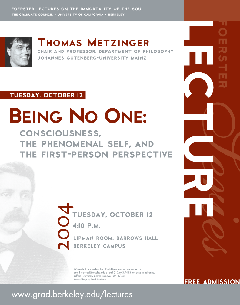
[00:00:00] TONY LONG:
Am I audible at the back? Uh, it’s less important that you can hear me than that you can hear our speaker shortly. Uh, it’s fine?
(crowd chatter)
[00:00:09] AUDIENCE MEMBER:
Fine.
[00:00:10] TONY LONG:
Thank you very much. Um, I’m, I’m… My name is Tony Long.
Uh, I’m a member of the Classics Department at Berkeley, and, uh, the chair of the Foerster Lecture Committee. And I’m extremely happy to be here to welcome our speaker today, uh, Professor Thomas Metzinger, uh, to give, uh, one of the Foerster Lectures on the immortality of the soul. Uh, this lecture series, uh, is run from our graduate division, and so I’m actually also welcoming you on behalf of, of the graduate division.
Uh, it’s so wonderful, uh, to see so many people here, and I hope everybody can, if they have an empty seat, uh, there may not be any, but there are one or two, so please, um, just, uh, bunch up if you, if you can. Um, Berkeley has many, uh, interesting spe- special lectureships and none more so, I think, than this one. I think it’s probably unique in the world with the title of, um, the, uh, lecture on the immortality of the soul.
It’s also unusual in that many of the lectures we have, these special endowed lectures, are named after their donor, whereas in this case, uh, the, the donor, I’ll say just a word about her in a moment, uh, gave this lectureship not, as it were, under her own name, but to honor the, uh, memory of her sister and her brother-in-law, who was his nephew, who in fact was called Foerster. And Edith Zweybruck, as she was, was a lady who lived, uh, in the early years of the cen- last century teaching in the public high school system, uh, in Berkeley. Uh, university was a very fortunate in those days, as it still is, to have many members of the local community that strongly supported it.
And, uh, Miss Zweybruck, uh, lost her brother-in-law at a, a young age. He was a distinguished, uh, lawyer in the c- city of San Francisco, and she decided to honor his memory and also that of her own sister, uh, by establishing this particular lectureship. Uh, it’s called the Foerster Lecture on the Immortality of the Soul, but if you read the bequest, the words are added, and kindred, uh, spiritual subjects.
Uh, well, one could have an interesting discussion, I think, about exactly what that implied. And certainly if you study the, uh, list of people who’ve given these lectures in the past, it’s an extremely interesting, distinguished, and varied group. Um, I think, uh, that when Bernard Williams, uh, gave this lecture a good many years ago, he actually lectured on the mortality of the soul.
Uh, well, uh, this is a matter of course of debate. The important point was that the lectureship should deal with the sort of topics, in fact, that our speaker today will be dealing with: selfhood, uh, the nature of consciousness, um, what it is to be a person. These are all highly relevant
(cough)
topics, of course, under this much broader rubric of, um, immortality of the soul and kindred spiritual subjects. Um, I’m going to ask my colleague Alva Noe in a moment, uh, to introduce, um, our speaker, uh, Professor Thomas Metzinger. Uh, I should also say that, um, his most recent book, and indeed, uh, some of his other books are available, uh, on the table in the back of this, uh, room, and you’re most welcome to, uh, peruse them and, I imagine, uh, purchase any of them, uh, at the end of these proceedings.
Uh, so I think without more ado, Alva, I will ask you to, uh, to continue this, uh, introduction, uh, say something about our very distinguished speaker and, um, and what we’re expecting to, uh, learn and, uh, and, and think about from him. Thank you.
[00:04:37] ALVA NOE:
And this year’s Foerster Lecturer, Thomas Metzinger, is a leading philosopher of mind working on consciousness and subjectivity, whose central thesis is that there is no subject. I will let him tell you more about his ideas. I was thinking over his accomplishments and thinking what might be good for me to tell you now by way of introduction, and I thought that I would tell you something that you might not know, which is that Thomas Metzinger is a community activist in a distinctively philosophical sort of way.
Philosophy, unlike science, is not a team sport, um, but it is a, it is a collective undertaking nonetheless. Philosophers need teachers, they need interlocutors, they need readers, they need an audience, they need a community. Thomas Metzinger has done much work establishing philosophical community where there was none before.
And I want to just give two examples. I can think of many, and I had to pick and choose among the examples, uh, to give you just two. If you’ve done work in philosophy at the frontier of philosophy and neuroscience, then you will know that that frontier can sometimes be a fairly cold, um, and inhospitable place.
Well, that certainly was true. It is much less true today, and I think in good measures, uh, as a result of the works of Thomas Metzinger, and in particular I’m thinking of his work establishing such internat– the, and the International Society, the Association for the Scientific Study of Consciousness, which seeks to further
(cough)
international collaboration between philosophers and scientists.
(cough)
A little bit closer to home, closer to Thomas Metzinger’s home, uh, Thomas has, under the auspices of his office as prof– as professor of philosophy, he has brought together young philosophers and neuroscientists working in the different corners of Germany in relative isolation on topics at the intersection of philosophy and neuroscience. He’s brought them togeth-together, provided opportunities for interaction, discussion, collaboration, and thus established community. I think you can safely say that today philosophical neuros– there’s a real critical mass of work going on in philosophical neuroscience, especially among young scholars in Germany, and there wasn’t before, and that is thanks to Thomas Metzinger.
Now, Immanuel Kant, in the Critique of Pure Reason, wrote that if you measure the length of a book, not by how many pages it has, but by how difficult it is to read, by how much time it takes to read, then many a book wouldn’t have been so long if it hadn’t been so short. I’m sure we can all think of examples. Thomas Metzinger’s recent book, Being No One, published by the MIT Press, is not an example of this.
It is not a short book, weighing in at something like seven hundred pages. It is a very long book. However, it is a book of which one can say, I think, that this is a book that wouldn’t have been so short if it hadn’t been so long.
It wouldn’t have been so accessible, so available to writers working and thinkers coming from different traditions. It wouldn’t have been so influential. It wouldn’t have been so excellent if it didn’t exhibit the kind of muscular scope, uh, which, which is, which is in evidence in its length.
Uh, so on that note, and without further delay, I introduce to you Professor Thomas Metzinger.
(applause and cheering)
[00:08:29] THOMAS METZINGER:
Thank you very much, Tony. Thank you very much, Alva, for your beautiful introductions. You must have all noticed how full of exaggerations Alva’s, uh, introduction was. Um, I’m very grateful for this, uh, invitation, let me say this. And, uh… Anything wrong with the microphone?
[00:08:48] STAFF:
Just unplug.
(microphone noise)
[00:08:50] THOMAS METZINGER:
Oh, okay. And I feel deeply honored, uh, for you to permit me to speak to you today. Um, and it’s always a pleasure to come back to Berkeley.
When I got this invitation, I thought, Thomas Wynn, actually did– were you the first time in Be-Berkeley? And it appears it was more than a quarter century ago. Uh, it must have been September nineteen seventy-seven.
I had just finished high school, grabbed my backpack and flown into Montreal, Canada, and I hitchhiked down to New York, came back up, hitchhiked all the way the, through the Trans-Canada Highway and came down here from Vancouver. And somebody dropped me, pitch-black, dark night, 10 o’clock at night on the freeway, and the next thing that happened is a car went over my backpack and tore everything apart. And as I was there on the freeway at 10 o’clock at night, gathering my belongings, my toothpaste here, my sleeping bag there, my camera there, the next car that came, uh, was a policeman.
So I ran to the man and said, “Hey, hey, listen, somebody just destroyed everything I have, and it’s actually easy. It’s the next car down the highway. Can you help me find these people?”
And he said, “No, you get a hundred-dollar ticket for pedestrian on freeway.”
(laughter)
And, uh, to be quite honest with you, um, I spent almost all of last Sunday trying to find this notice to appear in court for you, but I actually didn’t find it. And the next day, I– for the first time, I walked the Berkeley campus, and and then I saw this policeman walking the campus in a really relaxed way, swinging his, how do you say, riot stick or something like that in a, in, in a really relaxed way. And he had this nice, clean uniform and a beautiful cap and hair down to the belt of his trousers.
And, uh, I thought, “That is really convincing.” That would not have been possible in Germany in 1977, And I first realized there’s something about Berkeley that I like. And so I’m very happy to be back here.
Um, how many of you do know the story of Mary? Which was actually invented by an Australian colleague of mine, Frank Jackson, in 1982. It’s the second half of a thought experiment that actually goes like this: Mary is the best neuroscientist mankind has ever had.
She knows everything you can know about the physical, neurocomputational, what have you, underpinnings of conscious color vision. The first premise of the thought experiment is as strong as you may want to have it. Neuroscience has come to its historical ends.
Mary knows all the physical facts underlying conscious color exper-experience. The second premise of the thought exper-experiment is she’s never had a color experience herself. Through some allergy or something, she had to live in an achromatic prison under the earth.
Everything was black and white, and she did all her studies through the internet with a black and white monitor. In short, she has never had a conscious color experience herself. She doesn’t have any first-person knowledge.
Now the question is, what happens if Mary leaves her achromatic dungeon and for the first time sees the blueness of the sky and a red apple on a tree? Does she learn anything new about reality? For most people, it seems obvious that the answer is yes.
She learns new facts she didn’t know before. For instance, facts about the minds of other human beings. She knows suddenly what her subjects she conducted experiments with via her black and white monitor have been talking about all the time when they talked about their red experiences, blue experiences, and so forth.
But if this is true, says Frank Jackson, there is a hole in the scientific worldview which cannot be repaired because there are phenomenal facts, non-physical facts. Here is how the argument goes. Before leaving her achromatic prison, Mary knows everything that can be known physically or neuroscientifically about the conscious color vision of human beings.
When first viewing a colored object, she acquires new knowledge, and this knowledge is factual knowledge. Here’s our man. Therefore, Mary, before having her first conscious color experience, did not know all the facts one can know with regard to color experience.
Therefore, there are non-physical facts, for instance, about conscious human color vision that can only be grasped by phenomenal knowledge, by first-person knowledge, and therefore physicalism is false. I don’t buy this, and I don’t want to speak about the knowledge argument today. But what I want to point out is, is that there’s an, a very important central term, the notion of a first-person perspective and the notion of a self from which this first-person perspective originates.
And in philosophy, it’s very fashionable these days to say things like third-person facts are not reducible to first-person facts. But nobody ever asks what a first-person perspective is and what a self actually is. And this is what I will try to do together with you today.
And I also give you two promises. At the end, I will come back to the question if there’s any deeper meaning in all this popular talk you may have heard that the self is an illusion or that no such thing as a self exists. And of course, also as this is a first lecture, I will come back to the question of the immortality of the soul.
If we want to understand what a consciously experienced first-person perspective is, there are three phenomenal target properties we have to understand. The first one is the property of mineness. A phenomenal property is something that ex-exists in consciousness.
In the Anglo-Saxon world, you also call this the sense of ownership. Mineness is a higher-order property of particular forms of phenomenal content. And here are some examples how we refer to this private subjective property from public space by using linguistic representations.
We say things like, “I experience my legs subjectively as always having belonged to me.” I always experience my thoughts and my emotions as part of my own consciousness. Voluntary acts are initiated by myself.
Let me give you a first brief example, and forgive me if I take off my jacket. This is something from a very recent August issue of Nature. Have you ever– you can do this at home, heard of the rubber hand illusion?
Here is how it goes. Um, activation of the premotor cortex during the rubber hand illusion. In the illusion, normal individuals experience an artificial limb, a rubber hand, as if it were part of their own body The subject observes a facsimile of a human hand, the rubber hand, while one of his own hands is hidden from view.
Both the artificial hand and the subject’s hands are stroked repeatedly and synchronously with a probe. The green and yellow areas indicate the tactile and visual receptive fields, respectively, for neurons in the premotor cortex. To see something shifts.
The subject experience is an illusion in which the felt touch is brought into alignment with the seen touch. This brings the visual receptive field into alignment with the rubber hand, resulting in activation of premotor cortex neurons. This is just an illustration.
I will not go into any technical details, but that’s what I’m interested in. The moment where you suddenly have the feeling, “This is my hand,” although you cognitively know it’s not. The property of ownership, and as you see today, we have good nuts and bolts stories are appearing about what actually happens in the brain.
This is why we are living in such an interesting time. You see how these people can clearly delineate per certain areas of premotor cortex where you have a shift of functional properties in the moment where the rubber hand becomes a part of your experiential self. And you can do this at home.
Try it. And the thing is, you must stroke synchronously, and you must stroke at least thirty to sixty seconds, and you must make your subject not look in your face, but must make your subject really look on the probe or the brush or whatever you’re using. So much about mineness.
Here’s the second target property we have to understand. It’s the property of selfhood. Some crazy German philosophers call this präreflexive Selbstvertrautheit.
(laughter)
Prereflexive self-intimacy, the way of being infinitely close to yourself before you even start any thought or cognitive activity. Here are examples how we speak about this. We say things like, “I am someone.”
I experience myself as being identical through time. The contents of my phenomenal self-consciousness form a coherent whole. Before initiating and independently of any intellectual operations, I’m already directly, whatever that may mean, acquainted with the contents of my self-consciousness.
And here’s the third and last target property we must understand, and that’s the property of perspec-perspectivalness. That is a structural property of your experiential space as a whole. It possesses an immovable center.
Now, here is the mystery, a mystery Thomas Nagel wrote a lot about. For each one of you, it is true that you are this center yourself. To be phenomenally aware means to possess an inward perspective and to take on this perspective and the subjective experience of the world and of your own mental states.
But if you say, “I am this center myself,”
(clears throat)
you don’t really understand what you’re saying. This is where the puzzle occurs when you th-fli-flip from a third person description of a property of conscious space into a first person description by using a concept like myself. What I want to do now is I want to analyze these phenomenal properties on the representationalist and functionalist level, on lower levels of description.
I want to ask, what would it mean for a given information processing system to instantiate these properties? Let us start by analyzing these target properties. My first step will be to introduce a new theoretical entity.
That’s the phenomenal self-model or the conscious self-model or the PSM. I say something like that exists, and it will be found on all levels of explanation. It’s a distinct theoretical entity.
And at the very end of this talk, I will introduce a second theoretical entity. It forms the representational instantiation basis of the phenomenal, the conscious properties that we want to explain. Let me give you some ideas about what I mean by the notion of a self-model.
It’s only episodically active. It’s a representational entity, and the content of that representation is the very system in which it appears. From a logical point of view, you can distinguish three classes of information processing systems.
Some can do simulations. Think of the meteorol-meteorology department, a computer that simulates weather movements, cloud movements. Then there are more complex machines, machines that can emulate non-observable properties of another computer.
For instance, if on your Windows de-desktop you make the pocket calculator come up, or if a very clever Turing ma-machine prece-pretends to be a stupid Turing machine, then you have the situation where one information processing system emulates another one. It emulates the internal information flow. What I am saying is that
(laughter)
we are systems that do both of these things. We simulate and we emulate. And if you have the special case that target system and processing system are identical, then you have the case of self-modeling.
So what I’m saying is that you all, as you’re sitting here, are systems that simulate and emulate themselves for themselves as they’re listening to me. A background assumption is that this self-model possesses a true neurobiological description, some activation vector. It, it is some complex activation pattern in the human brain, but I will not talk about this
(coughs)
today, being a philosopher. The phenomenal, the conscious self-model is that part of the mental self-model which is currently embedded into the highest order integrated structure, the global model of the world. This will be very easy to see for all those of you who are interested in psychotherapy.
Human beings have an integrated self-model in their brain. Not much of it is conscious, but of course it is clear that parts of your unconscious self-model can have causal properties and influence, say, endocrinal output, psychosomatic interactions as we call them. So there is a conscious and an unconscious layer, and What is conscious is variable.
As philosophers say, the phenomenal content of the self-model supervenes locally. That is, for the experiential content, it is true that all of, if all of your brain properties are fixed, all of your properties of your phenomenal self-model are fixed as well, which doesn’t yet imply that there’s a reductive explanation. The phenomenal self in our own– self-model in our own case is a plastic structure, changes over the lifetime.
It’s a multimodal structure. Many different sensory organs from your blood vessels, from your vestibular organ, and so forth, feed into it. And possibly it evolved from a partially innate and hardwired model of the spatial properties of the system.
Some British philosophers have spoken about a long-term body image. You know the stories of Damasio and Melzack. Maybe more about this later.
An active self-model, it’s important to understand this is not a little man in the head. It’s a sub-personal functional state. That is, again, philosophically speaking, it is characterized by a distinct causal role, and from a strictly analytical perspective, it’s a set of causal relations.
And if anybody here still believes in classical cognitive science, we might say something like that. It’s a transient computational module which is episodically activated by the system in order to regulate its interaction with the environment. That’s a very complicated way of saying what happens when you wake up in the morning.
When you come to yourself, then the organism which you are, that’s what I’m saying at least, has to achieve complex sensorimotor integration. You have to go to the refrigerator or to the toilet, and then it needs this transient computational model, the conscious self-model, and it just switches it on. And this is the moment when you wake up, when you come into existence as a conscious being.
For those of you who are interested in logic, there’s a formal proof by Conant and Ashby nineteen seventy that every complex system that has a regulator that regulates its own behavior will automatically by necessity
(cough)
turn this regulator into a model of the system as a whole. That’s pretty intuitive. If you have to regulate different parts, you have to map them somewhere.
I also make a teleofunctionalist background assumption. The development of the activation and, uh, uh, the activation of this module plays a role for the system. It’s good to have it in pursuing your goals.
The functional mo- self-model processes a true evolutionary description. That is, it was a weapon which was invented and optimized in the course of a cognitive arms race. And that rather unromantic quote comes from Andy Clark from his nineteen eighty-nine book.
So the idea is that what we have now as our conscious self-model is something that has a long history and emerged out of a basically competitive process. You see how unromantic this gets, and it doesn’t have much to do with German idealism anymore. The functional basis of the phenomenal first-person perspective consists in a very specific achievement: the capacity not only to open representational spaces, but to open-centered representational spaces.
Spaces, spaces centered around a model of the self. And before all this gets too boring, I want to give you two low-level examples of what I mean by a self-model. Astronauts in space frequently get the following problem: they cannot feel where up and down is in their body anymore.
It’s, it’s like a radicalized version of motion sickness. And, um,
(breath)
it’s, you know, it’s difficult if you’re trying to eat, if you can’t feel up, tap, down in your body anymore. Every astronaut knows how to help his buddy if he has that problem. You just hit very hard on the heel from below, on the, uh, on the sole of the shoe.
And instantly the body image locks in again, and there’s this conscious experience, this is down, this is up. And every, um, astronaut knows how to annoy his buddy, hit him on the head right afterwards, you know?
(laughter)
So what that shows is that the human self-model is just a virtual model. It depicts a possibility, philosophically very interestingly, as a reality. It’s just the best hypothesis the system has about its own current state.
And if it is under-constrained by input, which is this in a spaceship, um, then it can become highly context-sensitive. You just have to knock on the back of the foot and it locks in, and down suddenly is there. So, um, the self model is a simulation, a virtual model.
Now, I guess many of you have heard of San Diego’s Ramachandran and Phantoms in the Brain and the many patients he has. And I used to go to lunch with him when I spent a year at UC San Diego in eighty-nine, ninety-nine. And how many of you have heard of these mirror experiments, mirror synesthesia?
You have these people who have an amputated arm, and they have a phantom limb. And usually that phantom limb will go away within a couple of weeks with a so-called telescoping effect. The phantom limb could become smaller, smaller, you can make a fist in the stump, and then it disappears.
Some people, however, have a hurting phantom limb that is paralyzed and stays up to twelve years. And if– I mean, how do you c-cure pain in a non-existing limb, right? Uh, if you want to help these patients, one knows the first thing you have to do is you have to regain volitional control.
You have to make it mobile. But it doesn’t work. So the task Ramachandran did with one of his patients who had this paralyzed phantom limb for 12 years was, “Now make butterfly-like symmetrical movements like this.
What is your conscious experience?” And the patient says, “Well, doctor, what is my conscious experience?” “My good arm moves, the phantom limb is paralyzed.”
Then what you do is you put a mirror down in the middle and say, “Can you please do the same thing again and look at the mirror from the side?” And the patient will exclaim, “Doctor, doctor, my, my phantom li-limb moves.” I can move my phantom limb for the first time in twelve years.”
You pull the mirror up or you tell the patient, “Close your eyes,” and with great disappointment they will say, “Oh, it’s frozen again.” What moves in that experiment is what I call the phenomenal self-model. Here, uh, you have the setup.
Technically speaking, you install a virtual source of visual feedback which points into just the ri– the region of state space where the system sends its motor commands and never gets feedback. And you see something is moving there. It’s the phenomenal self-model.
Now let us start to, um, continue our representationalist analysis of our three target properties. Remember the rubber hand illusion. What is mineness?
All representational states which are embedded into the currently active self-model gain the additional higher-order property of phenomenal mineness. That is a non-conceptual sense of ownership. Non-conceptual, something that a non-linguistic creature could have as well.
An animal could have this as well. If this integration process is disturbed, different neuropsychological syndromes or altered states of consciousness result. Here are some examples.
Consciously experienced thoughts are not my own thoughts anymore. You have that in florid schizophrenia. You probably hear– have all heard about this.
This is one of the main problems schizophrenics have. If you cannot integrate your own cognitive processing into your own self-model anymore, you cannot experience your own thoughts as your own anymore. How many of you know what unilateral hemineglect is?
Happens every day in hospitals around the world. Somebody wakes up after surgery, thinks the medical students have made a particularly distasteful joke, finds a dead leg in his bed, tries to throw the leg out, falls out of bed with it, realizes the dead leg is grown to his own hip. The nurse comes, uh, he says, “This is not my leg.”
(cough)
The nurse will say, “But then you should have three legs. Can you count?” Patient will say, “I cannot explain this,” but this certainly is not part of my body, even if it is fixed to me.”
This is something that is very well documented and studied, and it’s exactly the sense of ownership that is missing. In alien hand syndrome, my arm performs goal-directed actions without my own control. The interesting thing about that syndrome is that you have goal-directed actions, typically with a sense of intermanual conflict.
The alien hand syndrome patient will pick up the phone, and the other hand will slam the thing down and interrupt it. One hand will button down the shirt, the other hand will button it up.
(cough)
Um, the interesting thing is that some patients even start to attribute personality to that limb because it’s so obviously goal-directed. It’s clear you can have goal-directed motor behavior which cannot be integrated into your conscious self-model. Every day, people come into emergency wards and say things like this: “Doctor, I am a robot.”
“I am transformed into a mechanical puppet.” “My volitional acts are not my own volitional acts anymore.” You have that in depersonalization.
You feel remote controlled, and you lose what German philosopher and psychiatrist Karl Jaspers called Vollzugsbewusstsein, executive consciousness. The phenomenal experience not only of initiating an act, but of carrying it through. But then you also have states where people say, “I am the whole world.
All events in the world are controlled by my own volitional acts.” So to speak, the self-model can also expand to the boundaries of the world. And in a couple of years, I gave a talk in a psychiatry institution in Germany, I mean, they had two patients there.
One of them was standing by the window all day making the sun move. Experiencing every little movement as self-caused. And the other guy was looking down into traffic, making the cars drive, the puppets walk, turning the traffic lights on and off.
So there are phenomenal states in which every event that is consciously experienced is experienced as a self-caused. And of course, every modern philosophy of mind has to account for all these phenomena, or it is not an interesting theory of mind. Let us move on to the core property of selfhood.
What is it? It’s the existence of a single coherent and temporally stable self-representation which forms the center of the overall representational space. And again, if this representational module is damaged, if it disintegrates, or if multiple structures of this type alternate within the system, you get different neuropsychological syndromes, different altered states of consciousness.
Here are some examples for you. In anosognosia and anosodiaphoria, you have a loss of higher order insight into existing deficits. For instance, in blindness denial after a massive cortical infarct, Anton’s syndrome, you will have people who are totally blind.
They will never see anything in their life, not because anything is wrong with their eyes, but because something is wrong with their brain. They show all functional signs of being blind. They bump into walls, they fall over furniture, but they claim to still be seeing people.
Uh, if you say, “How many fingers” are these?” They say, “It’s, it’s kind of dark in here, and I don’t, I’m not interested in your experiments.” And if you take your keys and you say, “How many fingers?
Now, what is this?” And they say, “Well, it’s keys,” you know? And they start to confabulate.
I’ve had the most interesting discussions with German Kantians in my own country who claim that this doesn’t exist because it’s logically ex-excluded that something like this exists. As a matter of fact, it is, um, documented since eighteen ninety-nine in many clinics around the world. It’s a well-understood phenomenon, but there still are philosophers who say this is logically impossible.
The opposite is true. A modern theory of mind has to explain it. You may have all heard of multiple identity disorder.
It now has been renamed into DID, dissociative identity disorder. I do not want to go into this
(coughs)
in detail today, but
(coughs)
in this framework, it is of course easy to imagine how a system uses different and alternating self-models in order to deal with extremely traumatizing and socially inconsistent situations. Most, um, DID patients have been sexually abused by a parent. It’s very clear that if a love object becomes an aggressor suddenly, you may have to do something like a division of emotional labor.
You have to divide the emotionals, emotions you have to two different self-representations and create an amnesia in between, else you can’t go on living with that. But, um, this shall be enough for today. And then you have what in Germany we call Ich-Störungen, hard to translate, identity disorders, delusional misidentification.
There’s a large class of psychiatric disturbances which is accompanied by deviating forms of the conscious experience of one’s identity. That is about how you experience it. That doesn’t as such touch the philosophical issue of personal identity.
Now, what is it to have a first-person perspective? The existence of a single, coherent, and temporally stable model of reality, one world, which is representationally centered around or on a single, coherent, and temporally sta-stable phenomenal subject that is not only a self, but a model of the system. as experiencing.
This is not circular. I will come back to this point in the end. That is, if you have a model of the system as being tied to objects in the world through perceptual relations, through grasping behavior or something like that, then you get a perspective.
The structural feature of the global representational space then leads to what I call a non-conceptual first-person perspective. Again, please note this is– you do not have to be able to think thoughts or speak a language to have that. A dog that has visual attention will have that.
If this global represent-representational property is lost, again, the phenomenology will change, and you will get different neuropsychological syndromes or altered states of consciousness. Again, I’ve brought examples for you. You can have complete depersonalization.
You can lose the phenomenal first-person perspective, and this can be accompanied by dysphoric states, by fear reactions, and functional deficits. There are some psychiatrists in Zurich who have, who have developed a big statistical battery, and they have tested very different types of altered states of consciousness, drug-induced, psychosis-induced, through rhythmic drumming, many different stimuli only, and have found what the etiology-independent functional clusters are in these altered states. And there’s one very strong cluster which they call angstvolle Ich-Auflösung, dreadful ego dissolution.
The interesting real result, however, is that there are also experiences which are described as selfless and non-centered later by the people undergoing them, which are just experienced and described as non-pathological and non-threatening. These Swiss researchers termed this oceanic boundary loss, and it is of course true that any modern philosophical, uh, theory of mind will also not be able to shut its eyes in that direction. I will very, very slowly start to come to the end of my talk now by asking the Two major questions.
What is the central theoretical problem on the functional level of description? And then I will a-ask, what is the function, uh, the central theoretical problem on the representationalist level of description? And I will briefly give you my own answers, and we can discuss this.
Here is the question. In which way does the phenomenal self-model differ from all other phenomenal models currently active? Which functional property characteristically marks it out?
How does it precisely become the center of the phenomenal space of representation? I mean, there’s everything here, bottles, laptops, flowers, and the phenomenal model of myself. Why is it the immovable center?
Here’s my answer. The self-model is the only representational struct-structure which, which is anchored in the brain by a persistent functional link. That is, by a continuous source of internally generated input, of input you generate yourself.
Whenever you have anything like conscious experience at all, that is whenever a stable and integrated model of reality is there, you also have this continuous source of internal proprioceptive input. There is something in your conscious experience now which is so invariant that it is almost unconscious, and it has something to do with the background sensation of your own body. As a man, at McGill University in Canada, Ronald Melzack, who claims that there’s a hardwired partition of the neuromatrix underlying the spatial model of one’s own body, which is independent of external input, be– and that becomes the center.
That is, you have a part of your body image which is autonomously active, and fifty times a second tells you, “This is me.” Here are two empirical hypotheses from a philosopher, But you see, they’re stolen. New results concerning pain experience in phantom limbs point to the existence of a genetically determined neuromatrix, the activity pattern of which could form the bo-basis of the, of the more invariant aspects of your bodily self-experience.
I just talked about that. Uh, Melzack calls it the phylomatrix of the body image. So it’s something we share with our ancestors.
Then there is the Damasio story, which I’m sure many of you will know. There’s a second empirical hypothesis which says that the homeodynamics as regulated by upper s-brain stem and hy-hypothalamus generates this continuous source of input by which you feel yourself. I have termed this emotional embodiment, the way you are anchored in your emotional background state.
Here’s a quote from Ronald Melzack. He says, “In essence, I postulate that the brain contains a neuromatrix or network of neurons that, in addition to responding to sensory stimulation, continuously generates a characteristic pattern of impulses indicating that the body is intact and unequivocally one’s own.” He says, “I call this pattern a neurosignature.”
If such a matrix operated in the absence of sensory inputs from the periphery of the body, it would create the impression of having a limb even when that limb has been removed. Here is a woman, AZ, a patient from Zurich, Switzerland, from a department people I cooperate with. And this person was born without arms and legs.
She’s an academic, absolutely cognitively lucid, forty-one years old. And you see they ah can’t go there without the microphone. They told her, “Please rate how real your phantom limbs, um, feel to you compared, uh, to the torso, to your real body, on a scale from zero to seven.
Say, your real body feels like seven, and I feel nothing is zero.” And you see an interesting variance. You see, some toes are five point zero, another toe will only be three point two.
So these phantom limbs which are there are not as real phenomenologically as is the body that sends continuous input through normal proprioception, but they are also there all the time. Being a philosopher, I will not take a position there, but the interesting issue is if something like that could actually evolve postnatally, or if there is an innate functional core to the b-body image. Intuitively, for many–
(cough)
to many of us who are not neurologists, it seems like if something like that can happen, you must have a body image you’re born with, right? There must be something, um, that is pre-structured. Some of my expert friends doubt that.
Here’s a bit of Damasio. “Of course,” he says, and he tries to go deeper, “the brain does represent muscles and joints and bones.” But before it ever gets to the muscles and bones, there are other aspects of the body to consider, namely the viscera and the internal milieu.
The internal milieu corresponds to the chemistries of the fluids in which all of our living tissues are immersed. Not only must the body model in the brain include the latter aspects of the organism, it is likely that the model is anchored on those aspects because they are indispensable for the maintenance of life. The dynamic structure and operation of internal milieu and viscera are the beginning of the body-minded brain.
And he points out that it is the first div-division, the one concerned with the organism’s interior, which is permanently active, that’s my persistent functional link, permanently signaling the state of the most internal aspects of the body proper to the brain. The brain is truly the body’s captive audience. From a philosopher’s point of view, my friend Tony’s theory has many conceptual problems.
It’s not entirely coher-coherent, but I think he’s got a very good point there because he can explain how self-modeling, the process of becoming self-aware, is actually anchored in molecular level dynamics, in, uh, autonomous self-regulation of body fluids, uh, around the bra– Uh, the brain stem. And you can see also how far that is from what any artificial system can do today.
The ti– the time by which we have, um, robots with body fluids and that ultra fine-grained emotional background state we have is I guess is a distant point in time. Now I want to ask the second and last question. What is the central theoretical problem on the representationalist level of description?
Here’s the problem. There seems to be no necessary connection from the functional and representational properties to our conscious targeted properties of mineness, selfhood, and perspectivalness. Somebody like Dave could come along and say, “All this could conceivably take place without the emergence of a genuine phenomenal self or a subjectively experienced first-person perspective.”
We can imagine biological information processing systems which develop and use centered representational spaces without the emergence of true self-consciousness. Somebody could say, “Thomas, you’re cheating with the word self.” A self-model is not a self, but only an internal representation of the system itself as a whole.
It is a system model. So the question becomes, how does one get from the functional property of centeredness and the representational property of self-modeling to the phenomenal property of selfhood? Here is my answer.
The transparency of the data structures used by the brain. What is phenomenal transparency? A standard philosophical definition will say that only content properties of certain representational structures used by the brain are available to introspection.
The vehicles, as philosophers, say themselves, the physical states employed by the system are transparent. That is, they do not represent the fact that they are representations on the level of their content. This is an old philosophical, uh, notion, goes back to G.E. Moore, nineteen oh three.
Just look at these flowers here. We would say as philosophers, this is a phenomenally transparent representation because you introspect your perceptual processing as hard as you want, want to. You cannot… recognize the fact that this is all a state in your visual system.
You cannot see the representational state itself, and that is why you are a naive realist. You have the feeling you are in direct and immediate contact with reality. We are systems that, so to speak, look through their own representational structures as if they were in direct and immediate contact with their content.
Now what you have to do, and now let me give you two empirical hypotheses why we are beings that are naive realists. The respective data structures are being activated so fast and so reliable that the system cannot recogni-recognize them as such anymore. And my idea on a small timescale is simply because of a lower temporal resolution of meta-representational functions.
That is, the earlier processing stages, for instance, leading to this coherent pattern here are not available for introspective attention. You cannot penetrate them in principle because they are just so much faster. That is, systems like us cannot become aware of the construction pr-process, however hard they may try.
I have a second empirical hypothesis which operates on a lot– much larger time scale. I think there has been no evolutionary selection pressure on the relevant parts of our functional architecture. For beings like us, naive realism has been a functionally adequate background assumption, and it’s easy to understand that.
We only needed to represent the fact there’s a wolf there, there’s a bear there. We did not need to represent the fact there’s an active wolf representation in my brain now. That would have what the experts call a much higher metabolic price.
You would inclu-increase the computational load on the system, you would burn more sugar, but that wouldn’t pay. It wouldn’t pay to burn more sugar for that. At least s-that is my own hypothesis.
For the functional properties we needed to survive, we didn’t need to distance ourselves, uh, from ourselves. Now, the crucial point in my talk is that you have, uh, to apply this point to the notion of a self-model. I’m claiming that we are systems which are not able to recognize their own subsymbolic self-model as a self-model.
Therefore, we operate under the condition of what I would call a naive realistic self-misunderstanding. We necessarily experience ourselves as being in direct and immediate epistemic contact with ourselves. So to speak, as you are listening to me right now, what I’m saying is that metaphorically speaking, you are a system that constantly confuses itself with the content of its own self-model.
Now we can continue our representationalist analysis and come to the very last question. We have an idea of what consciousness could be maybe, and an idea how a phenomenal self-model emerges. But what makes conscious experience subjective experience?
Here is very briefly a second theoretical entity. I call it the phenomenal model of the intentionality relation, the PMIR. And what I say is that we are systems that co-represent the representational relationship while they represent.
That is, the P- the PMIR is a dynamical and transparent model of the self in the act of knowing. A PMIR is a continuously changing inner representation of ongoing subject-object relationships. That is, the relationship between, say, subject and perceptual object, or subject and internally represented action goal.
We are systems of capably of dynamically representing ourselves as selves standing in relationship to object components in the world or in our, in our life. So if the phenomenal model of one’s own perceptual state contains a transparent representation of its causal history, then you will have nested global states, the content of which the system itself can only truthfully describe in the following way. It can say things like this: “I, myself,” that is the content of the currently active transparent self-model, am seeing this object, the content of a transparent object representation, and I’m seeing it right now.
Right now means as an element within a virtual window of presence, as an element of working memory. And I’m seeing it with my own eyes. And this with my own eyes is the simple story the brain tells to itself about direct sensory perception, which suffices for the evolutionary purposes of the brain.
Of course, you don’t see with your eyes. I hope nobody of you believes that. You see with your visual system.
But on the user surface, so to speak, on the top level, there is this abbreviated short story the system tells of itself that it sees with it eye– with its eyes. And it creates this little avatar, which you are, the phenomenal self-model. This avatar doesn’t know it has a visual cortex, it just sees with its eyes.
It doesn’t know it has a motor cortex, it just acts with its hands. So, my final claim will be that to have a phenomenal first-person perspective is to possess a transparent PMIR. And now I come, can come back and keep the promise, um, I gave to you at the beginning.
Given all this, isn’t it true that the self is an illusion? I think it is not true because it contains a logical mistake. On the level on which we are talking, there is no such thing as truth or falsity.
Yet there is nobody who could have an illusion in this system. So if you really wanted to stay with the idea that the self is an illusion, you would have to say that it is an illusion which is no one’s illusion. And this, this brings me to the final point, to the question, as this is this year’s Foerster Lecture, The Immortality of the Soul.
If it is true that the self is not a thing, but a process, as I’ve described it, then it is also true that the tragedy of the ego dissolves because, strictly speaking, nobody is ever born and nobody ever dies. Thank you very much.
(applause and cheering)
(music playing)
[01:00:05] AUDIENCE MEMBER:
You haven’t used the word free will. I wonder, I presume your model has no room for free will as we ordinarily describe it.
[01:00:15] THOMAS METZINGER:
Well, as you may imagine, this is a long story. In Germany, we have a raging public debate because leading neuroscientists have told the public there is no such thing, and the laws of physics hold in human brains, and everybody’s going nuts about the issue of free will. Um, I think there are three mistakes one can make.
The first mistake is that one thinks one knows what one means by the concept of will. I mean, have you ever seen one? How much does it weigh?
What color does it have? Does a will have any observable properties? Yes, of course, it’s true.
I can introspectively observe my own will. That is, it’s a property of phenomenal content. You have a conscious experience of will, and of course, we can make scientific progress on that.
There’s no question that we will find out the neural correlate of the conscious experience of will, and, uh, this is actually happening right now. The second mistake people frequently make, I’m not saying that you’re making it, uh, is that they think they know what free means. So first, they have an entity that has no observable properties, then they attribute a property, freedom.
Freedom is not the opposite of deter-determinism. We don’t want charts, right, in our brains. Uh, that’s not what we want.
So what does it actually mean? It’s probably something like autonomy, something what Kant talked about, and this would have to be spelled out. And now the third mistake that’s v-very often made, at least in my own country in public debates, is that people think if you ask them, and now what’s your position on freedom of the will?
They think they have to say either yes or no. What they don’t know is that the majority of the experts in the philosophical community, people who work, work for decades on that problem, are compatibilists who say that this is all hot air, and both things can be true at the same time. You can have a physically determinant, determined system which is free in an interesting sense of the word, for instance, in the sense of being an autonomous agent.
But ultimately, I think it is obviously true that our brain states obey the laws of physics, and there is no indeterminacy there. And it is already scientifically shown how our conscious experience of willing and of freedom is determined from below. The interesting issue, I think, is how high is the degree of functional rigi-rigidity in systems like ourselves?
And I think we have a high degree of flexibility. We cannot even predict our own behavior, and, uh, maybe that’s all we need in freedom of the will. That we are beings that, although we are physically determined, can constantly surprise themselves.
I don’t know if that answers your question, but, um, uh, I think there is no metaphysical entity like the will or anything like that. That is a phenomenal experience.
[01:03:33] ALVA NOE:
We have a question over here.
[01:03:35] AUDIENCE MEMBER:
So, sorry. This is a question.
[01:03:38] THOMAS METZINGER:
It’s kind of- Go ahead with the question, please.
[01:03:41] AUDIENCE MEMBER:
Okay. Thank you for your presentation. Very bedazzling and very German.
[01:03:47] THOMAS METZINGER:
Very German. Um- That was an insult, actually.
[01:03:52] AUDIENCE MEMBER:
No. No, no, no. No, I’m, I’m new school trained, so that’s a compliment.
Um- But I– it’s interesting, the timing of your speech comes on the day that Christopher Reeves died, and he was, uh, paralyzed in ninety-five and had no sensation in his body from his neck down and could not breathe, but what with the help of a machine, Mmm, I couldn’t help but wonder what he would have had to say about your hypothesis since he had no sensation in his entire body, but he’s dead. And then Derrida died yesterday, so we lost another philosopher.
Interesting timing. My question was in terms of, um, not philosophy, but sociology, which is my discipline, and law, um, this is a very interesting hypothesis applied to the sociological phenomena of h-the human body and law in the US right now with the Roe versus Wade controversy, which I believe is the only piece of strong legislation that litigates that the body is owned by an individual and this now being strongly challenged. Um, then there’s also the DNA patenting, DNA data banking, uh, seed sperm banking, the selling of human body organs.
All these controversies of the body being part of a bigger system litigated by the law. Can you take your hypothesis and apply that to that social phenomena where it intersects with law?
[01:05:43] THOMAS METZINGER:
Well, it’s a bit hard because there were so many different points you brought up. But please note that I have just been speaking about phenomenal appropriation today. What I’m saying is that a self-model is a tool by which a system starts to own its own hardware.
Only by becoming a conscious self we can develop certain new functional properties, we can functionally appropriate our own body by having a model of ourselves as a whole on the level of global availability. And you are of course, right. Um, I have cut my story short in at least two very important respects.
I have talked as if the phenomenal self-model of human beings only has neural correlates and nothing else. But of course, it has social correlates too. There are layers, content layers in the conscious self-model of human beings which are determined by social environments.
And we influence ourselves, for instance, through mirror neurons. For some of you may have heard this. And this is a very interesting aspect because this may be a level on which the human self-model is very distinct because the social level and the social correlates determining the content are just so much richer than anywhere else in the k– animal kingdom.
[01:07:12] ALVA NOE:
I’d like to ask, we have time maybe for two more questions, possibly three. I’d like the questioners to be brief.
[01:07:20] AUDIENCE MEMBER:
Yeah. Very briefly about the transparency of the self-model. Uh, it’s true that visual perception is transparent typically, but sometimes if we-
[01:07:28] THOMAS METZINGER:
Exactly.
[01:07:28] AUDIENCE MEMBER:
-experience an illusion and then we reorganize-
[01:07:31] THOMAS METZINGER:
Exactly.
[01:07:31] AUDIENCE MEMBER:
suddenly We’re aware of a certain kind of illusion or opacity of the perceptual process. What’s the, what’s the eq-equivalent phenomenon in the self-model? When do we experience reorganization or illusions of self that change?
[01:07:46] THOMAS METZINGER:
Very important question. Thank you very much. Uh, the second thing I’ve cut short is that opaque phenomenal states, of course, do exist.
Um, there are levels of conscious experience in which it is not transparent. For instance, on the level of sensory processing in bistable percepts or in pseudo-hallucinations. If you see a breathing pattern on the wall unfolding into ever deeper and deeper levels of beauty.
All right? You know that this is a hallucination. You experience it as a representational process.
Maybe you even think something’s going wrong. That is phenomenal opacity. There are– the standard, the most important example for a opaque conscious state, of course, are conscious thoughts.
If we think, we are aware that we are operating with representations that might be true or false while we think. Conscious thoughts are opaque. And I think the really interesting, uh, feature of the human self-model is that it has fully transparent layers, typically the body image, and fully opaque layers.
Usually, we know that we think when we’re thinking, and then the emotions in between oscillate on a continuum between being realistic and being recognized, uh, as a representation. Think of jealousy. You have a direct perception out there, this person is cheating me, and it’s part of reality.
And then suddenly, you become aware that maybe you have a problem, that you misrepresent social reality, and suddenly it’s a property of your own way of representing reality. So emotions are something like the middle layer that changes a lot.
[01:09:45] AUDIENCE MEMBER:
What is wrong with us? Um, ha– Are there in medical literature, um, any, uh, folks that, uh, do not have any concept of, of them– of self, of, of the– or I guess, of the locus of themselves being in, in them, in themselves. And what do you have to say about those?
[01:10:16] THOMAS METZINGER:
Well, uh, to have a concept of yourself as yourself is a very high-level property. Let me make this point very clear, maybe towards, uh, the end. Many animals will have a non-cognitive first-person perspective.
They will consciously– Your dog will experience itself as directed at a goal state and at, as, at attending to a ball. It has this subject-object relationship on the level of consciousness, but it does not have the co-co-cognitive capacity to ascribe the fact that it operates under such a perspective to itself. And that may be more the uniquely human thing to have a concept of yourself as being this kind of system.
That is a very rare feature.
[01:11:10] ALVA NOE:
This will be the last question, Professor Tan.
[01:11:15] PROFESSOR TAN:
Oh, unfortunately, we can’t really prove anything in any absolute way. Uh, and, uh, our models are basically models which seem simplest and real to us, uh, somehow. Uh, and, um, we picked those models which seemed to correspond with what we think we see.
But, uh, we can’t prove it. I can’t prove that you’re there. I don’t know, maybe nobody else is here.
I just imagine I see these things. It’s fine. Um, you feel your model is a particularly simple and satisfying one?
[01:11:50] THOMAS METZINGER:
No.
[01:11:50] PROFESSOR TAN:
For humans?
[01:11:51] THOMAS METZINGER:
No. It very obviously has many flaws, but it has the advantage that you can gener- one advantage, you can generate empirical predictions from it. And, uh, I mean, I do it all the time.
Uh, you can test it. There are many ways by which you could show this is false. For instance, just to give you one example, we say, “No, Thomas, the idea of an unconscious self-model is totally false.
You need, um, integration in, in the gamma frequency band to be conscious, and you need that to integrate the conscious self-model. And below consciousness, there just is no integrated, uh, image of the organism as a whole. It’s just a bag of competing functional modules, and that’s a bad idea you have.
We will find a conscious self-model in, in the, in the brain, but we’ll never find this iceberg below the surface you’re thinking of. So that’s testable.
[01:12:51] ALVA NOE:
Thomas Metzinger is on German time right now, and he’s staying up late for us in Germany, so I think we should offer him our deepest gratitude.
(applause and cheering)