
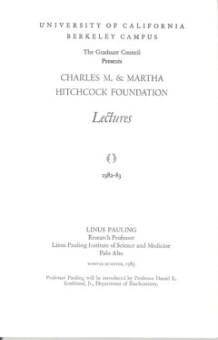
[00:00:00] BRUCE AMES:
Just say a few words. Uh, last, uh, I’m Bruce Ames from Biochemistry. Uh, last time, uh, as you know, uh, Koshland, uh, talked a little bit about Pauling’s many contributions in many fields, and of course, Dr. Pauling talked about his work.
But, uh, I was a graduate student at Caltech in the early ’50s, and it was a small place, and sort of everyone there knew that if you wanted ideas on your project, the person to go talk to was Pauling. It was just a constant stream of new ideas coming up and, uh, but in very many, uh, different fields. And I think that, uh, the, uh, in– his contributions, as, as you all know, have been really enormously diverse for a scientist in so many different fields.
And I think in recent years, Ah, his, his intuition is still really, uh, ah, fantastic because the, uh, work that he’s been doing on metabolic profiling and sort of looking in different people for, uh, sampling metabolism and getting at human variability, I think is gonna start off a whole or and has started off a whole area of people working in that area. And then he’s had this intuition about ox-oxidants and damage, uh, and the role of oxidants in health and the importance of antioxidants. And again, I think more and more evidence is coming up that that’s really, uh, an important field.
So that, uh, I think there’s so many different contributions and also so many students he’s trained over the years, uh, that have, uh, in, uh, have, uh, when I was a graduate student at Caltech, some of the fellow students there were working with Pauling were Alex Rich and Gary Felsenfeld and Martin Karplus. And so there had just been student after student who’ve, who’ve really made enormous contributions that Pauling has tra-trained. And so one can ask then, is Pauling always right?
And, ah, I’d like to just tell one story about a famous, ah, German chemist, ah, a predecessor of Dr. Pauling, ah, Emil Fischer, who was one of the great chemists of his age. And, ah, over the years, ah, Fischer, ah, would be, ah, finding out all sorts of things, but every once in a while he’d find out that Abderhalden was wrong about something. Abderhalden was another great German organic chemist of the last century.
And, uh, and so this went on for about three or four times that Fischer proved Abderhalden wrong about something. And then someone asked, uh, Fischer, “Well, is Abderhalden always wrong?” And Fischer thought for a moment and said, “No, he’s not that reliable.”
(laughter)
And, and, uh, so, so I was asking, uh, Dan Koshland the other day, “Well, was Pauling always right?” And Koshland thought a moment and said, “No, he’s not that boring.” So, uh, so for that, uh, reason and others, we’re very happy to have Dr. Pauling give his second lecture.
(applause)
[00:03:09] DR. LINUS PAULING:
Thanks. Well, I’m pleased to be here to give a second lecture. The title that I gave for this lecture was, uh, Chemical Bonds in Biology.
I thought, uh, I had thought that I would call it The Nature of Life, and, and, and that, in fact, I shall talk about the nature of life, especially the molecular basis of life, or at any rate as I see it, about my own efforts to understand life, living organisms and to satisfy my own curiosity. This effort ended quite a long time ago. Uh, I can’t talk about recent discoveries, but rather about the basis on which they have been made.
Uh, I’m astonished that in recent discussions of, uh, uh, life, even in biology textbooks, there’s usually rather little about what I consider the basis of life. Uh, my interest in the problem of the nature of life began in 1939 when I had been in the California Institute of Technology for seven years. In 1929, the institute, which had, uh, departments of, uh, physics and chemistry that were pretty vigorous ones and had mathematicians and engineers, uh, brought in, started a, uh, Division of biology.
Thomas Hunt Morgan, who had discovered the gene in 1911 with his students, came from Columbia to be the chairman of this division. And he brought with him his co-discoverers, except for Hermann Muller, who didn’t come. He brought Alfred Sturtevant and, uh, Bridges, the two young biologists who had been, uh, most, uh, active with him in developing the theory of the gene.
And he also brought other biologists, including Albert Tyler, an embryologist. I soon got interested in what they were doing and spent a good bit of time with, uh, Morgan and the others. There are some that I haven’t mentioned too.
Well, I’ve been determining the structures of minerals and other inorganic substances up to that time, and doing quantum mechanical work, theoretical work on the chemical bond. The, this X-ray diffraction technique was surely a fine one, which I liked to, to. It was really great.
With a little bit of luck, you could determine the structure of a crystal in three months, say, and get the answer to some interesting problem in structural chemistry. And then having got that answer, go on to some other question and get another answer. Uh, I hope that scientific, uh, research is just as exciting now as it was then.
I can’t believe that it’s more exciting. This– That was a great period. Well, I was beginning to feel that, uh, the puzzling questions, uh, in the inorganic world, at any rate, were all being answered.
And, uh, I realized that there were still many puzzling questions. The, the puzzling question about, uh, uh, the nature of life. By nineteen twenty-eight, I felt that the problem of the nature of the chemical bond was well on its way to, uh, solution.
I wrote in nineteen twenty-nine a paper on the principles determining the structure of the silicates and other minerals. The silicates have complicated formulas, many of them, but, uh, uh, the– it turned out there were some structural principles that enabled one to see why a, a feldspar, for example, an aluminosilicate feldspar, which often contains sodium or potassium or calcium, had one sodium atom for every aluminum atom and had a ratio of oxygen to aluminum plus silicon of two, and so on. Well, th- these principles also permitted one to determine the structure of crystals that were too complicated to permit a straightforward determination by the X-ray diffraction method that, uh, led to the determination of the structure of topaz and mica, zuniite, for example.
I remember how pleased I was at the structure of zuniite. Uh, it turned out, and the, the mineralogists weren’t sure what its formula was. It turned out that it was Al thirteen
Si five O twenty OH eighteen Cl. This Cl happened to get in there, uh- by the chlorine ion, chloride ion got in, and one could see from the structure. There was one peculiar aluminum atom in the structure.
One could see from that the peculiarity in the aluminum atom was responsible for there being a chlori- chloride ion in the crystal. Well, uh, the problem that, uh, uh, about the nature of life, what is it? I learned from the biologists that biological specificity is essentially the major problem that we have to understand if we want to understand life.
Biological specificity is the set of characteristics of living organisms or constituents of living organisms of being special or doing something special. Each animal or plant species is special, shows specificity. It differs in some way from all other species of animals.
Its outstanding specificity is that of passing on to its progeny, its descendants, its own characteristic nature. How is it possible for two, you know, you were all, uh, pretty sophisticated, bored, jaded now, I suppose, by these things. It may not seem interesting to you, but, uh, in the old days, uh, we could ask, how is it possible for two human beings to have an offspring that is a human being instead of some other animal?
Even an offspring that resembles his parents more than he resembles other human beings. Well, uh, Morgan, Sturtevant, and Bridges around 1910, and Muller, around 1911 had developed the theory of the gene, and the three of them were there in Pasadena. I was always being exposed to talk about, uh, genetics, heredity, specificity, and being stimulated to ask myself over and over again, “What can the molecules be doing that confers such high specificity on these living organisms.
I doubt that I had any idea that I would ever do anything about this, or even that I would ever that anyone would have done enough to give me an understanding of it. But I couldn’t help thinking about it from time to time. And it’s not only the organisms that show this remarkable specificity, uh, but also parts of them.
For example, you can take an, an enzyme out of, uh, plant or animal cells and, uh, find that they have, uh, are, are, are able in a remarkable way to make a chemical reaction go tens of thousand times faster than it would go in the absence of the enzyme, with the enzyme not itself being changed. And the enzymes are very particular about what chemical reactions they catalyze in this way. I mentioned superoxide dismutase, a stuff that you can buy in the health store to swallow, and it gets digested there, of course, and that’s that.
But if, if it’s injected into the bloodstream, it might have some value against disease, and of course, it is essential for, uh, health of all organisms, of cells by killing the, uh, superoxide radicals that get formed there. So, uh, that’s what s-superoxide dismutase does. Very, very minute amounts of this protein is enough to keep cells almost completely free of superoxide dismutase.
It causes destruction of that radical, and it doesn’t do anything else. It doesn’t do anything to hydroxide radicals or singlet oxygen or, so far as I know, anything else. There may be another reaction, another substrate, but if there is, I don’t.
Well, uh, there’s specificity of another sort. That’s a high specificity. There’s specificity of another sort.
Uh, there are million species of animals. So far as I know, practically every species of animal manufactures a different kind of superoxide dismutase molecule from another, other species of animals, so that there may be about a million kinds, even more, of this particular protein. Well, proteins are big.
A standard protein may have ten thousand atoms in it. You can change some of these atoms, replace a few atoms by another group of atoms without interfering with the catalytic power, not disturbing the active site. And perhaps you confer some benefit by, uh, for the particular animal species by making this change.
At any rate, we have, uh, uh, specificity in the nature of proteins that are produced by living organisms, characteristic often of the species, with only once in a while the same protein being produced by, uh, two different species. The, uh… Well, there were lots of things I wanted to understand, uh, without much hope, uh, how an enzyme is able to catalyze one reaction and not another, how organisms are able to have progeny of the proper kind, and so on.
The red protein in the blood, hemoglobin, uh, has interested me for a long time, has a beautiful color. When I was a young graduate student beginning, I saw in the library, in the chemical library in the California Institute of Technology, uh, some big green volumes which I looked at through curiosity. They were by, I’m not quite sure, Brown and Schuckert’s or someone like that.
These investigators have collected blood from a lot of different animals. They separated the red corpuscles and hemolyzed them and let the hemoglobin crystallize, and then took photographs of these hemoglobin crystals. And the crystals were all looked different from one animal species to another animal species.
All animals manufacture, uh, oh, uh, uh, its own– Each animal species manufactures its own kind. Human beings manufacture human hemoglobin.
Uh, fetal humans manufacture fetal, uh, hemoglobin, which is more alike fetal calf hemoglobin, say, than adult human hemoglobin. The fetuses of the world are more closely related to one another in some way than they are to the adults of their own species. Well, uh, here– and of course now we know that about three hundred different kinds of human hemoglobins are manufactured by adult human beings, these mutants, these variants of human hemoglobin.
So, uh, I– that’s another example of biological specificity. Uh, And here– Well, in nineteen thirty, a year after Morgan came, I began work on organic molecules.
I’d never had any interest in organic chemistry, but of course the molecules are molecules and they’re interesting, so I, uh, worked on them by a new technique, electron diffraction of gas molecules. Very powerful. We got a lot of results, uh, in that way.
And at the same time, having felt satisfied with an understanding of the silicate minerals, I began to work on the sulfide minerals. Uh, I worked– determined several sulfide structures, but it was quite a chore. I said three months.
The sulfide structures are apt to be complicated enough to take more than three months per structure, and I got impatient. So I, uh, applied to the Geological Society of America for a grant from the Penrose Fund, uh, and didn’t get it. So then I applied to the Rockefeller Foundation, and they gave me five thousand dollars for an assistant to help me work on, uh, the sulfide minerals.
And, uh, I, uh, enjoyed myself with, uh, my having an assistant to help me getting some of these structures, and they gave me ten thousand dollars the next year. Warren Weaver there was in charge. And then Warren Weaver said, “Uh, the Rockefeller Foundation isn’t really interested in the sulfide minerals.
What we are interested in is, uh, biology.” So that sank in for a while. And
(laughter)
Now I remembered those beautiful red crystals of hemoglobin, and in fact, I had written a paper on the sigmoid equilibrium constant of hemoglobin with oxygen, a theoretical paper. That was my first, my beginning in the protein field. So I had an idea, and I applied for a grant to study the magnetic properties of hemoglobin.
Uh, this was 87 years, I think, after the last work had been done. Faraday wrote in his diary, “Have measured the magnetic, uh, susceptibility of old, dried blood. Must try recent fluid blood.\” So, uh, we got the grant.
(laughter)
And, uh and, uh, uh, Charles Coryell and I, uh, borrowed, uh, an old, uh, discarded balance from the sophomore analytical lab and drew, drilled a hole in it and hung a tube from it and borrowed a magnet from Mount Wilson Observatory and measured the susceptibility of hemoglobin, uh, venous blood and arterial blood. And to our astonishment, there was a big difference in susceptibility, magnetic properties of venous blood and arterial blood. Very interesting consequences of the magnetic properties, uh, significance for the structure of hemoglobin.
Well, you know, uh, perhaps I’d be a great authority on the sulfide minerals if it weren’t for Warren Weaver or if I’d got the grant from the Penrose Fund originally. Well, uh, I remember, uh, when, uh, once when President Truman in an address said, “Why doesn’t– why does Dr. Pauling work on the red cells in the blood? Why doesn’t he work on the white cells?”
Well, of course, uh, now, uh, we determine the amount of ascorbate in the white cells. That’s required for phagocytic activity, so I’ve got around to that too.
(laughter)
Well, Warren Weaver, he invented a phrase to describe what we were doing. He called it to molecular biology. So in 1936, I gave a grand round talk, grand rounds talk at the Rockefeller Institute for Medical Research in New York about hemoglobin.
And, uh, after my talk, Karl Landsteiner asked if I would come to his laboratory and talk with him. He was doing very interesting work. He had discovered the blood groups back in 1900, A, B, and O.
And he was then making studies of the reactions of antibodies and the antigens, homologous antigens or heterologous antigens. And in fact, it was the sort of work that would appeal to a chemist because he would take a chemical off the shelf, something with known structure, simple substance, and, uh, couple it to a protein, usually by diazotization– diacetization of an amino group, and inject this azoprotein into a rabbit and get antibodies which, uh, were characteristic of this simple chemical. He would get protein, a solution of protein molecules that would combine specifically with the chemical that he had took off the shelves, something that no rabbit had ever seen before.
Uh, the, uh… Well, this was surely interesting to me. Uh, another example of biological specificity.
These immune reactions are about as specific as you can get. Uh, you can detect a difference between, say, hen egg ovalbumin and duck egg ovalbumin, when, uh, up until recently, there were no other ways of showing that these two, uh, closely related proteins were in fact different from one another. So I thought about— I couldn’t answer any of Landsteiner’s questions.
I thought about them for four years and, uh, I think I’ll tell you later, uh, what came out of my thinking about them. Well, I want to put in an interlude here about chemical bonds in biology. Uh, in my book, The Nature of the Chemical Bond, first edition 1939, I wrote on the last page of the book: “Among the most interesting problems of science are those of the structure and properties of substances of biological importance.
I have little doubt that in this field, resonance and the hydrogen bond are of great significance, and that these two structural features will be found to play an important part in such physiological phenomena as the contraction of muscle and the transmission of impulses along nerves and in the brain.” Well, at that time, forty-three years ago, there was little known. Forty-three, forty-four, isn’t it?
It’s 1983. Uh, forty-four years ago, there was little known about, uh, the structure of proteomes. You may not believe it, you young fellows and young ladies or women, I guess it’s proper to say now
But, uh, 44 years ago, uh, there was even some doubt as to whether proteins consisted of polypeptide chains. An English scientist, Dorothy Wrinch, had proposed structures for proteins in which there were no polypeptide chains, no double bonds from carbon to oxygen in the carbonyl groups, which instead had opened up and formed single bonds. And, uh, th-these were three-dim– two-dimensional, well, some three-dimensional, but sort of planar structures bent around.
They were very interesting from the geometric or even topological point of view, uh, but, uh, of course were wrong. Uh, they’re just forgotten about now. But back in 1939, Irving Langmuir, the same one that I talked about on Monday, Irv– the great man.
Irving Langmuir wrote a paper with Dorothy Wrinch giving arguments as to why these cyclol structures were correct for proteins. And, uh, this per- disturbed a colleague of mine, Carl Niemann, protein chemist, and me enough so that we wrote a paper that was published in 1939, uh, giving the arguments for the polypeptide chains. And of course, they’re overwhelming.
Uh, ever since the time of, uh, Emil Fischer, the father of H.O.L. Fischer, who was here, uh, w- it’s been pretty def- certain that, uh, the polypeptide chains are present. Well, there was then the question– In fact, in nineteen thirty-six, uh, uh, Mirsky, Alfred Mirsky, who came from– worked with, um, with me for a year, and I wrote a paper on proteins in which we said that, uh, a native protein is held in a well-defined, uh, conformation by weak forces between parts of the chain, including espe– and perhaps especially hydrogen bond formation.
And, uh, uh, many people, Huggins, whom I’ve talked about, for example, had got interested in the question, also William Astbury in England, the question of how these polypeptide chains got folded. Here you have a long polypeptide chain with a hundred or two hundred amino acid residues in it and with carbonyl and, uh, NH groups that can form hydrogen bonds with one another. How does this chain fold up in a globular molecule, or how are the chains related to one another and to themselves in, uh, uh, a hair, for example, alpha-keratin?
So by 1937, I reached the conclusion that I knew enough about bonds and carbon, nitrogen, and hydrogen atoms, uh, to be able to find a structure for alpha keratin. I spent the summer of 1937 folding these polypeptide chains. I assumed that the peptide group, the amide group, was planar because of resonance.
This is where resonance comes in. And that the chain was folded around in such a way that the CO group and the NH group would form hydrogen bonds with one another. And I also, from the X-ray pictures of, uh, hair, uh, there was a well-defined, apparently meridional reflection off in the direction of the axis of the hair with a spacing of five point one angstrom, which everybody assumed meant that the structure repeated every five point one angstrom in that direction.
So I spent the summer without finding any structure. And, uh, This is what had happened to Astbury too. He, he had, he described this structure, but it wasn’t right.
And so I decided that there was something missing in my knowledge about chemistry, structural chemistry. Uh, that perhaps the secret of life was hidden in these protein molecules. Uh, perhaps there is a structural feature, a chemical feature about polypeptide chains that haven’t been discovered from the examination of simpler substances.
Uh, at the end of that summer, Robert B. Corey came to me, uh, from the Rockefeller Institute for Medical Research. He was interested in proteins, too, and we decided, uh, that the thing to do was to look for this unknown structural feature. Uh, nobody up to nineteen thirty-seven had ever made a structure determination by X-ray analysis of crystals of any amino acid or peptide.
And, uh, we decided that our program would be to determine the structures of these crystals. It was, uh, sort of at the borderline of science then. The techniques of X-ray crystallography were improving, but they were far from what they are today, when it’s a pretty routine job to determine the structure of a crystal.
It wasn’t routine at all then. Them would take a year, a man-year or two man-years. Many people were involved in this work for over a period of years, continuing to the present time.
At the end of eleven years, uh, we in Pasadena had determined the structures of a dozen amino acids and several simple peptides. No one anywhere else in the world had determined any such structure. Uh, we were interested in doing it.
I looked them over in nineteen forty-eight and realized that we hadn’t made the discovery that we wanted to make. The dimensions, the structures were all just what I had thought they would be back in nineteen thirty-seven. There wasn’t any secret of life hidden in the folded polypeptide chain.
So far as these basic structural characteristics go, the bond lengths and bond angles, and so on. And so one day I thought, uh, why don’t I think about, uh, how to fold the polypeptide chain again. And I, uh, just sort of forgot about the evidence, the 5.1 Angstrom repeat, and just thought about the bond lengths and the bond angles, the planarity, the resonance in the amide group, and the formation of hydrogen bonds.
And in a couple of hours after I had made the decision, I had discovered the alpha helix. without even the mo-molecular model at hand, only a sheet of paper that I could fold in three-dimensional space. And, uh, what was wrong in 1937?
Paying too much attention to that 5.1 Angstrom repeat. It turned out that it isn’t a repeat distance after all. It’s a sort of pseudo-repeat.
Uh, the– The, uh, well, I think I’d better start in with those slides because, uh, I have them and I’d feel that I needed to show them, and then it might run, be too late. Can we turn some lights off, too?
(cough)
Well, here, I, I just show the hydrogen bond in diacetic acid, uh, essentially as described qualitatively by Latimer and Rodebush up here in Gilman Hall in nineteen twenty with… And here is a, a molecule of glycine as described for the first time about nineteen sixteen here in Berkeley by a man named Elliot Quincy Adams. He didn’t stay here long.
Whether he was– I’m not sure whether he took his doctor’s degree. I think he did, uh, here. And also at the same time by Bjerrum in Copenhagen.
Well, the aspect that they discovered was that one end is the ammonium ion group with a positive charge, and the other end, the carboxylate ion group with a negative charge. And here we have, uh, two glycines which have condensed together, eliminating a water of molecule– a wa-molecule of water, forming the, uh, peptide bond. And here we have a lot of amino acid si– lined up in a chain.
And the top way is the way that a chemist looks at it, a series of amino acid residues. The bottom is the way a structural chemist looks at it, uh, a set of planar peptide groups connected by alpha carbon atoms, which happen to have, uh, different side chains, any one of twenty different side chains attached to them. And the problem of– that I had then in both nineteen thirty-seven and nineteen forty-eight, was to rotate around the two single bonds from carbon to carbon or carbon to nitrogen of the alpha carbon atom that has an hydrogen and another group attached, and find a structure where the CO and the NH would form hydrogen bonds.
That was the problem. And of course, alpha helix, I found by assuming that all of the structural units are equivalent, and the helix is the most general structure that you get from a– from, uh, asymmetric equivalent elements. They always form a helix, which may be a degenerate helix.
I didn’t worry about restriction of rotation around the single bonds discovered here by Professor Kemp Pitzer, uh, And Kemp, I guess, back in the 1930s at- it’s not a big enough effect to, uh, bother us as a first approximation.
(cough)
And here’s a drawing showing the dimensions. They’re within a hundredth of an angstrom or two or three degrees in angle of the ones that I was using in 1937. I just didn’t think hard enough, I guess, in 1937.
Uh, here is a drawing which antedates, uh, the alpha helix. It just shows what we were working on, a polypeptide chain and folding in such a way that, uh, hydrogen bonds are formed. And it shows these space-filling models.
Dr. Corey and I were building space-filling models before the alpha helix came along. Now everyone has them. Uh, they’re commercially available.
I remember my son Peter saying that they were the most expensive atoms in the world. So here’s the right-handed helix on the right. The left-handed one hasn’t been found.
There are four and six-tenths residues per turn, so that– And the, the, uh, pitch, the length per turn is five and one-tenth, five and four-tenths angstroms. That’s six percent greater than the five point one indicated by the photographs. And it was so far off, uh, that, uh, it worried me.
I knew that the bond lengths and bond angles were so good that it had to be 5.4 angstroms. The photographs looked good, and they said 5.1 angstroms. Well, I delayed publication of this for a year, always expecting that Huggins or Perutz or someone would find the alpha helix in the meantime, uh, because I couldn’t understand this discrepancy.
You know, no doubt, that I’m a very cautious and reliable scientist. Uh, I don’t ever publish anything until I’m sure that it was right. So I waited for a year and, uh, finally published, Corey and I, Corey, Branson, and I published this description of the alpha helix.
This shows the helix as it goes along with approximately eighteen residues and five turns, 3.6. I said 4.6. I should have said, You know, it’s remarkable, this reverberatory memory that you have, because when I, uh, start, when I said eighteen residues in five turns, so I divided, got three point six, and my memory said, “But I’ve just said four point six.”
Well, that’s three point six residues per turn. So here’s one of our models. They were made out of wood, were very heavy, these atoms.
That would be a polyglycine with the alpha helix structure, and here with some side chains attached to sort of miscellaneous side chains. And of course, here’s that myoglobin picture showing all 2,500 atoms, and you can see off down at the lower left side, that segment of alpha helix. It has eight segments, eight alpha helical segments comprising about 85 percent of all the other residues.
Others are involved in bending around the corners. Here’s a carboxypeptidase, which has three hundred and seven amino acid residues in the polypeptide chain. And, uh, only the residues are indicated by little straight pieces of wire.
That’s each of them is about ten atoms. And you can see the several, uh, segments of alpha-helix in that structure. Well, I was told last month that a hundred new protein structures were published last year.
Several hundred altogether, two or three hundred have been published so far. Almost all of them show alpha helix. Some of them only the pleated sheet.
Well, here are the two pleated sheets that we described, the parallel chain and the antiparallel chain pleated sheet. If you stretch a hair by taking one of these permanent wave or just steaming it and, and stretching it, it’ll stretch out to about two and a half times its original length, and it has the parallel chain pleated sheet structure. But silk, silk fibroin has the antiparallel chain structure, which is shown here.
The hydrogen bonds are lateral. Even before the al-the alpha helix was discovered and the, the structure of silk was discovered, it was known that the hydrogen bonds were in the direction of the fiber, uh, the hair, uh, and were lateral in silk because you could, uh, determine the anisotropy of absorption of ultraviolet– of infrared light, the carbon, oxygen, or ni-nitrogen, hydrogen stretching frequencies. And finally find out the orientation of the hydrogen bonds.
Well, of course, scientists can do lot fancier things than that now. I continue to be astonished at how penetrating some of the new techs-techniques are. This is a pleated sheet showing the pleats and sort of from the side and,
(coughs)
a-a-another view made by my friend Roger Hayward, an, uh, an architect who had a remarkable understanding of science and mathematics, too. Well, it’s interesting that nobody discovered the alpha helix in that period between nineteen thirty-seven and nineteen forty-eight, ’cause a number of people were working at it. And in particular, uh, Bragg, Kendrew, and Perutz published in 1948.
or after I discovered the alpha helix, which I hadn’t said anything about, a long paper describing a whole lot of helical structures for alpha keratin, all of which were wrong, just because they were physicists. They didn’t-
(laughter)
If they had been chemists, they would have known about the theory of resonance, would have known that, uh, the, the peptide group in these polypeptides is planar and that they had to include that restriction. They didn’t. In all of their structures, the peptide groups were twisted around in a way that, uh, it just isn’t true and it would have been rejected by the chemists.
Well, I’ve come to the basis, to the question, what is the nature of life? What is the basis of biological specificity? And, uh, that turning point that came for me in 1936 when Karl Landsteiner asked me how to explain biological specificity.
How can the antibodies distinguish between, uh, hydrogen atoms around the benzene ring and the, the benzene ring that has a methyl group in the, uh, say, if it’s benzoic acid in the position meta or para to the carboxyl group? Um, that’s something that we need to explain. Well, by 1940, I had formulated the theory of, of the specificity of serological reactions.
And by nineteen forty-eight, uh, my associates and I had verified this theory in many of its aspects. I’d kept asking myself, “How can the antibody, using the intermolecular forces that we know about, uh, van der Waals repulsion, if two atoms get too close together, they repel each other. The electron shells are involved in repulsion.
That involves attraction, a result of electric polarizability. Inter– There are electrostatic interactions between these polarizable, electrically polarizable atoms, and interaction of positive charges and negative charges, an ammonium ion group and the carboxylate ion group attract one another. Hydrogen bond formation.
These are weak forces that hold molecules or parts of molecules that aren’t connected by covalent chemical bonds together. The conclusion that I reached is that there’s only one way in which molecules can interact in this highly specific way, and that is through a detailed and close complementariness between the haptenic group of the antigen and the combining region of the antibody. I concluded also that precipitation by, uh, an antibody, precipitation, agglutination and agglutination of cells, red cells, for example, by anti-erythrocyte antibodies, requires that the antibody be bivalent, have two combining groups.
Here we have a big red cell, an anti-red cell antibody, homologous to haptenic groups on the surface of the red cell. The antibody has two combining regions. One grabs a haptenic group on this cell, and the other grabs a haptenic group on this cell, and so they hold the two cells together, and if there are a lot of antibodies, the red cells are clumped together, and you get the, uh,
(clears throat)
the agglutinated red cells that of course cause trouble in blood transfusions. So the conclusion is that the antibodies, that these two molecules interacting with– interact with one another when they don’t form real chemical bonds by, uh, uh, as a result of the cooperation of a number of weak forces which cooperate, uh, over a surface area where one molecule fits very closely against another– the other. And this idea of a detailed and close molecular complementariness is, of course, similar to ideas that had been proposed before from time to time, going back, for example, to Ehrlich, lock and key sort of explanation, which means a complementariness in structure.
Well, but they weren’t accepted, uh, in general.
(page turn)
What do I have here? Oh, here’s a list of some of the people who worked during period about nineteen forty to forty-eight or fifty on these antibody studies. Dan Campbell, David Pressman, John Singer, now at UC San Diego.
Art Pardee, we were talking about Art Pardee a couple of days ago. Uh, John Cushing at UC Santa Barbara. Uh, George Feigen at Stanford.
Carleton Gajdusek, back in Bethesda, I guess, if he isn’t in New Guinea. Uh,
(laughter)
Here I show Dan Campbell and the two of our other associates in this work. Uh, we had– My wife was a bit irritated.
We had a m- little old house on the front, uh, or to one side on our place up in the hills above Pasadena, going back to 1860, and it was full of rabbit cages with rabbits that I injected with antigens every morning, and then we built a shed on the front lawn that contained the cages in which the breeding rabbits were kept to provide us with additional rabbits. She commented on this slide. She said, “The only thing that that slide shows is that you don’t know how to hold a rabbit.”
(laughter)
(laughter)
(student background chatter)
Well, see, this sort of illustrates our idea of what an antibody. Of course, we know there are detailed structures of antibodies now with those long chains and short chains and sulfurs, disulfide bonds, and I don’t know what all. Uh, but I like to think of them, well, it, as being like this early picture.
And, Uh, here would be an ovalbumin, anti-ovalbumin precipitate. The ovalbumin, I thought to– it has a molecular weight forty-three thousand, uh, antibody a hundred sixty thousand. But– and the ovalbumin, any part of its surface could have haptenic groups on it, and so it could have a large valence, and the antibody is restricted to small, and this predicts that you have seven or eight times as many antibody molecules as ovalbumin molecules, which of course, is what’s observed.
Here’s the– So we wanted to check this bivalent idea of bivalence. We made these, uh, simple compounds which will precipitate with an anti-benzene arsonic acid, uh, antibody just the way that, uh, the azoproteinum will precipitate with it.
And all we did was to make, uh, the antibody against benzene arsonic acid, make the precipitate with one of these compounds, say the, either one of the two on the right side there that have two haptenic groups, and analyze it. It came out one antibody per dye molecule, perhaps. And, uh, since the molecules have two haptenic groups, we said that the antibody must have two combining regions.
Well, there was an immunologist who said he didn’t think that we had proved that both of these were involved in the precipitation, both of the haptenic groups. So we made this compound. It, it has a, a benzene arsonic acid R on one side and a benzoic acid on the other side.
And if you add this compound to antibody against benzene arsonic acid, you don’t get a precipitate. Uh, if you add it to an antibody solution against benzoic acid, you don’t get a precipitate. You– in each case, you get soluble complexes like this.
But if you take, uh, antisera from two rabbits that have been injected differently, then the compound gives a precipitate with the mixture of the antibodies from the two rabbits, As shown here, you have an anti-R and then R and then X, the benzoic acid, anti-X, and then XR, anti-R, RX, and so on. I don’t know how that antibody molecule with three combining regions got in there. Uh, it, uh, was put in by an artist, I think.
But we determined hundreds of equilibrium constants between antibodies b– and haptenic groups, hundreds of them. Uh, and, uh, this illustrates– This diagram shows some of the combining constants of anti-para azobenzene arsonic acid, anti-meta azobenzene arsonic acid, anti-ortho azobenzene arsonic acid with a lot of substituted arsonic acids, and so on.
And, uh, a lot of information. All I want to say about that is that there was a lot of information. And, uh, if the hapten, the molecule, uh, was not rather similar to the one, uh, that had been added to the original immunizing antibody, uh, it wouldn’t combine very strongly.
And since we knew the sizes and shapes of all of these simple molecules, we could say how close the fit is, just how big the pocket is in the antibody. And the, uh, these… We decided that, uh, for benzene arsonic acid, the fit was to about a quarter of the diameter of an atom.
Very close fit all around here. No doubt that you have this detailed molecular complementariness. In one case of para-azosuccinate ion, we para-azobenzenesuccinate ion here, we were able by, uh, using these equilibrium constantses- constants for a whole lot of substances to show that the, uh, you- immunizing hapten had the succinic acid bent around into approximately a cis conformation, is indicated.
And to show that there was a positive charge in the antibody right close to the carboxyl, the negatively charged oxygen there on the succinate ion, and that there was a hydrogen bond formed from between the antibody and the carbonyl group there, and, uh, and so on. So that, uh, there was a great deal of information obtained. Well, I concluded that there was no doubt then that, uh, it was a detailed molecular complementariness in structure between the antibody and the antigen, uh, the hapten that was responsible for the specificity of combination there.
And of course, predicted that, uh, or said that it was also responsible for the phenomenon o-of heredity. In fact, in 1940, Well, here, the– jumping the gun a bit, So I don’t have to worry about the slide anymore. We have this remarkable example of complementariness with adenine and thymine forming two hydrogen bonds, guanine and cytosine forming three hydrogen bonds.
Probably the most important, uh, example of, uh, complementariness in structure in living organisms. So, in 1940, the German physicist Pascual, Jordan, Jordan, or Jordan, who had worked with Born on matrix mechanics, of course, knew physics, didn’t know any chemistry, I’m sure, uh, wrote a paper in which he said that the gene duplicates itself because according to quantum mechanics, two identical molecules interact with one another more strongly than a molecule and a non-identical molecule. Max Delbrück met me on the campus and, uh, said that Jordan, Jordan had published a paper, which I said was nonsense.
So, uh, Delbrück and I published a paper saying that we had calculated the magnitude of the energy of interaction, and it was just completely negligible, this special quantum mechanical interaction between like molecules of the dimensions of molecules that are present in the human body. And, that in fact, uh, the gene consists of two mutually complementary strands, and that the gene duplicates itself by the unfolding of the pair of mutually complementary strands so that each can act as a template for the synthesis of the other. Well, later on, uh, Watson and Crick, that was, uh, 1940 that we published that paper.
Uh, many years later, Watson and Crick discovered the double helix with the help of Jerry Donohue, who pointed out that, uh, they were using the wrong structures for the nitrogen bases, that the correct structures could form hydrogen bonds with one another. That was a valuable contribution. He’s the only person whom they thank in their paper on the double helix.
They could have thanked him, uh, even much more strongly, I think, uh, than they did. So we have that example of complementariness. Well, even back in nineteen forty, I was feeling that I didn’t need to worry much any longer about what the secret of life is.
It’s molecular complementariness. And of course, after Watson and Crick, I was nearly completely satisfied. If I were giving another lecture, I could go on in detail.
We can imagine how the primitive Earth was, and there developed the hot thin soup of Oparin and Haldane, as ultraviolet and l-light and lightning caused all sorts of chemical reactions to go on. Every conceivable kind of moderately simple molecule to form. And the, with the situation far from equilibrium, a catalyst could cause one reaction to go much faster than the other, so that you would get a preponderant number of molecules of a certain sort.
Adenine might speed up the production of thymine, and thymine speed up the production of adenine. Enzymes, polypeptide chains, polynucleotides would come into existence, and multi– single-celled organisms, and we could have rapid reproduction, and the billions of billions and billions of billions of cells, uh, mutating and, uh, competing and for two billion years, uh, building up finally the extremely complex, uh, uh, system of living organisms that we have on Earth now. And so I’m happy, even if I, uh, don’t, uh, follow all of the details as the biochemists and others, molecular biologists are working out now.
I’m happy to feel that I have, and have had for a long time, an understanding of at least the basic, uh, answers to the question, what is life? Well, I’ve taken pleasure in being here in this great university and having contact with scientists who are learning more and more about, uh, the nature of life. Not the basic question, that’s been answered, but, uh uh, uh, the frills.
Uh, the, uh… I might make a remark about the double helix. Uh, my wife once said to me, “If that was such an important problem, why didn’t you work harder at it?”
(laughter)
Well, I shan’t try to answer the question. That’s just an introduction to something else that she said. Uh, she said, “The most important of all activities of that of keep is that of keeping the world from being destroyed in the nuclear war.”
(applause)
So I conclude by saying that the most important of all problems is that of keeping the world from being destroyed in the nuclear war. And also to say that every one of you should do whatever you can to prevent this ultimate catastrophe.
(applause and cheering)
[01:00:25] MODERATOR:
Well- I’m gonna, I’m gonna take your microphone a minute just to-
[01:00:28] DR. LINUS PAULING:
Sure.
[01:00:28] MODERATOR:
Thank you for that.
[01:00:29] DR. LINUS PAULING:
And I should sit there, uh-
[01:00:46] SPEAKER 4:
I just… I’ll give you one more chance. I think we have to end.
It’s very sad for all of us that we have to end these lectures, but I’d like to thank the Hitchcock Committee for making such an excellent choice, and Dr. Linus Pauling for giving us such an honor on our campus to spend this time with us. Dr. Pauling has not only given two lectures, but has met with students, faculty, in almost a continual round of, I think, exploitation of a visitor. I don’t think we’ve given him a moment’s rest since he’s been here.
I think one of the great contributions of the Hitchcock Lectureship is something that gives us an extra dimension beyond the articles. I think although we reviewed Dr. Pauling’s many accomplishments, most of you have read them in textbooks, in articles.
[01:01:33] HOST:
I think his personal magnetism and his excitement of what he’s given us to this campus during this week has illustrated, I think, two features that have characterized his career. One is courage. Courage both in the political area and the courage to take new scientific ideas.
And the second is his enormous enthusiasm for life and for intellectual ideas. In fact, I looked back over the history of the Hitchcock Professorship and found that in many cases, it was a recruiting device, that some of the people who were Hitchcock lecturers ended back in Berkeley. And so if I had to pick an able young assistant professor with– who’s shown some ability, who had enormous enthusiasm, and many years of productive ideas ahead of him, I would nominate Linus Pauling.
It’s been a great pleasure to have you here.
(applause)
[01:02:31] DR. LINUS PAULING:
Almost done with the country track too.
(applause and cheering)
Thank you.
(applause and cheering)