
[00:00:00] (laughter)
[00:00:02] MEG CONKEY:
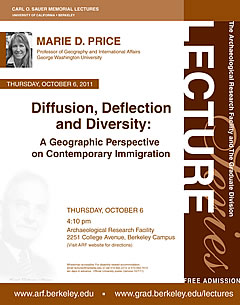
Okay, I’d like to welcome you all this afternoon to the twenty-first Carl Sauer Memorial Lecture. Uh, my name is Meg Conkey. I’m a former director of the Archaeological Research Facility, which is a co-sponsor of these lectures with the, uh, Graduate Division here at Berkeley.
And, um, I bring you greetings from the current director, Laurie Wilkie, who is, uh, unfortunately unable to be here with us today. But as the chair of the Sauer Lecture Committee, I’m really happy to see that we have been able to, uh, organize and arrange this, uh, lecture this afternoon. As you know from your program, and if you don’t have a program, there’s some in the back of the room, and if there’s anybody up front here who wants one.
But as you know from the program and, uh, just from general knowledge, these lectures were established in nineteen seventy-six, uh, by colleagues, uh, joined by friends, family, and students to commemorate the contributions and their continuing influences and transformations of Carl Sauer, who was perhaps one of the– or certainly is one of the most influential geographers of the, um, twentieth century. His books, um, his works are veritably cross- and transdisciplinary, and there are many concepts and approaches that Sauer pioneered and/or championed that scholars use today, often without realizing their origin and their history. Sauer was a professor of geography here at Berkeley from 1923 to 1957, and he was an emeritus professor until his death in 1975.
This was the formative time, um, of what became a distinctly Berkeley cultural geography, and you would not be surprised to learn that being a contemporary here with the anthropologist Alfred Kroeber, there were discussions and debates between the two and their students, both leaving a legacy of promise and challenges to the understanding of human cultures, their landscapes, and their histories. We are honored that members of the Sauer family are here with us today for the twenty-first Sauer Memorial Lecture, and we are grateful to them for their continuing support of the endowment. Today, I am really pleased to introduce our twenty-first Sauer lecturer, Professor Marie Price of the George Washington University, where she has recently chaired the Department of Geography.
As you will understand from her lecture, she is also a professor of international affairs and has served as director of the Latin American Studies for, uh, the Elliott School of International Affairs. She is frequently on call, uh, for the press and many organizations, and if you go onto, uh, Google, you can find some interviews with her, uh, given her expertise in such crucial topics for today’s world as immigration. This is something of a homecoming, if you will, for Marie.
She is a Californian. She is a Berkeley graduate, uh, having earned her first bachelor’s degree here in the Department of Geography before attending Syracuse University from where she received her PhD in 1991. She’s had extensive field experience researching urban immigration, migration, and development in Latin America.
She surveyed emigration from Bolivia, investigated migration and coffee cultivation in Venezuela, and gathered data and conducted field research on global cities and immigrants. Her articles have been published in such journals as the Annals of the Association of the American Geographers, the Geographical Review, the Journal of Historical Geography, Urban Geography, International Journal of Urban and Regional Research, Studies in Comparative International Development, and Focus. Her books include a co-edited book, Migrants to the Metropolis: The Rise of Immigrant Gateway Cities in 2008 with Lisa Benton-Short, and on the up now to the fifth edition of the textbook, Diversity Amid Globalization: World Regions, Environment, and Development, co-authored with, um, Les Rowntree, Martin Lewis, and William Wyckoff, who are all here today to celebrate their co-author.
Price is a member and very active member of several of the key professional associations, including the American Geographical Society, the Association of American Geographers, the Institute of Current World Affairs, the Latin American Studies Association, and the Society of Women Geographers. She’s been awarded numerous honors for her extensive work in the field. In two thousand and ten, the Conference of Latin American-
Americanist Geographers awarded her the Preston E. James Eminent Latin Americanist Career Award. She received the 2005 Trachtenberg Prize for Teaching from GW, uh, George Washington University, and her article that she co-authored with Catherine Cooper, “Competing Visions, Shifting Boundaries: The Construction of Latin America as a World Region,” was honored as the Best Current Content Article of 2008 in the Journal of Geography by the National Council for Geographic Education. We are therefore more than pleased to be able to welcome, uh, Marie back to Berkeley, where she will give her presentation on today.
As you can see, Diffusion, Deflection, and Diversity: A Geographic Perspective on Contemporary Immigration. Marie.
(applause)
And before Marie begins, I’d just like to remind everybody to please turn off your cell phones and any other beeping devices. We are videotaping this. It will be available for classroom use for UCTV and other events.
Um, and so we really hope to not have you intervene into this wonderful talk. And, uh, following the talk, there will be a reception in the adjacent room. And for those of you who may need, there is one restroom in the adjacent room and off to the left and another one at the base of the stairs.
Thank you very much, and let’s hear from Marie.
[00:05:50] MARIE PRICE:
Thank you, Meg. Can you hear me back there? Good?
Well, uh, it’s, uh, a great privilege to be here and see so many familiar faces and, and friends. Um, I was thinking when I agreed to do this, that the Sauer Lecture changed my life. In 1983, I was an undergraduate, and I’ve only attended one Sauer Lecture.
It was given by D.W. Meinig. And, uh, after the event, as would be Betty Parsons’ tradition, she invited everybody up to eat at her house. It was a big crowd, and she asked me if I’d help.
I was an undergraduate, I said yes. The end of the dinner, everyone served, and there’s one seat left at the table, and it’s next to D.W. Meinig. And, uh- I sat next to him.
And next thing you know, I was headed to Syracuse University to get a PhD.
(laughter)
So, uh, be forewarned, this, uh, lecture could change your life.
(laughter)
Professor Michael Watts invited me to give this lecture, and I was honored and both taken aback. Uh, my work is very unlike Carl Sauer’s. Surely there were others that would be more appropriate to give this talk.
I write about contemporary immigration and rely on large datasets from censuses and government agencies to examine demographic, cultural, and political consequences of labor migration. Sauer was interested in plant and animal domestication by historical and prehistorical peoples undergoing processes that are largely non-recurrent and concerning spans of time beyond the short runs available to enumeration. Sauer’s brand of cultural history focused on human environmental interaction and the place of humans in nature, whereas I’m interested in human patterns of settlement and social inclusion and, and exclusion in increasingly diverse cities.
As different as my empirical focus is from Carl Sauer’s, uh, the Berkeley School tradition of cultural geography has always inspired me as a fertile and diverse body of scholarship focused upon fieldwork and long-term landscape change, especially in Latin America. Uh, this is an illustration done by a Bolivian artist, Antonio Sotomayor, of Sauer in the field, 1932. And you know it’s Sauer because he has a pipe in his mouth.
(laughter)
He’s in a cot in the front. Um, and insistence on field experience was the rule in Sauer’s day, and I’m happy to see it is very much alive today among Berkeley geographers. The value of going to places, observing forms and patterns, talking with people, digging into archives, mapping results cannot be underestimated.
Interestingly, since many immigration scholars base their research on statistical analysis of large data sets, having a field component in my immigration research often leads to different lines of argument and interpretation. Secondly, Sauer stressed the importance of following particular themes or topics rather than insisting on regional expertise for its own sake. Fieldwork in Latin America led to Sauer’s interest in agricultural origins and dispersals as well as native peoples, but ultimately, the topic demanded research well beyond the boundaries of Latin America.
Similarly, I was trained as a Latin Americanist at Syracuse University, but due to the global reach of international migrants, my research has stretched into new localities such as the streets of Barcelona, Dubai, or Washington, DC, as well as into new literatures. Sauer insisted that geographers make value judgments in their writings and actions, and for Sauer, these judgments reflected his serious concern about environmental degradation, especially the threat that modernity posed for traditional rural peoples. Sauer was not an overt activist, but he sought to engage a broad audience and share his deeply held conviction for the necessity of sustainable livelihoods.
Over seventy years ago, he published a subtly subversive book for American school children, Man in Nature: America Before the Days of the White Man. Granted, it’s not a gender-neutral title, but, uh, it was handsomely illustrated by Bolivian artist Antonio Sotomayor, and it was a book meant to teach American children about Amerindian life prior to European contact that was way ahead of its time. Uh, sadly, its message did not penetrate U.S. school curriculum in the 1930s, but it demonstrates a conscious effort at outreach and engagement that continued throughout his lifetime.
As an immigration scholar, my outreach has been through policy engagement, working with immigrant groups, and creating tools that local jurisdictions can use to facilitate immigrant inclusion, a project I just finished with UNESCO. The value judgment I bring to my research is that immigrant inclusion is important but difficult and does not naturally happen because racially, linguistically, ethnically distinct immigrants force a reexamination of self and collective identity that can be difficult for native and foreign-born alike. Yet ultimately, inclusion is essential in our increasingly diverse and immigrant-dependent societies.
Or as political scientist Robert Putnam de– reminds us, “The central challenge for modern diversifying societies is to create a new and broader sense of we.” I was fortunate to be an undergraduate at Berkeley in the early nineteen eighties when practitioners of the Berkeley School of Cultural Geography were still an active force in the Department of Geography. And when I teach geographic thought to seniors in my department, they all read works by Carl Sauer.
Most recently, we discussed the essay, The Seminar as Exploration, which is included in William Denevan’s newly edited collection called Car-Carl Sauer on Culture and Landscapes. And as Dr. Conkey said, you cannot, uh, ignore Carl Sauer when you’re talking about twentieth century North American geography. My human bridge to the tradition was the incomparable Dr. James Parsons, a student of Sauer’s and noted Latin Americanist in his own right.
Parsons was a mentor and friend from my undergraduate days at Cal until his death in nineteen ninety-seven. Jim always referred to Carl Sauer as Mr. Sauer, a deferential stance towards the man and his work that frankly seemed out of place with the rough and tumble world of Berkeley academic discourse. What was it about the man and his scholarship that seemed beyond reproach?
For some geographers in the department, I always suspected that this deference was annoying and even downright perturbing. Like Sauer, most Berkeley scholars are eager to chart their own course. And by the 1980s, critical social theory and later political ecology were the roads that beckoned.
Traditional cultural geography a la Berkeley was too much cumbersome baggage, best to cast aside. I believe that a tremendous opportunity was lost by this rejection. Rather than build connections with an intellectual tradition that has inspired multiple generations of American and Latin American geographers, the preferred course was an active disassociation from a rich academic inheritance that any other department wouldn’t embrace.
So in today’s talk, I hope to demonstrate how two traditional Sauerian concepts, cultural diffusion and cultural landscape, have been relevant in my research on immigration. I will draw upon a decade of fieldwork in the Americas, especially Washington, D.C. and Cochabamba, Bolivia, to demonstrate how immigration creates new patterns of diffusion and ruptures in the landscape that must be acknowledged in order for more inclusive and diverse communities. So let us turn now to the topic of immigration.
Uh, immigration has always, uh, captured my geographic imagination. The literature on immigration is immense, and scholars from many disciplines contribute to it. Ironically, given the popular and scholarly interest in immigration, very few people actually leave their country of birth for residence abroad.
According to the United Nations, the migrant stock figure is two hundred and fourteen million people, or three point one percent of the world’s seven billion people. Of course, this figure does not capture all international migration, so it’s important to consider this number as a demographic floor and not a ceiling. This figure shows the steady upward trend in the estimates of global migrant stock.
Here, the absolute numbers warrant attention. In nineteen sixty, the world’s migrant stock was about eighty million, and a large portion of those numbers came from the partitioning of India, along with traditional countries of settlement, the US, Canada, Argentina, and Australia. Today, the number exceeds two hundred and fourteen million, which if grouped together in one state, would be the
(laughter)
fifth largest country in the world wedged in between Indonesia and Brazil. Despite the absolute growth of immigrants, for fifty years, the world’s migrant stock has ranged between two point one or three point one percent of the world’s population. So why is immigration a big deal
(laughter)
if so few people leave? The answer is an uneven geographic distribution. When shifting level to the nation-state, where immigrants settle is extremely uneven, both in terms of absolute numbers and proportion of the total population.
It’s no surprise to anyone in this room that the United States is the largest foreign-born population, around 40 million, which is more than three times larger than Russia, which is the second-largest foreign-born population, followed by Germany, Saudi Arabia, Canada, and France. A more interesting list of immigrant destinations, uh, shows that states where migrants make up the largest proportion of the total population. Here, the Gulf states stand out, with Qatar topping the list at a whopping eighty-seven percent foreign-born, followed by the UAE at seventy percent and Kuwait at sixty-nine percent.
Migrants to these countries come from other Arab states, but also large numbers are from South and Southeast Asia. A running joke amongst immigrants in Dubai is that it’s the best-run Indian city in the world. Two cities on this list, Singapore, a city-state that relies heavily upon immigrants from neighboring Malaysia, but also from East and Southeast Asia, and Hong Kong, which for administrative purposes is still treated as a demographically distinct entity from the PRC, although not surprisingly, the majority of Hong Kong’s immigrants come from mainland China.
Uh, by comparison, the US, which is not on this list, only has twelve point five percent of its population foreign-born. The uneven geography of immigrant settlement is more stunning when you shift to the scale of analysis to metropolitan areas. In research that Lisa Benton-Short and I conducted on immigrant gateways, we found that nineteen metropolitan areas that had over one million foreign-born residents accounted for nearly one in five of the world’s immigrants in two thousand and five.
This map is dynamic and changing. Cities such as Doha and Madrid, uh, may soon be added. Buenos, Buenos Aires fell off the list but may be back on when the census is completed.
Also, there’s emerging data on the foreign-born in Chinese cities, especially Shanghai. And these global immigrant destinations, the foreign-born can be one quarter or more of the total population. Uh, a point that’s underscored by this next, uh, figure, uh, which, uh, shows a list of cities, uh, followed by, uh, the percentage foreign-born in red, and then the percentage of the country’s foreign-born in blue.
So for example, Toronto, which, uh, is over forty-five percent foreign-born, um, is, uh, the– whereas the country of Canada is a little bit about twenty percent foreign-born. Mapping the world’s urban immigrant destinations is challenging because no agency collects and distributes urban immigrant data. Um, but this figure shows met-metropolitan areas, um, with work I’ve done with my colleagues at GW, that have at least a hundred thousand foreign-born in purple, those with two hundred and fifty thousand foreign-born in green, and over a million in red.
Europe, the region of the world with the most immigrants, and North America dominate this worldview. Yet Southwest Asia has many important destinations, and there’s some significant shifts occurring in East Asia with more immigrants flowing into cities in Japan, Korea, and China. Unfortunately, serious data gaps result in underrepresentation of immigrant movements in sub-Saharan Africa, which we know are significant, but we just don’t have data on, as well as, uh, for India and China, although China’s story is really much more of internal migration.
But on this map, there are over a hundred and forty metropolitan areas that account for about seventy million immigrants, and each of these dots represents cities that are experiencing demographic, cultural, and economic change due to immigration. So let me turn to the first concept of cultural diffusion. Large-scale contemporary immigration, especially to cities, creates new pathways of cultural diffusion that are both exhilarating and intimidating to localities and livelihoods.
The agents of cultural diffusion are immigrants themselves, especially when they arrive in large numbers as adults and bring with them distinct cultural practices, languages, religions, food preferences, identities, and taste. Obviously, culture is complex and cannot be reduced to national origins. But country of origin is not a bad proxy measure for culture, and it gives us some data to work with when trying to understand global and metropolitan level change.
To appreciate this shifting cultural complexity, we need a new reality TV show.
(laughter)
Call it Wheaton 20906.
(laughter)
Anyone know Wheaton?
(laughter)
There’s Wheaton right there. Imagine a suburb that was ninety-seven percent white in 1970, but in the decades of the nineties received new immigrants from one hundred and thirty-one countries. This was not the only zip code in the Washington area that received a sudden and diverse flux of immigrants.
Metropolitan Washington is still a relatively new immigrant gateway compared to San Francisco, at least. But the foreign-born poured in in the 1980s and ’90s, and now make up about twenty percent of the metropolitan area’s population. There are varying ways that we can visualize this that are suggestive of both demographic and sociocultural change.
So this map here is, uh, showing just the suburbs of Washington, and the codings, uh, the pale yellow is less than nine percent foreign-born, the darker yellow, ten or more, and the orange twenty percent. This is what the pattern looked like in– from the 1980 census. This is the 1990 census, and this is the 2000 census.
And as an editorial aside, the US Census note did not ask in 2010 foreign-born status, so, uh, it would be really interesting to know that,
(laughter)
but, uh, we will not, though you can kind of dig through the ACS data and try and piece it together. But there are other ways to think about this change. I’d rather like this map.
I couldn’t show all the different countries because the map would look like a plate of spaghetti. But by regions, you see that Washington does get a very diverse flow of immigrants, uh, from South America, Central America, East Asia, Southeast Asia, Africa, and Europe, or the ever-popular pie chart. One of the things that makes Washington, uh, a bit different is, uh, the mix of its immigrants.
The largest group is Salvadoran, followed by India, Korea, Mexico, Vietnam, Philippines, China, Guatemala, Bolivia, and Ethiopia.
[00:23:57] SPEAKER 1:
Yeah.
[00:24:00] MARIE PRICE:
In major immigrant destinations such as Washington, San Francisco, Chicago, or New York, social scientists are still struggling to understand what does culture mean in such diverse settings? What kind of society will form and how do we visualize it? Anthropologist Arjun Appadurai summarizes the problem in his work, Modernity at Large.
As groups migrate, regroup in new locations, reconstruct their histories, and reconfigure their ethnic projects, the ethno in ethnography takes on a slippery, non-localized quality to which the descriptive practice of anthropology will have to respond. Like anthropologists, many cultural geographers usually associate culture with territory, yet it is the non-localized or re-territorialized experience of culture, in part brought about by complex migratory streams, that is unsettling and unexpected. This unsettling experience happened to me at a PTA meeting at my son’s middle school several years ago.
Before it began, an announcement was made that the proceedings would be simultaneously translated into Spanish, not unusual, and Mongolian, unusual. I later found out that through the US Diversity Visa program, a sudden influx of Mongolian families had arrived in the early two thousands and settled in Arlington County. Hence, the unsettling need for Mongolian translation.
There is an uneasiness when our assumptions about the cultural map of a place do not conform to our experience. And in places that undergo rapid demographic change due to immigration, the sense of cultural uncertainty is shared by native-born and foreign-born alike. Imagine again what it must be like to live in a zip code with neighbors from a hundred and thirty countries.
Given the cultural ambiguity, it’s not surprising that immigrant groups seek refuge among co-ethnics to affirm a sense of identity. One Bolivian immigrant in metropolitan Washington explained the need to do folkloric dance in such, uh, as a refuge. It’s very difficult to come to a country like this.
It’s so big that it’s a monster. It’s a monster to us because it’s so big and diverse. Then this is the reason why we continue folkloric dancing.
It’s a cultural refuge. We like to dance. We like the music.
It’s a cultural refuge to maintain life and stay connected with Bolivia. When I dance and dance, I return. But this cultural practice of folkloric dance on a fall afternoon occurred in a suburban park where children and parents from other countries also viewed the spectacle with curiosity and perhaps some empathy that this was a symbolic act of return, or at least an expression of identity in a multicultural setting.
Yet the feeling of displacement al-also happens among the native-born. “It’s them, the immigrants, who’ve made us into racists,” remarked a Swedish teen quoted in geographer Allan Pred’s remarkable and unblinking analysis of immigrant exclusion and segregation. Even in Sweden, racisms, racialized spaces, and popular geographical imagination describes the intolerance and spatial segregation experienced by racially distinct immigrants in a formerly homogeneous country long recognized for its progressive policies of social tolerance.
As the title suggests, seemingly tolerant places can suddenly shift when immigration is questioned or rejected. In fact, the certainty of anti-immigrant backlash is perhaps the one law of immigration that we can count on. Dimitri Papademetriou, a founder of the Migration Policy Institute, contends that when support for immigration collapses, which historically speaking occurs with pendulum-like regularity, the duration and depth of a society’s engagement with the process does not seem to inoculate it against excessive reactions.
Excessive reactions happen no matter the size, composition, or contributions of an immigrant population. So if you accept the premise that immigration results in cultural diffusion, and in some cases hyper-diverse localities form, then how do localities and the people in them react to these changes? In general, there are three spatial strategies that emerge as immigrant newcomers settling in cities and localities.
They’re loosely grouped in concentration-segregation strategies, deflection strategies, or an integration diversity approach. How intentional these strategies are can vary over time and with distinct immigrant groups and local governance. Also, in any one locality, each of these patterns may be evident.
So I’ll begin with concentration and segregation. It’s irresistible for geographers to map immigrant residential patterns. Geocoded census data invites others to take such, uh, spatial patterning seriously.
Patterns of immigrant clusters, however, do not get at the processes by which they form. The drivers may be economic, housing policies, network-driven, or blatantly discriminatory. In the US, the formal restriction of immigrant settlement to particular areas of a city is not legal, but that does not stop informal networks and structural forces from directing certain immigrants to reside in particular areas.
One of the interesting debates in immigration policy, especially refugee policy, is should clustering be encouraged or discouraged? Um, or how much does racial or ethnic segregation inhibit social and economic integration in society? Evidence shows that concentrated immigrant areas are often poorer, less educated, and linguistically isolated, Yet others contend that in a democratic society, if immigrants self-select to cluster among co-ethnics, co-ethnics, then it’s their choice and their right.
For immigrant groups, small and large, highly skilled or less skilled, there are clear advantages in clustering. Geographer Wei Li writes about ethnoburbs as a suburban cultural and commercial landscape that formed to meet immigrant needs and maintain transnational linkages. This does not mean that compact neighborhoods emerge of a single ethnic group, such as in Little Italy.
But if co-ethnics settle relatively near each other, then an ethnic economy emerges with small businesses such as restaurants, travel agencies, groceries, money-sending services that serve the particular needs of immigrants. In this map, uh, Bolivians in Washington show some patterns of concentration, especially in Northern Virginia. But what was interesting is I– when I was in a focus group with business entrepreneurs who were Bolivian, I didn’t show them this map, I showed them a map of Washington and asked them where did they think the best places for business opportunities were, and it pretty neatly conformed with where the Bolivians resided.
The second strategy we call deflection. Deflection is an exclusionary practice that happens regularly and may also explain why immigrants leave one area of a city for another or cluster in particular areas. Deflection happens according to sociologist Ivan Light, when zoning ordinances, anti-loitering laws, and industrial regulations, often created for other purposes, are enforced to push out or redirect poor immigrants away from particular cities or suburbs.
Light describes it as a four– stop– a four-step process of s– of absorption, saturation, intolerance, and later deflection, which pushes migrants around U.S. cities. So in metropolitan Washington, there have been three major deflection strategies, which I’ve had the opportunity to view up close: zoning against excessive occupancy, regulation of day laborer sites, and 287
(g)
agreements. Interviewing local officials and town planners, going to town meetings, conducting focus groups at day laborer sites provided insight in how deflection happens. Most local jurisdictions have occupancy limits based on housing type that are in place for public protection and safety.
But enforcement of these codes varies tremendously. Typically, if a neighbor is unhappy with the number of cars in a nearby, uh, private residence, he or she can report excessive occupancy violations to the town, and they’re obliged to investigate it. Immigrants often feel targeted by this, saying that they have larger households and extended families.
At one point, the town of Manassas, Virginia, which had experienced a dramatic surge in Hispanic population, tried to legally define family. And when they couldn’t do that,
(laughter)
they took the unusual approach of passing a local ordinance that made it illegal to sleep in any other room but a bedroom.
(laughter and coughing)
Not surprisingly, the law was contested and repealed.
(laughter)
Day labor sites can be informally tolerated by communities, uh, formally organized by them, or aggressively prosecuted. The town of Herndon, Virginia erupted in 2005 as it struggled to resolve a day labor issue. And here’s some day laborers gathered.
Actually, they’re mostly sending money back home in this photo. It’s– Herndon straddles the border of Fairfax and Loudoun counties near Dulles Airport. Herndon’s immigrant population grew in neighborhoods with older, less expensive apartments and single-family homes.
But it was a concentrated gathering, sometimes 200 or more, of Hispanic men near a 7-Eleven waiting for work that drew the ire of residents. A coalition of religious groups and a progressive mayor created a formal day labor site in a former police station at the edge of town where the men could gather, employers and employees could register, and English language classes were taught by volunteers. And interestingly enough, I found a geographer who was running the site.
(laughter)
Yet, a race for mayor in 2006 led to a denouncing of public monies going to non-citizens. A new mayor was elected. The facility was eventually closed.
Loitering laws were aggressively enforced, and the day laborers began to dissipate, many moving to other more tolerant areas in the metropolitan area. Yet the most politically contentious strategy has been the adoption of two eighty-seven G agreements, where local law enforcement officers are trained to act as immigration enforcement officials. Uh, and interestingly enough, Herndon was one of the first towns to adopt the two eighty-seven G agreement, which was considerably more costly than maintaining the day labor site.
But it was Prince William’s County’s decision to adopt the two eighty-seven G, um, led by an, uh, an ambitious chair of the County Board of Supervisors, Corey Stewart, that led to an ugly chapter in immigrant deflection processes. Among Latinos, Prince William County had been a popular destination with good schools and affordable housing, but suddenly it became tierra prohibida. A year and a half into the program, when enrollment in ESL programs showed declines, Corey Stewart declared victory.
Yet the stigma against Prince William County’s anti-illegal immigrant approach manifested itself in stunning devaluation of home prices and a dramatic drop in small businesses, so much that the Chamber of Commerce asked that they stop enforcing the policies. The county was hurt much more by the economic reception– recession in two thousand eight and nine than comparable outer jurisdictions.
[00:36:58] MEG CONKEY:
Mm-hmm.
[00:37:01] MARIE PRICE:
Robert Putnam’s two thousand and seven large-scale study documenting greater erosion of social capital or trust in more ethnically diverse settings is a relevant, albeit controversial, uh, study. He warns, in the short to medium term, immigration and ethnic diversity challenge social solidarity and inhibit social capital. Or in the vernacular, diversity, at least in the short run, brings out the turtle in all of us.
Yet there are scholars who highlight the diversity advantage, such as Richard Florida’s The Rise of the Creative Class or AnnaLee Saxenian’s The New Argonauts, stressing the positive economic impact of creating societies that are open to diverse peoples, including immigrants. Usually, this group is mostly interested in the highly skilled immigrants, but, but not always. In metropolitan Washington, South Asian Indians are the second-largest immigrant group in, uh, the region.
Probably the only metro- metropolitan area where they’re number two, except maybe San Jose. They’re generally highly educated and have higher than average household incomes. In terms of immigrant settlement, they are highly suburban and dispersed, and there’s no real residential clusters.
But they’re, they are large in number. Although this map sh– uh, does show some residential avoidance, the District of Columbia and, uh, Prince George’s County, which is this area here that’s the palest green. In both these cases, these are areas where African Americans are, or at least recently have been, the majority.
Um, and the District of Columbia no longer has a racial majority as according to two thousand and eleven estimates. For people with families, the district also has notoriously underperforming schools, despite recent efforts to improve them. So that’s one of the explanations.
But mapping, uh, immigrant inclusion or exclusion, at least in Washington, there’s always a complex layer of Black-white racial segregation that seems to be influencing the settlement decisions of immigrant newcomers, uh, from very different backgrounds. In terms of celebrating the diversity advantage, I returned to Wheaton, the location of my imaginary reality show.
(laughter)
Wheaton officials decided to promote their diversity with a marketing campaign, Wheaton, Deliciously Habit Forming.
(laughter)
Why go to downtown to eat where the food’s more expensive and there’s no parking? Come to Wheaton. You can still have all the ethnic food and diversity you want.
Now, my comments about the cultural landscape. The cultural landscape concept has been useful to me in appreciating the ways that immigrants change localities, not only demographically, but also through the built environment. Cultural landscapes, especially residential ones, often conceal the degree of social change occurring, and, uh, that epitomize the lie of the land that Don Mitchell writes about in his analysis of migrant agricultural workers in California.
But commercial and religious landscapes can be more revealing of multicultural dynamism. There’s also an ephemeral ethnoscapes that groups create to maintain identity and transnational linkages. In terms of immigrant exclusion or backlash, these physical changes to familiar places often deeply distress long-term residents.
So when I take my students out and to Washington’s edge gateways, they are struck by the normalcy of it all. Narrow townhouses, brick garden apartments with rows of cars in front of them. They’re no way distinct immigrant markers.
They almost seem disappointed. How come the lawns don’t have pagodas on them or shrines to the Virgin of Guadalupe? But then we turn a corner, and a strip mall or ethnic shopping center heralds an immigrant-created landscape, such as Eden Center, named for a popular shopping center in former Saigon, or Seoul Plaza.
My GW colleague, Elizabeth Chacko, defines these as socio-commercescapes that play important commercial and community-building roles for immigrant groups who are not residentially clustered. If you’ve been to Washington, DC, you may be familiar with the Shaw neighborhood, and especially, uh, U Street and 9th Street, where there’s an impressive array of Ethiopian restaurants, music shops, and ethnic services. Ethiopians were important small business pioneers in this area in the 1980s and ’90s before the Green Line opened up U Street to a wave of gentrification.
Yet when the Ethiopian community approached the DC government about designating the area Little Ethiopia, they were publicly rebuked. For the first half of the 20th century, U Street in the Shaw neighborhood was the Black Broadway for segregated Washington. This is where Duke Ellington lived and performed, and famous venues such as the Lincoln Theatre are still located.
Ethiopians were welcome to bring their businesses to this place and reshape its landscape, but there was no formal rebranding of this place as Little Ethiopia. Ethnoscapes, another Appadurai term, are created through fluid networks of people that are often ephemeral in nature. Rather than the built environment, they’re an informal occupation of space for a particular event that may be filled with meaning for the immigrants involved.
I’ve learned a lot about the Bolivian community through spending time at immigrant-run soccer leagues. These gatherings are not just about a sport. They are social events where friends gather, news from home is shared, jobs are offered, and funds are raised to help communities back home.
One of the more interesting events as I attended was when the Bolivian ambassador, the hip guy here in the ponytail, uh, presented the Copa Evo Morales to the championship team from the INCOPEA League, Mamanaka. Here, the captain, from a very small town, with probably fewer than a thousand people, is accepting some serious hardware from the president of Bolivia in Reston, Virginia. Which leads to Bolivia and how landscape analysis and interpretation have been fundamental in understanding the complex transformation that is occurring in this rural area due to long-standing and far-reaching patterns of immigration.
Up until now, I’ve focused upon the impacts of immigration, but how does emigration transform landscapes? And what do people think about this? An area I have done research for ten years now, now the Valle Alto, um, and this, this rural scene is very much a transnationalized landscape.
This rather large church for a town of maybe three hundred people was built with money from immigrants and a plaza in front as well. All these peach trees are also the result of, uh, capital coming from the US and Spain and people investing in, in the land. The Valle Alto, uh, s-s– Thank you, Google Earth.
Uh, this is the city of Cochabamba. There’s a large band here. And this large area here is a high valley around nine thousand feet long and an agricultural center for Bolivia, and, and actually a major sending area for emigrants, not just within Bolivia, but, but internationally.
But one of the striking things, and I’ve visited here and flew– have flown over in a light plane, is it’s, uh, on one level, it’s a very simple place. Small communities, many of them were established, uh, a hundred, three or four hundred years ago. Humble, poor, uh, and, uh, dirt roads, lots of adobe structures.
But suddenly, there have been ruptures in the landscape. And it’s been very striking as people talk about… This is a, a house that really stood out, uh, when I was there, um, in, uh, gosh, it was like nineteen ninety-nine.
And it seems to be a competition going on in, uh, these immigrant show houses. And it led us to some very interesting discussions. Um, many of these homes are empty.
People just come for a few weeks at a time, or maybe they have a family member or caretaker stay in them. And yet the extraordinary thing is every year I go back, there’s more and more of these and, uh, and they’re getting more and more elaborate. It’s not a coincidence that, um, the immigrants, generally men, although women immigrate as well, work in construction, and they’ve brought housing types and designs that they’ve done in places like, uh, Barcelona or Washington, and have added it to the, the mix of, of lifestyles.
People have lots of different attitudes. He says, uh, this man, Juan, said to me, uh, grew up in Mamanaca, spent all his youth Youth in Argentina, came back with his young children and then went to the United States for a few years and was, and he’s quoted here, “you’re very thankful to the United States for the opportunity it gave me to work.” He worked for four years and then came back and, uh, started building.
Now, all of his children are in the United States. Uh, one recently returned, and he’s been spending the last few years building their dream houses and, uh, not quite as elaborate as the earlier ones, but this conscious effort to capitalize abroad and then, uh, uh, build upon, uh, a, a future in Mamanaca through transnational labor flows. This is the mayor of Arbieto, well, the former mayor of Arbieto.
He had a pretty downright negative view of immigration. Um, he complained that the youth left and, uh, and they were all taking this same road, although the road could lead to different places. Uh, he also complained that, uh, there’s a problem that there’s no support, bad governments, not a progressive state.
There’s no plan. But we can’t do anything. Interestingly, he was just voted out of office about a year ago, and an immigrant who had, uh, made a small fortune, uh, selling used cars in Miami has returned to Arbieto and is now running the town, which, uh,
(laughter)
locally they refer it as to the, the land of little gringos because, uh, there’s actually a lot of American-born Bolivians there. And, uh, and as the surrounding towns or, and cities complain is they’ve got more money than we do. So this is, uh,
(coughing)
another, uh, rupture in the socioeconomic landscape. I’m going to end with a photo that always makes me smile. Employing the concepts of cultural diffusion and cultural landscapes when studying contemporary immigration does not lead to a Sauerian interpretation of the world, yet these concepts can help to explain why immigration is filled with promise and negative backlash.
My interest in living with diversity is very different from Sauer’s concern for conserving diversity, or at least preserving the viability of distinct rural lifeways. The hyper-diverse places I’ve described are a relatively new socio-cultural phenomenon, but since they are growing and occurring in many of the global command centers of the world economy, making them work is of keen importance. Sauer’s interest in cultural diffusion was quite specific in that he saw domesticated plants and animals as historically meaningful cultural products that diffused widely and in the process reshaped the biophysical and cultural landscape.
In terms of human migration, the early Spanish Main by Sauer documents with devastating precision the impact of Spanish colonization on the peoples of Hispaniola. Conquest, slavery, disease, and demographic collapse within fifty years of Spanish arrival. Consequently, for Sauer, there was no upside to this migrant-led form of cultural diffusion and demographic collapse.
The cultural practices that immigrants bring with them are complex, multifaceted, and difficult to pin down. Yet the cultural anchors migrants move with motivate all kinds of social and economic networks, as well as identity performances that persist in interesting and sometimes unexpected ways in places of destination. One way I’ve tried to appreciate this cultural mélange is through mapping.
It isn’t perfect and perhaps too empirical for some, but it is an intuitive tool that be– can be used to elicit process as well as pattern. Put a street map in front of a group of people, immigrants or native-born, and some sticky dots and ask them: “Where would you like to live and why?” Or, “Where would you not like to live?”
“What makes a good neighborhood or a right place to establish a business?” These simple exercises can reveal starkly different understandings of space and place in the culturally diverse settings where many of us live, and these can be especially helpful in working towards greater inclusion. As for the cultural landscape, it is a fickle guide to cultural change with regards to immigration.
That is, it can hide as much as it can reveal. Yet I’ve found that paying attention to the built environment and the relative visibility or invisibility of immigrant communities within it has opened up ways for understanding how we live with diversity and as we struggle to construct more inclusive cities. Thank you very much.
(applause)
[00:52:04] STAFF:
Mm-hmm.
[00:52:15] MEG CONKEY:
Uh, we do have time for some questions if anybody would like. We do have a microphone to pass around. Anybody want to ask any questions or make some comments?
[00:52:27] STAFF:
Pass the question mic.
[00:52:28] AUDIENCE MEMBER:
Uh, great talk, Marie. I’m wondering with, uh, communities that do aggregate, if you find another level of aggregation based on region or ethnicity. For example, do the Bolivians who are native Quechua speakers tend to live somewhere different from those who are Spanish or Aymara speakers?
[00:52:45] MARIE PRICE:
Mm-hmm. Um, uh, the li– linguistic isolation is a really interesting one, and you can find. But in general, I find no.
That actually most of the speakers who come are either Spanish or, uh, Quechua speakers, and we don’t have many Aymara speakers. But I mean, if you start looking at language and, and, uh, in some of the ACS data, you can tease that out. But what I found, the separation of Bolivians, and I’ve mapped this quite a bit, is that it’s often between uh, class differences and, uh, also time of arrival.
So there’s this perception of the newcomers versus the old guard, and it’s probably when they are where they’re able to buy homes and afford to live, and that shifts. But, um, you could definitely move down a scale in terms of region of origin, language, and really come up with some, some different patterns, I’m sure. Especially for the Indians.
I– and, uh, and I’m still waiting to dig into that.
[00:53:47] AUDIENCE MEMBER:
I’m curious, Maureen, how important is uh, religious affiliation, particularly for sort of evangelical or fundamentalist communities?
[00:53:55] MARIE PRICE:
Mm-hmm. You know, I, I haven’t looked at religion, and I should. Um, but certainly, um, Central Americans are very strongly evangelical, and they often form their own churches and have very clear transnational linkages and direct flows.
So, o-on one level, you can look at the Catholic Church, which probably has benefited enormously from immigration, uh, especially Latino, Filipino, Vietnamese, uh, Catholics. Um, uh, and, and that is very– But, but there’s also, uh, I– my colleague Elizabeth Chacko is working on Ethiopians.
There’s the Coptic Christians, and there’s– but they form their own churches, and And so what country of origin is a convenient start for diversity, you can, uh, slice and dice it in religion. There’s a group that have tried to look at religious mapping them, where churches are and synagogues and temples as a way to understand the complexity.
The thing that always amazes me in Washington, because we have a large Korean population, we have huge Korean churches, and they’re very well intended. So I think, like, to get at the Korean Baptists in particular, that’s a really powerful. Um, Bolivians, my feeling and experience is they don’t go to church so much.
They like soccer better. So soccer is clearly the place to go to learn about what was going on. There’s a couple of hands back there.
[00:55:26] MEG CONKEY:
Yes.
[00:55:26] AUDIENCE MEMBER:
Pardon me. Thank you very much. Uh, some time ago, I found an old study that I guess apparently at the time was real well-known.
Uh, it was William Kornblum’s study of, I think, working class communities, which is a sociological rather than anthropological or geographic, or at least not self-consciously either of those. Mm-hmm. And, uh, he– This was, uh, Chicago in the, in the ’50s.
Mm-hmm. So we’re talking about all the residue of Eastern European and Southern Europeans-
[00:55:54] MARIE PRICE:
Sure…
[00:55:54] AUDIENCE MEMBER:
who are still Eastern European and Southern European. And, um, one of the interesting things was, um, this was a time of, of, of, uh, industrial prosperity, and the steel mills were rolling along. I don’t know the exact ups and downs, uh, economically at the time, but one of the chief places of negotiation between the different groups was the workplace.
And these were large, you know, industrial places with a lot of internal technical division of labor. So there’s all this fights about who’s gonna be the foreman and who’s gonna work under whom.
[00:56:27] MARIE PRICE:
Mm-hmm.
[00:56:28] AUDIENCE MEMBER:
And they s– Uh, According to Kornblum’s rather rosy picture of it, it’s just, you know, burly guys working
[00:56:34] MARIE PRICE:
it out, so to speak. And also, and also, um, the, uh, the religious area too, because there’s a, a mix of, you know, orthodoxy and the Cath-Catholici-Catholicity. There’s also another place because there’s only so many churches, and you’ve gotta sort of once again negotiate in the church.
Sure. So I was wondering about, you know, comparing that with your,
[00:56:58] AUDIENCE MEMBER:
uh, in your presentation, we looked at a lot of residential-
[00:57:01] MARIE PRICE:
Mm-hmm.
[00:57:02] AUDIENCE MEMBER:
um, areas, and I guess in the suburbs, you don’t mix it up too much. But I, I wanted to know more about that. About the church.
[00:57:09] MARIE PRICE:
Thank you. Um, well, two responses. Uh, one of the curious things is in, in the near-in suburbs and the cities, a lot of churches, different congregations, have really lost, um, their congre– uh, the base of their congregation.
So what often happens is that churches, in a sense, rent out space or, or, or appeal to a diversity of immigrants. And so you might have a, a congregation that offers religious services in seven or eight languages, and then different groups come in. And so you can have groups sharing the same space, but coming in at different times.
And so how integrated it is, is not, uh, it’s limited. In terms of employment, uh, some work I’ve looked at immigrant entrepreneurship, in general, immigrants are more likely to be self-employed than,
(cough)
um, the native-born. And there’s reasons for that, you know, being excluded from the workforce in some ways, and also maybe a desire to create your own business. Um, but, um, in, in the case of Bolivians, where I’ve just written a piece on immigrant entrepreneurship in Washington, they have um twice the rate of entrepreneurship than other Hispanics in the area, and they’re really good at opening a business.
Say, “We’re gonna do drywall.” Now, drywall is not a lot of fun.
(laughter)
I don’t know if you’ve done drywall. They’re heavy sheets. But then they just bring in a stream of young guys from the country.
There’s a boss that organizes it. There’s a, there’s a lot of trust, uh, maybe some self-exploitation amongst co-ethnics, and they get their drywall business up and running. Um, um, women have really cornered the market in, in, uh, these very kind of cutesy domestic services.
One that’s got about forty-five Bolivian women called the Maid in America, M-A-I-D. That makes me smile. So they run around in little Toyota Corollas and do, you know, their cleaning services, but it’s all Bolivian. Occasionally, they’ll let in an outsider, say, a Peruvian or Guatemalan.
But, uh, it’s very interesting how the ethnic– You know, there, there is, you know, as, as people stay and, and, and integrate, or certainly by the second generation or young children, there’s probably a lot more crossing the lines. But I think when you first arrive, there’s a real tendency to stick with your own. Yes.
[00:59:34] AUDIENCE MEMBER:
Thanks a lot, um, Marie, for bringing on some geographic concepts to migration that we don’t, um, get enough of, I think. A couple of questions. One is, could you tell us a little bit about when migration kicks off from the Valle Alto?
[00:59:48] MARIE PRICE:
Mm-hmm.
[00:59:49] AUDIENCE MEMBER:
Um, what period? What kicks it off? And then as far as the connections to the Washington DC area,
[00:59:56] MARIE PRICE:
Mm-hmm.
[00:59:56] AUDIENCE MEMBER:
What is, what draws the pioneers there?
[00:59:59] MARIE PRICE:
Mm-hmm.
[00:59:59] AUDIENCE MEMBER:
What is the initial, you know, hook there?
[01:00:02] MARIE PRICE:
Thanks. Great. Um, so people in the Valle Alto started migrating in the ’20s, but they weren’t going, uh, to North America.
Um, an early movement to Chile, uh, and then also Argentina. That was clearly the big destination. And it would be much more a bus ride to Argentina, and kind of a long bus ride and be coming back and forth, and maybe staying there for several years and then coming back.
Um, the… I’ve met some people that literally call themselves pioneers that went to the U.S., and, and those first pioneers came in the 1960s, late ’60s, early ’70s. One of them came as a young, uh, woman, worked as a
(clears throat)
domestic, eventually got a college degree. Her daughter went to Harvard, and now is the only elected Bolivian official in the U.S. She was elected by the, um, Arlington County School Board, Emma Violand-Sánchez.
And she tells this, you know, the rags to riches story that will just make you cry. She is a believer in what can happen, these transformations and opportunities that happen. But most of the Bolivians really start coming in the early ’80s, and Bolivia was in terrible, um, economic freefall, hyperinflation, and then Argentina wasn’t looking so good either.
So this notion of, well, we better try someplace new, somebody knew somebody, and then the classic kind of chain migration. Then, uh, very clearly, um, even before nine-eleven when Operation Gatekeeper went in in ninety-six, ninety-seven, it got a lot harder because many people from the Valle Alto, they just look at where they’re from, and they’re never given a visa. And they just assume they’re intended migrants, so then they, they will often come illegally, and it’s very expensive, fifteen thousand dollars.
That’s a lot of money, and you gotta work that debt off. Uh, so then the promised land became Spain, and, uh, there are twice as many Bolivians in Spain now than in the States. Um, and they really poured into Spain for several years, and, uh, and then a few other places.
Italy’s got it, yeah. So what, what’s interesting, you know, unlike s– the Mexican immigration story is overwhelmingly to the US.
What is it? Ninety-six, ninety-seven percent of Mexicans who emigrate come to the US. Um, Bolivia is obviously much smaller.
Proportionately, it has a very large emigrant stream, but they’ve always gone to a variety of places, both within South America and Europe. There’s even an interesting flow to Japan because Bolivia received something like a hundred Japanese in, you know, when the Brazilians… Mostly they were going to Brazil.
And then if you could somehow prove ancestry or connect, you could get to Japan. And so the embassy estimates there’s like two thousand “Bolivian Japanese.” We say that with quotation marks, uh, in, in Japan, uh, because they’re, they’re probably not ethnically Japanese, but they’ve somehow proved that.
Um, so and, and so that, that strategy– and I, I think right now there’s– the flows are not s– The illegal flows are very small, um, because it’s so hard and expensive. And, uh, and there’s also been a pretty significant deportation.
Um, I was looking at some statistics, and the O-Obama administration, um, uh, has deported more people than any other president, uh, any other presidential administration. Still got another year to go. Um, I don’t think that was totally intentional.
It was about the, um, changes in secure communities. But we’re not just talking stopping people at the borders. These are deportations that people have lived several years.
And, uh, there– it’s wrenching. I’ve been to fundraisers when, you know, basically what happens, Dad drives to work, dad gets stopped. Dad doesn’t have a driver’s license, um, because you can’t get one if you’re undocumented.
Dad is arrested. Um, dad’s detained for months, and the family’s stuck. Um, kids might be Americans.
So, um, that, that deportation story is obviously a kind of national deflection strategy. Um, but it’s– plays up all the time in the Latino media. We don’t hear it as much in the Anglo media.
But estimates are that one in four Latinos in the US, um, know someone who has been deported or will be. And that’s a, a really… it’s, it’s a sad figure, but it’s, uh, it, it plays up, at least in the work that I’ve been doing in Washington, how immigrants perceive their opportunities.
I think what it merely means for the economic challenges with the, the recession is just coming here is not so appealing. Greg. Right.
Greg? Steve? Oh, there’s a microphone.
[01:05:00] AUDIENCE MEMBER:
Me? I have a booming voice.
(laughter)
This is also my brother.
(laughter)
So I was looking at the e-economic examples, the economic examples from Prince William County. Mm-hmm. Two questions: How well known in that community, uh, were those e-in the economic consequences of the immigration policy?
Mm-hmm. And looking at what’s happening in Alabama and earlier in, in Arizona, what could our elected officials learn from geographers? Hmm.
[01:05:31] MARIE PRICE:
Thank you for that policy question. So in Prince William County, as people looked at the data, it’s very hard to tease out the impacts of the recession, which was coming on at the same time. But and there was also a lot of home foreclosures there, especially among Hispanics.
And was that because they just decided to walk away because of the political environment? The political environment was really ugly. Um, and I went to a couple of meetings, and it was terrifying.
It really had this mob quality of, uh, people just inciting, saying outrageous things from both sides. Uh, so one of the things that I learned from that, I went and interviewed the, the sheriff who had to enforce this, and I asked him, “Let’s say tomorrow legislation was changed and everybody became undocumented, which was the target of their search, became legal, what would that mean to you?” And he said, “It would make my life so much easier.
This is a really hard thing to do. We can’t police this way.” Um, and to me, the, the lesson from Prince Williams was it, it, it again, it often happens.
It was really one or two politicians that saw an opportunity to play on fears and prejudices and run with it. Um, so that is one lesson. Uh, in terms of Alabama, I don’t get it.
It’s not like Alabama has a lot of immigrants to begin with, but I do think it plays upon a general feeling of, uh, all immigration is somehow tainted with illegality now because of the, uh, the deadlock we’re in. You know, there has been– Uh, people have been saying immigration reform is coming, it’s coming, it’s coming. It’s not coming.
Um, and so states and jurisdictions think, “Well, this is the way we act.” And, um, I, I’m not sure Alabama can go much lower economically, so that’s, you know, hard to, to, to, to really, you know, compete. But, uh, Arizona, I, I think there is some pretty convincing evidence that it’s having economic implications.
But, but at the same time, you know, if you really believe that immigration is making your place worse, then you’re going to marshal evidence that will support that, and people do.
[01:07:55] MEG CONKEY:
I think that was probably, unless somebody has another burning question, was probably the, the last question. What can geographers offer to policy? It’s a good one for us to all reflect on,
(laughter)
um, and also think about the, uh, ways in which Marie has so creatively used some of these, uh, Saussurean concepts to, uh, engage us in something of everyday concern. We thank you enormously. Please join us for refreshments, uh, just in the atrium here, and, um, thanks again, Marie.
[01:08:24] MARIE PRICE:
(laughter)
Thank you.
[01:08:26] STAFF:
Uh, congratulations.
(applause)
(applause)