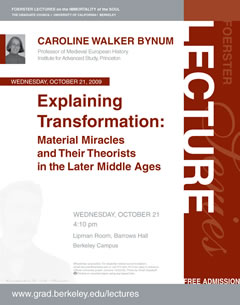
[00:00:00] ELLEN GOBLER:
Good afternoon. My name is Ellen Gobler, and I manage the Graduate Council lectures. Uh, thank you all very much for joining us today. And now it is my pleasure to introduce Dean Andrew Szeri.
(applause)
[00:00:19] ANDREW SZERI:
Good afternoon. I’m Tony Long– No, I’m–
(laughter)
I’m, I’m Andrew Szeri, uh, Dean of the Graduate Division. We are pleased, along with the Graduate Council, to present Carolyn Walker Bynum, this year’s speaker in the Foerster Lecture Series. As a condition of this bequest, we’re obligated to tell you about how the endowment supporting the Foerster Lectures on the immortality of the soul came to UC Berkeley.
It’s, it’s a story, it’s a story that exemplifies the many ways this campus is linked to the history of California and the Bay Area. In nineteen twenty-eight, Miss Edith Zwey, Zweybruck established the Foerster Lectureship to honor the m-memory of Agnes Foerster and Constantine Foerster. Edith’s beloved sister, Agnes Foerster, shared her high ideals and hopes, as did Agnes’s husband, Constantine Foerster.
A lawyer by profession, Foerster was a man of high intellectual achievements and of rare personal charm. An unusual combination, I might add. Although he passed away at the age of thirty-seven, he had achieved an enviable place at the San Francisco Bar and was considered one of the most highly respected members.
For several years prior to his death, Foerster was the law partner of Alexander Morrison, one of the most prominent of San Francisco attorneys, after whom our own Morrison Memorial Library is named. In her last days, Miss Edith Zweygbergk expressed her deep and abiding interest in the spiritual life by creating this lecture series on the subject, The Immortality of the Soul, or other similar spiritual subjects. She believed that through the medium of a great university and the words of scholarly lecturers, she might bring new light upon a subject that has interested the world for centuries.
Past Foerster lecturers have included Oliver Sacks, Thomas S. Kuhn, Aldous Huxley, and Paul Tillich. And now I welcome Professor Tony Long, a member of the Foerster Lectureship and the Lecture Committee, and a professor of classics, to the podium to introduce our speaker, Carolyn Walker Bynum. Thank you.
(applause)
[00:02:36] TONY LONG:
Well, thank you very much, Dean. Only, I’m not going to name this person. I’ve been named three times already.
Um, it’s a very happy occasion because we, on the Foster Lecture Committee, have been, um, trying to tempt, uh, Professor Bynum here for several years, and at last, we have succeeded. and, uh, we’re very pleased indeed about that. She does need no introduction, but, but she’s going to get one, although nothing like as, uh, full as, uh, one could give or as indeed, um, she would deserve.
Um, she’s renowned, of course, as I’m sure most people in this room know already, for her truly seminal contributions to the stead-study of religious life in the Middle Ages of Western Europe. In fact, um, I thought I was going to be late because the elevator in this room is terrible, and I was actually engrossed in reading about, uh, Brother… No, I forget his name.
The guy who, um, you told us about the werewolves in, um, uh, in, in Ireland in the twelfth century. That wonderful sto– wonderful story in, in the, in the book called Metamorphoses. So terrific work on women’s piety, interactions between history, theology, and philosophy, and, um, the social context of all kinds of very important and interesting ideas.
So what has she not written about? Immortality, resurrection, heaven, and if you write about heaven, I suppose you also have to write about hell. She’s explored how these conceptions shaped contemporary views of the body, the gender, and the self.
And her current work, like the topic of today’s lecture, is on the role of transformation, metamorphoses again, miracles, transformation miracles in late medieval piety. Uh, Caroline Bynum’s most recent book, Wonderful Blood, studies the piety attached to Christ’s saving blood in fifteenth century northern Germany. It’s a book that received the American Academy of Religion’s two thousand and seven award for excellence in the historical studies category and the Gründler Prize of the Medieval Institute for the very best book in any area of medieval studies published in two thousand and seven.
Her earlier books, and I’m only going to mention a, a selection here, include Jesus as Mother, Holy Feast and Holy Fast, both, I can proudly say, published by the University of California Press. The Resurrection of the Body in Western Christianity from two hundred to 1336, and Metamorphosis and Identity, which starts with the amazing story I stumbled over of Gerald of Wales’s own encounters with an all-too-human werewolf in twelfth-century Ireland. All the best historians, in my experience, are wonderful storytellers, and that quality is very evident in, uh, Professor Bynum’s work.
We always give a brief, uh, biography here, so I’d just like to tell you that Professor Bynum received her BA from the University of Michigan, uh, and her MA and PhD from Harvard University, where she’s taught, at the University of Washington, where she’s taught, and Columbia University. In 1999, she became the first woman to be appointed University Professor at Columbia, uh, a position she held until she left in– a few years ago for the Institute for Advanced Studies in Princeton, where she is now Professor of the Western European Middle Ages in the School of Historical Studies at the Institute. She’s received innumerable, uh, awards and honors, including being a MacArthur Fellow, and in two thousand one she was awarded the Centennial Medal of the Harvard Graduate School of Arts and Sciences.
A very, very distinguished, uh, career indeed. So please join me in welcoming Caroline Bynum, who will lecture to us on Explaining Transformations, Material Miracles, and Their Theorists in the Later Middle Ages. That’s fine.
(applause)
(laughter)
[00:07:04] CAROLINE BYNUM:
And now,
[00:07:05] TONY LONG:
And now- I almost took your arm.
(applause)
[00:07:15] CAROLINE BYNUM:
Be sure my lecture’s here, and Tony didn’t take it off with him from the podium. Thank you so much. I’m glad you persuaded me, uh, finally to come out here after several years, uh, which were very busy years for me.
But this is, coming to the West Coast is always coming home because I spent many years at the University of Washington, and while I was there, I had very close friends down here at Berkeley, many of whom are, are still here, and came down at one point actually to work on a textbook project with, uh, people here at Berkeley. And so I was in and out a lot. And, uh, this is a wonderful campus.
There are wonderful, wonderful people here, and I’m very grateful for the invitation to be here, so thank you very much. Explaining transformation, material miracles and their theorists in the later Middle Ages. As is well known, miracles were an important part of medieval Christianity.
Although Protestants in the sixteenth and seventeenth centuries debated whether the age of miracles had ended with Christ’s ascension or with the triumph of Christianity under Constantine, most medieval theologians thought miracles continued into their own day. However much preachers might emphasize inner virtues, miracles remained crucial signs, even proofs of sanctity. Recent historians have been much interested in medieval discussions of the supernatural and have agreed that it was only in the early modern period that a theory of miracle as an event that violates the laws of nature was clearly worked out.
They’ve emphasized that theologians after Thomas Aquinas did understand miracle as something above or beyond nature, but they’ve also stressed that medieval writers continued the New Testament tradition of understanding miracles and marvels as signs of God. In the wake of the recent flood of studies of the marvelous and the bizarre, much attention has been devoted to the theoretical distinctions medieval thinkers worked out between magic and marvels, which we do not understand, but which might be explained naturally if we did understand them, and miracles, which are done by God beyond the ordinary regularities of the world. But reading medieval texts makes it quickly clear that for all the occasional theoretical distinction, the terms marvel and miracle were used remarkably fluidly.
Now, I don’t want to talk today about miracles generally, or even about the theoretical distinction between miracula, miracles, and mirabilia, marvels. Rather, I want to discuss a particular kind of miracle, the transformation miracle. That is a miracle in which material or bodily stuff metamorphoses into something else.
Aha, now a miracle. We’re going to see this return. Okay, she’s going to type in the password while I continue to, to lecture.
All right, the transformation miracle, this is my subject, so this is a, an important definition. It’s a miracle in which material or bodily stuff metamorphoses into something else, often remaining as such and becoming a place of pilgrimage or cult. I argued that this type of miracle became more common in the later Middle Ages, especially the fourteenth and fifteenth centuries.
Some miraculous transformations were even creations of the late Middle Ages. In this lecture, I shall treat not only their appearance, but also some of the theories intellectuals evolved for dealing with them, and the conception of matter that lay behind their discussions. Now, of course, material objects were central to Christian practice throughout the Middle Ages.
Despite the arguments of learned theologians that images only gesture toward the saints and the divine, people behaved in some cases as if they were the saints. Moreover, holy matter was prominent in other ways, as relics and contact relics, sacraments and sacramentals. Indeed, such objects tended to be conflated.
Some panel paintings and three-dimensional sculptures contained relics. Hence, what modern art historians would call iconography or image of actually became the thing itself. You can see in this slide, uh, of the, uh, Karlstein Chapel that here Christ has a relic of the True Cross in his chest, a relic of the crown of thorns in the halo, a relic of the nail in the nail, a little bit of the sponge here, and a relic of the lance that pierced his side in the side wound.
So obviously here we find that relic and image, uh, have become conflated. But conversely, animated images and transformed Eucharistic wafers became relics. In other words, here you have an image which is becoming a relic because relics are embedded in it, but you also have material objects which themselves, uh, become relics, asserting their transcendence, that is their more than ordinariness, exactly by asserting their materiality.
Indeed, we often do not know whether late medieval monstrances, that is, containers, contained relics, the Eucharist, or other holy things. If the contents have been lost, as they often have, because art historians are often interested in the container and not the contents. And if the contents have been lost, we often don’t know what kind of holy matter was in it.
So parallel, so similar were the ways liturgically and devotionally in which these very different kinds of objects were treated. It was only in the period after eleven hundred, however, that certain kinds of transformed and animated materiality began to appear. A vision received by Peter Damian in about ten sixty is usually considered the first case of a claim literally to drink blood from the crucifix.
Assertions that bodies were literally and miraculously branded with the cross first appear in accounts of the first two crusades. The earliest cases of stigmata are late twelfth century. By the fourteenth century, they are often depicted as inscribings into the body of the adherent, not by Christ, but by a devotional object, the crucifix.
This is a very, very typical, um, medieval depiction of the, uh, stigmata of Francis, and you can see that the miracle is not presented as the impression of Christ in Francis. It’s the impression of the crucifix on which Francis was meditating at the time into, uh, Francis’s body. So it’s the devotional object that has the impact that is inscribed into the body of the saint and not Christ’s body per se.
And as we know from Katie Park’s work, 15th-century canonization processes began to investigate the physical interiors of holy bodies, especially female bodies, to look for material proof of sanctity, such as marvelous kidney or heart stones incised with religious scenes. Eucharistic visions were recounted in late antiquity and the Carolingian period, but, and this is the important point, these early visions are accompanied by prayers that God return the transformed flesh and blood to bread and wine so people will not be afraid to receive it. In other words, the early texts warn against making any claim that the transformed stuff endures.
What German historians called Dauerwunder, that is miracles in which the Eucharistic wafer or the wine is transformed into flesh and blood and remains as such, appear around 1200 They’re found in large numbers after twelve ninety. Now, here you have an image of one such, uh, miracle host. The miracle was alleged to have occurred before fourteen thirty-three.
There are vague, uh, allegations of Jewish desecration, but we don’t actually know the origin of the object. What we have, however, is the object was given by the Pope Eugene IV to, uh, the Duke, uh, of Burgundy. This particular pope was an enthusiastic supporter of these kinds of material miracles.
And, uh, we then— what we have here is a miniature depicting the miraculous object in the monstrance, so made about 60 years or so, uh, after the alleged miracle. This is one of these Dauerwunder. In the Mark Brandenburg alone, the area of northern Germany in which I did research for my last book, which Professor Long mentioned, The Wonderful Blood, there were dozens and dozens of such claims by the mid-15th century.
Most instances of animated statues and paintings are fourteenth and fifteenth century. And what is particularly significant for my argument is the fact that animated images are usually themselves older objects that have recently been neglected and revived one or two hundred years later to reinvigorate the cult. Here, for example, uh, is, uh, the image from Prato in Italy, which is still venerated today.
Uh, in this case, it’s a fourteenth-century image that supposedly came alive in the fifteenth century. A child, uh, supposedly saw the Virgin get down from the wall and walk around, and he ran and told other people, and they came, and the Virgin smiled at them, and she winked at them, and so they got the bishop, and the bishop came, and cult was established, uh, and this image is still, uh, venerated today. Relics that bleed, ooze, transport themselves through space, glow with light, or even create other material, such as manna.
I mean, a number of saints’ tombs are said to create their own kind of miraculous manna that, that falls from heaven on, uh, devotees who come. So these, all these kinds of objects which animate and even possibly produce stuff are often, uh, older objects newly come to life. The blood of Saint Januarius in Naples that has liquefied several times a year since the fourteenth century is supposedly a fourth-century relic.
It took it a thousand years to decide, uh, to regularly come to life. Moreover, such transformed objects were regularly alleged to transfer their power via contact with physical copies of themselves. Sometimes clay models actually made of holy dirt impregnated with the saint’s body or with Eucharistic blood.
So in this kind of case, where a pilgrim taking away from a site an image of the miracle which is actually made from the dirt of the tomb is, you see, it’s both an image and it’s a physical contact carrying, uh, the, the, the sacred power with it. Although freestanding sculptures emerged by the Carolingian period and were sometimes themselves a conflation of relic container and mimetic representation, religious art objects of all sorts proliferated in the late Middle Ages as village churches became able to commission statuary, altarpieces, and panel paintings, and aristocratic laity to purchase illuminated manuscripts and small devotional objects. Such objects sometimes called attention to their materiality and transformative power quite overtly by tituli, which explained that the devout should fondle and kiss them in order to receive rewards.
Here you have, uh, two examples. On your right, you have a devotional object which you can see is actually abraded to the point of being effaced by people kissing the central part of the object. Here what you have is a s-, a devotional object representing something similar, that is the wound of Christ, and what you have is the tituli which tell you that you should kiss it.
Indeed, this is a, a, you know, very interesting object because the, um, uh, the little cross in the middle, um, what it says on this side is that if you multiply it by forty times, you get the actual length of Christ. And then if you kiss it, you get, um, seven years of indulgence from the Pope. So you can see the tactility, the physicality o- of, uh, these objects.
At the same time that all this is happening, of course, as all of you know, image hating and image bashing increased, as did spirited rejection of relics and Dauerwunder. This is the period, obviously, of, uh, medieval iconoclasm. As many historians have noted, the fury of such attacks suggests how highly charged is the matter that must be destroyed in these assaults.
Behind such phenomena, both enthusiasm for transformed materiality and the need to destroy it, lay a keen sense that matter is powerful, hence dangerous, because labile and alive. Now, there was considerable confusion, both conceptual and practical, about this sort of Christian materiality. In an effort not so much to explain away this confusion, which is itself instructive, as to probe for the assumptions and anxieties behind it, I turn now to address directly what some philosophers and theologians said about holy matter.
I do so by looking especially at a few of the many places where they treat the topic of miracles. That is, cases where matter, under the direct action of God, ruptures the order of nature God himself has established. In what follows, as you see on the outline, I’m going to do several things.
Having given you examples of the kind of miracles I’m talking about, which is point one on the outline, I shall now argue, point two, that the problem of miracles was, to medieval intellectuals, a problem of the nature of the material. Then, point three, I shall consider briefly some conceptions of matter available to late medieval thinkers. Finally, I shall argue that both theologians and natural philosophers tried to use the understandings of matter available to them to rein in the miraculous conceptually without denying it entirely.
In discussing this, I shall underline the basic contradiction lurking behind all this ratiocination, the fact that the very understandings of matter that provided conceptual tools for limiting change contributed to a growing sense of it as dynamic substratum. Hence, late medieval conceptions of material transformation paralleled the behavior of actual transformed objects, which simultaneously proliferated and aroused increasingly acute opposition. So the kind of theories that you have are increasingly trying to control the thing, but the theory itself is making the thing more apt to happen.
And this is exactly what the things themselves are doing. Uh, they’re, they’re– these kinds of materials are, uh, miracles are happening more and more, and yet people’s anger, people’s hostility, people’s need to destroy it, you all know what I’m talking about, Lollards, Waldensians, Hussites, this kind of thing is, is increasing at the same time. In the later Middle Ages, theologians and natural philosophers spilled a good deal of ink discussing the miraculous, but their focus seems to us an odd one.
From the twelfth century on, the miracles actually recorded as worked by holy people were overwhelmingly miracles of healing. But the paradigmatic miracles discussed by intellectuals were materials– uh, miracles of material transformation, especially the wedding at Cana described in the Gospel of John, where Christ changed water into wine, and the contest between Aaron and Pharaoh’s magicians in Exodus seven. Indeed, healings, resurrections, and exorcisms were themselves treated as questions of the manipulation of bodily stuff, and delineating exactly how spirits, either angels or demons, might interact with and employ bodies received a great deal of attention.
In the twelfth century, Peter the Venerable argued that the distinction between counterfeit miracles, such as those of Pharaoh’s magicians, and true Christian ones, was not only that magic had a natural cause, and miracle a cause beyond nature, but also that counterfeit miracles vanished quickly and take much education to perform, whereas Christian miracles are solid and real, firmly rooted in matter. A century later, Albert the Great explained that both the marvelous and the miraculous result in real transformation, and stated decisively, quote, “The method of miracles is this: the transformation of matter.” To Aquinas, it is exactly because demons cannot fundamentally alter bodies that the rods made by Pharaoh’s magicians are only magic and manipulations of natural change.
Whereas Aaron’s seemingly exactly similar rods are miracles. That is, real and preternatural transformations of matter. The fourteenth-century philosopher Nicholas of Autrecourt, one of the very few medieval thinkers to espouse atomism, used a complex argument about balance in the universe to suggest that bodily resurrection is possible because, quote, “If a man who exists now ceased to exist here in our hemisphere and were caused elsewhere, and again ceased to exist there sometime later and then were caused here, he would be said to have risen.”” Unquote.
Autrecourt’s discussion is not so much a fully naturalized explanation of resurrection, which almost all theologians took to be a miracle, as an analysis of the particulate nature of an eternity of matter. Even efforts we would not consider to be physical were understood as such. Fascinated as were other medieval thinkers by examples of action at a distance, the fourteenth century theorist Nicole Oresme argued that only bodies can act on bodies.
If a body acts on another body across intervening space, what really happens, says Oresme, these are examples like magnets and things like this, what really happens is that the configuration, the geometrical pattern of the first body or its member is altered. That configuration then alters the medium between it and the affected body, which is then itself altered. So you see, it’s a physical process.
By the fifteenth century, much of the discussion of witches, which had earlier involved the charge that it was heresy to believe witchcraft possible, came to focus on ways in which witches might manipulate alien bodies to achieve physical results, such as riding animals or collecting sperm and impregnating women. In the same period, Jean Gerson described the great twelfth-century saint, Bernard of Clairvaux, as quote-unquote, “invaded by something when the power of miracle came over him,” just as Jesus felt something go out of himself when the hemorrhaging woman touched his garment in Luke 8:46. It is as if Gerson has to think of spiritual power as a quasi-physical thing entering and exiting the body.
Although, interestingly enough, there is no source for this way of putting it in the original text Gerson draws on, so he’s physicalizing it as he interprets it. My point is not that all these theorists were making the same argument. Oresme’s theory of configurations, for example, was almost unique in the fourteenth century, significant though modern historians find it as a step toward the mathematizing of explanation.
My point here is simply to underline that events and objects understood as unusual or miraculous tended to be analyzed in the late Middle Ages as material changes. To intellectuals, miracles were a matter of matter. Now, I cannot here give a survey of medieval conceptions of matter and the problems they raised, but I want to say a few words about the major texts philosophers and theologians drew on.
I began with Isidore of Seville, whose etymological dictionary provided basic definitions for the entire Middle Ages. Isidore says, “Matter is always accepting with regard to something. Hence, we say the elements are the matter of things that are made from them.
Indeed, materia, matter, is named from mater, mother.” It was perfectly easy to see that. Mater is in materia.
In its essence, therefore, materia is fertile and capable of becoming. Moreover, discussing corpus, body, and caro, flesh, Isidore says, quote, “Corpus is called from the fact that something being corrupted, corruptum, perishes.” Again, you see corpus is in corruptum.
“For it is soluble, and mortal, and able to be dissolved.” Caro, however, is called from creating. Corpus and caro signify differently.
Body can be said of something after life has departed, and of something that has been brought forth without life, and sometimes they’re bodies without flesh, as, for example, grass or trees, unquote. Now, the way such etymologic– eh, etymology works in the Middle Ages is that the structure of the word is the structure of the reality to which it refers. So if something is in the word, it’s in the thing.
That’s how this kind of thinking works. So if mater is in materia, materia is maternal. It is labile, fertile, percolating.
If corrupt is in corpus, then this means that corpus is that, um, which changes. So it’s the nature of body and flesh to be passing away and coming to be. Moreover, to Isidore, as you can see here, corpus means something closer to living thing or even thing than to human being.
So you know, all this, this modern stuff about the body in the Middle Ages, but the body in the Middle Ages was Isidore’s corpus. It was a thing or living thing. It wasn’t necessarily only or even particularly the human body.
This understanding of matter and body, that is, of both, is by definition changing ontologically as well as etymologically. Change is, is in, uh, things i-itself, is an understanding that operated throughout the Middle Ages. It’s especially clear in late medieval discussions of alchemy.
For example, when Giles of Rome asked in a quodlibetal question of about 1300 whether people can make gold, the possible arguments he gives for the proposition include both the fact that human beings can make glass and the fact that Pharaoh’s magicians made serpents from staves, are both natural processes. Giles then goes on to classify different forms of generation: horses from equine menstruum, bees from the decaying carcasses of cattle, wine from grapes, and gold from other metals deep in the earth. The difference, he says, is the place and form of generation.
They’re all described by him as generatio. Difference is they’re in different places and have a different form, but it’s the same ultimate process. Now, what interests me about this is the fact that what we would call normal physiological production, that is fetus from uterine material, what we would call spontaneous generation, that is bees from decaying flesh, and what we would call mechanical production, that is glass from sand or if possible, gold from lead, are treated as parallel cases in this kind of discourse as far as the production of body is concerned, and that production is conceptualized as generation.
This sense we find in Isidore and much later in Giles of Rome that matter is fertile, maternal, labile, percolating forever, tossing up horses, bees, glass, or gold, was enhanced in the High Middle Ages by the enormous influence of two works: the opening and closing books of Ovid’s Metamorphoses and Aristotle’s essentially biological model of change in his On Generation and Corruption. Following these ancients, medieval thinkers assumed that at least in the sublunar world, to be was to be about to change. I give three examples: Bernard Silvestris, and Nicola Rem, and Nicola Tignosi da Foligno.
In the twelfth century, Bernard Silvestris’ his magisterial allegorical poem, the Cosmographia, gave a very Ovidian account of creation. Indeed, as Brian Stock remarks, “Matter is the heroine of the Cosmographia, fighting death by perpetuating species.\” Sometimes a chaos of primitive and warring elements longing to be reborn, sometimes a more abstract substratum, Bernard’s matter draws from two rather different treatments in Ovid. It is both the rough and teeming mass of Ovid’s Book One and the perduring, the lasting reality of the more Pythagorean account in Ovid’s Book Fifteen.
What’s especially important about the Ovid reception of the later Middle Ages, of which Bernard’s poem is probably the single best example, is the fact that poets, natural philosophers, and commentators persistently emphasize the two parts of Ovid that deal with matter and change over the more moral or immoral stories that come in between. In the later thirteenth and fourteenth centuries, new conceptions of matter, very different from the teeming mass of Ovid or the maternal corpus of Isidore, became commonplace among intellectuals. Change came to be understood in line with Aristotle’s doctrine of contraries.
That is the idea that material qualities come to be and pass away within a narrow range defined by the contraries. Both a principle of change and a limitation of change, Aristotle’s matter is what accounts for going from one thing to another. Caterpillar to butterfly, ice to water, whole log to cut wood.
To Aristotle, change is real because matter is not a thing itself. Now, obviously, if a matter is a thing itself, it would endure and change would be only superficial. Matter is not a thing itself to Aristotle, but because a potency to be something else accounts for particular changes, change is not inexplicable or arbitrary.
A thing has a potency to be some other things and not other, other things. Hence, Aristotelian concepts rein in a sense that change might be completely random without making change only superficial because there’s something there that endures. Nonetheless, understanding change continued to be a major metaphysical worry for those who studied Aristotle.
Nicole Oresme, for example, pointed out that we cannot even think without the concept of transmutation. Commenting on the Generation and Corruption, Oresme, like a number of his contemporaries, gave a strictly Aristotelian theory of change, making matter the potentiality to be not A that guarantees identity and the change of A to not A. Oresme said, quote, “We say that the fact of contraries is the cause of corruption. And this is proved because all corruption is by the alteration of the previous.
Therefore, it follows that everything having a contrary is at some time corrupted. And thus because the same thing is the matter of contraries, therefore they succeed to each other in the same matter. And thus matter which is under one contrary is in potency to this, that it can be under another contrary, which, unless it occurs, it would follow that this potency would be frustrated, unquote.
Now, this kind of an interpretation might seem to suggest that unlike Ovidian matter, Aristotle’s matter has no characteristics. It would then be only that which accounts for the fact that we can say we’re dealing with the same thing when a previous something becomes a posterior something. All the essence, the definition, the whatness of the thing would be accounted for by the form.
But as Zoe Bozenberg has pointed out, this is not really Aram’s understanding. Matter to Aram is not empty potency. The use of the word frustrated in the passage I just quoted suggests indeed that matter has a certain dynamic quality.
It is characterized on the one hand by privation or lack; turpitudo is a Ramist word, which is a sort of desire for form, and on the other hand, by a tendency toward persisting. Conatus is a Ramist word. Hence, it would seem that even after the reception of Aristotle, natural philosophers continued to have a sense of matter as more labile and fertile than Aristotelian texts taken strictly would have suggested.
Indeed, many of those who used and commented on Aristotle spoke as did Oram of a kind of propensity or yearning in matter. Albert the Great held, for example, that there was a confusion in the heart of matter that could cooperate in the generation of creatures. Although some Aristotelians rejected this, a number of theorists such as Bonaventure and Henry of Ghent continued to hold to a sort of autonomy or actuality or desire in matter.
In the thirteenth and fourteenth centuries, then, even Aristotelian matter had certain affinities with the percolating stuff of Ovid and Bernard Silvestris. Moreover, in the fifteenth century, Neoplatonic interpretations, which had always accompanied Aristotle in the High Middle Ages, contributed to the tendency to give the whole material world a labile, dynamic, almost animate quality. Although the twelfth-century reception of alchemy had doubted the possibility of transformation– of transmutation at all, there was resistance to alchemical texts when they first came in, later authors began to understand all matter as animate.
The development of the i– the idea of an alchemical quintessence led to theories of a vital stuff diffused throughout the cosmos. Marsilio Ficino, for example, related alchemical quintessence to a spiritus mundi, that is, a soul or spirit of the universe. Using Neoplatonic theories, intellectuals also debated the relationship of heavenly bodies to Earth.
It was after all clear that the heavens do influence earthly change and fertility. Tides correlate with the phases of the moon. Seeds need sunshine to germinate.
Tadpoles appear quite suddenly in apparently empty ponds after rain. Not all worldly change is as obviously the production of like by like, as is the birth of puppies from dogs. Moreover, I mean, you’ve got to explain these things.
Moreover, theories of astral determinism derived directly from the ancients or from Neoplatonizing Arab text contributed to a heightened and anxious interest in the role of the heavens in worldly affairs. Hence, philosophers asked whether earthly changes occurred through the induction or eduction of forms by celestial intelligences. That is, through a process whereby these intelligences impregnated matter with forms or drew forms out from matter, and queried whether something like a Platonic idea was a necessary intermediary in this process.
Two treatises on Platonic ideas attributed to a certain Niccolò Tignosi da Foligno, who was a physician and teacher of both logic and medicine at Florence, provide an example. At issue was whether things generated in cases where like does not produce like are generated by the heavens acting directly or involve the Platonic ideas. The examples given in both Nicola’s treatises are the birth of a mouse from putrefaction and the generation of fire by striking stone and iron together.
I mean, already striking that these two processes are taken as analogous. Now, I’m not concerned here with Nicola’s abstruse discussion of astral influence. What interests me are two points, his queries about and his definitions of change.
So just now listen to what these passages are going to say. First, we have to note his assumption that a wide variety of changes are parallel and can be explained as form acting on matter. As I just said, there’s no theoretical difference for him between the production of fire from flint and the birth of an animal from slime.
Both are generation. What needs explaining is the emergence of not like from like and how the stars produce it. Second, we should note the actual definitions of matter at play here.
Attempting to sort out the very complicated issues raised along the way, the author concludes, “If anyone wants to interpret rightly the statement, form is deduced from the potency of matter, other than it is commonly understood, he must say that matter is subsumed under three headings. First, for that which is pure potency, which is the nonexistent part of a natural thing. Second, for a thing which is opposite, that is, for that from which something is made, so that that from which it is made is not non-existent, as for example, fi-fire is made from air.
And third, for a natural agent.” Unquote. In the ensuing explanation, the second meaning of matter is the four elements.
The third refers to that from which the form is made in the process of generation, and Nicholas says, quote, “So that the substantial form which is generated is educed from the potency of matter, that is, from the active potential of the material agent. And by this material agent, I understand, in the way of the theologians, every agent which includes in itself imperfection, which are all agents except the first, God.” So you can see what’s happened to matter.
Right? Matter has three meanings. First, it’s the pure potency that you might say is, is in the strict sense, Aristotelian matter.
Second, it is that from which something is made, and third is its natural agent. All these things are materia, matter. He understands– So Nicola understands matter not only as stuff rather than his simple potentiality, but also as dynamic stuff.
Indeed, matter is all the stuff of creation, forever in motion, exactly because imperfect, in contrast to the perfection of God. So by this point, the whole universe has become materia in, in a sense. Now, this understanding of matter is in some sense dynamic, as possessing power or desire within it, does not run in a straight line from the Neoplatonic and Ovidian writings of Bernard Silvestris and his twelfth-century contemporaries to fifteenth-century figures like Tignosi and Ficino.
The thirteenth-century recovery of Aristotle did make a difference. And as I suggested, Aristotle’s matter is not a substance, hence it’s less labile in itself than the matter of twelfth or fifteenth-century theorists. Moreover, fourteenth-century scholastics such as Oresme were less concerned with matter per se than was, for example, Bernard Silvestri’s.
They were suspicious of ideas of animate matter, whether alchemical or cosmological, although change, especially in the form of local motion, remained a pressing question for them. The theories of matter we find in natural philosophy from the twelfth to the sixteenth century are not all the same, nor do they show a continuous development from the world soul of some twelfth century commentators on Plato to Ficino’s Soul of the Universe. Nonetheless, even the theorists of the thirteenth and fourteenth centuries who opposed the possibility of living stars or alchemical manipulation tended to assume, almost in spite of themselves, a basic dynamism lurking in matter.
Now, this kind of understanding of matter, I’ve taken you, you know, on a brief tour through the Middle Ages, but it– I think if we’re gonna talk about theories, you have to understand the theories, uh, and the base. This understanding of materiality was, theologically speaking, a problem. If matter was by definition the great roiling mass of Ovid’s Metamorphoses, or even the active potential of Nicola of Foligno’s material agent, then the eruption of the sacred in Dauerwunder, for example, or in animated statues, was easy to envision.
Its continuing presence, its stasis or endurance, became difficult of explanation, however. If things were always coming to be, were they not also always passing away? To Isidore, after all, corpus was related etymologically and thus ontologically to corruptum.
That’s what it is to be a thing. And was not such passing on, such corruptio, a threat if it touched the divine? Remember we’re talking about miracles where the divine appears in matter.
In the controversy over the miracle host at Wilsnack, for example, there were theorists such as James of Clusa, who claimed not only that the deteriorated stuff revered in the fourteen fifties could not be sacred because it had decayed, but also that if it later decayed, it could not have been holy in the first place. So it– when it appeared in 1383, you look-looking back, you know, retrospectively, you say, “It couldn’t have been holy then because now it has decayed.” God cannot change.
His body does not appear and disappear. So clearly, the fact that sacred things pass away was a problem. But even coming to be was a problem.
Materiality needed to be controlled conceptually and ecclesiastically. Neither church authorities and theologians nor natural philosophers could tolerate a world in which anything might erupt anywhere. Hence, they devised theories that controlled, that is, limited, miraculous change in a variety of ways.
They did this sometimes by reducing it to mere appearance of transformation, sometimes by admitting it, but hedging it about with explanations that involved as little change as possible. It’s to this point, the efforts of theorists to rein in the miraculous without denying it, that I now turn. This is part, uh, 4B here on the outline.
So I’m not arguing that here are these guys, they’re just naturalizing miracles. If they were, that wouldn’t be all that interesting. You know, I mean, once Hume says it, he said it.
But what’s interesting is that they can’t naturalize miracles completely, but look what they’re doing in order to rein them in in all kinds of ways short of simply denying or naturalizing them. Okay. A number of theologians held that Dauerwunder were not real change of accidents, that is, appearance.
The real change in the Christian Eucharist was, of course, the substantial change of bread to flesh, but this was invisible. Indeed, it was part of the definition of transubstantiation that accidents do not change. Hence, most theologians held that if an individual or a group saw a host or communion chalice changed to blood, they were not seeing the substance of Christ in the Eucharist, but an effect produced by God in their imaginations.
So the theorists are, in a way, substituting one kind of miracle, of, for another, but you cannot see God in transubstantiation because it’s exactly the definition of transubstantiation, that you can’t see the substance, and the accidents don’t change. Those wonders might be miracles, but they were not miracles of seeing God. Building on theories that went back to Augustine of Hippo, theologians by and large made similar arguments about the bodily metamorphoses that so fascinated late medieval people.
The change of humans into animals or werewolves, supposedly caused by witches, demons, heredity, sin, or the moon. For example, Heinrich Kramer, in the notorious Malleus Maleficarum, The Hammer of Witches of 1486, argued that witches could make men believe they had lost their genitals by hiding them from view, or act on the senses and the imagination to delude people into, quote-unquote, “thinking they see marvelous things such as beasts or other horrors, when in actual fact they see nothing.” But witches cannot, in a strict sense, turn people into beasts.
Thus, some intellectuals between the thirteenth and fifteenth centuries dealt with the supposed miraculous miracle, a magical or marvelous changes by claiming them to be the mere appearance of transformation or one kind of appearance and another sort of miracle. But theologians and natural philosophers also limited or naturalized the physical changes involved in miracle. We see this in two moves.
First, explaining physical change by internal mechanisms, even if they’re used supernaturally. So you keep some kind of supernatural element, but you actually come up with a natural explanation for the change, even if it takes God to trigger it. And second, explaining bodily occurrences, even in Christ’s body, by natural physiological processes.
The first move made use from the twelfth to the fourteenth centuries of an idea inherited from Augustine of Hippo that fit particularly well with an Ovidian sense of nature as a percolating mass of forms. This was the idea of seminal reasons. Seeds of later things or incipient forms or patterns of development implanted by God at creation.
The idea that bodies bore seeds of other bodies they might generate or become was used by a number of intellectuals to explain miracles or elucidate doctrines such as transubstantiation. It was an idea that closely controlled the nature and direction of change without, as I said, naturalizing the miraculous completely. In the twelfth century, for example, both John of Salisbury and Rupert of Deutz explained the miracle at Cana thus, that is, the change of water into wine.
There are seminal reasons in things that unfold in preordained time. Trees draw up water into grapes and make wine. If God speeds this up and turns water into wine without the intervening steps, we call it a miracle.
Okay, so you’ve got a– In a way, you’ve got a natural explanation. The divine element is the speed up.
Theories of seminal reasons lasted into the fourteenth century, but there were other concepts that could be used to limit change. Hugh of Saint Victor seems to have had a theory of atoms that explained the production of Eve from Adam’s rib. And as I said earlier, Nicholas of Autrecourt explained resurrection atomically by that vaporization and recondensation.
Roger Bacon gave an analysis of resurrection as the reduction of body to prime matter and the induction of the same form again. Although not denying the miraculous nature of the event entirely, this discussion analyzes it in terms of a natural process like that debated by contemporary alchemists. Oram, commenting in The Generation and Corruption, naturalized the effects of the Eucharist, but not the Eucharist itself, arguing, “It is a miracle that accidents are present without a subject, but not, however, a miracle that these accidents act on other accidents or substances.
Hence, the Eucharist can feed those who eat it. In addition to such models as seminal reasons, atoms, configurations that can be employed to explain extraordinary or miraculous change, a number of late medieval theologians and natural philosophers used physiological theories, such as the traditional Galenic idea of the humors, to categorize anomalous bodily events. Around thirteen hundred, there was, for example, discussion of whether the bloody sweat Christ shed on the Mount of Olives was naturally or supernaturally produced, and whether his death on the cross was a result of bleeding or an act of his will.
Fifteenth-century debates about the relics of Christ’s blood at places such as Westminster, Weingarten, and La Rochelle entailed determining whether the blood Christ shed on Golgotha was superficial nutritional blood generated from food or the blood of the so-called core of human nature. You’ll probably be glad I’m not going to explain these debates, uh, in detail, but the interesting thing is that scientific theories are being employed, not as I say, to completely naturalize, but to go a long way towards naturalizing so that you can understand scientifically the process that’s going on, even as I say, if God has to trigger it. They did similar, very interesting sort of discussions with, with stigmata, uh, which, which come close to some kind of maybe even modern sort of psychological understandings, because they, they talked about how the imagination between the upper and lower elements of the intellect and the body would actually– God would have to cooperate with it in order to produce physiological effects.
Okay. In order to give you a more detailed example of how medieval intellectuals used theories of matter to limit without denying miraculous change, I turn to an example, and I’m gonna talk about a little bit more, and this is my last example. This is Jan Hus’s two treatises on Christ’s blood from fourteen oh six to seven.
Treatises that were produced for the ecclesiastical commission appointed in Prague to look into the claims of the Wilsnack miracle. And here, just incidentally, is the Wilsnack, uh, church as it is today, on the chest where this– these miracle hosts were kept, um, in the fifteenth and early sixteenth centuries before the actual miracle, uh, was destroyed. Hus dismissed effluvial relics, such as the Holy Foreskin and the Blood of Christ, labeling them mere visible signs for the faithless.
He rejected as fraudulent transformation miracles that were associated with the Wilsnack Host. It supposedly had produced resurrections from the dead. It had turned staves into swords and vice versa, this kind of thing.
He rejected all this, and he suggested that preserving supposed blood relics and host miracles was akin to, quote, “venerating horse’s blood smeared on wafers by lying priests,” unquote. To revere such bits of matter was to denigrate God. Yet Hus admitted the absolute power of God, and that it could cause Christ’s blood to remain behind on Earth.
But the theory of concomitance, that is the theory that part is whole, Christ’s blood is wholly present in every celebration of the Eucharist, hence it could be on Earth as well as in heaven, uh, in glory. And Hus employed technical Aristotelian terminology and natural philosophical analogies to explain the possibility both of blood relics and of another singularly unnatural occurrence, the resurrection of the body at the end of time. Apropos of blood relics, Hus asserts that redness might remain on tunic, that is Christ’s tunic, or the sweat cloth, or on the bread of the Eucharist, apart from the substance of Christ’s blood, just as accidents remain in the Eucharist when the substance changes.
So it’s a kind of transubstantiation, but in reverse. In transubstantiation, the substance changes, but the accidents stay bread and wine. Here the idea would be that the accidents of the blood can appear on the miraculous objects, but the substance of Christ’s blood is not there because it’s, it’s in heaven.
He– So this is a possible explanation. He insists, however, that if this kind of redness appears, the redness would be a miracle caused by God, but only, quote, unquote, “left in memoriam,” unquote.
In other words, he has to admit the possibility of blood relics, but he uses technical substance-accident language, both to explain the possibility and to claim that the present redness, even if created or permitted by God, is not the substance of Christ. Apropos, the blood of Christ’s circumcision, Hus writes, quote, “And it is possible that the blood of Christ, which flowed out from his body in the circumcision, was substantially converted into something else according to form, or that the blood, if drained out on the cross and converted to vapor by the heat of the sun, reverted then by His power on the day of resurrection to its proper form, and this was the same blood in number as in form.”” “”Nor should the faithful fear that they will not receive again their bodies because wild animals have eaten them, for in the resurrection, all will be glorified,” unquote. Now, there are a lot of interesting things in that passage.
We see Hus using Thomistic notions of formal identity, how something can be the same thing over time because the form is the same, that’s a philosophical argument, and natural philosophical understandings of vaporization to render the miracle of bodily resurrection as credible as possible, logically and scientifically. Because form carries what a thing is, the return of substantial form to matter, which has in the meantime had another substantial form, can make the entity the same thing it was before. Things converted to gas or vapor above the sun can recondense.
So philosophical argument, scientific argument. Hence, even the blood shed in crucifixion days before or in the circumcision, years before, about 32 years before, can be reassembled for resurrection, just as moisture returns out of the air. And at a technical sense, it will be the same salvific blood of Christ.
Now, Hus’s point is not, of course, to limit material change or to rein in the miraculous per se. To him, the devotional and theological agenda is paramount. What he wants to restrain is false piety.
What he asserts most passionately is the soteriological significance of the resurrection of the dead. He uses the natural analogy of vaporization to assert that all Christ’s blood rose with Christ because he wants to limit pilgrimage to blood relics and Dauerwunder. He uses Thomistic language of form and substance because to him, the return of bodies at the end of time is central to the Christian hope for personal salvation.
His argument constrains one kind of miraculous change, the eruption of blood on sacred objects, but supports another, the resurrection of every bodily particle. Moreover, he employs the language of formal identity to bolster faith in God’s power to do the truly astonishing, raise the dead, although he denies that God did so at Wilsnack. Using metaphysical and scientific language, Hus restricts certain kinds of miraculous change while supporting others.
He demystifies, makes intellectually accessible, even naturalizes certain aspects of holy matter. What he does not do is either deny God’s power to transform matter or leave it without explanation. And I argued this is a typical fifteenth century, fourteenth and fifteenth century move.
Now, I could give many more examples of such types of argumentation, but I won’t. And I hope I’ve now demonstrated that behind the discussion of university theologians, devotional writers, and natural philosophers about miracles lay a quite ambivalent fascination with material change that coincides with the contemporary proliferation of transformed images, relics, and Dauerwunder, and the increasing anxiety about them. Chronology is important, although for such changes in attitude, it is necessarily not very precise.
People don’t wake up one morning and have different attitudes from those, uh, they had the day before. Nonetheless, I must underline that it is in the fourteenth and fifteenth centuries when Dauerwunder and other transformation miracles proliferated, accompanied by theological efforts to deal with them, that we find a shift in other sorts of theorizing. Whereas in the twelfth and early thirteenth centuries, the newly received alchemical texts were accompanied by glosses that suggested that alchemy was not possible, that species were inviolable.
By the fourteenth and fifteenth century, there was growing confidence that species could be transmuted. Gold could be made if only the correct formula were found. Twelfth century ideas of a world soul or of matter as Ovidian fecundity were succeeded in the late thirteenth and fourteenth centuries by a more Aristotelian focus on local motion and an opposition to ideas of a living heaven.
But these were followed in the fifteenth century by the return of Neoplatonic ideas of the soul of the universe. Twelfth-century stories of werewolves and other bodily transformations, although very popular, insisted that such changes were basically only apparent. By the later fifteenth century, some theorists hinted that people really became wolves.
There continued to be resistance to the idea that witches actually turned people into beasts or snatched away their body parts, but they were increasingly persecuted for creating widespread illusions of change. Some among them and among their persecutors did believe they could cause such metamorphoses. By the later Middle Ages, astrology flourished, and intellectuals devoted a great deal of discussion not only to ways in which the stars controlled earthly events, but also to material changes they caused here below, such as the birth of hermaphrodites and monsters.
Now, there was, as we have seen, no one medieval understanding of matter. From Isidore’s materia as mater and Bernard Silvestris’s teeming mass to Nicola Ram and Nicola Tignosi’s several different understandings of matter as potency, there was a wide range. And as I’ve just underlined, the understanding of matter as animate increased markedly in the fifteenth century.
But as I’ve also demonstrated, I hope, most medieval theorists assumed a material substratum with some dynamic aspects. Moreover, for all their efforts to categorize objects, effects, and types of generation, their primary distinction in treating the natural world was not, as the texts I’ve talked about makes abundantly clear that between animate and inanimate matter. Not only was matter understood as by definition that which changes, the paradigm for change was biological process.
Theorists did, of course, distinguish living from non-living, and more frequently artificial from natural or human from non-human. But they usually spoke, um, that is, they had the apparatus for doing this, and when they comment in technical ways, they’re perfectly capable of making, making this distinction. But they usually spoke as if they assumed all change to be what we would call organic generation and decay.
Nicole Oresme analogized gases in the earth to vapors from decaying corpses. The alchemists generally talk about the growth of metals in the earth as analogous to, you know, the growth of plants. Nicholas of Autrecourt and Jan Hass understood as parallel the condensation of bodies and their resurrection.
Paradoxically, then, intellectual efforts to control supernatural change conceptually by using natural models could contribute to a sense of all bodies as a flow of generation and corruption. And understanding matter under the template of generation could encourage the expectation that blood, motion, life, or intentionality would erupt from deep within it. In conclusion, then, the end.
In conclusion, I’m arguing that claims to miraculous transformation increased in the later Middle Ages, as did suspicion and rejection of them. And that medieval natural philosophy provided both a sense that matter is that in which radical change erupts, and a set of conceptual tools for containing, if not naturalizing completely, such eruptions. I would also suggest that these developments in this complicated kind of contradiction foreshadow, and in some ways lead into the sixteenth century religious upheavals we call reformations, but to discuss that would be to give another lecture.
Thank you.
(applause)
[01:05:21] TONY LONG:
Thank you very, very much for this wonderful trip. I am just staggered by the clarity of your managing to take us on this tremendous journey where what I got the sense of was how from this sort of almost, um, uh, excess of, um, of, of the miraculous with the, uh, the relics becoming part of the image to the end, I mean, as, as this sort of very, very Aristotelian almost rationalization, uh, came in with… I mean, uh, most fascinating of all to me was this idea that, well, appearances apart, I mean, something is going on, but we don’t see it.
Mm. I mean, again, it seemed to me in a mar-marvelously sort of- Mm. -empirical way almost-
[01:06:08] CAROLINE BYNUM:
Yeah.
[01:06:08] TONY LONG:
-of disposing-
[01:06:09] CAROLINE BYNUM:
Yeah.
[01:06:09] TONY LONG:
-of the, uh, the f-the worry about false, false miracles and marvels.
[01:06:13] CAROLINE BYNUM:
Yeah, Yeah.
[01:06:14] TONY LONG:
So I’m sure there are, uh, uh, I think you’d like to hear some, some questions.
[01:06:17] CAROLINE BYNUM:
Absolutely. Absolutely. Questions, comments?
[01:06:19] TONY LONG:
So it’s open to question, yes.
[01:06:21] CAROLINE BYNUM:
Sure.
[01:06:21] AUDIENCE MEMBER:
Uh, that was a fascinating lecture. I have a question that is about the politics of medieval theology, and I hope it is not too speculative a question. Are you suggesting, do you suspect, that one reason medieval scholars felt it was important to closely monitor and critique the popular enthusiasm for miracles was out of fear that otherwise miracles might serve to inspire schismatic sects?
[01:06:51] CAROLINE BYNUM:
Yeah, I think that’s part of it, and I think that’s an important point. I think, however, there’s a fundamental contradiction for not only every theorist, but in a sense, every practitioner in the Middle Ages, because you find this same kind of push-me-pull-me, this same kind of basic contradiction as high as the papacy itself. The papacy is on the one hand– I mean, for example, if we just take, um, the case of Nicholas of Cusa sent as a papal legate to the north of Germany, and he pronounces that most of these miracles are fraudulent and should be suppressed.
On the other hand, he then goes south to a place where the duke is a loyal supporter of the papacy, and he suddenly accepts a miracle which is in this particular duchy. The papacy was giving indulgences for these kinds of miracles and encouraging and at the same time trying to suppress them. And I think in part it did have to do with the fear of various sorts of dissident positions, and certainly there is complicated politics around the Hussites as there is around the Lollards.
But I think that the ecclesiastical authorities and the theologians were fearful of this for loyal, if you will, ordinary Christians as well. I mean, I think the problem is fundamentally in the things themselves. These things are acting up.
I mean, blood is appearing, statues are weeping. We know this happens. Um, you can say how we want to explain it today, and we have to explain if things appear, but things appear.
These, given the politics, and you used the word politics, and there’s certainly a lot of politics. These are very, very useful politically. You know, if I’m a little town and I’ve got a miracle, and I’m twenty kilometers away, a-and I’m a little town, a parish church, I might wanna have a miracle too, because I get the pilgrims to come.
So for economic benefit, for political, um, power, for self-identity, for representation, for spiritual power, these places were loci of spiritual power. I’m gonna wanna have them too. Now, if stuff can do this, this is very, very useful because it might do it, and I can have my miracle and have my cult.
But then this is very dangerous because if I can do it, then you can do it, and you can do it. I mean, these things might, might pop up. So you’ve got to have, if you’re the authorities, you’ve got to have a way of declaring that some are not acceptable and others are.
And you are not at a stage where you can just say there is no such thing as, as miracle. This is a problem in a lot of parts of the world for a lot of kinds of religion even today. Uh, and at the same time, many of the best minds, and I think that, that really is one of the things that interests me.
A lot of people sort of write about the politics, which I think is tremendously important, and the social pressures, but people write less about the intellectual challenge that these presented. And I think it’s interesting that university intellectuals also actually spend a good deal of time discussing this. I mean, they have to work it out, um, because on some deeper level, too, Aristotle has come in.
The nature of matter and the nature of change is a fundamental intellectual problem. It is the ontological problem. And miracles simply, um, push it on you very insistently.
So, uh, at every level, from the local person who has to decide, “I’m going to go on pilgrimage here rather than here, which is the most powerful miracle?” To university intellectuals, to popes themselves, who are going to explain certain things, explain away certain things, authorize certain things. I think this is a problem, and one of the things I’m suggesting is I think both sides of this, this contradiction get more acute in the 15th century, again, for complicated political reasons.
The trashing of this kind of stuff, the questioning of it, the resistance to it gets more acute, but also the support of it and the explanation of it gets more acute. And, and that’s where I think– And it’s not exactly a crisis, maybe that’s an overstatement, but certainly, uh, attention about this is developing.
[01:11:09] AUDIENCE MEMBER 2:
Uh, yes. I was, uh, just thinking, were there any phenomena, um, regarding miracles, uh, that had to deal with time? I’m thinking of the transfiguration on the mountain with Moses and Esau, and it’s like an eternity there and–
But you also have the changing of the Christ figure, and yet they know that it’s Christ.
[01:11:33] CAROLINE BYNUM:
Yes, there are. And, and, uh, again, in a sense, they’re also often, you know, miracles which have to do with material transformation, except they may be the opposite. You have objects which don’t change, uh, which resist changing.
Um, the– one of the, the, uh, classical ones from the later Middle Ages would be incorrupt bodies. That is, bodies which continued the same over time, and they present similar kinds of theoretical problems for, for theoreticians.
[01:12:03] AUDIENCE MEMBER 3:
I have a question. I, I’m not sure whether I can, uh, really express it, but something I, I observed looking into discernment of spirits treatises in the later Middle Ages, yeah, is that they, what I, the way I read it, becomes increasingly literalist. That something that used to be embedded in, and I risk to use the word in a more allegorical- Mm-hmm, kind of context, are read more and more in a literal way.
Also in Gerson and, and others of that time. And you seem to suggest at some point that, uh, the demonic appearances that used to be seen as appearances and kind of figments and simulation are seen as more literal physiological transformations of matter. Now I, I just wonder whether you, you see a parallel there in Yeah, in the later middle of the 15th century, especially 14th, 15th century especially.
[01:13:05] CAROLINE BYNUM:
Yeah, I mean, I’d, I’d, I’d have to think more about it, but I think you’re right. Indeed, even the, the little example that I’ve cited from Gerson, it’s very interesting ’cause he takes a 12th century saint’s life and then interprets the miracle working of Bernard in a much more physical and literal way than the text that he’s working from. I mean, there’s no, there’s no basis in the text he’s working from to interpret that kind of miracle as a power, a, a physical power going out from Bernard and touching somebody else.
So he’s physicalizing it and scientizing even in that particular miracle. And certainly in the witchcraft literature, I mean, there is an increase– and the werewolf literature and all this kind of stuff, there is an increasing literalizing. At the same time, I have to say, and I won’t go on and on about this, but, but everything I’ve talked about, even though I’ve talked about sort of radical contradiction and tension, is one side of a fourteenth, fifteenth century development, the other side of which is, of course, the increasing, if you will, spiritualization, the radical mysticism, the denial of all kinds of images, materiality.
I mean, I, you know, I mentioned, uh, Cusanus, Nicholas of Cusa, as being very involved in papal politics and these actual physical things, having to accept or deny them, but he is, at the same time, this is radical negative theology, uh, where one’s trying to escape from all sorts of literal material things, even, even from language and any kind of images. So I think the same kind of tension, this same kind of push me, pull me is going on there in an even more radical sense that this increasing materialization and literalization in the interpretation of things, which is certainly going on, is also pushing th-this other, this very radical, uh, sort of departure from any kind of physicality or language or, or this kind of thing. Um, this, I think, I mean, this neglected fifteenth century that, that people look at as either the tail end of the Middle Ages or maybe some kind of precursor is itself, I think, really interesting exactly because of all these tensions.
Now I’m, now I’m on Tom’s territory, so
(laughter)
he’s, he’s got to make a comment. I’m sorry, Tom.
[01:15:25] TOM:
I think you’ve already made your conquest. And I would, it’s a wonderful, a wonderful and powerful lecture- Thank you and I, I thank you for it, and I recommend to everyone who is, who has got a real interest in these things to read Wonderful Blood.
[01:15:39] CAROLINE BYNUM:
Thank you.
[01:15:39] TOM:
It’s a magnificent book. Um, it occurs to me, this story that you’ve told us is a, a tale of a, of a dance, that it’s a pas de deux or pas de trois, and it goes on and on and on, and the dancers appear in different, somewhat different guises and somewhat different colors. And there is no reason from the story you’ve told why it should not have gone on for century after century after century.
Uh, can you give us a quick explanation what you think it didn’t?
[01:16:19] CAROLINE BYNUM:
Yeah, I think, I mean, in one sense, yes. You know, and, and you probably can answer this question better than I because you know more about the sixteenth century, much, much more. Um, but I actually think, you know, the tension was building, and I think it was building a lot, and I think it was building in certain places, um, almost to the point that it was getting unbearable.
Um, this kind of radical conflict between– I mean, increasingly objects becoming important, doing these things, needing to be explained, needing to be controlled, and at the same time, increasingly radical interiority. And it’s the same kind of thing with this, this sort of quantification that’s going on. I mean, I showed you that one little image where not only are you supposed to kiss the wound, but you’re supposed to multiply the little cross inside by forty, and then you’re supposed to say all these prayers.
Um, are things like Bernardino of Siena and the Holy Name, and you’re increasingly making Holy Name tablets, and yet there’s increasing suspicion of this because it might be kind of like magic. In other words, this is getting more and more charged. These objects are, in a way, becoming more and more dangerous, and that’s why, I mean, the Lollards are angry about this stuff, the Hussites are angry about this stuff, But they don’t just– I mean, if somebody comes up on eBay and they say, “Here’s, uh, Mary in the, uh, cheese toast,” and she’s being auctioned, I say, “Eh, you know, they can have Mary in the cheese toast.”
It’s okay with me, you know, Jesus in the tortilla or whatever.” Uh, people didn’t say that in the late fifteenth century. They said, “Mary in the cheese toast?”
We’ve got to stop this. We’ve got to smash it. We’ve got to smash anybody who believes in it.
There’s a different kind of valence to Mary in the cheese toast, and people are getting– even the people who are rejecting this are getting angrier and angrier about it, trying to find ways around it, trying to, to make religiosity be something radically different. So I– one never knows why things explode at the time they do, and obviously there’s a lot of local politics in that, and we all know those kinds of explanations. But I’m, I’m not sure that it wasn’t getting to be such a problem that it wasn’t gonna explode one way or ano-another.
And I think that the, the real argument for that would be that in places where you don’t have the Reformation, um, Catholic spirituality changes radically too. I mean, the Council of Trent gets rid of all these things. They are very suspicious about relics.
They pass rules, no devotional objects in churches except the ordinary ones. They have to be approved by the bishop. You can only have your little, you know, insipid Madonna, and the only kind of saints you can have are missionary bishops.
And I mean, they– so the Catholics are beginning to find this just as unbearable as, as the areas which break. So something was gonna change, I think.
[01:19:22] TONY LONG:
Can I just ask a question while you’re still reading? Mm. Do you think that, uh, y- the extremely sort of, um, systematic, often subtle reuse of Aristotle, uh, which emerged as the kind of… as your lecture went on, It sort of became more and more prominent.
Yeah. Seminal reasons, uh, accidents and substances Yeah, yeah.
Could it have a kind of influence on, perhaps a secularization? In other words, it begins to therefore take on a life of its own, and the, the theological superstructure may not then be able to support it. I mean, could that be-
[01:19:59] CAROLINE BYNUM:
Absolutely, yeah, yeah, absolutely. I mean, I think that, that it was always an uncomfortable marriage, and in a, in a certain sense, That was what I was trying to say, that you could have– you actually could have used Aristotle to completely naturalize this. Right, right.
And the fact that you don’t is itself indicative. But Aristotle was both a wonderful solution and a wonderful problem
(coughs)
, given, you know, where you were going. So absolutely, I, I think.
[01:20:25] TONY LONG:
Yeah.
[01:20:26] CAROLINE BYNUM:
Um, and that indeed is why I think you get all this Neoplatonizing- Mm-hmm Aristotle coming back in the fifteenth century, some of which I, I find very weird.
[01:20:36] TONY LONG:
Uh- Yeah.
[01:20:36] CAROLINE BYNUM:
Much… I mean, the straightforward Aristotle I find quite attractive. I can see what it’s doing, I can see its power, and some of this weird kind of fifteenth century stuff.
[01:20:46] TONY LONG:
Yeah. Yeah.
[01:20:47] CAROLINE BYNUM:
No, I think you’re absolutely right.
[01:20:49] TONY LONG:
I think I’m being told that we should stop the formal part of discussion here. You can see, without me encouraging you to see it, uh, just why we were so eager to have, uh, Caroline, uh, to come to, to give us this lecture, And I hope you might be a little bit as eager to come back. Thank you very much.
So thank you very much indeed.
(applause)
[01:21:15] CAROLINE BYNUM:
Thank you.