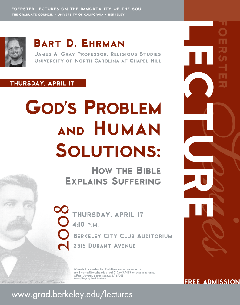
[00:00:00] ANDREW SZERI:
I’m Andrew Szeri, Dean of the Graduate Division, and we’re pleased, along with the Graduate Council, to present Bart Ehrman, this year’s speaker in the Foerster Lecture series. As a condition of this bequest, we’re obligated to tell you how the endowment supporting the Foerster Lectures on the Immortality of the Soul came to UC Berkeley. It’s a story that exemplifies the many ways this campus is linked to the history of California and the Bay Area.
In 1928, Miss Edith Zweybruck, Zweybruck established the Foerster Lectureship to honor the me– the memory of Agnes Foerster and Constantine Foerster. Edith was a public school teacher in San Francisco for many years, and the teaching profession was to her an opportunity to develop a true knowledge and love of the spiritual values of life and the young minds entrusted to her care. Edith’s beloved sister, Agnes Foerster, shared her high ideals and hopes, as did Agnes’s husband, Constantine.
A lawyer by profession, Foerster was a man of high intellectual achievements and of rare personal charm. Although he passed away at the age of thirty-seven, he had achieved an enviable place in the– at the San Francisco Bar and was considered one of the most highly respected members. For several years prior to his death, Foerster was a law partner of Alexander Morrison, one of the most prominent of San Francisco attorney– attorneys for whom our Morrison Memorial Library is named.
In her last days, Ms. Edith Zweybruck expressed her deep and abiding interest in the spiritual life by creating this lecture series on the subject, the immortality of the soul or other similar spiritual subjects. She believed that through the medium of a great university and the words of scholarly lecturers, she might bring new light upon a subject that has interested the world for centuries. Thank you, Edith, Edith Zweybruck.
Past Foerster Lecturers have included Oliver Sacks, Thomas Kuhn, Aldous Huxley, and Paul Tillich. Now I welcome Professor Susannah Elm, a member of the Foerster Committee and Professor of History and of Classics, to the podium to introduce our speaker, Bart Ehrman.
(applause)
[00:02:30] SUSANNAH ELM:
Thank you very much. As you can imagine, as you might imagine, to serve on this distinguished committee is one of the great pleasures of being a professor at this great university. One gets to let one’s imagination fly because there are many ways in which one could conceivably think about the theme of the immortality on the soul and related topics.
As you have heard, many distinguished persons have already spoken on the subject. Among the more recent speakers are Martha Nussbaum, Christof Koch, and also Thomas Metzinger. Carlo Ginzburg came, and we shall hear about Talal Asad, from Talal Asad about the subject of the immortality of the soul.
It is an extraordinary pleasure to welcome Professor Bart Ehrman today. Professor Ehrman burst on the scene in 1993, with a book that was devoured by his fans entitled The Orthodox Corruption of Scripture: The Effect of Early Christological Controversies on the Text of the New Testament. The scene was the small scholarly community, and persons devouring this book were persons such as me.
Things by now have changed. The Colbert Report, Fresh Air, CNN, you name it, Bart Ehrman has spoken there. He has written the books persons like me dream about writing.
When we read The Da Vinci Code and keep thinking, “What is going on here?” I think it, he wrote it. And that is true for lots of other things.
Professor Ehrman’s output has been extraordinary. He has written about Peter, Paul, and Mary Magdalene, Misquoting Jesus, Truth and Fiction, if there is such a thing as truth in The Da Vinci Code, and Lost Christianities, which he says is among the many children that constitute his books, one of his favorite ones. He has also just published a book entitled God’s Problem: How the Bible Fails to Answer Our Most Important Question\u2014Why We Suffer.
So you know, it takes a particular passion, a really passion, to speak with such eloquence as Professor Ehrman does about such things as the New Testament, how it came to be, and what that really means for those who read the text today. And today, it is my great pleasure, and I’m sure you will see what I mean with this passion, and I’m welcome Professor Ehrman.
(applause)
[00:05:29] BART EHRMAN:
Well, thank you very much for that generous introduction. I’m really, uh, very pleased to be with you today. As a, uh, professor of, uh, religious studies, uh, I’ve always thought that I had one of the, uh, best conversation stoppers at a cocktail party.
Uh, you are gathered around with a, uh, a group of people whom you don’t know and, uh, drinking wine, and somebody comes up and asks, “Oh, so what do you do?” And you reply, “I teach at the university.” “Oh, great.
What do you teach?” “I teach New Testament.” “Oh,” that must be interesting.
(laughter)
And you can see the, uh, the, the mental file going, trying to think of a follow-up question. Uh, well, uh, more recently, uh, I’ve come up with a better conversation stopper. I’m at the cocktail party and somebody comes up to me and they say, “So what are you working on?”
“I’m, I’m writing a book.” “What’s it on?” “It’s on suffering.”
(laughter)
“Oh, what are you doing next?” Uh, so suffering is one of those topics that, uh, people as a rule don’t want to talk about, but everybody has an opinion on. Uh, and I, I suppose it makes sense that everybody has an opinion about suffering because everybody has suffered, uh, and everybody knows people who have suffered, and, uh, everybody can read the newspaper and can see what kind of excruciating suffering there is, uh, around the world.
Uh, I published my book on, uh, God’s Problem: How the Bible Fails to Answer Our Most Important Question, Why We Suffer. I published this book a couple of months ago, and since then I’ve gotten hundreds of emails, uh, from people. Uh, most of them are very well-meaning emails, and a, uh, number of them are, uh, intent on telling me what the answer is.
And so, uh, in an email of twelve lines, uh, one can answer the problem, uh, that has, uh, plagued the human race since time immemorial. Uh, and, uh, I, I, and I appreciate these emails, and I, I appreciate the thought that goes behind them, but one wonders, uh, if you can really solve the problem of suffering in twelve, twelve lines. Well, uh, some people, uh, think that you can.
Uh, as I give, uh, talks about suffering around the country, I am impressed by the number of people who th– who, uh, are sure that they, they know what the answer, the answer is. My thinking on suffering actually began about twenty years ago. Uh, I was teaching at the time at Rutgers University, and they had a course on the books called The Problem of Suffering in the Biblical Traditions, uh, dealing with both Hebrew Bible and New Testament, and they wanted me to teach this course, and I thought it would be a, a good course to teach, in part because virtually everybody that I knew who thought about this issue had a set answer to why there’s suffering in the world.
Uh, it’s the free will response, uh, that sometimes I call the robot answer, uh, which goes like this. Uh, human beings were given free will by God. And since human beings, uh, were not, uh, they weren’t programmed like robots just to obey, they were given the ability to obey or disobey.
And since people are free to love God, they can also– they’re free to hate. And since they’re free to do good, they’re also free to do evil. And so that’s why there’s so much suffering, uh, in the world, is because of free will, or the, as I say, the robot solution.
Uh, and I think that in fact, there’s a lot to be said for this. I mean, obviously, there– a lot of evil in the world happens because people have the free will to do it. But of course, it doesn’t answer everything.
It doesn’t answer why there are tsunamis and hurricanes and earthquakes and other natural disasters. Free will leaves a lot of things out of the equation. And so I thought it’d be interesting to teach a class on what the Bible has to say about suffering.
And one of the things that struck me in teaching the class is that the Bible has a lot of different things to say about suffering, as it has a lot of different things to say about a lot of different topics. Uh, some parts of the Bible think that, uh, that the reason people suffer is because they’ve, they’ve sinned against God, and God is punishing them. So, suffering comes as a penalty from, from God for wrongful acts.
Other, other parts of the Bible think that it’s not God who’s punishing people, it is evil forces in the world that are opposed to God that are punishing people. There are some parts of the Bible that think suffering is a test of faith to see whether you will remain faithful to God even when things go bad. Some authors of the Bible think that suffering is a huge mystery, that we can’t ever understand why they’re suffering, and even to ask why we suffer is itself virtually blasphemous.
Some authors of the Bible simply think that chaos happens, and sometimes we get in the way. And so, uh, I thought it’d be interesting to teach this class at Rutgers on the problem of suffering, uh, and to, uh, and to, and to deal with it. It turned out the biggest problem I had in my class was convincing my 19- and 20-year-old New Jersey middle-upper-class white students that there was a problem.
(laughter)
Uh, and so, uh, so this was, this was, uh, this was actually in the m-mid ’80s. It was, it was during one of the horrible Ethiopian famines, and I, I resorted to doing things like bringing in pictures from The New York Times of women starving to death with children on, on their breasts starving to death, pointing these– took, pointing my students to these pictures and saying, “This is a problem.” Uh, and well, by the end of the semester, I think they at least got that, that point, uh, down.
What– The way I set up this class was by talking about what is the classical, uh, problem of suffering, which is the problem of, uh, typically, uh, it’s a tradition called theodicy. Uh, the word theodicy comes from two Greek words that mean, uh, God’s justice.
And the question of theodicy is: How can God be just given the state of things in this world? Given the pain and misery all around us, how can we possibly think that God is just? And often, this problem of theodicy is set up as a kind of logical problem.
The logical problem involves three statements that are typically made in the Judeo-Christian tradition, each of which i– seems to be true on its own, but when you put the three together, there seems to be a contradiction. And so, uh, these are the three statements. First, that God is all-powerful.
Second, God is all-loving. Third, there is suffering. How do you reconcile these three statements?
If God is all-powerful, he can do anything he wants, including he can prevent suffering. If God’s all-loving, he certainly wants to prevent suffering. He doesn’t want people to suffer, and yet they’re suffering.
So how does one explain all three statements being true simultaneously? Throughout the history of Christian thought, there have been two basic approaches to dealing with this problem of theodicy. One approach is to deny one of the three statements.
So one could deny, for example, that God is all-powerful. This is the approach taken by, uh, Rabbi Harold Kushner in his very popular book, When Bad Things Happen to Good People. Uh, I used this book, uh, in my class at Rutgers that year that I taught this course.
My students started calling it, When Bad Books Are Written by Good People.
(laughter)
Um,
(laughter)
The, um, the, uh, the point of the book is that, uh, God, in fact, really wants to help you when you suffer. He wishes he could prevent the suffering. He w-
He, he wishes there was something he could do, but his hands are tied. And so he, he can stand by you and, and help you through your suffering, and he can comfort you in your suffering. He can make you face your suffering.
And God is more like, instead of the kind of the great grandfather in the sky, he’s more like your mother. Uh, your mother in the sky, who really puts her arm around you and kinda gets you through it. Uh, but there’s nothing he can do.
His hands are tied. He can’t prevent suffering. So Go- God is not all-powerful.
Well, for, for a lot of people, that’s a satisfying solution. For other people, it doesn’t really seem like God is much of a God if he can’t do what he wants. And if he, if he can’t intervene in the world, then in what sense is he really God?
There are other people who want to deny the second proposition, that God is all-loving. This comes very close to the position that you find in some of the writings of Elie Wiesel. Uh, m-many people have become reacquainted with his book Night, uh, his classic.
Another book of his is, is called God on Trial, where in effect, Wiesel finds God, uh, guilty for crimes against humanity, uh, so that he’s not loving in any traditional sense. Uh, so one could deny that God’s all-loving, or, uh, one could deny that there’s suffering, but there aren’t too many people who want to go that route, uh, since one just needs to look around the world a little bit. So one could deny.
One, one way of getting around the problem is denying one of the three statements. Another way of getting around it is to, is to call on some kind of extenuating circumstance that can explain it all. That there’s some-something that explains all three things by bringing something else in from the outside.
For example, this idea that you’re suffering because God’s punishing you. God might be all-powerful, and He might be loving, and He might be causing you to suffer precisely in order to get you to change your ways, and so that’s an extenuating circumstance that can make a sense of, of suffering. Well, in any event, these were the, uh, these were the issues that I was dealing with, uh, in my class, uh, at Rutgers twenty years ago.
And at the time, when I finished teaching this class, I thought, “You know what?” That was kind of interesting. I, I think maybe I’d like to write a– write, write about it.
Then I thought, “You know, you’re only thirty years old.” You’re not old enough to write a book on suffering. So about three years ago, I was fishing around for the next thing to write.
I’d written a lot of kind of things that were on sort of a similar line. I thought, “You know, I’d like– I wouldn’t mind going back to that problem of suffering book.”
Then I thought, “No, you’re only fifty years old. You’re too young to write the book.” Then I thought, “You know, when I’m eighty years old, I’m gonna think, you’re too young to write the book.”
And so I just decided to go and write the book, and so I did. And so that’s, uh, that’s what the book is about, is about the problem of suffering as dealt with in the Bible, specifically. How do the authors of the Bible deal with suffering?
And the reason I think this is an important topic is because whatever one’s view of the Bible happens to be, whether one actually believes in the Bible as somehow inspired scripture or not, for everyone, the Bible is the most important book in the history of the history of our civilization, without any without parallel, really. Uh, this is the most important book, and it’s worthwhile seeing what the authors of the Bible have to say about this most important, uh, question. So what I’m gonna do in the rest of my lecture is look at two of the major answers to suffering that y– that one finds in the Bible, an answer that dominates the Hebrew Bible, and an answer that dominates the New Testament.
Uh, and I’m not saying that one view, that the Hebrew Bible view is not also found in the New Testament, and the New Testament view not also found in the Hebrew Bible. They’re actually found throughout the Bible, but, but there are two views that dominate both testaments. And then, uh, after that, I’ll talk about the view that I find myself to be, um, personally most palatable.
So first, uh, a view that is very common throughout the, uh, throughout the Hebrew Bible is a view that is in fact embraced by the prophets. The prophets such as Isaiah and Jeremiah, Ezekiel, Hosea, Joel, Amos, all, all of the prophets of the Hebrew Bible. Uh, in fact, I would argue that all of them have this same basic view about why the, why they’re suffering.
Specifically, the prophets were concerned about why the people of God suffer. To understand what the prophets have to say about this, I need to provide a little bit of background. The prophets, uh, many of the prophets explicitly were rooted in traditions found in an-ancient Israel, that God, at some point in the, in the past, had saved Israel from a disastrous situation, uh, that it was experiencing as it was enslaved to a foreign nation.
This is found in the Exodus traditions you find in, in the Book of Exodus. The basic line is that the, that the children of Israel had gone into Egypt to escape a famine, and while there, they had become enslaved, and they served as slaves to the Egyptians for four hundred years. But God raised up a savior for the Israelites, Moses, who’d, uh, performed ten plagues against the Egyptian Pharaoh, uh, so that the Pharaoh then drove the people out of his land and then had second thoughts and started chasing them.
Ended up at the Red Sea. Moses depart-parted the Red Sea, the whole Charlton Heston thing, and, uh, and, uh, the Egyptian army was drowned, the people of Israel were saved, and, uh, they ended up getting the law of God on Mount Sinai, and then they even-eventually got the promised land. These traditions were taken quite seriously by many people in ancient Israel, uh, that God had in fact intervened on behalf of the people, uh, in order to save them from their slavery.
There were some theological implications that were drawn by some thinkers in ancient Israel. First, that God is all-powerful, more powerful than the Egyptians, for example. Second, that God is on the side of Israel and has chosen Israel to be his people.
And third, that God will intervene on behalf of his people when they get into trouble. Those were the theological implications drawn from the Exodus tradition. As time went on, however, there were historical problems with these theological implications.
Because if God is powerful and on the side of Israel and willing to intervene on its behalf, why is it that Israel continues to experience one disaster after another? Drought and famine and pestilence, war, military defeat. Eventually, the northern part of the kingdom, uh, of Israel was destroyed by the Assyrians in the eighth century BCE.
A hundred and fifty years later, the southern part of the kingdom was destroyed by the Babylonians. Then there were the Persians, then there were the, the Greeks, and it just went on and on. How does one explain the fact that Israel continues to suffer despite the fact that God is on its side and God has chosen it to be His, to, to be His God and they to be His people?
The prophets of Scripture had answers to why the people of God continued to suffer. As an example of this answer that is found throughout the prophets, I’ll read a couple of brief passages from the Book of Amos, one of the earliest authors, uh, uh, among the prophets. Amos chapter three, verse two.
This is God speaking. God says to His people, Israel, “You only have I known of all the families of the earth, therefore, I will punish you for your iniquities.” Why is it that Israel suffers?
Because God is punishing them. That’s the prophetic solution. The people have broken God’s law, God is angry with them, and He’s punishing them to get them to turn around so that they’ll repent.
If they repent of their sin, then God will, uh, cause the suffering to abate and good times will return. Amos goes on to explain that God has created all sorts of havoc among His people in order to get them to repent. And so he says in chapter four, “I,” this is God speaking, “I gave you cleanness of teeth in all your cities,” He says.
Uh, it’s not that this… This isn’t He invented toothpaste or something. It means that they’ve, they’ve had nothing to eat.
Cleanness of teeth, “And lack of bread in all your places, yet you did not return to Me,” says the Lord. In other words, God created a famine. He starved people to get them to return.
“I also withheld the rain from you when there were three months to the harvest. I would send rain on one city and send no rain on another city, so two or three towns wandered to another town to drink water, and they were not satisfied. And yet you did not return to me,” says the Lord.”
So he created a drought. That didn’t work either. “I struck you with blight and mildew,” I laid waste your gardens and your vineyards.
The locusts devoured your fig trees and your olive trees, yet you did not return to me,” says the Lord. “I sent among you a pestilence after the manner of Egypt. I killed your young men with the sword.”
This is God speaking. “I killed your young men with the sword. I carried away your horses.
I made the stench of your camp go up into your nostrils, yet you did not return to me,” says the Lord.” “I overthrew some of you as when God overthrew Sodom and Gomorrah, and yet you did not return to me,” says the Lord. “Therefore, thus I will do to you, O Israel.
Because I will do this to you, prepare to meet your God, O Israel.” Uh, in this context, meeting your God is not a happy prospect. Uh, That is not something you want.
God says, “You’ve had it bad so far. You’ve had famine and drought and pestilence and war, and people are dying right and left, and now you’re really going to get it.” Uh, more specifically, Amos thinks that, uh, that there’s gonna be an invasion from an enemy from the north, and the nation is going to be wiped out in a military defeat.
Why is it that Israel is suffering? Because God wants them to turn back to Him. They refuse, and so the punishment continues.
This is what I call the prophetic answer to why the people of God suffer. It’s a, it’s a view found not only in the prophets, it’s found throughout much of the historical narratives of the Hebrew Bible. I mean, the Bible begins, of course, with Adam and Eve.
They’re told not to eat the fruit, They eat the fruit, they get punished. Uh, the whole world becomes wicked, And how does God respond? He destroys the whole world with a flood, killing everybody on it except for Noah and his family.
And so it goes through the historical narrative of the Hebrew Bible. Sin brings punishment. People suffer because they have violated God’s will, because they have sinned.
One might ask whether this is a very, uh, acceptable, whether this is acceptable at all as an understanding of why people suffer. Uh, in our own context, for example, is it really true that suffering comes because God is punishing people? People continue to feel this way.
Uh, whenever something bad happens and someone says, “What have I done to deserve this?” Right? Well, the, the whole idea behind that is that you’ve done something that deserves, merits the punishment.
Or when somebody says, “Why me?” Uh, well, that, that, that implies that there’s some reason for what’s happening. But is this really true?
Is it true that every five seconds a child dies of starvation because God’s trying to punish somebody? Or that every minute twenty-five people die from drinking unclean drinking water? Every hour in our world, seven hundred people die of malaria.
Is this because God’s punishing people? Is this why tsunamis hit the Indian Ocean and kill three hundred thousand people overnight? Or why a holocaust happens that kills six million Jews?
Or a purging in Cambodia that kills two million Cambodians under the Khmer Rouge? We still have this answer with us today, but I certainly don’t think that, uh, very many of us are going to find it a very satisfying answer, but it is surprising how many people have it. I was on a radio show a couple months ago, uh, I was in, uh, Lincoln, Nebraska, and I was on this radio show with a pastor who told me that, uh, a couple months before this, he had a woman in his congregation whose twelve-year-old daughter had died of a brain tumor.
And he was talking with this woman, and this woman told him she knew why her daughter had died. It was because she, this mother, had promised God that she would quit smoking, and she hadn’t done it, And so God was punishing her. Well, uh, yeah.
So, uh, most of us don’t find this very satisfying. Uh, and luckily, there are other answers in the Bible besides this one. Uh, this answer, which dominates the Hebrew Bible, can be found to some extent in the New Testament, uh, is one of the many answers that biblical authors had for suffering.
Another answer that I want to look at is one that is found in the latest book of the Hebrew Bible and comes to be a very dominant understanding among Jews, uh, in early Judaism and then among Christians, the followers of Jesus. It’s a response to suffering that I’ll call the apocalyptic response. The term apocalyptic first needs to be explained.
Uh, the word apocalyptic comes from a Greek word apokalypsis, which means an unveiling or a revealing. This, uh, view is called an unveiling or a revealing because Jewish thinkers began to think that God had revealed to them the heavenly secrets that could make sense of earthly realities. God had revealed the heavenly secrets that could make sense of earthly realities.
Specifically, these apocalyptic thinkers came to understand that suffering was not coming as a punishment from God. Suffering was coming from other sources in the world besides God. Before I explain w-what this, uh, w-what the view itself is, let me say how we have information about this particular view that became prominent prominent in early Judaism.
Daniel, the Book of Daniel is probably the latest of the Hebrew Bible books to be written, possibly 150, 160 years before, uh, the life of, of Jesus, and it embodies this apocalyptic, uh, point of view, as I’ll explain in a second. Jewish Apocrypha, which are outside the traditional Protestant, uh, canon of Scripture. The Apocrypha, uh, also contain books that, uh, that, that relate this view.
And the Dead Sea Scrolls, which were, uh, discovered in, uh, the nineteen-forties, also widely contain this apocalyptic point of view. It became a view that was dominant among Jews in the, uh, time of the f– the, uh, beginning of Christianity. Uh, and it ended up being a view that dominated the New Testament itself.
The basic view of the apocalyptic response is this: God is not causing suffering. There are enemies of God who are cosmic forces in the world that are causing suffering. God has personal enemies.
These enemies include the devil and his demons. In the apocalyptic view, God has a personal opponent, the devil. Throughout m- m-
Most of the Hebrew Bible, you don’t find a devil figure at all. You don’t find him in the prophets, for example. But apocalyptic thinkers started thinking that God had a personal opponent who stood over against him, the devil, and that just as God has angels under him, the devil has demons under him.
These, uh, these forces had other, uh, had other, uh, powers aligned with them. For example, God had the power of life, and the devil had the power of death. God had the power of righteousness, and the devil had the power of sin.
In the apocalyptic view, sin is not simply something that you do wrong. It’s not simply an act of disobedience. Sin, for an apocalyptic Jew, is a cosmic force that’s in the world that is trying to enslave you, to force you to do things contrary to what you want, to force you to violate God’s will.
The psychology of this is, you know, there are people sometimes who just, uh, they, they do things that are against their best interests, and they just can’t stop themselves. I mean, what is that, that you know what the right thing to do is and you can’t do it, or you know that something is wrong and you just can’t stop yourself? I’ve never had this experience myself.
Uh, but, but I, but I’ve heard that some people have had this experience, and, and what is that? Well, for an apocalyptic Jew, that is the power of sin that is enslaving you and making you do something that’s wrong.
So there are these cosmic powers in the world that are forcing you to do things wrong, and these cosmic powers are what is bringing suffering in the world. It’s the devil and the demons and the other cosmic forces. But eventually, God is going to overthrow these forces and bring in a good kingdom on Earth.
In which there’ll be no more suffering. There’ll be no more pain or misery. There’ll be no more sin or death.
That’s the basic view of the apocalyptic response, but I want to unpack it by explaining it in greater detail, uh, by talking about four major tenets of apocalyptic thinking. Four major tenets. First of all, dualism.
Uh, and, and the, the apoc-apocalypticists were basically dualists. They thought there were two fundamental components of reality. As I pointed out, these are cosmic forces, the forces of good and the forces of evil.
But the thing to re– to, to know about these apocalypticists is they thought that everything and everybody participates on one side or the other. Everybody sides either with God or with the devil, either with good or with evil, so that there’s no neutral territory. You have to choose which side you’re going to be on.
If you side with God in this world, you are likely going to suffer because the powers in control of this world are the powers of evil. So that siding with God is not going to make you rich and famous and prosperous. What’s going to happen if you sided with God is the powers of evil are going to get you.
But there’s going to come an a, a future life in which you will be rewarded. So you have to decide which side you’re going to be on. The, the people who are rich and powerful, prosperous, by the way, famous people, uh, they’re obviously on the side of evil.
This is, this is explaining why it is that the wicked prosper and the righteous suffer. The prophets had a hard time explaining that, but the apocalypticists had a very easy time explaining that. The reason the wicked prosper is because they’re on the sides that– they’re on the side of evil that has dominance in this world at the ti- for the time.
This cosmic dualism was worked out in a historical scenario. Do, uh, apocalypticists believed that there were two ages of this world. There’s this age that we live in now, and there’s an age to come.
The age we’re living in now is controlled by the forces of evil, and it’s just going to get worse and worse. But God is going to intervene, and there will become a cataclysmic break at the end of this age, and God will bring in a new age, a new kingdom. There’ll be a utopian-like existence in which there’ll be no more pain or misery.
And so you have this age and the age to come, the kingdoms of evil now and the kingdom of God yet to come. So these, uh, these Jewish apocalypticists were dualistic. They were pessimistic.
They did not think that we could improve our life in this world. We can’t improve our lot. We can’t make things better.
We can’t decide which nations to, uh, to attack in the Middle East so as to stabilize or destabilize the region. We, uh, we can’t decide to put more cops on the beat or more teachers in the classroom. I mean, we can do all these things, but it’s not going to matter because the powers of evil are going to increase in their, uh, intensity and their, their power until at the end of this age, literally all hell is going to break out, and there’s nothing we can do to stop it.
Things are going to get worse. But at the end of this age, there will be a divine vindication. God will vindicate His name and His people.
He will redeem this world that He created. He Himself will once again become sovereign. This vindication at the end of this age will involve a judgment.
The powers of evil will be destroyed and taken away, and everybody who has sided with them will face punishment. Those who are good, however, who have sided with God, will be given an eternal reward. An eternal reward.
So there will be a future judgment. Everybody will ju– be judged, and when I say everybody will be judged, I mean literally everybody. You shouldn’t think that you can side with the forces of evil, become rich and powerful and prosperous, and then die and get away with it.
You can’t get away with it, because at the end of this age, there’s going to be a resurrection of the dead. God is going to raise everybody bodily from the dead. Everybody who’s ever lived will face judgment.
You can’t get away with siding with evil and succeeding because of it, because God’s going to raise you from the dead to face judgment, and there’s not a sweet thing you can do to stop Him. You will face either an eternal reward or an eternal punishment, and the choice is yours. Well, w– uh, so I should point out that within the history of ancient Israelite thought, most ancient Jews thought either that when you died, your soul went to some kind of shadowy place called Sheol, where everybody kind of went, whether they were good or wicked.
They, they all sort of went there, and that’s where they lived forever. Other Jews thought you died, and that was the end of the story. That was it.
It was only with apocalyptic thinking that the idea that you were going to live forever came about. With apocalypticists, in a sense, immortality came into, into being, and immortality came into being as a kind of theodicy, an explanation about how things can be so rotten now. They’re rotten now because they’re going to be made right in the future kingdom of God.
But this was not a belief in the immortality of the soul per se, in the sense of the soul apart from the body. Apocalypticists did not think your soul was going to live on after death. Your body was going to be reconstituted, and you were going to live forever bodily.
This is the beginning, though, of the idea of having some kind of afterlife after this death with the resurrection of the dead that was going to transpire at the end of this age. Well, when is the age going to end? When will it all happen?
Jewish apocalypticists believed it was going to be imminent. It was right around the corner. Things had gotten bad, and they were just about as bad as they possibly could be.
God was soon going to intervene and overthrow the forces of evil and set up his kingdom on earth. And when would this be? “Truly I tell you, some of you standing here will not taste death before they see that the kingdom of God has come in power.”
The words of Jesus, Mark chapter 9, verse 1. Or as he said later to his disciples, “This generation will not pass away before all these things take place.”” Jesus anticipated that the end of the age was coming within his own generation, that his disciples would live to see it, that the kingdom of God would arrive in power. It’s not surprising that Jesus’ followers, after his death, continued on with this vision.
The apostle Paul, for example, thinking that he himself would be alive when Jesus returned. And down to the present day, there continue to be Christians who think that in fact the end is coming sometime next Tuesday afternoon. This is an apocalyptic view that the end of the age, in fact, is imminent.
This apocalyptic view is dominant throughout the New Testament. It predominates in the teachings of Jesus and in the writings of Paul, and in most of the, uh, writings of the New Testament, including, of course, the Book of Revelation. I think that there are some serious upsides to this way of looking at suffering, uh, and why there’s suffering.
This view takes evil seriously. It takes evil as a power that is bigger than any of us. The Holocaust is bigger than the individuals who made it happen.
This takes evil as a very serious phenomenon in our world. It asserts that God will eventually make right all that is wrong. That is a hopeful thought.
That eventually God will make right all that is wrong, that evil does not have the last word, but God has the last word, and that death is not the end of the story. This is a view that can provide hope in a world of hopelessness. At the same time, I think that there are some downsides to this point of view.
One obvious downside is that it makes possible moral complacency in the face of evil and suffering. If, in fact, things are just going to get worse, and there’s nothing we can do about it, and they’re going to get worse and worse until God intervenes, Then what’s the point of working for justice? Why, why worry about homelessness and poverty?
Why, why worry about hunger? Why, why worry about countries that are falling apart and destabilizing? Why, why worry about any of that?
If, in fact, it’s only going to come– become better when God intervenes? This apocalyptic view can and has led to moral complacency, and I think that’s a problem. The other problem is, I, I think sort of the obvious problem, is that this is– this view is based on a belief, a false belief, in the imminent end of all things, that everything’s going to end pretty soon.
Uh, now, this, this may not be, uh, such a, a big problem in Berkeley, but let me tell you, it’s a big problem in North Carolina, uh, where I teach, the buckle of the Bible Belt. I moved to North Carolina in nineteen eighty-eight. I moved there from New Jersey, which was quite a shock.
When I moved to North Carolina in nineteen eighty-eight, I started getting phone calls from the local newspapers. They wanted to know if it was true that the Bible predicted that the end of the world was going to happen in September of nineteen eighty-eight. I didn’t know what they were talking about, uh, but they told me that a book had been written that said– indicated that the Rapture was going to oc-occur in nineteen eighty-eight.
Now, for those of you who, uh, don’t know, the Rapture is when Jesus comes back from heaven and takes his believers out of this world before the great tribulation that takes place on earth when the Antichrist arises. So the Rapture is when Jesus comes back. Well, it turns out somebody had written a book.
This guy’s name was Edgar Whisenant, and, uh, before he wrote this book, he w– he literally was a rocket engineer for NASA. Uh, so he was a smart guy, and he had written a book called 88 Reasons Why the Rapture Will Occur in 1988. This book was taken very seriously in North Carolina.
I had students whose parents literally sold the farm because they knew that Jesus was coming back, and the Rapture would take place in 1988. And this, this book, this book was in… There were two million copies of this book in print, in circulation, and was taken very seriously in the South.
He had 88 reasons why this was going to happen, so I’ll just give you one of the 88. So in, in Matthew’s gospel, Jesus’ disciples want to know, when is the end going to come? And Jesus says, “Learn a lesson from the fig tree.”
When the fig tree puts forth its leaves, you know that summer is near. So too, when these things take place, you know that the end is near. Truly I tell you, this generation will not pass away before all these things take place.
So Whisenant interprets this, uh, this saying of Jesus. What does it mean about the fig tree? Well, in the Bible, the fig tree is often used as an image for the nation of Israel.
When the fig tree puts forth its leaves, well, that’s, that’s in the springtime. When the fig tree’s been dead through the winter, it comes back to life in the spring. So when does Israel come back to life?
Well, Israel comes back to life in 1948, when Israel again began to become a sovereign state. This generation will not pass away before all these things take place. How long is a generation in the Bible? 40 years.
1948 plus 40, bingo. 1988. That was one of his 88 reasons. He had 87 others that I won’t bother you with.
Uh, Jesus rapture– The rapture was going to occur during the Jewish festival of Rosh Hashanah in September of 1988. Now, some people pointed out to Edgar Whisenant that Jesus actually said, “No one knows the day or the hour when the end will come.”
And Whisenant was completely unfazed by that. He said, “Yes, it’s true. I don’t know the day or the hour.
“I just know the week.”
(audience laughing)
And so it goes. Of course, what happens, of course, Rosh Hashanah came and went, and, uh, Jesus never appeared. And so Whisenant did what people always do in those situations.
He wrote another book. And, and in the next book, what he, he said that he’d made a mistake in his calculations because he forgot that when they created the modern calendar, they didn’t include a year zero. So, you know, it goes from one BCE to one CE, or, you know, one BC to one AD.
It doesn’t– There’s no year zero, and so he was off by a year. So in fact, it was gonna happen in 1989. And, and so it goes, uh, world without end, and amen.
Is there an alternative perspective to either the prophetic or the apocalyptic views? Well, there are a lot of different perspectives in the Bible. I’m going to end my last couple minutes talking about another view that I personally, uh, relate to much better than either of the preceding two.
Uh, this is a view that’s found in the Hebrew Bible book Ecclesiastes, one of the books that I think is much under-read by readers of the Bible. Ecclesiastes claims to be written by King Solomon, uh, the wisest man on earth. In fact, it wasn’t written by Solomon.
It was written hundreds of years after Solomon, but it continues, I think, to be a very wise book. Ecclesiastes’ view is more or less summarized in its very opening lines. “Vanity of vanities, all is vanity,” “Vanity,” says the preacher.
The word vanity in this, uh, book, Ecclesiastes, is a Hebrew word, Hevel. Hevel is a word that is used to refer to the mist that’s around for a little while and then burns off. So it’s here for a little while, and it’s gone.
It’s a word that, that implies transience, impermanence, uh, vanity in the sense that, that, uh, that there is no substance to it. The author of Ecclesiastes looked around the world, and he saw that, in fact, uh, that it was all a very transient life that we live. He looked, and he saw that there was no justice in the world.
The righteous suffer and the wicked prosper. And the author of Ecclesiastes Ecclesiastes did not think that this problem was going to be solved in the afterlife. He does not believe in the immortality of the soul.
He does not believe that after you die, you continue to live. For the author of Ecclesiastes, this life is not a dress rehearsal for something that’s going to happen later. This is not a dry run.
This is it. This life is all we have, and it is transient and fleeting. How then should we live this life?
We should li-live life as fully as we can in the present. This life is not going to be here forever. It’s not going to be here for long.
And so we should enjoy what we eat. We should enjoy what we drink. We should enjoy our work.
We should enjoy our spouses. We should enjoy our friends and families. We should grab life for all it can give us because this life is all that we’re going to have.
That’s the view of Ecclesiastes, and it’s a view that I find most acceptable. The problem, of course, is that there are a lot of people who can’t enjoy life to its fullest, people who are suffering because of, uh, all sorts of reasons. Because of natural disaster, because of poverty, because of homelessness.
I take as an implication of grabbing life for all that we can, that we should work in order to make life better for others so that they, too, can grab life for all they can. My conclusion. I’m not sure at the end of the day there’s an answer to suffering, or at least there are lots of different answers, sometimes contradictory answers.
But even if we don’t have an answer to why there are tsunamis, and hurricanes, and earthquakes, and genocides, and murder, and homelessness, and poverty, even though we don’t have an answer, I think we can have a response. Our response should be ourselves personally to live life to its fullest because this is all we have. We should enjoy what we eat.
We should eat good food. We should drink good wine. We should drink microbrewed beer.
We should, uh, we should enjoy our families. We should enjoy our friends. We should stay up late drinking single malt scotch and talking about the big issues.
We should enjoy life as much as we can for as long as we can. And we should also work to make life happy and satisfa-satisfying for other people who are less fortunate than ourselves. We all can do more, in fact.
We can volunteer more. We can give more money to deal with issues of local poverty and homelessness. We can give more to international relief efforts.
We can do more, and we should do more because this life is all there is, and we should grab for it all that we can. Thank you very much.
(applause and cheering)
[00:48:55] SUSANNAH ELM:
Thank Professor Ehrman. And I think you see what I meant when I talked about his passion. Professor Ehrman will answer questions, and please do come forward and, um, formulate your questions in a fairly concise manner because they will be recorded. Thank you.
[00:49:21] AUDIENCE MEMBER:
Uh, I have a question which is, um, how does your answer solve the problem of suffering? Uh, in other words, do you believe there is an omnipotent, wholly benevolent deity?
[00:49:36] BART EHRMAN:
Uh, personally, I do not.
[00:49:38] AUDIENCE MEMBER:
Oh, I see. So nothing you, you are not presenting a theodicy then?
[00:49:43] BART EHRMAN:
Uh, no. I, I am saying– My, my personal view– Actually, what I deal with in my book is to explain how, in fact, this problem of suffering led me away from belief in a personal, uh, omnipotent, powerful, loving God.
Uh, so I don’t personally believe that such a being exists. I don’t believe that there– I, I don’t subscribe to the Judeo-Christian understanding of God.
I think though, uh, so that I don’t have, and so I don’t use my answer to suffering is not that God’s involved with it, because I don’t think God is involved with it. I think suffering comes because we live in a random and chaotic world, and sometimes we get in the way of it. So the salute, so-
So that’s why I say there isn’t necessarily an answer, but there is a response.
[00:50:23] AUDIENCE MEMBER:
Right. So that you’ve really given kind of a historical description of what the Bible says.
[00:50:28] BART EHRMAN:
Yes. I’m not affirming-
[00:50:29] AUDIENCE MEMBER:
But you haven’t a- attempted to, to provide a theodicy.
[00:50:33] BART EHRMAN:
No, the only– the– I’m not giving a theodicy because I don’t believe in God. But I am saying that at least one book of the Bible seems to me to give a satisfying answer to the relationship of humans to suffering, which is the Book of Ecclesiastes.
[00:50:46] AUDIENCE MEMBER:
And why is that satisfying? I mean, what are the, what are the criteria that make that a satisfying response?
[00:50:52] BART EHRMAN:
Uh, it’s the least problematic answer.
[00:50:55] AUDIENCE MEMBER:
Okay, thanks. Hi. Um, my question actually is maybe the other side of the coin, and that is of happiness.
And, um, as somebody who can maybe not speak for the happiness of everybody but for myself, um, I’ve actually feel I’ve lived life in many material extremes, um, from a very, um, materially challenged childhood to another point in my life where I was in a v– in a, a point of great privilege. Um, and I actually don’t think that one situation was necessarily happier than the other. I actually would say that, um, a– for me, a closer correlation with happiness is where I felt I was, um…
It’s often been put in the terms of serving something greater than myself. Um, so I actually could see being in a situation of, um, physical and material, say, suffering, um, which I’ve had the experience of being in, and still experiencing a sense of optimism and happiness because I was– I felt that I was– had the op-opportunity to serve something greater than myself. Um, so I wondered if you could comment on something like that.
[00:52:08] BART EHRMAN:
Uh, I agree with it 100%. Completely agree with it. I don’t think, I don’t think that happiness is contingent on, uh, material well-being.
I think that, uh, there are a lot of things that everybody at every, at, at every possible level of material well-being can do in order to promote their happiness, some of which may, some of the things you’re talking about, serving others or doing good things for others. But also, uh, I mean, one can take care of oneself without, uh, without having a good deal of material, uh, wealth. I mean, uh, for many of us, the life of the the mind is far more important than the life of the body, for example.
And one, uh, many of us find happiness in having, uh, sustained conversations about big issues. You don’t have to be rich or poor to have those.
[00:52:57] AUDIENCE MEMBER:
Hi.
(laughter)
Um, I was wondering, um, where do you get your morality? And how do you know that– or just personally, why, How do you know that it’s not good that people suffer? So where do you get your morality that tells you that suffering is bad?
[00:53:13] BART EHRMAN:
Yes, good. Thank you. It’s a good question.
You know, when I was a, uh, when I was a Christian, I thought that the only way a person could have morality is if there was some kind of authority figure over them telling them what was right and wrong, whether it was the church or your parents or God. You know, that God was sort of an ultimate, uh, arbiter of morality. And I was really afraid when I was thinking–
I, I only became an agnostic nine or ten years ago. I’d been a Christian for my entire life. And when I was reflecting on whether I really wanted to take that leap or not, the one thing that held me– one of the things that held me back is I thought that it would lead to a life of com- of complete immorality.
That in fact, you know, I’d become this complete reprobate, and it would just be one party after the other, and I wouldn’t be able to, you know. Then I thought, “Well, maybe that wouldn’t be so bad.” So, but no, no, seriously, I, I, I thought that would happen, and it didn’t happen.
Uh, and I think that I had a false belief that you have to have a divine figure giving you morality before you know what’s moral. My own view is that as an agnostic, even, uh, without the existence of God, how do I decide what’s good and what’s bad? I have a fairly traditional utilitarian view.
Whatever is good for the most people is good. Why is it that I don’t want people to suffer? I don’t know.
I’m made that way. I mean, humans are made that way. You see somebody suffering, and you don’t want them to suffer.
So I, I don’t have deep philosophical reasons for it. That’s just part of being human.
[00:54:38] AUDIENCE MEMBER:
Wait, what do you mean by humans are made that way?
[00:54:41] BART EHRMAN:
Uh, well, humans are made that way or they evolved that way, but they are that way.
[00:54:44] AUDIENCE MEMBER:
Mm-hmm. Oh, yeah. And one other thing is, um, do you think that truth is always based on what makes sense to people? Or do you think that truth is there despite, um, what might not make sense or what might not be comfortable to people?
[00:54:59] BART EHRMAN:
Um, well, I don’t believe in a capital T truth. Uh, I don’t believe in some kind of Platonic form of truth that’s sitting up there that we need to discover. Uh, so I mean, I think that truth… I don’t, I don’t look upon truth that way, as some kind of objective thing that’s out there someplace.
[00:55:16] AUDIENCE MEMBER:
Thank you.
[00:55:16] BART EHRMAN:
You’re welcome.
[00:55:19] AUDIENCE MEMBER:
I, uh, I appreciate the fact that you’ve come out publicly as an agnostic rather than a-an atheist. Um, you know, none of us ever really absolutely know, uh, what goes on cosmologically or, or, or what doesn’t. And, uh, so I appreciate the fact that, um, that you acknowledge that, uh, agnosis or agnosis, um, lack of knowledge.
Um, and since all we can do is discuss and bounce ideas off each other, I want to put forth an idea and ask you to rip it apart. Um, the– I think the dualism between, um, atheism and, uh, and the, the apocalyptic view of, of, you know, God and forces of good fighting against evil, um, leaves us with, uh, yeah, with, with two unsatisfying choices, at least a lot of people, you know, folks who, who do, uh, have this very human yearning for, uh, for some kind of spiritual connection. And, um, I’m wondering what you think about a, a middle road.
I, I’m– Full disclosure, I’m a Lutheran with a, an agnostic streak a mile wide. And, um, what you’re s– what you’re positing sounds very much to me like, like a Lutheran take. If you take out the love God part, Luther is very, uh, very, very, very, uh, heavy on serving our neighbor.
The, the way to live life to the fullest is to be free to serve our neighbor in whatever way we, we can. And, uh, yeah, I was wondering if, if you think this, um… yeah, w– how you think, um, this is, I don’t know, I guess whether, whether the, the theistic view of Luther is, is compatible with the agnostic view that, you know.
[00:57:09] BART EHRMAN:
Yeah, I mean, I, I think theism was rather important to Luther. Uh, I mean, he, he, he, he was, he was all about God. Uh, but you’re right.
Uh, there, there is a definite, uh, streak within Lutheranism of, uh, of serving, uh, fellow humans. Uh, and so, uh, that, that part of it I, I completely, uh, subscribe to. On your earlier point about agnosticism and atheism, I, I often get asked about that, you know, why I’m agnostic instead of, uh, atheist.
Usually it’s atheists who ask me that, uh, because they want me– You know, they– Atheists typically think that agnostics are just wimpy atheists. Uh, but you know, uh, agnostics think that atheists are just arrogant agnostics. And, and, uh, and so, I mean, my, my view is that, uh, that, uh, I mean, I don’t believe that the Christian God exists.
But is there some kind of superior force in the universe that’s beyond my comprehension? I don’t know. How would I know?
I don’t know, and neither does Richard Dawkins. So, yeah. Um, I’m, I’m not a Christian anymore either, and so the, the Christians that I have s-sympathy for or some commonality are the ones that seem to read the Bible, I think the Pope might even be in this category, where you just– you read it, and you don’t understand all of it, and it seems like there’s contradictions, so you, you just end up saying that it’s a big mystery that you don’t quite understand.
And I’m thinking… So I’m curious act– more specifically, I’m wondering, uh, what you think of some of the modern interpreters of the Bible, modern Christians. What do you th– I’m assuming that you might feel that some people, um, have sort of the view that I already said, and then other people try to explain away the contradictions.
And I’m wondering if C.S. Lewis is maybe the type of person who walks away from the Bible saying like, “Oh, it’s very clear to me what the response to suffering is,” where someone maybe like Garry Wills or Kierkegaard is more of a, “I’m trying to make sense of this,” and maybe this is an answer, but it’s still bigger than I am, and it’s, and it’s more of a mystery. Right. Well, I mean, there, there are a range of, I mean, there are a range of thinkers who deal with the problem of suffer-suffering.
Some of them are more biblically oriented than others. Uh, and, uh, I mean, Kierkegaard wasn’t particularly biblically oriented in the way, uh, that C.S. Lewis was, and C.S. Lewis isn’t as pa-particularly oriented toward the Bible as, as New Testament, uh, interpreters are. And so there’s a whole range, a whole range, And I think, uh, you know, in my, uh, in my book on this, I’m not really dealing with, uh, issues of, uh, philosophical approaches toward suffering.
Uh, so I, uh, it’s really more dealing with what the Bible itself actually has to say about it. So, yeah.
[00:59:57] AUDIENCE MEMBER:
Uh, hello. Uh, I think from a theological perspective, this life is, uh, short. It’s kind of–
It’s, it’s a test. I mean, it’s a place example. It’s not suppo– We are not supposed to live here forever.
And, uh, if there is a sort of afterlife and God can– I mean, God can compensate, God can, I mean, from the– If somebody suffers here, I mean, he can be sort of compensated. We, we– I mean, from the whole this life and the afterlife, it might seem just. And I think the laws of this, uh, we should look at why this world was created.
If it’s, uh, God puts a law, uh, it– I mean, the bad things might happen, but if, if we said that when something bad happens, God intervenes, then that– So we should put that as a law, that whenever something bad happens, and that law might have some implications.
So I think if somebody has to generate a full system of consistent laws in which, I mean, having the– some purpose. A full system of interconnected laws which consistently describe another world which is, has total overall less suffering than ours, and that then we can say that God has not been optimal. But just pointing out that this one is not good, that one is not good without providing any alternative, So.
[01:01:21] BART EHRMAN:
Okay, thank you.
[01:01:22] AUDIENCE MEMBER:
Thank you. Hi. I, um, am an atheist as well as a revolutionary and a communist, and I wanted to say that I really appreciated a lot of what you said about suffering.
In particular, that if there were such a God, you know, why is all this suffering happening? Um, I wanted to ask you a question. Um, there’s a new book called Away With All Gods by Bob Avakian.
And one of the questions it asks is, is believing in gods actually harmful? And is, um, believing in God and religion, does it stand in the way of emancipating humanity? And it makes the point that religion is a very negative role, in particular because it, it, um, blinds people to, uh, the way the world really is, and I was wondering if you could comment on that.
[01:02:12] BART EHRMAN:
Yeah. I ha- Uh, thank you. I haven’t, I haven’t read that book. Somebody earlier, uh, gave me a copy. I think, uh, uh, a group, group of you all are here.
(laughter)
Uh, thank you. Uh, and, uh, so I don’t have anything directly to say to that because I haven’t read the book. I, I have read the other, uh, neo-atheists as they’re being called, Dawkins and Hitchens and, and, um, Sam Harris.
And, um, I think the thing that is most disappointing to me about these authors is that they know very little about religion as a rule, and they, they make claims about religion that simply, uh, are, uh, are sophomoric and silly. And that I think if there’s going to be a bona fide attack on religion, it has to be somebody who actually understands religion and doesn’t make claims about religion that aren’t true. I mean, Sam Harris acts as if everything that’s evil that has ever happened in the world is because of religion.
Well, I think that’s completely bogus. Uh, I think religion, in fact, does a lot of good as well as a lot of evil, and that you can’t blame a religion for, uh, for, uh, everything wrong that’s happened. But again, I haven’t read this book, so I, I, I can’t really comment on it.
[01:03:21] AUDIENCE MEMBER:
Hi. I lived in North Carolina for five years.
[01:03:24] BART EHRMAN:
So, I, I see the Wake Forest hat.
[01:03:26] AUDIENCE MEMBER:
I actually went to Davidson. My sister goes here. Okay.
Um, I, I’m a Christian. I do read the Bible. I love Ecclesiastes.
Um, I’m gonna bo- butcher this quote by Gandhi, but essentially I think what Gandhi… one of the things Gandhi argued was, “How can I live so that you may live free?” Um, so when we go to your premise in Ecclesiastes, to live full, to reduce suffering, which I think is, um, very noble, how much do we live so that we can reduce another’s suffering? When, when does it stop?
When we stop getting pleasure out of it, for instance, is that when we stop serving others? Um, and kinda I guess the fundamental question is, am I living for myself in this world? Um, and so others’ suffering doesn’t really affect me.
I might help them on my free time. Or is it my duty? Do I live to relieve others’ suffering?
And I think that’s one thing that the life of Christ, one interpretation of life of Christ is, is that through the healing and, um, restoring of the sight, turning water into wine, all these different miracles was designed in a very little way to relieve suffering and he ended up giving his life for that. His life for that?
[01:04:41] BART EHRMAN:
Yeah. Uh, were you asking that as a question for me about how- I’m sorry, yeah.
[01:04:44] AUDIENCE MEMBER:
About how f- D- do you live, w- Do you live your life for yourself or do you live it for others?
[01:04:48] BART EHRMAN:
Yeah, I understand. Yeah, okay. So, uh, it’s a difficult issue because, um, you know, if, if somebody believes that they’re to love their neighbor as themselves, and really to do that, uh, How exactly do you do that without killing yourself in the process?
I mean, without giving away every cent that you own and without, uh, killing yourself in the process. I think it’s interesting, though, that you, you point to Jesus turning the water into wine as the example, uh, because you know, that whole story is they’re at a party, and they’ve run out of wine. And, uh, so this isn’t like taking care of the, you know, the homeless.
This is like allowing them all to get drunk. I mean, this is, uh, this is a wild– this is a party they’re having, and Jesus provides the wine, and I, I think that that’s, uh, that’s more in tune with Ecclesiastes, that you should eat, drink, and be, be merry.
Um, what is, uh, my, I guess my own view, I don’t have a good answer for you, but my own view is that you, uh, you certainly should work to relieve the suffering of others, but that if you take that to an extreme, then you cause yourself to suffer more than is necessary. And, uh, there are some people who feel called to do that. Uh, historically, in the Christian tradition, of course, uh, there have been a, a lot of people who have gone, gone to an extreme, not just in the Christian tradition.
I mean, obviously, you’re, you mentioned Gandhi, but most of us, in fact, aren’t, aren’t prepared to give up every single thing we have, uh, uh, that we also want to live our own lives. And so I think there has to be a balance. Two–
Just two more questions.
[01:06:25] AUDIENCE MEMBER:
One, one quick comment and a question. Uh, my comment is that if Jesus said he’s coming back soon or within his lifetime, two thousand years later, he haven’t shown up, I think there should be a statute of limitation– –and we should just, just forget it. Uh, my question to you, you mentioned, uh, Ex-Exodus and Deuteronom-Deuteronomic history.
Uh, in your opinion, how much of that is, uh, really history and how much is that bunch of herdsmen sitting around a fireplace shooting the bull?
(laughter)
[01:06:52] BART EHRMAN:
Well, okay, so these are my two choices? I think that the, uh, um, I, I personally am skeptical about most of the, uh, incidents r-um, narrated in Exodus and the Deuteronomistic history. I, I think the l-
The later you get in the Deuteronomistic history, the more you’re actually getting history. But, uh, but I am, um, closer to, uh, those scholars who call themselves minimalists when it comes to things like the Exodus. I don’t really believe that there was a parting of the Red Sea and that the entire Egyptian army got drowned and that, you know, and that there were millions of these Israelites wandering around the wilderness.
I, I just, I don’t think that happened.
[01:07:32] AUDIENCE MEMBER:
Yeah. Do, do you believe we’re causing global warming like Al Gore believes?
[01:07:35] BART EHRMAN:
Do I believe in global warming?
[01:07:36] AUDIENCE MEMBER:
No. Do– That we’re cau– humans are causing global warming like Al Gore?
[01:07:41] BART EHRMAN:
Uh, well, I, I believe humans like Al Gore are causing hu- global warming, yes.
(laughter)
[01:07:45] AUDIENCE MEMBER:
(laughter)
No, but seriously, I mean, do you b- actually believe that humans… I d- I, I agr- I agree with that, but-
Yeah uh, do you, do you seriously believe that Al– that we’re actually as humans, we are causing global warming? Yes.
Okay. Then the Bible says only God knows the future of the weather, and it also says that God rides the whirlwinds as his chariots, and it, it also says that God rides the clouds and God– uh, only God knows the future of the weather. So anybody, to my way of looking at it, that believes in global warming is a pure atheist.
And there’s no such thing as any kind of belief in God if you believe we’re causing global warming because you’re, you’re not interested at all in any form of truth whatsoever. And, uh, global warming is… Al Gore has a PhD in theology, too.
He, he, um, I don’t know what school. He must have come from a, a Methodist school, but I mean, he’s totally godless. But, uh, uh, that, that’s how he’s able to convert everybody to this, uh, global warming cult.
The Nazis had the global cooling cult, and that’s how Hitler got elected, you know. You remember that.
[01:08:55] BART EHRMAN:
Huh. Okay. Thank you. I think, uh, do– is this our last question?
[01:09:01] SUSANNAH ELM:
Yes.
[01:09:02] AUDIENCE MEMBER:
Thank you very much. Um, the, the point… I really, uh, uh, appreciated everything you said, but at the end, you, you talking about kind of a summation about suffering.
Maybe there’s not an answer, but at least there should be a response, which I find kind of agnostic in itself. If, if we look at the world and the suffering that’s happening in the world and where that’s coming from, there is obviously an answer, it seems to me. I mean, you have, you know, everybody in the world producing everything, and you have a small group of people that are in control of that, and we could take care of all the starving and the, and people dying of thirst and preventable diseases almost overnight.
[01:09:45] BART EHRMAN:
Yes.
[01:09:46] AUDIENCE MEMBER:
And, and to say that, you know, all we can have is a, as a, as a response to that and not an answer seems again to go back to this biblical understanding that the poor will always be with us and, and, uh, this is just human nature and all of these other things that the Bible, you know, and other religions really put forward. So it, it seems to me that there’s still, even within what you’re saying, a kind of a default back to the sense of morality, which in fact belief in God, belief in things unseen, and biblical and other, um, ancient scriptures-
[01:10:25] BART EHRMAN:
Yes,
[01:10:26] AUDIENCE MEMBER:
have as a substance.
[01:10:26] BART EHRMAN:
No, I un- I understand how you’re hearing me, and I think you’re not hearing me the way I’m, I mean to be heard. Uh, that, that’s not what I really mean at all. Part of our response to suffering is, in fact, to deal with just what you’re talking about.
I mean, we are at a moment in history when there is absolutely no reason for there to be starvation in the world. We have more food in the world than is necessary for everybody to be overweight. Uh, we can solve malaria, we can solve, uh, all sorts of things.
So I don’t mean that we should just be complacent about that. I think we, in fact, really– And it, you know, we lack the political will. It’s the o–
That’s the only thing. We lack the political will to do what’s necessary. Um, so I completely agree with that.
But when I say that there’s no answer, what I, I just mean in kind of the philosophical sense. I mean, why is there a tsunami that kills 300,000 people? I mean, it just doesn’t m-
You know, for some of us, it just baffles our minds. So we’re, you know, a couple of years ago, there was this earthquake in the Himalayas that left five, that killed 50,000 people and left three million people facing winter without shelter. And I’m not–
So when I’m saying, is there an answer to that? I’m saying there’s no– I mean, stuff happens.