
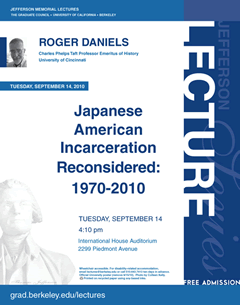
[00:00:00] CHAIR OF THE JEFFERSON LECTURES COMMITTEE:
The honor of being the chair of the Jefferson Lectures Committee. And, um, uh, we nominate, uh, speakers and help to organize visits, uh, for this series, which has brought very distinguished people over the years and is our campus’s leading, uh, annual lecture in the social sciences. These lectures, uh, were established in nineteen forty-four by a generous endowment from Elizabeth Bonestell and her husband, Cutler Bonestell, uh, a prominent San Francisco couple who loved this university and wanted to provide opportunities for the tradition of, um, to- the legacy of Thomas Jefferson, uh, and to have distinguished scholars and, uh, politicians and, uh, journalists and other public figures come to Berkeley to explore the ma- the matter of the values that are inherent in or that challenge American democracy.
Uh, after today’s, um, talk, uh, there will be a reception at the rear of the room, and everyone is invited, uh, to stay. Um, the details of our speaker’s career are in your program, and I don’t want to take more time, uh, than is needed. So I will just say a few words about his reputation and his contributions.
Uh, Roger Daniels, more than any other individual at the time, um, took the history of Japanese American internments in World War II and, uh, explored them from a scholarly standpoint and with a candor and a devotion and a, a, uh, an ardor, um, passion, uh, that has been undiminished for the nearly fifty years since then. Um, he’s done other writings on immigration history generally, on American history generally, and he’s had a tremendous influence as a mentor of graduate students, as a mentor to younger scholars, and as a colleague of people of his own generation, I include myself, uh, who have, um,
[00:02:08] HARRY, CHAIR OF THE JEFFERSON LECTURES COMMITTEE:
written, in my case co-written, in that field, uh, and who still have to look to him for authoritative judgments on the issues of that, um, extraordinary episode, let us hope it’s an extraordinary episode, i-in American history. Uh, it’s a very special pleasure, uh, to welcome our speaker, the nineteen– I’m sorry, the twenty-ten, uh, I’m an historian. The twenty-ten, the twenty-ten, uh, Jefferson, uh, uh, lecturer, Professor Roger Daniels, uh, the Charles Phelps Taft Professor Emeritus from the University of Cincinnati.
Roger.
[00:02:59] ROGER DANIELS:
Thank you, Harry. Let me get seated here. I find that standing in one place for fifty minutes is no longer fun.
There’s a slight correction in the title. You have to turn in the title before you write the piece. So the proper dates are 1941, 2010.
There’s more on the earlier period than I had originally intended.
(paper rustle)
What you’re going to hear is largely an oft-told tale, but it is a tale modified by being in post-9/11 America. What you see depends on where you stand. First, it is in order to provide a reminder of what happened to Japanese Americans after the United States was attacked by Japan in December nineteen forty-one, and her allies, Germany and Italy, declared war on the United States.
There were more than a million nationals of the three main Axis powers living in the United States, Hawaii, and Alaska. Nearly 700,000 Italians and more than 300,000 Germans had chosen not to be naturalized, and about 90,000 foreign-born Japanese who, like most other Asians, were ineligible for naturalization, all became alien enemies. Those who were 14 years of age and upward were liable to internment.
Clearly, the government had no pre-war plans for mass incarceration, nor any intention of rounding up most alien enemies. Federal authorities eventually interned some eleven thousand enemy aliens. And the phrase Japanese American internment is a misnomer.
Internment can only be done to aliens, not to citizens. Incarceration or some such term is, is what has to be used if you want to be accurate with the mass of Japanese Americans. Federal authorities eventually interned about eleven thousand enemy aliens, about one percent of the total.
They took some eight thousand Japanese, twenty-three hundred Germans, and a few hundred Italians. Although most proved no threat to the United States, their confinement conformed to the statute, and such, and, and each was entitled to a hearing without counsel after imprisonment, and as a result of those hearings, some were released. In other words, there was a hint of due process in this.
Internment of eight thousand Japanese men and a few women, one in eleven of the foreign-born ethnic population, included many community leaders and most, most Buddhist priests, language school teachers, and was orderly and generally governed by the rules set forth in the Geneva Convention. Initially, federal authorities carefully distinguished between aliens and citizens. But as far as most Americans were concerned, the two hundred and seventy-five thousand Americans who looked like the enemy were the enemy.
Something reiterated by the journalists, radio commentators, and politicians. Some two-thirds of the two hundred and seventy-five thousand were birthright citizens. The majority of Japanese Americans, some one hundred and fifty thousand, lived in the territory of Hawaii and were so vital to its functioning as the focal point of the Pacific War that a real military necessity required that almost all of them, regardless of citizenship, be left at liberty.
Their wartime story will not otherwise concern us this afternoon, although it needs to be better known. And for those of you who are interested, Harry Scheiber and Jane Scheiber were are telling part of that story in a forthcoming work. Our chief concern is the hundred and twenty-five thousand Japanese in the 48 states and Alaska.
90,000 of them lived in California, with most of the rest in coastal Washington and Oregon. They and the very few in Alaska and a small part of Arizona were eventually subjected to mass incarceration. The few thousand who had lived in or fled to the rest of the United States lived throughout the rest of the war in a kind of nervous liberty.
But the West Coast Japanese Americans, men, women, children and infants were exiled from their homes in the spring of 1942 in what we have learned to call ethnic cleansing, were temporarily warehoused in unsanitary fairgrounds, racetracks, and livestock pavilions close to their homes for months before being shipped off to ten ramshackle, purpose-built concentration camps in late summer or fall. These were in desolate places where few people have ever lived before or since. This exodus has been authoritatively described as caused by racism, war hysteria, and a failure of political leadership.
Factors, I must say, that are still active and viral in our political life. But history is made by men and women, and we need to understand who caused this disaster of democracy and why. The perpetrator-in-chief was Franklin Delano Roosevelt.
On February 11th, Secretary of War Henry L. Stimson, who the night before, in other words, the night of February 10th, 1942, had written in his diary the following: “The the racial characteristics of the second-generation Japanese are such that we cannot understand or trust even the citizen Japanese. This latter is the fact, but I am afraid it will make a tremendous hole in our constitutional system to apply it. He telephoned Roosevelt to make that hole and asked for authority to remove the Japanese Americans from the West Coast.
He reported to his key subordinate, Assistant Secretary of War John J. McCloy, that the President had given them carte blanche in dealing with the Japanese on the West Coast, adding only, “Be as reasonable as you can.” Eight days later, February nineteenth, 1942, the real date of infamy for constitutional liberty, the President signed Executive Order numbered 9066, which had been written in the War Department to give the Army absolute power over the West Coast Japanese Americans, although neither they nor any other group is named in the order. Why did Roosevelt sign it?
There is no definitive answer to that question. The president never once discussed his decision publicly, or as far as we know, in private. It seems to me that his perception of political realities and political advantage at a time when the war was going very badly for the United States and his greatest domestic concern was national unity, was that such an action was expedient.
A great clamor raised about the danger, the dangers of Japanese American sabotage by journalists, radio commentators, politicians, and professional patriots had made. It seemed to be the expedient thing to do, and Roosevelt’s reaction responded to it. No major act of his wartime presidency received greater approval from the public.
Soon thereafter, he was willing to ameliorate his decision in certain ways. When encouraged by educators, including the president of this university, Robert Gordon Sproul, as well as by some of his own aides, Roosevelt ordered in the spring of 1942 that incarcerated students might be released to intend– attend colleges and universities away from the West Coast. And in 1943, as part of restoring the right of Nisei to enlist in the army, he said that Americanism is a matter of the mind and of the heart.
Americanism is not and never was a matter of race and ancestry. Many young Nisei in camp did, in fact, enlist. Others asked, “If that is the case, why are we in concentration camps?”
A year later, the president restored another right, the right to be drafted. Most of those called up for the draft while in concentration camps obeyed, but a significant minority resisted, although they couldn’t either flee nor hide. There is no time today to go into the conditions of camp life.
Except for the camp of Tule Lake, which became a place where the government sent troublemakers, the treatment was generally humane. The American concentration camps were not death camps. But on several occasions, incarcerated Japanese American protesters confronted armed American soldiers, and as would happen later at Kent State and at some Black colleges, some protesters were shot and killed.
And in one instance, in an isolated portion of the Utah concentration camp known as Topaz, a soldier in a guard tower shot and killed an aged prisoner and went unpunished, although the available forensic evidence justifies an indictment for murder. Government lawyers had feared that the that the courts might interfere with incarcerating civilians by military means without a declaration of martial law. But alas, their fears were unwarranted.
The courts in wartime almost always give the government great latitude in questions that claim to affect national security, and the Roosevelt court, he had put each man in his seat, made no exception, was no exception. Four Nisei in their twenties who did not know one another and had little institutional or community support and much opposition from Japanese American community leaders non-violently resisted the government’s efforts to incarcerate them and instituted lawsuits that reached the Supreme Court, which in the Japanese American cases rendered three terrible decisions in June nineteen forty-three and December nineteen forty-four, effectively ratifying Roosevelt’s decisions and the t– and the actions of Congress to implement them as a constitutional exercise of the war power. In the first case, Hirabayashi, the court said that imposing a curfew only on persons of Japanese ancestry, even if they were citizens of the United States, was permissible.
In the second case, Korematsu, it said that a citizen of Japanese ancestry who failed to report for certain exile and incarceration when ordered to do so by a general could be punished. And in the third case, Endo ruled that a loyal citizen could not be held, but only referenced the War Relocation Authority rather than the president who created it, or the Congress who appropriated money for it. The Endo decision did have the effect of forcing the government to cancel the out– the longstanding orders that prevented most citizen Japanese Americans from returning to their West Coast homes even after they had been released from camps.
Apparently, two justices had tipped off the White House and or the Army as to what Endo would hold, and the government announced the cancellation of those orders, keeping people off the West Coast, the day before the decision was announced by the Court. It was very much what Justice Brandeis might have called a dirty business. The court’s December nineteen forty-four decisions did speed up the closing of the camps which were in progress.
Many of those who have written about the wartime Japanese Americans comment appropriately on their resilience, often comparing them to bamboo. But such celebrations all too often ignore the fact that many were so traumatized by their experience and fearful of what life outside camp might hold for them, that they literally had to be evicted as the camps could be, so the camps could be shut down. In post-war Los Angeles, and elsewhere on the West Coast, where most returning Japanese began to reestablish themselves economically without significant government help, there were more Japanese, mostly elderly aliens, on relief than there had been in the depths of the Great Depression.
The government did little to ease their passage. The WRA, the War Relocation Authority, furnished camp leavers with a train or bus tickets and twenty-five dollars a head. In July 1946, President Harry S. Truman had a ceremony staged on the Ellipse behind the White House for elements of the Nisei 442nd Regimental Combat Team, to which he awarded that much.
I read that wrong. Uh, he gave the combat team, a much-decorated unit, its seventh Distinguished Unit Citation, and remarked that, and I quote the President, “You fought not only the enemy, but you fought prejudice, and you have won.” Truman, in his 1948 civil rights message, noted that one hundred thousand Japanese Americans were evacuated from their homes in the Pacific States.
solely because of their racial origin and, I quote, “Suffered property and business losses as a result of this forced evacuation through no fault of their own.” At his urging, Congress enacted the Japanese American Claims Act, appropriating thirty-eight million dollars to settle claims that eventually totaled one hundred and thirty-one million. Congress refused in nineteen forty-eight to make a judgment about the nineteen forty-two decision.
As the Senate Committee on the Judiciary put it, “the,” the question of whether the evacuation of the Japanese people from the West Coast was justified is now moot.” End of quotation. The Justice Department, in a seventeen-year process, litigated and adjudicated claims aggressively.
One case file that I examined of a Japanese American who had lost his farm in Kent on Seattle’s East Side because he could not meet his mortgage payments while in camp. The files showed that he had received only half of the reduced settlement agreement he had signed. When he complained, the Justice Department explained it to him.
Washington was a community property state, and since his Caucasian wife did not have to accompany him to camp, he, really they, could not– could be compensated only for his half of the loss, not for her half of the loss. In September 1950, after the beginning of the undeclared Korean War, Congress passed over Truman’s veto the Internal Security Act of 1950, an extreme example of legislative hysteria. A part of it known as the Emergency Detention Act of 1950, introduced and supported by Democratic liberals, including Hu– including Hubert H. Humphrey and Herbert H. Lehman, was explicitly modeled on the procedure used to incarcerate Japanese Americans, because, as its sponsors repeatedly pointed out, the procedure had been approved by the Supreme Court.
Must be all right then. The purpose of the statute is described in Section 101, paragraph 14. I’m going to read some legal language, and you’ve gotta listen carefully because this is unbelievable.
“The detention of persons who there is reasonable grounds to believe will commit future attempts or conspire with others to commit espionage is in a time of internal security emergency essential to the common defense and the safety of the security of the United States. The people and the Constitution of the United States do declare that the President, this is Section 103, acting through the Attorney General, is hereby authorized to apprehend and by order detain each person as to whom there is, and again, this wonderful language, reasonable grounds to believe will probably engage in or probably will conspire to engage in acts of espionage or sabotage. It did not say what would happen if they just dreamed of them.
This is the method of Executive Order nine zero six six, with the Attorney General substituted for the Secretary of War and ideological enemies substituted for ethnic ones. It re- it re- remained unused as a kind of sleeper law on the books for more than twenty years, for some twenty years.
The only part of the law that required action was a provision providing that standby facilities be prepared and making the tie to Japanese American incarceration a little clearer, the facility at Tule Lake was designated as one of the standby detention camps. After massive numbers of Chinese volunteers entered the Korean conflict in late nineteen fifty, many Chinese Americans feared that they might become the s– target of government reprisals, and there was heightened activity by the Immigration and Naturalization Service against Chinese Americans who were perceived to be communists, including a confession program which offered amnesty to persons who had entered the United States illegally as so-called paper sons if they would con– inform on relatives, real and fictive, who were radicals. At the same time, the Justice and State Departments tried to prevent Chinese nationals who had received scientific or technical training in American colleges and universities from returning to China, although they would let them return to Taiwan.
Further emphasizing the ending of ethnic exclusion was dropping the ethnic bars to naturalization, begun with the repeal of the Chinese Exclusion Acts in nineteen forty-three and continued piecemeal until 1952, when the otherwise reactionary McCarran-Walter Act made naturalization colorblind while increasing ideological barriers to immigration and even prohibiting visits, including academic visits, to the United States by persons believed to be communists. The long overdue exclu-admission of Hawaii in 1959 changed the political dynamics for Japanese and other Asian Americans. The House of Representatives had voted to admit Hawaii in 1947, 1950, and 1953, but Southern Democrats in the Senate had blocked it each time.
Ernst Gruening, the New Dealer who oversaw the territories and island possessions, remembered that after several Japanese Americans had testified during statehood hearings in Hawaii in 1937, Mississippi’s John E. Rankin turned to him and said, “My God, if we give them folks statehood, we’re likely to have a senator named Moto.” And in fact, from its first post-statehood election, Hawaii has sent a steady progressions-progression of Asian Americans to Congress, beginning with Hiram Leong Fong in the Senate and Daniel Kenan Inouye in the House. It is difficult to overstate the positive effect that this representative-representation has had on the changing roles of Japanese and Asian Americans in American life.
Now that we have reached what is roughly the halfway point in our story, it seems appropriate to ask where, in what the Library of Congress delights in calling the American memory were the wartime experiences of a hundred and twenty thousand Japanese Americans nearly a quarter of a century after all of the camps which held them had been closed down? One cannot say that their experience was secret or unknown. It had been described in daily wartime newspapers, and there had been books and articles by scholars and journalists.
But there was simply no place in the victory culture which dominated the post-war quarter century for what could be called an American war crime. Particularly one that claimed one hundred and twenty thousand victims. Many of those victims themselves wanted to hear no more about it, and many of the younger Nisei and Sansei literally knew nothing about it, including some who had been born in the camps.
College students learned precious little about what happened to Japanese Americans in that time. The year I began my graduate study at UCLA, nineteen fifty-seven, not one of the several historians teaching survey courses in American history even mentioned it in lectures. And the most extensive standard textbook treatment in a book whose lead author was the iconic Columbia historian Richard Hofstadter, who gave this lecture in 1966, allotted it just one long sentence, which I’m going to read.
“Since almost no one doubted the necessity for the war, there was much less intolerance than there had been in World War I, although large numbers of Japanese Americans were put into internment camps under circumstances that many Americans were later to judge unfair or worse.” End of quotation. Many college texts of those years said nothing at all about Japanese– the Japanese-American wartime ordeal, and I am not aware of any mention of it in a secondary textbook before 1965.
For most of the rest of the afternoon, I’m going to try and trace and explain how the World War II mass incarceration, so little noted in that fir- first quarter century following the war, was restored to the American memory. Two distinct narratives of this restoration have emerged. One celebrates the eventual vindication of a betrayed people and is the kind of stories that audiences like to hear, and I’ll tell it.
While the other makes the incarceration an increasingly influential reference point for those concerned with the expansion of the American security state and the corresponding shrinkage of individual rights. Thus, the tale becomes both triumphal and cautionary. The focus of the story also changes.
Before nineteen seventy, Japanese Americans were largely portrayed as the objects of history. After that time, they regularly appear as actors affecting their own destinies. By the beginning of the nineteen seventies, a growing sense of Asian American community consciousness was developing.
Nowhere stronger than in San Francisco, where the engineer historian Him Mark Lai and the community activist Jeff Edison Uno and others created the first college courses in Asian American history at San Francisco State College. Courses long shunned by more prestigious universities. Uno, one of the first to propose what became known as redress, was instrumental in a campaign aided by the Hawaiian congressional delegation to repeal the Emergency Detention Act of nineteen fifty, the act whose terms I read earlier.
An assistant attorney general told the Senate Judiciary Committee that the unfounded fears of many Americans that the act might be used to apprehend and detain citizens who hold unpopular beliefs, and that the repeal of this legislation will allay such fears. This benefit outweighs any potential advantage which the act may provide. The repeal, which was passed by lopsided majorities in both houses in September 1971 and signed by the President Nixon, what’s called the Non-Detention Act, contained the following sentence: “No citizen shall be imprisoned or otherwise detained by the United States except pursuant to an act of Congress.”
It was made nugatory by the 2001 Patriot Act. President Gerald R. Ford, in a move that surprised contemporaries, chose the thirty-fourth anniversary of Roosevelt’s executive order to repeal it with a bicentennial proclamation which observed that an honest reckoning of history had to acknowledge our national mistakes. “We now know,” President said, “that we should– what we should have known then, not only was that evacuation wrong,” first time a, an American president had said that, “but Japanese Americans were and are loyal Americans.”” Ford’s proclamation, little noticed in the national press, had a paradoxical effect within the Japanese American community.
Conservative community leaders who were resisting efforts by mostly younger activists who were calling for a formal apology and some kind of compensatory comp— Pardon me, and some kind of monetary compensation could now argue that Ford’s action was such an apology and that attempts to get monetary compensation were unrealistic. The activists, of course, drew particular encouragement from the action by a genuinely conservative president. The redress movement was eventually embraced by most Japanese Americans.
The stunning, unprecedented, and highly improbable result, Harry Kitano called it the improp-impossible dream, that the activists eventually gained from Congress and a president went on until 1988 and was not fully consummated until February 1999. The struggle within the Japanese American community was acute and complex, and I’m not going to go into all the details. Initially, only a minority favored a campaign for redress.
The yet as unpersuaded majority was not so much opposed on principle, although such opposition did exist, but rather it was rather a matter of misbelief as to the possibility of a good result. After two failed attempts, the activists succeeded in getting the endorsement of the ethnic group’s major organization, the Japanese American Citizens League, JACL, at its nineteen seventy-eight convention. Its chief goals were a formal apology from Congress and individual payments to victims of twenty-five thousand dollars, thereby setting an upper limit on what individuals could even hope to receive.
Only then did the JACL committee appointed to direct the redress campaign meet with the Japanese American members of Congress to plan strategy. It received a rude awakening. The elected officials, with Senator Inouye taking the lead, said that no bill calling for compensation could possibly pass, but promised to support a bill calling for the appointment of a presidential commission to investigate what happened in nineteen forty-two and recommend any remedies that it found appropriate.
This upset an awful lot of people. The commission was forced to accept the commission’s approach, and the bill sponsored by Inouye, with more than a majority of the Senate as co-sponsors, easily passed Congress in the closing days of the Carter administration, under whose aegis the commission was appointed. The misnamed Commission on the Wartime Relocation and Internment of Civilians was a blue ribbon group whose most effective members were former Supreme Supreme Court Justice Arthur J. Goldberg and Philadelphia Judge William Marutani, the only Nisei on the panel, who had been incarcerated briefly in camp at Tule Lake before being released to go to college.
It took testimony from more than seven hundred and fifty witnesses during twenty days of hearings in the capital and cities across the country, particularly on the West Coast. Although one erudite but insensitive staff attorney described the hearings as irrelevant freak shows, they were an important rite of passage as hundreds of former camp inmates narrating their captivity after four decades of silence, often punctured by tears, shouts, and curses, and otherwise behaving in ways that Japanese Americans Rarely behaved in public. A few years later, uh, they surprised not only themselves and their children and their grandchildren.
A few years later, a Nisei woman speaking to a Nisei Week audience at the 50th anniversary of her wartime acceptance at a small Missouri Bible college out of camp, said that, “I never said anything to anybody before speaking at a commission hearing. That loosened my tongue, and I have been talking about it, what it was like in camp ever since.” The CWRIC published its unanimous report titled Personal Justice Denied in February 1983.
It was a root and branch condemnation of what the government had done to Japanese Americans, which concluded that, I’m going to read a long paragraph. “Executive Order nine zero six six was not justified by military necessity, and the decisions that followed from it, detention, ending detention, and ending exclusion were not driven by analysis of military conditions.” A grave injustice was done to American citizens and resident aliens of Japanese ancestry, who without individual review or any probative evidence against them, were excluded, removed, and detained by the United States during World War II.”
The report was issued without recommendations which were delayed until June. That was in February. One commissioner, sitting Republican then-California Congressman Daniel E. Lungren, dissented from the recommendation of a monetary award to individuals.
The other eight commissioners agreed that each survivor should receive a one-time compensatory payment of twenty thousand dollars. Other recommendations were for a formal apology from the Congress, a presidential pardon for all who were convicted of violating edicts of the Western Defense Command, and that the Justice Department review all federal convictions of ethnic Japanese during the war. Congressional instructions to all agencies to be liberal in restoring any rights or benefits Japanese Americans might have lost because of stemming from their wartime, because, or stemming from their wartime mistreatment, and finally that Congress fund an educational foundation to educate Americans about what their government had inflicted on Japanese Americans during the war.
The bill that enacted the commission’s recommendations, the Civil Liberties Act of nineteen eighty-eight, was given the number HR-four-four-two, the designation of the Nisei unit which fought so well in Italy and France. Meanwhile, in November 1983, five months after the commission’s recommendations, a federal district judge in San Francisco voided Fred Korematsu’s original conviction, which had been upheld by the Supreme Court in the most potent of the three wartime Japanese American decisions. This highly unusual, perhaps unique situation had come about because Peter Irons, a political scientist and attorney, had in the course of researching a book about the Justice Department, found evidence of blatant misconduct, deliberate suppression of evidence in the preparation of the government’s brief presented to the court in nineteen forty-three and nineteen forty-four.
Irons and a group of largely Sansei attorneys, all working pro bono, were able to reopen not only Korematsu’s case in San Francisco, but Hirabayashi’s case in Seattle, and a second curfew case involving Minoru Yasui in Portland. Only Korematsu’s case need concern us here, although all the cases are important. The attorneys applied successfully for a writ of coram nobis.
The Latin means the error before us, which had been used, by the way, by Alger Hiss in his unsuccessful attempt to get his 1950 perjury conviction overturned. After considerable delay, the Justice Department moved to vacate the conviction. In other words, they were willing to say, “Okay, vacate the conviction,” but refused to permit to admit previous government misconduct.
The district judge, Marilyn Hall Patel, a Carter appointee, ruled the government’s motion out of order, accepted Korematsu’s petition coram nobis, voided the original indictment and reversed Korematsu’s original conviction. In her opinion, she warned that—this is in 1983— “Korematsu stands as a constant caution that in times of war or declared military necessity, our institutions must be vigilant. That the government must not be used to protect government activities from close scrutiny and accountability.
The successful attorneys were delighted by the victory, but were disappointed that the government failed to appeal, as they had hoped that the case might be again heard by the Supreme Court and reversed there. In addition, their victory was one more argument for the c- for the redress bill in Congress. Reagan’s Justice Department, which had opposed the bill, told a congressional committee, “It may be the Commission is correct in concluding that the assumptions on which the exclusion and detention programs were based were erroneous, but some of its conclusions are wrong.
These matters are best left to historical and scholarly analysis rather than debated by Congress.” The legislative process was painfully slow. A divided Congress, Republican control of the Senate, Democratic control of the House, the hostility of the administration, and the constant budget crises of the 1980s meant that final passage came more than five years after the Commission issued its recommendations.
H.R. 442 initially passed the Senate by a comfortable sixty-nine to twenty-seven margin, but similar House approval by a vote of two hundred and forty-three to one forty-one was close enough to suggest that a presidential veto would be upheld, and all the signs were that Reagan would veto it. But on the day that a conference committee report adjusting minor differences between the House and the Senate versions was to be voted on, the President sent a letter to the Democratic Speaker of the House endorsing the bill and urging its passage, and I quote him, “To end a sad chapter in American history in a way that reaffirms America’s commitment to the preservation of liberty and justice for all.” At the bill’s signing ceremony, the President read from an December nineteen forty-five newspaper clipping describing General Joseph W. Stilwell’s award of a posthumous Distinguished Service Cross to the sister of Staff Sergeant Kazuo Masuda of the 442nd at her farm home in Orange County, California.
Ignoring what General Stilwell had said, the president, still reading from the clipping, desc- described how the motion picture actress Louise Allbritton, a Texas girl, told how a Texas battalion had been saved by the 442nd. Other show business personalities paid tributes, Robert Young, Will Rogers Jr. And one young actor, and this is still quoting Reagan, one young actor said, quote, “Blood that has soaked into the sands of the beach is all of one color. America stands unique in the world, the only country not founded on race, but on a way, an ideal.”
The name of that young actor, I hope I pronounced this right, was Ronald Reagan. Unlike many of Reagan’s anecdotes, this one was largely true.
(laughter)
The young actor, of course, was thirty-four-year-old Air Force Captain Reagan, completing of his, his three years of military service, for which he never left home because it was all in Hollywood. Stilwell was doing what he was doing in response to orders from Truman after he had been alerted by Eleanor Roosevelt about the abuse returning Japanese Americans were receiving after returning to the West Coast. And Reagan’s lines were written by military public relations writers.
Despite the low comedy of the ceremony, something important had been done, and something unique. A victorious nation acknowledged that it had done wrong and paid a significant price for it. Eventually, some eighty-two thousand persons received payments totaling one point six billion dollars.
And in an echo effect, in the days after Reagan’s signing, the Canadian government concluded negotiations with a Japanese-Canadian organization for similar payments, twenty-one thousand dollars to a much smaller number of victims of its parallel wartime policies. While human rights advocates had hoped that the principles and meaningful monetary redress for wartime actions against the nation’s own citizens would be adopted elsewhere, it has had no tangible effect outside of North America. An important intangible change was that the wartime exile and incarceration, all but forgotten in the post-war decades, was firmly implanted in the American memory.
This was demonstrated with striking clarity in the aftermath of what we have learned to call 9/11. In the days following the destruction of the World Trade Center and its more than 3,000 dead, and throughout the nine years since that horrific event, countless persons have raised the haunting specter of Arab or Middle Eastern,
(cough)
or now more often Muslims, becoming the twenty-first century’s equivalent of Japanese Americans. Historical analogies are always tricky propositions, Particularly when, then– one is dealing with a contemporary event. Current history is, after all, a contradiction in terms.
Nevertheless, there are striking similarities as well as differences between the events of nineteen forty-one to forty-five and those of our current decade. In both periods, race prejudices, augmented by religious prejudice in our time, and war hysteria were abundantly prevalent. But at the highest levels of recent government, there were repeated warnings not to make assumptions about guilt based on race, ethnicity, or religion.
And there was an almost total restriction of prohibitive actions, of punitive actions to non-citizens. But when it came to treatment of prisoners, we must remember that while the World War II Afrika Korps veterans brought to America later described their places of confinement as golden or Käfig — a golden cage. No such praise will come from the survivors of Guantanamo or its populist version, Abu Ghraib.
While in the aftermath of Roosevelt’s 1942 order, there was almost no public criticism of the extreme measures taken against Japanese Americans. So many public figures and others made reference to the Japanese American experience after 9/11 that it seems obvious that an increased awareness of what had happened in 1942 was a factor in the heightened sensibilities about violations of civil rights in 2001. And no one should imagine that what has happened in the last nine years is on the same scale as what happened in 1942.
Some critics have insisted that even to mention both eras in the same breath is inappropriate and worse. Those optimists assure us that a mass incarceration of American citizens in concentration camps will not recur and point to the relative mildness of the governmental reaction after 9/11 as evidence of that. But reflection on our past suggests we ought not to be so sanguine.
We must remember that it was not just the disaster at Pearl Harbor, but the subsequent sequence of Japanese triumphs that triggered Executive Order nine zero six six seventy-four days after Pearl Harbor. Shouldn’t we ask, if terrorist attacks on American soil had continued after September 11th, would the current government reaction have been so moderate? And were there to be a recurrence of such attacks, would there not be those in our security establishment who would argue that the moderation after nine eleven was a contributing factor in the renewed assaults?
Thank you.
(applause)
Okay, there’s gonna be time for not just questions, uh, but if somebody wants to make a comment, brief, uh, a complaint, brief, fine. But, uh-
[00:51:21] HARRY, CHAIR OF THE JEFFERSON LECTURES COMMITTEE:
We can all can concur that it must-
[00:51:22] ROGER DANIELS:
This hall’s been hired for me that it must be
[00:51:24] HARRY, CHAIR OF THE JEFFERSON LECTURES COMMITTEE:
brief, as we are late, and we want to give everyone who wishes to speak a chance to do so. Um, Mrs. Gobler is gonna have this hand microphone, and I’ll call on people. And we’ll ask you to show self-restraint so that we can have everyone, uh, enjoy a chance to speak.
Yeah, and to also to remind you that, um, there’s a reception afterward. It’s in the back, right?
[00:51:50] AUDIENCE MEMBER:
Yeah. You haven’t touched on the role of the governor of California at that time. I didn’t vote for him.
[00:52:05] ROGER DANIELS:
Um- No, but it was awful. In February 1941, I was a teenager, and I can remember very clearly that we were told that there were Japanese submarines off the California coast, God knows how many, and that there have been signals back and forth from the land to the subs, from the subs to the land, and of course this was, uh, when you talk about the national hysteria, this was sort of the basis of it.
And I was wondering, what can you tell us that the West Coast military command, what did they tell Washington about the situation at that time? Did they– Were they part of this canard about the Japanese subs? Was–
But did they–
(cough)
tell Washington we needed to do this? Did they tell them we should not do it? What can you tell us?
Well, first of all, there, there were two submarines, one of which popped up at, off Santa Barbara and fired several shots at some oil tankers– at some oil tanks on the hillside and missed them. Uh, the commander of that sub, by the way, unlike most commanders of Japanese submarines, uh, survived the war and was interrogated and, uh, by American officials, and he said that he was terrified, that he was sure that the entire Uni– American Navy was gonna pounce on him immediately. But actually, there were no, there were nor– no wa-no warships at sea within, within hundreds of miles of where he was.
There’s no evidence whatsoever of signals. Uh, Washington was told in a report from the Western Defense Command of Lieutenant General John L. DeWitt, again, who I haven’t mentioned in this lecture, that there were all kinds of signals, radio signals and others, and that was that that has been proved to be a total canard. That was, that was a lie.
Uh, there was hysteria. Uh, the Army quickly, quickly understood that the Japanese, that the Los An– that the great Los Angeles air raid was started when one gun near Santa Monica fired at a weather balloon thinking that it was a Japanese plane. And then anti-aircraft guns all over the, It was in the middle of the night, anti-aircraft guns fired hundreds of rounds, uh, and insurance companies knew because there was great damage to, uh, automobiles parked on the streets of Los Angeles when the shra-when some of the shrapnel comes down because you send one of those things up and it explodes, it comes, it comes down to earth, uh, there was not one single documented instance of espionage or sabotage.
And to anticipate a question about the governor of California, uh, who was at that time… I think he really wants me to talk about Earl Warren, because the governor of California at that time was bad enough, uh, but wasn’t as bad as is it his attorney general, Earl Warren, who at a meeting of law enforcement o-officials said accurately, “There hasn’t been one single case of espionage and sabotage.” That’s what makes it so dangerous.
“There’s a conspiracy to lull us to sleep.”
(laughter)
“And our time will come. We don’t know when.” So that’s why it was necessary. In other words, the same kind of, uh paranoia we saw in the Emergency Detention Act, and we’ve seen in the Patriot Act and all sorts of other activities. Long answer to a short question, but I hope that helps.
[00:56:25] AUDIENCE MEMBER:
Hi. I was just wondering whether Eleanor Roosevelt made any comments about this in her papers. Did she argue with FDR? Did… Was there-
[00:56:35] ROGER DANIELS:
No evidence of that. Uh, she accepted it. Uh, she thought it was, she thought it was unfortunate.
Uh, and everybody was pretty well traumatized in Washington. Uh, it was made worse when a Supreme Court justice came back from Hawaii with the false reports that they’d been sabotaged there, and that’s what caused everything wrong. Uh, she did go, uh, early, fairly early on, uh, to visit one of the concentration camps.
Uh, and, uh, wrote a few letters for individuals who were recommended to her to help them get out of camps. But had not, uh, there’s no evidence. We don’t know.
We don’t know what she may have said privately to her husband, but she, she never claimed to have been against it. And in some of the, in the introduction to a book called Beauty Behind Barbed Wire, published shortly after the war, Uh, she described it as an unfortunate, unavoidable necessity. That’s not a, that’s not a quotation.
That’s, that’s a description of what she said. Uh, uh, And there’s, there’s a, there’s a widely held myth in the Japanese American community that Eleanor Roosevelt was their champion, and it’s just not true. But she did, she, she did go to, uh, one of the camps.
She did say things like, uh, “I’m sorry that you’re all here,” and this sort of thing. She was very sympathetic, and she was she could… she was very, very good at projecting empathy.
But, uh, that’s where it ended.
[00:58:21] MODERATOR:
Yeah. This was really an interesting summary of what happened during World War II, and, uh, We’re grateful for you for writing out those stories. The point I wanna make is, um, unlike, um, all these, uh, uh, academic people writing about what happened during World War II, there was a small minority that really, um, enjoyed being in the internment camp and got a lot out of it, such as our family.
I came from a very rural part of, uh, Sutter County, and we were interned at Tule Lake, and then later on we transferred to Minidoka. At Minidoka, the people in camp were from Seattle and Portland, a very urban area. And that’s where, um, my sister and our family really, uh, got educated.
That is, you know, when we were growing in Yuba County and, and Sutter County, we went to a one-room schoolhouse. And at camp at Minidoka, we all learned about there was such a thing as college. And from there up, you know, when we came back from camp, my sister and brother was all excited about going to college.
And, uh, the four of us ended up going to University of California, Berkeley. And, uh, we always felt that by being– going, going into the, uh, camp and learning about the urban living that, uh, we escaped from being a farmer, you know, essentially
(laughter)
.
[01:00:00] HARRY, CHAIR OF THE JEFFERSON LECTURES COMMITTEE:
Thank you very much. Any questions?
[01:00:04] ROGER DANIELS:
Lady here. Thank you.
[01:00:11] AUDIENCE MEMBER:
Hi. Thank you. Thank you very much. I’m wondering if you have any comments about the status of the Peruvian and other Latin American Japanese that were, were brought to Crystal City, Texas.
[01:00:23] ROGER DANIELS:
Yes.
[01:00:23] AUDIENCE MEMBER:
And they’re seeking reparations now?
[01:00:25] ROGER DANIELS:
Yes. The, uh, the reparation to some of them, uh, has, has been inadequate. Uh, it’s a difficult situation.
There’s no particular reason. You know, it’s not gonna break the government. We’re not dealing with, with, with a large number of people.
Uh, and I think that their, their cause is a, is a good one. Uh, I wouldn’t, uh, I wouldn’t hold my breath until, until it was satisfactorily settled because I suspect that that’s not going to be the case. I hope that, I hope that I’m wrong.
Uh, but it certainly was… And some people may not know what, what it is, but the United States, fearful of mythical sabotage and mythical German and Japanese saboteurs in, in Latin America, encouraged various Latin American countries and urged them, and in some cases insisted, that they round up some of their Japanese and some Germans and one or two or three Italians, nobody was really much worried about the Italians, uh, and shipped them to the United States, where they were placed in, uh, in camps. By the way, one of the camps in which they went, Crystal City, Texas, where they sent families with children, was, uh, An incredibly better place than most of the camps that most Japanese Americans went.
Uh, there was, for instance, everybody lived in family units with cooking facilities. The government was obligated to supply a quart of milk a day for each child, et cetera, and they’d have find them on the doorstep in the morning, just like a civilian proposition. So it was a–
So some of them were, were in a, if not a gilded cage, at least a, a, a more comfortable existence Uh, and there’s no reason why that kind of existence could not have been done if you had to do incarceration for all of the incarcerated people in the United States, but that didn’t happen. Uh, it was an outrage. Uh, but again, Uh, well, no, I know I’m getting too much.
Uh, there’s always an again and again. And, uh, and history is a never-ending story.
[01:03:14] NANCY UKAI RUSSELL:
Um, my name is Nancy Ukai Russell. Thank you very much for your very important work. I just wanted to comment on a follow-up on this man’s remark about his experience in the camp.
Um, my grandfather was an immigrant from Japan to Berkeley. He had a cut flower nursery on Sixth Street, and because Sixth Street was considered a militarily important area because of these ideas of submarines. He was not allowed as a quote-unquote alien enemy to live in his home.
So he had to live somewhere east of Sacramento Street and find somewhere to live, and then come back and visit with the family, sneak over, um, west of Sacramento Street to meet with the family to decide what to do. The family went to Topaz, Utah, and as you know, were only allowed to carry two suitcases worth of, um, belongings. When they got to the camps, my mother–
And you know, they rode on these trains with the curtains pulled down. She said, “What did you bring?” He had packed his two suitcases filled with eucalyptus leaves.
And she was yelling at him, and she said, “You’re such a fool. You should have brought blankets and tools.” And he said, “I love Berkeley.”
I, I didn’t know if he’d ever come back, and he loved the fragrance of the eucalyptus leaves. So I think that people experience the camps according to their age and their circumstance, and some of the children had fun and have memories of running around. But I think for a lot of older people, it was extremely, um…
It just destroyed the structure of the family. I just wanted to ask you briefly about the politics of the term concentration camp, uh, as a follow-up.
[01:04:49] MODERATOR:
Thank you.
[01:04:51] ROGER DANIELS:
No politics about it. There’s some, uh, some people… There are different reasons for opposing the use of the word concentration camps.
Some people say, “Look, Americans can’t have concentration camps.” Uh, A number of people who’s Jewish and otherwise, whose concern is the Holocaust, say, “You can’t do that.” “Uh, you can’t use the same term.”
But concentration camps weren’t invented by Stalin or Hitler or Roosevelt. Concentration camps, as we know them, were invented by the British in the Boer War. They’re the proper term to describe places where you put civilians who you are in one way or another holding as hostages.
For one reason or another without, in a democracy, due process of law. Uh, it’s, it is to me, uh, an appropriate term. And by the way, Franklin Roosevelt used it on several occasions.
And so he was, he was very blunt about it. Uh, the first, his first use came when he was asked in a press conference, which was talking about farm labor. Uh, he described the beginnings of the Bracero, w-what became the Bracero program, which started during the war, and then said that there are also some Japanese who were harvesting beets in Montana and elsewhere.
And the reporter says, “Where did those Japanese come from?” Roosevelt answers, “Oh, our concentration camps.” Period.
Uh, it’s history. That’s what it is. Uh, some people get very upset about it, uh, and, uh, I’ve been cursed, nasty phone calls about it when I first started doing this, but now it’s generally accepted.
Not by everybody. Uh, the term internment camp is, is not that bad, but it’s wrong. Uh, but I, I, I’m, I, I’m a person who thinks that words are important, and it’s important to describe events in what they are.
Uh, so that words do matter. And… Much love.
[01:07:18] HARRY, CHAIR OF THE JEFFERSON LECTURES COMMITTEE:
Okay, thank you. I think that this concludes our formal session. We have to–
I know there are always more questions at the end, but we do have to, uh, end these events. Yes, I can’t say enough, Roger, how much we appreciate your and Judith Daniels, your wife, and also an historian, coming to Berkeley and sharing this day with us. I should also add that Professor Daniels has been very generous in his time, with his time in meeting with students and faculty, uh, during his visit to our campus.
So it’s, uh, in a sense, the model Jefferson lecture visit for us on the faculty who organized this. Um, I want to remind you that we have a, um, reception planned in the back, and, uh, you’re all very welcome to join. And I think that Professor Danis will be here for at least a few minutes, uh, to join with you.
Th-thank you very much.
[01:08:10] ROGER DANIELS:
No, no. Thank you.
(applause)