
[00:00:00] ELLEN GABLER:
Good afternoon. My name is Ellen Gabler. I am the senior public events manager, and I manage the Graduate Council Lectures, of which the Jefferson is one of them.
It is my pleasure to introduce Harry Scheiber, the Stefan A. Reisfeld, Reisenfeld Professor of Law and History, and also the chair of the Jefferson Committee. Thank you.
(applause)
[00:00:26] HARRY SCHEIBER:
Thank you very much. I want to welcome everyone and say what a pleasure it is on this occasion to represent the Jefferson Lectures Committee and the Graduate Council of the Academic Senate in this uh, most recent in a long and d– very distinguished venerable now series, the Jefferson Endowment Lectures. These lectures are a wonderful event for us each year, one or two per year over the years, and occasionally we have conferences that have produced books in this area.
And we’re indebted for the endowment that supports these lectures as your program says, to a bequest from Elizabeth and Cutler Bonestell, who are prominent San Francisco residents who cared for history and hoped these lectures would encourage students, faculty, visiting scholars, and others to study the legacy of Thomas Jefferson, and to explore the values inherent in American democracy. Those are the words from the bequest. And I think that they would, as we are, be enormously pleased to uh, see that not only is Professor Kammen going to address some very central issues in the culture of American democracy, but has even linked Thomas Jefferson to Forrest Gump.
And uh, which expresses, I think a turn of mind that makes Michael Kammen really virtually unique among American cultural historians. The range of his imagination and the degree of his extraordinary inventiveness and originality is shown in the subject matter of his many books. Um, I’m not gonna list them all.
There are several that are in the program. Among my own favorites as an historian on my little shelf of Kammen, and so it’s, it’s a fairly long shelf actually is his early work as a colonial historian who had studied at Harvard University for his doctorate and did wonderful history of colonial New York and other studies of New York in his, early in his career, but went on to very broad-ranging subject matter, which over the years has brought him a Pulitzer Prize for People of Paradox which has brought him other very distinguished awards. And I met, I don’t know how he would rank them in his own mind, but certainly I would think his election as president of the Organization of American Historians, has been speaking his preeminent status among his peers.
I would be on the list of his most treasured honors. He has recently examined how Americans look at, respond– how American culture and its responses to the seasons speaks to American optimism and American attitudes. He’s done studies in the history of art and the history of low culture, as he says, as well as high culture, and in the societal relationships of art, and the arts and the crafts, and architecture and public space to American culture.
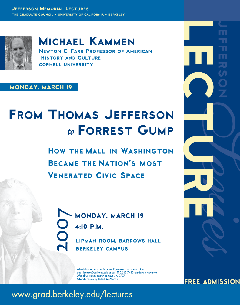
we’re very privileged, as I say, to have my friend Michael Kammen, he has many friends on this campus to speak to us on the title From Thomas Jefferson to Forrest Gump: How the Mall in Washington Became the Nation’s Most Venerated Civic Space. Mr. Kammen.
(audience applauding)
[00:04:11] MICHAEL KAMMEN:
Thank you, Harry. I’m needless to say, delighted to be here, honored to be here, to encounter old friends, make new friends, see grandchildren who happen to live not very far away in Oakland. Many of you are very likely Americanists, and many of you are also likely to be, not to be Americanists, and so I want to begin by providing just a little bit of a comparative framework or context, as the case may be.
[00:04:48] HARRY SCHEIBER:
I’m gonna be talking about a transformational narrative concerning what I like to call a Great Space, capital G, capital S. Arguably, I think, the most significant Great Space in the United States, and so some of you may want to keep in mind Great Spaces elsewhere that are comparable in diverse ways. St. James Park comes to mind immediately in the center of London, 58 acres, once a marshy meadow, as the Mall in Washington was originally, and a place where all sorts of ceremonial events take place. Horse Guards are located there.
Buckingham Palace is along the edge of it, and it, it is comparable in certain ways to the Mall in Washington. But three others are comparable in even more interesting ways. The Tuileries and the Tuileries Palace in Paris is especially worth keeping in mind first of all, because Le Nôtre designed parterres there for King Louis XIV, and L’Enfant had those parterres and Le No– Le Nôtre’s designs very much in mind when he was thinking about the mall in the context of his design for Washington, D.C. more important, the Tuileries and the palace there are far more symbolic of political protest, and indeed violence, in French history than the Bastille.
So that in 1792, when the French Revolution was at its most violent, the attacks and burnings at the Tuileries were very important. In 1830, when the July Revolution occurred and the uh, Bourbon rev– the Bourbon Dynasty fell once again, the Tuileries were attacked. Protests, political protests were held there.
And in 1871, when the Commune occurred, once again, political protests and, and violence occurred at the Tuileries. In Mexico City, the Zocalo, or Constitution Square, is significant in, in, in, in historically in very much the same way. It began as an an– an ancient Aztec site and marketplace.
Rioting, the history of rioting there goes back at least to about 1624 and 1692. Major political protests took place at the Plaza Mayor. And there are interesting, uh, comparabilities between the Zocalo in Mexico City, and the Mall in Washington.
To mention only one other place to keep in mind, Tiananmen Square was created in 1417 during the Ming Dynasty as a uh, site designed to be a great gathering place, but especially as the site where the announcement would be made of a new emperor and a new empress. And there’s a long history of crowds gathering there for a variety of reasons, and obviously, the best remembered is the 1989 protest that occurred there, and the way in which it was quite brutally repressed. There are some principal motifs that are gonna run through my talk.
I’ll simply call four of them to your attention, and the first and the fourth are the most important. The Mall, as visitors to Washington, and from both the U.S. and abroad have known it, for about the last half-century, may seem and feel inevitable. That the configuration of buildings there and the uses made of the space for purposes of both ceremony but also political protest in retrospect within our lifetime it sort of seems inevitable.
And I wanna insist that the way the Mall e– evolved and, and, and became the, the site that we know today was anything but inevitable. And that, in essence, is really the burden of what I wanna present to you. There’s been a, there was a long history of neglect and many episodes that I would call serendipitous in the history of the Mall.
Keep in mind that during the course of the 19th century the transformation of the m– the, the very slow, or almost reluctant transformation of the Mall owed a great deal to Congressional parsimony, an unwillingness to spend money on building structures and properly decorating it, and also perhaps even more, endless Congressional indecision. Because all sorts of proposals were made to do, to enhance the Mall in a variety of ways, and Congress dilly-dallied and, and could never quite come to terms with what it wanted to do. So that by the end of the 19th century, the Mall had actually been divided up into six separate gardens, each one under the jurisdiction of a different Congressional committee– none of which communicated with one another.
So the Mall was really quite, quite chopped up by the end of the 19th century. A, a third theme involves neoclassicism and ongoing debates and discussions about e– either the necessity of having architectural cohesion and coherence, so that there would be a kind of uniformity, but at the same time, or, or a– alternating with that perspective there was a sense that we needed to sort of move on– do things that were more American, less indebted to European styles of architecture and design. And I’ll call to your attention just some of the major moments when when, when there was real conflict over whether neoclassicism was going to be inevitable.
And finally the, m– uh, in many ways, the, the other really important point that I wanna leave with you is that when the major transformation occurred that would result in the Mall being the, the, the place that, that, that we perceive it to be today, there were two crucial ingredients that brought that transformation about. The first was, involved protest against racial injustice and discrimination, and the second was anti-war protest beginning especially in the late 1960s with, with protests against the war in Vietnam. So the problematique of, of what I wanna convey today is simply how did the Mall come to be the civic space that we know?
Per– perhaps I should ask before getting into the meat of this, how many of you saw Forrest Gump in 1994 or since? Great. All right.
Uh, that’s really not terribly important, but it s– it’s helpful to, helpful to be able to envision that moment when Forrest Gump is standing in front of the Lincoln Memorial looking out over a large anti-war protest.
[00:12:15] PRESENTER:
Start with genesis. In 1789, when the United States became a nation, there had to be a national capitol located somewhere. And so, for expedient reasons, it was located in New York City.
And Pierre L’Enfant, who had come to the United States in 1776 to join the Continental Army and serve in the Continental Army, was trained as an artist, an architect, and a civil engineer. So, L’Enfant was asked by George Washington to essentially do a makeover of the building that we know as Federal Hall, and make it suitable for the Congress to meet in, and for the executive to meet with the Congress, which L’Enfant did in, in 1789. In 1790, as a result of a complicated political deal that need not concern us, the decision was made to relocate the capitol of the United States to the banks of the Potomac River.
Needless to say, that would take time because they were starting from scratch. So, for 10 years, the Capitol would be located in Philadelphia. But in 1790, ’91 planning needed to begin in earnest.
L’enfant who was ambitious had a tremendous ego, approached his friend, George Washington. They, Washington who had no children of his own sort of adopted Lafayette as his primary adoptive son, and L’Enfant came in somewhere second or third among Washington’s informally adopted children. And Washington believed that L’Enfant was probably the best qualified person to plan this new capital city, so he got the assignment.
Thomas Jefferson, at that time, was Secretary of State, and Washington and Jefferson in tandem took it upon themselves to have principle responsibility for the creation or an oversight of this new capitol city. They also, however, appointed three commissioners who would have immediate supervisory responsibilities but the commissioners would be closely answerable to Jefferson and to Washington. L’enfant did not much like having to deal with the commissioners.
In fact, he really bridled at not being able to only work directly with his old friend, George Washington. And he did, in fact during, during the year that he worked on the project and meet with Washington at Mount Vernon in Georgetown on several occasions. Thomas Jefferson promptly made a sketch of what he envisioned for the city, and that’s what you see on the screen there.
He did it in 1791, and he gave it to L’Enfant, who clearly was very much influenced by it because y– as you’ll see in, in a second it, it it really corresponds in terms of the sense of, of public walks, Jefferson’s phrase and, and gardens it corresponded very closely to, to what L’Enfant would develop so that one of my m– lesser arguments is that whereas L’Enfant normally gets credit for everything having to do with the design of Washington, Thomas Jefferson, in my view, is really the godfather of the Mall in particular because that– that’s the essence of what you’re– What you’re seeing there. So L’Enfant gets to work, and he draws up a plan during 1791, but a conflict arises, several conflicts arose, but one in particular over having the plan engraved and published.
Jefferson and Washington were in a huge hurry and wanted the plan engraved and published as quickly as possible. L’enfant dragged his feet and was very reluctant to do so. It’s not entirely clear from the documentary sources why there was this difference of opinion.
Our best guess is that, on the one hand, Washington and Jefferson needed to sell lots because money was needed to pay for the construction of the Capitol, where the president would live and so on, and other, other federal buildings that were envisioned. L’enfant apparently was afraid that if lots were sold too quickly, and private individuals began building their own structures rather randomly, they would interfere with the cohesion of the relationship among the new federal buildings that he had in mind.
[00:17:26] HARRY SCHEIBER:
Well, dragging his feet made Washington and Jefferson very unhappy, and so they fired him after 11 months of work. He should have submitted a bill at that point. He was fired in February of 1792.
He should have submitted a bill, neglected to do so, submitted a bill for his services, which were considerable because the design is really quite brilliant but only submitted his bill some year, many years later and it never got paid. And also, the bill that he did submit was quite extravagant in terms of the sum and he never got paid. Then, there were there were other conflicts between L’Enfant and Jefferson in particular.
On the one hand, L’Enfant had been happy to come to America, serve in the Continental Army was clearly very sympathetic to the American cause. On the other hand, he was French, he had grown up at Versailles where he lived between the ages of 4 and 12, and so growing up in a monarchical culture in his initial plan for Washington he designated the place where the President of the United States would live as the Presidial Palace. Thomas Jefferson changed that to President’s House, much more democratic, much more, much simpler, and much more egalitarian.
And we have, what has survived is L’Enfant’s original drawing for Washington with Jefferson’s pencil emendations on top of it. And to make a long story short about the publication of the plan, when Jefferson took it upon himself to have it engraved and published first in Philadelphia and then in Boston, he he altered the cartouche. He also simplified and democratized the language in the cartouche, made it much less aristocratic and pretentious than what L’Enfant had, and he also omitted L’Enfant’s name from the cartouche as the author of the design.
L’Enfant was really pissed off about this. So it was, it was a brilliant plan, and we might ask, “Well, what did L’Enfant envision for the Mall in particular?” Well, what he envisioned was an extended area which you, you see in, in black on there, and there’s a facsimile edition of the original plan that the Library of Congress made in 1887.
And here is the Capitol. Uh, there obviously is the Mall. There is the White House and, and the Ellipse.
And L’Enfant envisioned that there would be a a Grand Cascade of water, 40 feet high and 100 yards wide directly below the Capitol. Where was the water going to come from to make that possible? Well, originally, there was a, a a sort of a, a major inlet from the Potomac River, called the Tiber River, and in 1815, the Tiber River was, was dredged and converted into the Tiber Canal, and the Tiber Canal as it passed below what was called Jenkins Hill, which is the hill on which the Capitol rests, the Tiber was going to supply the water for this grand cascade.
Then L’Enfant called this the Grand Avenue, and he envisioned that it would be lined on each side by buildings of, of intellectual significance. He doesn’t, he never used the word museums. He talked about artistic and academic structures, but not meaning academic in quite the way that we do, so that what he envisioned was a special, grand space for an elite and leisure class.
Now, as you all know, he laid out Washington on a grid, but a grid crisscrossed by avenues that would run at diagonals. Jefferson and Washington were not very enthusiastic about these avenues that would cut across the, the Baroque grid that L’Enfant had in mind, but they decided to go with it anyway. We believe, we don’t know for sure, but it would appear that it was Jefferson’s idea that the first 15 of these avenues should be named for the first 15 states, the 13 original colonies plus Vermont and Kentucky, which had become states by the early 1790s.
And we also have reason to believe that it was Jefferson it was Jefferson’s idea that the principal, or the most important of all the avenues that would connect the the Congress House with the President’s House should be called President should be called Pennsylvania Avenue as a kind of sop, if you will, to Pennsylvania because they had lost the national capital, and they were not terribly happy about that.
[00:22:38] PRESENTER:
We do know for sure that in 1803, it was Jefferson’s decision to line Pennsylvania Avenue with poplar trees to make it as elegant as possible, because it was his sense, as actually as it was L’Enfant’s, that this would be the principal connecting artery between the President’s house and the Congress’s House. And for 150 years, Pennsylvania Avenue would, would really be far more important than the Mall in terms of demonstrations. So for example, in 1893, a year in, into the, or I’m sorry, 1894 one year into the worst depression in American history up till that time, Jacob Coxey led a march from Ohio to Washington, DC and his group proceeded from the White House to the Capitol in order to demand that more action be taken by the Congress.
In 1913, the Women’s Suffrage Procession and Pageant marched on Pennsylvania Avenue in the opposite direction. They started at the Capitol, ended at the White House in order to plead with President Woodrow Wilson for his support of women’s suffrage. And in 1931, the so-called Bonus Army, now early in the, the worst depression of all depressions in American history, the Bonus Army retraced Coxey’s route marching from the White House to the Capitol in order to demand bonuses for their service in in, in, in Europe in, during World War I.
So as late as 1941 when A. Philip Randolph called for a march on Washington that never came off for reasons would we’ll talk about in a minute. The idea was to begin the march on Pennsylvania Avenue, but end up on the Mall. So Pennsylvania Avenue would be much more important as a site for demonstrations than the Mall.
So what, what was the Mall like in the 19th century and what, what slowed things down in terms of development to, to the extent that it did? First of all, the Mall initially was simply, a pasture with some very nice stands of trees and it was mainly used for grazing.
[00:25:08] MICHAEL KAMMEN:
And in fact, Congress contemplated renting it out to farmers to where their livestock could graze. That was considered, but it was never approved. In 1816, Benjamin Latrobe, the most brilliant architect in the United States at the time had a commission and designed– Came up with a design which has, has survived for a national university to be located on the Mall in Washington.
And that never got approved and never went forward. Then Robert Mills, who was the, uh– who became the principal architect of the United States during the second quarter of the 19th century came up with a design a landscape architect’s design for the Mall in 1841, and nothing came of that. In the mid-century, a greenhouse and a botanical garden did get located in the southeast corner of the Mall, and it’s, it’s there to this day.
And that’s about all there was until the middle of the 19th century. Then came the Anglo-Norman Smithsonian Castle, erected between 1846 and 1855. And this was the first major contretemps over architectural style, because the, the Capitol was neoclassical, the President’s House was Neo-Georgian, and therefore considered to be consistent cohesive with the Capitol.
Uh, so why on earth did the Smithsonian Castle get built in the style that it did? It happened because in the mid-19th century, there were quite a few enthusiasts in Washington for Oxford colleges, and so they wanted this building to look like an Oxford college. Uh, Robert Dale Owen, for example, a congressman from Indiana loved this, the Smithsonian design.
On the other hand, Horatio Greenough, the most prominent American sculptor of the day, hated it. So there was, there was a, a, a big uh, to-do about the inappropriateness of, of the Smithsonian Castle, and that’s, that’s episode number one in this ongoing controversy over neoclassicism. Then Robert Mills was asked to design a Washington Monument.
By the way in, L’Enfant’s original plan, there was supposed to be a gigantic equestrian statue of George Washington located there. And for a variety of reasons, it never happened, partially because some people said, “Equestrian statues are too European. We need to do something more American to honor the father of our country.”
So instead the Washington Monument got placed there, and despite L’Enfant’s obsession with Baroque symmetry and axes the Washington monument had to be located on a raised piece of ground. And so it is not exactly along his grand avenue. It is somewhat off-center which bothered which now we just take for granted but at the time was very disturbing to a lot of people.
Then the design of, of Robert Mills for the Washington Monument was sort of a hodgepodge of neoclassical and other elements, because the obelisk, which he wanted to be the Egyptian obelisk, which he wanted to be the highest structure in the world, which indeed it turned out to be when it was finally completed completed was surrounded by Doric and Ionic colonnades, and of course that part never actually got completed. There you see the Tiber Canal in this lithograph that anticipated a construction that never came to be. Here, by the way, is Mr. Mills and his wife and here is the so-called brick chimney because in 1856, work on the Washington monument stopped because they ran out of money.
It was all being done by public subscription. Congress was not about to supply any money for it. Finally, in 1876, the, the year of the centennial of American independence, Congress was sufficiently embarrassed that not only the brick chimney, but all manner of debris surrounding it was really quite, quite ugly.
So they appropriated money to have it completed which was finally done by 1885.
[00:30:07] HARRY SCHEIBER:
The, in 1850, Alexander Jackson Downing, the leading landscape designer in the country, was commissioned to, to provide an overall comprehensive plan for the Mall. And what he the, the great buzzword of the day was picturesque, and Downing was a master of the picturesque. He wrote eloquently about it.
He was, in many ways, a disciple of Thomas Jefferson wanting grounds to be as democratic as possible. By which he meant, and he, he talks about this in, in a, a lengthy essay, he wanted the grounds to be educational as well as available for the pleasure of the people, so that what, what’s actually become of the Mall in terms of people playing Frisbee, football, soccer on the Mall, I think, would be perfectly satisfactory in the minds of both Jefferson and, and A.J. Downing. And Downing, who did not like many elements of L’Enfant’s design for Washington, deliberately made his scheme for the Mall very curvilinear.
He wanted it to contrast with the Baroque regularity of the street design for Washington. Unfortunately, Downing died in 1852, and without him present to supervise his plan, it didn’t go very far forward. During the Civil War, the Mall essentially became a highly functional staging area.
For example, the Armory Hospital was quickly erected exactly where the Air and Space Museum are now located. In 1864, the federal government seized the estate of Robert E. Lee directly across the Potomac and started the creation of Arlington National Cemetery, which eventually would enjoy a kind of semi-visible connection or sense of connectedness with the Mall and enhance the sense of the Mall as sacred space. So Congress discarded the plan for the Mall of Robert Mills, discarded Downing’s plan didn’t go forward with either one, and then, meanwhile, the railroad began to intrude.
In 1854, the Arlington and Washington Railroad was permitted to run its train tracks across the so-called Long Bridge across the Potomac and cut directly across what would become First Street directly below the Capitol, and there you see a lithograph of trains right below the Capitol running from south to north to a train station just north of the Mall. And then in 1872, the Baltimore and Potomac Railroad, which would eventually become the Pennsylvania Railroad was allowed to run its tracks across Sixth Street right next to where the National Gallery of Art would eventually be located and permitted to erect a huge and really, really ugly Gothic depot as well as various train sheds and, and equipment structures that were needed. So by the final third of the 19th century, the Mall really was becoming a mess, and as late as 1892, the Grand Army of the Republic which was the organization for highly patriotic Union veterans in the 1890s, the GAR reached the peak of its political influence, they held a major encampment on the Mall, and everybody thought it was just peachy for them to set up all of their tents and to hold their festivities there.
After the Spanish-American War in 1899, 1900, many members of Congress and other people prominent in politics began to feel that now that the United States had become an imperial power, having acquired Hawaii a few years earlier and then Cuba and Puerto Rico and the Philippines, that the Mall should really be worthy of a great nation. And so people began to think about what could be done. And 1900, of course, was the centennial year of the completion of Washington in the sense of its being ready for John Adams to move into the White House and for the national politicians to move their offices to Washington.
So in 1900 there was a flurry of plans offered for the complete redesign of the Mall, all of them very second-rate And invariably there was a major avenue called Centennial Boulevard that would have run the length of the Mall. Luckily, none of those got approved and so in 1901, Senator McMillan from Michigan decided to really take matters into hand and he created a truly Blue Ribbon Commission that consisted of Daniel Burnham, the architect who had been responsible for the White City at Chicago in 1893 for the Columbian World’s Exposition, World Exposition.
Frederick Law Olmsted Jr. whose father had actually been brought in as a consultant in 1875 to indicate what he thought might be done to make the Mall a more cohesive site that would be more appropriate for ceremonial purposes. Olmsted Sr.’s plan had been essentially ignored, and Junior, who took over his father’s distinguished practice, was a part of this commission along with the sculptor Augustus Saint-Gaudens and Charles McKim of McKim, Mead, and White. They went to Europe for an extended tour.
They visited all the major capitals of Europe. They collected plans of various sorts and came back, and in 1902, offered what came to be known as the McMillan Plan for Washington. And some of the key elements most important ones to keep in mind are the following.
First of all, A, the westward expansion of the Mall from the Washington Monument, which is essentially 17th Street all the way to the Potomac River And that caused a good deal of, and that a memorial to Abraham Lincoln be erected there. Lincoln had been born in 1809.
The idea was that a memorial would be ready for the centennial of his birth in 1909. There was such a fight over the Lincoln Memorial that it took much longer for it to be completed. There was a fight for various reasons.
The west end of what would of the Mall was so marshy and so swampy that the Speaker of the house Joe Cannon, who was from the Midwest and was a great fan of Abraham Lincoln’s, said to the and wrote to the Secretary of War, “I’ll be goddamned if we will dishonor Abraham Lincoln by locating a memorial for him in that feverish swamp.” Uh, so there was a big fight over whether a memorial to Lincoln should go there at all, and then there was another big fight which we don’t have time to go into, over what form the memorial should take. Should it be a Greek temple?
And so we have the neo, the whole neo-classical issue once again. Many people saying arguing against uh, the, m– uh, plan of a Greek temple that Abraham Lincoln didn’t know any Greek. He was a very practical, pragmatic man.
Why not do something highly functional to honor him? And so the principal proposal that was offered as an alternative to the Lincoln Memorial, as we know it was a 72-mile highway that would connect Washington to Gettysburg, Pennsylvania. Uh, there were–And that bill to that effect was offered in Congress twice, in 1909, seriously debated barely defeated offered again in 1912, barely defeated then, Henry Bacon got the commission how to design the Greek temple that we know.
So neo-classicism won out, but not without a considerable conflict. Then there were other important proposals t– that the McMillan Commission had. One was to erect what they called a memorial bridge that would link the Lincoln Memorial to Arlington National Cemetery, and that, in fact, took place between 1923 and 1929.
Again, a delay, but it did occur. Uh, they also recommended something that they called Monument Gardens. The Monument Gardens would be adjacent to the Washington Monument and would involve a gymnasium, baths, various, essentially athletic facilities and that never came about.
Many people felt this is going a little bit too far in the direction of endorsing sports on the Mall, but it, it, it did get serious consideration. And then Daniel Burnham successfully negotiated a deal with the railroad companies so that the, they would remove all of their tracks from the Mall in re– exchange for which they would receive 14 acres of prime land immediately north of the U.S. capital, on which a major train station could be built, and Union Station opened in 1907, and basically, architecturally, is, is fundamentally unchanged ever since. As part of the deal, the railroad companies, since their, many of their trains would need to go south as well as north from Union Station, had to agree that the train tracks going out of Union Station heading to Virginia would be run underground so that the Mall and surrounding area would not be sullied by what you saw from the 1850s through the end of the 19th century.
Now, between the two World Wars, th– there were, there was very slow progress, and there were a number of setbacks. Uh, first of all, there in 1917, when the United States entered World War I, the federal bureaucracy expanded exponentially, and so a quite a number of office buildings were put up that were called temporary office buildings. Now and they mainly ran along– is essentially a schematization– what they would be like.
These never came into existence. These did. Uh, in the summers of 1958 and 1959, I worked in one of those buildings in the Office of Naval History, and as the that was a, a great era of s– of air raid drills and civil defense, and my responsibility as the most junior most and, and newest employee when one of these weekly air raid drills occurred, my responsibility was to go to the third-floor men’s room, open the door, and yell, “This is an air raid drill.
Would everyone please evacuate?” So, in any case, the temp in, in 1941/’42 when the United States entered World War II more temporary buildings went up, and they began to seem less and less temporary. As I say, they were still there in 1958/’59 when I worked in them, and we’ll return to them in a minute.
Meanwhile, in, on August 8, to give you some indication that the sense of what was appropriate for the Mall had not yet exactly crystallized, on August 8th, the Ku Klux Klan held a major rally at what’s called Sylvan Gardens, which are immediately adjacent to the Washington Monument. 600 Kleagles arrived by train at Union Station with their families.
[00:42:49] PRESENTER:
Large caravans of, of Klan-bearing cars came from New Jersey, Pennsylvania, New York, Ohio, and in some cases, from as far away as Texas. The Klan was given permission to hold this rally with only one condition. They could wear their outfits, but they could not wear their hoods.
Their the hoods had to be, like sort of academic hoods fallen back on their shoulders so the invisible Klan had to become visible at least facially. They were given permission to have an encampment because there were about 60,000 people who came for this. They were given land for an encampment in Bethesda.
They were permitted to erect an 80-foot cro– and burn an 80-foot cross in Arlington directly across the river where it could be quite plainly visible from the Mall. And the acting chief of police of Washington DC actually led the parade up Pennsylvania Avenue in an open car and then the, the whole group, would end up on the Mall. There was some concern about possible protestors and one, exactly one protestor was arrested and very few others seem to have showed.
We don’t know precisely why this event actually took place. It would appear that there was a power struggle between the Northern Klan and the Southern Klan for supremacy of the Klan as a whole. The Southern Klan had a greater sense of, priority and of entitlement within the organization, and this seems to have been a power play on the part of the Northern Klan to demonstrate the amount of clout that they could that they could muster.
In in 1929 there was a proposal that 48 temples representing the 48 states be erected along the length of the Mall, both sides on the length of the Mall. Well by that time the Smithsonian Castle was there, the American Museum of Natural History had been erected in 1908, and so Ulysses S. Grant III, who was responsible for, all new developments in Washington DC, thought this was a peachy idea.
[00:45:18] HARRY SCHEIBER:
But he recognized there was no way in the world that 48 temples could be fit into that space. So Grant’s proposal was to locate them instead along the entire length of East Capitol Street, culminating in a stadium on the Anacostia River. Well, by the time that plan was ready to go forward in 1931, we were in the depths of the Depression, and so, fortunately, the 48 temples were ne– never built.
Then those of you who are familiar with Northwest Washington may, may remember that, for example, if you walk north from the National Gallery of Art, let’s say, or from the National Archives, you come to C Street, D Street, E Street, and you may be wondering whatever why is there no A Street and B Street? Well, originally, there were A Street and B Street, but in 1931, as late as 1931, A Street, and B Street got renamed Independence Avenue and Constitution Avenue. So the two avenues that defined the boundaries of the Mall finally got their symbolically significant names as late as 1931.
Then another highly undesirable development that occurred during the 1920s and 1930s involved parking. With the democratization of the automobile, many people began wa– uh, who worked for the federal government, for example, in the Department of Agriculture, which is at 14th Street and Independence Avenue, began wanting to drive to work, but there weren’t very many places to park. So the most convenient thing you could do was park on the Mall, but not in any organized fashion.
People parked on the Mall in the most random way possible. It wasn’t they didn’t draw white lines with separate lines for compact cars and other lines for normal-sized cars. People simply parked willy-nilly, and they even parked on the Ellipse, which now you can’t get anywhere near without setting off all sorts of, of security issues.
And parking on the Mall became quite normative right up until World War II. Then progress began to occur late in the 1930s. Uh, first of all, Congress gave approval for the National Gallery of Art to be located on the north side of the Mall between 4th Street and 7th Street, and that was brought to fruition in 1941.
[00:47:51] PRESENTER:
Congress also, in 1938, gave permission to the Smithsonian to use all of the remaining space on the Mall to erect whatever structures it needed for the development of the Smithsonian. And then, the first in a series of really, really pivotal developments occurred in early in 1939. The winter of ’38/’39, the impresario Sol Hurok, asked the DAR if the contralto Marian Anderson could give a concert in Constitution Hall.
The Daughters of the American Revolution refused on grounds that no African Americans should sing there, and so Walter White of the NAACP and Eleanor Roosevelt approached Oscar Chapman, who was an Undersecretary of the Interior, and asked for permission for Marian Anderson to give her concert in front of the Lincoln Memorial on the mall on Easter Sunday in 1939. Harold Ickes Chapman went to his superior, Harold Ickes, who was FDR’s Secretary of the Interior. Ickes approved and Ickes introduced Marian Anderson’s concert.
His introduction was quite interesting but he linked her concert with another development that was occurring at exactly that time, the permission to proceed with a memorial to Thomas Jefferson located on the lip of the Tidal Basin. Ickes to give you one extract from Ickes’ remarks, he said, “Facing us down the Mall, beyond the Washington Monument, there is a rising memorial to that other great democrat in our short history, Thomas Jefferson, who proclaimed that principle of equality of opportunity, which Abraham Lincoln believed in so implicitly and took so seriously.” So, Marian Anderson.
Oh, that’s Madison, the National Gallery of Art as seen from Madison Drive on the Mall side. And then this is the crowd, 75,000 that turned out to hear Marian Anderson’s concert on, on April 9th of 1939. There were Supreme Court justices present, there were members of Congress present and it was really quite a, a dramatic occasion, and that would would really be a critical turning point in terms of the, the sense that African American leaders had that the Mall might hold great symbolic importance for them.
So in 1941, A. Philip Randolph, head of the Sleeping Car Porters Union, decided to organize a March on Washington to ask for an end to discrimination in the armed services and and for equal opportunity in the rapidly rising defense industries that were being proliferated because of U.S. participation in World War II. The international situation was very tense in 1941. Franklin Roosevelt would not give permission for that march to go forward, but he did make a deal and issued an executive order that guaranteed, or hopefully guaran– would, would guarantee equal opportunities for African Americans in the defense industries.
Uh, that was about the extent of what, what he would agree to, but once again, the, the notion of a March on Washington would have a, a strong lingering sense of potential. And immediately after World War II, a series of events that are not very well remembered would, would occur. In 1946, Paul Robeson would lead an anti-lynching rally on the Mall.
A year later, the NAACP would have a major rally there on behalf of voting rights. In, and only simply selecting some prime examples, in May of 1957, there was a prayer pilgrimage that drew 30,000 people, mostly Black, some white, seeking the ballot and an end to racism, especially in the South. And then, of course, in August, August 28 of 1963, the March on Washington for Jobs and Freedom, at which Martin Luther King gave his I Have a Dream speech, and that drew a, a gathering of about 400,000 people, very carefully mobilized with buses of people coming from all over the country.
So the– that would swing momentum, and a, a series of, of now much more familiar events would occur in rapid sequence that gave, would give the Mall the character that we associate with it today. In 1968, there was essentially a Poor People’s rally called Resurrection City, organized by the Southern Christian Leadership Conference, and in the month of June of 1968, it rained almost continuously, and at the end of a month, most of the, the sheds and shanties that they had put up were a mess, and the federal government came in with bulldozers and razed the whole thing. But then in October of 1969 there was a major anti-war rally and then in 1971, the Vietnam Veterans Against the War organized a huge rally to which about half a million people came, and so the memorable scene in Forrest Gump where Forrest is standing in front of the Lincoln Memorial looking out over a crowd similar to this one and the master of ceremonies asks Forrest Gump to make some remarks whereupon someone pulls the plugs, you will recall, and so Forrest Gump’s speech cannot be heard, and then when he ends the plugs are reinserted and the announcer thanks Forrest Gump, at which point Sally Fields, as Jenny comes racing out of the crowd and plunges into the reflecting pool, and Forrest Gump sees her and he plunges into the reflecting pool and they’re both about waist deep run and embrace each other and when I saw the movie, there was this moment of recognition when Forrest Gump first appears in front of the Lincoln Memorial, looking out over a crowd like this, and then we have the Jefferson Memorial, of course, gets completed in 1943, and there’s a, not a very good photograph of the March on Washington, 1963.
And when that scene emerges in the Forrest Gump film there’s this immediate sense of recognition in the audience which, when I saw the movie, perhaps when you did also people sort of roared with enthusiastic recognition. Between 1987 and 1996, the AIDS Memorial Quilt was displayed five times. It was brought from San Francisco to the Mall where it was laid out.
It now has 44,000 pieces. And so if the AIDS Memorial Quilt were to be brought to the Mall today and laid out, which is not going to happen, it would extend the entire length of the Mall from the US Capitol to the Lincoln Memorial. Then the Million Man March occurred in 1995.
The Nation of Islam insisted that there were 1.4 million people there. The National Park Service insisted that there had been 400,000 people there. There was quite a ruckus because it was a matter of pride to have the biggest rally that had ever occurred.
And so since 1995, the National Park service, which has total responsibility for the mall has ceased giving any estimates of the size of crowds in order to avoid, avoid conflict to the sort that it had with the Million Man March. On October 4th 1997, the Promise Keepers, a Evangelical group that was organized by the football coach at the University of Colorado, gathered on the Mall about one million strong, and there have been a number of other gatherings of Evangelicals on the Mall. In 2004 only cite one more example there was the March for Women’s Lives and Women’s Health that gathered on the Mall.
But since the 1960s, it has not been entirely smooth sailing on the Mall. In 1967, the Smithsonian Folklife Festival began, and that’s been quite successful and introduced a popular culture a more proletarian atmosphere to the balance the formality and more ceremonial events that occurred. But late in the 1960s, as hard as it may be to believe, there was a proposal to construct an eight-lane freeway that would cut directly across the surface of the Mall to connect traffic from Washington DC into Virginia and to the South.
Fortunately, the Commission on Fine Arts, headed by the Director of the National Gallery of Art managed to kill that, but it was placed underground with the result that it was covered by this new reflecting pool so that the freeway is directly beneath and this got added to the Mall enhancing–And the Mall is now beginning to look pretty much like the Mall as we know it. Meanwhile, in 1969, Richard Nixon began making the usual presidential trips by helicopter from the White House to Andrews Air Force Base. And he looked down on the he kept seeing the temporary buildings and being disturbed by them and wondered why they were still there and what could be done about it.
And so his aide said, “Well it really is time for them to go. What would you like instead?” And Nixon proposed an amusement park, to be called Tivoli Gardens.
(audience laughing)
And fortunately, that did not transpire, but instead, wiser heads prevailed, and we got the, what’s called Constitution Gardens, which run between 17th Street and 20th Street on the north side of the Mall, and then eventually in 1982, just be– and in the Constitution Gardens a monument to the 56 signers of the Declaration of Independence, and then in 1982, just b– at the north edge of Constitution Gardens, the Vietnam Veterans Memorial would be placed. Um, meanwhile, there, there was a, a, a yet another ruckus over what kind of architecture was appropriate for the Mall in the period from the late 1960s to the early 1970s. Joseph Hirshhorn, the mining magnate, wanted to give his collection of contemporary art to the United States with certain conditions.
Namely, that the uh, that the federal government provide the money for a museum to be located on the Mall with his name on it. Well, here is Hirshhorn standing inside a model of his museum. Uh, Congress was, was pretty unhappy about all of this.
Congress was very unhappy about this, and people were even more unhappy when they saw the real model in 1970. Uh, critics like Ada Louise Huxtable called it the world’s largest bagel, the greatest donut in the world, made fun of it, scorned it, but eventually when, uh, it was completed, Huxtable made a tour and found that it worked very well for the display of art. The point is that this would, would finally put an end to the issue of whether only Neoclassical architecture would be appropriate for the Mall.
Uh, the Army Medical Museum had to be removed, and so it’s squinched in between the Arts and Industries Building and the um uh, Air and Space Museum. Huxtable remarked, by the way, when she first saw the model, “The scale is megalomaniac and the style is colossal funerary.” Other critics weighed in similarly.
[01:00:37] HARRY SCHEIBER:
In similarly. Then once the Hirshhorn had gained acceptance it was so much easier for I.M. Pei’s design for the East Wing of the National Gallery of Art to gain acceptance. It was the same white Tennessee marble that clads the original National Gallery of Art was used on the I.M. Pei design, and even though it is not exactly Neoclassical it was very, very warmly received, and a number of other structures had essentially paved the way for that.
And then we, of course, we have the Vietnam Veterans Memorial. We could talk more about that, but that remained controversial throughout the 1980s. And in 1997, beginning in 1997 the longstanding question of where to locate a World War II Memorial arose.
It had been festering for years, and everyone agreed that there had to be a World War II Memorial, but the question was where to put it. And its advocates wanted it since that World War II was a very major event, major effort on the part of the United States its advocates wanted the World War II memorial to go in the center of the Mall. But with the 56 very tall pillars representing the states, 50 states and the territories, along with two even taller steles representing the Atlantic Theater and the Pacific Theater critics formed an organization called Coalition to Save Our Mall, and they fought bitterly for three years to prevent the disruption of what had now become a kind of sacred vista, uninterrupted two-mile vista between the Lincoln Memorial and the Capitol of the United States.
In the year 2000 finally, President Clinton gave his approval. There were veterans’ organizations led by Bob Dole insisting that if something wasn’t done soon, there would be no World War II veterans still alive, and so the plan got approved, and essentially what you see now is pretty much the Mall as it was by the end of the 20th century. Just a couple of closing notes.
By that time, by 2000 or even by the time that the World War II memorial was completed in 2004, people were now beginning to say, ‘The Mall is full.’ There is no more room for anything on the Mall.” And the phrase, popular phrase was, “The Mall is complete.”
Well, what then would be the future of a museum of African-American history and culture, which had been talked about, pleaded for by John Lewis for a very, very long time? And no one doubted that there should be such a museum, but the question was whether it would go on the Mall, and a very powerful coalition of figures, especially, m– primarily African American said, “If it doesn’t go on the Mall, there’s gonna be big-time trouble.” So on January 28 last year, congressional approval came for the National Museum of African American History and Culture to be located on the Mall, basically between the National Museum of American History and the Washington Monument.
And at that point everyone said, “The Mall now really is full.” Well, on February 7th of this year, in the House of Representatives, a bill was passed to create a commission, uh, with a budget of $3.1 million to consider a Latino museum and where to locate it. And my guess is that that museum will come into existence probably in about 15 or 20 years, which is how long it took to get the Museum of African American History and Culture, but that it probably will not be located on the Mall.
Instead, there will be th– concept of extending the Mall east of the Capitol, and beginning the development of, of a second mall. So, I think we can take comfort from the fact that the Mall now does represent diversity. It does offer knowledge as well as beauty.
It’s accessible. It’s free. It truly is a great space, and it’s not been commercialized.
It has no Tivoli gardens. It’s now fully established as the nation’s focal point for pageantry, protest, and commemoration, and as the distinguished architectural historian Richard Guy Wilson remarked not long ago, “The Mall is the axis mundi, the great stage for American secular worship.” Uh, I don’t know about the headstrong Monsieur L’Enfant, but I think Mr. Jefferson would be very pleased on a variety of counts.
Thanks very much.
(audience applauding)
[01:05:46] MICHAEL KAMMEN:
Thank you. I’ll be happy to answer questions, and Professor Scheiber has a microphone for those people who would like to make comments, suggestions, criticisms, whatever.
[01:05:55] HARRY SCHEIBER:
Right. We’ll just ask you to keep your questions brief.
[01:05:58] AUDIENCE MEMBER:
This was just fantastic, and I just wanted to ask you that, you know, during, with the ascension of FDR, of course, there was such a search for American heroes and, you know, some way of really kind of, you know, concretizing the values of the, of the American government. My understanding was that two things happened during that period. I, I have, you’ll know, I won’t, it was Washington’s.
[01:06:17] MICHAEL KAMMEN:
Just explain, when you say that period.
[01:06:19] AUDIENCE MEMBER:
Well, in the, from ’33 to about when he became president, ’33 to about ’37.
[01:06:25] MICHAEL KAMMEN:
Okay.
[01:06:25] AUDIENCE MEMBER:
There was a big issue of having his, George Washington’s wet nurse’s cabin moved to the Mall.
(lecturer chuckles)
Do I have the wrong, do I have the wrong, but it definitely was a slave cabin that was being talked about, placed on the wall in the, on the Mall, and there was a lot of controversy over that. And then there was a national competition, also about having some kind of museum, and one, one of the things that I thought was important about it was never had Western architects made it to a certain kind of level of, of competition, and I think that William Worshter, one of the California architects was really high in that competition. Do you know about that?
[01:07:04] MICHAEL KAMMEN:
I don’t know much, but you’re absolutely right that the, the architects who invariably got commissions were from the East. John Russell Pope, for example, would be the architect not only for the National Gallery of Art, but for the Jefferson Memorial, which was immensely controversial because that, the, that site on the lip of the Tidal Basin was coveted by the, the fanatical followers of Teddy Roosevelt, and they wanted a memorial to, to Teddy Roosevelt to be placed there. There was a bitter fight over that
And and then once again, we, I flashed by very quickly the images of the Jefferson Memorial, but once again, people said, ‘Oh my God, another neoclassical structure,’ in this, in that case, Roman Pantheon. And partisans of the idea, Fisk Kimball was the chairman of the Thomas Jefferson Memorial Commission insisted, “Well, since Thomas Jefferson introduced neoclassical architecture to the United States, shouldn’t at least the last neoclassical structure go to, to Thomas Jefferson?” Others, again, had all sorts of suggestions for playgrounds and functional, more American things as, an appropriate way to honor Jefferson.
The proposal for locating a slave cabin on the memorial, on the mall, needless to say didn’t go anywhere.
[01:08:28] HARRY SCHEIBER:
It was exhibited though. There’s no way, was exhibited.
[01:08:30] MICHAEL KAMMEN:
As a temporary thing, as a very temporary thing. I don’t recall precisely how long it was there, but not for very long. The other interesting episode that fits into this story is that in 1936, there was a proposal for a museum of contemporary art to be located on the mall, and there was a major competition for that, and Eliel Saarinen won the competition, but his design was so exceedingly modern, it was very blocky.
It was as un-Neoclassical as could possibly be, and even though it won the competition for which $40,000 had been appropriated it never got built. The Fine Arts Commission took one look at it and said, “This will not, this will never do. It will not fit.”
[01:09:18] HARRY SCHEIBER:
Last year I was at the Jefferson Memorial and I overheard a tour group, a person tell his group that with the building of the Jefferson Memorial, the Mall became a Christian cross. Was there any flap at the time? Was anyone concerned that with the White House, the Jefferson Memorial, the Capitol, and Lincoln, it is indeed a Christian cross?
[01:09:40] MICHAEL KAMMEN:
Not really. Yes, some people early on said that this idea of an axis running from the Capitol to the White House and then completing it was highly suggestive of a Christian cross and of course, for the Promise Keepers, for example I’m sure many of them had that symbolism in mind, but it really, it didn’t generate a whole lot of attention and was never there was never an attempt to even give the mall an informal label of that sort, of that nature.
[01:10:22] PARTICIPANT:
Michael, you’ve taken us through a number of very specific events along the way, but as I’m reflecting on how they add up, it occurs to me that one could offer the following interpretive proposition, and maybe you can tell me whether or not you find it persuasive.
[01:10:37] HARRY SCHEIBER:
It sounds to me like the one single defining moment at which the Mall became the sacred space for the enactment, and contest over the specific nature of the American Republic was the Marian Anderson concept, Concert of 1939. Everything after that seems to be really different. Isn’t that true?
Falls into place? Yeah. I couldn’t agree more.
That’s what I– I wanna make sure I got that right. That’s what I thought I was saying. That’s good.
When I talked about the Marian Anderson concert. That was the pivotal moment, and especially for African Americans and, and others sympathetic to putting an end to discrimination.
[01:11:19] PARTICIPANT:
I’m, I’m curious about tourism and we talked a little bit about tour groups and it seems now that there’s kind of a grand tour that centers on the Mall that is pretty commonplace for families and school groups, and I’m wondering how after several generations of this, how that plays into the development of this idea of a sacred space for the mall and if this is kind of a continuing process that goes on and on?
[01:11:48] HARRY SCHEIBER:
I think you’ve said it very well. It is a continuing process that goes on and on, and these tour groups, unfortunately, are limited in time, and so what’s happened is what I call doing the mall on roller skates, which means not so much doing the Mall itself but the various structures. So you allocate two hours for, let’s say, the National Museum of American History, in which you really need to spend an entire day, or could easily spend an entire day.
The same is true of the National Gallery of Art. So high school seniors who are brought to Washington may have three or at the most four days, and so they’re trying to take in as much as possible. Well, a tour of the U.S Capitol, a tour of the White House if you’ve prearranged that through your member from your congressional district, a couple of hours in each of the museums on the Mall.
It all happens with tremendous speed. But you’re absolutely right. The Mall, it does become the focal point.
There are a few other sites in Washington that people get to, but most of the activity is concentrated in terms of tour groups, school groups, and so on, on the mall. Unfortunate in being in Washington when John F. Kennedy died, and his body was in the rotunda, the White House and the crowd was fantastic. I was stuck in that crowd for up beyond midnight
And I couldn’t move my— it was so packed with people that there was a matter of calling out to tell people not to panic because some people were getting very uptight about— I sort of enjoyed the crowd myself, but it was a very moving thing to go up into the Rotunda and see the casket, but it was a moving experience for me. Yeah, thank you.
[01:14:00] INTERVIEWER:
Yeah. Uh, wanted to ask you about a couple of things that you left out– which uh, Most of us who have spent some time on the Mall would uh, would think of as, maybe not immediately part of the Mall, what– uh, there are two, institutions. One is the Library of Congress, which, it seems to me is part of this academical village that, that the Jefferson and others have imagined.
But the other, the other one that you left out actually, there were two of them, Native American Museum, which is fairly new, but then the– do you, do you consider the Holocaust Museum on the Mall, or is it just off the Mall? And this seems to me to be one of the most interesting additions to the Mall in the sense that it celebrates, you know, or negatively celebrates or reminds us of something that didn’t happen in America something that it does make it truly anomalous in that sense. What would you– what’s your comment on that or your observation?
[01:15:07] HARRY SCHEIBER:
Well, first of all, in terms of whether or not the Holocaust Museum is on the Mall or not, I regard it as a bookend to the Mall. There are any number of structures. For example, there’s going to be a four-acre memorial to Dwight Eisenhower, which will directly face the Mall.
Uh, it’ll face the Department of Education, which came into being during his administration.
[01:15:33] MICHAEL KAMMEN:
So, there are any number of structures that couldn’t be on place, there was simply no, no, no space to put them on the Mall proper, so they got space as close as possible, such as facing. And in the case of the Holocaust Museum, basically, that faces the Mall at, at– it’s, it’s, it’s a sort of a terminus at, I guess, 15th Street at, at the western end. Uh, its, its, its influence and I– importance is really quite striking for– there’s a, a very good book by Ed Linenthal on the history and all the controversies that, that arose in the process of defining what the Holocaust Museum would and would not include precisely because it was not an event, if I can use that word that took place in the United States.
So that there are many people who thought it was inappropriate to have one at all, or to have one in Washington, or to give it such a prized piece of, of space next to the Bureau of Printing and Engraving and it is a, it, it is prime real estate. It also, however, once it w– w– was in place and open to the public in the early 1990s, it gave a tremendous boost of support to the advocates of the Museum of African American History and Culture because the, the phrase or the concept of a Black Holocaust of, of the Middle Passage, and of slavery as a Black Holocaust had begun to acquire a certain currency in Afrocentric circles. And so John Lewis and many others could begin to say, “Look, if there can be a memorial to an event which did not even occur in the United States to Americans, surely there, there has got to be, on the Mall an appropriate structure to, to commemorate the, the role of African Americans in American culture.”
So there’s, there’s that spillover effect that results from the Holocaust Museum. Its, its success can’t be contested despite all the controversies over whether it would be an exclusively Jewish museum or and exclude Gypsies, Pole Poles, various others who died at the hands of the Nazis. Uh, once all of that died down the attendance there is extraordinary, 65 to 70% of all the visitors are not Jewish and it– it– it’s, it’s had a, a sort of worldwide ripple out effect because of, of, of, of how powerful the experience of going through it has been.
[01:18:13] HARRY SCHEIBER:
Uh, let me perhaps take issue with a point raised by my old friend, Dave Hollinger, and to some extent, joined by you, pointing to the Marian Anderson event as signaling and opening up a demo– and again, I don’t wanna uh, vulgarize your words. Uh, I would argue that given the, the, the Randolph Initiative, the March on Washington, and after that, the Vietnam protest, certainly the Million Man March, all of these were fundamentally opposed by, I would argue, most Americans, certainly the Kennedys, did not welcome the March on Washington. And needless to say, the war movement and so forth, now they indeed happened, I’ll have to think more about the legislative rhetoric, accompanied the eventual decision to allow these–
But see, think that was a bit more insurgent than Dave’s suggestion implied to me. And I know he appreciates sharp arguments, and if we had more, I had more time, I could make it even sharper, but, again, that’s just a notion.
[01:19:30] MICHAEL KAMMEN:
Well, thank you. Um, I– I– I take your point, and what I was trying to suggest was that the Marian Anderson event was pivotal on which these other events built. Uh, one thing, a point that, that is not ordinarily acknowledged is that Kennedy, JFK and, and Nixon both actually welcomed the existence of the Mall as a way of–
They, they considered it a secure and contained area within which these inevitable protests could occur, as opposed to what? As opposed to Pennsylvania Avenue, and causing traffic chaos in Washington, DC. They, they, they regarded the, the Mall.
They, they never used the word, I’m, I’m, I’m, I’m at a loss for a better word, but they, they regarded the Mall as a kind of playground in, in terms of these protests that they had to allow to happen, but God forbid if they occurred on Pennsylvania Avenue and in downtown Washington, the city would be utterly paralyzed. So if they took place on the Mall, they could be contained and in terms of security measures and, and we, we have explicit information about this, security measures to contain the event within the Mall would be far easier than, than trying to provide security if these events took place anywhere other than the Mall. So we know that both, both Kennedy and Nixon indeed were not happy about the March on Washington in 1963, which caused both Kennedys a good deal of discomfort because they, after the end of the march, they had to negotiate with the leaders.
Um, in Nixon’s case, I, I, I, I can’t resist, I hope you’ll allow me a couple of minutes to share with you a story about Nixon’s, Nixon’s nightmare night. I don’t know how many of you remember this. On April 4th, 1970, four students were killed at Kent State protesting the the bombing of Cambodia.
Nixon, when it, when it became public knowledge that Cambodia was being bombed, Nixon’s, what, what, what subsequently is called Nixon’s dark night of the soul occurred. He on, and on April the 8th, four days later, the man was really deeply, deeply troubled. And so at about 9:30 that night, he began a series of 51 phone calls.
Uh, he was, he was somewhat out of his mind, and started calling e– simply everyone that he knew to try to explain that uh, he really had not approved of the bombing of Cambodia. He had all sorts of things to say. He finished all these phone calls at about 2:30 in the morning.
At that point, he woke up his valet and asked his valet to drive him to the Mall, where there were quite a number of students gathered all night long. In fact, they’d been there for a number of nights at the Lincoln Memorial. So two Secret Servicemen learned that Nixon was, the President was about to go to the Mall.
They leaped into their car, followed him, so which is how we have a good account of what happened that night. And Nixon, the car is parked at about 2:30 in the morning, and Nixon begins chatting with these students on the Mall about everything from his love for football, his desire to end the war in Vietnam. He was, he was, if not out of his mind, trying desperately to make contact with, with all these people at the Lincoln Memorial.
Finally, at about 5:30 in the morning, he asked to be driven to the Capitol of the United States, where apparently the only person he could find to talk to, he was just desperate to talk to people he found a cleaning woman washing the floors of the Capitol, and he talked to her for about half an hour. He was then driven, at his request, to the Mayflower Hotel, where he had breakfast of hash and eggs, and whole wheat toast and was back in the White House by 7:30 in the morning. The next day, the day after the big black-letter headline in the Berkeley Barb read, ‘Nixon’s mind snaps!’
So that’s how, that’s how the account of it was received in, in Berkeley.
(audience laughing)
[01:24:08] ELLEN GABLER:
We’ll just, we’ll take one or two more questions.
[01:24:11] MICHAEL KAMMEN:
All right, we have time.
[01:24:12] HARRY SCHEIBER:
Professor Kamen, you tell a story about the Japanese cherry blossoms. Is that the pre-war or after, or I don’t know.
[01:24:20] MICHAEL KAMMEN:
Well, the cherry blossoms were given to the United States in 1906, as a result of Teddy Roosevelt’s mediation in the Russo-Japanese War. But the, the story you may be thinking of that’s so interesting is that when approval was given for the Jefferson Memorial to be erected the, the it meant that about 600 of the cherry trees on, surrounding the Tidal Basin would have to be removed. And Washington society ladies, those same DAR gals that wouldn’t have Marian Anderson sing in Constitution Hall, were tremendously upset.
So on the designated day, when the backhoes were going to come and dig up the cherry trees, the DAR ladies with banners across their heaving bosoms chained themselves to the cherry trees to try to prevent the cherry trees from being dug up. Needless to say, they were very gingerly removed by the Washington, DC police and the 600 cherry trees were relocated. But it was overstanding.
[01:25:24] HARRY SCHEIBER:
All right. We do have time for one more, and then. Yes, please.
[01:25:28] PRESENTER:
I’m interested in how design decisions were made for public places. And in the early days, arbiters were on point and In recent years, Jay Carter Brown? And since his era, is there anyone who has taken stewardship of the aesthetic and patrimony Of them all?
[01:25:46] MICHAEL KAMMEN:
Not to the same degree, but keep in mind that to have anything erected on the Mall, it has to get through at least four significant entities. The Fine Arts Commission that Jay Carter Brown headed the National Park Service, which is the official custodian, Congress there, and then for war-related things, there’s the American Battle Monuments Commission. So there’s quite a battery that you’ve gotta get through in order to get anything located.
[01:26:20] PRESENTER:
A single charismatic design professional.
[01:26:23] MICHAEL KAMMEN:
There’s no one with the prestige and respected judgment that Jay Carter Brown had. Jay Carter Brown, for example, was able to finesse the conflict between Ross Perot and— and James Watt on the one hand, and Jan Scruggs and the Vietnam veterans on the other, and work out a compromise so that the representational statue of the three soldiers would go up, but not be so close to the VVM as to ruin its effect. There’s no one like Jay Carter Brown, but there is this battery of commissions that one has to get through now.
[01:27:03] PRESENTER:
Thank you.
[01:27:03] HARRY SCHEIBER:
On that note, I wanna thank Mr. Kammen from a lot for all of us. He’s gonna stay for a few moments to join you at the reception. You’re all very welcome to remain there and mingle there for a bit. And on behalf of the university and the Jefferson Committee, thank you so much, Michael.
[01:27:20] MICHAEL KAMMEN:
Thank you.
(applause)