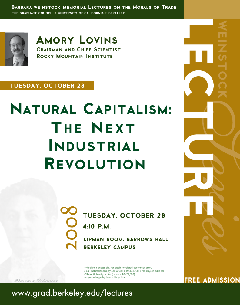
[00:00:00] ELLEN GOBLER:
Okay, um, my name is Ellen Gobler. I manage the Graduate Council Lectures, of which the Weinstock is one, and it is my pleasure to, uh… Well, first before I do that, okay, anybody who has a cell phone that’s still on, you need to turn it off right now.
Okay. Um, it is my pleasure to introduce Andrew Szeri.
(applause)
[00:00:32] ANDREW SZERI:
Good afternoon. Uh, my name is Andrew Szeri. I’m Dean of the Graduate Division.
Um, we’re pleased along with the Graduate Council to present Amory Lovins, this year’s speaker in the Barbara Weinstock Memorial Lecture series. In 1902, Harris Weinstock, a well-known businessman of Sacramento, California, presented the University of California with a fund to support an annual public lecture on the morals of trade on behalf of his wife, Barbara. Weinstock was fundamentally committed to the economic and moral progress of humankind.
He wrote many newspaper columns and gave numerous lectures on topics ranging from Napoleon to socialism. Inspired by Spencer and Newton’s essays on the morals of trade, which lamented the state of morals in the mid-nineteenth century business world, he argued that a man does not profit if he gains the whole world and loses his soul. Harris Weinstock hoped that this lectureship would lead to a better life for those who spend their lives in commercial pursuits.
He said, “Let men and women the world over worship character rather than wealth. Let them do homage to the high-minded and pure-minded rather than to the merely rich and powerful. And the ideal age will be at hand when trade will carry with it the badge of honor, and the successful man of business will take the place hitherto confined to the patriot and the faithful servant of mankind.”
Past lecturers have included Ralph Nader, Neil Kinnock, and Nobel laureate Amartya Sen, and they have delivered the Barbara Weinstock Memorial Lectures on the Morals of Trade. Now it’s my pleasure to welcome to the podium, uh, Karlene Roberts, chair of the Weinstock lectur-lectur-lectureship Committee, who will introduce our speaker.
(applause and cheering)
[00:02:35] KARLENE ROBERTS:
Amory Lovins is co-founder, chair, and chief scientist of the Rocky Mountain Institute. RMI and Dr. Lovins work to foster efficient and restorative use of resources to make the world secure, just, prosperous, and life-sustaining. He is also active in creating policy in energy, resource, environmental development, and security around the world.
Dr. Lovins has written twenty-nine books and several hundred papers. Among his most recent books is Winning the Oil Endgame: Innovation for Profits, Jobs and Security. Dr. Lovins dropped out of Harvard and Oxford and then went on to be awarded doctorate degrees from ten United States and UK universities.
He has received me- numerous awards, including Time Magazine’s Hero of the Planet Award in 2000. In 2007, he received the Blue Planet Prize, the Volvo Environmental Prize, and the Popular Mechanics Breakthrough Leadership Award. It gives me a great deal of pleasure to welcome Dr. Lovins to Berkeley.
(applause and cheering)
[00:04:06] DR. LOVINS:
Thank you, and thanks to those who made today possible. I was thinking about the morals of trade and how trade typically occurs within the context of capitalism, so it seemed a natural opportunity to introduce a new way of doing business as if nature and people were properly valued, but without needing to, uh, determine or signal their value. Capitalism is conventionally defined as the productive use of and reinvestment in capital.
But what’s capital? Normally, we only talk about four kinds, and industrial capitalism only deals seriously with two, namely money and goods. But there are two other kinds that are more valuable that it typically ignores and often just liquidates, namely people and nature.
Of course, without people, there’s no economy, and without nature, there are no people. So this is a material omission. And it turns out if you play with a full deck and you productively, uh, use and reinvest in all four kinds of capital, not just two.
You make more money, have more fun, and do more good. Now, when our co-author of the book Natural Capitalism in ninety-nine chose that title, uh, Paul Hawken, uh, I think he had in mind not just that this is a form of capitalism that takes natural capital seriously, not just physical and financial, but also that capitalism as we know it today, and as we see daily illustrated in the headlines, is unnatural, is a temporary aberration, not because it’s capitalist, but because it liquidates and doesn’t value its more– most valuable forms of capital, and therefore violates its own precepts. It’s internally inconsistent.
Uh,
(coughing)
the value of the ecosystem services we get for free from nature becomes obvious whenever something like Katrina comes around. The ability to stabilize climate it is an important service. Uh, the ability to recycle nutrients, to, uh, metabolize wastes, to neutralize toxins.
Uh, and we don’t know how to do any of that stuff, although we have a little idea how to pollinate. Uh, you will find, though, if you try hand-pollinating the planet, it quickly becomes tedious, so it’s nice to have all these little helpers when we do. Uh, and, uh, and if we, uh, if we lack these services, we feel the, the lack very acutely, uh, and perhaps at our peril.
In fact, as ecosystems everywhere come under stress, the limits to the human prospect are increasingly set not by by how many fish there are– uh, excuse me, not, not by, uh, how many boats and nets we have, but by how many fish are in the sea, uh, not by chainsaws, but by forests, not by, uh, irrigation pumps, but by fertile land. Uh, now, this sort of scarcity imposing constraint is not new. In fact, it was the basis of the first industrial revolution when, to oversimplify a bit, there weren’t enough weavers, uh, to make enough cloth for most people to afford.
But if you had come into Parliament around 1750 and said, “Oh, don’t worry, I have a solution to that. We’ll just make weavers a hundred times more productive,” nobody would have understood the concept, let alone thought it was possible. But it did happen when profit-maximizing capitalists supported technological innovators and vice versa, and soon a Lancashire spinner could produce the cloth that had previously required about 200 weavers,
(cough)
And, uh, not just in textiles, but spreading throughout the economy, we had this proliferation of affordable mass goods, purchasing power, middle class, uh, all the, uh, artifacts that we see around us and identify as the hallmarks of an advanced industrial civilization. Now, the logic of that industrial revolution was very clear and correct that at a time when a relative scarcity of people was limiting progress in exploiting seemingly boundless nature, the obvious solution was to make people a hundred times more productive, and we did. Economics is good at this.
It teaches to economize on our scarcest resource. But as Herman Daly points out, although the logic remains perennially true, the pattern of scarcity has quietly reversed. In the next industrial revolution now getting well underway, we have abundant people and scarce nature, not the other way around.
So now it’s no longer people, but nature that we need to be using, uh, four, ten, a hundred times more productively, wringing far more work out of the energy, water, minerals, topsoil, everything we borrow from the planet. So that radical increase in resource productivity is the first of four interlinked principles of operating as a natural capitalist. But there are three others, also very important.
One is to make things the way nature does, to produce in enclosed loops with no waste, with no toxicity. And then there’s a principle about
(coughs)
uh, adopting a business model that rewards the first two shifts, uh, by rewarding both the customer and the provider for the same thing, as I’ll describe later. And then what do you do with the resulting profits from getting rid of all this waste? Well, how about reinvesting it productively into the kind of capital we’re shortest of, namely nature?
I want to dwell on each of these, but emphasize mainly the first one. It’s the easiest to get started with, and, uh, since many of the world’s tensions and problems come from actual or perceived scarcity, uh, it would be a really good idea to create abundance by design. Now, just a word, though, about how this relates to trade.
There has been a long-standing argument as, as globalization has initially gained force that increased trade lifts all boats. Uh, and this might be true if we only were talking about financial and physical capital. Uh, but actually, since true wealth comes from productively using and reinvesting in four kinds of capital, not just two, uh, we have to pay attention to all four of them, and it turns out that people and nature have very different trade attributes than the relatively portable and fungible, uh, capital of goods and money.
Uh, therefore, the ideology of trade is incomplete. Uh, trade in money and goods can increase wealth, although whether it does so equitably depends on uh, the policy framework. Uh, trade, however, does not necessarily enhance it and may degrade human and natural capital because people are rooted in a place, uh, in a culture.
Nature is rooted in a place, in a biome, and if you try to move them around, uh, you may degrade them or even destroy them. Uh, so I think what are commonly regarded as the labor and environmental issues, uh, in the globalization controversy simply reflect the absence of two of the four forms of capital from the ideology of trade. If we’re going to be good capitalists and try to create wealth by productively using and reinvesting in capital, we’re going to–
(clears throat)
Excuse me. Double requires there. We’re going to have to pay attention to all four kinds of capital and to differentiate their divergent trade attributes.
It’s a very, very simple idea, but one that one doesn’t often hear expressed. Now, let me dig a bit into initially the first principle of natural capitalism, radical resource productivity. And since I usually talk about energy, let’s go to materials instead.
It turns out that the flow of stuff that we, uh, extract from the planet and process, move around, use and throw away, is about 20 times your body weight per person per day in this country, and not very different in other industrial countries. And that only counts the flow of water returned dirty, not water returned clean. Uh, it’s a huge mass flow, very destructive to the planet, And, uh, one way of thinking about it is if you scale it globally, it’s getting on for a half trillion tons a year of stuff moving around, and yet only one percent of it actually ends up in durable products and is still there six months later.
So what’s the other ninety-nine percent? It’s waste, also known as a vast business opportunity. More on that later.
Energy is similar. We’ve saved well over four hundred billion dollars a year by reducing energy intensity in the past thirty years or so, but we’re still wasting nearly that much. Just for example, the efficiency of converting fuel at a power plant into incandescent light in the room is about three percent.
The power plant waste heat that we throw away is more energy than Japan uses for everything, uh, or about two-thirds of what China uses for everything. Uh, China actually has a purchasing power parity on the order of nine times the energy intensity of Japan, which is not even a tenth as energy efficient as the laws of physics permit. But in practice, the Japanese government recently found ways to triple Japanese energy efficiency, uh, at a profit.
And that’s without counting most of the efficiency tricks that I’ll sketch for you in a minute. Uh, we have very well-known ways to make old buildings several-fold more energy efficient, new buildings an order of magnitude more efficient, but typically at lower cost. Let me give you a few little examples.
Um, and I’ll do this in written metric units and spoken, uh, Burmese units in case anybody needs those. Um,
(cough)
you know, we’re moving toward the metric system inch by inch in this country. So let’s go to my house and
(laughter)
indoor farm and research center near Aspen in the Colorado Rockies, where it can go to minus forty-seven F on occasion at, uh,
(cough)
seventy-one hundred feet elevation. You can get frost any day of the year. You can get thirty-nine days of continuous midwinter cloud. And yet, if you come in
(cough)
out of the snowstorm to the central atrium, there you are in the banana jungle where I’ve so far harvested twenty-eight crops with no furnace. Why don’t I have a furnace? Well, I didn’t need one, and it was cheaper up front not to put one in.
Huh? Well, if you ask most engineers or look in any engineering textbook, you’ll find that the right amount of insulation to use in your house is supposedly the amount that will pay for itself over the years from the saved heating bill, which sounds perfectly reasonable. You don’t want to pay more than it’s worth, do you?
But this is methodologically wrong because it leaves out, among other things, the capital cost of the heating system. And it turned out it was eleven hundred bucks cheaper up front not to have a heating system, but to put in so much insulation and such good windows and ventilation, heat recovery, and so on, that I wouldn’t need a heating system. I then t-took the saved eleven hundred dollars in nineteen eighty-three or so, and invested that plus another seventy-one hundred dollars, so six thousand net, A dollar fifty a square foot, to save also ninety-nine percent of the water heating energy, half the water, ninety percent of the household electricity, which would cost five bucks a month if I didn’t make it with solar.
And all of those savings together paid for themselves in ten months with nineteen eighty-three technology. Today, we can do a lot better and cheaper. Let’s try Davis, California, where it goes to a hundred and thirteen, and later we did the same at a hundred and fifteen Fahrenheit in Stanford Ranch.
Here’s an ordinary-looking tract house with the obligatory stupid dark roof and the big garage in front that says, “Cars live here.” And, uh, as part of PG&E’s ACT squared experiment that Art Rosenfeld and I and Ralph Cavanagh and Carl Weinberg cooked up. Uh, this was one of about, oh, nine or so experimental projects done, showing that if this house were built in quantity, not as a one-off experiment, it would cost about eighteen hundred dollars less than normal to build, sixteen hundred dollars less present value to maintain because it has no heating or cooling equipment, and yet it is comfortable with no air conditioner at up to a hundred and fifteen.
And it’s designed to use, uh, about a fifth of the energy than allowed by the strictest code in the country, um, and, uh, a tenth of the normal U.S. amount. Or here’s a house in steamy Bangkok that provides superior comfort with a tenth the normal air conditioning energy and has exactly normal construction cost. Now, I’ve used houses for my example both because they’re familiar and because they have a big surface-to-volume ratio, which makes it difficult to stay comfortable inside while it’s having such a huge range outside, a range spanning the r-
the extent of the Earth’s climates pretty much, at least where anybody lives. And yet, these houses all tell the same story, that if you optimize the house as a system, you can make very large energy savings cheaper than small or no savings. This goes against an economic dogma called diminishing returns, which says that in general, as you use… Or excuse me, as you save more of a resource, the cost of the next unit of savings goes up more and more steeply until it gets too expensive and you have to stop.
(coughs)
Well, some components like insulation work that way. Some others, like motors don’t, or pumps, or rooftop chillers. But what’s really interesting is when you put the pieces together properly, uh, something quite different happens.
A different part of the curve pops up. As I add more insulation to my house in the Rockies, at first, I experience diminishing returns because that’s how insulation works. But if I add so much of it that I no longer need the furnace, pipes, pumps, ducts, uh, fans, wires, c-controls, and fuel supply arrangements, then the cost comes down even more, eleven hundred dollars cheaper than if I set out to save little or nothing, and yet I’m saving ninety-nine percent of the heating energy, and why should I get there the long way around when I can tunnel through the cost barrier directly to this design destination by asking, is there a sensible way to design this house with no mechanical systems?
Well, as usual, there is. So we just go straight for the prize. Now, and, and by the way, if you wanna know how to do this, please visit rmi.org slash Stanford, where you’ll find my five public lectures of March two thousand and seven on how to do this sort of thing, this tunneling through the cost barrier in buildings, tr– uh, industry and transport.
Now, the same thinking applies in industry. Uh, I’ll do, I’ll do a motor example because they use three-fifths of the world’s electricity and a pumping example because that’s the biggest use of motors. In fact, half of motor energy goes to pumps and fans which have the same physics.
And we needed a pumping loop to move some heat transfer oil around it in a circle. And the system had been optimized to use ninety-five horsepower of pumping power. But a Dutch colleague with some ideas we brought him was able to cut it to seven horsepower, that is ninety-two percent less.
It worked better. It cost less to build, uh,
(clears throat)
not because of changes in the, uh, pumps, controls, or process or motors, but because of two changes in the design mentality. So we ended up using fat, short, straight pipes instead of skinny, long, crooked pipes. This is not rocket science.
This is good Victorian engineering rediscovered. Then we found we’d messed up. We sh– we left seven or eight, uh, uh, benefits out that we should have counted, and if we’d counted them, we would have saved more like ninety-eight percent, and it would have cost even less.
So sorry, we left a factor four on the table. We’ll do better next time. And if you apply this sort of integrative design across all uses, you end up saving at least three-quarters of all the electricity in the country cheaper than just running a coal or nuclear plant, even if building it costs nothing.
And we know that from just looking at the measured cost and performance data of about a thousand technologies for saving electricity. An important principle, which we also have not found in the textbooks, is to start your savings downstream. I can feed here a hundred units of coal into a power plant, lose about two-thirds of the energy on the way, lose more in the grid, and there are all these compounding losses going through the motor and pumping system, and only a tenth of my initial fuel actually comes out as flow.
Turn it around backwards, and every unit of flow or friction I can save downstream in the pipe will save ten units of fuel, cost, pollution, and global weirding back at the power plant. And it will also make my upstream equipment smaller, simpler, and cheaper. So I’ll save the most energy and the most capital cost by starting my savings all the way downstream.
And it’s often surprisingly simple. Often in a building or a factory, we see a big pump that’s designed to send something up a pipe. Next to it is an identical in-place, uh, spare pump or a helper pump, and they’re drawn like this, and then they’re built like this.
So all the time the flow has to go through two right-angle bends and usually two valves Why don’t we plumb it this way so it goes through no bends, less friction, and no valves or one valve? Well, because we don’t normally do it that way.
(laughter)
But, uh, you know, if you tell the pipe fitters to lay out the supply pipes as if they were drains, ah, there’s another part of their brain that knows that if drains have bends, they clog, and then you end up with this kind of plumbing. Peter Rumsey did this one right here at the Oakland Museum. Uh, and he was able to save three-quarters of the energy used to pump the condenser water with these Y-bends and big pipes and small pumps instead of small pipes and big pumps, and a sweep bend.
And imagine a pipe running diagonally through the air, what awful workmanship. You know, pipes are supposed to be at neat right angles. Well, if it looks pretty, it won’t save money.
And actually, in this case, he also eliminated 15 pumps that will never again waste energy and maintenance. Negapumps are a good kind. Uh, now, we’ve been applying these principles lately in over thirty billion dollars worth of redesigns in twenty-nine sectors.
So and we’re t– we typically have found about thirty to sixty percent energy savings fixing up old factories and so on with two or three-year typical paybacks. In new ones, we save more, typically more like forty to ninety percent, and the capital cost Almost always goes down, um, tunneling through the cost barrier in a replicable way. Of course, these kinds of results wouldn’t be possible if the systems had been designed properly in the first place, and I’m getting pretty tired of redesigning stuff that wasn’t designed right.
So we’re hatching a plot for the non-violent overthrow of bad engineering called 10xE, Factor Ten Engineering, and we are on the prowl for great cases and practitioners to add to next summer’s casebook writing project. Just as a few examples to give you the flavor, there are thirty-five things you can do to motor systems to save about half their energy without counting the downstream pump, pipe, and so on, stuff you should do first. And the reason you get your money back in about a year from this retrofit is you only pay for seven of the improvements.
The other twenty-eight are free byproducts. We’ve gotten similarly fast paybacks, saving often upwards of half the energy used to make chilled water and clean air in chip fabs. Uh, we showed how to retrofit for a forty-two percent energy saving in the most efficient refinery in Europe, uh, with an excellent payback.
Um, similarly, how to save half the electricity used on a North Sea oil platform and get the other half from stuff they’re throwing away. Forty-three percent savings in the world’s biggest platinum mine with a three-year payback. Now then, when it gets into new stuff, just for example, um, the famous Texas Instruments fab was built in Richardson, Texas, not in China, because they’re able to cut out thirty percent or two hundred and thirty million dollars of capital costs together while saving a good deal of energy and water.
By the way, the two biggest energy-saving measures were deferred for the next plant. That’s why we only saved a fifth. Uh, but our, our latest fab design saves about two-thirds of the electricity and half the capital cost and eliminates all twenty-two thousand tons of chillers.
Um, about a billion-dollars saving on a big gas to liquids plant, saving over sixty percent of the energy and carbon. Depending on what you start with, a new supermarket should save about seventy to ninety percent, probably gets cheaper. You certainly get better merchandising and food safety.
Um, besides normal stuff in a chemical plant, we had a fun example recently with NREL, um, showing how to take a corn stover ethanol plant, supposedly good new design, and save half the steam and sixty percent of the electricity and thirty percent of the capital cost. Normally, in a new big office building, we expect to save about eighty or ninety percent of the energy and a few percent of the capital cost. And, uh, one of my favorite cases is a, uh, a big two hundred thousand square foot curtain wall office building, uh, near Chicago, so it’s both hot and cold.
And if you retrofit it at the time when, in any case, you’re replacing the glazing whose edge seals have failed at after 20 years, you can put in super windows that are about perfect in letting in light without heat, deep daylighting, efficient lights, efficient office equipment, and save three-quarters of the peak cooling load. Then you, you can take the mechanical system, the air conditioners that you, you need to replace anyway, uh, for age and CFCs, uh, and, uh, make them four times more efficient while you’re making them four times smaller and save enough money on the downsizing to pay for everything else. So you end up saving three-quarters of the energy, uh, at a slightly lower cost than the regular twenty-year renovation that saves nothing, just by coordinating with stuff you’re gonna do anyway.
Uh, how does this all apply to saving oil? Well, four years ago, my team published an independent study nobody’s arguing with, co-sponsored mainly by the Pentagon, called Winning the Oil Endgame. written for business and military leaders and built around competitive strategy business cases for five sectors.
You can get it all free at our Oil Endgame website. And it’s a roadmap for getting the U.S. completely off oil by the 2040s, uh, led by business for profit and with a much stronger economy. The transition could look something like this, that oil use and oil imports, instead of heading steeply toward the northeast corner as usually projected, could be turned down along these green curves, by redoubling the efficiency of using oil.
We’ve already more than doubled it since nineteen seventy-five. We can double it again, and the average cost of saving a barrel is about twelve dollars in year two thousand dollars. And then we could go down more steeply along the blue curves by replacing the other half of the oil with a mixture of saved natural gas and advanced biofuels unrelated to the food system at an average cost of eighteen bucks a barrel.
So let’s see, the average of twelve and eighteen is fifteen. So I don’t really care what the oil price does. This is all still going to make sense and make money.
And actually, we know it works in principle because we did it once before. Notice what happened back here. That was the last time our country paid attention to oil, nineteen seventy-seven to eighty-five.
And in those eight years, GDP grew twenty-seven percent, oil use went down seventeen percent, oil imports fell by half. Imports from the Persian Gulf fell 87%, and they would have been gone in one more year if we’d continued. Uh, and indeed, OPEC’s exports were slashed by half, and it broke their pricing power for a decade because we customers, especially in America, the Saudi Arabia of negabarrels, we had more market power than the supply cartel because we could save oil faster than they could conveniently sell less oil.
Much the same seems to be happening in the market at this moment. Uh, well, that was then, this is now, uh, you are here, and after this practice run, of course, we could rerun that old play all over again a lot better. But let’s be, uh, more ambitious.
Suppose that we invest about a hundred and eighty billion dollars, half of it to retool the car, truck, and plane industries, uh, which seem to need it, uh, half of it to build a modern biofuels industry, uh, that will actually increase agricultural and forest sustainability. And suppose that this was so successful that it crashed the oil price back to twenty-six bucks a barrel, which was the official forecast for twenty twenty-five when we did this study four years ago. Well, against twenty-six dollar oil, that hundred and eighty billion dollar investment would yield a gross return of a hundred and fifty-five billion dollars a year, a net return of seventy billion a year, a very handsome return.
As a free byproduct, we’d save a quarter of the carbon emissions, uh, and we would create a million new jobs, three-quarters of them in rural and small-town America, and we would get to save a million jobs now palpably at risk, mainly in the car industry, where we need to decide whether we’re going to continue importing efficient cars to replace oil or make efficient cars and import neither the oil nor the cars. That somehow sounds smarter. And because the spread between the fifteen-dollar average cost of saving or displacing a barrel by these means and whatever the price is, is such an enormous incentive that can go to the solution providers, uh, the business logic is very compelling.
And, uh, although we do propose some innovative public policies in the book that can support and not distort that business logic, it is really driven by business for profit, and implementation therefore does not require new fuel taxes, subsidies, mandates, uh, new federal laws or anything else that either party doesn’t like or could mess up. Technologically, the key is, of course, transport. Buildings and industry have similarly big opportunities for the thirty percent of the oil that they use, but seventy percent moves things around.
And it turns out there’s a common recipe for making cars, trucks, and planes three times more efficient with improved safety and no compromise of comfort or performance by making them lighter, more slippery, and moving through the air and along the road and giving them advanced propulsion. So it’s equivalent, for example, in cars to being able to buy gasoline for fifty-seven cents a gallon, uh, even cheaper for truck diesel and Jet A, and often with improved performance. For example, uh, this diesel hybrid sports car from Opel, uh, can get one hundred and fifty-five miles an hour and ninety-four miles a gallon, although not at the same instant.
Uh, and the, the surprise to many is that the ultralighting that doubles the efficiency of these carbon fiber concept cars does not increase their production costs because the lighter, more exotic materials are paid for by simpler automaking and a smaller, two or threefold smaller propulsion system. Now, to understand how this works, you just need to think about the physics of a car, which typically uses every day about a hundred times its weight in ancient plants, very inefficiently converted into oil. Where does that energy go?
Once you put your gasoline in the tank, seven-eighths of its energy never gets to the wheels. It’s lost first in the engine, idling, driveline, and accessories. Of the one-eighth that reaches the wheels, half of that either heats the tires and road or heats the air that the car pushes aside, and only the last six percent actually accelerates the car and then heats the brakes when you stop.
But since only a twentieth of the mass you’re accelerating is you, nineteen twentieths is the heavy steel car, only five percent of that six percent or zero point three percent of the fuel energy ends up moving the driver After a hundred and twenty-some years of devoted engineering effort, this is not very gratifying. Fine. However, the good news is that three-quarters of the energy needed to move the car is caused by its weight, and every unit of energy we can save at the wheels saves an additional seven units we don’t need to waste getting it to the wheels.
So there’s huge leverage in making the car radically lighter weight, whether through aluminum or ultralight steel or carbon fiber composites, which is what we used
(coughs)
eight years ago with a couple of European tier one firms, uh, to design this uncompromised mid-size suburban assault vehicle that will, uh, take five adults in comfort, uh, sixty-nine cubic feet of cargo. It can carry a half ton up a forty-four percent grade. It has quite brisk acceleration, zero to sixty in seven or eight seconds, and it gets about a hundred and fourteen miles
(coughs)
a gallon on hydrogen or sixty-seven with a Prius-like gasoline hybrid whose extra sticker price in mid-volume would, would be about two and a half thousand dollars, and that extra is because it’s hybrid, not because it’s ultralight. That part is free. Uh, and the reason we know what it would cost is
(cough)
we put out almost a five-hundred-line item bill of materials to anonymous bid
(laughter)
by the supply chain. Now, the reason that the costlier materials don’t increase production costs shows up here. There are only fourteen parts in that SUV body, and you notice they’re suspended from rings like an airframe rather than built up from a tub, which is our horse and buggy legacy in the car business.
Uh, each of these 14 parts can be lifted with one hand and no hoist. In fact, the biggest part on the side here I can briefly lift with one finger. Each of the parts is made with one low pressure die set.
Now, a steel SUV has 10 or 20 times more parts than this, each made with an average of four progressive steel stamping die sets, a billion dollars worth, football field’s worth of it, uh, full of tooling. And we just saved about ninety-nine percent of that tooling cost. Uh, and then these plastic parts snap together like a kid’s toy for bonding without needing the jigs, robots, and welders of the body shop.
And if we lay color in the mold, there’s no paint shop either. Those are the two hardest and costliest parts of making the car. So it, at least two-fifths of the capital intensity went away compared to the leanest plant in the industry.
I brought along my carbon cap today. This is a few-year-old test piece for some military helmets being shipped by a little company I used to chair that we spun off. And you can tell from the sound, and we can pass this around As long as I get it back.
(laughter)
That, um, don’t worry about dropping it, it’s tougher than titanium. You can tell from the sound that plastics have really changed since The Graduate. Uh, uh, if you make cars and trucks out of this stuff, uh,
(laughter)
half the weight and half the fuel use go away. It gets safer because this can absorb twelve times as much crash energy per pound as steel, and yet the car costs the same to make for the reason I described here and because the powertrain is three times smaller. Um, so it’s nice that we now have technology that when matured and scaled, makes it possible to make these advanced composite structures with aerospace performance, but automotive cost and speed.
It’s just like finding a Saudi Arabia under Detroit. So my wildcatters have been busy drilling this really prospective play in the Detroit formation. And, uh, you know, and altogether, we found over fourteen million barrels a day of, uh, mega barrels in the US economy at 12 bucks a barrel.
So gee, if you go to the ends of the earth to drill for very expensive oil that might not even be there, and somebody else found all that cheap oil under Detroit, wouldn’t you be embarrassed and maybe bankrupt? Uh, so let’s, let’s drill the most prospective place first. We’re just drilling in all the wrong places.
And lest you think this is fanciful, uh, here’s a concept car that Toyota showed a year and two days ago, uh, and called the 1X. Why do they call it that? Well, because it has the interior volume of the Prius, but one half the fuel use and one third the weight.
In fact, if you take out the 20 kilos of extra batteries that make it a plug-in hybrid, then it has exactly the same curb weight, 400 kilos, that I suggested in ’91 a good four-seat carbon car should have, to much hilarity from the industry, as you can imagine. And this is so light that the little half-liter engine tucks under the rear seat. Uh, now, this concept car, like most, might be dismissed as a brag that’ll never get to market, except that the previous day, by arrangement it turns out, the world’s biggest maker of carbon fiber, Toray, had announced a point three billion dollar plant in Nagoya to mass produce carbon fiber car parts for Toyota.
Uh, clearly, therefore, this was not done for amusement. This is a statement of strategic intent, as they have since confirmed. And a few months ago, Honda and Nissan did a similar deal.
Uh, meanwhile, other makers like Ford and Nissan and the whole Chinese car industry are embarked on very substantial lightweighting, perhaps based on more familiar materials that they’re very good at. So this highest leverage thing we can do to cars, lightweighting, is actually off and running. And the next, uh, big shoe to drop, the electrification of traction is coming along very rapidly.
Uh, so here’s how the automotive revolution could unfold. If you take a good hybrid like a Prius and drive it properly, not the way Consumer Reports says to, uh, you’ll get doubled efficiency even without clean diesels, which are emerging. Uh, if you then make it ultra light and slippery, uh, you redouble its efficiency.
If you then run it on sustainably grown cellulosic ethanol from woody, weedy stuff like switchgrass, you can save three-quarters of the remaining oil. Now you’re using a sixteenth of the oil that you started with per mile. Uh, and you can pay farmers for taking carbon out of the air and putting it back in topsoil where it belongs.
If you then do a good plug-in hybrid, such as Toyota’s getting out over the next year or two, you can redouble fuel efficiency. Uh, so now you’re down to three percent of the oil per mile that you started with. And by the way, your second biggest household asset, currently ninety-six percent idle, uh, can now turn into a profit center when parked, selling stored or generated onboard electricity back to the grid when and where it’s most valuable.
The first couple of million people to do that will probably earn back the whole cost of the car. Uh, and for the rest, it will still be a significant profit center. Uh, the car fleet, even at tripled efficiency, will then have six to twelve times as much capacity, uh, as the whole power system has now.
Uh, so it doesn’t take very many of us liking these new value propositions from the smart garage with the– let the car, utility, and building talk to each other intelligently to, uh, put the coal nuclear plants out of business. And I haven’t even talked yet about hydrogen, which actually does make sense and make money when the car gets this efficient. Now, you might wonder whether these kinds of efficiency breakthroughs can create a new competitive strategy, and the answer is yes, because Boeing just showed us how to do this.
In nineteen ninety-seven, Boeing was in about as much trouble as Detroit was a decade later. Uh, they had runaway costs, which they brought under control with Toyota Production System and so on. Uh,
(laughter)
a lot of wrenching change, but there wasn’t a whole lot of innovation in the pipeline, and Airbus was pulling ahead, and some folks were starting to doubt Boeing’s staying power. Well, Boeing’s bold riposte, uh, in 2004 is what was renamed then the 787 Dreamliner, saving a fifth of the fuel at no extra cost, half carbon fiber by weight, up from nine percent, many advantages for the maker, for the builder, and they’re now closing in on their thousandth order. They’re sold out well into 2018.
It’s the fastest order takeoff of any jet in history. Uh, and now they’re rolling out that suite of radical advances to every plane they make before Airbus can steer itself out of the ditch. So starting with advanced materials and manufacturing for ultralighting and better aerodynamics and engines and design integration, they got this big jump in efficiency and then translated that into breakthrough competitive advantage and flipped the sector in about three to five years.
Uh,
(coughs)
this is a complex product with a couple of million parts and very highly regulated. Not bad. Well, with that in mind, my team has been busy implementing the oil endgame through what we call institutional acupuncture.
That is, we figure out where the business logic is congested and not flowing properly, and we stick needles in carefully selected sites to get it flowing. Uh, this is very effective, and it’s as much fun as you can have with clothes on. You, you–
(laughter)
We really need to shift what’s happening in six main sectors, and we don’t need to worry much about aviation because Boeing already did it. Although if you wanted to help, uh, legacy airlines get out of their cost hole, you could offer them federal loan guarantees specifically, uh, to buy super efficient planes, offset the loan guarantees with equity warrants so there’s no net cost to Treasury. And then for every plane you so finance, you scrap one of the inefficient old planes parked in the desert so nobody will ever fly it again.
Uh, it’s worth more dead than alive. Let’s take it out back and shoot it. Boeing likes this idea.
Now,
(coughs)
in the case of heavy trucks, uh, based on our analysis, Walmart has insisted on getting doubled efficiency trucks from its suppliers. They’ve already saved a quarter of the fuel, now they’re headed for half to turn over their fleet by 2015. That will save them billions of dollars net present value, so they’re highly motivated.
And basically, we’re using the demand pull of giant partners like Walmart to drag these trucks into the market soon so everybody can buy them. The Pentagon, the world’s biggest buyer of oil and of renewable energy, emerged on thirteen February this year as the leader within our government in getting the nation off oil, so they won’t need to fight over oil. They have a little different, uh, more specific and immediate reason for being worried about oil, and that is they have to deliver it, uh, to the platform in theater in wartime with people shooting at them and trying to blow them up.
And it turns out that half the casualties in theater now are associated with convoys. Seventy percent of what they haul is fuel, mostly then wasted because when requiring, designing, and buying the platforms that use the fuel, the Pentagon had always assumed that fuel delivery is free and invulnerable, even though they have whole divisions of people moving fuel around and trying to guard the movement of fuel. Uh, well, in April ought seven, we finally persuaded them to change the policy so that saved fuel will be valued one or two orders of magnitude typically more than it was before.
Because they’ll count the fully burdened cost of fuel delivered, and that which is now written into law, uh, that requirement is going to drive huge innovation because when the prime contractors start fighting over who can make the most efficient tanks, planes, ships, and so on, uh, that innovation that they come up with is going to spin back to the civilian sector, much as military R&D already gave us little things you might have heard of, like the Internet and the chip industry and the jet engine industry and the Global Positioning System. So that will s-further speed up the tripled efficiency cars, trucks, and planes. And as you can imagine, the warfighters really like the notion of negamissions in the Gulf, mission unnecessary.
There’s a huge amount of activity in advanced biofuels, including now algal oils. And in finance, the private capital sector put a hundred and forty-eight billion dollars of new capital into the clean energy space last year worldwide. We always knew the toughest sector would be cars and light trucks.
But in ought four, when Boeing was suggesting its new strategy, we suggested in our book that Detroit tried the same thing. It seemed like a good idea. So it was gratifying two years later to see Ford Motor Company hiring the head of Boeing Commercial airplanes to run Ford.
And he’s now in Dearborn with transformational intent. The UAW and the dealers are very keen for basic innovation to save their industry as this tsunami of creative destruction sweeps over them, opening minds, uh, further opened by new competitors like India and China, uh, 20 venture-funded car startups in the US. We just spun off another one.
Uh, and, uh, you know, over a hundred entrants for the Automotive XPRIZE. Things are starting to move real fast. Uh, and now there are n-new policy instruments like the feebates we’ve been promoting that’ll make more profit for the automakers and greatly speed this kind of innovation.
So the competition is now at a pace we haven’t seen since the 1920s, and it’s going to change the managers or their minds, whichever comes first. So our job is just to accelerate that change and maximize competition, which is lots of fun. Uh, well, it’s obvious from all of this that protecting the climate is profitable, uh, because, uh, it’s cheaper to save fuel than to buy fuel.
Efficiency is cheaper than fuel. Somehow the economists who talk about the cost of climate protection overlook this obvious point and talk about costs when they got the sign wrong and should be talking about profits. Here are some of the firms that have figured this out, whether they worry about climate or not, uh, they are leading, uh, profitable climate protection.
Some of our biggest chip makers are cutting carbon emissions 6 percent a year with two or three-year paybacks just by making their plants more efficient. DuPont set a goal that by 2010, by 6 percent a year gain in energy productivity and some renewables, they would have cut their greenhouse gas emissions to 60 percent less than they were in 1990. Guess what?
They were eighty percent down even a couple of years ago, thirty percent more output, three billion dollars richer. Dow made even a bigger profit substituting efficiency for fuel. BP made two billion bucks on that deal, meeting their carbon goals eight years early.
GE is boosting its energy efficiency thirty percent to build shareholder value. United Technologies just started paying attention and cut energy intensity by forty-five percent in five years, and they’re just getting started. Maybe the record holder is Interface, eighty-two percent less greenhouse gas emissions over an eleven-year period while growing the business and making hundreds of millions of dollars profit on the deal.
So the politicians keep debating theoretical costs, but the smart companies are racing to pocket the profits before their competitors do. And once more of our leaders understand, and, uh, that this is a highly profitable activity, uh, I think any remaining resistance to doing it will melt faster than the glaciers. How fast do we need to do that?
Well, economic theorists normally assume that global energy intensity, primary energy consumed per dollar of real GDP, will keep falling, just drifting down gradually one percent a year. But if we could make that two percent a year, we could stabilize carbon emissions rather than tripling them so we’re all toast. If we could make it three or four percent a year, we could decrease those emissions fast enough to stabilize climate to the extent that irreversible changes aren’t already underway.
Can we imagine three or four percent a year drop in energy intensity? Well, the U.S. routinely does it without even paying attention, and we’ve done it for a long time with stagnant light vehicle efficiency for twenty-six years and rewarding utilities in forty-eight states, but not this one, uh, for selling you more energy and penalizing them for cutting your bill, which is just as dumb as it sounds. Uh, California has been saving energy a percentage point faster than the country as a whole, thus saving each Californian a couple of hundred bucks a year by now.
China about one percentage point faster than that, other than a glitch in 2002 to 6, which they’ve now pretty well fixed. And now it turns out that at least half the oil and gas in the country and three quarters of the electricity can be saved at an eighth of the price we’re paying for them. That sounds like a pretty good deal.
along with two-thirds of Japanese energy, and they’re several times more efficient than we are. So, uh, there are really two stories about profitable climate protection. Uh, and you see that the rates of implementation required are a lot less than, say, attentive companies achieve.
They do about six to fifteen percent a year. Everybody who does this makes money at it, so why should three or four percent a year be hard, and why should it be costly? Well, two-fifths of the opportunity, uh, is in burning oil and two-fifths in making electricity, which is largely a coal story.
Uh, and I’ve told you the oil story already. Here’s a bigger version of it. Uh, here’s a supply curve.
It happens to be BP data, but I think the industry pretty well agrees on this. For roughly how many trillion barrels of oil can ultimately be extracted besides the one trillion we’ve already done, at what free market price, assuming no OPEC? And, uh, so this is just actual production cost plus a reasonable profit.
The OPEC Middle East countries say they’ve got another trillion barrels of cheap oil, which is about what the world’s projected to need to 2030. And a lot of companies wanting to avoid OPEC Middle East, if they can, are already into expensive frontier hydrocarbons and thinking about tar sands, Oil shales, coal to liquids, very expensive
(cough)
stuff, Uh, and this doesn’t count inflationary, uh, cost escalation pressures that have put these numbers now much, much higher. In fact, the tar sands need now about ninety or a hundred bucks a barrel to break even. Uh, now let’s splice into this graph a conservative scaling to the world of the oil endgame opportunities we found on the supply and demand side.
Then everything slides three trillion barrels to the right. And if that means that you avoid this very expensive carbon-intensive stuff here
(cough)
Multiplying quantity times carbon intensity, let’s say you stop at this point, it means your carbon emissions will go down by at least a trillion tons, and you’ll save tens of trillions of dollars plus whatever monopoly rent you would have been paying to OPEC. That’s a pretty good deal. And you notice I haven’t talked about the peak oil argument about how much oil is in the ground.
That’s because nobody can know who’s right about how much is in the ground, because about ninety-four percent of the reserves are owned by governments which don’t know or won’t honestly tell you what they’ve got. But it doesn’t matter who’s right about what’s in the ground because we ought to do the same things anyway just to make money or improve our security or protect the climate. Any one or more of those is a perfectly solid reason, and I don’t need a fourth indeterminate reason.
So I think this is kind of a distraction. Now, electricity, I mentioned that each Californian is saving about two hundred bucks a year. What I mean by that is that the per capita use of electricity has been flat for thirty years in this state while it’s gone up in the rest of the country and up steeply in places like Texas.
And the reason we’ve saved money on the deal is not just making the electricity, but we’ve avoided about a hundred billion dollars of investment to make and deliver it, and that could be more productively used elsewhere. Uh, so per capita real income during those thirty years has gone up seventy-nine percent in this state, yet without increasing the use of electricity. And equally important in achieving that were efficiency standards in buildings and, and, uh, uh, appliances and rewarding utilities for cutting your bill, not selling you more energy.
So they got enthusiastic about making this happen. And that reform is now starting to spread pretty quickly. It’s adopted now or being considered in half the states.
But we can go a lot further. Back in the late ’80s, my colleagues and I looked at the data for about a thousand technologies and concluded that you could save about three-quarters of U.S. electricity if you fully deployed them wherever they would fit, make sense, make money. And the average cost of doing that would be, in today’s dollars, about one cent a kilowatt hour.
There were similar findings in other, more efficient countries. The Utilities Think Tank found a somewhat smaller potential, only forty to sixty percent savings at a few cents a kilowatt hour, but still cheaper than just, uh, making and delivering power from a power plant that costs nothing to build. And of course, the savings keep getting bigger and cheaper faster than we use them up, so this is an ever bigger, cheaper resource.
It’s, it’s as if the low-hanging fruit were mushing up deeper around our ankles and spilling in over our boots while the innovation tree keeps dumping more fruit on our head. And there’s an equal shock happening on the supply side of electricity. Uh, the upper graph shows the amount of electricity worldwide produced, and the lower graph, the capacity installed worldwide for what the E-Economist magazine calls micropower.
And there are two kinds. The bigger tan wedge here, uh, is cogeneration. That is, uh, providing or producing both electricity and useful heat together in buildings or factories, thereby saving at least half of the, uh, cost, fuel, and carbon.
And then the colored wedges underneath are renewable sources other than big hydro. Well, together, micropower is now producing, as of two thousand six, a sixth of the world’s electricity, slightly more than nuclear, a third of the world’s new electricity, a sixth to over half of all the electricity in a dozen industrial countries. This doesn’t even count electric savings, which are not as well tracked, but are probably also really big.
Which means that central power plants, which we are told are indispensable, are probably now producing less than half the world’s new electrical services because they cost too much and have too much financial risk. So in two thousand six, the last full data we have, these lower, no-carbon power sources added six times as much output and thirty or forty times as much capacity as nuclear added. That’s the essentially flat line here.
In fact, nuclear added less capacity than photovoltaics did, or a tenth what wind power added. Last year, China or Spain or the US each added more wind power than the world added nuclear capacity, and the US added more wind capacity than it’s added coal capacity the past five years put together. I’m not sure what part of the story anybody who takes markets seriously doesn’t get, but it’s pretty clear.
And in the US, even before the capital collapse, there was not any investment capital available. nobody put a penny into proposed new nuclear plants despite hundred-plus percent new subsidies. Now, this is all a good thing for climate because here’s roughly how many cents it costs to make and deliver a new kilowatt hour from nuclear, coal, combined cycle gas, firmed wind, three flavors of cogeneration or efficiency according to the latest empirical data for the US from the last year or two.
We used to think that making and delivering, which is the red part, a new nuclear kilowatt hour would cost about eleven cents. But then the Keystone study showed the fuel was going to be a lot more expensive in the future,
(cough)
and the capital costs were going rapidly, and now they’ve gone up even more. So the latest numbers are somewhere up around here, uh, from say, Moody’s,
(cough)
eighteen cents a kilowatt hour or so. And, uh, there’s been a little more escalation in coal. Um, actually, wind has gone down a little bit last year.
But, uh, at any rate, nuclear is extremely expensive. Now, if you take, uh, these cents per kilowatt hour costs and turn them upside down, take the reciprocal, you get how many kilowatt hours you can get by investing a dollar in different ways of providing electrical services. And if you then correct for the carbon emissions of the several sources that actually emit some carbon, then you can get how many kilograms of carbon emission, CO2, actually, you can displace by spending a dollar in different ways.
So a new nuclear plant at the latest cost would probably be down around five kilograms CO2 displaced per dollar. Uh,
(cough)
but you can get about two and a half times that much with a firm power from a wind farm. Cogen is about similar. Recovered waste heat, cogen is better.
Efficiency at the average cost actually observed, which is two cents a kilowatt hour, is right up in the top of the chart here. And well-designed efficiency, which is less than half that cost, is way up in the ceiling. In other words, a new nuclear plant will save you about two to eleven or more times less carbon and do so about twenty to forty times slower than if you’ve spent the same money, uh, buying efficiency and micropower, the market winners.
And in fact, if you bought a new nuclear plant instead of efficiency, the result would be the release of so– uh, more extra carbon than if you would sp– spent the same money building a coal plant. So it’s not good enough just to be carbon-free. You also have to be cheap and fast.
If, if climate’s a problem, we need the most solution per dollar and the most solution per year, and we need to invest judiciously, not indiscriminately. Otherwise, we’re just making things worse, reducing and retarding climate protection. And there are a lot of conservatisms in what I just showed you, including that I’m not counting, uh, over 200 hidden benefits of the decentralized power production that we wrote up in an Economist Book of the Year six years ago, and that typically increase economic value by about a factor ten.
For example, uh, because there’s less financial risk in building, uh, small, fast modular plants than big, slow, lumpy ones, or renewables, uh, give more valuable energy because it doesn’t have a volatile fuel price, so you’re hedged against that financial risk. And as the markets, uh, uh, tries to or starts to, um, recognize these benefits more, it’s going to further accelerate distributed power, decentralized power. But even without doing that, you can make a good case right now that f-even photovoltaics have already passed cost crossover.
Um, Tom Dinwoodie, the founder of SunPower, has done this. He’s shown that if you start building a coal plant right now and right next to it in New Jersey, a photovoltaic plant, by the time the coal plant is done, a photovoltaic plant big enough to produce the same annual electricity will be producing four times as much peak output at lower lifetime cost because it has positive cash flow from year one. It’s actually producing power and revenue.
Uh, it’s much more peak coincident in its output, and you’re riding the cost curve down as you build it. Uh, this is without a- counting on any breakthroughs, but just what’s already baked in. Okay, that’s way too much on principle one.
Let me run you quickly through principles two, three, and four and show how they fit together. Okay. At the University of Zurich, not ETH, the other one, uh, in the chem lab, every year they were turning, uh, lots of pure simple reagents into very expensive toxic wastes until Professor Hans Fischer said, “Hey, why don’t we turn this around backwards and teach the same lab techniques separating the toxic wastes we just made into the pure simple reagents we started with?”
And the students really loved this. They stayed nights and weekends separating waste back into starting reagents. And waste went down 99 percent, costs went down 20,000 dollars a year.
And by closing the loops and designing out the toxicity, uh, those students were making themselves very much in demand, and now they can go out and save the chemical industry. Or an example from the green architect Bill McDonough, about closed loops and designing out the toxicity, producing stuff the way nature does. Uh, a division of Steelcase asked him to look at the design of a textile to cover office chairs because the fabric that was being used had edge trimmings that had just been declared by the Swiss government to be a toxic waste because of heavy metals and other bad stuff used in treating and dyeing the cloth.
Now we know why it’s called dyeing. Uh, so it kind of makes you wonder what’s the middle of the cloth that you’re sitting on.
(clears throat)
Uh, so, uh, Bill and his German chemist colleague, Dr. Michael Braungart reported that they tested eight thousand chemicals used in the cloth business and only found thirty-eight that didn’t cause cancer mutations, birth defects, endocrine disruption, or bioaccumulation. Well, then they took the thirty-eight safe ones and showed that from those, you could make any color and you, you would end up making cloth that would last longer, feel better in your hand, and cost twenty percent less to produce, partly because you didn’t have to have those embarrassing conversations anymore with OSHA and EPA ’cause there was nothing in your process that would hurt the workers or the neighbors. You know, you can take off your masks now.
And, uh, when the inspectors came to the plant using the new process, they found that the, uh, water leaving the plant was a little cleaner than the Swiss drinking water going in. They thought their apparatus was broken, but this was actually the correct result because the cloth product was acting as an additional filter.
(laughter)
A nice example of what happens, Bill says, when you take the filters out of the pipes and put them where they belong in the designers’ heads- designing out everything that shouldn’t be there. And as he points out, this is also a nice closed-loop system, uh, because when you’re done with the cloth, you can compost it in your veggie garden, or if you have a fiber deficiency, you can eat it.
(laughter)
Now,
(laughter)
what, what this is partly about, I mentioned, is designing stuff the way nature does. Uh, there’s 3.8 billion years of design genius out there in which the 99 or so percent of products and designs that didn’t work all got recalled by the manufacturer, and from the 1% that did work, we can learn a great deal about design. Uh, my friend Janine Benyus has beautifully shown all this in a book called Biomimicry: Innovation Inspired by Nature.
She asks things like, “How do spiders make silk, uh, you know, tougher than the Kevlar in bulletproof vests, stronger than steel. If we want to make Kevlar, we need boiling sulfuric acid and high-pressure extruders. Spiders don’t do that.
They make this stuff in their bellies out of digested bugs. How do they do that? Let’s figure out and try to do it ourselves.
There’s actually three levels at which biomimicry works that are being applied now to products like how does the thing work, self-cleaning paint like a lotus petal rising brilliantly white out of the muck, adhesives using gecko foot nano-hair technology, biomimetic rotors based on the Fibonacci spirals in nature and producing much more efficient fans and pumps. Here’s a big building, the biggest commercial building in Harare, uh, based on the architecture of termite mounds to do passive cooling and air handling. And then there are other kinds of innovations about how is the thing made?
Like the inner shell of abalone has to withstand being pounded on by a rock on the chest of an otter that wants to eat the abalone. If you get eaten, you don’t get to reproduce. So there’s a very strong incentive to have an immensely tough inner shell.
And it turns out the abalone knows how to make a material that is about twice as tough as our best missile nose cone ceramics, but it’s self-assembled at four degrees C in seawater with no waste, and now we figured out how to do that. There are other levels of biomimicry as well, and when we put these in an open public database, uh, then the, the wisdom of all those organizations that know how to do these things will be available to us for our design solutions. Where this is taking us is a world where the natural capitalist businesses, uh, the successful businesses are those that take their values from their customers, their designs from nature, and their discipline from the marketplace.
Exactly the opposite of what the biotech industry tried to do with genetically modified organisms. And, uh, they have met the expected reception. And also, this is a, a world where conventional environmental regulation starts to become pretty anachronistic because the companies that most need it will probably by then be out of business, having spent too much time and money making things that nobody wants, making things that in the twentieth century we used to call wastes and emissions.
Now we have a better term. We call them unsaleable production because this Focuses our minds on why are we producing stuff nobody wants? Let’s design it out.
And then you get into really serious innovation and competitive advantage. Well, a very good way to do that, uh, is cybernetics, the signals we get from the market, which depends on our business model. How do we make money?
For example, um, how clean would you make your car if its tailpipe, instead of being aimed at pedestrians, were just plumbed back into the passenger compartment? Probably real clean. Uh, how safe would you make your explosives factory if you built your house next to it?
Very safe. That’s what Mr. DuPont did. They’ve led in industrial safety ever since and safety culture.
You know how Admiral Rickover got really high quality hull welds on the first nuclear submarines? He just told the welders and their CEOs that they would be aboard for the maiden dive. Feedback is really powerful.
Systems without feedback are stupid by definition. Uh, and therefore, if you change the business model to give the right feedback, you get a very powerful result. Principle three of natural capitalism, which we call the solutions economy business model, in which both the provider and the customer get rewarded for the same thing, namely doing more and better with less for longer.
So Schindler, for example, experimented successfully with not selling you an elevator, but leasing you a vertical transportation service. You didn’t want to own a bunch of metal. You wanted to be moved up and down, and if they owned it, they would get the savings from its being, they felt, more efficient and more reliable than competing ones.
And the more efficient and reliable it was, the more money you’d both make. Dow, instead of selling you a solvent, would rather lease you a dissolving service. They bring the solvent, it does the dissolving, you never own it, that’s good.
They take it away again and repurify it, and the more loops they can put it through with more customers, and the less they lose each time, the cheaper the dissolving gets, the less they charge you, the more market share they get, the more profit they make, everybody comes out ahead. Uh, and we’re starting to see these business models pop up, like in the Zipcar, Flexcar model, uh, where, you know, your 96% idle car doesn’t have to belong to you. It can belong to a company that provides it by the hour, and if you want to haul drywall on Wednesday and pick up your honey in a sports car on Saturday, you could do the s-, the both, and you don’t need to own either one.
Uh, it turns out vehicle miles traveled go down by about half under this system. Imagine if you’re a car company or an oil company and somebody else does this first, that could be pretty embarrassing. And the same thing in chemicals.
There are many interesting examples, uh, where people are following the Dow example, starting to provide the services of a chemical without your having to own the chemical itself. And the more productively it can be used or the more you can design it out by changing the process, the more money you both make. So this is a great way to encourage principles one and two.
So let me tie this together. Every year, millions of tons of carpet, generally made of oil, go to landfill where they sit for ten or twenty thousand years, uh, because, you know, we, we use broadloom carpet, which this appears to be, comes in a big roll, and after ten or 20 years, it, it starts to look pretty ratty, so you, you have to shut down your operation, move everybody out, roll up the partly worn carpet, send it to landfill, lay down a new carpet made of more oil, move back in, hope you don’t get poisoned by the fumes and the carpet glue, and resume operations. This sounds pretty dumb, actually, it seemed to Ray Anderson.
Um, now, he’d already gotten serious starting in ’94 about resource efficiency and made hundreds of millions of dollars, uh, wringing out waste, providing two-fifths of his firm’s operating profit. But then he got to thinking about closed-loop production, and they came up with an experimental carpet which turned out to have a few issues, but the basic concept is, is sound. It’s non-toxic, no chlorine, climate neutral.
You can wash it with a garden hose, doesn’t stain, doesn’t mildew, looks good, feels good. Four times longer life with a third less material. And then you can completely remanufacture it into the same stuff.
But then Ray said, “Well, wait a minute. You don’t really want to own a carpet. You want to walk on it and look at it.
Let’s think about a solutions economy business model, where instead of selling you a carpet, we lease you a floor covering service. So every night, the little elves, or every month, the little elves come in the night and replace only the worn carpet tiles, which is about a fifth of them. The other four-fifths are places where you’re not walking, so they don’t wear out.
And then you t– you send the wor-worn ones back for remanufacturing, replace them with fresh ones, no disruption to your operation, and Interface captures the durability value. Another factor five
(coughs)
here. And you get better service at lower cost as a customer with 97% less material and with manufacturing 99.9% material. Imagine competing with somebody who uses a tenth the capital and a thousandth the material you do.
You aren’t going to be very happy. And by the way, this is a tax-deductible net operating lease, so it’s a tax-advantaged financial product, not an idle balance sheet item. And you employ more people, uh, for delivering the service than you lost jobs making less carpet.
And then the next step, which they’re well ahead on, is to make the carpet out of corn stover grown organically, uh, and normally in traditional black farming communities in the Deep South in ways that actually enrich, uh, tilth and rural culture while protecting the climate. So that’s a reinvestment in human and natural capital. And you– as you can expect, people at Interface are really jazzed about this.
Uh, anybody who runs a natural capitalist firm will tell you it’s the most exciting place to work, and anybody who runs any kind of a green company will tell you that it, it’s a huge help in recruiting, retaining, and motivating the best people, which is what competition is ultimately about. And by the way, just the first four years on this path, they more than doubled revenues, more than tripled operating profits, and nearly doubled employment all at the same time. Not a bad deal.
Uh, so that leads me finally to principle four, that you reinvest the saved money into natural capital. And this is the easiest principle to follow because nature does the production. You just need to treat nature with proper respect, get out of the way, uh, stop messing things up.
And, and this, this principle shows up first in, uh, sectors like f- raising trees or crops or livestock or catching fish, things where your success depends on the health of the ecosystem around you, so you get real direct feedback about that. Allan Savory, for example, uh, showed huge increases in carrying capacity even on, uh, very arid land, uh, highly degraded, but it turned out it was degraded not by overgrazing, but by undergrazing and grazing the wrong way, not following the grazing model of the ungulates that used to live there and would circulate around in huge herds. Uh, or in California, thirty percent of the rice-growing area switched over from burning the straw after harvest to flooding and inviting in millions of ducks and geese that would provide fertilizer and, uh, dig up little crustaceans and so on, provide lucrative hunting licenses, and you’d get the high silica straw that used to cause lung problems downwind, and now you’d use it for straw bale building because bugs don’t like to eat it.
You’d recharge the groundwater. You’re still a rice farmer, but you get lots of other benefits and make a lot more money. Or here’s one I just saw in Borneo in May.
Dr. Billy Smits has turned nineteen square kilometers of, uh, of, uh, devastated grassland that used to be forest back into a lush rainforest in just six or seven years. Uh, and the whole model is built on the welfare of the local Dayak people. So if you come try to steal the wood with the corrupt police, the Dayaks will kill you, and they were recently blowpipe headhunters, so this is a credible threat, and it makes the forest self-protecting despite the breakdown of rule of law.
Uh, so this little guy then has some applied hope. Even the Zen apes, this one’s meditating on a pineapple. Uh, so to tie it all together, in the US, uh, at the moment or recently, remember that flow that’s twenty times your body weight per person per day?
Well, that flow is what we extract from the planet. It’s about eighty-three percent mined, seventeen percent grown. But all that extractive flow, well, eighty– uh, ninety-three percent of it’s actually wasted in extraction and manufacturing, so only seven percent ends up in products that we ship.
And six-sevenths of those are consumer ephemerals that get thrown away after one use or no uses. So only one percent of what we start with in the ground gets– ends up as durables. What do we do with that when it’s done?
Two percent of it gets remanufactured or recycled or composted. Ninety-eight percent is thrown away. So this system, to first order, is ninety-nine point nine eight percent pure waste.
What a business opportunity. And by the way, a lot of the waste is toxic, so when it comes back into nature, it poisons the ability of the ecosystem to keep producing the food and fiber we need and the ecosystem services we can’t live without. So this is a really stupid design.
Let’s change it. In a natural capitalist system, we grow more, mine less, and extract a great deal less of what we need through comprehensive systematic resource efficiency, uh, that affects how we harvest, how we manufacture, how we use, how long things last, how they’re dematerialized, And then we close the loops in manufacturing and after use, so we almost eliminate what’s thrown away. These are all– these changes are all encouraged by the shift to the business econ– or the solutions economy business model.
And then we also design out toxicity, so the little bit that comes back does not harm nature’s regenerative capacity, And in fact, we systematically increase that by reinvesting money made by waste elimination back into natural capital. That’s how all the pieces fit together. And this works even in a city in difficult circumstances.
Our fourteenth chapter in the book is the story of Curitiba, a city the size of Houston or Philadelphia that had quadrupled population in twenty years. It was a relatively poor city, and yet by treating its formidable social, economic, ecological needs, not as competing priorities to be traded off in budget fights, but as integrated design elements with synergies to be captured, a brilliant design process led largely by architects, largely by women, made it one of the world’s great cities by design. They integrated from the start, uh, nut– waste and nutrient flows, transport and land use, participation and dignity, education and health.
They never did just one thing. They tried to solve lots of problems at once without making new ones, and they treated their citizens as their most precious resource, reinvesting a lot in people, individuals, culture, and community. Uh, and that, of course, uh, is really necessary to have a harmonious society and become better people.
Uh, now, most of the heavy lifting was done by the private sector, but government believing it should steer not row got the rules right. So in the famous, uh, rap– surface rapid transit bus system, maybe the world’s best public transport system now imitated in eighty-four cities, the ten competing companies that run that are paid not for how many people they carry, but for how much route they serve. So they spread out and serve everybody equally.
And, you know, that kind of private sector leadership is really important in a world where over half of the hundred or two hundred top economic entities are not countries, they’re companies. And this may be perhaps, other than the military, the only really effective institution we have with what it takes to solve tough problems quickly at scale. And that depends on integrative design and on how we deal with each other.
But the early adopters of these four principles are finding stunning competitive advantage. They’re finding, as Ed Woolard said when he chaired DuPont, that companies that take such opportunities seriously will do very well, while he added, “Those that don’t won’t be a problem because ultimately they won’t be around.” So maybe the real problem with capitalism, this extraordinarily powerful engine of wealth creation, uh, involving the productive use of and reinvestment in capital, all four forms of capital, is that we haven’t really tried it yet.
But the early returns are encouraging. I would urge you to take a look at the website natcap.org, where you can download the book for free in English,
(clears throat)
and it’s also in lots of other languages. Uh,
(clears throat)
we will soon post a bunch of updates and things that got pruned out of the book in late slash and burn editing. Uh,
(clears throat)
and, uh, we will, um, I, I would like to add more cases, so I hope any entrepreneurs in the house will let us know how you are doing. Uh, if anything I’ve said too– seems too good to be true, just remember the Marshall McLuhan remark that, uh, only puny secrets need protection. Big discoveries are protected by public incredulity.
Thank you for your kind attention.
(applause and cheering)