
[00:00:00] NELSON POLSBY:
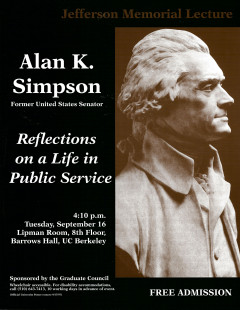
Welcome to the Jefferson Lecture. Uh, my name is Nelson Polsby. I am a member of the Jefferson Lecture Committee of the Graduate Council, under whose auspices we’re meeting today.
And it’s going to be my pleasure to introduce Alan K. Simpson, who from 1979 to 1997 was U.S. Senator from Wyoming, and from 1984 to 1994 was his party, the Republican Party’s deputy leader in the Senate. Al Simpson comes from a family that has been settled in Wyoming for a long time, and in whom the urge for public service is strong. His father, Milward Simpson, was both governor and senator.
And bef- and before he retired at the end of the 104th Congress, Alan Simpson had put in almost forty years of public service at both state and national levels. My own interest in bringing him here is sparked by a desire to give our community a little first-hand knowledge of what some of the people are like who are running our country. The idea is to add a dimension of understanding to what sometimes seems a cardboard image of the American politician, an image where all we know about a member of a legislative body is his or her voting record.
(cough)
Like Tom Foley, who was here last year on the same errand, uh, Al Simpson became one of the political leaders of this country, not because of his voting record, which on most issues would have been the opposite of Foley’s if the Speaker cast votes. More to the point, Alan Simpson conducted his business in such a fashion, uh, that his colleagues, friend or foe, came to trust the intellectual honesty with which he dealt with issues. Alan Simpson has occasionally generated unfavorable news coverage, and it is of record that he doesn’t mind a fight.
As you can see, he stands six foot seven. Not the only reason that he has admirers who do not see eye to eye with him.
(laughter)
What they admire in him is the constructive spirit, the patience, uh, the energetic attention to legislative detail, his reachability on the merits, and the broad humane perspective that marks an extraordinary legislative craftsman. And he’s a great storyteller. I’m delighted he was willing to come to us for this week.
He will appear in several classrooms on campus and will be hanging out with us at IGS. And anybody who’s got some time can simply come over, and there he will be. His Jefferson lectures today– his history lecture today is titled Reflections on a Life of Public Service.
Alan K. Simpson.
(applause)
[00:03:19] ALAN K. SIMPSON:
Thank you. Uh, did you say there would be a hanging at IGS? Oh, no, hanging out.
Hanging out at IGS. Well, that’ll be good. Well, it is a, a great pleasure, indeed a great pleasure and a privilege to be here.
Uh, you are all very fortunate to participate, uh, uh, in the teeming life of this very renowned university, uh, one of America’s finest. And Anne and I are, are pleased to be with you for a few days. Uh, she is here.
There’s this classy lady I’ve been living with for 43 years, married all that time, of course.
(laughter)
(applause)
And, uh…
(applause)
That was a very perfunctory standing there, uh, uh, at one of the last functions, official functions of, uh, our public life. Uh, uh, Anne was, uh, was conducting the activities, and she said, “And now, and now my lovely spouse will, uh, be acknowledged.” ” And I got up and went, “What?”
“Yeah.” And people threw things and called me names. It was too bad.
Anyway, uh, and I thank the dean, uh, Dean Cherney, uh, and especially, uh, to Nels Polsby, who I first met in Washington, D.C. many years ago. One great guy in my mind, he is warm, witty, wise, and a friend to his friends. And, uh, he is a rare and, uh, talented man who in every sense has made a difference in our country’s political life.
(coughing)
You can list me as a fan of Nels Polsby. And now he is off to Oxford for a year. The end of this month, I understand, leaving for Oxford. All I know is that I’m not worried about Polsby, but I’m worried as hell about Oxford.
(laughter)
There is cause for that. Well, he’ll have a great adventure, and I hope Linda will get him to Paris. He’s never been to France.
I hope you will get over there and come back and report to us on your versions of, uh, that area of the world. We’ll go into that no, no further. I wanna thank the staff, uh, uh, who administer this, uh, highly regarded program, this Jefferson Memorial Lecture Series.
Uh, uh, Teresa Malango has been very kind. Uh, I could never have succeeded in the in the world of public life without a very fine staff, uh, without question. And now I have a very serious defect and malady which has overcome me.
It’s staff deprivation.
(laughter)
And Ann will say to me as I’m crouched in my bed in the fetal position, “Alan, I am not one of your staff.” “Your staff is gone.” “They’re, they’re gone.”
“They’re not here.” “Uh, you had 37 of them, and all of them are gone.” And that’s a very serious test of, uh, 43 years of marriage.
And of course, there’s biblical precedents for all of this. Uh, it is said there in the good book, it is recorded, “Jacob died leaning on his staff.”
(audience laughter)
And, uh, so I see many of you are in the same boat, the way you laughed at that. So enough of that. Uh, we are, the two of us, involved in, in great new adventures in our lives.
Uh, I love the Senate, uh, but we felt it was, we felt, and it’s true, we, uh, felt it was time to move on. Uh, not really a magnanimous act on our part. You–
It’s a blend of get out before they throw you out, and I felt I had alienated every single group in society at least once,
(laughter)
by the issues that I was, uh, uh, chosen, uh, to, to, to deal with, and sometimes without my full approval. And besides that, the constituents are getting a little restless and restive. Uh, go to a town meeting, guy gets up in the back, he said, “Two terms for you guys, one in Congress and one in prison.”
(laughter and applause)
And, uh, by the- that’ll take a lot out of your, your work. But the worst, the worst one of all, the absolute worst one, in the Irma Hotel in Cody, Wyoming, Buffalo Bill’s hometown, where I grew up, named after his daughter. And I’m in there on a Saturday morning, got my grubs on, cowboy boots, puts me about 6’10”.
Uh, Levi’s, and I’m paying the bill. Guy said, “Anyone ever tell you you look kinda like Al Simpson?” I said, “Yeah, they do.”
He said, “Makes you kinda mad, don’t it?” And, uh, so… That’s, uh, part of the joy of public life, too, uh.
And people will say, “Well, what do you miss the most, and, uh, and what do you miss the least?” Well, you miss the most, you miss, uh, your friends in the Senate, um, of both parties, uh, you miss the Senate itself, you miss the city, uh, of, of, a s-, a stunning city, the city of Washington, uh, and that’s all true. But we’ve sold our home there and we’re, we’re home.
Ann was born in Greybull, Wyoming. I was raised in Cody and, and we are home, but traveling the world over and, and around the United States. And so then they said, “What will you miss the least?”
“Ah,” I said, “I know I can’t wait. It will be a reception, December of ’96, the end of the tour. And Ann and I will be standing there and the crowd will come forward and about eight feet away, someone will come up and cover their name tag and say, “You don’t know who I am, do you, Al?”
And I’ll say, “No, and I don’t give a rat’s ass.”
(laughter)
Now, enough of that.
(laughter)
That just- it just came over me, but let me tell you, there are people who do that,
(laughter)
And they have a look and they go, “You don’t remember me, do you?” Say, “Could you help me a little?” “No, I baked a cake for you.
You remember that?” “I was your coffee chairman.” Your brain has gone mush.
And they like to do that, and they’re cruel. Well, enough of that. About me a bit.
Uh, you heard that my father was a governor and US senator. Four generations of lawyers practicing law in Cody, Wyoming. Uh, someone introduced me and I said, well, I said, “Actually, I descended from a long line that my mother once herded.”
You’ll think about that later.
(laughter)
No, uh, enough of that. I, I won’t do it. So I ran… Yes, I heard a groan. That means the pun is always getting a groan when somebody goes, “Ah.”
(laughter)
Um, I ran for the state legislature at 33. I made it. I loved it.
I loved legislating. Uh, I couldn’t administer my way out of a paper sack, and that’s why I never wanted to be governor or president or vice president. Those things never entered my mind.
Uh, I wrote my own bills, uh, in the legislature, uh, wrote my own amendments, have no staff. Uh, floor managed the bills, uh, in the House of Representatives, in the Wyoming House, and I loved it. I loved taking, uh, an idea and crafting it all by myself into legislation and then warding off the detractors, and then getting the job done and getting it signed into law by the governor and, uh…
Nothing I can do about that. It’s humming. So in, in ’78, a Senate seat opened up, and, uh, we decided to go for it.
Was that rattling and hissing back there or something? Can you all hear? I’m trying to get away from it so it won’t do that.
Somebody said there was a screw loose in the speaker.
(laughter)
Oh.
[00:12:08] AUDIENCE MEMBER:
I didn’t. That’s not true.
[00:12:11] ALAN K. SIMPSON:
Uh, a word about, uh… I see many young people here worried about family in this game. Many here are thinking of politics, at least.
I would surely hope so. Be careful. Uh, people will say, “How do you do that with a family?”
And it’s tough. Our two sons were twenty-two and twenty when when I ran for the U.S. Senate, and Sue was sixteen, our only daughter. The boys, you know, were on their own.
They were, you know, living it up at the Buckhorn Bar in Laramie. Or no, I don’t know where they were. One of those great watering holes of the world.
I see it was listed last week, uh, as one of the great watering holes, uh, of college campuses. Susie was, uh, sixteen. It was tough for her, and yet it was a great experience.
She blossomed in Washington after the tears, uh, passed. Uh, and I said to her, “You know, are you, you know, we’re going to go to Washington, and we’re not going just so Daddy can be famous.” Uh, I’m going because I like to, to do this.
I like to legislate.” She cried, uh, and then she called me at my office in Cody before we left, and she said, “You know, this could be as great an experience for you as, as, as, or for me rather, as, as it will be for you. And it turned out that that was so because she, after six or eight weeks of pretty sad times, she finally one day, she said, “I’m gonna take my guitar, and I’m gonna go down, sit on the floor of that school, at National Cathedral School, and I’m gonna make these people like me.”
She did. She became president of her class, and then in her senior year was president of the student body of National Cathedral School. And so a remarkable chapter in her life.
Anne and I were married at the age of forty, of twenty-two. I said forty.
(laughter)
Twenty-two years old, uh, and, uh, I think it, uh… Can you hear me still?
(laughter)
Yes, maybe even without it. So, uh, and we worked through lots of stuff, uh, during those years, like all married couples. And in Washington, if you don’t know who you are before you get there, it is a very poor place to start finding out.
There is not a good area to begin to sort your life when you’re in Washington, DC. And of course, those who travel the high road of humility in Washington are not troubled by heavy traffic.
(audience laughter)
All right. I, I had been in Washington less than two years then when, uh, the Republicans became the majority party in 1980. A startling thing.
We were not prepared for that in the Senate, at least. Uh, your California governor came to town, uh, with a big broom and swept out, uh, some of the principal, uh, Democratic U.S. senators of our day. Uh, and, uh, suddenly I was the chairman, the chairman of, uh, one committee and the chairman of two subcommittees.
Uh, and the ranking Democrats on the three committees or the three committee subcommittees, the ranking Democrats were Ted Kennedy, Al Cranston, and Gary Hart. All three of them running for president. And I went to each one of them because I had a good relationship, and still do, with each one of them.
And I said, “Do not use this committee post for your quest. If you do,” I said, “I can make it just as rough on you as you can make it on me.” So if you don’t use the committee for your quest, I will be as fair as I can with you while you are doing your work running for the presidency of the United States.
All three of them, promises kept. So some great years, uh, followed, uh, ups and downs, uh, you bet. Politics is a contact sport.
You gotta have a hide like a rhinoceros, and when they peel the skin off of you, it grows back double strength. And if it doesn’t, you’re in trouble. It’s a tough town, too, and yet a very warm town.
One month you’re on the cover of Time, and, uh, six months later you’re doing time.
(laughter)
Uh, I loved it, though. I, I never dreaded, uh, going to the office. Uh, I loved to legislate. And I think you need to hear that. That’s what I loved to do,
(coughing)
legislate. A-and if you’re thinking of public life, then I can tell you it isn’t speaking in beautiful forums like this on beautiful days like this or cutting ribbons and all that stuff. It’s tough duty.
There’s lots to it. And you have to decide whether you want to be president or governor or senator or a legislator. That was my craft.
It is a very messy forum, kind of like coming in after the Frontier Days Parade in Cheyenne or the Cody Stampede Parade, uh, in Cody, and, and, uh, you kind of have to get down in the dust of the arena, as Teddy Roosevelt said. And it is about politics. And, uh, that is a charged word now, and politicians, it’s about politicians.
And, uh, you young people here should hope that politics will always be like this. Don’t throw anything, because you really don’t want to ever live in a country with no politics. You don’t want to live in a country where they don’t have politics, Because then you find dictatorships and authoritarian governments and regimes that always in history have limited personal growth and personal freedom, Always.
Politics and partisanship is America. That is who we are. The best definition I ever heard of politics, and, and you should, you students should commit this to memory, as Miss Gertrude Smith used to say.
(coughs)
They don’t use that term anymore. You’re not supposed to commit anything to memory. You commit things, but not to memory.
The best definition I ever heard of politics is this. In politics, there are no right answers, only a continuing flow of compromises between groups resulting in a changing, cloudy, and ambiguous series of public decisions where appetite and ambition compete openly with knowledge and wisdom. That’s politics, right, Councilwoman?
Paula, you know that one. And that’s what it is. You have people there who are not interested in anything sane except getting in the next morning’s paper, and you have people there that don’t care if they ever get in the paper, just hoping to do something sensible, and that’s the mix, and that’s the way it works.
And it competes, and it’s open. The word open, compete openly with knowledge and wisdom. And I learned another truth, and this is the one where the rubber hits the road, ’cause I was in all the issues that, that you are going to visit about when you ask your questions.
You either pass or kill a bill based on a use of a deft blend of emotion, fear, guilt, or racism. That’s how you pass or kill a bill. Emotion, fear, guilt, or racism.
Too bad that it’s that way, but that’s the way it is. And so it’s so easy to do, you know it on any campus. It’s so easy to grab a microphone and get people all worked up.
And then thoughtful people, Democrat and Republican, have to come along behind those people and police up after them. It’s the way it works and always will work. And I have always been involved with All the hot ones.
I never had an agenda. I never went to Washington with an agenda. That’s not my style.
It just fell to me to work on immigration reform. I was put on the Select Commission on Immigration and Refugee Policy. I said, “Who has done this to me?”
And, uh, Howard Baker, our leader then, said that President Carter had, had done this to me at his recommendation because I was the junior member of the U.S. Senate Republican Party. So I went on the Select Commission and went to work. Then I was involved in the Superfund legislation, one of the co-authors of that.
The Clean Air Act. There is, I want to get a little emotion. Endangered species.
Oh, there’s one that’ll keep your juices up for the rest of the day. Veterans Affairs. I thought you’d like to be chairman of the Veterans Affairs Committee.
Try this one on so you get the full flow of it. There are twenty-six million of us who are veterans. I am very proud to be a member of, of, of the VFW and the American Legion.
Only three million of those twenty-six million veterans ever were involved in combat, and the rest of them just raise hell.
(laughter)
And there are guys who served less than a year and never left Camp Beetle Bailey who draw every single benefit that a combat veteran draws. Do you know that? You don’t know that.
And then you can be a service-connected disabled veteran by playing special services basketball and hurting your knee in Heidelberg. Do you know that? Well, that’s the way it is.
And then you mention the word veteran and pretend that this country isn’t the most generous country on Earth. There’s no other country on Earth that takes care of non-combat-related veterans like we do here. But don’t get into that one.
That, you’ll lose a lot of hair and a lot of skin, uh, Uh, and, uh, I’ve been there. I know that one. And then try the other one.
I chaired the Nuclear Regulation Subcommittee. Mm, that’s a dandy. And then judicial nominations like Robert Bork and Clarence Thomas.
I’ve been in those up to my hips, which is a long way off the ground. And that’s, that’s when you learn things about loyalty, when the President of the United States, George Bush, who we’ve known since 1962, my father took over his father’s office in the U.S. Senate, Prescott Bush, and he said to me, “A-Alan, I’m, uh, nominating Clarence Thomas to the United States Supreme Court, and I want you to help me in every possible way you can.” I did, and I can show you the scars from that.
But they were all self-induced. Nobody did them to me. And you learn fast, and, uh, what you really learn is that everyone is entitled to their own opinion, but nobody is entitled to their own facts.
(laughter)
And I hope you’ll mark that one on the wall when you get home. Everyone is entitled to their own opinion, but by God, no one is entitled to their own facts. And that’s what’s happened in this country in present times.
And you have to be totally accessible if you want to do this kind of work. You have to be cons-accessible to your constituents, to the public, and to the press. I just finished a book in January called Right in the Old Gazoo: A Lifetime of Scrapping with the Press.
I was asked to write that book. I didn’t run around with a manuscript. In fact, it was the worst experience of my life.
Took five years writing my reflections and public life with the press because I have always taken on the press. It’s a sick idea, I know. The First Amendment belongs to me too.
and I get to whack on them every opportunity I get, and I love to do that. But you have to remember another thing about politics. When the press is after your butt, answer the phone.
You don’t huddle with your staff and say, “How are we going to tilt this?” “How are we going to fake this?” “How are we going to, how are we going to do this with this issue?
Just answer the phone. You can explain it better than anybody. You can say, ‘I made a mistake.
I feel strongly about this.’ You can say what you want to say. You’ll get in a lot of trouble in politics.
And then remember another part of it. When s- y- When you’re in this game, you’re entitled to be called a fool, a boob, an idiot, a squirrel, a screwball, whatever, whatever the adjective.
But you don’t have to sit and watch people distort who you are. And so whenever that happened to me and I felt that they were distorting who Alan Simpson is, I would respond. Feeling that an attack unanswered is an attack believed.
In fact, if you really want to get to it, an attack unanswered is an attack agreed to. So you’ll see people, all losers, at least have lost, who will say, “Oh, I’m not going to respond to that.” No one would believe that.”
And ladies and gentlemen, that’s the laugh of the century. They will believe it, and they’ll believe anything, absolutely anything, even the grotesque and the bizarre. So you want to remember when you get into that one that some unknown day, that the people who are telling you not to respond are the people who love you the most, Your spouse, your campaign people, your closest friends are saying, “Don’t do that.
It’s childish. Are you going to get down on their level? Are you going to do that?”
And I’d say, “You bet.” Because, and it’s so simple, that’s my name, not yours. That’s me, not your name.
That’s Alan Simpson, and I don’t have to take that crap. You can get in a lot of trouble doing that one, but don’t forget it. And it will get you in trouble.
And all the troubles I ever had with the press were self-induced, as I can tell you. Uh, once, you know, you’d be the toast of the town, and then you’d be toast. That’s how that works.
But the press is the only unaccountable branch of society today. They are interested only in conflict, confusion, and controversy, and not clarity. And that’s something you want, And there’s another C in TV, it’s called coiffed.
They’re interested in being very properly coiffed. Uh, the hair is a very important part of all television now, even though they look like their brains are in a vacuum tube. And so that’s another item.
We won’t get into anything too personal. Every one of us in society is accountable to somebody, somebody. I would come out of an all-day meeting with my colleagues, Democrat and Republican, hammering out something.
What’s the first question by the, those gathering around? Who won? Who lost?
Who caved? Who gave in? Who, who said something nasty?
Never did the country come out a, a tad ahead in the process. And then you remember a year ago, all you heard about was gridlock. You remember that?
Media every night, gridlock, gridlock, gridlock. What the hell are they doing? What do we pay them for?
And this coming from an announcer who’s getting two million a year. It’s tough to watch that. Uh, gridlock, gridlock, gridlock.
And what did we do that year? We did unfunded mandates, taking the heat off of the local communities when we passed a federal bill. We did line-item veto.
I heard a lot of people moan about that for years. We did it. An incremental health care bill with Kennedy-Kassebaum.
An anti-terrorism bill which is seriously, seriously intrusive on civil liberties, but I haven’t heard anybody peep on it yet because, you know, we needed to do that. Congressional compliance, where we made ourselves carry out the same laws we do to you. A telecommunications bill of sweeping, sweeping, uh, stature.
A farm bill where we diddled the support system. It used to be if you wanted to make more money in corn in Iowa, you just put up a second mailbox.
(laughter)
And now we changed that. We changed that.
(laughter)
Uh, illegal immigration, lobbying reform, and all you heard about blah, blah, blah, was gridlock. I think that’s wholly irresponsible. And then they got plenty of other problems.
They’ll take a twenty-five grand honorarium and say, “We don’t have to tell you who paid it to us.” I think that’s a serious conflict. If you speak for the insurance industry for twenty-five grand and then write columns, you better let people know that that’s the way that happens.
And then as far as ethics goes, at Harvard, in this remarkable experience where I’m teaching at the graduate school at the Shorenstein, I heard a shot from across the hallway. Well, you have to watch that in my line of work, too. Um, in the graduate course at Shorenstein Center, uh, um, they asked a question in the Nieman, uh, Fellowship, which is the journalist society.
A person posed the question during the Food Lion case. Well, it, it was, “If you lie to get a story,” then do you believe the American people feel the rest of the story is true?” And they all, most of them said, “Oh, yes.
Yes, that, that would be certainly a bit of lying there is for the common good,” saving people from tainted meat or whatever. And, uh, this guy said, “No,” no, a lie. If you lie to get a story, the American people think the rest of it might be a lie.”
Well, they were stunned at that. Uh, and, and I would think that most American people think that might be true. If, uh, part of it’s a lie, is the rest of it true?
Well, I-that’s for us to decide, I guess, as a society. And then finally, the other one is that the journalism now has become the hunters versus the hunted, and that was a good thing , I guess, that Woodward and Bernstein did
and it certainly uncovered a gross, uh, deception in society, but, but that’s over. It doesn’t mean that everybody in this line of work, uh, is involved in some heinous activity. And then finally, uh, and you will want to ask questions.
I can see you’re about ready. Anne, up at, at the… An-anne has never been like Nancy Reagan.
She never would sit
(laughter)
and look at me, uh, with because she has a tendency to doze off. And she’s magnificent, but, uh, and so is Nancy, but that’s another story. No, wait, I am kidding.
(laughter)
Two things that the, that the politicians and the media have to do. The media have to give up anonymous sources. That’s the phoniest thing in society today.
You never saw an anonymous source that says, “This is one of the greatest guys on Earth.” Uh, there’s always the anonymous source, “This is a twenty-four karat son of a bitch,” said an anonymous source about this person. And then politicians have to give up that marvelous phrase, “I want to go off the record.”
And no wonder the journalists are fed up with us, and no wonder we’re fed up with them. Well, Jefferson, who is… this is— This is a marvelous picture of Jefferson here. Not me.
I did not… I never had a nose that pronounced. But, uh, what Jefferson said about the media was fascinating, and you’ve all heard part of it, but you don’t hear all of it.
And what he said was, this was before he was president, and you’ve all heard this one, “The opinion of the people, ah, the very first object is to keep that right. But if it were left to me to decide whether we should have a government without newspapers or newspapers without a government, I should not hesitate for a moment to prefer the latter.” But then he added, and they leave this out, “I should mean that every person should receive those papers and be capable of reading them,” unquote.
And that’s what’s happened to your country. People are not capable of reading newspapers or even un-understanding television, and that’s where the breakdown that would bring a tear to that great patriot’s eye. But he did get one lick in with the media after he got out.
This is what all presidents do after they’ve had the lumps. He said, quote, ‘From forty years’ experience of the wretched guesswork of the newspapers of what is not done in the open daylight, and of their falsehood even as to that, I rarely think them worth reading and almost never worth notice.’ Unquote.
That was Thomas Jefferson, President of the United States. Well, you can’t live with them, and you can’t live without them, and that’s good. And I have no desire to do a single thing to them.
They’ll do all their correction in, in, in their own remarkable way, and I think they’re doing it now. I see that in, in, in Boston. Well, I’m looking at the clock on the towers.
It’s now a quarter to five, and, uh, you see, you didn’t think that I would… So I’m gonna go another five minutes. Hang on tight here, and then you can lob them in.
You told me thirty-five minutes, didn’t you? Or forty, didn’t you, Nelson? Now, so wasn’t that what you said?
Yeah. Put it away.
(laughter)
Don’t pay any attention to the man sitting in the chair to my left. No, we’re gonna get here’s because here’s the stuff. Here’s the stuff if you don’t remember anything else.
There is lots of big stuff out there, and we’re not dealing with it in any way at all. No Republicans are dealing with it, no Democrats are dealing with it, and why? Because it’s too hot.
And why again? Because you can get beat doing it. Denial is really, really not a river in Africa.
And we are in it totally with three or four issues, and I’m just going to name three. The entitlements, ladies and gentlemen, that’s Social Security, and we must use the word, and Medicare and Medicaid and federal retirement. I was on the Entitlements Commission, and what did we find?
And here was, here was the scenario. It’s very simple. In the year twenty twelve, unless we– a-and having done a perfect healthcare bill a-and, and having no additional taxes, there will only be sufficient money to pay for Medicare, Medicaid, Social Security, and federal retirement.
There will be nothing for education, defense, transportation, WIC, WIN, Head Start, or anything else in the discretionary program that you like, nothing. Who’s telling us this? This is the Entitlements Commission telling us this.
That’s who’s telling us this. And who are they? That was Bob Kerrey and Jack Danforth.
And the Social Security system will begin to go broke in the year 2012 and will be completely out of lunch in the year 2039. Who is telling us this? Twenty twenty-nine.
It’s the trustees of the system that are telling us this. And who are they? Robert Rubin, Donna Shalala.
These are not goonies from the right and the left. And nobody is doing a thing about this, And we can’t touch it. Last year, the government shut down a year ago, a year and a half ago, because we wanted to make Part B premiums on Medicare go up nine bucks.
And ladies and gentlemen, here’s a thirty-second drill, and if you miss this one, you’re we’re all gone. Medicare Part B premiums are for physician reimbursement and durable goods. That’s wheelchairs, oxygen.
One-fourth of the premium is paid by the beneficiary. It’s about $46.10 a month, and the rest of it is paid by the general taxpayers. So you have a situation in America today where the richest people in America are paying one-fourth of the premium for Part B, and the people in the kitchen over here in the student union or wherever you have, are paying the other 75%.
And if that’s fair, the drinks are on me. That’s the phoniest thing. And we were trying to say that if a person’s got 50 grand a year in retirement income, by God, they ought to pay the whole thing, which would be a hundred and eighty a month, which is less than some poor guy working for 25 grand a year has to lay out for his or her health insurance.
Now try that one on. Who distorts this issue? It is a group of 33 million Americans called the AARP, who, who are 33 million people bound together by a common love of airline discounts and automobile discounts and, and RV discounts, and let me tell you, they are big business, and they don’t care a whit about their grandchildren.
They can’t for what they’re asking because what they want is long-term healthcare for everyone in the US regardless of your net worth or your income. Well, try taking care of your parents. If any of you are fortunate enough to do that, and we were.
Costs you about one hundred and twenty thousand bucks a year. Keep them in your home and feed them and kiss them and pay eight bucks, uh, an hour, three hundred sixty-five days a year, and that’s the way it works. Is the government ready to do that?
Well, when we balance the budget in the year two thousand two, and you all click your heels and jump up and down, remember that the budget will be balanced, but the debt will have gone from five point four trillion to six point four trillion in that seven years. How about that one? Has anybody got that figured out?
The debt of the United States is five point four trillion, and it will go to six point four trillion in this next seven years, and nobody is doing a thing because we can’t touch the issues that drive the debt, and those are those four issues. Those are the realities. And the final one is this.
Nuclear high-level waste. Now listen to this one. This is a one-minute drill.
Whether you and I like it or not, there are one hundred and eight nuclear reactors furnishing twenty-one percent of America’s power. Now that, you know, whether you like it or not, that’s the way it is. Those plants sit between th- twenty-five and thirty-seven miles from the biggest population centers on this earth, New York, Chicago.
And in the year two thousand and five, there will be forty-three thousand metric tons of spent fuel sitting under sixty feet of demineralized water. No containment, no nothing, nothing, just concrete and containment. No enclosures, no enclosure, no reactor enclosure, no nothing.
And if the water disappeared from the top of the spent fuel, it would become recritical in ten to fourteen days. That doesn’t mean it’s going to blow up, It doesn’t mean that the China Syndrome is going to happen, but it means it will become recritical. Rich Muller will correct me at any point in this discussion when if I fall off the edge of the truck.
But that’s serious business. And what do we get out of that? We get people carrying placards.
“Hell no, we won’t glow,” versus, “Nobody’s ever been killed.” Well, gang, you got to do better than that in America. That’s a phony cop-out.
Now, you got to do something with that stuff. And what you do with that stuff is try to do what Sweden does with that stuff or what France does with that stuff, instead of just standing around letting it sit under six feet of demineralized water. And what are the utilities doing?
Well, they can’t do very much because there are too many people carrying those placards, so they just re-rack the pools. That means they build another one, a little concrete enclosure, and put demineralized water in that and f– put the spent fuel, which is red hot stuff, and just put her down in there again. And they ain’t doing nothing with it, and America sits.
This is really something to watch. If that isn’t total denial, you’ve got to do better than that. Marching with placards won’t get it done.
And then when you’re losing a little sleep at night, try the population of the Earth. Because it doesn’t matter how much methane gas you get out of cows, ladies and gentlemen, I can tell you that, or how much propellant there is in the bottom of a shaving cream can. It’s what the hell, how many footprints will the Earth hold?
That’s the issue. And since the beginning of mankind to nineteen forty, the Earth has doubled in population. nineteen forty, since from the beginning of mankind, and will double again in another fifty, sixty years, and we just sit because nobody wants to get into that one.
Then you’re into ethnicity and racism and abortion and contraception and all sorts of things like that that don’t get dealt with in the real world. And that’s for you young people to decide. It just ain’t good enough to just sit.
And people come up to me, and I… Those are some thoughts for you from me with great feeling. I was at one in Harvard, guy comes up, cap on backwards, you know, pants hanging.
He said, “Hey, Simpson, who speaks for us?” I said, “Well, we gave you the right to vote when you were 18, and only 15% of you use it. Why the hell don’t you learn to speak for yourselves?”
Hey, man, you— you— And then he gave, you know, “Hey, me, a man’s got a big butt,” you know? He’s Beavis and Butt-Head in person. You know, I’ve seen it all.
And, and that’s a shame. That’s really a shame. It’s a tragedy.
Democracy is not a spectator sport. And remember this above all else, if you forget every other word of my remarks, any damn fool can be a critic. Doesn’t take a damn ounce of brains to be a critic, not one.
A critic is a product of creativity, not his own. And that’s the way it works. So get in the game and take part or get taken apart.
And let me tell you, if you don’t, these senior citizens groups will peel you like an apple, and you’ll be picking- picking grit with the chickens when you’re 65 years old and blinking like a frog in a hailstorm, and that’s that’s what’s waiting for you out there. Well, I believe that should terminate the official remarks, uh.
(applause and cheering)
Now. Thank you. Thank you. So, uh, any, any questions of any kind? Yes. Okay.
[00:45:49] AUDIENCE MEMBER:
Yeah. From Eleanor Roosevelt’s book, nineteen- of nineteen sixty-three, your comment on one paragraph.
[00:45:55] ALAN K. SIMPSON:
Sure.
[00:45:56] AUDIENCE MEMBER:
“I am aware that if we commit ourselves wholeheartedly to the strengthening of the United Nations.”
[00:46:02] ALAN K. SIMPSON:
Oh, my God.
[00:46:03] AUDIENCE MEMBER:
“The United Nations— And I share the opinion of Clark M. Eichelberger that the United Nations should be the foundation of policy, not a diplomatic tool. There will be outcry from people complaining that is a risk. Do you have any comments on Eleanor’s Tomorrow Is Now way back in sixty-three and bringing it current?
[00:46:26] ALAN K. SIMPSON:
Well, I don’t know. I think you’re speaking obviously of her views on the United Nations. Yes.
And, and I think the United Nations is a great experiment. It hadn’t worked like we thought, But it sure as hell better than nothing. Uh, and that’s my feeling, uh.
uh, and it’s, uh, it, it has, it has serious defects. I would not want to abolish it. I think, uh, we have to be certain that, uh, that, uh, we don’t just get savaged by every tin pot dictatorship or outfit in the world, uh, when, when we’re paying most of the bill.
But we’re not paying most of the bill, we’ve held back. Yeah. But I, I do think that, uh, those who say that we should abolish the United Nations, I do not ascribe to that, and I just think, uh, I agree with my friend Nancy Kassebaum.
She said it’s got serious problems. We should watch their budget. We should, uh, we should cut it.
We should cut a lot of the overhead and the staff, and I always voted to do that, but never to eliminate it. Thank you. Yes, sir.
Hi.
[00:47:25] MICHAEL SCHUTZ:
I appreciate very much your comments about the, uh, Congress’s failure to deal with important issues in there, but I’d like to focus for a second on an issue that you did deal with and, and see exactly how it was happening. And I wonder-
[00:47:36] ALAN K. SIMPSON:
Can you all hear the question? Yes, sir. Stand up. I think.
[00:47:40] MICHAEL SCHUTZ:
Right. Yeah, my name is Dr. Michael Schutz, professor of sociology at Cal State Hayward. Uh, your work with immigration is a classic example of coalition building.
Uh, and I’d like to ex– have you explain for a minute how you and Congressman Mazzoli, uh, put together a coalition which was able to defeat an equally complex coalition and result in serious reform of the immigration, illegal immigration problem. And, and how did that happen as a matter of political business? How did that come about?
And what was the nature of your opposition? And also, as a follow-up to that, what do you think is the status of illegal immigration control at this time as a political issue?
[00:48:20] ALAN K. SIMPSON:
He asked the question of immigration and the coalition. I, I wanna be s-short and precise. Ron Mazzoli was a Democrat from the third district of Kentucky.
I’m from Wyoming. We got together, we were both on the entit– on the s– on the, uh, on the, uh, Commission on Immigration. And we said, “Well, why did, why would we wanna have separate hearings in the Senate and, and” a separate hearing in the House when we’re gonna bring the same people and just waste time?”
So the two of us said, “Let’s have joint hearings.” Well, the Speaker of the House said, “We’ve never had a Republican in the Senate who chaired a committee and a Democrat of the House chair a subcommittee. That can’t be.”
And we said, “Why not, if we agree?” Finally, old Tip went for it, and so Ron Mazzoli and I had joint hearings. Unheard of for a Democrat and Republican to do that, and we built a coalition based on the work of Father Ted Hesburgh and the Select Commission.
We had a lot of wonderful people, Larry Fuchs and, and, um, oh, there are many people. And then of course, later, in later years, Barbara Jordan, who was an extreme and extraordinary highlight of my life working with her. And when she died, a lot of the reforms died with her.
But we did it, uh, and we dealt with illegal immigration first, and we said, “You have to have, you have to have something.” The first duty of a sovereign nation is to control its borders, and that’s what we decided to do. And to do that, you had to have, uh, sanctions or penalties against employers who knowingly hired illegal undocumented people.
You had to do that, and then you had to legalize the people who had been here prior to a certain time, or else you were on the hunt. And I said, “I’m not gonna be part of the on the hunt.” So we took a lot of flak.
The opposition groups who were MALDEF and LULAC and the Council of La Raza and all the, all the, all the crew, the groups. the groups, as I call them. And remember, some of those groups don’t even have members.
No, you, you wanna hear that. They don’t. They, they have grants from the Ford Foundation, But they don’t have members.
And I’ve been in debate with them. all through the years, and they’re great people, Antonio Hernández and Raul Lizagarri and all the rest, and we did them all. Their opposition will always be the same, is that we should do nothing, we should enforce existing laws, uh, that this is a great country, and we know that, and, and, uh, all that.
So just say that we did it, and about three million people were legalized, and I was very proud to be part of that. Very proud to be part of that. And people come up to me today and say, “I would still be in the underground if you hadn’t done that bill.”
Don’t forget that that was what was in that bill. And two point nine million people came out of the dark. The Mexican government said, “Oh, this is terrible.
We– If our people are there in America, you should treat them humanely.” I said, “How the hell do you do that when they’re there illegally?”
Well, that’s a good question because, ladies and gentlemen, if you’re here illegally, you’re going to get exploited, and that’s the way that is. And I’d get into the salons of Georgetown, they’d spill Chardonnay on my shoes and say, “Oh, I hope your bill isn’t going to be inhumane. And your bill doesn’t apply to just one person, does it?
Surely it doesn’t apply to one.” I’d say, “Why do you ask?” “Well, out in the kitchen is Sylvia, who, who’s getting 50 a week and, uh, one Thursday off a month, who is, quote, ‘like one of the family.’
They hoped it wouldn’t apply to her. That’s the kind of crap you have to go through in that issue. So I’ve been through that one, too.
And so we did it, and it worked. Uh, it didn’t work well enough because there’s no way we could ever ward off the fraudulent documents. The worst breeder document is the birth certificate.
Twenty-eight hundred jurisdictions issue it. You can’t keep track of it. People are going to tombstones, picking the date off, getting a Social Security card.
Once you get a Social Security card, you get a driver’s license, and you’re in the game, and you’re in the system. So until we do something with that, and, and Dianne Feinsteinstein was one of my greatest supporters and allies in my last work. She has got a lot of guts.
I love working with her, and, and she, she ain’t among the faint-hearted. And that’s why she gets a lot of hell in public life, too. But, uh, we did it, and, and then Barbara Jordan came up with her report saying we should limit legal immigration.
We should not have a million point two a year or a million. We should try to have about five hundred thousand a year, and first, first give the precious numbers to spouses and minor children of permanent resident aliens. Nobody heard that, because all we heard was, “Oh, you can’t do this.
You mean that we can’t bring in our adult sisters and brothers who are married or unmarried?” And that’s where the rubber hit the road. We were saying, “No, a nuclear family is spouses and minor children.”
Let’s clean up the backlog and give a million and a half to the spouses and minor children of permanent resident aliens, and then limit those who, uh, who are the adults, brothers and sisters. Well, we tried that, and then we tried to say we should bring people with special skills. We have people now coming under family reunification who are living in, in a world that you and I can’t imagine.
They don’t speak English. They don’t ever come out. They’re in New York, uh, they’re in, in L.A., and that can’t be good for America.
And so Barbara Jordan, God rest her soul, was saying these things, and I took eighty percent of what she wanted to do and tried to put it into a bill, and she died during the process, and all of it went to glimmering. And, and she was the one that got up in a public meeting and said, “I am,” in that voice, “I am tired” of the phrase African American.” I am tired of the phrase Hispanic American.”
I am tired of the phrase Italian American.” I am tired of the phrase Asian American.” I am tired of the phrase…”
And if anyone else in America had said that, they’d have torn the building down. But she said it because it was true. And she said, “And we’re going to talk about assimilation and a common language and Americanization.”
And that’s what she said. Powerful woman. So, you know, that’s where it is.
And now today, the RAND Corporation comes out with their study today saying that we are receiving in our immigrant flows what is not quite described as an indigestible element. People who have no skills, no abilities, and no ability to learn those skills, and that that is a problem in America, and that is exactly what Barbara Jordan was saying. And they were also saying that legal immigration should be three hundred to five hundred or six hundred thousand per year, and that’s a figure less than what I was trying to go for, which was five hundred and fifty thousand a year.
So I’ve been called everything. You can’t invent a new word. Bigot, racist, bonehead, butthead, idiot, squirrel, uh, whatever you wanna roll up, uh, I’ve been called on the issue of immigration.
But it’s a phony, because whatever I had in mind was gonna happen to people who looked foreign as well as bald-headed Anglos like me, and that means some kind of a universal identifier that is presented twice in your life, maybe three times, not carry it on your person. The cops don’t get it. It’s not used for law enforcement, but it is presented anytime you present yourself to the public treasury and anytime you get a job, period.
And it is presented by bald Anglos and people who, quote, “look foreign.” And if you don’t get that done, you will not have any kind of immigration reform. Yes, Courtney.
(applause)
So a few clap on the issue.
(laughter)
Thank you for clapping. All right, Bert. Oh, yeah. Okay.
[00:57:19] BERT:
Um, I’m curious whether you’re for term limits or if you’re more like the Alexis de Tocqueville, where you think that if you don’t have, um… Like, okay, if you don’t have term limits, then people are gonna hope that they’ll get reelected, and they’ll work harder so that they can get reelected. But if you have term limits, then they know that they’re gonna be out of office in two terms, three terms or whatever, so maybe they won’t work as hard, and they’ll just work for their own agenda and not listen to the public.
[00:57:52] ALAN K. SIMPSON:
She asked about term limits. Uh, of course, I, I never favored term limits except even when I was running for my third term. No.
I, as assistant leader, I became a devotee of term limits, and I’ll tell you why. I’d go up to my colleagues, and I’d say, “This is a critical national vote. This is not provincial.
This is it.” And they say, “No, if I vote for that, I’ll be history.” I say, “You mean this one vote will prevent you from getting elected in your state?”
“Yeah, and it would be a vote like dealing with the entitlements,” and they’d say, “God, you know, there are five hundred thousand AARP members in my state that tear me limb from limb.” Or, “There are four hundred and twenty thousand NRA members who will tear me limb from limb.” Or, “There are five thousand members of the National Education Association or the teachers union who will tear me limb from limb.”
And they had all their dragons out there in the pen, and so nothing got done. And all I say is, I do favor term limits because of one thing, and one thing only. That after it kicked in, at least one-third of the Senate would be voting right every year.
And then you would have thirty-three votes, and you go get eighteen more out of that pool of forty, who are always voting the American way. And there’s an amazing group of forty. Steady Democrats and Republicans, the, the Lugars of the world, uh, uh, the thoughtful ones who are always there.
and, and, uh, then you get your fifty-one votes, but you’re not gonna get anything done in this atmosphere as long as all those groups are playing hardball like they are. So then you’re gonna say to me, “Why don’t you just do your job? That’s what you get paid for.”
That was always a good one, governor. You got… “You guys, you do thanks.
You— it’s just, God, you get a hundred and thirty-three thousand six hundred bucks a year. Why the hell don’t you do the work?” And that would be, that’s what you can forget getting reelected.”
Well, okay. We did that once in ’85. We got rid of 13 agencies of the federal government, froze the entire federal budget, let Social Security go up only 1%, and veterans issues go up 2%.
And the vote was 50 to 49, and we wheeled Pete Wilson in on a gurney at 2 in the morning. Literally, he was ill, and he had the tubes in him. And, and the vote was cast, and it was fifty to forty-nine, and the Democrats came across the aisle that night, I’ll never forget it, and they meant it.
They said, “That was the gutsiest thing we’ve ever done.” Couldn’t support, but one did, and that’s how we carried it. Uh, and, and there was a, a pleasure that you know among your colleagues.
Well, ten days later, Ronald Reagan and Tip O’Neill pulled the rug on it, said we couldn’t do that to the seniors. The AARP had gone to work in the interim. The senior, the silver-haired legislators, the Gray Panthers, the Committee for the Preservation of Social Security and Medicare.
When you get a note from them, put a rock in the envelope and mail it back. They have to pay the postage. Just send, send it back, because they’re totally irresponsible.
And so we lost the issue, and then in the next election we lost six U.S. senators— six Republicans who cast the tough vote. And how? 60-second spots.
This is the slob that cuts your Social Security. This is the slob that took your black lung benefit. This is the slob that cuts your veterans’ benefits, and you bought it, or at least the American public bought it.
So how do you think this works? It is a representative government. That’s how it works.
You throw people out who do the heavy lifting, and that’s the troublesome part of society today.
[01:01:45] AUDIENCE MEMBER:
Well-
[01:01:45] ALAN K. SIMPSON:
Yes, well, the councilwoman from Oakland who has been through all sorts of hell.
[01:01:51] AUDIENCE MEMBER:
Berkeley.
[01:01:52] ALAN K. SIMPSON:
My God, from Berkeley, yes.
(laughter)
Berkeley. If Oakland is\u2014 Oh, yeah. Okay, well, I’m from Wyoming.
[01:01:59] AUDIENCE MEMBER:
Who are the three finest legislators in your years in Congress?
[01:02:04] ALAN K. SIMPSON:
The three finest legislators, pure legislators? Now, don’t throw anything. Forget philosophy, forget background.
Ted Kennedy, one of the most amazing legislators I’ve ever known because he has a staff that are superb, including his own parliamentarian. And when you’re legislating with Ted, uh, you’re in the, you’re in the full, full, full gear. And, and he knows the issues, he knows the, the parliamentary procedures.
He’s a superb, uh, legislator. Uh, Robert Byrd of Virginia, West Virginia, a skilled parliamentarian, uh, knew how to get a bill through and all had given up. Uh, those were two.
Dick Lugar of, of the Republican Party, a superb legislator. Those were three that immediately, uh, come to mind. There are guys who sponsor a lot of legislation but really never intend to follow any of it up.
They’re just looking for the press release. And those people you quickly, uh, discover. Well, I tell you, I think that’s it, uh, is this the hour?
But let me tell you how fortunate you are, uh, here to have all the tools, uh, for growth and leadership, uh, and not to use all the talents and, and, and the things that you learned here in this very remarkable privileged arena would really be like spitting in God’s eye if you didn’t do your best. And so God bless you, and thank you for inviting me.
(applause and cheering)
Thank you. Yeah, thank you.
(applause and cheering)
[01:04:12] NELSON POLSBY:
Thank you all for coming.