
[00:00:01] (crowd chatter)
[00:00:02] ELLEN GOBLER:
Okay, so thank you all for coming. To the people who are just walking in now, you’ll have to stand along the sides, either on this side or this side. There’s an aisle.
Come forward, please. There’s an aisle here you can use. We have cameras in the back, so you can’t go that way.
Okay. All right. Thank you all.
My name is Ellen Gobler. I manage the Graduate Council Lectures, and we’re happy to have you here today, and it is my pleasure to introduce Andrew Szeri, Dean of the Graduate Division.
[00:00:40] ANDREW SZERI:
Thank you, Ellen. Welcome. I’m delighted to see such a terrific turnout for this Foerster Lecture.
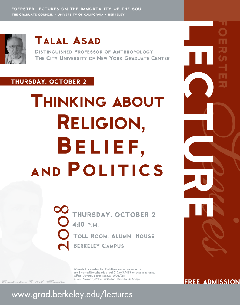
My name is Andrew Szeri. I’m a professor of mechanical engineering, and I serve also as Dean of the Graduate Division. And I’m pleased, along with the Graduate Council, to present Talal Asad, this year’s speaker in the Foerster Lecture series.
As a condition of this bequest, we’re obligated to tell you how the endowment supporting the lectures on the immortality of the soul came to UC Berkeley. In 1928, Miss Edith Zweybruck established the Foerster Lectureship to honor the memory of her sister, Agnes, and brother-in-law, Constantine Foerster. A lawyer by profession, Foerster was a man of high intellectual achievements and rare personal charm, we are told.
Although he passed away at the age of thirty-seven, he achieved an enviable place in the San Francisco Bar and was highly respected. For several years prior to his death, Foerster was a law partner with Alexander Morrison, one of the most prominent San Francisco attorneys, and he is the Morrison after whom the Morrison Memorial Library is named. In her last days, Miss Edith Zweybruck expressed her deep and abiding interest in the spiritual life by creating this lecture series on the subject of the immortality of the soul or similar spiritual subjects.
She believed that through the medium of a great university and the words of scholarly lecturers, she might bring new light upon a subject that has interested the world for centuries. Past Foerster lecturers have included Oliver Sacks, Thomas Kuhn, Aldous Huxley, and Paul Tillich. So it is now my pleasure to welcome to the podium Professor Stanley Brandes, Chair of the Foerster Lectureship Committee and Professor of Anthropology, and he will introduce our speaker, Talal Asad.
Thank you.
(applause)
[00:02:41] STANLEY BRANDES:
Thank you very much, Dean Szeri. It’s great to see so many people here, and I’m so happy that we have a good turnout for our distinguished speaker, Talal Asad. And it’s my great pleasure and distinct honor to present him to you.
He joins a long list. You heard some of the names of illustrious Foerster lecturers. Dr. Asad received his master’s degree from Edinburgh University and his doctorate at Oxford.
After some years teaching in Great Britain, he moved to the United States, where he joined faculties first at the New School for Social Research and then at Johns Hopkins University. For the past decade, he’s occupied a position as Distinguished Professor of Anthropology at the Graduate Center of the City University of New York. Dr. Asad has been a visiting professor at universities around the world, including, to our great benefit and pride, our own.
So this is a revisit for him to our campus. Talal Asad is a prolific writer, the author of six books and numerous shorter works. More than four decades of productive scholarship have earned him a well-deserved place in the canon of required reading for anyone interested in comparative religious studies.
Among his most celebrated publications are Anthropology and the Colonial Encounter, published in 1973, Genealogies of Religion, published in 1993, Formations of the Secular, 2003, and just last year, On Suicide Bombing. Warm welcome to Dr. Talal Asad.
(applause)
[00:04:41] TALAL ASAD:
Thank you very much for those kind words, Stanley, and I want to thank the committee as a whole for the honor that they’ve done in inviting me to give this lecture. And it is indeed for me always a very great pleasure to come to Berkeley. You didn’t quite specify the date that I came, which was nearly thirty years ago, when I came to spend the semester here and when we first met, I remember.
And my memories of that time are very warm indeed. So I’m really delighted and honored to have this opportunity to give this lecture here. So let me try and say what I have to say within a relatively short time that’s available for me.
I was told strictly fifty minutes or fifty-five minutes. I think I’ll be able to do it. But I have first of all to put on my own reading glasses.
Which makes it easier for me to read. All right. Thinking about religion, belief, and politics, and it is really an attempt to think rather than to present any kind of complete and determined position.
Since the closing decade of the millennium, social friction generated by the presence of substantial numbers of Muslim immigrants in Europe and the threat of Muslim terrorists have given a new impetus to the fear of politicized religion. Violent and intolerant fundamentalist movements have emerged not only in the Muslim world, although these are the most frightening in the West, but also in India, Israel, and the United States. The secular values of liberal democracy are under siege, or so much of the Western media tell us.
Academics who teach religious studies have responded eagerly, seeing in this an opportunity to demonstrate the public relevance of their expertise. What is to be done about the dangers to liberal democracies of religious belief? But tonight I want to begin with a prior question, one which I’ve addressed before, and I’ll go over some of the points.
What is religion? How has it come to be defined in the ways it has? Why is belief so strongly emphasized in so many definitions?
I’ll then go on to speculate about its connections with politics, mainly through a discussion of some shifts in perspective in the anthropological study of ritual and religion. But I’ll also discuss Charles Taylor’s recent magnum opus, A Secular Age, that draws strategically, but very importantly, on anthropology, on Victorian ideas of the primitive mind, as well as on recent ideas about ritual. This is a generous and learned work, full of insight into the kind we’ve come to expect from this philosopher.
But I want to try and think beyond it. And I’ll do so by stressing the body as the site of senses and sensibilities in religion and politics. And I’ll end by drawing on an ethnographic work on religion and politics that is a counterpoint to Taylor’s epic, and this is by an anthropologist who is actually a Berkeley anthropologist, Charles Hirschkind, The Ethical Soundscape.
Now, skeptics have long written about the origin of religion. However, for most of them, it was not the idea of religion that was puzzling, only its emergence was. At least since the Enlightenment, one important approach to understanding religion has consisted in what anthropologists call the sociology of error.
The main question was: What gave rise to such patently false beliefs in the first place? The testing of belief propositions in this area, and thus their falsification, tends to depend on a highly simplified language ideology that predicates both the counterintuitive character of religious belief statements and the emotional character of religious conviction. The sociology of error invented by Victorian anthropologists for understanding religion eventually gave place to another approach in which a different set of questions was raised.
Is religion a universal? What kinds of belief and practice are peculiar to religion? Do religious beliefs and practices give meaning to life?
If so, what kind of meaning? Do primitives find psychological comfort from religious practices when confronted by an unprecedented natural environment? And do moderns seek certainty in religious belief when they are plunged into bewildering political economic change?
Anthropologists and others sought to explain religion by reference to what I would call externalities. That is, by looking for its social function or for its cultural meaning. The concept of religion and its history remained virtually unexamined in this twentieth century approach.
To my knowledge, Wilfred Cantwell Smith’s The Meaning and End of Religion in nineteen sixty-two was the first book to present a historical sketch of the concept of religion in the West. The first to suggest that it was relatively recent. He also argued perceptively against essentialist approaches, and yet in the end, he didn’t quite break free of a residual essentialism himself.
Smith sought to substitute the word faith for religion in order to avoid the dangers of reification. But what this move led to was an emphasis on an ineffable experience as opposed to relationships created through, maintained by, and expressed in practices of various kinds. It’s not that there’s anything wrong, in my view, in stressing the importance of inner states when discussing religion, even when describing non-modern religiosity.
What’s questionable, I think, is making a particular language game, in which an apparently unmediated inner life articulates faith, the basis of a universal conception of religion. As when he writes, and I quote from him, “My faith is an act that I make myself naked before God.” The reason I think there can’t be a universal conception of religion is not because religious phenomena are infinitely varied, and certainly not because there’s no such thing as religion, as some have suggested.
It’s that defining is an historical fact—an act, sorry— and when the definition is deployed, it does different things in different times and circumstances and responds to different questions, needs, and pressures. Although what’s marked for devout practitioners as religion relates to what is essential for them, at the level of scholarly analysis, it has no essence, I would say. And by this, I don’t mean that things don’t hang together in distinctive, even necessary ways in particular religious tradit-traditions, but only that these are altered over time.
To define is to repudiate some things and to endorse others. Defining what is religion is not merely an abstract intellectual exercise. It’s not just what anthropologists or other modern scholars do.
The act of defining religion, and this is forgotten sometimes even by religious scholars, scholars of religion, I beg your pardon, not the same thing at all. It’s not just what religion or what anthropologists and other modern scholars do. The act of defining religion is embedded in passionate disputes connected with anxieties and satisfactions affected by changing conceptions of knowledge and interest related to institutional disciplines.
In the past, colonial administrations used definitions of religion to control and regulate the practices of their subjects. Today, liberal democracy is required to pronounce on the legal status of such definitions and thus to spell out immunities and obligations. Definitions of religion thus have profound implications for the organization of social life and the possibilities of personal experience.
And yet, for this very reason, academic expertise is often invoked in the process of arriving at legal decisions about religion. In short, universal definitions of religion divert us from asking questions about what the definition includes and what it excludes, why, by whom, and with what consequences. Popular debunkers and defenders of religion very often tend to anchor their polemics in clear-cut definitions.
They are uninterested in how diverse religious notions do different things in people’s ordinary lives, in how the human sensorium, seeing, hearing, and so forth, articulates experience recognized as religious or called non-religious. They don’t ask in what historical context, to what audience the act of defining particular practices as religious makes or fails to make good sense. Liberal critics and defenders of religion have nevertheless argued with one another over its implications for modern ethics and politics.
Central to both sides of the debate is the notion, I think, of belief. Regarded at once as a privilege, that is, the subject’s ability to choose her beliefs, and a danger, belief’s incitement to violence. A first step towards understanding this convergence between both positions is to review the classical Lockean doctrine of religious freedom that sets some of the main ideological terms for this argument.
Those of you who are very familiar with it will forgive me if I just go through very briefly one or two points here which are important for what I want to say. According to the modern conception of religion, belief can’t be coerced because it’s located in a private mental space. This, of course, is the core of John Locke’s theory of toleration and one part of the genealogy of secularism.
The theory rests on a new religious psychology that was beginning to emerge in seventeenth-century Europe. This allowed Locke to insist that the prince’s attempt to coerce religious belief, including belief in the salvational implications of religious practices, was irrational because impossible. All that force could secure was an insincere profession of faith and outward conformity.
Therefore, so the argument went and still goes, force employed by civil government should be directed only at securing Objective public interests: the protection of life, limb, and property, as the famous phrase has it. In fact, it’s precisely because the mind is seen as the impregnable bastion of true religious experience that the modern argument regarding the impossibility of controlling belief from outside acquires plausibility, plausibility. Some liberal philosophers have countered the awkward example of brainwashing by arguing that it merely creates inauthentic belief.
However sincerely that belief may be held. Authenticity, they argue, consists in the subject’s ability to choose her beliefs and to act on them. In this fashion, belief reinforces the idea of an autonomous subject.
But does the insistence that authentic belief is quite different from a sincere and yet inauthentic belief mean that the act of saying something passionately without choosing should be pronounced inauthentic? And I’m not sure that it should. When somebody takes up a stubborn position because as they put it famously, “Because there is no moral alternative, I can do no other,” in the famous phrase of Luther’s.
Should we say they are being inauthentic? I don’t think this strikes; at least, it doesn’t strike me as being somehow quite right. External, external forces can not only compel subjects to do or to refrain from doing things, but beliefs too, in my view, can be imposed by indirect means.
So although the insistence that beliefs cannot be changed from outside appeared to be saying something empirical about personal belief. It’s singular, autonomous, and inaccessible to others, location. It was really part of a political discourse about privacy, a claim to civil immunity.
But the claim tended by and large to be made against the state, and still to some extent does. Not against the market, where political-economic seduction is typically transmuted into internal compulsions. We don’t think of that as being somehow an imposition, and that’s interesting.
In his acclaimed book, A Secular Age, Charles Taylor has recounted a story that seeks to vindicate both the historical emergence of the secular democratic order and the promise of liberal religion. Although there’s virtually nothing in the book itself on the liberal democratic state as such, but there is in his other writings, contemporary Western Christianity, as he puts it, clearly depends on it. The most important sense of belief sought by liberal religion is private belief that is protected by the liberal state.
Taylor’s first chapter opens with the following statement: “One way to put the question I want to answer here in this book is this: Why was it virtually impossible not to believe in God in, say, 1500 in our Western society, while in 2000, many of us find this not only easy but inescapable. If there is a single condition, and that’s the quote from– that’s the sentence from Taylor. If there is a single condition that can be said to sum up the modern character of belief for Taylor, it’s that individual believers are now confronted by the distinction between experience and its construal.
He thinks this is a particularly modern. I don’t quite agree with that, but still, that’s an important distinction. This distinction makes religious belief private.
That is, one may entertain doubt and certainty and uncertainty, as well as optional. One can choose. So these are the two aspects that were absent, according to him, in the pre-modern world.
A secular liberal state is necessary if these conditions of belief are to be defined and protected. Taylor isn’t primarily concerned with beliefs as propositions that people hold to, of course. His interest is in what he calls social imaginaries, or what anthropologists call social myths that undergird them, undergird these beliefs.
His interest is in telling the story of how, and I quote again from him, “the whole context of understanding in which our moral, spiritual, or religious experience takes place is gradually changed.” Spiritual experience, according to him, is a matter of being directly in touch with transcendence that offers itself as a source of meaning and gives the individual what he calls a sense of fullness. When unbelievers feel that life lacks meaning, the result is a characteristically secular unhappiness that Taylor calls a modern malaise.
Yet in modern society, I would suggest, Christians and non-Christians, believers and non-believers, all live more or less the same life within the capitalist system. But if they share, given class differences, of course, and so on, but if they share a style of private life and a distinctive relation to public politics, how does belief distinguish them? As I understand Taylor, it’s the modern Western individual’s ability to interpret experience that leads to different beliefs.
Taylor recognizes the plurality of beliefs as an inescapable modern fact and affirms the right to individual interpretation as a transcendent liberal value. And although belief in his story is not to be taken to be equivalent in some simple way to a proposition, as I said already, the centrality of construal or interpretation by what he calls the buffered self in this account, which is counterposed to the pre-modern porous self, brings it pretty close to something that is capable of being stated, I would argue. If not propositionally, then in the form of a narrative.
Taylor’s narrative promises the unhappy conscience the possibility of redemption by religious belief. A self that seeks to be redeemed regards its life as a narrative, a life that takes the form of a personal quest. But there’s no redemption for disrupted selves in his account.
Taylor’s narrative of how a reformed and disciplined Christianity got here by traversing overlapping social imaginaries is itself an attempt at narrative coherence in which some things are repressed and others are emphasized. One can see why individual belief as a choice by right, not the content of beliefs, but the fact of belief, is so central to Taylor’s story about the secularization of religion, and why the Christian promise of personal salvation finds a place in his optimism about liberal politics. Perhaps one might also see why Taylor is so scornful of attitudes that regard modernity non-teleologically, as having a tragic because irresolvable character, and why he sets aside disruption as offering a creative opportunity.
There’s no mention in Taylor’s story of the global crises that threaten the world today, interestingly enough. Climate change, the militarization of space, economic collapse. This was written before the present crisis, by the way.
Economic collapse, it wasn’t hard to do that. Nuclear proliferation, war, and terrorism, and the widening gap between the wealthy few and the many poor. The word crisis appears in his entire text, which is nine hundred pages long or thereabouts, appears in that text only in reference to the loss of personal meaning for believers and to a felt need for an absent narrative.
But what’s this to do with religion, you may ask? Well, the answer is nothing. That is, nothing if religion is to be defined essentially as a matter of belief in personal salvation.
And yet one wonders what happens to the possibility of narrating the self if the world in which the believing subject must live is seriously imperiled, and there’s no discussion of that, unfortunately. Since the beginning of Western scholarly interest in the subject, ethnographic reports have played an important part in helping to construct the object of religious studies. Taylor himself draws generously on anthropology.
So let me turn to some debates on the concept of religious belief. Among anthropologists, it was Rodney Needham who first critically examined how Anglophone ethnographers identified the religious beliefs of the people they studied. What exactly, he asked, is being presented to the reader when the ethnographer claims to be writing about the interior state of believers?
His answer was a sceptical one. Because these states are necessarily expressed socially through language, there are no inner states that are universal. Not everyone found this answer conclusive, but Needham did point to something of central importance to the whole enterprise of comparative religion, and that is translation, not only from one language to another, but also across two different modalities, that is the interior and the exterior.
Several anthropologists who subsequently addressed the question of belief did so with respect to the universalism versus relativism debate, in which the concern remained cognitive and primary intention was paid to implicit meanings in ritual. For example, Malcolm Ruel, writing on the Christian creed in a widely read article, observed, and I quote from him, that “The performance of the creed is as complex, symbolic, and condensed an act of ritual as any other liturgical act, and is consequently as much subject to the categories developed, for example, by Turner for the analysis of ritual symbolism.” The Christian creed, Ruel pointed out, combines two senses of belief.
Belief in a divine person, the living Christ, and belief that a sacred, a sacred event had occurred, the crucifixion and resurrection. This echoed an important historical distinction between belief as a relationship of trust, love, and commitment, and belief as a proposition held in one’s mind as true or falsifiable. Although Ryle doesn’t say so, it should be clear that whereas the second sense of belief allows for choice, the first doesn’t do so, or at least not so easily.
Following Needham, we might ask how we can identify belief in medieval Latin Christendom, a society in which it’s said that it was almost impossible not to believe, as, as Taylor famously says. Recent historical research has shown that it is not plausible to regard the medieval period as a monolithic age of faith. There’s ample evidence that medieval people often rejected such orthodox doctrines as the immortality of the soul.
I’m sorry for this series: the resurrection, the incarnation, virgin birth, and purgatory. The difficulty is that no ready method exists for deciding whether such rejections simply meant a total absence of so-called religious beliefs or were prompted by alternative beliefs. The problem is further complicated by the fact that the vocabulary used belongs to a very different semantic field.
Infidelitas was typically used in secular contexts as such as charters, laws, and historical narratives. It usually meant breaking a contract or an oath, acting in a disloyal manner, or breaching someone’s trust. Infideles were not simply those who failed to hold orthodox convictions.
They were first and foremost those who acted disloyally in some way, or those who, through acts of treason or misfortune, were no longer a part of the relation that bound together God, Latin Christians, and their king one to another. Credere, the word in Christian Latin that’s translated into English as “to believe,” more usually has a moral rather than an epistemological sense, meaning to trust someone more often than to be convinced about the truth of a proposition. Thus, the medievalist Dorothea Weltecke cites the case of Aude Fauré, a young peasant woman who was brought before the Inquisition.
She was unable, she said, to credere in Deum. The detailed context makes it quite clear that what she meant was not belief in the sense that we would now translate it. She took the existence of a God for granted.
It was precisely because in her desperation, she couldn’t see in the Eucharist anything but bread, and because she found herself struggling with disturbing thoughts about incarnation, that she had no hope of God’s mercy, and that is what she meant when she said she didn’t, as it were, what we would translate as believe in God. My point is simply that the words then in use, and this applies to other cultures as well, that we now translate as belief and unbelief, should not be regarded as epistemological concepts that define objects of choice, so important for us in our modern culture. Both words expressed emotional dispositions embedded in social and political relationships, as well as distinctive sensibilities.
What’s changed is the hierarchy of the senses, I’d suggest, that links human practices to one another and to their natural environment. A change in what Wittgenstein called a way of life. And ways of life don’t change as easily as ideas in one’s head.
I will return to this point later, but first, I want to say something about ritual, a kind of practice that’s often been seen by critics as symbolic activity and by many critics, as activity with an anti-democratic implication. This is just ritual, as the saying goes. Anthropologists studying re-religion have been interested not only in religious doctrines; They have also written about religious practices.
Like other Victorians, evolutionary anthropologists tended to interpret as magical ways of coping, rich rites as magical ways of coping with difficulties of the natural environment. Protestant theologians, who were also students of primitive religion, such as the famous, Robertson Smith, both an anthropologist and a theologian, took the view that true Christianity required that it be stripped of Catholic magic, that is, of false science. But later anthropologists saw all this as a Methodological mistake.
Rituals, they maintained, were not to be regarded as primitive ways of adjusting to nature, not as evidence of primitive minds. As actions, rituals had a social function of their own. Some anthropologists, like Edmund Leach, proposed the idea that rituals weren’t instrumental actions at all.
Rituals symbolized something, communicated cultural meaning. But for Victorian evolutionists, as well as for many of their anthropological successors, the modern notion of belief attributed to what used to be called primitive peoples was essential to their conception of ritual. Whether it took the form of a cosmology or of culturally defined norms, whether it was to be reconstructed from explanations offered by practitioners or read into social actions and arrangements by resort to Western theories of signification, belief was central to the repetitive activities classed as rites.
Scarcely any anthropologist, in my view, took Needham’s worries about beliefs as an interface between inner and outer seriously. However, some anthropologists who now wrote about ritual took the communicative perspective in an interesting direction. Thus, Maurice Bloch took linguistic performance itself as the paradigm of symbolic action, and argued that the very formality of oratory, as in the formality of polite manners, was a crucial means of social control and political domination.
Formal communication, including religious ritual and political oratory, was to be seen as the denial of choice. One was forced into a certain form, he argued, uh, in, in this kind of paradigm, and that therefore it meant submission to traditional authority. And traditional authority, in Max Weber’s influential view, was one of the three modes of legitimate domination, as many of you will know.
This approach to ritual therefore reinforced the idea that the autonomous subject needed to break from tradition and the repetition of the past it demanded from him or her. The claim that ritual had a repressive social function resonated with the view that liberal religion should primarily take the form of private belief, with a strong Protestant rejection of Catholic ritualism. It reinforced the well-known notion that ritual was not only non-rational, but also anti-political in the sense of the politics that liberal democracy values, including the principles of equality, the freedom to choose, and the right to free speech, and so on.
However, the notion that formality is necessarily an external form of coercion is questionable. It’s only when forms become elements in a Goffmanesque strategy that they serve as a means of control over others. Goffman was also another person from here, I remembered suddenly.
But to the extent that public forms contribute to the making and remaking of the self in a social world, to cultivating it, where, in other words, external forms are part of the developing self, its effects will be different. In that context, what the embodied self learns to say and do, how it handles behavioral and verbal forms in relationship to others, are at the center of the self’s moral potentialities and not merely externally imposed. In short, if we think of ritual not as a mode of denying choice of belief by means of imposed formalities, but as developing aptness of behavior, sensibility, and attitude by means of a learned grammar, then we, I think, come to a more useful understanding.
Thus, contrary to Bloch’s thesis that the repetition of forms, that’s the condition of formality itself, is necessarily repressive, one can see that formality requires not only repetition of past models, but also the creativity that issues from judgment of its present relevance. The cultivation of forms is thus necessary to the cultivation of ethical virtues. In my mind, it was Marcel Mauss who in his famous essay entitled Body Techniques, offered the most fruitful insight into the study of ritual.
And he began from the obvious fact that the educated body achieved a range of human objectives, from styles of physical movement, walking, for example, through modes of sensibility and to kinds of spiritual experience. Mauss was not interested in the divide between religion and secularity. He had no investment in constructing a category called religion as a component of a universal called— ritual—sorry, uh, as a component of a universal called religion.
His interest was in the formation of attitudes both sacred and profane. Most importantly, he showed a way of asking different questions than the ones focused on belief. In the final paragraph to that essay, Mauss wrote famously, and I’ve quoted this before, “I believe precisely that there are, even at the base of all our mystical states, body techniques which have not been studied, but which were fully studied in China and India ever since ancient times.”
This socio-psychobiological study should be made, he goes on to say. I think there are necessarily biological means of entering into communion with God. This is still Moss, not me.
that biological means of entering into communion with God. Now Mauss isn’t saying, of course, that that experience can be explained biologically, but only that the inability to enter into what people have called communion with God, or the inability to revere words, things, and persons associated with him, may be the function of inexperienced bodies. Of bodies for whom certain kinds of experiences have been made difficult, if not impossible.
For Mauss, belief was not a matter of construing and choosing, but of the mode in which the human body, conscious as well as unconscious, exists. To put this point in less invidious terms, one might say that the secular attitude and experience, like the religious, requires particular social, psychological, biological conditions. I’m using Mauss’s phrase.
That the distinctive attitudes underlying secularism as a political arrangement presuppose particular hierarchies of the senses. Some culturally valorized senses are deliberately encouraged as objects of disciplinary projects. Others emerge out of the convergence of various political economic developments and the regulatory strategies that they give rise to in modern industries, mass markets, cosmopolitan cities, modern transport and communications, capitalist corporations, and modern warfare.
Social imaginaries, in other words, as a set of pre-reflective assumptions and beliefs, don’t seem to me to be quite explanatory of the historical shift from a so-called believing culture imposed and maintained by traditional authority to one that’s free and predominantly unbelieving. Because explanations in terms of social imaginaries, as Taylor himself has argued, subsumes lower-order desires, which are raw and corporeal, within higher order desires, which are construed, that is, interpreted and evaluated, so that those lower order desires are actually organized by the higher order desires according to him. And this seems to me to underestimate the contingency of bodily senses.
In other words, the notion of social imaginary and the associated notion of construal seem to me to fail to get at the unpredictable shifts and distortions in social life that are independent of the criteria for interpreting experience and of a coherent sort in narrative. To explore connections between religious, religion, belief, and politics, we need to ask a number of questions about the body, I think, its senses, and its attitudes. For this, we need ethnographies of the human body, its attitudes to pain, physical damage, decay, and death, as well as to bodily integrity, growth, and enjoyment, to isolation from and strong connection with other persons and things.
Attitude, incidentally, seems to me, uh, to be less intellectualist and more practical, uh, than our modern overstretched word belief. What architecture of the senses, hearing, seeing, smelling, touching, tasting, do particular attitudes and sensibilities depend on? How do new sensory perceptions take shape and make older ways of engaging with the world, that’s older experiences, and older political forms, not merely wrong, but irrelevant?
The work of Walter Ong, especially, I won’t mention them, but anyway, his work is relevant to these questions because he was among the first to trace shifts from the reliance on hearing to primary emphasis on seeing. Ong has rightly been criticized for recounting an overly simple story of historical stages in the development of human communication from oral culture through alphabet and print to the electronic media. In fact, both in the past and today, orality and writing have been intertwined in complicated ways.
Let me give you one example from the Islamic scriptural tradition, in which the senses of hearing and seeing, reading and reciting are closely intertwined.
(coughs)
The Quran, which, as many of you know, means literally recitation, is deeply rooted in complex continuities, quite apart from the major schools that have provided it with its construals. The earliest text, written in a primitive seventh-century Arabic script, seems to have been treated as a kind of musical score, a prompt for the oral rendition that depended on memorization through reiteration. Sign and sound went together, but not in any direct or fixed way.
It was only because the oral traditions were continuous that they were able to provide an immanent frame for the written text, and thus for its scholarly reception over the centuries. An effort has always been required to abstract the Quranic text as an intellectual object consisting of statements or even narratives from the relationship between the charged sound and the attentive body with its growing store of memorizations. The historian Henri Corbin has taken up the question of changing perceptions of the world appropriated by different human senses, hearing, seeing, smelling, in detail.
In his fascinating study, The Foul and the Fragrant, he traces the densely interwoven discourses on the cramped condition of the urban masses, the conditions of contagious disease, and the practices of individual hygiene in eighteenth and nineteenth century French society. One eventual consequence, Corbin observes, was an added emphasis on the priority of clear sight. And I quote: “There was increased concern for light in private dwellings as in public spaces.
This was the beginning of the great swing in attitudes that was to give uncontested supremacy,” he writes, “to the visual.” Darkness made nocturnal animals sad and perfidious. Uncertain light was a threat to health, zeal for work, and sexual morality.”” Corbin points out that it was not always the ideas themselves that immediately changed, but rather that the new form of perception made for what he calls a new intolerance of traditional actuality.
Shifts in sensory perception endow experience of other people and things with complicated emotions, anxieties, and pleasures, a function not merely of what is sensed, but of how it’s sensed. The new hierarchy of the senses associated with new patterns of living contributed to an aspect of modern subjectivity that we might provisionally identify as secular. I quote from him again: “Techniques of ventilation,” insofar as they acknowledged the need for space between bodies and gave protection against other people’s odors, brought individuals into a new encounter with their own bodily smells, and as such, contributed decisively to the development, he writes, of a new narcissism.
Now, if Corbin is right, then this narcissism, this disgust at other people’s bodily odors and love for oneself and one’s own odors may have reinforced the feeling that an unwanted touch by a foreign body, an unwanted touch by a foreign body, was a shameful contamination, making a wound inflicted by another yet more of a defilement, one calling for a vigorous cleansing response. So one might turn this around and ask, what kinds of violence, whether individual or collective, can be traced to this modern narcissism, if in fact we are willing to go along with this? And this may help, I think, explain why the ambitious narcissist protects his own boundaries religiously, if I may put it that way, but easily transgresses the secular boundaries of others.
At any rate, many secular sensibilities are the unintended consequences of new sense perceptions that are themselves part of the changing ways of life. Of course, attitudes and sense perceptions are also deliberately cultivated in institutions and social movements. But the important point is that the senses are central to the public life in which people participate, to the ways they promote, submit to, or resist the forces of political life.
The modern secular state isn’t simply the guardian of one’s personal right to believe as one chooses. It’s also, and first of all, a collective condition in which one senses and feels in specific ways. And yet the work of the senses has received less attention than it should in the study of secular politics.
What has come to be discussed in increasing detail is discipline, and I’ve myself been very interested in that. Discipline in the cultivation and internalization of attitudes, as well as in the regulation of individual conduct by external authorities. But important though discipline is, the conscious cultivation of behavior and belief isn’t quite the same thing as the unintended shifts in the sensorium described by anthropologists and historians like Corbin.
Thus, in his interesting study of the role of Calvinist doctrine and practice in the formation of the early modern European state, Philip Gorski has reviewed a range of authors who’ve dealt with the idea of discipline in ways that he regards as useful but not quite adequate. His own thesis is that the intensification of religious discipline in early modern Europe helped strengthen the state in several ways, and that the process of strengthening was dual in origin, both from above and below. Taylor draws in some detail on Gorski because he’s interested in the way discipline has contributed to the formation of what he calls a buffered self, an objective, self-contained self, disenchanted and modern, and able to control its emotions and feelings, to separate itself from objects by contemplation, reasoning, and interpretation, and to choose from available beliefs.
For Taylor and for others who have taken this view, it was the civilizing process that produced the buffered self out of the primitive, porous self, and thereby gave the world the gift of individual freedom. Now, this familiar story about the role of discipline in the formation of modernity is one I’m not very comfortable with because it too often ignores who is disciplined and how, and fails to pursue all the effects of discipline, whether intended or not. But assuming that this is the story, we encounter an intriguing question when we consider so-called fundamentalists in the contemporary Middle East, and I would like to put this to you.
Thus, although in Euro-America, the disciplined self or the model or the ideal of the disciplined self is said to be the distinctive figure of modernity and its freedom, the presence of discipline in Muslim life generally, and Islamic movements in particular, is commonly taken as evidence of precisely its opposite. The existence of rules of conduct, of dress, comportment, daily prayers, etc., and the cultivation of sensibilities, the control of emotion and speech and behavior, and reverence towards the sacred voice are seen as constraint and suppression. This is an example of precisely what arguments for toleration warn against.
If political or religious authority imposes norms of conduct and doctrine on the individual, and if this imposition is accepted, then this must be a case of sincere but inauthentic belief, or what one would call an ideologically confused consciousness. Now, I don’t want to present this as a question of bias. I want to make a rather different point here.
And this is that one might pursue a more anthropological question, that instead of approaching such behavior in terms of belief, and in this case of inauthentic belief, and this is obviously what differentiates these people from us. Instead of doing that, because belief is my quarry, as you know, here, one should inquire into what the behavior does and how the bodily senses are cultivated to take shape in different circumstances, and hence into what politics this cultivation makes possible or difficult. Now, this leads me finally to a study by an anthropologist who many of you know, who has tried to formulate his questions in his ethnography in just this way, The Ethical Soundscape by Charles Hirschkind.
And I described it, I described it earlier as a counterpoint to Taylor’s book, by which I meant both that it deals with a much shorter historical time span and a specific location, and that it’s more dense in its account of that time and space. Hirschkind is less interested in ideas and histories of ideas than in a way of life. In this sense, he’s a better anthropologist than I am.
More precisely, his study asks how the enormously popular practice of listening to sermons in contemporary Cairo shapes religious sensibilities and traces some of its consequences for politics. Throughout Islamic history, attending the Friday sermon has been an important part of Muslim subject formation. Hirschkind analyzes the reception of sermons as an active process, one in which the faithful listener cultivates her ability to attend, and to which, as in listening to a piece of demanding music, belief and meaning are of little significance.
Just as we don’t really say, “What’s the meaning of this piece of music?” That’s one of the points that he’s trying to make about listening. Listening to sermons in modern Cairo is no longer confined to the Friday mosque, and it’s no longer a one-off experience.
Taped sermons are now heard numerous times in many urban contexts. Political oratory and media entertainment have affected sermon styles and so made new connections with the institutions of national life as well as with the transnational Islamic community. This movement has grown in response to the Egyptian state’s often violent attempt to suppress the Muslim Brotherhood, which is very unpopular in some quarters here, which constitutes the most serious popular opposition to it, to that state.
Hirschkind’s account of the movement describes how it promotes an acoustic sensibility opposed to the state’s obsession with spatial order, as well as to the nouveau riche who have withdrawn increasingly into their clean, orderly, gated communities in Cairo, as in so many other cities. Contained in this opposition is a struggle for defining the scope and sensibility appropriate to real Islam. What Hirschkind calls a counterpublic is thus an Islam, Islamic space of moral distancing from the hegemonic religious secular order of the state.
Thus, many Islamists regard the regime of personal discipline as helping to develop sensibilities that might moderate, if not totally negate, the seductions of a neoliberal consumer culture. Since Hirschkind did his fieldwork in Egypt, an oppositional movement has emerged in strength known as Kifaya, Enough. That’s the name of that movement.
Kifaya overlaps with the counterpublic, and it brings together a variety of social elements, Muslims and Christians, Islamists and secular liberals, men and women, professionals and labor unionists in a coalition against the authoritarian neoliberal state. It’s not that there’s now a happy union of all these elements, but that an irreducible plurality persists as a foundation of political sensibility. What gathers secular liberals and Islamists and others together, despite a continuing measure of mutual unease, is precisely not their belief, but their oppositional attitude, their common feeling that circumstances in Egypt have become intolerable.
They speak of their opposition as something they did not choose, but were compelled to adopt. However, this situation isn’t merely negative. It also provides a space of daily interaction and negotiation whose future nevertheless remains entirely unclear.
Discrete and not so discrete intrusions by, among other things, American power, as well as the contradictory desires, feelings, and sensibilities within individuals and between them, make a political teleology virtually impossible. The religiosity involved in this movement emerges as a mode of being that is inwardly unsettled, yet outwardly civil. It’s never simply a mode of living where belief can be chosen together with every other good in the marketplace.
Instead, there’s an attempt to cultivate a sensibility attuned to mutual care among the community. To what extent this succeeds or even what its future holds are, of course, entirely different questions, and I won’t venture into that. So perhaps the crucial point for understanding the threat of religion in the contemporary world, the thought with which I began, isn’t the secular tolerance of plural beliefs is, is that this is the only remedy for religious belief, belief that generates violence?
It’s not that conversion to the liberal model of Christianity provides the best way of demonstrating the authenticity of belief for the modern religious subject. The interesting point, in my view, I would suggest, is that different kinds of practice encourage and presuppose particular forms of what has been called religious sensibility, and that this relates in unpredictable ways to emerging political and moral possibilities. Thank you.
(applause)
[01:00:56] STANLEY BRANDES:
Thank you very, very much for that extremely broad-ranging and interesting discussion. So we’re going to open up the floor now to questions. Please be brief and direct with your questions, and then Ellen Gobler is going to walk around and give you the microphone so that everyone can hear what you have to say.
So anyone with a question or a brief comment?
[01:01:26] TALAL ASAD:
There must be something. Okay, well then we can have an early drink.
(laughter)
[01:01:33] STANLEY BRANDES:
Yes, please.
[01:01:36] AUDIENCE MEMBER:
I’m gonna be loud enough.
[01:01:38] STANLEY BRANDES:
It takes time for people to think about this.
[01:01:43] AUDIENCE MEMBER:
Would you be willing to suggest what a reasonable person is to do in these times?
[01:01:55] TALAL ASAD:
You assume I’m a reasonable person.
(laughter)
[01:01:58] AUDIENCE MEMBER:
No, I assume that you’re a very well-educated person. I’m assuming I’m a reasonable person.
[01:02:03] TALAL ASAD:
Oh, yeah,
(laughter)
But you know, one of, if I may, one of the astonishing things one encounters, and I’m sure many of you will have encountered again and again, is this attitude among people. How could he or she, an educated person, act like this or think like this? Which has always astonished me.
What on earth makes people think that educated people are any more reasonable than anybody else? I mean, we know this isn’t the case, right? But this is– sorry, I couldn’t resist that, but it’s true.
About your other– partly because I don’t really know how to answer that other question, what is a reasonable person to do? I think that, you know, one has to decide for oneself what is a reasonable person and what the situation is as best as one can. I, you know, I’m really totally incapable of answering that question.
I’m sorry.
[01:03:13] AUDIENCE MEMBER:
You sort of argued against the idea that we should look to liberal Christianity as a model, but how would you respond to the argument that Western Christians, as well as people of other religions, have all been brainwashed, and it’s all, uh, not a legitimate belief?
[01:03:33] TALAL ASAD:
Well, yeah, I’m not sure that the term brainwashed is adequate for this kind of problem. I mean, you know, we know what sometimes we do say, and I think it’s useful to say that censors are brainwashed. And if you hear Bill Maher, Bill Maher, he will say it again and again, of course,
(laughter)
uh, about, about the American people, as he puts it, but I think that’s a bit unfair. People may, you know, I mean, the question is, what—that there are obviously differences. Are there differences within, among Christians as well, and among secularists in modern society?
And I think that there are, but I wouldn’t put it in terms of brainwashed. I would simply say that there’s a dissatisfaction with a particular model, which seems to accommodate itself too readily to, not only to a sort of a highly individualist self, but then there’s the other extreme also, as we know, in which certain authoritarian political forms are mobilized, very much in our time. So both these, you could say, were brainwashed, or at least they are not satisfactory and are criticizable.
And I would hope that other people would feel that too. And they do, of course. It’s not just, you know, my observation on this.
Sorry.
[01:05:14] AUDIENCE MEMBER:
Thank you. I was wondering, I was struck by your critique of Charles Taylor’s concept of a social imaginary. And I was wondering if you were willing to expand and elaborate a little bit on it, because what I heard you say was that the problem with the concept of the social imaginary was that lower-order desires and the affects are subordinated to higher-order forms of symbolic relations.
And maybe I misunderstood you, but are you suggesting that therefore the concept of a social imaginary is inadequate, for any kind of social analysis? Are you just saying that in this specific example that you cited, maybe the distinction between, you know, the year 1500 and the year 2000, um, that here the the idea of just comparing two social imaginaries is reductive. And if you’re saying the first thing, namely that the concept of the social imaginary is too reductive for a social analysis, full stop, then to what extent is your own work, perhaps also informed by a certain understanding of a social imaginary or symbolic relations, even if it’s you don’t call it that?
[01:06:30] TALAL ASAD:
Yeah, thank you. Well, my main concern was, in fact, the second, although I mentioned one of the foundations of his– of the way in which he uses the notion of a social imaginary. I mean, I don’t think in principle it is illegitimate to use the term social imaginary for various kinds of analyses.
This is a case of somebody trying to explain how a shift occurs from what he himself calls a believing culture to an unbelieving one. And really, the overwhelming part of the book, if you’ve read it, you will remember and you will agree with me, is devoted to tracing certain developments in ideas and different sorts of idea traditions and so on. So that it’s really a concern to explain something in terms of those shifts, and it’s not, it’s simply a matter of two different social imaginaries.
I mean, he would dispute that and say that he hasn’t, in fact, claimed that there are simply two, although you never quite know with Taylor and in that book what it is because, you know, people have pointed out, I taught it for a semester in class with students who were constantly frustrated and said, “But he says this,” and then next week we came back with further chapters, and said, “But he said the opposite this time,” and he’s taken it all back, which disarms one, to put it mildly. So, uh, I think that in… I’m dissatisfied with the fact that he doesn’t take the conditions of certain kinds of experiences, because his focus is on these social imaginaries, which are, as it were, the unreflected basis of the kinds of experiences and ideas and so on that people have and how they tend to interpret their happinesses and unhappinesses, as it were, particularly in modern times. And his focus is mainly, of course, in, in the development of, of modern ideas.
So it is, I wouldn’t lay down a general rule and say, \”In my view,\” social imaginaries is out, and nobody in the social sciences should use… I don’t really mind what you do in the social sciences. I have no special authority in that matter.
But I’m not concerned to make that kind of argument, not at all.
[01:09:00] STANLEY BRANDES:
So… The back of the room?
[01:09:02] AUDIENCE MEMBER:
Uh, yeah.
[01:09:06] TALAL ASAD:
And then somebody else.
[01:09:10] AUDIENCE MEMBER:
Thank you. Um, I’m wondering if in your… I, I find it intriguing to think in terms of, um, uh, to think about being attuned to the senses as you suggested, and hearing and, and other forms of senses.
I’m wondering if you would include in that a kind of, um, awareness or attunement to materiality in the, in a kind of Marxist sense, the m-material conditions as well, uh, uh, kind of economic relations?
[01:09:41] TALAL ASAD:
I, I think to some extent I’ve already referred to certain developments which, as it were, have unintended consequences and convergences. I’m not very happy with, in this context, although I’m willing to use polemically the idea of false consciousness in all sorts of political situations. But I don’t think it’s really a very happy, explanatory approach.
And that’s one of the things that I wanted to stress here, and to stress, as it were, the materiality of, instead of experience in some ineffable sense, to stress the importance of the senses, but the senses are not permanently set for, for everybody in every, you know, in all societies. They do change very importantly, a-and they are the sort of, uh, the basis on which certain experiences become compelling a-and others become repugnant, and so on. And that was the, the, the point that I was trying to stress in that part of, of the paper.
But yes, indeed, I would, I would, uh, emphasize the importance of, of the market, of cities, of, of, uh, uh, You know, I’ve mentioned, uh, corporations and so on. This was not intended to be an analysis along those lines, for which there is a place and which I think is quite legitimate as to how these systems work and what some of their consequences might be at a sort of systemic level. But we’re talking about, and as much of the literature on questions of belief and choice of belief and so on has to do with, is, the nature of experience, which is said to be based on certain social imaginaries, uh, without paying attention to what I think and many other people think is very important, and that is the senses.
[01:11:43] ELLEN GOBLER:
Okay, this will be the final question. Thank you.
[01:11:47] AUDIENCE MEMBER:
In regard to the question as to whether religion is universal, are you a believer, so to speak, in modern technology? And I’m thinking of functional studies of the brain, for instance, functional MRI. Um, trying to answer that question, whether religious thought and disparate rituals activate the same part of the brain.
And do you think that is helpful information or a sidetrack?
[01:12:14] TALAL ASAD:
Well, I haven’t found it, and look, uh, I’m not an expert in these matters. I haven’t found it, uh, very helpful, but that doesn’t mean very much. It simply means I haven’t followed the literature.
Uh, when I have occasionally read some of these things, uh, I’ve been unpersuaded, uh, because they seem to me to be uh, somewhat reductive of, uh, what promises eventually to yield, uh, an answer. But in fact, it’s still a promise, and a promise is, is, you know, whether you believe in the promise i-is the issue. And I’m, I’m, I’m not quite at the, at the point where I, I’m persuaded by that promise.
But that doesn’t mean anything. If you believe in it, that’s fine.
(laughter)
So, yeah.
[01:13:00] STANLEY BRANDES:
Well, I’m sorry. I’m sorry. We’ve run out-
[01:13:03] SPEAKER:
It’s on.
[01:13:04] STANLEY BRANDES:
It’s on? Okay. Doesn’t sound like it’s on to my ear. Uh, we’ve run out of time, and, uh, let us thank Talal Asad for coming here and-
(applause)
[01:13:16] TALAL ASAD:
Thank you.
(applause and cheering)
[01:13:22] STANLEY BRANDES:
Have a good evening.
(applause and cheering)