
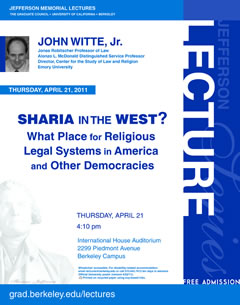
[00:00:00] HARRY SCHEIBER:
Well, welcome everyone. Uh, my name is Harry Scheiber, and I’m a professor in law and history at Boalt Hall and Jurisprudence and Social Policy Program. Uh, I have the privilege of being chair of the Jefferson Lectures Committee, uh, which, uh, operates under the aegis of the Graduate Council and the Dean of the Graduate School, uh, Graduate Studies, um, Andrew Szeri, formerly under the distinguished leadership of, uh, Professor Cerny, who’s joined us today.
Welcome. Um, we’re very pleased to have, uh, as our Jefferson lecturer, uh, a person, a scholar who lives up to the really remarkable history of this lecture series, which, as you see from your program, uh, goes back to nineteen fifty-eight and has included some of the leading figures in public intellectual life and political life and journalism and above all, in scholarship. These lectures were established in nineteen forty-four through a bequest from Elizabeth Bonestell and her husband, Cutter Bonestell, a San Francisco couple that cared a lot about history and hoped that lectures on the democratic tradition, Thomas Jefferson, and the values of American democracy would be of interest to this community.
Um, today’s lecturer is, uh, John Witte, who’s a professor at Emory University, where he holds a distinguished chair and where he has headed a center, a remarkable center, uh, which has engaged in studies of religion and law for many years. Um, it’s always been a matter of astonishment to me how in, uh, Professor Witte’s own career, he’s been ahead of the curve by about fifteen years in just thinking about such questions as religion in the post-Soviet Russia or thinking about Islam and the challenges that a migration such as we experience would, um, generate. And, uh, and, uh, he very kindly met with a group of students and faculty at lunch today, and lo and behold, he said that their objective was to get fifteen years ahead of the curve.
So it was on purpose, but with an immense, uh, with immense success that he’s done that. Uh, his detailed biography is in your program, and, um, I encourage your, your reading all those details of a distinguished career in which he’s made, uh, mark as a leading scholar and thinker in my own field of history. He’s a great authority on questions of law and religion in the, in Protestant Europe from the early modern period down to the present.
He’s written on the First Amendment as a constitutional scholar. Um, he teaches in these fields and, uh, has also taught in criminal law and other fields, and has given lectures of this sort, endowed lectures, in which an institution seeks to bring the very top-tier person in a given field at many other just fine institutions in this country. Um, in his almost latest book, an, uh, two oh nine book on some themes that may be touched on today, uh, uh, called The Sins of the Fathers on illegitimacy, the issue of illegitimacy.
Um, there are two reviews that I’d just like to quote briefly, ’cause I couldn’t, I couldn’t say them better myself, and I couldn’t say them with half the auth– or tenth the authority that these people have said it. David Ford, the Regius Professor of Divinity, Cambridge University, uh, refers to John Witte as one of the world’s foremost thinkers on law and religion, a man whose work is noted for rigorous scholarship, perceptive theology, and wide re– wise reflections on civic responsibility and other aspects of the subject. Uh, David Novak, the Shiff Professor of Jewish Studies at Toronto, uh, says that this book demonstrates what we always expect from John Witte.
Painstaking historical research, lucid presentation, plus jurisprudential and theological gravitas, and also the profound humanity of this man. Those of us, um, there are many in law and history and religious studies who are his friend, uh, would also say it’s an incomplete reduction– uh, introduction without referring to his brilliance as a teacher and his, um, profound humanity. So it’s with very great pleasure that I present, um, Professor John Witte as this semester’s Jefferson lecturer, and he’s going to speak on Sharia in the West: What Place for Religious Legal Systems in America and Other Democracies?
Thank you. Hey, John.
(applause)
[00:05:00] PROFESSOR JOHN WITTE:
Thanks so much. That was great.
[00:05:02] HARRY SCHEIBER:
You’re good. Go ahead.
[00:05:10] PROFESSOR JOHN WITTE:
Well, thank you very much, uh, Professor Scheiber for your warm and very generous introduction. Uh, good afternoon to each of you. It’s a great pleasure to be back on this beautiful campus in this lovely time of the year, to have the chance to partake of the intellectual sparkle of this place, and to enjoy the faculty and the students, uh, whom I’ve had the privilege to meet again here.
I want to, uh, thank all of you for taking the time to be with us in the late afternoon when beautiful skies beckon and the beach is close and margaritas are flowing in some venue of this city. I want to thank, uh, Ellen Gobler and her colleagues for their special choreography of this event and the wonderful hospitality they’ve accorded. I want to thank, uh, my dear friend, uh, Harry Scheiber, um, for the great hospitality that he has accorded me together with his wonderful bride, Jane, uh, for his brilliant scholarship in legal history and economic history, of which I and many thousands of others have been the happy beneficiaries.
Uh, and for his un– uncommon kindness to me in the last decade and more, in opening doors and opportunities and inviting me to participate in various things, not least, uh, this, uh, distinguished lectureship. I want to thank the members of the le– the Jefferson Lecture Committee for their, uh, kindness in lowering their standards to allow an unripe and unworthy youngster to stand before you, uh, to deliver, uh, this lecture this afternoon. Um, as I was looking over the long roll of distinguished speakers who have stood here before me, I could not help but feel a sharp pang or two of inadequacy, and I could not help but remember the rather embarrassing experience of my good friend Brian in our first-year class in contracts together some twenty-five years ago at the Harvard Law School.
The class was taught by the venerable Archibald Cox of Watergate fame, a master of Socratic dialogue and repartee, and I note, uh, a prior Jefferson lecturer. Uh, Bryan was a particularly gifted student. He had been trained in rhetoric and in drama at Radcliffe College.
He had been a national debating champion. He had been a professional actor, even appearing in a part in a play on Broadway before law school. And so when Professor Cox called on Bryan to recite the first case of the day, Bryan initially held forth with considerable aplomb.
Professor Cox, of course, had only begun his interrogation, and he began to press his line of questions a bit more closely, and Bryan found that the answers did not fall nearly so easily off his tongue. Cox became more insistent, now lashing out his Socratic whip with increasing alacrity and increasing accuracy. Bryan became more and more confused.
Cox became even more insistent, and when the questions threatened to overwhelm him, Bryan summoned up the little courage he had left, looked Professor Cox in the eye and repeated a line from his drama days. “Sir, I am afraid I am teetering on the edge of the abyss of my ignorance.” Cox’s reply was instantaneous.
“Young man, you fell into that abyss some time ago.” Well, standing up here experimenting with questions at the edge of family law and Islamic identity and religious freedom and women’s rights and other fundamental rights, um, I too feel like I’m teetering on the edge of the abyss of my ignorance, and I shall leave it to my friend Harry Scheiber to declare when I have fallen in. On February seventh, two thousand and eight, Anglican Archbishop Rowan Williams set off an international firestorm by suggesting that some accommodation of Muslim family law was, quote, “unavoidable” in England.
His suggestion, though carefully qualified, prompted more than two hundred and fifty articles in the world press, the vast majority denouncing it and denouncing the Archbishop. England, his critics charge, will be beset with licensed polygamy and barbaric procedures and brutal violence against women encased in suffocating burqas. Muslim citizens of a Western democracy will be subject to legally ghettoized Muslim courts, immune from civil appeal and constitutional challenge.
Consider Nigeria and Pakistan and other former English colonies that have sought to balance Muslim Sharia with the common law, other critics added. The horrific excesses and chronic human rights violations of these religious courts, even ordering the faithful
(gavel bangs)
to stone innocent rape victims for dishonoring their families, prove that religious laws and state laws and marriage in the family simply cannot coexist. Case closed, said the Archbishop’s critics. This case won’t stay closed for long, however.
The Archbishop was not necessarily calling for the establishment of independent Muslim courts in England, let alone the enforcement of Sharia by English courts. He was instead raising a whole series of hard but unavoidable questions about marital, cultural, and religious identity and practice in Western democratic societies committed to human rights and religious freedom for all. What forms of marriage should citizens be able to choose, and what forums of religious marriage law should states be required to respect?
How should Muslims and other religious minorities with distinct family norms be accommodated in a society dedicated to religious liberty and self-determination, to religious equality and non-discrimination? Are legal pluralism and perhaps even a form of personal federalism necessary to protect Muslims and other religious believers who are conscientiously opposed to the liberal values that now inform state laws on sex, marriage, and family? These and other hard questions are becoming unavoidable in many modern Western democracies with growing and diverse Muslim communities, each making new and ever louder demands for accommodation.
If current growth rates of Muslim communities in the West continue, a generation or two from now, the so-called Danish cartoon crisis is going to seem like child’s play. Even democratic countries that share a common law heritage and a common commitment to human rights and religious freedom for all have taken quite different approaches to these basic questions. Take three examples: England, Canada, the United States.
Of these, England has the largest group of religious Muslim minorities and has been the most accommodating of Muslim schools and charities and banks and arbitration tribunals that litigate and adjudicate the private issues of their voluntary faithful. In particular, English courts are increasingly upholding the arbitration awards of Muslim tribunals in marriage and family disputes, so long as all parties consent to participate and so long as there is not a hint of any physical coercion of any of the parties. The same deference is accorded to the marital arbitrations of Jews and Hindus and Christians and other peaceable religious authorities.
Canada, the most constitutionally liberal of these three common law countries, debated seriously in the last decade the recognition of Sharia marital tribunals in Ontario And a bid in Quebec as well. But ultimately, after ample con-cultural contestation, rejected them in favor of single provincial laws and marriage for all citizens, Muslim and non-Muslim alike. But Canadian and Muslims enjoy ample religious freedom to engage in their own worship and apparel, education, banking, religious rituals and more, and have no other serious impediments upon their religious group rights.
The United States, though with sizable and diverse Muslim populations, has been the least accommodating of its Muslim citizens. American Muslim litigants have not fared well of late when they have challenged state denials of charters or exemptions for their schools, charities, or mosques. Nor have they often succeeded in challenging prohibitions to wear traditional religious apparel from headscarves to burqas while teaching in public schools or testifying in state courts or serving in public places.
Most American state courts have only sporadically upheld private Muslim marriage contracts, and that trend is in a downward direction. They have often sided with non-Muslim spouses in divorce and child custody cases involving mixed marriages. They have always held a firm line against Muslim polygamy and have granted shrinking deference to arbitration awards and mediation settlements when Muslim officials have been involved.
But American Muslims have continued to agitate for greater religious freedom, autonomy, and self-determination in marriage and related domestic subjects. It is no surprise that it is the law of marriage and family life that has triggered this new contest between law and religion in Western democracies. For marriage has long been regarded as both a legal and a spiritual institution, subject at once to special state laws of contract and property, and to special religious canons and ceremonies.
Marriage has also been long regarded as the most primal institution of Western society and culture. Aristotle and the Roman Stoics called the marital household the foundation of the polis and the private font of public virtue. The church fathers and medieval scholastics called it the seedbed of the city, the force that welds society together.
Early modern Protestants called the household a little church, a little state, a little seminary, the first school of love and justice, charity and citizenship. John Locke and the Enlightenment philosophers called marriage the first society to be formed as men and women moved from the state of nature to an organized society dedicated to the rule of law and protection of natural rights. Because of its cultural importance, marriage was also one of the first institutions to be reformed during the decisive battles between church and state in the history of the West.
In the fourth and fifth centuries, when Constantine and his imperial successors slowly converted the Roman Empire to Christianity, they soon passed comprehensive new marriage and family laws predicated directly on Christian teachings that gradually soaked into the Roman law. In the later eleventh and twelfth centuries, when Pope Gregory the Seventh and his successors threw off their civil rulers and established the Catholic Church as an independent legal authority in Western Christendom, the Church seized jurisdiction, lawmaking power over marriage, calling it a sacrament subject to the church courts and to the law of those courts, the canon law. In the sixteenth century, when Martin Luther, Henry VIII, and other Protestants called for reforms of church, state, and society, one of their first acts was to reject the Catholic canon law of marriage and the sacramental theology that supported it, and to transfer principal legal authority over marriage to the Christian magistrate.
In the later 18th century, when the French revolutionaries unleashed their fury against traditional institutions, they took early aim at the Catholic Church’s complex marital rules and roles and rituals, consigning marriage to the rule of secular state authorities alone. And in the early 20th century when the Bolsheviks completed their revolution in Russia, one of Lenin’s first acts was to abolish the legal institution of marriage as a bourgeois impediment to the realization of true communism. Modern Western democracies have not abolished marriage as a legal category, but they have dramatically privatized it and thinned out many of its traditional elements.
Half a century ago or so, most Western states treated marriage as a public institution in which church, state, and society were all deeply invested. With ample variation across jurisdictions, most Western states in the middle twentieth century still generally defined marriage as a presumptively permanent monogamous union between a fit man and a fit woman with capacity and freedom to marry each other. A typical state law required that engagements be formal and that marriages be contracted with parental consent and witnesses after a suitable waiting period.
It required marriage licenses and registration and solemnization before officials. It prohibited sex and marriage between couples related by various blood and family ties identified in the Mosaic Law. Couples who sought to divorce had to pub-publicize their intentions to petition a court to show adequate cause or fault, to make provision for dependent spouses and children.
Criminal laws outlawed fornication, adultery, sodomy, contraception, abortion, and other perceived sexual offenses. Tort laws held third parties liable for seduction, enticement, loss of consortion, alienation of affections of one’s spouse. Today, by contrast, a private contractual view of sex, marriage, and family life has come to dominate the West, with little constructive role left to play for parents or peers or religious or political officials.
Marriage is now generally treated as a private bilateral contract to be formed, maintained, and dissolved as the couple sees fit. Private prenuptial, marital, and separation contracts that allow parties to define their own rights and duties within the marital estate and thereafter have gained increasing acceptance. No-fault divorce statutes have reduced the divorce proceeding to an expensive formality and largely obliterated the procedural and substantive distinctions between annulment and divorce.
Payments of alimony and ongoing forms of post-marital support to dependent spouses and children are giving way to privately negotiated lump-sum property exchanges, providing a clean break for parties to start anew. The functional distinctions between the rights of the married and the unmarried couple, the straight and the gay partnership have been considerably narrowed by an array of new statutes and constitutional cases. Virtually all traditional sex crimes, save incest and polygamy, have been constitutionally outlawed or become dead letters.
These exponential legal changes in the past half century have in part been efforts to bring equity and equality within marriage and society, and to stamp out the patriarchy, paternalism, and plain prudishness of the past. These legal changes are also in part simple reflections of the exponential changes that have occurred in the cultural and condition of Western families. The stunning advances in reproductive and medical technology, the exposure to vastly different perceptions of sexuality and kinship born of globalization and immigration, the explosion of international and domestic norms of human rights, particularly gender rights and children’s rights, the implosion of the traditional nuclear family born of new economic and professional opportunities for adults.
But more fundamentally, these legal changes represent the rise of a new theory of private ordering of the domestic sphere and the gradual growth of a new democratization of desire. A fantastic range of literature has emerged in the past four decades vigorously describing, defending, or decrying these legal changes. Many Muslims living in the West decry these massive changes to prevailing state laws of sex, marriage, and family life, and they want out.
Some Muslims have just gone back to their Muslim-majority homelands, shaking their heads in dismay at what Western libertinism has wrought. Others have stayed put and quietly ignored the state’s marriage and family law, using the shelter of constitutional laws of privacy and sexual autonomy to become, in effect, a law unto themselves. Others have developed elaborate premarital contracts that seek to exempt Muslim couples from much of the state law in favor of internal norms and practices of their own religious communities.
And still others have led bicultural lives, dividing their time between Western homes and Muslim majority lands that allow them to form a Muslim marriage and a family, including such an institution that licenses polygamy, patriarchy, and primogeniture. All of these informal methods of cultural and legal coexistence, however, can only be temporary expedients. These creaky accommodations and concessions that now exist in various Western lands for Muslim citizens and subjects can easily fall apart.
Eventually, a Muslim citizen will appeal to the state for relief from a religious marriage contract or a religious family practice that he or she cannot abide but cannot escape. Eventually, an imam or a shadow Sharia court operating in the West will overstep by using force or issuing a fatwa that draws the ire of the media and the scrutiny of a state official. Eventually, an aggressive state caseworker or prosecutor will move upon a Muslim household, bringing charges of coerced or polygamous marriage.
Eventually, a Muslim school or charity will find itself in court, faced with a suit for gender discrimination or with child abuse owing to its practice of single-sex education and corporal punishment in the school. Eventually, another major media event like that surrounding Rowan Williams’s stray, unavoidable accommodation comment of two thousand eight will bring a bright spotlight back on Western Muslim communities. And once such a major case and controversy breaks and the international media gets involved, many of these informal and temporary domestic arrangements for Muslims might well unravel, particularly given the cultural backlash against Muslims prompted by nine-eleven, seven-seven, Fort Hood, and the unpopular wars against Islamicist extremism in Iraq, Afghanistan, and elsewhere.
It’s precisely this vulnerability that advocates of faith-based family law and Sharia courts want to avert. They want to put Sharia, the family law of the Muslim community, and its voluntary use by the Muslim faithful on firmer constitutional and cultural ground in the West. But rather than denouncing Western liberalism and the sexual, moral, and marital lassitude it has purportedly occasioned, sophisticated advocates now press their case for Sharia in and on the very terms of Western constitutionalism and political liberalism.
Three main arguments are part of the literature today at the cutting edge. The first part of the case for Sharia is an argument for religious freedom. Both Western constitutional laws and international human rights norms give robust protection to the religious freedom of individuals and groups.
Why, the argument goes, should peaceable Muslim citizens not be given freedom to opt out of state laws on sex, marriage, and family that run afoul of their core claims of conscience and central commandments of their faith? Why should they not have the freedom to choose to exercise their domestic lives in accordance with the norms of their own voluntary religious communities? Why doesn’t freedom of religion provide a sincere Muslim with protection against a unilateral divorce action or a child custody order by a state court that directly contradicts the rules of Sharia?
Why doesn’t freedom of religious exercise empower a pious Muslim man to take four wives into his loving, permanent care in imitation of the Prophet, particularly when his secular counterpart can consort and cavort freely with four women at once and then walk out scot-free? The second part of the case for Sharia is an argument for religious equality and non-discrimination. After all, many Western Christians do have religious tribunals to govern their internal affairs, including some of the family matters of their faithful.
And state courts will generally respect their judgments, even if these cases are appealed to Rome or Canterbury or Moscow. No one is talking of abolishing these church courts or even trimming their power, even after recent discoveries of grave financial abuses and cover-ups of clerical sexual abuse of children in selected churches. No one seems to think that these Christian tribunals are illegitimate when some of them discriminate against women in decisions, say, about ordination or church leadership.
Similarly, Jews are given wide authority to operate their own Jewish law courts to arbitrate marital and financial and other disputes among the Orthodox Jewish faithful. Indeed, in New York State by statute and several other states and European nations by custom, courts will not issue a civil divorce to a Jewish couple unless and until the Beth Din, the Jewish law court, issues a religious divorce, even though Jewish law systematically discriminates against the wife’s right to divorce. If Christians can have their canon laws and consistory courts, if Jews can have their Halakha and Beth Din, and if even indigenous peoples can have their ancestral laws and tribal rulers, why can’t Muslims be treated equally in their use of Sharia and Islamic courts?
The third part of the case for Sharia is an argument from political liberalism. One of the most basic teachings of classical liberalism in the West is that marriage is a pre-political, a pre-legal institution. Marriage is not created by the state.
It comes before the state and its positive laws, both in historical development and in ontological priority. As John Locke put it famously in his two treatises on government, the marital contract was the first contract and the first society to be formed as men and women came forth from the state of nature. The broader social contract came later, presupposing stable marital contracts, and contracts to form state governments and religious communities and other voluntary associations within this broader contract to society came later still.
Why on this simple contractarian logic should the state get exclusive jurisdiction, lawmaking power over marriage? After all, it was 16th century Protestants, not 18th century Enlightenment philosophers, who first vested the state with marital jurisdiction. But why is state jurisdiction over marriage mandatory or even necessary?
Before the 16th century Protestant Reformation, and in a number of Catholic lands well after the Reformation, too, the Catholic canon law and Catholic church courts governed marriage. Moreover, even in Protestant England until the 19th century, the state delegated to ecclesiastical courts the power to treat discrete marriage and family issues. There is evidently nothing inherent in the structure of Western marriage and family law that it requires it to be administered by the state.
And there’s nothing ineluctable in liberalism’s contractarian logic that requires marital couples to choose the state rather than their own families or their own religious communities to govern their domestic lives, particularly when the state’s liberal rules diverge so widely from their own religious beliefs and practices. On this latter argument, conservative Muslims sometimes join hands with selected conservative Christians and selected critical liberals who call for exemption from, if not the abolition of, state marriage law. Conservative Christians, because the state has purportedly betrayed traditional Christian teachings on marriage.
Critical liberals, because the state has purportedly continued to encroach too much on individual privacy and sexual autonomy. So those are the three big arguments, religious freedom, religious equality, and this contractarian argument. And let’s sort them out and try to give some preliminary answers.
The problem with the first pro-Sharia argument from religious freedom is that it falsely assumes that claims of conscience and freedom of religious exercise must always trump. But that’s hardly the case in modern democracies, even though religious freedom is amply cherished. Even the most sincere and zealous conscientious objectors must pay their taxes, register their properties, answer their subpoenas, obey their court orders, swear their oaths or give other forms of veracity, and abide by many other general laws for the common good that they may not in good conscience wish to abide.
Their eventual choice, if they persist in their claims of conscience, is to leave the country or to go to prison for contempt. Moreover, even the most devout religious believer has no religious exemption claim from criminal laws for activities like polygamy or child marriage or female genital mutilation or corporal discipline of wives or coerced marriage of young daughters, even if their particular brand of Sharia might command it or their particular religious community might commend it. The guarantee of religious freedom is not a license to engage in crime.
Muslims who are conscientiously opposed to the liberalism of Western laws of sex, marriage, and family are certainly free to ignore them. They can leave ch– They can live chaste private lives in accordance with Sharia and not register their religious marriages with the state.
That choice will generally be protected by the constitutional rights to privacy and sexual autonomy, so long as that conduct is truly consensual. But that choice also leaves their family entirely without the protections, rights, and privileges available through the state’s complex laws and regulations, not only of marriage and family, but also marital property and inheritance, social welfare, life insurance, social security benefits, and much, much more. And if minor children are involved, the state will intervene to ensure their protection, support, and education, and will hear nothing of religious freedom objections from their parents or from the community’s religious leaders.
Western Muslims enjoy the same religious freedom as everyone else, but some of the special accommodations pressed by some Muslim Sharia advocates today in the name of religious freedom are simply beyond the pale for most Western democracies. Even further beyond the pale is the notion of granting a religious group legal sovereignty over the sex, marriage, and family lives of their voluntary members. It’s one thing to allow religious officials to officiate at weddings or testify in divorce cases, or assist in the adoption of a child, or facilitate the rescue of a distressed family member.
Most Western democracies readily grant Muslims and any other peaceable religious communities such ready accommodations. Some democracies, only a few, will also uphold the religious arbitration awards and mediation settlements over discrete domestic issues that are engineered by Muslim and other religious authorities. But that’s a long way from asking the state to delegate to a religious group the full legal power to govern the domestic affairs of their members in accordance with their own religious laws.
No democratic state can readily accommodate a competing sovereign to govern such a vital area of life for its citizens, especially since family law is so interwoven with so many other public, private, penal, and procedural laws, and especially since so many other rights and duties of citizens turn on a person’s marital or familial status. Putting aside the formidable First Amendment obstacles to such a delegation of core state power to a private religious body, surely a democratic citizen’s status, rights, and entitlements cannot turn on the judgments of a religious authority that has none of the due process and other procedural constraints of a government tribunal. Moreover, the proud claims of Muslim advocates that Sharia provides a time-tested and comprehensive law governing all aspects of sex, marriage, and family life is, for some, an even stronger strike against its accommodation by the state.
Once a state takes the first step down that slippery slope, skeptics argue, there will eventually be little to stop the gradual accretion of a rival religious law over sex, marriage, and family life, particularly as Muslim communities grow larger and more politically powerful. Some Western states thus resist even religious arbitration and mediation of marital disputes involving Muslim officials. We saw last year Oklahoma passed a constitutional amendment saying Sharia does not apply in our state, full stop.
Nine additional states are now contemplating such anti-Sharia measures. Six European nations have those under advisement at the national level. That trend will continue.
The pro-Sharia argument from liberal contractarian logic, the argument that says since marital contracts are pre-political, coming before the contracts that form the state, the society, or religious associations, marital parties should be free to choose whose laws govern them. That argument is clever, but deliberately incomplete. It ignores another elementary teaching of classical liberalism, namely that only the state and no other social or private union can hold the coercive power of the sword.
The government contract does grant this coercive power over individuals, but only in exchange for strict guarantees of due process of law, equal protection under the law, and respect for the fundamental rights of citizens and subjects. A comprehensive system of marriage and family law, let alone the many other correlative legal systems of inheritance and trusts and family property, children’s rights, education, social welfare, and much more, cannot long operate without coercive power, given the transience and the porousness of our modern communities. Such a law needs police, prosecutors, and prisons, subpoenas, fines, and contempt orders, material, physical, and even corporal sanctions.
Moral suasion and example, communal approbation and censure could certainly do part of the work, but a properly functioning marriage and family law system in a modern society requires resort to all of these coercive instruments of government. And only the state, and not a religious body, can properly use these coercive instruments in a modern democracy, again, with strict due process constraints. The pro-Sharia argument from religious equality and non-discrimination, because Jews and Christians have their religious tribunals, we should have them too, takes a good bit more effort to parry.
A useful starting point is the quip of Supreme Court Justice Oliver Wendell Holmes Jr., “The life of the law has not been logic, but experience.” This old adage has bearing on this issue. The current accommodations made to the religious legal systems of Christians and Jews, First Peoples, and others in the West were not born overnight.
They came only after centuries of sometimes hard and cruel experience, with gradual adjustments and accommodations made on both sides. The accommodation of and by Jewish law to Western secular law is particularly instructive in this regard. It is discomforting but essential to remember that Jews were the perennial pariahs of the West for nearly two millennia, consigned at best to second-class status and periodically subject to waves of brutality, whether imposed by Germanic purges, medieval pogroms, early modern massacres, or the twentieth-century Holocaust.
Jews have been in perennial diaspora after the destruction of Jerusalem in the year seventy of the Common Era, living in a wide variety of legal cultures in the West and well beyond. One important legal technique of survival that Jewish communities developed after the third century of the Common Era was the concept of Dina d’malchuta dina, the law of the community is our law. This meant that Jews accepted the secular law of the legitimate and peaceful secular ruler who hosted them as the law of their own Jewish community, so long as it did not conflict with core Jewish laws.
This technique allowed Jewish communities over time to sort out which of their own religious laws were indispensable, which more discretionary, which secular laws and practices could be accommodated, which had to be resisted even at the risk of life and limb. This technique not only led to ample innovation and diversity of Jewish law over time and across culture, it also gave Jews the ability to survive and even to grow legally, even in the face of ample and bitter persecution. Western democracies, in turn, particularly in the aftermath of the Holocaust and in partial recompense for the horrors it visited on the Jews, have gradually come to accommodate core Jewish laws and practices.
But it’s only in the past two generations, and only after endless litigation and lobbying in state courts and legislatures, that Western Jews have finally gained legal ground to stand on, and even that ground is still thin and crumbles at the edges at times. Today, Western Jews generally have freedom to receive Sabbath day accommodations, to gain access to kosher food, to don yarmulkes and distinctive grooming and other forms of religious dress in most public places, to gain zoning, land use, and building charters for their schools and charities and synagogues to offer single-sex and bilingual education in those schools and more. And Jewish law courts have gained the right to decide some of the domestic and financial affairs of their faithful who voluntarily elect to arbitrate their disputes before them rather than suing a fellow Jewish brother and sister in a secular court.
These Jewish law courts are attractive to Jewish disputants because they are staffed by highly trained jurists conversant with both Jewish and secular law and sensitive to the bicultural issues that are being negotiated. Unlike their medieval and early modern predecessors, these modern Jewish law courts claim no authority over all Jewish sex, marriage, and family life, leaving many issues to the state. And these Jewish law courts have also abandoned their traditional authority to impose physical coercion or sanctions on the disputants.
In particular, they claim no authority beyond persuasion to stop a disputant from simply walking out of the court and out of the Jewish community altogether. The modern lessons in this story for Sharia advocates are four. First, it takes time and patience for a secular legal system to adjust to the realities and needs of new religious groups and to make the necessary legal accommodations.
The hard-won accommodations that modern Jewish law and culture now enjoy are not fungible commodities that Muslims or any others can claim with a simple argument from equality. These are individualized, equitable cultural adjustments to general laws that each community needs to earn for itself based on its own needs and its own experiences. Muslims simply do not have the same history of persecution that the Jews have faced in the West, and simply do not yet have a long enough track record of litigation and lobbying.
Concessions and accommodations will come, but only with time, with persistence, with patience. Second, it takes flexibility and innovation on the part of the religious community to win accommodations from secular laws and cultures. Not every religious belief can be claimed as central.
Not every religious practice can be worth dying for. Over time and of necessity, diaspora Jewish communities learned to distinguish between what was core and what more penumbral, what was essential and what more discretionary to Jewish legal and cultural identity. Over time, and only grudgingly, Western democracies learned to accommodate the core religious beliefs and practices of Jewish communities and citizens.
Diaspora Muslim communities in the West need to do the same. Islamic laws and cultures have changed dramatically over time and across cultures, and modern-day Islam now features immense variety in its legal, religious, and cultural practices and norms. That diversity provides ample opportunity and incentive for Muslim diaspora communities to make the necessary adjustments to Western life and to sort out what is core and what is more discretionary in their religious lives.
Cultural adaptation, not assimilation, is what is needed to win the accommodations of the state. Third, religious communities in turn have to accommodate or at least tolerate the core values of their secular host nations if they expect to win concessions for their religious courts or religious practices. No Western nation will long accommodate, perhaps not even tolerate, the religious community that cannot accept its core values of liberty, equality, and fraternity, or of human rights, democracy, and rule of law.
Those who wish to enjoy the freedom and benefits of Western society have to accept its core constitutional and cultural values as well. So far, only a small and brave band of mostly Western-trained Muslim intellectuals and jurists have called for the full embrace of democracy and human rights in and on Muslim terms. These are highly promising arguments and courageously proffered, but so far these arguments can hardly be heard amidst all the loud denunciations of them from sundry traditional Muslims in and beyond the West.
Moreover, even liberal Muslims are hard-pressed to point to modern examples of a Sharia-based legal system that maintains core democratic and human rights values. Unless and until that case can be reliably made out, deep suspicion will remain the norm. And finally, Muslim tribunals in the West must become a good deal more legally sophisticated and procedurally equitable to be both attractive to voluntary Muslim disputants and acceptable to secular state courts.
Like the Jewish Beth Din that sits in New York or in London, the Muslim law court needs to be staffed by jurists who are well trained, both in religious law and in secular law, and who maintain basic standards of due process and representation akin to those in secular courts or secular arbitration tribunals. A single imam pronouncing legal judgments in an informal proceeding at the local mosque will get no more deference from a state court than a single priest or rabbi making legal pronouncements in a church or in a synagogue. And Western state courts will have little patience with claims that this lack of deference violates the religious liberty of the mosque or the imam or the members before the imam.
The court’s suspicions will, in fact, be the opposite, that the disputing parties who appeared before the imam did not understand the full legal options available to them at state law or were coerced to participate in the internal religious procedures, abdicating their state’s rights. It’s much harder for a secular court to have such suspicions when educated Muslim parties, eyes wide open, choose a legally sophisticated Muslim arbitration tribunal over a secular court that does not share their core values but still offers them a serious jurisprudential option to state marriage law. Lest all of this seem like an unduly patronizing argument for religious minorities to wait and see or change and hope for the best, it’s worth remembering that majority Christians, too, went through much of this same exercise in the area of religion and education.
The American story offers a good illustration of how this developed and how common educational standards were eventually raised and maintained. In the later nineteenth and early twentieth century, a number of American states wanted a monopoly on education in their public, that is, their state-run schools. Some of this agitation was driven by anti-Catholicism, some by anti-religious animus altogether.
For half a century, churches, schools, and religious parents struggled earnestly to protect their rights to educate their children in their own private religious schools. And in the landmark case of Pierce versus Society of Sisters in 1925, the United States Supreme Court held for the churches and their families and ordered American states to maintain parallel public and private education options for their citizens. But in a long series of cases thereafter, courts also made clear that states could set basic educational requirements for all schools as a matter of accreditation, setting mandatory courses, and texts and tests, mandatory standards for teachers and students, common requirements for laboratories, libraries, gymnasia, and more.
Religious schools could add to the state’s minimal accreditation requirements, but they could not subtract from them. Religious schools that sought religious freedom exemptions from these requirements found little sympathy from the courts, which instructed the schools either to meet the standards or to lose their accreditation and licenses to teach. This compromise on religion and education, forged painfully over more than half a century of wrangling, has some bearing on issues of religion and marriage.
Marriage, like education, is not a state monopoly, even if state marriage law must be a prerogative. Religious parties in the West have long had the right to marry in a religious sanctuary following their religious community’s preferred wedding liturgy. Religious officials have long had the right to participate in the weddings, annulments, divorces, and custody battles of their voluntary members.
But the state has also long set the threshold requirements of what marriage is and who may participate. Religious officials may add to these thresholds state law requirements on marriage, but not subtract from them. A minister may insist on premarital counseling before a wedding, even if the state will allow the couple to be married without it.
But if a minister bullies a minor to marry out of religious duty, the state could throw him in jail. A rabbi may encourage a bickering couple to repent and reconcile, but he cannot prevent them from filing for divorce, except in New York. And an imam may preach of the beauties of polygamy, but if he knowingly presides over a polygamous union, he is an accessory to crime.
If religious tribunals do eventually get more involved in marriage and family law, states may well build on these precedents and set threshold requirements in the form of a license, a kind of accreditation, formulating these license rules through a democratic process in which all parties of every faith and non-faith participate. Among the most important such license or accreditation rules to consider, no child or polygamous marriages or indeed any other forms of marital union not recognized by the state. No compelled marriages or coerced conversions before weddings that violate elementary freedoms of contract and conscience.
No threats or violations of life or limb or provocations of the same. No blatant discrimination against women or children. No violations of basic rules of procedural fairness and more.
Religious tribunals may add to these requirements, but not subtract from them. Those who fail to conform will lose their licenses to arbitrate disputes and will find very little sympathy when they raise religious liberty objections. This type of arrangement worked rather well over time to resolve some of the nation’s hardest questions on religion and education.
And it led many religious schools slowly to transform themselves from backward sectarian isolationists into exemplary cultural leaders. Muslims in the West have already begun some of this exercise, too in the development of Muslim grade schools and high schools, which are now sometimes attractive to non-Muslims because of their discipline and high academic standards. And one can imagine in the next decade or two arising alongside a Notre Dame or a BYU, a, or a Yeshiva, a new school that has Muslim religious identity.
Such an arrangement holds comparable promise for questions of religion and marriage in Western Muslim communities. It not only prevents the descent into licensed polygamy and barbaric procedures and brutalized violence that Archbishop Rowan Williams’s critics properly feared, it also encourages and incentivizes various Sharia tribunals to reform themselves and to pick those marital laws from that vast canvas of Sharia that are most conducive to abiding by Western cultural standards and constitutional norms. Even hardened and prejudiced local communities in democratic lands eventually will find room for new Muslim major– minorities who are skilled at cultural navigation and who are both consistent and persistent in pressing their main case for accommodation.
The Catholic example in America is a good example. And in the process of adjusting to the legal and cultural realities of their new homes, Western Muslim religious minorities may eventually become legal and cultural leaders of the law of marriage in succeeding generations of the West. Thank you very much for your kind attention.
(applause)
[00:56:50] HARRY SCHEIBER:
Well, thank you, Professor Whitty, for this very learned and provocative discussion. Uh, Professor Whitty has, uh, uh, agreed to take questions and, uh, uh, we will if you raise your hand, we’ll call upon you, and that microphone can be brought around if I can disengage it. There.
[00:57:12] PROFESSOR JOHN WITTE:
So if you have any hard questions, please put those to Professor Scheiber. Uh, easy questions, uh, I can try to handle. So these are experimental thoughts, and there’s nothing dogmatic in their formulation. There is a lot of problems, I’m sure, and I’d like to hear them. Madam.
[00:57:35] AUDIENCE MEMBER:
Thank you very much. This is a wonderful discussion and lecture. Uh, my question has to do with specific examples.
Can you point to something in your practice or study, um, that exemplifies ways that the Sharia, uh, law and our state and federal laws have, uh, made it through a rough transition ar-around marriage and family.
[00:58:10] PROFESSOR JOHN WITTE:
So there are two different ways to answer that. One, I’ll answer on the theoretical side, and the other I’ll answer just looking at comparative law. On the theoretical side, I would point to, uh, my distinguished colleague and friend, Ala-
Abdullahi An-Na’im, who was on the campus last year giving the Tanner Lectures, uh, to a comparable audience. And he has been one that has tried to demonstrate very clearly in and on Muslim Islamic terms, uh, what it means to embrace human rights and democracy and what it means to have structural or social pluralism in dealing with questions of marriage and family, which by definition are both religious and legal in their formulation. Uh, his work I commend to you warmly.
Uh, he has a new book. Um, he has an old book called Toward an Islamic Reformation. Uh, that book, uh, was one of his early, uh, statements of a hermeneutic of human rights within the Islamic community.
Uh, it’s really a, a powerful statement of if we want Islam to embrace human rights, let them discover human rights from within. And in point of fact, if we go back to the canon, go back to the Quran, go back to the Hadith, go back to the practices of some of the early sages in the tradition, there are teachings and practices that are conducive to, if not exemplary of, what we now in the 20th century call human rights. His latest book, uh, on issues of Sharia, uh, are dealing with the question about, uh, taming Sharia from, as… this is his terminology, taming Sharia from a convenient state system of law into an internal private body of law governing the voluntary faithful within mosques and other religious communities, akin to the role that canon law now plays in the Catholic and Orthodox churches or forms of ecclesiastical discipline p-play within Protestant churches.
And his agitation in this last book out from Harvard University Press is to, uh, try to find a way of showing that state appropriation of religious law is a violation not just of First Amendment norms, it’s a violation of international human rights norms of religious freedom, and he makes that case in, in quite compelling terms. Um, areas where cultural navigation by Muslims And by, um, accommodating, uh, political officials they are harder to point to. Um, I would say that England has, amongst common law countries dedicated to religious freedom and human rights, England has probably done the best job in trying to find ways of dealing with the equality questions, the religious freedom questions, and in the necessity for having an overarching common marriage and family law system and fundamental rights, especially on gender and children grounds.
Um, th-there’s clumsy jurisprudence there, uh, but it’s gradually, uh, really beginning to emerge. Um, there’s a wonderful, uh, colleague you have at Berkeley, Professor Song, who has written on mult-multiculturalism, Justice, Gender, and Multiculturalism, a Cambridge University Press book in 2007, who identifies some of this material. There’s a woman called Pascale Fournier, uh, F-O-R-U and then N-I-E, Fournier, uh, who’s just published a book on Muslim marriage contracts and their treatment in different Western and non-Western, uh, democratic lands, which I would commend as, uh, kind of exemplary.
She points out to all the best examples one can find, uh, of accommodation. And there are some wise courts that, uh, in Australia, New Zealand, England, that have opined on this. And a good window on that is a new book just published by Rex Ahdar, A-H-D-A-R, uh, and Nicholas Aroney, A-R-O-N-E-Y, The Oxford University Press title on, uh, the case for Sharia and there they gather, uh, the best evidence from different parts of the world for and against, uh, Sharia.
And, uh, s-special interest, I happen have an essay on there, so all the more reason to read it. Other questions or comments? Please.
I guess this is being recorded, so please.
[01:02:28] AUDIENCE MEMBER:
In a sense, you’ve qualified Sharia law down to family and marriage law, but of course it has much wider-
[01:02:36] PROFESSOR JOHN WITTE:
Yep.
[01:02:37] AUDIENCE MEMBER:
implications.
[01:02:38] PROFESSOR JOHN WITTE:
Yep.
[01:02:38] AUDIENCE MEMBER:
And the whole, um, pan-Islamic attempt to have a non-national world is based in the Sharia-
[01:02:45] PROFESSOR JOHN WITTE:
Yep.
[01:02:45] AUDIENCE MEMBER:
conception. So surely there’s a much larger problem here. You’re really suggesting that Sharia law gives up its universal claim and becomes simply far-ma-family and marriage, and then conforms with-
[01:02:57] PROFESSOR JOHN WITTE:
Yeah, Western democracies.
[01:02:59] AUDIENCE MEMBER:
So there is really no place for Sharia law within Western democracies, I think is what you’re concluding. Would that be fair?
[01:03:05] PROFESSOR JOHN WITTE:
Certainly, um, if, um, the goal is to create a pan-national, um, world Islamic community subject to a common Sharia law enforced coercively by political authorities under advisement from religious authorities, if that’s what having Sharia means, uh, I would be firmly opposed, as would much of the rest of the world community that’s within and outside of the Muslim world. Um, but I would dare say that that is a twentieth century hijacked version of what Sharia is. Uh, the, the Sharia that obtains, uh, until the nineteenth century without this political, um, aspiration, uh, and cosmopolitan aspiration is a, a sturdy legal system that deals, as you say, with a number of other aspects of life beyond domestic law, uh, and economic issues, uh, criminal issues, a variety of, of, uh, interesting things of what we would call torts and contract and property.
And it’s a quite comprehensive, uh, legal system, uh, that has operated sometimes as a substitute for state law and sometimes there’s a parallel to state law in different parts of the world. Um, there is no– So if we take that tamer version of Sharia, I, I dare say, uh, cutting and pasting pieces of that into the operation of a diaspora Muslim community living in the West is not a betrayal of that Sharia.
it is simply creating the first steps for its implementation voluntarily for its own voluntary members alongside the law of the state. And in that sense, it can be, I think, tamed without violation either of the religious freedom norms of that community, uh, or the integrity of the legal system. And I dare say a good, um, analogy to that is what happened to the canon law of the Catholic Church, which was the universal law of the West from 1200 to 1500 that had, um, procedural and, and institutional mechanisms for enforcement for all of Western Christendom.
Uh, and that was slowly trimmed over time, to be sure, much to the consternation of those who initially held power, but nonetheless retained its integrity as an internal religious legal system for the faithful, which was the Catholic Church’s accommodation of the reality of the nation-state. Uh, a-and I think the Catholic Church, there may be a few that are, that aspire to th-medieval Christendom again. I suspect very few do.
Um, that I think is the, uh, at least one prototypical path down which, uh, Muslims can walk, uh, as they accommodate the realities of the nation-state. If we eventually go to the cosmopolitanism of Appiah or somebody else and, and we become, uh, post, uh, or trans state actors and world citizens, uh, then it’s a new ballgame. But I think that’s– I dare that, I dare say that probably won’t happen in our lifetimes.
Although you’re, you’re a much younger man than I.
[01:06:17] ISAAC:
Thank you, s- Uh, Professor Reid. I’m Isaac, uh, a Fulbright student from Indonesia, and I’m curious how you bridging Western law and human rights, which is based on Locke, Kant, individualisms and, uh, human rationality with Sharia law, which is hinges to communality and Quran in Arabic, which is also the word of God itself.
Mm-hmm. So how you bridge– bridging this to kind of gap between Western rationality, individualisms and, uh, Quranic communality and inerrancy. Yeah.
Thank you.
[01:07:06] PROFESSOR JOHN WITTE:
Good. Well, thank you, Isaac, for being here, and thank you for your very good question. Um, first of all, I would say I would question the premise, uh, and characterization, uh, of Western understandings of rights that you offered in your question.
I know you’re trying to be provocative. Uh, I would say that human…
[01:07:26] HARRY SCHEIBER:
You want to take the question again?
[01:07:27] PROFESSOR JOHN WITTE:
Oh, as I, as I understood it, how can, um, I make an argument for human rights in Islamic terms when human rights are predicated on individualism, rationalism, the autonomy, uh, proffered initially by Locke and Kant, and now part of, uh, our understanding of liberalism in the West, uh, with a, uh, an argument to say that there can be human rights within Sharia when Sharia is communal. Sharia presupposes, uh, a, a common community, a common ethic, a common religion to that community, uh, and does not have the individualism, rationalism, and contractarianism that the West has. So it’s just a softball question, so I’m gonna give that one to Harry Shutt.
(laughter)
Um, I mean, that’s the, that’s the real question. I would say, first of all, um, I don’t think that the Western enlightenment formulation of human rights, uh, is a necessary precondition to talking about rights. I would say–
Secondly, I would say that human rights are not creatures of the West, they’re not, uh, creatures of Western Christianity, and they’re not hostage to any particular belief system or any particular theology. Uh, I would say that human rights are gifts and goods of human nature, that the West and Christians in the West over time, gradually, painfully, through trial and error, came to discover about our human nature and what it means to live together as brothers and sisters, what it means to live together in community, catering to a common good. And that in the history of the West, we can find that understanding of rights already in some of the early Greek and Roman and Hebrew texts.
We can find more of it institutionalized in classical Roman law. We can find a good deal more of it formulated in medieval canon law. We can find a great deal of it formulated even further in the Reformation and Counter-Reformation period to the point anecdotally that by 1650, every one of the rights that is going to appear a hundred and fifty years later in the US Bill of Rights has already been defined, defended, and died for, uh, by Western Christians.
And so in many ways, what Christians discovered, again painfully, is that these are goods and gifts of human nature which can be rationalized in a number of different ways. And yes, individualism, rationalism, contractualism provides one sturdy epistemology of rights, but it’s by no means the ear– only one. Sometimes rights can be understood as the reciprocals of religious duties.
Sometimes they can be exercises of one’s religious office. Sometimes they can be products of one’s, uh, commandments to the poor, and to the needy, and to the uneducated, to those that have to be served in society. There are a variety of templates to think about what human rights are and how they can be situated and how they can be rationalized in a society.
And it’s precisely, and I, I like to think about human rights in some sense as middle axioms between the particular, uh, day-to-day life of a, of a community and the civil law that gathers around it and the higher natural law or transcendent order or ideal world, uh, in which religious and other communities play a part. In some sense, human rights draw upon the wisdom, the inspiration, the sometimes prophecy and examples of that higher set of ideals and provide sturdy, but eventually porous norms and transient norms to govern the particular activities of a given religious community. Human rights grow over time, they adapt over time, they absorb other inst– ideas and institutions, they accrete to, uh, deal with different cultural situations, uh, but they’re relatively sturdy.
I call them the ius gentium of our time. Now, if you start with that assumption about what human rights are, then they’re not some superimposition that the West, and particularly Western Christians and imperialists or colonialists, impose upon our Muslim friends in different parts of the world. This is not the last residue of Dutch, um, colonialism in Indonesia.
This is in fact simply, uh, one statement that has emerged about what are the goods of human nature. That the world community, after World War II, had to articulate in bald terms when it stared into Hitler’s death camps and Stalin’s gulags, when it tried to deal with the reality that sixty million people had just been killed in six years. What are the fundamentals of human nature, of human dignity, of human society that we all should embrace?
The world was forced in 1948 to formulate that. Now, that formulation was done on the fly. It was done with all– with some representation of other communities, perhaps not enough, but it was an invitation to state the fundamentals of our human existence.
Now, that idea of human rights as a mirror for all of society, as a ca– as a, in some sense, the code of what it is to have a good life, a good society. What are the gifts of our human nature that we’ve evolved or that have been created in us or anything in between, depending on your theology of human nature? Mm-hmm.
How can every other community look in that mirror and discover for themselves in their own traditions, in their own texts, in their own prophets, in their own experiences, things that are conducive, practices that are conducive? And that’s why I like my colleague, Abdullahi An-Na’im, or another dear friend who was quoted in the introduction, David Novak, We’re using human rights that way, as a way, well, let’s rethink our own traditions, and let’s think about what our texts say. Is there a way of translating some of those wonderful surahs into formulations about rights?
Is there a way of taking some of the Prophet’s great examples recorded in the Hadith and translating them into normative statements of what the good life and good society are? And can our Confucian and Buddhist and Hindu and Taoist and indigenous friends do the same? And I dare say the answer has to be yes.
If we start with the premise, human rights are simply statements of human goods and human gifts that we’ve been given, from my perspective, divinely.
[01:13:45] HARRY SCHEIBER:
On that note, I wanna thank you- Uh-huh, Professor Woody, and to say how, what a privilege it was for us to hear you on these subjects, and what an appropriate way to end this wonderful session. Thank you.
[01:13:55] PROFESSOR JOHN WITTE:
Thank you.
(applause)
[01:14:02] HARRY SCHEIBER:
Everyone is invited to, uh, join in a reception. There are some refreshments. Where are they? On… In the back of the room behind, uh, the wall, and thank you all for coming.
[01:14:12] PROFESSOR JOHN WITTE:
If I can be of any help, just, uh, I got a card, so drop me a line if, um… I’m at the Emory Law School, but, uh, if you wanna grab a card and we can be in continued email. There were some hands up that couldn’t, uh, have their questions recognized.
So thanks so much for coming, and thank you, Professor Scheiber.
[01:14:27] HARRY SCHEIBER:
Thank you.
[01:14:28] PROFESSOR JOHN WITTE:
That work?