
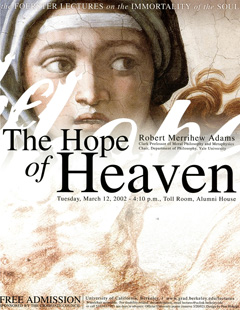
[00:00:00] MODERATOR:
Welcome you to this wonderful event. The Foerster Lectures are really a gem of the Graduate Council lectures. Most of my daily mundane matters do not deal with the immortality of the soul, so I’m always very pleased to, uh, be asked to, uh, become involved with the Foerster Lectures.
And tonight, we’re particularly, particularly honored to have Robert Merrihew Adams as our speaker. Uh, and so now I’d like to introduce Professor Sam Scheffler, who is a professor here on campus in both law and philosophy, to introduce, uh, uh, Professor Adams. Thank you.
[00:00:35] SAM SCHEFFLER:
On behalf of the Foerster Lecture Committee, I’m pleased to welcome you to today’s Foerster Lecture on the immortality of the soul. The Foerster Lectures were established in nineteen twenty-eight by Miss Edith Zweybruck, a San Francisco public school teacher, to honor the memory of her sister, Agnes Foerster, and her brother-in-law, Constantine E. A. Foerster. It was Miss Zweybruck’s wish that these lectures should address the immortality of the soul or other kindred spiritual subjects.
The very first Foerster lecture was delivered by the Harvard philosopher Ralph Barton Perry in nineteen thirty-three. Over the years, the Foerster lecturers have been a remarkably distinguished group of individuals who have represented a wide variety of scholarly disciplines and intellectual orientations. For the first twenty years or so, most of the lecturers chose to address themselves directly to the topic of immortality.
Early titles included, for example, The Premises of Our Faith in Immortality, The Hope of Immortality, The Experience of Immortality, Imagination and Immortality, Immortality and Fulfillment, and simply Immortality. Beginning around the 1960s, however, Foerster lecturers began to range further afield, taking more advantage of the kindred subjects clause in Miss Zweybruck’s instructions. Bernard Williams, who gave the lecture in 1972, memorably said that his kindred spiritual subject would be the mortality of the soul.
And in recent decades, there have been Foerster lectures on computers and the mind, on science and rationality, on neurobiology, on consciousness, and on evolution.
(cough)
Indeed, it is now the standard practice for the letter inviting prospective Foerster lecturers to include an assurance that, quote, it is appropriate to work in a modern context when reflecting on immortality and the soul, both in quotes. And a broad range of philosophical, historical, cultural, or psychological subjects can be presented under this lectureship. It’s clear, I think, that the perceived need to provide this kind of reassurance reflects, shall we say, a certain unease with the very topic of the immortality of the soul and an expectation that even prospective Foerster lecturers are likely to share that unease.
Whether or not they do in fact share it, the undoubted prevalence of such unease presents a challenge with which contemporary Forster lectures must surely reckon.
(coughing)
I know of no one who is better equipped to deal with that challenge than today’s distinguished speaker, Professor Robert Merrihew Adams. Professor Adams is the Clark Professor of Moral Philosophy and Metaphysics at Yale University. He received his BA from Princeton, and he also holds degrees from Ox– from Oxford, from the Princeton Theological Seminary, and from Cornell, where he received his PhD in nineteen sixty-nine.
He taught briefly at the University of Michigan and then went to UCLA, where he remained for over twenty years before moving to Yale in nineteen ninety-three. There he has just completed an eight-year term as chair of the Department of Philosophy. Professor Adams is a world-renowned scholar who has made significant contributions in several different areas of philosophy, including ethics, metaphysics, the history of philosophy, and the philosophy of religion.
His numerous publications include three important books: The Virtue of Faith; Leibniz: Determinist, Theist, Idealist; and most recently, Finite and Infinite Goods: A Framework for Ethics, published in 1999. This most recent book provides a sophisticated philosophical defense of a theist- of a theistically grounded ethical framework and uses that framework to illuminate some of the perceived shortcomings of contemporary moral philosophy. Like all of Professor Adams’s writing, it is a work of great subtlety and originality, and it merits careful study whether or not one shares its religious orientation.
In nineteen eighty-nine, Professor Adams was the Wilde Lecturer in Natural Religion at Oxford, and in nineteen ninety-nine, he delivered the Gifford Lectures at the University of St. Andrews. He’s a fellow of the American Academy of Arts and Sciences, past president of the Society of Christian Philosophers, past president of the Leibniz Society of North America, and a member and past chair of the Board of Trustees of the Princeton Theological Seminary. It’s a great pleasure to welcome Professor Adams to Berkeley and to the Foerster Lectureship.
The title of his lecture has actually changed a bit since the announcements that you’ve seen were printed. Uh, instead of The Hope of Heaven: A Spiritual Universe, the title will be simply A Spiritual Universe. Professor Adams.
[00:05:45] PROFESSOR ADAMS:
Thanks very much, Sam, for the, the generous introduction. Uh, let me first of all express my very real gratitude, uh, for the honor of the invitation to deliver this Foerster Lecture on immortality. I had thought at first that I would address that topic directly, uh, under the title The Hope of Heaven, since I do in fact cherish such a hope.
But as it has turned out, the lecture that wanted to be given, so to speak, on this occasion is concerned rather with a topic belonging to the metaphysical context in which we may think about immortality. I have titled it A Spiritual Universe. Its thesis is that everything that is real in the last analysis is broadly spiritual in character, and is to be conceived on the model of our own minds as experienced from the inside.
I do not mean to suggest that immortality can be inferred or proved from this thesis. There was a time, no more than two hundred years ago, when it was generally thought to be part of the business of a metaphysician to prove immortality, but that time is past. Hardly anyone today believes that immortality can be proved from general metaphysical premises, and I don’t believe that either.
Reasons, if we have them, for believing in immortality will have to be sought in some richer context, such as those proposed by a number of religious traditions. But I do think the thesis of the fundamentally spiritual character of reality provides an intellectual context that is friendly to belief in immortality. My thesis belongs, broadly speaking, to the idealist tradition in philosophy.
Modern metaphysical idealism enjoyed a distinguished history and a flourishing and sometimes dominant position in European philosophy from the early part of the eighteenth century to the early part of the twentieth century. Since then, it has fallen on hard times. Not that it has been refuted.
Its appeal in modern thought has rested, as I will try to explain, on certain deep problems about supposed non-spiritual substances, and those problems have neither gone away nor been solved in a non-idealist way so far as I can see. But other intellectual motives have led philosophical interest away in other directions. My thoughts on this subject are heavily indebted to great philosophers of the seventeenth and eighteenth centuries, especially Leibniz and Berkeley, but also Hume and Kant.
This has not seemed to me the occasion for a primarily historical lecture, however. I will borrow freely from their views and arguments and as freely adapt them to my own purposes, which is to offer you in my own voice, and I hope in accessible and non-technical language, a sort of vindication of idealism. I’ve chosen to begin it autobiographically by telling you how I became an idealist as a teenager.
I came to idealism spontaneously when I was about fifteen by thinking about ordinary physical objects with which I dealt on a daily basis. I remember sitting outdoors on a nice sunny day, pulling out blades of grass and asking myself, What is it in itself for this blade of grass to exist? I could see its green color and smell the fresh grass scent.
But Miss Quinn, my ninth-grade science teacher, had explained to us, in accordance with the preponderance of modern thought, that such qualities are subjective, aspects of the way objects appear to us rather than of their physical nature. The size and shape of the blade of grass, long and pointed, which I could also see and feel, were allowed to belong to the object, but that didn’t satisfy me. It seemed to me that there should be something filling the size and shape.
There should be something it was like in there, something as robustly qualitative as the green color, but intrinsically characterizing the physical object. I wondered whether if I could penetrate the surface of the object and look inside it, I could discover what sort of thing it was in itself. That’s hard to do with something as thin as a blade of grass, but I thought about somewhat thicker things that I had broken open with the destructive curiosity of the young.
Pencils made of wood and graphite, more used then than now, and pieces of chalk like this one. I break it in half, and sure enough, I can see in a way what’s in the middle. It’s white in there as it is on the outside.
The pencil, more interesting perhaps, was yellow on the outside and mostly pink inside as kind of a blotchy or wavy pink, but dark gray or black in the very center. But these are still colors, subjective as I’d been taught, a matter of how the object looks to me. My finding then in the middle of the object gets me no nearer to knowing what the object is like in itself.
It was at this point that the idealist hypothesis occurred to me. Perhaps there is nothing that the physical object is like in itself. Perhaps it isn’t anything in itself.
Maybe all there is to it is the way it looks, feels, smells, and tastes to me. These thoughts open one to a lot of philosophical questions. I’m not sure how many of them occurred to me when I was fifteen.
One I do remember asking myself is, how come my friend Mike has perceptions so similar to mine if the perceptions aren’t caused by physical objects that are independent of them? The answer I gave was similar to Berkeley’s, though I hadn’t yet heard of Berkeley. Mike and I had similar perceptions because God caused us to have similar perceptions so that we could communicate with each other.
Whether or not I did then, I could obviously have given Berkeley’s kindred answer to the question, uh, how come my perceptions are ordered as if they were produced by interaction with independently existing physical objects? God causes them to be so ordered so that I can live an organized life. Like Berkeley, I did not think as much as I perhaps should have about the question, how do I know that anybody but me really exists?
Like him, I was more puzzled about bodies than about minds. A year or two later, when I first ran across a mention of Berkeley as a philosopher who held that esse est percipi, to be is to be perceived, I thought, That’s the philosophy for me. I’ve indulged in this bit of intellectual autobiography because I think it encapsulates, in a fairly intuitive form, an approach to these matters that I still find persuasive.
In narrating it, I have introduced three of the themes that I will now develop in a form that is fuller and, I hope, philosophically more precise. The first is that idealistic thoughts about physical objects arise from views characteristically associated with modern science. The second theme is that a central problem about supposed non-spiritual objects is what intrinsic qualities they would have.
And the third theme is what to make of the causal order that most idealists do indeed suppose produces our perceptions, since they do not suppose that we merely imagine the world. Section one: Modernism. David Hume declared that the fundamental principle of the modern philosophy is the opinion concerning colors, sounds, tastes, smells, heat and cold, which it asserts to be nothing but impressions in the mind derived from the operation of external objects and without any resemblance to the qualities of the objects.
Hume perhaps exaggerates the importance of this principle, but it is at least very characteristic of early modern philosophy and science in its contrast with Arist- the– with the Aristotelian scholasticism that it rejected and largely succeeded in replacing. Aristotelianism allowed that the forms of color, sounds, tastes, smells, heat, and cold present to the mind in sensation do have a resemblance to the qualities of the objects. And this view is deeply connected with the central role of the concept of form in the Aristotelian philosophy.
On scholastic Aristotelian views, things are what they are by virtue of forms that are in them. The most fundamental things are called substances and are what they are by virtue of substantial forms. In the case of living substances, such as an oak tree, a fish, or a human being, the substantial form is the soul of that thing.
But there are also qualitative forms. Things are hot and red, for instance, by virtue of possessing qualitative forms of heat and redness. It is common to interpret these Aristotelian forms as properties, or perhaps particular occurrences of properties.
And that is not wrong. But what is fully as important about them is that they were conceived as causes, real, active causes. The substantial form or soul of a plant or animal causes the growth of the organism, for instance, by an inherent teleology.
And qualitative forms can cause similar qualitative forms in many instances as the heat of a hot body propagates heat in other bodies that touch it. This was important for Aristotelian theories of sense perception, which they conceived naturally enough as a causal interaction. They held that under appropriate conditions, a sense-perceptible qualitative form, say, of white color, present on the surface of this paper, and can’t you see it there?
Uh, they held that the qualitative form of color propagates a series of forms similar to itself in a medium, illuminated air in this case, and eventually in the eye, with the result that a similar form is ultimately presented to the soul. This has the consequence that the form of color present to the mind in sensation does resemble a form really present in the object perceived. Aristotelian forms can be seen as linking body and mind.
By virtue of the similarity of perceptible forms in the perceiver and the perceived, the mind can see in sense perception something of what bodies are like qualitatively in themselves. And by virtue of being itself a substantial form and being conscious of many of its own operations, the mind might have some insight into what it is like for a substantial form to be and act in any substance. Though I should say that the Aristotelians themselves were less interested in this last point than some early modern philosophers were.
In truth, many early modern philosophers, notably including Descartes, thought Aristotelian theories of form projected altogether too much of the mind into the physical world. And the conception of forms as causes in the physical world was precisely the part of Aristotelianism that they wanted most to overthrow, because they believed that better and scientifically more useful explanations could be obtained with a more austere conceptuality. Many of them, notably including Descartes again, adopted a mechanical ideal of physical explanation.
All causal interactions in the physical world were to be understood mechanically. That is, in terms of geometrical properties and motions of bodies which interact only by touching and pushing each other. It follows from their conception of it that in a mechanical interaction, only geometrical properties and motions of bodies can be either causes or effects.
So, if all the properties of bodies are to be explained mechanically, it follows that nothing but geometrical properties and motions can be admitted as a property of bodies. That excludes color, sounds, tastes, smells, heat, and cold on the plausible assumption that, as perceived by the mind, they are something over and above geometrical properties and motions. These qualities, which came to be called secondary, were thus confined to the mind.
Bodies might, of course, have mechanical properties by which they act on our sense organs in such a way as to cause sensations of color or taste, and some philosophers would be willing to call such– call configurations of such mechanical properties by the names of colors and tastes if their connection with the relevant types of sensation is reliable enough. According to the mechanistic theory, however, nothing over and above geometrical properties and motions is thereby ascribed to the bodies, and that turns out to be the key point for my argument. This mechanistic view receives elegant articulation in Descartes’ theory of corporeal substance.
He identifies the essence of corporeal substance with extension. That is, with the property of being continuously spread out in three spatial dimensions. All the other properties of bodies, that is, all their mechanical properties, their sizes, shapes, and states of motion and rest, he treats as modes of extension.
That is, as merely ways of being extended and not forms added to extension. The Cartesian can argue that the other secondary sensible qualities, such as odors and flavors, are not similarly ways of being extended and are therefore not qualities of bodies. Section two: Qualities.
Descartes inferred several interesting consequences from his thesis that extension is the essence of corporeal substance. One of these consequences is particularly likely to seem scandalous to us. Descartes concluded that there is no real difference between body and space, and hence that there cannot be any empty space.
For space, empty or full, must be extended in three dimensions, as body is. But then, since extension is the whole essence of body, there is nothing in the idea of body, qualitatively speaking, that is not also contained in the idea of space. Our first objection to Descartes on this point may be that his conclusion is likely to conflict with physical science, since many physicists have found reason to postulate empty space.
But a more metaphysical objection may also occur to us. We probably had thought that the idea of body contains much more, qualitatively speaking, than the idea of space. If that is false on Descartes’ view, does that mean that he has enriched, perhaps implausibly, the idea of space?
It seems not. For all he is saying about space is that it must extend in three dimensions, and we already knew that. So then has he impoverished, perhaps implausibly, the idea of body, making it as hollow as the idea of space?
That seems likelier. That is indeed the theme of one of the most interesting of Leibniz’s many arguments against Descartes’ thesis that extension is the essence of corporeal substance. And I’ve given you a quote from Leibniz on the handout that has been given out.
He says, “For extension signifies nothing but a repetition or continuous multiplicity of that which is spread out, a plurality, continuity, and coexistence of the parts, and consequently, it does not suffice to explain the very nature of the substance that is spread out or repeated, whose notion is prior to that of its repetition.” The basic idea in this argument is that extension is a relation which cannot constitute a substance without presupposing some positive intrinsic nature of the terms of the relation. The same holds for geometrical properties and motions.
The Cartesian modes of extension, which are purely features of spatiotemporal relationship. On a purely mechanistic account, as Kant puts it, corporeal things are still always only relations, at least of the parts outside one another. The intuitively compelling point here, I think, is that a system of spatiotemporal relationships constituted by sizes, shapes, positions, and changes thereof is too incomplete, too hollow, as it were, to constitute an ultimately real thing or substance.
It is a framework that by its very nature needs to be filled in by something less purely formal. It can only be a structure of something of some not merely structural sort. Formally rich as such a structure may be, it lacks too much of the reality or material of thinghood.
By itself, it participates in the incompleteness of abstractions. What can fill the otherwise abstract structure of spatiotemporal relations? Think about our visual fields.
There, shapes, for instance, are shapes of colors, colored lines, and areas of color, which may change over time corresponding to motion. Within the visual field, the colors literally fill in the shapes. And it is because shapes need a filling that we can hardly imagine visually a shape without some chromatic property.
And it is because of the qualitativeness of colors that they bring to the context something that is not merely formal and structural. In a more general way, then, we may conjecture that the reality of a substance must include something intrinsic and qualitative over and above any formal and or structural features it may possess. I believe this conjecture is substantially correct.
But colors, of course, are secondary qualities. On typical modern views, those qualities whose peculiar character we apprehend only visually, and which fill in the shapes in our visual field are confined to the mind. If there is anything corresponding to them on the surfaces of bodies outside the mind, it is only a structure of primary qualities, um, or perhaps of powers of some sort, and I’ll get to that.
And on the Cartesian view, it will be only a structure of spatiotemporal relations still waiting to be filled in by something more qualitative. Do we know of any qualities that can do the job and that may exist outside the mind? That is a historically situated version of the problem about bodies that puzzled me as a teenager.
In the respect that now concerns us, our conception of minds seems richer and fuller than our conception of bodies. Early modern thought, having expelled from bodies such clearly qualitative and non-structural sensed qualities as colors and smells, readily found a home for them in the mind, identifying them as qualities of sensory images or sensory states, or, as I will generally say, qualities of consciousness. They have not generally been regarded as properties of the mind or thinking thing itself.
The mind itself is not blue or sweet-flavored. The mind or thinking thing does, however, have such properties as having a blue visual image and experiencing a sweet taste. And these properties derive from that subjective sort of blueness and sweetness, an irreducibly qualitative character that is much more than merely formal or structural.
Can we conclude that minds or thinking thing derives from such qualities of consciousness, though perhaps not from them alone, the kind of positive, non-formal, qualitative content that they need if they are to be substances or complete things in themselves? And can we conclude further that the thinking thing that possesses qualities of such fundamental reality are indeed things in themselves? I believe so.
In saying so, I leave unanswered, for the time being, many metaphysical questions about the thinking things, whether they endure longer than an instant, for example, and whether they are immaterial or whether, on the contrary, they have physical as well as psychological properties. My present point is just that, whatever else may be true of them, things that think have in qualities of consciousness, a kind of positive content that marks them as substances and that substances as such require. In saying even this much, I imply that we do have knowledge of qualities of consciousness in our own experience as qualities that belong to a substance or thing in itself and can constitute, at least in part, the reality of such a thing.
This is a controversial assumption. It was denied, in effect, by Kant, who held that not only bodies, but also our own minds are known to us in experience only as appearances. Our inner sense, he says, presents even ourselves to consciousness only as we appear to ourselves, not as we are in ourselves.
Not having time to review here the complex reasons for this position in Kant’s critical philosophy, I will simply say that despite those reasons, this has always struck me, as it struck some of his first readers, as one of Kant’s least plausible theses. When we see colors and taste tastes, we surely know, if we know anything at all, that something is going on that involves those qualities as features of our consciousness in a metaphysically primal way. The Kantian thesis that qualities of consciousness are known to us only as appearances has its contemporary defenders, however.
They are typically motivated by an interest in the alleged possibility of a reduction of mental properties to physical properties. Such a reduction seems to me implausible from the outset for the sort of reason I have just suggested. Here we can add another reason.
I believe intrinsic non-formal qualities have an indispensable role to play in the constitution of substances or things in themselves, and I suspect that such qualities are known to us only as qualities of consciousness or by analogy with qualities of consciousness. If those points are correct, as I think the argument of this lecture will tend to confirm, is it not perverse to seek to eliminate known unreduced instances of such qualities, not only from bodies, but from the universe altogether? Now, if it is indeed right that things in themselves must have intrinsic non-formal qualities, and that such qualities must be conceived as qualities of consciousness or analogous to qualities of consciousness, it follows that things in themselves must be conceived as all having qualities of consciousness or qualities analogous to qualities of consciousness.
And that is at least very close to the conclusion that nothing can be anything in itself without being something for itself, and thus that things in themselves must be conceived as having a broadly spiritual character. But is it really true that all intrinsic non-formal qualities must be qualities of consciousness or strongly analogous to qualities of consciousness? Have we even canvassed all the known properties of bodies that might be candidates for this role?
So I come to section three, causa- causality and qualities. In thinking about possible intrinsic properties to be ascribed to bodies, we should not now restrict our consideration to the primary and secondary qualities of early modern mechanistic natural philosophy. Since Newton, the most important property of matter for modern thought has been mass.
It is natural to ask whether mass might be the filling of positive content that an otherwise empty spatiotemporal structure of geometrical and kinetic properties needs in order to constitute a substance. But such a solution faces a serious difficulty. I take it that mass is used in science as an undefined term, but that what physics tells us about mass is its causal role, including its dynamical effects on such factors as inertia and gravitational attraction.
For working purposes, mass may be treated as a family of causal powers or dispositions known and measured only through the geometrical and kinetic properties of their effects. So perhaps the obvious place to look for qualities of bodies that might solve our problem about them is among their powers and dispositions. Of course, we cannot very well appeal to causal properties to solve our metaphysical problem unless we are metaphysical realists about causality.
If there is nothing more to causality than observable regularities of occurrent properties, as many philosophers, uh, following the suggestions of David Hume have held, then we are thrown back again on non-causal properties to find the qualitative content that we need. I will not pursue that direction here, however, because I believe that causal properties are so deeply implicated in our ordinary views of things that non-realism about causality undermines any sort of metaphysical realism and is indeed quite implausible. Certainly, I see little point in a metaphysical realism about bodies that does not include a metaphysical realism about causality.
Powers and dispositions have figured prominently in discussions of the constitution of substances. I don’t want to discuss here whether powers and dispositions are required for the existence of a substance, as many philosophers have held. What I do want to discuss is whether they could assume the role of qualities in constituting a substance.
More precisely, could powers and dispositions provide all the positive intrinsic content n-needed for the existence of a substance without its possessing any occurrent or non-dispositional qualities? My answer to this question is negative. From this point on in this lecture, I shall restrict the signification of quality and qualitative to occurrent qualities, qualities that are more than merely dispositional.
I believe that without such qualities, powers and dispositions constitute an empty or metaphysically incomplete relational structure. They are constituted by relations between the actual or present state of the substance that has them and other possible states of affairs. Fragility, for example, consists in a relation between a present state of something and its possible future breaking.
Intelligence, as a power, consists in a relation between a present state or nature of something and its possibly understanding things and acting intelligently. Such causal relations presuppose the terms, in this case, states or events related in them, and are intuitively, I think, an empty framework apart from occurrent qualities of those terms. If we are told that A is a power to cause B, and B is a power to cause C, and C a power to cause D, and in general, if we are given a network of causally related terms and are told nothing about them except their actual and possible causal relations, we have not been told what the whole system is about.
It is as if we were given something called money, but there were nothing non-monetary that could ever be bought with it. The potentially resulting state of affairs seems particularly important to defining a power or disposition, which is normally understood as a power or disposition to produce a certain state of affairs under certain conditions. Powers and dispositions will be defective in positive content if they do not derive enough qualitative content from the possibly resulting states of affairs.
The concept of a capacity to feel pain, for example, has positive content derived from the qualitative content of the pain, whereas the power to cause motion has thus far, in my argument, no complete reality to add to the formal framework of spatiotemporal relations to which motion belongs. Intuition will support rather strongly, I believe, a further claim about the dependence of substantial reality on occurrent qualities. It is not enough for such qualities to be potentially present in the system as defining the powers and dispositions.
Substances must have occurrent qualities actually and at present. Of the two states of affairs related by a power or disposition, it is the present actual grounding state of the substance that is more important for our understanding of what the substance is or is like actually and at present. If present powers and dispositions of a substance borrow qualitative content from the qualitative states of affairs that they may produce, that may tell us what the substance could have been like or may yet be like, but no amount of such information will provide intuitively a metaphysically complete answer to the question what the substance is like actually and at present.
For that, we need some present actual occurrent qualities. A thing that has, actually and at present, no occurrent qualities over and above its powers and dispositions and its spatiotemporal relational features is, I think, still too empty to constitute a substance or thing in itself. If intrinsic qualitative content must be sought in occurrent properties, it is still not obvious that it cannot be sought in causal properties.
For there are occurrent causal… Sorry, there are occurrent as well as dispositional causal properties. Things not only have powers, they are apt at any time to be actually acting on things and being acted on by things.
Occurrent causal properties of things have historically been conceived as actions and passions, whereby passion is meant simply a being acted on. Let us focus on actions. Because actions are occurrent properties, they may have qualitative content in a way that powers and dispositions do not.
The mere fact that they are occurrent properties, however, does not assure that their content will be complete enough metaphysically to solve our problem. That’s because a causing must be a causing of something, and is thus relational, a node in a sys– in a structure of causal relations. The metaphysical content of the causing can hardly be complete if the content of the something that is caused is metaphysically deficient.
Suppose what is caused is a motion. Without qualities that we have yet to find, motion is deficient in qualitative content. Adding to it a causing of motion adds only something that needs to get from motion a metaphysical completion that it therefore cannot add to motion.
This leaves us with a vicious regress, a failure of metaphysical grounding. The whole framework is still intuitively too empty to constitute a substance. That an action is an occurrent causing is therefore not enough to solve our problem.
If we can find complete enough qualitative content in an action, it is likeliest to be in what I will call activities. An activity is an action or an aspect of an action in which the effect produced is not distinct from the action itself. We may hope, therefore, that the content of an activity will not need to be completed by the content of an effect distinct from it.
Since the effect in such a case is identical with the activity, it will, of course, be intrinsic to the thing performing the activity. Are there activities in this sense that have intrinsic qualitative content? I believe so.
And I’m going to lapse again into autobiography. A few years ago, I had surgery under a spinal anesthetic. Following the operation, my feet were paralyzed for a while.
I tried to wiggle my toes. At any rate, I set out to do that, and on reflection, I think I did that, though my first reaction to the experience was that it didn’t even feel as if I was trying to wiggle my toes. That, I think, is because I had no sensation of physical effort.
But I reason as follows. I knew I could not wiggle my toes. How did I know that?
Not just because I was told I could not, for I was also told that the effects of the anesthetic would wear off. So it was up to me to determine by experience whether I could wiggle my toes yet. In fact, I think I knew that I could not yet wiggle them because I knew by experience that I had tried and failed to wiggle them.
So I knew by experience that I had tried. And in fact, I think I knew by experience when I was trying that I was trying to wiggle them, although I had no feeling, that is to say, no sensation of trying. Does this experience yield the sort of intrinsic qualitative content that we are looking for?
The absence of feeling left the experience seeming curiously empty of qualitative content. Is the content of the experience then just a node in a framework of causal relations? The obvious obstacle to that reading is that a key term of such a relation, the effect in it, is missing here.
No toe wiggling, no physical effort, not even a feeling of such resulted from my trying in this case. Should we invoke a hypothetical effect? On that account, we’d say that what I knew when I knew that I was trying to wiggle my toes was that if the anesthetic had not rendered me unable to do so, I would then have been wiggling my toes.
I suppose I did know that. But there are several ways in which the truth or approximate truth of that counterfactual conditional could be grounded. The way in which it was in fact grounded was that I was actually trying to wiggle my toes.
So the trying grounds and does not consist in the truth of the counterfactual. And I know what it is like to try to wiggle my toes, even when the trying evokes no response, not even a sensation of effort. In this, I think it is reasonable for me to believe that the activity has an intrinsic content that is qualitative in the relevant sense, though quite unlike a quality of sensation, and that is complete enough metaphysically to play the part of a quality in giving material content to my reality as a substance.
Although trying unsuccessfully to wiggle my toes is an action that is not distinct from the effect actually produced, it is an action that is aimed, and essentially so, at producing an effect distinct from itself, namely the wiggling of my toes. Perhaps it will be objected, therefore, that it must depend for part of its content on that wiggling, which as a motion and part of a system of spatiotemporal relations has not yet received sufficient content in my account. To this, I reply that the content my trying has as a trying does not require of the envisaged wiggling the sort of content that would constitute my toes as things in themselves, but only enough content to constitute an intentional object of my trying.
The latter content it surely has and is relatively easily obtained. For an intentional object as such does not need as much content as would be required to constitute a complete thing in itself. For example, a fictitious character need not have any identifiable birth date, though an actual person must have one.
This example of activity belongs to the mental realm. It is an activity of which I am conscious in myself. That is no accident.
If there are activities with a positive intrinsic qualitative character of which one cannot be conscious in oneself, it is hard to see how I would know that. It appears, therefore, that we have not found in activities, or more broadly in causal properties, a clear case of intrinsic qualitative character that is not a quality of consciousness. In fact, I do not see how to find a clear known case of the requisite qualitative character that is not a quality of consciousness.
So is it true after all that all intrinsic non-formal qualities must be qualities of consciousness or strongly analogous to qualities of consciousness? I know of no proof that it is true. It does not strictly follow from the claim that the only intrinsic non-formal qualities known to us are qualities of consciousness.
For how could we prove that there are no intrinsic non-formal qualities that are quite unlike any qualities known to us? But why suppose that there are such qualities? In order to ascribe them to bodies is the obvious answer.
But why do that? Let me mention three reasons for not doing that. The first is that to the extent that we are talking about qualities with which we do not claim to be acquainted, we lack the most obvious reason for being confident that they are not, after all, of a somewhat psychological character.
A second and equally obvious point is that to the extent that we assign an essential metaphysical role to qualities quite different from any with which we are acquainted, we have a more obscure and less intelligible view of the universe. This is not an argument of peremptory decisiveness. There could, after all, be qualities that are quite unknown to us.
But it seems reasonable to work so far as we can in our theorizing with qualities with with which we are acquainted. And it is surely an advantage in a metaphysical theory if the properties that figure most importantly in it are at least akin to properties with which we are acquainted. In the third place, the view that in addition to intrinsic non-formal qualities of consciousness, there is at least one other type of intrinsic non-formal quality radically different from them, seems also to be attended with some of the unattractiveness that is widely thought to afflict metaphysical dualisms.
Why suppose the types of fundamental qualities in the universe are more alien to each other than we have to suppose them to be? One way of avoiding a dualism of properties, of course, would be to suppose, as some physicalists do, that qualities of consciousness are reducible to properties of an apparently quite different sort. But is it not, as I have argued, bizarre to do that if qualities of consciousness are the only intrinsic non-formal qualities with which we are acquainted?
Why not rather decline to postulate intrinsic non-formal qualities radically different from qualities of consciousness? Wouldn’t that be a more plausible way of avoiding dualism? If there is a reason for taking an opposing view and insisting that there are internal non-formal properties, uh, very different from qualities of consciousness, it might most likely be found in considerations about the relation between qualities of consciousness and spatiality.
Qualities of consciousness do not seem to be tied to spatial properties in the way that colors, for example, pre-theoretically are. Pre-theoretically, it seems that only something that has a size and a shape, or at least a position, in some sort of space, can be colored. On typically modern views of the subjectivity of secondary qualities, of course, qualities of consciousness include colors in a way, but the latter are now seen as tied to images of geometrical and kinematic qualities, which are in themselves features of qualities of consciousness rather than of physical substances or physical space.
They occur in a visual field, as we say, which is a sort of intramental space. And the states of consciousness as such do not seem to be ordered in any physical or extramental space. So if there are substances that have shapes and sizes in an extramental physical space, those shapes and sizes do not appear to be filled by qualities of consciousness, at least not in the obvious and intuitively satisfying way in which colors fill shapes and sizes in the visual field.
So if we rely on qualities of consciousness to provide our things in themselves with intrinsic non-formal qualities, we may perhaps be driven to abandon the idea of physical space existing extramentally or without any sort of ground in perception of facts of consciousness. Would that be such a bad thing?
(clears throat)
This question opens a perspective on views that are idealist in the most straightforward way. Section four: The causal order and the reality of bodies. For reasons that I think are close kin to reasons that I have suggested, Berkeley held that the spatial qualities of bodies cannot be separated from the so-called secondary qualities such as color, and therefore cannot exist except where the latter exist in the perceptions of perceiving minds.
But Berkeley did not conclude that bodies do not really exist. Indeed, most forms of metaphysical idealism can be characterized very largely in terms of accounts that they give of what it is for bodies really to exist. An idealist conception of the reality of bodies can be built up in layers.
A first layer can be expressed to a first approximation as follows, drawing in diverse ways on suggestions of Leibniz, Berkeley, and Kant. And this, uh, is the formulation RP that’s on the handout that was distributed. A body that appears to us to exist is a phenomenon, an internal intentional object of our sense perception and thought.
A character, so to speak, in a story told us by those faculties. It really exists as a phenomenon at a certain place and time if and only if it exists with a certain causal role at that place and time according to or in, as we say, the story or stories with which our perceptual experience coheres and will continue to cohere the best, that is, in the cognitively and practically most satisfactory way. Appearances of bodies in our ordinary experience do satisfy this criterion of reality.
Appearances of bodies in dreams, fantasies, and hallucinations do not satisfy it because they do not participate in a sufficiently comprehensive coherence. All of us, in practice, judge of the reality of bodies in accordance with such a coherence condition. The idealist, as Berkeley shrewdly observed, takes what everybody treats as at least evidence of the reality of bodies and treats it as constituting the reality of bodies, as explaining what the reality of bodies consists in.
Does this allow enough reality to bodies? Leibniz said he would call phenomena real enough if they just satisfied a criterion of this sort, because then experience would never disappoint the expectations we formed about future experience of bodies when we used our reason well. But is that enough if we care not only about our own experience, but also about things that we suppose to go on outside our own experience?
Most of us care at least about other experiencers whom we take to exist besides ourselves, and we will hardly be satisfied with RP if we cannot interpret it as requiring real phenomena to cohere also with the experience of other perceivers, other minds, if you will, that appear as characters in relevant parts of our coherent story and that we think really exist. Let it be so interpreted. Moreover, most of us will find it hard to believe that a coherent experience occurs to us just by accident.
Surely there must be some real causal order, not just constituted by our experience, that produces the coherence exhibited in our experience. Given our interest in other minds, we will expect them to have a place in such a causal order, too. If an appearance is to constitute a really real body, we may think, it should be grounded in such a causal order.
Borrowing from Leibniz the term well-founded phenomenon, we may enrich our idealist account of the reality of bodies with another and more demanding layer as follows, again to a first approximation. This is RWP. A body that really exists as a phenomenon in the sense existed, in the sense indicated by RP, really exists as a well-founded phenomenon if and only if there is a real causal order, real independently of our experiencing, by virtue of which the body appears to us as it does, and by virtue of which it is no accident that the body appears to have the causal roles that it appears to have.
With RWP, unlike RP, we do take our experience to be evidence of a reality, specifically a causal order, that consists in much more than the coherence of our experience. As these criteria are to be part of an idealist or spiritualist view, according to which everything that is real in the last analysis is is broadly spiritual in character, the ultimately real causal order of which we speak will be understood as having its seat also in spiritual or perceiving beings. There is no need in the present context to decide among a, a number of alternative ways in which this might be conceived, but I will list some of them.
There are alternatives as to the inventory of perceiving beings. Uh, should we, more or less with Berkeley, limit the inventory to God and human minds or subjects of human experience, perhaps adding minds or souls of animals? Or should we with Leibniz add a vast number and infinity, Leibniz thought of much less gifted perceiving things, all of whose perceptions would be unconscious?
Leibniz’s alternative incurs the obvious difficulty of understanding the notion of unconscious perception, but gives him what some may consider the advantage of supposing an ultimately real thing, or maybe more than one, corresponding to every portion of matter in the realm of well, of a real, well-founded corporeal phenomena. A third type of alternative would recognize a multiplicity of perceivers, but no God, though this would limit our alternatives in the next round. For there are also alternatives regarding the structure of causal relationships among the ultimately real perceiving things.
Two historically prominent alternatives presuppose that God is included in the inventory. One alternative is a broadly occasionalist structure, such as Berkeley supposed, in which, with the possible exception of a few kinesthetic sensations caused directly by ourselves, all our perceptions of the world of corporeal phenomena are caused in us directly by God. The second alternative is Leibniz’s famous theory of pre-established harmony, according to which God has pre-programmed all the other substances deterministically so that they will always represent to themselves the same world of corporeal phenomena and will always make choices in accordance with that program.
A third alternative, perhaps the only one available without God in the inventory, but also available with God in the inventory, is a structure of direct causal interactions among many different perceiving substances. To some it may seem a glaring objection to all these alternatives that it remains unexplained how the causal connections between the perceiving substances, including those in which God is the active cause, are supposed to work. A first response to this objection is that at the relevant deep metaphysical level, causal connections among perceiving substances are no more mysterious than causal connections among material substances would be.
No view of the nature of the things causally connected is going to remove the fundamental metaphysical mystery of the nature of the causal connection. What should indeed concern the idealist here, however, is that without solving the deepest metaphysical perplexities about the nature of causality, physical science and common sense have given us much more highly developed and articulated views of the structure of causal relationships among bodies than we have for any supposed direct causal relationships among minds. It may be feared, therefore, that the idealist hypothesis will entail an appalling loss of causal understanding unless it can incorporate in its hypothesized real causal order structures of causal relationship sufficiently isomorphic to those explored by physical science.
There is reason to believe an idealist hypothesis can satisfy this requirement. Here is one way, an occasionalist way, in which God causes corporeal phenomena to appear to us as they do. The basic idea will be that the mathematical structure of the causal order that physics is exploring will have its seat or realization in the mind of God.
Suppose God thinks a system of all possible ordered quadruples of real numbers and assigns to each quadruple a value. In a very simple version, uh, the value might just, might be just occupied or unoccupied. The intended interpretation in this example, of course, is that in accordance with something like Cartesian geometry, the quadruples of real numbers correspond to the points of four-dimensional space-time, and exactly those quadruples are occupied that correspond to space-time points at which there is matter.
I take it that such a system of quadruples of real numbers in God’s mind can provide an interpretation of all the scientifically important structure of a supposed real space-time, and even more clearly that it provides an interpretation of all the structure of space to which our perceptual experience gives us access. This, of course, is just a sketch of an approach. Perhaps correspondence with our most up-to-date mathematical physics would require that God assigned to the quadruples values more complicated than just occupied or unoccupied.
Perhaps an ordered plurality of values would be needed for each point. And perhaps some of the values would be probabilities. The origin point, zero zero zero zero, may be selected arbitrarily, or in a Christian or Muslim version of the hypothesis, one might imagine that it falls within the space-time location of Christ’s birth or of the Hijra.
Suppose further that God’s assigning the value occupied to suitably patterned groups of quadruples of real numbers causes relevant created per-perceivers to have experience as of the existence, sizes, shapes, and motions of bodies occupying the corresponding space-time points. Finally, s-suppose that God more or less uniformly follows certain principles in assigning the values occupied and unoccupied to ordered quadruples of real numbers. Then we can say that those principles are modeled more and more accurately, we hope, in the laws of physics formulated by science.
This is a way in which the underlying causal order, hypothesized by an idealist theory, can have a structure comparable in its articulation to that presented in physical science. I think it is fair to say that the austerely mathematical character of modern physical theory lends itself to this sort of modeling in an idealist system. I will close with a provocative observation.
One currently popular materialist strategy for reducing mental properties to physical properties is what is called functionalism. In it, mental properties are defined in terms of their causal roles or functions. And it is argued that the properties that in fact fulfill those causal roles are physical properties with which the mental properties can then be identified.
I do not find it plausible to define qualities of consciousness in terms of causal roles. I hope by now you can guess some of my reasons for that. But perhaps it is plausible to define bodies and their physical properties in terms of their causal roles.
Suppose they are so defined. and suppose further that the speculation I have just offered about causal structures in God’s mind is in fact correct, as of course, I have certainly not shown that it is. That would be a way in which it could be true that bodies are sets of quadruples of real numbers understood as existing as ideas in God’s mind to which God assigns the value occupied.
That would be an idealist truth of a rather old, indeed, a broadly Pythagorean and Platonic type. Thank you.
(applause)
[01:05:26] SAM SCHEFFLER:
Professor Adams has kindly agreed to take s– a few questions, and I should say that for interested students and faculty, there w-will be a dis-a discussion tomorrow, uh, between twelve and one at the Townsend Center in Stevens Hall for those who would like to continue the discussion with Professor Adams. But we can take some questions now.
[01:05:45] AUDIENCE MEMBER:
Do you have a, a metaphysical framework for these non-formal qualities?
[01:05:51] PROFESSOR ADAMS:
Could you say a little more about what sort of framework you’re looking for?
[01:05:54] AUDIENCE MEMBER:
A framework that philosophical argument could use. Uh, a framework that would be reliable.
[01:06:03] PROFESSOR ADAMS:
In a sense, I take myself to have indicated the kind of metaphysical framework in which, uh, I would place them. I take them to be, uh, fundamental, um, qualities, uh, qualities, uh, occurring in consciousness. Uh, I take their occurrence to be a primitive fact with which we are acquainted.
Um, if what you’re suggesting, I mean, if what, if your question reflects some discomfort over the fact, which I certainly grant to be a fact, that we do not have, uh, a structural articulation of our vocabulary for talking about them comparable to, uh, the structural articulation that we have in our physical vocabulary, I grant that to be true. Um, I think that, as it were, uh, uh, both the physical language and the introspective language have their richness and their poverty, and the richness of the physical language is in its structure, and the richness of the introspective language is in its qualities, in its qualitative aspects. And my argument was one in effect that intuitively, uh, fundamentally existing things require, uh, the qualitative.
Um, that isn’t to say that there needn’t be, uh, or isn’t some, um, um, reasonably robust causal structure underlying them, and it may be that some of that structure is accessible to us and s- and some isn’t. Um, uh, I suppose another, uh, comment I might make is that I have not offered a theory, uh, of, uh, how the mind functions, uh, as a substance.
Um, I think, um, I’ve offered an argument for the, as it were, the, the greater clearness of the reality of thought than of anything definitively non-thinking. Um, but that’s certainly not to say that there are no mysteries about the mind and, uh, the, uh, and it isn’t even to say that there are not, uh, questions about the mind that, uh, may be and probably usefully are explored, uh, through its connection with physical phenomena, especially the phenomena of the brain. Um, uh, I do assume that, uh, uh, that there are many facts about underlying realities, uh, that, uh, are unknown to us and probably that we are not in a position to know.
That, uh, I, I, I d- did not mean to suggest that, uh, idealism would clear up, uh, all mysteries about the world.
[01:09:42] AUDIENCE MEMBER:
Um, what do you make out of a typical objection that some physicalists may articulate in reaction to your position? Let’s assume, um, at, on, on a certain evolutionary grounds that the cosmos has been evolving over a long period of time before living human beings, before life came into existence, before living human beings came into existence, and before human consciousness came into existence. And during this long evolutionary process, there were a whole complicated structure of physical activities governed by a whole complicated structure of laws.
[01:10:34] PROFESSOR ADAMS:
Now, through some sort of, what’s the term, retrospective form of science, we can determine, to some degree, the, the nature of these physical activities, the laws governing them prior to the emergence of any singular act of human consciousness.
[01:10:55] AUDIENCE MEMBER:
Doesn’t this, in some sense, assume a robust law-like activity going on before any individual conscious mind is aware of it without positing the existence of God, actually. Does that sound like a plausible, um, objection?
[01:11:13] PROFESSOR ADAMS:
Well, first of all, I ha– I have no objection to positing the existence of God. Uh, and, uh, the, um… So the question… Let me make a point about the character of my argument.
The charac– my argument starts from problems about the concept of matter, shall we say, uh, and argues for, uh, an idealistic or mentalistic, uh, account of the nature of reality. Then there is the question, uh, can, can, Can our, uh, picture of the physical world, including, you know, everything since the Big Bang, uh, be fitted into, uh, that idealistic framework? Um, the, the, the first answer is, um, clearly it can, if we include the existence of God in the idealistic framework as a large proportion of idealists have.
Um, uh, there are other ways. One would be, uh, an adaptation of Leibniz’s system of monads, though Leibniz himself, of course, was, uh, most definitely a theist. Um, but there are other versions of panpsychism in which one supposes that the things that have existed since the Big Bang are somehow constituted at bottom by quasi psychic, uh, properties.
Uh, and that would, uh, I mean, that’s among the views that would fit the argument that I was offering. I, as I, as I said, I, uh, I wasn’t, um, um, wasn’t presented an argument for deciding one way or another among the alternatives about the inventory of, uh, more or less perceiving beings that the, the metaphysics requires.
[01:13:22] AUDIENCE MEMBER:
This is, uh, I have heard so many times that when people say the natural law is also the law of God, Is that the same as saying in, in God’s mind or in God’s eye, it’s reading that the, the, the physical law, the natural law, whatever is the natural, including everything physics, is the way God intended it. Is it the same as what you are saying?
[01:13:52] PROFESSOR ADAMS:
Uh, if– I mean, there are, of course… I mean, first of all, there are two different contexts in which someone might s-say that because the term natural law is sometimes used in ethical theory as well. Set that aside, assuming that we’re talking about the laws explored by science.
Uh, there’s no doubt in my mind that historically, uh, when the, uh, concept of natural law or laws of nature assumed its, uh, modern prominence, in the seventeenth century, uh, these laws were understood as having reality through divine decisions or intentions, which constituted, uh, their reality. Um, and, you know, more recently, uh, some philosophers have, uh, given other interpretations to them. I mean, there, there’s the Humean view that they’re just descriptions of, of, of regularities among actual events.
I don’t think that provides enough reality to, uh, to causation. Um, there, um, uh, some philosophers, uh, most implausibly in my own personal opinion, uh, have conceived of these laws as freestanding. I mean, just fundamental facts about reality with no divine intention or anything like that to back them up.
I, uh, have a hard time seeing what sort of reality that, that would have. But a-another approach would be to say that, uh, what they are describing is causal powers in each of the individual substances that are affected by them. That would be reverting, uh, to a more Aristotelian v-view of the matter.
So there are those different ways of looking at it, but I think that, uh, the development of the concept in modern thought does owe something to the idea that they are divine intentions.
[01:15:45] SAM SCHEFFLER:
I think we have time for one more question.
[01:15:49] AUDIENCE MEMBER:
Uh, I’m, I’m struggling with the, uh, the idea of how things in themselves exist and how things relate to each other. Um, and I know, it, it– I may make it a little fuzzy, too fuzzy, but, you know, for Hume, how understanding the self as a bundle of impressions, um, in you that, that is in a constant flux. I mean, you have people that can influence things and how a thing itself will stay itself.
Is it, is it somewhat clear what I’m asking?
[01:16:21] PROFESSOR ADAMS:
Uh, you’re asking a question, I take it, about, uh, the mind. The, the nature of the mind, the nature of the, the thinking things or the thoughts or something like that?
[01:16:31] AUDIENCE MEMBER:
No, no, I’m sorry, that’s not what I… Um, how, how things can affect each other or if things can affect each other through themselves. When, when you’re describing the piece of grass that you’re in with, let’s say, and you bend it, and how it’s still staying itself, even though, you know, in our–
[01:16:46] PROFESSOR ADAMS:
Is your, is your question about the identity or persistence through time of, of, of the things?
[01:16:54] AUDIENCE MEMBER:
Yes.
(clears throat)
[01:16:55] PROFESSOR ADAMS:
Um,
(coughs)
that’s a large subject, and I don’t take the views I was presenting today, uh, to be committed to one view rather than another on it. Remember, I, uh, I mentioned at one point, uh, that, uh, I didn’t take myself thus far to have answered the question, uh, whether the thinking things I was talking about persist longer than an instant. I don’t take myself to have answered that question in what I said.
Uh, though, um, In some sense, uh, I believe that we do persist longer than an instant, but, but then that’s, that’s a large further subject which I don’t think is answered, uh, by a fundamental, by a, a commitment to the sort of basic view that, uh, however long they last, uh, the fundamental things are mental or quasi-mental or perceiving things that or that have qualities at least strongly analogous to qualities of consciousness, which was the thesis of the talk.
[01:18:03] SAM SCHEFFLER:
Okay, um, let me say once again that there will be a discussion, uh, tomorrow from twelve to one in the Townsend Center for people who would like an opportunity to pursue these issues further with Professor Adams. In the meantime, please join me in thanking Professor Adams for this wonderful addition to the course this year.
(applause)