
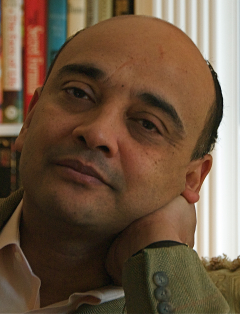
[00:00:00] JOHN CAMPBELL:
Hello. Good afternoon. I’m John Campbell, a philosophy professor here at Berkeley, and I’d like to welcome you to this rainy, windswept Howison lecture.
George Howison was born in eighteen thirty-four. He really entered academic life as a mathematics professor at the University of Washington at St. Louis. Um, is this not loud enough?
Okay. Um,
(microphone thumping)
Hello?
(laughter)
Okay. Um- Uh, so he began his academic life as a mathematics professor, but in St. Louis, he joined a group who were reading Hegel’s Phenomenology of Spirit, and, uh, this was a rather rambustious, larger-than-life collection of, um, academic characters.
Uh, the St. Louis Hegelians were a very vibrant force. Um, they were very engaged with and ultimately swept away by the emerging naturalism in American, uh, philosophy. But, um, Howison’s, uh, legacy was perhaps the most enduring of any of them.
He seems to have had Josiah R-Royce in particular as his nemesis. Howison wrote, \”The most depressing sign about Josiah Royce’s thinking is that he seems perfectly aware how this makes no provision either for immortality or for real freedom, and yet he appears to have no uneasiness under it, but to contemplate this ghastly destiny of ours with a complacency, say, even savoring of self-satisfaction. Um, Howison had a lot of gusto, I think.
Um, he became the holder of the first endowed chair in philosophy at Berkeley, and he built the philosophy department. He was evidently an influential and much-loved individual. And on his death, his friends and colleague, colleagues put together a fund that is funding today’s lecture, uh, to continue his work by bringing the most influential figures of the day to speak here.
And I think we really couldn’t have a better person to fill that role than Professor Kwame Anthony Appiah. He’s had many awards and honors. Um, a, a, a representative sample would be, for example, the National Humanities, um, Medal.
Uh, Forbes magazine put him on a list of the world’s seven most powerful thinkers. Um, this is not usually what happens to philosophy professors.
(laughter)
Um, i-i-in his many books, he’s challenged
(laughter)
and engaged with questions about identity and culture that matter to all of us every day. He said that we should live with fractured identities, engage in identity play, find solidarity, yes, but recognize contingency and above all, practice irony. In a memorable passage, he said, “The truth is that there are no races.
There is nothing in the world we can ask race to do for us. As we’ve seen, even the biologist’s notion has only limited uses, and the notion that underlies the more hateful racisms of the modern era refers to nothing in the world at all.” ” But he’s written across a very wide range of subjects.
His dissertation was in probabilistic semantics. His first two books were on philosophy of language. He’s written three novels.
It’s been an extraordinary career covering a panorama of topics. And today we’re privileged to hear, uh, the latest direction of his current work, which I, as, as I understand it, he’s opening up the topic of idealization. So his lecture today is called The Philosophy of As If.
Will you please join me in welcoming Professor Appiah?
(applause)
[00:04:17] KWAME ANTHONY APPIAH:
Thanks very much. Thank you.
(applause)
Um, thanks very much for that kind introduction. Imagine you were raised in a devout Swabian parsonage near Tübingen in the mid-19th century. That may be hard for some of you.
Uh, and grew up with great respect for the leading theologians of your age. Imagine, too, that you had the profoundest engagement with the ethical and aesthetic aspects of Christianity. Suppose, finally, that you became a serious student of Kant and Schopenhauer and Nietzsche, and that you moved, in part as a result, from theism to pantheism to agnosticism, while retaining your Christian ethical and aesthetic commitments.
Then, since like all educated men and women of your place and time, you were familiar with classical Greek and Roman ideas, you might come to feel, quote, “According to the customs of the cultured Greeks and Romans, one may regard and treat these myths as myths, and yet, or rather just because of this, continue to esteem such fictions for their ethical and aesthetic value.” This was pretty much what happened to Hans Vaihinger, the philosopher who wrote those words in his autobiographical essay, which preceded his nineteen eleven magnum opus, Die Philosophie des Als Ob, translated in nineteen twenty-four into English by C.K. Ogden as The Philosophy of As If. Vaihinger tells us there that he’d reached the view that theology was composed of what he called myths by his mid-twenties, about the time of his graduation from the University of Tübingen.
Over the next forty years, as a student of the history of mathematics and the physic- physical sciences, and while keeping up with the psychology of his day, Vaihinger came to apply the same strategy over and over again to one field after another, abandoning realism about a domain, atoms, infinitesimals, imaginary numbers, law, space, abstract objects, force, uh, economics, freedom, the idea of freedom, but maintaining what he called his esteem for the corresponding ideas because of their utility. And in explicitly connecting this strategy with the one that Kant had made famous in arguing that rational agency required us to act as if we were free, even though our theoretical understanding showed that we were governed by immutable laws, He claimed a Kantian ancestry for his ideas. Indeed, in the final section of the Philosophy of As If, Vaihinger records scores of places in Kant’s work where his great predecessor speaks of proceeding as if what is theoretically known to be false is true.
Vaihinger’s suggestion that large areas of our thought are fictions amounts to this. Very often we we can reasonably proceed as if what we know to be false were true because it’s useful for some purpose to do so. There are shades here of pragmatism, of course.
On the first page of the general introductory remarks on fictional constructs, Vaihinger wrote, “It must be remembered that the object of the world of ideas as a whole is not the portrayal of reality. This would be an utterly impossible task, but rather to provide an instrument for finding our way about more easily in the world.”” Vaihinger proposed, in essence, that an idealization is a useful fiction, or as he once put it, that fictions are errors, but fruitful errors. And for anyone interested in this powerful way of thinking about idealization, Vaihinger’s work is a treasure trove of interesting resources.
But there’s one way in which Vaihinger differs from at least one strand of pragmatism. He thinks that there’s a gap between what is true and what it is useful to believe. That’s why he asserts that most of our thought is fiction.
If you equated the true and the useful to believe, as people say some pragmatists do, then you would lose exactly the contrast that guided the philosophy of As If. And that book is the work of a modern philosopher who thought long and hard about this particular tangle of ideas and thought about its application over the widest range. Others may have gone deeper into idealization in one sphere or another, but Vaihinger is the first thinker I know of who defined clearly the issues I’d like to come to grips with.
Vaihinger’s notion of what he called a real fiction is, I think, in one way, quite surprising. A real fiction, he held, involved a thought that was not just false, but in some way contradictory, as he thought such useful ideas as the square root of a negative number or the atom were contradictory. On his view, when we understand the world as composed of atoms, remember we are in the physics and chemistry of the late nineteenth century, we’re supposing something that we know to be impossible.
Suppose, quote, “following Cauchy, Ampère, Seguin, and Moigno,” a cornet- a quartet of distinguished nineteenth-century physical scientists, “suppose we designate the atoms as centers without extension.” “The result,” he said, “turns out to be a very strange construction indeed.” ” For an entity without extension, that is at the same time a substantial bearer of forces, that is simply a combination of words with which no definite meaning can be connected.
Defining an atom as a point mass seems to require, among other things, for example, that it should be infinitely dense. What sense, Vaihinger makes one want to ask, can one make of that? Similarly, like many in his day, Vaihinger thought there was something simply contradictory in the conception of the imaginary number, which Gauss had made such successful use of in the early nineteenth century.
Vaihinger’s view is nicely articulated in a famous conversation in Robert Musil’s novel, Die Verwirrungen des Zöglings Törleß. There, he describes a conversation between Törleß, the protagonist, and a friend about imaginary numbers. Törless objects that, quote—this is my translation— you wouldn’t like to hear me read it in the German.
Um, Törless objects that, quote, “There is no such thing. Any number, whether it’s positive or negative, yields something positive when it’s squared, so there can’t be a bona fide number that’s the square root of something negative.” But Törless insists, what’s remarkable is precisely one can really do calculations with such imaginary or otherwise impossible values and end up with a tangible result.
Or, as Vaihinger puts it in one of his characteristic paradoxes, the concept in question is contradictory but necessary. Vaihinger contrasted these real fictions with what he called semi-fictions, where the concepts, quote, “Only contradict reality as given or deviate from it, but are not in themselves contradictory.” One clear example he gives would be Adam Smith’s rational egoism, which Vaihinger understands as an assumption that Smith knew to be false, but which nevertheless allowed the Scottish philosopher to construct a useful predictive economics.
Quote, “The empirical manifestations of human actions are so excessively complicated that they present almost insuperable obstacles when we try to understand them theoretically and reduce them to causal factors.” For the construction of his system of political economy, I’m still– this is still Vaihinger, it was essential for Adam Smith to interpret human activity causally. With unerring instinct, he realized that the main cause lay in egoism, and he formulated his assumption in such a way that all human actions, and particularly those of a business or politico-economical could be looked upon as if their driving force lay in one factor, egoism.
Thus, all subsidiary causes and partially conditional factors such as goodwill, habit, and so forth, are here neglected. With the aid of this abstract cause, Adam Smith cons– succeeded in bringing the whole of political economy into an ordered system. Nevertheless, Vaihinger went on to argue, these, quote, provisional assumptions are, or at least should be, accompanied by the consciousness that they do not correspond to reality, and that they deliberately substitute a fraction of reality for the complete range of causes and effects.
Now, the difficulty with Vaihinger’s idea of the contradictory fiction of a model that’s literally inconsistent is obvious. It makes it very hard to understand how an idealization can be useful since, as we teach our students in introductory logic, if a theory is inconsistent, we can deduce from it anything at all. And a prediction that something will happen and that it won’t happen can’t surely be useful.
Indeed, it’s not really a prediction. Of course, one can construct paraconsistent logics in which the general thesis that from a contradiction anything follows fails. But I suspect that the way that many of our actual inconsistencies are actually corralled in is not by the implementation of a non-standard logic, but by what you might call functional isolation, so that in effect, we have a large set of families of beliefs, each of which we try to keep consistent, and these families aren’t usually brought together in deliberation, so the contradictions are, as it were, kept apart.
Uh, David Lewis, the philosopher, once exemplified this sort of thing in a nice way in a story about how he failed for a while to notice that he acted as if a certain street in Princeton was parallel to the railway track for some purposes and orthogonal to it for other purposes. Um, in Euclidean space, that’s not possible. Now, everybody has experiences of the inconsistency of such internal maps.
Now, some of our colleagues working in the philosophy of science have suggested that scientific explanations in contemporary physics do involve mathematically inconsistent theories, or to speak more carefully, involve the application at the same time of models that are inconsistent with each other, even if each of them is itself consistent. Actually using these theories involves, in effect then, knowing which lines of inference one should and which one should not follow. Nancy Cartwright, for example, has criticized what she calls the vending machine model of theories in which you feed in certain, I’m quoting, certain prescribed forms for the desired output.
It gurgitates for a while, then it drops out the sought-for representation, plonk, on the tray, fully formed as Athena from the brain of Zeus. Rather, she argues, the process involves knowing how to take advantage of the available formal resources to treat a specific phenomenon. If she’s right, then Vaihinger’s idea that our idea-
Our idealizations are contradictory may turn out, in a way, to be correct. But that’s because the understanding of the the world implicit in the scientific theory, the knowledge it delivers, is held not just in the abstract statement of the theory, but in the skill of applying it to certain standard cases, in particular– Sorry, in certain standard cases, in particular to what Cartwright calls ontological mach– not, sorry, nomological machines, where a nomological machine is, as she says, a fixed enough arrangement of components or factors with stable enough capacities that in the right sort of stable enough environment will, with repeated operation, give rise to the kind of regular behavior that we represent in our scientific laws. Uh, a nomological machine, uh, she gives the solar system as one example, is screened off enough from outside forces that we can make roughly reliable laws about its motions.
So the physicist’s knowledge is not held in the formal theory, which is one reason why its inconsistency should worry us less. Now, I don’t know enough about the relevant physics to evaluate many of these claims, but they surely do support the idea that Vaihinger was right about something important. You can’t refute the idea that our best theories are inconsistent by arguing that the world itself can’t be inconsistent unless you presuppose that our best theories aim only at truth.
There’s a point here of some importance, even though it may prove controversial. Once we grant that our models assume what is not so, the fact that another representation is inconsistent with a model we currently accept cannot by itself count against accepting it too. For we know, ex hypothesi, that we already have a picture that is untrue to how things strictly speaking are, And the success of our current model for some purpose or other cannot count against accepting another model that is inconsistent with it for at least two reasons.
One is that just because our theory, which is not strictly true, uh, succeeds to some degree for some purpose, We cannot infer that another theory inconsistent with it could not also succeed to more or less the same degree for the same purpose. And the other is that what is successful for some purposes may not be successful for others. The result is that Weingart can give us an explanation for why we might profit from mobilizing a set of theories that are inconsistent with one another.
Another of our– Vaihinger’s distinctions between what he called fictions and what he called hypotheses is surely uncontroversially helpful. Vaihinger’s point was that the very same claim, Adam Smith’s claim, say, that men are rational egoists, could be treated either as a fiction, a fruitful untruth, or as something whose actual truth remains an open possibility. And the- a good deal of Vaihinger’s argument amounts to saying that many theories that are offered as hypotheses need not be given up because some of their claims are known to be false, because we can continue with them, treating them now as fictions.
But if idealization is, as Vaihinger proposed, the question of useful untruths, there are now two questions to ask that are familiar from the discussions of pragmatist ideas about what it is useful to believe. First, useful for what? And second, if a falsehood is useful, isn’t there some truth in the vicinity that would be even more useful?
Why stick with the useful untruth? Won’t the truth always be better? Now, I’ll return to that second line of questioning in a moment, but for the moment, let’s stick with the first, useful– the first, useful for what?
One old line of thought here, it’s a thought almost as old as systematic philosophy in the West, is that utility means usefulness in saving the phenomena. A simplifying idealization is useful if it allows us to cover the past record and predict the future course of our experiences. But despite some passages that suggest this picture, I don’t think this is Vaihinger’s view.
What he thought, as I’ve essentially already pointed out, was that it was in controlling the world that thought proved itself useful, our representations proved themselves useful, and even though sensation is our only means of access to the world, thought’s object is not to manufacture or predict sensations, but to control the world that produces them. Vaihinger’s treatment has the great virtue that it responds. It regards questions about our everyday thinking about the world as continuous with our scientific thinking.
Both aim, he says, at controlling reality, both leave things out in order to make it practicable to represent the world we’re trying to control. So Vaihinger believes our representations are fundamentally tools that allow us to control the world. But why must they be idealized?
Let’s begin by examining a passage Vaihinger refers to in, once more, a nineteenth-century discussion of Adam Smith’s idealizations, which we’ve already been talking about. Um, uh, he’s quoting here Henry Thomas Buckle’s Introduction to the History of Civilization in England. “Adam Smith, in his Wealth of Nations, simplified the study of human nature by curtailing it of all its sympathy.”
“But,” he continued, “this most comprehensive thinker was careful in his theory of the moral sentiments to restore to human nature the quality of which the wealth of nations had deprived it. And thus, by establishing two different lines of argument, he embraced the whole subject. Now, Buckle is overreaching here, for the complete treatment would presumably include not just egoism and sympathy, but all the psychological factors relevant for explaining human behavior.
And as is clear from the passage I cited earlier, one of Vaihinger’s insights is that it’s precisely the difficulty of embracing the whole subject that makes idealization es-inescapable on his view. It’s the fact that the phenomena are inesc– excessively complicated that requires us to leave out some of the details. But to say that the complexity is excessive is to make a point not so much about the world as about our capacity to understand it.
The complexities exceed our cognitive capacity to encompass them, and this is a fact as much about us as about them. Suppose, for example, that the quantum theory were precisely true. In– Sorry, that may stretch your imaginative capacities.
Uh, it certainly stretches mine. In principle, I suppose that would allow us to write a precise equation for each of the atoms in a baseball. To describe the baseball, we would then have to solve a system of the order of something like ten to the twenty-six equations.
Yeah. No human being, I suggest, knows how to do this. No machine exists that could do it either.
And even if there were such a machine, what on earth use would it be to us? If the utility of scientific fiction derives from the excessive complexity of the world, that is, from the fact that its complexity exceeds our cognitive capacities, the utility of religious myth for Vaihinger seems to come from somewhere else. He pronounces himself here a disciple of Friedrich Lange, who had articulated a standpoint of the ideal that permits a metaphysical atheist nevertheless to hold on to religion as myth because of what he calls the ethical efficacy of religious language.
Vaihinger did not think atheists couldn’t have moral ideas. He did not think that if God was dead, everything was permitted. But he did think that we’re more likely to be able to live by our ideals if we express them poetically, as it were, in religious language.
This is meant, so far as I can see, as an empirical claim, and I’m not going to canvass the evidence for or against it here. Uh, Richard Braithwaite, one of my earliest teachers in philosophy, argued later that one could understand and adopt religious belief without an appeal to theology. In effect, he thought one could treat the creed he recited on Sundays explicitly as fiction.
And Vaihinger’s treatment, uh, strategy of argument shows that the utility of fictions can be conceived not only in their power to aid us in manipulating the world outside us, but also in their capacity to help us manage ourselves. His thought, like Kant’s thought about the inevitability of the idea of freedom in the world of the understanding, is that we can grasp theoretically that the ideas we’re using are false, while still finding them practically useful, indeed inescapable. So suppose with Vaihinger that useful means useful for managing the world, including sometimes ourselves.
Then there’s a puzzle about how we can make good predictions by leaving stuff out. Wigner’s answer, I think– first answer, I think, can be twofold. First, sometimes leaving stuff out makes too little difference to matter for the purpose at hand, as when we use the Newtonian rather than Einsteinian mechanics in building a bridge.
This is a very familiar thought, and the example is a familiar example. But Vaihinger also thought, uh, thought the question had a second more interesting answer. Sometimes our idealizations allow us to get things right because we proceed, as it were, in two steps.
First, ignoring a range of phenomena in order to build a model of a world without them, and then once we’ve grasped how that model works, adding more and more of the world gradually back in. As he puts it, if, in fictions, thought contradicts reality, or if it even contradicts itself, and in spite of this questionable procedure, it nevertheless succeeds in corresponding to reality, then, and this is a necessary inference, this deviation must have been corrected, and the contradiction must have been made good. Now, Vaihinger was in the end something of an instrumentalist about theory.
He focused, as we’ve seen, on the role of our theories in controlling the world. But this line of thinking, advocated here, might suggest another view in which we take the role of the idealized model as helping us not just or not even to predict or control the world, but to understand it. That is a really important idea, I think.
I have only time here, however, to note it and march on. And, you know, when I finish the book on this topic, I will say more about that question, but I want to mark it here as an important possibility. Because I wanted now to discuss a second, more recent philosopher, first, because his work can be taken as a case study of Vaihinger’s philosophy of the as-if, and second, because in the course of thinking about his proposals, we can come to see the power of Vaihinger’s picture in framing our understanding of idealization.
Uh, the philosopher I have in mind is Daniel Dennett, who has urged us to adopt what he calls the intentional stance to many things, ourselves among them, and to adopt the design stance to many things, too, ourselves included as well. To adopt the intentional stance towards something is to treat it or her as if she were a rational agent with beliefs and desires, the beliefs and desires it ought to have, given its place in the world and its purpose, and then to predict what this rational agent will do in order to further its goals. Similarly, to adopt the design stance towards organisms and the things they produce is to treat them as if they were designed to perform certain functions, and this can allow us to predict what they will do.
Just as we explain what it is to be an intentional system by specifying the intentional stance, so we can say what it is to have a certain function by adopting the design stance, by treating something as if it had been made by a designer with certain aims. In each case, adopting a stance of this sort involves treating something as if something were so, as if it had internal states of belief and desire, as if it were the product of intentional design. So Dennett, too, as I say, is a philosopher of the as if.
I’ve been arguing with Vaihinger that we do this a whole lot in many domains. Dennett agrees. But that this is what we are doing leads naturally back to the question why it works.
If it works, I’ve suggested we have reason to go along with it, even perhaps at the price of inconsistency. That is what Nancy Cartwright taught me about much physics. It’s what Vaihinger taught, thought about theology, number theory, physics, and economics.
It’s what Braithwaite thought about religious language. But showing that it does work– does work doesn’t explain why. Yeah.
Cartwright believes that it works because our theories latch on to what she calls the real capacities of much of the world. As far as I know, she’s right, but I want now to explore the question why idealization works by thinking through some of Daniel Dennett’s insistence on the importance of the as-if, uh, in the case of the mind. Now, Dennett cla– De-Dennett claims, at least sometimes, that beliefs– but I’ve already given you a reason for not worrying too much about inconsistencies, so I won’t point out that on other occasions he says the opposite.
Um, Dennett claims that beliefs and desires are real states of people, the states, in fact, which make it possible for us to predict what they will do by adopting the intentional strategy. Quote, “To a first approximation,” the intentional strategy consists of treating the object whose behavior you want to predict as a rational agent with beliefs and desires and other mental states exhibiting what Brentano and others call intentionality. To do this, you must figure out what beliefs and desires the agent ought to have, given its place in the world and its purposes.
Then you figure out what desires it ought to have on the same considerations, and finally, you predict what this rational agent will act– that the rational agent will act to further its goals in the light of its beliefs and desires. The agent, therefore, must be reasonable in two ways. It must first form its beliefs and desires in ways that are reasonable, and second, it must perform the acts that are reasonable given those beliefs and desires.
This is what it is to adopt the intentional stance towards it. What it is finally to have beliefs and desires is to be, and I quote, “an intentional system,” a system whose behavior is reliably and voluminously predictable via the intentional strategy.” Now, here’s a question.
Does it matter why the agent’s behavior is predictable in this way? If I have beliefs and desires, and I’m rational, the reason the intentional strategy of treating me as a rational agent works is, well, that I’m a rational agent with beliefs and desires. It works because it treats me as what I am.
If the intentional strategy works with something that doesn’t have both beliefs and desires and behave rationally on the one hand, the success of those, uh, reliable and voluminous predictions might seem to be just a mystery. But Dennett serves up an example that’s supposed to show why the success of the intentional stance can in fact be quite unmysterious. Consider, he suggests, a computer chess program and ask yourself how to predict what it will do.
Reading the program, or worse, looking at the transistors of the computer that is implementing it, isn’t going to be much help. It would take you too long to read and understand the program, at least if it’s any good. A much better way to predict what will move, uh, what moves it will make is to ask yourself this question: What would a reasonable person who knows the rules and the aim of chess do, faced with this board?
You’d figure the computer knows how to play chess, wants to win, and will act accordingly. You would, in short, adopt the intentional stance. You would do pretty much exactly what you would do if you were trying to predict the moves that a person would make.
The reason—the reason this will usually work, of course, is that this is what the computer was designed to do. It is meant to make the best move that it can. The better the design, the more likely it is that the intentional strategy will work, though, and again, of course, if it’s really well designed, it will see more possibilities and opportunities than most of us mortals, and so we will get our predictions wrong.
We may understand looking backwards why it did what it did, but we won’t be able to predict it because it’s better at chess than we are. Predicting the moves of Deep Blue, the program that beat Garry Kasparov in nineteen ninety-seven, is something only possible for the grandest of grandmasters. Now, the scare quotes around knows, knows how, wants and sees in some of Dennett’s writings about this topic draw attention to the fact that most of us, in adopting the intentional stance towards the computer, and let’s admit it, we all do that often, uh, that we nevertheless take talks of beliefs and desires to be figurative, not literal.
A façon de parler where we are clear that our mode is a kind of fiction. With humans, on the other hand, we take it literally, and also with many other animals. I think the sheep on our farm know that we’ll feed them.
They don’t just know it. And you probably have analogous thoughts about your dog. Dennett tells us that we should simply postpone the question of whether it really has a mind.
Unfortunately, there are reasons to worry about whether any actual thing really has a mind on Dennett’s view. Here’s why. You and I are supposed to be intentional systems.
We can be reliably predicted by approaching us with the intentional stance, so we meet one of Dennett’s criteria. But neither you nor I is fully rational. Indeed, that we are going to do irrational things is equally voluminously predictable.
So it remains a bit of a mystery why the intentional strategy succeeds with us on the occasions where it does. Dennett does not, I think, stress sufficiently the fact that the strategy also fails a great deal. This is in part because the sort of rationality in question is extremely demanding.
It involves having all the beliefs and desires we ought to have and acting only as we ought to act given them. And the evident fact that many people don’t believe what they ought to, that the president was born in Hawaii, for example, or desire what they should, to abstain from smoking, for example, is one reason why the strategy is not guaranteed to succeed. So if you have to be fully rational to have beliefs and desires, then so it seems to me, I don’t have beliefs and desires, and not to put too fine a point upon it, nor do you.
Now, Dennett has an answer to the question why the intentional strategy works as often as it does. He thinks we were designed by evolution to work this way. And so, as you see, unlike many naturalistic philosophers, he thinks there is nothing wrong in speaking of organisms or their parts as designed by evolution to do things.
This makes sense to him because, as I said, he thinks that just as we can adopt the intentional strategy towards people and animals and computers, we can adopt the design stance towards organisms and the things they produce. We can treat them as if they were designed to perform certain functions, and this can allow us to predict, again, reliably and voluminously, what they will do. Once you know what an alarm clock or a chainsaw is for, You know what it can do.
So too for a kidney or a heart. Here again, Dennett doesn’t think it helpful to distinguish between what was really designed by a capital D designer, as it were, and what is merely predictable once we adopt the design stance. In the history of philosophy, many things have been called pragmatism, but one central candidate for the name is the thought that our theories are to be evaluated by what they enable us to do.
So you might think that Dennett is here operating in this good American philosophical tradition. If the intentional stance enables us to predict the behavior of a computer, why not just accept that it has beliefs and desires and reasons? But that is not what he actually says.
What he proposes instead is that in the cases where the intentional stance is a rewarding strategy, yielding a budget of useful predictions allowing us to manipulate the world to our advantage, shades thereof. Again, we should say not that the thing has beliefs, but that it sorta has beliefs. Then its use of the cozy word sorter, he pokes fun at the style of analytic philosophy by insisting on calling it the sorter operator, is one of the more interesting things in his recent philosophical writings.
Dennett uses this operator in two crucial ways. First, to talk about anything to which we can productively apply the intentional stance. If the strategy works, then the thing sorta believes or desires.
Second, in the context of evolution, to talk about the relationship between species and their ancestors. Before there were bacteria, he writes, there were sorta bacteria, and before there were mammals, there were sorta mammals, and before there were dogs, there were sorta dogs, and so on. It is easy to see one way in which these two uses are connected, for among the things that sorta believed were some of our sorta ancestors.
Beliefs came into being gradually through an evolutionary process, and there’s no exact moment when suddenly, hey presto, full-fledged belief appeared, just as there’s no exact moment when the first mammal was born. There is no principled line, Dennett writes, above which true comprehension is to be found. Now, as I say, like many of his ideas, I think this one is extremely interesting, but is also, I think, and also typically, a little mysterious.
And the mystery just is the mystery of why idealization is a good strategy here, why it so often works. So I want to try and unpack this mystery a little further. In particular, let’s no longer postpone the question whether anything has an act– any actual beliefs.
Adopting the intentional stance involves applying a rather elaborate theory to predict something’s behavior. You treat the putative agent as having beliefs and desires ascribed to it by supposing it believes and desires what it’s reasonable for it to believe and to desire. And then you predict that it will do what it would be reasonable to do, granted that it has those internal states.
A creature that always had the rationally required states and did the rationally required thing, let’s call it a cognitive angel, would always respond as the intentional stance requires. Its states would be full-fledged beliefs and desires, no sorta about it. But there are no cognitive angels.
So in the actual world, every belief is a belief, a sorta belief, and every desire is a sorta desire. No doubt some creatures in our actual world are closer to cognitive angels than others, in the sense that they will more often do in the circumstances of the actual world what a cognitive angel would have done. You and I are no doubt closer to a cognitive angel than your dog.
Well, at least you are. Your dog is presumably closer than an ant. An ant does a better cognitive job than an amoeba.
Maybe an amoeba does such a, a terrible job that the intentional strategy with it is a complete waste of time. In sum, the strategy of prediction, the strategy we use to make sense of the behavior of all the things we can usefully treat as intentional systems, is to apply an idealized model, knowing that just because it is idealized, it won’t always get things right. To say that something sorta believes is to say that the idealized model works for it well enough to be getting along with.
If it worked perfectly, it would be just plain true that we believe. If it works badly enough, it’s plain false. In between is the vaguely delineated world of the sorta true.
Now, I doubt that Dennett would accept this picture of his proposal. As Robert’s Rules of Order rightly insist, there is no such thing as a friendly amendment. Still, looking at it this way helps us to see that the right answer to the question whether anything at all has a mind might be sorta.
But being sorta true is not, alas, a way of being true, it is a special way of being false. And though it’s easy to see why a true story might make the right predictions, again, why should a false one? And so we’re brought back to the question whether the fact that we approximate a rational creature isn’t something of a mystery.
Dennett thinks it isn’t, because he thinks we can understand through evolutionary theory how they came to be creatures like us. And at the heart of this understanding is a claim he first made a long time ago, at least as far back as Elbow Room, his book on freedom of the will. The world, he thinks, is full of, quote, “free-floating rationales, reasons why creatures do what they do even though they don’t know that that is why they do them.”
Squirrels bury nuts, which they will be able to eat in the winter. They don’t know this when they bury them, but still, that’s the reason why they do it. They have purposes, as he says, but they don’t need to know them.
The need to know principle reigns in the biosphere, and natural ex- sexual selection itself doesn’t need to know what it’s doing. Dennett thinks that evolution has endowed us, on the other hand, with the capacity not just to have, but also to know our purposes, and a proper evolutionary account of how we came to be sort of agents with sort of beliefs and sort of desires and sort of intentions will make it less mysterious, he thinks, that we respond to reason’s demands. But notice that the explanation here of why the intentional strategy works for us, in essence, is that the design stance shows us why we have come to be intentional systems.
And what does that mean? Well, that it is as if we were designed to have intentional states. But the mystery of why we can be managed by an intentional systems approach is not explained by saying that it is as if we were designed to work intentionally.
It would only be explained if we were designed to work intentionally. We have just replaced one mystery with another. It is impasses such as these that lead people to want to say that the fact that we can be predicted and controlled in these ways shows that there is an underlying truth that the theory captures.
That’s why Dennett in some moods says we do have beliefs and desires. Ian Hacking has suggested that what gives us reason to be a realist about things like positrons is that we can manipulate them, intervening in the world on the basis of our beliefs about them. Once, he tells us, when he was discussing a physics experiment with a friend, he asked how you alter the charge on a niobium ball.
“Well, at that stage,” said my friend, “we spray it with positrons to increase the charge, or with electrons to decrease the charge.” Hacking’s response: “From that day forth, I’ve been a scientific realist.” “So far as I’m concerned, if you can spray them, they’re real.”
And notice that like Bacon, his thought is not about saving the phenomena, but about managing the world. He’s on Bacon’s side here. Now, Nancy Cartwright, it seems odd to mention them both regularly without mentioning that they were once married to one another, but I won’t.
Nancy Cartwright, as I just pointed out, thinks that the success of the strategies of physics gives us reason to believe in the capacities our physical laws adumbrate imprecisely. She has a book called How the Laws of Physics Lie. What better reason, we might ask, by parity of reasoning, could there be than the successes of the intentional strategy for believing in the intentional states?
Well, here’s a better reason. Uh, it– we’d have a better reason if the theory didn’t get so much wrong. In particular, if it didn’t treat us as rational in ways we already know we’re not, and predict that we’ll do things that we don’t do.
Now, on each trip of explanation, every– I’m sorry, on each trip, every train of explanation comes to its last stop. Unless you think the whole world is the working out of conceptual necessities, you will have to accept that there are some brute empirical truths. And for the moment, I’m inclined to think that the fact that the intentional strategy works to the extent that it does is, in that way, brute.
Evolution apparently equipped us with the intentional strategy, and it was built in, uh, but it was, sorry, it was built into us. I seem to have lost the page here. Presumably because it was adaptive.
But it seems to me that it’s not at all clear yet why it is adaptive, what features of it led to its selection, and the hypothesis that we really have states that are like beliefs and desires is only one candidate explanation. Now, pace the Churchlands, you can’t really doubt that you yourself have beliefs and desires. It’s hard realistically to doubt that other people have them, except in the skeptical or paranoid frame of mind that can have you doubting that anything at all is really as it seems.
But it could be true, even if you were wrong. Pace Descartes, what cannot be doubted need not be true. The idealization– that idealization sort of works then is in many cases just something that turns out to be simply true.
There is in any case a reason to doubt whether the question I’m asking is a fair one. You cannot ask seriously why our idealizations work for us, except from the point of view of a picture of the world that includes both us and our idealizations. The picture that is in that sense, uh, Sorry.
Better, uh, than the one that we actually currently have. Uh, so that it seems to me that there’s just a reasonable thing we can say, which is that we cannot do anything from the point of view of a theory we don’t have. If the question is how to understand the fact that our idealizations work, we have to understand that question against the background of a picture, and the picture has to be one which includes both us and our idealizations.
And if it’s going to be very interesting, it had better be a better theory than the one we’ve currently got. But we can’t do anything from the point of a theory that we haven’t got. And if that’s right, this sort of idealization will only be possible, as it were, in the rearview mirror.
And that’s should lead us to revisit Weingard’s explanation as to why idealization is necessary. The question whether the complexity for us of the world explains our need for idealization requires us to have a picture of our own relation to the world. If the only picture we have of the world and of ourselves is an idealized one, we have no strictly and totally true theory with which to approach this question.
We can try to answer it with these useful false theories, but they will, ex hypothesi, represent the world as simpler than it is. So once more, it will only be from the point of view of theories that are better than ours that our question can be asked. So we can look back to Newtonian physics and ask why it worked well enough in the circumstances of our world, even though it ignored complexities of which it was unaware.
And we can see from where we stand now that it would have been very difficult with the tools, both experimental and theoretical, that the Newtonians mobilized to represent these post-Newtonian complexities. I’m inclined to think that the question I have been trying to get Dennett to answer only makes sense as a question we will ask later, looking backwards at our present selves, and only then because we will suppose that our later theories are better. If that is right, then here, as elsewhere, in Hegel’s justly famous phrase, “The owl of Minerva flies at dusk.”
Thank you. Mm
(applause and cheering)
[00:49:16] JOHN CAMPBELL:
We’ll now have ten to fifteen minutes for questions from the audience. So given the, the size of this massive auditorium, um, if you have a question, could you please come to the front and, uh, use the mic?
[00:49:29] SPEAKER 4:
Um, it’s also required for our taping. Thank you.
[00:49:43] KWAME ANTHONY APPIAH:
I’m always delighted.
[00:49:47] JOHN CAMPBELL:
So you raise your questions in the following manner.
[00:49:51] KWAME ANTHONY APPIAH:
Um
(laughter)
[00:49:54] JOHN CAMPBELL:
I guess I’d like to ask about the, um, uh, the idea, the idea that common sense psychology involves this idealization of rationality. And I, I guess what I wonder is, isn’t it just a mistake Dennett makes to say that we, we actually use an idealization of rationality? I suppose I own a casino, and I’m-
Mm trying to set up the casino. I want to make a lot of money from this. Um, then idealizing that my patrons have ra- complete rationality is, is going to make life very difficult for me.
Um, what I need actually is a very good understanding of all the ways in which they’re irrational. I mean, I could be exhibiting my grasp of folk psychology. Um, I could be the apotheo- apotheosis of a skilled folk psychologist working with my clients’ irrationalities.
I don’t need an idealization of rationality here. So it may be true that sometimes we assume that people will get the easy things right, but if you’re good at interpersonal relations, that may involve you often assuming that they’re going to get stuff wrong.
[00:51:00] KWAME ANTHONY APPIAH:
Good. So, um, I think that’s– I mean, I agree with what you just said.
Uh, I think that, um, our capacity to understand other people, to predict them, to respond to them, uh, depends upon, uh, our knowing some truths about, uh, the ways in which we characteristically deviate from all sorts of forms of rationality. Uh, this is a truth that even economists have finally discovered. So, um, But the question is–
But I don’t think that that shows, I think that that shows that Dennett’s sort of put it in the wrong way. I don’t think it shows that he’s clearly wrong. Um, and this is– this relates to the question that I put aside for the book about, about the role of these idealized models in understanding things as opposed to in just i-in prediction.
Um, we, we would like an account– Well, philosophers anyway, would like an account of what beliefs are. And it seems to me very hard to give an account of what beliefs are in a way that ignores certain norms about, as it were, how beliefs are supposed to operate. Um, so we do have in, in our conception of what the states are that we’re ascribing to people, uh, we have in, not just in philosophy, but in ordinary life, notions about what, as you said, in the obvious case, it would be, um, reasonable, uh, for a person to believe, what it would be reasonable for them to do given what we think they believe and desire, and so on.
Now, we also have, again in common sense, a bunch of ideas about things that are obstacles to carrying out the, the, uh, the, the re- the required, uh, thing. Uh, we know that there are systematic ways in which people make failures of reasoning. We know that, for example, forming beliefs about yourself is especially difficult because you’re–
you have– you– we’re designed to have an interest in representing ourselves as better than we are. There are lots of things we know informally, uh, about, about that, but it’s still the case that those are explanations about that attend to beliefs as things which, in the absence of those things, uh, would behave in the way that reason requires. So when you’re dealing with your, uh, when you’re building your casino, uh, when you’re managing your casino, um, you have to treat people both as, uh, for many purposes, as doing what their beliefs and desires require them to do.
They want to play the game, uh, they’ll be willing to give you money, uh, in, in exchange for trips, and so on. Uh, all these things involve treating them as having believ– desires and beliefs that are working in the correct way. But then as you say, um, you, you will, uh, um, you will require, if your casino’s gonna make any money, you will require them to make bets that they ought not to make.
And, um, and you know some things as a casino operator about what will make them do that. Um, for example, we know that however irrational, however clearly un-false it is, people think that they, that they can be on a winning streak. So we should be attentive to people who’ve won a few things and encourage them to bet more.
That’s one of the things we know. Even though, um, a properly scientifically and rationally trained person will know that that’s the very moment that you should realize that you’re subject to a, a very characteristic human delusion. So, but in that case, again, we’re understanding the state, uh, that, that they’re the, the, the thing they’re doing that’s a deviation from what’s reasonable in terms of what it would be like for them to do the reasonable thing, and where we have an explanation for the deviation.
So I think it’s actually not in, I really think that it’s not actually in predicting people, which is anyway something we don’t do a lot of that, if you think about it. I mean, not individuals. We, we do.
But, but in general, uh, we re– we rely on people, but that’s different from predicting them. O-one reason why I know, I knew that you would come and fetch me from the hotel, it wasn’t a prediction, it wasn’t any elaborate theoretical prediction. You’d said you would, and I trusted you, right?
And you did. And that’s a normal thing in human affairs. Um, I didn’t need to know anything very much about the rest of your internal states to make that, uh, to rely on you in that way.
No, nothing elaborate. If you hadn’t come, I would have entertained hypotheses, and they would have been hypotheses s-that assumed you had some of the normal desires and beliefs. I would assume that something, something– you might have had a problem in your family.
I mean, there are lots of things that I would have guessed might have happened. Um, and all of those, again, those guesses would be guided by the thought, well, what would a person– what should a person with these beliefs and desires do? So we’d be back with the, with the sort of rational thing.
But these would be– Uh, this is to do with how we understand one another, not how we predict one another. And I don’t– In general, well, here’s something I know because the general theory, as Dennett rightly insists, is holistic. Um, I couldn’t possibly know all the things that could be relevant to what you’re going to do.
Because anything, any proposition at all could come to be relevant to what you’re going to do. pr– If you came to believe about that proposition that if it were true, you would gain something by doing certain actions.
And given the ways in which people can come to have beliefs, which include not just looking at things, but being told things, pretty much anything can come to occupy that position. I can end up caring about where the nearest star is because there’s a bet available, right? And if I guess– if I get the right answer, I get, you know, I get a hundred dollars.
Uh, so and– So, uh, because of the the elaborate holism, the elaborate and rational holism, right? The, the, it’s, uh, if this bet is available, it’s reasonable for you to take it if you think you know the answer, right? Uh, but I don’t know which of these things you know.
I don’t know actually, uh, in very great detail, a lot about my own beliefs and desires, and I have some access to them. Certainly don’t know about even the people I love and know most dearly. So I think focusing on the sort of prediction side is actually not, uh…
I think focusing on understanding and the, the way, again, this is a bit of a different kind of Owl of Minerva point, that it’s, it’s looking backwards at action very often that rationality and irrationality come into play. But as I say, I think in order to, uh, understand the cases which are not rational, we, we start by thinking of the states that we’re invoking as if, uh, uh, we understand them through what it would be for them to operate rationally correctly. I think that’s right.
But it’s different from what Dennett says.
[00:58:11] AUDIENCE MEMBER:
Thanks for the talk. Um, I wanted to ask you about the thing you didn’t want to talk about yet, so understanding. Yes.
That seemed to me to, uh, like, be in between the two things you discussed that, uh, we’re seeking in, uh, trying to explain things. On the one hand, we’re trying to discover truths, uh, and so this, uh, case where we have, uh, an idealization where we only act as if it’s true really fails in that regard. And then we might have this other thing which is, like, pragmatic, uh, or useful.
We can use it to manipulate the world or something. But it seemed to me that understanding was a kind of, like, epistemic middle ground between those two things. It’s not just a brute fact that acting in this way allows us to, like, get something in a kind of vulgar way.
Uh, and it’s not that it’s true necessarily, but we gain some other important epistemic good, namely like coming to understand the world we live in in a better way, and that’s like a really important part of the scientific enterprise. And so, yeah, that would seem like the natural way to go in trying to understand why we do this thing where we pretend as if something’s true when we really know that it’s not. And so,
yeah, I just want to hear what you have to say about that.
[00:59:27] KWAME ANTHONY APPIAH:
Well, um, so it’s a bit… I agree with what you said. Uh, uh, and, um, it– the, the– but the only sort of, uh, I think to make sense of it, one has to tell a big story about something, about understanding something, and I, I don’t have the memory or the…
I’ve got it written down somewhere for one case. Um, but I, basically, I think, uh, there is this… So let me just say something about it, but it won’t probably seem very satisfactory.
Um. I, I think at the heart of this is, uh, something that, we were saying this to each other at lunch, something that’s a, a very important part of our natural, uh, history, which is our capacity for make-believe. Um, you do not have to teach children make-believe.
This is a point that Kendall Walton has made very eloquently. Children spontaneously treat uh, Lumps of mud as cakes,
(clears throat)
uh, your cell phone as a motorcar, and so on. They, they spontaneously know that we don’t teach, we don’t teach pretending to children. Children know how to pretend.
They come knowing how to pretend, basically, and they do it all the time. And it’s, uh, Walton has argued that this is at the heart of fiction, that, that, that, that, that what happens to, to children’s make-believe is that it grows up and becomes the novel and movies, and so on. I think that’s a plausible view, though people in literary studies don’t always like it.
Um, so, um, that is a very hard thing to understand what we’re doing there. Uh, I mean, um, I wanted to make the point both that we all know how to do it. We all did it without anyone telling us how to do it.
We understand it perfectly well in one way. But actually, what’s– it’s really weird what’s going on there when the child goes, you know.
Because, mm, for example, i-if you put your hand up, the child has to decide whether to treat that as an accident or are you interfering with the game, and it does. one or other of those things, and it knows that they’re different. Um, So we know from children how to treat a collection, an ensemble of objects as if they were some other things, and we know what the boundaries are of that.
We know that it isn’t really a cake, the, the mud pie. Uh, we know that certain moves with the mud count as serving the pie– serving the cake, and others count as, uh, changing the subject, doing something else, stopping the game. W–
Um, so I think it’s… And that’s essentially in grown-up form. I think a lot of theorizing is like that, only, only perhaps we don’t–
Perhaps we’re less clear when we’re doing theorizing that that’s what we’re doing. We’re understanding… I mean, what are children doing in this case?
They’re, they’re learning how the world works. They’re learning to understand the world. Uh, they are actually picking up on genuine features of the world as they play these games, and we are picking up on–
That’s the point about capacities in the Cartwright account of why theories that are strictly speaking inconsistent and therefore couldn’t be true, can nevertheless help us understand things. But it’s a bit mysterious how that works, I think. I, you can say, perhaps we should say, look, what’s going on here is made possible by our access to possibilities, to the fact that we can understand, um, so that what’s going on is that we have this amazing capacity to understand what it would be for the world to be a certain way that it isn’t, and we understand the way that the world is in terms of pictures of the way of ways it might have been, though it isn’t.
Um, I think that’s true. I don’t know how deeply explanatory it is to say that, but it is to say, I think that sort of Possibilities and, maybe you don’t like possible worlds, but possibilities are key to this, that understanding things involves understanding their possibilities, their capacities, what they, what they would do. So take the simplest case of an idealization, the kind of Galilean story about the, the ball moving down the inclined plane.
We tell a story in which we understand– we imagine a world in which there’s no friction. There is no such world. There is no actual world.
There is no place in the world with that. Well, actually, there is now with superconductors, but anyway, forget about that. There are no actual inclined planes with balls on them with no friction.
We get the story, as it were, exactly right for a world with no fric- with no friction. Only that isn’t this world. It’s this other world that we know how to imagine.
And I think that capacity, which we display from the very beginning as children in our make-believe, is the one that is key to sort of unpacking all this.
[01:04:33] JOHN CAMPBELL:
Okay, thanks.
[01:04:37] AUDIENCE MEMBER:
So it sounds like you’re saying essentially that philosophical systems are like toys, like they’re partial without our pretending that they are something or another. And in internet and youth culture, there’s another operator, the kinda.
(laughter)
So the kinda and the sorta, are you suggesting that they are more accurate or more valid or more precise in a way than the definitive clauses?
[01:05:01] KWAME ANTHONY APPIAH:
Well,
(clears throat)
one thing I suppose I would be inclined to say is that, uh, I– there are very few things that I know are true, but there are lots of things that I know are sorta true. Uh, so, uh, so very often, if I say something’s sort of the case, I’m saying something that I’m, as it were, confident of precisely because it’s a little bit inchoate. If you ask me for a choate thing, I wouldn’t know which choate thing to pick from the many inchoate things that that sort of, uh, covers as possibilities.
Um, I do think that what this view suggests, and I didn’t say this, but I mean, is that, um, we have, basically, I think we have lots of pictures of the world, lots of representations of the world, and th- and, and they’re good for, you know, some of them are good for nothing, and so we should abandon them altogether. But many of them are good for something, and our knowledge is held, our understanding of the world in a way, is held in these, all these partial pictures.
Uh, and each of them, uh, m-many of them we don’t know what’s wrong with them. That is, we don’t– they’re, as Vaihinger would say, hypotheses at the moment, not yet fictions. But many of them are fictions, and we’re still not going to abandon them.
Um, because just as, uh, you know, philosophers of science found it very hard to say that the, the, the– you could say the work of Paul Feyerabend is about this question. What’s– Why do we feel that there’s still some truth in the Newtonian story after we’ve learnt the Einsteinian story, right? Surely the Einsteinian story just shows the Newtonian story was wrong.
Well, yeah, but don’t we think that the Newtonian story is better than, than medieval impetus theory? Yes. But what does that mean?
Better, In the light of what? For what purposes? Uh, I, I think it’s hard to say, and one of the things that I think reading van Fraassen has made me think about is that, um, as I said, you know, useful means useful for some purpose.
I think it’s often very unclear what the purposes are with which we mobilize our representations. He says controlling the world, that is one of them. But as I said, understanding the world is another, and that’s le– a great deal less clear what the criteria of success and failure are.
In controlling the world, we succeed if we sort of get what we wanted.
(breath)
Understanding, it’s less clear to me that we have sort of a solid picture. So I would say that my, my sort of conclusion from all this is that, is that our understanding of the world is held in many incompatible pictures, and that there’s a reason to hold on to some pictures that are known to be wrong because the fact that they’re wrong doesn’t mean that they aren’t useful for some purpose, though it can be unclear what that purpose is. Thank you.
[01:08:22] JOHN CAMPBELL:
I would really like to ask you one more question, and I, I hope I may do that.
[01:08:26] KWAME ANTHONY APPIAH:
Mm-hmm.
[01:08:27] JOHN CAMPBELL:
Um, um, I wonder if you really need Dennett to frame the, the, the puzzle that interests you. I mean, there are two things in Dennett. One is there’s some kind of instrumentalism.
There’s a, a familiar pattern where there’s a lot of instrumentalism, and then there’s a lot of talk about how I’m not an instrumentalist. But it’s important. Suppose you were as u-uncompromising a realist as you like about the mental life.
I say consciousness, rationality, all that’s just there. It’s got nothing to do with reliable and voluminous prediction. It’s the only bit of the universe that really matters.
That’s what’s important to us, the mental life. Everything else only matters because of its connection to the mental life. And that’s not to be explained as instrumental for something else.
That’s just there, a bit of reality to be studied. Um, Now, even if you have such a view, which I take it is opposite to Dennett’s, um, your puzzle, it seems to me, you could still raise because it would still be true, it would be as true as it ever was at, uh, that, um, we are using rationality as an idealization in understanding this bit of the world. And your question will still be live.
How does that work? How can it be helpful to understand this bit of reality, um, when we just know that we’re not rational?
[01:09:45] KWAME ANTHONY APPIAH:
Mm-hmm. Um, so th-th-the as if comes in twice here. As if comes in, in, um, your picture of what the psychological life is.
I mean, one way of putting Dennett’s picture is to say, “You don’t really have a mind. It’s only as if you have a mind, um, and we can use that to predict. You don’t need that bit.
[01:10:03] JOHN CAMPBELL:
You, you, you, you want– We’ve got a mind, whatever that is, and we use this ideal, and we use this idealization of as if we were rational, and that’s the key thing.
[01:10:13] KWAME ANTHONY APPIAH:
Mm-hmm.
[01:10:14] JOHN CAMPBELL:
Is that right?
[01:10:15] KWAME ANTHONY APPIAH:
Is– I think, yes, the problem would still arise on that view. I’m a little bit interested in, uh, Dennett’s way of doing it because I’m interested in… I’m old enough to have grown up thinking there was an interesting problem of other minds.
[01:10:32] JOHN CAMPBELL:
Oh, me too. Yes.
[01:10:34] KWAME ANTHONY APPIAH:
Lots of people nowadays seem to think that there isn’t a very interesting problem of other minds. But, but, uh, and, and, uh, uh, and so I’m interested in, as it were, the reasons why we might think that other creatures, including ourselves, have minds. Uh, I mean, each other.
Uh, I agree that the reasons why I think I have a mind might be peculiar and distinctive, but I’m, uh– and, you know, mutatis mutandis obviously for you. But, um, but I, I, I, I guess I am interested in whether we can say how it is that it’s possible, given the fact that the way I know what I think is so different from the way that you know what you think, that I can know what you think. And this whole tradition that, uh, at the end of– which includes Wegner and Dennett, is sort of broadly empiricist in its attempt to understand the mind as not, not one’s own mind, but, but the minds of others, including other organisms than, than humans.
I think it’s, in a way, I know. Look, um, There’s no practical doubt in my mind about whether other people have minds, uh, particular other people have minds. I, I don’t…
Some people sometimes have a kind of moment when they… I, I don’t have that experience, but I do have that thought about some other animals. I, I have, as I mentioned, sheep.
Yes. I’m interested in the question: how sensible it is to think of them. It seems to be obvious that they have perceptions, but, but, um, so I’m not–
That’s not one of the things I’m, I’m not clear about. But I am unclear about how much one should say about them in terms of the language of belief– Yeah, desire. I, I don’t find myself tempted to think that they hope things, um,
But I, I, I think they have intentions at least sometimes, but I’m not sure. And in trying to decide what that worry amounts to, I think the sort of thing that Dennett is doing with the intentional stance is, is one of the kinds of answers. But I agree that for you and me, the question whether…
I’m not– I, I don’t understand the Churchland view that it might turn out-
[01:12:52] JOHN CAMPBELL:
Yeah. Yeah.
[01:12:54] KWAME ANTHONY APPIAH:
That it’s not that their view that it might could turn out that we don’t have minds, it’s their view that we could turn out to have minds that were sort of radically different from the way they appear to us to be. Um, uh, you know, I, I’m really interested in the sort of thing Charlie works on, which is the relationship between that story and the neurobiological stories. It’s not that I don’t think that’s an interesting question, but I don’t think of the neurobiological story as one that could force me to abandon this other story.
And I’m in part saying that because of the general view that I just suggested, which is that we need lots of stories that are doing different jobs for us. And I suppose I’m arguing that actually against our claims for the importance of the unity of knowledge. I’m arguing that our knowledge is held in many incompatible represent– systems of representation, and if we were God, maybe we could integrate them all.
Uh, if we were cognitive angels, we could integrate them all, but we’re not, and, and we never will be. So we’re always going to need lots of different pictures. And one of the pictures that I just don’t see how it, it would make sense for a human being to try to be without is this picture of ourselves as wanting things and hoping for things and desiring things and thinking things and, and, um, having reasons for doing and thinking and feeling things.
That seems to me, um, I just don’t know how I could do without or how we could do without.
[01:14:32] JOHN CAMPBELL:
Oh, oh, listen. Oh, pl-pl-please go on.
[01:14:38] KWAME ANTHONY APPIAH:
So I want to go back to two things that you said about make-believe and also about the final image about going off into the future. So from an empirical perspective, at least one account you might have about why kids are making believe is that one of the capacities we need to have to make cognitive progress is the capacity to say, “Here’s the belief that I hold now, here’s how it fits the data.” Here’s an alternative belief which I currently do not hold, which I am currently, currently don’t think is true.
I want to check how that fits the data. So I have some new set of data. I’ve done an experiment, AKA, you know, gotten into everything in my nursery, and-
And now I have a new bunch of data. I have a current belief. I check that belief against the data, but here’s an alternative belief that I’m gonna check against the data.
Mm-hmm. And if you don’t actually have the cognitive capacity to say, “Here’s an alternative belief. It’s false as of now, but if it were true, here’s what the consequences would be.
Here’s the data. How does that actually fit with the potential consequences? And the capacity to sometimes override and say, “Oh, look at that, the thing that I thought before was false and this thing is true,” then you wouldn’t be able to make the kind of cognitive progress that we actually make.
And from that perspective, what you’re doing when you’re making believe is essentially exercising this capacity to say, “Here’s a premise.” It’s important that I currently think that it’s false because I don’t want to get confused about my predictions, but I can think if it were true, that if this were true, then here’s what the consequences would be. So I think there’s a relationship between, And I think part of the reason why it seems plausible to have idealizations is because we, and as a matter of fact, also four-year-olds, know that the current belief might be susceptible to this kind of replacement by what at the moment is just the as-if, uh, is just the as-if beliefs.
So I think there’s a, there’s a connection between those two that actually makes sense out of why it is that we would en- be not only entertain as-ifs when we’re doing things like, like make-believe, but the sense in which we could say that we’re, where we know that the belief that we currently have is, is gonna turn out to be false, but we, it’s still useful and important for us to hold it. And it’s also important for us to hold the alternative, to be able to work with the alternative hypothesis as if it were true. Mm-hmm.
[01:17:04] AUDIENCE MEMBER:
(thud)
I,
[01:17:06] KWAME ANTHONY APPIAH:
um, I don’t know what to say except that that seems absolutely right to me. Uh, that seems absolutely right that it is. Though I would say one thing, which is that I think there’s a way, there’s a human way of doing this that is somewhat distinctive because, uh, um, because, because animals change, other animals change uh, change their beliefs too.
But I don’t think my sheep engage in kind of counterfactual, uh, reasoning. So I think that this capacity for counterfactual reasoning here means that we’re capable of a kind of knowledge development that is very distinctive and, and therefore especially important because it’s, it, it’s one of the reasons why we can do things cognitively that other organisms, as far as we know, can’t. And just for, for, for what it’s worth, like we have empirical, uh, relationships, empirical correlations between kids, between how much they’re capable of doing this kind of test and how good they
[01:18:03] AUDIENCE MEMBER:
I don’t think they are doing counterfactual
[01:18:04] KWAME ANTHONY APPIAH:
are at doing counterfactual reasoning in a
[01:18:05] AUDIENCE MEMBER:
reasoning and are not
[01:18:05] KWAME ANTHONY APPIAH:
non-counterfactual reasoning. good. And as, as you said, they’re, they’re conceptually connected. Yeah. Um, yes, I agree with that, and thank you. Um, yes.
[01:18:17] AUDIENCE MEMBER:
Yeah. Uh, just a brief, uh, observation about, um, about usefulness and context. I think this is in the spirit of the way you’re thinking about things.
But, you know, to say that, um, as, as if way of thinking about things is, uh, is view– useful is, you know, that’s something that might make sense or might be a plausible thing to say in some contexts, but not others. Uh, and, you know, a very natural way of dividing up context for some of these purposes is to, is to contrast, you know, the deliberative standpoint, uh, with a retrospective or explanatory or third personal standpoint. Good.
This is very natural in connection with this original Kantian idea that we, you know, that we act under the idea of freedom. You know, sort of like when you’re moving forward in life, there’s nothing you can really do with the thought that it’s all determined in advance. That’s not going to help you to, you know, decide what to eat for breakfast, right?
You’ve got to make up your mind and, um, within that context, it’s, um, it’s– there’s, there’s in some way no alternative but to assume that it’s up to us what we’re going to do. Uh, that, that same assumption when we look back at what people have done in the past may be less, ultimately less useful-
[01:19:28] KWAME ANTHONY APPIAH:
Mm-hmm. Including ourselves.
[01:19:29] AUDIENCE MEMBER:
Uh, in-including ourselves, exactly. So I think that’s a very s– you know, Um, y-you’re mostly talking about explanatory, um, and interpretive contexts where we’re trying to predict and explain things. But, um, at least some of these notions, and I think the same is true of rationality, notions of reasons.
They have some predictive significance, uh, and certainly have some significance in the retrospective point of view. But really, a-a-again, uh, it’s, it’s hard to know how you’re gonna get through life without assuming that, you know, the fact that a car is coming, coming– bearing down on you is a reason to get out of the way. Uh, and that, that idea, uh, has tremendous significance in that deliberative context, which might be entirely, uh, independent from whether it’s, uh, is useful
Yes, in other, other con-
(coughs)
Yes, good. I take that to be grist for your mill.
[01:20:17] KWAME ANTHONY APPIAH:
No, no, I think that’s, that’s very helpful. Uh, and the, the, the, the, the difficulty I think about the, the sort of useful for what question is that it can sometimes be hard to articulate the for what. We do have some cases, the practical, uh, what am I doing question, that’s, that’s one context which we know how to sort of define in that rather crude way, but still it’s an important way.
Uh, as I said, I think it’s a bit less clear what, uh, what it is to say that it’s useful for the purposes of understanding to say something. But nevertheless, I think I want to say that sometimes. And it… and, um, and then sometimes, uh…
So just to go back to the make-believe thing, I mean, as I said, adults do make-believe. We– Uh, that’s what we’re doing in the theater.
Uh, we’re responding as if, um, Juliet just killed herself because she discovered Romeo dead on the thing beside her. Or is it the other way around? I can’t remember.
Um, and we’re moved by that, as we would be if we came across such an event, uh, in reality. Um, but we’re not confused about what’s going on. We don’t, we’re not, uh, I mean, this is all Kendall Wontle- Wal-Walton.
So, um, what’s the, the for what, how are we doing that? Uh, I don’t know. Uh, uh, I mean, I’m– it’s one of the most important things that happens to me when I’m going to the theater, so, I– it’s not that I don’t have any doubt that for what is an important for what.
It’s just that I, I don’t know that there’s a, um, an interesting way of specifying what it is, and maybe there doesn’t have to be an interesting one in, in the sense of theoretically interesting. Maybe it’s just one of the things that human beings either do or don’t get. So that it’s like the funny or the amusing.
I mean, I don’t know that one can give an interesting account of the amusing, but, uh, life without it would be, at least for me, less interesting.
[01:22:33] AUDIENCE MEMBER:
Yeah, it’s less amusing.
(laughter)
[01:22:36] JOHN CAMPBELL:
We have time for just one more. Um, uh, oh yeah, please.
[01:22:41] AUDIENCE MEMBER:
Hi. There’s an, uh, excuse me. There’s an approach which seems to me obviously promising, and so I’m wondering if you have thoughts about it or problems with it.
When you talk about idealizations and wonder how can this fictional thing be useful, In science and technology, there’s the concept of approximations, and there’s– there are elaborate techniques for evaluate for evaluating their goodness and their utility for different purposes. Would that perhaps solve some of your problems?
[01:23:22] KWAME ANTHONY APPIAH:
So it’s an instance of the– thank you very much– it’s an instance of the, the general question, and I didn’t say much about it, in part because I haven’t thought too much about it, but also because I think it is, as you say, a relatively well-developed area of thinking about this. That is, this is one of the places where people already have the idea that it can be useful to use a picture that’s strictly speaking false because it gets you in a certain domain, approximately the right answer.
And I think that’s a really good answer to the question why you should use a certain picture in a certain domain. Um, but of course, as you, as you– as was pretty much explicit in what you said, what’s, um… Being sort of approximately good enough is relative to a, a thing you’re trying to understand. Um, um, I, I was once, uh, years ago, actually in, in company with Richard Braithwaite, listening to a, a, a theoretical physicist, and he went– he was talking about the fundamental constants.
And he went through a bunch of mathematics of, of very, very much physicist, physicist mathematics, so a lot of gestures here and there. Uh, and at the end, he ca– he wrote down one hundred and twenty-two or something. He said, “That’s close enough to twelve,” which is the number, which is the number he was getting.
Now, in, in a calculation where, you know, sometimes you’ve been in ten to the ninety-three, and sometimes you’ve been in ten to the minus fifteen, actually twelve is pretty close to one hundred and twenty, right? But you need to know what the context is to decide whether some, whether and, whether something is approximately good enough. And, uh, I think, again, I think this is well understood.
I don’t mean– I’m not telling you something that, that you or other people don’t know, but it’s… So that’s a relatively well-developed area of thought about one particular kind, both because it’s, I mean, well-developed not just by philosophers, but by, by, by scientists themselves, ’cause they need the notion of approximation in order to do this work, and they need to be able to decide what’s, you know– when to accept which approximations for which purposes. But, but of course, the point is that you do need to specify what you’re trying to do in order to decide whether, uh, uh, you know…
I mean, as it were, you know, um, the– Our theory of rational agency, uh, uh, very often predicts that someone will, um, I don’t know, buy something, then they don’t. Uh, no, but they buy something else.
Is the theory approximately true because they bought something? Well, that depends on whether what they bought is sort of like enough to the thing that you said they were going to buy, I suppose. Uh, or on whether you have an ex– alternatively, not as treating it as an, an approximation, an explanation for why there’s a deviation between what the rational thing was to do and what they actually did.
They were distracted by something, and so on. But yeah, approximation is… I, I’m– In the book I’m writing about it, I’m not going to talk much about approximation, not because I don’t think it’s really important, because it seems to me better understood than some of these other things, but it’s a really important part of the subject.
[01:26:40] JOHN CAMPBELL:
That was a delightful and very stimulating talk. Thank you very much.
[01:26:43] KWAME ANTHONY APPIAH:
Thank you very much. Thank you for coming.
(applause)
[01:26:57] SPEAKER 4:
Don’t forget your umbrellas, please.
[01:27:04] KWAME ANTHONY APPIAH:
Let’s see.