
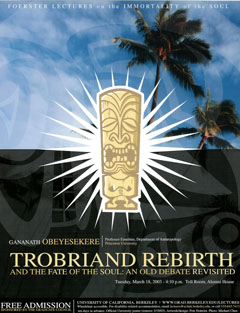
[00:00:02] MARY ANN MASON:
Good afternoon. I’m Mary Ann Mason, Dean of the Graduate Division. On behalf of myself and the Graduate Sco– uh, Council, who sponsors these lectures, I want to warmly welcome you, and particularly Professor Obeyesekere, this year’s speaker in the Foerster Lecture Series.
I must say that this is really one of my very favorite lecture series. Who can’t be attracted by the immortality of the soul? Usually, we have more prosaic things like genomic structures, et cetera, but today we get to soar beyond all of that.
Uh, as a condition of the bequest, we’re b-obligated to tell you how the endowment came to be, and I think its connection, like many of our lecture series, is old and shows how the Bay Area and California history have really enriched the tradition here at the Berkeley campus by providing these endowed lectures. In 1928, Miss Edith Zweybruck established the Foerster Lectureship to honor the memory of her sister, Agnes A. Foerster, and her brother-in-law, Cons-Constantine E. A. Foerster. Edith was a public school teacher in San Francisco, and she was very taken with spiritual values.
She felt her life’s work was to impart spiritual values and the love of spiritual issues to children, which she did. Her beloved sister, Agnes E. Foerster, also shared her ideals and her interest in spiritual issues, as did her husband, Constantine A. E. A. Foerster. Now, the connection is a very Bay Area connection because you may recall there’s a very large law firm called Morrison and Foerster, and Foerster was one of the founders, along with Morrison, of this, uh, law firm, and one of the other bequests from the law firm is the Morrison Room right here in Doe Library, one of our most beautiful libraries and, uh, really a treasure for the campus.
Uh, Mr. Foerster, Constantine Foerster, was a very dynamic and apparently very, uh, charismatic young man, and he died very early at the age of 37. And that’s really what inspired Edith Zweybruck to name the lecture series for the Foersters, who she felt were very beloved, and I think felt that there, maybe, the spiritual connection would be stronger if she endowed a lecture series which really focused on these matters that perhaps someday people could understand spirituality better. So we’re very thankful to Edith Zweybruck for this endowment and for allowing these lectures to continue every year.
We’ve had an incredible array of outstanding people, Oliver Sacks, Thomas S. Kuhn, Aldous Huxley, Paul Tillich, and now today, in the same tradition, we are going to have Professor Gananath Obeyesekere. And now I welcome, uh, Professor Anthony Long, chair of the Foerster Committee, to introduce our guest.
[00:02:43] ANTHONY LONG:
Uh, thank you very much, uh, Dean Mason. Um, uh, it’s interesting, I think, uh, just following what the dean was saying about the bequest. But in, um, her, uh, letter of, uh, gift to the university, um, Edith Zweybruck said that, um, it should be on the immortality of the soul or kindred or a kindred spiritual subject.
And as you’ve said, I mean, that has been interpreted quite broadly over the years. Mm. Uh, we’ve had, uh, computer science, and when Bernard Williams, uh, gave this lecture about 20 years ago, uh, which came out as a wonderful article called “The Makropulos Case,” uh, it was totally clear, uh, that part of the thesis was the lecture that term, immortality of the soul isn’t really a starter at all.
Uh, so it’s been a very broad, uh, and, uh, interesting, uh, array of, um, topics that we have had, and we’re delighted, as you say, to have, uh, Professor Obeyesekere with us today. Um, he is no, uh, stranger, uh, to the Berkeley campus. In fact, um, although he and I have only met over the last twenty-four hours, it’s been striking and, uh, and very delightful to see how many people have just come up to him.
I mean, walking, walking over here from, uh, from Alumni House, uh, people said, “My goodness, here you are.” So, uh, it’s very nice indeed to have you here. Um, he retired recently from his position as Professor of Anthropology at Princeton, having begun his studies as an English major, uh, at the University of Ce-Ceylon, I suppose when that, uh, when Sri Lanka was still so-called.
Uh, he acquired his PhD in anthropology at the University of Washington, and, uh, that was one of the American universities which he, uh, taught at. Uh, in fact, before, uh, taking up his position at Princeton, uh, where he chaired the Department of Anthropology for several years, as well as at the University of Washington, um, he taught at UC San Diego. So again, certainly no stranger to this, uh, place.
Uh, Gananath Obeyesekere is a scholar of extraordinary, um, breadth and range. Um, he’s made fundamental contributions to the study of Buddhism and South Asian religions, and he actually comes to us now from his native Sri Lanka, uh, where he has been and will be continuing to do field work on Buddhist practices in remote parts of that island. But he’s not only a leading anthropologist and interpreter of religious traditions, but also a thinker whose work, as you start to read it, uh, plunges deeply into history, philosophy, uh, medicine, psychoanalysis, and, and other fields too.
Among his hundred and more articles and reviews, you find such titles as “The Idiom of Demonic Possession,” “The Conscience of the Parricide,” “The Illusory Pursuit of “the Self,” and “Illness, Culture and Meaning.” And his books are just as wide-ranging. They include, among, uh, others, and I’m merely being selective, The Cult of the Goddess Pattini, Buddhism Transformed, and a fascinating study entitled The Apotheosis of Captain Cook: European Mythmaking in the Pacific, where the important thing is it’s the Europeans who were making the myths and not the, um, Pacific peoples themselves.
And that book was awarded the book prize, uh, of the American Society for Eighteenth-Century Studies. Now, most appropriately from our point of view today, uh, Professor Obeyesekere’s latest book, which I can’t resist holding up, uh, was published only last year by the University of California Press, entitled Imagining Karma. This book investigates and compares rebirth beliefs in an astonishingly wide range of world cultures.
Buddhism, yes, we expect that from, uh, him. We’re going to hear in this book as well as in today’s lecture about the Trobriand Islanders, but also a great deal of information about North American, um, Indian culture and, uh, from my v-particular, uh, very local perspective, a great deal about ancient Greece. As a classicist familiar only with the Greek material in the book, I find this a splendidly rich and innovative study, and, uh, I recommend it, uh, with enormous, um, enthusiasm.
Professor Obeyesekere has been the recipient of numerous prestigious fellowships, far too many to name here. He’s in great demand as a lecturer for important occasions such as this one, so we’re very, very fortunate to have him with us today to deliver this year’s Foerster Lecture. So please join me in welcoming our distinguished visitor, who will speak to us on Trobriand Rebirth and the fate of the soul: an old debate revisited.
Professor Obeyesekere.
[00:08:08] GANANATH OBEYESEKERE:
Thank you.
(applause)
Thank you, Tony. Well, thank you, Dean Mason. Thank you, Tony.
And, um, as they say in Sri Lanka, Ayubowan, which means may you live long, and, uh, since we are on the brink of war, that’s a, that’s a good wish. Um, uh, I can’t function without water. Um.
So it’s, uh, it’s, uh, I’ve seen so many old faces and some young faces and, um, sort of thi-third generation scholars, you know, and, um, and, uh, it’s, it’s, uh, I, I, I’ve been here in, on campus before, so it’s, it’s a real privilege and an honor and a pleasure to be here. Uh, the topic of course, um, as you know, is on, on Trobriand rebirth. Uh, uh, it’s sort of, sort of parasitic on my book, uh, Imagining Karma.
Um, uh, but I, I, I presume that most of you ha-haven’t read it in the first place. So this is a, a, a kind of provocation for you to buy it and enhance a poor retired man’s royalties. Um, Uh, so the, so I must say that, uh, I, I just briefly mentioned some of the things that I tried to do in that book.
It’s, it’s the first study of comparative, uh, rebirth, you see, because we are– we assume that rebirth theories are found only in the Indian subcontinent. So the first thrust of that book is to de-center India as the locus and ground of rebirth and say, not so. It’s found in a multiple– multiplicity of cultures, small-scale societies in West Africa, now we know among Amerindians, you know, in the Northwest Coast, Inuit, you know, uh, Trobriands and, and so forth, you see.
It’s found in, um, uh, in ancient Greece, as Tony pointed out, and some classical scholars might be horror-struck at the way I’m approaching this whole, uh, issue. But, uh, so, uh, so India is not the home of rebirth. So this, I think, has provoked me to look at, um, rebirth in a special kind of perspective, and that is, uh, rebirth has a c- what I call a certain elementary structure.
That in, in rebirth, you have the soul. And we are dealing with immortality of the soul, so I’d, I have to talk about that. The soul comes from wherever it is into the womb of a h- of a, of a, A human being, a woman, you’ll see, goes around the life cycle, goes to some other world.
comes back to this world, and it goes, has this cyclical structure. This cyclical structure is, is found whatever the place, whether it’s in ancient Greece, whether it is in, uh, in, in, in these so-called small-scale societies, whether it is Buddhism or Jainism, you cannot miss this cyclical structure. It is there.
It is the elementary form of a, of a rebirth eschatology. And it is on this basis that the larger cosmological systems and the more complex cosmological systems that you associated that, that you associated with Buddhism and with Greece, so to speak, are built, you know, around that structure. So we know, for example, that Buddhism really has that same elementary structure, but it introduces a new theme, karma.
That is reward or punishment for your ethically intentioned good and bad actions. That means, I point out in the book, the other world has to split at least into, uh, two portions, where the good guys go and the bad guys go. You see?
Most of us are bad guys, you know. And then back again to the human world, you have a human world which is a plus world and a minus world, you see? So there is, uh, in-
Whereas in the Trobriand instance and in the small-scale societies where you have a kind of ancestor cult, that is the soul at death goes to the other world, comes back into the same, uh, group, the same patrilineal or matrilineal or bilateral society. But whereas when you have ethical, the ethical dimension that you get in Buddhism, there is what I call a dislocation of place. You cannot be born in the same place.
Now, with that kind of proviso, sort of let me get into my little bit of esoterica, you see, uh, which is, uh, Trobriand rebirth and, um, and I want to sort of, uh, say that in addition to Trobriand rebirth, it deals with the Buddhist side. I deal with both Trobriand and Buddhists because one of the aims of the book, and of course one of my aims is, uh, here is to sort of argue with my colleagues in anthropology that relativism is not the only thing, you see, which is so popular today, uh, that I am sort of pro-relativistic and also anti-relativistic. Uh, you know?
So that in some sense, I’m arguing that the– though there are great soteriological differences between, let us say, Christianity, Buddhism, and Trobriand, there are also similarities and family resemblances, uh, to be parasitic on Wittgenstein here. So let me say that, uh, I’m going to limit this topic in a, in a very drastic fashion. And that is, I’m not going to talk about the immortality of the soul, uh, uh, since you’re all going to buy this book, you know, you can read it yourself.
But rather, I’m going to talk about, um, uh, one aspect of it, namely, a, a problem that intrigues me. That is, some spirit or soul from… that exists elsewhere has to be reborn in the human body, you see. How does this embodiment take place, you know?
And this is, this is the, the latter part of my, uh, uh, the title, An Old Debate Revisited. The old debate is truly ancient. In the nineteenth century, anthropologists like Frazer, Hartland, and others, uh, pointed out the fact, and I think they are true up to a point, that in many societies, particularly in Melanesia, among the Austra- Australian Aborigines, uh, people did not have any idea of physical procreation or the role of the father in, in, in, in, co– in conception, you see.
Physiological paternity was unknown to them. And in the early nineteenth century, you had, um, uh, ethnologists, uh, the f- uh, sort of pioneer ethnologists who worked among the Australian Aborigines who seemed to confirm that hypothesis.
Then you get more professional anthropologists, Ashley Montagu, an old friend of mine, unfortunately, uh, now diseased. Deceased, not diseased. Um, and Phyllis Kaberry, Carberry, who worked among, uh, who wrote a very fine book on, uh, uh, Aboriginal women, who pointed out that according to the, uh, uh, the Aborigines, am-among whom she worked, there was a notion of time long ago.
And in that time long ago, there’s a fixed pool of souls, and this fixed pool of souls were wandering around and got embodied in plants, animals, and so forth, And after some time, achieved a kind of human embodiment. Yes, you see. And, uh, she said that even after 30 years of contact with white people, the Aborigines with, with whom she worked had no conception of the ca- of the relation between, um, coitus, uh, and, uh, and procreation, you see.
That debate, that debate is, uh, is, uh, really, um, nothing new. I mean, um, these debates have come and gone in anthropology. Uh, Tony mentioned the debate, uh, that I had about Captain Cook, you know.
After some time, these debates become rather boring and no one pays any attention, uh, just like the debate we are– that, that I’ve just had a-about Captain Cook. But periodically, someone gets interested in it, you know. Out of, uh, new data that has emerged or out of new theoretical or ideological interests, often hard to distinguish in the human sciences, you know.
And then the old debate ge-gets a kind of new life. And this new life came around, um, nineteen sixty-six when one of the great anthropologists, Edmund Leach, a very cl– a friend of mine and a kind of intellectual guru, who is also now deceased, you see, wrote a very interesting article called “Virgin Birth.” You see, In this article, which appeared in Man in, um, uh, nineteen sixty-six, the, the Journal of the Anthropological Institute, Leach made the point that all these people are talking about Australian Aborigines and Melanesians, ignorant, so to speak, of, uh, physical procreation and the role of the father and, and, and, uh, sexual intercourse.
Uh, he said, “Look, is that so different from that of the virgin birth?” You know? I mean, you have Christ’s immaculate conception, and is it all that different?
Uh, and, uh, his point, And I’m not quite sure I fully agree with him because on the one hand, it is true that Christ’s, uh, Immaculate Conception i-i-is really a quite an extraordinary event. But it is a con– an extraordinary event.
It is not something that, uh, not you and I, but mostly you Christians around here sort of, uh, w-wouldn’t sort of believe that, uh, you know, you, you produce your children through some kind of Immaculate Conception. So, so
I, I don’t think that, uh, Leach’s i-i-idea that the virgin birth was something similar to that of the aboriginal conception of spirit births, uh, is, is quite right. And this, this was taken up by, uh, a-another very important anthropologist, um, you know, who, uh, argued, uh, that after all, um, the, the, who, who made the p- Uh, p- uh, made the traditional point that the Australian Aborigines did have a notion of spirit conception, that is, there’s a spirit child who enters into the human womb, you know.
And there were, you know, Spiro, that is the person we are talking about, again, an intellectual mentor of mine. Spiro made the, uh, the, uh, two points. One, that the idea of the, uh, virgin birth is a very Christological thing.
It is unique to Christianity. It is a miraculous thing, and it is a lot, uh, you know, something what, uh, Tertullian mentioned when he said, “I believe in Christianity because it’s absurd.” You see?
That is because of the nature of the miraculous in it. Whereas among the Australian Aborigines, it is a normal thing. Everyone conceives it in that way, you know?
So he made a further point that we we are not talking, um, uh, you know, the Australian Aborigines, so to speak, um, were either ignorant of, of, uh, physiological conception or more likely, he said, they deny physical uh, conception because, um, of unconscious motivations. In his case, the, the Oedipal theory, you see. The Oedipal theory makes them want to deny.
They know that, uh, uh, at subliminally, unconsciously, they know the relation between, uh, um, uh, sexual intercourse and, and conception, but they want to deny that in a psychoanalytic sense because of their, uh, terrifying Oedipal complex. To me, that argument, too, is not entirely plausible, though he has dealt with it in great detail in a book called Oedipus in the Trobriands, you know. Uh, not entirely plau-plausible because we know from Malinowski, you know, that the Trobriand father-son relationship…
This is a matrilineal society after all. The Trobriand’s, uh, father-son relationship was a very good one, you know. They had friendly relations and, um, and the hostility, Malinowski said, was projected not to the father, but to the mother’s brother.
A very interesting thesis that relativized, uh, the Oedipus c- uh, complex, and it led to Auden’s– I, I don’t know the poem you are familiar with, uh, Auden, when he said, um, “the Malinows-” Malinowski, Rivers, Benedict, and others showed how common culture shapes the separate lives. Matrilineal races kill their mothers’ brothers in their dreams and take their sisters for their wives, you see? So I think this very interesting, very, very–
It just struck me as I was reading, it’s not in the paper, you see. Uh, this very interesting, uh, um, uh, argument of Malinowski’s was sort of shoved under the carpet because there was a lot of hostility from the psychoanalytic establishment, particularly people like Ernest Jones. So much so that Malinowski himself recanted and said nothing of the sort.
There is nothing called infantile sexuality, you see. So here’s our argument and, um, and, uh, and I-I’m now going to p-uh, present you my alternative view of it, you see. I’m saying the following.
I’m suggesting that when you have a notion of spirits that exists outside there, you know. And the spirit has to enter a human womb. There is a problem of the relationship between the spirit and the body in which it is conceived.
You see, that is a problem, and you can’t get away from that. And saying this problem is exacerbated when you have a distinction between the materiala-materiality of the body and the spiritual nature of the soul. So you have the notion, the Christian logical notion, uh, the miraculous notion of Christ’s immaculate conception, and you have it in, um, in other societies too, in the birth of deities and so forth.
And while I’m in this sort of, uh, uh, poetic mood, uh, suddenly, there’s a, there, there, there– sonnets– the two lines from, uh, from Yeats, uh, came, you know, struck me. “What sacred drama through her body heaved when world-transforming Charlemagne was conceived?” You see, some– the–
these great people when, you know, what happens when they are conceived. Then there’s the other problem, and I think I’m suggesting that other problem is different from the virgin birth, and that problem is what people like Malinowski and others have pointed out in respect of Melanesia. That is, the soul enters the body of the body of generally everyone, you see?
Everyone, you see? And then the problem is, what is the relationship between this soul that enters the human womb, you know, and the processes of bodily, uh, procreation, you see? Does sexuality, does intercourse have a, have a, a relation there?
So I am going to argue two things. I’m gonna say– I’m going to first pre-present the Trobriand case, which is a sort of locus classicus of this spirit conception theory. Secondly, I want to deal with the Buddhist case and show that the Buddhist case had both forms of spirit conception.
Some sort of Buddhist scholars I see, my friend Padmanabha here, who might be shocked at what I’m going to say. But anyhow, I am saying that the Buddha himself was born very much like Christ in the virgin birth model, you see, in a miraculous model. That model operates in respect of Buddhism.
Then I am suggesting in the Buddhist tradition, there is a minor tradition which is very much like the Trobriand or the Australian, uh, Adivasi or Aboriginal traditions, namely spirit conception unmediated by sexual intercourse. That’s my sort of thesis, and I’m saying this is endemic to the societies in which we have rebirth theories. So let me start off with Malinowski.
Um, um, in Malinowski’s case, you see, um, in the Trobriand, as you know, he was in-incarcerated there, physically, uh, unable to get out of the Trobriand Islands in the First World War, and he wrote these marvelous books as a consequence of that. I’m not sure this is a good model for all of us to emulate, but still, um, he was there and he, um, he wrote these very detailed accounts of Trobriand, uh, Uh, anthropology, uh, ethnography. And he was– and he has, in my opinion, you can’t sort of dismiss him, he has detailed accounts of the notion of spirit conception.
You see, he says what happens in Trobriand is simply This: the spirit enters from some other world. The spirit enters into the womb of the woman of the same matrilineal clan. Then it goes on the life cycle, and at death goes into the other world, which is called Tuma, you see, and and is uh, born as a spirit called Baloma and lives in that other world.
After some time, you come back to the human world, back into the same matrilineal clan, into the womb of a woman, you see. And in this case, the– while the woman is bathing or she has a presaging dream that the spirit has entered her, you know, there is some something that is going, some some sign, some indication is given, uh, which is also true of other societies like Amerindians and Inuit, you know, you sometimes see the vision of the child coming. You know, the, the spirit child then is directed by an ancestor, the Baloma, into the womb of a woman, often when she’s bathing, you know.
And it enters her, and she conceives a child, and the husband has nothing to do with it, you know. Now, this whole theory, wonderful theory, um, uh, you know, um, was, uh, in my view, it, it was based on, on a great deal of empirical evidence, and it received, uh, some confirmation a few years later in nineteen thirty-four, I think, uh, when, um, an E- an English magistrate, Austen, Leo Austen, worked among the Trobriands and collected, uh, through interviews, you know, uh, semi-structured interviews, first in English and then in Kiriwinan, that’s a village where Malinowski worked, uh, on, uh, trying to prove or disprove Malinowski’s thesis that considers that there are people without the knowledge of a physiological paternity. And he also came up with, wait, after very detailed interviews, You see, he confirmed Malinowski’s hypothesis, and in fact said that these people have no notion of physiological paternity.
Uh, but, uh, following Malinowski, uh, you know, Malinowski made the point that s- uh, okay, earlier he made the point that sometimes, uh, people in the Trobriand say, uh, “This is not true of animals.” See for example, pigs copulate, they copulate, and they give birth.
But then Ma-Malinowski said, “Well, you know, that’s a different kind of thing. That’s, that’s, that’s pigs and animals and not humans, but humans ha-have no idea.” But, uh, Austin pointed out very nicely that, um, Malinowski’s, uh, thesis was really, uh, confirmed.
But one of the problems I have with both Malinowski and with Austin is simply this. You know, Malinowski is one of the great ethnographers and, you know, one of our, our great father figures. He believed that, uh, the improbable thesis to me, some, some of you may disagree, the improbable thesis that the f- business of the anthropologist is to give the natives’ point of view, you see?
I mean, I don’t think any anthropologist can do that in the first place, and I don’t think any native can do that in the first place, you see. But any of that was this. But it was a sort of a, a sensible idea at that time.
But when he got contradictory opinions, what did Malinowski say? He had this fantastic statement. He says, “We must put these different contradictory statements,” and here are his words, into a clear and final solution.
A shocking thing nowadays, you see. Those are his actual words. So in spite of the fact that he is given to presenting the native point of view, what you really have is the discourse here, the multiplicity of native discourses.
Pigs copulate, you know? And he said, “Well, you know, just forget about that,” you see? Uh, and, uh, and so forth, Then he’s sort of, um, putting them into a kind of, what he calls orthodoxy.
You see? Orthodoxy. So with Austin, Austin too tried to do the same thing and, uh, o-o-one, one of the troubling features about, uh, Austin is that, um, some of Austin’s informants, and he said, “You know, one of my best informants was a woman,” you know, and, uh, she said that, “What are you talking about?”
She said, “No, men, it is true that men have nothing to do with it.” Spirit children also have nothing to do with it. We create our own children in our own wombs through the blood that we have inside of us.”
Here you have a fascinating view by women, you see, an unorthodox view by women saying what I would call, um, physiological maternity, you see. They are denying that the father has any role, which fits in nicely with this matrilineal society, you know. And saying that– also saying that spirit conception has nothing to do with it.
We are autonomous. We create our own children. And, uh, Malinowski then said– I’m sorry, Austin then said, “Look here, you know, um, uh, these people they are, they are strange, you know.
There are a few women who believe in this unorthodox thing.” But, um, but when we questioned them further, they said that, “Yeah, that’s true, we produce the thing, but at some point the spirit comes there.” It seems to me, nevertheless, an important statement, you see, which is being ignored, uh, because what these women are saying is, “We produce our own children,” and after some time, of course, the spirit enters into the child and, and, and you have, uh, a spiritual development of the fetus, you see?
So what I think is happening in these kinds of situations is rather, rather troubling thing for anthropologists. We often ask questions about our informants, but our very physical presence poses a question to them, you see? So we ask a question like, “How do you ch— how are children conceived?”
We bring in our preconceived notion that, okay, children are, are born, uh, you know, outside our bodily processes, uh, through, uh, a spirit child that enters the womb. So we think, uh, that we have got the answers, but we don’t realize that, quote, “natives” out there have their own an- have their own problems too. They have their own debates.
You see? Here’s a woman who said, “We produce these children.” And I’m sure Malinowski’s early informants were right when they said, you know, “Pigs copulate, and then they bring out children.”
You know? And, um, uh, so So what very often happens is that the kind of questions we often ask our informants, so to speak, imprisons the local discourse. We don’t p- pr-
permit contending, contentious discourses to erupt and foul our hypothesis-specific kinds of, uh, questions, you see? So this, I think, is a, is a real problem that came with both with Malinowski and with Austin, you know? And further Ma– in, in Malinowski’s, uh, second trip to the Trobriand, he was much more flexible because, for good reasons, he met a wonderful shaman whose spirit used to go into the world of the ancestors and comes back, you know, and, and tells what was happening there.
So he became much more flexible, and he engaged in dialogues with native informants. What?– and he challenged native informants to say, “Isn’t– all your answers are, are wrong, isn’t it?” I mean, uh, I mean, people do have sexual intercourse, and they produce children.”
So… And he said, “But the missions had asked that question before me,” you know. So he then he, he went on to say, “I firmly,” and that’s his own words, “arrogantly,” you know, told them that that is not so, you know.
“You’re wrong,” you know. “Your, uh, conception is, uh, occurs through, um, heterosexual intercourse,” you know, and, uh, and so forth. Then these people, you know, what is happening is what we don’t realize is not a one-way street.
This is a two-way street. So when you have these arrogant questions first from the missionaries and then from Malinowski saying, “You’re all wrong,” you know, uh, “What do you say to this?” These people then what, what Bateson calls schismogenesis, you know, they just, they just gave the opposite reply and say, “Of course we are right.
Even pigs don’t produce children.”
(laughter)
You see? You know? And then Malinowski said, “My God, how can people be so foolish?”
But that’s not his words, but you know, I’m sort of putting it in his mouth. But how can people people people be so foolish? Because I have seen, you know, that it is true that they castrate the male pigs.
But then the copulation is done by wild pigs, feral pigs from out there. You know, I’ve seen them. But Malinowski never asked the question, my God, if you saw them after one year’s field work, these guys who are living their whole lives there, didn’t they see the same thing?
You see? So what is really happening here is, faced with this sort of unrelenting questions from first the missionaries and from the ethnographer, it is now the native who has retreated into the imprisoning discourse, you see. So this, uh, of course, does not mean, uh, that, uh, uh, these people didn’t have a, a theory of, um, of, um, of, um, speech procuration, and I think they did.
But what it– what I think, uh, ha-happened was that they had multiple theories, you know, and multiple theories of this, uh, thing, including this woman who accidentally emerged out of the questionnaire, you know? And, uh, and these multiple theories are sort of stifled in the sort of anthropological representation of the ethnography. Now, what about the Buddhists?
My gosh, I’m almost running out of time. Um, um, so I am suggesting, I, I, as I said, the Buddhists had both these conceptions. First, they had a concep– a conception of a conception, uh, of, uh, of a, of a kind of virgin birth, and the ideal type of that is, is very much like the Christological one, uh, that’s the Buddha’s birth.
Very early texts pointed out, you see I quote some of it, that the Buddha to be was born in one of the heavens, where all Buddhas are born, and after his lifespan there was over, he decided to be reborn in the human world, mindful and clearly conscious. He entered his mother’s womb mindful and clearly conscious, and when this happened, the earth trembled. You see, that’s a great person appearing, Charlemagne.
And then there appeared the illimitable glorious radiance surpassing the, even the divine majesty of the gods. As he entered the womb, four gods guard the four quarters to prevent harm done to the mother or the child. More miracles.
The mother sees the Buddha in the womb as an emerald jewel, and the child was complete in all, uh, his, um, bodily parts. Organs are perfect. Further, he is, is quite stainless, undefiled by watery matter, undefiled by mucus, undefiled by blood, undefiled by any impurity.
He is pure and stainless, owing to the purity of mother and son. And the texts go on to say that the mother dies seven days after he is born. And then in the wonderful Buddhist sort of myths of the eternal recurrence, all Buddhas are born in the same way, and all the mothers of Buddhas die seven days after the redeemer is born.
So you have a very interesting thing. Now, in the historical traditions of Buddhism, it is impossible to convert the Buddha’s mother into a kind of virgin. It is not oh-hard to do– uh, not easy to do.
But she conceives the Buddha when she is observing one of the Buddhist precepts among the ten that, uh, people are supposed to observe, and that precept pertains to the absence of sexuality. So at the time the Buddha was conceived, she was not practicing sex with her husband, you know? So that is as far as, um, the virgin birth, uh, is concerned.
And then the question you might ask is, what is the necessity for the mother to die in seven days? Virtually every textbook that I have written about Buddhism takes this literally, and you have to say, “The, the Buddha’s mother died soon after.” You know, seven days is too much.
You see, it’s so soon after. That’s the kind of thing. But we are not dealing with real events, you see, in a, in a life.
I, I mean empirical events. We are dealing with mythic events. The necessity for the mother to die in seven days is very clear according to the Theravada, the text, the Southern Buddhist tradition to which I belong, And it says, because no other child is fit to be conceived in the same womb as the Buddha, you see.
The most interesting answer to this is given in the Mahavastu, a famous text of the, uh, group known as the Transcendentalists, you see, who, um, sort of the herald of the Mahayana or the Northern tradition of Buddhism. In which, um, uh, he– the text says that the Buddha up in heaven says, “I will descend into the womb of a woman who has only seven nights and ten months of her life remaining.” And why so?
Because, says he, it is not fitting that she who bears a peerless one like me should afterwards indulge in love. You see? So the motivation– that is, so the reason for the mother to die in seven days not– is not an empirical thing in history, but a necessity of the, of the story.
You see, the womb in which the Buddha is born is pure, and you know, South Asian conceptions of purity and impurity, and I’m sure similar conceptions existed in the Bible. I, I don’t want to, uh, you know, go that far. But the b-womb in which the Buddha is born is in the first place pure because there was no sex, you know?
And it, uh, and, uh, afterwards, no one else can, uh, that womb cannot be contaminated. So you’ve come very, very close, uh, to that. Now again, given this sort of myths of the eternal return and so forth, you have a very fascinating account.
The Buddha’s father is called Śuddhodana, which means, according to most, uh, Sanskrit and Pali scholars, pure cooked rice. But local traditions make a different story. Local traditions say it is pure rice, and rice equals seed, equals semen in all of the South Asian traditions and including European traditions, you see?
So in other words, not only is the womb of the Buddha pure, but the name of the Buddha’s father is also taken up in the same spirit, and you have him having a pure seed, you know, and, uh, and so forth. The Buddha’s mother is called Maya. What does Maya mean?
In the Upanisha-Upanishadic theory of the time, Maya means illusion, you see, or to create out of nothing. You see? So the Maya, the Buddha’s mother is an illusory figure.
She’s an illusory figure. She sees the Buddha in her womb in this way, you know? And the Buddha also sees her.
So again, the name of the Buddha’s mo- uh, mother takes on that quality. When the Buddha’s mother died, her– you had the practice of the sororate, that is the Buddha married, uh, her sister. And what is she called?
Prajāpati. Prajā is to, of course, procreate, but Prajapati is the great god of, uh, o-of Hindu, uh, Hinduism, you see? So Prajapati is the real creator of the Buddha, the one who brought, uh, you know, the proge– in some sense, the progenitor of the Buddha, and for her, there is no problem.
After the Buddha dies, she can marry and produce two, um, siblings, uh, step-siblings to the Buddha. So you have this, uh, whole idea, so to speak, uh, carried to extreme limits. In the text that I just mentioned of the local Theravadins or the transcendentalists, where every physical aspect of the Buddha is denied, Everything.
Carrying on that theme of Maya or illusion, the Buddha himself is Manomaya, that is a mind illusion. All Buddhas have that sort of mind illusion. And then the question is, and then therefore there is no problem for the Buddha to enter the mother’s womb, you see?
He’s sitting there in a, in a sq– in a squatting position, all limbs perfect, you know. There is no mucus, no… He’s like a pearl in there.
And then of course, uh, the question is asked, well, you know, if, if, if, if all this is true, uh, how did the Buddha marry? And how did he have a son called Rahula? And now we can get the predictable answer.
Rahula too came from the Tushita Heaven and was born in exactly the same way. So the– this text then ends up in a kind of tone of triumphant exaltation, which I can quote you now. The conduct of the Exalted One is transcendental, his root of virtue is transcendental.
The seers, walking, standing, sitting, and lying down are transcendental. The Buddhas conform to the world’s conditions, but in such a way that they also conform to the traits of transcendentalism. It is true that they wash their feet, but no dust ever adheres to them.
Their feet remain clean as lotus leaves. This washing is mere conformity with the world. It is true that the Buddhas bathe, but no dirt is found on them.
Their feet remain as clean as lotus leaves. This washing is mere conformity to the world. Though the Buddha’s corporeal existence is not due to the sexual union of parents, yet the Buddhas can point to their fathers and mothers.
This, my friend, is mere conformity with the world. So you have in two different, radically different cultural and soteriological traditions, you see, something similar appearing, the miraculous birth of Christ, the miraculous birth of the Buddha in this kind of way. But in Tibetan tradition, there is another thing happening which is closer to the Trobriand.
The Buddha is the exceptional one as Christ is the exceptional being, born in this immaculate fashion, which is the Buddha’s case too. So in the Buddhist case then, Buddhists by, in, you know, there is a strong, uh, argument that, uh, uh, classical Hindu medicine developed in Buddhist monasteries. Some argue against it, but, uh, that doesn’t look like it.
Yeah, no. What it is, there’s a development of a Hindu medicine, and by and large, Buddhists believe that you have– they-they had elaborate theories of conception, physical conception occurs, you know. Through the union of the parents, the woman must be in the right menstrual cycle, and crucially, the gandhabba must be present.
What is the gandhabba? Gandhabba– You know, Buddhists have no theory of soul.
In fact, a crucial aspect of Buddhism, unlike Trobriand or Christianity, is the doctrine of no soul. That is, everything, our bodies and the world are constantly changing, and there is no stable entity called the soul. Then what goes from body to body?
It is the Gandharva, of which we might say, you know, the spirit-seeking entity, which is also a changing body, you see? So the Gandharva has to be present anyhow. But in some instances, you see, Buddhists discuss four kinds of, of births: through moisture, through eggs, through human sexual intercourse, and lastly, spontaneously, you see?
So spontaneous rebirth then, the kind of thing that is normal in the Trobriand Islands has become a special category formalized, written about, and given conceptual formulation in Buddhism. So you have these fantastic stories about, uh, spontaneous rebirths, and I’ll just give you a few, a few examples in my own research on the goddess Pattini. Um, she’s, um, she is born from the cobra’s tear, from a shawl, from a tree, from all sorts of ways, you know?
One of the great heroes in Buddhism, uh, in Buddhist history, Dutthagamini Abhaya, who is, uh, who killed a lot of Tamils and is very, uh, very popular nowadays, you see. Uh, the mother was barren and, uh, she went up to a, a, to a, a novice who was about to die and told the novice, “I want you to be born in my womb.” And her husband was not present at that time.
And there are hundreds of stories in the Buddhist tradition of these, uh, um, births outside of bodily processes, and they are given a technical term, opapatika. You see, they are given, recognized, given a technical term, opapatika. So then I’m, uh, I-I’m suggesting here in this tradition too, you have, uh, the notion of spirit conception that occurs outside of, uh, uh, the human birth.
But, um, in, um, in all fairness, that even when, when you are born outside of that, the Buddhist idea of the Gandhabba has to be present. You know, whether you are born in a shell or in a tree, you know, the, the, the karma of the person, uh, is operative, and the karma-carrying being is a spirit entity or Gandhapa. So now let me expand our own, uh, consciousness a little bit more.
Um, yeah, take a little more of your time if you don’t mind. And, and, and also point out at least in one instance, uh, from, from the Greek, you see, where Empedocles says, “For before now I have been at some time boy and girl, bush, and a mute fish in the sea,” you see? So I mean, after all, it isn’t, um, how,
(laughter)
how the hell did he become a bush, you see? Uh, unless it is through the kind of conception that we are talking about, uh, in, um, in Buddhism and in the Trobriand and in other places. And so is, if I think, I don’t want to deal with that since Tony Long is around here, you know.
Uh, that, that is if you look at Plato’s Timaeus, uh, contrary to many classicists, I’m arguing that, that, you know, in in the first generation in Plato’s Timaeus, people are born without sexual organs, and in the second generation, they could be born because of their sins as women and as plants. See, how did that happen? You see?
So you have again this widespread notion of spirit conception. Here’s my conclusion. This I’m going to read out.
I started this discussion with a touch of levity and seriousness. Actually, I omitted the levity. It glossed this way.
And let me end this discussion with, uh, a little bit of mild levity and a lot more seriousness. Um, the, the levity was, you know, I, I, I said I, I have written this book on rebirth and I, I want to, uh, you know, I, I, I mentioned all these people who wrote about it who are now, uh, deceased and I… This is a dead issue now.
Um, and I also pointed out that, uh, since I am also in that sort of retirement position, you know, I also must my, my quietest make, and then I qualified it by saying quietus make. So that was, uh, let’s get back to the serious. Uh, I only briefly responded to Mel Spiro’s argument that the matrilineal Trobrianders, with their denial of physical procreation, were afflicted with a higher quantum of Oedipal feelings than their patriarchal fellow humans in the West, thus countering Malinowski’s thesis that Trobrianders have a matrilineal complex where instead of the son’s hatred for the father, you have the reverse.
In relation to Hindu India, both Robert Go-Goldman here at Berkeley, A.K. Ramanujan, another friend who is no longer with us, argued that instead of the classic Greek form of the complex, you have in Hindu texts another form where the dominant motive is not parricide but filicide that fits in with that highly patriarchal structure of at least Brahmanically influenced society. But in Buddhist texts, this is reversed once more, and you have in the, the Greek model, so to speak, raising its ugly head. Owing to, I think, the larger presence of the nuclear family as a norm and a more liberal evolution of the female role.
Therefore, let me present the views of the fifth-century philosopher Vasubandhu, who deals in great detail with the entry of the rebirth-seeking entity, the Gandharva, I pointed out earlier, into various wombs, including the most desired one, the human rebirth. This spirit entity is immaterial, incandescent, and survives by feeding on odors, and this is very interesting because it is very much like the Inuit or Eskimo, who also ha-have a similar, uh, idea of a spirit entity. The spirit entity, says Vasubandhu, arises at the place where death occurs, and depending on its karma, it can seek a variety of rebirths.
In human rebirth, the rebirth-linking consciousness operates thus, I quote him: The intermediate being, that is, the spirit entity, is produced with a view to going to the place of its realm of rebirth where it should go. It possesses by virtue of his actions the divine eye. Even though distant, he sees the place of his rebirth.
There he sees his father and mother united. You are back to coitus. His mother, his mind is troubled by the effects of sex and hostility.
When the intermediate being is male, it is gripped by male desire with regard to the mother. When it is female, it is gripped by female desire with regard to the father, and inversely, it hates either the father or the mother, whom it regards as either a male or female rival. This is Freud in fifth century AD.
You see, Now we are also talking about, you know, how ideas, you know, get invented in different places. It’s not the virgin birth. It’s not spirit things, all sorts of other ideas, including the Oedipus conflict.
And Freud never knew that he was anticipated ages ago by Vasubandhu. Furthermore, Vasubandhu then says how excited this spirit entity becomes through sex, you know, and desire gets rooted in the consciousness. And then he relates this brilliantly into the Buddhist idea of, uh, of tanha or greed, you see, which is the second noble truth to Buddhism.
The first noble truth is called dukkha, sometimes translated as suffering or, or the unsatisfactory nature of existence. And what generates the dukkha is tanha, desire. So the primordial tanha is the desire, eroticism of the rebirth-seeking entity.
But to caution you that the Buddhist idea of desire is a much broader one, much broader, and includes all sorts of desires, including, one might say, following Nietzsche, uh, The will for power. You see, the will for power. Uh, the Buddhists are very strong on this, and the Buddhist argument is that the will for power is also, uh, uh, very, uh, rooted in this sort of, uh, rooted in this kind of desire.
And, and from a Buddhist point of view, I might say that, uh, this, this will for power, which Nietzsche saw as both constructive and destructive, the Bu-Buddhists saw as primarily destructive. And one of the great tragedies of the Buddha’s own life is that the Buddha was brought up in a, a small, uh, uh, uh, what sometimes scholars call a republican, uh, city-state kind of place. And adjacent to him were the new empires that were sort of gobbling up these city-states.
And in the Buddha’s lifetime, he was asked, “What is happening to your, to your own nation, to your own country?” And he made the idealistic, but in my view, uh, as beautifully wrong statement when he said that as long as these Sakyans have their collective assemblies, as long as they air their views in a collective fashion and live accordingly, then nothing can harm them. But in fact, Kosala, the king of Kosala, who was also a disciple of the Buddha, you see, invaded the Buddhist, uh, kingdom of Sakya, put to death everyone, women and children, you see.
But in spite of the grimness of that tragedy, there was no shaking the Buddhist theory that all wars are unjust wars. Thank you.
(applause)