
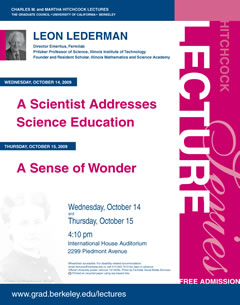
[00:00:00] WILLIAM LESTER:
Good afternoon.
(clears throat)
Forgive my voice. A little something is, uh, in my throat. But in any event, I am William Lester, professor of chemistry and chair of the Hitchcock Professorship Committee.
We’re pleased, along with the Graduate Council, to present Dr. Leon Lederman, this year’s speaker in the Charles M. and Martha Hitchcock Lecture Series. As a condition of this bequest, we’re obligated and happy to tell you how the endowment came to UC Berkeley. It’s a story that exemplifies the many ways this campus is linked to the history of California and the Bay Area.
Dr. Charles Hitchcock, a physician for the Army, came to San Francisco during the Gold Rush, where he opened a thriving private practice. In 1885, Charles established a professorship here at Berkeley as an expression of his long-held interest in education. His daughter, Lillie Hitchcock Coit, still treasured in San Francisco for her colorful personality as well as her generosity, greatly expanded her father’s original gift to establish a professorship at UC Berkeley, making it possible for us to present a series of lectures.
The Hitchcock Fund has become one of the most cherished endowments of the University of California, recognizing the highest distinction of scholarly thought and achievement. Thank you, Lillie, Charles, and now a few words about Dr. Lederman. Leon Lederman is internationally renowned for his research on neutrinos, ghost-like particles that pass through everything in the universe, and on some atomic– subatomic particles known as quarks.
He was awarded the National Medal of Science in nineteen sixty-five and the Wolf Prize in Physics in nineteen eighty-two for discovering the bottom quark, which establishes the existence of a third generation of quarks. In nineteen eighty-eight, Lederman was co-winner of the Nobel Prize in Physics with Melvin Schwartz and Jack Steinberger for his discovery of the muon neutrino, proving that there are at least two families of neutrinos. His research has provided major advances in the understanding of weak interactions, one of the fundamental nuclear forces.
In addition to his work as a researcher, Lederman is also a leading proponent of science and math education at the high school and college level. He founded the Illinois Mathematics and Science Academy, IMSA, in nineteen eighty-six, and has served as resident scholar since nineteen ninety-eight. IMSA is an internationally recognized, inter-educational institution for developing talent and stimulating excellence in teaching and learning and mathematics, science, and technology.
Lederman is also an outspoken adv-advocate for the Physics First movement, which seeks to rearrange the current high school science curriculum so that physics precedes chemistry and biology. Dr. Lederman received his master’s in nineteen forty-eight and his PhD in nineteen fifty-one from Columbia University. In nineteen sixty-three, he proposed the idea that eventually became the Fermi National Accelerator Laboratory, where he served as director from nineteen seventy-nine to nineteen eighty-nine and is now director emeritus.
He previously served as the Eugene Higgins Professor at Columbia and as the Frank L. Sulzberger Professor of Physics at the University of Chicago before becoming the Pritzker Professor of Physics at the Illinois Institute of Technology in nineteen ninety-two. Lederman is a founding member of the High Energy Physics Advisory Panel of the United States Department of Energy, and is a member of the National Academy of Sciences. He is also a past president of AAAS, the American Association for the Advancement of Science.
It is during my service on the AAAS board that I first met Leon and encountered his magnetic personality. Please join me in welcoming Dr. Leon Lederman.
(applause and cheering)
[00:04:05] LEON LEDERMAN:
Thank you very much. That was a really good introduction. Could you do it again?
Okay. Um, well, it’s great to be at Berkeley. I haven’t been here for some years.
Great to see many, many old friends. I’m delighted, uh, to be here and only, uh, sorry that, uh, I haven’t prepared the most spectacular, uh, presentation in, in world history. Uh, but, uh, I thought I would, um, talk today about, uh, about something I’ve been working at for some time, uh, and that is on science education.
I started getting involved in education as a professor at Columbia, where teaching was considered a very serious, uh, obligation of the faculty, something I enjoyed doing. And, uh, then something curious happened. I went to, uh, Fermilab as a, uh, as an administrator and, uh, found myself, uh, um, at– ill at ease because I wasn’t teaching anymore.
I’d do funny things like catch some postdoc in the corridor and pin him against the wall and teach him something. Uh, eventually, uh, a group of postdocs, uh, called for a meeting with me and tried to figure out what was wrong. And eventually, they got it that I’m not teaching, and that’s a bad thing to do suddenly.
And so that started a series of, uh, Fermilab laboratory activity– educational activities, Saturday morning physics, uh, for hundreds of, uh, high school kids that came on Saturday to listen and, um, things like that, and ultimately the Illinois Math Science Academy, uh, which I’m very proud of. It’s, uh, just won a major award by the Intel, uh, Foundation as one of the best high schools in the United States in the teaching of math and science. Uh, that’s good stuff.
And, uh, so, uh, I thought I would regale you today with some of my efforts in education, and we’ll try to use all this modern stuff. What I asked for was, “Do you have, uh, at Berkeley, a, a, slide projector?”
(laughter)
And I got a blank. Now, usually when I ask that they say, “Oh yeah, we have one. It’s, it’s in the closet on the third floor.” So I suggest that here, but
(laughter)
there was no third floor, no closet, so… But we, we have, we have a, a, a good effort and, um, I hope that, uh, you’ll be able to see some of these things. The, the, the– I have to r-recognize from this introduction that, uh, fame is an important ingredient in being a physicist, especially, uh, with awards and medals.
Uh, I was, uh, this ill-illustrated this by being on a crowded train coming out of Chicago one day, and it stopped at the, uh, this, uh, institute for, uh, mentally handicapped patients that, uh, the train stopped, and the nurse got on the train with a clipboard and a bunch of patients, and she organized them. And, uh, as, uh, very crowded, she counted them: one, two, three, four. And she looked at me and say, “Who are you?”
And I said,
(laughter)
“I’m Leon Lederman.” I have a Nobel Prize in Physics, and I’m director of Fermilab.” She says, “Yeah. Five, six.”
(laughter)
So here’s, uh, this thing. I hope we’ll, we’ll get it going. Uh, a scientist looks at educate– science education, and, uh, I’m very well aware that s-education is a complex phenomenon, and we all work at it.
Mon– Most of us who’ve been in academia, we work at it hard. I think a lot of us, especially in the teaching of physics, are aware of difficulties, and so on.
And so, uh, a lot of this that I’m going to tell you is experience. My point of view is that of an experimental particle physicist who gradually, uh, and then hopelessly became immersed in the educational process. And I’ve been now at it full-time for well over ten years with, uh, mixed results.
Uh, first of all, I worry a lot. I worry about the, uh, the whole gamut of educational, uh, things from pre-K, which is now very important, especially around here, where, uh, where Scientists in the Crib has become a textbook for many of us, uh, and it came out of Berkeley to, uh, all the way to grade way up in the college graduates and worry about the teachers, the poor kids left out of some of the advantages, the gifted kids, are we taking care of them? The college science dropouts, the ninth grade biology, which is my pet peeve, science illiterate college graduates, um, where, uh, for too many colleges, uh, it’s still, uh, I forgot the, uh, uh, the, uh, uh, one semester of Rocks for Jocks or whatever it is that’s considered to be a, uh, a proper course.
I worry about global warming, the Dow Jones, all kinds of things, but most of them not terribly relevant. Uh, this is something you may not be able to read, but, uh, I just want to say we live in a time of escalating global crises, problems so complex, interdependent, far-reaching, and resistant to traditional modes of thinking and problem-solving. They seem to render us impotent.
The short list is the economy. All of you here, especially in California, know about it. Uh, joblessness that goes with it, the healthcare system still struggling in, in the Congress, the problems of g-global climate change, the wars we have.
There’s enough here to, uh, keep many, many, uh, busy. Yes, and then there is the, uh, the competition. There’s the growth and power of China and India and Brazil.
But there is also an emerging realization that scientific, economic, sociopolitical, and environmental futures are inextricably linked, causing us to reevaluate policies, I hope, and redesign strategies. So what do we do about STEM education? STEM, of course, you all know, is science, technology, engineering, and mathematics.
It’s interesting that the engineers have gotten into this nickname twice, and maybe that they deserve it. Science, technology, education, and mathematics edu– where we now train our students to think in decidedly different ways. We have to, since clearly the old ways of teaching have failed.
Einstein said something like, um, the, um, thinking that created our seemingly intractable problems will not be able to solve them. And so when we’re talking about education, and we have a recognition that goes back, uh, certainly to nineteen eighty-three, but probably long before that, uh, what we must do to have our students open to creatively generate new knowledge, new questions, new ideas, and globally collaborate to wisely improve the human condition, to have them think in decidingly different ways.
(breathing)
Clearly, we must teach in decidingly different ways. So there’s an enormous burden we have on our
(breathing)
educational system, which is very difficult to
(breathing)
implement,
(breathing)
as anybody who’s worked in education will assure you.
(breathing)
So the twenty-first century is a different century. It’s a knowledge and information-based society which will produce new opportunities,
(breathing)
new challenges and all dimensions of our life. And there are three certainties. Change is inevitable.
Complete coverage of some subject is impossible, and obsolescence is unavoidable. I’ve been told that, uh, that, uh, three years is about the, uh, lasting, uh, uh, uh, period for, uh, electrical engineering. It’s not that you have to go back to school, but the things you’ve learned in your four years at electrical engineering, um, become obsolete very quickly.
And so continuous study is essential. New technologies, new discoveries, new media, new social structures, new possibilities for quality of life make lifelong learning, uh, not only a, a Hansi slogan, but essential so that humans can think, create, learn, and collaborate forever. The divided lifetime, once upon a time, you learn for twenty years or so, and then for the rest of apply– your life, you apply that knowledge.
That clearly does not work anymore. Lifelong learning becomes not a slogan, but a necessity. So how are we doing?
Well, there’s a widely held, well-documented realization that a nation is slipping dangerously in its ability to maintain a robust, innovative, industrial, and technological society. Leadership qualities of science, technology, engineering, and mathematics, which have made us prosperous, are rapidly being overtaken. Cries of alarm are now being sounded by leaders in business, economics, even the Congress and the White House.
The huge– And we’ve never been, I think, more fortunately poised to make progress in a dramatic way with this White House. The huge gap in essential scientific grasp between the U.S. public and the twent- and the twenty-first century requirements is a major object- obstacle to the reforms we need.
A vigorous technological nation must have cultural and social values to sustain the qualities that underlie progress, that venerate education, that respect rationality. A national commission, which is something we, I think we often seek to, um, uh, make dramatic changes in our system, but can only begin a process which must be long-term. Yet our commissions proliferate.
And, uh, I have had some experience with these. So why do our schools fail? Well, there’s a lot of reasons, and many of you know these reasons.
These are well-known reasons: teacher training, teacher morale, lack of continuous professional development on the part of teachers, inadequate teacher evaluation. In Chicago, the, uh, number of teachers rated as unsatisfactory is something like zero point two percent, which is clearly nonsense. Teachers are not rewarded for being good teachers or for teaching more demanding subjects.
And conversely, uuuh, difficulty in handling poor che– teachers is a major problem we have. Outdated and largely irrelevant curriculum, and I want to talk some more about that. Uh, dysfunctional school management system.
If you think about the nation and schools, there’s, uh, fifty states, there are sixteen thousand, I think, school districts. Uh, uh, then you have the, the, the various committed organizations, the unions, the PTA, uh, the book publishers, many other, uh, organizations who, um, seek sustenance, profit, and so on from the school system. Poverty, lack of preschool preparation, low parental education, motivations, and so on.
Not nearly enough parental choice. For example, charter schools, suburbs, where do you live? Social promotions, problems, retention in grade, summer schools, inability to use beautiful technol– educational technology that exists but often is just not used.
Uh, the Third International Math and Science Study has been, uh, widely advertised, and probably many of you are somewhat familiar with how, how we do. Our fourth graders actually are not so bad. Uh, they, they are among the leading, uh, components of our educational system.
By eighth grade, uh, our students do slightly above average, but by twelfth grade, there are only, uh, two countries, uh, that we’re better than, Cyprus and South Africa. The picture that emerges from these data, uh, as, uh, uh, expressed by Bill Schmidt from, uh, University of, uh, Michigan State University, is a curriculum that lacks focus, coherence, and rigor. National Association for Educational Progress assessments are in agreement.
Only twenty percent of US seniors meet the definition of proficiency in science. In 1983, a committee of ten convened as a national commission to design a curriculum for science, established the sequence biology, chemistry, physics as, um, uh, clearly alphabetically correct for high schools. Uh, but in the year 2008, this is still the sequence being used in some huge fraction, well over ninety percent of our high schools, in spite of profound revolutions in our knowledge of physics and chemistry and biology.
How do you get that to change? Uh, our high school curricula are over a hundred years old, and they were established in eighteen ninety something, and at least seventy years out of date. So we need, obviously, a sensible science sequence, and I’m going to talk a little bit about a sequence which, uh, a major change in which one, um, studies science, uh, in the following sequence in which in ninth grade, instead of biology as it is today, you study physics, and in tenth grade, you study chemistry, and in eleventh grade, you study biology.
And that sequence, uh, has a lot of other effects that, that you have to do when you change the sequence in the way of coordinating and correlating and doing something. There have been a lot of studies, enormous number of studies. Here’s the Glenn Commission report, A report to the nation from the National Commission on Mathematics and Science Teaching.
I’ve got a lot of these. We have– It’s an amazing amount of literature. There’s, uh, no time to waste.
You can tell from the… You don’t have to read these reports. You just read the titles.
No time to waste. The vital role of college, university leaders in improving science and math education. There’s, uh, the huge, uh, interest on the part of, uh, industry.
Uh, you know about Bill Gates with the huge sums of money that the Gates Foundation is putting into the schools and, and you have similar activities from the major industries, Intel, Motorola, IBM. The Business Roundtable is a very effective group. Uh, more recently, Norman Augustine, uh, led a, uh, study which produced a very, um, important report entitled Rising Above the Gathering Storm.
And somewhere, some of that material is percolating around in the Congress. I also strongly recommend, for those of you interested, to read President Obama’s talk to the National Academy of Sciences, where, just to quote, “I am here today to set this goal.” “We will devote more than three percent of our GDP to research and development and improve education in math and science.”
It represents the largest commitment to science innovation in American history. Uh, in response to Sputnik, President Eisenhower signed legislation, if you’ll remember, to create NASA and to invest in technology, science, and math education from grade school to graduate school. As President Obama said, “Today I am announcing a renewed commitment to education in math and science.
American students will move from the middle to the top of the pack, uh, in science and math over the next decade.”
(coughing)
And so with that, uh, scientists, engineers, educators, like supermen and superwomen, remove their lab coats, drop their slide rules. Uh, you don’t know what a slide rule is. It’s a piece of wood.
Yeah. Uh, drop their treadles, close their education tomes, and they get involved. The battle is for the hearts and minds of the citizens of the nation.
Enlist the population, this complex set of issues that connect scientific thinking capabilities. It’s a war on ignorance. We do seem to like wars, so we decided that maybe if we have a war on ignorance, that will take away from the other guys who want wars on almost everything else.
The battlegrounds of the schools, museums, the cinema, the TV, the newspapers. What is being tested is a commitment to rationality. So here’s the war, war on ignorance.
And, uh, I must say that, uh, an important component in this war are the business leaders, the Gateses and the, uh, Craig Barretts and Lou Gerstners and Google and YouTube and so on, Governors, congressmen, engineers, even lawyers. Is that a misprint? Oh, why not?
And then after a lot of this, lots of reports. Well, in two thousand and seven, uh, my partner, Shirley Malcolm, who was the head of, uh, uh, education at the AAAS, the American Association of Advancement of Science, and I co-chaired a national commission, uh, mandated to fix 21st century STEM education. So we read reports, lots of reports.
The reports were amazing. We went back to a report in 1983 called The Nation at Risk, which was beautiful, filled with military metaphors, like we’ve created a unilateral educational disarmament. Really, I, I wish I had thought of that.
Uh, eloquent, uh, reports. Lots of old reports. And we discovered a secret room in Washington.
Uh, it’s called the National Commission Storage Vault. All the reports are there. Lots of them.
Uh, and we read these reports, and the reports were all sensible. They, they told us what we have to do. They talked about teachers, they talked about schools, they talked about, um, curriculum.
They, they centrally set everything. The problem was that nothing was ever implemented. The failure was a failure to implement.
And, uh, that’s when, uh, in our particular, um, ex- Uh, experience, when we tried to implement, uh, we found that the implementation problem was, uh, was difficult. So let me go to
(clears throat)
uh, my own feeling for how the subject works. Out in, out in the, in the research field, this, uh, kind of pyramid makes sense that the base of the pyramid is mathematics, and if you like, computer science. And, uh, it’s the base because mathematicians are very happy to be mathematicians and not talk to anybody else.
Although if somebody talks to them, they’re not unhappy about it. Uh, physics and astronomy sit on mathematics and computer science because physics and astronomy require mathematics. Chemistry, these are the research fields now, not education necessarily.
But chemistry sits on physics and astronomy because physics provides the basis for, uh, what goes on in chemistry. There isn’t anything, any chemical phenomenon that I know of, or any chemical process that, if you say, “Why does that happen?” You’re not forced to go to physics for an explanation.
And then sitting on chemistry is modern molecular biology. And then there– that’s simplification. There are a lot of hyphenated subjects and so on.
But this is the hierarchy that exists in the sciences, that mathematics plays a crucial role for physics, and, uh, mathematics and physics support chemistry, and mathematics, physics, and chemistry support biology. And, uh, so you would argue that in education there ought to be some, some parallel. The existence of a hierarchy in the relationship of the sciences is a, I think, a profound cognitive statement.
Physics as a foundsh- fou- foundational science, uh, plays a unique role, and that therefore the sequence clearly ought to be physics and then chemistry and then biology, rather than the current, uh, trend in over ninety percent of high schools still, uh, biology, chemistry, physics. When you reorder the course, you do a lot of other things. You change the way you teach the course because when you’re teaching physics in ninth grade, these are ninth graders.
They’re, uh… You’re lucky if they’re taking, uh, Algebra I concurrently, someday Algebra one will be a seventh-grade course, but it isn’t there yet. And so this physics has to be conceptual, uh, without, uh, problem-solving or major problem-solving, but it could be a very solid, important base for chemistry and a base to explain what a science is.
Because very, very little in the way of, uh, the process of science goes on in the schools, and that’s an important issue. Most of the children that are learning science in the high schools will not be scientists, but they will be voters, and they’ll be citizens, and it will be important that they have a grasp of how science works. The year of physics gives students a good sense of how science works, especially when we tell stories.
Chemistry broadens the study of matter and energy, drawing explanations from physics, at the same time deepening the students’ grasp of concepts. More stories. Biology provides a more cognitive challenge, building on the chemistry and physics that undergrows, undergirds biological order.
Modern biology is DNA. What’s DNA? DNA is a molecule. What’s a molecule?
That’s made of atoms. So if you talk about DNA in ninth grade, you’ve got to wait for physics to find out what an atom is. That just doesn’t make any sense.
And teaching biology without mentioning DNA is another thing that seems, uh, too, too curious. So Physics First is what it’s called. Uh, that was my biggest mistake in s-launching this program, uh, was not calling it Biology on Top.
(laughter)
It was dumb to call it Physics First because people are very suspicious, especially of a physicist, probably justifiably so. So we propose that the disciplinary study of science begins with physics. This is eighth or ninth grade, age fourteen or fifteen, even though the students may have only just begun the study of algebra.
Conceptual physics, which was actually invented by, um, um, um, I forgot his name, but a long time ago, uh, as a, uh, as a way of teaching physics to, uh, children who just, uh, were impossible mathematically. But, uh, it’s changed a lot now. It emphasizes, uh, conceptual grasp.
Does not emphasize much mathematics, minimum of mathematics. But that doesn’t mean you can’t teach a good course in physics that way. The belief of some people that you cannot teach physics without calculus is just absolutely incorrect.
The intimate dance of physics and mathematics can be learned even with the simplest of equations. I mean, after all, if you say a car is going 50 miles an hour, where will it be in three hours? Um, and you write down x equals vt, you’ve done something fantastic.
You’ve written down a prediction. Wouldn’t Wall Street like to have such an equation? Well, uh, the first year of physics not only introduces the concept of a science with its broad, uh, foundations and implications, but it also prepares stu-students for the study of chemistry, which follows physics.
I I think this works. Let me just comment. I don’t know if you can see this.
That physics first is not a new idea. When we started looking into this, we found, um, probably fifty or so high schools that had been doing physics first for five, ten, fifteen years. Uh, And, uh, so that it isn’t, it isn’t a brand new idea.
And most of the schools that have, uh, adopted Physics First a long time ago are very happy with it. They find lots of advantages to it. Uh, the schools that have been talked into changing, which I know more about, uh, give, give us a very, uh, positive reinforcement to the idea because when it’s done with the enthusiasm of teachers, uh, and the support of the administration and so on, you find that, uh, uh, first of all, uh, the students who take, uh, uh, conceptual physics do better in chemistry, they do better in biology, they begin to be interested in elective courses.
Many schools have reported growth by factors of three to five in the enrollment in, uh, elective science courses. They found, uh, women taking, uh, advanced placement physics, which I always thought was illegal, but it’s not illegal. It’s in fact a good thing that happens.
Uh, so, so that there’s, there is a lot of positive, uh, happenings wi– in, in the subject. Oh, yeah, here’s a, uh, I found a, uh, my grandson’s biology book, uh, which had ninth-grade, ninth-grade biology, and there was a sentence in it, “The transmission of sodium and potassium positive ions through cell membranes is crucial to the functioning of nerve impulses.” This is a ninth-grade biology book.
It’s one sentence has the essential physics and chemistry concepts applied to a vital element of biology. In ninth-grade biology, students have to memorize a meaningless description of nerve impulses. That’s the problem with ninth-grade biology.
So much of it is memorization. So Physics First, uh, is the thing I’m trying to sell today. Uh, if you look at textbooks, high school biology textbooks, uh, they actually review physics and chemistry topics in the first chapters or two, uh, before looking at real biology.
Chemistry textbooks review physics topics, uh, atomic structure and relevant forces, definitions before looking at chemical reactions. Physics seems to have no other science prerequisites. The natural conclusion is to begin the disciplinary study of science with physics, suitably modified to fit the development status of ninth-grade students.
It’s not simply a switch of physics and biology courses. Ninth-grade physics is most commonly conceptual. It stresses a grasp of concepts as opposed to problem-solving.
I know that many of my own graduate students can solve all the problems in the textbooks, but when it comes to, uh, concept– conceptual grasp, they’re, they’re a lot weaker. As more and more schools advance algebra studies, more and more math can be included in the conceptual physics part. Biology for students with a year of chemistry and physics is a very different subject.
And, uh, Rodger Bybee, who’s run the, uh, a, uh, an institute in Colorado, uh, largely for biology teachers, has given many workshops in which the biology teachers were told, “Okay, now your students have had a year of physics and a year of chemistry. What do you do in biology?” And it’s clearly a more richer and more, uh, ex-exciting, uh, way of teaching the science.
So we get, uh, we got a lot of news. New York Times featured this several times, a push to reorder science puts phys- puts physics first. Uh, the, the various communities, the school communities are all discussing this.
This is now well known, and little by little, we’re getting schools to adopt, uh, physics in ninth grade. Uh, I think, what, at last count, there were some two thousand, a li– over two thousand public high schools that reordered the sequence to physics, chemistry, biology. Two thousand sounds like a large number, but since there are twenty thousand, twenty-five thousand high schools, we have a ways to go.
(laughter)
It’s a very slow process. Uh, one of the things you– One of the implications of this is not only do you make a change in the sequence, but you physics, chemistry, biology, and math teachers ought to give the given time.
I think this is a crucial issue in changing our schools. Uh, one of the major things teachers complain about is a lack of time. If you ask the math teacher, “How often do you talk to the physics teacher?”
They say, “Well, we pass each other in the hall on our way to classes,” and that’s not the way to do it. So we’re pushing very hard for at least, you know, a four or five hours per week, uh, epoch of collegial professional development, where teachers, uh, talk to one another, uh, design a strategy for how new subjects are brought in, and so on. And then why not bring in occasionally the history teachers and art teachers and literature teachers, and maybe this is a way to close the two cultures gap.
Here I recommend, uh, E. O. Wilson’s book, Consilience, which is a, uh, a very, uh, ambitious idea of the unity of knowledge, uh, which he, uh, espouses. The goal for all students is science as a way of thinking, designed to generate comfort with new ideas, behaviors, situations characteristic of our times. You can have numerous pedagogical excursions to real-world problems that make, uh, inter and transdisciplinary approaches, new educational technology.
Yeah, Bob Tinker has been a partner of mine in some of these developments. Make visualizations easy and the approach to abstraction possible in much earlier grades. Wide adaption of the inverse order must have waves that go way down to K-8 and up to higher grades, too So what we’re really talking about when we talk about Physics First is really, uh, this revolution we need.
And there’s more, even more important, and that is the thing I quickly alluded to that when you design a 21st-century high school curriculum, you have to ask, what do we want them, all of them to remember in 10 years? They will have forgotten equations, F equals ma, or E equals mc squared. In the high school science for all students, each discipline must sacrifice some time, uh, in the content of the course to the process of science.
How does science work? How messy is the process of discovery? The need for open-mindedness, skepticism, some sense of history, science as a humanistic activity, storytelling.
What is a scientist? What are they like? Social and economic results.
Science is the only universal culture. It’s the same anywhere. Science is a way of thinking and knowing.
So these are the things one hopes one can e-eventually, uh, produce. And now let me try to get to some quick conclusions here. A virtue of the PCB sequence is that the physics learned in year one is used in chemistry in year two, whereas the biology in ninth grade is ignored from then on, unless there’s a very, very unusual situation.
Both physics and chemistry are used in biology, thus deepening the conceptual grasp of how science works. Teachers of each of these core disciplines should have some knowledge of the others. So, uh, I think I’m, I’m making a case, uh, and, uh, it’s, um, uh, there’s a, a huge amount of data.
Unfortunately, it’s very hard to get high schools to track students when they leave the high school. But, uh, we have, uh, huge amounts of anecdotal data about the benefits of changing to Physics First, and I have some of these things here. I’m just gonna skip over them and be delighted to, to, uh, review with you, uh, some of the, some of the facts that they work.
As I pointed out, uh, the process of changing is a very slow process. So we’ve been working on this for, say, ten years. We’ve got two thousand schools, but we have many, many school districts, and the number of, uh, times that our group of people go out and talk to, uh, teacher meetings and so on, uh, is pretty impressive.
So that there is, this process is known. Uh, it’s working slowly. How we get to accelerate it is a good, good problem.
Uh, I do have, uh, uh, finally just two slides that, uh, may have some interest to some of you. The problem, uh, of atoms. Atom is a very abstract concept, uh, and many parents are worried that they’re– that if you introduce atoms in ninth grade, the atom, uh, is, is a, a difficult concept.
For example, how many atoms are there in the dot at the end of the sentence? Well, uh, it’s a, a million trillion atoms. How do you grasp that?
So I tell a story about Aristotle. Aristotle had an ur– common urge, and so he peed into the Aegean Sea, and in two thousand years, the water got all mixed up. And, uh, and so the, the nice calculation is how much of Aristotle is in this glass of water?
And anybody who does the calculation will find there are about a thousand atoms. Actually, we published this, uh, some years ago, and the President of the United States at that time
(laughter)
Found, uh, an error. And this was in the newspaper. He, he, he, he pointed out that we, we made a mistake of a zero or two. So anyway, I think that’s a good place to stop. Thank you very much for your attention.
(applause)
[00:43:44] WILLIAM LESTER:
All right. Questions and comments, please come forward. Dr. Lederman has agreed to respond to them.
[00:43:51] AUDIENCE MEMBER:
Well, I’d like to point out that the, uh, there’s the STEM technologies, which includes engineering. So if we’re going to make a hierarchy above biology, we really should have something, uh, human ecology, which goes out into engineering and which has a lot of, uh, subwork, uh, tech, uh, for technicians, ’cause that’s really the only way that the US is gonna be competitive in a world with several billion manual workers, is to have everything very highly automated, and so that most of the jobs here have some aspect of being a technician, uh, working with, uh, material production here. So, um, this would apply to me a rather different structure where we don’t have the standard lecture format and, and, um, quite the same goals, but really goals of working with teams to define how to make useful things and get them to succeed in the real world.
[00:44:48] LEON LEDERMAN:
No comment. I think that’s a g-a good statement. I know that, uh, uh, engineers have been working hard, especially, uh, I know about the work done in, um, uh, Boston, uh, where they– I think they’re leading the, the pack in trying to introduce the– duce engineering at earlier grades.
That, uh, the, the only, the problem you always have is what do you, what do you put in place, you know? If you’re going to add something, you’ve got to subtract something. But I think that is a, a valid comment.
[00:45:28] AUDIENCE MEMBER:
Hi. So you’ve convinced me that we should have physics first. What, um, what advice or suggestions or things would you say that we should do as, you know, future academics or, or present academics, faculty, teachers? What should we do?
[00:45:45] LEON LEDERMAN:
I didn’t hear everything, but you’re, you’re asking about advice to others who would foolishly go off and try to change the curriculum.
[00:45:54] AUDIENCE MEMBER:
I mean, if, if we agree with what you’re saying, Yeah, what would you– what’s the next step? What, what should– what advice or suggestions do you have for us to do to help education, well, you know, for high school, like you’re describing?
[00:46:06] LEON LEDERMAN:
Uh, I, I think the, the problem always is getting, getting, getting the public involved on your side. I mean, in a way, it’s not so hard to, to, uh, to find the academics and the, the thoughtful teachers to say, uh, “Yes, this makes sense,” uh, and administrators too. But until I think we can get the, you know, uh, my, my fantasy on this is, is very simply stated.
If I can only get Oprah Winfrey to listen. So, she hasn’t answered my telephone calls, but someday she will. And, uh, if what you need, I think, is, uh, is, uh, a popular force that says, “Look, we’re not doing well in education.”
We’ve got to do better, and this is, uh, this is— one way to, to do it. Now, we have a very strong Washington, uh, group that, uh, uh, is poised, I think, to make important changes. But, uh, so I’m, I’m speaking on my pre- pre-Obama momentum, but, um, we’re hopeful that maybe with, um, with more, uh, ability to spend time on this particular issue, uh, uh, we’ll get a lot more help from Washington.
[00:47:36] WILLIAM LESTER:
See, along those lines, I was wondering, uh, what you saw in terms of Arne Duncan’s, uh, leadership for the public schools of the city of Chicago. Do you see things emanating from that leadership in terms of our national directions?
[00:47:50] LEON LEDERMAN:
I’m sorry. I’m having a time hearing because of some-
[00:47:55] WILLIAM LESTER:
Okay, what I was mentioning was now that our Secretary of Education is Arne Duncan, who was head of the schools in the city of Chicago- Uh- Did you meet with him or were there conversations along the lines of the sort of thing that you’ve been talking to us about?
[00:48:10] LEON LEDERMAN:
Yes, there were, there were. There were some conversations. Uh, um, uh, this present Secretary of Education is a good guy, and, uh, I think he’s…
In principle, we’ve had conversations supportive. Uh, when I was, uh, when, uh, President Obama was my, uh, senator, we had some fantastic conversations, too, at least, in which, uh, uh, I was aw-aw-awed by his, his, uh, belief in the power of science and education. Uh, and he’s written papers on this subject.
It’s not something you have to tell him. He knows it. The big problem now we have is, is the complexities of our present.
Uh, that’s what I started out with, uh- uh, uh, the economy and, uh, uh, environment. So many problems are piling up in Washington, and yet every one of these problems has a science and education aspect to it, so we shouldn’t, we shouldn’t, uh, be too fearful to push education and science as hard as we can, because that’s the right key in all of these issues, you know?
How do we fix global warming? Well, you know that it’s science, and all of these other things are science. So I think we have to be emboldened to say, This is, this is the right, um, venue for helping in the, in this, uh, in the present, uh, under present circumstances.
We gotta work at it.
[00:49:58] AUDIENCE MEMBER:
Hi. So, uh, you mentioned, uh, engineering in Boston, and I actually was working at the Museum of Science on the high school approach to engineering for ninth graders. So we were sort of your competitor in some ways to Physics First, trying to do sort of an engineering first.
And as we started down the curriculum development road, we were sort of trying to mesh with you guys and say, “Well, let’s try and get kids to understand atoms and molecules. That’s a good goal.” But as we got into it, and we started doing more research, we sort of came to, uh, more of a, uh, macroscopic thermodynamics approach, right?
So flow models, which are bigger in engineering than a traditional atomic molecular interpretation, the kinetic molecular theory. And one, one of the things that we found that is not well addressed by physics, whether in ninth grade or, you know, later, is, and it sounds esoteric, is entropy or the general running down of things. And we talk about heat, but heat as a form of energy.
So I guess I have two questions. One, as you moved physics to be first and have this idea of let’s teach it so that kids can take chemistry and focus on the atom, have you, have you sort of not focused on reformulating things enough to have a better understanding of thermodynamics as a foundation for the other subjects? And, uh, I don’t remember the second question.
[00:51:24] LEON LEDERMAN:
I agree. I don’t have any comment on that. I think you have a–
I’d have to look in great detail. You’re making very positive suggestions, And, uh, I’m sure that somewhere in this… I mean, there’s a, there’s a email clutch of thirty or forty teachers that communicate regularly, uh, with ideas like, uh, how to, how to fix it better and so on.
And your, your statement is a, is a good one. If you write it up in a little more detail, I’ll circulate it among this crowd, and maybe something good will come out of the, you know, and Specifically out of the, uh, uh, reformulation of curriculum. Well, what it, it, what you make is, sounds plausible to me.
[00:52:11] AUDIENCE MEMBER:
But so in the, the… I, I have a follow-up.
(laughter)
And I’m looking at Dr. Moe. Um,
(clears throat)
in the, in this new reformulation, you talk a lot about commissions, and I hear now that the Governors Association is planning to get together and rewrite basically science standards. And it, it’s a question as to how much they’re gonna involve AAAS and their benchmarks, et cetera, et cetera. But ideas change very slowly and difficult, uh, difficultly, if that’s a word, in this field.
And so h-how do you see that happening? How do you see new ideas and really fundamental reformulations happening? And are you optimistic about that?
[00:52:48] LEON LEDERMAN:
Yeah. Well, optim– of course, you’re always optimistic, otherwise you don’t do anything. But, uh, what you’re touching on is, is in fact the proposal that Shirley Malcolm and I tried to sell, uh, uh, in this National Commission idea that we do need, uh, you know, during Sputnik, uh, uh, we didn’t have the kinds of things that were needed to combat the, the menace of, uh, Soviet progress.
So Eisenhower created NASA and so on. Right now, we don’t have a mechanism for implementing and for smoothing the, the fact that we have, uh, fifty states and each, you know, fifty governors. And the states are beginning to do things in the way which is interesting.
Uh, they’re, uh, I think they’re called P-20, uh, commissions. And, uh, they– if in fact, as the examples I’ve seen are correct, more and more businessmen get involved in this. Businessmen getting involved in, in the, uh, state manipulations is positive because they’re around longer than the governors.
And we’ve got to get a mechanism whereby states can talk to each other so that a, a New Jersey teacher moving to Missouri doesn’t have to learn a new language. So that there’s a lot we have to do in the way of the whole system that I, you know, I waived. Uh, we’ve got to improve the system and make it more coherent.
We can’t give up local control. That politically is out of the question in my view. But we can, uh, have a strategy, a national strategy for standards, a national strategy for many things that, that go into the whole educational mix.
That’s what we need to do, and that, that’s part of the kind of question you asked, that we need an org– we need to reorganize this chaotic, incoherent system we have.
[00:55:09] AUDIENCE MEMBER:
Many of, uh, many students in high school, including those at Cal right now, did not take physics last. They didn’t take it second, and they didn’t take it first. They just never took physics.
Uh, is it your hope that if physics is put first, more, more students will take it? Because, uh, we have a big problem that people just don’t take science, period. They’re not required to take it.
They’ll take some. Maybe they’re required to take one science class. Uh, but, but for the most part, uh, uh, in my class, which is the, the physics for non-majors, about half the students have never taken physics.
That’s a, that’s a, that’s a separate problem from what order we teach them. What are your comments on that?
[00:55:52] LEON LEDERMAN:
Well, when the city of San Diego, some time ago, uh, decided to adopt physics first, and nine thousand students registered for physics in ninth grade, uh, this was five years ago or so, they went through a huge effort to train. The big problem is training. There are not enough physics teachers.
They had to train, uh, physical science teachers and they, biology teachers to pitch in. But somehow, they managed this and, uh, it went on for three or four years successfully. They were really getting it now.
The teachers were getting more enthusiastic about it. A lot of it has to do with not forcing teachers, but having teachers being part of the, part of this, uh, revolution in a positive way. And then in came the parents, and the parents said, “What?”
Uh, you’re teaching physics to my ninth grader? It, it’s gonna destroy his mind or, or her mind.” You know, the parent and parents had two, two opposite points of view.
One is, uh, you’re watering down the physics by giving it in ninth grade. It, it should– we should wait for the calculus. And the other was, “It’s too much for my children.”
Both sets of parents objected for different reasons, and, um, the, uh, the, the, uh, the school board that had been so progressive in San Diego, uh, got fired, and they had to give up the program. But even though when you really looked at it, they were really making very, very good progress. Kids were learning, teachers were enthusiastic.
[00:57:34] AUDIENCE MEMBER:
You, you said nine thousand signed up, but I don’t know whether that’s twenty percent or eighty percent of the students.
[00:57:40] LEON LEDERMAN:
That was all, the whole, the whole school. Everybody registered for ninth-grade physics.
[00:57:48] AUDIENCE MEMBER:
Uh, Dr. Lederman, could you give us a hint as to what you’ll be speaking about tomorrow, please?
[00:57:53] LEON LEDERMAN:
I’m sorry?
[00:57:54] AUDIENCE MEMBER:
Tomorrow.
[00:57:54] LEON LEDERMAN:
Oh, tomorrow. Yes. I’m speaking— Didn’t they suffer enough today?
(laughter)
But tomorrow I’m gonna talk more about, um, uh, with no slides. Uh, I thought I would talk more about some personal experiences, uh, uh, that I’ve had as a, uh, As a, uh, graduate student and, uh, early professor at Columbia University, and, uh, with, uh, some insights that might be interesting to some of you on, uh, on the, um, the sense of science, Uh, why a scientist is the way he or she is, what the, uh, And, uh, in particular, I’d like to stress this wonderful idea of a sense of wonder that, that, uh, the, the joy of, uh, uh, of science really involves I think, this magical sense of wonder because science is beautiful. Why is it beautiful?
And what is this sense of wonder that drives people to do science even though instead of a paycheck, they get an IOU or or-
(laughter)
[00:59:20] WILLIAM LESTER:
Well, please join me in thanking Dr. Lederman for a wonderful presentation.
(applause and cheering)