[00:00:02] SPEAKER 1:
I thank you so much for joining us today. It is now my pleasure to introduce Marjorie Shapiro, Professor of Physics and past chair of the Physics Department.
[00:00:13] MARJORIE SHAPIRO:
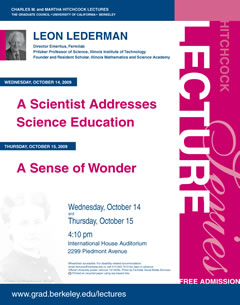
So I’m very pleased to be able to, uh, to introduce, uh, to you today, uh, for his second lecture of the week, uh, Professor Leon Lederman, physicist, Nobel laureate, former director of Fermilab, educator, and author. Uh, I’m not gonna give you a long biography of Leon because his talk today is really gonna talk about his life, and he can tell you about it much better than I can. But I did wanna say that I first met him when I went to Fermilab as a postdoc in the 1980s.
And it says something about Leon, first of all, that I always called him Leon f– even though I was a peon of a postdoc and he was the director of Fermilab at the time. And second of all, that I always felt very comfortable talking to him. He was somebody who used to eat in the cafeteria every day, and if you had a question about physics, you could just plop down next to him and ask him a question, and he would talk for hours.
Uh, he loved talking about physics, and he re-really felt that it was an important part of Fermilab that everyone feel that they were part of the community. So a-as I said, the lecture today is, is really going to, uh, to be about how Leon went from his start as a physicist through all of his great discoveries. But, uh, but as somebody who, who saw those discoveries both in the past, because some of his largest discoveries had happened when I was still a young student, but also saw them come to fruition later on, I just wanted to make sure it was clear to those of you who aren’t scientists in the audience, what a pivotal role he’s played in the history of our field.
Uh, the era where Leon was doing most of his science was an extremely important one. It was one where we went from having almost no understanding of what we now believe are the fundamental particles to where we’ve have a picture that, although it isn’t complete, allows us a framework for really describing what happens on a subatomic scale, hopefully all the way up to, uh, to– all the way up to very high energies and, and to what could happen in the early universe. And Leon played an important role in the discovery of several pieces of that.
The, uh, the thing he won the Nobel Prize for, the discovery of the muon neutrino, is one of the things that told us that matter had many copies of itself, that there was one– more than one family or generation of particles. And then later on, he showed us the same thing was true for the quarks as well as for the leptons as, as being the person who led the team to discover the bottom quark. He also played a very important role in making sure that the appropriate facilities existed to d-to do that science.
He was in-instrumental not only in discovering the neutrino, but in understanding how to produce beams of neutrinos. And when he was director of Fermilab, he was there during the construction phase and the initial operations of the Tevatron, the proton-antiproton collider that’s been the highest energy accelerator for the past twenty years and will continue to be until the turn-on of the LHC, hopefully at the end of this year. So with that, let me, uh, welcome Leon, and and I hope you all enjoy the talk.
And at the end, we will have time for questions, but, uh, I’ll step down now.
(applause)
[00:03:14] LEON LEDERMAN:
Um, so I’m gonna ramble, and I hope, uh, somewhere in this I will talk about, uh, physics and, uh, my experience in physics.
(coughing)
Um, but let me, uh, begin with a story. I was a graduate student at, um, Columbia University. That’s, uh, somewhere in New York. And, um,
(coughing)
we got a telephone call from a friend in Princeton, uh, asking whether we would like to meet Einstein. And, uh, we said yes. So, a friend and my, uh, uh, and I, uh, thought this was a joke.
You know, we– could we possibly meet Einstein? Is that doable? And our Princeton friend said, “Oh, yeah.
Yeah. He, he, uh, goes to lunch every day, and, uh, if you sit on a certain bench, I’ll show you where, uh, he’ll pass by and maybe, you know, he’ll feel like chatting with you.” So we drove down to Princeton and found the bench, and we were told to sit here and wait for the great- greatest physicist to pass by.
And sure enough, after a little while, there he came with his, uh, research assistant, I think. And, uh, there he was with his, uh, baggy pants and sweatshirt and, uh, sandals, I guess. And as they came close to us, we heard his assistant say, “Would you like to meet some students, Professor?”
“Ja,” he said, “Ja.” That meant yes. So we, uh, uh, sort of jumped up and he, uh, stopped with my friend first and said, uh, “What are you doing?”
That’s German for what are you doing? And, uh, my friend said, “I’m, uh, doing a thesis on, uh, quantum theory.” “Ach,” said Einstein, “You’re wasting your time.”
(laughter)
And I felt a little better because I’m an experimentalist, so I was doing experiments. So I told him, “I, I’m working, uh, on the properties of pions.” “Ah,” he said, “pions, pions. We don’t understand the electron. Why do you waste time with pions?”
(laughter)
“Okay, boys. Goodbye,” he said. And he walked off.
He had, uh, disposed of two brilliant, handsome graduate students in thirty seconds. Uh, but we didn’t care. We had exchanged words with the greatest physicist of our time, so we were really very happy.
Uh, it was quite an experience to, um, to have that, and, uh, I don’t know if anybody here is, uh, o-old enough to have met Einstein. Bruno, did you know meet Einstein? You see?
Okay. So I’m unique. I’m–
I talked to Einstein.
(laughter)
It’s, uh, quite a, quite an ex– it was quite a, a, an experience. Um, The um, uh, being a graduate student, uh, this was… I had spent, uh, some th-three years helping a guy by the name of Eisenhower with some problem he had in Europe, and it was called World War II.
And, um, so I had, uh, uh, and then, uh, as soon as I was able to, uh, uh, uh, manage, uh, being discharged from the, uh, military, I, uh, rushed to Columbia and registered, uh, uh, as a graduate student and, uh, started to study physics again. And I think that was probably the worst year of my life because I had forgotten how to study and had spent three years doing totally irrelevant things, and all of a sudden, I was back to studying and had forgotten how to study. I’d forgotten that physics was, uh, was fun.
Uh, I was having a, a terrible time and, uh, several times considered that maybe I’m doing the wrong thing, you know, working on, uh, trying to get an advanced degree in physics when I didn’t really know, uh, much about it. I had forgotten. And, um, that was a, that was a very, very hard experience for me.
And, um, then, then something funny happened. Uh, I, uh, had, uh, uh, been given a small room where I could, uh, begin to think about apparatus and think about, uh, doing, uh, some research. Uh, the chairman of the department was, uh, one of the founders of American physics, uh, Isidor Rabi.
And, um, uh, he had told me that this room would be the place where I would do some research. And, uh, I, uh, been away from that room for a couple of weeks working on preparing for a major exam and, uh, came back and, uh, entered the room, and there was a janitor mopping the floor and singing obviously some Italian song. And as soon as I came in, he sort of used this mop as a kind of a, a rifle.
He held it and he announced in, uh, very loudly his, presumably his name. It was Bernardini. And I said, “Yes, that’s very good, but be careful.
That mop is wet, and the wires there have electricity, and you’re gonna cause short circuits.” And he looked at me blankly, you know, didn’t understand a word I was saying. His English was not so good.
But later, I, uh, I, uh, came out of the room, and I decided to wait until the janitor was finished with his mopping. And Mr. Rabi was actually in the hall, and I said, “I see you have a, a new janitor that doesn’t speak any English.” He said, “You mean the guy in the room?”
I said, “Yes.” “Oh,” he said, “that’s not a janitor, dope. That’s Gilberto Bernardini, a famous cosmic ray physicist, and I hired him here so that he may be able to get you through your PhD degree.”
(laughter)
“Oh, my God,” I said.
(laughter)
So I rushed back in to repair my damage and start to communicate with this guy, Bernardini. And that was hard because his English, you know, he’s– I remember he’d come in in the morning and say, “Good night, everybody.” And he was
(laughter)
he was very friendly.
(laughter)
Uh, and, uh, but he was, uh, very funny. He had– I watched him. He had, uh– I realized that he was, uh, a famous scientist, He had very curious, uh, activities.
He would, uh, enter a room and push the light switch, and the lights would go on, and he’d look at the lights, and he’d say, “Fantastico!”
(laughter)
Now, that’s Italian,
(laughter)
and I think it means fantastic. And then he’d turn the lights off, lights off, turn them on again, “Fantastico!” Turn them off, turn them on again.
He kept doing this, you know. What? What?
Well, he, uh, seemed to think it’s just fantastic that you can push a button and the lights go on. Come to think of it, it is kind of, you know, wondrous that you push a button and the lights go on. I mean, we know that you could figure out that, uh, push the button, then some circuit closes, and a hundred miles away, uh, a motor drives, uh, some electricity, and eventually the lights go on.
But it was, for him, what I call a sense of wonder. He’d push the button, the lights would go on. Fantastic!
And that’s what he had. Every, everything he did, he seemed to take a, a certain amount of amazement. So we, uh, we started to communicate, and his English improved.
My Italian didn’t get any better. In fact, there was zero to begin with, still is. But, um, but he was, uh, someone who, uh, took a great deal of joy.
And then the first thing he did is he’d wanted to find out what was in this laboratory. And, uh, the thing that I showed him, I– was my despair. I had built something called a cloud chamber.
What is a cloud chamber? Well, it’s a box, uh, about twelve inches in diameter, maybe six inches deep, And, uh, it’s filled with, uh, some hydrogen gas and some alcohol vapor of some kind. And, um, uh, the notion was that if you, uh, pushed a button, the bottom of the chamber would collapse and the temperature of the, uh, chamber would change, and you were supposed to see tracks of particles.
And all I got was white smoke. I tried and tried, and my– It was a failure. One of my many failures was I couldn’t get this cloud chamber to do anything but white smoke.
And Bernardini looked at the chamber, and he says, “What’s that?” And it was a wire going into the chamber. And I said, “That’s my radioactive source.”
Gilberto said, “Dig it out.” I said, “But that’s– that gives me the tracks. That’s radioactivity.”
He says, “Take it out! Take it out!” So I took it out.
Tracks, beautiful tracks appeared. My radioactive source was about ten curies of some terrible ultra-radioactive stuff that was killing the chamber. So, uh, we learned.
Uh, what else did we do? Oh, yes. Then he showed me how to make a, um, a, a kind of Geiger counter.
So we, we did some machining. He showed me how to use the tools, uh, of the machinery and string a wire through the middle of this, uh, copper tube, and there was uh little insulators and the wire came out. And uh eventually we’d have the whole thing working connected to an oscilloscope.
And we were watching the oscilloscope and all of a sudden on the oscilloscope there was a sweep And then there were little bumps. And Bernardini went crazy.
“It’s counting,” he said, “It’s counting!” He starts screaming, and he was much shorter than I was and probably half my weight. He picked me up and started dancing around the room.
“It’s counting, it’s counting.” Well, this is a phenomenon he must have seen hundreds of times as a cosmic ray scientist. But he never got used to the notion that we were actually observing particles that came from millions and millions of miles away and came to the tenth floor of the Pupin Physics building at Columbia University and said, “Buongiorno.”
If that’s what he said. He said, It’s, it’s saying, “Buongiorno to us,” you know. Uh, it was kind of, again, a phenomenon that he must have seen I don’t know how many times, uh, but never, um, got used to it.
He, he had this, uh, sense of wonder that you can actually, uh, observe this object that came from so far away, and that’s what he would say. “He’s come to say Buongiorno to us, tenth floor, Pupin, Columbia University.” Uh, it was the beginning of a, of a, um, return to me of the, the, the fun of physics, because that’s what it was.
For him, it was a joy, and, uh, I kept learning from him, uh, how to also enjoy the physics. Little by little, um, that was, uh, uh, something that, uh, restored my, uh, enjoyment, first of all, because he was a lot of fun And, uh, he, he put on a lot of…
He was a good actor in many ways. And, uh, and I think he was doing a lot of this for my benefit, but it was certainly a learning process. Uh, and, uh, uh Uh, I think I was very lucky to, uh, have that experience because I needed that kind of restoration of, uh, of, of enjoyment and fun.
And, uh, uh, the thing though that was most impressive was this, uh, sense of wonder about the world. Uh, he never, uh, got used to it. You push a switch and the light goes on.
Fantastic. Fantastical. I should say it right.
Um, Uh, that, um, at one point, I remember, uh, he, uh, warned me that, uh, sometime a-as when you’re in, in physics, you’re going to, uh, uh, see something that nobody ever saw before. He sort of warned me about the, uh, the, uh, joy of doing science and discovering something that no one has ever seen before, And that was, uh, certainly a, uh, a major, uh, uh, uh, e-effect. And, uh, so I thought I’d tell you this story because it’s, uh, um, uh, uh, illuminating to find out had I, I– had it been someone else, maybe a more conventional kind of guy who might have also been a good teacher, that might have helped too.
But having this, uh, gentleman be so enthusiastic and, uh, uh, uh, so sharp and in his, uh, enjoyment of science was, uh, I think, crucial, uh, to my, uh, my experience and my career. Uh, the, uh– Some years later, I was now at Columbia. I was a professor.
I was doing research. I had my own graduate students, uh, and, uh, what he warned me of, uh, happened. It was three o’clock in the morning.
I don’t know why these things happen at three o’clock in the morning. I was, uh, doing an experiment. I was out in, in,
(coughs)
the fields of Illinois, and I was checking apparatus. The graduate students had gone to sleep, and I was looking at the equipment and, uh, began to study some of the output from one of the computers, and it looked very funny to me. Something unusual was happening.
And then out came what was something we had been waiting for a spectacular, uh, track, uh, proving the existence of, um, muon-type neutrinos, let’s never mind what that is, but it was something we possibly expected. And there it was, and all of a sudden, it was, uh…
(breath)
it made you breathless Your palms started sweating. You were nervous. Uh, something was happening in this apparatus that was spectacularly beautiful, and its implications were very deep.
It would make headlines all the w- all over the world. And, uh, it became hard to breathe. I tested things.
I checked. I– Everything I looked at just confirmed that at 4:00 a.m., uh, in, uh,
(laughter)
in, uh, uh, On a, a cold winter day in the fields of Illinois, I had, uh, good evidence of a discovery. I, uh, actually loc-located, uh, Bernardini. He was in fact visiting in New York at the time, and I had a telephone number, and so I called him.
I told him what I had seen. Well, by this time, many years later, his Fantastico had disappeared, and it was Americanized. And when I told him what I had found, out came, “Holy shit, no kidding.”
So, uh, that was, uh, uh, an, uh, uh, a magical experience, uh, certainly. Uh, some years later, uh, my wife Ellen, who’s sitting out there, and I were in Sweden. Um, Gilberto had come too to help me, uh, uh, receive the Nobel Prize.
Gilberto— Gilberto’s “fantastico” was ubiquitous. He was very excited by this. And I said to Ellen, I, uh, “Did you ever in your wildest dreams imagine that we would be in Sweden dining with the king and queen?”
And Ellen, very skeptical as usual, said, “You were never in my wildest dreams.” That’s the way it goes. Okay.
Well, uh, what can I tell you? Uh, uh, physics, the joy of doing physics once you get to the knack. And you’re lucky.
Luck is a very important is-issue. If anybody tells you what does it take, luck would be, uh, probably one of the first things you would opt for. Uh, and, uh, so, uh, and, uh, also, also so the other thing is the– your surroundings and being at Columbia University was a fantastic experience.
Uh, there was, um, uh, a sense of vitality to the thing. Times were, were appropriate, discoveries were, uh, on the horizon, uh, new apparatus was available. If I compare those, those lucky times to the poor, uh, opportunities we have today, certainly because of, uuuh, uh, the economic crisis and, uh, the difficulties of, uh, of, uh, pursuing experiments at high cost and complicated, uh, uh, re– apparatus and so on.
Uh, we were very lucky in those days. And, um, uh, the big problem today is to try to maintain, restore, and improve the op-opportunities for young people to have the kind of experiences I had, uh, in, uh, in my graduate school days at Columbia. What else can I tell you?
Uh, that’s the, uh, uh, the– a major thing. I do want to say a few things about, uh, opportunities. One of the things that I got interested in and talked a lot about yesterday was science education.
And but what I didn’t talk about is, um, a, uh, a school, uh, uh, that I had the, uh, good luck and maybe a little bit of wisdom in starting, uh, in Illinois It’s called the Illinois Math and Science Academy. I was, uh, a-as a director of the, uh, Fermi Laboratory, I was interested in students and in education, and, uh, we had a lot of, uh, opportunities to invite students to come into, uh, the laboratory and to take courses. There was Saturday morning physics courses and, uh, out of that, a proce-procession of, uh, young students that would come into the laboratory, and that kind of inspired me because I realized that, uh, the average schools, uh, so in, uh, the Chicago area in Illinois were not, uh, exceptionally, um, good at teaching young people.
And so I, uh, uh, got involved in this thing and, uh, organized, uh, something called the Illinois Math and Science Academy, abbreviated IMSA, I-M-S-A. Uh, it was a, uh, special school. I, uh, had to see the governor of Illinois.
This was one of these governors who happens not to be in jail. I mean, it’s un- It’s unusual for Illinois, but this, this was an okay governor, and he was intrigued by the notion of, uh, creating a special school in Illinois.
I told him about the– I mean, he had knew about the famous Bronx High School of Science, and I said, “We need a Bronx High School of Science out here in the prairie of Illinois.” And, um, he, uh, authorized the existence of a special school, uh, for gifted young people, uh, in which the school itself, uh, would also be a, uh, a place where students could live in. It was a residential public school that would, uh, carry students through the last three years of high school, and that, uh, opened in 1986, and, uh, first graduating class was in 1989.
So it’s, uh, well over twenty years now producing some of the most brilliant and, uh, students. Uh, these were all, uh, restricted to the state of Illinois by the law, but it was a, uh, fantastic experience, uh, especially since, uh, uh, within the last, uh, month or two, um, uh, the Intel Foundation, which Intel is a huge, uh, electronics company, and they, uh, uh, spend a lot of money on, on education, on science education. And, uh, uh, they had, uh– they, uh, uh, organized a, uh, study of, uh, schools, and I was very happy to learn not so long ago that, um, the Illinois Math Science Academy was given what’s called the Intel Star Innovator award, and as, as the best science high school in the nation.
Uh, they had tested some seven hundred schools, uh, for us to win this particular award, which was, uh, Certainly, uh, uh, gratifying. Uh, some of our graduates, uh, we by now have, uh, have had, uh, uh, huge, uh, uh, careers, uh, in, um, in science, but not only in science, but in all subjects. Uh, but the notion of, uh, of giftedness and taking care of this notion, this, uh, idea that young students who have a gift should be encouraged, uh, and, and the best possible way was, uh, something that I was– I believed in and still believe in this.
And the Ill-Illinois Mathematics and Science Academy is a fantastic school. If you’re ever discouraged or, you know, feel, uh, uh, that you need to, to cheer up or so on, I invite you to come and visit the school. It’s, uh, about thirty miles west of of Chicago, very close to the, uh, uh, Fermilab, where you could– you’re also invited to visit.
But the school itself is a, um, has this fantastic group of students, uh, that are, uh, increasingly making their way in the world. Uh, of course, this is a high school, but the, uh, uh, push they get towards, uh, higher e-education is, is enormous and gratifying. Uh, and I– every time I feel a little, I need more encouragement, I’d go to the school and sit there and chat with the students.
We now have four thousand, uh, graduates. Then we graduate, uh, something like, uh, two or three hundred students a year. Uh, they go to the universities everywhere.
I’m sure there are, uh, many of our students are here at, uh, uh, California. Uh, but, uh, to take special care of giftedness is, is an important thing. It’s not the only thing you want to do in education, but it is an important issue because these are the students who will become the doctors and the, the, uh, wise people, uh, that will, uh, uh, uh, sustain our society in the times to come.
I think I’m rambling now a little bit, so perhaps this is a good time for me to pause and see if you guys have any questions or challenges. If you challenge me, I’ll, I’ll quit. And, uh, uh, or I can tell you more about the, uh, the Illinois Math Science Academy or whatever.
[00:30:13] SPEAKER 1:
Do you want to tell a story about the… picking of famous scientists like you told me earlier today?
[00:30:19] LEON LEDERMAN:
About the what?
[00:30:20] SPEAKER 1:
The- The famous– The… For them to write about the famous scientists, living scientists?
[00:30:25] LEON LEDERMAN:
Oh. Uh, well, uh, you mean the book?
[00:30:28] SPEAKER 1:
Yeah.
[00:30:29] LEON LEDERMAN:
Well, that’s, that’s one of the projects we did. Uh, the, uh, Illinois Math Science Academy, uh, uh, has projects, and one of the projects, uh, we had was for each of these students to pick, uh, a famous scientist and write a biography of the scientist. Now, it’s interesting that when you challenge them to name a famous scientist, and I say not, n-no-nobody present company, you know, just pick a fa– name of a famous scientist.
They were silent. They didn’t know any names of scientists. So I said, “Okay, well, you have subjects you like.
Uh, uh, look up the subject and find a scientist who’s active in that subject.” And eventually, uh, they did. Uh, that was one of our interesting projects because, um, they then, uh, there were fifteen students, and they picked fifteen scientists, and I, uh, told them that they, uh, then did research on what the scientists had done and,
And at some point, I said, “You have to interview the scientists.” “Well, how do we do that?” Uh, so I called up, uh, a lady by the name of Claudia Dreifus, who writes for The New York Times, and she writes a, an article periodically, uh, a biograph– a biography of Some living scientists.
And, uh, so I actually– she came and, uh, very kindly gave these kids a lecture on how you interview scientists, what do you ask, how do you ask questions, how do you keep the conversation going. And as a net result, each of these students wrote, um, an essay. I warned the scientists that they picked, the ones that I could reach on the telephone, “You may get a funny telephone call from a high school student.
Please be kind. “He’s d- gonna write a biography.” And eventually, that’s what happened.
They, uh, wrote biographies, and I put them together and called a publisher I knew, and he said, “Oh,” he’d be delighted.” So there’s a book called, um, uh, Structure or I’ve, I forgot the exact title, but it had to do with famous American scientists. And these ki- each of these kids is now an author of a book.
The book has these, uh, delightful stories of the scientists. They kids emphasized, of course, the, uh, high school experience of the famous scientists. I think, uh, you must know some of them here.
Charlie Townes is in the book. And, uh, uh, these, uh, students wrote, uh, um, a really lively story of, of these scientists. That was one of the projects, uh, the students had.
Uh, So, uh, again, uh, I wouldn’t mind, uh, answering any questions or, uh, listening to, uh, better stories on, uh, experiences of various kinds.
[00:33:39] MARJORIE SHAPIRO:
Okay. So we’re going to ask people to come up to talk because we’re recording, so please talk into the microphone and just, uh, make a line in the center if you’d like to ask a question.
[00:33:52] AUDIENCE MEMBER:
Um, Einstein has, has said that, uh, David Bohm, David Bohm is his intellectual successor?
[00:33:59] LEON LEDERMAN:
Yes.
[00:33:59] AUDIENCE MEMBER:
So what do you think about David Bohm’s quantum theory?
[00:34:04] LEON LEDERMAN:
David Bohm. Well, uh, he’s a very interesting guy, but I don’t–
I mean, I think if you want to learn quantum theory, There’s, there, there are probably, um, better, uh, educational books on quantum theory now. than– He– His– I think his book is, was, r– is rather old, and I don’t remember… I can’t really tell you whether it was one of the better books, but by now you can find some really good quantum mechanics books, uh, available that are more modern, more up-to-date.
David Bohm was an interesting guy, uh, but that’s a complicated story, uh, of, of his problems and so on. I think he, uh, he was, uh, uh, actually when he was in, in, in real political troubles, many of us were very sympathetic to his point of view.
[00:35:02] SHERRY HSI:
Hi, I’m Sherry Hsi from the Exploratorium, a museum in San Francisco that was founded by Frank Oppenheimer back in nineteen sixty-nine. Right. And I’m wondering, did you visit museums when you were a kid? And did you know the Oppenheimer brothers? And if you can tell some stories about that.
[00:35:18] LEON LEDERMAN:
Uh, museums, yes. Yes, there was, uh, New York– I always lived in New York City, and we had, uh, a plethora of museums, and I loved to go to museums, especially the Museum of Science and Industry in Manhattan. And, uh, I certainly went to museums.
Now, you asked about Oppenheimer. I, uh, I knew both Frank Oppenheimer and, and, uh, and what’s the… Huh?
Robert Oppenheimer there. Uh, that, that was part of our life. Uh, it was a political, uh, problem.
Uh, uh, the story of Oppenheimer is, uh, is well documented. There are several books on the subject. Uh, he had a, uh…
He was, of course, a, a heroic figure in World War II, uh, having led the research which led to the nuclear bomb. Uh, then he was, um, I think, uh, dumped on by, uh, uh, because he, uh, was a, uh, a free thinker and, uh, uh, although he, he, uh, made a huge contribution to the, uh, to the war effort in World War II, uh, he was unpopular in the military and, uh, they eventually, uh, uh, for s- reasons which were very complicated, uh, he, um, his, um, efforts to, uh, uh, help the United States were thwarted by people who thought politically he was not correct enough for them. Uh, and so he, um, retired to Princeton, where he, uh, uh, was director for the, of the Institute for Advanced Study.
But his scientific career was sort of ended by a dramatic experience he had politically.
[00:37:23] SPEAKER 2:
Uh, Leon, I wondered whether you’d, uh, t-talk to us a little bit about your experiences in the end of nineteen fifty-six when, uh, violation of parity was, uh, discovered.
[00:37:36] LEON LEDERMAN:
Ah, fifty-six, parity. Parity, yes. Let me try to reme- remember what happened. Um, uh, there, uh, I’m r- I’m really drawing a, a kind of blank as to the sequence of events, uh, which, uh-
[00:37:55] SPEAKER 2:
Let me ask more, let me ask more specifically. I mean, when, when did you hear about Madame Wu’s result, and when did you start doing experiments yourself?
[00:38:03] LEON LEDERMAN:
Yeah. Thank you.
[00:38:03] SPEAKER 2:
And what did you know about other people who were racing to get the result at the same time?
[00:38:07] LEON LEDERMAN:
Yeah. Well, we, we, we had the, uh, big benefit at Columbia of having, uh, Tsung-Dao Lee, who was a professor of physics at Columbia, and he was one of the authors, uh, along with Frank Yang, of the, uh, of the notion that, um, uh, that, uh, one of the, uh basic laws, uh, of physics, um, which we all believe in, which was conservation of parity, uh, might not be, uh, actually a valid, uh, idea. And, uh, there was, there was, uh, evidence, uh, if I remember right, uh, from various, uh, experiments to indicate that perhaps one of these basic sacred laws of physics we all thought was certainly valid, uh, might in fact, uh, not be valid.
And, uh, uh, so and– And they gave a series– they actually, uh, proposed a series of experiments that might, uh, test the validity of this notion. One of the, uh, dramatic, uh, consequences of this has to do with, um, with mirror symmetry.
That if you look in a mirror, uh, let’s say one wall of this, uh, room is a mirror, and all of you guys are doing experiments, and the guys in the mirror are, of course, doing the same experiments. The question is, um, uh, is the, is the symmetry such that, uh, both, uh, the mirror experimentalists and the real experimentalists get the same results? And, and ninety-nine percent or more of physicists would say, “Of course, you must get the same results because that’s just the mirror image of what’s going on here.”
But much to everybody’s surprise and to the wisdom of, uh, Lee and Yang, uh, they, uh, decided that perhaps the, uh, symmetry was not perfect, that there was a vi– there was a violation of mirror symmetry, and that the mirror world was not precisely the same as our world. And they, uh, made that part of their, um, uh, paper, which gave rise to the notion of, well, can we do– can we check this experimentally? And of course, the stairs– story was that, when, when experimenters, uh, now full of doubt about the validity of mirror symmetry went at it and made it, made tests.
We found, in fact, that the mirror symmetry between the world and the mirror world was not perfect, but it was imperfect. That was a major discovery because for, for, uh, fifty years or so, people believed that, uh, the mirror world and the real world were, were identical. You know, how can, how can it be different?
But it turned out that, uh, it was known as the, the mirror symmetry was broken. It was not a correct symmetry, and that made a big change in our philosophy of how particles behave. That was, uh, that was very exciting.
You know, every, every once in a while, you get, uh, uh, epochs of great excitement in physics where, where, uh, you rush in to do an experiment and you are not sure you know what the results will be. And it’s the greatest joy when in fact it turns out that the kind of results you, uh, expected don’t turn out to be the correct results, but something totally different takes place. And that’s what happened during the, the parity days.
We discovered by careful experiments that the, the mirror world and the real world are actually different. There are differences. And, uh, that was, uh, a period of great excitement.
Now we’re used to it. We understand, uh, the violation of mirror symmetry.
[00:42:16] AUDIENCE MEMBER:
Yeah. Uh, uh, Professor Lederman, uh, what– uh, do you remember, what were you doing?
[00:42:23] LEON LEDERMAN:
Make a little space between you and the microphone.
[00:42:26] AUDIENCE MEMBER:
What, what were you doing when the Nobel Prize committee notified you have won the Nobel Prize? And what’s your first, uh, what’s your feeling in the first time?
[00:42:38] LEON LEDERMAN:
Can someone tell me what? Yeah. What, what- Thank you.
[00:42:42] MODERATOR 1:
Yeah. When you got the call-
[00:42:44] LEON LEDERMAN:
Uh, I think– I li– let me, let me say that winning the Nobel Prize is something I recommend very highly.
(laughter)
It really is a lot of fun. Uh, this, uh, uh, probably, uh, as usual, it happens late at night. You get a telephone call.
I think in this particular case, or one very much like it, my wife had the phone, and we sort of suspected that there would be an award. It was rumored and so on, and, uh, she got the telephone call, and she said to me, “We can’t go to Sweden because I have a dinner date that night.” And she handed me the phone, and, uh, she was kidding, of course.
So I recommend winning a prize very highly, I think. It’s a great thing to do.
[00:43:37] STUDENT:
Um, I was actually a student of yours at Columbia.
[00:43:40] LEON LEDERMAN:
You were?
[00:43:41] STUDENT:
Yes.
[00:43:42] LEON LEDERMAN:
Oh, yeah. You sat in the third row-
[00:43:43] STUDENT:
You gave me an A+ in Physics eight- in nineteen. But, um, and was an undergraduate and graduate student during most of those years, uh, I, I got my PhD with Charlie Townes and, um, it was amazing to me, and people have remarked on that, that almost every professor I had who had, you know, won a Nobel Prize. And the…
And I was wondering if you had, when you were there, had a sense of this being some sort of golden age- or the other people being, uh, uh-
(throat clearing)
[00:44:22] LEON LEDERMAN:
Well, uh, as, as a graduate student at Columbia, uh, we had a button made, uh, uh, which we wore, for occasionally called Not Yet.
(laughter)
And that’s because the faculty at Columbia was loaded with Nobel Prize winners. There was Rabi, there was Townes, there was Willis Lamb. There were, you know, it was just this star-studded faculty.
And so the graduate students would, you know, feel a little bit awkward about this, so we got this nice button saying, “Not yet,” which was a sense of, uh, wild optimism that something good would happen to you. But cer-
[00:45:00] STUDENT:
Yeah, I, I, I think of two experiences. First of all, I had a lab on the tenth floor of Pupin also.
[00:45:05] LEON LEDERMAN:
Oh, yeah.
[00:45:05] STUDENT:
But I remember one, one morning, um, doing experiments, staying up at night and coming down the elevator, and I was in, in the elevator with, um, Lee and Kusch and Rabi, actually. And, uh-
[00:45:21] LEON LEDERMAN:
Three Nobel laureates.
(laughter)
[00:45:22] STUDENT:
Yeah, I couldn’t resist. It’s the only time I had that much chutzpah. I couldn’t resist saying, “Do you guys realize I’m the only person in this elevator who doesn’t have a Nobel Prize?” It’s a gutsy thing for a graduate student to say.
[00:45:36] LEON LEDERMAN:
Well, it was a great department, and having those people around, uh, was, uh, uh, a, a fantastic experience. Uh, and even, even, uh, uh, somewhat lesser, uh, creatures like, uh, uh, the Bernardini story who, uh, uh, uh, would always say, “Fantastico!” You know, what you learned there was a sense of wonder in physics that you, you learn something, and it’s just beautiful.
That in fact was a, uh, comment, uh, made to me by, uh, uh, some time ago by my senator in Illinois, who’s now the president of the United States, and we had a conversation on, uh, on, on physics. He seemed to know a lot about it, and what he said was amazing to me. He said, “The thing about science, and especially physics,” he says, “is when you guys make a discovery, it turns out to be beautiful.”
Now, that’s– that was sh– uh, a surprise because to say that something in physics is beautiful is something that physicists say all the time, but not when outsiders are listening. You don’t want, you know, you bragging about the fact that the subject is beautiful. But here was a, a layperson, in a sense, who recognized the beauty of science.
So I’m very happy about having him in the White House taking care, care of, uh, hopefully at some point, uh, supporting, uh, the increases that he really understands we need in research, uh, and education, which is what we’re all devoted to.
[00:47:21] STUDENT:
I have to say, I remember among all the professors that you really communicated that. I think, uh, this was the, I don’t know. There was some sort of honors physics for smart freshmen and, uh, like sophomores, and I think the, the last semester was optics and atomic physics or something.
Maybe that was the most beautiful of the three subjects.
[00:47:45] LEON LEDERMAN:
Right. There’s a guy behind you who’s bigger, and I would get out of his way.
[00:47:52] AUDIENCE MEMBER:
Uh, Professor, what in current physics research do you find particularly exciting?
[00:47:58] LEON LEDERMAN:
Now?
[00:47:59] AUDIENCE MEMBER:
Yes.
[00:48:00] LEON LEDERMAN:
Oh, gosh. Well, I think, uh, it’s very clear to me that what, what, uh, there’s… We’re in an epoch, I think, of, uh, incredible discovery.
(breath)
Uh, you can take a deep breath And you sort of can sense discovery in the air. Part of this discovery comes from astrophysics.
Uh, you know, there’s a, a new subject called particle astrophysics. It’s the, the particles are the smallest things we know about in the world, and the astrophysics are the large things that have to do with, with, uh, galaxies and, uh, stars and so on. These two subjects are sort of joined by phenomenon that bridge both, both subjects.
And, uh, uh, so this is, uh, an ex– a very exciting time, and what will cap the excitement will be the new machine that’s under construction. Hopefully, uh, we’ll start we’ll start working within the next months of s- s– uh, in, in, um, in Switzerland, in Geneva. Uh, the, uh, Large Hadron Collider it’s called.
That, that’s going to, uh, be like a new telescope. Telescope. Remember Galileo, you know, looked with a– made a telescope and looked up and discovered the moons of Jupiter and so many things, in fact, started, uh, scientific astronomy and, uh, this new machine that’s, uh, under construction in Europe, which is now participated, so all of the major nations are participating in this, this, uh, will, uh, certainly, uh, give us new phenomenon and, uh, will help us understand many of the puzzles that are, are bothering us right now that have to do with astrophysics and, you know, dark energy and dark matter phenomenon.
And we’re in an exciting time. I wish that economically, uh, uh, uh, we would, uh, uh, overcome our present, uh, difficulties, uh, and, uh, begin to really, uh, uh, uh, acc-accelerate, uh, the, the kind of research that, uh, will reveal what’s going on. Yeah.
[00:50:23] MODERATOR 3:
Leon, when you were a kid, was there some experience or-
[00:50:26] LEON LEDERMAN:
Still a kid, huh?
[00:50:27] MODERATOR 3:
Oh, that’s right. But, but that started you down the path to become a physicist instead of, say, a Wall Street wizard.
[00:50:35] LEON LEDERMAN:
So… Uh, I tried Wall Street, it didn’t work. Uh, why did I get into physics?
Uh, actually, in the beginning, I was, uh, uh, in high school and early college, I was a chemistry major. Uh, but, um, little by little, I turned to physics because chemistry was complicated and physics was simple. At least I– so I thought.
And, uh, the, uh, the physicists in the area were more dynamic, if you like, and physics, um, had a great attraction because in some ways it was very simple. You know, you dealt with a particle or two particles and so on, and chemistry was very complicated with all kinds of molecules sticking out in all directions. So I thought, uh, physics was, had, had a kind of appeal, uh, because of, ultimately, it looked for the simplicity and tried to make the most of understanding the world that, that we live in.
So I think that was a, for me, a very good choice is to, is to stay with physics. Well, some of my best friends talk to chemists.
(laughter)
[00:51:48] AUDIENCE MEMBER:
Uh, when you think, uh, back, uh, to the, the history of mankind, uh, can you mention two or three inventions that were most, uh, beneficial?
[00:51:59] LEON LEDERMAN:
Inventions. Well, inventions sort of imply something that’s useful, like, you know, I don’t know, automobile invention. Uh, that’s a good question.
If I can think of discoveries, maybe that’s a better word than inventions. Uh, and clearly, uh, the fact that we can understand so much of the world in which we live is already a discovery. I think that’s important to know.
That we, we can understand, you know, we can predict, uh, Halley’s Comet will appear 2061 at 3 o’clock in the afternoon on a Thursday, and pretty much we can get it right. So we know a lot about the world in which we live, but there are a lot of things about the world in which we live that we don’t understand. And the challenge of understanding those is very great and important.
Uh, we have lots of uh, facing us, uh, in environmental problems and, um, social problems and economic problems. And, uh, uh, but, uh, understanding the world, I think, and understanding the world in which we live in a thorough and deep way is one of the major th- tasks we have. And, uh, This is something that, uh, mankind has, uh, been concerned with for a long time, and it’s still there.
That we do, we do have so many things we, we need to understand better than we do now.
[00:53:36] JOHN REAGAN:
Hi, uh, John Reagan. I’m a electrical engineer, uh, degree here, uh, from Berkeley. And, uh, as an engineer, following on kind of the, the last gentleman’s question about, uh, inventions and, and your kind of response about, uh, discoveries, um, as an engineer’s job in the world is to take, uh, the knowledge from science and the, uh, desires and needs of humanity and come up with, uh, things that improve the world for, for people.
Um, so I’m not a physicist. I’ve had some physics classes, and recently I have read that, um, um, there is some discussion in the physics community about how certain parameters, physical parameters are, um, so precise, and if they were very s- even slightly off, um, major aspects of our physical world would not, um, come into existence. Um, so what I’m wondering is if, i-is, is your th- your thought about this.
Um, a-as an engineer, I think that if our, if our world came from, uh, from what little I understand, our world could have come out of nothing, or perhaps our world came from, um, uh, deliberate conscious thought by an entity with mental capabilities. And if, if that was true, that, that entity that did the thought and created the physical parameters of our world, uh, must have in, at least in part, have been an engineer. They were attempting to cr-create something.
Of course, they would have also been a, a scientist, maybe a mathematician, a philosopher, other things also. But y-just, uh, given the precise nature of certain physical parameters, could you tell me what you think, um, uh, thoughts about if our world was, uh, had a designer or what you think about what maybe, uh, what, what, what would be useful to speculate, uh, a-about that? Thank you.
[00:55:51] LEON LEDERMAN:
Well, it’s, uh, you’re over my salary level in a way
(laughter)
. Uh, if I had, uh, more, uh… Uh, my problem is I don’t know enough engineering to answer your question, but it’s, uh, it’s too profound.
[00:56:09] MARJORIE SHAPIRO:
Okay. With that, I’d like to, uh, to thank, uh, Leon for his talk, and thank all of you for coming.
(applause)