
[00:00:00] SPEAKER 1:
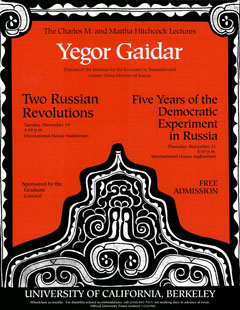
On Tuesday, Dean Cerny spoke about the history of the Hitchcock Lectures and gave the formal highlights of Yegor Gaidar’s distinguished career. Today, I would like to speak a little more personally about Dr. Gaidar. He studied economics at the Moscow State University from nineteen seventy-three to nineteen seventy-eight and was awarded the PhD at the age of twenty-four in nineteen eighty.
Thus, he began his studies at the height of the Brezhnev era. He and a small group of students, working largely alone, studied Western economic thought. It would have been much easier to conform to the prevailing orthodoxy.
These students had no support from the faculty. They had to explain why they wished access to Western economic texts, knowing that these requests would be monitored. Their job prospects must have appeared very bleak.
Indeed, their personal freedom was far from assured. It is easy sitting in Berkeley in 1996 to overlook the determination and courage that Dr. Gaidar and his fellow students demonstrated at that time. But we must recall that during the McCarthy era, many left-leaning faculty were hounded out of American universities, including Berkeley.
So if we recall the danger of pursuing unorthodox studies in America in the ’50s, we can appreciate the courage of those who did so in the Soviet Union in the ’70s. Over the last four days, a large number of people on campus have had the opportunity to listen to formal presentations by Yegor Gaidar and to engage in private discussion. I have been struck by the number of people who have commented to me on Dr. Gaidar’s candor, his willingness to give open answers to any question, and an honest sense of humor.
I hope we will see more of these qualities this afternoon as he discusses five years of the democratic experiment in Russia. Yegor Timurovich, пожалуйста.
(applause and cheering)
[00:02:08] YEGOR GAIDAR:
Dear friends, on the previous lecture, I tried uh to explain my views on the developments in Russia ’91, ’93. Uh, developments which, from my point of view, could be compared with the Russian Revolution of the 1917, with all of the different directions and the different stages of development. I think that, uh, in autumn ’93, the revolutionary stage of the Russian post-socialist transition were mostly finished.
Power was consolidated, dual power eliminated. Uh, the result of the dual power as usually it is, especially as usually it is in Russia, was very serious strengthening of the executive power, probably with the appearance of the autocratic tendencies here. Uh, the markets were more or less established.
Convertible currency existed. Crisis of the food supply all over us, all finished. But, uh, that doesn’t meant that, uh, we were not facing a very, very serious problems anymore.
And, uh, from my view, view of many of my colleagues, the crucial problem that we were confronted in August ’93 was the problem of whether we will be able to consolidate democracy, democratical mechanisms in Russia, and whatever we will be able to prevent a second communist experiment in our country. It was evident that two years of revolution were terribly difficult for the society, as every revolution is. It was a time of radical changes, and radical changes are always painful.
Some people are getting something, some people are losing something. Those who are getting usually do not incli- are not inclined to thank the government for it. Those who are losing, of course, do understand that it’s because of the government.
Uh, Some problems were resolved, and many of them quite pressing only two years before, like for instance, terrible shortages of food, et cetera. But when the problems are resolved, then they are not anymore in the center of the public conscience, of the public discussions, but another problems appeared, and they, that problem started to be in the center. The problems of the new poor, the problems of the, uh, deterioration of the social status of the many structures of the population, including those engaged in the intellectual professions, et cetera.
So it was evident that we are confronted with the very, very difficult tasks of consolidating the support to the democracy, democratic reform, and market economy in our country. We have seen by the experience of our friends in Eastern Europe, that all of the pain of the transition, even in the situation which were the situations which were much easier than Russia, the Russian situation usually creates the precondition for the communist, post-communist parties’ victories on the second crucial elections after the start of the reforms. We have seen it in Poland, we have seen it in Hungary, we have seen it in Lithuania, we have seen it in many, many places.
Also, we were very much aware that our Communist Party is not the nice, not dangerous guys of Eastern Europe. They are real and serious communists, and their victory, the democratical victory in the democratical elections, could mean a serious blow to the possibilities of market and democratical development in our country. So our task was to somehow elaborate the strategy of economic and political reforms which will minimize the risk of the communist victory, which will strengthen the support to democratic and market institutions, which will create for us the possibility to prevent the second communist experiment in Russian history.
Well, really, that was, uh, uh, the time of a very, very intensive debates in the Russian government, generally around President Yeltsin, of what should we do in this situation when now we have consolidated power, when the possibility to move forward are much bigger than they were only a few months before. It was my position, position of many of my, uh, colleagues and supporters, that now it is exactly the time to start a very, very rapid and radical and serious reforms in many fields of our social life. It’s exactly the time to cut down drastically the inflation rate.
It’s exactly the time to start a serious military reform, cutting down the numbers of, uh, those engaged in the military, increasing the social standards of those who are in the army. It is the time to start serious land reform, granting to the peasants possibility to own and the land on which they are working. It is the time for a so serious social reform, making our system of social protection more targeted, et cetera.
So exa- of course, it was evident that all of these reforms would not be easy. These reforms would be painful in some directions, but if we will start them immediately, if we will start them in the autumn ’93, winter, spring ’94, we will end year ’94 with a low inflation, with a financial stability in the country, low interest rate, with the most painful reforms already implemented. We will have the preconditions for the economic growth in the ’95, so we will enter the election year of the year ’96 with a growing economy, low inflation, financial stability, working market, so we will be in a position to show to the people the practical results of the reforms.
It was our position, and the position of our opponents was that, well, it was a difficult years. Maybe we pushed forward too rapidly, too energetically. It is the, the time to slow down, not to be in a hurry, to move gradually, maybe to wait and see a little bit, so not to add additional, uh, burdens of the reforms on the population, which is already suffering from the adaptation to the new realities.
So try to calm down and try to do nothing. It was really a very intensive debate and a very intensive discussion, uh, during which we were preparing to the parliamentary elections of the year, of December ’93. Well, to tell you the truth, economically it was, uh, quite evident for us how to win these elections.
Uh, already we were very well aware about the time lags between money supply and the price dynamics in Russia. These time lags at that time in the autumn ’93 were approximately five months. So for instance, if after October events, in October, November, early December, we would rapid– start rapidly printing money, we would finance all of the arrears on the wages, pensions, etc.
We would pay to everybody everything. We will show to the population how nice it is when we, when we are not confronted with the constraints of the anti-reform Supreme Soviet. Of course, it was evident that it was rather easy to win parliamentary elections, and only then, only in January, February, March would be– when we would be well represented in the parliament, would be confronted, we would be confronted with the terrible consequences of this irresponsible policy.
To tell you the truth, from the beginning, we rejected the idea that that this approach is possible. Even even now, when I’m considering the consequences of this decision, I think it was right. We just could not allow this type of adventure.
So even before the elections, we were, uh, trying to implement a few rather conflicting measures. Just before the elections, we eliminated privileged cri- credits to the agriculture, bread subsidies, subsidies to the imported food, started to increase the price of the house. So we were doing what was necessary to do on the, uh, reasons of the economic logic and financial common sense.
Well, the results of the elections of December ’93 were mixed. We got better parliament than the previous Supreme Soviet. We, Russian Democratic Choice, got the biggest fraction in the Russian parliament.
But still, the parliament was very much divided, and, uh, the results were much lower than the expectations. So generally, in the society, the results of December elections were regarded as a defeat of the democracy, democrats, and the radical reformers. Of course, it influenced the final solution of Yeltsin.
Well aware of the es- about the essence of our debates after the elections, uh, of December 1993, he decided that probably society really wants to calm down, not to hurry up with the reforms. to not to indulge in a serious conflicting experiments and a different side of the social and economic policy. So when it was evident that we could not get a presidential support for the reforms we would like to implement, it was a time for us to decide whether, uh, we should stay in the government or we shouldn’t.
It was my decision that we should not, because, of course, uh, we could stay in the government and, uh, uh, be shown as a, a symbol that the reforms in Russia are still continuous, et cetera, et cetera. But, uh, uh, we would not be practically in a position to implement the policies we would like to. So then, why to be present there?
So that’s wha- was the moment when I decided that I have to resign from the government, and, uh, uh, I think even now that it was the right decision. Well, after, uh, my resignation and the resignation of my colleague, Minister of Finance Boris Fedorov, uh, this attitude of wait and see, uh, definitely prevailed in the government. Uh, in the rhetorics of the government of the, of that time, you can hear about non-monetary ways of fighting inflation, about, uh, necessity to, uh, finish with this economic romantics, et cetera, et cetera.
Well, uh, the results of these changes in the policy were very rapidly to be demonstrated. But also here, the phenomenon very well known to the economists, the time lags, played a very, very interesting joke with the Russian politics and with the public perception of what happens in the economy. If the time lock is from five to six months, you would understand that the results of our tightening of the monetary policy of autumn winter nineteen ninety-three, first of all, would be well, very well felt from winter to the spring and to the summer.
So inflation, which was twenty-six percent in August nineteen ninety-six, was going down and was thirteen percent per month in, uh, December nineteen ninety-three, and was going down to something, uh, lower than five percent at the early summer ’94. And that was exactly in the ti- the time when the government decided that it should not be very strict with the finances, that it could allow a lot of compromises, that it could allow to increase the money supply, that it could allow additional cheap credits to agriculture, et cetera. So, uh, this spring of nineteen ninety-four was a very, very specific combination.
Government started to print money with a higher and a higher speed, and the inflation was going rapidly down. So the government officials, uh, the leadership of the government got this splendid notion that they found at last the uh, mirac- miracle ways of dealing with economic policy. You’re printing more money, and the prices are going down.
You’re printing even more money, and the prices are further going down. Splendid. The problem with this policy is only one, that it would not last for long.
And, uh, in the summer ’94, it was evident that the results of this easy monetary policy of early ’94 are starting to be demonstrated. First of all, it’s usually in the unstable markets in a radical change on the dynamics of the demand for hard currency. Well, from July, markets understood that the exchange rate is comp– incompatible with rapidly increasing money supply.
When in August, uh, the government added additional, uh, added additional 10 trillions of rubles of the cheap credits to agriculture, it was evident that the exchange rate inevitably would explode. So, uh, the central bank and the government made a few mistakes, the result of which was rapid deterioration of their hard currency reserves, and then inability of the central bank to control the exchange rate anymore. It ended in so-called bla-Black Tuesday in October ’94, uh, depreciation of the ruble in one single day by more than 30%, uh, rapid acceleration of the inflation, which once again at the end of the year ’94 was approximately five times higher than in summer ’94.
So all of our– of the results of our efforts of the autumn, winter ’93, ’94 were liquidated. Inflation once again was very high. Hard currency reserves which were accumulated during ’92, ’93 disappeared.
Uh, Port rate, which usually goes uh, in our, in our economy with inflation, was rapidly going up. It was evident that the result of this easy financial policy, of this fight with the economic romanticism, were disastrous for the Russian economy, which was especially bad news was that all of these financial adventures were combined with political adventures. Political adventures especially dangerous because they were tried in a very dangerous region, in the North Caucasus.
Well, uh, I would not really like to start, uh, uh, all of the story of the Chechen conflict and, uh, uh, the Russian pol- policy of the Russian government to, to, toward Checheny. But in ’94, uh, sp- spring and summer ’94, it was evident that, uh, the Dudayev regime, regime of the, the Chechenian leader Dudayev, is in a very, very bad shape. That Dudayev is losing control over the situation in Chechnya itself.
Economic conditions in Chechnya are terrible. Uh, that Dudayev is very much prepared in this situation to negotiate. So it was exactly the time to start calm negotiations, to create for the Chechenians the honorable way of dealing with the problem of their independence, to start calming down this conflict, which was terribly, terribly dangerous.
But, uh, in, uh, uh, the circles then around Yeltsin, another view prevailed at the moment. Well, in December ninety three, we have seen how popular are the ideas of the imperial Russia. Dudayev is weak.
So what we need now is a small victorious war. We will use the force, we will show who is the master, and that will add to the popularity of the regime. With this, we will go to the next presidential elections.
(laughter)
You see, uh, uh, I would really not go– like to go to the personal details, but this story of Chechenyan conflict at the start of the Chechenyan war show very well how, how terrible harm could be, uh, imposed by one single energetic fool. If this single energetic fool has a position over po- of power. And there was a very energetic fool around the president at the moment.
Uh, energetic fool in the rank of deputy prime minister. Energetic fool who would understand nothing about North Caucasian history, who would not learn anything from the history of the Tsar wars in the 19th century, who would not understand anything about Chechenians, et cetera. He would think that Chechenians are, of course, cowards.
We just will show force, and then, uh, they, they will complain. It was absolutely possible, even in December ’94, to create the ground for fruitful compromises. I know very well from what later Chechenian leaders were telling to me that, uh, uh, they had the instructions from Dudayev generally to agree on Tatarstan-type solution in December ’94.
But well, they would not like the, this type of the solution because it would be a compromise with Dudayev. It would not give, get, uh, give you any political dividends. They needed a more small victorious war, so they started it.
Of course, uh, it was probably the most terrible mistake that could be, uh, uh, done by, uh, political leadership in Russia. That was exactly the place when you could not get, uh, you know, get the small victorious war. Only war you can get, uh, get here would be a long-term, terribly nasty, terribly bloody, and success.
The only way of winning this type of the war is if you are prepared to exterminate the population. If you are prepared to kill millions of Chechenians, of course you can win this war. If you are unprepared, and I hope that no Russian government would be prepared to do it, at least Yeltsin was not, then it will be a fight with, with which costs you a lot of blood and which will be absolutely fruitless.
Anytime you, uh, will bomb additional Chechenian village, you will add additional fighters for the Chechenian independence. So two very unpleasant, uh, developments together in at the end ’94. Terrible economic situation, disappearance of hard currency reserves, high inflation, terribly high interest rate on the state borrowing, started Chechenian war, bombarded Grozny, fightings there, et cetera.
It looked like as if the situation is hopeless for the Russian democracy. That was the moment when, uh, we decided that we just could not support this type of the policy. We have to declare ourselves in opposition to Yeltsin’s policy.
Uh, Of course, it was a difficult dec- solution for us because, uh, we shared a lot with Yeltsin, and we were able at least to quite substantial extent to influence him. But when we were unable to persuade him that the Chechenian war would be a terrible adventure, well, we had no other choice. Government at December, January understood very well, including Prime Minister Chernomyrdin, How terrible a mistake had it done in ’94.
Well, from that moment, I think Chernomyrdin is a converted monetarist. Uh, it was enough to survive the Bl-Black Tuesday to understand that you can hear a lot of the advice, how nice it will be, but at the last moment, when everything will blow up, it will be you as a prime minister who will have to answer for a lot of this. So that’s why he was prepared to change radically the, uh, economic policy and once again to start tightening.
But if you, you do understand that you have to pay a lot for the year which was lost. In, uh, March– In, uh, January ’95, uh, it was not evident that this policy of the financial tightening was genuinely sustainable.
Uh, hard currency reserves, uh, disappeared each day. It was, uh, a moment, uh, in, uh, the 20th of January ’95 when hard currencies at the disposal of the government were comparable to these which we, we had at the beginning of ’92. Uh, but so government practically had, uh, two possibilities.
First, to forget about financial stabilization once again, to continue printing money, then to eliminate the ruble convertibility, to implement once again the system of the distribution of hard currency. So practically, that means that strongly undermine all of the market mechanisms to start to be confronted with the explosion of prices, probably to confront this explosion of prices and attempt to reintroduce the price controls, so once again be back in the situation of ’91. Or to finance Chechenyan war with the cuts in the budgetary expenditure on all of another fields, including healthcare, education, et cetera, and to try somehow to regain financial control.
So it was the choice between the terrible and the bad. Uh, the government decided for a bad, which was in this situation the only possible solution, and it was able to step by step regain, regain financial control. It was able step by step to regain the confidence.
Uh, interest rates started to go down. Exchange rates once again stabilized. Hard currencies have started to grow, et cetera.
But all of this was paid by a very, very serious crisis in the budgetary field, by a very serious decrease of the average wa-wages of the tea-teachers, doctors, ah, cultural workers, et cetera, et cetera. So they practically had to bear the burden of Chechenian adventure. Even with the financial reforms, with the financial tightening, which, uh, allowed the government once again to cut the inflation rates and, uh, to stabilize the exchange rate, et cetera, uh, allowed to start decreasing of the poverty rate, it was evident that we are moving too slowly, That the government, unable to implement reforms in a few crucial fields, is confronted with once and once the with, with stronger and stronger contradictions.
For instance, you are unable to pay the military. You are not unwilling for the serious military reforms. Practically, your financing of the army is few times lower than it was in the Soviet Union times.
You have to deal with the army, which is by the quantity comparable to this in Soviet times. You, you were unable to close one single military academy. You practically were unable to close once to, uh, liquidate one single division.
And you have approximately seven times less money than you had in Soviet time. What will be the result? The result would be the money, the army in which officers are not getting, getting paid for three months, the army in which you do not have the necessary resources for the training of the pilots, et cetera, the m-
The army which is terribly dissatisfied with it itself. And that is the result of the lack of ability to implement the reforms which were evidently necessary three or four years ago. And a similar situation in a few other crucial, most important fields.
Well, uh, all of this created a very, very unpleasant politi- uh, economical and political background for a crucial battle of the next presidential elections of year ’96. In December ’95 parliamentary elections, communists win overwhelming victory. It was evident that they are by far the strongest political organization and political force in the country.
To tell you the truth, in January, February ’96, I, as many of my friends and colleagues in Russia, were practically pursued that it is impossible to prevent the communist victory on the presidential elections. We just, we just could not understand how it could be done. What was necessary, what was necessary really?
What the necessary thing to do was to create once again the coalition of the Democrats, those who would like the more efficient market, more socially just society, society with the equal rules of the game, less corrupt society, et cetera, et cetera, and know very well what to do to achieve all these goals, and, uh, the party of power, those who are generally satisfied with the, the capitalism as it emerging in Russia. capitalism which is not s- very beautiful, capitalism which is, uh, very much corrupt, capitalism in which, uh, property and the power are not divided. But both of these groups, which, uh, have not a lot together, are not interested in a second communist experiment in the country, on the different grou- grounds, But both not interested.
So the only way to stop this, uh, communist victory was to somehow bring these two fractions of the Russian society, which are opposing the communists together, and to create this broad coalition. It was evident that probably it is possible to create this broad coalition only around Yeltsin. But it was terribly difficult to understand how it’s possible to create this coalition around Yeltsin with all of his previous background.
In January ’96, the terrible events in Budyonnovsk, about which I even would not like to speak, uh, which showed that Yeltsin is not in the control of the situation to the smallest degree, uh, were the demonstration that probably any hopes connected with the creation of this coalition are fruitless. Well, uh, I think that, uh, probably this feeling that the communist victory is inevitable, played a very, very bad joke on the communists themselves. They became a little bit too frank, too open, too understandable for the society.
I do remember very well the interview in Izvestia of the leading, uh, uh, legal, uh, expert of the communist fraction, Mr. Ivanov, where he was explaining how the communists, when they will win the presidential elections, will address the problems of the private property. Well, he was telling how they will confiscate the private property. When, when he was asked, “Well, but, but the law?”
“What law? We’ll change the laws.” “But the Constitution?”
“Pfft, who cares about Constitution?” “But the Constitutional Court?” “We will dissolve the Constitutional Court.”
Uh, we will, we will create troikas, and the troikas will decide from whom to take and to whom to give.” Uh, that was the time, uh, when the communist leader were traveling to the regions, and everybody were expecting them as a new master which will come again, and they will be asked, They will be meeting with a business leader, and they will be asked, “Well, what will you do with the private property?” And they will tell, “Well, we will decide whether it is a good private firm, then we will leave the private property in its hands.
If it is a bad private firm, then we will take property and give it to the good private firm. Then the next question, and how could be regard- we be regarded as a good private firm? What should we do?
(laughter)
Uh, well, uh, with all of this, after the December victory of the communists,
(coughs)
the quite important part of the population, which was terribly dissatisfied with Yeltsin, Chechenian War, last two years of, of policy, et cetera, lack of the reforms, started to understand, well, well, well, well, well, we are very much dissatisfied. All of this is terrible. It’s very bad.
But do we seriously want this to come back? So that was really the basis for the Yeltsin campaign. Of course, Yeltsin, uh, had a splendid campaign from February to June ’96.
Uh, once again, he’s proven that in this type of the crucial crisis situation, he could change himself entirely. He could change the image, public perception, et cetera. I know, uh, tens and hundreds of people who told me, I was the strong defender of Yeltsin until the very last, that never will they vote once again for Yeltsin.
Uh, no price, no– nothing could persuade them. And that was the people which, uh, in May, June ’96 decided that of course they will vote for Yeltsin regardless of they, of what they think about his previous policies.
(cough)
Uh, what was the crucial thing, I think, was, uh, connected with the fact that the society really understood that That it is serious. Well, parliamentary elections is a splendid place, especially under the Russian Constitution, to express the dissatisfaction with the power, the present power, the government, et cetera. You can show with the parliamentary elections how bad they are, how dissatisfied you are with, uh, their policies, et cetera.
But presidential selections are about real, are about life, life of your children, your family, et cetera. And, uh, The society had a feeling of serious danger. Well, uh, when I, I’m thi– all the time I’m thinking, well, the post-communist parties triumphed, won practically everywhere in Eastern Europe.
Economic reforms in Russia were inconsistent, uh, not implemented in time, uh, because of this very socially destructive and painful. They had no Chechenian war. We had this Chechenian war.
Why exactly in Russia the communists were unable to win? And the answer from my point of view is only one. They were unable to win because they are communists, and they were regarded as communists by the society.
Really, the Polish society, Lithuanian society, Hungarian society had a very clear understanding that all of these post-communist parties are not the communists anymore. Well, they could, uh, use, uh, the same slog– some of the same slogans, but they accepted the reality of the democracy, free elections, private property markets, et cetera. In our case, it was evident that they had not done it, that they really could try to turn it back.
And the society, after all of these difficult years, really would not like to go back. And probably that was the most serious results– result of the Russian economic reforms. With all of its, uh, problems, with all of its, uh, incompleteness, with all of this pain, all the same, society when asked, definitely decided we would not like to turn back.
Uh, from my point of view, uh, history, serious history of the communism in Russia was finished on the 3rd of July ’96. Of course, the Communist Party will stay as a strong political force. Uh, they will participate in the regional and the parliamentary elections.
They will try to change the image. They are doing it now. They will try to pursue the people that they are not dangerous, that they are harmless, et cetera.
But as a Communist Party, I think that they do not have a future, uh, in the Russian serious political life, as in the presidential elections. That is connected with the specificity of the communist electorate. It’s very old.
They were unable to pursue the young strata that, uh, they should vote for the communists. It’s rural and the old electorate, and as you don’t understand, this electorate is not increasing, could not be increasing.
(breathing)
Uh, so they had all of the trump cards this time. They had not won. I’m absolutely sure that they will not won again.
Of course, after presidential elections, uh, we will be confronted with additional unpleasant and difficult problem, the problems connected with the health of the president. He was seriously ill between the first and the second round of presidential elections. Of course, it– he was, uh, leading a terribly exhausting election campaign, and of course, he’s not young.
He was– he’s sixty-five. Uh, so, uh, He felt ill, and the reaction of this illness was a few months of political instability and unpredictability, which of course were not very helpful for the developments in our country. Practically, the government during these few months was paralyzed.
It just wouldn’t decide what to do. Nobody could tell you, “Well, you will– will we have– will we have presidential elections in a three month or in a four years?”” Different strategy, different priorities. And in this situation, it is the easiest solution is to do nothing.
And that was exactly what the government was doing there between June and October. It was trying to do nothing. Let us not be in a hurry.
Let us slow down. Let us wait and see, et cetera. Let us not, not make the mistakes, et cetera.
The problem was that we are– we were not in the type of the situation which allows to the government to, uh, adopt this attitude because, uh, their previous serious political clashes, of course, seriously destabilized the economic situation. Well, at January ninety-four ninety-six, once again, we rebuild the hard currency reserves. In July, hard currency reserves were seriously down during presidential elections because of the panic before the elections.
Uh, In January ’96, uh, Yeltsin fired Chubais, of course, on the political reasons because he was unpopular, and Chubais was exactly the person in the government who made the enterprises afraid and made them, uh, pay taxes. Uh, it was probably one of the most expensive, uh, change in the go- changes in the government in history. Uh, the re- government revenues were down five percentage points, uh, f- in the first quarter ’96 in comparison with the fourth quarter ’95.
Government had to borrow on a very, very high, prohibitively high interest rate before the elections, and the markets were very uneasy in, uh, providing financial resources even for this interest rate. So after elections, it was necessary to, to radically improve tax collections, to show to the enterprises that the time when you can, uh, avoid paying taxes and not to be punished is over, to cut down the interest rate, et cetera. And the government was very, very slow to address all of these issues betw- between July and October.
Well, now the situation, uh, is rapidly changing. The government is out of this coma, uh, showing that it is willing to do some things. Of course, the enterprises reacted immediately.
Well, you just have to sh-to tell us, well, that you’re serious. Well, we’ll stay– start paying taxes. So the, the situation is improving.
The interest rate is going down. Of course, it’s evident that the general perception of the perspectives of the Russian economy in the world is rapidly changing. Uh, well, between presidential elections and the November, the market still hesitated whether the Russia is relatively safe.
Uh, I was, uh, last week in New York. I had discussions with many investors. It’s evident for me that the situation is rapidly changing.
For instance, one single example of this. Uh, last Friday, first time in, uh, ninety years, a Russian firm was quoted in a New York Stock Exchange. Uh, it was VimpelCom.
Uh, Uh, at the beginning, uh, the demand for the shares of the VimpelCom was, uh, eleven times higher than the supply of the shares. Those who were the first subscribers got, uh, forty-five percentage po- percent percents of the revenues, of the profit per one day. Uh, it’s evident that the demand for the Russian bonds will be quite high.
The previous emission of the Gazprom shares is high. So it’s evident that now the market sta- is, do start to believe that Russia, of course, is a young market economy, a market economy with a lot of the problems, but it is not terribly different from the point of view of the political risk than Mexico or Brazil or Poland, et cetera. That, of course, creates the basis for hope.
Of course, we still are in need in Russia of the very serious reforms in a few crucial fields of our social life. I will name just a few. Probably the most urgent is the reform of the system of the social support.
It is terribly poorly structured and poor-poorly targeted. We are spending a lot of money on it. And we do have a lot of different kinds of subsidies.
Of these subsidies, only one subsidy on which we are spending approximately one percentage points of all of the social expenditures is means-tested. So we are, uh, spending eighty percent of our social support money on the support of the families who are not poor. We are s-
We do have a serious problems with the poverty in Russia, it’s really serious, but only twenty percent of the social support money comes to the families which are poor. So that means that we do have a terribly expensive system and a terribly inefficient one. Well, uh, it’s evident what should be done.
We have to concentrate the subsidies to make it– to consolidate them, to make them me-means tested, to address them, first of all, to the poor, et cetera. Nobody really was prepared to disagree with what I am saying now openly. Everybody will genuinely agree with this.
The problem is that whenever you touch the concrete elements of this sy- system, you cannot touch this, you cannot touch that, you cannot touch this, you cannot touch that, et cetera, et cetera. So you are back again. Well, you in America are very well aware of the similar problems.
You have the similar one. The, the difference is that you’re a rich country, you can afford to have these problems. We are a poor country, we cannot afford it.
Uh, the tax system, the similar situation. Uh, terrible amount of the loopholes in a tax system, uh, which means high tax rates for those who are loyal taxpayers, zero legal tax rates for everybody who, uh, who would– who is willing to avoid taxation. So that means that you’re pushing your econ-economy to the black market.
You’re pushing them to the gray zone. Uh, you are creating a strong stimulant for, uh, disobedience of the law. We are having the lowest level of tax on the wages, including Social Security, in Russia now is forty-nine percent.
It’s the lowest tax rate on wages. The usual tax rates on another revenues, non-wage revenues, is zero. So if you are paying, for instance, to the employees of the bank in non-wage form, which is easy, you are paying zero.
If you are paying the wages, pay- paying forty-nine percent. What is the result of this situation? It’s evident in a five-year period of time, the wages and the GDP would be zero.
You are pushing all of the economy from the wages. It’s evident what should be done. Elimination of the tax exemptions, unifications of the tax rate, uh, cutting down of the tax rate, unifications of the taxes on the wages and the different kinds of incomes.
Simple. Nobody disagrees with these statements, but somehow nobody’s serious enough to push it through. And I can mention many, many other, uh, fields like the system of the relationship between federal budget and the local budgets, uh, budget control, military reform, land reform, et cetera, et cetera, et cetera.
So all of this is necessary. Generally, it is known to the government. It is in the governmental program.
It is necessary to make our capitalism, our market economy, more just, more socially stable. So to make it more dynamic, to create the preconditions for the sustainable economic growth, which is necessary for Russia after all of these years of the communist experiment. It’s also evident that these type of the solutions are not easy solutions.
When you are trying to deal with them on the face-to-face basis, you are getting nowhere. Government many times tried to introduce to Duma, uh, the reforms, uh, the goal of which was elimination of the some very inefficient subsidies. All the time, it finished with few additional inefficient subsidies added by Duma.
Uh, the only way from my point of view, political way to do it, is to create, to put all of this in a comprehensive package, to make these reforms the center of the second Yeltsin’s presidency, to confront the Duma with a choice, either they are prepared to support this package or they will have to go to the early elections and are terribly afraid to go to the early elections. So to make it in a very, very forceful political way. Oh, it is difficult.
It is difficult for me to imagine how the present government, which is very much divided, coalition government, could do it. But also to tell you the truth, why, which creates for me the basis for hope, I just, knowing very well the budgetary perspectives of our country for ’97, ’98, ’99, I cannot see how we couldn’t avoid it. Once again, I would, uh, repeat, we are not rich enough to afford as an official, uh, structures and the system as we are having now.
So that means that somehow the government would have to go in this direction. And of course, the situation in which the president does not have to seek re-election, Uh, have, can now concentrate all of his efforts in implementing these necessary reforms, reforms which will complete what was, already was achieved in Russia, which will create the necessary foundation for the sustainable democratic development in our country. I think that creates the base for hope.
Well, dear friends, uh, of course, the problems of the Russian development and, uh, the, uh, difficult task we have to resolve are practically an exhaustible topic. Uh, so I have to stop somewhere. Uh, probably I will do it now.
Once again, I will tell you, uh, that, uh, it was a terribly difficult five years of the transition. We had to deal with the problems which had no simple solutions. It is not the case, well, you can ask a good advisor, this advisor or that advisor, who would explain you what you have to do, and then everything will be okay.
Uh, there are no easy solutions to the major part of the Russian problems. Somehow, more efficiently or less efficiently, we were able, until now, to resolve these problems. Hope very much that that will be the foundation for a long-term market and democratic development of our country.
Thank you.
(audience applauds and cheers)
[00:51:52] SPEAKER 1:
Uh, Dr., Dr. Gaidar would be happy to take a few questions.
[00:51:57] YEGOR GAIDAR:
Yes.
[00:52:01] AUDIENCE MEMBER:
I have a question about the year nineteen ninety-four. Uh, did I understand you correctly that, putting it this way, in your view, were it not for the unwise economic policies followed during that year, you would not have had Black Tuesday?
[00:52:20] AUDIENCE MEMBER 1:
and the economic crash of that period, and that it would have been much less likely that Yeltsin would have t-taken the decision to invade Chechnya. Because the decision was taken out of the sense of the need for a small victorious war to boost popularity.
[00:52:40] SPEAKER 2:
Larry, are you making that connection explicitly?
[00:52:42] YEGOR GAIDAR:
Yes, I’m absolutely sure of this, to tell you the truth.
[00:52:51] AUDIENCE MEMBER 2:
Uh, Mr. Gaidar, I just want to-
[00:52:54] AUDIENCE MEMBER 3:
What is the position of the Central Bank, uh, on economic issues of the Comecon, and what is its influence on the policy in this area of the Comecon?
[00:53:05] YEGOR GAIDAR:
Uh, no position, no influence.
(laughter)
[00:53:12] AUDIENCE MEMBER 2:
Uh, Mr. Gaidar, I just wanted to ask you about after the disruption of the Comecon markets with the transition and so on, uh, do you believe that the Russian Federation would have some interest in, uh, reestablishing these markets in a democratic way in the future? And do you believe that the NATO expansion to the east would be a problem?
[00:53:33] YEGOR GAIDAR:
Well, uh, of course the Comecon market could not be reestablished in the form in which it existed, because it was strongly connected with the socialist economy and the structures just were unsustainable under the market economy. Of course, uh, there are still the possi-possibilities, and very serious possibilities, corresponding trade between Russia and East European countries. And I am happy to see that the decline of this trade stopped, and we started, uh, once again the increase.
Because, uh, still, uh, we have a lot of the, uh, well-established ties with the industries in this region. I hope it will be continued approximately on this, these lines. So without some drastic declarations, without the creation of the trade bloc, et cetera, just with the stabilization of the finances, increase of the, uh, export finance, et cetera.
Uh, the second question was, would you remind me, uh- In a NATO expansion, NATO expansion?
(laughter)
Well, um, uh, all the time I was, uh, uh, in Russia trying to explain to the Russian public that NATO expa-expansion is not dangerous to our country. And I really do not think that the NATO expansion is dangerous to Russia, because, uh, you have to be crazy to imagine the organization, uh, which consists of Denmark, uh, P- uh, uh, uh, Portugal, Norway, et cetera, which is by consensus, uh, making the decision to start the big war with, uh, with Russia. Uh, so, uh, to tell you the truth, uh, it was not the easiest job I have done in my life trying to explain it.
And to tell you the truth, I was not very successful in doing it. So, uh, taking it, well, let us agree that the expansion of NATO is not, uh, the, uh, treat to the Russian national interest, which is true. Uh, let us also forget that the NATO expansion, of course, will create very difficult internal political problems for us because, uh, it is a demonstra- it is the best, uh, help you can give to our radical nationalists.
You can do no- not do better, but let’s forgot- forget about it. Let’s forget about it.
Uh, from my point of view, the problem of NATO expansion is connected with the fact that in all of the countries, the NATO expansion was first of all discussed from the point of view of internal politics. It was internal politics in Russia. It was internal politics in the United States in presidential elections because of the minorities.
It was election. It was an internal policy problem in Eastern Europe because, well, Do you seriously think that the Czechs now are afraid of Russia? And the membership in the club, well, that is the crucial.
Uh, it is the internal policy problem in, uh, Western Europe. So you cannot, for instance, be a politician in the Czech Republic and be against the NATO enlargement. Well, it is the matter of the political realities.
But let us genuinely forget about all of these this internal political problems. Let us think a- about the matter from the point of view of security and long-term strategy.
What was the NATO? NATO was the organization created to protect Western Europe against the Soviet threat. It was a very serious task, and you have to invest in it a lot of efforts and the money.
Myself and, uh, Alexander Yakovlev, who is present here and who was the Politburo member, would tell you that the threat was very serious. Well, uh, all of the NATO military structures, military planning, nuclear planning was done for this reason, for the leadi- f-for the war against Soviet Union, now Russia. Everybody in Russia knows it, including any General Staff, et cetera.
So, if you are enlarge-e-enlarging NATO without changes in NATO, then what is the more or less inevitable response in Russia? The splendid response for our military-industrial complex. They are now trying to show that they are terribly afraid of NATO.
They would– that would be the best news for them. Well, you’re enlarging NATO, that means that we have, once again, to start, uh, building our military structure, preparing ourselves to war against– nuclear war against NATO. Splendid.
Previously, at least we were serious. We thought that you could start the war. You thought that we could start the war.
It was the serious thing. Now, well, you would not try to persuade me that anybody is serious, that Russia would now start the conquering Europe. We do not believe for a minute that, uh, uh, NATO is, uh, really preparing for the war against Russia.
But somehow we are just going in the directions to start once again the, uh, uh, developments of the Cold War. Well, it, it is usually. Every time the generals are preparing themselves to the previous war.
Previous war was the Cold War, so now they are trying to prepare once again for the Cold War. So from, from, uh, my point of view, if we are, uh, forgetting about internal politics, then of course the problem with NA- NATO enlargement could not be seriously resolved or discussed without the very, very serious changes in the relationship between NATO and Russia. Only if we do have a very evident goal of the creation of the long-term military political alliance between Russia and NATO, I can understand what we are doing from the point of problems of the long-term security.
[00:59:40] AUDIENCE MEMBER 4:
How are you speculating what Russia might be like in ten years, uh, under a President Medinsky or a President Medvedev?
(laughter)
[00:59:50] YEGOR GAIDAR:
I really would not like to speculate. Uh, it’s not my favorite job. Uh, in a 10-year, uh, period of time, you can discuss the na-
Uh, the, uh, Russian, uh, future only on the scenario-based approach. Uh, there was a book published in, uh, United States, uh, where the four scenarios of, for Russian developments were genuinely outlined. Uh, I do not remember really the title, but it was a good book, and in this book, there was one scenario called the Russian Miracle.
Uh, I discussed, uh, the situation with the author now, and he thinks that probably we are closest to this scenario. I think that it is a possibility. Of course, nothing is granted to us, but I think that the possibility that, uh, in a 10-year period of time, Right, Russia would be still younger, still not very, um, rich, but rapidly expanding.
market economy, uh, with a growing living standards, with much more stable social institutions, with lesser level of, level of crime, with a lo- lower level of inequality, is absolutely in the framework of possibilities. Of course, it is not granted. The second, from my point of view, dangerous possibility, which do exist, is not the communist, but the radical nationalist experiment in Russia.
If the present government would be especially inefficient in addressing our most pressing social problems, if it will be unpre- unable to create the preconditions for economic growth, of course, those who are now playing the card of the Am-Americ- uh, s- uh, Zionist-American plot against Mother Russia, would have all of the possibilities It is to use the, uh, this rhetorics to build additional support, to try to injure Russia in an absolutely fruitless and hopeless attempt to rebuild the empire, which will be dangerous for everybody and for Russia, first of all. That’s from my point of view, most serious danger which, with which our country still is confronted.
[01:02:05] AUDIENCE MEMBER 5:
Yeah. Um, the attack on the parliament in October of 19, 1993, was that a necessary and, but res– uh, reprehensible action on the part of Yeltsin or just plain reprehensible? What’s your take?
[01:02:23] YEGOR GAIDAR:
I think I tried to explain it on the previous lecture that it was absolutely a necessary action. He would be an irresponsible politician. He would repeat the mistakes of Kerensky in 1917 if he would not do what he had done in September, October 1993.
[01:02:44] AUDIENCE MEMBER 6:
Uh, your opponents, uh, very often accuse you of, uh, destroying the industrial potential of Russia. Uh, while saying that you have managed to recreate the consumer sector, they very often say that you have destroyed the industrial parkland. So in that light, I would like to, uh, I would like to ask you the following question.
I would like to comment on the view that the stressful transition of, of, of the Russian economy from the, uh, command economy to market e– to market economy should have been navigated and guided by the appropriate care and vision in imposing market economy while protecting the strategic industrial sectors.
[01:03:24] YEGOR GAIDAR:
Well, uh, uh, as usually, in, if you are in the framework of the science, uh, the best way to do it is to try to test this, uh, thesis on practice. Uh, we have seen, uh, approximately 25 post-socialist countries trying to address the problems of the transitions. At least a few of the governments of these countries tried to, uh, use exactly this politics.
Ukraine was probably the best possible example. Now, the situation of the Ukraine shows that this was not the solution. Uh, disruption of the industrial structure in the Ukraine in the last result of all of this transition was higher than in Russia.
To understand what happened with the industrial structure, first of all, you have to address one single most important question: What was this industrial structure? What were we producing? And, uh, if you would ask yourself this question and you have, uh, even the very, very minimal knowledge of the Russian economy, you would have to answer.
It was, first of all, military production. Military production was not the part of the Russian economy. It was the essence of the Russian economy.
All the rest was supplying the military economy with some g-, uh, additional resources or feeding the people employed in the military-industrial complex.
(breathing)
Really, our, uh, military strategy, uh, military doctrine was, uh, elaborated from the standpoint that the Soviet Union have to be prepared to fight simultaneously the war against the United States, Western Europe, China, and Japan. And, uh, we were trying to overproduce all of these countries by the amount of the conventional weapons. As you do understand, you can use all of the resources of any rich country in this process.
So, uh, but the problem is that you have somehow to finance it. We were financing all of this military consumption, but fro- first of all, from the oil revenues, previously from the agricultural sector, and in the la- later decades from the oil revenues. When the oil revenues were gone, you just could not sustain this production.
You could not find markets for them, you couldn’t find where what to, uh, um, uh, the resources to buy, uh, materials for these industries, et cetera. That was the essential problem which could not be resolved with any fluctuations in economic policy.
[01:06:09] AUDIENCE MEMBER 7:
I want to stick to the title of your lecture, which is Democracy in Russia
(cough)
. Well, you know, political setup in Russia is such that democracy is shown only during the vote that you know, during the presidential election.
[01:06:27] AUDIENCE MEMBER 8:
Well, what do you think-
[01:06:30] AUDIENCE MEMBER 9:
Could you repeat the question, please? We can’t hear in the back.
[01:06:34] YEGOR GAIDAR:
Please repeat the question. Mm-hmm.
(laughter)
(coughing)
The question is that, uh, can you tell, can you tell why- Yes.
[01:06:45] AUDIENCE MEMBER 7:
Will the Yeltsin government, uh, draw a lesson from the popular discontent? Will it try to please the public to become more popular? Or will the next presidential elections still be, be between such extreme choices?
[01:07:04] YEGOR GAIDAR:
(clears throat)
Mm-hmm. I hope it will not, because the worst that the Yeltsin government could do is to try to be popular. We are no- exactly not in the situation in which the go- government can afford to be popular.
I try… Well, uh, now we have a new minister of finance, Mr. Livshits, uh, who is a very good economist and, uh, to whom I have a high regards. But he has one mistake.
I tried to explain to him that it’s a mistake, that either you are minister of finance or you are popular. You cannot be both. Uh, so when you are confronted with the problems which, with which, uh, the c- uh, our government and our country is confronted, either you are prepared to be very, very, uh, serious in implementing the reforms for which you will not be immediately pri- You will be prized in a five-year perspective, maybe in a three-years perspective, but not immediately, or you are trying to be popular, and then usually you would do the things that could be terribly counterproductive on, and for, for which usually the population will have all of the possibilities to blame you, but in a two or three-year perspective.
[01:08:22] AUDIENCE MEMBER 11:
Uh, to what extent does the, uh, uh, organized crime in Russia, uh, drain the financial
(cough)
resources of the government? Financial… Uh, organized crime in the government and outside of the government, and to what extent does organized crime represent a danger to democracy? And finally, if it’s in the government, how can the government fight it?
[01:08:45] YEGOR GAIDAR:
Mm-hmm. Well, organized crime is a serious problem in Russia. Uh, it is a serious danger to the Russian democracy.
I’m absolutely sure that the problems of the organized crime could be addressed only by implementing of the syria- uh, of the liberal reforms, the essence of which are equal rules of the game, sta- uh, state which is controlled by the society, elimination of the possibilities of the state employee to decide with his discretion of to whom to give money and to whom not to give money, you know, unit simplification of the, uh, tax system, et cetera, et cetera. Of course, the organized crime is not as great a problem in Russia as it is being usually pictured in American TV.
As the mafia in the United States is a serious problem, but probably not as serious as if you are looking only at the TV and not confronted with the real life. Yes.
[01:09:44] AUDIENCE MEMBER 12:
Would you think, uh, that the Russia would possibly present a credible threat for Baltic states?
[01:09:53] YEGOR GAIDAR:
(laughter)
A cre- a credible what?
[01:09:55] AUDIENCE MEMBER 12:
Threat.
[01:09:56] YEGOR GAIDAR:
Ah, threat. Well, to tell you the truth, uh, you can answer this question only on scenario-based approach. If, uh, uh, Russia would be a de- a democracy, if, uh, the radical nationalists would not be in, uh, power in Kremlin, then of course, Russia never would be a threat to the Baltic states as it is not a threat now.
Uh, that’s exactly why I think that everything that works for radical nationalists in Russia is a major treat to the Baltic states, And, uh, that includes the problems of the minorities in the Baltic states. Uh, the best way the Baltic states could assure their security from my point of view is by trying, first of all, to address the problems of the minorities in the ways usual in the European Community. Uh, to tell you the truth, I do not have, uh, see any other serious ways of securing the independence, uh, of these countries.
Because when I discussed the problem, when we, we discussed the problems of the possibility of the NATO la- enlargement to the Baltic states with, uh, many of my friends on the West, uh, many of the Western politicians, I all the time tried to, uh, uh, find the answer on one single question. If radical nationalists would be sitting in the Kremlin, who will send the first regiment to, uh, defend Tallinn from them? And nobody was prepared to give me an answer.
So from this point of view, I think that, uh, the interest, the best interests of the Baltic states are absolutely, uh, equal to the best interests of the Russian democracy.
[01:11:55] SPEAKER 3:
Yeah.
(crowd chatter)
(unintelligible)
for the future.
[01:12:09] AUDIENCE MEMBER 13:
Do you think that market forces within Russia and market forces outside of Russia are strong enough to push our country in
[01:12:15] SPEAKER 3:
I just want to ask a question.
[01:12:18] AUDIENCE MEMBER 13:
the direction that you hope for?
(coughs)
(audience background chatter)
[01:12:21] YEGOR GAIDAR:
Well, uh, to tell you the truth, I think that, uh, now we have only one really strong and really efficient political party in Russia, and that is the Communist Party. Uh, of course, we are trying to form the democratical parties, and, uh, we do have some successes as, uh, uh… But it’s a very, very difficult and a long-term problem.
So, uh, we will need time to build anything comparable, um, by the efficiency as a political machine to– machinery to the Communist Party. But when I’m speaking about the reforms, I don’t think that the political parties will push there. I think that the life will push there.
For instance, uh, without the reforms I mentioned, you cannot resolve the problems of the federal budget. So without the reforms I mentioned, you could not pay officers in time. So not paying officers in time is dangerous, and you do not need a political party to make you understand it.
[01:13:27] AUDIENCE MEMBER 14:
Yes. Um, to what extent is the economic future of Russia tied to the fate of the newly independent states of the near abroad? And what role should Russia play in influencing those states to follow their economic policy?
[01:13:40] YEGOR GAIDAR:
Well, we are s- Uh, seriously economically integrated. Uh, the trade between Russia and the newly independent states is, uh, increasing rapidly now.
Um, economic growth in Russia and, uh, economic stability in Russia, of course, uh, would inevitably make Russia a center of gravitation for these countries. It’s evident that the Russian market is the easiest market, it’s a big market, uh, it’s terribly important for the products, et cetera. So, uh, I think that inevitably, if the Russian economy will, uh, be growing under the market condition, it is inevitably that the Russia will be the center of the economic consolidation in these regions.
It doesn’t mean that all of the previous republics of the Soviet Union would be in this integration. It doesn’t mean that the borders of this, uh, uh, integration unit would coincide with the Soviet Union borders, but it’s inevitably that this process will go on.
[01:14:40] AUDIENCE MEMBER 15:
Yes. Yeah, um, what I wanted to ask is, uh, it appears that, it ap- it appears that, uh, recent stabilization of the economy in Russia was rather due to spontaneous reasons than, uh, due to the some planned, um, planned action from the, from the government.
And, uh, can you please deliberate on, uh, how much likely this, uh, this revival will, will precipitate and not be, and not be, uh, again hampered by some, as you expressed it, fool close to the president who will again involve Russia in some kind of, uh, violent adventure like Chechen war.
[01:15:26] YEGOR GAIDAR:
Maybe I hadn’t heard all of the question, but I will try to answer if I agree on question. Well, uh, first of all, of course, you understood me absolutely correctly. Uh, the, uh, transition to the market economy in Russia was not the result of s- implementation of some well-elaborated pla- plan, but was the result of the intensive crisis of the socialist economy, which, uh, uh, were unable anymore to to, uh, create the basis for the sustainable economic growth, and more than this, even for the preservation of the existing levels of the consumption with the elimination of the very cheap and very efficient oil reserves.
Well, uh, the situation now is quite different. Uh, Soviet, uh, socialist experiment was a very, very serious deviation from, uh, long-term tendencies of the developments of the mainstream market economies. This development was sustainable in the middle-term ru- run, but proved to be unsustainable in the long run.
What we are now in need is the attempt to reintegrate Russian economy in the mainstream strategies of the market economies. Well, nobody can give you the guarantees that in a 50-year period of time, Russian economy would not be confronted with a few new serious problems which could result in economic crisis. As much as nobody can guarantee you that the American economy would not be in a 50-year period of time, in this situation.
It is out of the possibility of the serious, uh, scientific forecast.
[01:17:18] AUDIENCE MEMBER 16:
Chernobyl was seen as a tremendous disaster for the whole world. How is it possible that a nuclear energy still is so frightening to the public? What is the result to sweep this problem not only for the public, but for the main investors?
[01:17:41] YEGOR GAIDAR:
Well, the Ukrainian government, uh, is adopting a very, very simple position. Uh, and that is we are a poor country, we do not have resources to deal with the problem. We are dissatisfied.
Pay the money, and we will do it. Uh, well, uh, in Russia, of course, we are very serious about the safety of the nuclear reactors now after Chernobyl. And our Ministry of Atomic Energy is trying to, uh, improve the quality of the control of the equipment, et cetera.
Uh, we are, of course, we are not introducing new Chernobyl-type reactors. We are trying to increase, first of all, the safety of the existing reactors, et cetera. Practically, we stopped the serious program of the additional development of the nuclear, uh, energy sta-stations in Russia until we are sure about the security problems.
Uh, well, that is approximately the fact.
[01:18:38] MODERATOR:
I think we have one last question, Yeah, I think so. Right. And I wanted to ask, uh, on the right.
[01:18:49] AUDIENCE MEMBER 17:
But I wanted to ask in regarding to Russian space program, Well, considering the shortage of money and, uh, all the problems that it has right now, how do you see the development? And, uh, does it really make sense to develop it in the Russian market?
[01:19:04] YEGOR GAIDAR:
Well, of course, we do, uh, have a very, very, uh, good specialists and good technologists in, uh, our space program. Uh, and it would be terribly pity to lose this technical potential. Also, you’re quite right that, uh, we do have a very, very serious, uh, constraints, uh, fin- in, uh, financing our space program.
I think that the best possible solution, uh, is a market solution. That is opening of international, uh, market for the, uh, Uh, space, uh, programs, uh, for, uh, the Sputniks, et cetera, uh, to Russian competition to probably the higher extent that it’s being done now. We are making progress here, but it’s rather slow progress.
I think that if it’ll, it will be done, it will be the best possible demonstrations that the world is serious about, uh, um, open markets, and it’s serious about the attempts to help Russia, especially in preserving its high-tech industries.
(applause and cheering)
[01:20:08] MODERATOR:
Thank you very much.