
[00:00:05] INTRODUCER:
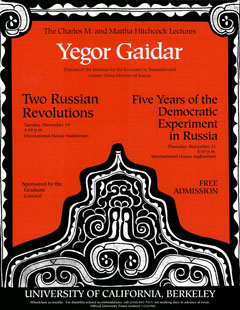
Good afternoon. On behalf of the Graduate Council of the Academic Senate, it is my very great pleasure to welcome you today to the first of two Hitchcock Lectures to be given by Professor Yegor Gaidar. The Hitchcock Professorship is one of the earliest endowments of the University of California at Berkeley.
It was developed from a bequest of property made in 1885 by Dr. Charles M. Hitchcock, a San Francisco physician with a long interest in education. As stated in his will, the purpose of the bequest was to establish a professorship at the University of California for the purpose of giving free lectures on scientific and practical subjects. The fund was allowed to accumulate until nineteen oh nine when Hitchcock Lectures were instituted with the inaugural lecture by the distinguished chemist from the University of Chicago, Julius Stieglitz.
The university received an additional gift in nineteen thirty from Dr. Hitchcock’s daughter, Mrs. Lillie Hitchcock Coit, best known as the donator of funds to build Coit Tower in San Francisco. Mrs. Coit directed that the professorship made possible by this enlarged endowment be designated the Charles M. and Martha Hitchcock Professorship in honor of her parents. The great extent to which this endowment has enabled the faculty, staff, and students of the university, and the general public as well, to become closely acquainted with distinguished scholars from throughout the academic world is evident by the list in your programs of those who have been– who have served as Hitchcock Lecturers and Hitchcock Professors.
We are proud to see the long tradition of the Hitchcock professorship so eminently upheld by a scholar of the stature of Professor Gaidar. Russia has rolled back more than seventy years of the command economy to introduce a market economy under democratic principles. Professor Gaidar has been at the forefront of this radical transformation.
He is considered to be the most accomplished and respected among the group of young Russian economists trained in Western economic practices. Before his resignation in nineteen ninety-four, Professor Gaidar served in several positions under President Yeltsin, including Prime Minister, Minister of the Economy, and Minister of Finance. Born in nineteen fifty-six, Professor Gaidar received his PhD in economics from Moscow State University.
He is a member of the Russian Academy of Sciences and conducted research at the Institute of Economic Forecasting in the mid-nineteen eighties. In nineteen ninety-two, he founded the Institute for the Economy in Transition and currently is its director. Without further delay, I’m pleased to present to you Professor Gaidar, whose lecture topic today is Two Russian Revolutions.
(applause)
[00:02:57] PROFESSOR GAIDAR:
Dear friends, dear ladies and gentlemen, to the, to the true, the idea to name this lecture, uh, Two Russian Revolutions, was not mine. It was the idea of the or-organizers. And I even thought about changing the subject because the subject is so broad and complicated.
It’s fit for not for one lecture, but for a spectrum of lectures. But then I thought against it Really during last years, I spent a lot of time thinking about the comparison between, uh, these two Russian revolutions. And, uh, from my point of view, a lot of mistakes, uh, in the discussions about developments in, in Russia in the late few years are connected with the fact that a lot of people do think that we were dealing with the Russian reforms.
So with some process, uh, which, uh, is based on the well-established state, which is able to promote consistent program of reforms, et cetera, which was absolutely contrary to my understanding what, of what really happened in Russia during these years. We really had to deal with the revolution, and the revolution is a word which is very romantic, especially for the young. For those who had to live through the revolution, the The revolution always is a tragedy.
It is, uh, a terrible pain for everybody who have to go through it. It is also the accusation to the elites of the previous regime, which were unable to implement the systematic reforms which would allow us to avoid the revolution. Of course, uh, the, uh, general historical causes, the general historical preconditions for the revolution, Russian Revolution of the nineteen seventeen and the Russian Revolution of the nineteen ninety-one, nineteen ninety-third were absolutely different.
In the 1917, we had to deal with the revolution of the early industrial society. Uh, first of all, connected with the pains of the first decades of industrialization, m– dangerous conflict about the land property between peasants and the landowners, war. Now we have to deal with the revolution connected with the crisis of the late socialist economy, uh, absence of the ability to promote further the development of the economy in the framework of the existing socialist institutions.
Level of development which is usually connected with the increase of the level of education, communication, uh, establishment of the standards of the, uh, middle class, which are hardly compatible with the totalitarian regime. So, I would not really like to discuss all of these broad historical issues. I would first of all concentrate on a few similarities which really do exist in the different revolutions, however different they are from the point of view of historical development.
And, uh, first of all, I would like to address, as the problems connected with the financial crisis and revolution, procurement crisis and the food supply crisis and revolution, and generally the crisis of the power and the crisis of the state and the revolution. Which, uh, we could see very well in the history of the Great French Revolution of the 18th century, which we could see very clearly in the history of the first Russian Revolution of the 1917, and which we could see, and with which we had to deal, uh, in the Russian Revolution of 1991, 1993. I do remember very well the nice sunny, uh, day of twenty-second of August ’91.
Coup failed. Leaders of the attempted coup were in jail. Hundreds of thousands, uh, of Moscovites were in the streets of Moscow.
Russian flags. My friends from democratical Russia protecting KGB building against the demonstrators. Occu- occupation of the central committee of the CPSU office on the Staraya Ploshchad.
General feeling of joy, of happiness that the things about which manybody dreamed for a long time happened at last. Just a few years, few days ago, nobody was sure and nobody really believed that all of this will end this way. Only two years ago, so, uh, all the world was able to follow the bloody events in, in Tiananmen Square, and, uh, nobody could tell you in August ’91 that nobody in Russian history, uh, created the basis for hope that it will not be fi- finished exactly the same way in ’91 in Moscow as it finished in ’89 in Beijing.
But with all of this, uh, feeling of joy and happiness, also my s- I myself was confronted with an increasing worry. As I think many of those present here, I had a chance to read a lot about the February Revolution of 1917, and it terribly resembled February 1917.
The general feeling, the general situation in the streets, et cetera. But also those, uh, who knows something about Russian history knows how the February ni- 1970 finished, how rapidly it evolved in a bloody civil war and in a cruel dictatorship. So if you try to forget for a minute about the joy and confront the hard social and economical facts with which now the new young Russian democratical government was confronted, it was evident that the situation is very, very dangerous and very unpredictable.
Well, I will remind you a little bit about the economic situation, uh, in Russia just before the first Russian Revolution, nineteen seventy. Uh, First World War, together with the, uh, anti-alcohol campaign started in nineteen fourteen, resulted in a severe fini- financial crisis already in 1915 and 1916. The result of this financial crisis was, uh, more or less the usual reaction of the peasants.
If they do not believe in money, if they do not believe that, uh, uh, money is sound, the usual reaction on this is the, the limitation of the supply of the food to the big cities. Why sell the grain to the big cities if the money could rapidly lose it val- value? So better to keep it to itself and to wait until the situation clarifies.
So in, uh, 1915 and 1916, uh, the country was confronted with the downfall of the production of grain because of the mobilization, et cetera. But first of all, the problems were connected with the radical downfall of the supply of grain on the market. There was a lot of grain in Siberia, there was a lot of grain in the southern Russia, in, across, in Kuban, on Stavropol, et cetera.
But, uh, it was very difficult to get this grain to the northwest, to St. Petersburg, to Moscow, to Ural, et cetera. Uh, the reaction even of the tsar government, uh, was more or less, uh, inevitable. The attempt to introduce the, uh, administrative redistribution of grain, so-called, uh, Rittich.
Re- grain redistribution, named by the last Tsar’s minister of agriculture. Uh, but the government at the last days of the Tsar regime was weak and unable to implement this administrative redistribution with the necessary vigor. Because if you do try to apply the instruments of the regulation of the repressed inflation, and that’s exactly what is the system of administrative regulation of the redistribution of grain was, you– the worst thing to do is to be weak in trying to implement this system.
Because the introduction of this system inevitably further undermines the willingness of the peasants to sell the grain for money. Of course, the food shortages in St. Petersburg in February was not the cause for the revolution, but they were one of the factors that influenced the developments in St. Petersburg then. Uh, uh, provisionally, government inherited this problem from the Tsar government.
And, uh, it was evident that there are only two ways of addressing the problem seriously. One is to try to reestablish finan- financial control, to try to reestablish the belief of the peasants in m- national money, and on this basis to overcame the problem of the food supply to the big cities. Another was to implement the administrative system of the, uh, food redistribution with all of the necessary vigor, cruelly if it’s necessary.
The Provisional Government was unprepared to follow any of these paths consistently. It could not stop the rapid money creation. It could not impose the financial control because it was a weak government.
And also, it could not impose the serious system of the food redistribution because it was weak government. So that means that during all of the period between February and, uh, uh, late 1970, we had the deterioration of the situation with the food supply of the big cities. Bolsheviks, after the October Revolution, confronted with a similar dilemma, were prepared to choose the bloodiest path of prodrazverstka, of food redistribution, to extract grain from the peasants using force and killing as many people as it’s necessary, which of course was one of the major reasons for the Civil War.
Well, I mentioned all of this fact more or less evident to everybody who knows the Russian economic history, because the situation in, uh, September, October ’91 closely resembled what, uh, we have seen in Russia at the beginning of the century. Uh, all of the communist command economy was based on the efficient system of the distribution of the material flows. So, uh, the presence of the bread in the, uh, shops or the meat in the shops or the milk in the shops, had not dependent on the interest of the private owners.
It dependent on the ability of the state to impose its will, to order the parts of the distribution of the resources, to make all of the e- economic agents obey these orders, and, uh, by these, uh, instruments to substitute the markets and the market economy. But to work, this system should be connected with the efficient political power. It works only until the factory chief in Krasnodar, uh, collective farm chairman in Stavropol, uh, concerned director in Tula, etc., knows that if they disobey these orders, they will be severely punished.
So it is a system in which the power and the state are incorporated to the microeconomic transactions. Without the efficient power, without the fear that the power could be executed, you would not find the bread in the shops, you would not find the milk in the shops, you would not find electricity, uh, electricity supply, you wouldn’t find railways running, et cetera. Years of ’89, ’19, ’91 were the years of the crisis of the socialist regime, crisis of the efficient power, which were, were going hand by hand with an increasing economic crisis, crisis of the supply of the big cities.
Already in summer ’91, shelves in Moscow were absolutely free. Nobody was there. Nobody was prepared to sell some- anything for money because money was worthless, and nobody was anymore afraid of the state, so anyway, nobody was prepared to supply it free, to supply it because of the fear.
But after, uh, the events of August, uh, ’91, the crisis of sufficient power reached next level. The first result of the August events was the radical cuts in the amount of the grain which state was able to procure from countryside next week after the events. Next week after the August events, the state grain procurement were four times down.
Practically, collective farms, state enterprises stopped to sell grain to the state because, as I mentioned, nobody wanted money, money was worthless, and nobody was afraid anymore that they could be punished. There was no KGB, no Communist Party, uh, regional organizations, nothing of which they could, should be in fear or could be in fear. So well, we are having, uh, grain reserves which could last us approximately until the beginning of February, with the radical cuts in the amount of the consumptions.
Money is worthless, so it’s impossible to buy anything for money. Hard currency reserves are exhausted by the previous communist government. We do have zero hard currency reserves.
After the communist government during the previous three years exported approximately thousand tons of golds, Russian gold reserves are close to zero. So we do not have grain to feed the people until the next harvest. We do not have the gold or hard currency to buy this grain.
We do not have efficient money for which, national, national money for which we could buy this grain, and we do not have a power to extract this grain from the countryside. So that means that we are in a situation which in many aspects resembles a situation with which the provisional government was confronted. That’s why probably you would understand why in the autumn of the year ’91, there was no long line of those wanting to work in the Russian government.
Uh, everything that I am mentioning was evident for a ruling elite, it was evident for the decision-makers, and to tell you the truth, nobody could find more or less simple or working answer on the simple question, what to do? Well, uh, from the beginning, we had the discussions in the Russian executive power, in the Russian government, or what general dire-direction to follow in this situation. There was, uh, um, ideas that we should follow, try to follow the Bolshevik example with the prodrazvyortka, with the assistance of the food redistribution.
So try to impose emergency rule, try to use military forces, uh, Ministry of Interior, try to extract the grain from the countryside, try to redistribute the grain through through the, through the country, et cetera. Uh, vice-presiden– then Vice President Mr. Rutskoy was a strong advocate for this type of dissolutions. Uh, I was absolutely sure that it is nonsense, that irregardless of, uh, what we think is, uh, compatible or incompatible with the longer-term strategy, this strategy just would not work.
After the previous three years, after the August ’91, after the Chechenian events of October and November ’91, it was evident that military forces, military Ministry of Interior would do nothing to implement this type of the policy. Just do nothing. States do not have necessary authority, will to try this type of the strategy.
Attempt to do it would probably result to the very, very serious problems and maybe to the open conflicts, but it would be absolutely fruitless. So if it is the truth, and I think that the vast majority of those who participated in this discussion accepted early the fact that it is the truth. So, what should we do to, uh, prevent humanitarian catastrophe?
Situation in which we would be confronted with, uh, hunger comparable to which, uh, we have seen in nineteen twenty-one, in nineteen thirty-two, in nineteen forty-seven, et cetera. Uh, it was evident that if you cannot implement the efficient system of the food redistribution, then the only way you have to make markets work at any cost. It was not the time when you could consider, “well, let us celebrate a strategy which in a five-year period of time will create preconditions for the efficient market economy,” et cetera.
All of this was absolutely out of the question. At any cost, at February ’92, we had to get working markets. Other way around, we would, uh, leave the country without food at all.
Well, that’s easy to say, much more difficult to do. Uh, I would mention just a few problems with which we were confronted. First of all, a huge accumulated monetary overhang.
During the last few years, the communist regime practically lost the control over the financial flows, so the budget deficit, uh, was running around thirty percent to– of the GDP in the year ’91. Uh, it was evident that the money supply which and the share of money in the GDP was ar-approximately, uh, around a hundred percent of the GDP, it is absolutely excessive, and with any step to the price liberalization, it inevitably result in a drastic jump in the prices. And as those who are economists know, uh, usually the monetary overhang with the price liberalization after the war, uh, was the major cause for the hyperinflation.
And if you do have a hyperinflation in the economy, which during the 70 years had no efficient money, that just means that you then do not have money. So that means that you are exactly in the same situation. Uh, you do not have a working market, and you have the crisis of the food procurement and the food supply to the big cities.
So first of all, monetary overhang. The second, enormous problems with the monetary flows. Budget deficit, as I have mentioned, 30% of the GDP, and the, the task is to cut it drastically and very rapidly.
As you do understand, you cannot invent the popular policies by which you could cut 30% budget deficit, uh, as a share of the GDP to something very close to zero, because with this monetary overhang, you could not allow budget deficit, at least at the beginning, much higher than zero. But all of this would be nice if you would not be confronted with a third problem, and the third problem being the fact that we do not have a control over money creation in all of the ruble zone. Remember that, uh, in ’91, we were one single country, Soviet Union.
Now, after the August, at least if not in the paper, then practically, we are 15 independent countries with 16 banks, including the Soviet Union Bank. All of them with all of the ability to create non-cash monetary balance. Uh, the situation comparable to this imaginary scenario, for instance, uh, United States of America disappears.
State of California is now independent state. All of the money outside the California, of the California is not the sound money anymore. All of the banks outside of California are foreign banks.
How? Change of all of this so that you could regain the control over the money supply? How to change the structure of the interconnection between the different previously interconnected by the single monetary union community, et cetera, et cetera, et cetera.
In the his- in economic history, uh, we know one, uh, evident example of the similar problems to the lesser extent, of course, uh, the problems connected with the dissolution of the Austro-Eu- uh, Hungarian Empire, uh, in, uh, year 19, uh, 90. And the result, as you know, was the hyperinflations in both Austria and Hungary. Only Czech Rep- Czechoslovakia able to rather rapidly implement its own national currency was able to avoid hyperinflation.
So, uh, we do not control money supply, and, uh, you do not have any simple, uh, set of the measures which could allow you to control the money supply at least earlier than in a few months. Practically, by our calculation, earlier than to the in the s- six to eight months. You have to rearrange your banking structures, you have to rearrange the system with the connections between the bankings in Russia and the bankings in other republics.
You have to deal with the problems that your cash money is, uh, the joint cash money asset. So that means that, first of all, we do not have six to eight months before the humanitarian catastrophe. Second, we c-
We do not have, we do not have an ability to implement the efficient system of the control over the money supply in the ruble zone before six to eight months. That is the real situation, very evident in the September, October nine- eighty- uh, 1991. The situation from which, from my point of view, and I discuss it with many of my colleagues, There is no evident and foolproof solution.
There is no strategy, strategy which will grant you not only, not even the efficient reforms or painless reforms, but just a resolution of this simple problem of how to resolve the problems of, of the food supply to the big cities in a situation of revolution when you can, you don’t have the control over your own monetary system. Well, uh, uh. uh…
There was a lot of discussions about how to deal with this problem, and then, uh, we were at the agreement that in this situation, we just have no other strategy, but first of all, to try to implement as rapidly as we can, uh, monetary control over the money supply in Russia. So as rapidly as you can, divide the ruble zone. Second, we cannot wait until we will do it until the price liberalization.
So to liberalize the prices as rapidly as you can. Third, because, uh, the danger of the hyperinflation in the context of the huge monetary overhang and the emissions from another republics is very serious, try to be as restrictive as you can in the budgetary policy, at least next few months after the price liberalization, so to, uh, create the preconditions for the remonetization of the economy and, uh, to stop hyperinflation. I don’t know, even now I thought a lot about it, and I discussed the matter.
I don’t see any other possible or reasonable strategy in this situation. But also you have to understand that it was the strategy which were not granting us the success at all. All the time when we were, for instance, cutting five times the military expenditure, and that was exactly what we were doing, increasing, uh, the value-added tax from zero to twenty-eight, et cetera.
So making a lot of the decisions which, uh, usually would bring any democratic government down in any stable democracy. All the time, we were not sure that these measures would be enough because, uh, they could be confronted and were confronted with the, uh, uncontrollable, uh, emission in other, uh, republics, members of the ruble zone. Um, our belief was in effect that the Russian economy is so big a share in the Soviet economy, in the ruble zone, that somehow, at least for a short period of time, we will be able to adjust to this, uh, money creation in other republics.
And really, that proved to be right. Uh, from February, we started to get at least, uh, with some delay, with two or three-week delay, information about, uh, how big the emission, uh, was from another republic to Russia. And we are trying to prepare as rapidly as we can for the dissolution of the ruble zone.
It was a very, very interesting time. For instance, the time when the, uh, professor in Moscow was getting eight times less in the same rubles than professor in Kyiv Because Russia were trying to be very restrictive in monetary policy, and the Ukraine was very easy. Very easy.
Uh, the then Ukrainian Prime Minister, Mr. Fokin, uh, mm, had a very nice im- im- uh, expression. It was, “Why to control budget deficit if you have the printing press in your hands?” Uh, And he was using this printing press as, as radically as he could.
Uh, it also had political implications. For instance, I do remember very well discussions about the, uh, Chernomorsky flot, uh, Black Sea Fleet. Um, and, uh, the essence was that we were unable to provide financing to them, and Ukraine easily printing money was providing all of the money necessary for the Black Fleet, Black Sea Fleet.
Well, uh, but generally, with all of these problems, uh, the result was, uh, achieved. At the first of July, uh, ’92, we were able to implement, uh, ru-ruble as a national currency. We were able to start controlling the inflow of money to Russia.
At the moment, we had the working markets. We were able, with the very high inflation of the beginning of the year ’92, to avoid the hyperinflation. And in summer ’92, it was evident that the food crisis is behind us, that if you do have a money, you will have a grain or any other foodstuffs.
That the willingness of the, uh, agriculture to sell the food for now convertible currency is high. So all of these problems are behind us. But, but of course, we had to pay a lot for it, pay a lot for it politically.
Uh, many times I was criticized for the fact, in- including in Russia, for the fact that we were not explaining at the time what we are doing, what happens in the economy, et cetera. Well, uh, for instance, now I try to explain to you what happened. Probably you would agree with me that if you tried to explain it in December ’91, January ’92, nobody would prevent catastrophe.
If you would try to explain that we are practically flying on the jet, uh, without, uh, gasoline, that nobody is granting us that we could land, uh, the panic would be unavoid- unavoidable, and I think the results would be disastrous. But then, of course, uh, as a result of this very, very difficult adjustment, we practically exhausted all of the possibilities for political maneuver. As you know, it is your possibi-
You are dealing with, uh, radical changes. Uh, your possibility for political support and the money were, are very high at the beginnings. And then they start to be limited, limited, limited, limited, more and more limited, and then they became close to zero.
That’s exactly what happened with us, uh, at the end of the spring, beginning of summer of the year ’92. It was evident that it is impossible to proceed further with the financial stabilization, to cut radically down the inflation rate, to create the preconditions for, uh, the economic growth on the market basis, if we will not resolve another crucial problem also having a lot in common with the problems, uh, of the first Russian Revolution, the problem of the divisions of power or dual power. What also was not very easy to understand to those who had no chance to work, uh, at, uh, Russian, uh, institutions at the moment, was that, uh, we had not one single government at the moment.
We had a few governments. Like for instance, in 1917, it was a few governments practically. The government, provisional government, government of the, uh, Soviet of the, uh, workers’ deputies, et cetera.
So we had a government. We had a majority of the Supreme Soviet, which, uh, were constitutionally unrestricted to interfere in any measures. We had a central bank which was subordinated to the Supreme Soviet and absolutely responsible.
We had the presidential administrations, which, uh, was not exactly the government. And in this situation, it was terribly difficult to implement anything like a consistent economic policy. Of course, we tried to implement reforms including, uh, privatization, especially small-scale privatization to prepare ourselves for the large-scale privatization, to build up the social basis of the support for the market economy in Russia.
But all of this was, first of all, struggle. It was not as if government is elaborating the policy and th- making the decision and then implementing the policy. It was, uh, like we are elaborating the policy and then we are fighting for this policy, trying to block, uh, another political forces which are able to prevent any progress.
So at the moment, we were living under the g- previous Soviet constitution, which made it absolutely unclear who can do what. And until this problem was resolved, any serious problems with the stability- any serious progress with the stabilization of the economy or politics in Russia was practically impossible. Uh, I know that, uh, a lot of the, uh, observers are blaming Yeltsin for the fact that after August event, he had not dissolved, uh, Supreme Soviet and had not uh called for the early elections.
When I’m reading all of this, I do understand how, uh, unjust are many, uh, objections, for instance, to Kerensky policy in the year 1917. For instance, that he had not dissolved the Soviet of, uh, Workers’ Deputies, uh, in, uh, July 1917, et cetera. Uh, from my point of view, the idea that Yeltsin could somewhere in August, September 1991 dissolve the Supreme Soviet was absolutely unrealistic.
The Supreme Soviet only one month ago supported him in, uh, August coup events. Uh, he had no constitutional powers to dissolve it. Soviet Union still existed.
Nobody would understand this move from the president. It would be the terrible political mistake and would not be understood by anybody at the moment. But, uh, in year ’92, it was evident that the growing dual power and, uh, the weakening of the state mechanism as the results of this dual power are undermining the Russian-
the possibility for the Russian state to anything like an organized reforms or progress to the, uh, stability. Well, just one story to show how practically it worked. Well, uh, spring ’93, uh, Chelyabinsk Regional Soviet decided that they would like to have the elections of the head of the regional administration.
Regional court, court, uh, rules that this solution is unlawful, that these elections will not, should not be enforced. Soviet proceeds with the elections. Administration ignores these elections.
Chairman of the Soviet wins the elections. Government and the court do not, uh, accept the results of these elections. Supreme Soviet accepts the results of these elections.
Head of the original militia, uh, betrays the present head of the administration and supports the new elected head of the administration. Head of the c- city police supports the previous head of the administration. Central bank supports the new elected, uh, uh, administration.
Ministry of Finance tells that only previously, uh, elected m- head of the administration is lawful and just. You do understand that a big nuclear state just could not live in these conditions. The result is the criminalization of the society.
It’s the beginning of all of the state structures, terrible, unresolvable economic problems, very difficult situation for the society. It is evident that somehow this situation of the dual power should be resolved. Other way around, the explosion is inevitable.
The situation would be uncontrollable. Well, during year ’92, uh, all the time I thought that- that it is possible to resolve this problem of dual power on the basis of the compromise. And, uh, when we discussed the issue, I tried to persuade Yeltsin that the possibilities of the compromise are not existent.
That somehow we, we have to, uh, agree with the Supreme Soviet, with the Supreme Soviet majority to the changes in the constitution, which will eliminate this mess in state machinery, which will make the division of the power evident, simple, and understandable. Uh, when, uh, the tensions between the president and, uh, the Supreme Soviet were especially intensive in December ’92, uh, I myself, uh, give him an advice that probably we have to try the compromise. My resignation as a prime minister for the agreement of the Supreme Soviet majority for the referendum on the new constitution.
This agreement was made on so-called constitutional negotiations in December ’92. It was voted by the Congress of the People’s Deputies. It was in front of all of the country.
Uh, the majority of the Supreme Soviets, uh, get what they wanted. They wanted the resignation of our government, they got it. And in a two-week period of time, of course, as you would expect, they refused to honor their own part of the deal, telling, “Well, what referendum?”
We do not know any referendum. “Referendum will be harmful,” said. Really, that was the moment when it was clear for me that probably it is impossible to make any kind of the compromise with these people.
Yeltsin still tried, if you would remember history of the year ’93, he tried a few times to make the compromise. On the eighth Congress of the People’s Deputies, said farther and farther and farther. They tried to impeach him, they were unsuccessful.
Uh, he won the referendum. People once again expressed his support– their support for for his policies, et cetera. And the summer ’93, it was evident that all of the resources at the hands, uh, in framework of the constitution, in the hands of the Yeltsin are practically exhausted.
Well, uh, the mess I mentioned was in- Rapidly increasing, Economy was in a situation of the rapid decline with the inflation running around 20% and government, of course, In this situation, unable to do anything to cut the inflation. Poverty rapidly increasing because in our case, and that statistics is showing very well, uh, poverty is closely connected with the inflation.
The higher is the inflation, the higher is the poverty rate. Uh, all of the financial services were concentrated in the financial speculation. Nobody would invest in the real sector with these rates of inflation, et cetera.
Uh, it was evident that nothing could be done without the clarification of the institutional solution and without the new constitution. It also was evident, first of all, that the, uh, Su-Supreme Soviet majority will never accept any compromise. So in this situation, what to do this time for Yeltsin?
Practically, he was confronted with only three possible solutions. First, to resign, giving all of the power to the communists and the radical nations majority on the Supreme Soviet, showing that we had one more Kerensky in our Russian history, betraying the millions of people who supported him two times in ’91 and ’93. Second, to do nothing and to see how the economy is deteriorating, social structures are falling apart, uh, crime increasing, anarchy, uh, prevailing in the major part of Russia.
Or third, to go away from the constitutional field and, uh, to proclaim, to dissolve the Supreme Soviet and to proclaim the early elections. For me, it was evident that he cannot follow both. Either the, the first and the second solutions would be absolutely irresponsible.
So that means that he had only one solution, and that was to dissolve the Supreme Soviet, to, uh, call for the early elections and to put the constitutions to the popular vote. But also it was evident that when you are trying to go in this way, nothing can be granted to you. Nobody can tell you how the military forces would react, how the Ministry of Interior would react, how the previous KGB, which doesn’t like at all, uh, new democratic government would react.
So you’re entering the field, you have to enter the field, which is terribly unpredictable. That was, of course, what Yeltsin thought during the summer of ’93. Also, it was evident that the economic situation rapidly deteriorated.
In August already, inflation was twenty-nine percent per month. Uh, Supreme Soviet was preparing to adopt the law, which will make all of their irresponsible decisions made previously obligatory for the financing by the central bank and the government, which will inevitably lead to the hyperinflation and the destruction of the market mechanisms. It was evident that the Supreme Soviet is very well prepared for confrontation, so they are prepared for the actions and they practically are provoking Yeltsin.
Uh, and then the solution was for him to do. To tell you the truth, I would not like to be on his place in these days. Uh, he asked me then once again to join his government.
I had a quite clear, as a senior deputy prime minister, I had a quite clear understanding of what we are being confronted with during the next few days. Could not, of course, uh, not accept this invitation. Uh, tried to call him and to tell him that, from my point of view, the timing for his solution is terribly, badly selected.
That, uh, it is very inefficient to do exactly the thing your opponents are expecting you to do exactly in the moment when they are expecting you to do it. Well, he hesitated for a while, and they all told me that the solution is made, and then as it will be. Well, I would not really like to tell you in the details, uh, the events of these, uh, September, October ninety-third days.
They are more or less well-known. Uh, what strikes me and what is, uh, connected with the f- this, uh, uh, the, the topic of this lecture was how all of this resembled terribly to what I myself had a chance to read about the 1997, 1917, but this time not about February, but about October. Uh, dual power.
Nobody can understand who will do what. Uh, Yeltsin is trying to involve the opposition in the process of the new elections. The opposition is more than all interested in the destabilization of the situation, in some kind of an open conflict, blood, et cetera.
On the 3rd of October, opposition succeed. Approximately 10,000 of the well-organized, uh, voice of the communist and the radical nationalist organizations were able to, uh, demobili– uh, to go through militia cordons to reach the White House, and then to occupy, uh, mayor office of Moscow, and then to start for Ostankino. Uh, when,
(coughs)
uh, I entered the meeting of the Russian government on the seventh post meridiem of the 3rd of, oh, October 1993, I thought how- close it is to the pictures I had chance to read about the last meeting of the provisional government. For instance, in the book of papers, et cetera.
Uh, the feeling that the government is not controlling the situation anymore, the minister of electricity telling, “Well,” so-something in his system was taken by the opposition. Minister of Communication telling, well, something in his system was taken by the opposition. The information that they, uh, uh, reached the control over the Customs Office, I really would not understand why Customs Office from the beginning.
I thought that maybe they are so much in a hurry to, uh, issue licenses on the oil export for them. Uh, only later I understood, uh, that was, uh, published that they, uh, supposed to use the, uh, custom office to prevent the immigration of the leaders of the so-called, uh, bourgeois regime, uh, toward the West. Uh, well, it was evident that we are exactly in the situation in which if nothing happens, military forces, Ministry of Interior forces would do exactly nothing.
It is exactly the type of the situation in which you cannot reach the generals. You cannot… The generals could not reach the colonels, colonels could not reach the, the captains, et cetera.
When everybody becomes ill, nobody would like to be held responsible, nobody functions, noth- nothing works, et cetera. So you have a situation in which 10,000 of well-organized and armed men are absolutely capable of getting the control over Moscow, and that means over the country. Uh, all the time, uh, when I was trying to understand what happened in 1917, uh, I could not find an answer why there was as many officers in St. Petersburg, as many of the people who were not at all sympathetic to the communist ideas.
They wanted somehow to be organized, and you can also read it in the memoirs, et cetera, and they could not find anybody who take responsibility and organize them. So it was my perception at the time that it’s not exactly not the moment when you have to put your hopes that somebody will defend democracy for you. Some General Kornilov, General Krasnov, or somebody, somebody, somebody else.
That’s exactly the moment when you have to defend democracy yourself. That’s why I made the decision for which I was criticized for a very long, long period of time. First of all, to prepare to distribute the arms to the people if it’s necessary, and then to collect the the people who are supporting Yeltsin or around Mossovet.
Uh, it was a very difficult decision to tell you the truth. Very difficult because I was telling the people, ordinary people, uh, to the streets of Moscow when there was a battle, shooting. Uh, of course, it was the, the, the state could be blamed and the government could be blamed that it had to, uh, call for the people to fulfill its own duties.
but it was the mess, the point that could be discussed further, whom to blame. And now what was necessary is not to repeat the terrible mistake of provisional government, thinking that somebody will resolve this problem for them, that it is not, uh, for the people to defend itself against the well-organized adventurers. Uh, when, uh, around 9:30, 8:00, uh, 10 o’clock, I’ve seen the tens of thousands of the Moscovites around, uh, Mossovet.
For me, it was clear that they will never win. That if it will be necessary, of course, we will distribute the arms to the people and we will resolve the problem ourselves. But I was also sure that now, when it’s evident that we are not dealing with the popular rebellion against the, against the Yeltsin regime, but with the, uh, adventure that the people is on the side of Yeltsin and democracy, it was evident that the military force now will start doing things.
The picture of the tanks shooting on the White House, uh, were on the TV, I think, hundreds of times. And, uh, I think that a lot of people blamed Yeltsin for what he had done, for all of this picture. Everybody forget about the 3rd of, uh, October.
Everybody forget about the terrible feeling of fear which, uh, was true all over, not only Russia, but all the world. Everybody blamed Yeltsin for the tanks shooting by the, on the White House. I think that if, uh, uh, Kerensky was courageous enough to, uh, destroy the communist plot by efficient military action.
Also, a lot of people would blame him for using these measures. I know that a lot of people who at the evening of the 3rd of October ’93 were crying from the fear and asking where are the military and when Yeltsin will be able to, uh, implement them. And now exactly the same people are making Yeltsin the blame.
They are forget, forgot everything, and they are holding Yeltsin to blame for what he have done. To tell you the truth, I think that it was only a possible solution, and it was responsible solution. Any other solution would be terribly dangerous for Russia and irresponsible, with all of the consequences.
Practically, we on the 3rd and the 4th of October ’93, we had a small, short civil war in Moscow. And it’s very important that we were able to prevent this short and the small civil war becoming the huge, terrible, and the bloody civil war through all old Russia as a country full of the nuclear weapons. Nobody could take, took it for granted at the evening of the 3rd of October.
Well, uh, I think that, uh, the events, said events of the 3rd and the 4th of October, then elections, uh, in December ’93, adaptation of the new constitution in December ’93, practically they finished the page in the Russian history which could be called the Russian Revolution of the year 1991, 1993. Further, we had a lot of political problems, successes and the great unsuccesses in the policy of reforms. I will try to address these issues in the n- next lecture, but the history of this revolution was over.
Of course, when we are comparing what happened in 1917 and 1991, 1993, it’s evident that the major part in the different results of these events played the broad social and economical factors. Of course, the crucial point was that, uh, 80 years ago, we were dealing with a society which was illiterate by 80%, peasant by 80%, uh, the society in which the, uh, educated minority was a very small minority, et cetera, et cetera. Now we were the literate society, well-educated society, society which is much more difficult to manipulate, et cetera.
And, for instance, the division in which those who are usually highly educated, uh, were on the side of Democrats and those who were not as educated on the side of the communists was very evident in, during ’91, ’93. And of course, uh, the radical changes in this field strongly influenced the, uh, different outcome of the events. But, well, uh, I’m acade-academic myself.
I studied the revolution before I had to deal with them. Uh, and, uh, this personal experience just, uh, allow to understand some feeling, some things probably better than anything you can read from the books. Uh, in a revolution, you have to deal with a very strong, uh, social and economic developments.
It’s like a heavy train. When it goes in a high speed, it’s impossible to stop it, But you can change the ways a little bit, and this heavy train with a high speed will go in a quite another direction. And then all of the specialists will explain how inevitable it was, how it could not be another way, et cetera.
So I’m very happy that being the specialist, we do not now have to explain why democracy could not survive in Russia, why it was evident for everybody for, for the very beginning, wh- how it is connected with all of our history, et cetera. We still are confronted with a very, very serious problems.
We need a lot of time to create the working efficient market economy and the stable democracy in our country. But at least until now, we succeed in creation, at least the basis for the possibility of doing this. Thank you.
(crowd cheering and applauding)
(laughter)
(crowd cheering and applauding)
(laughter)
(crowd cheering and applauding)
(applause)
Yeah, we have time for a few questions. Yes.
[01:03:19] AUDIENCE MEMBER:
It seems that all the comparison and analysis between these two democratic periods, except for mention of the peasantry, there was no mention of what social classes were on which side in each of these struggles. And you talk about democracy, you don’t mention the fact that his, uh, support Yeltsin’s rise had something to do with the fact that Yeltsin controls the media, uh, uh, television,
(background chatter)
and which was one of the main press media, And so it was fighting against the ruling class and the, the oligarchic circles behind, and it marked the development of… Most parts of Latin America, we have democracies where you’ve got, like in Russia, the model in Russia, the democracies where a few people are very rich and a lot of people are extremely poor.
Touch on that.
[01:04:04] PROFESSOR GAIDAR:
Well, uh, it is a very, very broad question. revolution of 1917, of course, the, uh, communists were able to mobilize the support of the peasants first of all, because of the conflict around the land, and of the workers because of the promises of the paradise in the world. Uh, well, uh, we have a long history of the socialism behind us, which differs us with Latin America.
So we know, uh, as- that some solutions are not solutions. Uh, that’s why probably, uh, the distribution of the social forces in, uh, around the late post-socialist revolution, when we had to deal with the consequences of the socialist experiment, was a little bit another. Well, about the press, the communists had, uh, full control over the press before ’91, and somehow it had not helped them.
Uh, the communists still do have the biggest network of the regional newspapers and comparable to anything in the control of any democratical organization, absolutely incomparable. It had not helped them. So, uh, our experience shows, but I will tell about it, uh, in a bigger detail in next elections, that there are limits to the ability to manipulate people.
At least in Russia, the people now are much more rational than you would think. Well, uh, generally the division was, uh, uh, approximately on the, uh, uh, these lines, on those who supported Yeltsin and the Democrats and those who supported, uh, communists and the radical nationalists. Usually the, uh, majority of the educated was for Democrats.
Majority of the low-educated was for the communists. Majority of the young were for the Democrats. I’m sorry, but majority of the old was for the communists.
Majority of those living in the big cities were for the democrats. But majority of those living in, uh, r- rural areas were for the communists. So the usual type of the person who supported uh, democrats were young, educated, uh, person living in a big metropolitan city.
Usual, uh, per- usual, uh, type of those supporting the communists was old, low-educated person living in a small city or in countryside.
[01:06:38] AUDIENCE MEMBER:
Can you tell us where you were with Yeltsin on October 3rd before the White House was bombed?
[01:06:45] PROFESSOR GAIDAR:
Excuse me?
[01:06:46] AUDIENCE MEMBER:
Can you tell us where you were on October 3rd when the White House was bombed?
[01:06:51] PROFESSOR GAIDAR:
Uh, uh, on– White House was bombed not on the 3rd but on the 4th of October. Uh, on the 3rd of October, uh, first of all, I addressed the people on the Russian television through asking them to, uh, come to the support of democracy around Mossovet. Then I was addressing the people around Mossovet, then I was addressing the people around Kremlin, which were also were gathering to support Yeltsin and democracy from there.
Then I was in the governmental building, then once again, I was in the Mossovet.
(laughter)
(background chatter)
[01:07:29] AUDIENCE MEMBER:
Based on the, the, uh, recent health problems that President Yeltsin had, uh, first off, uh, What kind of power do you think, uh, the communists will try and assert in the Russian parliament again? Number two, Uh, who do you think, uh, is the possible successor, uh, in the Russian presidency?
[01:07:48] PROFESSOR GAIDAR:
Well, uh, I think that now everything is more or less okay with the health of the president. So at least in the Russian press, it is not, uh, anymore the news. Uh, the general reaction of the press to the attempts of the administration to, uh, discuss the problems of the presidential health is that, uh, who is interested in, uh, in it anymore?
Uh, so I would– I don’t think that it is uh, the topic to be discussed. Uh, as to the communists, to tell you the truth, uh, they will be influential in the parliament, of course, but I think that they do not have, uh, chances to win next presidential elections. They had all of the trump cards this year, absolutely all.
Well, if they lost this time, I think they would not win presidential ever.
[01:08:36] INTRODUCER:
One more?
[01:08:38] AUDIENCE MEMBER:
Could you compare the role of the military officers and, uh, uh, enlisted people, uh, in both of those revolutions.
[01:08:49] PROFESSOR GAIDAR:
Well, uh, uh, the di– uh, huge enormous difference between these two revolutions was that the first revolution was, in the time of the First World War. So of course, the role of the army was, uh, much, much higher than in the second Russian Revolution. The idea of peace, which appealed to the peasant majority with their, uh, weapons, of course, was one of the most, uh, uh, important vehicles which, uh, created for the Bolsheviks the possibility to, uh, have the power.
Of course, the officer– the division of the army on the officers which were connected with the highest strata of the population and the peasantry, uh, was much higher, much more serious than now in So- in, uh, Soviet and then Russian Army. Uh, and as you know, the officers were a quite important part of the White movement, et cetera. Well, uh, uh, in the second Russian revolution, uh, in the majority of the cases, the major role of the army was that it i- is trying to play no role.
It was so in August ’91, uh, when the major solution of the army was to do nothing. And that to some extent was in October ’93, when army also tried every– to do nothing if it is possible. And it was very difficult, uh, to, uh, make the army do something, and as I have mentioned, I was absolutely prepared to the case that we will have to resolve the problems ourselves if it will be impossible to make them.
Of course, of course, the casualties would be much higher.
[01:10:35] AUDIENCE MEMBER:
Could you please briefly explain, uh, two things that you brushed over? First, how did the, uh, communist redistribution system break down before, uh, August ’91? And second, how did you, uh, efficiently avoid the, the food crisis in February and early?
[01:10:56] PROFESSOR GAIDAR:
Mm-hmm. First, uh, how theee food, uh, system of food distribution break up- break out before, before the August. Well, uh, this system to work, you need a very efficient system of the control over the order fulfillments.
You have all of the country should be, uh, integrated by structures of the bureaucrats, which do obey the orders of the higher level bureaucrat. What happened with the late eighties, with the crisis of the communist power, was that this system started to disintegrate. For instance, the republican authorities started to declare that they are the supreme power.
So for instance, they started to give their own orders to the enterprises where to send the resources. Enterprises, the regional authorities under the republican authorities, confronted with the different orders from this Union and from the Republic, started to give their own orders. Enterprises’ director confronted with the orders from the Union, Republic, and the region decided that it, it could do as it wished, telling to each other that it, it has to obey the different the orders.
So that means that the system which allowed to manipulate the millions of tons of grain just stops to function. Um, on the second question, well, of course it was terribly tight because the grain reserves was practically nonexistent. But, uh, when we had the ability to have a ruble, national currency, as something in a short supply, something you wish to have, the collective farms started to sell grain for rubles.
That was really the turning point. When it was evident that we can buy grain for rubles, it was evident that we could avoid the humanitarian catastrophe.
[01:13:03] MODERATOR:
One last question.
[01:13:07] AUDIENCE MEMBER:
Despite the privatization in Russia, Russia has one of the lowest unemployment rates of all post-Soviet countries. Could you explain that phenomenon?
[01:13:14] PROFESSOR GAIDAR:
Well, yes. Uh, two points. First of all, uh, the wages were very flexible, practically, in the Russian economy.
And that was, of course, quite an important part of the explanation. And the second is that in Russia, still the enterprise is much more than just the enterprise. It is much more than just the employer.
It is the community. So for the enterprise, the open layoff is the measure Of absolutely last resort. Also for those working in the enterprise, even if the enterprise is in crisis, even if the wages are very low, the fact that maybe practically it works in second economies, needs in judging trade, et cetera, but the person prefers still to belong to the enterprise.
So this combination of these two factors, I think, played a major role here.
[01:14:08] HOST:
Let’s, uh, thank Professor Gaidar again. I hope to see you very soon.
[01:14:12] PROFESSOR GAIDAR:
Thank you.
(applause and cheering)